PART2:He Spent Years Chained in Filth Until His Teeth Wore Down—Then Doctors Found Four Tumors Inside His Chest
PART2
The smell inside the rescue van changed once the heater came on.
Wet fur.
Old urine.
Infected skin.
The heavy, sour smell of neglect.
Marin lay on two blankets in the back.
He did not look out the window.
Did not pace.
Did not cry.
He simply rested his head between his front paws.
Every few minutes, I turned around to make sure he was breathing.
He always was.
Shallowly.
Quietly.
But there.
We did not name him immediately.
At first, he was simply the chained dog.
That is how emergency cases often begin.
Not because rescuers do not care.
Because there is too much to do.
Temperature.
Heart rate.
Hydration.
Pain.
Skin.
Bloodwork.
Nutrition.
You focus on what can kill the animal first.
Names come after.
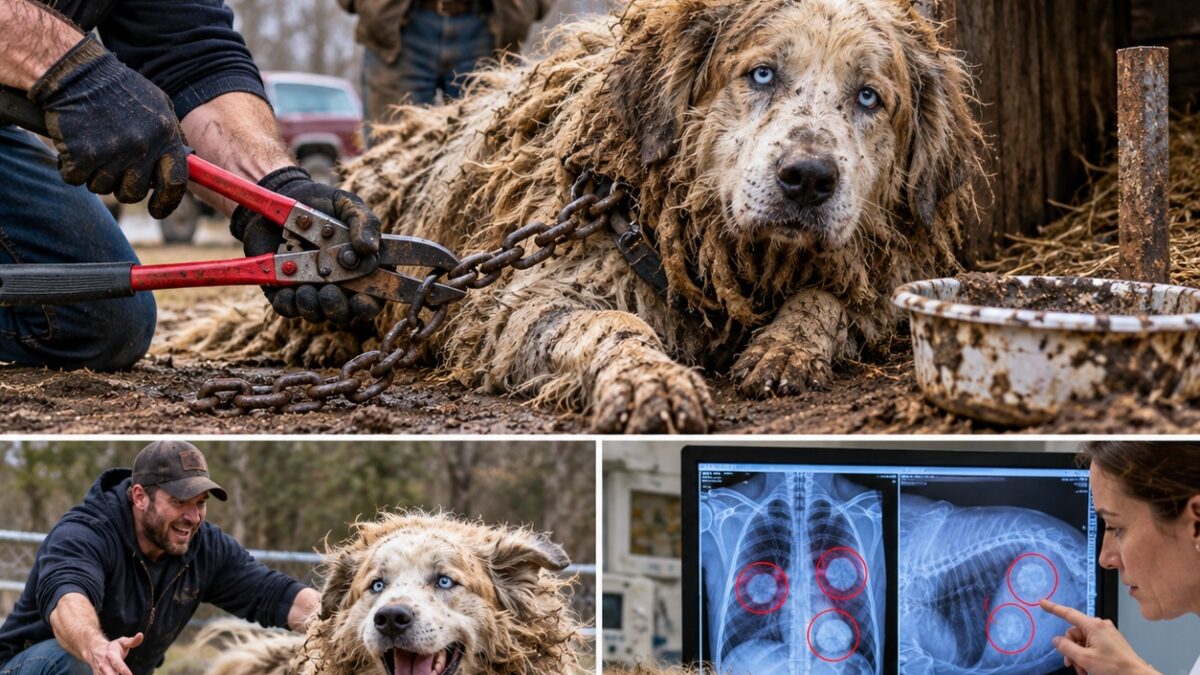
At the clinic, three people helped lift him from the van.
He could walk, but the mats restricted the movement of his back legs.
Some were so tight around his joints that every step pulled at the skin.
The veterinarian, Dr. Lena Morris, took one look at him and said:
“Do not shave him all at once.”
I understood why.
The coat was not simply tangled.
It had become part of the medical problem.
Some sections were glued to the skin by dried waste.
Others covered open sores.
There were places where the hair had pulled so tightly for so long that the skin underneath had begun to break down.
Removing everything too quickly could tear tissue.
So they started slowly.
Scissors first.
Electric clippers where they could.
Warm saline.
Disinfectant.
Pain medication.
Marin stood for the first few minutes.
Then his legs trembled.
We let him lie down.
He did not protest.
That bothered me.
A healthy dog usually dislikes having strangers manipulate his body.
Marin seemed to believe resistance was pointless.
That may be one of the cruelest things neglect teaches an animal.
Do not bother asking for anything.
Nothing changes.
For three hours, fur came away in slabs.
Not handfuls.
Slabs.
Some pieces held the shape of his body after they were removed.
Underneath, Marin looked impossibly small.
The giant dog hidden under that coat was not giant at all.
He was thin.
His ribs stood out.
His hips were sharp.
The skin along his chest was red and inflamed.
His inner thighs were raw.
There were ulcers where dirty hair had held moisture against his body.
One wound near his neck had been hidden beneath the collar.
The chain had rubbed there for so long that the skin had thickened and scarred.
Dr. Morris cleaned it gently.
Marin flinched.
Just once.
Then looked at her.
“I know,” she whispered.
“I know, sweetheart.”
His ears moved slightly.
That was the first time I saw him respond to a soft voice.
When most of the mats were gone, we finally saw his face.
Really saw it.
Long muzzle.
Graying around the mouth.
Blue eyes brighter than they had looked outside.
“Like the sea,” one of the technicians said.
Another answered:
“Marin.”
The name stayed.
Marin.
It fit him.
The first night, he slept almost seventeen hours.
Not continuously.
He woke when people entered.
Lifted his head.
Watched.
Then slowly lowered it again.
We kept him in a quiet room.
Thick bedding.
Water near his nose.
Small portions of food.
His stomach had been empty too often for us to simply give him a huge meal.
He wanted more.
That was encouraging.
When the bowl was empty, he put one paw beside it.
Then pulled it closer.
The next time a technician tried to remove the bowl to wash it, Marin stiffened.
Not aggressive.
Just afraid.
I understood immediately.
“Give it back.”
She did.
We washed another bowl and placed his old one beside the bed.
Dirty as it was, we could clean it gradually.
But Marin needed to know nobody was taking everything.
He rested his chin beside it.
That night, I went home and cried in my shower.
I had been around neglected animals before.
Dogs with scars.
Dogs with untreated infections.
Dogs left in abandoned houses.
But something about Marin’s bowl stayed with me.
How small his life had become.
A shelter.
A chain.
A bowl.
That was his inventory.
The second day, we took radiographs.
Routine at first.
His breathing had sounded slightly abnormal.
Not dramatic.
Just not right.
Dr. Morris listened to his chest longer than she listened to most dogs.
Then ordered additional imaging.
I was standing beside the exam table when the first images came up.
She stopped talking.
That silence changed the room.
“What?”
She leaned toward the screen.
Adjusted brightness.
Moved to another image.
Then another.
“What do you see?”
“I want ultrasound.”
That was not an answer.
“Lena.”
She looked at me.
“There are masses.”
My stomach dropped.
“How many?”
“I can see at least three.”
The ultrasound found four.
Four distinct tumors inside Marin’s chest.
I remember the number because the rest of that conversation blurred.
Four.
Not one suspicious spot.
Not something tiny we could watch.
Four masses.
One near the front of the chest.
Two deeper.
Another positioned close enough to important structures that nobody wanted to make promises.
Dr. Morris sat with us in the consultation room.
Marin lay on a blanket between our chairs.
He had eaten breakfast.
For the first time since rescue, he had wagged the tip of his tail when I entered.
Then we were discussing whether he might die.
“We need a surgical consult.”
“Can they remove them?”
“Maybe.”
“Are they cancer?”
“We won’t know until pathology.”
“Has it spread?”
“We need more imaging.”
“What are his chances?”
She hesitated.
That hesitation hurt more than an answer.
“He is underweight. His skin is infected. He has dental damage. His immune system has been under stress for years.”
I looked at Marin.
He had fallen asleep.
One front paw resting across the old bowl.
Dr. Morris continued.
“Surgery would be hard on a healthy dog.”
“And on him?”
“Harder.”
“What if we don’t operate?”
“If these continue growing, they could compromise his heart or lungs depending on exactly what they are and where they’re attached.”
“So we do surgery.”
“We stabilize him first.”
“How long?”
“As long as his body gives us.”
That became our next fight.
Not the tumors yet.
Strength.
Food.
Infection control.
Weight.
For twelve days, Marin stayed at the clinic.
The mats were completely removed.
His wounds were cleaned daily.
Antibiotics.
Pain medication.
Nutritional support.
Bloodwork.
More tests.
He began eating four small meals instead of two.
At first, he ate lying down.
Then one morning I arrived and found him standing.
He had pushed his bowl across the kennel floor and was licking around the edge.
“Hey.”
His head lifted.
The tail moved.
Once.
Twice.
I sat down.
He walked toward me.
Three steps.
Stopped.
Then came closer.
That was the first time he chose contact.
I held out my hand.
He smelled it.
Then pressed the side of his face against my palm.
I closed my eyes.
“Good boy.”
The words came out broken.
Marin leaned harder.
A technician passing the door saw us and quietly walked away.
We all knew what was happening.
He was beginning to trust.
Not dramatically.
No jumping into arms.
No miraculous transformation.
Just a dog discovering that a hand could mean comfort.
As his skin healed, the itching became intense.
The first time Marin scratched himself properly, he seemed almost surprised.
Then he scratched too hard and nearly fell over.
We laughed.
He looked offended.
That was good.
Offended was personality.
He began complaining when breakfast was late.
A low grumbling sound.
Not growling.
Talking.
The dog who had barely responded now had opinions.
The clinic staff loved him.
His blue eyes became brighter.
His weight rose.
Slowly.
Two pounds.
Then another.
His blood values improved.
The infection began retreating.
Every morning, Dr. Morris would say:
“One more day stronger.”
Then the CT scan came back.
All four tumors appeared technically operable.
But one sat close to a major blood vessel.
The surgeon, Dr. Elliot Crane, was honest.
“We may go in and discover removal is not safe.”
“What happens then?”
“We take samples, close, and discuss other options.”
“And if it is safe?”
“We remove what we can.”
“All four?”
“That’s the goal.”
I looked at Marin.
He was standing beside the consultation-room window.
Watching a tree branch move outside.
He had recently discovered windows.
He loved them.
Outside used to mean chain.
Now outside existed beyond glass.
Safe.
Interesting.
Something he could watch without enduring.
“When?”
“Friday.”
Three days.
That night, I took Marin to the rescue house for the first time.
He was stable enough to spend one evening outside the clinic before returning for surgery.
I wanted him to know something other than medical rooms.
The rescue house had a fenced yard.
Large.
Grass.
Trees.
No chains.
When Marin stepped out of the van, he froze.
The yard stretched in front of him.
I unclipped the leash inside the secure fence.
He looked down at the grass.
Then back at me.
“Go.”
He took a few steps.
Stopped.
Looked behind himself.
Nothing.
Another few.
Still nothing.
Then he ran.
That same circular run he had done the day we rescued him.
But this time the circles became wider.
Ten feet.
Twenty.
Thirty.
Then he broke the circle.
Straight line across the yard.
Turned.
Ran back.
His ears bounced.
His awkward shaved body looked ridiculous and beautiful.
He ran until he was tired.
Then came to me voluntarily.
Collapsed at my feet.
Rolled onto one side.
Panting.
I sat in the grass beside him.
He looked up.
I scratched his chest carefully between healing patches of skin.
“You know what freedom is now, don’t you?”
He closed his eyes.
I do not know whether he understood the word.
His body understood.
That night he slept inside.
First time we knew of.
He had a bed near the fireplace.
He ignored it.
Instead, he dragged the bed toward the wall.
Then carried his food bowl into it.
Old habit.
I did not stop him.
Around midnight, I heard movement.
Marin was standing in the doorway of the room where I slept.
He stared at me.
“What is it?”
He took two steps inside.
Stopped.
I patted the floor.
He came closer.
Lay beside the bed.
Not touching.
Just there.
That was how we slept.
Friday morning arrived too fast.
At the clinic, Marin was cheerful.
That felt cruel.
He ate half of the small meal he was allowed before the cutoff.
Walked around.
Nudged hands.
He had no idea everyone around him was afraid.
The surgical consent form was four pages.
Bleeding.
Anesthesia complications.
Respiratory arrest.
Cardiac injury.
Death.
I signed.
Then sat on the floor with Marin.
He rested his chin on my knee.
“You have to come back.”
I whispered it because I did not want the staff to hear my voice.
“You just got free.”
He blinked slowly.
“No disappearing now.”
When they came to take him, he followed the technician.
Then looked back.
Once.
That nearly destroyed me.
The surgery began at 9:07.
At 10:30, no update.
At 11:45, a nurse came out.
“They’re still operating.”
“Is that good?”
“It means they’re still working.”
Not helpful.
True.
At 1:10, Dr. Crane called from the operating room.
They had removed two tumors.
The third came away cleanly.
The fourth was attached near a major vessel.
They were dissecting slowly.
“He’s stable.”
That was the only sentence I heard clearly.
Stable.
At 2:22, the doors opened.
Dr. Crane walked out.
Cap still on.
Mask pulled down.
His eyes were tired.
I stood so quickly my chair fell backward.
“All four.”
I stared.
“All four?”
“We got them.”
“Completely?”
“Grossly complete excision. Pathology will tell us more.”
“Is he alive?”
“Yes.”
I started crying before he finished.
“He’s in recovery.”
I put both hands over my face.
After everything Marin had survived, those were the words I had needed.
Alive.
Recovery.
Not done.
But alive.
The first twelve hours after surgery were worse than the operation for me.
Marin struggled coming out of anesthesia.
His blood pressure dipped.
His breathing was shallow.
Chest surgery hurts even with excellent pain control.
Every breath requires movement.
He looked at us once through heavy eyes.
Then closed them.
A drainage tube ran from his chest.
Monitoring wires.
IV catheter.
Oxygen.
The free dog from the yard was gone again beneath medical equipment.
I sat outside ICU until midnight.
Dr. Morris finally made me leave.
“You need sleep.”
“What if something happens?”
“We call you.”
“I can stay.”
“You can.”
She folded her arms.
“But you’ll be useless tomorrow.”
I hated that she was right.
At 3:17 in the morning, my phone rang.
I answered before the first full ring.
“What?”
A nurse.
My heart stopped.
Then she laughed softly.
“Marin is awake.”
I gripped the phone.
“Okay.”
“And annoyed.”
“What?”
“He tried to remove the oxygen line.”
I started laughing.
Actual laughing.
Tears running down my face.
“He’s annoyed?”
“Very.”
“Good.”
“We thought you’d want to know.”
“I did.”
At seven, I was back.
Marin looked terrible.
But he was awake.
I crouched.
His tail moved once against the blanket.
“Hey, fighter.”
I immediately regretted the word.
Marin did not owe anybody a fight.
So I corrected myself.
“Hey, buddy.”
He pushed his nose into my hand.
That was enough.
Pathology took six days.
Six of the longest days of my life.
We knew there were four tumors.
We knew they had been removed.
We did not know what they meant.
Cancer can change the meaning of every future plan in one phone call.
On day six, Dr. Crane asked us to come in.
I hated that he did not tell me over the phone.
We sat in the same consultation room.
Marin was still hospitalized but stable enough to join us.
He walked in slowly.
Chest shaved.
Incision clean.
Blue eyes alert.
Dr. Crane placed the report down.
“The masses were not the aggressive metastatic cancer we feared.”
I stopped breathing.
“What does that mean?”
“It means pathology showed the tumors were localized and completely removed at the visible margins.”
“Cancer?”
“Two showed benign changes. The others had abnormal cells, but there is no evidence right now of aggressive spread.”
“Does he need chemo?”
“Not based on what we have.”
I stared at him.
“You’re telling me—”
“I’m telling you he has a very real chance at a normal life.”
Nobody spoke.
Marin looked between us.
Then sneezed.
The entire room started laughing.
Maybe that is what relief does when it becomes too large.
It looks for any exit.
Marin came back to the rescue house eleven days after surgery.
This time, he did not run.
He was under strict restriction.
No wild circles.
No sprinting.
No jumping.
He hated it.
That was another beautiful problem.
For years, nobody cared whether Marin moved because he could not go anywhere.
Now three adults followed him around telling him:
“Slow.”
“Easy.”
“No stairs.”
“Marin, stop.”
He would turn those blue eyes on us with absolute betrayal.
I loved it.
Recovery was not smooth.
Three weeks after surgery, one section of his incision became inflamed.
We panicked.
Back to clinic.
Not catastrophic.
Treatable.
Then he stopped eating for a day.
Another panic.
Medication adjustment.
Appetite returned.
Later, he developed a cough.
Imaging.
No recurrence.
Just irritation from healing tissue.
Every small problem felt enormous because we knew how close we had come to losing him.
Marin seemed less concerned.
He had discovered couches.
At first, he would not climb onto one.
He stood beside it.
Looked up.
Then at me.
I patted the cushion.
Nothing.
I lifted his front paws gently.
He pulled away.
So I stopped.
Two days later, I found him asleep on the couch.
No assistance.
He had figured it out.
His old food bowl sat beside it on the floor.
We had cleaned it carefully by then.
It was still scratched.
Still ugly.
I offered him a new stainless-steel bowl.
He used it for water.
But his food stayed in the old one.
Fine.
Some things do not need replacing simply because they are damaged.
His coat began growing back.
At first, soft gray fuzz.
Then longer.
Silkier.
The true colors underneath the neglect appeared.
People who saw him after several months did not recognize photographs from the day we found him.
That gave me mixed feelings.
I loved the transformation.
But I never wanted the healthy coat to make people forget what had been underneath.
Wounds.
Infection.
Years without grooming.
The coat had hidden everything.
Neglect often does.
From a distance, someone might have said:
He just needs a bath.
No.
He needed years returned to him.
We could not give him those.
So we gave him what came next.
Routine.
Breakfast at seven.
Short walk.
Rest.
Medication.
Gentle grooming.
Dinner.
Another walk.
Bed.
Predictable.
Marin loved predictability.
At 6:50 every morning, he appeared beside the kitchen.
At 6:55, one small whine.
At seven, if food had not arrived, he would pick up the old bowl and drop it.
Once.
Metallic plastic thud.
“Message received.”
His tail would move.
He learned toys slowly.
The first tennis ball confused him.
I rolled it.
He watched.
I rolled it again.
Nothing.
Another dog at the rescue house chased one.
Marin observed.
On the fourth day, I rolled the ball.
He took two steps.
Stopped it with his paw.
Looked at me.
I clapped.
Probably too enthusiastically.
He walked away as if embarrassed by me.
A week later, he chased it.
Not far.
But enough.
The biggest challenge was the leash.
Marin had spent years attached to something around his neck.
The first time we clipped on a normal leash, his entire body froze.
Tail down.
Eyes wide.
He would not move.
I immediately unclipped it.
That night, I searched for alternatives.
Harness.
Different attachment point.
No pressure on his neck.
For days, we simply left the harness near his bed.
Then gave treats beside it.
Touched it to his shoulder.
Treat.
Put it over his head.
Treat.
No leash.
Eventually he wore it.
Then a lightweight line.
The first outdoor walk lasted six minutes.
Marin stayed within three feet of me.
Every time the line became slightly taut, he stopped.
I would step back.
Release pressure.
Wait.
“No one’s pulling you.”
Another step.
Then another.
Weeks later, Marin finally understood that a leash could connect him to a person without imprisoning him.
He began walking ahead.
Not far.
Then looking back.
Making sure I followed.
The day he first pulled because he wanted to smell a tree, I nearly cried.
Again.
People around rescue dogs cry over strange things.
A dog pulling on leash can be annoying.
For Marin, it meant he had learned the difference between restraint and companionship.
Spring came.
Snow disappeared from the higher ground.
Grass softened.
Marin’s chest hair grew over the surgical scar.
His follow-up scans were clean.
One month.
Three months.
Six.
No new masses.
No evidence of recurrence.
Every clean scan changed the future slightly.
At first, we planned by weeks.
Then months.
Eventually Dr. Crane said:
“Stop treating him like he’s dying.”
I stared.
“He isn’t?”
“Nobody gets guarantees.”
“I know.”
“But Garrett—”
He caught himself.
Sorry, wrong story. Need narrator unnamed. Let’s continue carefully.
“But he is living.”
That sentence changed me.
We had built every decision around fear.
Do not get attached.
Do not plan too far.
Do not assume.
But Marin had already gotten attached.
To us.
To couches.
To his bowl.
To morning walks.
To the corner of the yard where the sun hit first.
He was planning without permission.
Maybe we should too.
That was when adoption became real.
The rescue posted Marin’s story.
Not the dramatic version.
The honest one.
Years chained outside.
Severe neglect.
Four chest tumors removed.
Ongoing monitoring needed.
Dental damage.
Some sensitivity around his neck.
Needs patient home.
No chaining.
Ever.
We received messages.
A lot.
Some from people who loved the photos.
Some from people who wanted “the blue-eyed dog.”
That made me nervous.
Marin did not need to become somebody’s trophy rescue.
He needed someone prepared for the dog behind the story.
Then an application came from a woman named Claire Bennett.
Forty-eight.
Widowed.
One adult son at college.
Worked from home as a medical translator.
Fenced yard.
No other dogs.
Had cared for a senior dog with chronic health problems for eight years.
In the section asking why she wanted Marin, she wrote:
I don’t need him to become anything different. I would like to give him somewhere he never has to wonder whether he belongs.
I read that sentence three times.
Claire visited Saturday.
No dramatic introduction.
She sat on the floor.
Did not reach for Marin.
That was the first thing I liked.
He stood near the doorway.
Watched her.
She talked to me.
Ignored him mostly.
After twelve minutes, Marin approached.
Smelled her sleeve.
Claire kept her hands still.
He smelled again.
Then walked away.
Twenty minutes later, he returned.
This time he pressed his nose against her palm.
Claire did not cry.
I did.
“Sorry.”
She smiled.
“I’ve been warned rescuers do that.”
“Constantly.”
Second visit, Marin sat beside her.
Third, he fell asleep against her leg.
We did a home visit.
Beautiful yard.
Not fancy.
Secure fence.
Warm kitchen.
Dog bed near a window.
I pointed to the bed.
“You already bought one?”
Claire shrugged.
“I hoped.”
Then I noticed something beside it.
A shallow wooden stand.
Exactly the size of Marin’s old food bowl.
“You measured it?”
She looked embarrassed.
“I asked one of your volunteers.”
That was when I knew.
Adoption day terrified me.
Not Marin.
Me.
I packed his medication.
Medical records.
Harness.
Favorite blanket.
Tennis ball he barely cared about.
Old bowl.
I held that bowl longer than I expected.
The same one he had carried into the shelter because it was the only thing he owned.
Now it was going to a house prepared specifically for him.
Claire opened the back door of her SUV.
A padded area waited.
Marin climbed in.
Then immediately climbed back out.
My heart broke.
“He doesn’t want to go.”
Claire looked at me.
“Or he doesn’t know yet.”
She was right.
We waited.
No forcing.
Marin walked around.
Smelled the tires.
Looked at me.
Then Claire.
After several minutes, he climbed in again.
This time he stayed.
I put his bowl beside the blanket.
He touched it with his nose.
Then looked at me.
I pressed my forehead against his.
“You don’t have to protect it anymore.”
His tail moved.
“Everything in that house is yours too.”
Claire drove away slowly.
I stood in the parking lot long after the car disappeared.
For years, Marin had gone back toward familiar people even when familiarity had hurt him.
Now he was driving toward someone new.
Someone safe.
That was growth.
The first night, Claire sent one photograph.
Marin asleep beside her couch.
Old bowl tucked near the bed.
Second day:
Marin in the yard.
Blue eyes open wide.
Third:
Marin on the couch.
Apparently he had remembered couches.
End of week:
Marin lying on his back with all four feet in the air.
The most vulnerable sleeping position a dog can choose.
I stared at that picture.
Then sent it to Dr. Morris.
Her reply:
That’s what safe looks like.
A month later, I visited.
I worried he might not remember me.
Then felt guilty for wanting him to.
Claire opened the door.
Marin came around the corner.
Stopped.
His ears lifted.
Then he ran.
Straight.
No circles.
Straight to me.
He hit my legs so hard I almost fell backward.
I dropped to my knees.
He pushed his head under my chin.
Made a strange whining sound.
I held him.
“Okay.”
His whole body wiggled.
“Okay, buddy.”
Claire laughed behind us.
“He remembers.”
“Yes.”
But something else mattered more.
After greeting me, Marin turned around and went back to Claire.
He leaned against her.
Home.
That was the moment I truly knew we had done our job.
Rescue is not about making an animal depend on rescuers forever.
Success is when they leave us.
When somebody else becomes home.
Claire became Marin’s person.
She learned his routines.
He learned hers.
Every morning at eight, she worked near the window while Marin slept beneath the desk.
At noon, they walked.
Harness.
Loose leash.
Marin eventually started choosing routes.
If Claire tried turning left when he wanted right, he planted his feet.
Blue-eyed protest.
She sent videos.
“Your formerly shut-down dog is opinionated.”
I answered:
“Best diagnosis we’ve ever had.”
His follow-up scans remained clear.
Nine months.
Twelve.
At one year, Dr. Crane used a word none of us had dared use.
“Excellent.”
His weight was healthy.
Skin healed.
Coat full.
The scars around his neck remained beneath the fur.
His worn teeth remained.
We could repair some dental problems but not give back what had been ground away against metal.
Those parts of his past stayed in his body.
Healing does not erase evidence.
It makes the evidence no longer control the life.
Claire understood that.
She never took Marin’s old bowl away.
Eventually it cracked.
One side split.
She sent me a picture.
“I think we’ve reached the end.”
I wondered how Marin would react.
She bought a new ceramic bowl.
Blue.
Same size.
Placed the old bowl beside it.
Dinner went into the new one.
Marin sniffed both.
Ate from the new bowl.
Then picked up the old cracked one.
Carried it toward his bed.
Claire let him.
For another month, the old bowl stayed there.
Then one day she found it untouched in the kitchen.
Marin had left it behind.
Claire sent me the photograph.
The cracked bowl on the floor.
Nothing dramatic.
But I stared at it for a long time.
For years, Marin had carried that bowl because it represented scarcity.
Ownership.
The one thing he could control.
Now food came every day.
No one took anything.
He had beds.
Toys.
Blankets.
A yard.
A person.
Maybe he simply no longer needed to guard the symbol of the old life.
We kept the bowl anyway.
It sits in the rescue office now.
Clean.
Cracked.
Beside a framed photograph of Marin running.
Not because we want to keep him tied to suffering.
Because it reminds us how little an animal can have and still try to protect it.
The second winter after his rescue was the one that affected me most.
Snow fell heavily overnight.
Claire sent a video the next morning.
Marin stood at her open back door.
Snow across the yard.
He hesitated.
For years, snow had meant lying beside that shelter with nowhere else to go.
Now he stepped out.
Sniffed.
Then began running.
No leash.
No chain.
No circles.
Across the entire yard.
Back.
Again.
He pushed his face into the snow.
Rolled.
Sneezed.
Ran harder.
Claire laughed from behind the camera.
At one point, Marin stopped in the middle of the yard.
Looked back at the house.
Then sprinted toward the door.
Inside.
Warm.
Choice.
That was the difference.
He could go outside.
He could come back in.
Freedom is not simply having space.
It is having a choice.
Marin finally had one.
His story became known locally.
People occasionally asked Claire if they could meet “the chained dog.”
She disliked that phrase.
“So does he have a name?”
Yes.
Marin.
Eventually the old photographs circulated less.
New ones replaced them.
Marin in a green bandana.
Marin sleeping in sunlight.
Marin watching Claire work.
Marin standing beside a lake.
Marin refusing to walk because it was raining.
That last one made me laugh hardest.
A dog who once spent years outside in every weather now considered light rain an unacceptable inconvenience.
Claire sent:
Apparently rain violates his contract.
Good.
Let him be spoiled.
Not dangerously.
Not without structure.
But let him have preferences.
He had spent too many years without them.
One summer, Claire brought Marin to the rescue fundraiser.
It was held in a large fenced meadow.
Dogs everywhere.
Families.
Food trucks.
Music.
Marin entered slowly.
Crowds still overwhelmed him.
Claire stayed near the edge.
I walked over.
He greeted me.
Then we sat beneath a tree.
A volunteer asked whether Marin could be brought onstage for the before-and-after presentation.
Claire looked at me.
I looked at Marin.
He was resting comfortably.
“No.”
The volunteer seemed surprised.
“People would love to see him.”
“I know.”
“But he doesn’t owe anybody a performance.”
Claire smiled.
“Exactly.”
We showed his photos instead.
The crowd applauded.
Marin slept through it.
I preferred that.
The greatest thing we gave him was the right to stop being an inspirational story.
He could just be a dog.
A complicated dog.
A scarred dog.
A dog who hated rain.
A dog who still disliked anything tight around his neck.
A dog who sometimes carried a sock into his bed and guarded it for ten minutes before forgetting why.
A dog who loved cheese more than he should.
A dog who eventually learned that cars could lead somewhere good.
That last one took time.
The old man’s car had become part of the rescue memory.
When we freed Marin, he went straight toward it.
Familiarity can be powerful even when the familiar situation was painful.
For months afterward, Marin hesitated around cars.
Claire worked slowly.
Treat near car.
Treat inside car.
Short drive.
Home.
Longer drive.
Park.
Home.
Eventually he began jumping into the SUV when she picked up the harness.
Car no longer meant being taken somewhere he might be abandoned.
It meant trail.
Vet.
Visit.
Home again.
Always home again.
That repeated return mattered.
Every time Marin left Claire’s house and came back, his nervous system learned something.
This place does not disappear when I leave.
I still belong here.
The third year after rescue, Claire called me one October afternoon.
Her voice sounded strange.
My stomach immediately tightened.
“What happened?”
“Nothing bad.”
I did not believe her.
“Tell me.”
“Marin had his scan today.”
I sat down.
“And?”
“Clean.”
I closed my eyes.
She continued.
“Dr. Crane says at this point the chance of those tumors returning is very low.”
I leaned back.
“Very low?”
“That’s what he said.”
I started laughing.
Then crying.
Again.
Claire waited.
“You know,” she said, “you cry a lot.”
“I’ve been told.”
“Marin doesn’t.”
“He complains.”
“Oh, constantly.”
That evening, she sent a photograph.
Marin asleep on his couch.
Not beside it.
His couch.
Blue eyes closed.
Full coat.
Chest rising easily.
Nothing medical visible.
I printed it.
Placed it beside the photograph from the day we found him.
I do not often show them together.
The first image is difficult.
A chained shape beside a collapsing shelter.
Matted fur.
Head low.
Eyes barely visible.
The second:
Marin stretched across a couch like a dog who has never been denied comfort in his life.
Same dog.
That is what matters.
Sometimes before-and-after pictures accidentally suggest two different creatures.
A broken animal becomes a beautiful one.
No.
Marin was always Marin.
The beautiful dog existed under the mats.
The trusting dog existed under the fear.
The opinionated dog existed under exhaustion.
The dog who loved snow existed while he was lying in it with nowhere warm to go.
Rescue did not create his worth.
It gave that worth room to be seen.
We often ask how someone could leave an animal on a chain for years.
I still ask.
But I have learned not to let that question become the center of the story.
If cruelty becomes the center, the people who hurt Marin remain the most important characters.
They are not.
Marin is.
Claire is.
Dr. Morris.
Dr. Crane.
The technicians who cleaned wounds.
The volunteers who sat with him.
The people who paid for surgery without knowing whether he would survive.
The ones who chose to keep trying.
Those are the people worth remembering.
The old couple eventually signed full surrender papers.
There was no dramatic trial.
No screaming confrontation.
No revenge scene.
They were elderly.
Overwhelmed.
Wrong.
The authorities handled what they needed to handle.
I stopped thinking about them.
Marin did not need me to hate anyone on his behalf.
He needed care.
Hatred is easy.
Care requires alarms in the night.
Medication schedules.
Cleaning infected skin.
Paying surgeons.
Driving hours.
Waiting.
Following instructions.
Showing up tomorrow.
That is harder.
That is what changed his life.
Sometimes people asked whether the first family—the people who gave him away because he became too big—ever learned what happened.
I do not know.
Part of me hoped they saw him one day.
Not because I wanted them ashamed.
Because maybe they would understand the consequence of treating an animal like a possession that becomes inconvenient when it changes.
Puppies grow.
Animals age.
They get sick.
They become expensive.
They become difficult.
Commitment means adapting.
Marin had spent years paying for other people’s inability to adapt.
Then Claire adapted everything.
Work schedule.
Furniture arrangement.
Vet budget.
Walk routes.
Even the bowl stand.
That is what love looked like for him.
Not sentiment.
Accommodation.
When Marin turned what we estimated to be around nine years old, Claire threw him a birthday party.
Small.
Five people.
No crowd.
Blue bandana.
Chicken treats.
A cake made for dogs.
On top she placed one candle.
Not nine.
I asked why.
“Because this is the first birthday we actually know.”
That hit me.
We did not know Marin’s true birth date.
Did not know the first family’s memories.
Did not know the exact year he was chained.
So Claire chose his rescue date.
His second birthday.
The day the chain came off.
Marin stared at the cake.
Nobody sang loudly.
Claire leaned toward him.
“Ready?”
He ate the frosting before she finished.
Perfect.
Later, I stood in her backyard.
The same yard where Marin had learned to run beyond circles.
He walked over.
Pressed against my leg.
Older now.
Gray around the muzzle.
Still blue-eyed.
I scratched behind his ear.
“You did it.”
Then corrected myself again.
“We did it.”
Actually, even that felt wrong.
Life is not a finish line.
Marin was simply living it.
He had not won some contest.
He woke up.
Ate.
Walked.
Slept.
Loved someone.
Was loved.
That was enough.
Maybe that is the happiest ending possible for an animal who spent years in suffering.
Not a dramatic final scene.
Normal days.
Hundreds of them.
Then thousands.
Days where nothing terrible happens.
Days so ordinary nobody photographs them.
Breakfast.
Nap.
Window.
Walk.
Dinner.
Couch.
Home.
I once asked Claire what she thought Marin had taught her.
She took a long time answering.
Finally:
“That safety is repetitive.”
I looked at her.
“What do you mean?”
“You don’t prove you love a dog once.”
She looked toward Marin.
“You feed him tomorrow.”
Pause.
“And the next day.”
Another.
“You come back.”
That was it.
Marin had spent years waiting for consistency.
The chain had been consistent.
Cold had been consistent.
Neglect had been consistent.
But care had not.
Then rescue reversed the pattern.
Food.
Again.
Medication.
Again.
Gentle hands.
Again.
Claire.
Again.
And again.
Eventually safety became more believable than fear.
That is healing.
Not forgetting.
Learning a new expectation.
Marin still occasionally startled when metal clanked.
Still refused traditional collars.
Still slept with his back against a wall when visiting unfamiliar places.
Those things did not mean rescue failed.
Trauma leaves habits.
Success is not erasing every trace.
Success is giving the animal enough safety that those traces stop controlling every decision.
Marin reached that place.
One morning, years after his rescue, Claire woke and could not find him.
She checked the bedroom.
Office.
Kitchen.
Panic started.
Then she saw the back door had not fully latched.
Her heart dropped.
She ran outside.
Marin was sitting in the yard.
Not at the fence.
Not trying to leave.
Just sitting in sunlight.
She called his name.
He looked over.
Then slowly walked back inside.
No chain.
No fence line in his mind.
No panic.
No running because freedom might disappear.
He simply chose home.
Claire told me later and said:
“I think that was the moment.”
“What moment?”
“When I knew he understood.”
“Understood what?”
“That staying was his choice too.”
I think about that often.
For years, Marin stayed because metal forced him to.
Now he stayed because he wanted to.
Same physical act.
Completely different life.
The old chain ended up in evidence storage for a while.
Eventually it was released.
Someone asked whether we wanted it for the rescue office.
I said no.
We kept the bowl.
Not the chain.
That decision felt important.
The bowl represented the small piece of life Marin had protected.
The chain represented what someone else had done to him.
One deserved remembering.
The other did not need a shrine.
So the chain was discarded.
Metal gone.
Marin remained.
A few months later, we received another neglect case.
Different dog.
Different circumstances.
Young volunteer named Emma stood beside me at intake.
The dog was filthy.
Thin.
Terrified.
Emma looked overwhelmed.
“How do you do this?”
“What?”
“See them like this and keep doing it?”
I thought about Marin.
Then pulled out my phone.
Showed her the couch photograph.
“This.”
She stared.
“Same dog?”
“Same dog.”
Her face changed.
Not optimism exactly.
Resolve.
That is what recovery stories can do.
Not guarantee every ending.
Nothing does.
They remind you the beginning is not always the conclusion.
The dog on the floor today may become the dog on a couch later.
Sometimes.
Enough times to keep trying.
Marin’s story does not prove love cures everything.
It did not repair his teeth.
Did not erase scars.
Did not return the years he lost.
Four tumors still had to be cut from his chest.
Surgery could have gone differently.
We were lucky.
Medicine mattered.
Skilled people mattered.
Money mattered.
Timing mattered.
But love gave all those things somewhere to land.
If nobody cared enough to unclip the chain, none of the rest would have happened.
That first moment remains the beginning.
The metal opened.
Marin took one step.
Then another.
Then ran circles.
I had thought those circles meant joy.
Now I think they meant confusion.
His body had learned the mathematics of captivity.
Radius fixed by chain length.
Turn before the pull.
Do not go farther.
Even without the chain, his first instinct was to move inside the old boundary.
Then the circles widened.
Then became a straight run.
Maybe healing looks like that.
At first, freedom still has the shape of the cage.
Then gradually the edges move.
Eventually you stop remembering where the old line was.
Marin did.
That is the image I keep now.
Not the shelter.
Not the wounds.
Not the X-rays.
Marin running across Claire’s snowy yard.
Straight.
Farther than the old chain could ever reach.
Then turning.
Running toward the warm house.
Nobody forcing him either direction.
Choice.
Care.
Home.
The last update Claire sent me came on a rainy Sunday.
Marin refused his morning walk.
He stood beneath the porch roof while she held the door open.
Rain fell lightly.
“Come on.”
He looked at her.
Did not move.
“You lived outside for years.”
Marin turned around.
Walked back to the couch.
Claire’s video shook because she was laughing.
Caption:
Apparently his difficult past has not made him more tolerant of bad weather.
I watched it twice.
Then again.
The dog who once endured rain because nobody gave him an option now refused to step into drizzle.
That was the happiest update I could have received.
Some survivors become grateful for everything.
That is the story humans like to tell.
Marin did something better.
He became picky.
He expected comfort.
He demanded breakfast.
He disliked rain.
He wanted the good blanket.
He preferred the couch.
He complained if Claire worked too late.
He carried toys from one room to another.
He chose sunny spots.
He learned which cabinet held cheese.
He became inconvenient in all the ordinary ways loved dogs become inconvenient.
Perfect.
I do not want Marin grateful for survival every day.
I want him annoyed when dinner is ten minutes late.
That means survival is no longer the biggest thing in his life.
Years ago, the only object he guarded was a dirty bowl.
Today, Claire says Marin will occasionally leave half his dinner and wander away because something outside the window interests him more.
Imagine that.
Food once scarce enough to protect.
Now abundant enough to ignore.
That may be the cleanest measure of how far he came.
The blue eyes are still the first thing people notice.
Bright.
Clear.
No longer buried beneath mats.
Someone once suggested we should have named him Hope.
I am glad we did not.
Hope would have made him responsible for being symbolic.
Marin got to be Marin.
That was enough.
A dog.
Not a lesson.
Not an inspiration.
Not proof that everything happens for a reason.
Nothing about his years on the chain needed to happen.
There was no reason good enough.
The good came afterward because people chose to answer suffering with care.
That distinction matters.
We did not turn cruelty into destiny.
We interrupted it.
That is rescue.
And when I think back to the day we found him, I still see one particular moment.
Not when the chain came off.
Not the running.
The car.
Marin standing beside the old man’s car even after he was free.
At the time, I thought it was heartbreaking because he was returning to familiarity.
Now I see it differently.
He did not know yet that familiarity was not the same as home.
That lesson took time.
Home became Claire’s voice.
Her kitchen.
Her couch.
His blue bowl.
The yard.
The SUV that always brought him back.
The place where nobody tied him outside.
The person who noticed if he coughed.
The person who knew which side he preferred to sleep on.
The person who took him for scans long after everyone else stopped worrying.
The person who chose him after knowing every medical complication.
That was home.
Years chained outside had taught Marin one kind of attachment.
Years with Claire taught him another.
One based on fear of losing what little he had.
The other based on knowing more would come tomorrow.
Tomorrow.
That word may be the whole story.
When we found Marin, he looked like an animal with no concept of tomorrow.
He had survived today.
Then yesterday.
Then however many terrible days before that.
No reason to expect change.
Now tomorrow is ordinary.
Breakfast.
Walk if it is not raining.
Maybe cheese.
Maybe nap.
Claire.
Home.
That is what everybody who helped him fought for.
Not heroism.
Tomorrow.
Marin got thousands of them.
And every one stretched farther than the old chain ever could.
The shelter is gone now.
The dirt circle has grass growing over it.
Nobody looking at that patch of ground would know a blue-eyed dog once spent years there wearing down his teeth on metal.
I am glad.
Not every place of suffering needs to become a monument.
Sometimes grass should grow.
Sometimes the earth should cover what happened.
The memory can live elsewhere.
In a cracked food bowl.
In medical records that end with clean scans.
In photographs of snow.
In a woman’s phone full of blurry couch pictures.
In the sound of a dog grumbling because rain exists.
And in the simple truth that the last chapter of Marin’s life was longer, warmer, and kinder than the one people expected when we first cut away those mats.
We once did not know how his story would end.
We knew only that he had four tumors.
A damaged body.
Worn teeth.
Years of neglect.
And people finally willing to stay.
That turned out to be enough to begin.
The tumors came out.
The wounds healed.
The coat grew back.
The scans stayed clear.
And one day, almost without anybody noticing when it happened, Marin stopped being the chained dog.
He became Claire’s dog.
Her stubborn, rain-hating, cheese-loving, blue-eyed dog.
The one sleeping on the couch.
The one who had a yard.
The one who knew the car always came home.
The one who no longer carried his bowl into a shelter because the entire house belonged to him now.
For years, Marin’s world ended wherever that chain pulled tight.
Today, there is no chain.
No circle of dirt.
No weather-beaten shelter waiting at the edge of his reach.
There is only a warm home, a soft bed, a woman who loves him, and a blue-eyed old dog who finally learned the most important thing freedom could teach him.
He does not have to keep running just because he can.
He can stop.
He can rest.
He can close his eyes.
Because this time, when he wakes up, someone will still be there.








