PART2:He Cried Alone So Deep in the Woods No One Should Have Heard Him—But Freddy Refused to Stop Calling for Help
PART2
There was no reason to wait.
Freddy needed care immediately.
Every new problem we found made that clearer.
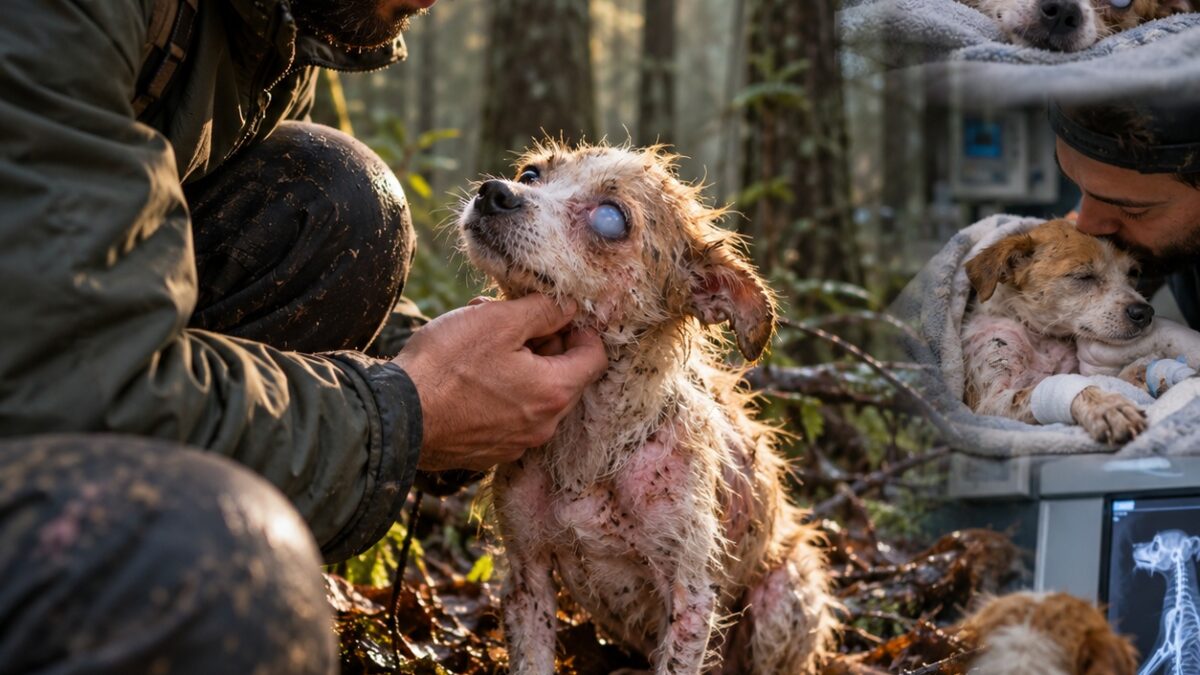
His fur was badly matted, and what remained of his coat hid how severe the skin damage really was.
The mats could not simply stay.
They trapped dirt against already inflamed skin.
They made examination harder.
They covered places that needed treatment.
So the damaged coat had to come away.
Even that could not be done casually.
Freddy hurt.
His skin hurt.
His ears hurt.
His entire body seemed to have been living with discomfort for so long that touching him required thought.
Slow hands.
Gentle movement.
No unnecessary pressure.
He had to be sedated so his caregivers could remove the mats and clean his skin without putting him through even more pain.
I remember the first time the full extent of his body could be seen.
The fur had hidden part of the story.
Without it, there was nowhere for that story to hide.
Raw areas.
Angry skin.
Wounds.
Inflammation.
Places that should have been protected but had been exposed to suffering for far too long.
It was difficult to look at him without wondering how long he had been carrying it.
How many days had he tried to sleep while his skin burned?
How many nights had his ears hurt?
How long had that damaged eye bothered him?
How long had parasites been taking strength from a body that had almost nothing left?
No answer ever came.
We stopped asking questions Freddy could not answer and focused on the one thing we could control.
What happened next.
Antibiotics began working against his infections.
Pain medication gave his body some relief.
Fluids supported him while he was so exhausted.
The treatments were not dramatic.
No instant transformation.
No miracle where Freddy woke the following morning looking like a completely different dog.
Recovery does not usually work that way.
Especially when neglect has been allowed to build slowly.
Healing has to answer that damage slowly too.
One problem at a time.
One uncomfortable day becoming slightly less uncomfortable.
One wound beginning to close.
One meal.
One drink.
One hour of sleep.
Then another.
Those first days carried more uncertainty than hope.
Would Freddy eat enough?
Would his strength begin returning?
Would the infections respond?
Could a body already fighting heartworms, hookworms, anemia, severe skin disease and painful ear problems keep answering treatment?
Nobody could honestly promise.
That is the cruel part of rescue sometimes.
Finding the animal is not the same as knowing you saved him.
You can carry a dog out of the woods.
You can place him on soft bedding.
You can bring medicine.
You can stand beside him.
But his body still has to choose, in whatever biological way bodies choose, whether it can continue.
Freddy was frighteningly fragile.
Sometimes I looked at him and thought about how easily the story could have ended before anyone heard those cries.
What if the man had walked a different direction?
What if the wind had carried Freddy’s voice away?
What if Freddy had stopped crying minutes earlier?
What if he had been too weak to make one more sound?
Questions like that can drive you crazy.
So again, we returned to what was real.
Freddy had been heard.
He had been found.
He was here.
And whatever happened now, he would not be alone.
That changed everything even before his body began improving.
For two days, the hospital became his whole world.
Medication.
Care.
Cleaning.
Rest.
People checking him.
Gentle hands.
Soft voices.
No empty woods.
No unanswered crying.
He could close his eyes and someone would still be there when they opened again.
Maybe he did not understand that yet.
But we did.
After two days, Freddy was able to leave the hospital for a home where his care could continue.
That did not mean he was recovered.
Not even close.
It meant his world had changed again.
From the forest.
To the hospital.
Then to a place with warmth.
Blankets.
Food.
People.
Safety.
The first steps inside that new life showed us just how much the neglect had taken from him.
Walking exhausted him.
His legs trembled.
He could move, but movement cost him.
A few steps could look like a much longer journey.
His body had no reserves.
Every action drew from strength he was only beginning to rebuild.
Sometimes he stood and seemed uncertain whether his legs could continue carrying him.
We never rushed him.
If Freddy needed to stop, he stopped.
If he needed to lie down, there was somewhere soft.
For perhaps the first time in a very long time, weakness no longer placed him in danger.
He was allowed to be tired.
That sounds small.
It is not.
A sick animal alone outdoors does not get to choose recovery.
Hunger still comes.
Weather still comes.
Fear still comes.
He has to move whether moving hurts.
Search whether searching exhausts him.
Stay alert when his body wants sleep.
Freddy no longer had to do that.
If his legs trembled, somebody waited.
If he could only make it partway across a room, that was enough.
No one expected more.
His body had been asked for too much for too long.
Now we could finally ask less.
Rest.
Eat.
Heal.
The most heartbreaking moments often came before sunrise.
Freddy would wake crying.
The sound was different inside a home, but I could not hear it without thinking about the woods.
That same little voice.
The voice that once went out between trees with no guarantee anyone would answer.
Sometimes he woke frightened.
Sometimes unsettled.
Whatever he was remembering—or whatever his body was feeling—he called out.
But there was one enormous difference now.
Someone always came.
Every time.
Early morning.
Middle of the night.
Before sunrise.
It did not matter.
Freddy cried.
A person answered.
Again.
Freddy cried.
Someone came.
Again.
Again.
Again.
There is something powerful in repetition.
One kind of repetition can break an animal.
Hunger day after day.
Pain day after day.
Nobody coming day after day.
But repetition can also rebuild.
Food arrives again.
The blanket is still there again.
A hand remains gentle again.
You cry and someone comes again.
Freddy had spent enough of his life learning that suffering could repeat itself.
Now he was learning that kindness could repeat too.
I do not know when he first understood that his crying no longer disappeared into silence.
Maybe dogs do not understand it in words.
Maybe they understand in their bodies.
The heart slows.
The muscles release.
The cry becomes shorter because experience has taught you what happens next.
Someone comes.
Love answers back.
That became one of the most important parts of Freddy’s recovery.
Medicine was treating his body.
Consistency was treating something else.
The first changes were tiny.
So tiny that if you had seen Freddy only once every several days, you might not have noticed.
But when you watched him closely, you saw them.
One extra step.
Then another.
A little more balance.
Slightly less trembling.
His head lifting when someone entered the room.
His body leaning toward a gentle hand instead of simply tolerating it.
That last part affected me deeply.
Freddy did not just accept kindness.
He started seeking it.
A touch beneath the chin.
A hand along the side of his face where it did not hurt.
A quiet voice.
A person sitting close.
The dog found alone in the woods wanted company.
After everything.
That tells you something about Freddy.
Not that he forgot pain.
We cannot know that.
Not that suffering had somehow made him better.
There is nothing good about what happened to him.
But whatever neglect had taken, it had not taken his ability to connect.
His spirit had survived inside a body that had nearly been destroyed.
His eye could be damaged.
His skin could be raw.
His ears could be infected.
His blood could be weakened by anemia.
Parasites could steal strength from him.
But when a gentle person sat beside him, Freddy still found a way to lean closer.
That is the part no medical chart could capture.
The first time he actively moved toward comfort, I wanted to cry.
Not because it was a dramatic gesture.
It was barely a movement.
But in rescue, you learn to understand movements differently.
A dog choosing closeness is information.
A dog resting against somebody is trust.
A dog closing his eyes while being touched is a decision.
Freddy was making those decisions.
Little by little.
His skin also began changing.
Treatment was doing what treatment needed to do.
The angry inflammation started settling.
Wounds that had remained open began closing.
Fresh bandages replaced old ones.
Cleaning no longer revealed only damage.
It revealed the beginnings of repair.
Healthy skin slowly started appearing where disease had taken over.
Again, nothing happened all at once.
A photograph from one day might not show a dramatic difference from the day before.
But put several days together and you could see direction.
That word mattered.
Direction.
Freddy still had a long road ahead.
But now he was moving toward something.
Strength.
Comfort.
Healing.
Home.
Before, everything had been moving the other way.
More pain.
More weakness.
More isolation.
Now even small improvements pointed forward.
One morning, his steps looked just slightly steadier.
It might not have impressed anyone who did not know him.
To us, it felt enormous.
Another time, he walked farther before stopping.
Another victory.
His appetite began coming back.
That mattered perhaps more than anything emotionally.
A dog who wants food is a dog whose body is participating in recovery.
Freddy began showing interest.
Then real appetite.
Meals stopped feeling like another uncertain medical question.
They started feeling like part of his day.
That is the strange beauty of healing.
The extraordinary slowly becomes ordinary.
At first, you watch every bite.
Later, you smile because he finishes and looks as though there might be more.
At first, every step frightens you.
Later, you notice he crossed the room and you did not hold your breath.
At first, sleep feels medically important.
Later, you simply see a little dog curled into a blanket.
Ordinary begins returning.
Freddy deserved ordinary.
He also found Sal.
Sal was another dog.
And Freddy loved being near him.
The change was obvious.
Freddy followed him from room to room.
If Sal moved, Freddy watched.
If Sal settled somewhere, Freddy seemed more comfortable settling too.
There are things another dog can give that humans cannot.
We can offer medicine.
Food.
Warmth.
Hands.
But another dog speaks a language we only partly understand.
Body position.
Movement.
Scent.
Confidence.
Normal behavior.
Sal became a kind of guide.
Freddy watched him move through the home without fear.
Watched him interact with people.
Watched him lie down and sleep.
Watched him behave as though the environment was safe because, to Sal, it was.
Freddy seemed calmer when Sal stayed nearby.
It was almost as if he borrowed courage from him.
I loved watching that friendship develop because it asked nothing of Freddy.
Sal did not care about Freddy’s wounds.
He did not know the medical list.
Severe ear infections meant nothing to him.
Heartworms were not Freddy’s identity.
Mange was not a reason to keep distance emotionally.
To Sal, Freddy was simply another dog.
A companion.
Someone worth following and being followed by.
That normal relationship mattered.
Illness has a way of turning an animal into a patient.
Everything becomes treatment.
Medication.
Bandages.
Examinations.
How much did he eat?
How far did he walk?
Did the wound improve?
Was he tired?
Those questions are necessary.
But they can also consume the identity of the animal in our minds.
Sal gave Freddy another identity.
Friend.
Freddy could follow him.
Rest near him.
Watch him.
Be a dog beside another dog.
Not a case.
Not a list of diagnoses.
Not “the little dog from the woods.”
Just Freddy.
There were still setbacks.
Of course there were.
Recovery was not one clean upward line.
Some mornings filled us with hope.
Others reminded us immediately how fragile his body remained.
One better day did not erase the heartworms.
One stronger walk did not remove every consequence of anemia.
Healing skin could still be sensitive.
Energy could disappear quickly.
His damaged eye had not magically become normal.
His ears had suffered severe infection.
His body still carried more than anyone should have expected from something so small.
There were days when progress felt slower.
Days when we worried again.
That is difficult when you have already begun loving an animal.
At the beginning, fear feels abstract.
Will he survive?
Then he leans into your hand.
Follows another dog.
Looks for you.
Cries and calms when you answer.
Suddenly the fear has a face you cannot imagine losing.
That is the emotional risk of rescue.
You cannot protect yourself by staying detached.
Not completely.
If you care properly, you become invested.
Freddy became easy to care about.
Not because his story was sad.
Because he was gentle.
Even while exhausted.
Even while hurting.
Even when treatment must have confused him.
He continued trusting.
He never seemed interested in punishing the world for what the world had done to him.
That does not make him morally better than a frightened dog who snaps.
A dog protecting himself through aggression is not bad.
Fear comes out differently in different animals.
Freddy’s response was simply his.
Quiet.
Soft.
Seeking closeness.
It made his condition feel even more heartbreaking.
How had such a gentle little dog been allowed to become so sick?
No answer.
And maybe that is the hardest answer of all.
There was no explanation available that could repair the past.
We could only keep working on the future.
Two weeks passed.
Fourteen days.
Medication.
Cleaning.
Bandages.
Meals.
Water.
Sleepless moments.
Early-morning cries.
Hands reaching.
Sal nearby.
People checking.
Freddy resting.
Then trying again.
Those two weeks probably contained more consistent care than Freddy had known for a very long time.
Perhaps more than he had ever known.
We could not know.
But we knew what he had now.
Warm blankets.
A safe place.
Someone close when he woke frightened.
People who were not disappearing.
He could curl beside them.
Sleep.
Wake.
Still there.
That repetition began transforming him.
The fear in his face started sharing space with something new.
Curiosity.
That was one of the most beautiful changes.
Fear looks inward.
What is going to happen to me?
Where is the danger?
Can I escape?
Curiosity looks outward.
What is that?
Where is Sal going?
Who just entered?
Is there food?
What happens if I follow?
The appearance of curiosity meant Freddy had enough safety to think about something other than survival.
That is not a medical measurement.
But anyone who has watched a frightened animal heal knows what it means.
His world was getting larger.
In the woods, his world might have been only the next sound.
The next painful step.
The next cry.
At the hospital, his world became immediate treatment.
At home, it expanded.
Rooms.
People.
Blankets.
Sal.
Food.
Hands.
Voices.
Routes.
Routine.
Freddy began participating in life rather than simply enduring it.
His legs carried him farther.
Still not perfectly.
Still with stiffness.
Still with reminders of how much weakness had taken from him.
But movement became less frightening.
He followed Sal.
Stopped.
Rested.
Then followed again.
Every extra distance felt earned.
I remember watching him cross a room one day and realizing halfway through that nobody was hovering.
That was progress for us too.
Caretakers have to learn to relax as the animal heals.
At first, you monitor everything because everything might matter.
Then slowly you let the dog become a dog.
Freddy walked.
We let him walk.
He rested.
We let him rest.
He chose closeness.
We welcomed him.
He chose distance.
We respected that too.
His recovery belonged to him.
We were there to support it.
Not control every second.
He still woke before sunrise sometimes.
Still cried.
Those moments never stopped affecting me.
But even his crying changed in meaning.
The first cries anyone knew from Freddy happened in a forest where nobody had yet answered.
Now his voice existed inside a home.
He could cry because he was uncomfortable.
Or scared.
Or simply wanted someone nearby.
And somebody came.
I sometimes wondered how many repetitions it takes before an animal stops expecting abandonment.
Ten?
One hundred?
Maybe there is no number.
Maybe trust is never a finished calculation.
Maybe it is simply something you keep proving.
We did.
Again.
Again.
Again.
Freddy cried.
Someone came.
Freddy needed medication.
Someone gave it.
Freddy needed a bandage.
Someone changed it.
Freddy became tired.
There was a bed.
He wanted Sal.
Sal was nearby.
He wanted a person.
A person sat down.
This was what love looked like for Freddy.
Not one grand rescue.
Thousands of small answers.
That is why I do not think his story truly began when the man carried him out of the woods.
That was the turning point.
But rescue continued every day afterward.
Finding is one act.
Staying is another.
Freddy needed both.
The man who first heard him could have handed him over and disappeared from the story.
Others then had to keep showing up.
Hospital caregivers.
The people at home.
Everyone responsible for another medication, another meal, another early morning.
Love is not proved by one emotional moment.
It is proved through boring consistency.
Freddy received that consistency.
And he responded.
His appetite strengthened.
His walking improved.
He became more connected to the people around him.
Sal remained his shadow—or perhaps Freddy became Sal’s.
Sometimes it was difficult to tell who followed whom.
Freddy seemed happiest when he knew where everyone was.
If a person moved to another room, he wanted to know.
If Sal disappeared around a corner, Freddy often followed.
There was almost something poignant about it.
The dog once found completely alone now preferred not to be far from company.
He had spent enough time with silence.
He wanted to know where love was.
So he stayed nearby.
That became one of the sweetest parts of his personality.
Freddy did not need to dominate attention.
He simply wanted presence.
Someone close.
A familiar voice.
Sal within sight.
The same dog whose cries once vanished through trees now lived surrounded by responses.
His body still showed what he had survived.
Healing did not erase history.
The scars did not vanish because he was loved.
His damaged eye did not become untouched.
The stiffness remained.
Treatment did not turn him into a dog who had never suffered.
That is not what healing does.
Healing gives suffering a different place in the story.
At first, the suffering was the whole story.
Raw skin.
Infection.
Parasites.
Weakness.
Isolation.
Then it became the beginning.
Still real.
Still visible.
But no longer everything.
Freddy became more than what happened to him.
That is one of the greatest gifts rescue can offer.
Not a new body.
Not a rewritten past.
A future large enough that the past stops filling every page.
Freddy’s future began filling.
Meals.
Friends.
Soft places.
Quiet sleep.
Hands he trusted.
People he followed.
Sal.
Days that were easier.
Days that were harder.
Then another day.
And another.
His courage never looked dramatic.
That is why I call it quiet courage.
He did not conquer recovery.
He moved through it.
One shaky walk.
One meal.
One early morning.
One bandage.
One nap.
One little decision to continue.
People often want courage to be loud.
Freddy taught me something different.
Sometimes courage is a sick dog lifting his head when he is tired.
Taking another step when his legs tremble.
Eating when his body has forgotten what strength feels like.
Leaning into a hand after life gave him no good reason to trust hands.
Following another dog through a doorway because maybe something good is on the other side.
Sleeping deeply because someone has finally convinced you there will still be safety when you wake.
Those things are not small.
Not to Freddy.
Today, healing is still happening.
That matters.
His story did not suddenly reach some magical point where every medical problem disappeared.
Some days are easier.
Some steps stronger.
Other days still remind everyone that recovery has its own timetable.
His body had carried neglect for too long to pretend the consequences could simply vanish.
But he keeps moving.
That is the important part.
Forward.
Sometimes slowly.
Still forward.
His appetite came back.
His legs began carrying him farther.
His confidence grew.
Fresh skin appeared where disease had once dominated.
The frightened expression softened.
Not gone.
Changed.
Freddy learned his environment.
Learned routines.
Learned people.
Learned Sal.
And most of all, learned that when he needed somebody, the answer was no longer silence.
I often return mentally to those woods.
Not because that is where Freddy belongs in my memory.
Quite the opposite.
I think about the contrast.
The emptiness.
The sound.
A tiny dog crying between trees.
No collar.
No one calling his name.
Nothing around him except whatever he had managed to survive.
Then I picture him now.
Close to people.
Close to Sal.
Resting.
Looking for a familiar person instead of crying into emptiness.
Safe.
That distance is enormous.
Not measured in miles.
Measured in trust.
If Freddy could understand the whole journey as a story, I wonder which moment he would choose as the beginning of safety.
The man lifting him?
The hospital?
The first pain medicine bringing relief?
The first meal he wanted?
A blanket?
The first time someone answered his early-morning crying?
The day he met Sal?
Maybe dogs do not organize life that way.
Maybe safety is simply a collection of feelings replacing other feelings.
Warm instead of cold.
Full instead of hungry.
Comfort instead of pain.
Company instead of isolation.
Response instead of silence.
If so, Freddy has collected many new feelings now.
That is enough.
There is one moment I think about more than almost any other.
Freddy waking before sunrise.
Crying.
Imagine the first time that happened after the woods.
For him, perhaps it felt familiar.
Darkness.
Fear.
Call out.
The old pattern.
Except this time footsteps came.
A person appeared.
A hand.
A voice.
Comfort.
I wish I could have seen inside him at that moment.
Not because I believe one answer erased everything.
It did not.
But the first time love interrupts an old pattern has to matter.
Cry.
Someone comes.
Again.
Someone comes.
Again.
Eventually maybe the body stops preparing for no one.
That is what I mean when I say Freddy learned that love answers back.
Not as a sentimental phrase.
As a repeated fact.
He called.
People came.
They kept coming.
That is love in a form a frightened animal can understand.
Presence.
We cannot explain to Freddy that he is valuable.
We cannot tell him his illnesses were never his fault.
We cannot give him a lecture about abandonment, neglect, resilience or second chances.
Dogs do not need our speeches.
We show them.
A bowl.
A bed.
Medicine.
Hands.
Time.
Showing up.
Sal lying nearby.
Another morning.
Another night.
Still here.
That is the language.
Freddy learned it.
And because he learned it, his gentle spirit had room to become visible.
That spirit had apparently always been there.
Even when he arrived exhausted.
No growling.
No snapping.
No shutting everybody out.
He had every right to be frightened.
Every right to defend himself.
Instead, he remained quiet.
Allowed care.
Then sought it.
I never want to use that gentleness to romanticize what happened to him.
Suffering did not create Freddy’s sweetness.
It threatened it.
He carried that sweetness through the suffering.
That distinction matters.
His ability to trust is not evidence that neglect was somehow part of his destiny.
It is evidence that neglect failed to take everything.
Freddy survived it with part of himself still intact.
Then safety helped that part grow.
I wish we knew exactly how he reached those woods.
Maybe knowing would bring anger.
Maybe closure.
But there is no answer in the story we were given.
No collar.
No identification.
No person searching.
No explanation.
I refuse to invent one.
Freddy deserves truth more than he deserves a convenient villain.
What we know is enough.
He was alone.
He was sick.
He was heard.
He was carried out.
He received care.
He went home.
He kept healing.
He found Sal.
He found people.
He found response.
He found safety.
That is the story.
And it is already extraordinary.
Two weeks of intense care did not finish the journey.
They began showing everyone what was possible.
The Freddy who could barely manage a walk started moving farther.
The Freddy who needed encouragement to eat found his appetite.
The Freddy whose wounds dominated his appearance developed healthy skin.
The Freddy who cried in darkness began understanding that someone would answer.
The Freddy found alone began following a friend from room to room.
That is transformation.
Not perfection.
Direction.
Sometimes I think direction is the most hopeful word in rescue.
You do not need to know exactly where healing ends.
You only need to know the animal is no longer moving toward death.
No longer becoming weaker without help.
No longer alone.
Freddy had changed direction.
Everything else could come slowly.
Some scars might remain.
Some stiffness might remain.
Some medical realities might require time.
Fine.
He had time now.
That was something the woods had not promised.
Time.
Tomorrow.
Another meal.
Another treatment.
Another warm night.
Another chance to get stronger.
Neglect steals time from animals.
Rescue gives some of it back.
Not the lost years.
We cannot do that.
But future time.
Good time.
Safe time.
Freddy has that now.
He spends his days close to the people who care for him.
He wants to know where love is.
So he stays near it.
I find that almost unbearably beautiful.
Not because he is clingy.
Not because dependence is the goal.
Because he once had nobody.
Now he has learned there are people worth following.
Rooms worth entering.
Voices worth listening for.
A friend worth trailing down the hallway.
There is a home behind those choices.
A life.
Belonging.
The scars on Freddy’s body are still part of him.
They are not shameful.
They are not his identity either.
If you only looked at the reminders of mange, infection, eye damage, weakness and everything else, you would miss the dog.
You would miss the way he seeks closeness.
The curiosity returning.
The trust.
The quiet courage.
Sal.
The way he keeps trying on the difficult days.
We have to be careful with rescue stories.
Pain gets attention.
Before photographs shock people.
Raw wounds.
Thin bodies.
Fearful eyes.
But the animal deserves to be remembered beyond the shock.
Freddy is not a collection of diagnoses.
He is not the mange dog.
Not the heartworm dog.
Not the abandoned dog in the woods.
He is Freddy.
His suffering explains where the story began.
It does not tell us who he is now.
Now he is a little dog who wants to be near the people who stayed.
A dog who has a friend.
A dog whose cries receive an answer.
A dog whose body is still healing but no longer fighting every battle without help.
A dog with food.
Blankets.
Care.
People.
Home.
The word home means something different after you have seen an animal truly alone.
A building is not enough.
Four walls are not enough.
Freddy had to learn that home meant consistency.
Someone stays.
Someone notices.
Someone wakes up.
Someone changes the bandage.
Someone cares whether you ate.
Someone knows when your legs are tired.
Someone understands a stronger step is worth celebrating.
Someone sees you follow Sal and smiles.
Someone hears your cry.
That is home.
Freddy finally has it.
Sometimes, when he is curled close to people now, I wonder whether there is any trace of those woods in the way he sleeps.
Maybe not.
Maybe that is another human question dogs do not carry.
Still, the contrast is impossible for me to ignore.
The first image:
Trees.
Silence.
A tiny dog crying alone.
The last image:
Freddy resting close to people who are not going anywhere.
Sal nearby.
Warmth.
Safety.
No unanswered cries.
No need to call into emptiness.
No need to wonder whether anyone is coming.
That is why his story hurts so much and heals something at the same time.
Someone should have helped him sooner.
That truth does not disappear because his ending is happy.
His ears should never have reached that condition.
His skin should never have become that diseased.
His eye should never have gone untreated so long.
Parasites should never have been allowed to drain a little body already struggling.
He should never have been alone in those woods crying.
All true.
And also:
Someone heard him.
Someone followed.
Someone carried him.
People treated him.
Stayed awake for him.
Answered him.
Loved him.
Sal befriended him.
Freddy kept moving.
Both sides belong to the story.
Pain and rescue.
Neglect and care.
Silence and response.
Alone and home.
I cannot change the first half.
Neither can anyone who loves him now.
But every day Freddy lives safely adds something to the second.
Another meal.
Another nap.
Another stronger step.
Another time he follows Sal.
Another morning where he wakes and does not need to wonder whether anybody stayed.
Those days matter.
They accumulate.
One day, perhaps the safe days will far outnumber whatever came before.
I hope so.
Even if Freddy never counts them.
We will.
I think about the man in the woods sometimes too.
He did not know what he was walking toward.
He only heard a sound.
He could not know that following it would reveal heartworms, hookworms, anemia, mange, infected ears and an injured eye.
He could not know whether Freddy would survive.
He knew only that a living creature was crying.
And he chose to answer.
There is something beautifully simple in that.
You do not need to know the entire solution before taking the first good step.
Hear the cry.
Follow it.
Find the dog.
Pick him up.
Then let the next person do the next necessary thing.
The hospital.
The caregiver.
The home.
Sal.
Healing became a chain of people and moments.
One person could not do everything.
Nobody had to.
They simply could not walk away from the part that was theirs.
That is how Freddy got from the woods to home.
One answer followed another.
And Freddy answered too.
He ate.
Rested.
Trusted.
Walked.
Tried.
Followed Sal.
Leaned closer.
Kept living.
Rescue is cooperation between life and care.
We provide what we can.
The animal does the impossible biological work of healing.
Freddy did that work.
He is still doing it.
Some days easier.
Some harder.
Still.
He continues.
I love that about him.
Not because we should demand bravery from injured animals.
Freddy never owed anybody inspiration.
He was allowed to be weak.
Allowed to be tired.
Allowed to have setbacks.
Allowed to cry.
Allowed to need help.
Courage is not the absence of those things.
For Freddy, courage was living through them.
Accepting care again tomorrow.
Taking whatever next step his body could manage.
That was enough.
It is still enough.
If I could return to those woods and stand beside the place where he was found, I think the silence would feel different now.
I would imagine his cries there.
Then remind myself:
They were answered.
That is what matters.
The sound did not disappear forever into the trees.
Somebody heard.
And because somebody heard, Freddy reached a hospital.
Because people kept caring, he reached a home.
Because they stayed, he learned his voice mattered.
Because Sal came into his world, he learned companionship again.
Because treatment continued, his body began healing.
Because time was finally on his side, strength returned in small pieces.
Because nobody left, Freddy became something he had not been in those woods.
Safe.
He is still learning what that means.
Maybe he always will.
That is okay.
We have time.
Freddy has time.
That sentence alone feels like a miracle.
He has time.
Time to get stronger.
Time for healthy skin to replace what mange damaged.
Time to walk farther.
Time to rest when his legs become tired.
Time to stay beside Sal.
Time to trust another hand.
Time to wake early and discover someone still comes.
Time to simply be a dog.
There is nothing more I want for him.
No grand transformation required.
No perfect body.
No erased scars.
Just life.
Comfort.
Dignity.
Company.
A future.
Freddy already fought hard enough to reach those things.
Now he does not have to fight alone.
Today, if he cries, there is an answer.
If he is tired, there is somewhere soft to lie.
If he is hungry, there is food.
If he is uncertain, there is a familiar person.
If he wants companionship, there is Sal.
If one day is difficult, there is another day waiting.
That is the world Freddy lives in now.
Not the woods.
Not the silence.
Home.
And when I look at him today, I still see reminders of what he survived.
But I see something stronger beside them.
A little dog who kept calling when nobody seemed to be coming.
A little dog who allowed himself to be lifted by the stranger who finally found him.
A patient who endured care when his body hurt everywhere.
A frightened soul who discovered gentle hands.
A tired dog who learned to follow a friend.
A survivor who never stopped being gentle.
Freddy’s story began with a cry disappearing through trees.
It ends very differently.
Now, when he looks for someone, someone is there.
When he wants closeness, he finds it.
When he sleeps, he is surrounded by safety.
And when morning comes, Freddy wakes in a place where no one is leaving him behind.
His body still carries the proof that life once failed him.
But his life now carries proof of something else.
People came.
They stayed.
Love answered.
And Freddy is finally home.








