PART2:For My Son’s 11th Birthday, We Went to Adopt a Puppy—He Chose the Old Dog Who Had Been Waiting 412 Days Instead
PART2
Sarah and I both thought we had misheard him.
“You mean you want to meet him?” I asked.
“No.”
Ethan stood.
“I want him.”
I glanced toward the row of younger dogs.
“You haven’t even seen all the puppies.”
“I don’t need to.”
“Ethan.”
He looked at me with complete seriousness.
“Dad, they’ll get picked.”
“Who?”
“The puppies.”
Sarah crouched beside him.
“And Henry?”
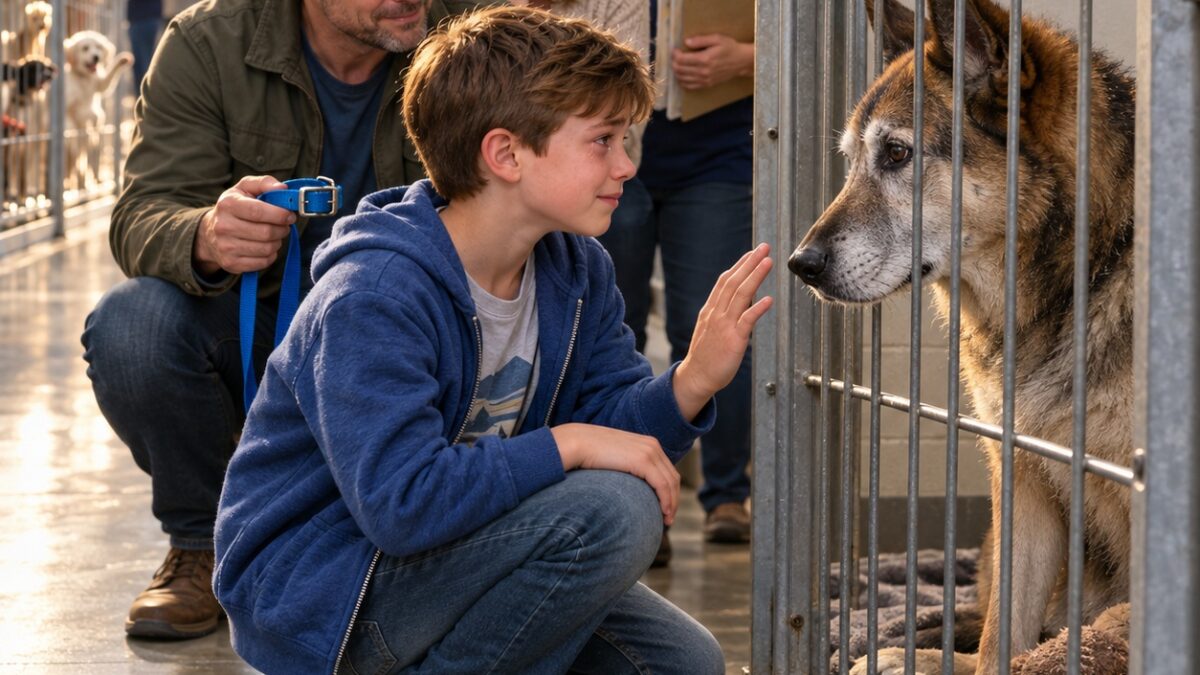
Ethan looked through the gate.
“He’s already waited 412 days.”
The shelter employee’s expression changed.
I remember that clearly.
Not dramatic.
Her eyes simply softened.
She unlocked the kennel.
“Would you like to meet him in the visitation room?”
Ethan nodded.
Henry stood.
Slowly.
His back legs took a second to straighten.
That detail hit me harder than it should have.
He walked beside the shelter employee without excitement.
No pulling.
No bouncing.
He seemed like a dog who had stopped expecting doors to lead anywhere important.
We entered a small room with two chairs and a rubber mat.
Ethan sat on the floor immediately.
Henry remained near the door.
He looked at us.
Sarah offered her hand.
Nothing.
I called softly.
“Come here, buddy.”
Henry glanced toward me.
Then back at Ethan.
My son did something smart.
He stopped trying.
He turned slightly sideways.
Looked at the floor.
Waited.
Five minutes passed.
Maybe less.
It felt longer.
Henry took one step.
Then another.
Ethan did not move.
The old dog reached him.
Sniffed his sleeve.
Then his hand.
Ethan whispered:
“Hi, Henry.”
Henry’s tail moved once.
Barely.
The shelter employee covered her mouth.
“What?”
I asked.
She shook her head.
“Nothing.”
Henry lowered himself beside Ethan.
Not touching.
Just close.
My son slowly lifted his hand.
Placed it against the dog’s shoulder.
Henry closed his eyes.
That was it.
No dramatic reaction.
But something happened in that room.
A dog who had spent more than a year being passed over rested his weight against an eleven-year-old boy.
Ethan looked at me.
“Dad.”
I already knew.
“Yeah.”
“He’s ours.”
I looked at Sarah.
She was crying.
I sighed.
Because fathers sometimes pretend sighing means we still have authority after everybody else has made the decision.
“We came for a puppy.”
Ethan put one arm around Henry.
“He was a puppy once.”
That finished me.
I turned to the shelter employee.
“What do we need to do?”
She smiled.
“You’re serious?”
“Yes.”
She looked at Ethan.
“I’ve worked here twenty years.”
My son stroked Henry’s neck.
She continued:
“Kids usually choose the smallest or the most playful.”
Ethan shrugged.
“He looked lonely.”
The woman nodded slowly.
“He was.”
We completed the application.
Veterinary history.
Home information.
Fenced yard.
Our work schedules.
Experience with dogs.
The shelter wanted us to understand Henry’s needs.
Arthritis.
Mild hearing loss.
Dental issues already treated.
A history of being surrendered after his previous owner moved into long-term care.
He had then been adopted once.
Returned after nine days because the family decided his mobility was “too limiting.”
That phrase angered me.
Too limiting.
As though age were a defect.
“He doesn’t destroy things,” the shelter worker said.
“House-trained.”
“Good with children?”
“He’s gentle.”
“Other dogs?”
“Mostly indifferent.”
“Cats?”
“Unknown.”
Ethan asked the most important question.
“Does he sleep alone?”
The woman looked at him.
“Usually.”
“Not anymore.”
We brought Henry home that afternoon.
Not the puppy we had planned.
No squeaky new beginning.
No wild tail.
No little paws on the dashboard.
Henry climbed into the back seat with difficulty.
Ethan sat beside him.
Within ten minutes, the old dog’s head rested across my son’s lap.
He slept.
Deeply.
I kept checking the rearview mirror.
Ethan barely moved because he was afraid of waking him.
At one red light, Sarah looked back.
“Comfortable?”
Ethan whispered:
“My leg is numb.”
“Want him to move?”
“No.”
Henry slept the entire drive.
For the first time, I wondered how much real rest an animal gets in a shelter.
Noises.
Doors.
Barking.
Smells.
Strangers.
For 412 days.
When we pulled into our driveway, Henry woke.
He did not jump out.
He looked through the open door.
New place.
New people.
Another transition.
I attached the leash.
“Come on, old man.”
He stepped down carefully.
Ethan stayed close.
Inside, Henry stopped at the threshold.
Sarah and I waited.
He sniffed.
One step.
Another.
Then froze when the door closed behind him.
Ethan noticed.
“It’s okay.”
Henry looked back.
My son opened the door again.
Fresh air.
Outside visible.
Henry relaxed.
Ethan waited a few seconds.
Then closed it gently.
“That’s our door.”
Henry looked at him.
“You can go out whenever you want.”
Of course the dog did not understand every word.
But tone matters.
Patience matters more.
We showed him the kitchen.
Water.
Food.
Living room.
Backyard.
Ethan had already prepared a blanket on his bedroom floor.
Henry sniffed it.
Then sniffed the bed.
Then Ethan.
My son poured food into a bowl.
“Mister, you need to eat.”
Henry looked at it.
Then him.
“Mange, mon ami,” Ethan said in terrible French because he had been practicing phrases for school.
Sarah laughed.
“What was that?”
“Eat, my friend.”
Henry stepped forward.
Ate slowly.
Every few bites, he checked Ethan.
Then continued.
That night, after the birthday cake and balloons and presents, I noticed something odd.
Henry sat in the corner of the living room while we sang.
Not afraid.
Not hiding.
Watching.
He seemed curious about the noise but unwilling to join.
Ethan noticed too.
He left his cake.
Walked to the dog.
Knelt.
“Today’s my birthday.”
Henry sniffed his hand.
“And you’re my present.”
The old dog licked Ethan’s fingers.
One time.
My wife looked at me.
I pretended my eyes did not sting.
After cake, Ethan spent most of the evening beside Henry anyway.
Every gift was opened and then shown to the dog.
Soccer ball.
Book.
Headphones.
New shoes.
“You can’t chew these.”
Henry looked uninterested.
“Good.”
By nine, Henry was tired.
Ethan took him upstairs carefully.
Henry could manage the steps, but slowly.
My son walked one step ahead, watching every movement.
That night, I checked on them around eleven.
Ethan slept in his bed.
Henry lay on the floor beside him.
Head pressed against the mattress.
Not touching Ethan exactly.
Close enough.
His breathing was slow.
Deep.
For a while, I stood in the doorway.
I thought about 412 days.
More than a year.
How many nights had Henry slept on shelter bedding?
How many footsteps had he heard coming down the kennel row?
How many families stopped?
Looked?
Continued?
How many times did that door open for another dog?
Now he had one boy breathing above him.
Maybe dogs do not count time.
I hope they do not.
The next morning, I woke early and checked again.
Henry was awake.
Sitting beside the bed.
Watching Ethan sleep.
When I entered, his eyes moved toward me.
Something in his expression made me stop.
Not aggression.
Question.
Are you still here too?
I crouched.
“Morning.”
Tail moved.
Small.
One sweep against the carpet.
First real wag I had seen.
“Yeah.”
I scratched his chest.
“We’re still here.”
Breakfast became our first lesson in Henry’s habits.
He waited until Ethan entered the kitchen before eating.
We placed his bowl down.
He looked at me.
Then Sarah.
Then toward the stairs.
Ethan came down.
“Morning!”
Henry immediately approached the bowl.
Sarah and I noticed.
“He was waiting for you,” she said.
Ethan smiled.
“He’s polite.”
I was not sure that was it.
Later we learned Henry did almost everything around Ethan.
If my son was upstairs, the dog rested near the stairs.
If Ethan played outside, Henry lay near the yard.
If Ethan did homework at the table, Henry slept under the chair.
When Ethan went to school for the first time after adoption, we discovered the difficult part.
Ethan put on his backpack.
Henry stood.
My son walked toward the front door.
Henry followed.
“I have school.”
The dog stayed close.
“You stay with Dad.”
Henry looked at me.
Not impressed.
Ethan hugged him.
“I’ll come back.”
Those words changed Henry’s posture.
Or maybe I imagined it.
The school bus arrived.
Ethan left.
Henry sat by the door.
Stayed there.
For nearly six hours.
I tried calling him.
Food.
Backyard.
Nothing held him long.
He always returned to the entrance.
At three-fifteen, the bus stopped outside.
Before I heard it, Henry stood.
Ears up.
Tail moving.
Ethan opened the door.
Henry took three quick steps.
Quick for him.
My son dropped his backpack.
“You missed me!”
Henry leaned into his chest.
Ethan hugged him.
“I missed you too.”
I stood in the kitchen pretending to wash a clean glass.
That became their ritual.
Every school day.
Waiting.
Return.
But the waiting changed.
At the shelter, Henry waited without knowing whether anyone specific would come.
At our house, he waited with evidence.
Ethan returned yesterday.
He would return today.
Tomorrow.
That difference matters.
Within two weeks, Henry knew the bus schedule better than I did.
At 3:10, he moved to the door.
At 3:15, ears up.
At 3:18, tail.
Even on Saturdays.
That caused disappointment.
Ethan found him by the door one Saturday afternoon.
“No school today.”
Henry looked at him.
“You don’t have to wait.”
My son sat beside him.
Neither moved for twenty minutes.
Sarah whispered:
“They’re ridiculous.”
I smiled.
“Which one?”
“Yes.”
Henry did not play at first.
We bought toys.
Rope.
Ball.
Stuffed fox.
He sniffed each one politely.
Then ignored them.
Ethan tried tug.
Nothing.
Fetch.
Nothing.
“Maybe he doesn’t know how.”
Sarah said:
“Or maybe he’s old.”
Ethan frowned.
“Old people play.”
I laughed from the couch.
“Careful.”
“What?”
“Your father is forty-four.”
“That’s not old.”
“Good answer.”
Henry preferred presence.
If Ethan sat on the floor, Henry came close.
If Ethan read, he slept beside him.
If Ethan rubbed his stiff paws, Henry sighed so deeply he sounded like an exhausted old man paying taxes.
My son loved that sound.
“He’s relaxing.”
“Yes.”
“Do dogs know massages?”
“He does now.”
A month passed.
Then one afternoon, something changed.
I was working from home.
Ethan was in the backyard rolling a tennis ball around absentmindedly.
Henry lay beneath the maple tree.
The ball rolled past his paws.
Henry looked at it.
Ethan froze.
“Henry?”
The old dog put one paw over the ball.
Ethan smiled.
“Come on.”
He rolled it again.
Henry stood.
Slow.
Walked after it.
Picked it up.
My son’s mouth opened.
“Dad!”
I came to the door.
Henry walked back.
Dropped the ball two feet from Ethan.
Not exactly fetch.
Close enough.
Ethan cheered like we had won a championship.
Henry’s tail wagged harder than I had ever seen.
Again.
They played for maybe five minutes.
That was all Henry could manage.
Afterward he lay down exhausted.
Ethan dropped beside him.
“You played.”
Henry panted.
“You’re still a puppy.”
That sentence stayed with me.
Still a puppy.
Maybe every old animal carries all previous versions of itself inside.
Same dog.
Slower body.
The joy had not vanished.
It had been waiting for the right reason.
Henry’s health improved slightly after adoption.
Not younger.
Healthier.
Regular gentle walks helped his joints.
Better sleep.
Medication.
Weight management.
The shelter veterinarian worked with our regular vet.
Ethan took every instruction seriously.
“Three short walks are better than one long walk.”
He repeated it to me like medical law.
“Yes.”
“No stairs too fast.”
“I know.”
“Joint supplement after breakfast.”
“Yes.”
“Dad.”
“What?”
“You forgot Tuesday.”
“I did not.”
“You almost did.”
My eleven-year-old became a retirement-home administrator.
Henry seemed satisfied.
Then came the tear.
I still do not know what caused it exactly.
Dogs’ eyes water.
People assign human meanings too quickly.
But I know what I saw.
Ethan returned from school after a difficult day.
A classmate had made fun of his science presentation.
Nothing catastrophic.
At eleven, humiliation feels catastrophic.
He came inside quiet.
Henry approached as always.
Ethan knelt.
Wrapped both arms gently around him.
“You missed me?”
Henry closed his eyes.
A tear-shaped line of moisture moved from one eye.
Ethan looked up.
“Dad.”
I saw it.
“He’s crying.”
“I don’t know if dogs cry emotionally.”
“Look.”
“I’m looking.”
Henry pressed his face into Ethan’s shoulder.
My son whispered:
“It’s okay. I came back.”
I turned away.
Because whether the tear meant emotion or simply an irritated eye, the moment meant something.
The dog had been seen.
That is what mattered.
A dog can survive food and shelter.
Belonging is different.
Henry belonged.
That evening, Ethan asked:
“Why did nobody want him?”
I hated the question.
“Some people did.”
“They didn’t take him.”
“No.”
“Why?”
I thought carefully.
“People get scared.”
“Of old dogs?”
“Of losing them.”
Ethan looked toward Henry sleeping nearby.
“But you lose every dog eventually.”
“Yes.”
“So why does it matter if they’re old?”
“It matters because you get less time.”
My son frowned.
“That means you should hurry.”
I looked at him.
“What?”
“If you have less time, you should love them faster.”
I had no answer.
Eleven years old.
That boy embarrassed my philosophy regularly.
A few weeks later, I asked him the question that had been bothering me from the first day.
“Why Henry?”
He was on the floor doing homework.
Henry’s head rested on his leg.
“Because he looked at me.”
“All the dogs looked at you.”
“Not like him.”
“What was different?”
Ethan thought.
“He looked like he was trying not to ask.”
That sentence stopped me.
“Explain.”
“The puppies were saying, ‘Pick me, pick me.’”
He scratched Henry’s ear.
“Henry looked like he already thought we wouldn’t.”
I sat down.
“So?”
“So I couldn’t leave.”
He returned to homework.
For him, that was enough.
For me, it rearranged something.
Adults often think compassion begins with pity.
Maybe it begins with attention.
Seeing the person or animal who has learned not to ask.
Henry changed our family in quiet ways.
We slowed down.
Walks were slower because he was slower.
Ethan noticed trees.
Birds.
Neighbors.
Instead of running ahead, he stayed beside Henry.
We spent more time sitting in the yard.
Less time rushing.
Sarah said one evening:
“I think we adopted a meditation teacher.”
Henry snored.
“A very loud one.”
He also changed Ethan’s understanding of responsibility.
At first, dog ownership was exciting.
Then reality arrived.
Rainy morning walks.
Cleaning accidents during one bad stomach week.
Medication.
Vet bills.
Brushing.
Picking up after him.
One cold morning, Ethan groaned.
“I don’t want to walk.”
I looked outside.
“I don’t either.”
Henry stood by the leash.
Ethan sighed.
“He has to go.”
“Yes.”
My son put on his coat.
That was responsibility.
Not doing what you enjoy.
Doing what someone depends on.
When he returned, wet and cold, he said:
“That was actually kind of nice.”
“Don’t tell Henry. He’ll expect gratitude.”
Months passed.
Henry began sleeping closer to Ethan.
First floor.
Then beside the bed.
Then, after we bought a low orthopedic platform and placed it right against Ethan’s bed, he slept with his head close enough for my son to touch without getting up.
The first time I found them like that, Ethan’s hand rested on Henry’s forehead in sleep.
I took a picture.
Did not post it.
Some things belong to a family.
The shelter employee who introduced us came to visit six months after adoption.
Her name was Marissa.
Henry heard her voice at the door.
His ears lifted.
He walked over.
Marissa knelt.
“Hey, old man.”
Henry sniffed.
Tail.
She started crying immediately.
Ethan looked concerned.
“Why are you sad?”
“I’m not.”
“You’re crying.”
“I’m happy.”
He frowned.
“Adults say weird things.”
Correct.
Marissa stroked Henry’s shoulders.
“He looks incredible.”
“He plays now,” Ethan said.
“Really?”
“Tennis ball.”
“For five minutes.”
“Five is a lot.”
Marissa looked at me.
“He never played at the shelter.”
“Never?”
“Not once.”
Ethan hugged Henry.
“He was waiting.”
Marissa smiled.
“He was.”
That visit gave us more of Henry’s history.
His previous owner was an elderly man named Walter.
He had adopted Henry when the dog was around two.
They lived together almost nine years.
Then Walter suffered a major stroke.
No family able to take Henry.
The dog arrived at the shelter.
Walter eventually entered long-term care and died several months later.
Nobody knew whether Henry ever saw him again.
That explained the door.
Waiting.
The quiet.
Another person who left and did not return.
I did not tell Ethan immediately.
I wanted to think.
Later, we sat in his room.
“Henry had someone before us.”
“I know.”
“A man named Walter.”
“What happened?”
“He got sick.”
Ethan’s face tightened.
“Did he die?”
“Yes.”
Henry slept beside us.
“Does Henry know?”
“I don’t know.”
“Does he miss him?”
“Probably.”
Ethan looked at the dog.
Then asked something that surprised me.
“Is it okay if he loves Walter and me?”
“Yes.”
Immediately.
“Both?”
“Yes.”
“Does that mean I’m not replacing him?”
“No.”
My son relaxed.
“Good.”
“Why good?”
“Because I wouldn’t want him to forget.”
That was when I realized Ethan understood love better than possession.
He did not need Henry’s entire past erased in order to feel chosen.
He could share a dog’s heart with someone who was gone.
Adults often struggle with that.
Children sometimes do not.
We found one photograph of Walter through the shelter’s old surrender paperwork.
An older man sitting in a recliner.
Henry younger beside him.
We printed it.
Put it in a small frame on Ethan’s shelf.
Sarah asked:
“You sure?”
Ethan answered for me.
“Walter’s family.”
So the photograph stayed.
Henry once sniffed the frame when it was moved lower.
No dramatic reaction.
Still.
I liked having it there.
Home should have room for history.
The first anniversary of Henry’s adoption became more important to Ethan than his birthday.
“Home Day.”
That is what he called it.
He insisted on cake.
“For the dog?”
“For us.”
“What flavor?”
“Chocolate.”
“Dog can’t eat chocolate.”
“Exactly. More for us.”
Strategic.
Henry received a dog-safe treat.
A new blanket.
And one ridiculous bandana that said:
412 DAYS WAS ENOUGH.
Marissa from the shelter sent it.
Henry hated clothing.
We got one photograph before he pulled it halfway off.
That evening, Ethan sat beside him.
“You’ve been home 365 days.”
Henry licked his hand.
“Almost as long as you waited.”
That fact hit me.
One year waiting.
One year home.
Time can contain opposite lives.
The following months brought small problems.
Arthritis worsened.
Medication changed.
One tooth required extraction.
Henry had a benign lump removed.
Each veterinary visit frightened Ethan.
“Is he okay?”
“Yes.”
“Are you sure?”
“Yes.”
“Promise?”
I stopped promising.
Instead:
“Today he is.”
That became important.
With an old dog, you learn to live inside today.
Not next year.
Not five years.
Today.
He ate.
Walked.
Tail wagged.
Today is good.
Ethan gradually learned that too.
One night, after Henry struggled more than usual standing, my son asked:
“How long do you think he has?”
I wanted to lie.
Instead:
“I don’t know.”
“A year?”
“Maybe.”
“Two?”
“Maybe.”
“Five?”
“Probably not.”
His eyes filled.
“That’s not fair.”
“No.”
“We just got him.”
“I know.”
“He waited 412 days and then he only gets this?”
I sat beside him.
“What would you rather?”
He looked angry.
“That he was young.”
“Me too.”
“I mean it.”
“I know.”
“What if I had chosen a puppy?”
The question hurt.
“You’d probably have more years.”
Ethan wiped his face.
“Then why did I choose Henry?”
I let the silence stay.
Eventually he looked at the dog sleeping beside us.
Then answered himself.
“Because he needed someone.”
“Yes.”
“But I need him now.”
“Yes.”
My son cried.
I held him.
There are lessons we wish children could avoid.
Love and mortality are not one of them.
Painful.
Necessary.
The next morning, Ethan was gentler.
Not sadder exactly.
More present.
He fed Henry.
Sat beside him.
Took him outside.
No talk about years.
That afternoon I overheard him in the yard.
“I don’t know how long we have.”
Henry rested in the grass.
“But I promise I’ll be here.”
I stood behind the kitchen door and cried.
That promise became Ethan’s philosophy.
Be here.
Not forever.
You cannot promise forever.
Today.
Tomorrow if available.
As many days as arrive.
Months later, his teacher assigned a project:
What do you want to do when you grow up?
Other kids chose firefighter.
Engineer.
Doctor.
Athlete.
Ethan made a poster titled:
A HOME FOR OLD DOGS.
Sarah and I saw it at parent night.
Photographs of senior dogs.
Statistics he researched.
Drawing of a large house with fenced yards.
At the bottom:
NO DOG SHOULD WAIT ALONE.
I stared.
His teacher smiled.
“He talked for twelve minutes.”
“He was supposed to talk for five.”
“She tried stopping him.”
“What happened?”
“He ignored her.”
That was my son.
At home I asked:
“You really want to open a shelter?”
“Yes.”
“You know it’s hard work.”
“Yes.”
“Expensive.”
“Yes.”
“Sad sometimes.”
“Henry waited 412 days.”
Apparently that was the answer to everything.
Maybe rightly.
The shelter started involving Ethan in senior-dog events.
With supervision.
He helped make adoption posters.
Collected blankets for a birthday donation drive.
Instead of birthday gifts the next year, he asked friends for senior-dog supplies.
Not every child complied.
He still received video games.
He did not complain.
Henry became the unofficial face of Ethan’s little campaign.
Before photograph:
Kennel.
Gray muzzle.
Waiting.
After:
Grass.
Boy.
Home.
The contrast moved people.
Several families adopted older dogs after meeting them through the shelter’s senior program.
Marissa called us once.
“Tell Ethan his poster worked.”
“What happened?”
“Bernard got adopted.”
Bernard was a thirteen-year-old beagle.
I handed the phone to Ethan.
“What?”
He listened.
Then screamed.
Henry jumped awake.
“Sorry!”
He hugged the dog.
“Another one went home.”
Henry sneezed.
Unimpressed.
That became part of what I loved about him.
He changed lives without knowing.
He did not need credit.
Old dogs rarely do.
They want dinner.
Warmth.
Their person.
Henry entered our family as Ethan’s birthday gift.
Eventually I realized he became mine too.
I had been a father who measured success through providing.
House.
School supplies.
Birthday gifts.
Savings.
Activities.
I wanted Ethan to have opportunity.
Nothing wrong with that.
But Henry taught me there are things money cannot deliver directly.
Patience.
Mortality.
Responsibility.
Compassion without reward.
Choosing something because it needs you, not because it entertains you.
Those lessons entered our home on four stiff legs.
Sarah changed too.
At first, she worried about the emotional cost.
“I don’t want his first dog to die too soon.”
Reasonable.
Later she admitted:
“I was wrong.”
“About what?”
“I thought more years automatically meant a better experience.”
She looked at Ethan brushing Henry.
“Maybe depth matters too.”
It does.
Henry did not have endless energy.
He had presence.
You sat beside him and he stayed.
That was his gift.
When Sarah’s mother became ill, Henry began following Sarah more.
Not abandoning Ethan.
Expanding.
After difficult phone calls, Sarah would sit on the floor.
Henry leaned against her.
One evening, she whispered:
“He knows.”
Maybe.
Or maybe bodies recognize stillness.
Either way, he helped.
When her mother died months later, Henry slept outside our bedroom door for three nights.
Sarah cried into his fur.
Afterward she told Ethan:
“Now I understand why you chose him.”
Henry had become family glue.
Quiet.
Old.
Steady.
Then came the first serious health scare.
Two years after adoption.
Henry collapsed during a short morning walk.
Ethan screamed.
I ran outside.
Henry remained conscious.
Breathing fast.
We drove to the emergency clinic.
Heart issue.
Manageable, the veterinarian said.
For now.
Those two words changed the room.
Ethan sat beside Henry on the floor.
“How long?”
The vet looked at me.
I nodded.
Honesty.
“We can’t know.”
She explained medication.
Reduced exercise.
Monitoring.
Signs of distress.
Ethan listened like a medical student.
At home, he created a chart.
Medicine times.
Meals.
Walk length.
Breathing.
I had to stop him from checking Henry every hour at night.
“You need sleep.”
“What if something happens?”
“We’re here.”
“But what if—”
“Ethan.”
He looked at me.
“You cannot love him by being afraid every minute.”
That sentence was for me too.
We adjusted.
Henry stabilized.
Six more months.
Then nine.
Then a year.
Every extra season felt stolen in the best way.
Summer.
Autumn.
Christmas.
Spring.
We celebrated ordinary things.
Henry sleeping in sunlight.
Henry stealing toast.
Henry barking once at a squirrel and surprising himself.
One evening, at age nearly fourteen, he managed to roll a tennis ball toward Ethan.
One time.
My son laughed.
“Still got it.”
Henry lay down.
Done.
That was enough.
Ethan grew taller.
Voice changing.
Henry smaller somehow.
Not actually.
Age does that.
My son could now lift him carefully if needed.
That image carried emotional weight.
At eleven, Henry had leaned on Ethan.
At thirteen, Ethan sometimes carried Henry.
Care changes direction.
That is part of love too.
One afternoon, I found them in the backyard beneath the tree.
Ethan reading.
Henry’s head on his leg.
I took another photo.
Same position as years earlier.
Different bodies.
Boy becoming teenager.
Dog becoming very old.
Time visible.
That night, I printed both photographs.
Placed them side by side.
Day one.
Now.
Sarah cried.
“Why would you do this?”
“I thought it was nice.”
“It is.”
She cried harder.
Marriage teaches that these are not contradictions.
Henry’s last winter came gently at first.
More sleep.
Less food.
Longer time standing.
The veterinarian adjusted everything possible.
Then one morning, he refused breakfast.
Ethan sat beside the bowl.
“Come on, friend.”
Henry looked at him.
Nothing.
My son tried chicken.
Nothing.
Peanut butter.
Nothing.
He looked at me.
“Dad.”
I knew.
We went to the vet.
Kidneys failing.
Age.
Heart.
Body reaching limits.
There were options.
Fluids.
Hospitalization.
Maybe days.
Maybe weeks.
The veterinarian spoke softly.
Ethan listened.
Then asked:
“Will he be scared if he stays here?”
The vet answered:
“Maybe.”
“Can we take him home?”
“Yes.”
That was my son’s decision.
Not because he wanted to give up.
Because Henry had spent enough time in cages.
No more.
We brought him home.
Placed his bed beside Ethan’s.
For two days, family visited.
Marissa came.
She sat on the floor.
“Four hundred twelve days.”
Henry opened his eyes.
“You really made us wait, huh?”
Ethan smiled weakly.
Marissa cried.
Sarah’s sister came.
Neighbors.
Nobody stayed too long.
Henry tired easily.
Mostly he wanted Ethan.
Always Ethan.
The night before he died, my son slept on the floor beside him.
I came in around midnight.
Ethan was awake.
“Can’t sleep?”
“No.”
I sat.
Henry breathed slowly.
Ethan whispered:
“Is tomorrow the day?”
The veterinarian was scheduled to come if Henry worsened.
“I think maybe.”
Ethan cried quietly.
“I don’t want him to think I’m leaving him.”
“You won’t.”
“What if I cry?”
“He’s seen you cry.”
“What if he gets scared?”
“Then touch him.”
My son placed his hand on Henry’s head.
“I told him I’d stay.”
“I know.”
“Does staying mean all the way?”
I swallowed.
“Yes.”
“If I can?”
“If you can.”
“I can.”
The next morning, Henry could barely stand.
He tried when Ethan entered.
His back legs failed.
Ethan immediately dropped beside him.
“No.”
Henry looked up.
“You don’t have to.”
Those words.
You don’t have to.
For years Henry had tried to stand whenever Ethan came home.
This time my son gave him permission not to.
We carried Henry to the backyard.
His favorite spot under the tree.
Blanket.
Soft bed.
Morning sunlight.
The veterinarian arrived around ten.
No clinic.
No metal table.
No kennel.
Home.
Henry rested his head across Ethan’s lap.
The same way he had rested against him in the car on adoption day.
Circle closed.
The vet explained everything.
Ethan nodded.
His hand never stopped moving.
I sat on the other side.
Sarah behind us.
Before the first medication, Ethan leaned close.
“Henry?”
One ear moved.
“It’s me.”
Tail.
Barely.
“You waited 412 days.”
Ethan’s voice broke.
“And I’m really sorry you had to.”
I covered my mouth.
“But you don’t have to wait anymore.”
Henry’s eyes remained on him.
“You’re home.”
Ethan stroked his gray muzzle.
“You’re my best friend.”
The veterinarian gave the medication.
Henry relaxed.
No pain.
No tension.
My son whispered:
“I’m staying.”
And he did.
Until the last breath.
Henry died with his head in the lap of the boy who had seen him when everyone else was looking for something younger.
For a long time afterward, none of us moved.
Then Ethan bent over him.
Cried into his fur.
I held my son.
Sarah held both of us.
That was grief.
Not failure.
The cost of getting what we had wanted.
Time.
Not enough.
Never enough.
But real.
We cremated Henry.
Ethan chose a simple urn.
No long inscription.
Only:
HENRY
412 DAYS WAITING
THREE YEARS HOME
WORTH EVERY ONE
When I first saw the engraving, I almost told him it was too sad.
Then I realized it was not.
The waiting was part of his story.
The home was the answer.
Ethan kept Henry’s collar in his room.
The tennis ball too.
For months, he stopped talking about opening a senior-dog shelter.
I worried the pain had changed his mind.
I did not push.
Then one Saturday, almost six months later, he came downstairs.
“Can we go to the shelter?”
My chest tightened.
“For what?”
“Just go.”
We went.
Marissa saw us.
Hugged Ethan.
He asked:
“Who’s been waiting the longest?”
Not puppies.
Not breed.
Longest.
Marissa stared.
Then led us down the row.
An older black dog named Molly had been there 281 days.
Ethan sat outside her kennel.
Did not ask to adopt her.
We were not ready.
Instead, he spent forty minutes with her.
Then took photographs.
Made an adoption poster that night.
A week later, Molly went home with a retired couple.
Ethan smiled when Marissa called.
That was when I knew.
Henry’s death had hurt him.
It had not closed him.
That may be the greatest victory grief can allow.
Pain without hardening.
Ethan began volunteering as soon as the shelter allowed his age group.
Cleaning bowls.
Folding blankets.
Making posters.
Reading beside anxious dogs.
Old dogs first.
Always.
At fourteen, he started helping with senior-adoption events.
At sixteen, he organized a fundraiser.
At seventeen, he wrote his college essay about Henry.
He let me read it.
The final line said:
“I thought I chose an old dog because no one should wait alone. I didn’t understand that he was teaching me how to stay.”
I cried.
He pretended not to notice.
“Good?”
“Too sentimental.”
“Dad.”
“It’s excellent.”
He smiled.
Years earlier, on his eleventh birthday, I thought we were teaching our son responsibility by buying him a dog.
I was wrong.
Henry taught all of us.
Not with tricks.
Not with adventure.
With age.
Stillness.
Waiting.
He taught us that love does not become less valuable because the ending is visible.
That is a hard lesson in a culture obsessed with more.
More time.
More years.
More energy.
More future.
Old dogs offer less future on paper.
But they offer the present with extraordinary clarity.
You know time matters.
So you stop wasting it.
You notice tail movements.
Slow walks.
A good appetite.
A peaceful nap.
One game of fetch.
One more morning.
That awareness changed how I treated people too.
My parents.
My marriage.
My son.
I stopped acting like time automatically replenishes.
It does not.
One evening, years after Henry died, Ethan and I sat in the backyard.
He was seventeen.
Much taller than me, which he mentioned far too often.
We sat beneath the same tree.
He said:
“Do you remember what you wanted me to pick?”
“A puppy.”
“You were wrong.”
“Apparently.”
“You wanted a Lab.”
“I wanted fewer vet bills.”
He laughed.
Then became quiet.
“Would you do it again?”
I knew exactly what he meant.
Henry.
Three years.
Loss.
“Yes.”
No hesitation.
“Even knowing?”
“Especially knowing.”
He looked at me.
“Why?”
“Because losing him hurt.”
“Exactly.”
I pointed toward the house.
“But before the hurt, he lived here.”
Ethan nodded.
“Worth it?”
“Yes.”
He smiled.
“Me too.”
That was our answer.
People sometimes ask whether adopting senior dogs is harder.
Of course.
There may be medicine.
Mobility issues.
Veterinary costs.
Shorter time.
Grief sooner.
Those are real.
Anyone pretending otherwise is selling sentiment instead of truth.
But difficulty is not the only measure.
There are gifts too.
An older dog often knows how to be with you.
No performance.
No demand for constant entertainment.
They have learned the rhythm of people.
Henry’s greatest joy was simply proximity.
We could sit in the same room.
Enough.
There is a maturity in that kind of companionship.
The shelter employee once said old dogs are often overlooked because people want to imagine all the years ahead.
I understand.
But I learned another way.
Do not ask only:
How long will I have?
Ask:
What can we do with the time that is here?
Henry had waited 412 days.
He got roughly three years with us.
Not twelve.
Not ten.
Three.
In those three years:
He became Ethan’s shadow.
Sarah’s comfort after her mother died.
My lesson in slowing down.
A shelter ambassador.
The reason other senior dogs got adopted.
The inspiration for my son’s future.
He changed more lives in three years than many of us manage in decades.
Length is not emptiness or fullness.
It is length.
What fills it is something else.
Ethan eventually went to college.
Animal science.
Of course.
He volunteered at shelters near campus.
I should have seen it coming.
One summer he came home and announced:
“I’m applying to veterinary school.”
Sarah cried.
I said:
“Tuition.”
He said:
“Dad.”
I said:
“I’m proud.”
When he was accepted, his first call was to Marissa.
Second to us.
Rude.
But appropriate.
Years later, Dr. Ethan became a veterinarian focused partly on geriatric and shelter medicine.
The boy who once said old dogs wait too long built a career around making their remaining time comfortable.
He did not open the giant senior sanctuary he drew at eleven.
Not exactly.
Instead, he partnered with rescues.
Senior foster networks.
Low-cost pain management.
Hospice programs.
Adoption support.
His version became more practical.
Better.
On the wall of his clinic hangs one photograph.
Ethan at eleven.
Sitting on a shelter floor.
Henry leaning against him.
The image was taken the day we adopted him.
Below it is a small plaque:
NO ONE SHOULD WAIT ALONE.
Every time I see it, I return to that first afternoon.
Rows of dogs.
Noise.
Puppies.
Our plan.
Then the last kennel.
Henry sitting quietly.
Not asking.
Ethan stopping.
I sometimes wonder what would have happened if we had walked out with a puppy.
Probably a good life.
A good dog.
Years of memories.
Nothing wrong with that.
This story is not an argument against puppies.
It is about seeing what is in front of you.
My son noticed a life everyone else had learned to overlook.
That choice redirected his own life.
Mine too.
Maybe compassion often works that way.
You think you are helping one person, one animal, one stranger.
Then the act changes what you notice forever.
Ethan never stopped noticing old dogs after Henry.
I never stopped noticing people who wait quietly either.
At hospitals.
Benches.
Family gatherings.
The one person not asking for attention.
The elderly neighbor who says he is fine too quickly.
The coworker who stopped talking.
The animal sitting at the back instead of the gate.
Henry trained our eyes.
That is no small legacy.
Sarah and I adopted another dog eventually.
Three years after Henry died.
A senior again.
Not because Ethan pressured us.
He had already moved away.
We went to the shelter to donate supplies.
Terrible idea.
Her name was Daisy.
Ten years old.
White face.
Overweight.
Snored.
Marissa laughed when she saw me staring.
“Don’t.”
“I said nothing.”
“You have that face.”
“What face?”
“The Henry face.”
“I do not have a face.”
“You’re taking her.”
“We are not.”
Sarah was already inside the kennel.
We took her.
Of course.
On the drive home, Sarah looked at me.
“Remember when we came for a puppy?”
I smiled.
“Worst planning of our lives.”
“Best.”
Daisy lived two wonderful years with us.
When she died, it hurt.
We adopted another senior later.
Then another.
Not immediately.
When ready.
Our home became, in a small way, the place Ethan had imagined.
Not a shelter.
A final home.
One or two old dogs at a time.
Nobody waiting alone if we had room.
Ethan mocked us.
“You know I said I was going to do this.”
“You got busy becoming a doctor.”
“So you stole my idea?”
“Intellectual property expires.”
“That is not how it works.”
Henry would have approved.
I kept his first shelter card.
Sarah thought I threw it away.
I did not.
I found it recently in an old folder.
HENRY
SHEPHERD/MALINOIS MIX
SENIOR
DAYS IN CARE: 412
I held it for a long time.
The number looked enormous.
Still does.
Four hundred twelve mornings waking behind a gate.
Four hundred twelve nights sleeping without one person who was specifically his.
Four hundred twelve days of being cared for but not chosen.
That distinction matters.
Shelter staff loved him.
They did everything they could.
But institutional love has limits.
Shift changes.
Kennels.
Schedules.
Home is different.
Home says:
You are the one I expected to see.
You are included in the count.
If you do not eat, I notice.
If you do not come back, I search.
That is belonging.
Henry received that at the end.
I wish he had received it sooner.
I am grateful he received it at all.
The older I get, the more that gratitude matters.
I used to think love was about building a long future.
Marriage.
Children.
Plans.
Retirement.
That is one version.
Henry taught me another.
Love can be complete even when you know the future is short.
You do not need enough time for forever.
You need enough presence for now.
That is difficult.
We prefer guarantees.
Animals do not offer them.
Neither do people.
The illusion of plenty of time makes us careless.
Senior animals remove the illusion.
Maybe that is why they scare us.
You see the ending while beginning.
But all relationships contain an ending.
Old dogs are simply honest about it.
Ethan understood that before I did.
He stood beside Henry in the garden once and said:
“I don’t know how much time we have, but I’ll be here every day.”
That may be the purest promise anyone can make.
Not forever.
Every day that exists.
When Henry died, Ethan had kept it.
Every day.
School morning.
Rain.
Medicine.
Walk.
Bad mood.
Good mood.
He stayed.
That is why I never say we rescued Henry.
The shelter rescued him from being homeless.
We gave him a family.
He gave us something equally important.
A standard.
Are you willing to stay?
When things become inconvenient?
When someone slows down?
When joy becomes care?
When care becomes grief?
Can you stay?
Ethan could.
Henry did.
Watching them changed me.
That is why I still remember the first little tail wag.
The morning after adoption.
Henry sitting beside Ethan’s bed.
Looking at me.
Question in his face.
You too?
I crouched.
“Morning, buddy.”
Tail.
One small movement.
If I could return to that morning knowing every appointment, every pill, every difficult last day ahead, I would say the same thing.
Yes.
Me too.
I’m staying.
And we did.
That was enough.
More than enough.
Years after Henry died, Ethan and I returned to the original shelter together.
Marissa had retired.
New staff.
Renovated kennels.
Better outdoor runs.
A wall near the lobby displayed photographs of memorable adoptions.
Henry was there.
Older dog.
Eleven-year-old boy.
Underneath:
412 DAYS.
Then:
HOME.
Nothing else.
Ethan stood in front of it.
He was a grown man now.
Doctor.
More confident.
Still my son.
I asked:
“You okay?”
He nodded.
“I forgot how small I was.”
“You were tiny.”
“I was eleven.”
“Tiny.”
He smiled.
Then touched the frame.
“Best birthday present I ever got.”
I said:
“You chose him.”
He shook his head.
“No.”
“What?”
“He chose me.”
“That’s not how I remember it.”
“He looked at me.”
I laughed.
“Still telling that story?”
“It’s true.”
He stared at the photograph.
Then said softly:
“I think he knew.”
“Knew what?”
“That I’d stay.”
Maybe.
Maybe not.
It no longer matters.
What matters is that he was right.
We stayed.
All the way.
And if there is one thing I hope people take from Henry’s story, it is not that everyone should adopt an old dog.
That decision needs honesty.
Resources.
Patience.
Veterinary care.
Emotional readiness.
The lesson is simpler.
Do not confuse less time with less worth.
Do not look at age and decide a life has already given everything it can.
Do not assume someone who waits quietly no longer hopes.
Sometimes the oldest heart in the room still has an entire family left to build.
Henry did.
Four hundred twelve days behind a kennel door.
Then one eleven-year-old boy stopped.
Really stopped.
Looked.
And said:
“I want this one.”
That sentence ended the waiting.
It started three years that shaped the rest of my son’s life.
It changed our family.
It helped other dogs.
It eventually influenced a career.
All because a child saw an old animal and did not ask:
How much time does he have left?
He asked:
How much longer should he have to wait?
I think about that question often.
Especially now that I am older myself.
We spend so much of life judging value by what remains.
Years.
Energy.
Beauty.
Productivity.
Potential.
Henry had little of the things people shop for.
He was old.
Slow.
Gray.
Stiff.
Quiet.
His future was short.
His love was not.
That was the mistake everyone made.
They saw limited time.
Ethan saw a dog.
And because he did, Henry spent the last years of his life not as kennel number anything.
Not as a senior intake.
Not as the dog nobody chose.
He became:
Ethan’s friend.
Sarah’s comfort.
My teacher.
Our family.
He slept beside a child.
Waited for a school bus.
Played badly with tennis balls.
Ate birthday treats.
Rested beneath a tree.
Learned the sound of our car.
Was missed whenever he left a room.
Had medicine bought specifically for him.
Photographs taken.
Stories told.
A name called lovingly.
A place saved.
That is a life.
A real one.
And when the end came, he was not alone.
The boy who had ended 412 days of waiting sat beside him and kept the only promise that mattered.
I’m here.
Sometimes people think love is measured by how long you get to keep someone.
Henry taught us differently.
Love is measured by what you do with the time you are given.
One day.
One year.
Three.
It does not matter.
Stay while the day is here.
That was Ethan’s gift to Henry.
And Henry’s gift to all of us.
We went to the shelter for a puppy.
We came home with an old dog.
And somehow, the dog with the shortest future gave my son a lesson that lasted the longest.
Four hundred twelve days, Henry waited for someone to choose him.
Then an eleven-year-old boy did.
And from that day forward, Henry never had to wait alone again.








