PART2:For 26 Days, the Abandoned Doberman Stared Down the Road Waiting for His Family—Then One Evening, He Turned Toward My Door
PART2
By the second week, I stopped pretending Max’s waiting was temporary.
His body had begun reflecting the strain.
He still ate what I brought.
But less.
He slept lightly.
Every car interrupted him.
At night, I sometimes saw him beneath the porch light, upright, listening.
There is something particularly painful about an animal waiting because animals do not lie to themselves elegantly.
Humans invent explanations.
Maybe tomorrow.
Maybe it was necessary.
Maybe they had no choice.
We build stories around pain because stories make pain manageable.
Max simply waited.
No philosophy.
No denial.
Just loyalty pointed down a road.
I started talking to him more.
Not because I thought words would fix anything.
Because silence between two lonely creatures can become heavy.
“Charles would have liked you.”
Ears twitch.
“My husband.”
Nothing.
“He liked dogs bigger than was sensible.”
Max glanced at me once.
That counted as progress.
I smiled.
“He would’ve pretended you were frightening.”
Max looked away.
“But he would’ve fed you under the table.”
I talked because Max didn’t interrupt.
Widowhood gives you many conversations nobody hears.
Charles.
The weather.
Memories.
The absurd price of groceries.
Max became an audience by accident.
Still, he belonged to the road.
Then came day twenty-six.
I remember the exact number because I had started marking them.
Not formally.
Just on my calendar.
Day 12.
Day 17.
Day 21.
As though documenting the waiting would make it more understandable.
Day 26 began warm.
Quiet.
Late afternoon light.
Max had eaten only half his breakfast.
I sat on my porch knitting.
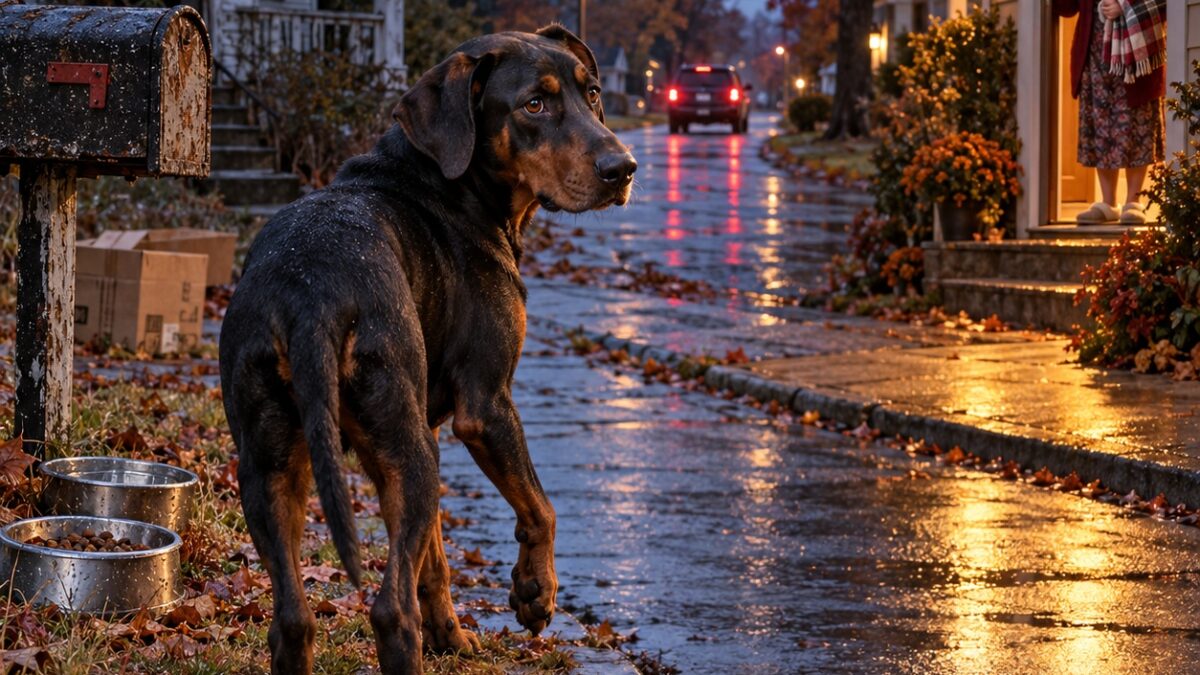
He was across the street near the mailbox.
Same position.
Then a car turned onto our road.
Older sedan.
Similar color to one the family had owned.
Max stood so fast his front paws slipped.
My knitting fell into my lap.
The car came closer.
Max’s entire body ignited.
Tail.
Movement.
He ran toward the edge of the property.
Stopped.
Ran several feet alongside the curb.
A sound came from him.
Not bark.
Not whine.
Something joyful.
Expectant.
It broke my heart before anything happened.
The car slowed.
For one second, I thought:
They came back.
I stood.
Max moved toward it.
The car passed the old house.
Passed him.
Driver looked once.
Kept going.
Turned at the end of the street.
Disappeared.
Max stood in the road.
Still.
Completely still.
I gripped the porch railing.
I had seen disappointment on his face twenty-five days in a row.
This was different.
Maybe because hope had risen higher.
He waited until the engine sound disappeared.
Then his tail dropped.
His head lowered.
For a long time, he stared toward the empty corner.
I could not move.
Neither could he.
Then Max did something I will remember until I die.
He turned.
Slowly.
Away from the road.
Away from the mailbox.
Away from the house where he had been left.
And looked at mine.
At me.
I stood in the doorway without realizing I had walked there.
My heart pounded.
“Max.”
He stared.
I didn’t call again.
No food in my hand.
No water.
No leash.
Nothing to lure him.
For the first time in twenty-six days, whatever happened next belonged entirely to him.
Max took one step.
Stopped.
Looked back at the road.
Then at me.
Another step.
Heavy.
Slow.
He crossed the grass.
Reached the curb.
Paused.
Crossed the street.
I could hear his nails touch pavement.
Click.
Click.
Click.
Each sound felt enormous.
He reached my walkway.
Stopped.
I opened the door wider.
Didn’t move toward him.
“Come in if you want.”
Max looked inside.
Then back toward the street.
I thought he might leave.
Instead, he climbed the two porch steps.
Stood directly in front of me.
Those dark eyes looked up.
I had never seen such exhaustion in an animal.
Not simply physical.
Something deeper.
As if the last twenty-six days had finally entered his body all at once.
He sniffed my hand.
Then walked past me.
Into my house.
No ceremony.
No dramatic embrace.
He walked to the center of the living-room rug.
Turned once.
Collapsed onto his side.
And sighed.
That sound still lives inside me.
A long, deep, broken exhale.
Not the comfortable sigh of a dog settling after dinner.
This was surrender.
Not surrender to death.
Surrender of vigilance.
For twenty-six days, Max had kept one part of himself on duty.
Listening.
Watching.
Expecting.
In my living room, he finally stopped.
I closed the door.
Very gently.
Then I lowered myself to the floor beside him.
My knees protested.
Eighty-year-old knees always have opinions.
I did not touch him immediately.
We lay there.
An old woman and an exhausted Doberman.
Evening darkening around us.
Max breathed.
I listened.
Eventually, I placed one hand against his back.
He didn’t move.
His warmth reached my palm.
“I won’t leave tonight.”
I whispered.
That was all.
The first three days inside my house were terrible.
Max did not eat.
Not one bite.
I offered food.
Meat.
Soft food.
Things no sensible dog should refuse.
He sniffed once.
Turned his head toward the wall.
He chose the darkest corner of the living room.
Lay there.
Eyes open.
Not watching the road anymore.
Watching nothing.
I began wondering whether coming into my house had not been hope at all.
Maybe he had simply run out of strength.
That frightened me.
I called a veterinarian.
Explained.
Abandonment.
Twenty-six days.
No food for three days.
We monitored him closely.
Nothing suggested immediate physical crisis that required removing him from the house, but his intake had to improve.
I was told what I already sensed.
Don’t force.
Offer.
Hydrate.
Watch.
Give time.
Time.
Funny word.
Max had already given twenty-six days to people who didn’t come back.
Now I had to ask him to give life a little more.
Every morning at six, I made coffee.
Then sat on the floor near him.
Not beside enough to crowd.
Near.
I read.
Knitted.
Sometimes spoke.
Sometimes did nothing.
My goal was simple:
Become predictable.
At eighty, I was very good at predictable.
Same footsteps.
Same coffee.
Same chair.
Same bowl.
Same voice.
Same house.
Same woman who did not disappear.
I wanted Max’s nervous system to learn before his mind could.
This place remains.
Food returns.
Water returns.
She returns.
I cleaned dust from his coat.
Slowly.
At first, his muscles tightened beneath my hand.
Then less.
I would rest my palm on his ribcage just to feel him breathing.
In.
Out.
Alive.
On the fourth day, he drank more.
The fifth, he stood long enough to move to another spot.
Then back.
On the sixth evening, he ate.
Three bites.
Maybe four.
I sat across the room.
Pretended not to watch.
Old women can act.
Not well.
But sufficiently.
Max chewed.
Swallowed.
Paused.
Ate another bite.
I smiled at my knitting.
Tears fell onto the yarn.
I did not make a sound.
He stopped soon after.
That did not matter.
Something inside him had chosen continuation.
The second week began with movement.
Max got up during the day.
Not just to drink.
He explored.
One room at a time.
Living room first.
Nose against chair legs.
Wall.
Doorframe.
Kitchen.
He sniffed the lower cabinets.
Found the trash can instantly.
Excellent sign.
I said:
“Absolutely not.”
Max glanced at me.
I nearly celebrated the disobedience.
He entered the hallway.
Bedroom.
Stopped at Charles’s old study.
That room had remained almost unchanged after my husband’s death.
Desk.
Books.
Old chair.
Max stood in the doorway.
Sniffed.
I watched from behind.
Something about that sight hurt.
A grieving dog entering a room belonging to a dead man whose grieving wife had barely changed it.
Two kinds of waiting meeting.
Max stepped inside.
Sniffed the chair.
Then came out.
I closed the door later.
Not because Max had done anything.
Because I suddenly understood how much of my own house had become memorial instead of home.
That realization embarrassed me.
I had judged Max for watching the road.
Meanwhile, I had spent years looking backward in quieter ways.
I still set Charles’s mug near the back of the cupboard.
Couldn’t throw it away.
Kept his coat.
His newspapers.
A drawer full of things no one needed.
I wasn’t standing at a mailbox.
But perhaps I had one inside me.
Max moved through my house.
I began wondering whether both of us were learning the same map.
End of the second week, rain came.
Hard.
Steady.
I sat in my armchair knitting.
Max had eaten better that day.
Still no tail.
Still no play.
But present.
He crossed the room.
I assumed he wanted water.
Instead, he stopped in front of me.
Looked up.
I froze.
He sat.
Then slowly lowered his enormous head onto my knees.
The weight surprised me.
Heavy.
Warm.
Trusting.
I stopped breathing.
My hands hovered.
Didn’t want to ruin it.
Then I placed one hand on his head.
Max exhaled.
Tears came.
Immediate.
Uncontrolled.
I hated that.
Not because crying is weakness.
Because I worried my emotion would frighten him.
“Sorry.”
My voice trembled.
Max lifted his head.
Looked at me.
I wiped one cheek.
“You’re not supposed to be taking care of me.”
He extended his tongue.
Licked my trembling hand once.
One time.
Then put his head back on my lap.
I broke.
Not loudly.
Just tears.
Years of loneliness.
Charles.
Max.
Empty rooms.
Waiting.
All of it.
We stayed like that until the room became dark.
That was the first evening I stopped thinking:
I’m helping this dog.
Something mutual had begun.
Third week.
The tail.
Tiny.
Almost nothing.
I set his breakfast down.
Max walked toward it.
The tip of his tail moved once.
I saw.
Did not react.
I had learned enough not to turn a fragile moment into spectacle.
“Breakfast.”
I said casually.
Inside, fireworks.
He ate.
Tail moved again.
Later that week, he followed me into the kitchen.
Then living room.
Then back.
Not attached constantly.
But checking.
Where are you?
Here.
Good.
The first time I used the bathroom and opened the door to find Max waiting outside, I laughed.
“You have boundaries to learn.”
He followed me anyway.
By week four, the house began sounding alive.
Nails on floor.
Water bowl.
Dog moving.
These are small sounds.
When you’ve lived alone too long, small sounds are company.
One morning, I found an old tennis ball at the back of a hall closet.
Charles had kept it for some reason.
Maybe grandkids.
Maybe a neighbor’s dog.
Yellow faded nearly gray.
I dropped it in the hallway and forgot.
Later, Max saw it.
Stopped.
I watched from the kitchen.
He lowered his head.
Sniffed.
Stared.
Then picked it up.
My hands froze over the sink.
Max turned toward me.
Walked down the hall.
Not slow.
Not quite energetic.
Intentional.
Reached me.
Dropped the ball at my feet.
Then gave a short whine.
I stared.
“You want me to throw this?”
Max looked at the ball.
Then me.
I bent.
Picked it up.
My shoulder was eighty too, so the throw wasn’t impressive.
The ball bounced down the hallway.
Max ran.
Ran.
Not walked.
Not shuffled.
Ran.
His feet slipped once on the floor.
He caught himself.
Reached the ball.
Grabbed it.
Turned.
Came back.
Tail wagging.
Full movement.
Left.
Right.
Left.
I laughed.
The sound startled me.
Not Max.
Me.
I hadn’t laughed like that in years.
A real laugh.
Not polite.
Not social.
Something uncontrolled.
Max stopped.
Looked.
Tail increased.
I threw again.
He ran.
When he returned the second time, I sat on the floor.
He put the ball in my lap.
“You’re going to kill me.”
Wag.
We played until Max tired.
Which did not take long.
He lay beside me.
Tongue out.
Eyes brighter.
For the first time, I saw the dog underneath the waiting.
Playful.
Proud.
Alive.
That night, he lay naturally against my ankles while I read.
No invitation.
No hesitation.
I stroked his head.
Max sighed.
This sigh was different from the first night.
That first sigh had sounded like collapse.
This one sounded like rest.
There is a profound difference between giving up and letting go.
Max was learning the second.
So was I.
Week five brought the hardest step.
Outside.
Not backyard.
Front door.
Street.
I had been letting Max into the garden, but our walks remained limited.
Eventually, he needed the world again.
I clipped on a leash.
Max seemed excited until I opened the front door.
He stepped onto the porch.
Stopped.
His entire body went rigid.
I followed his gaze.
Across the street.
The old house.
The mailbox.
The road.
The place he had waited twenty-six days.
Max trembled.
I almost closed the door.
Every protective instinct said:
Don’t make him face it.
Then I remembered how I had sat with him.
No forcing.
No dragging.
I stepped beside him.
Kept slack in the leash.
Waited.
One minute.
Two.
Three.
Max stared at the mailbox.
A car passed.
His head followed.
My chest tightened.
Would he return to the old vigil?
Would everything we built disappear?
I said nothing.
The choice had to be his.
Max looked at the road.
Then the empty house.
Then slowly turned his head toward me.
Our eyes met.
He stepped forward.
Away from the mailbox.
I moved with him.
We walked.
Past my gate.
Down the sidewalk.
Max looked ahead.
Trees.
Grass.
New smells.
The park.
He did not look back again.
Not once.
I cried on that walk too.
I’ve cried an unreasonable amount because of one Doberman.
Week six, his voice returned.
We were in the garden.
Squirrel.
Fast.
Tree branch.
Max snapped upright.
Chest forward.
And barked.
Deep.
Powerful.
One enormous sound.
The squirrel disappeared.
I jumped.
Then laughed so loudly Max spun toward me.
“There you are!”
He barked again.
Not distress.
Not defense.
Life.
Pure canine outrage at squirrels.
Beautiful.
I laughed until my side hurt.
Max ran one circle around the garden.
Then another.
Tail up.
The house across the street might as well have been on another planet.
By week seven, the transformation was undeniable.
Max greeted mornings.
Ate as though no meal had ever been guaranteed.
Brought me the ball.
Followed me room to room.
If I took my coat from the hook, he appeared instantly.
“No.”
Stare.
“I’m going to the pharmacy.”
Stare.
“You cannot come.”
Tail.
I usually surrendered.
He rode beside me.
Waited in the car when weather allowed.
Came on walks.
Sat near my feet while I had coffee.
At night, I talked.
To Max.
To Charles sometimes through Max.
About aging.
About fear.
About how strange it is to outlive parts of your own life.
Max listened.
Head on my knee.
Sometimes he’d lick my hand when my voice changed.
Maybe coincidence.
I chose not to care.
One evening, I spoke aloud what I had avoided admitting.
“I was waiting too.”
Max lifted his head.
“For Charles.”
Silence.
“For the life we had.”
I looked toward his face.
“I thought because I stayed in this house, I was living.”
He blinked.
“But maybe I was doing what you did at that mailbox.”
I laughed sadly.
“Watching the road.”
Max put his chin back down.
There it was.
The truth.
I had believed Max’s healing was about teaching him his family wasn’t returning.
No.
Healing was teaching him that a future could exist even though they didn’t.
Same for me.
Loyalty is beautiful.
But loyalty is not the same as freezing yourself beside an absence forever.
Memory is love when it warms you.
It becomes a cage when it prevents movement.
Max taught me that without meaning to.
He turned away from the road.
Eventually, I did too.
Late summer.
Sunset.
We sat on the terrace.
Sky orange.
Max beside me.
I put one arm around his powerful neck.
He was healthier.
Coat shiny.
Weight back.
Eyes alive.
“Max.”
Ears.
“You’re my home now.”
He looked at me.
Then climbed onto the bench.
Far too large.
Pressed his chest against mine.
Buried his muzzle into my neck.
I laughed.
“Personal space.”
No interest.
I wrapped both arms around him.
Two lonely creatures.
Different species.
Same lesson.
You can lose a home and build another.
A year passed.
One full year.
The Max who waited by the mailbox felt like a ghost from another life.
He ran in the park.
Barked at birds.
Greeted neighbors.
Played.
Loved the ball.
Loved food.
Loved walks.
Loved me.
But the greatest change wasn’t energy.
It was what happened when I left.
At first, every exit terrified him.
Keys.
Coat.
Door.
Max would follow.
Block.
Pace.
When I returned, his reaction was frantic.
Gradually, we practiced something essential.
I leave.
I come back.
Again.
Again.
Short trip.
Return.
Longer.
Return.
One day, I came home from the market.
Max was asleep.
He heard the door.
Lifted his head.
Tail wag.
No panic.
No explosion.
He trusted the return.
That was victory.
Not that he forgot abandonment.
That he learned absence can mean something else.
A parenthesis.
Not an ending.
Sometimes I looked at the mailbox across the street.
The old one.
Same place.
I waited for anger.
At first, there had been plenty.
How could they?
How do you abandon a dog who waits like that?
I imagined confronting them.
Demanding explanation.
Over time, the anger lost its grip.
Not because I approved.
Never.
But because Max no longer lived there emotionally.
Why should I?
Their choice remained cruel.
But it no longer defined him.
And I refused to let it define the life we built.
One thing I did not do was tell myself everything “happened exactly as it should.”
Pain doesn’t need to be justified by the good that follows.
They should not have abandoned him.
Charles should not have died when he did.
Loneliness is not made noble because later something beautiful arrives.
Both truths can exist.
What happened was wrong.
What came after became beautiful.
That’s enough.
Max taught me something more honest than fate.
We cannot choose every loss.
We can choose what we do once loss leaves space behind.
For twenty-six days, Max filled that space with waiting.
Then one evening, he chose a door.
Mine.
And I chose to open it.
Everything after began there.
Our mornings became my favorite part.
I woke.
Sometimes Max already sat at the foot of the bed.
Watching.
As soon as my eyes opened, tail against floor.
Thump.
Thump.
Thump.
“Good morning.”
He sprang toward the kitchen.
I moved considerably slower.
“Show-off.”
Coffee.
Breakfast.
Terrace door.
Max into the garden.
One morning, dawn was unusually clear.
Max ran to the middle of the lawn.
Stopped.
Raised his head.
Closed his eyes.
Breathed in.
Sunlight touched his black coat.
I stood in the doorway.
That image cut through me.
Free.
Home.
Not waiting.
Just living.
And suddenly I realized I felt the same.
For years, this house had been the place where Charles used to live.
Then the place where I lived alone.
Now it was home again.
Different.
Not replacement.
New.
Max didn’t replace Charles.
Love doesn’t work that way.
He restored movement.
He gave me someone to care for.
Someone to speak to.
A reason to walk when I’d rather remain inside.
A reason to laugh.
A reason to notice morning.
Charles remained part of me.
Max became part of what came next.
There was room.
That may be the great surprise of grief.
You think the heart becomes permanently occupied by what it lost.
Actually, the heart can hold memory and new love at the same time.
It doesn’t betray one to accept the other.
Max proved that too.
He had loved a family that abandoned him.
I never needed him to erase them.
I needed him to discover their leaving wasn’t the last thing that would ever happen.
He did.
A year after he crossed my street, I found myself on the porch at approximately the same time of day.
Max lay beside my chair.
The road quiet.
A car turned the corner.
I felt my body tense automatically.
Memory.
Max lifted his head.
Looked at the car.
It approached.
Passed.
Max watched for perhaps one second.
Then put his head back on my foot.
That was the moment I knew.
He was free.
Not because he had forgotten.
Because the road had lost its power.
I bent.
Touched his head.
“You did it.”
Max yawned.
Apparently my emotional breakthroughs bored him.
Good.
He no longer needed to dramatize survival for me.
I often wondered what he thought the evening he crossed toward my house.
Did he consciously understand the car wasn’t returning?
No.
Dogs don’t frame loss in sentences the way we do.
Maybe he was simply tired.
Hungry.
Cold.
Maybe my house smelled familiar because of food.
Maybe twenty-six days of my presence had become enough evidence.
That’s okay.
The meaning does not require him to narrate it.
He chose connection over isolation.
That is what I saw.
I did the same afterward.
I began accepting invitations I used to refuse.
Tea with neighbors.
Small gatherings.
Park.
I spoke more.
Laughed more.
People noticed.
One woman said:
“You seem different.”
I pointed at Max.
“He’s exhausting.”
Max wagged.
She laughed.
But the truth was deeper.
Before Max, I thought aging meant gradually shrinking life.
Fewer people.
Fewer places.
Fewer reasons to begin something new.
Why begin when time is short?
Max destroyed that logic.
He could have spent the rest of his life at a mailbox because the life he knew was over.
Instead, he walked across the street.
At eighty, maybe I could too.
Not literally.
Though walking across streets is still within my skill set.
Emotionally.
Begin.
Even late.
Especially late.
Time being shorter does not make love less valuable.
It makes delay more expensive.
So I stopped delaying.
I planted new flowers instead of only maintaining Charles’s old garden.
I moved some furniture.
That was enormous for me.
Charles’s chair shifted six feet and civilization did not collapse.
I donated clothes.
Kept what mattered.
Opened his study.
Turned part of it into a reading room.
Max claimed the rug immediately.
Of course.
The past remained.
But the house could breathe.
One afternoon, I found an old photo of Charles with a dog from his childhood.
Large shepherd mix.
I sat with the photograph.
Max nearby.
“See?”
He lifted his head.
“Charles would’ve loved you.”
Tail.
“He would’ve spoiled you worse than I do.”
Max stood.
Walked closer.
Put his head on my lap.
“You miss people you’ve never met.”
I smiled.
“Very talented.”
We sat.
Memory without paralysis.
That was new.
People sometimes told me:
“You saved Max.”
I disliked that.
I fed him.
Opened a door.
Waited.
Took him to the veterinarian.
Gave him time.
But “saved” suggests one direction.
Max did something equally large.
Before him, I was not in danger of starving.
Not abandoned outside.
But I was disappearing quietly inside routines.
He interrupted that.
He needed breakfast.
Walk.
Play.
Attention.
I could not remain an observer of my own life while caring for Max.
He forced participation.
And in participating for him, I returned for myself.
So when people say:
“You rescued him.”
I answer:
“We met at the right door.”
That’s closer.
One year became more.
Each month made the old twenty-six-day vigil feel farther.
But I kept the calendar.
The one where I had marked the days.
I found it in a drawer.
Day 1.
Day 12.
Day 21.
Day 26.
I nearly threw it away.
Then kept it.
Not as tragedy.
Proof of distance traveled.
Day 26 was the last day Max watched the road as though his life belonged to people who had already left.
Day 27 began in my living room.
That deserves remembering.
His first three days without food.
First bites.
First head on my lap.
First tail.
First tennis ball.
First walk past the mailbox.
First bark.
All these tiny moments.
Healing rarely arrives as one dramatic event.
It accumulates.
A bite.
A step.
A touch.
A game.
A walk.
A bark.
A nap without fear.
Then one day, you look up and the creature you met inside despair is living again.
Humans are the same.
We want transformation to feel cinematic.
Usually it is domestic.
You make coffee.
Open curtains.
Someone places their head on your knee.
You laugh.
There.
Life.
Max’s abandonment was spectacularly cruel in its simplicity.
Drive away.
Leave.
But his healing was built from equally simple acts.
Feed.
Sit.
Return.
Walk.
Stay.
Maybe that is why healing won.
Cruelty can happen in one moment.
Trust often requires hundreds.
But hundreds of small good things eventually become a world.
That was our house.
A world made of return.
I would leave to shop.
Return.
Doctor appointment.
Return.
Visit neighbor.
Return.
Max learned.
I went to sleep.
Woke.
Still there.
I learned too.
We became each other’s evidence.
Some people don’t disappear.
Some love remains.
Not all doors close.
Not every car means abandonment.
Not every death means your own life is finished.
These are simple statements.
Hard to believe after loss.
We practiced them.
One day at the park, Max saw another Doberman.
Younger.
Full speed.
The young dog bowed to play.
Max stared.
Then attempted to match him.
Bad idea.
For twenty seconds, Max behaved like he was two years old.
Then realized he was not.
Came back to me panting.
I laughed.
“Regret?”
He collapsed at my feet.
The younger dog’s owner apologized.
“No.”
I smiled.
“He needed to remember.”
What?
“That he’s ridiculous.”
We laughed.
Max rested.
That evening, he slept deeper than usual.
I watched him.
So alive.
No road.
No mailbox.
No old family.
Just exhaustion earned from play.
Another victory.
As I grew older, people began asking practical questions.
What happens to Max if something happens to you?
Fair.
At eighty, love requires contingency.
I made arrangements.
Neighbors.
Documents.
Veterinary information.
A specific person who agreed to take him.
I did not enjoy doing it.
But after seeing what abandonment did, I would never leave his future to chance.
I sat beside Max after signing everything.
“You’re covered.”
Tail.
“You don’t care.”
Nothing.
“Good.”
Preparation is love too.
Not romantic.
Necessary.
I wanted Max to know, as far as human planning could guarantee:
You will not wait at another mailbox because nobody thought ahead.
That mattered to me.
Maybe because I could not control his first abandonment.
I could control this.
Over time, our neighbors stopped describing Max as “that poor dog.”
Thank God.
Pity becomes another cage if it lasts too long.
He became Max.
The dog who barked at squirrels.
The one who loved the park.
The one who stole toast if you looked away.
The one who escorted me on slow morning walks.
The one children asked to pet.
The one who leaned his entire body against people he liked.
Not abandoned Max.
Just Max.
Identity beyond injury.
That is a form of healing too.
One morning, a child near the park asked:
“Why does he have gray hair?”
I said:
“He’s distinguished.”
The child looked confused.
“Old.”
“Oh.”
She petted him.
Max leaned.
“He’s nice.”
“He is.”
“Was he always yours?”
I paused.
“No.”
“Whose was he?”
“A family’s.”
“Where are they?”
“They left.”
The child’s face changed.
“Without him?”
“Yes.”
“That’s mean.”
Direct.
Accurate.
Then she asked:
“Why is he happy now?”
I smiled.
“Because life didn’t end there.”
She accepted that.
Children sometimes understand the entire lesson in one sentence.
Life didn’t end there.
Neither did mine.
One late-summer evening, I returned to the terrace.
Same kind of orange sunset as the night I called him home.
Max beside me.
I said:
“Do you know what I think?”
He looked.
“I think Charles was right.”
No response.
“The street just watches.”
Max looked toward the road.
Cars.
People.
Mailbox.
Then back.
“The people change.”
He placed his head on my leg.
I stroked him.
“And sometimes dogs do too.”
The road had watched Max wait.
Then cross.
It had watched me sit alone in one house while he sat alone at another.
Eventually, it watched both of us choose the same door.
Maybe streets do watch.
Maybe they keep no judgment.
They simply hold the distance until someone crosses.
Today, when I wake, Max is often already watching me.
Not anxiously.
Expectantly.
Breakfast.
Garden.
Life.
His tail begins before I even stand.
Thump.
Thump.
I say:
“Give me a minute.”
No patience.
I get up.
He leads.
Sometimes I think about how he used to be motionless.
Twenty-six days.
Eyes on the road.
Now he rushes toward each morning.
That may be the greatest change.
Not forgetting.
Not replacing.
Moving.
Forward.
I wish I could explain that to the woman I was after Charles died.
There is no betrayal in moving forward.
You do not love the dead less by continuing to live.
You do not excuse abandonment by trusting someone new.
You do not erase the past by stepping away from its mailbox.
You carry love.
Then move.
Max didn’t teach me with words.
He simply did it first.
He turned.
Saw my house.
Crossed.
I followed in every way that mattered.
There are still mornings when the house feels old.
When my body reminds me I’m eighty.
When memory is heavy.
When Charles feels close enough that I almost expect his voice.
I don’t reject those mornings.
Grief never completely leaves.
It changes furniture.
Moves rooms.
Becomes quieter.
Max usually notices when I sit too long.
He comes.
Head.
Lap.
Same gesture from the second week.
I smile.
“I’m okay.”
He doesn’t leave.
Good.
Sometimes we say we’re okay because we want company to stop asking.
Dogs ignore that.
Max stays.
That is one of his gifts.
Presence without interrogation.
On bad days, we walk.
Slowly.
He smells everything.
I watch trees.
We return.
House feels lighter.
One step at a time.
That phrase sounds cliché until you have watched a creature recover exactly that way.
One step.
One bite.
One tail movement.
One ball.
One road crossed.
That’s how life comes back.
Not all at once.
Enough at a time.
I am eighty now.
I know time differently than I did at forty.
People tell younger people not to waste time.
At eighty, I would say something else.
Don’t assume time has stopped offering beginnings because you’ve already experienced endings.
Max was abandoned.
Beginning.
No.
It felt like an ending.
Then my door.
Beginning.
Charles died.
Ending.
Max arrived.
Not replacement.
Beginning.
Human lives contain many beginnings we fail to recognize because they don’t look like youth.
Sometimes a beginning is an old woman opening a door to an exhausted dog.
That’s enough.
I don’t know how many more years Max and I have.
Maybe several.
Maybe fewer.
I don’t waste much energy on the number.
I learned that from grief too.
The future does not become safer because you worry early.
Today is available.
Use today.
Feed him.
Walk.
Throw the ball.
Sit outside.
Talk to Charles.
Talk to Max.
Laugh at squirrels.
Live.
One morning recently, I found Max in the center of the lawn.
Sunrise.
Same posture I’d seen a year before.
Head raised.
Eyes closed.
Breathing the morning.
I stood in the doorway.
“Max.”
He turned.
Ran toward me.
Not because he feared I’d leave.
Because breakfast existed.
I laughed.
That’s the best possible reason.
He passed me into the kitchen.
I followed.
Home.
I think about that word often.
For years, home meant the building where Charles and I built our life.
Then after his death, the building remained while home felt absent.
For Max, home had once been the house across the street.
Then they left him.
A building can survive while home disappears.
That taught me something.
Home isn’t walls.
Walls can contain abandonment.
Home is trust.
Home is knowing the person who leaves for groceries comes back.
Home is a hand resting on your back when you cannot eat.
Home is someone waiting three minutes at a front door while you decide whether you’re ready to face the road.
Home is a dog putting his head in your lap when you cry.
Home is return.
Max and I built that.
Not immediately.
Repeatedly.
That matters.
The house across the street eventually gained new occupants.
A young couple.
They had no idea.
New curtains.
Garden.
Car in driveway.
For a while, I worried how Max would respond.
First day, he watched.
Sniffed.
Then moved on.
No vigil.
The mailbox changed.
Different paint.
Max did not care.
That was another freedom.
The place could become someone else’s present because it was no longer controlling his.
I met the new neighbors.
Nice.
They asked about Max.
“Beautiful dog.”
“Thank you.”
“Has he always lived with you?”
I looked at the house behind them.
“No.”
Then smiled.
“But he’s home now.”
That’s all they needed.
Some stories don’t have to be handed to everyone who enters the setting.
Max’s life had moved beyond the explanation.
That night, he slept beside my chair.
I knitted.
Music low.
No dramatic event.
And I thought:
This is the ending.
Not revenge against the family who left.
Not knowing why.
Not them returning to regret it.
None of that happened.
None was needed.
The satisfying ending was Max no longer caring whether that road brought them back.
The satisfying ending was me no longer spending my days thinking life had already given me everything it intended to.
We were both wrong about endings.
That is enough.
I still have the old calendar.
Sometimes I see “Day 26.”
The day of the car.
The disappointment.
Then the turn.
If I had to choose one moment from our entire story, it wouldn’t be Max playing ball.
Or barking.
Or the first walk.
It would be that turn.
Slow.
Painful.
Uncertain.
Because healing often begins before anything feels healed.
It begins when you change direction.
Max had no guarantee my house would be kind.
He had evidence.
Food.
Water.
Twenty-six days of an old woman showing up.
But he still had to risk.
Trust requires risk after betrayal.
He crossed.
I opened.
Everything else came after.
Maybe that is the lesson I carry most.
When someone has been abandoned, don’t demand immediate trust.
Give evidence.
Be predictable.
Show up.
Again.
Again.
Again.
Let them choose the step.
Max chose on day twenty-six.
I waited.
If he had needed thirty, I hope I would have waited thirty.
If sixty, perhaps sixty.
You cannot rush a wounded creature toward safety and still call it safety.
Safety must feel voluntary.
That applies to animals.
Maybe people too.
I tell Max sometimes:
“You were very difficult.”
He wags.
“Twenty-six days.”
Wag.
“Then three days without food.”
Wag.
“Then you invaded my bed.”
Wag harder.
“I should charge rent.”
He brings the ball.
Argument won.
The ball still has extraordinary diplomatic power.
I throw.
Slowly.
Max runs.
Not as fast now.
Still with purpose.
Returns.
Drops.
I pick it up.
Again.
Small repetition.
Love is full of them.
The same action becoming meaningful because the one asking is still here.
I used to fear repetition after Charles.
Every day looked the same.
Now repetition feels different.
Max wakes.
Tail.
Coffee.
Breakfast.
Garden.
Walk.
Ball.
Nap.
Music.
Evening.
Repeat.
Routine is not emptiness when shared.
It is intimacy.
The knowledge of what comes next.
Something Max needed desperately.
Something I did too.
He taught me routine can be alive.
Maybe Charles knew that.
Forty years of marriage is mostly repetition.
Coffee.
Dinner.
Inside jokes.
Same person returning.
At the time, I did not understand the value.
Loss taught me.
Max reinforced it.
The grand gestures are memorable.
The returns are what build home.
If I ever meet the family who left Max, I don’t know what I would say.
Years ago, I imagined anger.
“You didn’t deserve him.”
Maybe true.
Now?
I think I’d simply keep Max close.
There may be explanations.
There may not.
Understanding is not required for healing.
That’s another thing age teaches.
You can spend decades demanding why from events that never answer.
Sometimes peace begins when the question stops controlling you.
Why did they leave him?
I don’t know.
Why did Charles die first?
I don’t know.
Why did Max cross to me on day twenty-six instead of twenty-five?
I don’t know.
The unknowns remain.
Life continues anyway.
That is not resignation.
It’s freedom.
Max lives in what is.
I try.
This morning, I woke before sunrise.
Max was sitting at the foot of the bed.
Watching.
As soon as I opened my eyes, tail.
Thump.
Thump.
“Good morning.”
He stood.
Stretched.
Moved toward the kitchen.
I dressed slowly.
Followed.
Fed him.
Opened the terrace.
Max ran out.
Stopped in the grass.
Lifted his head.
Morning air.
I watched.
No mailbox in his attention.
No road.
No car.
The present.
Then he turned toward me.
I stepped outside.
For a moment, I saw both of us as we had been.
Max across the street.
Me behind my window.
Two lonely lives within sight of each other.
Neither aware how much the other would matter.
Then I saw us now.
Same street.
Different world.
I put my hand on his head.
“Let’s go.”
We walked into the garden together.
The house behind us.
Home.
I am Éléonore.
I am eighty years old.
For more than forty years, I thought I knew what that word meant.
A house.
Marriage.
History.
Possessions.
A place where you stay.
Max taught me otherwise.
Home is not where you remain because you cannot move.
That was what his old yard became.
That was what my grief had almost made of this house.
Home is where you are safe enough to move and trust enough to return.
Home is where absence is followed by return often enough that the heart stops expecting abandonment.
Home is where someone sees your brokenness and does not rush you.
Where a bowl appears even if you refuse it.
Where someone sits on the floor until you’re ready.
Where a leash stays loose while you decide whether to walk forward.
Where grief is allowed but not worshiped.
Where love says:
I remember what happened to you.
But it doesn’t have to be the last thing that happens.
Max became that place for me.
I became it for him.
And if there is one moment I will carry with me for whatever years remain, it is not the morning he barked again.
Not the ball.
Not the park.
Not even the sunset when I called him my home.
It is the moment after that wrong car disappeared.
Max standing in the road.
Hope shattered for the twenty-sixth time.
Then slowly turning his head toward my house.
Toward me.
He had spent almost a month believing life could only return from one direction.
That evening, he discovered another.
One step.
Then another.
Across the road.
Up the porch.
Through the door.
Into a new life.
Sometimes the greatest act of courage is not waiting longer.
It is realizing what you’re waiting for is not coming back—
and choosing to walk toward the love that has been there beside you all along.








