PART2:For 13 Years, This K9 Found Missing People—When He Retired, He Was Left in a Shelter Until One Voice Brought Him Back
PART2
The first newspaper article I found was almost twelve years old.
The photograph was grainy.
A younger version of the dog stood beside a uniformed officer near the edge of a wooded search area.
Same ears.
Same dark mask.
Same eyes.
Only brighter.
The caption identified him as a search-and-rescue K9 assigned to a regional law-enforcement unit.
Another article mentioned a missing hiker.
Another, an elderly man with dementia.
Then a child who had disappeared near a wooded campground.
The deeper I searched, the more the dog in our shelter seemed impossible.
For more than a decade, he had worked.
Human remains searches.
Missing persons.
Disaster response.
Wilderness tracking.
He had been deployed across county lines.
Called out overnight.
Used when volunteers could not find a trail.
One article described how he had worked almost seven hours through rain before locating a disoriented teenager beneath a rocky overhang.
Another praised him for following a scent through miles of forest.
There was always one officer beside him.
Same man.
Younger in the early photos.
Older in the later ones.
Sometimes in uniform.
Sometimes tactical clothing.
Sometimes kneeling with one hand resting against the dog’s shoulder.
The captions named him as Officer Thomas Reed.
Handler.
Partner.
I looked from the photograph to the kennel.
The old Malinois sat in his corner.
I whispered:
“What happened to you?”
The records became less clear toward the end.
Retirement.
Unit restructuring.
Dog reassigned.
Then nothing.
No article explaining where he went.
No retirement ceremony I could find.
No family update.
No photograph of him sleeping beside a fireplace.
Just silence.
The following morning, I began looking for Thomas Reed.
It was harder than I expected.
Old department articles listed rank and service history but no current contact information.
The phone number attached to one archived K9-unit directory was disconnected.
I called former officers whose names appeared beside his in photographs.
Some remembered him.
Few knew where he had gone.
“Tom retired years ago.”
“He moved, I think.”
“Maybe south?”
“His wife got sick.”
“I haven’t talked to him in forever.”
One retired lieutenant remembered the dog immediately.
“You’ve got him?”
“Yes.”
“Are you sure?”
I read the microchip number.
Silence.
“God.”
“What?”
“That dog was everything to Tom.”
“Do you know where he is?”
“No. But I know somebody who might.”
That began three more days of phone calls.
Names.
Old numbers.
Voicemails.
One person led to another.
Finally, an elderly former dispatcher gave me a mobile number.
“I can’t promise it’s current.”
“Thank you.”
“If Tom answers, tell him Claire Madison gave you the number.”
“I will.”
“And…”
She paused.
“What?”
“Be gentle.”
That stayed with me.
I sat at my desk staring at the number.
I had made difficult calls before.
In shelters, difficult calls are part of the work.
Your animal was found injured.
Your surrender was denied.
The dog you asked about was adopted.
The dog you surrendered is very sick.
But this call felt different.
What exactly was I supposed to say?
Hello, you don’t know me, but the dog you worked beside for thirteen years is sitting alone in our shelter and seems to have forgotten how to hope.
I almost texted instead.
That felt cowardly.
So I called.
Three rings.
Four.
Then a man answered.
“Hello?”
His voice was older.
Low.
Cautious.
“Mr. Reed?”
“Yes?”
“My name is Rachel Bennett. I work at the county animal shelter.”
Silence.
“All right.”
“I’m sorry to call unexpectedly. I was given your number by Claire Madison.”
His tone softened slightly.
“Claire?”
“Yes.”
“I haven’t heard that name in years.”
“I’m calling because we have a dog here, and I believe he may have worked with you.”
Another silence.
Longer.
“What dog?”
I said the name from the old records.
“Ranger.”
Nothing.
I actually checked the phone screen to make sure the call had not disconnected.
“Mr. Reed?”
“That’s not possible.”
His voice had changed completely.
Not skeptical.
Shaken.
“It is Ranger.”
“No.”
“I have his chip record.”
“No, I mean…”
He stopped.
I waited.
“I thought he was still with the unit.”
That sentence told me more than every archive I had searched.
“You haven’t seen him?”
“Not in years.”
His breathing became audible through the phone.
“When I retired, they told me he would remain under departmental care.”
“How old was he?”
“Eight.”
“And you left him there?”
Silence again.
Then, quietly:
“I thought I was doing what was right.”
I regretted the wording immediately.
“I didn’t mean—”
“No.”
His voice tightened.
“It’s fair.”
“I’m not judging you.”
“I am.”
I let that sit.
He continued.
“I had health problems. My wife had just been diagnosed. The department said Ranger still had working value. They wanted to pair him with another handler for limited duty.”
“Did that happen?”
“For a while.”
“What happened after?”
“I don’t know.”
There was shame in those words.
I had heard it before from people who surrendered animals under circumstances they regretted.
Life moves.
Crisis happens.
You tell yourself the animal is safe.
Then time becomes distance.
“I thought somebody would call me when he fully retired,” Thomas said.
“No one did?”
“No.”
“I’m sorry.”
“How is he?”
That question was harder.
I could have softened it.
I did not.
“He’s shut down.”
His breath caught.
“He doesn’t play.”
Nothing.
“He eats, but without much interest.”
Nothing.
“He mostly stays in one corner.”
I looked toward Ranger’s kennel through the office window.
“He barely responds to people.”
Thomas asked:
“Does he seem sick?”
“Physically, he’s old, but stable.”
“Arthritis?”
“Some.”
“Hip?”
“Mild.”
“Teeth?”
I smiled despite everything.
“You still know him.”
“I knew every tooth in that dog’s mouth.”
His voice broke on the last word.
I looked down.
Thomas whispered:
“Do you think he remembers me?”
There was no safe answer.
“I don’t know.”
Silence.
“But I think it’s worth finding out.”
He said nothing.
Then:
“Can you send me a picture?”
“Yes.”
I went immediately.
Ranger was exactly where he always was.
Corner.
Head down.
I opened my phone.
For a moment I hated taking the picture.
It felt wrong.
This dog had once stood proudly in newspaper photographs.
Now I was sending the man who loved him an image of what years had done.
I took it anyway.
Sent it.
Then waited.
Five minutes.
Ten.
My phone rang.
Thomas.
I answered.
He said only:
“That’s him.”
Two words.
His voice was barely there.
Then:
“That’s my boy.”
I pressed my lips together.
“I’m sorry.”
“No.”
He inhaled.
“I’m coming.”
“When?”
“Tomorrow.”
“You don’t have to rush.”
“I’ve already been too slow.”
The call ended.
I walked back to Ranger.
Sat outside his kennel.
“Someone’s coming tomorrow.”
No reaction.
I smiled.
“He says he knows you.”
Ranger kept staring at the floor.
“I think you know him too.”
Nothing.
I left him alone.
But that night, I could not stop wondering what would happen.
Maybe Thomas would arrive and Ranger would not react.
Dogs remember scent.
Voice.
Routines.
But years had passed.
Ranger was old.
Perhaps memory had faded.
Perhaps too much had happened.
Perhaps we were attaching a romantic ending to something biology had already erased.
I told myself not to expect anything.
The next morning, I got to work almost an hour early.
Ranger was in the same corner.
I sat down.
“Big day.”
He ignored me.
“Don’t embarrass me.”
One ear twitched.
I laughed.
“I saw that.”
Hours passed.
Morning cleaning.
Medication.
Adoption appointments.
A stray Labrador came in.
Two cats went home.
Still no Thomas.
Around noon, I started worrying.
Maybe he had changed his mind.
Maybe this was too painful.
Then I heard footsteps.
Not rushed.
Slow.
Measured.
I turned.
A man stood at the far end of the corridor.
He looked nothing like the young officer in the earliest photographs.
His hair was almost entirely white.
Shoulders slightly rounded.
Deep lines around his eyes.
No uniform.
Jeans.
Dark jacket.
But the eyes were recognizable immediately.
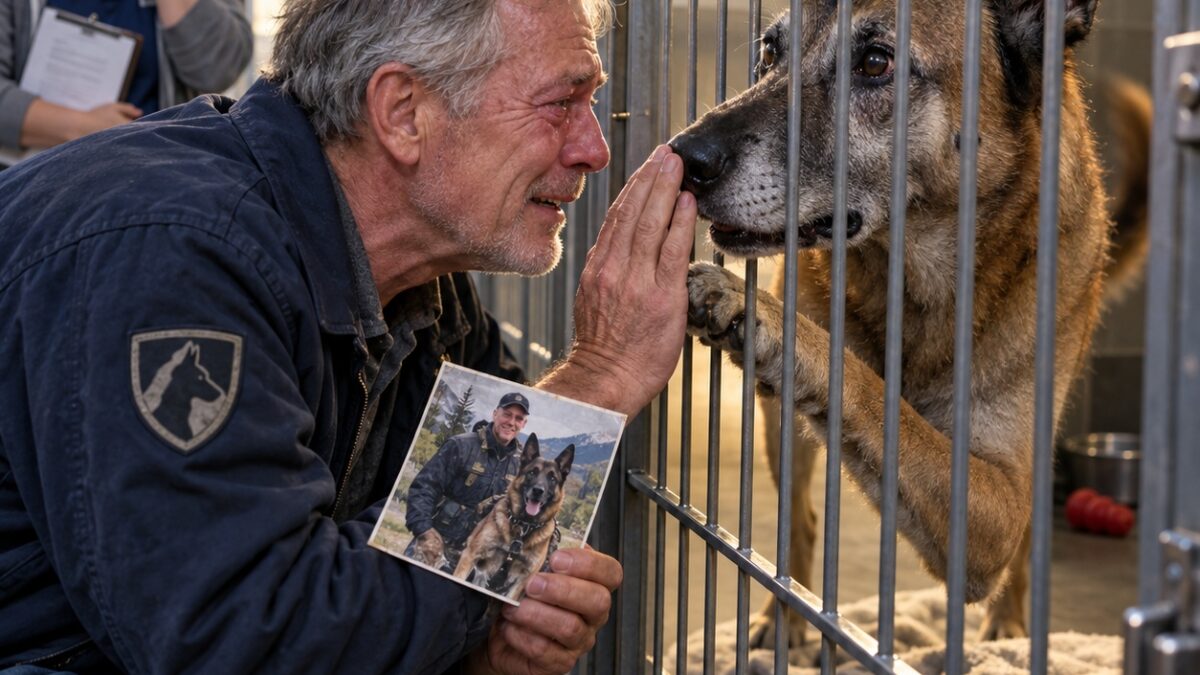
Thomas Reed looked at Ranger.
And stopped.
He did not approach.
For several seconds, neither of them moved.
Ranger had not noticed him.
His head remained down.
Thomas swallowed.
Then whispered:
“Ranger.”
The dog’s ear moved.
I stopped breathing.
Thomas said it again.
“Ranger.”
The old Malinois lifted his head.
Barely.
His eyes moved toward the corridor.
Thomas stood frozen.
Ranger stared.
His head rose higher.
Then both ears came up.
Fully.
For months, I had never seen them stand like that.
Thomas took one step.
“Hey, buddy.”
Ranger stood.
Slowly.
His legs were stiff.
He looked at Thomas as if trying to fit the old face over a younger memory.
Thomas moved closer.
Stopped outside the kennel.
Placed one hand against the bars.
“Come here.”
Ranger remained still.
I saw Thomas’s expression tighten.
Then Ranger took one step.
Another.
Then faster.
He reached the gate.
Sniffed Thomas’s fingers.
Once.
Again.
Longer.
His body trembled.
Thomas whispered:
“It’s me.”
Ranger’s tail moved.
Just an inch.
Then again.
Then harder.
I covered my mouth.
Thomas dropped to his knees.
“I’m here.”
Ranger pressed his muzzle through the bars.
Thomas put both hands around his face.
His forehead fell against the metal.
“God, Ranger.”
The dog whined.
One soft sound.
I had never heard him make it.
I unlocked the kennel.
Thomas looked at me.
“Can I?”
“Please.”
I opened the gate.
For a second Ranger stayed inside.
Then walked out.
Stopped directly in front of Thomas.
They looked at each other.
That moment felt longer than it was.
The years between them seemed visible.
Thirteen years of work.
Then separation.
Then whatever had happened afterward.
Thomas reached up carefully.
Ranger stepped forward.
Pressed his muzzle against Thomas’s shoulder.
Thomas broke.
Not quietly.
Not elegantly.
He wrapped both arms around Ranger and sobbed.
“I’m sorry.”
Ranger leaned into him.
“I’m so sorry.”
I stepped away.
Some reunions should not have an audience.
I stood near the end of the corridor pretending to reorganize a clipboard while tears ran down my face.
When I looked back, Thomas was sitting on the floor.
Ranger lay beside him.
Head across his lap.
Thomas stroked the familiar spot behind his left ear.
Same rhythm.
Again.
Again.
Again.
Ranger’s eyes were closed.
Peaceful.
Not exhausted.
Peaceful.
It was the first time I had ever seen him look at home.
They stayed there almost forty minutes before Thomas finally spoke to me again.
“Thank you.”
“You came.”
“You called.”
“I almost didn’t.”
He looked down at Ranger.
“I almost lost him forever.”
I sat across from them.
“Tell me about him.”
Thomas smiled through wet eyes.
“What do you want to know?”
“Everything.”
So he did.
Ranger had entered training young.
Energetic.
Too energetic, according to Thomas.
“He thought every search was the most important event in human history.”
“Maybe it was to him.”
Thomas laughed.
“Probably.”
Their first real call had been for a missing elderly woman who wandered away from assisted living.
Ranger found her near a drainage ditch after three hours.
“She was cold and angry.”
“Angry?”
“She slapped me because we woke her.”
I laughed.
“Ranger loved her.”
“Of course.”
Then came bigger cases.
A missing hunter.
Two teenagers lost after hiking off-trail.
A flood evacuation where Ranger helped locate a man trapped inside brush.
But one search stayed with Thomas.
A little boy.
Six years old.
Missing for nearly two days.
Hundreds of volunteers.
Helicopters.
Dogs.
Search lines.
The temperature dropping.
Ranger picked up the scent near a creek.
Pulled Thomas through brush for miles.
At one point Thomas wanted to stop.
“He wouldn’t.”
“What happened?”
“He dragged me another half mile.”
Ranger slept through the story.
Thomas’s hand never stopped touching him.
“They found the boy under a fallen tree.”
“Alive?”
Thomas nodded.
“Barely.”
He looked down.
“Ranger found him.”
I swallowed.
“He must have saved lives.”
Thomas was quiet.
“Maybe.”
Then he said:
“He never understood any of that.”
“What do you mean?”
“He didn’t know about awards.”
“Of course.”
“He didn’t know newspaper stories.”
Thomas smiled.
“He knew one thing.”
“What?”
“Find.”
The word changed Ranger.
His eyes opened.
Head lifted.
Thomas froze.
I stared.
He said softly:
“Find.”
Ranger’s ears rose.
His entire body seemed younger for half a second.
Thomas laughed through another wave of tears.
“You still know.”
Ranger’s tail thumped against the floor.
Thomas looked at me.
“That was his word.”
“I can tell.”
“He’d search until his paws bled if I let him.”
“Did you?”
“No.”
“Good.”
“He hated breaks.”
Ranger rested his head again.
Thomas sighed.
“I never thought he would end up here.”
That changed the mood.
I waited.
Thomas continued.
“When my wife got sick, I retired earlier than planned.”
“What was wrong?”
“Cancer.”
“I’m sorry.”
“She lasted eighteen months.”
His voice became quieter.
“Ranger was still active. The department said keeping him in the unit was better than sending him home with me while I was caring for her.”
“You believed them.”
“I wanted to.”
He looked at Ranger.
“I thought I was choosing both of them.”
No accusation.
Just pain.
“After she died, I called.”
“What happened?”
“They said he had been transferred.”
“Where?”
“Another regional program.”
“Did you call them?”
“I did.”
“And?”
“He’d been moved again.”
A familiar bureaucratic chain.
Unit restructuring.
Budget.
Handler transfer.
Records.
One organization assuming another would call.
“What then?”
Thomas looked ashamed.
“I stopped.”
I said nothing.
“I told myself he was working.”
His hand tightened slightly in Ranger’s fur.
“I told myself working was what he loved.”
“Maybe it was.”
“That doesn’t excuse me.”
“No.”
He looked at me.
I did not soften it because he had not asked me to.
“But it explains something.”
He nodded.
“I should’ve found him.”
“Maybe.”
“I found hundreds of people with this dog.”
His voice cracked.
“And I couldn’t find him.”
Ranger lifted his head.
Thomas looked down.
“Sorry.”
The old dog licked his wrist.
Thomas laughed painfully.
“You see? He forgives faster than humans.”
“Dogs don’t keep score the same way.”
“No.”
“Maybe that’s why we need them.”
He nodded.
I asked:
“What happened after his last transfer?”
“I don’t know.”
We eventually learned pieces.
The second handler left the department.
Ranger was too old for full operational work.
He was transferred to a contracted retirement placement.
That program closed.
Records became incomplete.
Somewhere in that chain, Ranger stopped being a decorated working K9 and became simply an aging dog nobody could clearly assign to anyone.
Eventually he was surrendered.
Not maliciously.
Negligently.
Almost worse.
No dramatic villain.
No one person dumping him at a gate.
Just institutions assuming someone else was responsible.
Responsibility diluted until nobody felt it anymore.
Thomas listened when I explained.
His jaw tightened.
“Thirteen years.”
“I know.”
“He gave them thirteen years.”
“I know.”
“And nobody called.”
“I’m sorry.”
He sat silently.
Then Ranger pushed his nose beneath Thomas’s hand.
Thomas looked at him.
“You don’t care, do you?”
Tail.
“You got me now.”
Tail again.
I smiled.
“Looks that way.”
Thomas looked at me.
“What happens now?”
“That depends.”
“On?”
“You.”
He nodded immediately.
“I’m taking him home.”
I had expected it.
Still, I needed to ask.
“Are you sure?”
Thomas almost looked offended.
Then understood.
Shelter protocol.
Old dog.
Older adopter.
Medical needs.
Adjustment.
Responsibility.
“Yes.”
“Ranger has arthritis.”
“I have arthritis.”
“He needs medication.”
“So do I.”
“He may have accidents.”
“So might I eventually.”
I laughed.
Thomas smiled.
“I’m serious.”
“So am I.”
“He may have trouble adjusting to another move.”
Thomas looked down.
“I’m not moving him again.”
Something in his voice told me that was final.
We began paperwork that afternoon.
Normally, reunification and adoption after such an unusual history would take time.
Verification.
Veterinary review.
Home assessment.
Ownership clarification.
But Thomas participated in all of it.
No frustration.
No “Do you know who I am?”
No attempt to bypass rules.
He answered questions.
Provided records.
Allowed a home check.
Discussed medication.
Exercise.
Senior-dog nutrition.
Emergency care.
“What happens if you become unable to care for him?” I asked.
“My daughter.”
“Does she agree?”
“She’s already crying and buying him a bed.”
“Good.”
“She remembers him.”
“How?”
“She was nine when we got him.”
That stopped me.
“She grew up with Ranger?”
“Until she left for college.”
Another lost connection.
Thomas showed me a photograph on his phone.
Young girl sitting beside a younger Ranger.
“Her name is Emily.”
“She knows?”
“I called her from the parking lot.”
“What did she say?”
Thomas smiled.
“She said if I come home without him, she’ll disown me.”
“Reasonable.”
The home check happened two days later.
Thomas lived in a modest ranch house outside town.
Clean.
Quiet.
Fenced backyard.
One bedroom had already been converted into what looked suspiciously like a luxury retirement suite for one Belgian Malinois.
Orthopedic bed.
Rug runners so Ranger would not slip.
Raised food bowls.
A basket of toys.
I looked at Thomas.
“You did all this in forty-eight hours?”
“My daughter has Amazon Prime.”
Of course.
On the wall above the bed were framed photographs.
Ranger working.
Ranger beside Thomas.
Ranger beside Emily.
Newspaper clipping.
Search-team commendation.
Nothing sentimental had been thrown away.
Thomas had kept everything.
That changed how I understood him.
He had not forgotten Ranger.
He had buried the loss under the belief that the dog was somewhere safe.
There is a difference.
The veterinarian cleared Ranger for placement.
The legal ownership issue was resolved.
Then came departure day.
I arrived early again.
Ranger was no longer in the back corner.
Since Thomas’s first visit, he had changed.
He stood more.
Ate eagerly.
Watched the entrance.
Every morning around the time Thomas had been visiting, Ranger moved toward the kennel door.
That alone told me the reunion had done something medicine never could.
Thomas arrived carrying an old leather leash.
I recognized it from the photographs.
“You kept that?”
“Everything.”
Ranger saw it.
His tail started before Thomas even spoke.
“Ready?”
Ranger stood.
I opened the kennel.
He walked out.
Then stopped.
Looked at me.
I crouched.
This old dog who had barely acknowledged me for weeks now held my eyes.
“You’re good.”
Ranger stayed.
“Go.”
He looked toward Thomas.
Then back.
I smiled.
“He came for you.”
Ranger walked to him.
Thomas clipped the leash.
His hands trembled.
At the parking lot, Thomas opened the rear door of his SUV.
Ranger placed his front paws up.
Stopped.
Looked back at me.
I swallowed.
“It’s okay.”
He remained still.
“Go home.”
Ranger climbed in.
Thomas shut the door.
Then came around to me.
“I don’t know how to thank you.”
“Send pictures.”
“That’s it?”
“That’s the rule.”
“Pictures?”
“A lot.”
He laughed.
“You’ll regret saying that.”
“I hope so.”
They drove away.
I stood in the parking lot until the SUV disappeared.
The shelter felt wrong afterward.
Quiet in a way shelters are never quiet.
Ranger’s kennel was empty.
His blanket removed.
Bowls washed.
Gate open.
I stood there longer than necessary.
For weeks, seeing him in that corner had hurt.
Now the empty kennel did not.
Empty meant gone.
Gone meant home.
That was different.
The first photograph came that evening.
Ranger asleep on an orthopedic bed.
Thomas sitting in a chair beside him.
Caption:
HE SNORING YET?
I replied:
GIVE HIM TIME.
Three days later, another.
Ranger at the front door.
Standing alert.
Thomas wrote:
EVERY MORNING HE WAITS HERE AT 7. I THINK HE THINKS WE’RE REPORTING FOR DUTY.
I smiled so hard my cheeks hurt.
A week later:
Ranger sitting inside Thomas’s old pickup.
Seat covered with a blanket.
Ears up.
Eyes bright.
The dog looked five years younger.
Two weeks later, Thomas called.
“He brought me my boots.”
“What?”
“My old field boots.”
“Where were they?”
“Closet.”
“How?”
“I left the door open.”
“What did he do?”
“Dragged one into the living room.”
I laughed.
“He definitely thinks you’re going back to work.”
Thomas became quiet.
“I think he’d go if I asked.”
“I believe it.”
“I won’t.”
“Good.”
“He did enough.”
That sentence stayed with me.
He did enough.
Working dogs often do.
More than enough.
We admire them while they are useful.
Photograph them.
Give them titles.
Badges.
Ceremonies.
Then retirement comes.
Age.
Medical bills.
Reduced mobility.
And suddenly their value can become less visible.
Ranger had spent thirteen years finding people.
He deserved to spend whatever time remained being found every morning by the same person.
Thomas understood that now.
The first month, Ranger followed him everywhere.
Kitchen.
Bathroom.
Garage.
Porch.
If Thomas moved, Ranger moved.
“I think he’s afraid I’ll disappear again,” Thomas told me.
“Probably.”
“What do I do?”
“Keep coming back.”
“I’m not going anywhere.”
“He doesn’t know that yet.”
So Thomas built routines.
Morning walk.
Breakfast.
Medication.
Porch.
Short drive twice a week.
Afternoon nap.
Dinner.
Ranger’s nervous attachment softened.
At first he slept beside Thomas’s bedroom door.
Then beside the bed.
Eventually he stayed on his own bed in the living room some nights.
That was progress.
Security is not always clinging.
Sometimes security is being able to let the person leave the room.
Emily visited on the third weekend.
Thomas sent me a video.
Ranger was asleep.
Emily entered quietly.
She said:
“Ranger?”
His eyes opened.
He lifted his head.
Then jumped up so quickly Thomas had to grab him to protect his hips.
Emily dropped to the floor.
Ranger pressed against her.
She cried.
Thomas cried.
I cried watching the video.
Apparently Ranger’s memory had more rooms than we realized.
He remembered the family.
Voice.
Scent.
Hands.
Maybe even the house.
Thomas told me something later that fascinated me.
“The first night home, he walked straight to the hallway.”
“So?”
“That’s where his old bed used to be.”
“Same house?”
“Yes.”
I had not realized.
Thomas still lived in the home where Ranger had spent his early off-duty years.
“He stopped where the bed used to sit.”
“What did he do?”
“Looked at me.”
My chest tightened.
“Then?”
“I moved the new bed there.”
“Did he sleep?”
“All night.”
Home is often scent and geography before it is language.
Ranger had returned not just to a man.
A map.
A place his body remembered.
The turn toward the kitchen.
The hallway.
The porch.
The backyard.
Years had passed.
Furniture changed.
Wife gone.
Daughter grown.
But enough remained.
Thomas sent me a picture after the first month.
Ranger stretched in sunlight near the back door.
His eyes open.
Bright.
Underneath:
HE’S BACK.
I knew exactly what he meant.
Not physically.
Ranger had always been physically alive.
But the dog in our shelter had been disappearing inward.
Now curiosity returned.
Appetite.
Routine.
Expectation.
Connection.
He looked outward again.
One afternoon Thomas brought Ranger to visit the shelter.
I almost told him not to.
I worried the environment might trigger him.
Thomas asked the veterinarian first.
Then me.
We decided on a short visit.
Ranger stepped out of the vehicle.
Looked at the building.
Stopped.
Thomas waited.
Ranger sniffed.
Then walked inside.
The barking started.
He did not retreat.
We led him toward the old kennel corridor.
When he reached Kennel 18, he paused.
Empty now.
Another dog had been moved out for exercise.
Ranger looked through the gate.
Then at Thomas.
No fear.
No shutdown.
He simply turned away.
I crouched.
“Remember me?”
He approached.
Sniffed my hand.
Then pushed his head into my chest.
I laughed.
“Okay.”
Thomas smiled.
“He remembers.”
Ranger stayed beside me for several seconds.
Then returned to Thomas.
That movement said everything.
Gratitude.
Recognition.
But home had moved.
Or returned.
Either way, it was with Thomas.
We walked through the shelter.
A young shepherd in one kennel barked desperately.
Ranger stopped.
Looked.
The dog quieted.
For a moment, Ranger stood there like the working dog in those old photographs.
Calm.
Focused.
Present.
Then Thomas called.
“Ranger.”
He turned immediately.
“Come.”
Ranger followed.
Same voice.
Same command.
Thirteen years of partnership lived in two syllables.
Months passed.
Ranger’s arthritis progressed slowly.
Thomas adjusted.
Shorter walks.
More rugs.
Joint supplements.
Warm compresses.
Veterinary checks.
He never complained about cost.
“I owe him retirement benefits.”
I laughed.
“You’re treating him better than some pensions.”
“Correct.”
Thomas began volunteering with retired-working-dog organizations.
He did not become loud about Ranger’s story.
No interviews at first.
No social media campaign.
He simply started asking questions.
What happens to police dogs when handlers retire?
Who tracks placement?
Who verifies care?
Who calls previous handlers if a dog is transferred?
Where do records go?
The answers bothered him.
Some departments had excellent policies.
Others relied on tradition.
Informal agreements.
Goodwill.
Most worked.
Until they did not.
Ranger had fallen through the space between “usually” and “always.”
Thomas began speaking at handler meetings.
His message was simple:
Retirement is an assignment too.
Do not assume.
Document.
Follow up.
Put a name beside responsibility.
Make someone accountable for the dog after its badge comes off.
A regional working-dog association eventually created a retired-K9 tracking network.
Annual welfare verification.
Updated microchips.
Handler contacts.
Emergency placement.
No dog should disappear between units again.
Thomas refused credit.
“Ranger earned it.”
That seemed fair.
A year after the reunion, Thomas invited me to a small ceremony.
The sheriff’s department had decided to formally recognize retired working dogs.
Nothing elaborate.
Community room.
Coffee.
Families.
Handlers.
Several gray-faced K9s lying on polished floors.
Ranger wore no tactical harness.
Only a collar.
A small ceremonial tag read:
K9 RANGER
SEARCH & RESCUE
13 YEARS SERVICE
When they called his name, Thomas stood.
Ranger stood too.
Slowly.
The room applauded.
Ranger looked mildly confused.
Thomas knelt.
Whispered something.
Ranger’s tail moved.
Afterward I asked:
“What did you say?”
Thomas smiled.
“Good find.”
I had to look away.
The phrase probably meant everything to them.
Thirteen years.
Every successful search.
Every person located.
Every trail.
Every command.
Good find.
Now perhaps the final one.
They had found each other.
As Ranger got older, Thomas sent fewer action photos.
More sleeping photos.
Ranger under a blanket.
Ranger by the fireplace.
Ranger beside Thomas’s chair.
Ranger staring hopefully at a sandwich.
Normal dog things.
I loved those most.
Working dogs deserve to become ordinary dogs.
To sleep too late.
Beg for chicken.
Walk without a mission.
Sniff a tree for five minutes.
No one waiting for results.
No radio.
No command.
Just life.
One winter morning, Thomas called me.
I knew before he spoke.
Ranger had stopped eating.
The veterinarian was concerned.
Blood work.
Kidneys.
Age.
Nothing sudden.
Everything inevitable.
“How old?” I asked.
“Almost fifteen.”
That is old for a Malinois.
Thomas knew.
I knew.
Still, numbers do not protect you.
“What do you need?”
“Nothing.”
“Thomas.”
He was quiet.
“Can you come see him?”
I went.
Ranger lay on his bed in the hallway where the original bed had once been.
Gray muzzle almost white.
Body thinner.
Eyes still clear.
Thomas sat beside him.
I knelt.
“Hey, old man.”
Ranger lifted his head.
Tail moved once.
I cried immediately.
No dignity.
Thomas handed me tissues.
“Shelter workers.”
“Shut up.”
He smiled.
Ranger put his head against my hand.
I stayed an hour.
Thomas told old stories.
Searches I had already heard.
Then others.
Ranger stealing a deputy’s sandwich.
Ranger refusing to work one morning because Thomas had accidentally brought the wrong reward toy.
Ranger jumping into the wrong patrol SUV after training and refusing to come out because it had better air conditioning.
Heroism is improved by embarrassing stories.
It makes the subject real.
Before leaving, I kissed Ranger’s forehead.
“Good boy.”
His eyes closed.
Thomas walked me outside.
“How do I know?”
I knew what he meant.
“You’ll know.”
“People say that.”
“I know.”
“What if I wait too long?”
“Then listen to your veterinarian.”
“What if I go too early?”
I looked back toward the house.
“Ask whether you’re keeping him here for him or for you.”
Thomas nodded.
Hard question.
Necessary.
A week later, Ranger stopped getting up to greet him.
He still recognized Thomas.
Still watched.
Still wanted closeness.
But his body had become heavy.
Pain medication was no longer enough.
Thomas called the veterinarian.
Ranger died at home.
On his bed.
Thomas beside him.
One hand behind the left ear.
Same place he had touched on every search.
Same hand Ranger recognized through shelter bars after all those years.
Thomas told me later:
“I said his name.”
“What happened?”
“He looked at me.”
That was enough.
“He knew?”
“Yes.”
Thomas’s voice cracked.
“He knew I was there.”
I cried with him.
There was nothing useful to say.
Some grief should not be repaired with sentences.
Afterward, Thomas donated Ranger’s working harness to a small departmental museum.
Not the collar.
He kept that.
He kept the old leash too.
And one toy.
A faded ball from Ranger’s early years.
The department framed a photograph.
Young Ranger.
Young Thomas.
Forest behind them.
Caption:
K9 RANGER
SEARCH AND RESCUE
13 YEARS OF SERVICE
Below it, Thomas requested one additional line.
PARTNER TO THE END.
I visited months later.
The photograph hung near the training room.
Recruits walked past it.
Some knew the story.
Most only knew the name.
That was all right.
Legacy does not require everyone to know every detail.
Sometimes it changes procedure.
A phone call that now gets made.
A retired dog whose handler receives an update.
A microchip record kept current.
A written retirement plan.
A kennel that stays empty because someone knows where the dog belongs.
That was Ranger’s legacy too.
Thomas continued volunteering.
So did I.
We became friends.
An odd friendship.
Retired police officer.
Shelter employee.
Built around one old dog.
Every year on the anniversary of Ranger’s reunion, Thomas visited us.
He brought coffee.
Never flowers.
“Flowers die.”
“So does coffee.”
“Coffee is useful first.”
Police logic.
One year, a newly retired K9 arrived temporarily while his handler recovered from surgery.
Young compared with Ranger.
Restless.
Confused.
Thomas sat outside his kennel.
Did not reach.
Did not call.
Just sat.
I watched from the office.
After fifteen minutes, the dog moved closer.
Thomas smiled.
I walked up.
“You’ve done this before.”
“Had a good teacher.”
He meant Ranger.
Of course.
The retired dog returned to his handler two weeks later.
No tragedy.
No broken chain.
Exactly how the system should work.
That felt like victory.
People ask why the story affected me so deeply.
I have seen reunions before.
Lost dogs returned after months.
Military families coming home.
Animals recognizing owners after hospital stays.
But Ranger was different.
Because he had spent his life finding people.
That was the job.
Someone was missing.
Ranger went.
Someone was afraid.
Ranger searched.
Someone had disappeared into woods, darkness, water, distance.
Ranger followed the trail until it ended with a human being.
Again.
Again.
Again.
For thirteen years.
Then his service ended.
The structure around him changed.
People transferred.
Records faded.
Responsibility moved.
And slowly, Ranger became the missing one.
Not physically.
Emotionally.
Institutionally.
He was there.
But the person who knew his entire history did not know where he was.
The dog who had been trained never to stop searching could not search for his own handler.
So he waited.
In a kennel.
Corner.
Head down.
Months of silence.
Then one day, the search reversed.
I followed paperwork.
Old articles.
Names.
Phone numbers.
Memories.
One person led to another.
Until I found Thomas.
And Thomas came.
I used to think I found Ranger’s handler.
Now I think that is too simple.
Ranger had left a trail.
Not scent.
History.
The people he saved.
Articles.
Photographs.
Old colleagues.
A dispatcher who remembered.
A phone number.
Everything he had done in his life eventually pointed back to the man beside him in every picture.
I simply followed it.
That was Ranger’s final search.
Except this time, he was the one waiting at the end.
I will never forget the instant he heard Thomas’s voice.
One word.
His name.
That was all.
Months of withdrawal could not erase thirteen years.
His body remembered.
His ears.
His eyes.
His tail.
Something deeper.
He did not ask Thomas where he had been.
Did not demand an explanation.
Did not calculate time.
Dogs have no use for our courtroom of resentment.
Thomas returned.
Ranger recognized him.
That was enough.
Sometimes people romanticize dogs by saying they love unconditionally.
I am not sure that is exactly right.
Dogs have conditions.
Safety.
Trust.
Consistency.
History.
What they often do not have is our obsession with punishment.
Ranger did not need Thomas to suffer before accepting him again.
He needed him present.
That lesson changed me.
I became more careful when people surrendered animals.
Less quick to judge.
Sometimes abandonment is abandonment.
Cruel.
Convenient.
Irresponsible.
But sometimes there is a story.
Illness.
Death.
Housing.
Violence.
Crisis.
Bad advice.
A choice made years earlier that seemed reasonable and later became regret.
Thomas had failed to follow Ranger’s path.
He admitted that.
But he had not stopped loving him.
Those truths could exist together.
People are complicated enough for two truths.
Animals often are too.
Thomas once said:
“I failed him.”
I answered:
“And then you came back.”
He shook his head.
“That doesn’t erase it.”
“No.”
“Then what good is coming back?”
I thought about Ranger leaving the kennel.
“Ask him.”
Thomas laughed.
“I can’t.”
“I think he answered.”
That silenced him.
Coming back does not erase absence.
It changes what happens next.
That matters.
Ranger got the rest of his life with the man he knew.
Thomas got years he thought were gone forever.
A department changed its retirement practices.
Other dogs benefited.
None of that deleted the lost years.
It made them lead somewhere.
There is value in that.
I still keep one photograph above my desk.
Not the old search photos.
Not Ranger in uniform.
The photo Thomas sent three weeks after bringing him home.
Ranger lies on a rug in the living room.
Thomas sits beside him.
The dog’s head rests against his leg.
Ranger looks directly at the camera.
Eyes bright.
Ears relaxed.
Alive.
Underneath, I printed the words Thomas wrote:
HE’S DOING WELL. EVERY MORNING HE WAITS BY THE DOOR. I THINK HE BELIEVES WE’RE GOING BACK ON A MISSION.
That sentence makes me smile every time.
Maybe Ranger never understood retirement.
Maybe service had never been about uniforms anyway.
Maybe for him, the job was always simpler.
Stay with your person.
Follow.
Search.
Wait.
Return together.
That is what partnerships become when they last long enough.
Not command and obedience.
Presence.
Thomas had once taught Ranger to find people.
Ranger eventually taught Thomas something in return.
If someone matters, do not assume somebody else is keeping track.
Call.
Check.
Go.
Find them.
I learned the same thing.
There are days now when a quiet older dog arrives and sits in the back of a kennel.
I no longer assume silence means emptiness.
Maybe there is a history we do not know.
A voice somewhere that still matters.
A person who thinks the animal is safe.
A connection buried under years.
So we search.
Records.
Microchips.
Old numbers.
Veterinary clinics.
Former owners when appropriate.
Working-dog organizations.
Sometimes we find nothing.
Sometimes we do.
And every time a phone rings on the other end, I remember my first call to Thomas.
You don’t know me, but…
Those words can open a door someone thought had closed forever.
The most important thing Ranger taught me is that memory is not always visible.
For months, nothing about him suggested the dog in those newspaper photographs still existed.
He did not perform.
Did not respond.
Did not show us.
Then Thomas said his name.
Everything came back at once.
The posture.
The ears.
The tail.
The movement.
The trust.
We thought Ranger had stopped remembering because we could not see the memory.
We were wrong.
It was there.
Waiting for the right voice.
People can be like that too.
Grief.
Trauma.
Age.
Loneliness.
Sometimes we mistake quietness for absence.
Maybe something inside is simply waiting to be called by its name.
I do not know.
I work with dogs, not philosophy.
But Ranger made me wonder.
Thirteen years.
That number still gets me.
Thirteen years searching.
Then years apart.
Then a reunion that took seconds.
The arithmetic of attachment makes no sense.
Time can weaken some bonds.
It cannot erase all of them.
Thomas came through the shelter doors older.
Ranger was older.
Everything visible had changed.
The voice had not.
The relationship underneath had not.
At least not enough.
That was all Ranger needed.
Years later, Thomas told me about a dream.
“I’m young again.”
“Good dream already.”
“Shut up.”
I laughed.
“What happens?”
“Ranger and I are in the woods.”
“Searching?”
“Yes.”
“For who?”
“I don’t know.”
“Do you find them?”
“No.”
I waited.
Thomas smiled.
“We just keep walking.”
I understood.
Maybe there was nothing left to find.
Maybe the point was simply being together.
Thomas still has Ranger’s collar.
He keeps it beside the front door.
I saw it the last time I visited.
Brown leather.
Worn.
Tag scratched.
I touched it.
“He wore this at the shelter?”
“Yes.”
“The whole time?”
“Yes.”
Thomas looked at it.
“That tag still had my old phone number engraved on the back.”
I turned it over.
Faded numbers.
No longer active.
An address to a connection that technically no longer existed.
Except it did.
That felt almost cruel.
Ranger had carried Thomas’s old number around his neck while nobody knew how to reach Thomas.
He had literally been wearing the trail.
No one had thought to follow it far enough.
I said:
“That’s ridiculous.”
Thomas nodded.
“I know.”
“But we found you.”
“You did.”
“No.”
I looked at Ranger’s collar.
“He did.”
Thomas smiled.
“Still working.”
I laughed.
“Apparently.”
That is how I like to remember it.
Not as a tragedy.
Not even primarily as a reunion.
As one final successful search.
Ranger spent thirteen years finding people.
A child in the woods.
A missing senior.
A stranded hiker.
Someone frightened.
Someone cold.
Someone waiting.
Then one day, after his career ended and the world moved him from one place to another, he became the one waiting.
So we followed the trail backward.
Old records.
Photographs.
Colleagues.
A dispatcher.
A phone number.
A name.
Thomas.
When Thomas stepped into that corridor, Ranger raised his head.
The search ended.
The person he had never forgotten had arrived.
And for the remaining years of Ranger’s life, they did what partners are supposed to do.
They went home together.








