PART2:Everyone Wanted to Adopt Luna—But She Refused to Leave the Terrified Dog in the Cage Beside Her
PART2
Within a week, Luna became one of the most requested dogs in the shelter.
That was not surprising.
She was everything families usually asked for.
Friendly but not hyperactive.
Affectionate without being demanding.
Good with children.
Comfortable around other dogs.
House-trained as far as we could tell.
She had the kind of face that made people kneel automatically.
Our adoption coordinator, Melissa, joked that we could have adopted Luna out ten times.
She was probably right.
The first couple came on a Saturday.
Newly married.
Small house.
Fenced backyard.
They had read Luna’s profile online and driven forty minutes specifically to meet her.
The woman sat on the floor.
Luna walked straight over and put her head in her lap.
“Oh my God,” she whispered.
Her husband smiled.
“That’s it. We’re done.”
They spent nearly an hour with Luna.
She accepted treats.
Rolled onto her side for belly scratches.
Walked beautifully on leash in the outdoor yard.
Perfect.
We completed most of the adoption paperwork.
Then I clipped the leash onto Luna and led her toward the lobby.
We passed Benji’s kennel.
Luna stopped.
I gave the leash a gentle tug.
“Come on, sweetheart.”
Nothing.
She turned her head toward Benji.
He was pressed into the back corner.
His eyes were fixed on her.
“Luna.”
She took one step toward the lobby.
Then turned completely around and walked back to Benji’s kennel.
She lowered herself in front of the bars.
The couple laughed at first.
“She doesn’t want to say goodbye.”
I smiled.
“Maybe not.”
We waited.
Five minutes.
Ten.
The woman knelt beside Luna.
“Come on, baby. We have a big yard.”
Luna licked her hand.
Then looked at Benji again.
When we tried walking away, she planted all four paws.
Not aggressively.
No growling.
No panic.
She simply refused.
Finally, the couple looked at each other.
The husband asked, “Does she do this often?”
“This is the first time.”
They waited another fifteen minutes.
Eventually they decided to think about it.
They never returned.
I did not blame them.
Adopting a dog should not begin by dragging her away from something she clearly believes she cannot leave.
At the time, though, I assumed the behavior would pass.
It did not.
Another family came two days later.
Same result.
A retired woman wanted Luna as a companion after losing her Labrador.
They connected immediately.
But when it was time to leave, Luna stopped in front of Benji.
The woman sat beside her.
“Oh, honey.”
She looked into Benji’s kennel.
“Is that your friend?”
Luna rested her chin between her paws.
Benji crept forward slightly.
The woman watched them.
Then sighed.
“I think she already belongs to someone.”
She left without Luna.
The third family had teenagers.
The fourth had another dog.
The fifth had three acres of fenced property.
Every time, Luna was interested.
Friendly.
Happy.
Until they reached the exit.
Then she returned to Benji.
We began joking that Benji had somehow adopted Luna before anyone else could.
But the joke stopped feeling funny.
Because Luna was adoptable.
Benji was not.
At least that was how people saw him.
Visitors would stop in front of his kennel.
He would disappear into the corner.
They would crouch.
Call him.
Offer treats.
Benji would shake.
Within a minute or two, they would stand again.
“He doesn’t like people.”
“He looks aggressive.”
“Is he sick?”
“Does he ever come out?”
Then they would walk on.
He was not aggressive.
He was terrified.
There is a difference, but fear does not photograph well on adoption websites.
People want connection.
They want the dog who runs to the kennel door.
The one whose tail beats against the wall.
The one who chooses them immediately.
Benji could not do that yet.
He was still learning that a human hand did not always mean pain.
Luna seemed to understand.
When we took her into the exercise yard, she played.
She ran.
She sniffed.
She chased tennis balls.
But afterward, she always returned to Benji.
Eventually, we started allowing carefully supervised time together.
The first meeting took place in a quiet room.
I carried Benji in using a crate because he still would not walk comfortably on leash.
Luna entered afterward.
Benji froze.
Luna did not rush toward him.
That mattered.
Most friendly dogs would have.
Luna simply lay down about six feet away.
Benji watched.
Five minutes passed.
Then ten.
Luna put her head on her paws.
Benji took one step out of the crate.
Stopped.
Another.
Luna remained still.
He came closer.
Three feet.
Two.
Then Benji lay down.
Not touching her.
Just near her.
For the first time since he arrived, his body loosened.
His shoulders dropped.
His breathing slowed.
I sat against the wall and watched.
Melissa whispered, “She knows.”
“Knows what?”
“I don’t know.”
Neither did I.
But Luna knew something.
From then on, we gave them time together every day.
Benji began eating more reliably if Luna was nearby.
He walked outside if she walked first.
When we introduced a leash, he panicked until Luna stood beside him.
Then he followed.
The change was gradual.
Tiny.
But undeniable.
He still feared people.
He trusted Luna.
That became our bridge.
If I sat beside Luna, Benji would come within six feet of me.
Then five.
Then four.
One afternoon, while I scratched Luna behind the ears, Benji approached and sniffed my shoe.
I pretended not to notice.
It was one of the hardest things I have ever done.
Every instinct screamed:
Look!
He’s coming!
But frightened animals do not need your excitement.
They need your patience.
So I kept scratching Luna.
Benji sniffed my shoe.
Then my pant leg.
Then retreated.
Progress.
By the end of the third week, the entire shelter understood that Luna and Benji were bonded.
Maybe not in the formal way shelters sometimes classify bonded pairs.
They had not grown up together.
They had not arrived together.
They had known each other less than a month.
But emotionally?
There was no question.
Luna had decided that Benji was hers.
Not possession.
Responsibility.
She seemed to believe that as long as he was afraid, she should stay.
That created a problem.
We could not keep Luna indefinitely.
Shelters have limited space.
Every occupied kennel means another dog might be turned away or transferred.
But separating them felt wrong.
So we changed Luna’s adoption profile.
BONDED COMPANION PREFERRED.
Then:
MUST BE ADOPTED WITH BENJI.
Applications dropped immediately.
People loved Luna.
They did not want the terrified terrier attached to her.
One man actually said, “Can’t you just separate them?”
Melissa answered, “Technically, yes.”
“Then why don’t you?”
“Because Luna doesn’t agree.”
He laughed.
Melissa did not.
He left.
I started worrying.
Weeks became months quickly in shelter life.
A friendly dog can deteriorate from stress.
A fearful dog can become more fearful.
The longer animals stay, the harder adoption sometimes becomes.
We needed someone unusual.
Someone patient.
Someone willing to adopt not one dog, but a relationship.
Then the family arrived.
I remember the afternoon clearly.
It was a Wednesday.
Rain had stopped shortly before noon, leaving the parking lot wet and shining.
A mother came through the front door first.
Early thirties.
Brown coat.
Kind face.
Behind her was her husband carrying a folded umbrella.
And between them was a little girl.
Seven years old.
Maybe eight.
Small.
Dark ponytail.
Bright blue rain boots.
Her name was Emma.
She did not run through the shelter.
That was the first thing I noticed.
Most children rush from kennel to kennel.
“Look at this one!”
“Mom, this one!”
“I want that one!”
Emma walked slowly.
She looked at each dog for several seconds.
Sometimes she smiled.
Sometimes she whispered hello.
But she did not stick her fingers through bars.
She did not shout.
She did not demand attention.
I liked her immediately.
Her mother said, “We’re looking for a dog.”
“What kind?”
Emma answered before either parent could.
“One that needs us.”
Her father smiled.
“We’ve been having this discussion for weeks.”
I crouched slightly.
“What does that mean?”
Emma shrugged.
“I don’t know yet.”
Fair answer.
I showed them several dogs.
A young beagle.
Friendly.
Emma liked him.
An older Labrador.
Gentle.
She sat with him.
A small poodle mix.
Emma laughed when he sneezed.
But she kept walking.
Then we reached Luna.
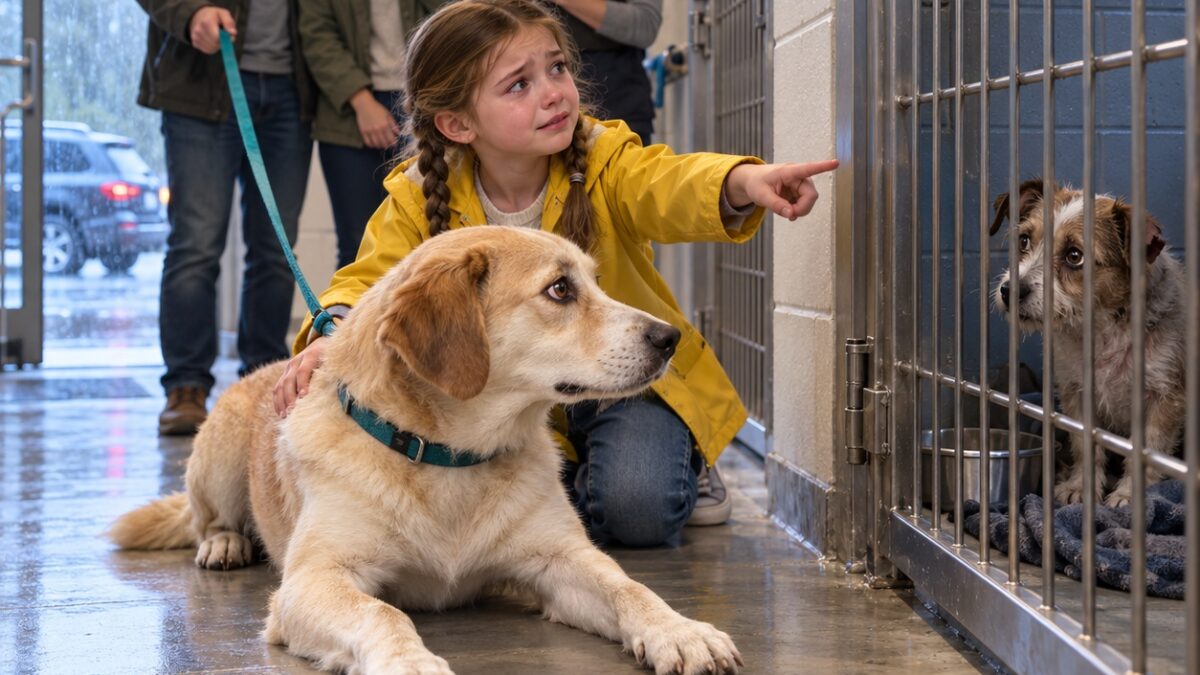
As usual, Luna was lying outside Benji’s kennel.
She was technically free in the supervised corridor because we had just finished exercise time.
Her chin rested between her paws.
Benji sat behind the bars in the corner.
Emma stopped.
Completely.
Her parents nearly walked into her.
“Emma?”
She pointed.
“Why is that dog lying there?”
I knew exactly what she meant.
Not why is she lying on the floor?
Why there?
Why in front of that cage?
I said, “Her name is Luna.”
Emma crouched.
Luna lifted her head.
Their eyes met.
Luna did not approach.
That was unusual.
She usually greeted children.
Instead, she stayed beside Benji.
Emma looked through the bars.
Benji pressed slightly backward.
She noticed.
“Who is he?”
“Benji.”
“Is he scared?”
“Very.”
“Why?”
I chose my words carefully.
“He had a difficult life before coming here.”
“Did somebody hurt him?”
Her mother touched Emma’s shoulder.
I answered honestly without giving details.
“He learned that people weren’t always safe.”
Emma became very quiet.
Then she asked, “And Luna protects him?”
I looked at Luna.
“That’s what we think.”
“Do they know each other?”
“They met here.”
Emma looked confused.
“Then why does she protect him?”
I smiled.
“I wish I knew.”
She sat down on the floor.
Her mother said, “Emma, honey, your pants.”
“It’s okay.”
She stayed.
Not directly in front of Benji.
Slightly to the side.
Smart.
Maybe instinctively.
Benji watched her.
Emma watched him.
Neither moved.
Luna lifted her head.
Looked at Emma.
Then at Benji.
Then lowered her head again.
Five minutes passed.
Emma did not call Benji.
Did not offer her hand.
Did not try to coax him closer.
She simply sat.
The silence became strangely peaceful.
Her father eventually whispered to me, “She does this.”
“What?”
“Waits.”
I looked at him.
“With animals?”
“With people too.”
He smiled faintly.
“She’s always been… observant.”
After almost ten minutes, Benji shifted.
Not forward.
But he stopped pressing against the wall.
Emma noticed.
She did not react.
Another minute.
Benji lowered himself onto his belly.
That was huge.
His mother whispered, “Emma.”
Emma stood.
For one moment I worried she had lost interest.
Instead, she walked toward her parents.
“I want them.”
Her father smiled.
“Luna?”
Emma shook her head.
“Both.”
Both parents looked at each other.
Her mother said, “Emma, we came for one dog.”
“I know.”
“Two dogs are different.”
“I know.”
“More food.”
“I know.”
“More vet bills.”
“I know.”
Her father crouched.
“And Benji is scared. He might take a long time.”
Emma looked back toward them.
“They’re together.”
Her father said gently, “That doesn’t necessarily mean—”
“Yes, it does.”
She spoke with such certainty that all three adults stopped.
“If we take Luna, Benji stays here.”
“Yes,” I said.
“And Luna will want to come back.”
I looked at her parents.
“That has happened every time someone tried adopting her.”
Emma’s mother looked surprised.
“Really?”
“Every time.”
Emma continued.
“And if somebody takes Benji without Luna, he’ll be scared.”
“Probably,” I admitted.
She folded her arms.
“So we take both.”
Her father rubbed his forehead.
“Your logic is inconvenient.”
Emma smiled.
“That means I’m right.”
Her mother laughed.
I did too.
Then I explained everything.
Benji’s fear.
His history as we understood it.
His eating issues.
His difficulty with touch.
The possibility of accidents.
Nighttime anxiety.
Veterinary follow-up.
Slow introductions.
No forcing.
No crowded gatherings.
No children chasing him.
Emma listened more carefully than some adults I had counseled.
When I finished, she said, “I can wait.”
I looked at her.
“It might be a long time.”
“That’s okay.”
“He might not want you to pet him.”
“That’s okay.”
“He may hide.”
“That’s okay.”
“He may be scared of your house.”
“Then Luna will show him.”
I felt something tighten in my throat.
Emma’s mother noticed.
She put a hand over her mouth.
Emma added, “I know what being scared feels like.”
Her mother knelt beside her.
Emma continued.
“When I started school, I was scared every day.”
Her father nodded.
“You were.”
“Mama told me, ‘I’m with you.’”
Her mother’s eyes filled.
Emma looked toward Benji.
“I’ll tell him that.”
She smiled.
“Every day until he believes me.”
That sentence broke me.
I had watched adults walk away from Benji because he would not wag his tail quickly enough.
This seven-year-old had just promised him time.
Her parents stepped aside to talk.
I pretended not to listen.
I failed.
“Two dogs,” her father whispered.
“I know.”
“And one is traumatized.”
“I know.”
“This is not what we planned.”
Her mother looked toward Emma.
“No.”
“What do you think?”
Long pause.
Then she smiled.
“I think our daughter already decided what kind of family she wants us to be.”
Her father looked at Benji.
Then Luna.
Then Emma.
He exhaled.
“We’re getting two dogs.”
Emma heard.
She screamed.
Benji jumped.
Emma immediately slapped both hands over her mouth.
“Oh!”
Then, whispering:
“Sorry, Benji.”
I laughed through tears.
We began paperwork.
It took over an hour.
Vaccination records.
Contracts.
Microchip registrations.
Behavior plans.
Feeding instructions.
Leashes.
Harnesses.
Benji needed a secure harness because frightened dogs can slip collars.
The family listened.
Asked questions.
Good questions.
By the time we finished, afternoon light was turning gold through the lobby windows.
Then came the difficult part.
Leaving.
I opened Luna’s kennel.
She walked out immediately.
Tail moving.
I opened Benji’s.
He did not move.
He stared at me.
Then at the open door.
Then Luna.
“Come on, Benji.”
Nothing.
I crouched.
“You’re going home.”
His body shook.
Luna walked toward the opening.
Stopped.
She did not go inside.
She simply stood outside.
Benji watched her.
Luna waited.
Thirty seconds.
One minute.
Then Benji lifted a paw.
Set it outside the kennel.
Stopped.
Another paw.
Slowly, inch by inch, he stepped through.
For the first time since arriving at the shelter, Benji voluntarily left his kennel without being carried.
He stood beside Luna.
Shaking.
But standing.
Emma came closer.
Her mother reached for her shoulder.
“Slow.”
“I know.”
Emma knelt several feet away.
She extended one hand.
Not toward his face.
Just held it there.
Benji stared.
Luna looked at him.
Then Emma.
Benji moved.
One step.
Stopped.
Another.
His nose stretched toward Emma’s fingers.
He sniffed.
Emma remained completely still.
Then Benji touched her hand with his nose.
Emma smiled.
Very softly, she said:
“Hi, Benji.”
He sniffed again.
“I’m Emma.”
Luna sat beside him.
Emma whispered:
“I’m with you.”
That was when I cried.
Not elegant tears.
Not cinematic single tear.
I sat down on the shelter floor and cried like somebody had broken open something I had been carrying for too long.
Emma looked worried.
“Are you sad?”
I laughed.
“No.”
“Then why are you crying?”
“Because sometimes happy hurts too.”
She considered that.
Then nodded as if it made perfect sense.
Her father took Luna’s leash.
Her mother held Benji’s, keeping it loose.
Emma walked between them.
They headed toward the door.
And this time, when Luna reached the exit, she did not stop.
She looked back once.
Not toward Benji’s empty kennel.
Toward me.
Then she stepped outside.
Benji followed.
I stood at the window.
Emma walked between the dogs.
Luna on her right.
Benji on her left.
Benji’s tail was tucked.
His body still trembled.
But he kept walking.
He did not hide.
He did not turn back.
He followed Luna.
Luna followed Emma.
And Emma followed her heart.
The shelter felt strange after they left.
Benji’s kennel was empty.
Luna’s blanket remained for another hour because I could not bring myself to remove it.
Melissa found me standing there.
“You okay?”
“Yes.”
“You’re crying again.”
“I’m allowed.”
She leaned against the door.
“That kid.”
“I know.”
“You think it’ll work?”
I looked at the empty cages.
“I think they have a chance.”
That is all shelters can honestly promise.
A chance.
We do not know what happens after the paperwork.
We cannot guarantee every adoption.
Animals have histories.
Families have limits.
Love helps.
But love without preparation can fail.
So I called the next morning.
Emma’s mother answered.
I braced myself.
“How was the first night?”
She laughed tiredly.
“Long.”
My heart sank.
Then she said, “But good.”
“What happened?”
“Benji wouldn’t come inside.”
I listened.
They had reached home just before dark.
Luna walked up the front steps.
Benji stopped at the bottom.
House.
Door.
Unknown space.
Too much.
They waited.
Nobody pulled him.
Nobody carried him.
Emma sat on the porch.
For twenty minutes.
Then Luna entered the house.
She walked into the living room.
Sat down.
Looked back.
Benji stayed outside.
Emma whispered, “She’s waiting for you.”
Five more minutes.
Benji climbed one step.
Then another.
Eventually crossed the doorway.
“He went straight to Luna,” Emma’s mother said.
“Of course.”
“They had two beds.”
“Good.”
“He ignored his.”
I smiled.
“Where’d he sleep?”
“Pressed against Luna.”
“How long?”
“All night.”
I closed my eyes.
“Perfect.”
The next several days were difficult.
Benji barely ate.
He drank when nobody watched.
He hid whenever Emma’s father entered carrying anything large.
Broom.
Laundry basket.
Grocery bags.
He refused to walk into the kitchen.
Certain floor surfaces frightened him.
The washing machine sent him running.
The doorbell terrified him.
Emma did exactly what she promised.
She waited.
Every morning before school, she sat on the floor near him.
“Good morning, Benji.”
No touching.
“I’m with you.”
After school:
“Hi, Benji.”
Sit.
Read.
Wait.
Her mother told me Emma had started doing her homework on the floor because that put her closer to his level.
Sometimes Benji stayed beside Luna.
Sometimes he watched from across the room.
But every day, he watched Emma.
The second week, he began eating properly.
The family noticed a ritual.
Benji approached his bowl.
Looked at the food.
Then looked at Luna.
Luna walked over.
Sniffed his bowl.
Looked at him.
Then stepped away.
Benji ate.
Every meal.
Same routine.
Emma interpreted it immediately.
“She tells him it’s safe.”
Maybe she was right.
Maybe Luna was simply interested in food.
But animals communicate in ways we often underestimate.
Luna had become Benji’s proof of safety.
Food safe.
Room safe.
Door safe.
Person safe.
World safe.
One small demonstration at a time.
The third week, something happened that made Emma call the shelter herself.
My desk phone rang.
“Hello?”
“Is this the dog lady?”
I laughed.
“That depends.”
“It’s Emma.”
“Oh! Hi, Emma.”
“Benji played!”
I sat up.
“What?”
“He played!”
Her excitement came through so loudly that I moved the phone away from my ear.
“What did he do?”
“He got a ball.”
“By himself?”
“Yes!”
Her mother was laughing in the background.
Emma continued.
“He picked it up and took it to Luna.”
“What did Luna do?”
“She looked at him.”
“And?”
“Then she looked at me.”
Emma lowered her voice dramatically.
“Then Benji wagged his tail.”
I froze.
“His tail?”
“Yes!”
“Are you sure?”
“I know what a tail is.”
Fair.
I covered my mouth.
“Emma, that’s amazing.”
“He’s happy.”
Her voice softened.
“He’s really happy.”
After we hung up, I cried.
Again.
I was becoming predictable.
The fourth week, Benji began exploring the house without Luna.
That sounded small.
It was enormous.
Until then, Luna had been his anchor.
If she moved, he moved.
If she rested, he rested.
If she entered a room, he followed.
Now he would leave.
Kitchen.
Hallway.
Bedroom.
Then come back.
Every time, Luna was waiting.
Never chasing.
Never hovering.
Waiting.
It felt almost like parenting.
Go.
See.
I’m still here.
The fifth week, Emma’s mother sent me a photograph.
Emma was asleep on the couch.
Book open beside her.
Benji curled against her hip.
His head resting in her lap.
Luna slept across the room.
The message underneath read:
HE CAME TO HER BY HIMSELF.
I stared at the photo for a long time.
Benji’s eyes were closed.
Completely.
Sleep is one of the deepest forms of trust.
To sleep beside someone, you must believe nothing bad will happen while you are defenseless.
Five weeks earlier, this dog could barely eat if someone watched him.
Now he slept in a child’s lap.
The sixth week brought another change.
Benji stopped sleeping against Luna.
At first Emma worried.
“Do they not love each other anymore?”
Her mother called me.
I smiled.
“This is good.”
“How?”
“Benji doesn’t need physical contact all night to feel safe.”
Emma was listening on speaker.
“So he still loves her?”
“Very much.”
“Then why doesn’t he sleep with her?”
“Because Luna taught him he can be safe even when she’s a few feet away.”
Emma was quiet.
Then:
“So she gave him courage?”
“Yes.”
“Can you give courage?”
I thought about it.
“Maybe you lend it.”
“Until they have their own?”
Exactly.
“Yes.”
The seventh week, the doorbell rang.
Benji ran to the door.
Barked.
Not screaming.
Not cowering.
Barked.
Normal dog behavior.
Luna stood.
Looked at him.
Then lay back down.
Emma laughed so hard her mother recorded it.
“Mom!”
“What?”
“He thinks he’s the guard dog!”
Benji barked again.
Emma knelt beside him.
“You’re protecting us!”
The frightened dog who once needed Luna to protect him now believed he had something worth protecting.
That may have been my favorite milestone.
Until week eight.
I drove to their house.
I wanted to see them myself.
The home sat on a quiet suburban street.
Blue shutters.
Small fenced backyard.
Bicycle on the porch.
Emma opened the door before her mother could.
“You came!”
Behind her, a dog barked.
Benji.
I almost did not recognize him.
His ribs were no longer visible.
Coat shinier.
Tail up.
He ran toward me.
Stopped about two feet away.
Barked once.
Then sniffed.
“Hi, Benji.”
He remembered my voice.
His head tilted.
I crouched.
He approached.
No Luna beside him.
No trembling.
He sniffed my hand.
Then sat directly against my knees.
I looked over his head.
Luna stood near the living-room doorway.
Watching.
Calm.
I swear she looked proud.
Emma appeared beside me.
“See?”
“I see.”
“He trusts you.”
I stroked Benji carefully.
“No.”
Emma frowned.
“He does.”
“Yes. But he trusts me because you taught him people can be safe.”
Emma thought about that.
Then looked at Luna.
“Luna taught him the world is safe.”
“Yes.”
“And I taught him people are nice.”
“Some people.”
Emma nodded seriously.
“Some people.”
“And what did Benji teach you?”
She thought longer this time.
Then smiled.
“That love is patient.”
I stopped moving.
Seven years old.
Love is patient.
Not love is exciting.
Not love is cute.
Not love gets what it wants.
Patient.
Emma continued.
“If I tried touching him when he was scared, he would run.”
“Yes.”
“So I waited.”
“Yes.”
“And then he came.”
“He did.”
She sat beside me.
“So love waits.”
I looked toward Luna.
She had waited outside a cage for weeks.
Emma had waited on floors.
Porches.
Beside bowls.
On couches.
Benji had waited until his body finally believed what his heart was slowly learning.
Safe.
I spent two hours there.
Benji played.
Actually played.
He brought me a rope toy.
Dropped it.
Backed up.
I tossed it gently.
He ran.
Luna joined once.
Then lost interest.
Emma chased neither.
She had learned.
Let them choose.
Before leaving, I knelt.
Benji walked over.
“You’re a good boy.”
He sniffed my cheek.
“You’re very brave.”
He licked my chin.
I laughed.
Emma said, “That means he agrees.”
“Probably.”
Benji ran back toward Luna.
Sat beside her.
Luna rested her head across his shoulders.
Not because he was afraid.
Because she loved him.
That distinction mattered.
I drove away crying.
Not sadness.
Gratitude.
Shelter work can make you cynical.
You see people abandon elderly dogs because they become inconvenient.
Return puppies because they chew.
Reject animals because of scars.
Demand perfect behavior from creatures that have survived imperfect humans.
You start protecting yourself.
Expecting disappointment.
Then a child walks in wearing blue rain boots and reminds you that some people still know how to stay.
Months passed.
Benji continued changing.
He explored the backyard.
At first only with Luna.
Then alone.
He discovered squirrels.
That apparently awakened several thousand years of terrier genetics.
Emma’s mother sent me a video.
Benji standing under a tree barking furiously while a squirrel sat safely fifteen feet above him.
Luna lay in the grass completely uninterested.
Caption:
FEAR OF HUMANS: IMPROVING
CONFIDENCE AGAINST SQUIRRELS: EXCESSIVE
I laughed.
Benji met neighbors.
He met Emma’s grandmother.
He hid when she arrived.
Came out twenty minutes later.
Accepted chicken.
Progress.
A teenage cousin visited.
Benji watched him from the hallway.
Eventually approached.
Progress.
The family took both dogs camping.
Benji initially hated the tent.
Luna went inside.
He followed.
Of course.
By morning, he had taken over Emma’s sleeping bag.
They sent a picture.
Only Benji’s ears visible beneath the blanket.
Another milestone.
Luna changed too.
That was something I had not expected.
At the shelter, Luna had carried responsibility constantly.
She watched Benji.
Positioned herself near him.
Checked him.
Waited.
At home, as Benji became stronger, Luna relaxed.
She played more.
Slept deeply.
Began choosing spaces away from him.
Not abandonment.
Relief.
Her job was ending.
Love was transforming.
That interested me.
We often imagine love as constant closeness.
Always together.
Never apart.
But Luna showed me something else.
Sometimes love means helping someone become strong enough not to need you every second.
She did not seem threatened when Benji bonded with Emma.
She did not compete.
She did not pull him back.
She made room.
That might be the purest kind of love I had ever witnessed.
Emma called one afternoon several months after the adoption.
“I figured it out.”
“What?”
“Why Luna wouldn’t leave.”
I smiled.
“Tell me.”
“Because Benji needed her.”
“Yes.”
“But that’s not all.”
“No?”
“Luna needed Benji too.”
I leaned back.
“What makes you think that?”
“Because if she only wanted to help him, she could leave when he stopped being scared.”
“That’s true.”
“But she stayed.”
“Yes.”
“So she loves him.”
“Yes.”
“And he loves her.”
“Yes.”
“They’re like one thing.”
“One thing?”
“One heart.”
I swallowed.
Emma continued:
“You can’t split one heart in half.”
I did not answer.
She said, “Hello?”
“I’m here.”
“Why are you quiet?”
“Because I’m thinking.”
“About what?”
“How you got so smart.”
She laughed.
“I’m seven.”
“I know.”
“That’s not very old.”
“No.”
“But I pay attention.”
There it was.
Maybe wisdom is not about age.
Maybe it is about attention.
Adults often stop paying attention because we think we already understand.
Emma did not assume.
She watched.
Luna watched.
Benji watched.
And because they watched, they learned each other.
A year passed.
Then another.
My contact with the family became less frequent.
That was normal.
Successful adoptions should eventually stop needing the shelter.
We are supposed to become part of the past.
Every few months, I received photographs.
Emma growing taller.
Luna graying slightly around her muzzle.
Benji looking confident.
Birthday hats.
Christmas pajamas.
Hiking trails.
Backyard naps.
One photograph stayed on my desk.
Emma sat beneath a tree reading.
Luna lay on one side.
Benji on the other.
Neither dog touched her.
They did not need to.
They simply existed together.
Three creatures who had once needed different forms of reassurance.
Now home.
People sometimes asked why I worked at a shelter.
They usually asked after hearing a hard story.
An abused animal.
A sick puppy.
A dog nobody wanted.
“How can you do that every day?”
Sometimes I wondered too.
There are days when shelter work feels like carrying a bucket with a hole in the bottom.
For every animal you help, another arrives.
For every happy adoption, someone leaves a dog tied to a fence.
For every Emma, there are adults who return an animal because its fur does not match the furniture.
You clean.
Feed.
Medicate.
Comfort.
Say goodbye.
Then do it again.
It hurts.
Of course it does.
Anything involving love and loss hurts.
But sometimes you witness a miracle.
Not the dramatic kind.
No lightning.
No music.
No impossible cure.
A frightened dog walks out of a cage.
That is the miracle.
He eats.
He sleeps.
He plays.
He trusts.
A dog who believes the world is dangerous learns that one room is safe.
Then one house.
Then one person.
Then another.
Eventually, the world becomes larger than fear.
That is a miracle.
It happens slowly enough that if you are not paying attention, you miss it.
Benji did not wake one morning cured.
Trust arrived in drops.
One meal.
One sniff.
One step.
One nap.
One wag.
One bark.
One couch.
One hand.
Until the bowl was full.
And none of it would have happened at the same speed without Luna.
Maybe some of it would never have happened.
I often think about Luna lying outside that cage.
Nobody trained her.
Nobody told her:
This dog is traumatized. Please provide emotional support.
She just knew he needed someone.
So she stayed.
Even when families tried taking her away.
Even when a home waited.
Even when affection waited.
Luna chose loyalty before comfort.
Then Emma did the same thing.
She could have adopted an easier dog.
There were dozens.
Dogs who would have slept in her bed the first night.
Played immediately.
Kissed her face.
Posed for photographs.
She chose the one who might never trust her.
Because Luna had chosen him first.
That is what I find extraordinary.
Compassion became contagious.
Benji’s fear called something out of Luna.
Luna’s loyalty called something out of Emma.
Emma’s patience called something out of Benji.
Then Benji’s trust changed everyone around him.
One act of staying created another.
And another.
Years later, I still sometimes walk past the kennel where Benji lived.
Different dogs occupy it now.
Some stay days.
Some months.
Every once in a while, one curls into that same back corner.
Whenever that happens, I remember him.
Small.
Shaking.
Eyes too large for his face.
Then I remember him running toward me in Emma’s living room.
That image helps on hard days.
Fear is not identity.
It is a state.
Sometimes temporary.
Sometimes long.
But not necessarily forever.
Animals remind me of that constantly.
So do people.
Emma once said:
“I knew what being scared felt like.”
She compared Benji’s trauma to her first day of school.
Obviously, those experiences were not the same.
But compassion does not require identical pain.
It requires imagination.
She remembered the feeling beneath her own fear.
Being uncertain.
Wanting someone familiar.
Needing to hear:
I’m with you.
Then she gave that feeling to Benji.
Adults often complicate empathy.
We ask whether someone earned it.
Whether their problem is serious enough.
Whether helping will be inconvenient.
Whether they might disappoint us.
Emma skipped every question except one.
Does he need somebody?
Yes.
Then I’ll be somebody.
That was her entire philosophy.
Simple enough for a child.
Difficult enough that many adults never learn it.
I visited them one last time several years later.
Emma was older.
Almost eleven.
Tall.
Longer hair.
Same eyes.
Luna moved more slowly.
Age was catching her.
She rose to greet me but did not run.
I knelt beside her.
“Hi, beautiful.”
She leaned into me.
Benji came next.
No bark.
Just immediate recognition.
He pressed his head beneath my hand.
“Look at you.”
Emma smiled.
“He’s brave now.”
“Yes.”
“He doesn’t need Luna anymore.”
I looked at the two dogs.
“Maybe not the way he used to.”
Emma sat beside Luna.
“But he still loves her.”
“Of course.”
Luna lowered herself slowly.
Benji lay beside her.
Their shoulders touched.
Emma scratched both.
“She taught him everything.”
“Not everything.”
Emma looked at me.
“You taught him too.”
“Like what?”
“That people can be kind.”
She smiled.
“I think he already knew some people could.”
“How?”
“He trusted Luna.”
“Luna isn’t people.”
“No.”
I laughed.
“Fair.”
Emma looked down at Benji.
“He taught me things too.”
“What?”
She counted quietly.
“Don’t rush someone because you want them to feel better.”
I nodded.
“Good.”
“Being quiet can help.”
“Yes.”
“Just because someone is scared doesn’t mean they don’t love you.”
I stopped.
“And?”
Emma looked at Luna.
“Sometimes helping someone means staying until they don’t need as much help.”
I could not improve on that.
Before I left, Emma walked me outside.
Benji followed us to the door.
Years earlier, he had refused to enter that same doorway.
Now he stood there confidently.
No trembling.
No hiding.
I knelt.
“You remember me?”
His tail moved.
“I’ll take that as yes.”
He licked my wrist.
Then turned and walked back inside.
No panic when I left.
No need to follow.
No fear.
He knew where home was.
I sat in my car.
Watched through the front window.
Emma returned to the living room.
Benji jumped onto the couch.
Luna stayed on the rug.
Emma opened a book.
Ordinary.
Completely ordinary.
That was the miracle.
Trauma had become ordinary life.
Fear had become naps.
Silence had become barking at doorbells.
Survival had become living.
I cried.
Of course.
Some habits never change.
Back at the shelter, people still ask me whether I remember every animal.
No.
I wish I could say yes.
There are too many.
Faces blur.
Names repeat.
We have had six Maxes in one year.
Four Bellas in one month.
I forget details.
But I remember certain moments.
A dog touching a hand for the first time.
An elderly cat relaxing in someone’s arms.
A child choosing the animal nobody expected her to choose.
Luna refusing to walk past Benji.
Those stay.
They become part of how you understand the world.
Before Luna, I thought successful shelter work meant matching animals to homes.
That is technically true.
After Luna, I began thinking differently.
Our job is not simply moving dogs from cages into houses.
A house is not automatically home.
Our job is finding relationships strong enough to survive fear.
Sometimes that relationship begins with a human.
Sometimes another animal.
Sometimes both.
Luna did not rescue Benji by herself.
Emma did not rescue him by herself.
Benji participated too.
That matters.
He made choices.
Tiny ones.
Come out.
Eat.
Sniff.
Step closer.
Sleep.
Play.
Trust.
Healing was not something done to him.
It was something he slowly agreed to.
Luna made agreement possible.
Emma made it worthwhile.
I think about that whenever someone asks why a frightened animal does not “just get over it.”
Because fear is not an argument.
You cannot defeat it with logic.
You cannot say:
Nobody is hurting you now.
Therefore stop being scared.
Bodies remember things minds cannot explain.
Trust has to be experienced repeatedly.
Safe today.
Safe tomorrow.
Safe again.
And again.
Eventually the body learns.
That is what Luna gave Benji.
Consistency.
She was there.
Morning.
Afternoon.
Night.
He looked.
Luna.
Still there.
When strangers came:
Luna.
When bowls moved:
Luna.
When doors opened:
Luna.
When the hallway became loud:
Luna.
Safety acquired a face.
Then Emma arrived.
Safety acquired another.
That is how his world changed.
Not because fear disappeared.
Because trust became bigger.
Sometimes people ask what happened to Luna and Benji later.
The truth is that eventually I lost contact.
Families move.
Numbers change.
Children grow.
Shelter records become old.
I do not know exactly where they are now.
That used to bother me.
Then I realized I do not need to know every chapter to understand the ending we gave them.
They left together.
They became a family.
Benji learned trust.
Luna got the home she refused to accept without him.
Emma got two dogs when she came looking for one.
And all three changed each other.
That is enough.
Every once in a while, near closing time, when the shelter is quiet, I stand by the window overlooking the kennels.
The evening sun comes through at an angle.
Dogs settle.
Some bark.
Others sleep.
One always watches the door.
Waiting.
They all wait for something.
Food.
Walks.
People.
Home.
It is hard not to project human meaning onto animals.
I know that.
But waiting is real.
You see it.
An animal hears footsteps and lifts its head.
Someone enters and every dog asks the same silent question:
You?
Is it you?
Most of the time, no.
The visitor keeps walking.
The head lowers.
Then someday, maybe, someone stops.
Sometimes it is a couple.
Sometimes an elderly man.
Sometimes a woman who lost her dog last month and swore she would never love another.
Sometimes a seven-year-old girl in blue rain boots.
They stop.
They look.
And something connects.
Not magic.
Recognition.
Maybe that is what love is at the beginning.
Recognition.
I see you.
Not the easy version.
Not the version you will become.
You.
Right now.
Afraid.
Complicated.
Inconvenient.
I see you.
And I am staying.
Luna did that for Benji before anyone else did.
Emma did it next.
One afternoon, years after their adoption, a new volunteer asked me about a photograph pinned inside my locker.
Emma sitting between Luna and Benji.
“Your dogs?”
“No.”
“Family?”
“In a way.”
I told her the story.
When I finished, she said, “So Luna saved Benji.”
I thought about it.
“Yes.”
“And Emma saved both?”
“Yes.”
“Then who saved Emma?”
I smiled.
“Maybe they did.”
She looked confused.
Emma was never physically in danger.
She did not need rescuing in the way Benji had.
But children are always becoming someone.
Every experience teaches them what kind of person to be.
Emma learned early that frightened beings do not need to be discarded.
That loyalty can be chosen.
That patience has value.
That love sometimes costs extra dog food and scratched furniture and weeks sitting on floors.
Maybe Luna and Benji helped save something in her too.
Compassion.
From becoming theoretical.
From becoming conditional.
Maybe they made it real.
I hope so.
The older I get, the less interested I am in dramatic definitions of love.
People talk about sacrifice.
Passion.
Destiny.
Big promises.
Shelter animals taught me smaller words.
Stay.
Wait.
Again.
Tomorrow.
Here.
Those words matter.
Luna did not tell Benji she loved him.
She lay outside his cage.
Emma did not prove love by making a speech.
She sat on the floor.
Benji did not announce trust.
He touched her hand with his nose.
That was enough.
The most important things often happen without language.
A dog choosing not to run.
A child choosing not to reach.
A frightened animal falling asleep.
A guardian finally resting because the one she protected can stand alone.
I think that is why Luna’s story stays with me more than many dramatic rescues.
Nothing spectacular happened.
Nobody climbed into a river.
Nobody stopped traffic.
Nobody survived a miraculous surgery.
A dog waited beside another dog.
Then a child noticed.
That is all.
And somehow, it was everything.
I still work at the shelter.
There are new cages.
New dogs.
New heartbreak.
New families.
Sometimes we lose.
An animal gets sick.
An adoption fails.
Someone returns a dog after years.
Those days are heavy.
Then I remember Luna.
I remember Benji.
I remember Emma kneeling in the corridor saying:
“I’m with you.”
And I remind myself why waiting matters.
Somebody out there may be coming.
We do not know when.
We do not know who.
We only have to keep the door open long enough for them to find each other.
One evening, after everyone else left, I walked past Benji’s old kennel.
A new dog was inside.
Young shepherd mix.
Terrified.
Back corner.
Would not approach.
I sat outside.
Not too close.
The dog watched me.
I said nothing.
Ten minutes.
Fifteen.
Then one paw moved.
Barely.
I smiled without showing it.
I had learned too.
From Luna.
From Emma.
From Benji.
Wait.
Let them believe.
Do not make their courage about your impatience.
So I stayed.
The shelter lights dimmed automatically around us.
Outside, the sky turned orange.
Dogs barked somewhere farther down the corridor.
The shepherd kept watching.
I kept waiting.
Eventually she came forward.
Not all the way.
One step.
That was enough.
I whispered:
“I’m still here.”
Her ears moved.
I thought of Emma.
Seven years old.
Blue boots.
Hand extended.
I thought of Luna refusing every exit.
I thought of Benji discovering that love did not drag him from fear.
It waited at the edge of it.
That is the story I carry.
Not that one dog saved another.
Not that one child adopted two dogs.
Something simpler.
Love did not divide.
It multiplied.
Luna gave courage to Benji.
Emma gave patience to both.
Benji gave trust back.
And once those things joined together, nobody had to lose anything for someone else to be loved.
That is what Emma understood before the rest of us.
She came looking for one dog.
She found two.
She saw what every adult had missed.
Luna and Benji were not obstacles to each other’s adoption.
They were each other’s reason to survive it.
So she refused to separate them.
And because she did, Benji learned to eat without fear.
Sleep without fear.
Walk through rooms.
Play.
Bark.
Trust.
Live.
Luna learned she could rest.
Emma learned love is patient.
And I learned that sometimes the most important thing we can offer another living being is not rescue.
It is presence.
You do not have to fix everything today.
You do not have to force the frightened one forward.
Sometimes you simply sit beside the cage.
You stay.
You wait.
You let them look up tomorrow and discover you are still there.
And one day, when they are ready, they take the step themselves.
That was Luna’s gift.
That was Emma’s promise.
That was Benji’s courage.
And whenever people ask me what love looked like in all my years at the shelter, I do not think of grand gestures.
I think of a cream-colored dog lying quietly outside a frightened terrier’s cage.
I think of a little girl sitting on a shelter floor.
I think of one tiny nose touching one open hand.
And I remember the three words that changed everything.
I’m with you.








