PART2:Every Shelter Refused King Because They Thought He Was Dying—Then Two Weeks Later, He Walked Out of the Hospital Alive
PART2
That became the first promise.
Not that King would recover.
I could not promise that.
Not that he would stand.
Not that his legs would somehow become normal.
Not that medicine would reverse everything happening inside his body.
We did not know any of that.
The promise was simpler.
I would stay.
The first days in the hospital were difficult because there was almost nothing dramatic to celebrate.
King was still sick.
Still unable to support himself.
Still carrying a body damaged by a long-term deficiency and complicated further by neurological disease.
Every time I looked at him, I could understand why the shelters had been afraid.
He did not look like a dog on the edge of recovery.
He looked like a dog on the edge of disappearing.
His eyes would open.
Then close.
Sometimes I would talk simply so there was a voice near him.
I did not know how much he understood.
That did not matter.
I told him his name.
“King.”
Again.
“King.”
I wanted that sound to become familiar.
Maybe his old name had been something else.
Maybe nobody had called him anything in a long time.
I did not know.
But from the moment I found him, he was King to me.
I hand-fed him.
Slowly.
Carefully.
Feeding a severely weakened dog is not glamorous.
It is patience.
Watching.
Waiting.
Offering what he can manage.
Then trying again.
Sometimes I found myself celebrating things I would never have noticed in a healthy dog.
Interest.
A little more awareness.
An eye staying open longer.
A response to my voice.
Small changes.
When the larger question is survival, tiny changes become enormous.
The veterinarians continued treating him.
I stayed out of their way when they needed to work and returned to his side whenever I could.
They had been honest from the beginning.
His prognosis was poor.
That honesty mattered.
Hope is not the same thing as pretending.
I did not want someone telling me King would be fine if they did not believe it.
I wanted the truth.
The truth was that he was very sick.
His bones had been damaged.
His nervous system was affected.
His body had been declining for a long time.
And nobody knew whether it had enough left to come back.
That was the reality we lived inside.
Somewhere in those early days, I stopped asking myself whether King would survive.
The question hurt too much.
Instead I asked smaller ones.
Did he eat something today?
Did he seem a little more alert?
Did he respond when I spoke?
Was he comfortable?
Could we get through tonight?
Then tomorrow?
Those were questions I could handle.
There is a strange kind of intimacy in sitting beside an animal everyone expects to lose.
You stop demanding anything.
You are not waiting for a trick.
You are not imagining the dog he might become.
You are simply present with the dog who exists now.
King did not need to impress anyone.
He did not need to prove he was worth the hospital bed.
He did not need to stand up so the shelters that refused him would feel wrong.
He was worth helping because he was alive.
That was enough.
Still, I could not ignore the sadness behind his condition.
Severe calcium deficiency does not destroy bones in one afternoon.
His body had been struggling over time.
There must have been a period before he became completely helpless when his legs were already changing.
When standing became harder.
When walking became harder.
When his strength began disappearing.
Someone had seen that decline.
Someone had known he needed more care.
And at some point, instead of continuing to help him, they left him behind an abandoned building.
I tried not to spend too much time imagining the person who did it.
Anger could not help King.
He needed food.
Treatment.
Rest.
A person sitting beside him.
So that was where I put my energy.
One day.
Then another.
The hospital became a routine.
Walk in.
Find King.
Sit.
Talk.
Feed.
Watch.
Hope carefully.
Go home.
Return.
There were times when the veterinarians’ faces told me everything before they spoke.
They were watching for decline.
So was I.
Every morning I prepared myself to hear that something had worsened.
That his body could no longer compensate.
That we had reached the point everyone feared.
But King kept being there.
Weak.
Fragile.
But there.
Then one day, something changed.
Not dramatically.
No one ran into the room shouting that he had recovered.
There was simply a small improvement.
The kind of change that could have been dismissed if everyone had not been watching him so closely.
King seemed a little more responsive.
Then another improvement appeared.
And another.
Nothing large enough to call a miracle.
Together, they created a pattern.
His body was not only failing anymore.
Something was beginning to move in the other direction.
The veterinary team noticed.
That was when I first saw the way they looked at him change.
In the beginning, their faces held the caution of people treating an animal they expected might not survive.
Now there was curiosity.
Then guarded optimism.
They still did not make promises.
Neither did I.
But the language shifted.
Less preparation for the worst.
More attention to what King was actually doing.
The dog everyone expected to lose had started fighting his way back.
I wish I could tell you the exact moment I knew he would survive.
There was not one.
Recovery does not usually announce itself that cleanly.
It enters gradually.
One encouraging sign.
Then another.
The fear remains.
You do not trust the improvement immediately because you have been bracing for loss.
King could have a better morning and I would spend the afternoon afraid the change would disappear.
A good day could still be followed by a difficult one.
That uncertainty was exhausting.
But it was also something we had not had before.
At first, the only uncertain question had been how quickly he might die.
Now uncertainty included another possibility.
Maybe he would live.
Maybe.
That word became everything.
I began speaking to him differently.
Not because I thought words would cure him.
But because I finally allowed myself to imagine a little future.
“You keep going, King.”
“You’re still here.”
“Let’s do another day.”
Sometimes his eyes followed me.
Sometimes he simply rested.
I kept talking anyway.
The shelters had said no because they believed his condition was too severe.
His chances too low.
And from their perspective, maybe they were making the only decision they felt able to make.
But King knew nothing about percentages.
Nothing about shelter capacity.
Nothing about prognosis charts.
His body either responded or it did not.
And slowly, impossibly, it began responding.
The medical team could see it.
That changed something in the room.
People who had approached him expecting decline began looking for improvement.
Not imagining it.
Looking for real signs.
The kind they could trust.
King was still medically complicated.
Still physically damaged.
The severe calcium deficiency had already affected his bones.
The neurological disease did not disappear simply because he seemed more alert.
Those facts remained.
Recovery was not going to mean becoming a dog who had never been sick.
It meant seeing what quality of life and strength his body could reclaim from where he was.
I had to learn that distinction.
When you rescue an animal in catastrophic condition, it is easy to build a perfect picture of success.
Healthy.
Strong.
Running.
No visible trace of what happened.
But that picture can become unfair.
King did not have to erase his history to have a future.
He only needed enough health to live one.
So I stopped measuring him against dogs whose bodies had never gone through what his had.
I measured King against King.
The dog in the garbage pile.
Motionless.
Eyes barely opening.
Breathing so faintly I nearly missed it.
Compared with that dog, every improvement was enormous.
He was still here.
That was victory number one.
He was responding.
Victory number two.
He was surprising the veterinarians.
Victory number three.
Then we reached two weeks.
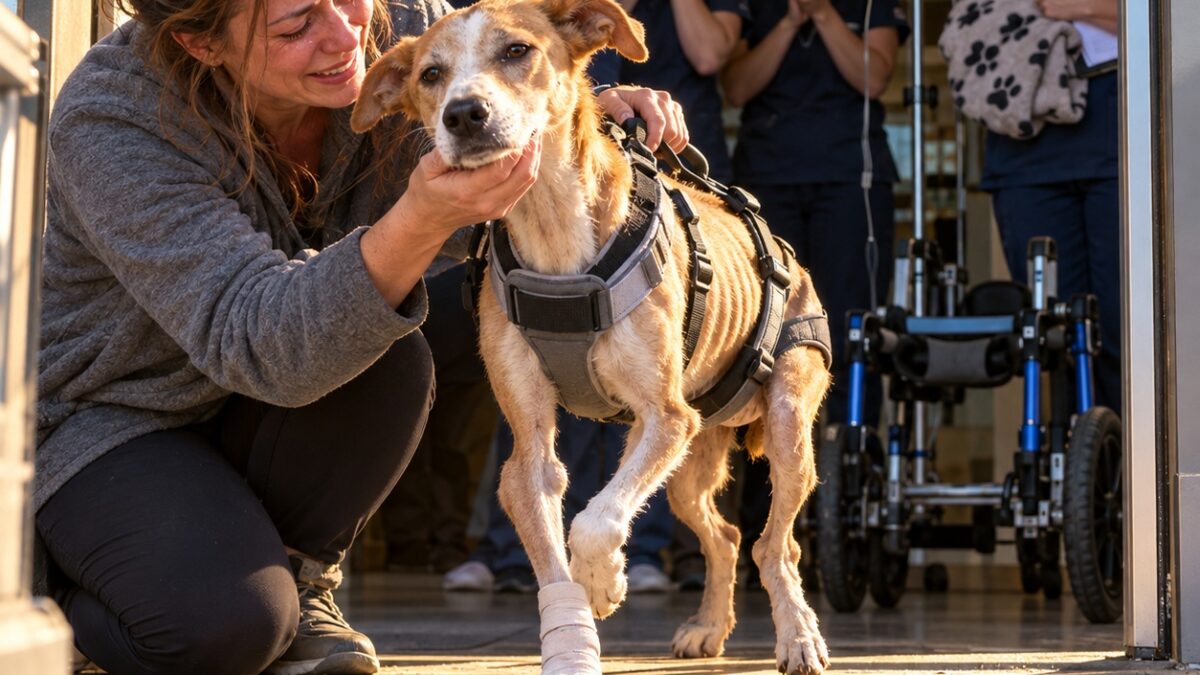
Fourteen days after I had lifted him from the garbage, King was ready to leave the hospital.
Even now, that sentence feels unbelievable.
Two weeks earlier, I had been calling shelters trying to find anybody willing to take responsibility for a dog almost everyone believed was dying.
Now hospital discharge was being discussed.
Not death.
Discharge.
King was leaving alive.
I remember looking at him and thinking about every phone call.
Every refusal.
Every quiet warning.
Every moment I sat beside him preparing myself for the possibility that the next day might not come.
It had come.
Fourteen times.
And now the hospital door was opening in the other direction.
I wish I could say I was fearless by then.
I was not.
Leaving a hospital does not mean the story is over.
It simply means the animal no longer needs that level of immediate care.
King still had a body with a serious history.
His bones had been damaged.
He had neurological disease.
Whatever came next would require patience.
The source of this story does not give me enough detail to invent an exact rehabilitation plan, specific medications, surgery, equipment, or therapy.
So I will not.
What I can tell you is what happened in the larger sense.
King kept changing.
The dog I had found unable to stand did not remain frozen in that condition.
His strength continued returning.
His appearance changed.
His energy changed.
The people who had treated him were surprised by how far he came.
That transformation did not erase the seriousness of his original condition.
It made the contrast harder to believe.
I kept thinking about the word dying.
Every shelter call.
Dying.
Too severe.
Too little chance.
The veterinarians had looked at the same failing body and prepared me for the possibility of losing him.
And now I was watching a living dog leave the hospital.
I did not feel angry at the people who had been realistic.
I felt grateful King had reached an outcome nobody could responsibly promise.
There is a difference between proving someone wrong and receiving more hope than anyone expected.
King did not owe anyone a comeback story.
He happened to give us one.
Once he left the hospital, my relationship with him changed again.
In the hospital, everything had revolved around survival.
Now we could begin thinking about life.
Not merely:
Can he get through tonight?
But:
What can he enjoy?
What does he notice?
What makes him comfortable?
Who is King when a medical crisis does not occupy every second around him?
That question had been impossible behind the abandoned building.
There, his entire identity had been suffering.
You could not see personality before you saw the broken body.
You could not look past the deformed legs.
The weakness.
The barely open eyes.
Later, those things stopped filling the entire frame.
There was a dog underneath the emergency.
There had always been a dog underneath it.
The emergency had simply hidden him.
I began understanding why transformations in rescue can feel so emotional.
It is not merely the difference in appearance.
It is the difference in possibility.
When I found King, his world had collapsed to one question.
Can I survive this moment?
Later, his world could contain more.
Comfort.
Attention.
Food.
Rest.
Interaction.
Another day.
Then another.
His future stopped being measured only in hours.
That is an extraordinary change.
People sometimes tell stories like King’s as if love alone saved him.
I do not believe that.
Love did not repair calcium-starved bones by itself.
Love did not diagnose neurological disease.
King needed veterinary medicine.
Professional assessment.
Hospital care.
Whatever medical treatment his team determined was necessary.
Those things mattered.
But there was another part too.
Someone had to keep choosing him while the outcome remained uncertain.
That was the part I could give.
Presence.
Food by hand.
A voice.
Comfort.
The promise he would not be abandoned again simply because he was difficult.
Maybe that was why finding him in garbage affected me so strongly.
Garbage is where people place things they have decided no longer matter.
That is what the scene said.
Not only abandoned.
Discarded.
There is a cruelty in that distinction.
If someone leaves a dog outside a shelter, they are at least placing him where help might be found.
King had been left behind an abandoned building among waste.
A place where nobody was supposed to look carefully.
Whoever placed him there apparently believed there would be no next chapter.
I wish I knew what King understood about that.
Probably not in human terms.
But animals understand absence.
Pain.
Hunger.
Cold.
A person who disappears.
A hand that returns.
If his last experience before I found him was being left by someone he depended on, then I wanted his next experiences with people to tell a different story.
Not every person leaves.
Not every person decides you are too much.
Not every person disappears when your body stops working properly.
That is why sitting beside him mattered to me even on days when I could do nothing else.
I could not cure him with conversation.
But I could be one predictable thing in a world that had become unpredictable.
I would come back.
Again.
King would open his eyes.
I would be there.
Food.
Voice.
Hand.
Comfort.
Return.
Animals learn through patterns.
So do people.
That pattern changed me too.
At first, I visited King because I feared every visit might be the last.
Later, I went because he had become part of the day.
That shift was subtle.
Fear becoming relationship.
The dog I had rescued was no longer a crisis I was trying to solve.
He was King.
That is when you realize rescue has already changed both lives.
I thought about the shelters sometimes.
Not with resentment.
Resources are finite.
Every organization makes difficult decisions.
A severely ill dog can require more time, money, medical care, and uncertainty than some shelters can responsibly absorb.
Their refusal was heartbreaking.
But it did not necessarily mean they were heartless.
The tragedy was that King had been placed in a condition where everyone had to make impossible choices because someone else had failed him long before.
His body had been deteriorating.
The calcium deficiency had been damaging his bones.
Neurological illness complicated everything.
The person responsible for him should have sought help before he became a dog lying motionless in garbage.
That was where the true failure began.
By the time I found him, the rescue community was inheriting the consequences.
Still, I could not forget the pattern.
One shelter.
No.
Another.
No.
Another.
No.
Each call seemed to confirm the same verdict.
King was too sick.
Then his body began improving.
That contradiction became part of how I understood him.
Not invincible.
Not miraculous in some supernatural sense.
Simply alive in a way nobody had expected him to remain alive.
The veterinarians noticed first in clinical ways.
I noticed in ordinary ones.
His presence felt different.
There is a particular helplessness in an animal whose eyes barely open.
Later, his eyes seemed to belong to the room again.
He noticed.
He responded.
He was not merely a body being managed medically.
He was participating.
I will not manufacture details that were not given.
I will not tell you he suddenly stood on a specific day.
I will not invent a wheelchair.
I will not invent surgery.
I will not claim his legs became perfectly normal.
The source does not tell us those things.
What it does tell us is enough.
Today, King looks nothing like the dog I found in that garbage pile.
His transformation surprised even the people who treated him.
Think about how far that statement has to travel.
From a veterinary team preparing for his body to shut down.
To those same people being surprised by the animal he became.
That is not a small change.
Somewhere along the way, the hopelessness surrounding King became possibility.
Then possibility became visible transformation.
I remember the first time I allowed myself to look at him without searching immediately for signs of decline.
It felt strange.
For so long, every glance had been a medical question.
Is his breathing okay?
Does he look weaker?
Is he alert?
Is he eating?
Then eventually there were moments when I simply looked at King.
No emergency calculation.
Just him.
That may be one of the most satisfying moments in any rescue.
When the animal becomes larger than the condition again.
King was never the calcium-deficiency dog.
Never the neurological case.
Never the dog every shelter rejected.
Those descriptions told pieces of the story.
They were not his identity.
He was curious in ways illness had hidden.
He had preferences.
Responses.
A presence.
You have to remember that when you see severely disabled or sick animals.
Medical information is important.
But a diagnosis is not a personality.
A prognosis is not a complete life.
King’s prognosis had been poor.
His life was still his.
That is why I never regretted staying beside him even before improvement appeared.
Suppose the veterinarians had been right and his body had continued shutting down.
Would sitting with him have been wasted?
No.
He would still have died knowing warmth instead of garbage.
Food offered by hand instead of hunger.
A voice instead of silence.
Someone present instead of abandonment.
That would have mattered.
The fact that King survived simply gave the promise more time.
People often ask themselves whether an animal knows it has been rescued.
I do not know.
King did not understand shelters refusing him.
He did not understand his diagnosis.
He did not know the word calcium.
He did not know what neurological meant.
He only knew what his body felt like.
And what people did around him.
One person left him.
Another picked him up.
Hands at the hospital treated him.
A person returned to sit beside him.
Food came.
Comfort came.
The pattern changed.
Maybe that is rescue from a dog’s perspective.
Not a concept.
A new pattern.
Bad things stop happening as often.
Good things begin happening reliably.
Pain receives treatment.
Hunger receives food.
Loneliness receives company.
The future becomes less frightening because yesterday and today were safer.
King’s transformation began there before anyone could see it physically.
The garbage pile had taught him one kind of pattern.
Being left.
The hospital gave him another.
People coming back.
I sometimes wonder how much strength recovery requires beyond the medical part.
A body under chronic stress spends energy differently.
A frightened animal exists differently from one who can rest.
I cannot tell you exactly how much emotional safety contributed to King’s recovery, and I will not pretend we can separate those variables neatly.
What I know is that no healing animal is harmed by having someone nearby who treats him as though his life matters.
So I stayed.
Two weeks became the dividing line.
Before hospitalization.
After hospitalization.
But King’s story did not suddenly become easy on day fourteen.
Transformation is usually slower than storytelling.
A sentence can say:
“Then he left the hospital.”
In life, that sentence sits on top of fourteen days of uncertainty.
Fourteen mornings wondering whether he would be worse.
Fourteen nights.
Repeated care.
Repeated choices.
Fourteen days after a moment when I almost mistook his breathing for death.
I think about that whenever someone calls a rescue transformation miraculous.
Miracles, when they happen, often look like repetition while you are inside them.
One feeding.
One treatment.
One day.
Then another.
Nothing cinematic until you compare the beginning with the present.
King’s present became the comparison nobody expected.
His body changed enough that people who had seen him at his worst barely recognized the same story in front of them.
That does not mean every mark disappeared.
The source does not tell us that.
And I do not need perfection for the ending to feel satisfying.
The dog I found could not stand.
Could not support his own weight.
His legs were badly deformed.
His body was failing.
He was fighting two serious problems at once.
He was expected to die.
Then he stabilized.
Improved.
Left the hospital.
Continued changing.
Today, he looks nothing like the dog in the garbage.
That is enough.
A satisfying ending does not require pretending his past never existed.
It requires knowing the past failed to become his entire future.
King did not remain where somebody left him.
That may sound obvious.
We physically carried him away.
But I mean more than location.
He did not remain defined by the moment of abandonment.
He outlived it.
The person who discarded him had made a decision:
This dog is too difficult.
Too damaged.
Too much.
No longer worth the effort.
King’s survival turned that decision into a lie.
Difficulty did not erase value.
Disability did not erase value.
Disease did not erase value.
A body that needed enormous help was still attached to a life.
That is something people forget when they look only at cost or prognosis.
Again, that does not mean every case must be prolonged regardless of suffering.
There are times when humane euthanasia is the right choice.
The veterinarians who prepared me for that possibility were not villains.
They were protecting King from being forced through suffering simply because humans were afraid of grief.
But King’s case still contained enough possibility to continue.
And when we continued, he responded.
That is what makes his outcome extraordinary.
Not that death was mentioned.
That life remained possible despite how reasonable death had seemed.
I learned to respect both truths.
King was very sick.
King recovered far beyond expectations.
Both.
One does not cancel the other.
The severity of the first gives weight to the second.
The transformation surprised the people treating him precisely because they understood how serious his condition was.
Their surprise mattered to me.
Medical teams see a lot.
They know what gradual improvement looks like.
For King’s change to surprise them meant his starting point had been genuinely frightening.
That is why I sometimes return mentally to the exact moment behind the abandoned building.
I crouched.
Watched his chest.
There.
A breath.
The smallest possible evidence of life.
Everything that came afterward depended on noticing it.
If I had walked away because he looked dead, there would have been no hospital.
No hand-feeding.
No small improvements.
No surprised veterinarians.
No discharge.
No transformation.
One breath.
That was all.
The difference between a body people believed was already gone and a dog with a future.
I do not say that to make myself sound heroic.
Anyone could have noticed if they stopped long enough.
That is the point.
Sometimes rescue begins with refusing to make an assumption from a distance.
Get closer.
Look again.
Is he breathing?
Is there something still there?
King was.
Barely.
But barely alive is still alive.
We did not know his chances.
We did not need to know them before taking him to the hospital.
Certainty is a luxury emergency rescue rarely gives you.
You act because there is still something to act for.
Later, once professionals examine the animal, you make harder decisions based on real information.
That is what happened with King.
Information was bad.
We prepared ourselves.
Then the information began changing.
That is why repeated assessment matters.
Today’s prognosis is based on today’s body.
Tomorrow’s body may answer differently.
King’s did.
I remember how heavy he felt emotionally when I first lifted him even though his physical body felt painfully weak.
There is a strange weight to carrying an abandoned animal.
You are carrying every unanswered question with him.
Who did this?
Why?
How long?
Did anyone see?
Was there a moment when this could have been prevented?
You carry anger.
Fear.
Responsibility.
Then, over time, those questions matter less than the animal in front of you.
King needed tomorrow more than he needed us to solve yesterday.
So that became the focus.
Tomorrow.
Then another.
Today, when I think of King, I do not first picture garbage.
That changed gradually.
For months, the original image was always strongest.
Motionless body.
Half-open eyes.
Deformed legs.
Then later images began competing.
A more alert King.
A stronger King.
The King who left the hospital.
The transformed dog who surprised the veterinary team.
Eventually the garbage image became the beginning rather than the definition.
That is what I wanted for him.
A beginning.
Not a label.
Someone abandoned him.
That happened.
He does not need to remain “the abandoned dog” forever.
He was rejected by shelters.
That happened.
He does not need to remain “the dog nobody wanted.”
He was expected to die.
That happened.
He does not need to live as a tragedy just because tragedy introduced us.
King continued.
That verb matters.
Continued.
Most rescue stories become emotional because an animal keeps doing something after humans assumed the story had stopped.
Breathing after being mistaken for dead.
Responding after being considered hopeless.
Leaving a hospital after being expected not to survive.
Changing after his condition looked permanent.
Continuing.
King did that.
There were people who eventually saw him after the transformation and struggled to reconcile the dog in front of them with the first photographs.
I understood.
Sometimes I struggled too.
The mind likes continuity.
It expects an extremely sick body to remain recognizable as extremely sick.
When that changes, you look for evidence that it is really the same animal.
The eyes.
A marking.
A familiar expression.
Then you remember.
Yes.
Same King.
Different circumstances.
That phrase became important.
Different circumstances.
Because it shifts the focus from what was supposedly wrong with King to what had been wrong around him.
His body had medical problems.
Real ones.
But abandonment turned illness into catastrophe.
Lack of care allowed weakness to become extreme.
Being discarded placed him somewhere survival became even less likely.
Then care changed the circumstances again.
Hospital.
Food.
Human presence.
Medical attention.
Time.
The body responded.
That does not mean every illness is caused by neglect.
It means the environment surrounding illness can determine whether the animal has a chance to respond.
King finally had one.
Sometimes I still hear the shelter calls in my memory.
Sorry.
Too severe.
Too low a chance.
Cannot take him.
At the time, every refusal felt like a door closing.
Now I see something else.
Those calls forced me to make a decision without institutional reassurance.
There would be no rescue organization immediately telling me:
Yes, we will take responsibility.
For at least that period, King was mine to stand beside.
I could either interpret every refusal as confirmation that trying was foolish.
Or I could look at the dog.
I chose the dog.
That is not the same as ignoring expert advice.
I listened to the veterinarians.
I took the prognosis seriously.
But there is a difference between hearing:
He may die.
And deciding:
Therefore he should be abandoned again.
I could not do the second.
So I stayed.
That is the part of the story I value most.
Not the transformation.
The staying before the transformation.
Anyone can celebrate the healthy-looking dog at the end.
The difficult love happens when the animal still smells like illness and nobody knows whether the effort leads anywhere.
That is when commitment means something.
King had already experienced what happened when care became inconvenient.
Someone left.
I wanted his next human experience to be the opposite.
Difficult?
Stay.
Expensive?
Stay.
Uncertain?
Stay.
Scary?
Stay.
No guarantee?
Stay.
Again, staying did not mean refusing humane decisions if suffering became unmanageable.
It meant not abandoning responsibility merely because the situation frightened me.
There is a difference.
King gave us time to discover what his body could do.
And his body surprised us.
By the time he left the hospital, I had already learned not to assume I knew his limit.
That lesson followed into whatever came next.
No grand predictions.
Give him support.
Watch.
Let King show us.
Today’s King is the answer.
The source does not give every detail of his life after discharge, and I will not fill that silence with fiction.
I will not tell you exactly how his legs changed.
I will not tell you he runs if the source does not say he runs.
I will not invent the name of a forever family.
I will not create a scene where all the shelters return to apologize.
Real rescue does not need those decorations.
The facts already carry enough weight.
King was found nearly dead in garbage.
He could not stand.
A severe calcium deficiency had damaged his bones.
He also had serious neurological disease.
Multiple shelters refused him because they believed he would die.
The veterinarians gave little hope.
I stayed.
I fed him.
Talked to him.
Comforted him.
He began improving.
The medical team noticed.
Two weeks later, he left the hospital.
And today, he has changed so dramatically that even the people who treated him were surprised.
That is the ending.
Not every detail is ours to know.
The direction is.
Away from death.
Away from garbage.
Away from abandonment.
Toward life.
Sometimes that is all a rescue story needs.
I think about his name differently now too.
King.
At first it had almost felt ironic.
A dog lying in waste with legs that could not support him.
Nothing regal about his condition.
But names are not descriptions of where you start.
Sometimes they are a statement about how you intend to treat someone.
King had been treated as disposable.
I gave him a name that reminded me not to do the same.
Feed him with dignity.
Speak to him.
Sit beside him.
Let him matter.
The dog does not understand the symbolism.
Humans do.
Sometimes we need it.
I needed to stop seeing the broken animal everybody expected to lose.
I needed to see King.
That helped me act accordingly.
Now the name no longer feels ironic.
He survived a moment when his body seemed determined not to.
He accepted help after abandonment.
He kept responding.
He left the hospital.
He changed.
No crown required.
I sometimes wish the person who abandoned him could see him now.
Not because I want revenge.
I do not need an argument.
I simply want them to understand the size of the life they were willing to throw away.
They saw deformity.
Disease.
Difficulty.
And apparently decided the burden was greater than the dog’s worth.
They were wrong.
King’s life was not finished because care became hard.
That is the deepest truth in the story.
Hard does not mean worthless.
Disabled does not mean worthless.
Sick does not mean worthless.
A terrible prognosis does not erase dignity.
Even if King had died in that hospital, those things would remain true.
Survival did not create his worth.
It revealed how wrong abandonment had been.
That is why I resist telling his story as:
Nobody believed in him, but he proved he deserved saving.
No.
He deserved saving before anybody knew whether he would improve.
The transformation is beautiful.
The decision to help came first.
That is what rescue is.
Acting before the happy ending exists.
If you wait until you know the dog will recover, you are not rescuing.
You are selecting a guaranteed outcome.
King offered no guarantee.
Only a faint breath.
That had to be enough.
It was.
The little improvements became the first return on that choice.
Not financial return.
Not gratitude.
Evidence.
The body answering.
A small sign today.
Another tomorrow.
Veterinarians looking twice.
The atmosphere around him changing.
I never got tired of that.
The first days, every medical conversation felt heavy.
Later, there was cautious excitement.
Did you see this?
He seems more alert.
He is responding.
Again, I will not invent the clinical specifics.
But I remember the emotional shift.
Hopelessness is quiet.
Hope makes people lean closer.
King made everyone lean closer.
What is he doing now?
How much more can he recover?
Nobody knew.
That became the good kind of uncertainty.
At the beginning, uncertainty meant death could come at any moment.
Later, uncertainty meant the future might be larger than we imagined.
Same word.
Completely different feeling.
That is how recovery changes a room before it changes a life.
After hospital discharge, I kept thinking about the two-week mark.
Two weeks is nothing in a lifetime.
Fourteen days.
Most of us waste fourteen days without noticing.
For King, fourteen days separated a garbage pile from leaving a veterinary hospital alive.
That made me think differently about time.
An animal in crisis does not always need a perfect future immediately.
Sometimes it needs enough support to reach the next week.
Then the next.
Recovery can be built in small extensions.
Give the body time.
Give treatment time.
Give trust time.
King used the time.
What happened afterward changed his life because he finally had a life available to change.
That was the real transformation.
Before rescue, his future had almost disappeared.
After two weeks, future existed again.
Maybe limited.
Maybe medically complicated.
Still future.
A dog can build a surprising amount from that.
I wish every abandoned animal could receive the same chance.
They do not.
That is why King’s story matters to me.
Not because it proves every hopeless case will recover.
They will not.
Not because it proves every shelter should accept every medically complex animal regardless of capacity.
That is unrealistic.
It matters because it shows how dangerous certainty can be when based only on a terrible first appearance.
King looked like death.
He was still alive.
He looked beyond recovery.
He improved.
His prognosis was poor.
He surprised professionals.
The correct response was not blind optimism.
It was assessment followed by compassionate care while there was still a reasonable chance.
That is a subtler lesson than “never give up.”
Sometimes giving up is not the right phrase at all.
Sometimes letting go is humane.
Sometimes continuing is humane.
The challenge is listening to the animal and the medical reality rather than to our desire for a particular story.
With King, continuing remained possible.
So we continued.
He made the rest extraordinary.
Today, I can look at him and understand why people who treated him are surprised.
The contrast is too large.
But I also see continuity.
Those eyes.
The dog inside them.
The same life I almost failed to recognize behind the abandoned building.
That life did not suddenly appear after treatment.
It had been there inside the failing body.
Waiting for somebody to notice the chest move.
That thought still gets me.
A faint breath.
Everything afterward.
If you compressed King’s story into one image, that might be it.
Garbage around him.
Still body.
Then the chest rises.
A tiny movement saying:
Not yet.
The world had treated him as finished.
His body said:
Not yet.
The shelters heard the prognosis and thought the odds were too low.
His body said:
Not yet.
The veterinarians warned his systems might be shutting down.
King remained.
Not yet.
Then improvement.
Then another.
Hospital discharge.
Transformation.
At some point not yet became still here.
That is the story.
Still here.
I do not know whether King remembers the abandoned building.
I hope not.
But I remember it.
Someone should.
Not so he has to carry it forever.
So we understand what the present cost.
Today’s healthy-looking transformation can make the past seem unreal.
The memory protects the truth.
He was left.
He was sick.
He was refused.
He was expected to die.
He was cared for anyway.
He survived.
Both halves matter.
Without the first, the transformation looks ordinary.
Without the second, the first becomes tragedy.
Together, they become King.
I sometimes think about what I promised while sitting beside him.
You will not face this alone.
That is the only promise I can say with complete certainty we kept.
We did not promise recovery.
We got it anyway.
We did not promise two weeks would be enough for hospital discharge.
It was.
We did not promise he would surprise everyone.
He did.
But we did promise presence.
That came from us.
The rest came from King, medicine, time, and whatever combination of factors allowed his body to turn toward life again.
Maybe that is why the ending satisfies me so deeply.
No one person gets to claim it.
Not me.
Not a shelter.
Not a veterinarian.
The ending belongs to many things working together.
And most of all, it belongs to the dog.
The dog who was left where nobody thought to look.
The dog whose legs could not carry him.
The dog whose bones had been damaged by severe deficiency.
The dog fighting neurological disease.
The dog almost everyone believed was dying.
The dog who kept breathing anyway.
Today, when people see King, they do not see the garbage first.
They see him.
That may be the greatest transformation of all.
Suffering no longer arrives before his identity.
He gets to be a dog before he is a rescue story.
He gets to exist beyond the worst moment of his life.
And when I look back at the place where I first found him, I no longer think only about whoever abandoned him.
I think about the breath I almost missed.
The tiny movement that said life was still there.
Then I think about everything that came afterward.
The hospital.
The refusals.
The difficult prognosis.
The chair beside him.
Hand-feeding.
Talking when I did not know if he was listening.
A little improvement.
Another.
Veterinarians looking at him differently.
Fourteen days.
Hospital doors opening.
King leaving alive.
And then a transformation nobody had been brave enough to promise.
Someone left him in garbage because they thought his life had become too difficult to carry.
They were wrong.
King was never garbage.
He was never worthless.
He was never just a dying dog.
He was a life waiting for one person to look close enough to see that his chest was still moving.
And once I saw that breath, walking away was no longer an option.








