PART2:Eva Had Been Chained Since She Was a Puppy—By the Time We Found Her Tied to a Tree, Her Legs Could No Longer Hold Her Up
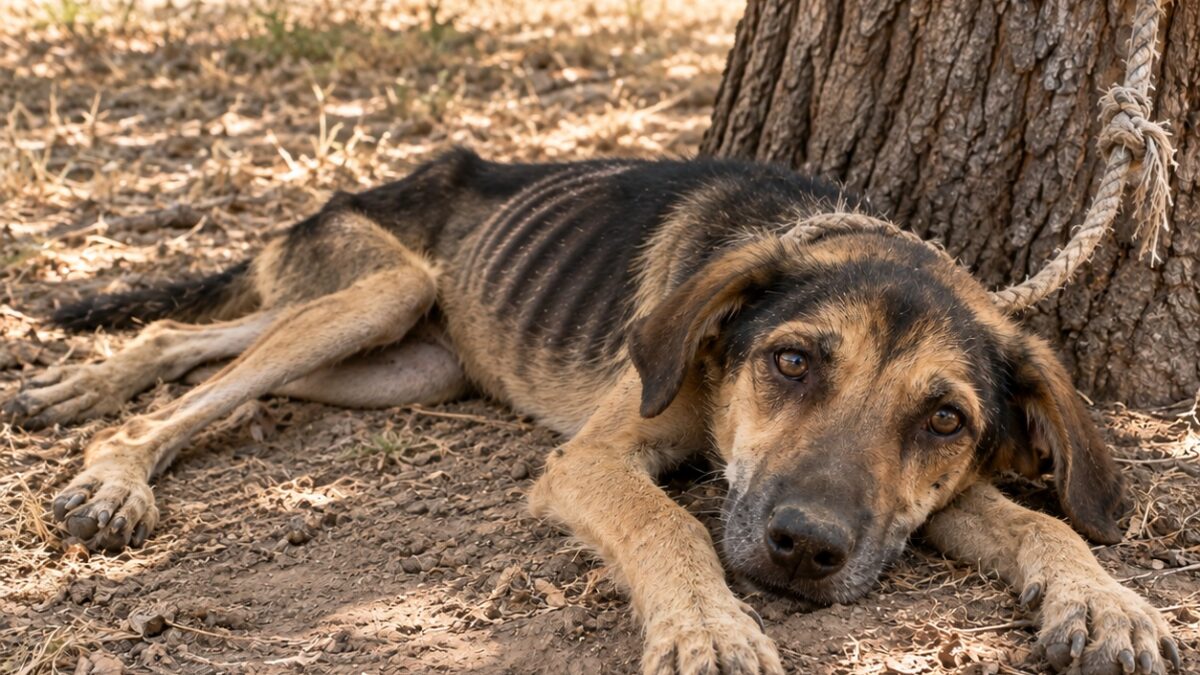
PART2
The team ordered an MRI.
That was when we finally got an answer.
Not a simple one.
Not a fixable fracture.
Damage and inflammation in the spinal cord.
Two vertebrae affected.
The veterinarian showed us the images.
I could see shapes.
Light.
Dark.
Areas that meant something to trained eyes.
To me, the explanation mattered more.
The pathways carrying messages between Eva’s brain and legs had been injured.
That was why she could not stand properly.
Why her limbs did not respond the way she wanted.
Why she could look at a place she wanted to go and still remain trapped on the floor.
I asked the question immediately.
“Surgery?”
The veterinarian shook his head.
“We don’t expect surgery to help.”
That answer hit harder than I thought it would.
Surgery, even frightening surgery, gives people a clear plan.
There is something wrong.
Open.
Fix.
Close.
Recover.
Eva did not have that kind of problem.
“So what do we do?”
“Rehabilitation.”
“How much can she recover?”
“We don’t know.”
“Will she walk?”
“We don’t know.”
“Ever?”
He looked at me.
“We need to see what her spinal cord can do as inflammation comes down and therapy continues.”
There it was again.
Uncertainty.
Not no hope.
Not a promise.
Something in between.
Eva lay several feet away.
She had no idea adults were discussing whether she might ever walk again.
She tried to reposition herself.
Her front legs pushed.
Her hindquarters dragged.
I looked back at the veterinarian.
“Then we start.”
Massage.
Medication to reduce pain and inflammation.
Electrical stimulation.
Gentle range-of-motion work.
Everything aimed at supporting the nerves, protecting muscle, and giving Eva the best chance her body could take.
The first massage session looked almost too simple to matter.
Hands moving over muscles.
Careful pressure.
Slow extension and flexion of limbs.
But a body unable to use itself normally begins losing muscle quickly.
Joints stiffen.
Circulation changes.
Pain creates more tension.
We were trying to preserve the bridge while waiting to see whether the nervous system could cross it again.
Eva did not love every part.
Some areas were tender.
At first she watched every hand.
Then, gradually, her head lowered.
Someone rubbed along her shoulder.
Eva exhaled.
That sound became one of my favorite things.
A long breath leaving a body that had been braced against pain.
Electrical stimulation came later.
Small controlled impulses.
The first session made Eva look confused.
She turned her head.
Tried to understand the sensation.
A technician spoke softly.
“It’s okay.”
Her leg twitched.
We all looked.
Not voluntary movement exactly.
Still movement.
Anything that reminded those muscles they existed felt valuable.
The days formed a routine.
Medication.
Massage.
Electrical stimulation.
Supported standing.
Rest.
Food.
Hydration.
Again.
Eva remained weak.
But no longer dehydrated.
That alone changed her face.
Her eyes became brighter.
Her body less hollow.
Then the harder work began.
Standing.
We supported her beneath the abdomen and chest.
Placed paws carefully.
“Ready?”
Eva always seemed ready.
We raised her.
For a second, four feet touched the floor.
Her hind legs held a little.
Front legs shook.
Then one folded.
Down.
Rest.
Again later.
The next day:
Stand.
Collapse.
Another day:
Stand.
Two seconds.
Three.
Then down.
I learned quickly that rehabilitation requires a different kind of patience than rescue.
Rescue is urgent.
Do something now.
Get the dog away from danger.
Rehabilitation is repetition without drama.
Same movement.
Again.
Tiny progress almost invisible.
No applause from the body.
Eva did not care.
She tried every time.
Each fall seemed to offend her.
Not emotionally in the human sense.
But she would hit the mat, pause, then start positioning herself to try again.
“Wait.”
Someone would laugh softly.
“You just fell.”
Eva pushed.
“All right.”
We helped her again.
Her back legs began changing first.
That surprised me.
At the beginning, both front and rear limbs seemed compromised.
Then one day during supported standing, a therapist loosened the support slightly.
Eva’s rear legs held more weight than before.
“Did you feel that?”
“Yes.”
Again.
The same.
Her hindquarters, once almost completely unreliable, were beginning to contribute.
Not enough to walk.
Enough to notice.
The front legs remained harder.
They buckled.
Crossed.
Failed to place properly.
So therapy adjusted.
Target different muscles.
Support.
Stimulate.
Repeat.
Days became weeks.
No miracle.
Just work.
Eva gained strength elsewhere too.
Her appetite improved.
Her coat looked better.
She started reacting when familiar people entered.
One caregiver would call:
“Eva.”
Her head lifted.
Tail moved.
The first tail wag happened while her legs still could not carry her.
That mattered to me.
Joy does not wait for complete physical recovery.
Eva proved that early.
She could be frustrated by her body and still be happy to see someone.
She could hurt and still lean into affection.
She could fail to stand and still want to try again.
Life was already happening inside rehabilitation.
Then we discovered the pool.
Nobody expected Eva to love it as much as she did.
Water therapy made sense physically.
Buoyancy reduces the amount of body weight the limbs must support.
Movement becomes possible with less pressure on joints and muscles.
But therapy being medically appropriate does not guarantee a dog will enjoy it.
Eva did.
The first time we lowered her carefully into warm water, she stiffened.
One second.
Then instinct took over.
Paws moved.
All of them.
Not perfectly.
But movement.
Real movement.
Her face changed.
She paddled.
The therapist supported her.
Eva moved forward.
I started laughing.
“Look at her.”
In the water, the dog who could barely stand on land had freedom.
Not complete.
Not effortless.
But freedom.
She did not fall.
Gravity no longer punished every mistake.
She could move her legs and go somewhere.
Eva began anticipating swim sessions.
We knew because of her face.
Bring her near the pool and she became alert.
Tail.
Excitement.
The same dog who had been tied to a tree now had something she genuinely enjoyed in the middle of treatment.
That mattered more than I realized.
Rehabilitation can turn an animal’s whole life into work.
Stand.
Exercise.
Medication.
Procedure.
Rest.
Repeat.
Swimming gave Eva play inside therapy.
Her body was rebuilding while her mind got something joyful.
Sometimes she splashed more than necessary.
Good.
Let her.
The goal was not only movement.
It was life.
After swimming, Eva slept deeply.
The good kind of exhaustion.
Not the depletion we had seen when she was found.
Muscles used.
Body warmed.
Safe bed.
Food coming.
That distinction felt huge.
Weekly plasma injections became another part of her treatment.
The medical team hoped they would support healing and reduce inflammation and pain.
Eva tolerated them.
Not enthusiastically.
She had opinions by then.
A dog developing opinions is usually good news.
If the needle took too long, she looked offended.
If someone offered affection afterward, forgiveness came quickly.
Over time, caregivers noticed something.
Eva seemed more comfortable.
Less pain.
Her body no longer tensed as strongly during some movements.
The veterinarian remained cautious.
But cautious optimism is still optimism.
Eva continued trying.
Supported standing.
Front paw placement.
Rear leg exercises.
Electrical stimulation.
Massage.
Swimming.
Plasma treatment.
Medication.
Every week looked similar from far away.
Up close, differences appeared.
A paw lands correctly once.
A hind leg pushes.
The trunk stays upright longer.
The head comes up.
A fall happens later than yesterday.
Those were victories.
One day, we tried small protective shoes.
They helped with traction and protected her paws as she attempted movement.
They looked almost ridiculous on her.
Tiny shoes on a dog who had survived being tied to a tree.
I smiled when I saw them.
Eva looked less amused.
We supported her.
Placed each foot.
“Okay.”
Her rear legs engaged.
One front paw forward.
Then the other.
Her body wobbled.
I held my breath.
A step.
Actual forward movement.
Then another.
Not being carried.
Not dragged.
Eva moved.
Her legs belonged to the movement.
Three steps.
Maybe four.
She stopped.
Everyone around her went silent.
There are times when cheering too early feels like it could break the moment.
Eva shifted.
Took another step.
Someone began crying.
Then everyone lost it.
“Good girl.”
Eva looked up.
She had no idea why humans were behaving so strangely.
Tail.
That made it worse.
I crouched.
“You walked.”
She leaned forward.
Almost fell.
We caught her.
I laughed through tears.
“You walked.”
For weeks, the best we had could fit inside seconds.
Stand.
Fall.
Try.
Now Eva had moved herself through space.
A few feet.
That was all.
It meant everything.
The next day, she did not suddenly walk across the room.
That is important.
Progress remained slow.
Some attempts were worse.
Fatigue changed performance.
Pain changed things.
Neurological recovery does not care about our emotional need for a straight line.
But once we saw those steps, we knew the pathway existed.
Some signal was getting through.
Eva knew how to use enough of her body to move.
Now we needed to build on it.
Five steps.
Rest.
Later, eight.
Another day, less.
Then more.
The little shoes became part of the routine.
Someone would bring them.
Eva watched.
Maybe she associated them with work.
Maybe with freedom.
We put them on.
Support.
Walk.
Her front legs remained the challenge longer.
Sometimes one crossed awkwardly.
Sometimes she stumbled.
But Eva corrected more often.
The hind legs that had improved first became stronger.
Her entire body began reorganizing around movement.
Muscle returned.
Balance improved.
And the distance grew.
Across a mat.
Then farther.
Toward the doorway.
One caregiver stood several feet away.
“Come on, Eva.”
Eva moved.
Slowly.
One paw.
Then another.
Her body swayed.
But she went.
When she reached the caregiver, she pressed her head into the woman’s hands.
Everyone laughed.
Eva had found motivation.
People.
That became part of therapy too.
Walk to me.
Walk to food.
Walk to the bed.
Walk because something you want exists over there.
Motivation matters when every step requires thought.
Eventually, the walks stopped looking like isolated therapy events.
They became actual exploration.
Eva moved through hallways.
Short distances outside.
She smelled things.
Paused.
Looked.
The world began expanding.
That was when rescuers learned another part of her history.
Eva had reportedly been chained since she was a puppy.
The sentence made everything inside me go quiet.
Since she was a puppy.
Not only the day we found her.
Not only during illness.
Chained.
Growing up attached to one place.
I imagined a young Eva.
Legs healthy then.
Energy.
Curiosity.
Dogs are built to explore.
To smell.
Walk.
Run.
Follow.
Learn.
If the history was accurate, so much of that had been taken from her before her spinal injury ever took away movement.
Now we were watching her discover the world at the same time she was relearning how to move through it.
That made every walk feel different.
Eva paused at grass.
Smelled.
Long.
We waited.
Why rush?
She had years of smelling to catch up on.
A leaf blew across the path.
Eva watched it.
One step toward it.
The leaf moved again.
She followed.
Not far.
Enough.
I thought about the tree.
One fixed point.
A chain’s radius.
The same dirt.
The same view.
Now:
Hallway.
Pool.
Grass.
Leaves.
People.
Doors.
Places.
Eva was not just recovering movement.
She was gaining geography.
The world became larger every week.
That may have been the most beautiful part.
Her walking distance improved.
The shoes remained useful.
Sometimes support remained close in case she lost balance.
No one forced speed.
We learned Eva’s rhythm.
She liked to stop.
Observe.
Continue.
Her body still needed care.
Massage continued.
Exercises.
Swimming.
Medication when indicated.
Plasma injections.
The work did not end because a video of her walking would have looked impressive.
Real rehabilitation continued after the viral moment.
That is the part I always want people to remember.
The first steps make everyone cry.
The hundredth exercise makes the first steps meaningful.
Eva kept doing both.
Swimming remained her favorite.
She became confident in water.
Paddle.
Turn.
Reach the other side.
Someone would call.
Eva moved toward the voice.
Sometimes she looked almost effortless.
Then she came out of the pool and reality returned.
Towel.
Supported footing.
Careful steps.
But even that contrast became less severe over time.
Land improved.
Water remained joy.
Her rescuers began wondering about the next stage.
Home.
Not temporary treatment.
A family.
That word carried risk.
Eva was not a simple adoption case.
She had neurological damage.
Ongoing exercises.
A history of immobility.
A need for people willing to continue physical care.
Swimming helped.
She might require long-term adaptations.
Anyone choosing her needed to choose the whole dog.
Not simply the inspiring story.
Applications came.
Questions.
Could she walk?
Yes, increasingly.
Would she always need therapy?
Likely some form of ongoing work.
Was she house-trained?
Could she use stairs?
What about cold?
What about exercise?
Every question mattered.
The right home would not pity Eva.
It would understand her needs.
Then a family chose her.
Not casually.
They knew what she had been through.
They knew she had been tied outside.
Knew she had once been unable to stand.
Knew recovery had taken weeks of repetitive work.
Knew adoption would not mean therapy ended.
They wanted her anyway.
More than wanted.
They were prepared.
And they lived in Canada.
That sounded impossibly far to me at first.
The dog once tied to one tree would cross borders.
Travel to another country.
Start a life somewhere she had never seen.
I thought about the size of that transformation.
One radius around a trunk.
Then Canada.
Eva did not understand geography.
Probably for the best.
Travel arrangements were made carefully.
Medical records.
Instructions.
Exercise routines.
Medications.
Everything her new family needed.
We talked about swimming.
They listened.
“Swimming is important to her.”
“We’ll keep it.”
That sentence made me smile.
They were not asking:
When will she be normal enough to stop all this?
They were asking how to continue what worked.
That is the kind of adopter rehabilitation dogs need.
Before Eva left, everyone wanted time with her.
The people who had massaged limbs when there was almost no response.
The technicians who had applied electrical stimulation.
The people who had held her during failed standing attempts.
The person who first put those little shoes on her paws.
The swimmers.
The feeders.
The ones who cried at the first steps.
Eva had built a community around recovery.
Now the purpose of all that work was for her to leave them.
Rescue can be cruel in that way.
You work until goodbye becomes possible.
Then you do it.
On her last day, Eva walked.
Not perfectly.
Not quickly.
But she walked toward the people saying goodbye.
One by one.
Tail moving.
I crouched when she reached me.
“You know what you did?”
Eva pushed her head into my chest.
“You made us all ridiculous.”
Tail.
“You fell about a thousand times.”
She licked my chin.
“And you got up.”
I held her carefully.
“I’m glad.”
That was all I could say.
I’m glad.
Glad the tree was not the ending.
Glad the MRI was not the ending.
Glad “surgery won’t help” was not the ending.
Glad the first collapse was not the ending.
Glad the first weak standing attempt was not the ending.
Glad Canada existed somewhere ahead.
Eva left.
And then the updates began.
The first photographs from her new home felt almost unreal.
New rooms.
New people.
Different landscape.
Eva in the middle.
Her family continued the exercises.
They did not assume adoption itself would heal anything.
Range of motion.
Strength work.
Walking.
Patience.
Everything carried forward.
Then they showed us the pool.
Bigger.
I laughed the moment I saw it.
“Of course.”
Eva had a larger place to swim.
Her family understood.
Water had been where she first rediscovered uncomplicated movement.
Now she could keep that joy.
The first video showed Eva entering the pool with help.
Then paddling.
Confident.
Her body moving smoothly.
Turn.
Across.
Back.
She looked happy.
That word can be overused with animals.
I do not care.
Eva looked happy.
She swam.
Then rested.
Then walked.
The new family continued supporting her in ways that made the progress last.
No miracle cured the spinal damage overnight.
The improvement came from all the same unglamorous things.
Exercises.
Consistency.
Medical support.
Time.
Eva responded.
Her walks became longer.
One video showed her outside.
Snow not present in that clip.
Just new ground.
Eva moving forward.
Stopping to smell.
Looking back toward her family.
Then continuing.
The dog who had spent her puppyhood chained was now walking simply because she could.
No destination required.
Exploration for its own sake.
I think that is the freedom I wanted most for her.
Not running.
Not athletic perfection.
Choice.
Go there.
Stop here.
Smell this.
Turn.
Come back.
The chain had once defined her available world.
Now her own curiosity did.
That is freedom.
Eva’s family sent messages about small things.
She liked certain resting spots.
She recognized routine.
Swimming days excited her.
She had preferences.
One caregiver joked that Eva had learned she was allowed to be spoiled.
Good.
Let her.
The dog who could not choose where to stand deserved opinions about where to sleep.
Her walking continued improving.
Not every day better than the day before.
But the overall direction remained forward.
She could cover more ground.
Recover more quickly after activity.
Use her legs with more confidence.
Every so often I returned to the first image.
Eva tied to the tree.
Unable to stand.
I stopped doing that eventually.
Not because I wanted to forget.
Because it began feeling unfair to make that version of her the first thing in my mind forever.
Trauma happened.
It should be remembered.
It should not become identity.
Eva was more than the dog tied to the tree.
She was the dog who loved swimming.
The dog who kept trying to stand.
The dog who walked in tiny shoes.
The dog who explored.
The dog who moved to Canada.
The dog with a family.
That was who she was now.
I began thinking about the word abandoned.
We say Eva was abandoned tied to a tree.
True.
But abandonment is not only physical absence.
It is the withdrawal of responsibility.
Someone sees a dependent living thing and decides:
Not my problem anymore.
Rescue is the opposite.
People who had never met Eva said:
She is our problem now.
Not in a negative way.
Responsibility.
Hydration.
MRI.
Therapy.
Massage.
Pool.
Shoes.
Home.
One person’s abandonment became many people’s commitment.
That is how the story changed.
No single heroic moment fixed her.
The rescuer who cut the rope mattered.
The veterinarian interpreting the MRI mattered.
The therapists mattered.
The person holding her upright mattered.
The family in Canada mattered.
Eva mattered too.
She brought the trying.
Again.
Again.
Again.
I think about how easy it would have been to call one of those failed standing attempts evidence.
She fell.
Maybe she cannot do it.
Another fall.
Maybe this is all she will regain.
But rehabilitation teams understand something important.
A failed attempt is sometimes part of the neurological work.
The body is practicing.
Searching.
Relearning.
Eva’s falls were not proof of hopelessness.
They were repetitions on the road toward movement.
That changed how I look at failure in general.
Sometimes falling is not the opposite of progress.
It is inside progress.
Eva showed us.
She fell.
Then tried again.
Not because anyone explained perseverance.
Because she wanted to move.
Simple.
Powerful.
There were days she became frustrated.
You could see it.
The body did not obey quickly enough.
A leg placed wrong.
She would try correcting.
Fail.
Pause.
Then continue.
We never turned frustration into pressure.
Rest mattered too.
A nervous system healing under constant exhaustion does not benefit from being forced.
So Eva learned another thing:
Trying and resting can coexist.
Work.
Pool.
Sleep.
Food.
Affection.
Again.
That balance traveled with her to Canada.
Her family continued the exercises without making every hour therapy.
She got to be a dog.
That phrase matters.
Rehabilitation animals can become projects if people are not careful.
Every movement measured.
Every minute purposeful.
Eva needed work, yes.
She also needed sniffing.
Sunlight.
Naps.
Companionship.
Swimming because she enjoyed it, not only because it strengthened muscles.
A life cannot be only treatment.
Her new family understood that.
The larger pool became almost symbolic.
In the beginning, water was a therapy tool someone discovered.
Later it was part of her home life.
Eva could swim because she liked swimming.
Medical value and joy together.
Perfect.
One update showed her floating for a second while someone supported nearby.
Calm.
I remembered the first time we lowered her into water.
The surprise.
Then immediate movement.
Perhaps Eva had always been a swimmer in another possible life.
A life where she was never chained.
We cannot know.
But at least she got that part now.
Rescue cannot return stolen puppyhood.
It can create experiences that were delayed.
First real exploration.
First free walk.
First big pool.
First family treating her disability as something to work with rather than a reason to leave her behind.
Those are new chapters.
They do not erase earlier ones.
They make the book longer.
I used to feel angry when people called Eva lucky.
Lucky?
She was chained from puppyhood.
Left without food and water.
Found unable to stand.
That does not sound lucky.
But later I understood what they meant.
Lucky that someone found her before she died.
Lucky that medical care existed.
Lucky that her spinal cord retained enough function to respond.
Lucky that people did not stop when surgery was not an option.
Lucky that a family understood what they were choosing.
Both can be true.
Eva was terribly unlucky in what was done to her.
Then very fortunate in who refused to leave afterward.
The word does not have to excuse the first part.
One of the most emotional updates came when Eva walked farther than anyone expected.
Not miles.
Distance is relative.
For Eva, each extension mattered.
Her family filmed her outside.
Little shoes.
Steady enough.
She moved across the ground.
Stopped.
Looked around.
Then continued.
No one held her body.
A person walked near her.
Ready if needed.
Not carrying.
That distinction made me cry.
Support without taking over.
That was the entire philosophy of her recovery.
Help enough for Eva to do what Eva could do.
Do not confuse assistance with replacement.
Her legs had to learn.
She had to attempt.
People made the attempt safer.
That is good rehabilitation.
It is also good love.
Years do not need to pass for a story to feel complete.
Eva’s story reached its emotional ending when home stopped being a place she was tied outside and became a place where people adapted life around her needs.
Canada was not magical because it was Canada.
The pool was not magical because it was bigger.
The family mattered because they continued the work.
They did not choose Eva despite her needs and then resent them.
They chose the needs too.
Exercises included.
Slow walks included.
Swimming included.
Whatever future mobility looked like included.
That is adoption.
Not taking home the inspiring version.
Taking home the whole dog.
Eva got that.
Sometimes I wonder what she thought the first night in her new home.
Did she expect a chain?
Did she notice no rope attached her to one spot?
Did she understand she could move from room to room?
Dogs do not narrate.
Maybe none of those questions existed in words.
Her body would learn.
Doorway.
No chain.
Bed.
No chain.
Yard.
Family nearby.
No chain.
Pool.
Return home.
No chain.
Repetition again.
The absence of restraint became normal.
That is healing too.
One day the family told us Eva had started moving toward the door when she wanted to explore outside.
I stared at that message.
A request.
Choice.
The dog once physically unable to reach water or shade now asked to go somewhere.
And people responded.
Doors opened.
That simple dynamic felt enormous.
Need.
Signal.
Response.
Exactly what she should have had as a puppy.
She finally had it as an adult.
I think that is why Eva’s story is not mainly about walking for me.
Walking is the visible triumph.
Important.
Emotional.
But underneath is something larger.
Agency.
Eva had none tied to that tree.
Her distance controlled by rope.
Her body controlled by injury.
Her survival controlled by whether someone else bothered to help.
Recovery returned options.
Stand or rest.
Swim.
Walk.
Explore.
Come close for affection.
Go lie somewhere else.
Choice is part of dignity.
Eva regained pieces of it.
Every step increased the size of her choices.
That is what made those little shoes so beautiful.
They were not a symbol because they were cute.
They helped her claim territory.
One step farther.
Then another.
The world became accessible.
I never stopped thinking about the MRI either.
Damage and inflammation in the spinal cord.
Two vertebrae affected.
Medical facts.
Scary.
Real.
But a scan shows structure.
It does not show determination.
It cannot predict every adaptation.
The veterinarian was right not to promise.
Nobody knew.
Eva taught us to work inside the unknown.
Maybe she walks.
Maybe she does not.
Do the therapy anyway if it is helping and humane.
Support comfort.
Watch response.
Let the body answer over time.
Her body answered:
Some movement.
Then more.
Enough to build on.
Medicine did not fail because surgery could not help.
It changed strategy.
Massage.
Stimulation.
Pain management.
Plasma therapy.
Hydrotherapy.
Physical rehabilitation.
That matters too.
Helping is not always fixing with one procedure.
Sometimes it is creating the conditions where the body can do what recovery remains possible.
Eva benefited from that kind of patience.
I think people underestimate patience because it does not photograph well.
Nobody takes a dramatic picture of the fiftieth range-of-motion exercise.
But without it, the dramatic walking video may never happen.
Eva’s story belongs to all those boring repetitions.
Rub.
Stretch.
Stimulate.
Rest.
Swim.
Stand.
Fall.
Again.
That is the real miracle, if you want to use the word.
Not a single impossible event.
Many ordinary acts refusing to stop.
I still remember her first little shoes.
They looked like something meant for a toy.
But when Eva moved forward in them, they became the most serious object in the room.
Step.
Everyone silent.
Step.
Tears.
That moment gave us hope.
But what mattered was what came next.
More work.
The hope became responsibility.
If she can take four steps, help her take five safely.
Then six.
Then let her rest.
Never turn success into punishment by demanding too much.
Eva’s team understood.
Her family did too.
That is why progress continued.
If I could choose one thing for people to learn from Eva, it would not be:
Never give up.
That phrase can become cruel if applied without thought.
Sometimes bodies cannot recover.
Sometimes stopping painful treatment is kindness.
Eva’s case was specific.
She kept showing us capacity.
Comfort improved.
Movement improved.
She enjoyed therapy, especially swimming.
Quality of life grew.
So continuing made sense.
A better lesson is:
Do not decide the ending before the body has had a fair chance to answer.
Eva had that chance.
And she answered in steps.
The people who first cared for her kept receiving updates from Canada.
Every time, the response was the same.
“Look at her.”
Not because she looked perfect.
Because she looked engaged.
Present.
Interested.
Loved.
That is more important than perfect gait.
Eva might always move differently.
Who cares?
Mobility is not a beauty contest.
Can she get where she wants with support?
Can she enjoy life?
Can she interact?
Swim?
Explore?
Yes.
Then celebrate.
Perfection is not the goal.
Participation is.
Eva participated in her own life more every month.
That was the win.
One video showed her walking near her family.
She stopped.
Turned.
Went back toward them.
I replayed it.
Not because of biomechanics.
Because she chose them.
Eva had learned people could be destination too.
The dog left tied alone to a tree now moved toward people because closeness felt safe.
That is another form of rehabilitation no MRI measures.
Emotional mobility.
From isolation to attachment.
She had traveled that distance too.
Her family gave her gentle care.
Not pity.
That distinction matters.
Pity looks at Eva and sees what she cannot do.
Care asks:
What helps you do more of what you enjoy?
Bigger pool.
Exercises.
Safe walking.
Time.
She got those.
People sometimes asked whether she was “normal” now.
I disliked the question.
Eva was Eva.
She walked.
Sometimes differently.
She swam beautifully.
She explored.
She had a family.
What else did normal need to mean?
If normal meant a dog allowed to live close to people who wanted her, then yes.
Finally.
The tree stopped being the center of the story.
That took time for me.
At first, every update made me compare.
Tree versus pool.
Collapsed versus walking.
Chained versus adopted.
Eventually I realized Eva probably did not spend her days performing comparisons for us.
She lived.
Morning.
Food.
Exercise.
Pool.
Walk.
Family.
Sleep.
The past mattered.
The present did not need to mention it every hour.
That is healthy.
We remember so she does not have to become a symbol forever.
Eva deserves ordinary days.
A dog in Canada.
Swimming.
Walking.
Getting tired.
Resting.
Exploring something new.
Being called inside.
Having someone waiting.
That is enough.
One evening, her family sent a picture of Eva asleep after swimming.
I stared at it longer than the walking videos.
She was sprawled comfortably.
Body loose.
No rope.
No treatment table.
No one holding her up.
Sleep.
I thought about the day we found her.
She could not stand.
She had no food.
Severely dehydrated.
Tied.
Now she was tired because she had been swimming in her own bigger pool with people who cared whether she enjoyed herself.
What an extraordinary change in the meaning of exhaustion.
Then:
Weak from neglect.
Now:
Tired from living.
That may be my favorite transformation.
Eva had once used every bit of strength trying to rise beside a tree.
Now she could spend strength on exploring.
There are few more satisfying endings than that.
I still think about the people who worked with her through the period when nobody knew whether those efforts would lead anywhere.
Rehabilitation without certainty is emotionally difficult.
You invest hours into movements that may never become functional walking.
You hope without promising yourself.
That team did it anyway.
Because therapy gave Eva comfort.
Because pain could be reduced.
Because whatever movement she could regain was worth supporting.
The outcome made those weeks look heroic in hindsight.
At the time, it was simply work.
That is often what heroism looks like from inside.
Work you do because someone needs it.
Not because you know the ending.
Eva’s family inherited that work gladly.
They did not see adoption as graduation from care.
They saw it as continuation.
I respect that deeply.
A medically complex rescue dog does not stop being complex because the paperwork says adopted.
The family kept exercising.
Monitoring.
Swimming.
Encouraging.
And Eva kept responding.
That is why the final chapter belongs to them too.
Not because they “completed” Eva.
Because they gave her the conditions to continue.
Home should do that.
Continue.
Not stop.
The pool became larger.
The walks became longer.
The world became wider.
From one tree.
To hospital hallway.
To rehabilitation mat.
To therapy pool.
To shoes.
To outdoor paths.
To Canada.
To home.
That map alone makes me emotional.
Every new place represented something the chain had once denied.
Distance.
Choice.
Movement.
Discovery.
Eva deserved all of it.
The last time I thought seriously about the tree, I imagined returning there with Eva.
I immediately decided I would not want to.
There is no need.
She does not owe that place a triumphant return.
Healing is not always confronting every location of pain.
Sometimes healing is never going back because there is somewhere better to be.
Eva had Canada.
A family.
A pool.
Paths she had not smelled yet.
Let the tree remain behind.
She had spent enough time there.
When people tell her story now, the beginning is shocking.
A dog tied to a tree.
Too weak to stand.
Spinal cord damaged.
No surgery to fix it.
The middle is exhausting.
Therapy.
Falls.
More therapy.
Swimming.
Plasma injections.
Little shoes.
Steps.
The ending is simple.
Eva walks.
Eva swims.
Eva explores.
Eva has a family.
Simple endings can carry enormous weight.
Because none of those things were guaranteed.
Walking means legs that once failed her can carry her.
Swimming means movement can be joy.
Exploring means the world is no longer limited to the length of a chain.
Family means someone wants her close.
That last one may be the most important.
Close.
Not tied at a distance.
Not left outside.
Close.
Someone notices when she struggles.
Someone helps with exercises.
Someone fills the pool.
Someone waits while she takes her time.
Someone sees Eva not as a burden but as part of the household.
That is home.
I think of her taking one of those first steps.
Tiny shoe on the floor.
Body trembling.
People around her afraid to breathe too loudly.
Then another step.
If Eva had understood why everyone cried, she might have thought humans were ridiculous.
Maybe we are.
But we had seen her lying beneath the tree.
We knew the distance contained in one step.
It was not inches.
It was everything.
From helplessness to possibility.
She kept going.
Not forever in that moment.
Enough.
That is how recovery happens.
Enough for today.
Then tomorrow.
More.
Eva taught us not to dismiss small movement.
She also taught us to notice joy in the middle of hardship.
Swimming came before complete recovery.
She did not have to wait until she was “fixed” to enjoy something.
That matters.
Life cannot always be postponed until healing ends.
Sometimes healing lasts a long time.
Find the pool.
Find the thing the body can do.
Let joy exist now.
Eva did.
Her family continued that philosophy.
Exercise, yes.
Care, yes.
But also life.
New places.
Exploration.
Closeness.
They gave her the care she had missed.
Not as compensation.
You cannot repay stolen years exactly.
As present-tense love.
Today, you get this.
Today, you are safe.
Today, the door opens.
Today, the pool is ready.
Today, somebody walks beside you.
Repeat.
Eventually present tense becomes history too.
A better one.
Eva’s new history grew.
I hope one day the number of safe mornings became larger than the number of mornings tied outside.
Maybe it already did.
We do not need to count.
The direction is enough.
When I picture Eva now, I do not picture the rope first.
I picture water.
That surprises me.
Eva in a pool.
Head above the surface.
Legs moving.
Purposeful.
Free.
Water supporting what gravity once exposed as weakness.
Then she reaches the edge.
Her family is there.
She gets out with help if she needs it.
Rests.
Later, walks.
That is Eva.
Not cured by one miracle.
Supported into a life.
There is dignity in that ending.
Sometimes love does not give you a perfect body.
It gives you enough help to inhabit the body you have.
Eva received that.
And used it.
Every step she takes now belongs to her.
Every swim.
Every new place.
Every choice about where to lie down.
Where to go.
Who to approach.
Small freedoms add up.
For a dog chained since puppyhood, they add up to an entirely different life.
I once thought the most emotional sentence in Eva’s story would be:
She walked.
Now I think it is:
She had somewhere to walk to.
A family.
That changes everything.
Movement without belonging would still have been progress.
Movement toward people waiting for you?
That is home.
Eva got both.
Today, the dog who was once tied to a tree without food or enough water can stand.
She can take herself forward.
She can enter water and move with confidence.
She can explore places beyond the radius of a chain.
She can become tired from exercise instead of neglect.
And when she needs help, somebody is there.
Not because she is a case.
Not because people are filming a rescue.
Because she is family.
That is where I leave Eva.
Not beside the tree.
The rope is gone.
Not on the hospital floor after another failed attempt to stand.
Not even in those first little shoes, though I will never forget them.
I leave her in Canada.
A bigger pool nearby.
Her family close.
Eva moving through water with the easy rhythm she loves.
Then climbing out.
Resting.
Getting back onto her feet.
One step.
Another.
No chain stopping her.
No person abandoning her.
No one asking whether trying is worth it.
She already answered that question.
Again.
Again.
Again.
Until the dog who could not stand had an entire world left to explore.








