PART2:Cloe Walked Into a Garage on Christmas Night With Burns Over 40% of Her Body—Months Later, She Was Sleeping in the Sun
PART2
The first bandage change showed me how difficult the next weeks would be.
You cannot simply cover a burn and forget it.
Wounds need cleaning.
Dead or damaged tissue has to be monitored.
Bandages must stay appropriate to the healing stage.
Pain has to be controlled.
Infection has to be watched for constantly.
And every time we did something necessary, Cloe had to feel hands near the places that hurt most.
The veterinary team moved slowly.
One person supported her.
Another cleaned.
Medication helped.
Still, Cloe’s body trembled.
Not violently.
Tiny vibrations running through her frame.
I sat where she could see me.
“You’re okay.”
Again, the phrase was not technically true.
She was not okay.
But I did not know what else to say.
“You’re safe.”
That was better.
Someone loosened another section of bandage.
Cloe closed her eyes.
She did not scratch.
Did not bite.
Did not scream.
She endured.
That word sounds noble when humans use it.
Watching an animal endure something is not noble.
It is heartbreaking.
I did not want Cloe to have to be brave.
I wanted her to be a kitten.
But bravery was what those first nights demanded.
Pain relief.
Wound cleaning.
Bandages.
Rest.
Repeat.
Her entire schedule revolved around injury.
She needed food, but even changing position to eat could be uncomfortable.
She needed sleep, but finding a way to lie without pressing against injured skin was difficult.
She needed warmth, but the team had to manage her carefully because burned skin could not regulate and protect the body normally.
Every ordinary need became complicated.
I went home after the first night and found myself staring at my own cat sleeping on a chair.
Curled in a ball.
Completely relaxed.
I almost cried.
That posture alone was something Cloe could not comfortably do.
The next morning, I returned early.
Cloe was awake.
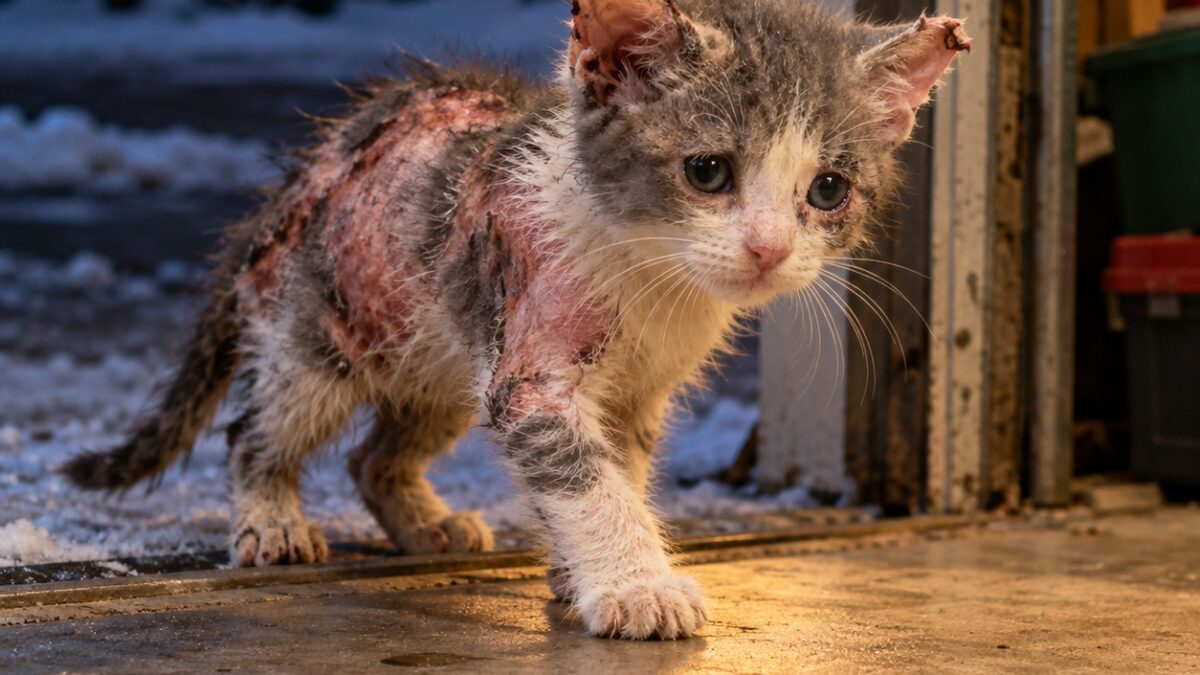
Bandages wrapped around much of her small body.
Her ears looked fragile.
Her face tired.
But when a technician approached, Cloe did not recoil.
She allowed the woman to check her.
The technician smiled sadly.
“She’s unbelievably sweet.”
I nodded.
That became something everyone said.
Not because Cloe performed affection immediately.
Because despite everything happening to her, she never seemed to want to hurt the people caring for her.
She would watch.
Sometimes tense.
Sometimes turn her face slightly away.
But there was no aggression.
The veterinary staff fell in love with her quickly.
It is difficult not to become attached to a patient who is so young and trying so hard.
But attachment made the fear worse.
Every wound check carried a question.
Is this healing?
Is infection developing?
Is the tissue healthy?
Is she comfortable enough?
Burn recovery can change quickly.
A kitten who looks stable in the morning can become more fragile if infection takes hold.
So we watched.
Closely.
Her temperature.
Her appetite.
The wounds.
The color of tissue.
Her energy.
Everything.
At first, progress was almost impossible to see.
That is one of the hardest parts of healing.
You do the same care for days and the animal still looks terribly injured.
People outside the medical team want photographs where everything suddenly looks better.
Real recovery is quieter.
One area less inflamed.
A cleaner wound bed.
A little more appetite.
A night with better rest.
Cloe’s first victories were those kinds of victories.
She ate.
Not a lot.
Enough.
She slept for longer periods.
Her pain seemed more controlled.
The bandages did their work.
Her body stayed stable.
Day after day.
That alone was huge.
Every day without serious infection was another day her skin had to begin repairing itself.
Still, there were moments when I was afraid to hope too much.
Her ears worried me.
They had been badly burned.
We knew they might never look the same.
Her right eye area worried me too.
The surrounding skin had been injured enough that every examination made my stomach tighten.
The veterinarian monitored it.
Time would tell how much would heal.
Again.
Time.
Everything depended on time.
Cloe did not know that.
She knew only this moment.
Bandage.
Warmth.
Food.
Hands.
Sleep.
Perhaps that was a blessing.
Animals do not sit awake imagining what their body might look like months later.
They simply experience what is happening now.
So we tried to make now bearable.
When a procedure finished, someone stayed near her.
When she wanted to sleep, we made the environment quiet.
When she ate, we let her eat without a crowd hovering.
When she tolerated touch, we did not demand more.
The goal was not only physical healing.
We wanted Cloe to reach the end of treatment without learning that every human hand meant pain.
That distinction mattered.
Some touch was unavoidable.
But not every touch had to become a procedure.
Sometimes a hand rested nearby.
Sometimes fingers gently touched an uninjured area.
Sometimes someone simply sat.
Cloe began recognizing those differences.
One day a technician reached toward her carefully after treatment.
Not to clean.
Not to bandage.
Just to stroke beneath her chin.
Cloe lifted her head.
The technician froze.
Then continued.
Cloe leaned.
Barely.
I saw it.
“So you do like that.”
Cloe closed her eyes.
For maybe five seconds, she looked like a normal kitten.
Not a burn patient.
Just small.
Soft.
Wanting affection.
That moment stayed with me.
Because the wounds were still there.
The bandages were still there.
But Cloe existed underneath them.
We began catching glimpses.
The first real turning point came with standing.
During the earliest days, Cloe could barely move without discomfort.
Her gait was stiff.
Slow.
Every step looked measured.
Then one afternoon, she stood up more steadily.
No dramatic announcement.
She simply rose.
One paw.
Then another.
Her legs held.
She looked around.
The technician beside her whispered:
“Good girl.”
Cloe took a step.
Then another.
I smiled so hard my face hurt.
This was not the end.
Not even close.
But movement that did not immediately look unbearable meant something.
The next days brought more standing.
More careful walking.
Her body was beginning to tolerate life again.
Then came the toy.
It was a tiny thing.
Something light.
Soft enough that it could not hurt her if she bumped against it.
We had put it nearby without expecting much.
Cloe had been watching.
One afternoon, the toy moved slightly.
Someone had nudged it.
Cloe’s eyes followed.
Then she lifted one paw.
Slowly.
Reached.
Touched it.
The toy rolled.
Cloe looked.
Everyone went silent.
She reached again.
A paw.
That was it.
No running.
No pouncing.
No wild kitten attack.
One paw toward a toy.
I cried immediately.
A technician laughed through tears.
“Oh, come on.”
“I’m sorry.”
“No, you’re not.”
I wasn’t.
That tiny movement meant everything.
A severely injured animal spends energy only on what matters.
Breathing.
Eating.
Changing position.
Avoiding pain.
Play is unnecessary.
That is why it matters.
Cloe had enough energy left over to be curious.
The kitten inside the bandages had started demanding a little space.
She wanted something that had nothing to do with survival.
Fun.
That was the first time I truly allowed myself to imagine her future.
Not simply alive.
Playing.
The next week, she reached for the toy again.
Then another.
She became more interested.
Her movements remained cautious.
But curiosity grew faster than strength.
Someone would move a small object.
Cloe watched.
Paw.
Sometimes she tried to follow.
We did not let her overdo it.
Her skin still needed protection.
But play had entered the recovery plan.
Not formally.
Emotionally.
Every time she played, the room felt different.
Her identity shifted.
Not:
The burned kitten.
Cloe.
A kitten who happened to be recovering from burns.
That change mattered.
Weeks passed.
The wounds slowly closed.
Some areas healed more quickly.
Others needed continued attention.
Bandages decreased little by little.
The first time a larger portion of her body remained uncovered, I stared.
New skin.
Tender.
Different.
But closed.
Healing.
Then came the fur.
At first, tiny soft growth around her neck and back.
Almost invisible.
Someone noticed before I did.
“Look.”
I leaned closer.
Fuzz.
I laughed.
“That counts as fur?”
“It absolutely counts.”
Cloe looked offended by our interest.
Good.
Healthy kittens should be offended by humans being ridiculous.
The fur continued growing.
Not perfectly everywhere.
Some scarring remained.
We expected that.
Her ears would carry permanent evidence of what happened.
They healed, but the shape was changed.
No amount of treatment could return them exactly to what they might have looked like before the burns.
At first, that made me sad.
Then I became protective of those ears.
Not because scars should be romanticized.
I would erase her pain if I could.
But they became part of Cloe.
She did not look in a mirror and mourn.
Humans did enough mourning for everyone.
Cloe simply lived.
The skin around her right eye improved too.
Each appointment brought another small piece of relief.
The area looked less inflamed.
Healthier.
The veterinarians continued monitoring.
No one declared victory too early.
Burn care punishes impatience.
We stayed consistent.
Cleaning.
Medication.
Observation.
Nutrition.
Rest.
Cloe contributed personality.
A lot of it.
Once her pain eased, the gentle kitten became a playful one.
She began batting at things.
Following movement.
Looking for attention.
She started greeting caregivers.
Not always dramatically.
Sometimes with a look.
Sometimes by leaning.
Sometimes by positioning herself where hands could find her.
One nurse joked:
“She’s training us.”
Probably.
Cats are efficient that way.
Cloe learned which people gave the best scratches.
Which person usually brought food.
Which voice meant bandage change.
Which voice meant nothing unpleasant at all.
And she began seeking the safe ones.
That was another form of healing.
Trust had survived the treatment.
Maybe even grown because of it.
One afternoon I walked in while a procedure was happening.
I expected Cloe to be tense.
Instead, she was asleep.
Actually asleep.
While someone worked carefully around part of her body.
I stopped.
“Is she sedated?”
The technician smiled.
“No.”
I stared.
“She fell asleep.”
That hit me harder than the toy.
Sleep is vulnerability.
Cloe had once walked into a garage burned and hurting with no idea who would touch her next.
Now she could close her eyes while human hands treated her injuries.
That is not only physical recovery.
That is trust settling into the nervous system.
I sat beside her afterward.
When she woke, she stretched slightly.
Not a full cat stretch yet.
Still careful.
But enough.
“Show-off.”
Cloe blinked.
I scratched beneath her chin.
She leaned.
The affection increased with strength.
She liked closeness.
That surprised me only because the beginning had been so violent to her body.
Whatever had caused the burns remained unknown in the story we had.
We did not fill the gap with invented cruelty.
We did not need to.
Cloe had arrived injured.
That was enough truth.
What mattered now was that every person around her treated her body as something worth protecting.
She responded.
Months passed.
By then the difference was impossible to miss.
The tiny patient wrapped in layers of bandages had become a kitten who moved around with confidence.
Her fur had returned across much of her neck and back.
Scars remained visible.
The ears looked different.
But the wounds were no longer open emergencies.
Cloe played.
Really played.
Pawing.
Following toys.
Sometimes moving fast enough that we had to laugh because months earlier every step looked painful.
She loved attention.
Cuddling became part of her routine.
And sunlight.
Cloe discovered sunlight the way cats always seem to.
Completely.
If a warm patch appeared, she found it.
Curled herself into it.
Closed her eyes.
The first time I saw her asleep in direct sun, I stood at a distance and felt my throat tighten.
Heat had once been associated in my mind with her injuries.
Burned skin.
Pain.
Now warmth meant comfort.
A sunbeam.
A nap.
Something harmless.
That felt like a kind of reclaiming.
Cloe did not know any of this symbolism.
Good.
She simply slept.
Eventually, we had to think about the next step.
A home.
Not clinic life.
Not temporary recovery.
A permanent person.
By then, anyone who spent more than a few minutes around Cloe understood why someone would fall in love with her.
Her injuries did not make her difficult to love.
They made people careful.
But Cloe herself?
Affectionate.
Playful.
Gentle.
Young.
Her whole life was still ahead.
That was what I kept returning to.
She had been only a few months old on Christmas night.
Everything terrible happened before she had even finished being a baby.
But that also meant most of her life could still be different.
That thought gave me peace.
An adoptive mother chose her.
I remember the first meeting.
No dramatic speech.
No one saying:
I’m saving her.
Thank God.
Cloe did not need another hero narrative.
She needed a person.
Someone who understood the burns.
The ears.
The scars.
The fact that some areas might always look different.
Someone who looked at Cloe and saw the cat first.
The woman sat.
Cloe watched.
Then approached.
Sniffed.
The woman let her decide.
Good.
Cloe moved closer.
The hand came down gently.
Cloe stayed.
Then leaned.
That familiar move.
I smiled.
Decision made.
Not officially.
Emotionally.
When adoption day came, I thought I would be happy.
I was.
And sad.
Rescue creates ridiculous emotional arrangements.
You spend months fighting for an animal to become healthy enough to leave you.
Then they leave.
Success hurts.
Cloe was placed in her carrier.
She looked healthy enough now that someone seeing only that day might not understand how close the beginning had been to disaster.
Her ears told part of it.
The scars another.
But the rest?
Bright eyes.
Strong steps.
Curiosity.
Life.
Her new mother spoke softly to her.
Cloe settled.
I crouched near the carrier.
“Christmas was rough, huh?”
Cloe blinked.
“Next one better.”
I put one finger near the opening.
She rubbed her face against it.
That finished me.
I laughed and cried.
“Okay.”
Her adoptive mother smiled.
“She’ll be loved.”
I believed her.
That mattered.
Cloe left.
And for a few days, the treatment room felt strange without her.
No bandage supplies prepared specifically for that tiny body.
No kitten reaching toward toys between care sessions.
No one asking:
Did she eat?
How does the skin look?
Did she sleep?
Recovery leaves its own kind of empty space.
Then the updates began.
Cloe at home.
Cloe playing.
Cloe curled beside her new mother.
Cloe asleep.
Cloe in sunlight.
I saved too many pictures.
No shame.
One showed her stretched near a bright patch on the floor.
Her eyes closed.
The healed areas on her body visible if you knew where to look.
Her ears permanently changed.
But Cloe looked completely at peace.
That was when I realized something.
I had spent months thinking the satisfying ending would be seeing her wounds disappear.
They did not disappear completely.
And that was fine.
A happy ending does not require the body to forget.
It requires pain to stop controlling the future.
Cloe had scars.
Cloe also had toys.
Both true.
Her ears were different.
She was adored.
Both true.
The skin around her eye had been injured.
Now she could close that eye peacefully in the sun.
Both true.
Healing does not have to erase evidence.
Sometimes it simply gives the evidence a past tense.
That happened to Cloe.
She had been badly burned.
She had needed bandages.
She had struggled to walk.
Those sentences moved backward.
The new verbs were different.
She plays.
She cuddles.
She naps.
She follows.
She sleeps in the sun.
Present tense is powerful after trauma.
I think often about how gentle she remained during the worst period.
People love to say animals know we are helping.
Sometimes maybe they do.
I am less certain.
Cloe may simply have been gentle by nature.
Maybe she was too tired to resist.
Maybe both.
But once pain decreased, gentleness remained.
It was part of her.
Not merely a reaction.
She liked people.
That amazed me.
Not because animals must become distrustful after injury.
Because she had every reason to associate touch with discomfort during treatment, yet caregivers managed to preserve something good.
Hands became safe.
That did not happen by accident.
Pain relief mattered.
Slow handling mattered.
Quiet voices mattered.
Letting Cloe rest mattered.
Not touching simply because humans wanted reassurance mattered.
Trust can survive necessary discomfort if the animal is treated with respect.
Cloe proved that.
Her caregivers learned her signals.
Body tense?
Pause.
Eyes soft?
Okay.
Need sleep?
Stop bothering the kitten.
The best medical care includes listening to the patient even when the patient cannot speak.
Cloe spoke with her body.
We tried to listen.
Later, her adoptive mother did too.
That made me confident in the match.
Cloe did not need someone impressed by her story.
She needed someone who knew when she wanted play and when she wanted sleep.
When scars needed monitoring.
When affection was welcome.
When a cat simply wanted to be left in a sunbeam.
Home is made from those details.
Not rescue headlines.
I came to dislike people describing Cloe only as “the burned kitten.”
Understandable.
That was how everyone first heard about her.
But identities can trap animals just as much as physical spaces do.
Cloe was not a burn.
She was a cat.
A young cat.
Playful.
Affectionate.
Patient.
Curious.
Probably capable of causing ordinary cat trouble once everyone stopped treating her like fragile glass.
That was good.
Let her climb something she should not.
Knock over something annoying.
Wake someone for food.
A rescue animal becoming inconvenient is a form of success.
Cloe had spent too long requiring solemn attention.
She deserved to become ridiculous.
The first time her adoptive mother told us Cloe had been playing so much that she finally collapsed into a nap, I laughed.
That is the exhaustion kittens are supposed to know.
Not pain.
Play.
Run.
Pounce.
Sleep.
A body tired because it spent energy on being alive.
What a difference.
I remembered Christmas night.
Every step hurt.
Now she chose movement for fun.
That is recovery you can see without medical language.
Sometimes people ask what percent of her body had been burned.
Nearly forty percent.
The number remains shocking.
But eventually I stopped saying it first.
I preferred:
Cloe is doing great.
Because the percentage was the beginning, not the definition.
Medicine needed numbers.
Life did not.
At home, Cloe’s world became simpler.
Food arrived.
Water.
Toys.
A person.
Comfortable places to sleep.
Routine veterinary follow-up when needed.
Sunlight.
No daily bandage changes.
No constant wound cleaning.
No clinic noise.
That simplicity was luxurious.
A healthy animal’s day is beautifully boring.
Cloe earned—no, deserved—that boring life from the beginning.
She got it later.
Better late than never, though I wish never had not existed.
One afternoon I visited.
Cloe was asleep.
Her adoptive mother whispered:
“She’ll wake up if you touch her.”
“I won’t.”
We sat nearby.
Cloe remained stretched in the sunlight.
I studied her ears.
Different shape.
Healed edges.
Permanent.
I had once felt sad looking at them.
Now I felt something closer to tenderness.
They were simply Cloe’s ears.
No tragic symbolism required.
Cats do not measure themselves against imagined uninjured versions.
Humans do that.
Cloe inhabited the body she had.
Comfortably.
That helped me stop mourning cosmetic perfection.
Scars are only sad when they still hurt.
Cloe’s no longer defined pain.
That was what mattered.
Eventually she woke.
Saw me.
Stretched.
Walked over.
Strong steps.
I remembered the clinic.
The careful movement.
The tiny paw touching the first toy.
Now she approached without thinking about each step.
That unconsciousness is part of healing too.
When movement no longer requires planning.
When the body stops being the center of every decision.
Cloe reached me.
Rubbed against my hand.
I scratched her chin.
“There she is.”
Her eyes closed.
Same expression as the early days.
Different context.
Then, affection had existed between pain.
Now pain had become background history and affection had the whole room.
Her adoptive mother smiled.
“She does that constantly.”
“Good.”
“She’s spoiled.”
“Better.”
Cloe went back toward the sunny spot.
Perfect.
I sat there and thought about Christmas.
Holidays encourage stories about miracles.
We decorate everything with them.
Cloe’s recovery could easily be told that way.
Christmas kitten appears.
Good people save her.
Miracle.
But real healing was less magical and more impressive.
People worked.
Every day.
Veterinarians calculated pain control.
Technicians cleaned wounds.
Bandages were changed.
Skin monitored.
Infection prevented.
Food offered.
Rest protected.
Cloe endured.
Her body repaired itself one layer at a time.
Then another person opened her home.
No magic.
Commitment.
That is better.
Miracles feel rare.
Care is something humans can choose.
Cloe survived because people chose it repeatedly.
The woman at the garage chose to approach.
Chose not to ignore.
Someone chose to drive to the clinic.
The veterinary team chose careful treatment.
Caregivers chose patience.
An adopter chose forever.
One choice connected to another.
Cloe’s life moved along that chain.
That makes me hopeful in a practical way.
You do not need supernatural power to change an animal’s future.
Sometimes you need to notice the kitten who walks into your garage.
And act.
Cloe acted too.
That deserves acknowledgment.
She walked in.
We do not know exactly why.
Maybe she saw shelter.
Maybe warmth.
Maybe a person.
Maybe she simply could not go farther.
But she got there.
Every painful step mattered.
Had she hidden outside, the outcome might have been different.
Again, I avoid the what-if.
It is too dark.
Instead:
She walked in.
The woman saw her.
Help came.
That is the story.
One Christmas night opened into months of healing.
And months of healing opened into years of possibility.
I do not need to invent what every future Christmas looked like.
The source gives us enough.
Cloe had a home.
An adoptive mother who adored her.
Play.
Cuddles.
Sun.
That is enough of a future.
More than enough.
Sometimes a rescue story becomes less satisfying when we keep adding dramatic things after the real ending.
Cloe does not need another crisis.
She has already had hers.
Let the last chapter be quiet.
Let the kitten sleep.
That is what I want for her.
Quiet.
Warmth.
Normal days.
Scars that nobody stares at anymore because everyone in the house is used to them.
Ears that are simply hers.
A toy under furniture.
Sun moving across the floor.
A person who notices where Cloe likes to sleep and does not disturb her unnecessarily.
Home.
The word looks small.
It contains everything.
Cloe’s first known doorway brought her into a garage because she was hurt.
The next important one took her into a clinic.
Then eventually she crossed one into a permanent home.
Those doors represented different things.
Emergency.
Treatment.
Belonging.
She had traveled farther emotionally than physically.
That is why I remember the toy.
People assume the biggest moment was discharge.
Or adoption.
Those were enormous.
But the paw toward the toy told me something before paperwork ever could.
Cloe was not only enduring anymore.
She was interested.
Interested means future.
What is that?
Can I touch it?
Will it move?
Again.
That is how a kitten thinks when there is enough room in the body for curiosity.
Pain had occupied almost everything.
Then pain gave back one tiny corner.
Cloe filled it with play.
Then another.
Affection.
Then another.
Sleep.
Then a whole life.
That progression is why I still tell her story.
Not because burns are shocking.
Because recovery can be quiet enough that you miss the exact moment life returns.
With Cloe, it returned one paw at a time.
One step.
One nap.
One patch of fur.
One cuddle.
One sunbeam.
People who saw her months later might have noticed the ears.
Asked what happened.
Her adoptive mother could tell them.
Or not.
Cloe did not need strangers to know.
She no longer had to be understood through suffering.
That freedom matters.
An animal can have scars without becoming public property.
Cloe’s story belongs to her first.
We were simply witnesses.
I hope that distinction remains.
When I think about the veterinary team, I remember their hands.
Careful.
Not glamorous.
Hours of touching injured skin in ways designed to reduce pain rather than cause it.
Cleaning.
Wrapping.
Checking.
Those hands could have become another source of fear.
Instead, Cloe eventually slept through treatment.
That is one of the highest compliments an animal can give.
I trust enough to stop watching.
That level of trust is earned quietly.
No one gets credit in a dramatic scene.
The reward is a sleeping kitten.
Perfect.
I remember the first time she did it.
Head down.
Eyes closed.
Breathing slow.
A technician working.
I whispered:
“Is she seriously asleep?”
The technician smiled.
“Yep.”
We both looked at her.
Cloe did not care.
She was busy recovering.
Good.
I started seeing sleep differently after her.
It is easy to think action is proof of progress.
Walking.
Eating.
Playing.
But sleep is proof too.
Especially after trauma.
The nervous system must believe it is safe enough to shut down.
Cloe reached that point.
Then took it home with her.
Pictures of naps became some of my favorites.
One curled against her adoptive mother.
One stretched in sun.
One with a toy nearby.
None medically interesting.
Emotionally, perfect.
There is another truth I want to preserve.
Cloe’s ears never returned to the exact shape they might have had.
Some scars remained.
That does not weaken the ending.
It strengthens it.
Because the goal was never to make the past invisible.
The goal was to make the future comfortable.
There is a difference.
If we insist happy endings require no scars, we exclude too many survivors from happiness.
Cloe was happy with scars.
Safe with scars.
Loved with scars.
Beautiful with scars, though beauty should not matter here.
Whole enough to live.
That is the standard.
Not pristine.
Alive.
Comfortable.
Loved.
I think of the skin around her right eye too.
How carefully everyone watched it.
How worried we were.
Then improvement.
Less damage visible.
Healing.
Eyes matter in rescue stories because we project so much into them.
Fear.
Hope.
Gratitude.
I try not to overinterpret.
But I noticed something real.
Early Cloe’s eyes were tired.
Later Cloe tracked toys.
Followed people.
Closed peacefully.
Those are behaviors.
And they tell a story without pretending to know her thoughts.
A painful body had become an engaged one.
That is enough.
The final time I saw her during that chapter, she was playing.
Not dramatically.
Batting something across the floor.
Then following.
Her adoptive mother laughed.
Cloe stopped.
Looked up.
Then returned to the toy.
I stood in the doorway longer than necessary.
Nobody asked me why.
They knew.
I had seen her when every movement hurt.
Now movement itself was entertainment.
There is no better contrast.
I knelt.
Cloe eventually wandered over.
Sniffed me.
Then pushed her face against my hand.
I stroked her.
She purred.
That sound almost broke me.
A purr is not proof an animal is emotionally uncomplicated.
Cats can purr for many reasons.
But in that room, comfortable, at home, leaning into touch?
I allowed myself to enjoy it.
“You’re okay.”
This time, the sentence was finally close enough to true.
Not perfect.
Okay.
Safe.
Loved.
That was enough.
Cloe returned to the sun.
Lay down.
Her adoptive mother sat nearby.
No one needed to watch her constantly anymore.
That was another victory.
At the clinic, every movement had been monitored because something could go wrong.
At home, Cloe could exist without supervision.
No one counting breaths.
No one inspecting every minute.
Care had become ordinary.
Food.
Affection.
Veterinary visits when needed.
Life.
I wanted that normality for her more than anything.
The kitten who arrived on Christmas night had been impossible to ignore because she was suffering.
The adult cat she was becoming deserved to become unremarkable to everyone except the person who loved her.
That is a good ending.
Famous for pain is not the goal.
Known at home is.
Cloe had that.
Her adoptive mother knew what toys she liked.
Where she slept.
How she asked for affection.
What parts of her body still needed gentleness.
That intimate ordinary knowledge is what family looks like.
Not a dramatic rescue post.
Knowing where your cat will be at three in the afternoon because the sun reaches the floor there.
I smiled when I realized Cloe had become predictable.
Burn patients are terrifying because every day contains uncertainty.
Will this tissue heal?
Will infection happen?
Will pain improve?
Months later:
Cloe will probably be in the sun.
What luxury.
Predictability became peace.
If I had been able to speak to Cloe that first night in a way she understood, I would not have promised her perfect healing.
We did not know.
I would have promised smaller things.
Someone will be here tonight.
Your pain will be treated.
These bandages are meant to help.
There will be food tomorrow.
You will not have to walk through the dark looking for help again.
And eventually, if her body allowed:
You will get to be a kitten.
She did.
That is the promise that came true.
She reached for a toy.
Then more.
The kitten who had nearly become nothing but an injury reclaimed her age.
Young animals are supposed to be inconvenient.
Playful.
Curious.
Sleep suddenly.
Wake and play again.
Cloe got that back.
Not the exact months lost.
Nothing restores time.
But enough future to fill with what should have been there all along.
I think this is why rescue stories resonate.
Not because people enjoy suffering.
Because they want evidence that suffering is not always the final word.
Cloe became that evidence.
Burns covered forty percent of her body.
Still not final.
Ears badly injured.
Still not final.
Could barely walk.
Not final.
Bandages.
Pain.
Fear of infection.
Not final.
A paw moved toward a toy.
There.
A new direction.
Fur grew.
Wounds closed.
Personality emerged.
Home.
That was the line.
Not straight.
Forward.
I will always remember Christmas differently because of her.
Not only as lights and meals and gifts.
Somewhere that night, a kitten hurt badly enough that every step mattered.
And she kept walking until she reached a place where someone could see her.
Maybe that is the part of Cloe’s story that stays closest to me.
She did not know what waited inside that garage.
She went in anyway.
Sometimes survival begins with one movement toward shelter.
The rest required people to answer.
They did.
That is the partnership.
Animal reaches.
Human responds.
Then veterinarians.
Caregivers.
Adopter.
One response opens another.
Cloe’s life became longer because enough people said yes at the right time.
Yes, I see you.
Yes, we’ll take you.
Yes, we’ll treat this.
Yes, we’ll change the bandage again.
Yes, we’ll wait.
Yes, you can stay.
That is what love looked like in her story.
Not one dramatic declaration.
A series of yeses.
Her adoptive mother gave the last important one.
Yes, come home.
I like imagining that first quiet evening.
Not details I cannot know.
Simply the truth supported by what came after.
Cloe safe inside.
No clinic urgency.
No garage.
No painful walk.
A person nearby.
The scars still there.
The ears still different.
And nothing requiring Cloe to be anything other than tired.
Then sleep.
Later, play.
Then sun.
That is enough.
Months after Christmas, when Cloe stretched out in the light, the warm rays touched skin that had once been too injured for comfort.
She did not move away.
She slept.
I think that is where her story should end.
Not with us looking backward at what burned.
With Cloe lying in warmth that no longer hurts.
A toy somewhere nearby.
Her adoptive mother close.
Her ears imperfect.
Her scars real.
Her body safe.
The little kitten who once walked into a stranger’s garage because she had nowhere else to go no longer has to search for anyone.
Someone is already there.
Every day.
And Cloe finally gets to spend her life doing what a kitten should have been doing all along.
Playing.
Cuddling.
Sleeping in the sun.








