PART2:Canila Was Too Old, Too Weak, and Too Pregnant to Stand—Then Three of Her Seven Puppies Died and a Man Came to Take the Rest
PART2
I sat a few feet away.
Canila slept.
Not deeply at first.
Every movement in the room brought her head up.
A tray.
A door.
Footsteps.
My hand shifting against the floor.
She was exhausted enough to sleep but frightened enough to keep returning to the surface.
That is a terrible kind of rest.
The body begging to shut down.
The mind refusing to believe it is safe.
We did not force affection.
When she woke, I spoke.
If she moved toward me, I let her.
If she stayed away, I stayed where I was.
The veterinary team had another problem.
Her skin needed treatment.
Pregnancy complicated medication choices.
Everything had to be considered around the puppies growing inside her.
What was safe for Canila?
What was safe for the litter?
What could wait?
What could not?
There was no aggressive treatment simply because we wanted fast cosmetic improvement.
Comfort first.
Control infection where possible.
Support nutrition.
Protect the pregnancy.
Build enough strength for labor.
That last one frightened me.
Labor.
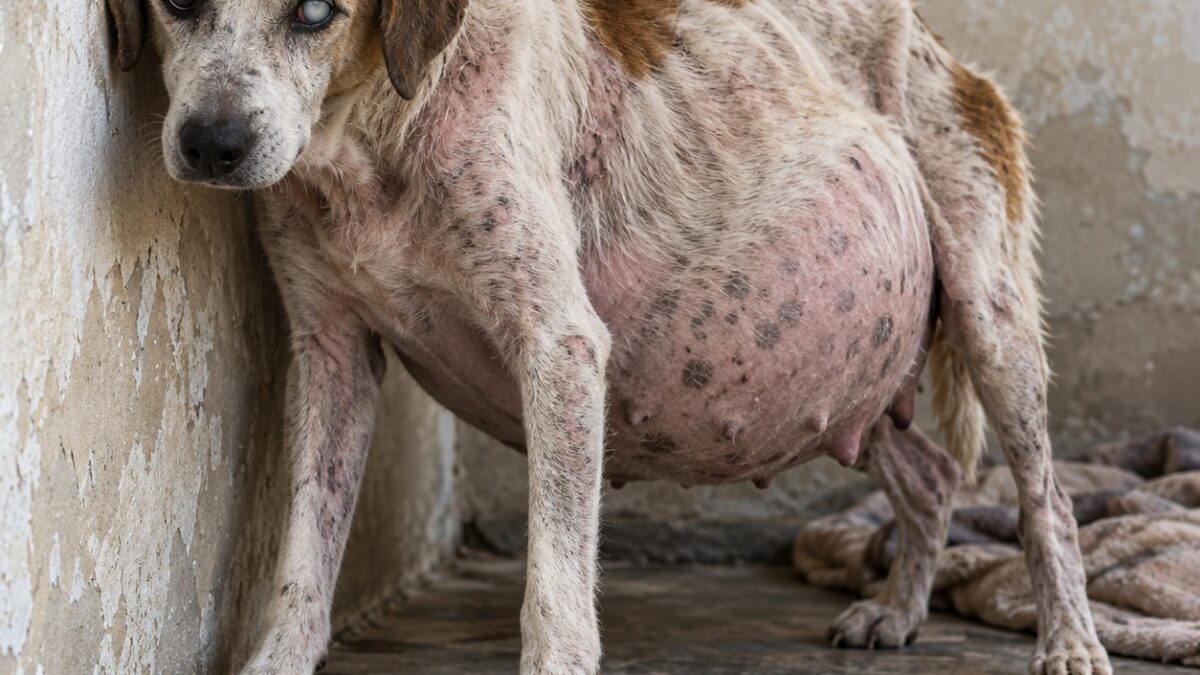
Canila already looked as though standing was a full day’s work.
Soon her body would be asked to deliver puppies.
Several, based on the size of her belly.
Maybe many.
I tried not to think too far ahead.
Rescue teaches you that sometimes tomorrow is too large.
Get through breakfast.
Then medication.
Then rest.
Then another meal.
Canila began eating.
Carefully at first.
Not with the wild desperation some neglected dogs show.
She seemed tired even by food.
We offered small, nourishing portions.
Water.
Quiet.
Her body needed resources for itself and the lives inside her.
Every bite mattered.
The skin infection made her uncomfortable.
She scratched.
Shifted.
Sometimes could not find a position where her belly and skin both stopped bothering her.
I watched her turn in circles on the bed.
Lie down.
Stand again.
Move.
Sigh.
Try again.
I wished we could explain:
This is temporary.
You are being treated.
You are safe.
Your body will not feel like this forever.
Instead we offered what dogs understand better.
Consistency.
Same gentle voices.
Same food.
Same bed.
Hands that moved slowly.
No punishment for fear.
After a few days, Canila began leaning toward me when I sat beside her.
The first time, I thought she had lost balance.
Her shoulder pressed against my leg.
I steadied her.
Then realized she was staying there.
I did not move.
Canila’s head lowered.
Rested lightly against my knee.
“You want this?”
Her eye closed.
I stroked behind one ear.
One pass.
Pause.
She stayed.
Another.
That became our ritual.
She had every reason to be wary of people.
Still, Canila remained gentle.
That word can sound too simple.
Gentle.
But gentleness in a dog who is frightened, sick, physically uncomfortable, partially blind, and heavily pregnant is not nothing.
She did not use pain as permission to hurt anyone around her.
She leaned.
Accepted.
Watched.
Slowly decided.
Her belly continued to grow.
The shape became almost shocking.
When she stood, we sometimes supported her.
When she moved, we kept the path clear.
No slippery flooring.
No unnecessary distance.
The veterinarian checked her regularly.
Puppies alive.
Heartbeats.
Movement.
Canila stable.
For now.
“For now” became another phrase I learned to respect.
It is not pessimism.
It is reality.
One afternoon the veterinarian looked at her and said:
“She may need help when labor starts.”
“We’ll be here.”
“I mean continuously.”
“We’ll be here.”
That was how we began rotating.
Someone close.
Always.
Especially as the expected time approached.
At night, Canila’s room remained quiet, but never unattended for long.
Sometimes I sat beside her while she slept.
Her belly would shift.
A puppy moving underneath.
Then another.
I would stare.
Seven little possibilities, though we did not yet know the final number.
Each movement felt hopeful.
Also frightening.
Because every puppy inside her was one more body Canila would have to deliver.
One more demand on a mother already stretched thin.
On the tenth day with us, Canila seemed more comfortable around familiar carers.
She would lift her head when I entered.
Sometimes her tail moved once.
That small movement was enough to make an entire terrible day feel lighter.
Day eleven.
Eating.
Resting.
Skin slightly improved.
Day twelve.
More itching, but no major decline.
Day thirteen.
Restless at night.
We watched.
Nothing.
Day fourteen.
Canila spent more time repositioning.
I barely left.
Then came day fifteen.
I remember the exact change.
Canila was lying on her side.
Then she raised her head.
Looked at her abdomen.
Stood.
Turned.
Lay down again.
Within minutes, she did it again.
Her breathing changed.
I called the veterinary team.
“I think it’s starting.”
Everyone became calm very quickly.
That is what experienced people do around frightened animals.
The room may be full of adrenaline.
Voices stay low.
Canila began contracting.
I sat near her head.
She looked at me.
“It’s okay.”
Her body tightened.
Release.
Another.
She panted.
I put my hand where she could reach it but did not touch her until she leaned forward.
Her nose pressed into my palm.
Then the first puppy arrived.
Tiny.
Wet.
Alive.
Canila turned immediately.
Whatever exhaustion had filled her disappeared beneath maternal instinct.
She cleaned the puppy.
Licked.
Nudged.
The puppy moved.
A tiny sound.
I started crying.
One.
One alive.
The puppy found warmth against her.
We waited for the next contraction.
It came.
Then another.
But no second puppy.
Minutes stretched.
Canila panted.
Rested.
Contracted.
Nothing.
I looked at the clock too often.
“How long is too long?”
The veterinarian was already monitoring.
“We’re watching.”
I hated that answer because watching felt like doing nothing.
But unnecessary intervention could create its own risks.
Canila continued.
The first puppy stayed beside her.
We kept it warm.
Allowed Canila contact.
She licked it repeatedly between contractions.
As though reassuring herself that at least one part of this had worked.
Then finally, another puppy.
Relief.
Two.
Then labor continued.
Hours.
Canila’s exhaustion became more visible with every delivery.
She would rest between contractions, head down, eyes almost closing.
Then another wave hit.
Her body tightened.
She lifted herself enough.
Pushed.
We supported where needed.
Spoke softly.
The third puppy arrived.
Then the fourth.
Fifth.
Sixth.
Seventh.
Seven puppies.
By the time the last one was delivered, Canila looked as though every ounce of strength had been spent.
I was afraid to celebrate.
I kept counting.
One.
Two.
Three.
Four.
Five.
Six.
Seven.
All there.
All breathing.
All gathered against their mother.
Canila lay on her side.
The puppies crawled toward warmth and milk.
Some stronger.
Some quieter.
Her eye moved over them.
She licked whichever one came close.
I sat on the floor and cried openly.
Nobody laughed.
We had spent fifteen days afraid Canila’s body might not withstand labor.
Now seven small bodies pressed against her.
She had done it.
For that moment, relief filled the room so completely that I thought perhaps the hardest part was over.
I was wrong.
The first warning came quietly.
One puppy did not seem to nurse as strongly.
Then another.
Then a third.
Newborn puppies can decline frighteningly fast.
There is very little reserve.
No room for long delays.
We warmed.
Adjusted.
Supplemented.
Watched.
The three weak puppies struggled.
Formula.
Careful feeding.
Temperature support.
Everything we could reasonably do.
Canila noticed.
Of course she noticed.
When one puppy was moved away briefly for extra care, her head lifted.
She watched.
I touched her shoulder.
“We’ve got him.”
She did not know what that meant.
Her eyes stayed on the puppy.
The first loss came like a door closing quietly.
No dramatic moment.
One minute we were trying.
Then we understood that we were no longer trying to strengthen a living puppy.
I stared down.
I had known this was possible.
Knowing never helps.
Canila still had six.
I told myself that.
Six alive.
Focus on six.
Then another weakened.
We kept going.
Warmth.
Formula.
Close monitoring.
Please.
There is a word rescuers say silently more than anyone knows.
Please.
Please breathe.
Please eat.
Please respond.
Please give us one more sign.
The second puppy did not make it.
I went outside the room for maybe thirty seconds.
That was all I allowed myself.
Hands against the wall.
Eyes closed.
Then back.
Canila still needed us.
Five puppies.
Five.
The third weak puppy fought longer.
That almost made it harder.
There would be a tiny improvement.
A movement.
A swallow.
Hope.
Then decline.
Again.
We adjusted.
Waited.
Canila rested with the stronger puppies while we tried.
Eventually, that third puppy died too.
Seven became four.
The number felt brutal.
Four living babies pressed against a mother who had delivered seven.
Three tiny spaces where bodies should have been.
I do not know what Canila understood about death.
I will not pretend.
I know she searched when puppies were removed.
I know her nose moved over the bedding.
I know she settled again around the four who remained.
Maybe dogs understand loss more directly than we do.
Something was there.
Then it was not.
No philosophy.
Only absence.
I sat beside her.
Canila leaned her head against me.
I stroked her slowly.
“You still have four.”
My voice broke.
“Four.”
She closed her eye.
For the first time since labor began, I allowed myself to feel the grief.
We had been so afraid Canila would die giving birth.
She lived.
Seven puppies were born.
Three died.
Joy and grief occupied the same room.
That is rescue too.
People often want stories to move cleanly.
Danger.
Rescue.
Happy ending.
Real life refuses.
Sometimes the mother survives and you still cry.
Sometimes four puppies are healthy enough to nurse while three others do not make it.
Sometimes relief and heartbreak happen in the same hour.
The next days were about protecting the four.
No assumption that because they looked stronger they were safe.
Weights.
Feeding.
Warmth.
Behavior.
Nursing.
Every detail.
Canila was recovering from labor herself.
Her body needed nutrition.
Her skin still needed treatment.
She had lost fur.
Still had infection to heal.
And now four puppies depended on her.
We supplemented with formula to reduce the burden and make sure each puppy received enough.
Bottle after bottle.
Tiny mouths.
Tiny stomachs.
Careful amounts.
Canila watched.
The first time I held one of the puppies to feed, she raised her head.
I brought the puppy close enough for her to sniff.
“It’s okay.”
She licked its back.
Then watched me feed.
Afterward, I returned the baby to her.
Canila cleaned it immediately.
I smiled through exhaustion.
“Inspection passed?”
Her eye closed.
The four began gaining.
Small increments.
Every increase mattered.
One puppy was slightly more demanding.
One slept more.
One seemed determined to crawl over every sibling rather than around them.
Personality beginning before their eyes fully understood the world.
Canila’s skin also improved.
Slowly.
Treatment had been cautious during pregnancy.
Now the veterinary team could make adjustments as appropriate while considering nursing.
The infection reduced.
The angry skin calmed.
Small areas of new fur began appearing.
Canila scratched less.
That alone changed her whole body.
Imagine trying to recover from labor while your own skin constantly itches and burns.
Now she could rest more comfortably.
She ate.
She slept.
She nursed.
And she trusted us.
More than before.
The loss of the three puppies seemed to make everyone around Canila even more protective of the four survivors.
Maybe too protective sometimes.
A puppy would sleep too deeply and somebody would immediately check breathing.
Normal.
A puppy would miss one feeding and panic entered the room.
We learned to calm ourselves.
Observe without creating chaos.
Canila did not need our anxiety transferred to her.
Weeks began moving.
The puppies grew.
Their bellies became round in the healthy way.
Their legs stronger.
Eyes opening.
Tiny sounds becoming louder.
Canila looked different too.
Still worn.
Still partially blind.
Still healing.
But the frighteningly enormous pregnancy was gone.
Her movement improved.
She could stand without the same crushing weight beneath her.
She began walking more comfortably.
One morning, she came toward me as soon as I entered.
No hesitation.
Tail moving.
I crouched.
Canila pressed her face against my hand.
I scratched beneath her chin.
“You’re feeling better.”
She leaned.
That was enough answer.
Those were the days when I finally began to believe the little family might be okay.
Then a man arrived.
At first, I thought he was another visitor.
He asked about Canila.
Specifically.
Not “the pregnant dog.”
Her.
He said he was her owner.
The sentence changed the entire atmosphere.
Everyone became careful.
“Your dog?”
“Yes.”
He said Canila had gone missing during a walk.
That he had been looking.
That he had now heard where she was.
We asked questions.
Details.
Timeline.
Circumstances.
Some parts did not sit comfortably with what rescuers understood about how Canila had been found and what condition she was in.
I watched him talk.
Then he asked about the puppies.
Four.
He knew she had delivered.
He wanted them.
That was when fear entered the conversation.
Not Canila’s fear.
Ours.
We had spent weeks watching this dog struggle to stand.
We had watched veterinarians navigate pregnancy in an older dog who appeared to have produced several previous litters.
We had watched her endure hours of labor.
Held seven newborns.
Lost three.
Fed the four survivors.
Treated Canila’s skin.
Watched her learn safety.
Now someone wanted to take the surviving puppies.
And his explanation did not match what we understood well enough for us to simply hand them over.
But then Canila saw him.
Her tail moved.
That made everything harder.
She recognized him.
At least she responded positively.
Maybe affection.
Maybe familiarity.
The man called her.
Canila approached enough to confirm that he was not completely unknown to her.
I felt torn.
People expect rescue situations to have obvious villains and obvious heroes.
Sometimes evidence is messy.
A dog can recognize someone connected to a painful history.
A tail wag does not resolve legal questions.
It does not tell you whether care was adequate.
It does not explain how an elderly pregnant dog with one blind eye and severe skin disease ended up weak enough to nearly collapse.
It only tells you:
I know this person.
We could not pretend that meant everything was fine.
The rescuers began asking for help.
Advice.
Authorities.
People responsible for determining what could legally and safely happen next.
Documentation mattered.
Veterinary findings mattered.
The circumstances in which Canila had been found mattered.
The owner’s account mattered.
Everything had to be considered.
I hated the waiting.
Canila did not know her future was being discussed.
She lay with her puppies.
Nursed.
Slept.
Accepted food.
Meanwhile, adults talked about ownership.
Rights.
Safety.
Evidence.
I sat beside her one night.
The four puppies were piled against her belly.
Canila’s head rested near my foot.
“You don’t know what we’re worried about, do you?”
Her eye opened.
“We’re trying.”
Tail tapped once.
I looked at the puppies.
They had survived what three siblings had not.
That fact made the possibility of losing control over what happened to them feel unbearable.
But emotion alone could not determine everything.
We needed the right process.
So we asked for help.
We documented.
We waited.
We made clear what worried us.
Canila’s condition when found.
Her age.
Evidence suggesting repeated litters.
The severe untreated skin problem.
Her weakness.
The conflicting story surrounding how she came into rescue.
The request to take the puppies.
No single detail existed alone.
Together, they raised enough concern that nobody wanted to act casually.
During that period, Canila continued improving.
Maybe that was the strangest part.
While humans worried, her world remained small.
Puppies.
Food.
Bed.
Gentle hands.
She had no idea how close uncertainty had come again.
I was glad.
Let us carry that burden.
She had carried enough.
The puppies began wobbling around the enclosure.
Four tiny bodies discovering legs.
One would stand.
Fall.
Try again.
Canila watched.
Sometimes licked them.
Sometimes looked exhausted by motherhood.
I could not blame her.
She had probably done this before.
More than once.
This time, at least, she was not doing it alone.
When the puppies cried, someone checked.
When Canila needed rest, we supplemented feeding.
When her skin bothered her, treatment continued.
When she ate, nobody took the bowl away because she had somehow become inconvenient.
That should not have felt extraordinary.
It did.
One afternoon Canila stretched out on her bed while the puppies slept in a pile several inches away.
For the first time since birth, no puppy was touching her.
She closed her eye.
Deep sleep.
I sat nearby.
She did not wake when I shifted.
That told me more about recovery than the fur beginning to grow.
A frightened animal had become comfortable enough to sleep deeply while another person remained in the room.
Trust.
Meanwhile, the situation with the man moved toward resolution.
The people involved in determining what happened next listened to the concerns.
The conflicting account was not simply ignored.
The condition Canila had been in mattered.
The need to protect the puppies mattered.
And finally we were told what we had desperately hoped to hear.
Canila would stay.
The puppies would stay.
Safe in care.
No sudden handover.
No taking the four survivors away.
No putting Canila back into an uncertain situation while she was still recovering.
I remember sitting down when I heard.
Not cheering.
Not immediately.
Just sitting.
Relief can make your legs weak.
I looked through the doorway toward Canila.
She was lying on her side.
Four puppies nursing.
Completely unaware.
“Okay.”
I whispered.
“Okay.”
Someone beside me started crying.
Then I did too.
Not because everything was solved forever.
We did not know every future detail.
But the immediate danger we had feared was gone.
Canila had time.
That mattered.
Time to heal.
Time for the skin infection to continue clearing.
Time to regain physical strength after pregnancy and labor.
Time to learn that affection did not always come with a demand.
And the four puppies had time to grow.
Together.
Warm.
Fed.
Observed.
Loved.
No one was asking their mother to produce another litter.
No one was taking them away in that moment.
They could simply be puppies.
That may sound small.
It was everything.
The surviving four grew quickly once their early danger passed.
Their movements changed from crawling to stumbling.
From stumbling to short chaotic runs.
Their voices got louder.
Much louder.
One morning I entered and found Canila standing on her bed looking deeply tired while all four puppies attacked a blanket.
I laughed.
“Regretting this?”
Canila looked at me.
One puppy climbed onto her paw.
She moved the paw.
The puppy returned.
Motherhood.
She eventually lay down.
All four converged.
I scratched behind her ear.
“You’re patient.”
Canila leaned into my hand.
That movement still affected me.
When we found her, touching her caused trembling.
Now she sought the contact.
Her past was not erased.
One eye remained blind.
Her age remained.
The pregnancies had happened.
The skin had been damaged.
Three puppies were gone.
A safe ending does not delete loss.
But safety gave those losses boundaries.
They were not continuing.
That is sometimes the best rescue can do.
Stop the next bad thing.
Then build something gentler.
Canila’s coat slowly returned.
Not instantly.
Patches.
Soft new growth.
The angry red skin faded.
She scratched less and less.
Her appetite strengthened.
The body that had seemed barely able to carry the pregnancy began carrying itself more easily.
She walked around without leaning into walls.
That detail mattered most to me.
The corner.
I kept remembering the corner.
Canila pressed into it because she could barely stand.
Later, she walked across the room by choice.
No wall.
No support.
Tail moving.
The distance might have been fifteen feet.
It felt enormous.
“You remember when we had to hold you up?”
She looked at me.
Probably hoping I had food.
“I remember.”
A puppy ran into her leg.
Canila looked down.
Normal problems.
Good.
The puppies also reached a stage where supplemental formula became part of a larger feeding routine as appropriate.
They were growing.
Strong.
Round.
Curious.
The three we had lost remained part of the story.
I never wanted to hide them simply because the ending became safer.
Seven were born.
Four survived.
That was the truth.
Sometimes I looked at the four and automatically imagined three more.
What personalities would they have had?
Which one would have been the loudest?
We would never know.
Rescue does not give every question an answer.
Canila did not appear to live in that question.
She cared for the puppies present.
I tried to learn from her.
Present.
Four mouths.
Four bodies.
Four lives.
Care for what is here.
One day, the puppies were playing close to my legs.
Canila came over.
She did not check them first.
She leaned against me.
I smiled.
“You need a break?”
Her head rested against my thigh.
I scratched her neck.
The puppies continued fighting over something completely unimportant.
Canila stayed.
For a few minutes she was not only a mother.
Not a breeding dog.
Not an elderly pregnant rescue case.
Not a patient.
Canila.
A dog who liked affection.
That identity had been buried beneath everything else.
We were finally meeting her.
She had preferences.
She liked soft bedding.
She liked gentle scratches behind the ear on the side where she could see you approaching.
That made sense.
With one blind eye, sudden movement from the wrong direction could startle her.
So we learned.
Approach from where she could see.
Say her name.
Let her know.
Good care adapts to the animal rather than demanding the animal adapt to us.
Canila responded.
She began greeting familiar voices.
Relaxing faster.
Resting longer.
The puppies treated her as though she were a climbing structure.
She tolerated an astonishing amount.
When she had enough, she stood and moved away.
We let her.
No forcing motherhood every second.
She deserved breaks.
She had probably spent too much of her life being valued only for what her body could produce.
Now her needs counted too.
That mattered to me.
The man who had claimed ownership became less central as Canila’s immediate future stabilized.
We stopped talking about him around her.
Not that she understood the words.
But because I did not want every chapter to remain about somebody else’s claim over her.
This chapter belonged to Canila.
Recovery.
Her babies.
Her body.
Her time.
People online sometimes asked:
“What happens next?”
I understood the question.
They wanted adoption.
Perfect homes.
Names for every puppy.
A photograph six months later.
Those endings feel satisfying.
But sometimes the satisfying ending comes earlier.
Canila and her puppies were safe.
That was enough for the chapter we actually knew.
We did not have to invent tomorrow to appreciate today.
Today, Canila ate.
Today, her skin looked better.
Today, four puppies grew.
Today, nobody was taking them.
Today, she slept without fear.
That was real.
That mattered.
The hardest thing in rescue is sometimes resisting the urge to make reality prettier than it is.
Three puppies died.
No happy ending changes that.
Canila remained blind in one eye.
No amount of affection restored the vision.
She was older than we wished.
Repeated pregnancies had already taken a toll.
Those truths remained.
But another truth grew beside them.
She was cared for now.
Pain was treated.
Food arrived.
Rest was possible.
Hands became gentle.
The four surviving puppies knew warmth instead of uncertainty.
Hope does not require pretending grief never happened.
Sometimes hope is what remains after grief is acknowledged honestly.
That is Canila’s story.
The day I realized her skin infection had visibly cleared, I ran my fingers gently through one of the areas where fur was returning.
Canila stayed still.
Months earlier, touching the damaged skin made her tremble.
Now she leaned slightly.
I whispered:
“Look at this.”
She could not.
Did not care.
I cared enough for both of us.
New fur.
Healthy skin.
Small evidence that the body keeps trying when given a chance.
The puppies began following us.
Everywhere.
Four tiny shadows.
If you sat, they attacked shoelaces.
If you cleaned, they attacked cleaning tools.
If you carried food, complete chaos.
Canila sometimes watched from her bed with the exhausted expression of a mother who understood exactly why humans looked tired.
I said:
“You made these.”
She blinked.
“No defense?”
Tail once.
Fair.
Their energy was almost offensive compared with the weakness we had seen after birth.
I loved it.
Three puppies had faded despite everything.
The four survivors seemed determined to use every possible ounce of life.
Let them.
Noise is beautiful after silence.
Chaos is beautiful after fear.
I thought about the first puppy arriving.
Then the long wait.
Our worry.
The hours.
Seven.
Then six.
Five.
Four.
Numbers can carry entire emotional histories.
Eventually, four stopped feeling like only a loss from seven.
It became its own number.
Four strong puppies.
Four growing bodies.
Four personalities.
That shift did not betray the three who died.
It honored the living.
Canila seemed to do this naturally.
Maybe animals always do.
She never counted for us.
She simply responded to the puppy in front of her.
Clean.
Nurse.
Protect.
Rest.
Again.
One afternoon, after feeding and treatment, Canila came to my side and sat.
Not leaned.
Sat.
Steady.
I looked down.
Her posture was so different from the first day that it caught me off guard.
No wall.
No trembling legs.
No enormous belly dragging her center of gravity forward.
She looked tired.
Older.
Still healing.
But stable.
Her surviving puppies slept nearby.
I put my hand on her shoulder.
She looked up.
“You’re still here.”
That sentence came out before I could stop it.
Her tail moved.
I smiled.
“Good.”
Sometimes that is all you need.
Still here.
The caregivers who had watched her through labor became her people.
You could see the difference when one entered.
Canila’s face softened.
Tail.
Approach.
She leaned.
The dog who once trembled under veterinary touch began walking toward familiar hands.
There is no better evidence of trust than voluntary proximity.
We celebrated it quietly.
Canila did not become a dog who loved every stranger.
She did not need to.
She became a dog who had people she trusted.
Enough.
The pups benefited from that environment too.
They grew up with gentle handling.
Regular food.
Medical attention.
Human voices associated with care rather than fear.
Whatever had happened to Canila did not have to become their beginning.
That is one of rescue’s greatest gifts.
Breaking repetition.
Canila’s history suggested litter after litter.
Her four surviving babies could have a different story.
Not because we could rewrite hers.
Because we could stop copying it.
That thought mattered every time I watched them play.
They did not know the controversy about the man.
Did not know why adults had made phone calls.
Did not know someone had asked to take them.
They only knew:
Warm.
Mother.
Food.
People.
Play.
Sleep.
That innocence was worth protecting.
And we did.
There are moments when people ask why rescuers become so emotional about animals they have known only days or weeks.
Because time is not the only measure.
Intensity counts.
We saw Canila when she could barely stand.
Watched her trust build.
Waited through contractions.
Counted seven births.
Held three dying puppies.
Bottle-fed survivors.
Treated skin.
Listened to conflicting claims.
Feared losing them.
Then heard:
They can stay.
Weeks can contain years of feeling.
Canila had become part of us.
Not property.
Responsibility.
There is a difference.
Responsibility says:
Your needs matter while you are in our hands.
That was what we owed her.
We tried to meet it.
Eventually, the room that had once felt like an emergency ward felt like a nursery.
Blankets.
Puppy sounds.
Food.
Canila sleeping.
The skin infection no longer dominated conversation.
Labor was past.
The ownership crisis had settled.
We could finally breathe.
That may have been the true ending.
Breathing room.
For weeks, every phase contained the next threat.
Can she survive pregnancy?
Can she survive labor?
Will the puppies live?
Three won’t.
Can the other four?
Will Canila heal?
Who is this man?
Will they be taken?
Then, finally:
Nothing immediate.
No emergency today.
Canila could sleep.
The puppies could grow.
We could plan meals instead of crises.
I have come to believe peace is underrated in rescue stories.
People want the dramatic rescue.
The last-second save.
The confrontation.
But when you have lived inside an emergency, the best scene is often one where nothing happens.
Canila on her bed.
Four puppies sleeping.
No phone ringing.
No one crying.
No vet rushing in.
Just breathing.
That is what safety sounds like.
One morning, sunlight came through the window.
Canila had stretched out with her back toward it.
The puppies were spread around her in ridiculous positions.
One upside down.
One with a paw across another’s face.
One alone for once.
One against Canila’s front leg.
She was awake.
Watching me.
I approached from her sighted side.
“Morning.”
Tail.
I sat down.
Canila moved her head onto my knee.
No trembling.
No hesitation.
I looked at the four puppies.
Then at the mother.
I thought about the man who had wanted them.
About the confusion.
The fear that everything we had fought for might be undone.
Then I looked around.
Still here.
Safe.
I scratched her ear.
“You can rest.”
Canila closed her eye.
For the first time, that sentence felt entirely true.
She no longer had to hold her exhausted pregnant body against a wall.
No longer had to endure untreated skin irritation without relief.
No longer had to give birth while nobody watched.
No longer had to carry every responsibility for the puppies alone.
Someone else was here.
More than someone.
A team.
People who knew which puppy needed extra formula.
Who knew how Canila liked to be approached.
Who noticed whether she scratched more than yesterday.
Who would ask for help when something did not feel right.
Attention had become part of her life.
That may have been the thing she lacked most before.
Not merely food.
Not merely medicine.
Attention.
Someone seeing.
Someone responding.
That is what changed everything.
The four puppies continued getting stronger.
Canila continued healing.
And slowly, the story stopped feeling like one about whether they would survive.
It became one about what they did during the day.
Puppy climbed out of bedding.
Canila stole extra attention.
Someone spilled formula.
One puppy barked at nothing.
Ordinary.
Gloriously ordinary.
I loved it.
The first time Canila playfully nudged one of her puppies instead of simply caring for it, I noticed.
She lowered her head.
The puppy bounced backward.
Returned.
Canila nudged again.
A tiny interaction.
Mother and baby.
Not survival.
Play.
She still had enough inside herself for that.
That told me recovery was becoming more than medical.
I whispered:
“There you are.”
Canila looked at me.
Yes.
There you are.
The dog underneath pregnancy.
Under illness.
Under fear.
She had always been more than a mother.
More than somebody’s former property.
More than a case.
Now we were finally getting to see her.
That is why I resist endings that turn her only into a symbol of motherhood.
Her devotion mattered.
Her seven puppies mattered.
The three deaths mattered.
The four survivors mattered.
But Canila mattered separately from all of them.
She deserved treatment if she had never delivered a single puppy.
She deserved gentleness because she was alive.
Not because motherhood made her noble enough to earn it.
That distinction is important.
For perhaps too long, her body had been valued for what it could produce.
In our care, the goal was different.
Heal Canila.
Protect the babies.
Both.
Not one at the expense of the other.
She had already given enough.
One evening, a caregiver sat beside her.
The puppies had been fed.
Canila had eaten.
Medication finished.
No procedure left.
The caregiver scratched her neck.
Canila leaned.
Then slowly lowered herself against the person’s side.
Full body contact.
Comfort.
The caregiver smiled.
“She trusts us now.”
I almost corrected her.
Trust is not finished.
It keeps being reinforced.
But I understood.
Canila had chosen closeness.
That is as much as anyone can ask from a dog.
She fell asleep there.
Four puppies nearby.
And the room stayed quiet.
I thought about the first time the veterinarian told us she appeared unusually old for pregnancy.
The concern in his voice.
The physical evidence of previous litters.
At that moment, Canila’s future seemed like a narrowing tunnel.
Now the tunnel had opened.
We did not know where it went.
Did not need to.
She had time.
Time without immediate pressure.
Time to recover.
The puppies had time to grow.
That was the ending supported by what we actually knew.
And it was enough.
Sometimes fans want an adoption scene.
A forever home.
A dramatic photograph years later.
I understand.
But there is something deeply satisfying about stopping at safety.
Because safety was what Canila had not had.
Safety is not a placeholder until a prettier ending arrives.
Safety is an ending worth celebrating.
Canila and her four surviving puppies stayed in care.
Warm.
Fed.
Observed.
Protected.
Her skin continued improving.
The puppies continued growing.
No one was forcing a decision before they were ready.
No one was taking them away because they could claim them loudly enough.
Their needs came first.
After everything, that felt revolutionary.
I went back one morning and found Canila standing in the middle of the room.
No wall.
I stopped.
She looked at me.
Tail moved.
I remembered that first corner so vividly my chest hurt.
Then Canila walked toward me.
One step.
Another.
Steady.
She reached me.
Pressed her head beneath my hand.
I stroked her.
She leaned.
Behind her, the four puppies woke and began making noise.
Canila turned.
Looked at them.
Then back at me.
For a second, she stayed.
As if choosing one more moment of affection before motherhood resumed.
I laughed.
“Take your time.”
She did.
That is the image I carry.
Not the frightened pregnant dog bracing herself against a corner because her legs were failing.
Not the hours of labor.
Not the three tiny bodies we could not save.
Not the man at the door asking for the remaining puppies.
I remember all of those.
But I carry something else.
Canila standing under her own strength.
Skin healing.
One eye watching us.
Four puppies alive behind her.
A hand reaching down.
And instead of trembling, she steps closer.
She leans into it.
No one pulls her away.
No one asks anything from her body.
No one needs her to produce another litter.
No one is measuring her worth by what she can give.
For once, the only thing Canila has to do is heal.
And the only thing her babies have to do is grow.
After everything this little family endured, that was more than enough.
It was peace.








