PART2:Canelo Was Brought Home as a Healthy Puppy—By the Time We Found Him in the Backyard, Every Bone in His Body Was Showing- But the Most Heartbreaking Part of His Story Was Still Hidden
PART2
The first goal was not making Canelo look normal.
It was keeping him stable.
People see photographs of severely emaciated dogs and imagine recovery as food going in until weight returns.
The reality is more complicated.
A starved body has adapted to starvation.
Metabolism changes.
Electrolytes can shift dangerously when nutrition returns too aggressively.
The digestive system has to relearn abundance.
The heart and other organs may already be under strain.
So Canelo’s meals were planned.
Measured portions.
Specific timing.
Close observation.
No emotional improvisation.
That was difficult because Canelo was hungry constantly.
The first days, the sound of food preparation changed him immediately.
He could be lying quietly.
Then a container opened.
Head up.
Eyes fixed.
Body trying to stand faster than his strength allowed.
He would follow the bowl with such concentration that nothing else seemed to exist.
When the food reached him, he ate as though somebody might pull it away forever.
Then it ended.
And Canelo looked for more.
The first time I watched that, I had to step away afterward.
Not because he was suffering in that moment.
Because hunger had clearly become a belief.
Not just a physical sensation.
Food exists now.
Eat now.
There may be nothing later.
We could not explain schedules to him.
We could only repeat them until his body eventually learned what words could not teach.
Morning meal.
Later, another.
Then another.
Tomorrow too.
Consistency was the language.
Alongside nutrition, Canelo’s skin needed care.
Neglect leaves marks beyond bones.
His skin was irritated and unhealthy.
Some areas were inflamed.
His coat looked dull and rough.
So medicated baths became part of the treatment.
The first one was difficult.
Water was not the main problem.
Hands were.
Canelo hated being handled.
Not violently.
Again, that would almost have been easier.
He withdrew.
Shrank.
His shoulders would rise.
His head would lower.
If someone touched along his side, his skin seemed to contract beneath the hand.
The message was clear.
Please don’t.
We could not completely avoid touch.
Medical care required it.
Bathing.
Examination.
Medication.
Checking his body.
But we could change how touch happened.
Slow hands.
Visible hands.
No grabbing from behind.
Pause when his body stiffened.
Continue only when necessary.
Give him room afterward.
Every interaction became an opportunity to teach something painfully simple:
A hand can touch you and nothing bad follows.
The first medicated bath took much longer than it should have.
We moved slowly.
Warm water.
Soft voices.
Canelo’s feet stayed planted.
His eyes tracked every person around him.
At one point, I placed my hand lightly against his shoulder to steady him.
He flinched so hard I immediately removed it.
“Okay.”
I waited.
“You’re okay.”
The words were mostly for me.
Canelo stood trembling.
Not from cold.
Fear.
The water ran dirty around his feet.
I remember looking at how thin those feet connected to those legs and feeling anger rise again.
He had been brought home as a puppy.
A healthy puppy.
Someone had chosen him once.
That detail hurt.
He had not always been unwanted.
At some point, somebody had decided they wanted a dog.
Maybe they had held him.
Played with him.
Taken puppy pictures.
Fed him.
Then somehow daily responsibility became neglect.
Meals missed.
Care ignored.
Body shrinking.
And Canelo had no way to leave.
A backyard can look like freedom because there is open air.
It is not freedom when the gate is closed and the people inside the house control whether you eat.
That thought stayed with me through every bath.
We finished.
Wrapped Canelo in a towel.
Someone tried gently rubbing his side.
He immediately leaned away.
So we stopped.
No pressure to enjoy affection.
Medical care was enough for one day.
His recovery did not have a dramatic breakthrough.
That is important.
People love stories where one moment changes everything.
A dog looks into someone’s eyes.
Tail wag.
Trust.
Transformation.
Canelo did not work like that.
His changes were so small at first that you could miss them if you were waiting for drama.
Day one:
A hand approached.
Canelo moved away.
Later:
A hand approached.
He stayed still.
Then:
He sniffed it.
Another day:
A finger touched beneath his chin.
He did not retreat.
Seconds.
That was progress.
His body remained tense around people.
But not as tense.
His eyes still watched.
But the expression softened.
The difference between terrified vigilance and cautious observation is small in photographs.
In person, it is enormous.
I started spending time near Canelo without doing anything to him.
That was deliberate.
Dogs in medical recovery sometimes begin associating humans with procedures.
Every person means bath.
Needle.
Medication.
Handling.
Even kindness becomes suspicious if it always predicts something happening to your body.
So sometimes I entered and sat.
Nothing else.
No leash.
No medicine.
No touching.
I talked.
Or did not.
Canelo kept his distance.
Fine.
The first time he lay down while I remained in the room, I almost celebrated.
Did not.
Quiet victories require quiet reactions.
His legs folded beneath him.
Head lowered.
Eyes still open.
But he rested.
That meant my presence no longer required standing ready to escape.
Small.
Huge.
The food schedule continued.
Canelo gained strength before he gained obvious weight.
His steps became less uncertain.
He stood longer.
His legs stopped trembling after every short movement.
The scale changed too.
Slowly.
Exactly as planned.
Every increase mattered.
But I learned not to obsess over numbers.
A dog can gain weight before learning trust.
Canelo needed both.
One morning he finished breakfast and did something new.
Instead of searching the floor immediately, he stood near the caregiver holding the empty bowl.
Not close.
Closer.
She did not move.
Canelo sniffed the side of her leg.
Then stepped away.
The woman looked at me.
Neither of us spoke until we left.
Then she whispered:
“He came to me.”
Yes.
He had.
Not because there was food in her hand.
The bowl was empty.
He came anyway.
That became the beginning of another phase.
Canelo started becoming curious about the people around him.
Curiosity is easy to underestimate.
Fear narrows the world.
Everything becomes:
Threat?
Safe?
Escape?
Curiosity means the brain has enough room to ask new questions.
What is that smell?
Where is that person going?
What is behind the door?
Why did that object move?
Canelo began following with his eyes.
Then with his feet.
A few steps.
Someone would leave the room and Canelo might walk toward the doorway.
Not follow fully.
Just check.
The first time he approached a caregiver from behind and sniffed her shoe, she pretended not to notice.
Smart.
Attention might have frightened him.
He sniffed longer.
Then walked away.
We smiled after.
His medicated baths became easier too.
Still not favorite activities.
Canelo was not required to become a spa enthusiast for the story to be successful.
But his body stopped bracing quite as hard.
Warm water no longer made him look trapped.
Hands became predictable.
One person washed.
One reassured.
No sudden movement.
He learned the sequence.
Dogs love predictable sequences.
Fear thrives on uncertainty.
Routine became medicine too.
His skin improved.
Redness reduced.
The coat began looking healthier.
At first, people noticed his physical transformation most.
Of course.
Bones that had dominated every photograph became slightly less sharp.
The spine no longer seemed to rise so aggressively.
His face filled.
His eyes no longer looked enormous inside a narrow skull.
But I was watching something else.
Distance.
How far from people did Canelo choose to stand?
At first:
Across the room.
Then:
Several feet.
Then:
Near enough to touch if we reached.
We did not.
That mattered.
Let him decide.
One afternoon, I sat on the floor and looked at my phone.
Canelo was resting nearby.
I felt movement.
He stood.
Walked toward me.
Stopped.
I kept staring at the phone.
He took another step.
Then his shoulder touched my arm.
Barely.
An accident, I thought.
I did not move.
Canelo stayed.
His body leaned.
Not much.
Then more.
The weight of one thin dog resting against my arm.
That was it.
No dramatic music.
No full embrace.
He leaned.
For a dog who once recoiled from touch, that movement felt enormous.
I whispered:
“Okay.”
Nothing else.
Canelo remained for maybe thirty seconds.
Then walked away.
I sat there staring at the floor afterward.
Someone asked:
“What happened?”
I said:
“He leaned on me.”
They understood immediately.
That became our new measure.
Not simply tolerating contact.
Seeking it.
There is a world between those things.
A dog can endure touch because escape feels impossible.
Trust begins when he chooses proximity.
Canelo was choosing.
Slowly.
The first voluntary chin scratch happened days later.
He approached a caregiver.
She let him sniff.
Canelo stayed.
She touched beneath his jaw with two fingers.
He lifted his head.
Not away.
Up.
More access.
She continued.
His eyes softened.
Someone across the room covered their mouth.
Do not cry.
Not here.
Canelo did not need emotional chaos surrounding his first good scratch.
The caregiver stopped after a few seconds.
Canelo looked at her hand.
Then nudged it.
That was the moment we all lost composure.
A dog who had once flinched from hands was asking one to come back.
She scratched again.
Canelo leaned.
And for those seconds, what had been done to him stopped controlling what was happening now.
The past did not disappear.
But it lost one inch of territory.
Recovery works like that.
Inches.
People started seeing a different Canelo.
Not because we had replaced him.
Because survival stopped hiding him.
He had preferences.
He liked quiet voices.
He disliked sudden loud laughter at first.
He preferred certain caregivers.
Food remained important.
Obviously.
But affection began competing.
That was extraordinary to me.
Imagine going from a life where your basic needs are not met to a point where your body has enough security to seek something unnecessary for survival.
A scratch.
Company.
Resting near someone.
Affection requires surplus.
Not just calories.
Emotional surplus.
Canelo was building it.
His steps grew steadier.
We began allowing more exploration appropriate to his condition.
Short movement.
No exhausting him.
His muscles needed time to rebuild.
He had spent too long with his own body as a burden.
Now walking began becoming normal.
The first time he moved across the room without hesitation, everyone noticed.
He sniffed a blanket.
A toy.
The corner.
Then came back toward us.
That last part mattered.
Canelo explored and returned.
Humans were becoming part of the safe environment rather than something to escape.
Another week.
More food.
More skin improvement.
More weight.
More trust.
Nothing spectacular.
Everything important.
He began greeting familiar caregivers.
Not jumping.
Not barking wildly.
Canelo’s greetings matched him.
Head lift.
Eyes brighten.
Body orient toward the person.
Eventually tail.
At first, barely.
One small motion.
Then two.
The first obvious tail wag nearly destroyed the entire room.
A caregiver walked in carrying his meal.
Tail moved.
We teased:
“That doesn’t count. Food.”
Next day, the same caregiver entered empty-handed.
Tail.
Everyone looked at her.
She smiled.
“That counts.”
Yes.
It did.
Canelo was recognizing people for what they had become in his life.
Not owners.
Not threats.
Care.
Food.
Warm water.
Medicine.
Hands that stopped when he needed space.
Voices that stayed soft.
People who noticed.
That last part may have been the biggest difference between his past and present.
People noticed.
If Canelo ate less, someone noticed.
If his stool changed, someone noticed.
If he seemed tired, someone noticed.
If his skin was irritated, someone noticed.
If he leaned into a touch, someone noticed.
Neglect often happens in the space where nobody responds.
Recovery happens when somebody does.
Again and again.
Canelo learned he could communicate without becoming desperate.
Turn away?
We respected it when possible.
Approach?
We welcomed him.
Tired?
Rest.
Hungry?
Meal coming.
Uncomfortable?
Check.
He did not have to scream with his body anymore.
His needs entered the room before crisis.
That is what care should have been from the beginning.
I often thought about the puppy his owners first brought home.
I never met that puppy.
But sometimes I imagined him.
Rounder face.
Full belly.
Energy.
No fear of hands.
Maybe chasing things in the yard.
Sleeping without wondering whether food would appear.
Then I looked at Canelo and felt grief for the version of him that should have had an ordinary puppyhood.
You cannot restore lost time.
That is one of the hardest truths in rescue.
We could make today good.
We could not go backward and feed yesterday.
We could not erase the hunger.
Could not give him all the weeks or months when care should have been automatic.
Healing is not repayment.
Nothing fully repays neglect.
What we could do was stop adding to the debt.
Today:
Fed.
Today:
Safe.
Today:
Gentle.
Tomorrow:
Again.
Eventually those days accumulate.
That is how a new history begins.
Canelo’s body continued filling out.
Not quickly.
Healthy recovery does not look like stuffing weight onto an animal.
Meals remained measured.
Adjustments made based on progress.
The urge to overfeed never completely leaves rescuers.
You see bones and want abundance.
But love sometimes means restraint.
Enough to restore.
Not enough to overwhelm.
Canelo stopped acting as frantic around meals.
Not completely.
Scarcity leaves habits.
But something changed.
After eating, he no longer searched every corner every time.
Sometimes he drank.
Then walked toward his bed.
Lay down.
Trusting that hunger did not need to be solved permanently in one sitting.
The first time he left one tiny piece of food in the bowl, somebody took a picture.
One piece.
Ridiculous.
Meaningful.
The dog who had once been starved could feel full enough to stop.
Maybe it meant nothing.
Maybe the piece had fallen in an awkward place.
We celebrated anyway.
Let us have our victories.
His coat began changing.
The medicated baths had helped the skin.
Nutrition helped from the inside.
What once looked dull became softer.
The rough texture eased.
His face looked younger.
That hurt and healed me at the same time.
Because Canelo was young.
Neglect had disguised it.
With health returning, you could finally see the dog he should have been allowed to become all along.
One day, someone brought a toy.
Soft.
Nothing complicated.
Canelo sniffed it.
Ignored it.
Fine.
Next day, toy in a different place.
He must have moved it.
No one saw.
We started watching.
A few days later, Canelo approached it while someone sat quietly nearby.
Sniff.
Paw.
Back away.
Approach.
Mouth around one end.
He picked it up.
Held it.
Then dropped it.
Everyone behaved as though this was normal.
Inside, we were screaming.
Play is another form of surplus.
A starving animal does not waste energy on toys.
A terrified animal does not make itself vulnerable for fun.
Canelo was approaching both.
Food security.
Emotional security.
Body strength.
Together, they created play.
He shook the toy once.
Startled himself.
Looked around.
I laughed quietly.
Canelo looked at me.
Tail.
Then he did it again.
That afternoon, he carried the toy several feet.
A dog being silly.
Nothing medically important.
Everything important.
People sometimes ask what exact moment told us Canelo had recovered.
There was none.
That is the whole point.
No miracle morning.
No magical touch.
No one dramatic day where he became fearless.
Recovery was accumulation.
A bath where he trembled less.
A meal finished calmly.
A nap while someone sat nearby.
A nose touching a hand.
A body staying instead of retreating.
A lean.
A tail wag.
A toy.
One thing added to another.
Eventually we looked at Canelo and realized the dog in front of us no longer looked like the dog from the backyard.
Not because he was a different dog.
Because the conditions around him had changed enough for him to live differently.
That distinction matters.
Canelo had always deserved food.
Always deserved gentleness.
Always deserved to rest without fear.
Care did not make him worthy.
Care finally treated him as though he already was.
The first time he approached me for affection without food anywhere nearby, I almost did not understand.
I was standing near the doorway.
Canelo walked over.
Pressed his nose into my hand.
I looked down.
“What?”
He stayed.
I scratched gently beneath his jaw.
His eyes softened.
Then he moved closer.
Shoulder against my leg.
Full lean.
I smiled.
“You’re really doing this now?”
Tail.
I scratched behind his ear.
Canelo leaned harder.
If I stopped, he looked at my hand.
There it was.
Demand.
Not desperation.
Demand.
Beautiful.
A dog learning that affection could be requested.
I gave it.
Of course.
For several minutes Canelo stood there while I scratched his head and neck.
Eventually he walked away.
No panic when contact ended.
That was another sign.
Secure interactions can end.
The good thing can stop and return later.
Everything did not have to be held onto.
He was learning abundance in more than food.
Affection would come back too.
People would come back.
Tomorrow existed.
Those are profound lessons for an animal raised inside inconsistency.
The healthy puppy Canelo had been was gone in one sense.
Time had moved.
Experience had happened.
But parts of that puppy seemed to emerge again.
Curiosity.
Play.
Interest.
Energy.
He began walking with more confidence.
Head higher.
He sniffed new spaces.
Investigated sounds.
He no longer seemed to move through every room asking:
Am I allowed?
He simply moved.
That freedom made me emotional.
Neglected animals often learn to reduce themselves.
Do not demand.
Do not approach.
Do not get in the way.
Canelo started taking up space.
Sleeping where people walked.
Standing near caregivers.
Moving toward attention.
That is what safety does.
It lets a living thing become inconvenient.
One afternoon he stretched directly across the walkway.
Someone said:
“Canelo.”
No movement.
“You’re blocking everything.”
Tail tapped.
We laughed.
Perfect.
Stay there.
Take up space.
You had spent enough of your life disappearing.
His medical care continued even as he looked better.
That matters too.
You do not stop treating because the photographs improve.
Skin.
Nutrition.
Weight.
Muscle.
Behavior.
Everything required follow-through.
His caregivers did not rush the finish.
They maintained the feeding plan.
Continued gentle handling.
Watched his body.
Allowed rest.
Recovery was not a social media before-and-after.
It was daily work.
And Canelo participated.
Each meal.
Each bath.
Each safe interaction.
The trust between him and his carers became visible in ordinary ways.
Someone entered.
Canelo stayed asleep.
That meant something.
Early Canelo would have raised his head instantly.
Body tense.
Now familiar footsteps could happen without requiring defense.
A hand touched his side.
He did not shrink.
A voice called him.
He approached.
Someone sat down.
Canelo chose nearby.
No command.
No food.
Just company.
I came to love those quiet moments more than the obvious progress.
A calm dog lying beside someone is not exciting to most people.
If you saw where Canelo began, it was everything.
Rest is vulnerable.
To sleep deeply near people is to trust that unconsciousness will not be punished.
Canelo learned to rest.
Not collapse from exhaustion.
Rest.
There is a difference.
One evening I watched him asleep.
Body loose.
Breathing slow.
A caregiver walked past.
Canelo did not move.
The person paused.
Looked at him.
Smiled.
No one touched him.
No need.
Let sleeping safety remain safe.
I thought:
This is what he should have had as a puppy.
A full stomach.
A clean body.
A place to sleep.
People nearby who did not demand fear.
Basic things.
The tragedy of neglect is how ordinary the missing things are.
Canelo had not needed luxury.
He needed food.
Attention.
Medical care.
Gentle hands.
Those should not be extraordinary gifts.
They are minimums.
Yet after deprivation, minimum care can look miraculous.
I tried never to forget that.
The miracle was not that humans finally fed him.
The shame was that humans had not before.
What impressed me was Canelo’s willingness to re-enter relationship after being failed inside one.
Dogs are remarkable that way.
Not because they “forgive everything.”
I think that phrase oversimplifies them.
Canelo did not erase caution.
He learned through evidence.
This hand is safe.
This person returns.
This bowl fills.
This room stays quiet.
Dogs can update their understanding when reality becomes consistent enough.
That is not blind forgiveness.
That is learning.
And Canelo learned.
The day he first leaned into a full-body scratch, he was not saying:
Everything before is forgotten.
He was saying:
Right now, this feels good.
Right now matters.
That is enough.
Humans could learn from that too.
Not to deny history.
To allow the present to become evidence of something new.
Canelo’s body continued moving toward health.
Eventually people who had not seen the first photographs met him and simply saw a dog.
Maybe still recovering.
Maybe still lean.
But a dog.
Not a skeleton.
Not a cruelty case.
That transition mattered.
Survivors deserve identities beyond what happened to them.
Canelo was not only “the starving backyard dog.”
He was cautious.
Then affectionate.
Curious.
Quiet.
Interested in toys.
Particular about certain touches.
Increasingly social.
He had a whole personality waiting underneath survival.
The worse the condition, the easier it is to reduce an animal to the injury.
But injury is context.
Not identity.
Canelo reminded us.
He started approaching multiple caregivers.
Some faster than others.
Trust is specific before it becomes general.
One person might get a lean.
Another a sniff.
Another simply the privilege of standing nearby without Canelo moving.
All valid.
We did not force equal affection.
A dog is allowed preferences.
That is part of dignity too.
One caregiver had been involved in nearly every medicated bath.
Canelo initially associated her with uncomfortable handling.
She worried he might never like her.
Then one day she sat down after the bath.
Canelo walked over.
She froze.
He pressed his forehead against her chest.
She started crying immediately.
“Are you serious?”
Canelo stayed.
She put one hand against his back.
No flinch.
The same hands that had once represented treatment had become comfort.
That is how association changes.
Not because the baths stopped being annoying.
Because the person around them remained kind.
Predictable.
Safe.
Canelo had enough evidence now.
We all did.
There were still moments of fear.
A dropped metal bowl.
Canelo jumped.
A sudden movement from someone entering.
He stepped backward.
A loud voice.
Body low.
Healing is not forgetting.
We never treated those moments as failure.
Pause.
Let him recover.
No:
You should be over this.
That sentence harms people and animals alike.
Canelo’s nervous system had spent too long learning danger.
Months of safety do not always erase reactions instantly.
The question was not whether he ever startled.
The question was what happened afterward.
Early:
Fear.
Withdrawal.
Stay away.
Later:
Startle.
Look.
Recognize.
Return.
That is progress.
Fear can arrive and leave.
It no longer has to own the entire day.
One afternoon, after a loud noise startled him, Canelo retreated several steps.
I stayed where I was.
No coaxing.
After a minute, he came back.
Pressed his nose into my hand.
I scratched him.
He stayed.
I thought:
There.
That is recovery.
Not no fear.
Recovery from fear.
Another meal came.
Then another.
Days.
Weeks.
The dog’s shape changed.
Shoulders fuller.
Back smoother.
Hips less sharp.
Skin healthier.
Eyes brighter.
Each photograph showed a little more life.
People loved the visual transformation.
I understood.
It was striking.
But if I had to choose one photograph, I would choose a boring one.
Canelo asleep beside a caregiver’s shoe.
No visible ribs emphasized.
No dramatic before-and-after.
Just trust.
Because the most damaged part of Canelo’s world had not been his appearance.
It was the belief that people could be relied upon to meet basic needs.
That belief required rebuilding too.
Every day of care was another vote.
People can feed me.
People can touch gently.
People can notice.
People can stop when I am afraid.
People can help.
Eventually the votes added up.
Canelo started behaving as though he believed them.
Not perfectly.
Enough.
I often wondered whether he remembered being a puppy before the neglect worsened.
Maybe there had been good days.
Maybe not.
Dogs do not tell us their timeline.
His body carried one version.
His behavior another.
We worked with what stood in front of us.
That is all rescue can honestly do.
Do not invent the past.
Respond to the present.
Canelo needed nutrition.
Skin treatment.
Patience.
Choice.
Affection when he requested it.
Space when he did not.
That became the plan.
Simple.
Not easy.
But effective.
The first time Canelo stood beside a person and gently pushed his head beneath their hand, everyone smiled.
He had progressed from tolerating touch to requesting it.
Then he became somewhat demanding about it.
Good.
A person stopped petting.
Canelo nudged.
They resumed.
Stop.
Nudge.
Again.
Someone laughed:
“You’ve created a monster.”
No.
We had helped uncover a dog who had preferences.
Let him be demanding.
Let him ask.
Let him learn requests can work.
For an animal whose needs had once been ignored, having a request answered may be one of the most healing experiences possible.
I started thinking about how humans interpret behavior.
A fearful dog moves away.
We call him shy.
A starving dog lunges toward food.
We call him food obsessed.
A dog afraid of touch stiffens.
We call him difficult.
Context changes everything.
Canelo was not difficult.
He was informed by experience.
Once his experience changed, behavior changed.
That does not mean every problem disappears.
It means understanding creates better care.
He taught us to look underneath.
Why does the dog move away?
Why does he eat like this?
Why does his body tense?
Then answer the reason rather than punish the expression.
That is rescue at its best.
Canelo eventually stopped shrinking when familiar people approached.
That sentence sounds small.
It makes me emotional every time.
Imagine living in your own body and expecting every approaching human to make you smaller.
Then one day:
No.
Someone walks toward you.
Your chest stays open.
Head stays up.
Maybe tail moves.
That is freedom inside the nervous system.
Canelo found pieces of it.
One day I approached with no food.
No medicine.
No towel.
Nothing.
He saw me.
Walked forward.
I stopped.
Canelo closed the final distance himself.
Pressed against my leg.
I placed my hand on his back.
He leaned.
No trembling.
No retreat.
Just warmth.
I whispered:
“Look at you.”
He did not know what I meant.
That was fine.
I knew.
The backyard dog had learned a new response to footsteps.
Come closer.
That is one of the best endings I know.
Not a dramatic revenge against the people who neglected him.
Not a sudden perfect life we have no evidence for.
Canelo’s source story does not need those things.
His victory existed in his own body.
He was fed.
Treated.
Handled gently.
Allowed time.
And slowly, the fear receded far enough that affection could take its place.
That is enormous.
His caregivers continued doing what had worked from the beginning.
Consistency.
No shortcuts because he looked better.
No assumption that gaining weight meant emotional recovery was finished.
Both tracks mattered.
Body.
Trust.
He continued gaining strength.
Short walks became easier.
Exploration expanded.
He noticed things beyond food and people.
Smells.
Sounds.
Objects.
The world became interesting rather than simply dangerous.
Curiosity returned.
Sometimes he would pause and stare at something completely ordinary.
A leaf moving.
A shadow.
A toy.
I loved those moments.
A dog who once had to devote everything to survival now had mental room for useless information.
Useless is beautiful when you have survived deprivation.
Play with the leaf.
Smell the wall.
Watch the person.
Waste time.
Canelo had earned nothing.
Again, wrong word.
He deserved the ability to waste time.
All living things do.
Neglect steals that first.
Every moment becomes about meeting needs.
Safety gives leisure back.
Canelo began to have leisure.
He rested.
Observed.
Requested touch.
Ate.
Recovered.
The rhythm became ordinary.
That was success.
No constant emergency.
No one staring at a scale every hour.
No panic around every meal.
Care became routine.
That is the point rescue stories sometimes rush past.
Drama brings the dog in.
Routine saves him afterward.
Canelo did not rebuild on one heroic day.
He rebuilt because someone fed him again tomorrow.
And the next day.
And the next.
Because baths continued.
Because voices stayed soft.
Because nobody decided his fear was inconvenient.
Because people paid attention after the headlines would have ended.
Recovery lives after the rescue photo.
Canelo proved that.
I remember one particular morning when he finished eating and walked directly over to a caregiver.
No search for extra food.
No panic.
He sat.
Looked up.
The caregiver scratched his chest.
Canelo’s eyes closed.
That scene represented everything.
Food had become reliable enough that affection could come next.
His stomach had been answered.
Now another need had room to speak.
Connection.
The caregiver said:
“You’re such a sweet boy.”
Canelo leaned harder.
Maybe he always had been.
Maybe sweetness had simply been buried under hunger and fear.
People like to say rescue changes a dog.
Sometimes rescue stops circumstances from suppressing the dog who was already there.
I prefer that.
Canelo did not owe us a new personality in exchange for care.
We were lucky he trusted enough to show us one.
As his condition improved, people who came near him no longer reacted first to shock.
That was another quiet milestone.
The first day:
Gasps.
Whispers.
Look at his ribs.
Later:
“Hi, Canelo.”
His name became more important than his body.
That made me happy.
He was no longer an image of abuse.
He was a dog people knew.
Canelo.
Likes this.
Doesn’t like that.
Needs meals on schedule.
Enjoys affection now.
Getting stronger.
Language shapes identity.
Eventually we stopped saying:
The starving dog.
We said:
Canelo.
That was enough.
I still kept the early photographs.
Not because I enjoyed looking.
Because forgetting the severity would be its own kind of disrespect.
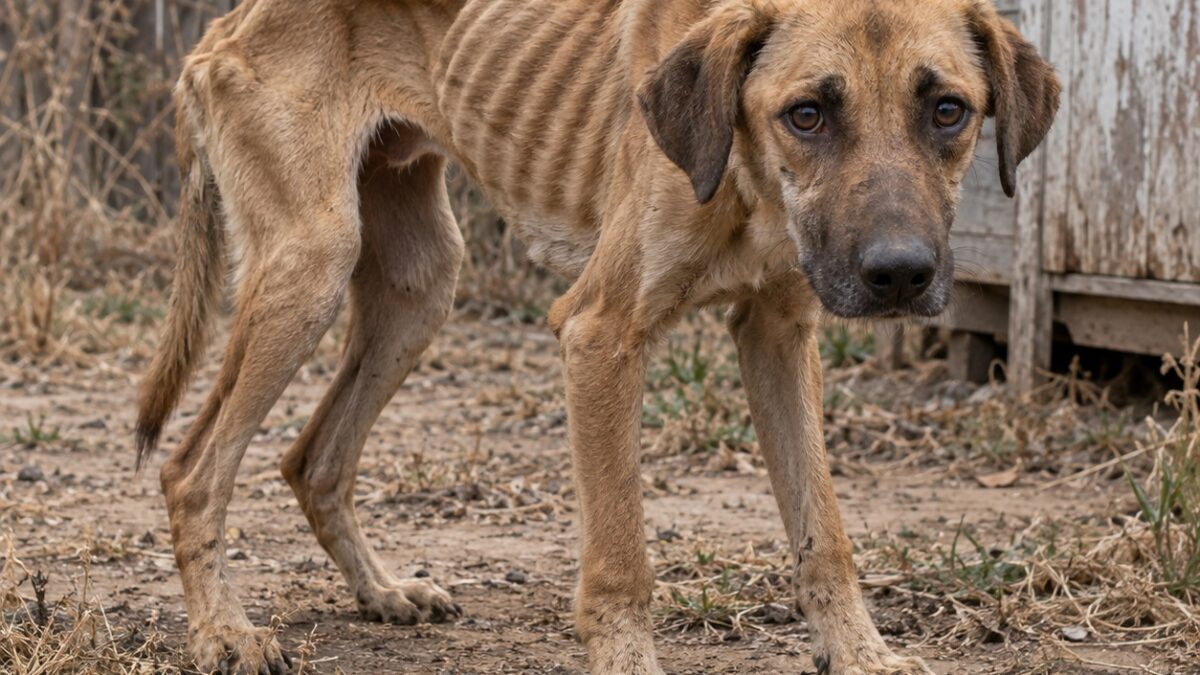
Every bone showing.
Weak steps.
Fear.
That happened.
Recovery should not erase accountability to the truth.
But the photographs did not get the final word.
The final word belonged to the living dog.
Canelo approaching.
Canelo resting.
Canelo leaning.
Canelo looking healthier.
Canelo realizing that touch could comfort.
Those were the images I preferred.
I do not know what exact future came after the period described in the source.
I will not invent one.
I do know what had already changed.
And sometimes that is enough.
A healthy puppy had been brought into a home where his basic care later disappeared.
He had been allowed to waste away in a backyard.
Someone finally reported what was happening.
Canelo was removed.
Then a group of people did the opposite of everything he had learned to expect.
They fed him carefully instead of withholding food.
Treated his skin instead of ignoring discomfort.
Approached softly instead of making him fear contact.
Waited instead of demanding.
Watched instead of overlooking.
Responded instead of neglecting.
And Canelo changed.
Not because love is magic.
Because conditions matter.
Bodies respond to nutrition.
Skin responds to treatment.
Fear responds to repeated safety.
Trust responds to evidence.
Day after day, the evidence changed.
A hand came.
Nothing bad happened.
Meal came.
Another later.
Person left.
Person returned.
Bath ended.
Bed remained.
Canelo learned.
That is the ending I trust.
No miracle required.
Just enough good days stacked together that the dog’s expectations began to change.
One evening, Canelo was lying near us.
Not pressed into a corner.
Not positioned for escape.
Just lying there.
Someone reached down and touched his shoulder.
Canelo did not flinch.
The hand moved gently behind his ear.
His eyes closed.
Then he shifted.
Closer.
Head against the person’s leg.
I watched.
Nobody spoke.
The room did not need commentary.
Months earlier, touch had made Canelo shrink.
Now he was moving toward it.
That is how far he had come.
Not measured only in pounds.
Measured in distance willingly closed.
Measured in muscles unclenched.
Measured in eyes soft enough to close.
Measured in the decision to rest beside a human.
There is no scale for that.
There should be.
Canelo eventually became strong enough to explore more confidently.
Each step looked different from the first weak movements in the yard where we found him.
His legs carried him.
Not perfectly.
Better.
He wanted to know what was around the next corner.
That is the future beginning inside an animal.
Curiosity.
Fear asks:
What will hurt me?
Curiosity asks:
What is there?
Canelo had moved from one question toward the other.
I loved watching it.
He did not need to become fearless.
No living creature does.
He needed enough safety that fear was no longer his only guide.
He got that.
His carers were patient enough to let curiosity lead.
The dog who once pulled away began approaching them for affection.
The dog who once froze under hands could relax beneath them.
The dog who once searched desperately for food received regular meals before desperation arrived.
The dog who had been nearly erased inside his own backyard began taking up room in the lives of people who noticed when he entered.
That is what rescue meant for Canelo.
Not just removing him.
Restoring his right to exist without apologizing.
Take up space.
Eat.
Sleep.
Ask.
Lean.
Trust.
I hope people who see the early picture do not stop at anger.
Anger is justified.
But look again.
Look at the later dog.
That is the part worth protecting.
Canelo’s body had been evidence of neglect.
His recovery became evidence of care.
Both were written visibly on him.
Ribs disappeared under returning health.
Tension loosened under consistent kindness.
Eyes changed.
Posture changed.
Behavior changed.
No single person could take credit.
Meals.
Medical treatment.
Baths.
Caregivers.
Time.
Canelo himself.
A chain.
That is usually how real recovery works.
Many hands.
Many days.
One animal slowly deciding the world is not exactly what he thought it was.
If I could tell Canelo anything about those first meals, I would tell him:
There was always another one coming.
He could not know.
That was why he ate like every bowl might be the last.
Eventually, repetition answered.
If I could tell him anything about those early touches:
The hand will move away if you need it to.
He learned that too.
If I could tell him anything about the room full of people watching his progress:
They notice you.
Maybe that was the most important thing.
He had spent too long being unseen in plain sight.
A dog does not become that emaciated overnight.
His condition had changed slowly enough that someone could have intervened earlier.
They did not.
Then eventually someone noticed enough to report it.
After that, people kept noticing.
Sometimes survival begins there.
Being noticed.
Canelo was finally noticed.
And once he was, nobody caring for him wanted to look away.
There were days when progress felt frustratingly slow.
A fearful interaction after a good one.
A meal eaten too frantically.
A body still thinner than our hearts wanted.
We learned patience.
Canelo’s recovery did not exist to satisfy our schedule.
His body had been damaged gradually.
His trust too.
Both deserved gradual repair.
That lesson stayed with me.
We often rush rescued animals because we need proof that the rescue worked.
Look!
Tail wag.
Look!
Cuddle.
Look!
Happy dog.
Canelo taught us to stop asking him to perform healing for our reassurance.
If today he only tolerated being near us, good.
If tomorrow he approached, good.
If next week he needed distance again, okay.
Progress belonged to him.
Not our camera.
That respect may have been part of why he trusted.
Nothing demanded.
Everything offered.
Choice whenever possible.
Canelo began choosing us.
That was the reward.
There is a moment I return to.
No date.
No dramatic event.
Someone was sitting.
Canelo walked over.
Rested his body against their leg.
The person continued sitting.
No excitement.
After a minute, Canelo lowered himself onto the floor without moving away.
He slept.
That is the image.
Sleep beside a human.
For a dog who once could not tolerate casual touch.
For a dog whose body had been denied the most basic care by the people responsible for him.
He slept.
That is trust in its quietest form.
People call dogs resilient.
Canelo was.
But resilience should not become an excuse to admire how much suffering animals can take.
I would rather admire how quickly gentleness can matter once suffering stops.
His body responded to food.
His skin responded to treatment.
His mind responded to patience.
Not instantly.
Enough.
That gives me hope without glorifying what happened.
He should never have needed rescue.
But once he did, rescue mattered.
That is the honest version.
Canelo had been brought home as a puppy.
The people responsible for him failed him.
By the time he was removed, his body showed every day of that failure.
But failure did not get to own everything that came after.
A different group of people entered his life.
They measured meals because his body mattered.
They bathed damaged skin because discomfort mattered.
They waited when he was afraid because feelings mattered.
They celebrated when he approached because trust mattered.
And slowly, Canelo learned that care could be real.
His days became predictable.
Food.
Treatment.
Rest.
People.
Gentle touch.
Another day.
Again.
One day, someone looked at him and said:
“He looks comfortable.”
That word hit me.
Not happy.
Not transformed.
Comfortable.
Sometimes comfort is the first luxury a neglected animal receives.
Canelo had it now.
His body no longer looked like survival was happening second by second.
He could simply be.
I think that is where I want to leave him.
Not in the backyard.
Not with every rib visible.
Not shrinking away.
I leave Canelo beside the people who helped him recover.
His body healthier.
His steps steadier.
His eyes softer.
Someone reaches down.
Canelo looks at the hand.
Once, he would have moved away.
This time, he steps closer.
The hand touches his head.
Canelo leans into it.
Just a little.
Then more.
He stays.
No fear forcing him to freeze.
No hunger forcing him to tolerate contact.
Choice.
Comfort.
Trust.
The person scratches behind his ear.
Canelo closes his eyes.
And for a dog who had spent so much of his young life learning that the people around him might ignore his most basic needs, there is something almost unbelievable about that simple moment.
He no longer has to disappear to survive.
He no longer has to make himself small.
He no longer has to wonder whether food is coming.
He can rest.
He can approach.
He can ask for affection.
And when he does, someone answers.
That care should have been there from the beginning.
It was not.
But now, finally, Canelo knows what it feels like.








