PART2:A Tiny Dog Survived 4 Days Under Concrete— They Told Marcus to Stop Searching. Four Days Later, What He Pulled From the Rubble Left Everyone in Tears
PART2
We started clearing the area again.
Carefully.
That word mattered.
When you believe something living may be under unstable debris, speed can become dangerous.
You don’t just pull.
You map weight.
You support what can shift.
You remove what you can without transferring pressure onto the space below.
The first twenty minutes gave us nothing.
Dust.
Broken plaster.
A twisted piece of frame.
Insulation.
Marcus worked beside me.
No wasted movement.
Every few minutes, he stopped everyone.
Listened.
Sometimes we heard nothing.
Then once:
Scratch.
Tiny.
Weak.
But real.
“That’s alive,” Marcus whispered.
No one argued after that.
The atmosphere changed instantly.
Fatigue disappeared.
Not physically.
Your body is still exhausted.
But purpose can temporarily overpower it.
We called for additional equipment.
Lights.
Supports.
A small saw.
Protective sheeting.
Someone brought water.
Nobody drank much.
We opened a narrow gap near the edge of the slab.
Marcus tried to look inside.
Nothing.
Too dark.
I used a light.
Dust floated in the beam.
Then the beam disappeared into a pocket deeper than expected.
“There may be space,” I said.
Marcus lowered himself again.
“Hey.”
We all looked at him.
He wasn’t talking to us.
He was speaking into the gap.
“Hey, little one.”
Silence.
“It’s okay.”
Marcus’s voice changed.
Softer.
“You hear me?”
Nothing.
Then:
Scratch.
Marcus shut his eyes for a moment.
“I hear you.”
I don’t know if the animal understood words.
Probably not.
But tone travels where language doesn’t.
For the next hour, Marcus kept talking.
Not constantly.
Enough.
“Still here.”
“We’re coming.”
“Easy.”
“You stay with me.”
Those were the phrases.
Simple.
Almost rhythmic.
At some point, one of the rescuers said:
“Could be a rat.”
Marcus didn’t even look at him.
“Then we’re rescuing a rat.”
That ended the discussion.
We removed another section.
The gap widened.
Still too small for a hand.
One of the supports shifted slightly.
Everybody froze.
My stomach dropped.
“Back.”
We repositioned.
Reset.
Tried from another angle.
Marcus’s hands were shaking by then.
Not fear exactly.
Exhaustion.
He had been lifting debris all day.
I touched his shoulder.
“Take five.”
“No.”
“Marcus.”
“No.”
“You’re no use if your hands give out.”
That got him.
He sat back.
Someone handed him water.
He drank half.
Then looked toward the opening the entire time.
“Four days.”
He said it quietly.
“What?”
“Four days.”
I understood.
The collapse had happened four days earlier.
If the animal had been trapped since the beginning…
No water.
No food.
Dust.
Fear.
Darkness.
The odds weren’t good.
Marcus knew that too.
He tightened the cap on the bottle.
“Four days alone.”
I said nothing.
There are moments when encouragement becomes dishonest.
So I didn’t tell him everything would be fine.
I said:
“It’s still making noise.”
He looked at me.
“That means we keep going.”
He nodded.
We went back to work.
Another forty minutes.
Then we saw fur.
Just a patch.
Gray-brown beneath dust.
Marcus stopped breathing.
I reached carefully through the opening.
The animal flinched backward.
Alive.
Definitely alive.
“Dog.”
Someone behind me said:
“It’s a dog?”
Marcus leaned closer.
“Hey.”
A tiny sound came from inside.
Not quite a whine.
More like breath trying to become one.
Marcus covered his mouth with one dusty hand.
The big man who had spent hours moving concrete suddenly looked like he might break apart.
“We’ve got you,” he whispered.
The dog couldn’t come out yet.
A piece of broken wall had created a triangular pocket, but one side was blocking the opening.
We needed another route.
That took time.
Everything takes longer when every wrong movement can collapse the space you’re trying to save.
We brought in additional support.
Cut through part of a damaged panel.
Removed fragments by hand.
My fingers were raw inside my gloves.
Marcus’s knuckles had started bleeding.
Neither of us noticed until later.
Every few minutes, we checked the dog.
Still breathing.
Still there.
Then, after what felt like an entire day but was probably another hour, we had enough space.
I could reach both arms inside.
The dog retreated again.
Not far.
There was nowhere to go.
“Easy,” I said.
Marcus crouched beside me.
“Let me.”
I shifted.
He lowered himself.
One arm disappeared into the opening.
His shoulder pressed against rubble.
“Hey, little one.”
The dog made that tiny sound again.
Marcus stopped.
Waited.
Then slowly moved his hand forward.
“That’s it.”
We couldn’t see his hand.
Only his face.
Tense.
Focused.
Then something changed.
Marcus’s expression softened.
“I’ve got him.”
“Don’t pull yet.”
“I know.”
The dog was tangled.
Part of a cord or fabric around one hind leg.
I reached in with him.
Worked by feel.
Dust.
Fur.
Something twisted.
We freed it.
Marcus slid one hand beneath the dog’s chest.
I supported the rear.
“Slow.”
He nodded.
We began moving backward.
Inch by inch.
First came one front paw.
Covered in gray dust.
Then the head.
Small.
Ears flattened.
Eyes almost closed.
The dog looked less like an animal and more like a piece of the rubble itself.
Then his entire body emerged.
Someone behind us gasped.
Marcus sat back on the ground with the dog against his chest.
The little animal weighed almost nothing.
That was my first thought.
Too light.
Dust coated every inch of fur.
Its body trembled violently.
Marcus looked down.
“Hey.”
The dog’s eyes opened.
Barely.
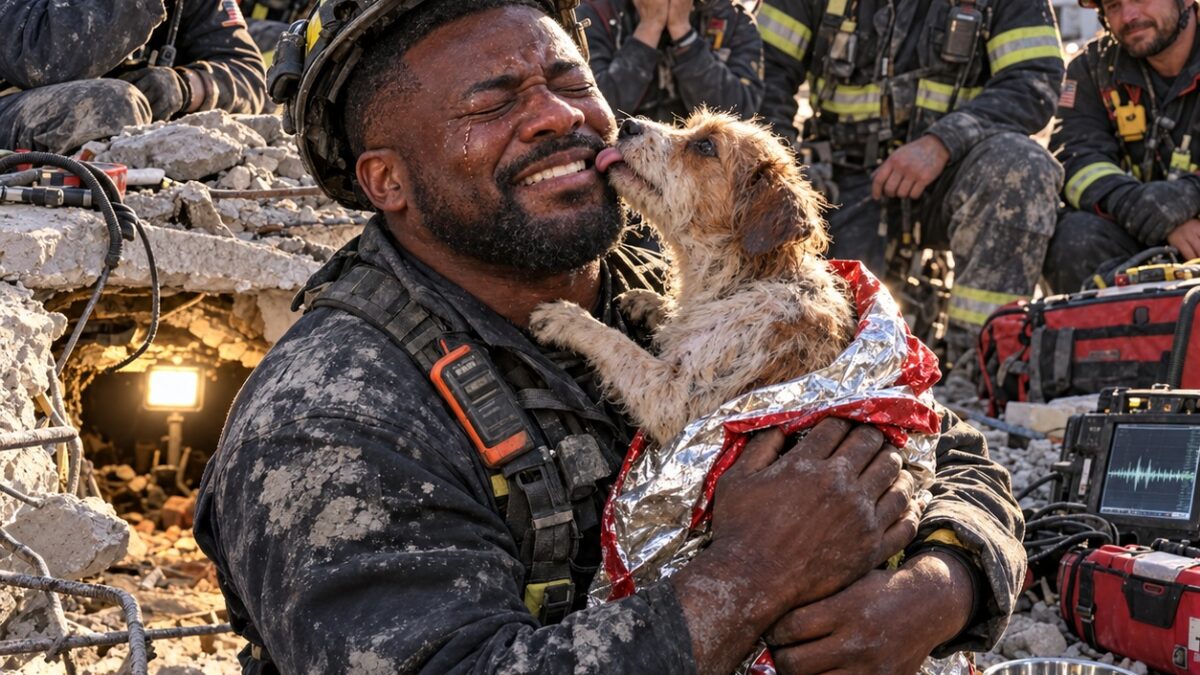
Marcus started crying.
No attempt to hide it.
No turning away.
Tears cut clean lines through the dust on his face.
“You’re okay.”
He said it even though none of us knew whether that was true.
The dog lifted its head.
I expected it to collapse again.
Instead, it stretched forward.
Slowly.
Its nose touched Marcus’s chin.
Then one lick.
Marcus froze.
Another lick.
His cheek.
Then another.
The dog began licking his face with whatever little strength it had left.
Marcus laughed through tears.
It was a sound none of us had heard from him before.
“Oh, come on.”
The dog kept going.
Forehead.
Nose.
Cheek.
Marcus pressed his face gently against the dog’s head.
“I know.”
He whispered.
“I know.”
People talk about rescue as if gratitude comes later.
After treatment.
After safety.
After food.
Not that day.
That little dog had spent four days in darkness, and the first thing he did after seeing light again was love the person holding him.
Nobody on our crew said anything for a while.
We didn’t need to.
We moved immediately after that.
The dog needed medical care.
Our field hospital had been set up several minutes away inside a large emergency tent.
I assumed Marcus would hand the dog to one of us for transport.
He didn’t.
He carried him to the vehicle.
Got into the back seat.
Still holding him.
I drove.
Marcus sat behind me.
The dog wrapped in a blanket against his chest.
During the drive, I checked the rearview mirror constantly.
The dog shook.
Every bump made his body tense.
Marcus held him tighter.
Not dangerously.
Protectively.
His arms said what he hadn’t been saying to anyone.
I’m here.
You’re not going back.
I won’t let go.
At one point, I asked:
“You okay?”
Marcus looked at me through the mirror.
“Yeah.”
It was the first word he’d said to me since we left the site.
The field hospital was chaos organized by exhausted people.
Doctors.
Nurses.
Volunteers.
Families.
People waiting for updates.
People bringing supplies.
People trying not to cry.
We walked in carrying a dog that looked as though he had been sculpted from dust.
Heads turned.
Marcus was a large man.
Covered in dirt.
Eyes red from crying.
Holding a tiny animal as carefully as if he were carrying glass.
A doctor came over immediately.
Her name was Anna.
Young.
Dark hair tied back.
Voice calm.
“What happened?”
“Four days under rubble.”
Her expression changed.
“Four?”
“Yes.”
“Bring him.”
Marcus placed the dog on an examination surface but kept one hand touching him.
Anna checked hydration.
Heart.
Lungs.
Eyes.
Ears.
Limbs.
Abdomen.
The dog barely resisted.
Too tired.
Marcus watched every movement.
“What?”
He asked when Anna paused.
“Nothing.”
“What does that mean?”
“It means let me finish.”
Marcus hated waiting.
I could see it.
Eventually, Anna stepped back.
“He’s dehydrated.”
Marcus nodded.
“Exhausted.”
“Yes.”
“But?”
She smiled slightly.
“But I’m not finding anything catastrophic.”
Marcus stared.
“He was under there for four days.”
“I know.”
“How is that possible?”
Anna looked at the dog.
“Sometimes small animals survive in spaces we wouldn’t expect.”
Marcus shook his head.
“Four days.”
“He’s strong.”
Anna touched the dog’s shoulder.
“Very strong.”
Then she looked at Marcus.
“And he wanted to live.”
Marcus’s eyes dropped.
Anna continued.
“Something kept him going.”
Marcus’s hand remained against the dog’s side.
The animal shifted closer to it.
Anna noticed.
“So did someone finding him.”
Marcus looked away.
We had to leave the dog under observation.
That was harder than getting Marcus away from the rubble.
Anna explained:
Fluids.
Monitoring.
Rest.
Check for delayed complications.
A few days.
Marcus stood beside the temporary cage.
“No.”
Anna stayed patient.
“He needs medical supervision.”
“I can stay.”
“You need sleep too.”
“I’m fine.”
I said:
“No, you’re not.”
He looked at me.
I had known Marcus for days.
Barely knew him at all.
But I knew exhaustion when I saw it.
His face had gone gray beneath the dust.
Hands swollen.
Eyes bloodshot.
“Marcus.”
He looked back toward the dog.
The dog had curled into the blanket.
Already asleep.
“You can’t help him if you drop.”
Marcus didn’t respond.
“I’ll stay.”
That got his attention.
“What?”
“I’ll stay here.”
“No.”
“Yes.”
“Ethan—”
“If something changes, I call immediately.”
He looked at me.
For several seconds, neither of us spoke.
Then something passed across his face.
Gratitude.
Deep.
Uncomfortable.
The kind people feel when they have been holding everything alone and somebody suddenly takes one corner of the weight.
“Thank you.”
Those were the first two personal words Marcus ever said to me.
Not instructions.
Not work.
Thank you.
I nodded.
“Go sleep.”
He left reluctantly.
Turned around twice before reaching the tent opening.
The dog slept.
I stayed.
Night settled over the field hospital.
Emergency tents sound different at night.
Daytime is movement.
Voices.
Equipment.
At night, every small sound feels closer.
A cough.
Blanket shifting.
Low conversation.
Someone crying quietly.
Boots on temporary flooring.
The dog slept through most of it.
Once, around two in the morning, he woke suddenly.
Body tense.
Head lifted.
Eyes wide.
Probably dreaming.
Or remembering.
I moved closer.
“Easy.”
He looked at me.
Not Marcus.
Disappointment?
Maybe I’m projecting.
“It’s okay.”
I put my hand near the bars.
Didn’t reach in.
Let him decide.
After a minute, he lowered his head.
Closed his eyes.
I sat there thinking.
Rescue workers like to believe we understand our role.
We arrive.
We help.
We save.
It’s a useful mindset.
You need confidence in disasters.
But that night, beside a cage holding a little dog who had survived four days under collapsed concrete, I began thinking about what rescue really means.
Marcus had heard him because Marcus listened.
Everyone else had been ready to leave.
Not because we didn’t care.
Because exhaustion had taught us skepticism.
Marcus ignored skepticism long enough to kneel down.
That dog survived because of stubbornness on both sides.
One refusing to die.
One refusing to walk away.
Near dawn, I fell asleep sitting upright for maybe twenty minutes.
When I woke, someone was standing beside me.
Marcus.
He had returned before sunrise.
Of course he had.
He carried a small blanket under one arm.
And a soft ball.
I stared.
“You bought him a toy?”
Marcus looked embarrassed.
“It was open.”
“What was open?”
“A supply place.”
“At five in the morning?”
“Something was.”
I laughed.
That was the first time I saw him almost smile.
He sat beside the cage.
The dog remained asleep.
Marcus placed the little ball outside the bars.
Waited.
Sunlight started turning the tent canvas pale gold.
Then the dog stirred.
Opened his eyes.
Saw Marcus.
Everything changed.
His ears lifted slightly.
He struggled upright.
Marcus moved closer.
“Hey.”
The dog came to the cage door.
Tail moved once.
Then again.
Marcus stopped breathing.
“Ethan.”
“I see it.”
Tail.
Small movement.
Then faster.
First time.
Anna arrived a little later.
Checked him again.
Hydration better.
Alertness improved.
She opened the cage.
The dog stepped out.
Not steadily.
But enough.
Then he saw Marcus sitting on the floor.
He ran.
Or tried to.
It was more of a stumbling sprint.
Straight into Marcus’s arms.
Marcus caught him.
The licking started again.
Hands.
Face.
Ears.
Marcus laughed.
Actually laughed.
Full sound.
“Okay.”
The dog didn’t stop.
“Okay, I get it.”
More kisses.
Anna stood beside me.
I whispered:
“I think we’re unnecessary.”
She smiled.
“Completely.”
Later, after another examination, Anna gave us the news Marcus had wanted.
“He can leave.”
Marcus looked at her.
“Today?”
“Yes.”
“He’s okay?”
“He still needs rest.”
Marcus nodded at everything.
“Water.”
“Yes.”
“Food?”
“Small amounts.”
“Medicine?”
She explained.
Marcus memorized every word.
Then he looked at me.
“What do you think?”
“About what?”
He glanced at the dog.
The dog was sitting against his boot.
“I don’t know where he came from.”
I waited.
“Don’t know who he belonged to.”
“No.”
“Don’t know what happened before.”
“No.”
He looked down.
“But he chose me.”
The dog leaned against him.
I smiled.
“I think that decision was made yesterday.”
Marcus nodded.
“I don’t want him alone again.”
That was it.
No ceremony.
No adoption application in the middle of a disaster zone.
Just one man deciding that if nobody came to claim this little survivor, he was not going back into the world alone.
Marcus named him Phoenix.
I asked why.
“Because he came out of destruction?”
Marcus shook his head.
“That sounds too dramatic.”
“You survived a disaster zone and adopted a dog you pulled from rubble. You’re allowed dramatic.”
He almost smiled.
Then looked down at Phoenix.
“Not because he rose from ashes.”
“What, then?”
Marcus scratched behind one small ear.
“Because he reminded us there’s still light where you think there’s only darkness.”
I didn’t answer.
That was better than anything I had.
The next several days were still hard.
Disaster doesn’t become beautiful because one rescue goes well.
We returned to the site.
There were losses.
Families we couldn’t help.
Searches that ended differently.
Phoenix’s survival did not erase those.
But it changed something inside our team.
Whenever fatigue began turning into certainty—
No one could still be alive.
Nothing could be under there.
We’ve checked enough—
someone remembered Marcus.
Listen again.
That became almost a rule.
Listen again.
Marcus continued working.
Phoenix stayed with medical volunteers while he was on site.
Every break, Marcus checked on him.
Phoenix transformed quickly.
Food.
Water.
Sleep.
Safety.
Those things remake an animal.
Within days, his eyes looked brighter.
He stood more confidently.
His tail developed opinions.
He learned Marcus’s footsteps.
You could watch the moment he recognized them.
Head up.
Ears forward.
Tail.
Then movement.
Marcus changed too.
That part took longer.
I hadn’t known him before the disaster.
But people who had said he was quiet.
Private.
Kept to himself.
Even among rescuers, Marcus rarely joined conversations unless necessary.
Phoenix broke through that.
At dinner, Marcus talked about whether the dog liked chicken better than beef.
At breakfast, he complained Phoenix had stolen part of his blanket.
One afternoon, he showed me a scratch on his wrist.
“He did this.”
“He weighs eight pounds.”
“Ten.”
“Terrifying.”
“He has sharp nails.”
“Combat injury.”
Marcus laughed.
The man who had barely spoken began laughing.
That is one of the things animals do.
They create conversation without asking permission.
A week later, the immediate rescue operation scaled down.
Teams rotated home.
Emergency infrastructure began changing from search-and-rescue to recovery.
Those transitions are difficult.
You leave people behind.
Not literally.
Emotionally.
You drive away from destroyed neighborhoods while knowing residents don’t get to leave what happened.
Marcus and I returned to our base.
Phoenix came with him.
Of course.
During the drive, the dog slept with his head on Marcus’s lap.
Every now and then, Marcus rested one hand over his back as though checking he was real.
I didn’t mention it.
Some reassurance should remain private.
Back at base, Phoenix became famous.
Not because Marcus wanted attention.
He hated it.
But the story spread.
The dog under rubble.
Four days.
Marcus hearing the sound.
The kisses.
People brought toys.
Food.
A tiny bed.
Phoenix ignored the bed and slept beside Marcus.
Someone gave him a red collar.
Marcus accepted it.
Someone else tried putting a rescue-team patch on a little vest.
Phoenix hated it.
That lasted four minutes.
I visited Marcus several weeks later.
He lived in a small house at the edge of town.
Lots of green around it.
Quiet.
Simple.
I pulled into the drive.
Before I had fully closed the car door, something came racing around the corner of the house.
Phoenix.
I barely recognized him.
His coat shone.
Healthy weight.
Eyes bright.
Tail moving so hard it seemed to steer the rest of him.
He ran straight toward me.
I crouched.
“Hey, little miracle.”
Phoenix launched himself into my arms.
Marcus came outside.
Smiling.
Not the brief smile from the hospital.
This one stayed.
“You came.”
“I said I would.”
Phoenix licked my chin.
I laughed.
“At least somebody’s happy.”
Marcus said:
“He remembers you.”
“You think?”
“He remembers everybody who helped.”
Maybe.
Animals remember safety in ways we don’t entirely understand.
We sat on the porch.
Phoenix lay at Marcus’s feet.
A soft ball nearby.
The same one from the hospital, I realized.
Chewed now.
Almost destroyed.
“You still have that?”
Marcus looked down.
“He likes it.”
“Clearly.”
We sat quietly.
The silence between us had changed.
At the disaster site, silence meant listening for danger.
Now it meant peace.
Phoenix closed his eyes.
Marcus watched him.
Then said:
“I never thought a dog could change this much.”
“He looks different.”
“I don’t mean him.”
I looked at Marcus.
He stared toward the yard.
“I mean me.”
I waited.
Some conversations die if you rush to fill them.
Marcus continued.
“I’ve always been alone.”
His voice stayed steady.
“I thought I liked it.”
“Maybe you did.”
“Maybe.”
Phoenix shifted until one paw touched Marcus’s boot.
Marcus looked down.
“I spent years thinking nobody needed me.”
That sentence carried more weight than anything else he’d told me.
I didn’t know his whole history.
Didn’t need to.
Loneliness has many origins.
Sometimes grief.
Sometimes habit.
Sometimes fear disguised as independence.
“He needs me.”
Marcus said.
Then, after a pause:
“And I need him.”
Phoenix opened one eye.
As if hearing his name without hearing his name.
I smiled.
“Sounds mutual.”
Marcus nodded.
That porch conversation stayed with me.
Rescue workers talk about lives saved.
Numbers.
People extracted.
Patients treated.
Animals recovered.
But the word saved is incomplete.
It suggests direction.
One person has strength.
The other receives it.
Marcus and Phoenix destroyed that idea for me.
Marcus found Phoenix under rubble.
True.
Phoenix found something in Marcus too.
Also true.
Maybe not buried under concrete.
But buried.
Loneliness.
Purpose.
The belief that no one depended on him.
Phoenix dug through that in his own way.
No equipment.
No training.
Just presence.
Every morning afterward, according to Marcus, Phoenix woke him by placing one paw on his face.
The first time Marcus told me, I thought he was exaggerating.
Then I stayed overnight once after a late visit.
6:12 a.m.
I heard Marcus shout:
“Phoenix.”
Then laughter.
I walked into the kitchen.
Marcus appeared with the dog under one arm.
“He punched me.”
Phoenix looked innocent.
“Paw?”
“Directly on the mouth.”
“Attempted murder.”
“Exactly.”
Phoenix’s tail moved.
This became their routine.
Morning paw.
Breakfast.
Walk.
Marcus worked.
Phoenix waited.
Evening outside.
Nothing extraordinary.
That was what made it extraordinary.
After surviving darkness, safety looked boring.
Boring is underrated.
People who haven’t lost safety think excitement is desirable.
People who have know the luxury of repetition.
Same house.
Same bowl.
Same person coming through the door.
Nothing collapsing.
Nothing disappearing.
That is a beautiful life for an animal who once spent four days buried.
Months passed.
Phoenix grew stronger.
His fear changed too.
At first, sudden sounds froze him.
Metal dropping.
Doors slamming.
Construction noise.
He would crouch.
Eyes wide.
Marcus never forced him.
Never dragged him toward the sound to “prove” it was safe.
He sat.
Waited.
Talked quietly.
Phoenix learned.
One afternoon I watched a truck backfire near the road.
Phoenix jumped.
Then looked at Marcus.
Marcus said:
“It’s okay.”
Phoenix stayed.
That moment moved me more than it should have.
Trust is an animal deciding your voice is more believable than its fear.
Marcus had become that voice.
The disaster anniversary came.
Nobody knew exactly how to handle it.
Survivors held memorial events.
Rescue teams were invited.
Families gathered.
Some brought photographs.
Some stayed away.
Both choices made sense.
Marcus nearly didn’t attend.
“What would I do there?”
“Whatever everyone else does.”
“That sounds terrible.”
“Probably.”
He looked at Phoenix.
The dog was lying beneath the table.
“Bring him.”
Marcus shook his head.
“Too many people.”
“He’ll be with you.”
Marcus thought.
Then nodded.
Phoenix wore the red collar.
No vest.
Marcus refused the vest again.
At the memorial, people recognized them.
Some had heard the story.
A woman approached.
“You’re Marcus?”
He nodded.
“And this is Phoenix?”
Phoenix wagged.
She crouched.
Her eyes filled with tears.
“My brother was rescued on the second day.”
Marcus didn’t know what to say.
She stroked Phoenix’s head.
“I heard about him.”
Marcus said quietly:
“He was lucky.”
The woman looked up.
“So was my brother.”
She hugged Marcus.
He froze for half a second.
Then hugged back.
That happened more than once.
Phoenix became a symbol without knowing what symbols were.
People touched him.
Smiled.
Cried.
Children sat near him.
Survivors asked to take photographs.
Marcus looked uncomfortable with attention.
Phoenix loved everyone.
Perfect partnership.
At one point, Marcus found me near the edge of the gathering.
“This is too much.”
“For you?”
“Yes.”
“For him?”
Phoenix was lying on his back while three children rubbed his stomach.
“No.”
I smiled.
“Use him as a shield.”
Marcus did.
He stayed.
That night, after most people left, Marcus and I walked near the memorial wall.
Names.
Flowers.
Messages.
The air was cold.
Phoenix moved between us on leash.
Marcus stopped.
“You know what’s strange?”
“What?”
“I used to think surviving something meant you leave it behind.”
I looked at the names.
“It doesn’t.”
“No.”
Phoenix stopped to smell a flower someone had placed on the ground.
Marcus continued.
“You carry it.”
“Yeah.”
“But maybe it gets lighter.”
“Sometimes.”
He looked down at Phoenix.
“Or maybe you get stronger.”
I thought about that.
“Maybe both.”
Years in rescue work had made me suspicious of easy lessons.
People love saying suffering happens for a reason.
I don’t.
Some suffering is just suffering.
People die.
Homes disappear.
Families change forever.
No moral balance makes that fair.
Phoenix’s survival did not explain the disaster.
Marcus finding him did not justify four days in darkness.
But meaning can be created after suffering without pretending suffering was necessary.
Marcus did that.
Phoenix did that.
They built something after.
That’s different from saying everything happened for a reason.
I think that distinction matters.
Another year passed.
I kept visiting.
Sometimes often.
Sometimes months apart.
Phoenix remembered me every time.
Run.
Jump.
Kisses.
No dignity.
Marcus became more social.
Not dramatically.
He didn’t become the guy organizing neighborhood barbecues.
But his house stopped feeling like a place designed for one person.
There were dog toys.
A second chair on the porch.
Photos.
One picture from the day Phoenix left the hospital.
Marcus holding him.
My favorite was another photograph.
Phoenix asleep on Marcus’s chest.
Marcus asleep too.
Someone had taken it after a long day.
Pure trust.
“You framed this?”
I asked.
Marcus shrugged.
“It was good.”
“You used to have nothing on these walls.”
“I have something now.”
That answer said everything.
Phoenix developed habits.
He hated closed doors.
If Marcus went into a room and shut the door, Phoenix waited outside.
Sometimes scratched.
Marcus eventually stopped closing doors.
“He’s controlling you.”
“Absolutely.”
“Healthy.”
“No.”
Phoenix liked sitting in sunlight.
Despised rain.
Would step outside, feel drops, and immediately reverse direction.
Four days under rubble apparently did not produce appreciation for weather.
He loved carrots.
No explanation.
Feared vacuum cleaners.
Reasonable.
And still woke Marcus with a paw.
Every morning.
One Christmas, I brought Phoenix a new soft ball.
Marcus held up the original.
“You know this one still exists.”
Barely.
Half the covering gone.
Shape distorted.
“That thing is biological material at this point.”
“He likes it.”
“He needs standards.”
Phoenix took the new ball.
Played with it for eleven minutes.
Then found the old one.
Marcus looked at me.
“I told you.”
“Ungrateful animal.”
Phoenix wagged.
Time did what it always does.
Turned miracle into life.
That is not a loss.
It is the best possible outcome.
Phoenix stopped being “the dog from the rubble” every day.
He became:
Phoenix.
The dog who stole socks.
The dog who barked at delivery trucks.
The dog who slept beside Marcus.
The dog who knew Ethan meant extra treats.
He didn’t wake every morning remembering disaster.
At least, I hope not.
He lived.
That was enough.
Marcus changed his own routines around Phoenix.
Longer walks.
More time outside.
Neighbors learned his name.
Children nearby asked whether Phoenix could play.
Marcus, who once told me nobody needed him, became the person a neighbor called when her dog escaped.
Then when an elderly man needed help carrying groceries.
Then when a storm damaged a fence.
Connection grows indirectly.
A dog opens a door.
Then people walk through.
One evening, I told Marcus this.
He looked annoyed.
“Don’t make this sentimental.”
“It’s already sentimental.”
“No.”
“You adopted a dog from earthquake rubble.”
“Collapsed building.”
“Even better.”
“He needed somewhere.”
“So did you.”
Marcus stared at me.
Then threw a dog toy in my direction.
Phoenix intercepted it.
Conversation over.
But he knew.
I knew.
Years after the rescue, I returned to the original site.
Reconstruction had changed almost everything.
New structures.
New pavement.
Fresh walls.
If you didn’t know what had happened there, you might never guess.
That’s another strange thing.
Places heal visually faster than people.
I stood near where we had found Phoenix.
Could not identify the exact point.
I expected that to bother me.
It didn’t.
The rubble was gone.
Good.
The site didn’t need to remain broken just because memory was.
I called Marcus.
“Guess where I am.”
“Work?”
“No.”
Silence.
Then:
“The site?”
“Yeah.”
Another pause.
“How is it?”
“Different.”
“Good.”
I looked around.
“Very.”
He said:
“Phoenix is asleep on my foot.”
I laughed.
“Also good.”
We stayed on the phone without talking for a while.
Then Marcus said:
“You know I almost didn’t hear him.”
“I know.”
“I think about that.”
“So do I.”
“What if we’d left?”
I had thought about that question hundreds of times.
“What if” is poison in rescue work.
There will always be another room.
Another sound.
Another search area.
You cannot know every missed possibility.
But some stay with you.
“I don’t know.”
I said.
Marcus breathed out.
“Yeah.”
Then I added:
“But we didn’t.”
Silence.
“No.”
He said.
“We didn’t.”
That is the only answer rescue gives you.
Not certainty.
Action.
We listened.
We stayed.
We found him.
Years later, Phoenix’s muzzle began turning lighter.
That happened before I was ready.
Dogs age unfairly fast.
The puppy-like energy softened.
He still ran when I visited.
Just not as hard.
Marcus noticed every change.
Of course.
“His back legs are stiff in the morning.”
“How old is he?”
“No idea.”
“Vet?”
“Says normal.”
Marcus hated the word normal.
When you love an animal saved from death, normal aging feels like betrayal.
But time is not disaster.
That distinction matters.
Phoenix had been given years.
Safe years.
Loved years.
Running in a yard.
Sleeping beside Marcus.
Stealing food.
Destroying balls.
That is not tragedy.
That is success.
I reminded Marcus once.
He didn’t appreciate it.
“I know.”
He said.
“No, you know intellectually.”
He glared.
“Thank you, therapist Ethan.”
“You’re welcome.”
He threw a cushion at me.
Phoenix opened one eye.
Old men.
All of us.
The bond never changed.
If Marcus left the room, Phoenix looked.
If Phoenix made an unusual sound, Marcus heard.
That listening from the rubble never stopped.
He had trained himself to hear that dog once.
Then spent the rest of their life hearing him.
A nail tapping differently.
A change in breathing.
Food left in bowl.
Small signs.
Love is often attention.
Not grand gestures.
Notice.
Listen.
Stay.
That’s what Marcus did.
That’s what Phoenix had asked for from beneath concrete without words.
Somewhere along the way, I realized Phoenix had affected me too.
I had been doing rescue work long enough to protect myself emotionally.
You have to.
Not by becoming cold.
By creating distance.
Otherwise every loss comes home.
Phoenix broke some of that distance.
Not destructively.
He reminded me why attention matters even after exhaustion.
Why one more pause can matter.
Why skepticism should never become indifference.
I became more patient with newer rescuers.
When someone said:
“I thought I heard something,”
I stopped.
Even if I doubted.
We checked.
Most times, nothing.
Sometimes pipes.
Animals.
Debris.
But check.
Listen again.
That became my private rule.
Years after Phoenix, another rescue worker told me he heard faint tapping where our initial equipment showed nothing.
We checked.
Found an elderly woman inside a protected pocket.
Different disaster.
Different country.
She survived.
Afterward, while everyone celebrated, I thought of Marcus kneeling with his ear against stone.
Listen again.
One life teaches you how to find another.
Maybe that is how rescue moves forward.
Not heroism.
Memory becoming practice.
I told Marcus later.
“You found her?”
“My teammate heard her.”
“You checked.”
“Yes.”
He was quiet.
Then:
“Phoenix.”
“Phoenix.”
We laughed.
The dog had no idea he had become doctrine.
By the time Phoenix was truly old, Marcus had changed beyond recognition from the man I first met.
Still quiet.
Still private.
But no longer alone.
His house had people.
Friends.
Neighbors.
Me.
Children who grew up knowing Phoenix.
Veterinarian who knew Marcus by first name.
Life.
One evening, sitting on the porch, Marcus said:
“I told you nobody needed me.”
“I remember.”
“That was stupid.”
“Yes.”
He looked offended.
“You could disagree.”
“No.”
He laughed.
Phoenix lay between us.
Old.
Sleeping.
Marcus rested one hand on him.
“I think I was waiting to be needed before I gave anyone a chance.”
That was the most honest thing Marcus ever said.
I looked at him.
“Maybe.”
“Phoenix didn’t ask permission.”
“No.”
“He just decided.”
“Dogs are rude.”
Marcus smiled.
“He saved me.”
There it was.
Not metaphor disguised.
Truth as Marcus felt it.
I looked at Phoenix.
“Probably.”
Marcus shook his head.
“No.”
He looked at me.
“He did.”
So I didn’t argue.
Rescue is not one direction.
I learned that from them.
Sometimes you pull a body from darkness.
Sometimes that life gives you a reason to step into light yourself.
Both are rescue.
I don’t know exactly when Phoenix stopped being a miracle story to me.
Maybe never.
But the miracle wasn’t four days under rubble anymore.
It was everything after.
The mornings.
Walks.
Chewed toys.
Neighbors.
Marcus smiling.
Ordinary years.
People want miracles to be dramatic.
I think miracles often become grocery lists and vet appointments.
If they last long enough, that’s the point.
One autumn afternoon, I visited when the leaves were changing.
Phoenix was slower.
He still came toward me.
Tail moving.
I crouched.
He pressed his head against my knee.
“Hey, buddy.”
Marcus stood behind him.
“He remembers.”
“Always.”
We sat outside.
Phoenix between us.
Sunlight warm.
No noise.
At some point, Marcus said:
“Do you remember what Anna said?”
“What?”
“He wanted to live.”
I nodded.
Marcus looked at Phoenix.
“He did.”
“Yes.”
“He really did.”
Then Marcus smiled.
“And he got to.”
That’s the ending I choose when I think about that rescue.
Not rubble.
Not fear.
Not the cage.
He got to live.
Not merely survive.
Live.
There is a difference.
Survival is heartbeat.
Life is what you do with the heartbeat afterward.
Phoenix ran.
Played.
Slept.
Loved.
Was loved.
Changed Marcus.
Changed me.
Maybe changed people who only heard the story.
That’s a lot for one small dog.
Eventually, strangers stopped recognizing Phoenix.
New people moved into town.
The rescue became history.
That’s healthy too.
Not every survivor should spend life representing the worst thing that happened to them.
Phoenix didn’t owe anyone inspiration.
He was allowed to be a dog.
Marcus protected that.
No constant media.
No performances.
No turning him into a mascot.
When someone asked for interviews years later, Marcus usually declined.
“He doesn’t care.”
“About interviews?”
“About being famous.”
“No dog does.”
“Exactly.”
Phoenix cared about breakfast.
Marcus.
Sun.
Old ball.
That was enough.
One day, a young volunteer asked me whether rescue workers ever know if what they do matters years later.
I thought about Marcus’s porch.
Phoenix sleeping at his feet.
“You don’t always know.”
I said.
“But sometimes you get lucky enough to see it.”
“What did you see?”
“A dog.”
He looked confused.
I smiled.
“Long story.”
Maybe that’s why I’m telling it now.
Not because Marcus was a hero.
He would hate that word.
Not because I was.
I wasn’t.
Not because Phoenix was supernatural.
He was a small dog with a stubborn heart.
I’m telling it because disaster strips life down to simple things.
Breath.
Sound.
Hands.
Time.
Someone listening.
Someone refusing to leave.
Four days in darkness could have been the entire story.
It wasn’t.
Because Marcus heard something.
Stopped.
Kneeled.
Listened.
Then believed the sound enough to act.
That’s all.
People often wait for certainty before helping.
Rescue rarely gives certainty.
Sometimes all you have is:
I think I heard something.
I think someone is there.
I think I should check.
Those thoughts can matter.
The day Phoenix came out, the first thing he did was lick Marcus’s face.
I’ve replayed that image more times than I can count.
Tiny dog.
Dust everywhere.
Marcus crying.
Phoenix barely strong enough to hold his head up but still reaching toward him.
People interpreted it as gratitude.
Maybe.
Maybe the dog simply recognized warmth after cold.
Touch after isolation.
Life after fear.
Maybe animals don’t separate those things.
Maybe gratitude is exactly that.
You are here.
I am not alone.
That’s enough.
Years later, when I visited Marcus, Phoenix still greeted him differently from everyone else.
He liked me.
Loved visitors.
But Marcus was home.
Dogs know.
You could see it in the way Phoenix settled.
A body relaxed differently around the person it trusts most.
Marcus became that place.
Home.
And Phoenix became Marcus’s.
That’s the circle.
The one people miss when they ask:
Who saved whom?
Wrong question.
Love doesn’t keep score that neatly.
Marcus found Phoenix.
Phoenix found Marcus.
I witnessed it.
That is enough for me.
The older I get, the less interested I am in grand definitions of courage.
At twenty-five, I might have said courage was running toward danger.
At thirty-five, maybe carrying weight when you’re afraid.
Now?
Courage can be kneeling.
Listening.
Waiting longer than everyone thinks is reasonable.
Believing a weak sound deserves another hour of work.
It can be letting yourself love something after you’ve learned how easily things can be lost.
Marcus did all of those.
So did Phoenix, in his way.
The dog had every reason to shut down.
Four days alone in darkness.
But when light arrived, his first response wasn’t fear.
It was connection.
Maybe that’s why the moment broke all of us.
He had survived the worst and still reached toward love.
I wish humans did that as easily.
The field hospital where Anna worked no longer exists.
Temporary structures get dismantled.
The disaster base moved.
People scattered.
Some volunteers I never saw again.
Lives continue.
But I still remember that tent at dawn.
Marcus on the floor.
Phoenix waking.
Tail moving for the first time.
Then running straight into his arms.
If I close my eyes, I can hear Marcus laugh.
That’s the sound I remember most.
Not rubble.
Not sirens.
Laughter.
A man who had been silent finally laughing because a dog was licking his ears.
That’s how I prefer memory.
Not denying pain.
Choosing what carries forward.
Phoenix taught Marcus something about being needed.
Marcus taught me something about listening.
Maybe I taught them something too.
I hope.
But if not, that’s fine.
Rescue doesn’t have to make the rescuer central.
Sometimes your privilege is simply being there when life chooses another chance.
My name is Ethan.
I’m a rescue worker.
For years, people have called me a hero because of the uniform, the equipment, the places I’ve gone.
I don’t think much about that word anymore.
I was there that day.
That’s all.
Marcus was there.
Phoenix was there.
And when everybody else was ready to move on, Marcus stopped.
Listened.
Heard what the rest of us almost missed.
A scratch.
A tiny sound.
A heartbeat hidden under four days of darkness.
We moved stone.
Opened space.
Reached inside.
And life came back out.
Then life licked Marcus directly across the face.
Maybe that’s all the philosophy anyone needs.
Listen closely.
Don’t assume silence means nothing is there.
When something living reaches for you, reach back.
And when you are lucky enough to pull hope out of darkness, don’t just celebrate that it survived.
Give it somewhere safe to live afterward.
Marcus did.
Phoenix did too.
Because the truth is, I used to believe rescue ended when we got somebody out.
When the rubble was removed.
When the ambulance left.
When the survivor reached safety.
I know better now.
Sometimes rescue begins there.
Phoenix’s real rescue wasn’t just the moment sunlight touched his face.
It was every morning afterward when he woke in the same house.
Every bowl filled.
Every hand that came down gently instead of dangerously.
Every night he slept without concrete above him.
Every time Marcus left and returned.
Every time fear said something bad might happen and experience slowly answered:
Not this time.
You’re safe.
Marcus’s rescue worked the same way.
It wasn’t one dramatic moment.
It was Phoenix waiting by the door.
Phoenix needing breakfast.
Phoenix getting sick once and forcing Marcus to worry like a parent.
Phoenix making him talk to neighbors.
Phoenix making him laugh.
Phoenix giving shape to mornings that used to feel empty.
Small acts.
Repeated.
Safety is repetition.
Love is repetition too.
That may be the deepest thing Phoenix taught me.
Grand gestures are memorable.
But ordinary presence changes lives.
I saw Marcus years after the disaster at another community event.
Phoenix was older then.
He lay under Marcus’s chair.
People moved around them.
Children.
Music.
Conversations.
Marcus saw me.
Waved.
I sat beside him.
No need for big reunion.
We had moved past that.
“How’s he doing?”
I asked.
Marcus looked down.
“Stubborn.”
“Good.”
“He steals my pillow.”
“Excellent.”
“He snores.”
“Character.”
Phoenix opened one eye.
Tail thumped once.
I reached down.
Scratched his head.
Marcus said:
“You know, I still think about the first night.”
“Hospital?”
“No.”
“Rubble?”
He nodded.
“I was sure everyone thought I was crazy.”
“We did.”
He looked at me.
I smiled.
“At first.”
“I knew I heard something.”
“I know.”
“What if I hadn’t insisted?”
There it was again.
The question never fully leaves.
I answered differently this time.
“You did insist.”
Marcus looked at me.
“That’s the story.”
Not what if.
What happened.
He insisted.
We listened.
Phoenix lived.
Memory doesn’t need alternate endings.
It has enough weight already.
Marcus nodded.
Then rested his hand on Phoenix.
“He’s a good dog.”
“The best.”
Phoenix thumped his tail again.
Agreement.
I drove home that evening thinking about how people measure life.
Years.
Money.
Achievements.
Places.
Rescue work teaches another measurement.
Moments where somebody stayed.
Moments where somebody noticed.
Moments where one life changed direction because another life paid attention.
That is how I measure Marcus and Phoenix.
One stopped.
One made a sound.
One listened.
Then both changed.
If that sounds too simple, maybe simplicity is the point.
We complicate meaning because we expect it to arrive with speeches.
It often arrives as a scratch beneath concrete.
A paw against a face.
A blanket.
A cheap soft ball.
A man saying:
He needs me.
And realizing, maybe for the first time:
I need him too.
Phoenix eventually became slower.
Old age came gently, as much as old age ever does.
Marcus never talked much about the future.
Neither did I.
You don’t ruin good days by rehearsing their ending.
We enjoyed him.
Every visit.
Every tail wag.
Every ridiculous ball.
I stopped taking photographs constantly.
At some point, being present mattered more.
That was another lesson.
Rescue workers document everything.
Evidence.
Records.
Memory.
But not every good moment needs proof.
Sometimes you just sit.
Phoenix sleeps.
Marcus drinks coffee.
Wind moves trees.
Nothing happens.
Perfect.
The last image I want to leave is not the disaster.
It’s that porch.
Marcus sitting in a worn chair.
Phoenix beside him.
Safe.
Green yard.
Quiet afternoon.
No dust.
No sirens.
No one digging.
That image tells the whole story better.
Because the purpose of rescue isn’t to create a dramatic memory.
It’s to return somebody to a life where drama is no longer necessary.
Phoenix got that.
Marcus got some version of it too.
And I got to see it happen.
So whenever someone calls me a rescuer, I think of that little dog.
I think about how quickly he ran to Marcus once the cage opened.
How Marcus’s face changed.
How one small animal gave a lonely man proof that his presence mattered.
Then I remember something I learned in the dark beside a pile of rubble:
Sometimes we think we’re the ones doing the saving because we’re the ones wearing gloves.
We’re the ones moving stone.
We’re the ones carrying stretchers.
But rescue is larger than the moment of extraction.
Sometimes the life you pull out reaches back.
Sometimes it gives something you didn’t know you were missing.
Sometimes the smallest heart becomes the reason another heart opens again.
Marcus named him Phoenix because light existed where darkness should have won.
I think the name fit.
Not because Phoenix was magical.
Because he wasn’t.
He was vulnerable.
Thirsty.
Terrified.
Small.
And alive.
That’s enough for a miracle.
Four days in darkness didn’t make him heroic.
Choosing life did.
Trusting again did.
Loving again did.
Marcus did the same.
And maybe that’s why they belonged together from the beginning.
Two lives that had spent too much time alone.
Both waiting for someone to hear them.
One made a tiny sound beneath concrete.
The other finally learned how to answer it.
I was there when they met.
I will always be grateful for that.
And whenever I think about the moment Phoenix first reached daylight and covered Marcus’s dusty face with kisses, I don’t think:
We saved him.
I think:
He found us.
And we were lucky enough to be listening.








