PART2:A Starving Mother Dog Stopped My Empty Bus in the Middle of the Night—Then She Led Me to Five Puppies Trapped Beneath the Highway
PART2
For several seconds, I could not move.
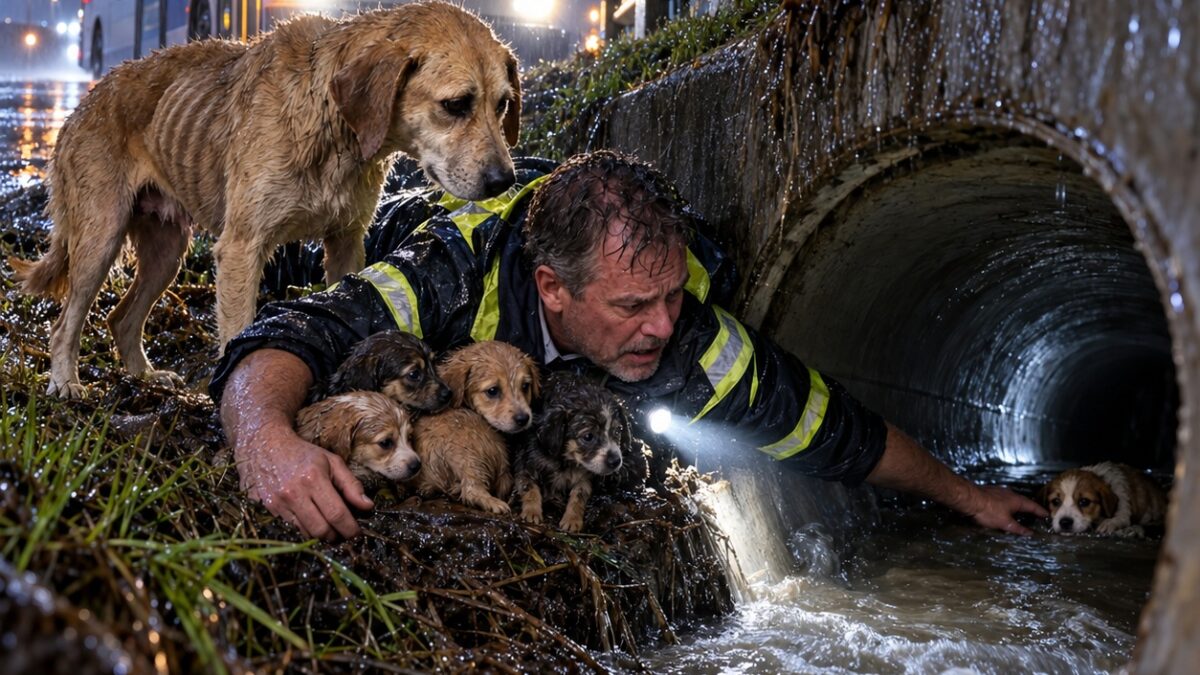
The pipe ran beneath the highway.
Wide enough for water.
Not wide enough for me to crawl inside safely.
The concrete was slick.
Cold runoff moved along the bottom in a shallow stream.
And huddled several feet inside were puppies.
Five.
I counted twice because I thought I had imagined the number.
One.
Two.
Three.
Four.
Five.
They were tiny.
A few weeks old at most.
Their fur was soaked flat against their bodies.
They were pressed so tightly together they looked like one trembling shape.
Their eyes were mostly closed.
The crying was weak.
That frightened me more than loud screaming would have.
Healthy puppies complain.
Hungry puppies make themselves heard.
These sounded tired.
Too tired.
I looked at the mother.
She stood beside me.
Rain dripping from her face.
She looked into the pipe.
Then at me.
And suddenly everything she had done on the road made sense.
She had not been trying to get onto the bus.
She had been trying to stop it.
She had seen headlights.
A human.
Something capable of doing what she could not.
“Those are yours.”
Her ears lifted.
I did not know whether she understood my words.
She understood my attention.
That was enough.
I leaned toward the opening.
“How did they get in there?”
No answer, obviously.
Maybe she had sheltered there from the rain.
Maybe water rose.
Maybe the puppies crawled too deep.
The entrance had a lip too high for them to climb.
Inside, smooth concrete offered no grip.
Whatever had happened, they were trapped.
And she could not reach them.
I imagined her outside that pipe while rain fell.
Hearing them cry.
Going in as far as she could.
Coming back out.
Running to the highway.
Trying to stop cars.
How many had passed before me?
I hated that question immediately.
I put my phone flashlight on.
The closest puppy was maybe three feet in.
Reachable.
The farthest much deeper.
I lay flat on the wet ground.
Extended my arm.
The mother moved beside my shoulder.
“Stay.”
She trembled.
Not aggression.
Exhaustion.
Fear.
I reached.
My fingertips touched wet fur.
The puppy made a weak sound.
“Got you.”
I moved carefully.
One hand beneath its chest.
Pulled slowly.
Concrete scraped my sleeve.
The puppy slid toward me.
Then out.
It was so small.
Cold.
Much colder than it should have been.
Its whole body shook in my hands.
The mother rushed forward.
For a second I worried she might bite me.
Instead, she sniffed the puppy from head to tail.
Licked its face.
Then its back.
Again.
Again.
Urgent.
Checking.
Reassuring.
Maybe both.
I took off my jacket.
Spread it on the driest patch of ground I could find.
Placed the puppy inside.
The mother curled briefly around it.
Then immediately returned to the pipe.
Looked in.
Looked at me.
Four more.
“I know.”
I lay down again.
Second puppy.
A little farther.
I stretched.
My shoulder pressed against concrete.
Touched a paw.
The puppy withdrew.
“Come on.”
I reached deeper.
Caught the body gently.
Pulled.
The puppy cried.
The mother whined.
“It’s okay.”
I brought it out.
She checked it.
Licked it.
Then moved back to the opening.
Third.
That one was easier.
It had crawled slightly closer while I worked.
I lifted it out.
Tiny paws moved weakly against my hand.
Alive.
Fourth.
I had to remove branches and debris from the entrance.
My shirt was soaked.
Mud covered my elbows.
Rain ran down the back of my neck.
I did not care anymore.
I reached.
My fingers closed around the fourth puppy.
Pulled slowly.
Out.
The mother went through the same ritual.
Nose.
Face.
Belly.
Lick.
Then she looked back into the pipe.
I did too.
One puppy remained.
The smallest.
Farthest away.
I could see only part of it in the flashlight beam.
It was not moving.
My stomach dropped.
“No.”
I lay flat again.
Reached.
Nothing.
Another inch.
Nothing.
The puppy was too far.
I pushed my shoulder farther into the pipe.
Concrete pressed against my cheek.
My fingers reached empty air.
“Come on.”
The mother began whining behind me.
I pulled out.
Looked around.
What could I use?
A stick?
Too dangerous.
Something with fabric?
Could I loop it?
No.
The puppy was too fragile.
I went back to the bus.
Ran.
Opened the storage area.
Grabbed another coat, a flashlight, a small towel, anything I thought might help.
When I returned, the mother was still at the entrance.
She had not moved.
Four puppies were wrapped in my jacket.
She stood between them and the pipe.
Unable to choose.
That image nearly broke me.
Four safe enough for the moment.
One still inside.
A mother physically pulled in two directions.
I crouched.
“I’m getting the last one.”
She looked at me.
“I promise.”
Promises to animals sound ridiculous until you are the one making them.
I stretched out again.
This time I pushed half my chest into the pipe.
Water seeped under me.
My shoulder hurt.
The flashlight lay beside my face illuminating the puppy.
Closer now only because I had moved farther.
Still not enough.
My fingers brushed fur.
Then lost it.
“Damn it.”
The mother barked.
One short sound.
I tried again.
I flattened my hand.
Reached until pain shot through my shoulder.
My middle finger touched something.
A tiny back leg.
I froze.
Did not grab.
Too easy to hurt.
I adjusted.
Reached farther.
Managed to slide two fingers beneath its stomach.
Nothing.
No movement.
I felt panic rise.
Not yet.
Please.
I hooked my hand gently enough to move the puppy a few inches.
Then stopped.
Repositioned.
Another few.
My shoulder felt like it was tearing.
I did not care.
The puppy came closer.
I finally got one hand around its little body.
Pulled.
Slow.
Very slow.
The puppy slid through water and mud.
Toward me.
Then into my hands.
It was limp.
Completely.
I sat up.
Rain hit my face.
The mother came immediately.
She sniffed.
Licked.
No response.
My heart sank.
“No.”
I wrapped the puppy in the towel.
Rubbed gently.
Not hard.
Just trying to warm it.
“Come on.”
The mother licked its face.
Again.
Again.
Frantic now.
She nudged it.
Nothing.
I thought I had been too late.
That is the second I remember more clearly than almost anything else.
The rain.
The highway noise.
The mother’s nose pressing against the puppy.
Four other tiny bodies crying inside my jacket.
And the fifth completely still in my hands.
I whispered:
“Please.”
Then the puppy opened one eye.
Barely.
A thin sound came from its mouth.
A whimper.
One tiny, miserable complaint.
It was the most beautiful sound I had ever heard.
The mother began licking harder.
I laughed and cried at the same time.
“You’re alive.”
The puppy moved one paw.
The mother pressed her nose against its face.
For one second, I swear she looked different.
Relief is a human word.
But if dogs can feel it, I saw it that night.
I placed the fifth puppy with the others.
The mother stepped into my jacket.
Curled around all five.
They crawled against her instinctively.
Searching for warmth.
Milk.
Safety.
She lowered her body around them.
And for the first time since I had stepped off the bus, she stopped watching the highway.
Her eyes closed.
Just for a moment.
That was when I saw how exhausted she really was.
While she was running back and forth on the road, urgency had hidden it.
Now her whole body shook.
Every rib.
Every breath.
She was starving.
Soaked.
Probably had not slept.
Maybe had not eaten properly in days.
Yet when I had offered food first, she refused.
Because five puppies were still trapped.
Only now, with all of them against her, did she allow herself to collapse.
I sat in mud beside them.
And cried.
I am not embarrassed by that.
At the time, I could not explain exactly why.
Relief.
Exhaustion.
The sight of the mother.
The fact that she had run toward buses and cars despite whatever fear she may have had of people.
She had made herself visible because hiding would kill her babies.
I thought about how long she must have been trying.
A highway late at night.
Rain.
Headlights passing.
Cars too fast.
Noise.
She was thin enough that simply running should have exhausted her.
Still:
Road.
Pipe.
Road.
Pipe.
Again.
Until someone stopped.
Until I stopped.
I called the shelter.
The person who answered sounded half asleep until I explained what I was looking at.
“Five puppies?”
“Yes.”
“And the mother?”
“She’s here.”
“Condition?”
“Very thin.”
“Any injuries?”
“Nothing obvious. She’s exhausted.”
“Keep them warm.”
“I’m trying.”
“We’ll send someone.”
“How long?”
“Maybe thirty minutes.”
Thirty minutes.
The puppies seemed too fragile for thirty minutes.
I moved them closer to the bus.
Not all at once.
I did not want the mother to panic.
I carried the bundled puppies.
She followed so closely her nose nearly touched my leg.
At the open bus door, she stopped.
Large vehicle.
Lights.
Steps.
Unknown.
I placed the puppies just inside on a blanket.
The mother stood outside.
Rain falling on her.
I crouched.
“Come on.”
She looked at the puppies.
Then at me.
I stepped back.
No leash.
No grabbing.
Her decision.
She put one front paw on the first step.
Stopped.
Then another.
Climbed.
As soon as she reached the floor, she went straight to the puppies.
Curled around them.
I turned the heat up.
The empty bus that had seemed so cold and silent twenty minutes earlier suddenly held six lives.
Five weak cries.
One mother panting softly.
I found the old sandwich.
This time, I offered her a small piece.
She ate it so quickly I almost missed it.
Then looked at my hand.
“Yeah.”
I gave another.
Small pieces.
Not too much.
I did not know enough about feeding a severely starved dog to risk overdoing it.
She swallowed.
Then lowered her head back toward the puppies.
They always came first.
I poured water into a clean container.
She drank.
Long.
I worried she would drink too fast.
I moved it briefly.
She looked at me.
“Slow.”
A few seconds later I offered more.
She drank again.
The fifth puppy remained the weakest.
I held it wrapped near the heater vent while the mother watched.
The tiny body still trembled.
But it was moving.
Making sounds.
Every sound gave me hope.
“You are causing a lot of trouble.”
The puppy squeaked.
“Exactly.”
The mother rested her chin near my knee.
I looked down.
Our eyes met.
I do not like pretending animals have human expressions.
But some things are universal enough.
She was tired.
Beyond tired.
And she no longer looked desperate.
For the first time, she looked as though maybe she believed the emergency belonged to someone else too.
Not just her.
I touched her head.
Slowly.
She did not flinch.
My hand moved down the back of her neck.
Wet fur.
Bones.
She closed her eyes.
A few minutes later, she shifted closer.
Then placed her head directly on my leg.
I froze.
This dog had been trying to stop moving vehicles perhaps all night.
A mother guarding five vulnerable puppies.
Everything about her situation should have made her suspicious.
Yet once those puppies were out, warm, and breathing, she placed her head on the lap of the stranger who had reached into the pipe.
Not because she knew me.
Because she had nothing left.
The trust of desperate animals does not always feel flattering.
Sometimes it feels like responsibility.
I put my jacket over as much of her as I could.
“You can sleep.”
Her eyes stayed closed.
“I’ve got them.”
She breathed out.
Deep.
The rescue vehicle arrived twenty-five minutes later.
Two workers stepped onto the bus.
Both stopped.
One whispered:
“Oh my God.”
The mother lifted her head.
Immediately alert again.
“Easy.”
I kept one hand on her.
“They’re here to help.”
The workers moved slowly.
They checked the puppies first without separating them far from her.
Temperature.
Breathing.
General condition.
The smallest drew the most attention.
“This one’s cold.”
“I know.”
“How long was he in the pipe?”
“I don’t know.”
“You got him out?”
“Yes.”
“Was he responsive?”
“Not at first.”
The worker looked at me.
“Not at all?”
I shook my head.
“Then he opened his eyes.”
She wrapped him more securely.
“He’s got fight.”
The mother followed every movement.
One shelter worker said quietly:
“She trusts you.”
“I think she’s exhausted.”
“Both can be true.”
They prepared transport.
The mother refused to enter their crate at first.
Every time they moved a puppy, she followed.
So they adjusted.
Kept them visible.
Let her approach.
No force.
Eventually she climbed in beside them.
The five gathered underneath her.
I stood outside the rescue van.
The mother looked at me through the open door.
I touched her forehead once.
“Go.”
She blinked.
“We’ll see you tomorrow.”
The door closed.
The van drove away.
Suddenly my bus was empty again.
But it no longer felt like the same bus.
Wet jacket on the floor.
Mud on the steps.
Tiny paw prints.
I sat behind the wheel.
Did not start the engine for a while.
I kept hearing that fifth puppy’s whimper.
Kept seeing the mother turn away from food because her babies were trapped.
I finally returned the bus to the depot.
I was late.
Very late.
The supervisor looked at the mud.
Then at me.
“What happened?”
I said:
“Long story.”
That night, I barely slept.
Every time I closed my eyes, I saw five puppies inside a pipe.
Then one limp body.
Then the eye opening.
At eight the next morning, I called the shelter.
Before I could explain, the woman said:
“You’re the bus driver.”
“Yes.”
“They made it through the night.”
All six.
I sat on the edge of my bed.
“All?”
“All.”
I covered my face.
“Can I come?”
“Of course.”
I arrived before lunch.
The mother was inside a quiet enclosure.
Warm.
Dry.
Different already.
Not healthy.
But no rain.
No highway.
No drainage pipe.
All five puppies were beside her.
The weakest had been monitored closely overnight.
Still smaller.
Still fragile.
But alive.
The mother saw me.
She stood.
That alone surprised me.
Then her tail moved.
One slow sweep.
I stopped walking.
She did it again.
The shelter worker smiled.
“She hasn’t done that for anyone yet.”
I crouched.
“Hey.”
The mother walked toward the front.
Tail again.
I put my fingers through carefully.
She pressed her nose against them.
That small tail wag hit me harder than the dramatic parts.
Because the night before, every movement she made had been about survival.
Now she had enough room inside herself for recognition.
Maybe even happiness.
The puppies grew.
Not overnight.
Recovery never works that way.
The first days were cautious.
Feeding.
Warming.
Checking hydration.
Monitoring the weakest.
Making sure the mother ate enough to support herself and the litter.
I visited whenever work allowed.
The shelter staff began teasing me.
“You work here now?”
“No.”
“You’re here more than some employees.”
“I drive a bus.”
“You sure?”
The mother started gaining weight.
Slowly.
Ribs became less sharp.
Her coat improved.
Her eyes changed.
That was the biggest difference.
No longer scanning everything.
She slept.
Deeply.
Sometimes stretched on her side with the puppies climbing over her.
The first time I saw that, I stood outside the enclosure for several minutes.
She looked almost ordinary.
Ordinary became beautiful to me after that night.
One puppy—of course the smallest—became the loudest.
The one I thought was dead now complained about everything.
Food late by ten seconds?
Complaint.
Sibling lying on him?
Complaint.
Picked up for examination?
Outrage.
I loved him.
The shelter worker laughed.
“He’s your favorite.”
“I don’t have a favorite.”
“He nearly died in your hand.”
“I said I don’t have a favorite.”
The puppy bit my finger.
Gently.
Traitor.
Weeks passed.
They grew into awkward little dogs with oversized paws and no understanding of personal space.
The mother became patient in the way exhausted mothers everywhere are patient.
Up to a point.
Sometimes she would stand and move away from all five.
Climb onto her bed.
Look at us.
I interpreted her expression as:
Your turn.
Fair.
When the puppies became old enough, adoption applications started.
That part was happy and difficult.
I knew it had to happen.
Still, I remembered them as five wet bodies pressed inside a concrete pipe.
It felt strange imagining them going in different directions.
But each puppy needed a home.
The shelter chose carefully.
One by one, families came.
They sat.
Played.
Asked questions.
The puppies chose in their own ways.
One climbed into a child’s lap.
Another followed a man everywhere.
The smallest—the one from the deepest part of the pipe—went to a family that fell in love with his ridiculous voice within five minutes.
I held him before they left.
“You nearly killed me.”
He licked my chin.
“Worthless apology.”
The family laughed.
I handed him over.
He left warm.
Fed.
Carried against someone’s chest.
Exactly the opposite of how I had found him.
That mattered.
Eventually, all five puppies were adopted.
Five homes.
Five families.
Five futures.
The mother remained.
For a while, I worried she might be overlooked.
Adult dogs often are.
Especially mothers after the puppies draw all the attention.
People see babies.
Cute.
New.
Then the mother becomes background.
I hated that possibility.
She had done everything.
If anyone deserved a home, it was her.
Then a family came.
They had heard the story.
Not just the dramatic part.
They asked about her.
“How does she do with people?”
“Better every week.”
“Does she like walks?”
“Yes.”
“Children?”
“Gentle introductions.”
“Does she have health issues from starvation?”
The shelter worker explained everything.
The family listened.
Really listened.
Then they sat with her.
She did not rush to them.
That was never her way.
She approached cautiously.
Sniffed.
One family member held out a hand.
The mother touched it with her nose.
Then sat beside them.
Decision made.
They said:
“We want her.”
I looked away because apparently being a grown man does not prevent you from crying in shelters.
On adoption day, I visited.
I told myself I wanted to say goodbye.
The mother wore a new collar.
Her coat shone now.
She still carried signs of the hard period if you knew where to look.
But no ribs.
No rain.
No trembling.
Her family opened the car.
She climbed in.
Then turned.
Saw me.
For a second, I was back beside the highway.
Same eyes.
But completely different.
That first night, her look had been:
Please.
Now?
Peace.
She stared at me.
Tail moved.
I walked over.
Put my hand against the side of her face.
“You did it.”
Her ears softened.
“Every one of them.”
Five puppies.
Five homes.
“All safe.”
She licked my wrist.
I laughed.
“Now you get yours.”
She settled beside the family.
As the car started moving, she looked through the window.
At me.
No panic.
No desperation.
She was not trying to stop anyone anymore.
She did not need help.
The car drove away.
I stayed in the parking lot until it disappeared.
I thought I would feel sad.
I did.
A little.
Mostly I felt something else.
Completion.
The story had started with a dog refusing to let an empty bus continue down the highway.
It ended with her leaving in a car full of people who wanted her.
That felt right.
I returned to work.
Same routes.
Same passengers.
Same complaints about traffic.
Life does that.
It gives you a night you will remember forever and then asks you to be back on schedule Monday morning.
But I changed.
Not dramatically.
I did not quit driving.
Did not start an animal sanctuary.
I simply paid more attention.
Especially at night.
Road shoulders.
Ditches.
Movement near drainage pipes.
An animal behaving strangely.
Because now I knew.
Sometimes a dog running toward traffic is not confused.
Sometimes she is trying to become impossible to ignore.
I began carrying an old blanket in my car.
Water.
A flashlight.
Nothing complicated.
Just things that might matter.
One coworker asked:
“You expecting another family under the highway?”
“No.”
“Then why carry it?”
“Because I didn’t expect the first one.”
That ended the conversation.
I thought about the mother often.
What would have happened if she had given up?
Again, dangerous question.
But difficult to avoid.
She was starving.
Exhausted.
Cold.
She had five puppies trapped where she could hear them but could not reach them.
Imagine that.
Not abstractly.
Imagine standing outside a locked room while your children cry inside and you have no hands to open the door.
She tried the only thing she could.
Find someone with hands.
The highway must have terrified her.
Cars.
Lights.
Noise.
Rain.
Yet she went there.
Again and again.
That was maternal love with every comforting layer removed.
Not sentiment.
Action.
Fear overridden by need.
People call animals instinctive as if instinct makes their actions less meaningful.
I think that night taught me the opposite.
Love is sometimes instinct at its highest form.
Protect.
Feed.
Stay.
Seek help.
Do not stop.
The mother did not need language to understand that her puppies were dying.
She did not need to know what a bus was.
Only that a human might be inside.
That was enough.
I also thought about trust.
Shelter staff said it was remarkable how quickly she trusted me around the puppies.
I did not think she had much choice.
That made it more painful.
Desperation forced her to hand responsibility to a stranger.
But something happened after.
She watched me reach into the pipe.
Saw one puppy come out.
Then another.
Then another.
With each one, maybe I became less dangerous.
By the fifth, I was no longer simply a human.
I was the thing pulling her babies out of the dark.
Trust does not always begin beautifully.
Sometimes it begins because there is no alternative.
What matters is what we do once someone gives it.
I could have grabbed her.
Moved too fast.
Taken the puppies where she could not see.
Instead, we moved slowly.
Let her check.
Let her stay.
I learned that night that rescue is not only removing danger.
It is preserving dignity wherever possible.
Even for a dog.
Maybe especially for a mother.
She had kept those puppies alive without me.
I was joining her work, not replacing it.
That distinction mattered.
The shelter later told me she settled quickly with her new family.
At first, she followed them around.
Especially when doors opened.
That did not surprise me.
After everything, uncertainty would take time to fade.
But she ate.
Slept.
Enjoyed the yard.
Learned the routine.
Eventually she stopped checking every exit.
I was glad.
The puppies’ families sent updates too.
Healthy.
Growing.
One apparently became obsessed with stealing socks.
Another slept upside down on the couch.
The smallest remained noisy.
Naturally.
I smiled every time I heard.
People like heroic endings.
The mother saving the puppies.
The bus driver stopping.
The dramatic rescue.
But my favorite part was what came later.
Socks.
Couches.
Dinner bowls.
Backyards.
Normal problems.
An animal is truly rescued when its life becomes boring enough that the crisis is no longer its most important story.
Those puppies were not “drainage-pipe puppies” forever.
They became somebody’s dog.
The mother was not “the starving dog from the highway.”
She became a family member.
That is the ending I wanted.
Years from now, perhaps nobody in those families will remember every detail of the night I found them.
Good.
The animals do not need to remain monuments to suffering.
They need life.
Sometimes I still replay the fifth puppy in my mind.
My fingers barely reaching.
Its body limp.
The moment I believed I had lost it.
That tiny eye opening.
That whimper.
There are sounds your memory keeps perfectly.
For me, that is one.
A sound almost too weak to hear.
Yet it changed the whole night.
Alive.
I had heard thousands of noises driving buses.
Brakes.
Horns.
Engines.
Passengers shouting.
Rain.
Nothing ever sounded better.
Whenever people heard the story, they often said:
“You saved six dogs.”
I always corrected them.
“No.”
I helped.
The mother started the rescue.
Without her, I would have driven past a drainage pipe and never known anything was inside.
She saved them long enough for me to arrive.
That matters.
We like human-centered stories.
Person discovers animal.
Person rescues animal.
Hero.
But that was not what happened.
The mother recognized a problem she could not solve.
Then created a solution with the only tools she had.
Her legs.
Her voice.
Her persistence.
She went toward the road.
Made herself seen.
Led me back.
Then supervised every puppy as I pulled it out.
Honestly, I was the assistant.
She was the project manager.
I told that joke once at the shelter.
They laughed.
It was also true.
The first puppy would not have survived because I happened to be heroic.
It survived because a nearly starving mother did not stop trying until somebody capable of reaching inside that pipe appeared.
There is humility in that.
Animals solve problems too.
Sometimes better than us.
One rainy night months later, I drove that same stretch of road.
My bus was empty again.
I saw the drainage opening.
Slowed.
Nothing there.
Of course.
Still, I remembered.
I imagined five tiny bodies where darkness now looked empty.
I imagined the mother running beside the bus.
I pulled into a safe spot for a moment.
Rain on glass.
Same sound.
Different night.
I thought about how close ordinary life sits beside catastrophe.
People drove over that pipe.
Cars.
Trucks.
Maybe hundreds.
Five puppies were beneath them.
The world continued.
Nobody knew.
Until one exhausted dog found a way to tell somebody.
How much suffering exists just outside our attention?
That question can become overwhelming.
We cannot stop for everything.
Cannot save every animal.
Cannot know what hides under every road.
But we can respond when something insists on being seen.
That is the lesson I kept.
You do not have to solve every problem in the world.
Sometimes the world puts one skinny dog in front of your bus.
Start there.
Stop.
Look.
Listen.
Follow.
Do what you can.
Then let others do the next part.
That is exactly what happened.
I pulled puppies.
Shelter workers provided medical care.
Fosters helped.
Families adopted.
One action became another.
A rescue is often a chain.
Nobody owns the whole miracle.
The mother was the first link.
I was only the second.
That made the story more beautiful to me.
Sometimes I wonder whether she remembered the bus.
Maybe loud engines bothered her afterward.
Maybe not.
Maybe she remembered my scent more than the vehicle.
Maybe dogs do not organize memory into stories the way we do.
I do not need to know.
The last look she gave me before leaving with her new family told me enough.
Not gratitude exactly.
We put human words on animal expressions because we have nothing else.
But I know what was absent.
Fear.
Urgency.
That mattered more than naming what remained.
She was calm.
Her babies no longer depended on her.
Nobody was trapped.
Nobody was crying in darkness.
Nobody needed her to run into traffic.
She could sit in a car and let someone else take her home.
I think about that transition often.
The first time I saw her beside a vehicle, she was trying desperately to stop one.
The last time, she sat peacefully inside one.
Same world.
Different relationship to it.
That is what safety changes.
Danger turns everything into a threat or tool.
Safety allows things to become ordinary.
A car becomes transportation.
A hand becomes affection.
Sleep becomes possible.
Food becomes expected rather than desperate.
That mother earned ordinary.
Every animal does.
People sometimes ask if I adopted any of them.
No.
I considered it.
Especially the smallest puppy.
Of course.
But wanting an animal and being the best home are different questions.
Each found a family prepared for them.
The mother did too.
My role was stopping.
Reaching.
Staying until help came.
Then letting the story continue without me.
That was harder than I expected.
But rescue should not make the rescuer the center.
The animal gets a life beyond you.
That is success.
Still, I kept one photograph.
The shelter sent it weeks after the rescue.
The mother lying on a clean blanket.
All five puppies asleep against her.
Her ribs less visible.
Her eyes closed.
No one crying.
No wet concrete.
No highway.
I printed it.
Kept it in the visor above my bus seat for a while.
Not permanently.
Long enough.
Whenever a shift felt pointless, I looked at it.
Bus driving can feel repetitive.
Same roads.
Same stops.
People come and go.
That photograph reminded me that routine places are where extraordinary things happen too.
A highway shoulder.
A drainage pipe.
An empty bus.
No spotlight.
No audience.
One decision.
Stop.
I think people underestimate stopping.
We praise action.
Speed.
Knowing what to do.
But first, someone has to stop.
Stop driving.
Stop scrolling.
Stop assuming someone else will handle it.
Stop long enough to notice that the dog is not simply wandering.
Every rescue begins with attention.
That night, mine did.
I am James.
I still drive buses.
I still finish late routes.
Still return empty vehicles to the depot.
Still complain about traffic.
Still drink bad coffee from places open after midnight.
But I am not the same driver I was before that night.
Whenever headlights catch an animal near the roadside, I look twice.
Whenever something seems out of place, I give it another second.
Because once, under a dark sky in cold rain, a starving mother dog stood in front of several tons of bus and refused to let me continue.
She had no idea who I was.
She did not know whether I was kind.
She did not know whether humans could be trusted.
She knew one thing.
Her babies were trapped.
So she kept trying.
And because she did, five puppies got another morning.
Then another.
Then weeks.
Then homes.
And she got one too.
That is why I do not tell this story as one about me rescuing a dog.
The dog came to rescue her family.
I simply happened to understand the invitation.
Follow me.
That was what every look said.
Please.
Come.
They are here.
When I finally did, she took me straight to them.
No hesitation.
No mistake.
A mother had turned an empty bus into an ambulance simply by refusing to stop asking for help.
There are nights when I think again about the moment she laid her head on my lap.
All five puppies warm beside her.
Rain still beating against the bus.
Her body trembling.
For the first time, she did not need to watch the pipe.
Did not need to watch traffic.
Did not need to run.
She had transferred the burden.
To me.
To the shelter workers already driving toward us.
She closed her eyes.
That was trust.
But more than that, it was exhaustion finally allowed to become rest.
There is something sacred about watching a creature realize it can stop fighting for one minute.
I had done almost nothing compared with what she had done.
She had carried hunger.
Cold.
Fear.
Five dependent lives.
Then walked into traffic because remaining invisible was no longer an option.
I only reached my arm into a pipe.
Yet she gave me the most valuable thing she had left.
Her trust.
I have tried to deserve it ever since.
Not by becoming some grand animal rescuer.
Just by paying attention.
By stopping when stopping matters.
By remembering that sometimes distress does not know how to speak our language.
Sometimes it barks.
Runs.
Looks back.
Waits.
Then runs again.
And if we are lucky enough to notice, we get the chance to answer.
I did that night.
Years later, I still remember the last time I saw the mother.
Sitting beside her new family.
Healthy.
Quiet.
Looking through the car window.
Her tail moved.
No desperation in her eyes.
No silent command to follow.
Nothing left for me to rescue.
I placed my hand against the glass for one second.
“Good girl.”
She looked at me.
Then turned toward the people beside her.
That was exactly what I wanted.
She did not need me anymore.
Her job was finished.
Mine too.
The car pulled away.
And unlike that first night on the highway, I did not follow.
I stood there and let her go.
Because this time, she was not leading me toward danger.
She was finally being taken somewhere safe.








