PART2:A Starving Dog With a Belly Full of Fluid Came to a Stranger’s Door—Six Weeks Later, the Vets Saw Something They Never Expected
PART2
The veterinary center was expecting us.
I sat beside Lulu during the drive.
Every turn made the swollen abdomen shift slightly.
Her breathing was shallow.
Not frantic.
Restricted.
As though there simply was not enough space inside her body to take a proper breath.
I kept one hand near her shoulder.
Not holding.
Just there.
She watched it at first.
Then looked away.
“You made it.”
I said that even though we had not made anything yet.
“You found somebody.”
Her eyes closed.
The first examination was quiet.
Too quiet.
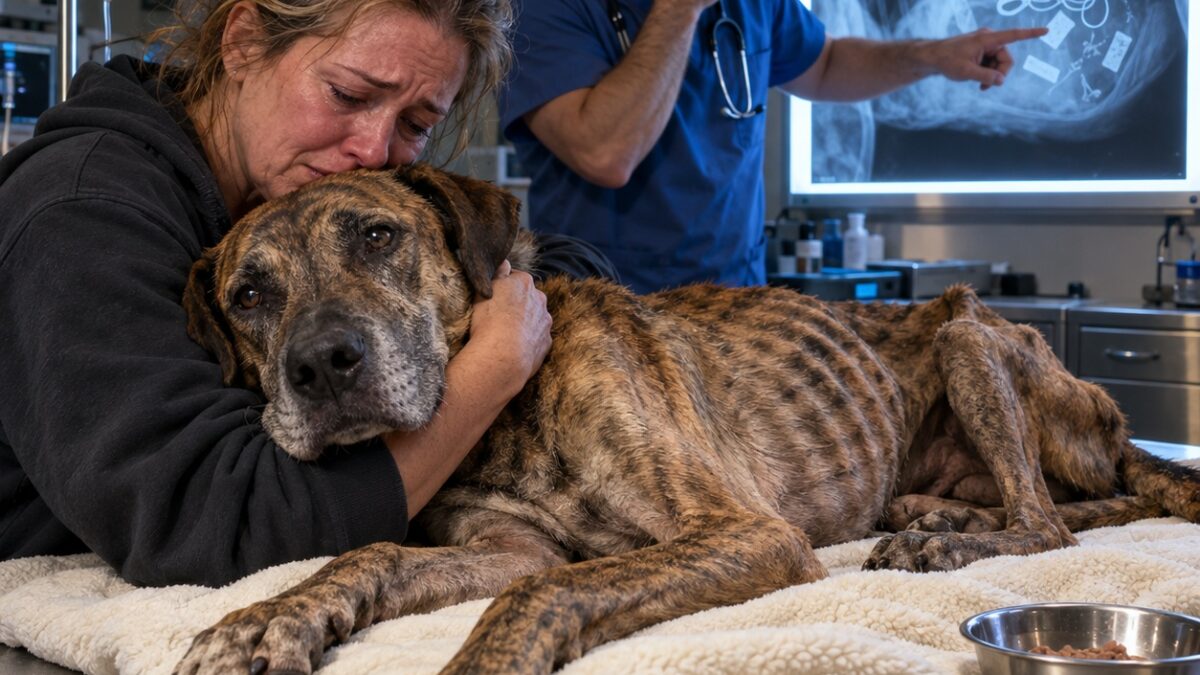
A veterinarian pressed gently against Lulu’s abdomen and immediately stopped.
“We need imaging.”
Blood.
Ultrasound.
Basic organ function.
Everything.
They weighed her.
The number meant little because so much of that weight was fluid.
Her actual body condition beneath it was devastating.
Shoulders narrow.
Spine prominent.
Muscle wasted along her hindquarters.
When a technician carefully shaved a patch for testing, I could see skin stretched tightly over bones.
I kept thinking:
How can a dog look both enormous and almost gone?
The answer came quickly.
Fluid.
Her abdominal cavity was filling with it.
Ascites.
The swelling was not food.
Not puppies.
Not weight.
Fluid collecting where it should not have been.
Enough to press upward and make breathing difficult.
Enough to make lying down uncomfortable.
Enough that moving her own body had become work.
The veterinarian explained the immediate plan.
Drain some of it.
Not necessarily all at once.
Relieve pressure.
Help her breathe.
Then find out why it was happening.
I nodded.
As though understanding made the situation easier.
It did not.
They inserted a catheter carefully.
The first fluid began to drain.
I watched the container fill.
And fill.
And fill.
I looked back at Lulu.
Her belly slowly softened.
Not normal.
Less impossible.
Her breaths became deeper.
That was the first good thing.
One fuller breath.
Then another.
Lulu lay her head down.
A technician said:
“She’s more comfortable.”
I almost cried over breathing.
That happens in rescue.
You start celebrating things people normally never notice.
A dog eats half a meal.
A fever drops one degree.
A tail moves.
A breath reaches the bottom of the lungs.
We waited for blood results.
Liver values.
Kidneys.
Protein.
Blood cells.
Anything that might explain why fluid was pouring into her abdomen.
The initial results were ugly.
The team did not panic.
Professionals rarely do that in front of rescuers.
But I had been around enough veterinary clinics to recognize when people became more careful with their language.
More scans.
Repeat tests.
An ultrasound examination lasted much longer than I wanted it to.
One doctor pointed at the screen while another took notes.
I could not understand the shapes.
I only understood their faces.
Finally, we sat down.
The veterinarian had the file open.
He did not start with optimism.
That told me everything.
“Lulu’s liver is in very poor condition.”
I swallowed.
“How poor?”
“Severe failure.”
The room seemed smaller.
“Can you treat it?”
“We can support her.”
“That’s not what I asked.”
He looked at me.
I regretted the sharpness immediately.
“Sorry.”
“It’s okay.”
“Can it recover?”
The pause.
Always the pause.
“There is significant damage.”
“How much?”
“We’re still evaluating the underlying cause, but based on what we’re seeing, this appears advanced.”
“So?”
“I don’t want to give you false hope.”
That sentence is almost always followed by something you do not want to hear.
He continued.
“We cannot assume this damage is reversible.”
I looked through the glass toward Lulu.
A technician had placed a blanket under her.
With some of the fluid removed, she looked smaller.
Too small.
“What does that mean for her?”
“It means we manage her comfort. Nutrition. Fluid buildup. Symptoms. We watch her kidneys. Her blood chemistry. We see how she responds.”
“And if she doesn’t?”
He did not answer.
He did not need to.
I looked down at my hands.
The unfairness of it hit me all at once.
Lulu had somehow survived long enough to find a door.
She had fought her fear hard enough to stand near a stranger.
Then fear had pulled her away.
We had chased her.
Found her.
Carried her.
And now that she had finally allowed people to help, we were being told there might be nothing left to repair.
“How much time?”
“I honestly don’t know.”
“Days?”
“Possible.”
“Weeks?”
“Possible.”
“Months?”
He took a breath.
“We need to see what her body does.”
I hated that answer.
Because it was honest.
Hope likes numbers.
Three months.
Six months.
Eighty percent.
Anything.
Instead:
We need to see.
So we watched.
The first night, Lulu stayed at the clinic.
I left only because I had to.
I drove home angry.
Not at the doctors.
Not at Lulu.
At whoever had watched her become that thin and done nothing.
At whatever chain of events had allowed the fluid to build until walking was almost impossible.
At every meal she had missed.
Every night she had slept somewhere nobody noticed.
I wanted someone to blame.
That is one way fear disguises itself.
Anger gives you somewhere to put your hands.
The next morning, I returned before the clinic had fully settled into the day.
Lulu was awake.
She looked at me.
No tail wag.
No greeting.
But she did not turn away.
That counted.
They offered food.
She sniffed.
Nothing.
Different food.
No.
Hand feeding.
No.
The veterinarian explained that severe liver disease and abdominal discomfort could destroy appetite.
But Lulu desperately needed nutrition.
So feeding became a negotiation.
Tiny amounts.
Highly digestible meals.
Frequent attempts.
Nothing overwhelming her system.
The first time she licked food from a spoon, we celebrated.
Three licks.
Then she stopped.
The next attempt, five.
By evening, she ate a few bites.
I sat near her cage.
Not close enough to trap her.
Close enough that she could see me.
Whenever somebody walked past quickly, Lulu tensed.
Whenever a door shut hard, her head lifted.
She watched hands.
That broke my heart more than the blood tests.
Her body was sick.
Her mind still believed humans might make everything worse.
We wanted a foster home.
Somewhere quiet.
Warm.
Not a veterinary cage.
If Lulu had very little time, I did not want all of it to smell like disinfectant and medicine.
We posted.
Asked.
Called.
Explained.
Medical foster needed.
Calm environment.
Frequent monitoring.
Potentially difficult prognosis.
Possibly hospice.
No one offered.
I understood.
I hated understanding.
A healthy young dog can collect applications.
A dog who may need medications, rechecks, emergency visits, and who might die in your home?
People become afraid.
Not always of the cost.
Sometimes of loving something already leaving.
Day three.
No foster.
Day four.
Nothing.
A message came in.
Can’t take her but sharing.
Another.
Wish I could help.
Another share.
Another heart emoji.
No home.
Lulu stayed at the clinic.
I started feeling guilty every time I left.
One evening I stood at her enclosure and said:
“I’m trying.”
She looked at me.
“I know this isn’t home.”
Her ears moved.
“I’m trying.”
She lowered her head again.
That became our routine.
Clinic.
Food.
Medication.
Draining fluid when necessary.
Monitoring.
Waiting.
Lulu’s abdomen began swelling again.
Not immediately.
Slowly.
The doctors expected it.
I still felt crushed when I noticed.
The first drainage had given us an illusion.
Smaller belly.
Easier breathing.
Maybe fixed.
Then fluid returned.
That was the reality of the underlying disease.
Treating the symptom did not erase the liver failure.
Another procedure.
More fluid removed.
Another temporary relief.
I looked at the container afterward and felt irrational anger at it.
All that liquid had been inside her.
Compressing.
Dragging.
Making every movement harder.
Lulu ate a little more after the second drainage.
One of the technicians discovered she liked warm food better.
Another learned she would eat if the bowl was placed near the back of the cage and everyone walked away.
Need without observation.
That told us something about her past even if we never learned the details.
She did not like eating while humans watched.
So we stopped watching.
At least visibly.
We checked from a distance.
Food disappeared.
Good.
Week one became week two.
Lulu was still alive.
That alone began shifting something in us.
The doctors had never said she would die in three days.
But once you hear “severe liver failure” and “irreversible,” every sunrise feels borrowed.
Yet Lulu kept waking.
Sometimes weak.
Sometimes brighter.
Some days worse.
She began recognizing routines.
Morning technician.
Medication.
Meal.
Short careful walk if she felt strong enough.
Rest.
I visited.
At first, I could not touch her head without seeing the slightest flinch.
So I stopped trying.
I sat.
Talked.
Read messages on my phone out loud.
Told her about traffic.
Weather.
Other rescues.
Anything.
I refused to make every interaction about dying.
“Someone sent us a photo of a puppy wearing sunglasses today.”
Lulu looked at me.
“It was terrible.”
Ear.
“I’m serious. Humiliating.”
She blinked.
“That’s the most judgment you’ve shown me.”
No tail.
But her eyes stayed on me.
Week two.
A technician sat beside her enclosure during lunch.
Lulu moved closer to the bars.
Not much.
Two inches.
The technician ignored her.
Next day, closer.
Then one afternoon, Lulu sniffed the back of her hand.
Nobody celebrated loudly.
We had learned not to ruin small victories.
The technician came into the hall afterward and cried.
Week three.
Lulu allowed a hand under her chin.
Only for seconds.
Then she backed away.
We let her.
Choice.
That was important.
So much had happened to Lulu’s body without her consent.
Needles.
Scans.
Drains.
Hands.
Medicine.
We tried to make whatever could be optional truly optional.
Affection should never feel like another procedure.
The foster posts continued.
Still nothing.
I began considering something I had been avoiding.
My house.
Not because I did not want her.
Because I knew medical fostering a dog with severe liver failure was not a sentimental decision.
What if she crashed overnight?
Could I recognize the signs?
Could I get her to emergency care?
Could I manage her meals?
Medications?
What if she died?
That last question was the real one.
I told myself it was logistics.
It was fear.
I had helped animals die before.
Held them.
Cried.
Gone home.
But Lulu was different because we had not reached the ending yet.
She was in the terrible middle where you love just enough to be frightened of loving more.
So I kept waiting for someone braver.
No one came.
Week four.
The fluid returned more slowly.
At first I thought I was imagining it.
The veterinarian noticed too.
“Her abdomen is not filling at the same rate.”
“What does that mean?”
“It means it’s not filling at the same rate.”
Veterinarians are deeply committed to destroying premature hope.
“Is that good?”
“It’s preferable.”
“That is the least exciting word possible.”
He smiled.
“I’m being careful.”
“Fine.”
We repeated bloodwork.
Some values still terrible.
A few slightly better.
Kidneys holding.
Protein still a concern.
Liver function still severely compromised.
But not every number was moving in the wrong direction.
I looked at the sheet.
“So she’s improving.”
“Some parameters.”
“She’s improving.”
“Some parameters are improving.”
“Let me have this.”
He laughed.
“Some parameters are improving.”
I accepted it.
Lulu began eating more reliably.
The clinic staff made a chart.
Not because they needed one medically.
Because everyone had become emotionally invested in meals.
Half bowl.
Three-quarters.
Full.
Someone drew a tiny star beside the first fully finished meal.
I took a picture.
Lulu would have been embarrassed if she understood.
Week five.
She wagged her tail.
One time.
A technician entered with food.
Lulu stood.
Tail moved.
Everyone froze.
“Did you see that?”
“Don’t scare her.”
“No one move.”
The tail moved again.
We acted as though nothing happened.
Then screamed quietly in the hallway.
That afternoon I sat with her.
“You’re becoming a problem.”
Tail.
Tiny.
“There.”
Another.
I covered my mouth.
“You did that on purpose.”
For the first time, I saw something in Lulu’s face besides fear, exhaustion, or tolerance.
Curiosity.
She looked at me like she was beginning to wonder what might happen tomorrow.
That can be enough to change everything.
Week six arrived.
Six weeks in a clinic.
Six weeks since the dog who ran from a stranger’s door finally stopped running.
The veterinarian scheduled repeat imaging and more extensive bloodwork.
I barely slept the night before.
Because improvement can become its own kind of terror.
At the beginning, you prepare yourself for loss.
Then the dog eats.
Wags.
Trusts.
Suddenly you have something new to lose.
I arrived early.
Lulu was taken for ultrasound.
I waited.
Longer than I wanted.
Again.
The same kind of waiting as the first day.
The same walls.
Same smell.
Completely different dog.
When the veterinarian returned, his expression was unreadable.
I stood.
“What?”
He sat.
Never trust a doctor who sits before giving news.
“What?”
“Lulu’s liver is still abnormal.”
My heart dropped.
“Okay.”
“The damage we saw has not disappeared.”
“Okay.”
“She is still a medically fragile dog.”
“Tell me the part you’re building toward.”
He smiled slightly.
Then looked at the results.
“Her body is doing better than we expected.”
I did not speak.
“Her kidney function remains stable.”
I nodded.
“Some of the liver-associated values have improved.”
“How much?”
“Enough that I’m comfortable saying this is a real trend, not one random test.”
I stared.
“The fluid?”
“Significantly slower accumulation.”
“She’s cured?”
“No.”
Immediate answer.
Good.
I needed honesty more than fantasy.
“Is her liver normal?”
“No.”
“Is the damage reversible?”
“Some damage may not be.”
My chest tightened again.
“But?”
“But six weeks ago, we were concerned she might be entering an end-stage process her body could not compensate for.”
“And now?”
“Now she is compensating.”
I did not understand.
“Say it like I’m not a veterinarian.”
He leaned back.
“Six weeks ago, I was worried we were managing the final stage of her life.”
I held my breath.
“Today, I’m not ready to call her terminal.”
The room disappeared for a second.
“What?”
“I’m not saying she has no serious disease.”
“I heard you.”
“She may need lifelong management.”
“I heard you.”
“She could relapse.”
“Yes.”
“Her prognosis remains guarded.”
“Doctor.”
He stopped.
“Can she leave the clinic?”
He smiled.
“Yes.”
That was Lulu’s surprise.
Not a miracle cure.
Not a healthy liver appearing where a failing one had been.
Something quieter.
Her body had refused the timeline we feared.
She had bought herself tomorrow.
Maybe many tomorrows.
We did not know.
But suddenly the question was no longer where Lulu could spend her final days.
The question was where Lulu could recover.
And we still had no foster.
I looked through the glass.
Lulu was standing beside a technician.
Tail moving.
Not fast.
Enough.
I said:
“She’s coming home with me.”
The veterinarian looked at me.
“Temporary foster?”
“Yes.”
The answer came too quickly.
He knew.
I knew.
Still:
“Temporary.”
We prepared everything.
Medication list.
Diet.
Monitoring instructions.
Warning signs.
Emergency numbers.
Scheduled recheck.
I took notes like my life depended on it.
Perhaps hers did.
That evening, six weeks after Lulu entered the clinic, I opened my car door.
She stopped.
Vehicles scared her.
We did not know why.
I did not pull.
Just waited.
“Take your time.”
Lulu sniffed.
Front paws in.
Back out.
Again.
Eventually she climbed.
I settled her on a blanket in the back.
During the entire drive, she stayed awake.
Watching through the window.
Then watching me.
At my house, she hesitated at the front door.
That image hit me hard.
Another door.
The first door we knew about had been a stranger’s.
She had stood there sick enough to die, trying to decide whether humans were worth the risk.
Now she stood outside mine.
I opened it.
Stepped away.
No leash pressure.
Lulu sniffed the threshold.
One paw.
Stop.
Second paw.
Then inside.
I almost cried.
Again.
Rescue turns adults into people who cry about doorways.
The house was quiet.
I had prepared a bed in the living room.
Water.
Food area.
Medication.
Non-slip mats because her muscles were still weak.
Lulu ignored the bed.
She chose the floor behind a chair.
Back against the wall.
Clear view of the front door.
Of course.
I sat on the couch.
Did not call her.
An hour passed.
She stayed there.
I heated her meal.
Placed it several feet away.
Walked into the kitchen.
Waited.
No sound.
Then bowl movement.
I smiled.
Still did not look.
When I came back ten minutes later, half the food was gone.
“Good.”
Lulu froze.
I pretended I had not noticed.
The first night, she did not sleep deeply.
Neither did I.
Every time I woke, I listened.
Breathing.
Movement.
At two in the morning, I checked her abdomen with my eyes.
Was it bigger?
No.
Maybe.
Was she breathing faster?
Probably because I was standing over her like a lunatic.
I went back to bed.
At four, I woke again.
Lulu was still behind the chair.
Eyes open.
“You too?”
She watched.
I sat on the floor several feet away.
“No clinic tonight.”
Ear.
“Just us.”
I stayed for twenty minutes.
Lulu eventually lowered her head.
I went back to bed.
The next morning, she was still alive.
That sounds obvious.
It did not feel obvious then.
Every morning began with relief.
Medication.
Breakfast.
Short bathroom walk.
Rest.
Lulu moved carefully in the yard.
Everything was new.
Grass.
Birds.
Fence.
The sound of neighbors.
She startled when a truck passed.
Flattened herself briefly.
I stopped.
Waited.
She recovered.
We went inside.
Three days.
Then four.
The abdomen remained reasonably controlled.
Her appetite held.
At the first recheck, the veterinarian said:
“She looks brighter.”
I said:
“She stole chicken from my hand yesterday.”
“Excellent.”
“It was mine.”
“Still excellent.”
We repeated tests.
No dramatic leap.
Stable.
That became one of my favorite words.
Stable.
I had once wanted miracle.
Now stable sounded beautiful.
Lulu slowly claimed more of the house.
Behind the chair.
Then beside the chair.
Then the rug.
One evening I sat on the floor with a book.
She walked over.
Stopped three feet away.
I did not look directly.
She sat.
I read.
Ten minutes.
Fifteen.
Then I felt something touch my leg.
Her nose.
One second.
Gone.
I continued reading though I had not absorbed a word for twenty minutes.
Next evening, she did it again.
Then stayed closer.
The first time Lulu let me stroke her head at home, I barely moved my fingers.
Forehead.
One pass.
Stop.
She remained.
Another.
Her eyes closed.
I felt tears come.
“Seriously?”
Lulu opened one eye.
“You’re going to make me cry every week?”
Tail tapped once against the floor.
That became our relationship.
Small permissions.
Lulu did not transform overnight into a dog who loved everybody.
Visitors frightened her.
Sudden movements still made her duck.
She preferred women at first.
Certain voices worried her.
She disliked doors closing loudly.
We did not force any of it.
Healing is not obedience.
If Lulu needed distance, distance was available.
Her medical care remained part of every day.
Diet.
Medication.
Monitoring.
Regular bloodwork.
Abdominal checks.
Sometimes the fluid increased slightly.
We adjusted under veterinary guidance.
Sometimes lab values worsened.
Then stabilized again.
There were days I drove home from rechecks with my heart in my throat.
But the predicted collapse did not come.
Month two outside the clinic.
Lulu gained weight.
Real weight.
Not fluid.
Her shoulders filled.
The line of her spine softened.
Her coat improved.
I took a photograph from above.
Compared it with the first.
Then put the phone down.
I hated the first photograph.
That swollen belly.
Tiny hips.
Eyes ready to flee.
The new Lulu was still thin.
But becoming proportional.
A dog instead of a medical crisis.
One morning, she stood beside the kitchen doorway while I prepared breakfast.
Not hiding.
Watching.
I put her bowl down.
Started walking away.
Lulu began eating before I left the room.
I froze.
She looked up.
I immediately turned my back.
“Sorry.”
She continued.
That may have been the moment I understood how far we had come.
At the clinic, she would only drink or eat when people disappeared.
Now hunger had become stronger than fear.
Or trust stronger than shame.
Either way.
Month three.
Lulu barked.
I was in the yard.
A bird landed near the fence.
Lulu stared.
The bird hopped.
Lulu gave one surprised bark.
Then looked at me as though the sound had come from someone else.
I laughed so hard she became excited.
Tail moving.
She ran two steps.
Not much.
Her muscles still rebuilding.
But it was the first time I saw her move because she wanted to, not because she needed to.
“Again.”
She looked at me.
The bird left.
Opportunity gone.
That evening, I bought a toy.
Soft.
Nothing loud.
Lulu ignored it for a week.
Then one morning it was in the hallway.
I knew where I had left it.
Living room.
Lulu denied responsibility.
Next day, bedroom doorway.
Then kitchen.
She never played while I watched.
Sneaky.
One night I pretended to sleep on the couch.
Lulu approached the toy.
Sniffed.
Pawed.
Bit one corner.
Shook it once.
I smiled with my eyes closed.
The frightened dog was learning frivolity.
That mattered more than any dramatic rescue photograph.
You know an animal is healing when it begins wasting energy on things that do not keep it alive.
Play.
Curiosity.
Stealing socks.
Those are privileges of safety.
Month four.
The veterinary team repeated ultrasound.
The liver still looked damaged.
No fantasy.
No clean reset.
But Lulu’s body had adapted more than expected.
The veterinarian used phrases like:
“chronic management.”
“continued monitoring.”
“quality of life.”
Not:
“very little time.”
I noticed the language.
“So we’re talking long-term now?”
He remained cautious.
“We’re talking longer-term.”
“I’ll take it.”
“She’s surprised us.”
“No.”
He looked at me.
“She surprised you.”
He smiled.
“Fair.”
Lulu was sitting beside my chair.
At the clinic.
Not hiding in the corner.
Six weeks had transformed that building too.
At first, clinic meant needles.
Pressure.
Fear.
Now people there were familiar.
One technician entered.
Lulu’s tail moved.
“She likes me best.”
“That is false.”
The technician crouched.
Lulu walked over.
Betrayal.
“See?”
“She associates you with food.”
“Love has many languages.”
I rolled my eyes.
Secretly, I loved it.
The dog who once fled from a stranger because approaching humans felt impossible now had a veterinary fan club.
One evening after that appointment, I sat in my yard.
Lulu lay several feet away.
Sun going down.
Her belly looked almost ordinary.
Not flat.
Not perfect.
Ordinary enough.
I remembered the first day.
That enormous abdomen.
The way her body shook.
I whispered:
“You know you were supposed to be temporary.”
Her ear moved.
“Medical foster.”
Tail.
“Very professional.”
She stood.
Walked over.
Rested her head on my knee.
I sighed.
“This is manipulation.”
Eyes closed.
I put one hand on her neck.
“I’m serious.”
Tail.
“Temporary.”
She stayed.
The next morning, I filled out adoption paperwork.
Not because she was cured.
Not because the future had become safe.
It had not.
Lulu would always need follow-up.
Diet management.
Medication decisions.
Regular veterinary testing.
The possibility of deterioration remained.
That was part of loving her.
But I had realized something.
I kept waiting for certainty before admitting she was home.
Lulu had already learned the opposite.
She did not need a guarantee that I would have her for ten years before placing her head in my lap.
She trusted one day.
Then another.
Maybe I could do the same.
The rescue coordinator looked at the application.
“You’re adopting your medical foster?”
“Apparently.”
She smiled.
“Foster fail.”
“Hostile terminology.”
“Accurate terminology.”
I signed.
That night, I came home with Lulu’s paperwork in my bag.
She greeted me at the door.
Not wildly.
Lulu was never wild.
Tail.
Head lowered for affection.
I crouched.
“You live here.”
She leaned against me.
“Officially.”
Nothing.
“You seem unimpressed.”
She walked toward the kitchen.
Dinner.
Priorities.
Months passed.
Not years.
I do not need to jump that far ahead to tell you the ending matters.
Lulu’s story changed through accumulation.
One full meal.
One normal breath.
One tail wag.
One lab result that did not get worse.
One night without fluid making her uncomfortable.
One person touching her head without fear.
One doorway crossed voluntarily.
That was how she came back.
Not miracle.
Steps.
There were setbacks.
I want to be honest about that.
Once, her abdomen began enlarging again.
My stomach dropped the second I noticed.
I took her to the clinic immediately.
Ultrasound.
Bloodwork.
Medication adjustment.
A smaller amount of fluid had returned.
Not the disaster I feared.
Still, I cried in the parking lot afterward.
Because old terror does not care about proportion.
The veterinarian came outside.
“She’s okay.”
“I know.”
“You don’t look like you know.”
“I remember the first time.”
“So do I.”
“What if this is the beginning again?”
He leaned against the wall.
“It might be a fluctuation we can manage.”
“Might.”
“Yes.”
“I hate that word.”
“I know.”
He looked through the glass doors toward Lulu.
“We cannot promise you she’ll never worsen.”
“I know.”
“But that’s not the same thing as saying she’s worsening now.”
I wiped my face.
Lulu came home.
Responded to treatment.
The swelling reduced.
Life continued.
That setback taught me something uncomfortable.
I had been treating every good day as evidence that the bad days had been defeated permanently.
They were not.
Chronic illness does not work like a villain in a story.
You do not beat it once and watch it disappear.
Sometimes you live beside uncertainty.
You monitor.
Adjust.
Enjoy what is still good.
Lulu was better at that than I was.
The day after I cried in the parking lot, she stole a piece of toast.
No existential crisis.
Toast existed.
Therefore toast should be taken.
I laughed.
“You almost put me in therapy yesterday.”
She ate my toast.
Zero remorse.
Good.
Month six at home.
Lulu had her favorite spot by the window.
Morning sunlight.
She no longer watched the front door constantly.
At first, every sound outside made her lift her head.
Eventually she learned most sounds did not belong to danger.
Delivery truck.
Neighbor.
Children.
Motorcycle.
Life.
She began sleeping through them.
That may be the greatest measurement of safety.
Sleep.
An animal who has been afraid to close her eyes eventually decides the world can continue without her monitoring it.
Lulu slept.
Deep.
Sometimes paws moving.
Dreaming.
I wondered what she dreamed about.
The streets?
Running?
Food?
Nothing?
I stopped needing to know.
The present was enough.
One Saturday morning, I opened the door to the yard.
Lulu stepped outside.
Sun.
Cool air.
She sniffed.
Then moved forward.
Not walking.
Trotting.
Five steps.
Ten.
She turned.
Looked at me.
Tail high.
Then ran.
A short awkward little run across the grass.
I laughed.
“Lulu!”
She circled.
Came back.
Body brighter than I had ever seen it.
For maybe fifteen seconds, she looked like a dog who had never heard the phrase liver failure.
That does not mean she was cured.
It means illness was no longer the only thing happening in her body.
Joy was happening too.
I crouched.
She reached me.
I opened my arms.
Lulu stopped before them.
Old instinct.
One second of hesitation.
Then came in.
Pressed her entire body against my chest.
I held her.
Not tight.
Enough.
“You did it.”
I meant more than running.
More than surviving six weeks.
She had done the hardest thing.
Stayed.
When her body gave her every reason to stop.
When her past gave her every reason not to trust.
Lulu stayed.
The clinic team saw the video.
They accused me of crying while filming.
False allegations.
Mostly.
One technician said:
“That’s not the same dog.”
I answered:
“Yes, she is.”
That mattered.
We love before-and-after language.
Before dog.
After dog.
Transformation.
But Lulu was not replaced.
The frightened dog at the stranger’s door and the dog running through my yard were the same animal.
Same memory.
Same liver.
Same body carrying scars we could not always see.
The difference was what surrounded her.
Food.
Medical care.
Routine.
Safety.
Choice.
Time.
Love.
Sometimes animals do not need to become someone else.
They need enough support to reveal who fear was hiding.
That was Lulu.
She was gentle.
Funny in quiet ways.
Strategic about stealing food.
Suspicious of squeaky toys but obsessed with cardboard boxes.
Loved warm towels.
Hated wet grass.
Adored one particular clinic technician and betrayed me publicly whenever she appeared.
She liked to sleep with her nose pressed against the couch.
She stretched one back leg straight behind her when comfortable.
She would wait for me to sit before settling nearby.
Not because she needed constant reassurance anymore.
Because companionship had become a preference instead of survival.
That distinction made me happy.
People who heard Lulu’s story sometimes called her miracle dog.
I understood.
I used the word too.
But I became careful with it.
A miracle can make the hard work invisible.
Lulu had veterinarians who kept looking when the first drainage did not answer the question.
Technicians who coaxed her to eat.
People who cleaned.
Measured.
Monitored.
Adjusted.
Stayed late.
Rescuers who searched unfamiliar streets after she disappeared.
People who shared foster posts even when no foster came.
Medical care mattered.
Consistency mattered.
And Lulu’s body did something nobody could guarantee.
It responded.
Maybe not fully.
Enough.
I preferred:
unexpected.
Lulu was unexpected.
The first expectation was that fear would keep her hidden.
She came to a door.
Then we expected she would run when we found her.
She could not.
Then we feared the liver failure had taken too much.
She stabilized.
Then we worried clinic life would be all she had left.
She came home.
Then I told myself temporary.
That one was obviously my mistake.
Lulu kept surprising us.
Not with impossible magic.
With one more day.
There is extraordinary power in one more day.
People underestimate it.
One more day gives medication time.
One more day gives food time.
One more day lets a frightened animal recognize a voice.
One more day gives bloodwork something new to show.
String enough together and suddenly you are talking about weeks.
Then months.
Then a dog is running across your yard.
I stopped asking how long.
That took practice.
At first, every veterinary appointment came with the question:
“How much time do you think?”
Eventually the veterinarian said:
“I can’t answer that in the way you want.”
I sighed.
“I know.”
“We monitor quality.”
“I know.”
“We respond to changes.”
“I know.”
“And we let Lulu live.”
That became the rule.
Let Lulu live.
Not merely survive.
Living meant sometimes skipping an unnecessary outing because she was tired.
It also meant letting her sniff the same bush for three minutes.
Giving medication hidden in something she liked.
Letting her sleep in sunlight.
Going for short walks.
Stopping when she wanted.
Laughing when she stole.
Not making every day a memorial while she was still inside it.
That last part was difficult.
When someone has been given a grim prognosis, you can start grieving before they are gone.
You photograph too much.
Watch too closely.
Turn every ordinary moment into “maybe the last.”
Lulu noticed my intensity.
Or at least I imagined she did.
One evening, I sat beside her while she slept.
I was watching her breathe.
Again.
She opened one eye.
Looked at me.
Then sighed dramatically and turned away.
I laughed.
“Fine.”
Maybe that was her lesson.
Stop attending my funeral.
I’m trying to nap.
So I did.
We lived.
A year was never promised.
Neither was tomorrow.
But then, tomorrow is not promised to healthy dogs either.
We simply become more aware of uncertainty when medicine names it.
Lulu had taught me something uncomfortable from the beginning.
She came to a stranger’s door without certainty.
She did not know whether the person inside would help.
She tried anyway.
Maybe that was all life ever gives us.
Try anyway.
Trust anyway.
Eat.
Sleep.
Play.
Love.
Even with incomplete information.
Especially then.
The stranger who first saw Lulu visited once after she was stable.
I invited them because the symmetry mattered to me.
Lulu did not recognize them in any obvious dramatic way.
That was fine.
The person stood in the yard watching her.
“I can’t believe it.”
“Neither can I sometimes.”
“She was huge.”
“The belly.”
“Yes.”
“And so thin.”
“I know.”
“I thought she was pregnant.”
“So did people.”
The stranger crouched.
Lulu approached cautiously.
Sniffed.
Accepted a treat.
The person cried.
“I’m sorry I couldn’t catch you.”
I said:
“You noticed her.”
They looked at me.
“That mattered.”
If nobody had photographed.
Messaged.
Called.
Maybe Lulu would have disappeared into the streets permanently.
Rescue stories often celebrate the person who physically carries the animal.
But noticing is the beginning.
A stranger opened a door.
Looked closely.
Did not decide:
Not my problem.
That mattered as much as anything I later did.
I thought about how many doors Lulu might have passed before that one.
How long she had been sick.
We never learned.
I stopped trying to reconstruct every missing chapter.
Mystery can become cruelty if you keep forcing it.
What mattered was the chapter she had now.
She had a home.
Medical team.
A name she recognized.
The sound of Lulu eventually made her ears lift.
That thrilled me.
Names are small homes too.
You hear one word and know it belongs to you.
One evening months after adoption, I opened the front door to bring in a package.
Lulu came behind me.
She stood at the threshold.
For a second, I saw the old image.
A starving dog at someone else’s door.
Swollen belly.
Fear.
Then Lulu stepped past me onto the porch.
Tail relaxed.
No trembling.
She sniffed the package.
Looked at me.
Went back inside.
I stayed outside alone for a moment.
That doorway broke me.
The first one had been a plea.
This one was hers.
She could cross it in either direction and know she was allowed back.
That may be what home means to an animal who has lived outside.
Not walls.
Return.
You can leave the room.
The food remains.
You can sleep.
Someone is still there.
You can walk through a door without disappearing from anyone’s life.
Lulu learned that slowly.
I did too.
Her rechecks continued.
Some good.
Some mediocre.
No clean movie ending where every laboratory value turns perfect and doctors declare a miracle cure.
I would not trade reality for that.
Reality was better in a different way.
Lulu had severe liver disease.
And a good life.
Both sentences could be true.
Her diagnosis did not erase her joy.
Her joy did not erase her diagnosis.
She lived between them.
Most of us live between things like that.
Grief and laughter.
Fear and connection.
Illness and ordinary mornings.
Lulu made the coexistence visible.
One morning we returned to the clinic for bloodwork.
She walked through the entrance.
Stopped.
Looked toward the hallway where she had spent six weeks.
I wondered if she remembered.
A technician called:
“Lulu!”
Her tail exploded.
She pulled me toward her.
The technician knelt.
Lulu pressed against her.
I pretended offense.
“This is humiliating.”
The technician hugged Lulu.
“She knows who really kept her alive.”
“Food bribes.”
“Love.”
“Chicken.”
“Same thing.”
Lulu looked happy.
A clinic had once been the place we feared she might never leave.
Now it was somewhere she visited and then went home from.
After bloodwork, she walked to the exit before I even called.
She knew.
Appointment.
Treat.
Car.
Home.
That sequence felt miraculous enough.
The results were stable.
Not normal.
Stable.
I drove home smiling.
Lulu slept in the back seat.
At a red light, I looked at her through the mirror.
The abdomen was no longer stretched.
Her body had filled enough that ribs were difficult to count.
Coat soft.
Eyes closed.
I remembered carrying her into the car the first time.
A different drive.
Same dog.
I whispered:
“You weren’t supposed to be here.”
Then immediately regretted the phrasing.
She was supposed to be wherever she managed to reach.
Maybe none of us are entitled to call survival impossible after it happens.
When we got home, Lulu woke.
Climbed out.
Walked to the door.
Waited.
I unlocked it.
She went inside without looking back.
That became the final image for me too.
Not lab results.
Not a veterinarian’s surprise.
Not even the run across the yard.
A dog entering her own house like nothing extraordinary was happening.
Because eventually, nothing was.
Breakfast.
Appointments.
Nap.
Medication.
Dinner.
Home.
Ordinary life had finally absorbed Lulu.
That was the ending I wanted.
The world first noticed her because she looked like an emergency.
I wanted a life where nobody had to notice her for suffering again.
Sometimes people ask what saved her.
I never know how to answer.
The drainage?
Medication?
Nutrition?
Veterinary skill?
Her liver’s unexpected response?
The stranger who noticed?
The search?
All of it.
Rescue is rarely one act.
It is a chain.
One person sees.
Another drives.
Someone tests.
Someone drains fluid.
Someone feeds.
Someone sits near a cage long enough that a frightened dog stops moving away.
Someone eventually says:
Come home.
And somewhere inside the chain, the animal also chooses.
One bite.
One step.
One more breath.
Lulu chose over and over.
Maybe that was the surprise the whole time.
We thought we were waiting for some medical twist.
What surprised me was Lulu herself.
A dog whose body was failing.
A dog terrified of human beings.
A dog so malnourished she should have had nothing left.
Yet she had enough left to walk to a door.
Enough to survive our search.
Enough to endure procedures.
Enough to eat.
Enough to trust.
Enough to wag.
Enough to come home.
Enough to become difficult about breakfast.
That is not nothing.
Months after I adopted her, I found her standing in the kitchen staring at me.
“What?”
She looked at the counter.
“No.”
Counter.
Me.
Counter.
“There is no chicken.”
Tail.
“You’re manipulative.”
Tail harder.
I gave her chicken.
Obviously.
As she ate, I thought about the dog who once would not eat if a person remained in the room.
Now she demanded food directly from the person responsible for it.
Progress can be shameless.
I loved it.
One evening, rain hit the windows hard.
Lulu usually disliked storms.
That night she came to the couch.
I lifted the blanket.
She climbed beside me.
Turned three times.
Lay down.
Her head landed against my thigh.
Thunder somewhere far away.
Her body tensed once.
I rested my hand on her shoulder.
“You’re okay.”
She sighed.
Not dramatic.
No miracle music.
Just a dog settling.
I looked down.
There were moments in the clinic when I had thought all I could give Lulu was comfort before death.
Warmth.
Food.
A kind voice.
Maybe a few weeks without fear.
I would have accepted that if that was all her body allowed.
That is important.
The goal was never to force survival because we wanted a happy story.
The goal was quality.
Dignity.
Care.
Lulu gave us more time than we expected.
So we used it.
Not to make her prove something.
To let her live.
That distinction matters.
I never wanted Lulu’s survival to become a lesson that every terminal animal should be pushed through endless treatment.
Sometimes letting go is love.
I know that.
Her veterinarians knew that.
What made Lulu different was that even while the prognosis was grim, she kept showing us signs she still had meaningful life.
Eating.
Engaging.
Responding.
Seeking affection.
Then objective tests began supporting what behavior had hinted.
Her body was finding balance.
So we followed her lead.
If she had stopped.
If pain had taken over.
If treatment had only prolonged suffering.
We would have faced another decision.
We never had to during that chapter.
That is something I remain grateful for.
Lulu did not become immortal.
She became alive.
There is a difference.
And alive was enough.
The day I officially adopted her, someone from the rescue posted an update.
I did not read the comments immediately.
Later that night, Lulu asleep nearby, I opened them.
People who had followed her clinic weeks wrote:
She made it.
Look at her.
I was so scared.
This is the update I needed.
Tell Lulu we love her.
I smiled.
Lulu snored.
Thousands of people emotionally invested in a dog who would sell them all for warm chicken.
Beautiful.
One comment stayed with me:
She went to a stranger’s door because she knew someone had to help.
Maybe.
We can never know what Lulu thought.
But I like the idea that some piece of her wanted to live enough to take that risk.
She did not knock.
Did not ask in words.
She simply appeared.
Then fear pulled her away.
People sometimes describe courage as not being afraid.
Lulu disproved that.
She was terrified.
She ran.
Courage was coming close in the first place.
Courage can coexist with retreat.
You can be brave and still run.
You can try again later.
That made Lulu’s story feel human in a way I did not expect.
How many times do we approach help and then become frightened?
How many people reach a doorway emotionally, then disappear?
Lulu got lucky.
Someone followed.
Maybe we should do that for each other more often.
Not chase aggressively.
Notice.
Leave the door open.
Search when someone is clearly in trouble.
Lulu did not need to become fearless before she deserved rescue.
Neither do we.
I kept the first photograph.
I hated it less with time.
The huge abdomen.
Thin legs.
Uncertain eyes.
At first, it represented everything that hurt.
Later, it became evidence of distance traveled.
Next to it, I kept another.
Lulu in the yard.
Not running.
Just lying on grass.
Belly comfortable.
Head up.
Sunlight.
If you saw only the second photograph, you would not understand why it mattered.
Side by side?
You could.
Still, I preferred people meet Lulu without the before photo.
Let them see her now first.
She did not owe strangers access to her suffering in order to be loved.
That is another thing rescue culture sometimes forgets.
Pain attracts attention.
But animals deserve identities after pain.
Lulu was more than the dog with liver failure.
She was more than ascites.
More than a scary prognosis.
She was Lulu.
And Lulu had preferences.
Personality.
Bad habits.
A ridiculous ability to detect medication inside almost any food except one specific kind of cheese.
She learned that the clinic staff could not be trusted if they approached holding a thermometer.
Smart dog.
She liked morning light better than afternoon.
She did not enjoy getting wet.
She liked quiet visitors who ignored her at first.
She disliked men wearing hats, though that improved.
She would carry one particular soft toy from room to room but never play fetch with it.
Those details matter more to me now than the diagnosis.
Disease tells you what a body is fighting.
It does not tell you who lives inside.
Lulu showed us slowly.
I think that was the real ending fans hoped for when they followed her story.
Not simply:
She didn’t die.
That is too low a bar.
They wanted:
She got to become a dog.
She did.
The first time she rolled onto her back in the grass and twisted from side to side with complete lack of dignity, I filmed it.
Lulu rolled.
Sneezed.
Got up.
Shook.
Looked proud.
I laughed until I cried.
No survival behavior.
No medical significance.
Pure nonsense.
Exactly what I wanted.
I sent it to the clinic team.
One technician replied:
THAT BELLY.
Not swollen.
Just soft normal dog belly.
The same part of her body that once made strangers stop and stare had become something unremarkable.
I stared at that message.
Sometimes healing is when people stop noticing what was once impossible to ignore.
Her abdomen had been the first thing anybody saw.
Now they saw Lulu.
That was victory.
At another recheck, a new staff member looked at her chart.
Then at Lulu.
“This is the liver failure dog?”
The technician corrected:
“This is Lulu.”
I loved her for that.
Yes.
This is Lulu.
Diagnosis secondary.
Life first.
We continued monitoring.
We remained realistic.
But the more time passed, the less I lived from test to test.
I learned her normal.
How she breathed.
How much she ate.
What tired looked like versus sick.
When she wanted space.
When she wanted touch.
Knowledge reduced panic.
Love became less emergency and more routine.
That is what I think families of medically fragile animals discover.
At first, you watch everything.
Eventually, care becomes woven into life.
Medication beside coffee.
Vet appointments on the calendar.
Special food on the shopping list.
No grand sacrifice every day.
Just family logistics.
Lulu became part of mine.
Sometimes I thought about the foster request that nobody answered.
For six weeks, I resented it.
Why wouldn’t somebody take her?
Later, I softened.
People knew their limits.
Taking a hospice dog—or what we believed might be one—is enormous.
Fear was real.
Resources mattered.
And perhaps the empty foster inbox was simply the path that brought Lulu to my door.
I do not believe suffering happens “for a reason.”
I refuse that idea.
Lulu did not need liver failure so I could meet her.
But once bad things exist, we can choose what we build around them.
No foster came.
So eventually I became one.
Temporary.
Then not.
That is not fate.
It is choice.
I prefer that.
One year was never part of the promise I made to her.
Neither was five.
Neither was forever.
“Forever home” is a phrase rescuers use.
I understand it.
But animals live shorter lives than we do.
Forever usually means something simpler:
No more abandonment.
However much time remains, you belong.
That was the promise.
Lulu did not need a guaranteed lifespan.
She needed permanence inside uncertainty.
I could give that.
So I did.
Sometimes at night she still woke suddenly.
Eyes wide.
Maybe a dream.
Maybe discomfort.
Maybe memory.
I would say her name.
“Lulu.”
She would find me.
Settle.
The first time that happened, I remembered the clinic.
Her watching everyone.
Every movement.
Now one word could tell her where she was.
Home.
Lulu.
Safe.
Names can hold a whole world after enough repetition.
Toward the end of that first long stretch of stability, the veterinarian looked at her newest results.
He smiled before speaking.
Rare.
“What?”
“No major worsening.”
“That’s it?”
“That is very good.”
I laughed.
“We have different definitions of exciting.”
“In chronic liver disease, boring can be wonderful.”
Boring.
There it was again.
The holy grail.
Boring labs.
Boring abdomen.
Boring appetite.
Boring days.
I wanted boring forever.
We celebrated with chicken.
Naturally.
I took Lulu to a quiet park later.
Not crowded.
She walked slowly.
Sniffed everything.
At one point she stopped at a bench.
I sat.
She sat beside me.
A woman passing asked:
“How old is she?”
I realized I did not know exactly.
“Not sure.”
“She looks sweet.”
“She is.”
“Had her long?”
I looked at Lulu.
“Long enough.”
The woman smiled and kept walking.
No rescue story.
No liver failure.
No explanation.
Just a woman, a dog, a bench.
I loved that interaction.
For once, Lulu’s suffering was irrelevant.
She did not need tragedy to justify her presence.
We sat.
Wind.
Trees.
Someone’s child laughing in the distance.
Lulu rested her head against my leg.
I thought:
This is what we were fighting for.
Not a viral ending.
This.
Ordinary afternoon.
A dog who almost died getting bored in a park.
If people want a satisfying ending, I think they sometimes imagine the biggest possible reward.
A mansion.
Perfect health.
Some dramatic adoption ceremony.
Lulu taught me satisfaction can be much smaller.
The belly does not hurt today.
Breakfast stayed down.
Bloodwork is boring.
The dog asks for another treat.
She sleeps without fear.
Someone knows her name.
Someone notices if she does not get up in the morning.
Someone will not let her disappear into the streets again.
That is enough.
More than enough.
I still remember the phone call that started everything.
Dog at a stranger’s door.
Very thin.
Huge belly.
Scared.
Gone.
The word “gone” had terrified me.
Now, when I opened my bedroom door each morning, Lulu was usually somewhere predictable.
Rug.
Hallway.
Sun patch.
Not gone.
That became a quiet joy.
There you are.
Every day.
There you are.
Maybe rescue is partly the act of making sure someone can be found tomorrow.
Lulu had been unfindable.
Now she had an address.
A veterinarian.
Records.
A bed.
A person.
A routine.
She was located in the world.
That sounds strange.
It mattered.
She belonged somewhere specific.
If she ever slipped out—which I guarded against like a paranoid person—people would be looking immediately.
She would not become an anonymous sick dog again.
Never.
That certainty gave me peace.
I think it gave her something too.
Months after the first night at my house, I opened the front door.
Lulu was in the yard.
I called:
“Come on.”
She looked up.
Then came toward me.
Not rushed.
No fear.
She crossed the threshold.
I closed the door.
She kept walking.
Did not turn around.
I stood there with my hand on the knob.
And suddenly I was crying again.
Because once, Lulu had stood outside a door with everything inside her body going wrong.
She had been starving.
Swollen.
Afraid.
She came close enough to be seen.
Then ran because trust had limits.
Now she crossed a doorway every day without thinking.
Inside was food.
Medicine.
Her toy.
Her bed.
Me.
A door had stopped being the boundary between danger and possible help.
It was simply the entrance to her house.
There are no blood tests for that kind of healing.
No ultrasound.
But I saw it.
I saw it every time she walked inside.
And if you ask me today what Lulu’s surprise was after those six weeks at the clinic, I could tell you about the lab results.
The slower return of fluid.
The stable kidneys.
The liver values that moved in a direction the doctors had not expected.
All true.
But those were not the biggest surprise.
The biggest surprise was that the dog we thought we might only be able to comfort at the end of her life began asking for more life.
A meal.
Then another.
A touch.
Then another.
A morning.
Then another.
A home.
And once Lulu finally had one, she stopped living like every good thing was about to disappear.
She never became a perfectly healthy dog.
She became something better than a miracle story.
She became ours.
One evening, much later than those first terrible weeks but not so long that I had forgotten them, Lulu was sleeping beside the couch.
Her body had filled out.
Her breathing slow.
No huge swollen abdomen rising and falling.
Just Lulu.
I sat on the floor.
She opened her eyes.
I put my hand against her head.
“You know you scared everybody.”
Tail.
“You weren’t supposed to make it easy.”
Tail again.
“You definitely didn’t.”
She pushed her head into my palm.
I smiled.
“Worth it.”
Her eyes closed.
I stayed there.
No clinic monitor.
No cage.
No unanswered foster post.
No stranger’s doorstep.
Just a quiet room.
The dog who once disappeared before anyone could save her was sleeping deeply enough that she did not need to know where I was every second.
That is the ending I choose for Lulu.
Not that disease vanished.
Not that medicine became magic.
But that the prognosis stopped being the only story anyone could tell about her.
She had been starving.
Then fed.
Terrified.
Then trusted.
Homeless.
Then expected at breakfast.
Critically ill.
Then stable enough to complain when dinner was late.
She had stood at a stranger’s door because somewhere inside that failing body there was still enough hope to come close.
And eventually, after six weeks of people refusing to let her disappear, Lulu found a door she never had to be afraid of again.
Mine.
She walked through it.
And this time, she stayed.








