PART2:A Starving Dog Chased My Car for Miles—When I Finally Followed Him Back Into the Hills, I Found Who He Was Trying to Save
PART2
When we reached my house, he did not explore.
That should have been my first clue.
Most frightened dogs entering a strange place either freeze or investigate.
They sniff corners.
Check exits.
Circle furniture.
Look for water.
Look for danger.
This dog walked directly to the front door.
Then turned around and stared at me.
I brought him water.
He drank.
I gave him a small amount of food because I was afraid too much at once would hurt him.
He ate.
Then returned to the door.
I found an old blanket.
Made a bed near the couch.
He stepped onto it once.
Immediately stepped off.
Went back to the door.
“You’re safe.”
He looked at me.
“Okay?”
Nothing.
“You can sleep.”
He sat.
Facing the door.
For the next hour, I tried everything.
Another bowl of water.
A towel.
More food.
Gentle voice.
Space.
Nothing changed.
He would occasionally look at me, then at the door.
Once, he walked over and touched my leg with his paw.
Then walked back.
Door.
Me.
Door.
Me.
At some point after midnight, exhaustion finally won.
Mine.
Not his.
I fell asleep on the couch.
When I woke before sunrise, the house was still gray.
No lights.
No sound except the refrigerator and the faint hum of morning beginning outside.
The dog was exactly where he had been.
Sitting near the door.
Awake.
Watching me.
My first thought was that he had not slept at all.
My second was stranger.
He had been waiting for me.
Not waiting for breakfast.
Not waiting to go outside.
Waiting for me to understand.
I sat up slowly.
His ears lifted.
“Okay.”
He stood.
That reaction was immediate.
I stared.
“What?”
He walked to the door.
Looked back.
Something clicked.
Not completely.
Enough.
“You want to go somewhere.”
Tail moved once.
Barely.
I stood.
He paced.
Not wild.
Focused.
I changed clothes.
Filled a bottle with water.
Packed some food.
Took a towel.
First-aid kit.
A few other things I thought might help if we encountered another injured animal.
I did not know why I was doing any of it.
I only knew the dog had crossed some impossible distance in the dark for a reason.
And every instinct I had ignored the night before was now telling me the same thing.
Go back.
I opened the door.
He moved before I finished.
Straight toward the car.
When I opened the rear door, he climbed in immediately.
Different dog.
Still weak.
Still painfully thin.
But no hesitation.
During the drive, he did not lie down.
He sat between the front seats with his head near my elbow.
Every time I looked at him, he looked back.
The desperate pleading from the previous night had changed.
Now there was something almost like trust.
Finally.
That was what his expression seemed to say.
Finally, you’re coming.
The highway looked different in daylight.
That always happens.
Places that feel isolated and threatening at night become ordinary after sunrise.
Dry roadside grass.
Telephone poles.
Faded signs.
A truck passing in the opposite direction.
Nothing supernatural.
Nothing mysterious.
Then the gas station appeared ahead.
The dog began trembling.
I noticed it through the rearview mirror.
His whole body.
“Hey.”
He stood taller.
Eyes fixed forward.
Not fear.
Recognition.
Emotion.
“This is where you came from.”
His breathing changed.
I pulled into the same section of gravel where I had first stopped.
Engine off.
Door open.
The dog jumped down.
For several seconds, he stood completely still.
Nose lifted.
Air moving across his face.
Then he looked at me.
I stepped out.
“All right.”
He stared.
I nodded toward the open ground beyond the station.
“Go.”
His ears lifted.
“I’ll follow you.”
He ran.
I had seen him barely capable of standing the night before.
Now he ran as though pain no longer mattered.
Past the station.
Behind an old service structure.
Onto a narrow path leading away from the highway.
“Wait!”
He did.
Twenty yards ahead.
Turned.
Looked back.
Saw me.
Then continued.
That became our rhythm.
Run.
Stop.
Check.
Run again.
The path crossed dry ground first.
Then dipped behind a low ridge where the highway disappeared.
Suddenly there was only scrub.
Hills.
A dried creek bed.
Dense brush.
The dog moved like he knew every turn.
I did not.
I nearly lost him twice.
Each time, he came back.
Not all the way.
Far enough to make sure I could see him.
“Slow down.”
He did not care.
The sun was climbing.
The air warmed quickly.
Within twenty minutes, my shirt was damp.
My legs scratched from brush.
My lungs beginning to complain.
The dog should have been more tired than I was.
He had been starving.
He had run behind a car less than twelve hours earlier.
But urgency gave him something food had not.
Purpose.
We crossed another low ridge.
The dog disappeared.
I climbed faster.
At the top, I saw him standing below.
Completely still.
No tail.
No movement.
Just staring at a small clearing.
That was when I knew we had arrived.
I walked down slowly.
“Buddy?”
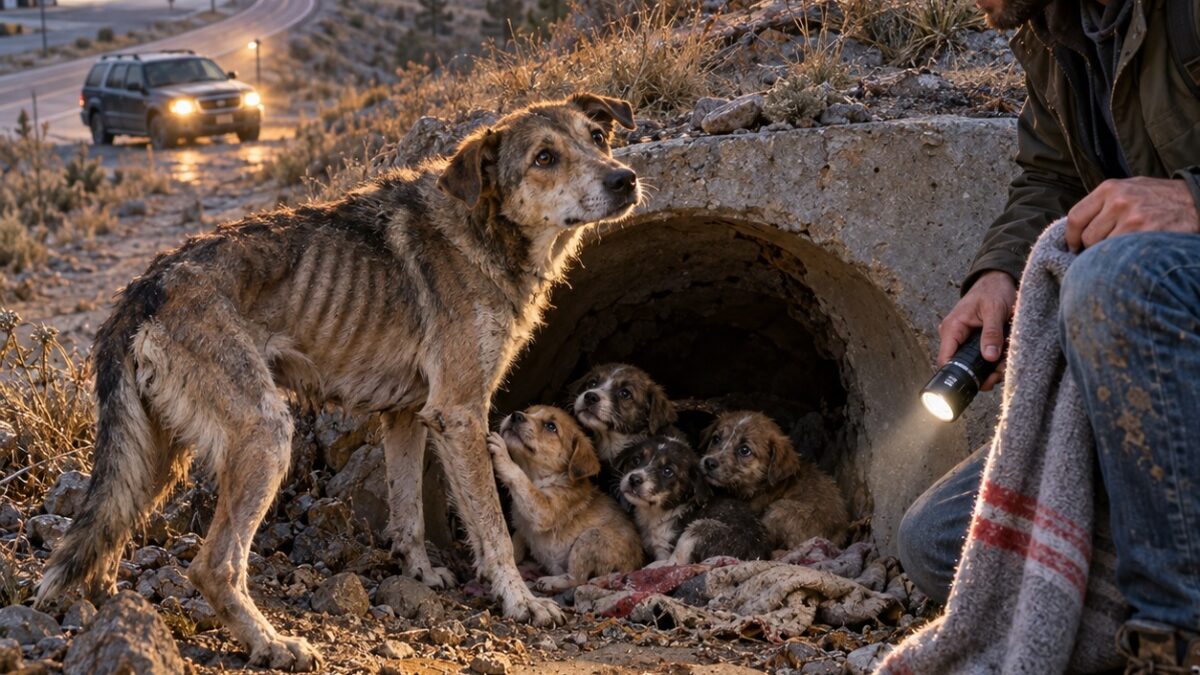
He moved toward a cluster of low bushes.
There was an old tarp on the ground.
Weathered.
Dirty.
Half caught beneath branches.
At first, I thought there was nothing underneath.
Then something moved.
I stopped.
A dog.
Female.
Lying on her side.
She was thinner than the dog I had found.
So thin her ribs seemed almost separate from her body.
Her coat was dull.
Her eyes half closed.
Her breathing shallow enough that I had to watch carefully to make sure it was happening.
Then I heard a sound.
Tiny.
High.
A whimper.
One puppy moved against her stomach.
Then another.
And another.
Several puppies were curled beneath and beside her.
Small.
Dirty.
Trembling.
Their eyes barely open.
One attempted to crawl closer to the mother and seemed to run out of strength halfway.
I could not move.
The dog I had rescued walked toward them.
The mother lifted her head.
Barely.
The reaction was immediate.
Recognition.
He approached slowly.
She touched her nose to his.
One puppy made a weak sound.
The male dog looked at me.
And everything became clear.
The running.
The paw against my car.
The refusal to sleep.
The door.
The staring.
The trembling near the gas station.
He had not been trying to save himself.
He had been trying to recruit me.
I felt my knees weaken.
“Oh my God.”
I walked closer carefully.
The male dog stayed between me and the family for half a second.
Not threatening.
Checking.
Then stepped aside.
Permission.
Trust.
I knelt.
The mother opened her eyes.
They were tired in a way I had never seen in an animal before.
Not simple fatigue.
Depletion.
Like she had used everything she had to keep those puppies alive and had reached the end.
“Hey, girl.”
No response.
I put my hand near her nose first.
She smelled it.
Did not pull away.
I touched her head.
Her eyes closed.
Not unconscious.
Relief.
The male dog lay beside her.
For the first time since I found him, he stopped moving.
His job was done.
That thought nearly broke me.
He had left this clearing in his condition.
Left a weak mother.
Left helpless puppies.
Found the highway.
Found the gas station.
Found cars.
People.
Noise.
Then chose mine.
Why?
I will never know.
Maybe I was simply the person who stopped.
Maybe he had tried others.
Maybe he spent hours watching vehicles leave.
Maybe he chased mine because instinct told him something.
Whatever the reason, he had gambled everything on convincing a stranger to follow.
And I almost kept driving.
One puppy moved.
That snapped me out of it.
I grabbed my phone.
No service.
“Of course.”
I stood.
Walked uphill.
One bar.
Gone.
Another few steps.
Two bars.
I called the nearest rescue organization listed in my phone from searches I had done the night before.
A woman answered.
I spoke too fast.
“I found a dog and puppies.”
“Okay. Slow down.”
“They’re in bad shape.”
“Location?”
“I don’t know exactly.”
“Can you send GPS coordinates?”
I checked.
“Yes.”
“How many puppies?”
I looked down.
Tried to count.
Five.
Maybe six.
One hidden beneath the mother.
“Six, I think.”
“Mother conscious?”
“Yes.”
“Standing?”
“No.”
“Any visible bleeding?”
“No.”
“Do not force food.”
“I brought water.”
“Small amounts only if she can drink voluntarily.”
“How long?”
“We’re dispatching people now.”
The woman’s tone changed when I explained the male dog.
“You found him last night?”
“Yes.”
“At the gas station?”
“Yes.”
“And he led you here?”
“Yes.”
There was silence.
Then:
“Stay with them.”
“I’m not leaving.”
“We’ll call if we need help locating you.”
I returned to the clearing.
The male dog looked up.
“They’re coming.”
He lowered his head.
I do not know why I spoke to him like he understood.
Maybe because by then I was convinced he understood more than I did.
I poured a little water into a shallow container.
Placed it near the mother.
She lifted her head.
Tried to drink.
Weak.
I supported the container, not her.
She managed a little.
Then stopped.
The puppies shifted.
The male dog watched every movement.
I opened some food but remembered the rescue worker’s warning.
Did not push it.
Instead, I sat.
There was nothing else to do.
Waiting feels different when something may die while you are doing it.
Every minute becomes offensive.
Why are they not here yet?
Did I send the correct coordinates?
What if nobody finds us?
What if the mother stops breathing?
What if one of the puppies does?
I checked my phone constantly.
Twenty minutes.
Thirty.
I walked uphill twice.
Saw nothing.
Back down.
The male dog had placed his head on my knee.
His eyes closed.
Finally.
Sleep.
I put my hand on his neck.
His body was warm.
Too thin.
“You did it.”
He did not move.
“You hear me?”
My throat tightened.
“You did it.”
The mother opened her eyes again.
Looked toward us.
I wondered what she understood.
Did she know he had gone for help?
Did she wait for him?
Had she watched him leave?
Had he been bringing scraps back before his own strength failed?
The veterinarian would later say there was no reliable way to know exactly how they were related.
Sibling.
Mate.
Maybe father of the litter.
What mattered was obvious.
He belonged to them.
Family does not always require a label.
Nearly an hour after my call, I heard engines.
Faint.
Then voices.
I stood so fast the male dog woke.
“Here!”
Nothing.
I climbed toward the ridge.
“Here!”
A woman answered.
“Hello?”
“Down here!”
Two rescue vehicles appeared beyond the brush.
Three people came down carrying crates, blankets, medical supplies, and water.
One took one look at the mother and moved immediately.
“How long has she been like this?”
“I don’t know.”
“Did she eat?”
“No.”
“Drink?”
“A little.”
“Good.”
They checked gums.
Temperature.
Hydration.
Heart rate.
The puppies one by one.
Six.
All alive.
That word mattered.
Alive.
Weak.
But alive.
The male dog stood when the rescuers approached.
One woman crouched.
“Easy.”
He moved between her and the puppies.
I touched his shoulder.
“It’s okay.”
He looked at me.
Then stepped aside.
The rescuer glanced at me.
“He trusts you.”
“I think so.”
“That may help.”
They moved the mother first.
Very carefully.
Blanket beneath.
Lift.
Crate.
She barely reacted.
The male dog followed the crate until one of the rescuers blocked him.
He whined.
I had never heard that sound from him.
Not like the noises at my house.
This was panic.
“She’s going with us.”
He tried around the rescuer.
I knelt.
“Hey.”
He turned toward me.
“I’m coming too.”
I had no idea whether those words meant anything.
Still, he stopped pushing.
The puppies were placed together in a padded carrier with heat packs.
Tiny bodies pressed against one another.
One rescuer said:
“They’re cold.”
“Are they going to make it?”
She did not give me comfort she could not promise.
“We’re going to try.”
That was enough.
I followed their vehicles to the veterinary center.
I could have gone home.
The rescue team had control.
Professionals were helping.
My responsibility could reasonably have ended there.
I did not leave.
Neither did the male dog.
At the clinic, they separated the animals temporarily for examination.
He hated it.
Paced.
Whined.
Looked at every opening door.
I sat on the floor beside him.
“You brought them here.”
Pace.
“They’re helping.”
Pace.
“They’re safe.”
That word did not calm him.
Safe was not yet true.
A veterinary technician brought water.
Then a carefully measured meal.
He sniffed it.
Did not eat.
She looked at me.
“He ate last night?”
“Yes.”
“How much?”
I described it.
“Good.”
She studied him.
“He may be too stressed.”
I pushed the bowl closer.
“Eat.”
He looked at me.
Then toward the treatment room.
“Come on.”
He ate three bites.
Stopped.
Five minutes later, another two.
Enough.
Hours passed.
The clinic waiting room changed around me.
Morning became afternoon.
People came and left with cats, dogs, carriers.
Phones rang.
Doors opened.
Every time a staff member appeared, I stood.
Usually not for us.
The male dog eventually slept against my shoe.
Sometime near evening, a veterinarian came out.
Middle-aged woman.
Tired eyes.
She sat beside me instead of remaining standing.
That scared me.
“How are they?”
“The puppies are responding.”
I exhaled.
“The mother?”
“She’s very weak.”
“How weak?”
“Severe dehydration. Malnutrition. She’s been nursing while taking in far too little herself.”
“Can you save her?”
“We’re treating her.”
Not yes.
I hated that.
She continued.
“You got them here at the right time.”
“What does that mean?”
She looked at the dog beside me.
“One more day out there might have been very different.”
I stopped breathing for a second.
“One day?”
“Possibly less for some of the puppies.”
I looked down.
The male dog was asleep.
His paws twitching.
He had run until he nearly collapsed.
Then refused to sleep.
Then ran back again.
One day.
If I had kept driving.
I rubbed my face.
The veterinarian waited.
“I thought he wanted food.”
“Who?”
“Him.”
I pointed.
“I thought he was chasing me because he wanted me to take him.”
She looked at him.
“Maybe he did.”
“No.”
I shook my head.
“He wanted me to follow.”
The veterinarian smiled faintly.
“Dogs can surprise us.”
“That isn’t surprise.”
My voice cracked.
“That is…”
I did not know what word belonged there.
Loyalty.
Love.
Instinct.
Duty.
Desperation.
All of them.
None enough.
The veterinarian looked toward the treatment room.
“Whatever you call it, he got you there.”
I stayed until they closed the waiting area for the night.
The rescue arranged temporary holding for the male dog near the others.
I did not want to leave him.
Ridiculous.
I had known him less than twenty-four hours.
Still.
When a technician took his leash, he turned.
Looked at me.
Stopped walking.
My chest tightened.
“I’m coming back.”
He stared.
“Tomorrow.”
The technician waited.
“You promise?”
I asked myself more than him.
“Yes.”
I crouched.
“I promise.”
He let her lead him away.
I drove home alone.
The house felt wrong.
Blanket near the couch.
Water bowl.
Food bowl.
No dog at the door.
I stood in my living room remembering the previous morning.
His eyes.
His waiting.
Finally, you understand.
I barely slept.
At eight the next morning, I was back at the clinic.
The receptionist recognized me.
“You’re early.”
“I know.”
“She’s stable.”
I froze.
“The mother?”
“Yes.”
Not recovered.
Not safe forever.
Stable.
The word felt beautiful.
“And the puppies?”
“Five are doing very well considering their condition. One is still weaker than the others, but improving.”
“And him?”
She smiled.
“Very annoyed.”
I laughed for the first time.
“With what?”
“Being separated from everyone.”
They eventually allowed me to see him.
He nearly pulled the leash from the technician’s hand.
Not because he was trying to escape.
Because he saw me.
He reached me and pressed his entire body against my legs.
I crouched.
“Hey.”
Tail moving now.
Actually moving.
“You remembered.”
He licked my wrist.
Then immediately turned toward the treatment area.
Of course.
“We’ll see them.”
Over the next several days, the clinic became part of my routine.
Work.
Clinic.
Home.
Repeat.
The mother slowly improved.
Fluids.
Nutrition.
Monitoring.
Rest.
Her eyes became brighter.
She began lifting her head when people entered.
Then she stood.
Not long.
Seconds.
But stood.
I was there the first time I saw it.
One technician said:
“Look who decided she’s tired of lying down.”
The mother took two shaky steps.
The male dog was in an adjacent area.
He saw her.
The sound he made was unlike anything I had heard.
High.
Soft.
Almost questioning.
She turned.
Her tail moved.
Once.
That was enough.
They allowed them closer under supervision.
He approached carefully.
Nose to nose.
Then lay beside her.
The puppies were getting stronger too.
Their bodies filled out.
Eyes opened.
Movement became purposeful.
One learned to crawl directly over its siblings rather than around them.
Another screamed every time it was hungry, which the staff considered a wonderful development.
“Loud is good,” one technician told me.
That puppy seemed committed to being excellent.
The weakest one gained weight slower.
I found myself checking its chart like I had any right.
“How much today?”
The technician laughed.
“You know you’re not staff.”
“I know.”
“Then stop interrogating me.”
“How much?”
She showed me.
Up.
A little.
I celebrated internally like a parent staring at a report card.
The male dog continued guarding everyone.
Not aggressively.
He simply wanted proximity.
If the puppies were examined, he watched.
If the mother was moved, he stood.
If somebody carried a puppy out of sight, his ears tracked the door until it returned.
One afternoon, I asked the veterinarian:
“What is he to them?”
She watched him with the puppies.
“We can’t know without more history.”
“The father?”
“Possible.”
“Brother to the mother?”
“Possible.”
“Just another dog from the same group?”
“Possible.”
“He acts like…”
“Family.”
She finished it for me.
“Yes.”
“Family is enough.”
That answer stayed with me.
Family is enough.
I had spent years believing the opposite.
I grew up in a house full of people who loved one another but rarely had time to demonstrate it.
My parents worked constantly.
They provided.
We ate.
We had clothes.
We went to school.
Nobody was cruel.
Nobody was neglectful.
We were simply busy.
My father came home tired.
My mother left early.
I learned not to ask for much.
I learned to solve things myself.
Forgot homework?
Fix it.
Bad day?
Keep it.
Scared?
Handle it.
Need help?
Try harder first.
Independence became the quality I was proudest of.
I built an adult life around it.
My own home.
My own schedule.
My own problems.
I had friends.
People at work.
Neighbors.
But there was always a line.
I did not ask.
Did not lean.
Did not need.
At least, that was the story I told myself.
Then this starving dog crossed a highway because he needed someone.
He did not treat needing help like failure.
He used the last strength in his body to find it.
That challenged something in me.
Strength had always meant carrying your own weight.
This dog could barely carry his.
Yet what he did was stronger than anything I had done in years.
He trusted.
That required risk.
I began thinking about my own family.
How long since I called my parents without a holiday as an excuse?
How often had friends said:
“Let me know if you need anything.”
And how often had I replied:
“I’m good.”
Even when I was not.
I did not suddenly transform.
Real people do not rebuild a lifetime of emotional habits because of one inspirational afternoon at a veterinary clinic.
But something shifted.
Small.
I called my mother.
She answered:
“Is everything okay?”
That told me how rarely I called unexpectedly.
“Yes.”
“You’re sure?”
“Yes.”
“Then why are you calling?”
I laughed.
“Can’t I call?”
“You can. You usually don’t.”
Fair.
I told her about the dogs.
All of it.
The highway.
The running.
The clearing.
The puppies.
By the end, she was crying.
Then I was pretending not to.
She said:
“You’re keeping him.”
“What?”
“The first dog.”
“I didn’t say that.”
“You don’t have to.”
“The rescue might adopt him out.”
“No.”
“Mom.”
“You already brought him home.”
“For one night.”
“And then followed him through the hills.”
“That doesn’t mean—”
“You’re keeping the dog.”
I ended the call feeling strangely lighter.
The mother dog’s recovery took time.
Weeks.
Not days.
Her coat improved first.
Then her appetite.
Then muscle.
The puppies grew at a speed that seemed impossible considering the condition I first saw them in.
They went from silent bundles under a dirty tarp to chaotic little animals with opinions.
Once they were healthy enough, the rescue moved them into a foster environment.
The male dog went too.
I visited.
Too often, according to the foster volunteer.
“You know,” she said one afternoon, “there are adoption forms.”
“I know.”
“You’ve been here four times this week.”
“I was nearby.”
“You live thirty minutes away.”
“Traffic was good.”
She stared.
The male dog sat beside me.
One puppy was chewing my shoelace.
“You’re fooling no one.”
I looked down.
The dog leaned against my leg.
The first time he had done that at the gas station, he was asking me for something.
Now?
Maybe nothing.
Maybe simply closeness.
That difference mattered.
“What happens to the puppies?”
I asked.
“When they’re old enough, vetted, and cleared, they’ll be matched.”
“And the mother?”
“Same.”
“And him?”
She smiled.
“You tell me.”
I did not fill out the form that day.
Or the next.
I told myself I was being responsible.
Dogs were long-term.
Vet costs.
Travel.
Schedules.
Commitment.
All true.
I also knew another truth.
Keeping him would mean allowing something into a life I had carefully organized around needing no one.
The dog had already disrupted that system.
Maybe I was afraid of making it permanent.
Then came the day the first puppy was approved for adoption.
A family visited.
Parents.
Two children.
Kind.
Patient.
They sat on the floor and let the puppies approach instead of grabbing.
One puppy chose the younger child immediately.
Climbed into her lap.
Fell asleep.
I watched the family leave later with paperwork started.
I should have felt happy.
I did.
Also something else.
Loss.
That frightened me.
I had become attached to all of them.
The mother found her family next.
An older couple.
Quiet home.
Fenced yard.
They wanted a calm companion.
The rescue introduced them slowly.
The mother dog walked to the woman, sniffed her hand, then rested her head against her knee.
That was it.
The woman started crying.
Her husband pretended not to.
I stood across the room feeling my throat tighten.
The male dog watched too.
He did not panic.
That surprised me.
Maybe animals understand departure differently.
Maybe he understood she was safe.
Maybe I am projecting.
I only know that he watched her leave, then came and sat beside me.
I looked down.
“Don’t.”
He leaned harder.
“You’re making this difficult.”
Tail once.
The puppies gradually found homes.
One.
Then another.
Then another.
Good homes.
The rescue checked.
Interviewed.
Followed procedures.
I watched the little family from the clearing become separate families with couches and yards and people waiting for them.
It should have been only happy.
Mostly it was.
Then one puppy remained.
Not because nobody wanted it.
Because I had quietly asked the rescue to hold the application for forty-eight hours.
The foster volunteer called.
“So?”
“So what?”
“Forty-eight hours.”
“I know.”
“You want the puppy?”
I looked across my kitchen.
The old blanket was still folded near the wall.
I had never put it away.
“Yes.”
“And him?”
I laughed.
“Yes.”
“How many forms should I send?”
“Two.”
“Finally.”
The paperwork was not dramatic.
Applications.
Home information.
Veterinary planning.
References.
Fees.
Responsibility written in ordinary boxes.
But signing felt significant.
The male dog had chosen me first.
Not as an owner.
As a possibility.
Now I was choosing him back.
I brought both dogs home on a Saturday.
The adult entered first.
Stopped just inside the door.
Same place.
Same house.
He looked around.
Then at me.
I remembered him sitting there that first night.
Rigid.
Waiting.
The puppy tumbled in behind him and immediately attacked the edge of the rug.
I laughed.
The adult walked toward the front door.
My chest tightened.
For one second, I wondered if he wanted to leave.
He stood there.
Looked at me.
Then turned away from the door.
Walked to the old blanket.
Circled once.
Lay down.
I had to look away.
He slept.
Actually slept.
Deeply.
No waiting.
No staring.
No unfinished mission.
The puppy climbed onto his back.
He tolerated it for twelve seconds, then moved.
The puppy followed.
That became the next several months.
Chaos.
Chewed shoes.
Accidents.
Vet appointments.
Training.
Hair everywhere.
My previously quiet house stopped being quiet.
It also stopped feeling empty.
Every morning, the adult dog woke before me.
Sometimes he touched my leg with his paw.
The first few times, the gesture stopped me completely.
That was the same paw.
Same motion.
Gas station.
Door.
Clearing.
Except now he was not telling me:
Come.
He was saying:
Breakfast.
Or:
Outside.
Or:
You have slept long enough.
Normal requests.
I loved them.
The puppy grew.
Fast.
Too fast.
Long legs.
Oversized paws.
Same eyes as the mother, I thought.
Maybe imagination.
The adult watched over him the same way he had watched the litter.
Patiently.
Mostly.
If the puppy wandered too far in the yard, the older dog followed.
If he cried during his first thunderstorm, the older one lay beside him.
If food dropped, however, family loyalty temporarily ended.
There are limits.
I received updates from the rescue.
The mother was thriving.
Her new family sent photos.
Soft bed.
Healthy coat.
Walking beside a garden fence.
One photograph showed her asleep in sunlight with her paws stretched forward.
I stared at it for a long time.
No tarp.
No dirt.
No hollow ribs.
Safe.
The other puppies were doing well too.
Different houses.
Different people.
A child.
A retired couple.
A young family.
One lived with another dog and apparently controlled the household within two weeks.
That sounded accurate.
I saved every picture.
Months passed.
My life changed outside the house too.
Not dramatically.
I did not quit my job.
Move across the country.
Start a rescue foundation.
I dislike stories where one emotional event is followed by a complete personality replacement.
That is not how my life worked.
I still valued independence.
Still liked quiet.
Still sometimes ignored messages longer than I should.
But I began answering differently when people offered help.
Sometimes I said yes.
Small things.
A friend helping repair something.
My mother visiting.
Dinner instead of:
Maybe another time.
I called my father more.
Awkward at first.
We are both men trained by habit to communicate through practical information.
“How’s the car?”
“Fine.”
“Roof?”
“Fine.”
“Work?”
“Fine.”
Eventually, the conversations became longer.
One day, he said:
“Your mother says the dog changed you.”
“She exaggerates.”
“She says you call.”
“That’s not the dog.”
Pause.
“Good dog?”
I looked toward the yard.
The adult was lying beneath a tree while the younger dog tried to dig a hole beside him.
“Yes.”
“Very.”
My father came to visit later that year.
He sat on the patio.
The adult dog approached.
Sniffed him.
My father offered a hand.
The dog leaned against his knee.
Dad laughed softly.
“This the highway dog?”
“Yes.”
“The one that found the puppies?”
“Yes.”
He stroked the dog’s head.
“Smart.”
I said:
“Brave.”
My father looked at me.
“Both.”
That night after he left, I thought about something.
The dog did not save his family by being independent.
He saved them by refusing independence.
He searched for someone.
Needed someone.
Trusted someone.
That idea continued working on me long after the emergency ended.
For years, I had believed strength meant needing as little as possible.
No burden.
No dependence.
No vulnerability.
But complete self-sufficiency is a fantasy.
We all depend on something.
People.
Animals.
Systems.
Food.
Care.
Someone answering a phone.
Someone stopping a car.
Maybe maturity was not eliminating need.
Maybe it was learning which connections were worth trusting.
The adult dog taught me without ever knowing he was teaching anything.
He simply loved his family enough to run.
I often wondered how far.
The gas station did not seem close when I followed him back.
Through the hills.
Across dry ground.
Brush.
Creek bed.
He had done that starving.
Then reached traffic.
Then chased my car.
How?
I still do not know.
Adrenaline.
Instinct.
Desperation.
Love.
Pick your word.
None feels large enough.
The veterinarian once told me:
“Animals don’t romanticize what they do.”
Maybe that is why we do it for them.
He did not stand in the clearing thinking:
I am sacrificing myself.
He knew his family was dying.
He left.
Found help.
Returned.
Action.
Simple in the way profound things sometimes are.
The younger dog eventually stopped being a puppy.
Technically.
Emotionally, I am less certain.
He grew almost as large as the older dog.
Still stole things.
Still tried to sit where there was not enough room.
Still followed me into every room as though I might vanish if unsupervised.
The adult became healthier.
His body filled out.
Coat changed.
People who met him later could not imagine the dog I had first seen under gas-station lights.
I kept one photograph from the clinic.
Early days.
Too thin.
Eyes tired.
I rarely looked at it.
Not because it upset me.
Because I preferred who he was now.
There is a temptation to define rescued animals entirely by what happened before safety.
Starving dog.
Abandoned dog.
Abused dog.
Lost dog.
Those descriptions explain history.
They should not become identity.
He was no longer the starving dog who chased my car.
He was the dog who slept with one paw over his face.
The dog who hated baths.
The dog who could hear a cheese wrapper from another room.
The dog who stood between the younger one and the vacuum cleaner like it was a mortal threat.
The dog who sometimes woke from deep sleep, saw me, and relaxed instantly.
That last one mattered.
Trust continued both ways.
One year after the rescue, I drove past that highway again.
Not intentionally at first.
Work took me near it.
Then I realized where I was.
I could have continued.
Instead, I turned into the gas station.
Same building.
Different employee.
Same patch of concrete.
I parked.
For a moment, I sat inside.
Remembered headlights.
Thin shape.
Paw against the door.
I got out.
The adult dog was with me.
I opened the back.
He jumped down.
Sniffed.
His body changed slightly.
Recognition?
Maybe.
He walked toward the edge of the lot.
Stopped.
Looked toward the path leading into the hills.
Then looked at me.
My heart accelerated.
“You remember.”
He smelled the air.
I half expected him to run.
He did not.
He came back.
Sat beside me.
I put my hand on his neck.
“Everyone’s okay.”
Tail against the ground.
I do not know if he understood the words.
I needed to say them.
“Everyone made it.”
We stood there another minute.
Then I opened the car.
“Home?”
He jumped in.
No hesitation.
That drive felt like closing a circle.
Not forgetting.
Completing.
The rescue organization invited me to a small adoption event a few months later.
They wanted me to meet volunteers.
I almost declined.
Crowds.
Attention.
Not my thing.
Then they told me the mother dog’s adopters might come.
I went.
She recognized the adult dog immediately.
At least I believe she did.
They saw each other across the yard.
Both stopped.
Then moved.
Nose.
Tail.
Circling.
No dramatic reunion.
No human-style hugging.
Just familiarity.
The younger dog approached too.
The mother sniffed him for a long time.
Then licked his face once.
I had to walk away for a minute.
Her adopter found me.
“You’re the one who found her?”
I shook my head.
“No.”
I pointed toward the adult dog.
“He did.”
She smiled.
“I know the story.”
“He found me.”
“That may be the same thing.”
We talked.
She told me the mother loved sleeping near windows.
Hated rain.
Preferred older people to loud children.
Had gained healthy weight.
The veterinarian had no ongoing concerns.
“She’s happy.”
I looked toward the dogs.
“Good.”
The woman touched my arm.
“She’s very loved.”
That was the sentence I needed.
Not:
She’s alive.
Not anymore.
Loved.
The puppies that attended were nearly unrecognizable.
Healthy.
Strong.
One had a red harness and dragged its owner around like an enthusiastic tractor.
Another had become quiet and cautious.
Different personalities emerging from what had once been six trembling bodies under a tarp.
I stood in the middle of all that life and thought again about one day.
The veterinarian’s words.
One more day.
What separates tragedy from rescue can sometimes be less time than we imagine.
One person stops.
One person follows.
One phone call.
That thought did not make me feel heroic.
It made me uneasy.
How many times had I not stopped?
Not literally for dogs.
For people.
Conversations.
Messages.
Moments when something felt wrong and I told myself it was not my problem.
We cannot stop for everything.
That is impossible.
But maybe we notice more when we stop pretending we notice nothing.
That became another quiet change in me.
I paid attention.
Neighbor struggling with groceries?
Ask.
Coworker suddenly silent?
Ask.
Friend cancels three times?
Call.
Sometimes the answer was:
I’m fine.
Sometimes it was not.
I learned not every paw against your leg looks like a paw.
People ask for help badly.
Indirectly.
With jokes.
Anger.
Silence.
Withdrawal.
“I’m busy.”
“Maybe later.”
“No big deal.”
The dog had no language I understood.
He still managed to communicate.
I had fewer excuses with humans.
Years have passed since the night at the gas station.
Both dogs still live with me.
The younger one has matured.
Mostly.
The adult has gray beginning around his muzzle now.
Not much.
Enough.
Every morning, they wake before I do.
Usually one scratches lightly at the bedroom door.
Sometimes the older dog puts his paw on my leg.
I always notice.
Sometimes I think about the first time.
Cold metal.
Dark road.
Skinny body.
Desperation.
Now the paw means something ordinary.
Get up.
Food.
Yard.
Life.
I am grateful for ordinary.
People talk about rescue as a single dramatic moment.
A dog pulled from traffic.
A puppy lifted from a ditch.
A family saved.
But rescue continues afterward in boring forms.
Vaccines.
Food.
Training.
Cleaning.
Veterinary bills.
Walks when you are tired.
Making arrangements before travel.
Standing outside in bad weather while a dog spends ten minutes choosing the perfect place to do something that should take ten seconds.
Staying.
That is the word I understand differently now.
Stay.
The dog stayed with his family until staying was no longer enough.
Then he left only to bring help back.
I told myself I was taking him home temporarily.
Then I stayed.
The rescue staff stayed.
Veterinary team stayed.
Adopters stayed.
That is how the story actually worked.
Not one savior.
A chain of people who chose not to leave too early.
The older dog sleeps at my feet while I work sometimes.
His breathing changes when he dreams.
Paws move.
I wonder what dogs dream about.
The highway?
The clearing?
Running?
Hunger?
Or is that another human mistake—assuming trauma owns every dream?
Maybe he dreams about our yard.
The younger dog chasing him.
Sun on the patio.
Food bowl.
My mother visiting and secretly giving him pieces of chicken despite promising she will not.
I prefer that possibility.
I once told a friend:
“I saved this dog.”
The sentence felt wrong the moment I said it.
Because technically?
Yes.
I stopped.
Fed him.
Drove him.
Followed.
Called rescue.
Adopted him.
But that is incomplete.
He changed the architecture of my life.
Before him, my home was a place where I lived alone.
After him, it became somewhere beings waited for me.
Before him, independence was my proof of strength.
After him, connection stopped feeling like weakness.
Before him, family meant mostly obligation and history.
After him, it became something active.
You show up.
You notice.
You ask.
You stay.
So when people say:
“You saved him.”
I usually smile.
Sometimes I answer:
“We helped each other.”
That sounds sentimental.
Fine.
Some true things are sentimental.
I do not care anymore.
There is one moment I return to more than any other.
Not the clearing.
Not the veterinarian saying we arrived in time.
Not adoption day.
The door.
That first morning.
Gray light.
Dog sitting there.
Watching.
Waiting.
He could not explain.
He did not give up.
I had misunderstood him all night.
He gave me another chance.
That feels important.
People misunderstand one another constantly.
Animals too.
Maybe love is partly the willingness to keep trying after being misunderstood.
He touched my leg.
Looked at the door.
Waited.
Eventually I listened.
That listening saved six puppies and one exhausted mother.
It also opened a door in me I had kept shut far longer than one night.
I still live in the same house.
Different house, really.
Same walls.
Different life.
Two dog beds.
Three if you count the couch they pretend is not theirs.
Toys under furniture.
Leashes by the door.
Water bowls in the kitchen.
Photographs from the rescue event.
One picture of the mother dog healthy beside her new family.
Pictures of the puppies sent by adopters.
My mother complains about dog hair every time she visits.
Then spends twenty minutes brushing them.
My father brings treats.
Claims he does not.
The dogs disagree.
Sometimes, on quiet evenings, the older dog lies with his head on my feet.
Exactly as he did that first day while we waited beside the dying mother in the clearing.
Same weight.
Different world.
Back then, he had done everything he could.
He had found someone who listened.
Now he does not need anything urgent from me.
That may be the most beautiful change.
No emergency.
No mission.
No one waiting under a tarp.
Just together.
Family.
I used to believe freedom meant being able to leave.
No obligations.
No one depending on you.
No one with the power to hurt you because you cared.
That kind of freedom is real.
It is also lonely.
The dog taught me another kind.
Freedom can be knowing where you belong.
Knowing who will notice if you are gone.
Knowing you can ask.
Knowing someone will follow.
The night I found him, I thought I was making a small decision.
Stop the car.
Help one hungry dog.
I did not know I was agreeing to be led somewhere.
Across hills.
Into a clearing.
Into responsibility.
Into grief and hope and vet bills and adoption forms.
Into a life that was less controlled and more full.
I am glad I stopped.
Glad I looked in the mirror.
Glad I opened the door.
Glad I followed the next morning when he asked again.
Glad I did not tell myself:
I already fed you. What more do you want?
Because he did not want more for himself.
That was what made him extraordinary.
He had almost nothing left.
Still, whatever strength remained belonged to someone else.
The mother.
The puppies.
His family.
That is what I think love is now.
Not a feeling.
Not possession.
Not needing someone because they make you happy.
Love is noticing what someone needs and being willing to move.
Sometimes toward them.
Sometimes away to find help.
Sometimes back again.
The adult dog wakes as I finish this.
He lifts his head.
Looks at me.
Then stands.
Walks over.
Puts one paw on my leg.
I laugh.
“What?”
He looks toward the back door.
No desperate eyes.
No trembling.
No starving family waiting beyond a highway.
He wants the yard.
That is all.
I stand.
Open the door.
He runs outside.
The younger dog follows.
They chase each other across the grass until the older one decides dignity requires stopping.
I stand in the doorway watching.
For a second, morning light hits his coat and I see both dogs at once.
The one who was starving.
The one who is home.
Then he looks back at me.
I know that look now.
Not because I learned dog language.
Because we have history.
Trust.
Time.
He does not need to run behind my car anymore.
He does not need to beg me to follow.
He knows I am here.
And I know something I did not understand before that night on the highway.
I did not rescue a dog from the darkness.
A dog came out of the darkness and showed me exactly where I needed to go.
I followed him.
And neither of us has been alone since.








