PART2:A Police K9 Waited Seven Days at the Station Doors After His Partner Was Taken Away Unconscious—Then We Finally Took Him to the Hospital
PART2
The first night, we thought Rex would eventually tire.
That sounds cruel now, but it was logical.
Dogs sleep.
Dogs eat.
Working dogs especially understand routine.
Daniel had occasionally left Rex at the station before.
Veterinary appointments.
Training schedules.
Administrative days.
Rex knew separation.
He had never liked it, but he understood it.
This was different.
There had been no ritual.
No command from Daniel.
No handoff.
No familiar:
“Stay with Sam.”
No pat on the neck.
No indication that his partner intended to leave.
Daniel had simply disappeared behind ambulance doors.
Rex had watched it happen.
And now, in his mind, Daniel had not completed whatever sequence was supposed to come next.
So Rex waited.
At midnight, Officer Lena Ortiz brought him food.
She set the bowl several feet behind him.
“Rex.”
One ear moved.
“That’s dinner.”
He kept staring through the glass.
She crouched.
“Come on, handsome.”
No response.
Lena looked at me.
“What do we do?”
“He’ll eat.”
“When?”
“When he realizes Daniel isn’t coming tonight.”
I said it with confidence I did not feel.
An hour later, the bowl remained untouched.
We brought water closer.
Rex drank a little after I cupped some in my hand and held it beneath his nose.
Then he returned to watching the doors.
Around two in the morning, he lowered himself onto his chest.
I thought he was finally sleeping.
He rested his head between his paws.
But whenever headlights crossed the parking lot, his head came up.
A cruiser entered.
Head up.
A civilian vehicle slowed.
Head up.
Someone opened the outer door.
Rex stood instantly.
Then another officer came in.
Rex sat again.
The first night became morning.
At six, shift change filled the lobby.
Boots.
Radios.
Coffee.
Voices.
Rex barely acknowledged anyone.
Usually he would have watched every person.
Maybe nudged the officer carrying breakfast.
Instead, his eyes stayed on the parking lot.
I called the hospital.
Daniel remained unconscious.
Stable, they said.
The doctors were still monitoring him closely.
I asked whether Rex could visit.
The nurse hesitated.
“Not yet.”
“His K9 partner.”
“I understand.”
“He’s not doing well.”
“I’m sorry. We can’t allow it right now.”
I hung up.
Rex looked at me.
I had the irrational feeling he knew exactly who I had called.
“Not today.”
His ears shifted forward.
I sat beside him.
“I’m sorry.”
He returned his gaze to the doors.
Day one became day two.
That morning, someone tried moving Rex to the kennel area.
Two handlers.
No force.
Just coaxing.
He went with them halfway down the hall.
Then stopped.
Turned.
Pulled free enough to head back toward the lobby.
One of the handlers laughed nervously.
“He knows exactly where he wants to be.”
Yes.
He did.
We compromised.
Food near the doors.
Water near the doors.
A blanket.
Someone always nearby.
We were not actually going to let him go seven days without water or meaningful rest, no matter how the story might later be told.
He drank.
Ate small amounts.
Slept in fragments.
But emotionally, he never left that entrance.
Even when we persuaded him outside to relieve himself, he hurried back.
He would walk through the station and return to the same patch of floor.
Glass doors.
Parking lot.
Waiting.
By the third day, everyone had stopped treating it as temporary behavior.
A detective from upstairs brought an old mat.
“Concrete’s cold.”
He put it beneath Rex.
Rex stepped off.
Sat directly on the tile.
The detective stared.
“All right.”
He moved the mat beside him anyway.
At lunch, dispatch sent down pieces of chicken.
Rex sniffed them.
Ignored them.
I ate one.
Lena glared at me.
“What?”
“That’s for the dog.”
“He’s not eating it.”
“Then leave it.”
“I’m preventing waste.”
She took the container away.
Rex did not care.
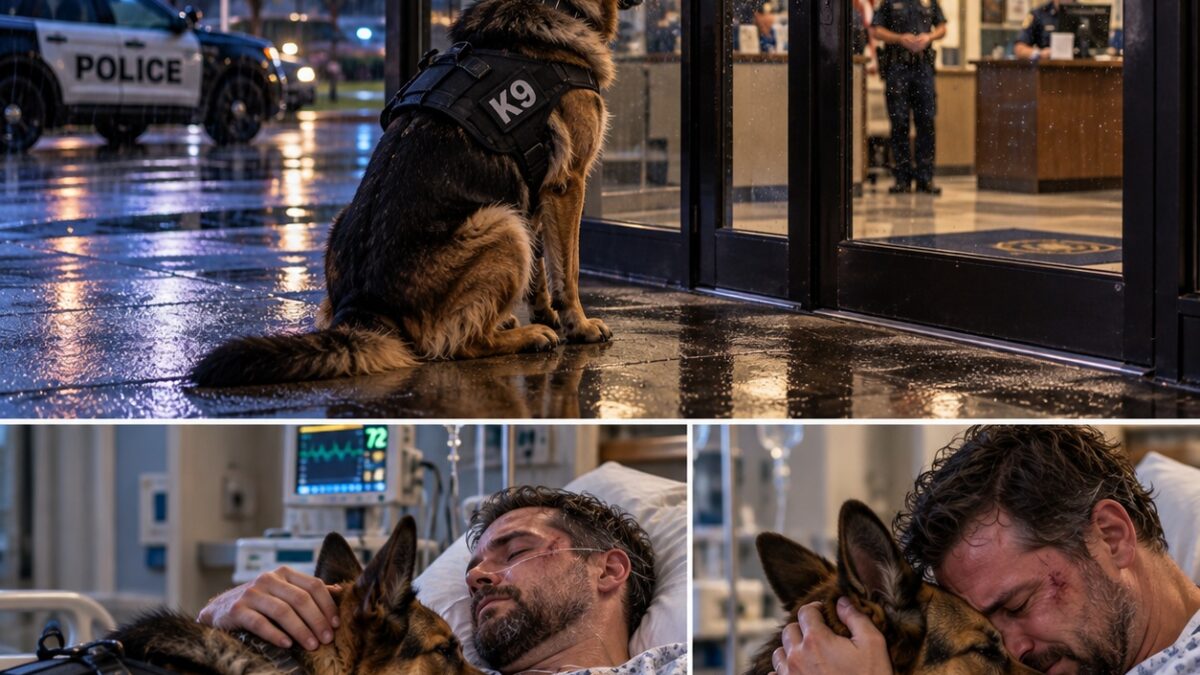
That afternoon, rain started.
Heavy autumn rain.
Wind pushed it sideways against the station doors.
Rex stood.
Not because he wanted outside.
Because every time headlights reflected through the rain, he thought someone was arriving.
I stood beside him.
“You know he can’t walk through that door tonight.”
Rex looked at me.
Then back outside.
I wanted to shake the certainty out of him.
Not physically.
Emotionally.
I wanted to explain:
Daniel is alive.
He is not abandoning you.
He is somewhere else fighting his own battle.
You are not failing by sleeping.
You are not betraying him by eating.
He cannot see you waiting.
But dogs do not understand hospital geography.
They understand absence.
And Rex’s answer to absence was loyalty.
People from other departments started hearing about him.
Someone posted a photograph internally.
Rex silhouetted against the glass doors.
Rain streaking the outside.
The image moved through the station faster than any official memo.
Officers came through the lobby and slowed.
One would scratch his ears.
Another whisper:
“He’ll come back, buddy.”
Rex tolerated them.
But he did not move.
Daniel’s locker remained closed down the hall.
His coffee mug sat unwashed beside the sink in the break room.
His spare gloves were still tucked inside the equipment bin.
Everything in the station suggested he should return.
Rex seemed to read those objects better than we did.
We were humans.
We understood hospitals.
We understood unconsciousness.
We knew Daniel had not chosen to stay away.
Rex only knew Daniel’s things were here and Daniel was not.
On day three, Daniel’s sister came to the station.
Her name was Melissa.
She looked exhausted.
Had spent most of the previous seventy-two hours at the hospital.
When Rex saw her, he stood.
Really stood.
Tail moved once.
Melissa froze.
“Oh, Rex.”
She knelt.
Rex walked toward her.
For the first time since the ambulance left, he moved away from the doors willingly.
He smelled her hands.
Her coat.
Then pressed his nose against her sleeve.
I realized why.
Hospital.
Daniel.
She smelled like wherever Daniel was.
Melissa started crying.
She wrapped both arms loosely around Rex’s neck.
“He’s still there.”
Rex leaned into her.
“He’s still fighting.”
His tail moved again.
Then he returned to the glass doors.
Melissa covered her mouth.
“He thinks Daniel is coming here.”
“Yes.”
“Can’t you take him to the hospital?”
“They won’t allow it yet.”
She looked toward me.
“Daniel would hate this.”
“I know.”
“He’d tell him to eat.”
“Probably curse at all of us for letting him sit here.”
That made her laugh through tears.
“Definitely.”
She stayed twenty minutes.
When she left, Rex followed her to the outer doorway.
I thought he might try to get into her car.
He did not.
He watched her drive away.
Then sat again.
That night, I went home for four hours.
Could not sleep.
Every time I closed my eyes, I saw Rex facing those doors.
Around three in the morning, I gave up.
Showered.
Returned.
He was still there.
Lena sat on the floor beside him.
Her back against the wall.
Eyes closed.
“You’re off shift.”
“So are you.”
“How much has he eaten?”
“A little.”
“Water?”
“Yes.”
“Sleep?”
She opened one eye.
“About as much as us.”
I sat on the other side.
Three police officers walking through at 3:30 a.m. saw us.
No one said anything.
The whole station had become quieter around Rex.
People stopped slamming doors.
Stopped shouting across the lobby.
It was absurd in a way.
This was a police station.
Phones rang.
Radios cracked.
People came in angry.
People came in scared.
People were arrested.
Reports were filed.
The world did not stop because Daniel was unconscious.
But near the entrance, everything softened.
Rex created a small zone of waiting.
By day four, the hospital updates had become our clock.
Morning call.
No major change.
Afternoon.
Still unconscious.
Evening.
Stable.
That word began to feel cruel.
Stable.
Not worse.
Not better.
Suspended.
Rex understood suspension better than any of us.
He existed entirely inside it.
I started talking to him more.
Not because I thought he understood the words.
Because I needed to say them.
“Daniel taught you badly.”
Rex’s ear turned.
“He should’ve taught you patience.”
Nothing.
“Actually, he did.”
I rubbed my face.
“This is your fault for being too good at it.”
Rex looked at me.
I swear there was judgment.
Daniel would have enjoyed that.
Daniel loved making jokes about Rex being smarter than the rest of us.
“He knows more commands than Carter,” he used to say.
“Your dog eats things off the ground.”
“So does Carter after midnight.”
We had been partners three years.
Long enough for insult to become affection.
Long enough for routine to become friendship.
I realized on day four that I missed Daniel in small ways more than dramatic ones.
His terrible coffee.
His habit of tapping the steering wheel when waiting at red lights.
The way he said “Copy” on the radio when he clearly meant “This is ridiculous.”
The sound of his boots in the hallway.
Rex missed all of it at once.
Maybe that was why his grief looked so pure.
Dogs do not compartmentalize.
There was simply:
Daniel here.
Daniel not here.
Wait.
Rain came harder that evening.
Wind drove water beneath the outer overhang.
Rex stood inside the doors.
He wanted closer.
I clipped his leash on.
Took him outside beneath the covered entry.
He sat.
Rain blew against his coat.
“Five minutes.”
He stared down the street.
A car passed.
Not Daniel.
Another.
Not Daniel.
I tried pulling him under the deeper shelter.
He resisted.
“Rex.”
Nothing.
“Come on.”
Nothing.
Finally I stood beside him.
Rain soaked one side of my uniform.
Chief Wallace came through the doors.
Stopped.
“What are you doing?”
“Losing an argument.”
“With the dog?”
“Yes.”
“Who’s winning?”
“Rex.”
Chief stared.
“Of course.”
He came outside.
No umbrella.
The three of us watched the road.
For several minutes nobody said anything.
Then Chief Wallace said:
“I had a shepherd when I was a kid.”
I looked at him.
“Never told anyone that.”
“Why would you?”
“He waited at our school-bus stop after my brother joined the Navy.”
Rex’s ears twitched.
Chief continued:
“Every afternoon for two months.”
“What happened?”
“My brother came home on leave.”
“The dog stop waiting?”
“Yep.”
We stood in the rain.
I said:
“That’s not helping.”
Chief nodded.
“No.”
Then went inside.
The fifth day brought the first real change from the hospital.
Daniel had responded.
Not fully awake.
Not speaking.
But neurological response.
Melissa called me herself.
“They said he reacted to my voice.”
I stood in the hallway.
“What kind of reaction?”
“He squeezed my hand.”
“On command?”
“They think so.”
I closed my eyes.
“Thank God.”
“I told him Rex is waiting.”
My throat tightened.
“Did he respond?”
“I think his fingers moved again.”
We told the station.
Word spread instantly.
Someone applauded in dispatch.
Lena cried.
Chief Wallace pretended his eyes were irritated by dust in a building with no dust.
I went to Rex.
He was sitting at the doors.
I crouched.
“Daniel moved.”
Rex looked at me.
“You hear me?”
His head tilted.
“He moved.”
Tail.
One slow sweep.
Maybe coincidence.
I did not care.
“He’s coming back.”
Another sweep.
I laughed.
Then I sat beside him and cried.
Not much.
Enough.
Rex leaned against my shoulder for perhaps five seconds.
Then returned his attention to the parking lot.
As if he had heard the update and decided the mission remained unchanged.
Day six, Daniel opened his eyes.
Only briefly.
But awake.
Melissa called at 6:12 a.m.
I answered before the second ring.
“He woke up.”
My knees weakened.
I sat on the bench beside the lockers.
“He talked?”
“Not yet.”
“He knows you?”
“Yes.”
She was crying openly.
“He knows me.”
I covered my eyes with one hand.
“When can we see him?”
“Doctors want today quiet.”
“And Rex?”
“I asked.”
“What’d they say?”
“Maybe tomorrow.”
Maybe.
That word was enough.
I walked to the lobby.
Rex stood as soon as he saw me.
I knelt.
“Tomorrow.”
He stepped closer.
“Maybe tomorrow.”
His nose touched my chest.
I placed both hands around his neck.
“You waited six days. You can do one more.”
He looked toward the doors.
Of course he could.
That final day of waiting was somehow the hardest.
Now that we knew Daniel was conscious, every hour felt unnecessary.
Rex did not know the distinction.
But we did.
I kept checking my phone.
Nine.
Ten.
Noon.
Two.
Finally at four, Dr. Moran called the chief.
Daniel was awake.
Weak.
Pale.
But stable enough for a controlled visit the next morning.
One handler.
One dog.
Brief.
Chief came directly to me.
“Wednesday morning.”
I looked at Rex.
“He’s getting a bath.”
Chief blinked.
“What?”
“If Daniel sees him after seven days looking like this, he’ll blame me.”
Rex’s coat smelled like wet station carpet, rain, and stress.
So that night we washed him.
He tolerated it with the offended dignity of a dog who believed personal grooming had nothing to do with finding Daniel.
Lena cleaned his collar.
Someone polished the badge plate.
We brushed him until his coat shone.
He ate a proper meal.
Not all of it.
Enough.
Then for the first time in seven days, we persuaded him to sleep somewhere other than the station entrance.
I lay on a cot in the K9 room.
Rex curled on the floor beside me.
Around midnight, I woke.
His head was up.
Looking toward the hallway.
“Tomorrow.”
He lowered it again.
I slept.
Wednesday morning, I clipped on his leash.
Rex stood beside me.
Clean.
Collar shining.
Back straight.
There was something about the way he walked that morning.
I know dogs do not understand hospitals the way we do.
But he knew something was different.
Maybe our energy.
Maybe Melissa’s scent on my jacket from when she hugged me the previous day.
Maybe nothing more than the fact that I had put him in the cruiser and driven away from the station.
Still, he sat upright the entire ride.
No whining.
No barking.
Eyes forward.
At the hospital entrance, I got out.
Opened his door.
Rex jumped down.
He looked at the building.
Then at me.
“Come on.”
We walked inside.
The hospital lobby smelled like disinfectant, coffee, and the cold dry air of climate control.
Rex’s nails clicked against the floor.
People noticed.
A uniformed police K9 moving through a hospital is hard to ignore.
Nurses stopped.
A respiratory therapist stepped aside.
One woman smiled.
Another covered her mouth.
Someone whispered:
“That’s him.”
Apparently Daniel’s story had spread.
So had Rex’s.
He ignored all of them.
He looked straight ahead.
We took the elevator.
Rex stood beside my leg.
Doors opened.
Long corridor.
Rooms.
Nurses’ station.
Quiet conversations.
His pace increased.
Not pulling.
Just quicker.
I tightened the leash slightly.
“Easy.”
He did not look at me.
He knew.
I am convinced he knew.
Dr. Moran waited near Daniel’s room.
Mid-fifties.
Calm face.
Twenty-five years in that hospital, he would later tell me.
He knelt slightly.
“Rex?”
The dog ignored him too.
Moran smiled.
“I’ve been warned.”
He looked at me.
“Daniel is weak.”
“I understand.”
“No jumping on tubes.”
“I’ll control him.”
“Can you?”
I looked at Rex.
“Probably not.”
Moran laughed quietly.
“Fair enough.”
We reached the door.
Closed.
My hand stopped on the handle.
Seven days.
For seven days, Rex had waited in front of glass doors.
Now there was one more door between him and Daniel.
I knelt beside him.
Placed my hand on his neck.
He looked at me.
“Go ahead, boy.”
I opened the door.
Rex entered.
For one second, he stopped on the threshold.
The room was bright.
Machines.
Bed.
Daniel.
He looked smaller than I remembered.
Thin.
Pale.
Hospital gown.
One hand resting near his side.
His face had changed in a week.
But his eyes were open.
And those eyes were looking directly at Rex.
Nobody moved.
Daniel’s mouth opened.
No sound at first.
Rex froze.
Then Daniel whispered:
“Hey, buddy.”
The leash ripped through my fingers.
Rex ran.
I had never seen him run like that.
Not during training.
Not after a suspect.
Not across an open field.
This was not speed for work.
It was release.
Seven days of waiting converted into motion.
He crossed the room in seconds.
Reached the bed.
I lunged instinctively, terrified he would pull equipment loose.
But somehow Rex seemed to understand the fragile thing in front of him.
He did not crash into Daniel.
He lifted his front half carefully onto the mattress.
Then pressed his head against Daniel’s chest.
Everything stopped.
Daniel’s face broke.
That is the only word.
Broke.
His eyes closed.
His mouth tightened.
One tear moved down the side of his face.
He lifted his hand.
It trembled badly.
For a moment I thought he could not reach.
Rex raised his head slightly.
Daniel’s fingers touched between his ears.
Then rested there.
“I knew you’d wait.”
I turned away.
Could not help it.
The room blurred.
Rex’s tail moved.
Slowly at first.
One thump against the mattress.
Then another.
Faster.
Soon his whole back end moved.
His body was laughing before any of us were.
He licked Daniel’s hand.
Daniel smiled.
Weakly.
Then Rex licked his cheek.
“Okay.”
Daniel tried to laugh.
It came out rough.
“Okay, man.”
Rex made a sound.
Not a full bark.
Soft.
Almost a whine layered beneath it.
I had heard that dog alert.
Track.
Defend.
Challenge.
Play.
I had never heard that sound.
Relief.
That is the only word I have for it.
Something inside Rex had been held tight for seven days.
Now it let go.
I remained near the doorway.
I did not want to enter farther.
That moment belonged to them.
Daniel.
Rex.
Partner and partner.
Dr. Moran approached quietly.
He stood beside me.
Watched.
For a long time, neither of us spoke.
Then he whispered:
“I’ve worked here twenty-five years.”
I looked at him.
“I’ve never seen anything like this.”
Daniel’s hand still rested on Rex’s head.
Rex had settled partly beside him, careful in a way I would not have thought possible after that sprint.
Moran continued:
“That dog just did something no medication could do.”
“What?”
“He gave him a reason to work.”
I looked at Daniel.
His eyes were open wider than they had been when we arrived.
He was stroking Rex in tiny movements.
Moran said:
“Recovery needs more than physiology.”
I nodded.
He added:
“I’m not saying love replaces medicine.”
“Good.”
“I’m a doctor.”
“Right.”
“But I’m saying I’ve watched patients who had every medical reason to improve and no emotional reason to try.”
He looked toward Rex.
“Daniel has one now.”
I will never forget that.
Not because I think Rex healed Daniel.
The doctors did their work.
Nurses.
Therapists.
Medication.
Daniel’s own body.
But motivation matters.
And Daniel had woken into a world where part of him had been missing.
Rex returned it.
The first visit lasted twenty-three minutes.
Hospital rules said fifteen.
Nobody enforced the difference.
When it was time to leave, Rex refused.
Of course.
I tugged gently.
“Come on.”
He pressed closer to Daniel.
Daniel whispered:
“Go with Sam.”
Rex’s ears moved.
“Rex.”
Daniel’s voice was weak but carried command.
“Go.”
That did it.
Rex stepped down.
He looked at Daniel.
Then at me.
Then back.
Daniel touched his head once more.
“I’m not going anywhere.”
The words caught in my chest because neither of us could guarantee that.
But Rex accepted them.
He left the room beside me.
At the elevator, he looked back down the hallway.
Did not pull.
That was the difference.
At the station, Rex no longer sat at the glass doors.
That evening, he went into the K9 room.
Ate.
Drank.
Lay down.
Slept six straight hours.
The whole department noticed.
Waiting had ended.
The next two weeks developed their own routine.
Every morning, I took Rex to the hospital.
We stopped at the same entrance.
Walked the same corridor.
Nurses began greeting him by name.
“Morning, Rex.”
He ignored them.
“Still rude,” one nurse said.
“Focused,” I corrected.
“Rude.”
By the fourth visit, Rex knew Daniel’s room number.
I barely had to guide him.
If we passed the door, he stopped.
Daniel improved slowly.
Again, I will not invent medical details the source does not provide.
He was weak.
He needed time.
Some mornings he looked exhausted before Rex even arrived.
But the moment Rex entered, something changed.
Daniel sat straighter if he could.
His hand lifted.
Rex went to the bedside.
Placed his head beneath Daniel’s palm.
That became their ritual.
Every day.
Head.
Hand.
Quiet.
Sometimes Daniel spoke.
Sometimes he was too tired.
Rex did not care.
He was finally where he needed to be.
One morning, Daniel said:
“You look terrible, Carter.”
I stared.
He had barely been conscious a week earlier.
“You almost die and that’s your opening?”
His mouth twitched.
“I’ve had time to think.”
“You look worse.”
“Fair.”
Rex’s tail moved.
Daniel scratched his ear.
“He wait?”
I knew what he meant.
“How long?”
“Seven days.”
Daniel stopped.
His hand froze on Rex’s head.
“What?”
“Seven.”
“At the station?”
“Glass doors.”
Daniel looked away.
His eyes filled.
“No.”
“Yes.”
“You should’ve taken him home.”
“We tried.”
“Sam.”
“We fed him. Watered him. Got him to sleep some. But every chance he had, back to those doors.”
Daniel looked down at Rex.
The dog stared up at him.
Daniel whispered:
“You idiot.”
Rex licked his hand.
Daniel laughed and cried simultaneously.
I sat near the window.
“He thought you were coming back through.”
Daniel closed his eyes.
“I would’ve if I could.”
“I know.”
“Did he…”
He stopped.
“What?”
“Did he think I left him?”
That question hurt.
“I don’t know.”
Daniel’s jaw tightened.
“I never left him.”
“I know.”
He bent his head toward Rex as far as he could.
Rex pressed closer.
“Never,” Daniel whispered.
From that day, Daniel’s recovery seemed to become more intentional.
Not magically faster.
Intentional.
He asked more questions.
When can I stand longer?
When can I walk farther?
When can I go home?
When can Rex come home?
The doctors reminded him not to rush.
Daniel hated that.
Rex would sit beside the bed as though supervising.
Physical therapists loved using him as motivation.
“Walk to Rex.”
Daniel would glare.
“That’s manipulative.”
“Yes.”
“Unethical.”
“Probably.”
Rex sat twenty feet away.
Daniel walked.
Slow.
Supported.
Frustrated.
But he walked toward his dog.
One afternoon, he made it halfway down the corridor before stopping.
“Enough.”
The therapist said:
“Rex is right there.”
“I can see him.”
“Then go.”
Daniel looked at me.
“You enjoying this?”
“Immensely.”
He swore at me.
Then took another step.
Rex stood.
Tail moving.
Daniel took another.
By the time he reached him, Daniel was sweating.
Rex pressed against his leg.
Daniel buried one hand in his fur.
“You’re a pain in the ass.”
Rex wagged.
Therapist said:
“Tomorrow we do farther.”
Daniel groaned.
I laughed.
For the first time since the ambulance, something felt normal.
Not fully.
But enough.
Hospital staff became attached to Rex.
One nurse started carrying approved treats.
Rex accepted them only after visiting Daniel.
Priorities.
Dr. Moran would occasionally stop in.
He kept his claim measured.
Never called Rex a miracle worker in any medical sense.
But he did say the dog changed Daniel’s engagement.
I believed him.
Before Rex’s first visit, Daniel had been awake but distant.
Afterward, he had a target.
Home.
Partner.
Work.
Routine.
Recovery became a path back to something concrete.
There is a difference between being told:
Get stronger.
And being told:
Get strong enough to go home to him.
Rex never knew he had become part of a treatment plan.
He simply showed up.
That is what dogs do best.
No speeches.
No philosophy.
Presence.
Every morning, Daniel’s hand rested on his head.
Every morning, Rex accepted that hand as proof.
Partner still here.
Mission continues.
During the second week, Daniel asked me what happened at the station while he was unconscious.
I told him stories.
Chief standing in the rain.
Lena sleeping beside Rex.
Dispatch sending chicken.
My theft of one piece.
Daniel smiled.
“You ate his chicken?”
“He refused it.”
“Thief.”
“Taxpayer funded.”
“It wasn’t.”
“Then I owe dispatch.”
“You owe Rex.”
That shut me up.
He looked at his dog.
“I owe him everything.”
“No.”
Daniel glanced at me.
“He’d say the same about you.”
Rex looked between us.
Daniel smiled faintly.
“That’s why he’s smarter than both of us.”
Fair.
Two weeks after the first reunion, Dr. Moran told Daniel he could go home.
The news spread through the station before I even got back from the hospital.
Someone decorated the lobby.
Chief removed half the decorations because he claimed they looked like a retirement party.
Lena brought balloons anyway.
But Rex knew nothing.
That was deliberate.
Daniel wanted to see him outside.
At the same doors where he had waited.
On discharge morning, I took Rex to the station first.
He walked into the lobby.
Looked toward the glass entrance.
For the first time since the hospital visit, I saw him sit there again.
My stomach tightened.
Then I realized the difference.
Before, his body had been rigid.
Waiting without information.
Now he looked calm.
He stared down the street.
Tail resting loosely behind him.
He knew.
Maybe because I told him.
Maybe because our entire station smelled like anticipation.
Maybe dogs simply read us better than we deserve.
A car turned into the lot.
Rex stood.
Daniel was in the passenger seat.
Melissa drove.
The car stopped.
Passenger door opened.
Daniel stepped out slowly.
Thinner.
Moving carefully.
But standing.
Home.
Rex exploded.
No other word.
He ran through the doors the second I opened them.
Across the walkway.
Daniel barely had time to brace.
Rex reached him.
Jumped up carefully enough not to knock him down, but enthusiastically enough to make Daniel laugh.
Daniel wrapped his arms around him.
Rex licked his face.
His ears.
Anything he could reach.
Tail moving so hard his entire body bent.
Daniel buried his face against Rex’s neck.
“I’m here.”
Rex kept moving.
“I’m here, buddy.”
Daniel held him tighter.
“I’m not leaving.”
Again, no human can make that promise literally.
Life does not allow it.
But I understood what he meant.
Not:
Nothing bad will ever happen.
He meant:
I came back.
I am here now.
You can stop waiting.
Everyone stood away.
Chief.
Lena.
Dispatchers.
Officers.
A few people pretended to be working.
Nobody fooled anyone.
Daniel finally looked toward us.
“You all have jobs?”
Chief Wallace said:
“Unfortunately.”
Daniel smiled.
Then looked at the glass doors.
His expression changed.
I knew he was imagining Rex sitting there.
Seven days.
Rain.
Headlights.
Waiting.
He placed one hand on Rex’s neck.
“I’m sorry.”
Rex leaned into him.
Daniel whispered:
“You waited.”
I stood several feet away.
Three years as Daniel’s human partner.
I had been there during bad calls.
Long nights.
Searches.
Arrests.
Arguments.
Coffee.
Hospital corridors.
But there are relationships you respect by knowing they are not yours to enter completely.
Daniel and Rex had one.
I was lucky enough to witness it.
Recovery did not end at discharge.
That would be too easy.
Daniel still had work ahead.
Strength.
Medical follow-up.
Time.
He did not immediately return to patrol.
Rex stayed with him through the transition.
For the first few days at home, Daniel later told me, Rex followed him everywhere.
Bedroom.
Kitchen.
Bathroom door.
Back porch.
Daniel would move ten feet.
Rex moved ten feet.
If Daniel closed a door, Rex waited outside.
“He’s become creepy,” Daniel told me on the phone.
“He spent seven days thinking you vanished.”
“I know.”
“Let him be creepy.”
“I am.”
Then:
“He sleeps touching the bed.”
“Good.”
Daniel was quiet.
“Sam.”
“Yeah?”
“I keep waking up and checking he’s there.”
I understood.
“Probably does the same.”
Another pause.
“Yeah.”
Trauma does not belong only to the dog.
Daniel had awakened to learn that his partner had waited for him.
That knowledge comforted him.
It also burdened him.
He became protective of Rex in new ways.
Made sure he never left for appointments without a clear handoff.
Talked to him before going anywhere.
It looked silly if you did not understand.
“Back in two hours.”
Rex would listen.
“Stay with Sam.”
Then Daniel left.
Rex watched the door.
But did not panic.
Ritual mattered.
Information mattered.
That was something they learned from those seven days.
Eventually, Daniel began visiting the station.
Not working.
Just visiting.
The first day he returned in civilian clothes, Rex walked beside him.
They paused at the glass doors.
Daniel stood there for a long time.
I watched from the desk.
He touched the glass.
Rex sat beside him.
Daniel looked down.
“This spot?”
I nodded.
He swallowed.
“All week?”
“Pretty much.”
Daniel crouched carefully.
Put one hand on Rex’s chest.
“I’m sorry, boy.”
I said:
“He doesn’t blame you.”
Daniel looked at me.
“How do you know?”
“Because he came back to work.”
That made him smile.
We all cope with guilt strangely.
Daniel’s guilt was irrational.
He had been unconscious.
Still, he felt responsible for Rex’s waiting.
I think that conversation at the doors helped.
You cannot apologize to a dog for something the dog does not conceptualize the way you do.
But you can restore routine.
Daniel started doing that.
Short visits.
Training commands.
Easy walks.
Then controlled exercises.
Rex changed too.
At first, he checked Daniel constantly.
In a room with five people, his eyes stayed on his partner.
If Daniel coughed, Rex stood.
If Daniel sat heavily, Rex moved closer.
Hypervigilant.
Understandable.
Over time, it eased.
Daniel grew stronger.
Rex saw the pattern.
Daniel leaves.
Daniel returns.
Daniel sleeps.
Daniel wakes.
The world became predictable again.
Months passed.
Then came the day Daniel put his uniform back on.
No ceremony was planned.
He hated ceremonies.
Chief Wallace tried to organize one anyway.
Daniel threatened to turn around and go home.
So we compromised.
Coffee.
No banner.
Lena ignored the compromise and hid a small sign near dispatch.
WELCOME BACK, REYNOLDS. REX DID ALL THE REAL WORK.
Daniel approved of that.
He arrived at 6:40 a.m.
Uniform crisp.
Still a little leaner than before.
Rex beside him.
The dog looked exactly like he had on the morning we took him to the hospital.
Washed.
Collar bright.
Purpose in every step.
Daniel walked through the glass doors.
Rex crossed with him.
That was the image that closed the loop for me.
Seven days earlier—or rather, months earlier now—Rex had sat on one side waiting for Daniel to appear.
Now they walked through together.
Chief shook Daniel’s hand.
“Light duty.”
Daniel nodded.
“No arguments.”
Daniel nodded.
“Reynolds.”
“What?”
“I know that face.”
“I didn’t say anything.”
“Your face did.”
Rex looked at the chief.
Chief pointed.
“And you’re not helping.”
Rex wagged once.
Daniel laughed.
They started slowly.
Training.
Administrative support.
Shorter shifts.
No immediate return to the hardest work.
Daniel hated caution but respected it.
Rex seemed less bothered.
He cared only that they were together.
Eventually, full duty returned.
The first time I saw them load into a patrol vehicle again, I stood near the garage.
Daniel opened the rear K9 door.
Rex jumped in.
Same as he had hundreds of times.
Daniel closed it.
Then noticed me watching.
“What?”
“Nothing.”
“You look sentimental.”
“I’m wondering whether your dog still outranks you.”
“He always did.”
“Fair.”
Daniel opened the driver’s door.
Then stopped.
Looked toward the station entrance.
Glass doors reflecting the sky.
He looked back at Rex through the window.
For a second, I knew we were both thinking about the same week.
Then Daniel got in.
Engine started.
They drove away.
Work resumed.
That is what people often misunderstand about emotional endings.
The best ending is not everyone standing still remembering what happened.
It is life moving again.
Daniel and Rex went back to the same streets.
Same calls.
Same people.
Same work.
But something between them had changed.
Before, they trusted each other because of training and experience.
After, they had proof of something deeper.
Rex knew Daniel could disappear and return.
Daniel knew Rex would wait.
I do not mean they became invincible.
No partnership is.
Time eventually separates everyone.
Age.
Retirement.
Life.
But while they had each other, there was certainty.
I watched it in small ways.
Daniel always touched Rex before leaving the vehicle.
A quick hand on the neck.
Rex always looked at him before moving.
They had done similar things before.
Now the gestures carried history.
Seven days lived inside them.
People at the station kept talking about Rex for months.
Visitors heard the story.
New officers heard it.
Someone joked we should put a plaque beside the entrance.
Chief refused.
“Rex doesn’t need a plaque.”
Daniel agreed.
“Give him steak.”
Rex supported that policy.
On the anniversary of Daniel’s hospitalization, Lena brought steak.
Not kidding.
Rex received a carefully appropriate portion.
Daniel said:
“This is ridiculous.”
Lena said:
“You’re welcome to skip yours.”
Daniel ate.
I started thinking about loyalty differently after that week.
Before Rex, if someone asked me to define loyalty, I probably would have said:
Standing by someone.
Simple.
But Rex taught me there are different kinds of standing by.
Sometimes loyalty is action.
Running toward danger.
Protecting.
Searching.
Sometimes it is the opposite.
Staying still.
Sitting at a door.
Doing absolutely nothing except refusing to leave the place where you believe your person will return.
That kind of loyalty is harder to photograph dramatically.
Except somehow the photo of Rex at those doors became one of the strongest images I ever saw.
He was not rescuing anyone.
He was waiting.
And waiting can be an act of faith.
I am careful with language like love when talking about animals.
We humans project too easily.
We put speeches in their heads.
Turn instinct into philosophy.
But I watched Rex for seven days.
Call it bonding.
Attachment.
Conditioning.
Working partnership.
Whatever scientific term you prefer.
I know what I saw.
A dog distressed because his person was gone.
A dog refusing to abandon the place associated with that person’s return.
A dog transformed the moment he saw Daniel alive.
If that is not some form of love, then the word may be too small.
Dr. Moran said something similar later.
I saw him months after Daniel returned to duty.
He was at a community event.
Recognized me.
Asked:
“How’s the dog?”
“Which one?”
He laughed.
“Rex.”
“Working.”
“And Daniel?”
“Also working.”
“Good.”
Then:
“I still tell that story.”
“You tell patients a police dog healed someone?”
“No.”
He looked offended.
“I have professional standards.”
“Sure.”
“I tell them recovery sometimes needs a reason.”
That was better.
Daniel’s reason had fur.
Four legs.
And had spent seven days staring through glass.
I asked Moran whether he really believed Rex changed Daniel’s outcome.
He thought before answering.
“Medicine is complicated.”
“I know.”
“I can’t quantify it.”
“Fair.”
“But I watched his affect change after that dog entered the room.”
He paused.
“He became engaged.”
Then:
“That matters.”
I believed him.
Love is not the greatest doctor in a literal medical sense.
I would never tell someone to replace treatment with affection.
Daniel needed physicians.
Nurses.
Rehabilitation.
Monitoring.
All of it.
But love can give a person a reason to tolerate treatment.
A reason to take another painful step.
A reason to imagine home.
Rex gave Daniel that.
And Daniel gave Rex something equally important.
Closure to waiting.
When I think about the hospital reunion now, the detail that affects me most is not Rex running.
It is Daniel’s hand.
Shaking.
Weak.
Trying to reach.
Rex could have jumped all over him.
Instead, once he reached the bed, he became almost still.
Head on Daniel’s chest.
Waiting for that hand.
When it arrived, everything in him changed.
Tail.
Body.
Sound.
Relief.
That image taught me partnership in a way no police manual ever could.
A partner is not only the one beside you during the dangerous part.
A partner is the one whose presence tells your nervous system:
You can rest now.
Daniel’s hand told Rex that.
Rex’s head on Daniel’s chest told Daniel the same.
Rest.
You found each other.
The waiting is over.
I am Sam Carter.
I am older now than I was then.
Still remember those seven days with ridiculous clarity.
The rain on the station glass.
Rex refusing the mat.
Lena asleep on the floor.
Chief Wallace standing outside getting soaked.
Melissa kneeling beside Rex.
The phone call:
“He opened his eyes.”
The hospital corridor.
Dr. Moran waiting.
My hand on Rex’s neck.
“Go ahead, boy.”
And then the run.
God, that run.
I have seen K9s move fast.
Chasing suspects.
Clearing obstacles.
Training fields.
Nothing ever looked like that.
He did not run as a police dog.
He ran as Rex.
No command.
No task.
No reward.
Just the shortest possible distance between himself and Daniel.
There are moments you know you will carry until you die.
That is one of mine.
People sometimes ask why I became a police officer.
My answer used to be predictable.
Service.
Protect people.
Make a difference.
All true.
But after Daniel and Rex, the answer became more complicated.
Police work puts you near some of humanity’s worst days.
Arguments.
Violence.
Loss.
People abandoning one another.
People making choices they cannot undo.
If that were all the job contained, I do not think anyone could do it for long without becoming hard.
But sometimes the job puts you near the opposite.
Someone returning.
Someone refusing to abandon another.
A family holding together.
A dog waiting at a door.
Those moments matter because they keep the darkness from being the whole story.
Rex did not know he was teaching us anything.
Good.
Lessons are often ruined when the teacher knows there is an audience.
He simply waited.
Day one.
Day two.
Rain.
Night.
Morning.
Footsteps.
Headlights.
Wrong person.
Sit again.
Then one day, instead of Daniel walking through the station doors, we took Rex through hospital doors.
He found his partner.
That was enough.
Years later, I walked into the station one rainy morning and saw a younger officer standing near the entrance.
He was looking down at the floor.
“What?”
He pointed.
“There’s a scratch.”
Near the glass.
I knew the spot.
One of Rex’s nails had left a faint line in the trim during that week.
Probably from standing too quickly when a car arrived.
I had noticed it before.
Never mentioned it.
The officer said:
“Facilities should fix that.”
“No.”
He looked at me.
“Why?”
“Leave it.”
He shrugged.
Walked away.
I stood there.
Rain moving down the glass.
Parking lot gray.
For a second, I could almost see Rex sitting there again.
Head high.
Eyes forward.
Waiting for someone the rest of us could not bring back fast enough.
I put my hand on the door.
Cold glass.
Then went back to work.
Daniel and Rex continued working together.
That is the ending people want.
And yes, it is a good one.
They returned to patrol.
Returned to training.
Returned to protecting the same streets.
But the deeper ending is what happened between them after.
Daniel never treated leaving as casual again.
Rex never watched him disappear without explanation.
Their routines became promises.
Small promises.
I am leaving.
You stay.
I will return.
And return he did.
Again.
Again.
Again.
Enough times that the seven days stopped being the present and became history.
That is how healing often works.
Not forgetting.
Repetition.
Safe return repeated until the nervous system believes it.
Daniel came back.
Rex saw him come back.
One day at a time.
Eventually, the station doors became just doors again.
Not the place where a dog lost his partner.
Not the place where he waited.
Doors.
That might be the most merciful part.
I once asked Daniel whether he ever thought about those seven days.
We were sitting in the break room.
Rex asleep near his chair.
Daniel looked down.
“Every day.”
“Still?”
“Not all day.”
“What do you think about?”
He considered it.
“That he waited.”
I nodded.
Daniel rubbed Rex’s ear with one foot.
“And that I made him.”
“You didn’t.”
“I know.”
“Then stop saying that.”
He smiled.
“You always this annoying?”
“Yes.”
Then he said:
“I think about waking up.”
“What about it?”
“I didn’t know what had happened.”
He stared at the table.
“Everything felt wrong.”
I waited.
“Then you brought him in.”
His voice softened.
“And suddenly one thing made sense.”
I never forgot that.
One thing made sense.
When Daniel woke, his own body had betrayed him in ways he was still trying to understand.
Hospital room.
Machines.
Weakness.
Uncertainty.
Then Rex entered.
Known.
Familiar.
Partner.
Home compressed into one dog.
That was what Dr. Moran had seen.
Not magic.
Recognition.
Daniel had something solid again.
Rex experienced the same thing in reverse.
For seven days, the world made no sense.
Daniel’s locker was there.
Cruiser.
Station.
People.
But Daniel absent.
Then hospital room.
There.
Everything aligned again.
Humans and dogs share more than we admit.
We both survive through patterns.
Home is partly pattern.
Person is pattern.
Safety is pattern.
When those patterns break suddenly, we become lost.
Finding one familiar thing can rebuild the map.
Daniel and Rex became each other’s map.
I still do not know what Rex thought during the seven days.
No one does.
I do not know whether he believed Daniel was on a long call.
Whether he thought he had been abandoned.
Whether he understood illness through scent and human emotion.
Anything beyond observation would be invention.
What I know is enough.
He waited.
He ate less.
Rested poorly.
Returned repeatedly to the doors.
Watched every arrival.
Responded strongly to people carrying Daniel’s scent.
Then completely changed when reunited.
Those are facts.
They are powerful without turning Rex into a human in a dog’s body.
He was a dog.
A highly trained working dog.
And perhaps that made his behavior more remarkable, not less.
Training taught him discipline.
Partnership gave that discipline direction.
When Daniel disappeared, Rex did what made sense to him.
Hold position.
Wait for partner.
No one had given the command.
He gave it to himself.
Seven days.
Then release.
I think often about the soft bark he made in the hospital.
I have never heard another dog make exactly that sound.
Maybe I never will.
The sound did not belong to training.
Not alert.
Not excitement alone.
Something between whine and bark.
His body releasing tension.
Daniel laughed when I described it later.
“I wish I’d heard it properly.”
“You did.”
“I was drugged.”
“Still counts.”
“Did I look terrible?”
“Yes.”
“Did Rex care?”
“No.”
“Best partner I ever had.”
I raised an eyebrow.
Daniel smiled.
“Present company excluded.”
“Too late.”
That is friendship too.
Knowing when you rank second to a dog and accepting it gracefully.
On a cold morning months later, Daniel, Rex, and I responded to a routine call together.
Nothing dramatic.
A lost elderly man found confused near a park.
Rex was not even needed operationally.
We helped reunite the man with family.
On the drive back, Daniel sat in the passenger seat.
Rex behind us.
Traffic slow.
Ordinary day.
Daniel reached one hand backward between the seats.
Rex pressed his nose into it.
Daniel left his hand there.
Neither looked at the other.
I smiled.
“What?”
“Nothing.”
“Carter.”
“Drive your own cruiser next time.”
He laughed.
That mundane contact affected me because nobody else would have noticed.
The public sees K9 demonstrations.
The dramatic work.
Running.
Searching.
Commands.
What they do not always see is that.
A hand extended without looking.
A nose finding it.
Confirmation.
Still here.
That was the relationship after the hospital.
Constant small confirmations.
Still here.
Still here.
Still here.
Maybe that is all loyalty really is.
Not one dramatic act.
A thousand small returns.
Rex waiting seven days was extraordinary.
Daniel returning to him every ordinary day afterward may have mattered even more.
The story people told was:
Dog waits seven days for unconscious officer.
Beautiful.
True.
But incomplete.
The full story was:
They came back to each other.
Then kept coming back.
Every shift.
Every walk.
Every morning.
That is how a bond becomes a life.
There were no grand speeches at the end.
Daniel did not stand before the department and explain what Rex taught him.
He would have hated that.
Chief Wallace never installed the plaque.
Lena kept bringing steak once a year because she liked traditions.
Rex continued being selectively rude to hospital staff whenever he happened to see them at community events.
Dr. Moran remained convinced he had witnessed something unusual.
I remained convinced he had.
And those glass doors stayed where they always were.
People walked through them every day.
Most had no idea what happened there.
That is okay.
Places do not need plaques to hold memory.
We knew.
When rain hit the glass, I remembered.
When headlights moved through the parking lot at night, I remembered.
When a K9 sat waiting for a handler to finish paperwork, I remembered.
Seven days.
One dog.
One partner.
One door.
An entire police station learning that waiting can be its own form of courage.
The last time I saw Daniel and Rex together after a long shift, they were leaving the station at dusk.
Daniel had his bag over one shoulder.
Rex walked beside him.
No leash tension.
No hurry.
They reached the glass doors.
For reasons I still do not know, Daniel stopped.
Rex stopped automatically.
Daniel looked down.
Then toward the parking lot.
Maybe he remembered.
Maybe not.
He placed his hand on Rex’s head.
Rex leaned against his leg.
They stood there for several seconds.
Then Daniel opened the door.
They walked through together.
No rain.
No ambulance.
No waiting.
Just two partners going home.
I watched until the door closed behind them.
And I thought about what Rex had taught all of us without ever knowing he was teaching.
Loyalty is not a word engraved on a badge.
It is not a slogan.
It is not something you announce when life is easy.
Sometimes loyalty runs.
Sometimes it fights.
Sometimes it protects.
And sometimes it simply sits beside a glass door and refuses to stop believing that the person on the other side of absence will find a way back.
Rex waited.
Daniel came back.
And after seven days apart, they spent the rest of their partnership making sure neither one ever had to wonder again.








