PART2:A Plumber Opened a Basement Door and Found a One-Week-Old Puppy No One Was Supposed to See—Days Later, Angelito Was Dumped at a Landfill
PART2
His temperature was dangerously low.
That became the first emergency.
Angelito needed warmth, but warming a critically ill puppy is not as simple as putting him beside something hot.
His little body was fragile.
Everything had to happen carefully.
Blankets.
Controlled heat.
Constant temperature checks.
Then came treatment for the infection.
Fluids.
Nutrition.
Medication.
Monitoring.
He lay surrounded by things he had never known before.
Clean fabric.
Gentle hands.
People saying his name even before we were sure what that name would be.
He did not understand any of it.
He only knew he was tired.
One of the veterinary technicians wrapped him in a soft blanket.
Angelito let out another quiet cry.
Everyone stopped for a second.
It was such a small sound.
But after seeing him almost completely unresponsive at the landfill, hearing anything from him mattered.
“Good,” someone whispered.
“Let us hear you.”
I touched one finger gently to his head.
“You can complain all you want.”
He did not complain again.
He fell asleep.
Or perhaps collapsed into sleep.
That first night, none of us knew whether he would be alive by morning.
His body temperature dropped again.
Then improved.
Then dropped.
His breathing changed enough to frighten us more than once.
Every time the numbers started going the wrong direction, somebody moved.
Adjusted heat.
Checked him.
Changed treatment.
Watched.
Waited.
There is something especially terrifying about a critically ill puppy because everything about him is so small.
Small veins.
Small lungs.
Small reserves of energy.
A minor change in a healthy adult dog can become a major crisis in a baby.
Angelito had almost no reserves left.
He had spent too much of his first life fighting cold, hunger, infection and neglect.
Several times during that night, I stood beside him thinking:
Please make it to morning.
Not to adoption.
Not to running.
Not even to walking.
Morning.
That was as far ahead as I allowed myself to think.
At some point, I sat down beside his little treatment area.
The clinic had become quieter.
Lights dimmed where they could be.
Machines continued their soft sounds.
I could hear Angelito breathing.
I watched his blanket rise.
Fall.
Rise.
Fall.
He looked so small inside it.
I remember wondering whether he had ever slept beneath anything soft before.
Had anyone ever tucked him in?
Had anyone ever checked whether he was warm enough?
Had anyone ever watched him sleep because they cared whether he woke up?
Those questions made me angry.
But anger did nothing for him.
So I pushed it away.
I kept returning to the same thing.
What does Angelito need now?
That became the only useful question.
Now he needed warmth.
Now he needed rest.
Now he needed medication.
Now he needed someone nearby.
The past could wait.
Sometime before dawn, his condition worsened again.
People moved faster.
I stayed out of the way.
That may be the hardest part of being a rescuer inside a clinic.
Outside, you carry.
You drive.
You make calls.
You act.
Inside, sometimes your job is to step back and let medical people do theirs.
So I stood against the wall.
Watched.
And waited.
Eventually, someone looked at me.
“He’s holding.”
Not improving.
Holding.
That was enough.
Morning came.
Angelito was still there.
His fever began coming down.
His breathing became steadier.
The crisis had not passed.
Not even close.
But when the veterinarian examined him again, the tone in the room changed slightly.
Not celebration.
Possibility.
“He’s responding.”
Two words.
I clung to them.
Angelito slept most of the next day.
He needed to.
His body had spent every available bit of energy simply remaining alive.
When he woke, he looked around weakly.
For the first time, his head stayed up for slightly longer.
Then dropped.
Someone offered food.
At first he showed almost no interest.
We tried again later.
He took a little.
Very little.
Still enough that everyone noticed.
With puppies like Angelito, recovery becomes a collection of things nobody normally celebrates.
Eating.
Swallowing.
Sleeping without his temperature falling.
Lifting his head.
A healthy puppy does those things without an audience.
Angelito had an audience for everything.
Every normal behavior felt like evidence that his body had not given up.
The veterinary team worked around the clock.
I watched them handle him gently.
Not only because he was medically fragile.
Because he had never been given reason to expect gentleness.
There is a difference between treating a disease and treating an animal.
Angelito needed both.
So when medication was given, someone spoke first.
When he was repositioned, someone touched him slowly.
When his bedding needed changing, he was held carefully instead of simply moved.
None of those things show up in medical charts.
They mattered anyway.
Stability was something Angelito had never had.
We wanted him to learn it immediately.
Same room.
Same voices.
Food returning.
Warmth remaining.
People coming back.
The first few days were uneven.
One good feeding.
Then a poor one.
A stronger hour.
Then exhaustion.
His eye infection needed treatment.
His body still looked painfully thin.
He had almost no strength in his legs.
But he was alive.
That became less miraculous each day and more like something we were beginning to believe could continue.
A volunteer brought him a small toy.
Nothing expensive.
Soft.
Bright.
The kind of thing people buy without thinking because puppies are supposed to have toys.
She placed it beside him.
Angelito stared at it.
Or at least seemed to.
He did not know what to do.
That moment hit me harder than I expected.
Because until then, everything Angelito had received had been necessary.
Blankets because he was cold.
Medicine because he was sick.
Food because he was starving.
Fluids because he was dehydrated.
The toy was different.
It served no medical purpose.
It existed because someone had looked at Angelito and thought:
He is a puppy.
Puppies should have something to play with.
That little toy changed the feeling of his room.
For the first time, we were not only trying to keep him alive.
We were beginning to imagine a life.
Angelito eventually nudged the toy.
Accidentally at first.
Then again.
Someone laughed.
“Did you see that?”
I had.
His nose touched it.
The toy rolled an inch.
Angelito watched.
That was all.
We talked about it for the rest of the day.
Ridiculous.
Wonderful.
A week passed.
Then another.
He remained under careful observation, but the emergencies became less frequent.
His body temperature stabilized.
His appetite improved.
The infection slowly lost its grip.
His affected eye began healing.
And one morning, when a technician entered carrying breakfast, Angelito’s tail moved.
Very slightly.
She froze.
“Do that again.”
Angelito looked at her.
Tail.
One small movement.
Then another.
She called for us.
By the time I arrived, Angelito had stopped.
“I swear he wagged.”
“I believe you.”
“No, you need to see it.”
We waited.
Someone opened a food container.
Angelito’s nose lifted.
The tail moved again.
There it was.
Barely.
A tiny wag against the blanket.
People started smiling like somebody had announced a lottery win.
A tail wag should not be extraordinary.
That one was.
Because Angelito had arrived unable to hold up his head.
Now something inside him had enough energy left over for happiness.
Or anticipation.
Or simple puppy excitement.
Whatever it was, survival was no longer consuming every bit of him.
There was room for something else.
That was when the name Angelito began feeling right.
Little angel.
Not because he needed to be perfect.
He wasn’t.
As he got stronger, we discovered he could be stubborn.
Very stubborn.
That made me love him more.
The first time he sat up without assistance, he remained there for only a little while.
His legs looked uncertain beneath him.
His head wobbled.
But he stayed upright.
Then looked toward the doorway.
A nurse entered.
Angelito’s tail moved.
He had begun greeting people.
Think about that.
A puppy whose first experiences with humans had been abandonment, hiding and neglect had started becoming excited when humans walked into the room.
He had every reason to distrust us.
Instead, because the people around him now returned consistently, his expectation began changing.
A person entering meant food.
Warmth.
Touch.
Maybe the toy.
Maybe a gentle voice.
Human beings had become predictors of something good.
Trust did not appear all at once.
It was built through repetition.
One feeding.
One nap.
One good day.
Then another.
That is what Angelito’s recovery looked like.
Slow enough to test everyone.
Fast enough to keep us hopeful.
His appetite strengthened.
Weight began appearing where there had only been bones.
His legs filled out.
His coat started improving.
The damaged areas healed.
The eye infection cleared.
One morning, I entered his room and almost did not recognize his expression.
He looked alert.
Not merely awake.
Alert.
Curious.
His eyes followed movement.
His ears responded to sounds.
When I crouched, he leaned forward.
“Who are you?”
I whispered.
His tail started.
There he was.
Not the landfill puppy.
Angelito.
A personality.
He wanted attention.
Then food.
Then more attention.
Then apparently no more attention because he turned away and went back toward his toy.
Perfect.
The strongest evidence of recovery was not that Angelito became endlessly grateful.
It was that he became normal.
Puppies are inconsistent.
Curious one minute.
Sleepy the next.
Affectionate.
Distracted.
Hungry.
Playful.
Irrationally fascinated by a piece of fabric.
Angelito became all of those things.
And with every ordinary puppy behavior, the basement receded slightly farther into the past.
He began moving around more.
At first, the clinic room seemed enormous to him.
A few steps exhausted him.
Then a few became several.
Soon he could cross the room.
Someone placed the toy farther away.
Angelito followed.
Not quickly.
But intentionally.
The first time he tried to play properly, he looked awkward.
He put one paw over the toy.
Missed.
Tried again.
Then bit it.
Everyone cheered.
Angelito immediately dropped it and stared at us.
Probably wondering why humans were so strange.
We were strange.
We had watched him almost die.
Everything now looked like victory.
As his strength returned, we began thinking about the next experiences he had missed.
Outside.
Fresh air.
Grass.
Sun.
Those sound simple until you remember Angelito’s beginning.
For his first weeks, sunlight had been something happening somewhere above him.
Other dogs were born into warmth, carried into yards, placed on blankets beside windows, held against human chests.
Angelito had lived beneath all of that.
Hidden.
Then dumped at a landfill.
His first real introduction to the world had been garbage.
So the day we finally carried him into a backyard mattered.
I put him down carefully.
He froze.
Grass touched his paws.
Angelito looked down.
Smelled.
Lifted one foot.
Placed it somewhere else.
Then another.
The air moved through his fur.
His nose worked constantly.
Everything contained information.
Soil.
Plants.
Wind.
People.
A distant dog.
Birds.
He had entered a universe.
To anyone walking past, it would have looked like a puppy standing in a yard.
Nothing remarkable.
But we knew.
That small body had spent the beginning of life in darkness.
Now sunlight was on his back.
Angelito lowered his nose and sniffed the grass again.
Then took three quick steps.
Stopped.
Tail moved.
I sat down several feet away.
“Take your time.”
He did.
He investigated everything.
A leaf.
A patch of dirt.
One corner of the fence.
My shoe.
Then back to the grass.
Eventually his confidence grew enough that his steps became quicker.
Not running yet.
But close.
That first backyard visit lasted only a short time.
He was still rebuilding strength.
When we carried him inside, he fell asleep almost immediately.
Deep.
Safe.
Exhausted for a reason puppies are supposed to be exhausted.
Exploration.
Not survival.
That difference meant everything.
Over the next weeks, Angelito began living more like a dog and less like a patient.
His medical needs continued.
Checkups.
Treatment.
Monitoring.
But medicine was no longer the center of every hour.
Routine appeared.
Breakfast.
A little play.
Rest.
Outside.
Food.
People.
Sleep.
He learned when certain staff members arrived.
He recognized familiar voices.
He learned which person was most likely to sneak him an extra bit of food.
He became very interested in shoes.
No one knew why.
Shoelaces apparently represented one of the great mysteries of the universe.
He would paw at them.
Sometimes bite gently.
Then look proud of himself.
His toy collection grew.
That first simple toy remained important to us, even if Angelito eventually preferred others.
It represented the moment we stopped seeing only illness.
He became social.
Other dogs were introduced carefully.
Angelito was uncertain at first.
Then fascinated.
Another puppy approached.
Angelito sniffed.
Retreated.
Returned.
Soon they were moving around together.
Not perfectly.
He was still learning.
But he had begun making friends.
Another normal thing.
Another thing that should have happened from the start.
I often wondered what he would have been like if someone had simply cared for him during those first weeks.
Would he have been bolder?
Less cautious?
Would he have learned play sooner?
Those questions had no useful answer.
We could not rebuild his beginning.
We could only build what came next.
And what came next became increasingly beautiful.
His coat filled in.
Soft.
Healthy.
The dirt and illness disappeared from the surface.
His body took on the rounder, stronger shape a young dog should have.
His eyes became brighter.
His face changed.
Sometimes I would compare new photographs with the image from the landfill.
Same dog.
Hard to believe.
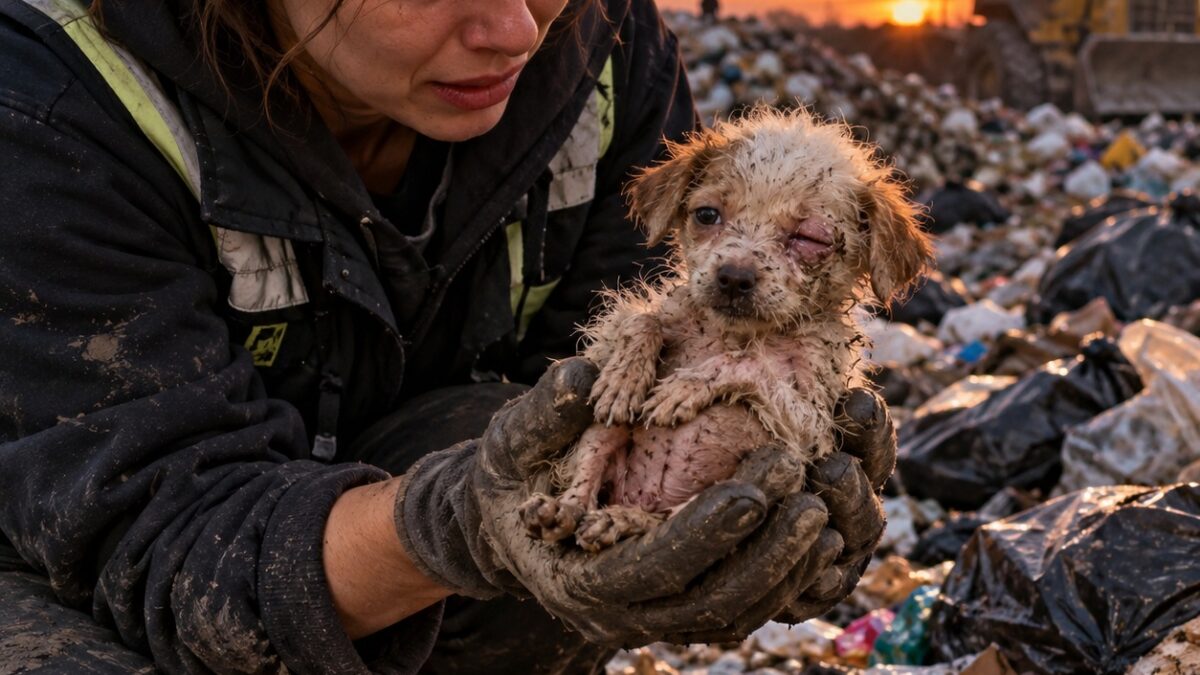
The first photograph showed a little animal almost disappearing into the ground beneath him.
The newer ones showed a puppy looking directly toward people, ears up, body ready to move.
That change was not cosmetic.
It was safety becoming visible.
A dog who feels unsafe often makes himself small.
Angelito had started taking up space.
He stretched when he slept.
Rolled onto his side.
Sometimes onto his back.
Belly exposed.
That posture moved me every time.
An animal does not lie completely vulnerable unless some part of him believes nothing terrible will happen during sleep.
For Angelito, sleep had once happened in a basement where no one cared what he needed.
Now he slept knowing people were nearby.
That is the kind of transformation photographs cannot fully capture.
One afternoon, someone reached toward him and Angelito immediately leaned into the touch.
No hesitation.
I remembered carrying him from the landfill.
The tiny cry.
The cold body.
The inability to lift his head.
“You really are still in there,” I whispered.
Except now I realized that was the wrong way to think about it.
Angelito had not disappeared beneath neglect.
He had been prevented from becoming himself.
Recovery did not bring an old personality back.
He had been too young to have one fully formed.
Recovery finally gave that personality permission to emerge.
Curious.
Playful.
Affectionate.
Persistent.
A little dramatic when food was late.
Very interested in toys that belonged to other dogs.
That was Angelito.
Not basement puppy.
Not landfill puppy.
Just Angelito.
As his condition improved, adoption became possible.
That word frightened me.
Adoption.
Rescue work creates a strange contradiction.
You spend weeks wanting the animal strong enough to leave.
Then the day comes when leaving becomes possible, and suddenly you want another week.
Maybe two.
Just to be sure.
Angelito had already experienced being discarded.
We could not let the next home become another mistake.
So applications were reviewed carefully.
People loved his photographs.
His story had spread.
A lot of people felt something when they saw the difference between the landfill puppy and the dog he was becoming.
But feeling moved by a rescue story is not the same as being prepared to care for the animal after the story becomes ordinary.
We needed someone who wanted Angelito.
Not the idea of saving Angelito.
Someone willing to wake up with him.
Train him.
Take him to appointments.
Deal with accidents.
Chewed objects.
Energy.
Fear if it appeared.
Whatever came.
Then one family stood out.
They did not ask whether Angelito would stay small.
Did not ask whether his difficult beginning meant he would be “extra loyal.”
Did not talk about how inspiring his pictures were.
They asked practical questions.
What food is he eating?
What does he fear?
How does he react around other dogs?
How often does he need follow-up care?
Where does he sleep best?
What routine has helped him?
I liked them immediately.
The first meeting was quiet.
Angelito approached carefully.
Smelled.
Moved away.
Came back.
The family did not chase him.
Did not scoop him up for photographs.
They waited.
Eventually Angelito decided they were interesting.
He moved closer.
One person sat on the floor.
Angelito sniffed a knee.
Then a hand.
Tail wag.
Small.
But there.
They visited again.
And again.
Angelito remembered them.
The second time, he approached faster.
By the third visit, he greeted them.
That changed everything.
The adoption was approved.
The night before he left, I sat beside him.
He had grown so much that I could no longer imagine fitting him into the fragile bundle I had carried from the landfill.
His coat looked healthy.
His eyes were bright.
He had enough energy to make staying still difficult.
I touched his head.
“You know what tomorrow is?”
Angelito tried to bite my sleeve.
“Apparently not.”
He pulled.
I laughed.
“Fine.”
I gave him the toy.
He shook it.
“Tomorrow you get a family.”
He had no idea.
Maybe that was good.
Dogs do not live inside speeches about tomorrow.
They live inside what happens next.
What happened next for Angelito was a car ride.
But this one did not end at a landfill.
It ended at a home.
A yard.
People waiting for him.
A bed.
Food already bought.
Toys placed where he could find them.
His new family opened the door and gave him time.
Angelito stepped inside.
Sniffed.
One room.
Then another.
He returned to the doorway once.
Looked toward us.
For a second, something tightened in my chest.
Then one of his new people called gently.
Angelito turned.
Walked toward the voice.
That was how his old life ended.
Not with a dramatic farewell.
With a choice.
Toward home.
The first update came that evening.
Photograph.
Angelito sleeping.
He had ignored the expensive dog bed.
Naturally.
Instead, he had chosen a folded blanket beside the couch.
One paw resting on his toy.
The message said:
He ate dinner and is completely exhausted from exploring.
Perfect.
Next morning:
He woke us early. Apparently breakfast is urgent.
Better.
Then:
He has discovered the backyard. We may never get him inside again.
I smiled for most of the day.
The backyard became one of his favorite places.
Grass.
Sun.
Fresh air.
Exactly the things absent from his beginning.
He ran.
Not far at first.
Then farther.
His new family sent a video.
Angelito moved across the lawn, stopped suddenly to investigate something invisible to us, then exploded into a clumsy puppy run.
Around the yard.
Back toward the house.
Out again.
No basement door above him.
No garbage beneath him.
No one deciding he should remain hidden.
Just space.
He made friends.
A neighbor’s dog became part of his routine.
They met through the fence.
Sniffed.
Eventually played together under supervision.
Angelito became more confident with people too.
Visitors no longer automatically worried him.
He had learned something important through repetition.
Not every hand hurt.
Not every door closing meant abandonment.
Not every car ride ended somewhere terrible.
Not every day required survival.
Trust became ordinary.
That may be the greatest thing his family gave him.
Not one dramatic act of love.
Predictability.
Breakfast appears.
Again.
People leave.
Then come back.
Again.
Bed remains.
Again.
Water remains.
Again.
His name gets called.
Someone answers when he cries.
Again.
Safety repeated enough times eventually becomes expectation.
Angelito had begun life expecting nothing.
Now he expected dinner.
I loved that.
He expected walks.
He expected his people to return.
He expected a place on the couch.
He expected toys to still exist tomorrow.
Those expectations are what belonging looks like.
Months passed.
Angelito no longer looked like the animal from the landfill.
His coat became full.
His body strong.
His eye healed.
He gained healthy weight.
His movements became confident.
No more struggling to hold up his head.
No more collapsing from weakness.
He ran.
Jumped.
Played.
Slept like only a young dog who has spent too much energy causing harmless trouble can sleep.
One photograph showed him sprawled across a couch.
All four legs pointing in different directions.
Head hanging partly over the edge.
I sent back:
Very dignified.
His family replied:
He disagrees with dignity as a concept.
Good.
A puppy who had started life forgotten beneath other people’s feet had become a dog comfortable enough to occupy an entire couch.
Let him.
One of his favorite habits became carrying toys from room to room.
That little detail reminded me of the first toy at the clinic.
How important it had felt simply to give him one object that existed for pleasure rather than survival.
Now he had too many.
Sometimes his family would gather them into a basket.
Angelito would immediately remove them.
One.
Then another.
And another.
As if organization offended him.
That was the kind of problem I wanted for him.
No more medical crisis.
No more cold body under blankets.
The crisis now was:
Angelito has distributed seven toys across the hallway.
Perfect.
People who followed his recovery loved the photographs.
The contrast was dramatic.
Before:
Underweight.
Sick.
Unable to lift his head.
After:
Bright eyes.
Healthy coat.
Strong body.
But I always felt the biggest difference could not be photographed.
The landfill puppy had no reason to believe anyone was coming back.
The adopted Angelito knew someone always did.
That knowledge changes how an animal moves through the world.
He stopped watching every door with uncertainty.
He stopped sleeping as lightly.
He became comfortable wandering into another room alone.
He knew the people he loved had not vanished simply because he could not see them for a moment.
Home had become permanent enough to trust.
That is an enormous achievement for an animal abandoned twice before he had properly begun living.
Angelito’s family eventually took him on a short trip.
Nothing dramatic.
A quiet place.
More grass.
New smells.
A different bed.
I wondered how he would react.
The answer came in photographs.
Angelito exploring.
Angelito looking through a car window.
Angelito asleep with one paw across someone’s leg.
A dog who once knew only a basement could now enter unfamiliar places without believing he had been discarded.
That was recovery too.
Confidence does not always look like bravery.
Sometimes it looks like falling asleep somewhere new because you trust the person beside you.
We occasionally received messages asking whether Angelito remembered what happened to him.
No one can answer that.
Dogs remember in ways we do not fully understand.
Associations.
Smells.
Sounds.
Body responses.
Perhaps certain things stayed with him.
Maybe basements felt strange.
Maybe garbage smells triggered something.
Maybe none of it remained consciously.
I learned not to need an answer.
What mattered was what his life looked like now.
Angelito did not spend every day thinking about the landfill.
Humans did that for him.
We told the story.
We compared photographs.
We remembered.
Angelito woke up and lived.
That is one of the gifts animals sometimes have.
They can carry scars without turning those scars into the only story they tell themselves.
Angelito was not “the abandoned puppy” when he woke up hungry.
He was a dog who wanted breakfast.
He was not “the basement puppy” when he ran across the yard.
He was chasing a smell.
He was not thinking about resilience when he destroyed a toy.
He was being annoying.
Beautifully, wonderfully annoying.
We began referring to him less as the landfill rescue.
More simply as Angelito.
That felt right.
No animal should be named permanently after the worst place humans put him.
The landfill was something that happened.
Not who he was.
The basement was a beginning.
Not destiny.
One afternoon, his family sent a video that I watched at least ten times.
The back door opened.
Angelito ran into the yard.
Sunlight everywhere.
He stopped in the middle of the grass.
Lifted his face.
Wind moved across his coat.
Then he started running.
Full speed.
Across the yard.
Turn.
Back.
Again.
No hesitation.
No weakness.
Nothing pulling him backward.
It reminded me of his first outdoor visit during recovery.
Those cautious little steps.
The way he examined each patch of grass as if the earth itself was new.
Now the yard belonged to him.
Not legally, of course.
Dogs do not care about deeds.
But emotionally?
Absolutely.
His place.
His grass.
His sun.
His people behind the door.
The transformation had become so complete that someone seeing only that video would never know how close he had come to dying.
I liked that.
Recovery does not owe visible suffering to anyone.
Angelito did not need to keep looking broken so people would remember what happened.
Let him look healthy.
Let the bad beginning disappear beneath muscle, fur and joy.
We can remember for him.
His family celebrated the anniversary of his rescue.
Not with anything huge.
A special meal.
New toy.
Lots of photographs.
They called it his “sun day.”
Because no one knew his exact birthday.
And because so much of his beginning had happened without sunlight.
The first sun day photograph showed Angelito sitting in the backyard.
Bright afternoon.
Tongue out.
Toy beside him.
His coat shining.
I thought about that basement door.
Closed.
Darkness behind it.
A plumber opening it accidentally.
One ordinary workday becoming the reason another living creature was ever noticed.
People often imagine rescues beginning with trained professionals.
Sometimes they do.
Other times, someone simply refuses to ignore what they see.
The plumber could have closed the door.
Said it was not his business.
Finished the job.
Gone home.
He didn’t.
That choice mattered.
Not because he could fix everything.
He could not treat infection.
Could not rehabilitate a starving puppy.
Could not decide Angelito’s future.
But he saw something wrong and allowed that knowledge to inconvenience him.
He told someone.
Authorities became involved.
The situation changed.
Even though the owner later dumped Angelito, the secret had already escaped the basement.
People knew he existed.
And because people knew, somebody eventually looked for him.
Somebody found him.
That is how rescue often begins.
Not with the ability to solve everything.
With refusing to look away.
Angelito’s story could have ended below that house without anyone outside knowing.
That possibility still frightens me.
How many suffering animals remain behind doors nobody opens?
How many are hidden because somebody is embarrassed by what happened?
How many people hear something, notice something, suspect something, then tell themselves it is not their responsibility?
Angelito is alive because someone did not.
That does not mean every concern will reveal abuse.
It means paying attention matters.
And when something looks wrong, asking for help can matter more than knowing exactly what to do yourself.
The clinic gave Angelito treatment.
His foster caregivers gave him stability.
His adoptive family gave him permanence.
The plumber gave him something too.
Visibility.
Before that door opened, Angelito was invisible.
Afterward, the world began moving toward him.
Slowly.
Not perfectly.
The first response from his owner was abandonment again.
But the truth was out.
Angelito could no longer disappear completely.
That became the beginning of everything.
The landfill was not the end.
The clinic was not the end.
Even adoption was not exactly an ending.
Life kept going.
Normal life.
That is the part of rescue stories people sometimes overlook because normal days are difficult to turn into dramatic photographs.
Angelito waking up.
Stretching.
Eating.
Going outside.
Coming back inside.
Playing.
Napping.
Growing older.
Those are the victory.
A rescue is not successful because there is one beautiful adoption photo.
It is successful when months later the animal is still safe.
When the family still wants him after he chews something expensive.
After he gets sick.
After the novelty of the rescue story fades.
When he becomes simply theirs.
Angelito did.
His family stopped thinking of him as a rescue project.
He became part of routines.
Who feeds him.
Who lets him outside.
Where he sleeps.
Which person he follows most.
Who he bothers during meals.
He became woven into the household.
That is belonging.
There was one update that meant more to me than the dramatic before-and-after photos.
His family wrote:
Nothing new this week. He’s doing great.
Nothing new.
Beautiful.
For weeks after the landfill, every day needed news.
Temperature.
Infection.
Food.
Weight.
Breathing.
Strength.
Something could go wrong at any moment.
Now:
Nothing new.
He is doing great.
That is what safety eventually becomes.
Unremarkable.
You stop counting.
You stop watching every breath.
You trust tomorrow.
Angelito had finally reached the point where tomorrow was expected.
I sometimes think about his first night with us.
How many times we were afraid his temperature would keep falling.
How several people quietly prepared themselves for the possibility that he would not survive.
Then compare it with the photographs now.
Angelito asleep in a sunbeam.
Angelito carrying a toy.
Angelito standing beside someone’s legs waiting for food.
Angelito exploring a yard.
Each one feels almost impossible.
But no single miracle created the change.
Care accumulated.
Warmth.
Food.
Medicine.
Sleep.
Routine.
Touch.
Play.
Another day.
Then another.
That is how bodies rebuild.
That is how trust rebuilds too.
One good experience does not erase abandonment.
But repeated good experiences create something new beside it.
Eventually the new thing becomes larger.
Angelito learned:
Someone comes when I cry.
Someone fills the bowl.
Someone opens the door.
Someone notices when I am sick.
Someone brings me back inside.
Someone says my name.
Someone stays.
That final lesson may have been the hardest.
People stay.
He had been hidden.
Then discarded.
He could have learned that humans disappear.
Instead, his family taught him otherwise.
Again and again.
People stay.
His confidence grew from that.
Not because he forgot everything.
Because the present became reliable enough that the past stopped deciding every moment.
One day, his family sent us a photograph taken from inside the house.
Angelito was outside near the far end of the yard.
He was looking back toward the door.
Not worried.
Just checking.
The person taking the photo wrote:
He always looks back once, then keeps exploring.
I loved that.
He checked.
Home still there.
Then moved on.
Maybe that was the entire transformation in one picture.
A puppy who once had no reason to trust anyone would now move away confidently because he knew where he could return.
Freedom and security at the same time.
Every dog deserves both.
Angelito had started life with neither.
Now he had them.
Years from now, if somebody sees Angelito only as a healthy adult dog, they may never know.
They may pet him.
Call him handsome.
Laugh when he gets excited.
Watch him run.
And unless someone tells them, they will not know there was once a tiny puppy beneath a house who had never seen the sun.
I think that is wonderful.
His pain does not need to introduce him forever.
Sometimes survival means reaching a place where strangers cannot tell you survived anything at all.
There is no requirement to wear trauma visibly.
Angelito’s healthy coat can cover the history.
His bright eyes can replace the sick ones in people’s memories.
The landfill can become a sentence instead of an identity.
We remember it because it matters.
We do not worship it.
What matters more is where he ended up.
Home.
That word is easy to say.
For Angelito, it took weeks to earn meaning.
A basement was a place.
Not home.
The landfill was a place.
Certainly not home.
The clinic saved him, but it was temporary.
The rescue gave him safety, but still temporary.
Home became the place where no one planned to send him anywhere else.
The place where his bowl stayed.
His toys stayed.
His bed stayed.
His people stayed.
That permanence is what every abandoned animal deserves.
Not simply rescue from danger.
Arrival somewhere that does not end.
Angelito found it.
Today he does not live hidden beneath anybody.
He does not lie surrounded by garbage.
He does not struggle to lift his head while strangers wonder whether his body will make it through the night.
He wakes up surrounded by people who know his habits.
People who know when he wants food.
When he wants to play.
When he needs rest.
He goes outside.
Feels grass.
Feels sun.
Breathes fresh air.
All the things that should have been ordinary from the beginning became ordinary eventually.
Maybe that is why his story stays with me.
Not because of how cruel the beginning was.
Cruelty is unfortunately not rare enough to surprise rescuers.
What stays with me is how completely a life can change once someone starts caring consistently.
Angelito was not saved in one dramatic moment.
The plumber opening the door mattered.
Being found at the landfill mattered.
The clinic mattered.
The adoption mattered.
But between those moments were hundreds of smaller ones.
A blanket.
A meal.
A hand placed gently beside him.
A toy.
A tail wag.
A nap.
A step into grass.
A family returning the next morning.
The small things became a life.
If you saw Angelito now, you might first notice his coat.
Healthy.
Full.
Maybe his eyes.
Bright.
Maybe the way he runs.
What I notice is his posture.
He stands like he belongs somewhere.
That sounds strange until you remember how he looked at the landfill.
Collapsed.
Small.
Almost apologetic for existing.
Now he takes up space.
Sleeps wherever he wants.
Runs across his yard.
Drops toys where people will trip over them.
Waits for meals as if meals are guaranteed.
Because they are.
There is no greater transformation.
Not from ugly to beautiful.
Not from sick to healthy.
From uncertain to secure.
Angelito knows he has tomorrow.
The puppy in the basement did not.
The puppy at the landfill could not.
The dog he became does.
And every morning, when sunlight comes through the windows of his home, Angelito no longer has to wonder what it feels like.
He simply walks into it.








