PART2:A Little Gray Bichon Waited Outside the Hospital Room for a Man Who Would Never Return—Then He Started Waiting for Me
PART2
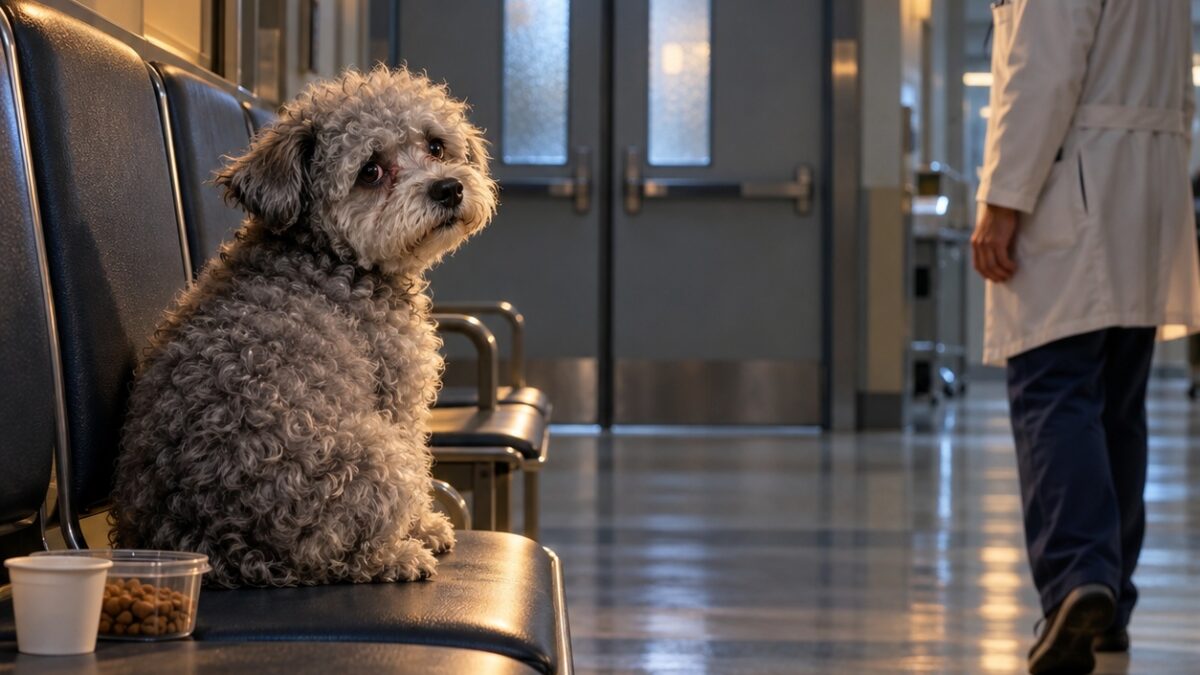
Those eyes.
That bench.
That door.
I tried reading.
Couldn’t.
Turned on television.
Didn’t absorb a word.
Made tea.
Forgot to drink it.
Every few minutes my mind returned to the same image.
The doors opening.
The little dog standing.
Then sitting again.
I told myself:
He is safe.
Shelter.
Food.
Water.
People.
He will be adopted.
Dogs adapt.
All true.
None helped.
Because what haunted me wasn’t his physical safety.
It was his waiting.
He didn’t know why the man had disappeared.
Nobody could explain:
He did not choose to leave you.
He did not forget you.
He did not walk away.
He died.
You can say those words to a human being and watch them break.
You cannot say them to a dog and expect meaning.
So what does a loyal animal do with absence when there is no explanation?
He waits.
At midnight, I was still awake.
At one, too.
Finally, I stood.
Not because I had made a plan.
Because lying there had become impossible.
“I need to see him.”
I said it aloud.
Empty room.
No one argued.
The next morning, I called animal services.
I had no idea which shelter they had used.
I explained.
Hospital.
Gray Bichon Frise.
Owner deceased.
The person on the phone paused.
Then gave me an address.
I wrote it on a small piece of paper.
Folded it.
Put it in my pocket.
For the rest of the day, I kept touching that pocket.
Between patients.
In the elevator.
At lunch.
I didn’t know why I was so affected.
I’ve seen worse.
That is an ugly sentence.
True.
Medicine gives you a terrible scale.
Worse suffering.
Worse injuries.
Worse deaths.
But emotion doesn’t rank itself clinically.
That dog had found a weak point.
Maybe because his grief was so pure.
No anger.
No bargaining.
No explanation.
Just:
He went through the door.
I will wait.
When my shift ended, I changed clothes.
Put on my coat.
Took the paper from my pocket.
Read the address again.
Then drove.
The closer I got to the shelter, the more ridiculous I felt.
What exactly was I doing?
Checking on a dog I did not own?
A dog I’d met for minutes?
Maybe he wouldn’t remember me.
Maybe he had already been adopted.
Good.
That should be good.
Still, I drove faster.
The shelter was smaller than I expected.
I parked.
Stayed in the car several minutes.
Hands on steering wheel.
Building in front of me.
One part of me wanted to leave.
Professional distance returning.
This is not your responsibility.
Another part answered:
Then why did you come?
I got out.
Inside, the shelter smelled like disinfectant, food, fur.
Dogs barked somewhere deeper in the building.
A young volunteer greeted me.
Friendly.
“Can I help you?”
“I’m looking for a dog.”
She smiled.
“Most people here are.”
I almost laughed.
“A small gray Bichon Frise. He was brought in from the hospital a few days ago.”
Her expression changed immediately.
“Oh.”
“You know him?”
“Yes.”
“He’s here?”
“He’s here.”
Relief.
Immediate.
Embarrassingly strong.
“Can I see him?”
“Of course.”
She led me down a long hallway.
Dogs appeared at kennel doors.
Some barked.
Some jumped.
Some simply watched.
I felt guilty passing all of them.
Every face carried a story.
But I was searching for one.
We stopped.
The volunteer pointed.
“There.”
He sat in the back corner.
Small blanket.
Head down.
He looked thinner.
Maybe only my imagination.
But sadness can make a body look smaller.
He didn’t react when we approached.
The volunteer unlocked the kennel.
“You can go in.”
I stepped inside.
Slowly.
The dog lifted his head.
Saw me.
And froze.
I stopped too.
Recognition is difficult to prove scientifically in one look.
I don’t care.
He knew me.
Something changed in his face.
His head rose.
Eyes widened.
He stood.
Slow.
Then walked toward me.
Not running.
Not yet.
Three steps.
Four.
He reached my knees.
Sat.
And placed his head on my lap.
I broke.
No professional partition.
No medical vocabulary.
No clinical distance.
I put both arms around him and cried.
I am not ashamed of that.
I cried because this little dog who had lost the person who made sense of his entire world still had enough trust left to put his head against another human being.
I cried because he remembered me.
Maybe only from the hospital.
Maybe because I had sat with him.
Maybe because my scent had been part of the last place he saw his owner.
I don’t know.
But he came.
The volunteer moved away quietly.
Good people know when to leave a room.
I sat on the kennel floor.
The Bichon stayed against me.
Eventually I asked:
“How is he?”
The volunteer returned.
“He’s physically okay.”
“Eating?”
“Yes.”
“Sleeping?”
“Some.”
“Walks?”
“Yes.”
“But?”
She hesitated.
“He’s sad.”
I looked down.
“He waits.”
My chest tightened.
“What does that mean?”
“He sits near the front when people come in.”
I closed my eyes.
“He thinks his owner is coming.”
“We think so.”
“He doesn’t understand.”
“No.”
I stroked the dog’s head.
“What was his name?”
The source didn’t give me one in the version I knew, and I won’t invent one here.
So for a while, in my mind, he remained simply the little gray dog from the hospital.
That somehow made his waiting feel even more fragile.
No name in my story yet.
Only devotion.
I stayed until closing.
When a staff member finally told me they needed to shut down for the night, I felt ridiculous resistance.
I didn’t want to stand.
The dog was half asleep against me.
Eventually I did.
He stood too.
I picked him up.
Small body.
Warm.
He looked at my face.
Then toward the door.
I whispered:
“I have to go.”
His eyes stayed on me.
That look.
Different from the hospital.
At the hospital:
Will he come back?
Now:
Will you?
I swallowed.
“I’ll come back.”
Dogs do not understand promises as language.
They understand patterns.
At that moment, my promise meant nothing.
I needed to make it true.
I left.
He watched.
The entire drive home, I thought about him.
Not only him.
His owner.
What their life must have been.
Breakfast.
Walks.
The dog waiting for him at home.
Sleeping near him.
Following him from room to room.
Maybe sitting beneath his chair.
Maybe hearing keys.
Maybe knowing footsteps.
A dog’s world can be very small and still be complete.
One person.
One home.
One routine.
When that person dies, the dog doesn’t lose “an owner.”
He loses structure.
Scent.
Voice.
Schedule.
Safety.
History.
Future.
Everything.
He had not lost one person.
He had lost the language in which his whole life had made sense.
I barely slept.
The next evening, I returned.
The volunteer smiled when she saw me.
“He’s out back.”
She led me.
The dog saw me.
This time, he moved faster.
Not running.
But almost.
I crouched.
He pressed his body against me.
“Hey.”
Tail.
One small wag.
First I’d seen.
I smiled.
“There you are.”
I took him for a walk.
The park near the shelter was quiet.
He moved slowly.
Sniffing.
Then stopping.
Every few minutes, he looked into the distance.
Not at me.
Past me.
Searching.
I knew who.
It hurt differently outside.
At least in the shelter, waiting had a place.
Front door.
People coming in.
In the park, every human shape could become possibility.
An older man on a bench.
The dog stopped.
Looked.
The man stood.
Walked away.
The dog followed him with his eyes.
Then continued walking.
I said nothing.
There was nothing useful to say.
Day three, I returned.
Then day four.
Then five.
Soon it became routine.
Work.
Shelter.
Walk.
Food.
Sit.
Some days we played.
At first he didn’t understand play with me.
I rolled a small toy.
He watched.
Eventually followed.
One evening, he ran after it.
Only a few steps.
Brought it back halfway.
Good enough.
The staff noticed changes before I did.
“He watches the door less when you’re here.”
One said.
I nodded.
Not sure whether to feel good or guilty.
I didn’t want to replace his owner.
That felt wrong.
Then I realized love isn’t a chair with only one seat.
His old person mattered.
Always would.
My presence didn’t erase that.
It gave the dog somewhere to put his remaining capacity for attachment.
That is not betrayal.
That’s survival.
A week became two.
When I entered, he started coming toward me.
Then running.
Little gray body moving faster than I expected.
One day, he barked when I walked away.
I turned.
He stood near the gate.
“I’m coming back.”
Again.
Promise.
Now the promise had evidence.
I had returned yesterday.
And the day before.
And the day before that.
Dogs build trust from repetition.
So do people.
One evening in the park, we sat on a bench.
He rested beside me.
Cold air.
Sun going down.
A man walked past wearing a coat similar in color to the one the dog’s owner had worn at the hospital.
The dog stood so fast his nails scraped the pavement.
He stared.
Tail slightly raised.
The man kept walking.
The dog took two steps.
Stopped.
I felt something crack inside me.
He still believed.
After all this time.
Still.
I lowered myself beside him.
He kept watching until the stranger disappeared.
Then slowly sat.
I touched his back.
“You loved him.”
My voice broke.
The dog looked at me.
“You really loved him.”
That was when I understood I could not let him spend the rest of his life inside a shelter doorway.
Waiting.
Maybe he would eventually be adopted by someone else.
Maybe.
But I was already there.
Every day.
Thinking about him at night.
Rearranging my schedule.
Learning what food he liked.
Knowing which part of the park made him nervous.
Knowing that he preferred sitting on my right side.
Who was I fooling?
I called the shelter the next morning.
“I want to adopt him.”
The woman on the phone laughed softly.
“We’ve been waiting for that call.”
“You knew?”
“Everyone knew.”
Apparently, I was the last person to understand my own life.
Paperwork followed.
Home check.
Questions.
Schedule.
Veterinary care.
Responsibility.
I answered.
The staff seemed genuinely happy.
One volunteer said:
“You should see him on days you come.”
“What about days I don’t?”
She hesitated.
“We can tell.”
That hurt.
I made sure there were fewer days I didn’t.
The adoption became official near sunset.
I arrived with a leash.
A small bed in my car.
Food.
A ridiculous number of supplies.
The little dog had no idea.
When the kennel opened, he ran toward me.
I crouched.
“Come on.”
He looked at the leash.
Then me.
“You’re leaving with me this time.”
No comprehension.
But tail.
We walked through the shelter doors together.
I expected him to hesitate.
He didn’t.
Outside.
Car.
He sat in the passenger seat.
Looked through the window.
Calm.
Not shaking.
Not whining.
I drove slowly.
Every few minutes I looked at him.
He looked outside.
Then sometimes at me.
I wondered whether part of him still believed I was taking him back to the hospital.
That thought hurt.
When we reached my home, I opened the passenger door.
He stepped down.
Looked around.
New building.
New smells.
I opened the front door.
He paused.
Then entered.
One room.
Another.
Hall.
Back to me.
I smiled.
“This is home.”
Words again.
Cheap at first.
He came toward me.
Put his head against my knees.
That was his gesture.
Hospital bench.
Shelter kennel.
Now my house.
I lifted him.
Held him.
And for the first time since meeting him, I didn’t imagine the door behind us opening for someone else.
That night, he slept near my chair.
Not deeply.
Every sound lifted his head.
When I moved, eyes.
When I stood, he followed.
I went to the kitchen.
He came.
Bathroom.
Waited.
Bedroom.
Followed.
The first week taught me that adoption was not the ending.
It was the beginning of proof.
I left for work.
He waited near the door.
I came back.
Explosion of movement.
Second day.
Leave.
Return.
Third.
Same.
Gradually, the panic changed.
This matters.
At the hospital, the door swallowed his person permanently.
At my home, the door became something different.
I walked through.
Then came back.
Again.
Again.
Again.
A door could mean return.
That may sound small.
For him, it was everything.
Sometimes, even after months, he watched the door when I left the room.
Sometimes he sat near it.
Waiting.
But the quality changed.
Not desperate.
Expectant.
There is a world of difference.
His owner had taught him love.
Death had taught him disappearance.
I needed to teach him return.
Not through speeches.
Pattern.
I come back.
One evening, I returned late.
Emergency at the hospital.
Hours later than usual.
When I opened the door, he was there.
Waiting.
For a split second, I saw the hospital bench again.
The door.
His body.
I dropped my bag.
Kneeled.
He ran into me.
I held him.
“I’m sorry.”
He licked my chin.
“I came back.”
Tail.
“I came back.”
That phrase became almost sacred between us.
Weeks turned into months.
His appetite improved.
He became playful.
Demanding.
Good.
The first time he barked because I stopped throwing a toy, I laughed.
“Excuse me?”
Bark.
“You have opinions now?”
Bark.
Excellent.
Traumatized animals becoming inconvenient is one of the best signs of healing.
A dog too frightened to demand anything eventually demanding dinner ten minutes early?
Success.
He slept deeper too.
At first, always facing the door.
Later, curled sideways.
Then on his back once.
Feet in the air.
I stood in the hallway staring.
Complete vulnerability.
He had no idea I was witnessing a miracle.
Good.
Miracles are often better when the subject doesn’t know.
One year passed.
He became calm.
Happy.
Loved.
He still sometimes looked toward the door when I came home.
But now his whole body moved with anticipation.
He knew the pattern.
Keys.
Lock.
Door.
Me.
Not maybe.
Me.
That certainty healed something nothing else could.
He still remembered.
I believe that.
Once, we passed the hospital.
Not intentionally.
Traffic diverted us.
As we walked near the entrance, he slowed.
I felt the leash change.
He looked toward the building.
My chest tightened.
Did he remember?
Scent?
Shape?
Maybe.
He stood for several seconds.
Then looked at me.
I waited.
He turned away.
We continued.
I cried after we reached home.
Not because I thought he had forgotten his old owner.
The opposite.
Maybe memory and present had finally learned to coexist.
He could remember.
And still walk forward.
That is healing.
Not deletion.
Integration.
People sometimes asked if I renamed him.
I won’t invent what the original source didn’t give me.
What mattered was not the name.
It was the relationship.
He became the dog sleeping at my feet.
The dog who waited by my door.
The dog who knew my schedule better than I did.
The dog who forced me to leave the hospital emotionally even after my shift ended.
Medicine trains you to save bodies.
This dog taught me something medicine rarely discusses.
Not every wound needs treatment.
Some need presence.
You can’t prescribe grief away.
You can’t explain death to an animal.
You can’t replace someone beloved.
But you can stay.
Then return.
Then stay again.
And perhaps, over time, life grows around the absence.
The absence does not disappear.
It stops occupying every room.
I watched that happen in him.
I think it happened in me too.
Doctors carry more grief than we admit.
Patients.
Faces.
Names.
Calls made to families.
Rooms cleaned for the next person before the last person’s grief has left the walls.
We learn not to take it home.
Mostly.
But some things come home anyway.
This little gray dog did.
Literally.
He brought a piece of the hospital’s grief into my living room and turned it into companionship.
That was not something medical school prepared me for.
One night, I woke and found him standing near the bedroom door.
Still.
Listening.
I sat up.
“What?”
He looked toward the hall.
Then back.
Nothing there.
Maybe dream.
Maybe sound.
He walked to the bed.
I lowered my hand.
He pressed his head under it.
Same gesture.
The shelter.
My lap.
Recognition.
I stroked him.
He sighed.
Lay down.
I thought about his first owner.
The man whose death began our story.
I never wanted to erase him.
In my mind, I thanked him sometimes.
For loving this dog well enough that the dog still believed in people after losing him.
That matters.
A badly loved animal may learn fear.
This dog learned waiting.
Painful, yes.
But underneath waiting was trust.
My person comes back.
The tragedy was that one day he didn’t.
But the belief itself came from years of return.
I benefited from a bond another man built.
I respected that.
Sometimes I imagined what I would say if I could speak to him.
Not:
I replaced you.
Never.
I would say:
He still remembers.
He waited.
He grieved.
And then he learned to live again.
I took care of him.
He’s safe.
You don’t have to worry.
Maybe that sounds sentimental for a doctor.
Fine.
Medicine does not protect you from sentiment forever.
Some lives deserve it.
The dog began sleeping beside the window in the evening.
I sat nearby.
Outside, lights.
Cars.
People.
He watched.
I watched him.
In the beginning, looking outward had meant searching.
Now it looked like simple observation.
World.
Nothing urgent.
Sometimes someone passed and he lifted his head.
Then relaxed.
No frantic standing.
No desperate hope.
That changed slowly enough I almost missed it.
Grief had stopped turning every stranger into possibility.
That is a huge thing.
Humans do it too.
Hear a voice that sounds similar.
See a coat.
A gait.
For half a second:
Them.
Then no.
The nervous system keeps trying to repair absence through recognition.
Eventually, it softens.
He softened.
So did I.
One day in the park, an older man sat on the bench beside us.
The dog looked at him.
My stomach tightened.
The man held out one hand.
The dog sniffed.
Then sat near him.
No searching.
No confusion.
Just another human being.
The man smiled.
“Friendly fellow.”
“Yes.”
“He yours?”
I paused.
Then:
“Yes.”
The word felt large.
Mine.
Not possession.
Responsibility.
Family.
The man scratched the dog’s ear.
“Looks like he trusts you.”
I looked down.
“He taught me to earn it.”
The man probably thought I was strange.
Fine.
At home, the dog had routines.
Morning.
Walk.
Food.
Nap.
If I came home later than expected, protest.
If I worked too long at a desk, he placed himself directly between me and whatever I was doing.
Medical authority meant nothing to him.
Good.
Everyone needs something unimpressed by their profession.
Patients called me doctor.
Staff called me doctor.
He needed none of it.
He needed the person who came back through the door.
That simplified me.
One particularly difficult day at work, we lost a patient.
I drove home exhausted.
Not physically.
The other kind.
I sat in my chair without removing my coat.
The dog came.
Stood in front of me.
Then put his head on my knees.
There it was again.
The same position from the shelter.
I placed one hand over his head.
For a while, neither of us moved.
I thought:
He doesn’t know what happened today.
Doesn’t need to.
Presence doesn’t always require comprehension.
That lesson became precious.
Doctors are trained to understand before treating.
Tests.
Diagnosis.
Cause.
But comfort can sometimes come before understanding.
A hand.
A body beside yours.
Stay.
Animals know this.
We forget.
The dog did not cure anything.
He simply stayed.
Enough.
People at the hospital eventually knew about him.
A nurse asked:
“That’s the dog from the waiting room?”
“Yes.”
“You took him?”
“Yes.”
She smiled.
“I wondered what happened.”
“He’s good.”
Another nurse remembered.
“Oh my God, the little gray one?”
“Yes.”
“He waited forever.”
I corrected gently.
“He doesn’t anymore.”
That mattered.
He still waited for me.
But not in the same way.
At the hospital, waiting had no answer.
At home, waiting ended with a key in the lock.
That is the difference between hope and torment.
Return.
One year after adoption, I bought him a new blanket.
Soft.
Gray.
He ignored it.
Preferred an old one.
Of course.
Animals disrespect human spending.
I sat beside him.
He slept.
Tiny sounds.
Peace.
I looked at his face.
The same eyes.
But I no longer saw the expression that had kept me awake that first night.
No desperate question.
No constant scanning.
Home had changed his face.
Safety often does.
Muscles soften.
Sleep deepens.
Eyes lose some of their vigilance.
He had become himself outside grief.
Playful.
Stubborn.
Selective about food.
Suspicious of vacuum cleaners.
Very interested in my chair despite owning several beds.
A full personality.
Grief had hidden much of it.
That’s why I don’t like defining rescued animals only by tragedy.
He wasn’t “the dog whose owner died.”
That happened to him.
It wasn’t all he was.
He was also a dog who loved the park.
Who hated getting wet.
Who knew exactly when dinner was late.
Who stole one sock and carried it around proudly.
Who sometimes slept with his paws moving.
Who had learned two different versions of waiting.
One endless.
One safe.
The safe version is the one I carry.
When I left for work, he watched.
Sometimes followed me to the door.
I would say:
“I’ll be back.”
Then go.
Hours later:
Door.
Key.
He came running.
Proof.
Again.
Return became our language.
If I was delayed, I came back.
If I traveled briefly, I came back.
If I went down to get mail, I came back.
Eventually he could sleep through short absences.
That may seem boring.
It’s not.
Boring trust is one of the most beautiful outcomes after loss.
No panic.
No dramatics.
The certainty:
My person leaves.
My person returns.
I hoped, somewhere beyond whatever humans understand about death, his first owner would have been grateful.
Not jealous.
Not erased.
Grateful.
The dog had another home.
Another chance.
I believe love, if it means anything beyond possession, would want that.
The source of my attachment to him still surprised me.
I had not been lonely in any obvious way.
Busy.
Professional.
Functional.
But he opened a room in me I hadn’t noticed was closed.
I began coming home rather than merely arriving at my address.
Difference.
Someone waited.
Not desperately.
Joyfully.
That made the apartment a home.
Maybe second chances work both ways.
He lost his world.
I had not lost mine.
But perhaps I had narrowed it.
Medicine can do that.
Hospital.
Work.
Sleep.
Repeat.
He widened it.
Walks.
Parks.
Evenings.
Play.
Responsibility outside a profession.
Life.
One evening, we sat near the window.
He was older now than when I first saw him, though still lively.
Streetlights came on.
He watched people.
I watched him.
A man passed wearing a dark coat.
The dog looked.
Then immediately put his head back down.
No rising.
No searching.
My eyes filled.
He had not forgotten love.
He had stopped confusing every absence with a promise.
That is peace.
Not forgetting.
Knowing where you are now.
I reached down.
Touched him.
He looked up.
Same eyes.
Different question.
Not:
Will he come back?
Just:
Are you still here?
“Yes.”
I said.
“I’m here.”
Tail once.
Enough.
Sometimes I think about what would have happened if I never went to the shelter.
Maybe someone else would have adopted him.
I hope so.
Maybe a loving family.
Maybe he would have waited longer.
No way to know.
Those alternate lives aren’t useful.
What matters is the one we got.
I couldn’t forget his face.
So I called.
Then drove.
Then went back.
Again.
Again.
Again.
Small decisions.
Eventually a home.
People like to imagine life-changing choices as one dramatic leap.
Mine was a piece of paper with a shelter address folded inside my pocket.
That’s all.
Then one visit.
Then another.
One walk.
One adoption form.
One open door.
A life can turn through ordinary actions.
The dog taught me that too.
He never made a dramatic decision to love me.
He simply moved closer.
Placed his head on my knees.
Ran when I came.
Barked when I left.
Slept deeper.
Trusted the door.
Love accumulated.
There was no replacement moment.
No day when his old owner stopped mattering and I began.
Both truths existed.
He had loved one person.
Lost him.
Loved again.
That is not disloyalty.
That is courage.
Maybe the greatest courage he showed was not waiting at the hospital.
Waiting was instinct.
The courage was allowing someone new to matter afterward.
Loss can teach a heart:
Don’t attach again.
He did anyway.
Animals are remarkable that way.
Humans too, when we’re lucky.
I remain a doctor.
I still lose patients.
Still make those calls.
Still walk out of rooms carrying things I don’t always name.
But now, when I see an animal or person waiting outside a door, I think differently.
I remember that grief often begins before anyone understands it.
That the body may wait for someone the mind has been told will not return.
That explanation is not enough.
Presence matters.
Return matters.
Patterns matter.
And love doesn’t end when one relationship ends.
It changes form.
Moves.
Finds another place to live without destroying the first.
I learned that from a gray Bichon Frise sitting on a hospital bench.
He thought the door would open.
It never did.
That part remains heartbreaking.
But another door opened later.
The shelter.
Then my apartment.
And this time, someone came back through it.
Every day.
Today, he sleeps near my feet.
Sometimes dreams.
Sometimes snores softly.
When I stand, he may open one eye.
Usually decides I’m not interesting enough to follow.
Progress.
When I return from work, he still comes to the door.
Tail.
Movement.
Joy.
He waits.
But now he waits with knowledge.
I am coming back.
That is the gift I was able to give him.
The gift he gave me was harder to name.
Perhaps this:
A second chance doesn’t require the first love to disappear.
You don’t heal by betraying memory.
You heal by making room beside it.
His first owner remains part of his story.
I remain the person who came after.
That’s enough.
More than enough.
I don’t know what happens to dogs when they die.
Medicine has no answer for that.
Science cannot tell me whether a dog sees the people he lost.
So I won’t pretend certainty.
But I understand why people hope.
And if there is any version of existence where reunion is possible, I like to imagine that one day this little gray dog will see the man he waited for beyond that hospital door.
Maybe he’ll run.
Maybe his whole body will shake with the same joy I eventually saw when he ran toward me at the shelter.
And if that old man could ask him:
“What happened after I left?”
I hope the answer, in whatever language love uses, would be simple.
I waited.
I missed you.
I remembered.
Then someone came.
He kept coming back.
I was safe.
I was loved.
I lived.
Until then, he stays with me.
He has food.
Warmth.
Walks.
A favorite chair he believes belongs to him.
A home.
And every evening, when we sit near the window, sometimes he looks outside and I look at him.
The sadness that once filled his face is no longer there.
Memory, yes.
Calm, yes.
Love, absolutely.
But not abandonment.
Not anymore.
Now, when a door closes behind me, he knows something that took months of repetition to teach.
Doors can open again.
People can return.
And sometimes, after the worst goodbye of your life, another person comes through a different door—
sits beside you,
stays,
comes back tomorrow,
and quietly helps you believe in home again.








