PART2:A Dog Guarded a Newborn Outside My Fire Station All Night—Then I Found the Note Tied to His Collar
PART2
The first thing I did was touch Ruth’s cheek with the back of my fingers.
Warm.
That surprised me.
The temperature outside was brutal.
Jasper’s coat was cold enough that I could feel it immediately, and when I slid my hand beneath his chest, he was trembling harder than I had realized.
Yet the baby beneath him was warm.
He had spent the night using himself as insulation.
“Okay, Jasper.”
His eyes stayed on me.
“We’re going inside.”
I did not want to separate them.
Not yet.
So I lifted the entire basket.
Jasper shifted his weight but did not leave Ruth.
The basket was awkward.
Heavy enough that I had to brace it against my chest.
I talked the whole way through the bay.
“I’ve got you.”
Jasper’s nose moved toward my sleeve.
“You’re okay.”
We reached the station kitchen.
I put the basket on the floor away from the door and grabbed the cleanest blankets we had.
Then I called for an ambulance.
“Newborn infant found outside Station 3. Less than forty-eight hours old, possibly. Exposure risk. Currently breathing normally and appears warm.”
The dispatcher paused for half a second.
Then:
“Repeat. Newborn?”
“Affirmative.”
I looked at Jasper.
“And there’s a dog.”
Another pause.
“A dog?”
“Long story.”
I wrapped a blanket around the outside of the basket.
Then another around Jasper’s back.
Only once we were inside did he slowly uncurl.
He stretched stiffly.
I could finally see Ruth completely.
Tiny face.
Dark hair.
One fist near her cheek.
The umbilical cord had been tied and trimmed.
Whoever had delivered her had done the best they could with almost nothing.
Jasper leaned over and smelled her face.
Then settled his chin across her legs.
I sat on the tile floor beside them.
That image has never left me.
A newborn girl sleeping peacefully.
An exhausted dog guarding her.
And a station kitchen that suddenly felt like the center of the entire world.
The ambulance arrived twelve minutes later.
Longest twelve minutes of my career.
Paramedic Chris Nolan entered first.
Behind him was Tara Shaw.
They both stopped when they saw the basket.
Chris looked at me.
“You weren’t kidding.”
“No.”
Tara crouched immediately.
“Hi, sweetheart.”
She checked Ruth carefully.
Temperature.
Breathing.
Color.
Heart rate.
“Warm.”
I nodded toward Jasper.
“He isn’t.”
Tara touched his back.
Her face changed.
“Oh, buddy.”
We showed them the note.
Chris read it once.
Then again.
“Sixteen?”
“That’s what she wrote.”
They estimated Ruth was less than two days old.
There was no obvious trauma.
No sign of severe cold exposure.
Whoever had wrapped her had used several blankets.
And Jasper had done the rest.
When Tara lifted Ruth out of the basket, Jasper changed instantly.
For the first time, he panicked.
He scrambled upright.
Paws slipping on the tile.
A sharp whine came from him.
Then another.
“Easy,” I said.
He pushed toward Tara.
Not aggressive.
Not threatening.
Terrified.
Tara carried Ruth toward the gurney.
Jasper followed.
Chris blocked him gently.
Jasper tried going around.
Then looked at me.
That look went straight through me.
He had guarded this baby through the night.
Probably longer.
Now strangers were taking her.
He had no reason to understand that this was help.
Tara looked from Jasper to Ruth.
Then back at me.
“We’re not separating them, are we?”
Chris exhaled.
“We can’t put a dog in the ambulance.”
Jasper whined again.
Tara stared at him.
“Apparently we can.”
I called the receiving hospital.
Explained.
There were several minutes of discussion.
Infection-control concerns.
Space.
Policy.
Then somebody higher up was contacted.
Eventually we got a reluctant approval under the circumstances, provided Jasper remained controlled and away from sterile procedures.
So that morning Jasper became the first dog I had ever watched climb onto an ambulance stretcher beside a newborn.
He curled immediately against Ruth.
Stopped whining.
As if that was all he had needed.
The ride to St. Anthony Regional Hospital was roughly sixty miles.
I followed in my truck.
I had no official reason to go beyond transferring the case.
But there was no chance I was staying behind.
During the drive, I kept thinking about the note.
Sixteen.
She had given birth alone.
At least that was what the note implied.
She had walked away from her baby because she believed somebody else could give Ruth a better life.
Whatever people later thought of that decision, I could not get past the terror required to make it.
What had those hours been like?
Who had cut the cord?
Who had wrapped Ruth?
How had Jasper become part of it?
And where was that girl now?
At the hospital, we met Dorothy Hale.
Fifty-six.
Pediatric nurse.
Nearly thirty years in neonatal care.
She had the kind of calm that makes everyone around her lower their voice automatically.
When she saw Jasper beside the bassinet, she raised one eyebrow.
Then somebody handed her the note.
Dorothy read it in silence.
At the end, she looked at Jasper.
Then me.
“He stays.”
That was the entire policy discussion.
Apparently thirty years of neonatal nursing can turn two words into law.
Ruth was admitted for observation.
Testing.
Monitoring.
Evaluation for anything that might have happened during an unattended delivery or outside exposure.
Her condition was remarkably good.
Healthy lungs.
Good oxygenation.
Stable temperature.
Feeding response normal.
There were no obvious signs of injury.
Jasper was examined too.
Dehydrated.
Exhausted.
Cold.
But otherwise healthy.
Estimated seven or eight years old.
No microchip information immediately useful.
Worn collar.
No tags besides the note.
Dorothy arranged a folded blanket beside Ruth’s bassinet.
Jasper ignored it at first.
He stood close to the crib.
Whenever a nurse moved Ruth, Jasper moved.
When someone wheeled the bassinet a few feet, he followed.
When Ruth cried, he stood instantly.
Nose toward her.
Body tense.
Then when she settled, he settled.
By the second night, nurses were calling him “staff.”
A respiratory therapist brought him a biscuit.
Security guards visited on rounds.
One maintenance worker came upstairs just to meet “the baby dog.”
Jasper accepted attention politely.
But his attention never stayed away from Ruth for long.
That was the strange thing.
He liked people.
He allowed touch.
He ate.
He slept.
But Ruth remained the center of his entire map.
If she moved, he moved.
If she cried, he woke.
If she slept, he finally allowed himself to sleep.
Dorothy told me one evening:
“I’ve worked with newborns almost thirty years.”
“I know.”
“I’ve never seen anything like this.”
She looked at Jasper sleeping beside the bassinet.
“That dog thinks she’s his.”
“Maybe she is.”
Dorothy smiled.
“Maybe.”
That was when Pilar Mendoza entered the story.
Thirty-nine.
County social worker.
Fourteen years handling foster placements.
She arrived with a thick folder and the expression of someone already anticipating ten different bureaucratic problems before lunch.
I watched her read the note.
She sat down.
Read it again.
Then crouched beside Jasper.
He sniffed her hand.
“Okay,” Pilar whispered.
“You’re going to make my job difficult, aren’t you?”
Jasper leaned into her fingers.
Pilar laughed softly.
“Of course.”
The first legal problem was obvious.
Ruth was a child entering protective custody.
Jasper was property.
Those systems did not naturally travel together.
Hospitals can make exceptions for a few days.
Foster-placement rules are less flexible.
Insurance.
Animals in homes.
Liability.
Placement licensing.
There were procedures.
Pilar called her supervisor.
I happened to be in the room.
She walked into the hallway but left the door partly open.
“I understand that,” she said.
Pause.
“No, I understand policy.”
Longer pause.
Then quietly:
“I’ve never had a case file where keeping a baby and a dog together felt this important.”
Another pause.
“I’m asking you to let me try.”
That sentence earned my respect forever.
Not because keeping Jasper and Ruth together was automatically more important than every safety rule.
Because Pilar was willing to do the work rather than immediately using policy as an excuse.
For the next two days, she called foster families.
Most had understandable concerns.
Some already had pets.
Some could not add an adult dog.
Others had licensing limitations.
Then she called Brett and Ines Calloway.
Early forties.
Small ranch outside the next town.
Six-year-old son named Caleb.
Two elderly farm dogs.
Chickens.
They had fostered eleven infants over six years.
Pilar began explaining.
Newborn girl.
Healthy.
Likely temporary emergency placement while authorities located family.
Then:
“There is one unusual complication.”
Ines apparently asked what.
Pilar told her about Jasper.
Before she could finish, Ines interrupted.
“The dog comes with the baby.”
Pilar paused.
“Mrs. Calloway—”
“Obviously.”
“You understand we would need to make some additional arrangements.”
“That’s fine.”
“You already have two dogs.”
“They’re old and mostly sleep.”
Pilar later told me she almost cried.
On March 5, Ruth was discharged.
Jasper watched everything.
The car seat.
Blankets.
Paperwork.
Nurses saying goodbye.
Dorothy kissed her fingers and touched them gently to Ruth’s forehead.
Then she hugged Pilar.
Then, unexpectedly, she hugged me.
“You opened the door.”
“No.”
I looked at Jasper.
“He waited at it.”
Jasper rode home with the Calloways in the backseat.
His head rested beside Ruth’s car seat the entire way.
I followed only as far as the hospital parking lot.
Then stopped.
I was not part of the placement.
My role should have ended there.
But stories do not always care where your official role ends.
Pilar kept me updated.
The first night at the Calloway ranch, Brett put a dog bed downstairs.
Apparently a very nice one.
Jasper ignored it.
He lay beside Ruth’s crib.
All night.
Second night too.
Third.
Eventually they stopped trying to relocate him.
The two farm dogs were suspicious at first.
Jasper barely cared.
They sniffed him.
He tolerated it.
Then went back to Ruth.
Caleb, the Calloways’ six-year-old son, became fascinated.
He told classmates that Jasper had “delivered a baby to the fire station.”
Not exactly.
Nobody felt strongly enough to ruin the story for him.
He named Ruth’s stuffed elephant Jasper.
Then started calling the real Jasper “Big Jas.”
Ruth settled into foster life.
Fed normally.
Gained weight.
Slept.
Cried.
Did all the ordinary things newborns do.
Except she had a sandy-brown dog stationed beside her crib.
Pilar described Jasper as a “silent babysitter.”
That sounded about right.
If Ruth cried, he arrived.
If she slept, he stayed nearby.
If somebody picked her up, his eyes followed.
Not possessive.
Watchful.
There was another side to Jasper too.
At night, once Ruth had settled, he finally began seeking attention for himself.
He leaned against Ines’s legs.
Followed Brett outside.
Accepted food from Caleb.
Slowly, he seemed to understand that he had not only delivered Ruth somewhere safe.
He had been included in the safety.
That distinction mattered.
For the first three weeks, nobody knew where Ruth’s mother was.
Police searched quietly.
Hospitals checked records.
Local agencies followed leads.
The note had no name.
No phone number.
No address.
Only details about Ruth and Jasper.
Then Pilar found her.
Sixteen years old.
Exactly as promised.
Her identity stayed private, and it should.
I will not use her name.
What matters is what Pilar later told us with the girl’s permission.
She had given birth alone at home in the middle of the night.
No doctor.
No nurse.
No adult beside her.
Only Jasper.
She had been terrified.
In pain.
Trying to keep quiet.
Jasper stayed next to her through labor.
Paced when she cried.
Lay beside her when she collapsed.
When Ruth was born and started crying, Jasper climbed close to both of them.
The girl said he barely left for nearly a day.
She knew she could not hide a newborn forever.
She also believed she could not raise one.
She was sixteen.
Terrified of her parents.
Terrified of authorities.
Terrified people would hate her.
So she chose the fire station.
Why?
Because when she was younger, firefighters had visited her school.
She remembered being told that if you were lost or scared during an emergency, firefighters were safe people.
That memory survived.
The morning she left Ruth, she wrapped the baby carefully.
Put her in the wicker basket.
Tied the note to Jasper.
Then started walking.
Almost two miles.
Before sunrise.
Freezing cold.
Carrying the basket.
Jasper beside her.
She told Pilar that halfway there, she tried making Jasper go home.
“Go back.”
He wouldn’t.
She pointed.
Ordered him.
He stood beside the basket.
She started walking again.
He followed.
At the station, she put the basket on the front step.
Then she tried taking Jasper with her.
He refused again.
She walked toward the road.
Jasper cried.
Returned to Ruth.
The girl understood.
So she left both.
That part broke me.
Not because she abandoned the dog too.
I no longer saw it that way.
I think she gave Ruth the one protector she trusted completely.
She could not make herself walk through the station door.
But she could leave Jasper.
And she believed Jasper would stay until someone came.
She was right.
When authorities contacted her parents, there was shock.
Fear.
Anger.
Then, according to Pilar, something better eventually emerged.
Support.
Not perfect.
Not instant.
But enough.
The girl chose not to parent Ruth.
After counseling and legal guidance, she agreed to a private adoption plan.
Her parents supported the decision.
There were discussions about relatives.
Long-term placement.
Open versus closed adoption.
The Calloways had not entered the case expecting to adopt.
They had fostered many babies before.
Loved them.
Then watched them return to family or move to permanent homes.
That was what fostering meant.
But Ruth became different.
And Jasper made pretending otherwise nearly impossible.
By the time private adoption became a possibility, Jasper already followed Ruth everywhere.
The Calloways had reorganized their entire house around both of them.
When Pilar raised the possibility, Brett reportedly looked at Ines.
Ines looked at Jasper asleep beside the crib.
Then at Ruth.
And said:
“We’re already their family.”
The biological mother asked for two things.
Not money.
Not control.
One photograph of Ruth each year on her birthday.
And a promise.
Jasper stayed with Ruth for the rest of his life.
Brett and Ines did not negotiate.
“Yes.”
That was it.
The first birthday photograph they sent showed Ruth sitting on a blanket in the Calloways’ yard.
She was round-cheeked.
Laughing.
One hand tangled in Jasper’s fur.
Jasper sat beside her wearing a ridiculous blue bandana Caleb had chosen.
The biological mother kept the photograph.
Pilar later said she cried when she received it.
By the time Ruth began crawling, Jasper had fully embraced his second career.
He followed her slowly.
She would crawl three feet.
Jasper moved three feet.
She changed direction.
He changed direction.
If Ruth headed toward furniture, Jasper sometimes positioned himself beside her.
Nobody trained him.
He simply stayed close.
Once Ruth learned to pull herself upright, she began using Jasper as furniture.
Hand on his back.
Push.
Stand.
Jasper tolerated it with the resignation of an animal who had accepted that dignity was no longer part of his employment contract.
Brett told me:
“That dog has patience I don’t possess.”
Caleb loved them both.
His version of the story continued evolving.
By first grade, Jasper had apparently rescued Ruth from a blizzard, driven an ambulance, and selected their family personally.
At some point Brett tried correcting him.
Caleb responded:
“That’s basically what happened.”
Honestly?
Close enough.
I did not see Ruth regularly.
But every few months, something brought the story back.
A photograph.
A message from Pilar.
A visit from Brett when he came through town.
Jasper growing grayer.
Ruth growing bigger.
And every update carried something ordinary.
That was what I loved.
Ruth hated peas.
Jasper loved them.
Ruth learned to throw food from the high chair.
Jasper’s loyalty intensified significantly during this developmental stage.
Ines claimed the bond had become “economically motivated.”
When Ruth started walking, Jasper developed the exhausted expression of a middle-aged security guard assigned to an unpredictable celebrity.
He followed anyway.
At night, he remained beside her.
Always.
Some habits never changed.
The biological mother finished high school.
That information mattered to me almost as much as Ruth’s updates.
When people first heard the story, some judged her immediately.
How could a mother leave a newborn outside?
That is an understandable reaction.
Leaving a baby outside is dangerous.
The cold alone could have killed Ruth.
If I had arrived later, maybe the outcome changes completely.
But I kept seeing the other part.
Sixteen.
Alone.
Giving birth without help.
Then carrying a newborn nearly two miles through freezing darkness because, somewhere inside her fear, she understood she needed to get Ruth somewhere safer than she could provide.
It was not a perfect decision.
It was a terrified decision.
There is a difference.
And Jasper may be the reason that imperfect decision did not become tragedy.
His body kept Ruth warm.
His presence kept her company.
His whining got my attention.
He stayed exactly where the girl believed he would stay.
Two years passed.
Ruth became loud.
That was the first word Brett used when describing her at two.
“Healthy?”
“Very.”
“Happy?”
“Usually.”
“Jasper?”
“Tired.”
I laughed.
By then Jasper was estimated to be around eight.
Gray spreading farther around his muzzle.
Still healthy.
Still gentle.
Still sleeping beside Ruth’s bed.
She called him “Jas.”
Not Jasper.
Not Big Jas.
Just Jas.
One of her first clear names.
When Ruth woke in the morning, she looked for him.
When she was upset, she sometimes sat against him.
When she got sick with a minor cold, Jasper refused to leave her room for most of the day.
The Calloways no longer talked about “keeping them together.”
There was no need.
No one in the house could imagine separating them.
Then came the first supervised meeting between Ruth and her biological mother.
Pilar arranged it carefully.
Private location.
No reporters.
No social media.
No pressure.
The young woman had grown older.
Still young.
But no longer the terrified sixteen-year-old from the note.
She saw Ruth.
Watched her play.
Cried.
Did not ask Ruth to call her anything.
Did not confuse roles.
The second supervised meeting was the one Pilar told me about in detail.
The young woman brought a gift.
Not for Ruth first.
For Jasper.
A small blue stuffed duck.
When she entered the room, Jasper froze.
His ears lifted.
She sat down on the floor.
For several seconds, nobody moved.
Then Jasper walked toward her.
Slowly.
Smelled her hands.
Her clothes.
Stopped.
And climbed directly into her lap.
A fifty-something-pound dog trying to become a puppy.
He placed his head against her chest.
Closed his eyes.
The girl wrapped both arms around him.
And started crying.
Jasper stayed.
Pilar said the entire room stopped.
Nobody spoke.
No one needed to.
Two years earlier, that girl had tried to make him go home.
Jasper refused.
He stayed with Ruth.
Now he had proof of something he could never have understood that freezing morning.
The girl had survived too.
Maybe dogs remember scent more powerfully than we can imagine.
Maybe voice.
Movement.
Emotional association.
I do not know exactly what Jasper remembered.
But I know what he did.
He went to her.
Immediately.
And rested.
As if one unfinished part of his own story had finally been answered.
The young woman continued moving forward.
School completed.
Plans developing for her own future.
The Calloways kept their promise.
Annual photograph.
Supervised contact under the arrangement everyone had agreed upon.
Nobody pretended the situation had been simple.
It wasn’t.
Ruth would someday ask questions.
Hard ones.
Her adoptive parents knew that.
Her biological mother knew that.
Pilar knew that.
The answer would have to grow with Ruth.
At two, all she needed to know was that she was loved.
Later, she could know more.
That a very young mother loved her enough to understand she needed help.
That fear made some of those decisions dangerous.
That strangers stepped in.
That foster parents became parents.
And that an old sandy-brown dog refused to abandon his assignment.
The fire station received attention after the story spread.
People called us heroes.
I disliked that part.
I opened a door.
That was my contribution.
Technically, I did not even open the door.
I arrived outside one.
Jasper did the hard shift.
He sat in freezing weather.
Kept Ruth warm.
Stayed visible enough for me to hear him.
Let a stranger approach without panicking.
Then trusted us when we took over.
If anyone deserved a medal at Station 3, it was him.
Someone actually sent one.
A cheap little plastic firefighter badge engraved with:
JASPER
STATION 3 HONORARY RESCUE DOG
Brett brought him to the station once so we could give it to him.
Ruth came too.
She was still small then.
I had not held her since the hospital.
Ines passed her to me.
For a moment, I could not speak.
The newborn from the basket had become a solid, healthy little girl grabbing the collar of my station shirt.
Jasper stood beside us.
I looked down at him.
“You remember this place?”
He smelled the floor.
Walked toward the kitchen.
Maybe.
Maybe not.
Dogs do not need our version of memory.
Ruth reached toward him.
“Jas.”
He came immediately.
The entire station went quiet.
Firefighters are sentimental people disguised as people who are not sentimental.
Nobody admits it.
Then someone brought out the plastic badge.
We clipped it to Jasper’s collar.
He shook himself and nearly flung it across the room.
Perfect ceremony.
Brett told me something that afternoon I never forgot.
We were standing outside while Ruth played with Caleb.
Jasper was between them.
Brett looked at his family.
Then said:
“A sixteen-year-old girl walked through freezing darkness carrying her newborn with the only creature she trusted beside her.”
He stopped.
I waited.
“I don’t know how to deserve being trusted with something like that.”
I understood.
“But I’ll spend the rest of my life trying.”
Jasper lay down near Ruth.
Brett looked at him.
“The dog’s helping all of us.”
He was right.
Jasper did not only protect Ruth.
He gave everyone a bridge.
The biological mother trusted Jasper.
Jasper trusted the firefighters.
We trusted the hospital.
The hospital trusted Pilar.
Pilar trusted the Calloways.
The Calloways honored the biological mother’s promise.
Ruth grew up inside that chain of trust.
Not a legal chain.
Not one trapping anybody.
The opposite.
One person handing responsibility to another because no single person could carry everything alone.
I thought about that often.
Especially because people wanted to simplify the story into good people and bad decisions.
Life is rarely that clean.
Was leaving Ruth outside dangerous?
Yes.
Would walking into the station have been safer?
Absolutely.
Should the girl have received medical help during childbirth?
Yes.
Could something terrible have happened?
Easily.
But if we stop there, we miss something important.
The girl knew she needed help.
She found the only way she could emotionally manage to ask for it.
And she chose a place because she believed the people inside would not hurt her baby.
Then she left her most trusted companion behind as protection.
That does not make the decision ideal.
It makes the human being behind it understandable.
I wish she had walked through the door.
I wish someone had been there for her before she ever needed that note.
But I cannot rewrite the beginning.
I can only tell you what happened next.
Ruth lived.
The girl survived.
Jasper stayed.
And enough people chose compassion over judgment that none of them had to disappear.
Dorothy retired not long after Ruth’s first birthday.
At her retirement party, somebody gave her a photograph of Jasper beside Ruth’s hospital bassinet.
She kept it.
When I spoke to her later, she said:
“I’ve held thousands of babies.”
“I know.”
“That one stays with me.”
“Because of Jasper?”
“Because everybody almost separated them.”
She paused.
“We kept thinking like institutions.”
I knew what she meant.
Baby goes to pediatric care.
Dog goes to animal control or shelter.
Mother becomes a social-services case.
Each category handled separately.
Reasonable.
Usually necessary.
But sometimes life arrives in combinations paperwork was not designed for.
Dorothy said:
“You have to know when the relationship itself is part of the care.”
That was Jasper and Ruth.
No, a dog cannot replace medical care.
Or parenting.
Or legal protection.
But the bond mattered.
The nurses saw it.
Pilar saw it.
The Calloways saw it.
And because enough people took that bond seriously, Jasper never became another loss layered onto Ruth’s beginning.
Imagine if he had.
Baby taken one direction.
Dog another.
The girl who wrote the note eventually learns the one promise she begged strangers to keep had been impossible.
Instead, the promise held.
Jasper stayed beside Ruth.
Through the hospital.
Foster care.
Adoption.
First crawl.
First steps.
First words.
First birthday.
Second.
That mattered.
As Ruth grew, Jasper became less intensely vigilant.
He no longer jumped every time she made a sound.
The Calloways joked that he finally trusted them to do part of the work.
But he still checked.
If Ruth cried at night, his head lifted.
If she left a room, he often followed.
If she fell while learning to walk, Jasper usually reached her before an adult did.
He could not pick her up.
Could not assess an injury.
He just stood beside her.
Sometimes that is what comfort looks like.
Presence without solution.
Jasper had mastered that long before any of us met him.
He had been beside the teenage mother during labor.
Beside Ruth in the basket.
Beside the hospital crib.
Beside the foster crib.
Beside the toddler bed.
He could not solve human problems.
He could stay.
That was his gift.
I eventually began thinking differently about the note.
At first, the lines that broke me were:
Please keep them together.
Later, another part became more important.
She sleeps better when he is near her.
Such a simple observation.
The girl had known her daughter for less than two days.
Already she had noticed what calmed her.
That mattered to me.
People sometimes assume placing a child for adoption means absence of love.
The note did not read like absence.
It read like fear mixed with attention.
Ruth sleeps better when Jasper is near.
She knew.
She noticed.
And in the middle of one of the most frightening events imaginable, she tried to preserve that comfort.
Love can coexist with inability.
A person can love a child and still be unable to parent that child safely.
Those truths are uncomfortable together.
Still true.
The Calloways never tried to erase Ruth’s first mother.
They kept the note protected.
Not displayed.
Not turned into decoration.
Stored safely for Ruth.
Someday, when she is old enough, it belongs to her.
So does the full story.
I hope when she reads it, she sees more than abandonment.
I hope she sees a scared sixteen-year-old who wrote down the exact minute she was born because that moment mattered.
4:14 in the morning.
March 1.
Healthy.
Her name is Ruth.
Those are the words of somebody trying to preserve identity.
Trying to say:
This baby existed before you found her.
She has a name.
She has a beginning.
Please take care of what I cannot.
And Jasper.
She made sure people knew his name too.
Not “the dog.”
Jasper.
Her dog.
The one who stayed.
That detail saved him from becoming anonymous.
A name changes the way people think.
The first responders were not dealing with a stray animal beside an abandoned infant.
They were dealing with Jasper, whose role had been explained.
That mattered.
When Pilar negotiated placement, she was not asking a foster family to accept “some dog.”
She could say:
This is Jasper.
The mother asked that he stay.
He has guarded Ruth since birth.
Context transforms responsibility.
Names help carry context.
I am grateful that girl had the presence of mind to write his.
The weather that morning remained one of the hardest parts to remember.
People asked whether Ruth would really have been in danger.
Yes.
Absolutely.
March cold in eastern Oregon is not sentimental.
A newborn cannot regulate temperature like an adult.
Exposure can become dangerous quickly.
Blankets helped.
The basket helped slightly by blocking some wind.
But Jasper’s body was the biggest source of warmth she had.
He curled around her.
Covered her.
Took the cold himself.
When we brought them inside, his body was freezing.
Ruth’s wasn’t.
You do not need to romanticize that to understand what happened physically.
Heat transferred.
He protected her.
Nobody can say exactly how different Ruth’s condition might have been if Jasper had left.
I am glad we never had to find out.
That was why his trembling stayed with me.
At the station, I had looked first at the baby.
Of course I did.
Then touched Jasper and realized what he had spent.
He had given her warmth until someone came.
Dogs do things like that without knowing anyone will ever praise them.
That is important.
Jasper was not being loyal because a camera was present.
Nobody had asked him to become inspirational.
He stayed because whatever existed inside him told him Ruth belonged inside his circle of protection.
That is all.
Humans added meaning later.
Jasper simply stayed.
When the biological mother brought him the blue stuffed duck at the second supervised visit, the Calloways let him keep it.
It became one of his favorite toys.
He did not destroy it.
Which, according to Brett, was unusual.
Jasper was gentle with most things, but stuffed animals sometimes met violent ends.
Not the duck.
He carried it.
Slept near it occasionally.
Again, I cannot tell you whether he connected the object with the girl.
Maybe he just liked the texture.
But everyone who knew the story noticed.
The duck stayed.
Ruth sometimes carried it too.
A small object moving between the dog and child that had been given by the girl who once carried them both through darkness.
Nobody planned that symbolism.
Life created it.
Ruth’s second birthday came with another photograph.
This one made me laugh.
She was standing in rain boots in the Calloway yard.
Mud on both knees.
Hair going every direction.
Jasper beside her.
Gray muzzle larger now.
Both staring at something outside the frame.
Probably chickens.
The caption read:
Two years old and absolutely no respect for authority. Jasper remains her accomplice.
I printed it.
It stays in my locker at Station 3 beside a copy of the original note.
Not the original.
That belongs to Ruth.
Just a copy Pilar gave me.
Sometimes a new volunteer asks why.
I tell the story.
Not constantly.
Station houses already collect enough old stories.
But certain ones should be passed down.
Not because firefighters need to feel heroic.
Because we need to remember people may come to us in ways we do not expect.
Sometimes they walk inside.
Sometimes they call 911.
Sometimes they leave a wicker basket outside because fear stops them ten feet short of the door.
We still have to be ready.
I also tell the volunteers something else.
Do not judge first.
Assess first.
Is the baby breathing?
Warm?
Injured?
Who needs help?
What evidence is there?
What needs preserving?
Judgment can come later, if it belongs anywhere.
That morning, if I had spent my first five minutes angry at whoever left Ruth there, I would have wasted five minutes Ruth deserved.
Emergency work teaches priorities.
Care first.
Narrative later.
Pilar handled the narrative.
Investigators handled the search.
Doctors handled medicine.
I handled the door.
Everyone did a part.
That is why I resist calling Jasper the only hero too.
He was extraordinary.
But his loyalty became a happy story because systems around him eventually worked.
The plumber? Wait, different story. No plumber here. Keep source fidelity. Here, no plumber. Need not mention.
Ruth needed paramedics.
Hospital staff.
Social worker.
Foster family.
Adoption professionals.
Biological family support.
Jasper.
No one person could have done everything.
Good outcomes are often networks.
One link notices.
Another transports.
Another treats.
Another places.
Another stays.
Jasper happened to be the first link we could see.
Maybe the biological mother was actually first.
She made the choice to move Ruth somewhere safer.
Imperfectly.
Dangerously.
But intentionally.
Then Jasper carried the rest until sunrise.
The Calloways once invited me to Ruth’s birthday gathering.
Small family event.
I went.
Ruth was old enough to run by then.
Not fast.
Toddlers never run in straight lines.
She charged around the yard.
Jasper followed at a pace appropriate for an older gentleman who had accepted he would never retire.
At one point Ruth tripped.
Sat hard.
Looked shocked.
Her face crumpled.
Before anyone reached her, Jasper was there.
He stood against her.
Ruth grabbed his fur.
Cried for about twelve seconds.
Then saw something else interesting and stopped.
Jasper waited.
She stood.
Kept going.
He followed.
I watched from the porch.
Ines came beside me.
“You okay?”
“Yeah.”
“You’re doing that thing.”
“What thing?”
“Looking at them like you’re about to cry.”
“I’m not.”
“You absolutely are.”
I laughed.
Maybe I was.
I kept seeing the basket.
My brain placed the newborn Ruth over the toddler running across the grass.
Same child.
The dog looked older.
The girl looked completely different.
But the relationship remained.
That was the part that got me.
I eventually met Ruth’s biological mother once.
Briefly.
Pilar arranged a meeting with everyone’s permission.
She wanted to meet the firefighter who found the basket.
I was nervous.
I do not know why.
Maybe because I had carried resentment early on.
Even while understanding her fear, part of me had wanted to ask:
Why didn’t you just knock?
Why leave her in that cold?
When she walked in, those questions disappeared.
She looked young.
Still.
Much younger than the image my mind had constructed.
She thanked me immediately.
I said:
“You don’t owe me that.”
“Yes, I do.”
“No.”
I looked at her.
“You got Ruth to us.”
Her eyes filled.
“I left her outside.”
“Yes.”
“I could hear people inside.”
I did not know that.
“I was so scared.”
“I know.”
“No, I don’t think anyone can know.”
Fair.
She looked toward Jasper, who was across the room with Ruth.
“He wouldn’t come with me.”
“I read that.”
“I begged him.”
Her voice broke.
“I thought I was losing both of them.”
That sentence changed something inside me.
She had not walked away feeling free.
She had walked away believing she might never see either one again.
She continued:
“I stayed down the road.”
I stared.
“What?”
“Behind some trees.”
“For how long?”
“Until your truck came.”
She had watched from a distance.
Saw me approach.
Saw the basket carried inside.
Then she left.
That detail was not in the note.
It was not part of the original story we knew.
And I will not make more of it than she did.
But it helped me understand.
She had needed proof.
Someone found them.
Then she could go.
I asked:
“Why didn’t you come back?”
She looked at the floor.
“Because then I would have had to be brave twice.”
I had no answer.
Sometimes one sentence explains an entire person.
We sat quietly.
Then Jasper noticed her.
He crossed the room.
Went to her.
She put both hands on his face.
“Hi, old man.”
Jasper leaned against her.
Ruth toddled over too.
For one strange, beautiful moment, all three were together.
The girl who gave birth alone.
The child she entrusted to others.
The dog who connected them.
Nobody claimed the moment meant more than it did.
No sudden reunion.
No reversal of adoption.
No fantasy that complicated decisions could be undone by tears.
Just recognition.
Love can exist without possession.
That was one of the deepest things this case taught me.
The biological mother loved Ruth.
The Calloways were Ruth’s parents.
Jasper loved both.
None of those truths had to cancel another.
People often want relationships to fit one clean box.
Family is sometimes more complicated.
Ruth had a birth mother who wanted her to be safe.
Adoptive parents who raised her.
A foster story woven into adoption.
A social worker who fought for an unusual bond.
A fire station where her life changed.
And Jasper.
Always Jasper.
The dog who did not understand any of the paperwork but somehow fit into every version of the family.
As Jasper aged, the Calloways became more aware of time.
Eight years old is not ancient for every mixed-breed dog.
But gray had spread.
He tired faster.
He still followed Ruth.
Just more slowly.
Brett built a small ramp beside one step because Jasper had begun hesitating in cold weather.
Ruth learned to wait for him.
That moved me.
At first, Jasper adjusted his entire life to Ruth’s pace.
Now Ruth was beginning to adjust to his.
If they went outside, she sometimes stood by the door.
“Jas!”
He came.
She waited.
Then both went.
Relationships mature even when one half is two years old and the other has four legs.
The veterinarian said Jasper remained healthy.
Good heart.
Healthy weight.
Some age-related stiffness.
Nothing alarming.
That was a relief.
Because the promise from the note still hung quietly over everyone.
Keep them together.
The Calloways could not promise Jasper would live forever.
No one can.
What they could promise was that whatever time he had belonged beside Ruth.
They were keeping that.
When his time eventually comes, Ruth will face a loss she may or may not be old enough to fully understand.
I hate thinking about it.
Brett does too.
But love is never made less valuable by the fact it ends physically.
If anything, Jasper’s story proves the opposite.
A freezing night mattered because it was temporary.
He stayed until someone came.
Every later day was more time added.
His job was never to live forever.
It was to stay as long as he could.
He has.
Maybe that is why dogs break us so easily.
They compress loyalty into fewer years than we want.
Then leave us holding all of it.
But Ruth’s story with Jasper will not disappear when he is gone someday.
She will have photographs.
Stories.
The blue duck.
The plastic firefighter badge if Caleb hasn’t lost it.
And the note.
Most importantly, she will have a beginning that is not simply:
My mother left me outside.
It is:
My mother carried me through the freezing dark because she believed firefighters would help.
Her dog refused to leave me.
He kept me warm.
A fire chief heard him.
People came.
A family opened their home to both of us.
That is a different inheritance.
Not easier.
But fuller.
Context matters.
Someday Ruth may feel abandoned.
She may feel grateful.
Angry.
Curious.
Loved.
All at once.
She will be entitled to every one of those emotions.
Nobody should dictate the correct interpretation of her own beginning.
What we can give her is truth.
All of it.
The frightening parts.
And the loving parts.
Jasper belongs to both.
He was there when things were frightening.
He stayed long enough to become part of the loving part too.
I drive into Station 3 before sunrise all the time.
Same parking lot.
Same bay doors.
March mornings still freeze.
Sometimes frost covers the concrete where the basket once sat.
I always notice.
Not dramatically.
I do not stop and stare every shift.
Life moves.
Alarms come.
Trucks need checks.
Coffee needs making.
But every now and then I hear a sound outside and remember.
Soft whining under wind.
I remember walking around the corner.
Seeing wicker.
Seeing fur.
Seeing that tiny yellow sleeper.
And those exhausted amber eyes looking up at me.
I used to think Jasper looked like he trusted me immediately.
I am no longer sure.
I think he was simply out of options.
Maybe trust came later.
When I lifted the basket and did not hurt Ruth.
When the paramedics kept them together.
When the hospital made him a bed.
When Pilar fought for placement.
When Ines said:
“The dog comes with the baby.”
Maybe trust is not the moment someone asks for help.
Maybe it is what happens after.
Do people do what they said?
Do they come back?
Do they protect what you handed them?
By that measure, the promise was kept.
Ruth was protected.
Jasper was protected.
The girl’s privacy was protected.
The Calloways became permanent.
The yearly photograph arrives.
The visits happen under careful supervision.
Nobody got everything they might have dreamed of.
But everybody got a future.
That is more than I thought possible while sitting on the station floor that morning.
I remember looking at Ruth and thinking only about the next hour.
Hospital.
Temperature.
Assessment.
Locate mother.
I never imagined birthdays.
Mud boots.
Stuffed ducks.
First steps.
I never imagined a six-year-old telling his teacher the dog delivered a baby.
I never imagined Jasper sleeping beside a toddler bed two years later.
Emergency responders rarely get to see what happens after.
We meet people during the worst ten minutes of their lives.
Then hand them to somebody else.
Most disappear from our world.
Maybe that is necessary.
You could not do this work if every call came home with you.
But Ruth and Jasper did.
Not physically.
As a story.
As a reminder.
The worst moment can be an opening too.
Not because tragedy is good.
Because people can answer it well.
That morning contained fear.
Risk.
Abandonment.
Cold.
But it also contained a dog using his body to warm a newborn.
A girl choosing a fire station because some childhood memory told her firefighters were safe.
Paramedics deciding compassion mattered.
A neonatal nurse willing to bend routine.
A social worker willing to fight paperwork.
A foster mother saying yes before hearing the whole complication.
An adoptive father promising to spend his life deserving trust.
None of those things erase the danger.
They answer it.
That is what I remember most.
Not that Ruth was left.
That people kept picking her up afterward.
Jasper first.
Then me.
Then Tara.
Dorothy.
Pilar.
Brett and Ines.
Again and again.
Until eventually there was nowhere else she needed to be carried.
She was home.
Jasper understands none of those words.
Fire chief.
Social worker.
Foster placement.
Private adoption.
Custody.
Supervised contact.
He never signed anything.
Never testified.
Never attended court.
He understood one thing before every professional involved did.
The baby needed someone beside her.
So he stayed.
On a freezing concrete step.
In an ambulance.
Beside a hospital bassinet.
Next to a foster crib.
Alongside a crawling infant.
Behind a toddler learning to walk.
At the edge of a bed every night.
That kind of loyalty looks almost supernatural when humans describe it.
To Jasper, maybe it was simple.
Ruth was there.
So he was there.
Sometimes I think the best people are trying to make life that simple too.
Someone needs help.
Stay.
Someone is scared.
Stay.
A frightened sixteen-year-old cannot walk through the door.
Do not spend your first moment condemning her.
Help the baby.
Then find the girl.
Stay long enough for both.
A newborn cannot explain why a dog matters to her.
Pay attention anyway.
Stay.
A foster family is asked to take on one more complication.
Make room.
Stay.
Maybe that is what all of us learned from Jasper.
Not heroism.
Presence.
The night he guarded Ruth was dramatic because of the weather and the danger.
The next two years mattered because he kept doing the same quiet thing after the emergency was gone.
He stayed.
That is much harder.
And much more important.
Ruth is two now.
Healthy.
Curious.
Loud enough that Brett jokes the neighbors can hear her learning new words.
Jasper’s muzzle is grayer.
He still sleeps beside her bed.
The biological mother is moving forward with her own life and receives proof every year that the child she once carried through darkness is safe.
The Calloways are raising Ruth knowing that her story began before them and does not need to be erased to make them her parents.
Pilar still gets updates.
Dorothy still asks about Jasper.
And at Station 3, I still have that photograph in my locker.
Ruth in rain boots.
Mud on her knees.
Jasper beside her.
Sometimes I compare it with my memory of the basket.
I always come back to the same detail.
That freezing morning, Jasper’s body was cold.
Ruth’s was warm.
He had spent whatever warmth he had protecting her.
And somehow that old dog became the first promise in Ruth’s life that somebody would stay.
A promise a frightened sixteen-year-old wrote down on notebook paper because she was too scared to say it out loud.
Please keep them together.
We did.
And every night, when Ruth falls asleep and Jasper settles beside her bed, that promise is still being kept.
A Dog Guarded a Newborn Outside My Fire Station All Night—Then I Found the Note Tied to His Collar
The dog was curled so tightly around the newborn that at first I could barely see her beneath his chest, and his own body was shaking from the cold while the baby underneath him was still warm.
When I knelt beside the wicker basket outside Station 3, he didn’t growl or run—he simply lifted his exhausted amber eyes toward me as if he had spent the entire freezing night waiting for one person he could finally trust.
Then I saw the folded piece of notebook paper tied to his worn brown collar, and halfway through reading what a terrified sixteen-year-old girl had written, I had to stop because I could no longer see the words through my tears.
My name is Garrett Lawson.
I was forty-eight years old in March of 2024, and by then I had been a firefighter for twenty-two years.
I had seen things people should never have to see.
Farmhouses burning in January.
Pickup trucks folded around utility poles.
Teenagers trapped after rollover crashes on black ice.
Overdoses in motel rooms.
Men we could not get out in time.
Children we did.
After enough years, you learn how to function even while something inside you is screaming.
You breathe.
Assess.
Move.
Call for what you need.
Feel everything later.
But nothing in twenty-two years prepared me for what I found outside Station 3 that morning.
Our little volunteer station sat outside Pendleton, Oregon, surrounded by wheat country, pasture, and long roads that disappeared into darkness before sunrise.
I pulled into the parking lot a few minutes before six.
The temperature was well below freezing.
Frost covered the asphalt in a silver film.
When I stepped from my truck, the cold went straight through my jacket and burned my lungs.
I heard the wind first.
Then something underneath it.
A whine.
Soft.
Short.
Then silence.
I stopped.
A lot of people abandoned animals around rural fire stations.
Not constantly, but enough that every firefighter eventually found a cardboard box or a dog tied to a fence.
Sometimes families were broke.
Sometimes ashamed.
Sometimes just cruel.
I assumed somebody had left a stray.
“Hey, buddy?”
Another whine.
I walked toward the front bay doors.
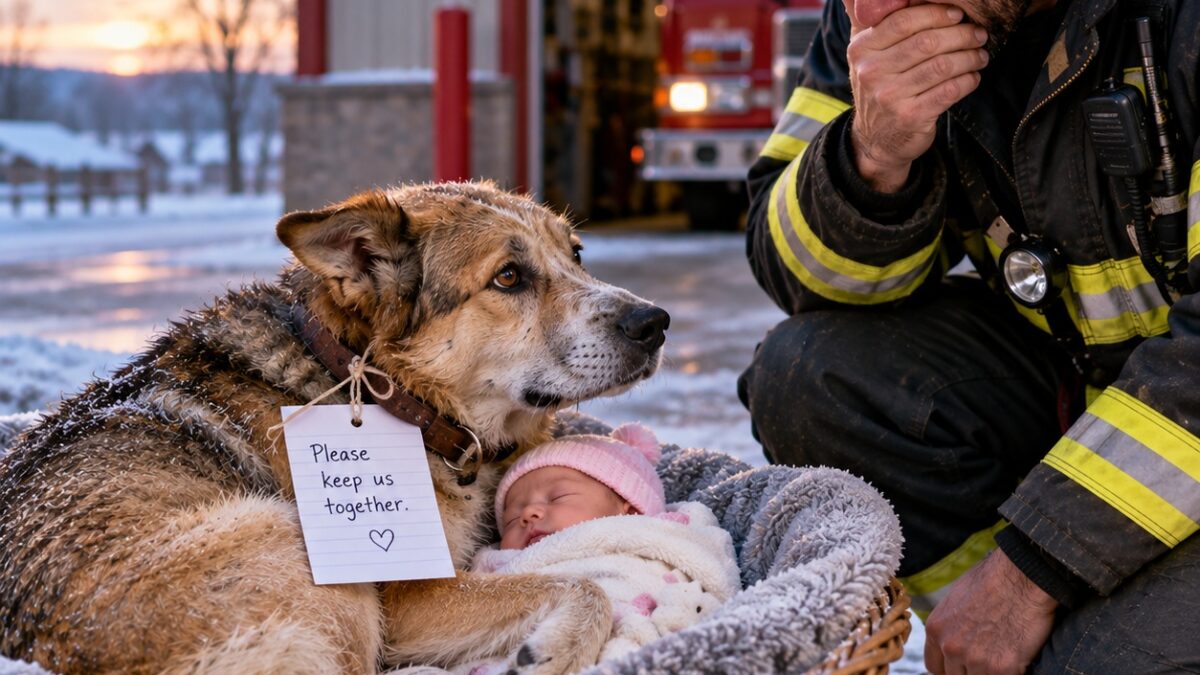
That was when I saw the basket.
Old wicker laundry basket.
Gray blanket.
Sitting directly on the concrete step.
A medium-sized dog was curled inside it.
Sandy brown coat.
White paws.
One ear standing straight up.
The other folded at the tip.
Gray beginning around his muzzle.
He looked part shepherd, part retriever, maybe something else mixed in.
His body was wrapped around the center of the basket so tightly that I initially thought he was protecting a second animal.
Then something moved beneath his chest.
Tiny.
I stopped walking.
“No.”
The dog raised his head.
And underneath him was a baby.
A newborn girl.
She wore a pale yellow knitted sleeper beneath several layers of blankets.
Her face was pink from warmth.
Her breathing looked regular.
Her eyes were closed.
The dog was trembling.
The baby wasn’t.
I knelt slowly.
The dog watched every movement.
He did not bare his teeth.
Did not bark.
Did not move away.
His amber eyes looked exhausted.
Not afraid exactly.
More like relieved.
As though whatever job he had been given had gone on much longer than he thought he could manage, and I was finally the person arriving to relieve him.
“It’s okay.”
My voice sounded strange even to me.
“You did good.”
His head lowered slightly.
That was when I saw the string around his collar.
Kitchen twine.
A folded square of notebook paper tied to it.
My fingers were shaking as I loosened the knot.
The dog stayed perfectly still.
I unfolded the note.
The handwriting was careful but uneven.
And the first line changed everything.
Her name is Ruth.
I kept reading.
Born March 1 at 4:14 in the morning.
Healthy.
Mother sixteen years old.
Too frightened to walk into the station.
The dog’s name was Jasper.
He belonged to her.
He had stayed beside her through everything.
She had tried to send him home.
He refused.
And then the line that made me stop reading:
Please, if you can, keep them together. She sleeps better when he is near her.
I looked down at Jasper.
Then Ruth.
My eyes filled so fast the rest of the handwriting blurred.
Twenty-two years in emergency services.
And I had to sit down on a freezing concrete step because a sixteen-year-old girl had trusted strangers she was too afraid to face with the most important things she had in the world.
Her baby.
And her dog.
PART2
The first thing I did was touch Ruth’s cheek with the back of my fingers.
Warm.
That surprised me.
The temperature outside was brutal.
Jasper’s coat was cold enough that I could feel it immediately, and when I slid my hand beneath his chest, he was trembling harder than I had realized.
Yet the baby beneath him was warm.
He had spent the night using himself as insulation.
“Okay, Jasper.”
His eyes stayed on me.
“We’re going inside.”
I did not want to separate them.
Not yet.
So I lifted the entire basket.
Jasper shifted his weight but did not leave Ruth.
The basket was awkward.
Heavy enough that I had to brace it against my chest.
I talked the whole way through the bay.
“I’ve got you.”
Jasper’s nose moved toward my sleeve.
“You’re okay.”
We reached the station kitchen.
I put the basket on the floor away from the door and grabbed the cleanest blankets we had.
Then I called for an ambulance.
“Newborn infant found outside Station 3. Less than forty-eight hours old, possibly. Exposure risk. Currently breathing normally and appears warm.”
The dispatcher paused for half a second.
Then:
“Repeat. Newborn?”
“Affirmative.”
I looked at Jasper.
“And there’s a dog.”
Another pause.
“A dog?”
“Long story.”
I wrapped a blanket around the outside of the basket.
Then another around Jasper’s back.
Only once we were inside did he slowly uncurl.
He stretched stiffly.
I could finally see Ruth completely.
Tiny face.
Dark hair.
One fist near her cheek.
The umbilical cord had been tied and trimmed.
Whoever had delivered her had done the best they could with almost nothing.
Jasper leaned over and smelled her face.
Then settled his chin across her legs.
I sat on the tile floor beside them.
That image has never left me.
A newborn girl sleeping peacefully.
An exhausted dog guarding her.
And a station kitchen that suddenly felt like the center of the entire world.
The ambulance arrived twelve minutes later.
Longest twelve minutes of my career.
Paramedic Chris Nolan entered first.
Behind him was Tara Shaw.
They both stopped when they saw the basket.
Chris looked at me.
“You weren’t kidding.”
“No.”
Tara crouched immediately.
“Hi, sweetheart.”
She checked Ruth carefully.
Temperature.
Breathing.
Color.
Heart rate.
“Warm.”
I nodded toward Jasper.
“He isn’t.”
Tara touched his back.
Her face changed.
“Oh, buddy.”
We showed them the note.
Chris read it once.
Then again.
“Sixteen?”
“That’s what she wrote.”
They estimated Ruth was less than two days old.
There was no obvious trauma.
No sign of severe cold exposure.
Whoever had wrapped her had used several blankets.
And Jasper had done the rest.
When Tara lifted Ruth out of the basket, Jasper changed instantly.
For the first time, he panicked.
He scrambled upright.
Paws slipping on the tile.
A sharp whine came from him.
Then another.
“Easy,” I said.
He pushed toward Tara.
Not aggressive.
Not threatening.
Terrified.
Tara carried Ruth toward the gurney.
Jasper followed.
Chris blocked him gently.
Jasper tried going around.
Then looked at me.
That look went straight through me.
He had guarded this baby through the night.
Probably longer.
Now strangers were taking her.
He had no reason to understand that this was help.
Tara looked from Jasper to Ruth.
Then back at me.
“We’re not separating them, are we?”
Chris exhaled.
“We can’t put a dog in the ambulance.”
Jasper whined again.
Tara stared at him.
“Apparently we can.”
I called the receiving hospital.
Explained.
There were several minutes of discussion.
Infection-control concerns.
Space.
Policy.
Then somebody higher up was contacted.
Eventually we got a reluctant approval under the circumstances, provided Jasper remained controlled and away from sterile procedures.
So that morning Jasper became the first dog I had ever watched climb onto an ambulance stretcher beside a newborn.
He curled immediately against Ruth.
Stopped whining.
As if that was all he had needed.
The ride to St. Anthony Regional Hospital was roughly sixty miles.
I followed in my truck.
I had no official reason to go beyond transferring the case.
But there was no chance I was staying behind.
During the drive, I kept thinking about the note.
Sixteen.
She had given birth alone.
At least that was what the note implied.
She had walked away from her baby because she believed somebody else could give Ruth a better life.
Whatever people later thought of that decision, I could not get past the terror required to make it.
What had those hours been like?
Who had cut the cord?
Who had wrapped Ruth?
How had Jasper become part of it?
And where was that girl now?
At the hospital, we met Dorothy Hale.
Fifty-six.
Pediatric nurse.
Nearly thirty years in neonatal care.
She had the kind of calm that makes everyone around her lower their voice automatically.
When she saw Jasper beside the bassinet, she raised one eyebrow.
Then somebody handed her the note.
Dorothy read it in silence.
At the end, she looked at Jasper.
Then me.
“He stays.”
That was the entire policy discussion.
Apparently thirty years of neonatal nursing can turn two words into law.
Ruth was admitted for observation.
Testing.
Monitoring.
Evaluation for anything that might have happened during an unattended delivery or outside exposure.
Her condition was remarkably good.
Healthy lungs.
Good oxygenation.
Stable temperature.
Feeding response normal.
There were no obvious signs of injury.
Jasper was examined too.
Dehydrated.
Exhausted.
Cold.
But otherwise healthy.
Estimated seven or eight years old.
No microchip information immediately useful.
Worn collar.
No tags besides the note.
Dorothy arranged a folded blanket beside Ruth’s bassinet.
Jasper ignored it at first.
He stood close to the crib.
Whenever a nurse moved Ruth, Jasper moved.
When someone wheeled the bassinet a few feet, he followed.
When Ruth cried, he stood instantly.
Nose toward her.
Body tense.
Then when she settled, he settled.
By the second night, nurses were calling him “staff.”
A respiratory therapist brought him a biscuit.
Security guards visited on rounds.
One maintenance worker came upstairs just to meet “the baby dog.”
Jasper accepted attention politely.
But his attention never stayed away from Ruth for long.
That was the strange thing.
He liked people.
He allowed touch.
He ate.
He slept.
But Ruth remained the center of his entire map.
If she moved, he moved.
If she cried, he woke.
If she slept, he finally allowed himself to sleep.
Dorothy told me one evening:
“I’ve worked with newborns almost thirty years.”
“I know.”
“I’ve never seen anything like this.”
She looked at Jasper sleeping beside the bassinet.
“That dog thinks she’s his.”
“Maybe she is.”
Dorothy smiled.
“Maybe.”
That was when Pilar Mendoza entered the story.
Thirty-nine.
County social worker.
Fourteen years handling foster placements.
She arrived with a thick folder and the expression of someone already anticipating ten different bureaucratic problems before lunch.
I watched her read the note.
She sat down.
Read it again.
Then crouched beside Jasper.
He sniffed her hand.
“Okay,” Pilar whispered.
“You’re going to make my job difficult, aren’t you?”
Jasper leaned into her fingers.
Pilar laughed softly.
“Of course.”
The first legal problem was obvious.
Ruth was a child entering protective custody.
Jasper was property.
Those systems did not naturally travel together.
Hospitals can make exceptions for a few days.
Foster-placement rules are less flexible.
Insurance.
Animals in homes.
Liability.
Placement licensing.
There were procedures.
Pilar called her supervisor.
I happened to be in the room.
She walked into the hallway but left the door partly open.
“I understand that,” she said.
Pause.
“No, I understand policy.”
Longer pause.
Then quietly:
“I’ve never had a case file where keeping a baby and a dog together felt this important.”
Another pause.
“I’m asking you to let me try.”
That sentence earned my respect forever.
Not because keeping Jasper and Ruth together was automatically more important than every safety rule.
Because Pilar was willing to do the work rather than immediately using policy as an excuse.
For the next two days, she called foster families.
Most had understandable concerns.
Some already had pets.
Some could not add an adult dog.
Others had licensing limitations.
Then she called Brett and Ines Calloway.
Early forties.
Small ranch outside the next town.
Six-year-old son named Caleb.
Two elderly farm dogs.
Chickens.
They had fostered eleven infants over six years.
Pilar began explaining.
Newborn girl.
Healthy.
Likely temporary emergency placement while authorities located family.
Then:
“There is one unusual complication.”
Ines apparently asked what.
Pilar told her about Jasper.
Before she could finish, Ines interrupted.
“The dog comes with the baby.”
Pilar paused.
“Mrs. Calloway—”
“Obviously.”
“You understand we would need to make some additional arrangements.”
“That’s fine.”
“You already have two dogs.”
“They’re old and mostly sleep.”
Pilar later told me she almost cried.
On March 5, Ruth was discharged.
Jasper watched everything.
The car seat.
Blankets.
Paperwork.
Nurses saying goodbye.
Dorothy kissed her fingers and touched them gently to Ruth’s forehead.
Then she hugged Pilar.
Then, unexpectedly, she hugged me.
“You opened the door.”
“No.”
I looked at Jasper.
“He waited at it.”
Jasper rode home with the Calloways in the backseat.
His head rested beside Ruth’s car seat the entire way.
I followed only as far as the hospital parking lot.
Then stopped.
I was not part of the placement.
My role should have ended there.
But stories do not always care where your official role ends.
Pilar kept me updated.
The first night at the Calloway ranch, Brett put a dog bed downstairs.
Apparently a very nice one.
Jasper ignored it.
He lay beside Ruth’s crib.
All night.
Second night too.
Third.
Eventually they stopped trying to relocate him.
The two farm dogs were suspicious at first.
Jasper barely cared.
They sniffed him.
He tolerated it.
Then went back to Ruth.
Caleb, the Calloways’ six-year-old son, became fascinated.
He told classmates that Jasper had “delivered a baby to the fire station.”
Not exactly.
Nobody felt strongly enough to ruin the story for him.
He named Ruth’s stuffed elephant Jasper.
Then started calling the real Jasper “Big Jas.”
Ruth settled into foster life.
Fed normally.
Gained weight.
Slept.
Cried.
Did all the ordinary things newborns do.
Except she had a sandy-brown dog stationed beside her crib.
Pilar described Jasper as a “silent babysitter.”
That sounded about right.
If Ruth cried, he arrived.
If she slept, he stayed nearby.
If somebody picked her up, his eyes followed.
Not possessive.
Watchful.
There was another side to Jasper too.
At night, once Ruth had settled, he finally began seeking attention for himself.
He leaned against Ines’s legs.
Followed Brett outside.
Accepted food from Caleb.
Slowly, he seemed to understand that he had not only delivered Ruth somewhere safe.
He had been included in the safety.
That distinction mattered.
For the first three weeks, nobody knew where Ruth’s mother was.
Police searched quietly.
Hospitals checked records.
Local agencies followed leads.
The note had no name.
No phone number.
No address.
Only details about Ruth and Jasper.
Then Pilar found her.
Sixteen years old.
Exactly as promised.
Her identity stayed private, and it should.
I will not use her name.
What matters is what Pilar later told us with the girl’s permission.
She had given birth alone at home in the middle of the night.
No doctor.
No nurse.
No adult beside her.
Only Jasper.
She had been terrified.
In pain.
Trying to keep quiet.
Jasper stayed next to her through labor.
Paced when she cried.
Lay beside her when she collapsed.
When Ruth was born and started crying, Jasper climbed close to both of them.
The girl said he barely left for nearly a day.
She knew she could not hide a newborn forever.
She also believed she could not raise one.
She was sixteen.
Terrified of her parents.
Terrified of authorities.
Terrified people would hate her.
So she chose the fire station.
Why?
Because when she was younger, firefighters had visited her school.
She remembered being told that if you were lost or scared during an emergency, firefighters were safe people.
That memory survived.
The morning she left Ruth, she wrapped the baby carefully.
Put her in the wicker basket.
Tied the note to Jasper.
Then started walking.
Almost two miles.
Before sunrise.
Freezing cold.
Carrying the basket.
Jasper beside her.
She told Pilar that halfway there, she tried making Jasper go home.
“Go back.”
He wouldn’t.
She pointed.
Ordered him.
He stood beside the basket.
She started walking again.
He followed.
At the station, she put the basket on the front step.
Then she tried taking Jasper with her.
He refused again.
She walked toward the road.
Jasper cried.
Returned to Ruth.
The girl understood.
So she left both.
That part broke me.
Not because she abandoned the dog too.
I no longer saw it that way.
I think she gave Ruth the one protector she trusted completely.
She could not make herself walk through the station door.
But she could leave Jasper.
And she believed Jasper would stay until someone came.
She was right.
When authorities contacted her parents, there was shock.
Fear.
Anger.
Then, according to Pilar, something better eventually emerged.
Support.
Not perfect.
Not instant.
But enough.
The girl chose not to parent Ruth.
After counseling and legal guidance, she agreed to a private adoption plan.
Her parents supported the decision.
There were discussions about relatives.
Long-term placement.
Open versus closed adoption.
The Calloways had not entered the case expecting to adopt.
They had fostered many babies before.
Loved them.
Then watched them return to family or move to permanent homes.
That was what fostering meant.
But Ruth became different.
And Jasper made pretending otherwise nearly impossible.
By the time private adoption became a possibility, Jasper already followed Ruth everywhere.
The Calloways had reorganized their entire house around both of them.
When Pilar raised the possibility, Brett reportedly looked at Ines.
Ines looked at Jasper asleep beside the crib.
Then at Ruth.
And said:
“We’re already their family.”
The biological mother asked for two things.
Not money.
Not control.
One photograph of Ruth each year on her birthday.
And a promise.
Jasper stayed with Ruth for the rest of his life.
Brett and Ines did not negotiate.
“Yes.”
That was it.
The first birthday photograph they sent showed Ruth sitting on a blanket in the Calloways’ yard.
She was round-cheeked.
Laughing.
One hand tangled in Jasper’s fur.
Jasper sat beside her wearing a ridiculous blue bandana Caleb had chosen.
The biological mother kept the photograph.
Pilar later said she cried when she received it.
By the time Ruth began crawling, Jasper had fully embraced his second career.
He followed her slowly.
She would crawl three feet.
Jasper moved three feet.
She changed direction.
He changed direction.
If Ruth headed toward furniture, Jasper sometimes positioned himself beside her.
Nobody trained him.
He simply stayed close.
Once Ruth learned to pull herself upright, she began using Jasper as furniture.
Hand on his back.
Push.
Stand.
Jasper tolerated it with the resignation of an animal who had accepted that dignity was no longer part of his employment contract.
Brett told me:
“That dog has patience I don’t possess.”
Caleb loved them both.
His version of the story continued evolving.
By first grade, Jasper had apparently rescued Ruth from a blizzard, driven an ambulance, and selected their family personally.
At some point Brett tried correcting him.
Caleb responded:
“That’s basically what happened.”
Honestly?
Close enough.
I did not see Ruth regularly.
But every few months, something brought the story back.
A photograph.
A message from Pilar.
A visit from Brett when he came through town.
Jasper growing grayer.
Ruth growing bigger.
And every update carried something ordinary.
That was what I loved.
Ruth hated peas.
Jasper loved them.
Ruth learned to throw food from the high chair.
Jasper’s loyalty intensified significantly during this developmental stage.
Ines claimed the bond had become “economically motivated.”
When Ruth started walking, Jasper developed the exhausted expression of a middle-aged security guard assigned to an unpredictable celebrity.
He followed anyway.
At night, he remained beside her.
Always.
Some habits never changed.
The biological mother finished high school.
That information mattered to me almost as much as Ruth’s updates.
When people first heard the story, some judged her immediately.
How could a mother leave a newborn outside?
That is an understandable reaction.
Leaving a baby outside is dangerous.
The cold alone could have killed Ruth.
If I had arrived later, maybe the outcome changes completely.
But I kept seeing the other part.
Sixteen.
Alone.
Giving birth without help.
Then carrying a newborn nearly two miles through freezing darkness because, somewhere inside her fear, she understood she needed to get Ruth somewhere safer than she could provide.
It was not a perfect decision.
It was a terrified decision.
There is a difference.
And Jasper may be the reason that imperfect decision did not become tragedy.
His body kept Ruth warm.
His presence kept her company.
His whining got my attention.
He stayed exactly where the girl believed he would stay.
Two years passed.
Ruth became loud.
That was the first word Brett used when describing her at two.
“Healthy?”
“Very.”
“Happy?”
“Usually.”
“Jasper?”
“Tired.”
I laughed.
By then Jasper was estimated to be around eight.
Gray spreading farther around his muzzle.
Still healthy.
Still gentle.
Still sleeping beside Ruth’s bed.
She called him “Jas.”
Not Jasper.
Not Big Jas.
Just Jas.
One of her first clear names.
When Ruth woke in the morning, she looked for him.
When she was upset, she sometimes sat against him.
When she got sick with a minor cold, Jasper refused to leave her room for most of the day.
The Calloways no longer talked about “keeping them together.”
There was no need.
No one in the house could imagine separating them.
Then came the first supervised meeting between Ruth and her biological mother.
Pilar arranged it carefully.
Private location.
No reporters.
No social media.
No pressure.
The young woman had grown older.
Still young.
But no longer the terrified sixteen-year-old from the note.
She saw Ruth.
Watched her play.
Cried.
Did not ask Ruth to call her anything.
Did not confuse roles.
The second supervised meeting was the one Pilar told me about in detail.
The young woman brought a gift.
Not for Ruth first.
For Jasper.
A small blue stuffed duck.
When she entered the room, Jasper froze.
His ears lifted.
She sat down on the floor.
For several seconds, nobody moved.
Then Jasper walked toward her.
Slowly.
Smelled her hands.
Her clothes.
Stopped.
And climbed directly into her lap.
A fifty-something-pound dog trying to become a puppy.
He placed his head against her chest.
Closed his eyes.
The girl wrapped both arms around him.
And started crying.
Jasper stayed.
Pilar said the entire room stopped.
Nobody spoke.
No one needed to.
Two years earlier, that girl had tried to make him go home.
Jasper refused.
He stayed with Ruth.
Now he had proof of something he could never have understood that freezing morning.
The girl had survived too.
Maybe dogs remember scent more powerfully than we can imagine.
Maybe voice.
Movement.
Emotional association.
I do not know exactly what Jasper remembered.
But I know what he did.
He went to her.
Immediately.
And rested.
As if one unfinished part of his own story had finally been answered.
The young woman continued moving forward.
School completed.
Plans developing for her own future.
The Calloways kept their promise.
Annual photograph.
Supervised contact under the arrangement everyone had agreed upon.
Nobody pretended the situation had been simple.
It wasn’t.
Ruth would someday ask questions.
Hard ones.
Her adoptive parents knew that.
Her biological mother knew that.
Pilar knew that.
The answer would have to grow with Ruth.
At two, all she needed to know was that she was loved.
Later, she could know more.
That a very young mother loved her enough to understand she needed help.
That fear made some of those decisions dangerous.
That strangers stepped in.
That foster parents became parents.
And that an old sandy-brown dog refused to abandon his assignment.
The fire station received attention after the story spread.
People called us heroes.
I disliked that part.
I opened a door.
That was my contribution.
Technically, I did not even open the door.
I arrived outside one.
Jasper did the hard shift.
He sat in freezing weather.
Kept Ruth warm.
Stayed visible enough for me to hear him.
Let a stranger approach without panicking.
Then trusted us when we took over.
If anyone deserved a medal at Station 3, it was him.
Someone actually sent one.
A cheap little plastic firefighter badge engraved with:
JASPER
STATION 3 HONORARY RESCUE DOG
Brett brought him to the station once so we could give it to him.
Ruth came too.
She was still small then.
I had not held her since the hospital.
Ines passed her to me.
For a moment, I could not speak.
The newborn from the basket had become a solid, healthy little girl grabbing the collar of my station shirt.
Jasper stood beside us.
I looked down at him.
“You remember this place?”
He smelled the floor.
Walked toward the kitchen.
Maybe.
Maybe not.
Dogs do not need our version of memory.
Ruth reached toward him.
“Jas.”
He came immediately.
The entire station went quiet.
Firefighters are sentimental people disguised as people who are not sentimental.
Nobody admits it.
Then someone brought out the plastic badge.
We clipped it to Jasper’s collar.
He shook himself and nearly flung it across the room.
Perfect ceremony.
Brett told me something that afternoon I never forgot.
We were standing outside while Ruth played with Caleb.
Jasper was between them.
Brett looked at his family.
Then said:
“A sixteen-year-old girl walked through freezing darkness carrying her newborn with the only creature she trusted beside her.”
He stopped.
I waited.
“I don’t know how to deserve being trusted with something like that.”
I understood.
“But I’ll spend the rest of my life trying.”
Jasper lay down near Ruth.
Brett looked at him.
“The dog’s helping all of us.”
He was right.
Jasper did not only protect Ruth.
He gave everyone a bridge.
The biological mother trusted Jasper.
Jasper trusted the firefighters.
We trusted the hospital.
The hospital trusted Pilar.
Pilar trusted the Calloways.
The Calloways honored the biological mother’s promise.
Ruth grew up inside that chain of trust.
Not a legal chain.
Not one trapping anybody.
The opposite.
One person handing responsibility to another because no single person could carry everything alone.
I thought about that often.
Especially because people wanted to simplify the story into good people and bad decisions.
Life is rarely that clean.
Was leaving Ruth outside dangerous?
Yes.
Would walking into the station have been safer?
Absolutely.
Should the girl have received medical help during childbirth?
Yes.
Could something terrible have happened?
Easily.
But if we stop there, we miss something important.
The girl knew she needed help.
She found the only way she could emotionally manage to ask for it.
And she chose a place because she believed the people inside would not hurt her baby.
Then she left her most trusted companion behind as protection.
That does not make the decision ideal.
It makes the human being behind it understandable.
I wish she had walked through the door.
I wish someone had been there for her before she ever needed that note.
But I cannot rewrite the beginning.
I can only tell you what happened next.
Ruth lived.
The girl survived.
Jasper stayed.
And enough people chose compassion over judgment that none of them had to disappear.
Dorothy retired not long after Ruth’s first birthday.
At her retirement party, somebody gave her a photograph of Jasper beside Ruth’s hospital bassinet.
She kept it.
When I spoke to her later, she said:
“I’ve held thousands of babies.”
“I know.”
“That one stays with me.”
“Because of Jasper?”
“Because everybody almost separated them.”
She paused.
“We kept thinking like institutions.”
I knew what she meant.
Baby goes to pediatric care.
Dog goes to animal control or shelter.
Mother becomes a social-services case.
Each category handled separately.
Reasonable.
Usually necessary.
But sometimes life arrives in combinations paperwork was not designed for.
Dorothy said:
“You have to know when the relationship itself is part of the care.”
That was Jasper and Ruth.
No, a dog cannot replace medical care.
Or parenting.
Or legal protection.
But the bond mattered.
The nurses saw it.
Pilar saw it.
The Calloways saw it.
And because enough people took that bond seriously, Jasper never became another loss layered onto Ruth’s beginning.
Imagine if he had.
Baby taken one direction.
Dog another.
The girl who wrote the note eventually learns the one promise she begged strangers to keep had been impossible.
Instead, the promise held.
Jasper stayed beside Ruth.
Through the hospital.
Foster care.
Adoption.
First crawl.
First steps.
First words.
First birthday.
Second.
That mattered.
As Ruth grew, Jasper became less intensely vigilant.
He no longer jumped every time she made a sound.
The Calloways joked that he finally trusted them to do part of the work.
But he still checked.
If Ruth cried at night, his head lifted.
If she left a room, he often followed.
If she fell while learning to walk, Jasper usually reached her before an adult did.
He could not pick her up.
Could not assess an injury.
He just stood beside her.
Sometimes that is what comfort looks like.
Presence without solution.
Jasper had mastered that long before any of us met him.
He had been beside the teenage mother during labor.
Beside Ruth in the basket.
Beside the hospital crib.
Beside the foster crib.
Beside the toddler bed.
He could not solve human problems.
He could stay.
That was his gift.
I eventually began thinking differently about the note.
At first, the lines that broke me were:
Please keep them together.
Later, another part became more important.
She sleeps better when he is near her.
Such a simple observation.
The girl had known her daughter for less than two days.
Already she had noticed what calmed her.
That mattered to me.
People sometimes assume placing a child for adoption means absence of love.
The note did not read like absence.
It read like fear mixed with attention.
Ruth sleeps better when Jasper is near.
She knew.
She noticed.
And in the middle of one of the most frightening events imaginable, she tried to preserve that comfort.
Love can coexist with inability.
A person can love a child and still be unable to parent that child safely.
Those truths are uncomfortable together.
Still true.
The Calloways never tried to erase Ruth’s first mother.
They kept the note protected.
Not displayed.
Not turned into decoration.
Stored safely for Ruth.
Someday, when she is old enough, it belongs to her.
So does the full story.
I hope when she reads it, she sees more than abandonment.
I hope she sees a scared sixteen-year-old who wrote down the exact minute she was born because that moment mattered.
4:14 in the morning.
March 1.
Healthy.
Her name is Ruth.
Those are the words of somebody trying to preserve identity.
Trying to say:
This baby existed before you found her.
She has a name.
She has a beginning.
Please take care of what I cannot.
And Jasper.
She made sure people knew his name too.
Not “the dog.”
Jasper.
Her dog.
The one who stayed.
That detail saved him from becoming anonymous.
A name changes the way people think.
The first responders were not dealing with a stray animal beside an abandoned infant.
They were dealing with Jasper, whose role had been explained.
That mattered.
When Pilar negotiated placement, she was not asking a foster family to accept “some dog.”
She could say:
This is Jasper.
The mother asked that he stay.
He has guarded Ruth since birth.
Context transforms responsibility.
Names help carry context.
I am grateful that girl had the presence of mind to write his.
The weather that morning remained one of the hardest parts to remember.
People asked whether Ruth would really have been in danger.
Yes.
Absolutely.
March cold in eastern Oregon is not sentimental.
A newborn cannot regulate temperature like an adult.
Exposure can become dangerous quickly.
Blankets helped.
The basket helped slightly by blocking some wind.
But Jasper’s body was the biggest source of warmth she had.
He curled around her.
Covered her.
Took the cold himself.
When we brought them inside, his body was freezing.
Ruth’s wasn’t.
You do not need to romanticize that to understand what happened physically.
Heat transferred.
He protected her.
Nobody can say exactly how different Ruth’s condition might have been if Jasper had left.
I am glad we never had to find out.
That was why his trembling stayed with me.
At the station, I had looked first at the baby.
Of course I did.
Then touched Jasper and realized what he had spent.
He had given her warmth until someone came.
Dogs do things like that without knowing anyone will ever praise them.
That is important.
Jasper was not being loyal because a camera was present.
Nobody had asked him to become inspirational.
He stayed because whatever existed inside him told him Ruth belonged inside his circle of protection.
That is all.
Humans added meaning later.
Jasper simply stayed.
When the biological mother brought him the blue stuffed duck at the second supervised visit, the Calloways let him keep it.
It became one of his favorite toys.
He did not destroy it.
Which, according to Brett, was unusual.
Jasper was gentle with most things, but stuffed animals sometimes met violent ends.
Not the duck.
He carried it.
Slept near it occasionally.
Again, I cannot tell you whether he connected the object with the girl.
Maybe he just liked the texture.
But everyone who knew the story noticed.
The duck stayed.
Ruth sometimes carried it too.
A small object moving between the dog and child that had been given by the girl who once carried them both through darkness.
Nobody planned that symbolism.
Life created it.
Ruth’s second birthday came with another photograph.
This one made me laugh.
She was standing in rain boots in the Calloway yard.
Mud on both knees.
Hair going every direction.
Jasper beside her.
Gray muzzle larger now.
Both staring at something outside the frame.
Probably chickens.
The caption read:
Two years old and absolutely no respect for authority. Jasper remains her accomplice.
I printed it.
It stays in my locker at Station 3 beside a copy of the original note.
Not the original.
That belongs to Ruth.
Just a copy Pilar gave me.
Sometimes a new volunteer asks why.
I tell the story.
Not constantly.
Station houses already collect enough old stories.
But certain ones should be passed down.
Not because firefighters need to feel heroic.
Because we need to remember people may come to us in ways we do not expect.
Sometimes they walk inside.
Sometimes they call 911.
Sometimes they leave a wicker basket outside because fear stops them ten feet short of the door.
We still have to be ready.
I also tell the volunteers something else.
Do not judge first.
Assess first.
Is the baby breathing?
Warm?
Injured?
Who needs help?
What evidence is there?
What needs preserving?
Judgment can come later, if it belongs anywhere.
That morning, if I had spent my first five minutes angry at whoever left Ruth there, I would have wasted five minutes Ruth deserved.
Emergency work teaches priorities.
Care first.
Narrative later.
Pilar handled the narrative.
Investigators handled the search.
Doctors handled medicine.
I handled the door.
Everyone did a part.
That is why I resist calling Jasper the only hero too.
He was extraordinary.
But his loyalty became a happy story because systems around him eventually worked.
The plumber? Wait, different story. No plumber here. Keep source fidelity. Here, no plumber. Need not mention.
Ruth needed paramedics.
Hospital staff.
Social worker.
Foster family.
Adoption professionals.
Biological family support.
Jasper.
No one person could have done everything.
Good outcomes are often networks.
One link notices.
Another transports.
Another treats.
Another places.
Another stays.
Jasper happened to be the first link we could see.
Maybe the biological mother was actually first.
She made the choice to move Ruth somewhere safer.
Imperfectly.
Dangerously.
But intentionally.
Then Jasper carried the rest until sunrise.
The Calloways once invited me to Ruth’s birthday gathering.
Small family event.
I went.
Ruth was old enough to run by then.
Not fast.
Toddlers never run in straight lines.
She charged around the yard.
Jasper followed at a pace appropriate for an older gentleman who had accepted he would never retire.
At one point Ruth tripped.
Sat hard.
Looked shocked.
Her face crumpled.
Before anyone reached her, Jasper was there.
He stood against her.
Ruth grabbed his fur.
Cried for about twelve seconds.
Then saw something else interesting and stopped.
Jasper waited.
She stood.
Kept going.
He followed.
I watched from the porch.
Ines came beside me.
“You okay?”
“Yeah.”
“You’re doing that thing.”
“What thing?”
“Looking at them like you’re about to cry.”
“I’m not.”
“You absolutely are.”
I laughed.
Maybe I was.
I kept seeing the basket.
My brain placed the newborn Ruth over the toddler running across the grass.
Same child.
The dog looked older.
The girl looked completely different.
But the relationship remained.
That was the part that got me.
I eventually met Ruth’s biological mother once.
Briefly.
Pilar arranged a meeting with everyone’s permission.
She wanted to meet the firefighter who found the basket.
I was nervous.
I do not know why.
Maybe because I had carried resentment early on.
Even while understanding her fear, part of me had wanted to ask:
Why didn’t you just knock?
Why leave her in that cold?
When she walked in, those questions disappeared.
She looked young.
Still.
Much younger than the image my mind had constructed.
She thanked me immediately.
I said:
“You don’t owe me that.”
“Yes, I do.”
“No.”
I looked at her.
“You got Ruth to us.”
Her eyes filled.
“I left her outside.”
“Yes.”
“I could hear people inside.”
I did not know that.
“I was so scared.”
“I know.”
“No, I don’t think anyone can know.”
Fair.
She looked toward Jasper, who was across the room with Ruth.
“He wouldn’t come with me.”
“I read that.”
“I begged him.”
Her voice broke.
“I thought I was losing both of them.”
That sentence changed something inside me.
She had not walked away feeling free.
She had walked away believing she might never see either one again.
She continued:
“I stayed down the road.”
I stared.
“What?”
“Behind some trees.”
“For how long?”
“Until your truck came.”
She had watched from a distance.
Saw me approach.
Saw the basket carried inside.
Then she left.
That detail was not in the note.
It was not part of the original story we knew.
And I will not make more of it than she did.
But it helped me understand.
She had needed proof.
Someone found them.
Then she could go.
I asked:
“Why didn’t you come back?”
She looked at the floor.
“Because then I would have had to be brave twice.”
I had no answer.
Sometimes one sentence explains an entire person.
We sat quietly.
Then Jasper noticed her.
He crossed the room.
Went to her.
She put both hands on his face.
“Hi, old man.”
Jasper leaned against her.
Ruth toddled over too.
For one strange, beautiful moment, all three were together.
The girl who gave birth alone.
The child she entrusted to others.
The dog who connected them.
Nobody claimed the moment meant more than it did.
No sudden reunion.
No reversal of adoption.
No fantasy that complicated decisions could be undone by tears.
Just recognition.
Love can exist without possession.
That was one of the deepest things this case taught me.
The biological mother loved Ruth.
The Calloways were Ruth’s parents.
Jasper loved both.
None of those truths had to cancel another.
People often want relationships to fit one clean box.
Family is sometimes more complicated.
Ruth had a birth mother who wanted her to be safe.
Adoptive parents who raised her.
A foster story woven into adoption.
A social worker who fought for an unusual bond.
A fire station where her life changed.
And Jasper.
Always Jasper.
The dog who did not understand any of the paperwork but somehow fit into every version of the family.
As Jasper aged, the Calloways became more aware of time.
Eight years old is not ancient for every mixed-breed dog.
But gray had spread.
He tired faster.
He still followed Ruth.
Just more slowly.
Brett built a small ramp beside one step because Jasper had begun hesitating in cold weather.
Ruth learned to wait for him.
That moved me.
At first, Jasper adjusted his entire life to Ruth’s pace.
Now Ruth was beginning to adjust to his.
If they went outside, she sometimes stood by the door.
“Jas!”
He came.
She waited.
Then both went.
Relationships mature even when one half is two years old and the other has four legs.
The veterinarian said Jasper remained healthy.
Good heart.
Healthy weight.
Some age-related stiffness.
Nothing alarming.
That was a relief.
Because the promise from the note still hung quietly over everyone.
Keep them together.
The Calloways could not promise Jasper would live forever.
No one can.
What they could promise was that whatever time he had belonged beside Ruth.
They were keeping that.
When his time eventually comes, Ruth will face a loss she may or may not be old enough to fully understand.
I hate thinking about it.
Brett does too.
But love is never made less valuable by the fact it ends physically.
If anything, Jasper’s story proves the opposite.
A freezing night mattered because it was temporary.
He stayed until someone came.
Every later day was more time added.
His job was never to live forever.
It was to stay as long as he could.
He has.
Maybe that is why dogs break us so easily.
They compress loyalty into fewer years than we want.
Then leave us holding all of it.
But Ruth’s story with Jasper will not disappear when he is gone someday.
She will have photographs.
Stories.
The blue duck.
The plastic firefighter badge if Caleb hasn’t lost it.
And the note.
Most importantly, she will have a beginning that is not simply:
My mother left me outside.
It is:
My mother carried me through the freezing dark because she believed firefighters would help.
Her dog refused to leave me.
He kept me warm.
A fire chief heard him.
People came.
A family opened their home to both of us.
That is a different inheritance.
Not easier.
But fuller.
Context matters.
Someday Ruth may feel abandoned.
She may feel grateful.
Angry.
Curious.
Loved.
All at once.
She will be entitled to every one of those emotions.
Nobody should dictate the correct interpretation of her own beginning.
What we can give her is truth.
All of it.
The frightening parts.
And the loving parts.
Jasper belongs to both.
He was there when things were frightening.
He stayed long enough to become part of the loving part too.
I drive into Station 3 before sunrise all the time.
Same parking lot.
Same bay doors.
March mornings still freeze.
Sometimes frost covers the concrete where the basket once sat.
I always notice.
Not dramatically.
I do not stop and stare every shift.
Life moves.
Alarms come.
Trucks need checks.
Coffee needs making.
But every now and then I hear a sound outside and remember.
Soft whining under wind.
I remember walking around the corner.
Seeing wicker.
Seeing fur.
Seeing that tiny yellow sleeper.
And those exhausted amber eyes looking up at me.
I used to think Jasper looked like he trusted me immediately.
I am no longer sure.
I think he was simply out of options.
Maybe trust came later.
When I lifted the basket and did not hurt Ruth.
When the paramedics kept them together.
When the hospital made him a bed.
When Pilar fought for placement.
When Ines said:
“The dog comes with the baby.”
Maybe trust is not the moment someone asks for help.
Maybe it is what happens after.
Do people do what they said?
Do they come back?
Do they protect what you handed them?
By that measure, the promise was kept.
Ruth was protected.
Jasper was protected.
The girl’s privacy was protected.
The Calloways became permanent.
The yearly photograph arrives.
The visits happen under careful supervision.
Nobody got everything they might have dreamed of.
But everybody got a future.
That is more than I thought possible while sitting on the station floor that morning.
I remember looking at Ruth and thinking only about the next hour.
Hospital.
Temperature.
Assessment.
Locate mother.
I never imagined birthdays.
Mud boots.
Stuffed ducks.
First steps.
I never imagined a six-year-old telling his teacher the dog delivered a baby.
I never imagined Jasper sleeping beside a toddler bed two years later.
Emergency responders rarely get to see what happens after.
We meet people during the worst ten minutes of their lives.
Then hand them to somebody else.
Most disappear from our world.
Maybe that is necessary.
You could not do this work if every call came home with you.
But Ruth and Jasper did.
Not physically.
As a story.
As a reminder.
The worst moment can be an opening too.
Not because tragedy is good.
Because people can answer it well.
That morning contained fear.
Risk.
Abandonment.
Cold.
But it also contained a dog using his body to warm a newborn.
A girl choosing a fire station because some childhood memory told her firefighters were safe.
Paramedics deciding compassion mattered.
A neonatal nurse willing to bend routine.
A social worker willing to fight paperwork.
A foster mother saying yes before hearing the whole complication.
An adoptive father promising to spend his life deserving trust.
None of those things erase the danger.
They answer it.
That is what I remember most.
Not that Ruth was left.
That people kept picking her up afterward.
Jasper first.
Then me.
Then Tara.
Dorothy.
Pilar.
Brett and Ines.
Again and again.
Until eventually there was nowhere else she needed to be carried.
She was home.
Jasper understands none of those words.
Fire chief.
Social worker.
Foster placement.
Private adoption.
Custody.
Supervised contact.
He never signed anything.
Never testified.
Never attended court.
He understood one thing before every professional involved did.
The baby needed someone beside her.
So he stayed.
On a freezing concrete step.
In an ambulance.
Beside a hospital bassinet.
Next to a foster crib.
Alongside a crawling infant.
Behind a toddler learning to walk.
At the edge of a bed every night.
That kind of loyalty looks almost supernatural when humans describe it.
To Jasper, maybe it was simple.
Ruth was there.
So he was there.
Sometimes I think the best people are trying to make life that simple too.
Someone needs help.
Stay.
Someone is scared.
Stay.
A frightened sixteen-year-old cannot walk through the door.
Do not spend your first moment condemning her.
Help the baby.
Then find the girl.
Stay long enough for both.
A newborn cannot explain why a dog matters to her.
Pay attention anyway.
Stay.
A foster family is asked to take on one more complication.
Make room.
Stay.
Maybe that is what all of us learned from Jasper.
Not heroism.
Presence.
The night he guarded Ruth was dramatic because of the weather and the danger.
The next two years mattered because he kept doing the same quiet thing after the emergency was gone.
He stayed.
That is much harder.
And much more important.
Ruth is two now.
Healthy.
Curious.
Loud enough that Brett jokes the neighbors can hear her learning new words.
Jasper’s muzzle is grayer.
He still sleeps beside her bed.
The biological mother is moving forward with her own life and receives proof every year that the child she once carried through darkness is safe.
The Calloways are raising Ruth knowing that her story began before them and does not need to be erased to make them her parents.
Pilar still gets updates.
Dorothy still asks about Jasper.
And at Station 3, I still have that photograph in my locker.
Ruth in rain boots.
Mud on her knees.
Jasper beside her.
Sometimes I compare it with my memory of the basket.
I always come back to the same detail.
That freezing morning, Jasper’s body was cold.
Ruth’s was warm.
He had spent whatever warmth he had protecting her.
And somehow that old dog became the first promise in Ruth’s life that somebody would stay.
A promise a frightened sixteen-year-old wrote down on notebook paper because she was too scared to say it out loud.
Please keep them together.
We did.
And every night, when Ruth falls asleep and Jasper settles beside her bed, that promise is still being kept.








