PART2:A Dog Dragged a Bag Into the Middle of the Road and Wouldn’t Let Me Pass—What He Led Me to in the Woods Still Haunts Me
PART2
The ground inside the trees was slick.
Recent rain had darkened the soil and softened the trail until my shoes sank slightly with every step.
Branches dripped onto my jacket.
Wet leaves clung to my pants.
The dog moved ahead of me with the bag between his teeth.
Not fast.
He could not.
The bag was heavy enough that one side kept catching on roots.
Whenever it snagged, he would pull harder.
If it refused to move, he released it, repositioned his teeth, and tried again.
Then he would turn around.
Always turn around.
Checking.
Are you still there?
At first, I stayed fifteen or twenty feet behind him.
I did not know this dog.
Did not know whether pain or fear could make him unpredictable.
But the farther we went, the more obvious it became that he had no interest in threatening me.
He needed me.
That was different.
“Where are you taking me?”
He stopped.
Dropped the bag.
Panted.
His sides moved rapidly.
He looked exhausted.
I crouched several feet away.
“You’ve been doing this a while, haven’t you?”
His tongue hung out.
He looked back toward the way we had come.
Then deeper into the woods.
I reached toward the bag.
He immediately grabbed the handle again.
Not growling.
Protecting.
“No?”
He pulled it toward himself.
“All right.”
I backed off.
“Your bag.”
He resumed walking.
I followed.
The silence after rain in a forest can be deceptive.
Everything feels peaceful.
Muted.
But that day I kept feeling watched by the trees, because I knew there was a reason this dog had been working so hard to bring that bag to the road.
Every few minutes, doubt came back.
What if I was wrong?
What if the dog belonged to someone nearby and had simply stolen a bag?
What if I was following him in circles?
What if I should go back and call somebody?
Each time I slowed, he noticed.
He would stop.
Look at me.
Then at the path ahead.
And wait.
That stare pulled me forward every time.
I do not know how long he had been trying before I arrived.
Hours?
All night?
The mud on the bag suggested distance.
One side was torn.
Leaves and twigs clung to the zipper.
The dog’s mouth was red around the gums from gripping the handle.
When he released it to breathe, he sometimes shook his jaw as if it hurt.
Still he picked it up again.
That detail bothers me even now.
Whatever was inside that bag mattered enough to him that pain had become secondary.
We went deeper.
The road sounds disappeared.
The ground became uneven.
Small rocks.
Roots.
Low branches.
The dog began slowing.
Twice, the bag slipped from his mouth entirely.
The second time, he stood over it breathing hard.
I moved closer.
“Let me carry it.”
He watched me.
I reached slowly.
My fingers touched the handle.
The dog did not snap.
But he picked it up again before I could.
“Stubborn.”
His ears lifted slightly.
I almost smiled.
Then he turned and continued.
Several minutes later, the woods opened into a small patch where the ground looked disturbed.
The dog stopped so suddenly I nearly walked into him.
He dropped the bag.
Then began digging.
Not casually.
Frantically.
Paws scraping wet earth.
Leaves flying behind him.
“Hey.”
He ignored me.
He dug beside what looked like an ordinary depression hidden beneath branches and dead leaves.
I stepped closer.
Then froze.
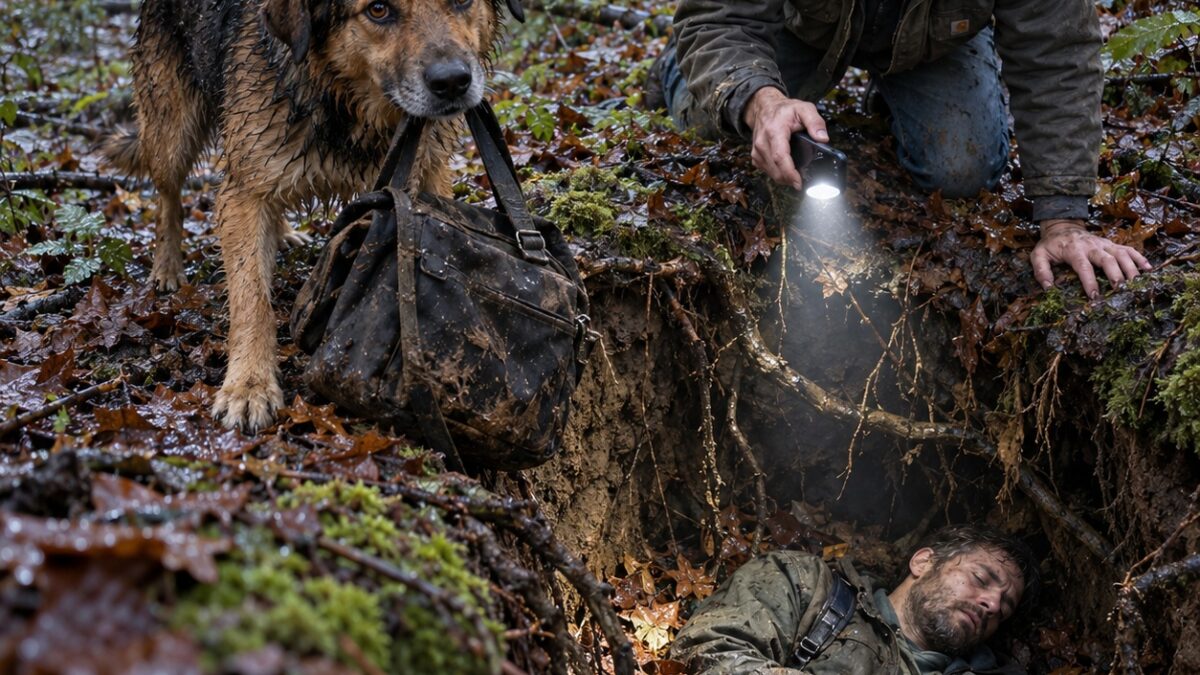
The depression was not shallow.
It was a hole.
Deep.
Partially concealed.
The kind of thing someone could step into without seeing until it was too late.
My stomach tightened.
The dog stopped digging.
Looked down.
Then at me.
I moved to the edge and pushed aside branches carefully.
At first I saw dirt.
Then fabric.
A jacket sleeve.
A hand.
“Oh my God.”
I dropped to my knees.
There was a man at the bottom.
He lay twisted on one side.
Still.
His face pale.
A dark wound near his forehead.
For one terrible second I thought he was dead.
“Sir!”
Nothing.
I shouted louder.
“Can you hear me?”
No movement.
The dog stood beside me.
All the barking stopped.
That was almost worse.
He simply looked down at the man.
Then at me.
Silent.
Waiting.
The entire story suddenly rearranged itself.
The bag.
The road.
The dog refusing to leave.
He had not wanted help for himself.
He had been trying to bring someone here.
I pulled out my phone.
Signal weak.
One bar.
I stood.
Moved several feet.
Two bars.
I called emergency services.
“My location is in the woods off the county road.”
The dispatcher asked questions.
Was the man breathing?
I did not know.
Could I reach him safely?
Maybe.
Was there danger from the dog?
“No.”
I looked at him.
“No, the dog brought me here.”
A pause.
“The dog?”
“He led me to him.”
I gave the best location information I could.
The dispatcher told me help was coming.
Twenty minutes, maybe less.
Twenty minutes suddenly sounded enormous.
I returned to the edge.
The man had not moved.
The dog whined once.
I looked at the slope.
Loose soil.
Not ideal.
But possible.
“I’m going down.”
The dispatcher was still on speaker.
“Sir, do not put yourself at unnecessary risk.”
“I can reach him.”
“Move carefully. Avoid moving his spine unless necessary.”
I lowered myself.
Hands against roots.
Shoes sliding.
Dirt crumbling.
The dog stayed above.
Watching.
I reached the bottom.
The man’s chest moved.
Barely.
Relief hit me so hard I almost laughed.
“He’s breathing.”
The dispatcher’s voice answered:
“Good.”
I touched the man’s neck carefully.
Could feel a pulse.
Weak.
But there.
His skin was cold.
The wound on his head had dried blood around it.
“Sir?”
No response.
I took off my jacket and covered his torso.
Tried to position him as safely as possible without twisting him.
The dog moved along the edge above us.
Every step matched mine.
When I shifted closer to the man’s head, the dog did too.
When I touched the man’s shoulder, the dog leaned down.
“You’re watching me, huh?”
He sat.
For the first time since I saw him on the road, he was still.
As though finding someone else who understood the emergency had finally allowed him to stop.
I told the man:
“Help is coming.”
His eyelids moved.
I leaned closer.
“Can you hear me?”
A sound.
Barely.
Not a word.
Enough.
I looked up.
The dog’s ears were forward.
“He’s alive.”
The dog lowered his head.
I cannot prove that he understood the sentence.
But his body changed.
The rigid tension in his shoulders softened slightly.
I stayed near the man.
Kept talking.
Not because he responded.
Because I wanted him to hear another human voice if he was conscious somewhere beneath the injury.
“You’re not alone.”
That sentence felt important.
I had no idea how long he had been down there.
Hours.
Maybe through the night.
Cold earth.
Rain.
No way to climb out.
Maybe he had called for help until his voice failed.
Maybe the dog had stayed beside him first.
Then realized staying was not enough.
The thought hit me suddenly.
The bag.
It was still above.
I looked at it.
Why the bag?
Why would a dog waste strength dragging luggage through the woods when he could simply run to the road?
I asked the dispatcher if I could check it.
“Yes, if you can safely.”
I climbed partway back up.
The dog stood.
I reached the top.
This time when I touched the bag, he did not grab it away.
That stopped me.
Maybe because the mission had changed.
Someone had followed.
He no longer needed to carry it.
I unzipped the bag.
Personal items.
Water bottle.
Wallet.
Small towel.
A few things someone might take during a walk.
Then, inside a side pocket, a medication container.
I pulled it out.
Read the label.
Heart medication.
I stared.
Everything clicked into place in my mind.
Or at least a possible version did.
The man had been walking with his dog.
He fell.
Hit his head.
Lost consciousness.
The dog stayed.
Could not pull him out.
Could not call.
But somewhere in that dog’s experience, the bag mattered.
Maybe his owner reached into it regularly.
Maybe the dog associated it with medication.
Maybe simply with the man.
Maybe the dog had no concept of medicine at all and only knew the bag belonged to his person and that bringing it would make strangers understand.
I cannot know exactly what the dog thought.
But I knew what he did.
He dragged that bag through the woods.
To the road.
And waited.
Then, when a car stopped, he made sure the person followed him back.
That alone was astonishing enough.
I brought the medication container down far enough to tell the dispatcher the name.
She noted it for the responders.
The dog stayed close.
He did not bark anymore.
I sat again near the man.
His breathing remained steady.
Occasionally his face tightened as if pain found him even while unconscious.
I covered him better.
The dog lay at the edge of the hole.
Head between his paws.
Eyes on his owner.
“You did everything.”
I said it quietly.
“You did your part.”
One ear moved.
“You hear me?”
Nothing.
“You found somebody.”
I pointed at myself.
“Not the smartest somebody, maybe.”
The dog blinked.
“But somebody.”
I sat there in wet dirt with an unconscious stranger below me and a mud-covered dog above me, and for some reason I nearly cried.
Because I suddenly understood how long the dog might have been working before I arrived.
Dragging.
Waiting.
Trying.
Cars may have passed.
Maybe none stopped.
Maybe he had run back to his owner and then out again.
Maybe he had spent the entire night between that hole and the road.
No food.
No rest.
No certainty.
Only one thing:
Do not leave him.
That is devotion stripped down to action.
We heard rescuers before we saw them.
Voices through the trees.
The dog stood immediately.
Barked.
Once.
Then again.
The rescuers answered.
“Over here!”
I shouted.
Within minutes, the quiet forest became organized movement.
Medical bags.
Ropes.
Equipment.
Questions.
One responder climbed down.
Another secured the area.
The dog tried to get close.
“Easy.”
A paramedic moved him back.
The dog resisted.
Not aggressively.
He simply refused to leave the man’s head.
I climbed out.
Took hold of his collar gently.
“It’s okay.”
He looked at me.
“They’re helping him.”
He tried to step forward again.
I stayed beside him.
“Let them.”
The paramedics evaluated the man.
Head injury.
Cold exposure.
Weak pulse.
Possible cardiac issue complicated by the fall.
They did not speculate much in front of me.
They worked.
That professionalism calmed me.
The dog watched everything.
When they fitted a cervical collar around his owner’s neck, he whined.
When they transferred the man to a stretcher, he moved closer.
One medic said:
“Can somebody hold the dog?”
“I’ve got him.”
I crouched.
The dog pressed against me.
Hard.
As if my body had become the only fixed object in a world changing too quickly.
They lifted the man out.
The dog followed every inch.
Once the stretcher reached flat ground, he broke from me.
Not violently.
Slipped forward.
Went straight to the man’s head.
One medic tried to redirect him.
I said:
“Wait.”
The dog put his head against the man’s chest.
Just rested it there.
Everyone stopped.
Only for a second.
But they stopped.
I watched the dog’s body.
He was feeling something.
Heartbeat?
Breathing?
Smell?
Familiar warmth?
I do not know.
He stayed there.
Then his tail moved.
One slow motion.
The paramedic looked at me.
“Okay.”
They continued.
The dog walked beside the stretcher all the way to the ambulance.
He tried to climb in.
The medic looked at him.
Then at me.
“He yours?”
“No.”
“Family?”
I almost said no.
Then looked at the dog.
“Yes.”
The medic understood.
They made arrangements to keep him with his owner as much as safely possible.
I followed to the hospital.
I do not know why.
Maybe because after the road and the woods, leaving before knowing the ending felt impossible.
In the hospital courtyard, the dog paced.
The smell of antiseptic and strange people made him anxious.
He watched every door his owner disappeared through.
I sat beside him.
“You’re waiting again.”
He leaned against my leg.
“You’re really good at that.”
Eventually someone came out.
The man was alive.
Stable enough for treatment.
The immediate danger had eased.
I exhaled for what felt like the first time all day.
“What about the dog?”
I asked.
The staff member smiled.
“He hasn’t exactly given us a choice.”
Later, they allowed him near the bed.
I stood at the doorway.
The man remained unconscious or heavily sedated.
Machines nearby.
Blanket pulled up.
The dog entered slowly.
No barking.
No frantic movement.
He approached the bed.
Sniffed the man’s hand.
Then lay down at the foot.
That was it.
The dog who had dragged a bag through wet woods, waited beside a road, led a stranger back to a hidden pit, and refused to leave while paramedics worked finally closed his eyes.
He slept.
Deeply.
His body almost collapsed into the floor with exhaustion.
I stood there looking at him.
For the first time, he was not watching.
Not checking.
Not carrying.
Not trying to solve anything.
His person was alive.
Other humans had taken over.
He could finally stop.
I drove home that evening in silence.
No radio.
No phone.
The road looked exactly as it had that morning.
Gray sky.
Wet trees.
Ordinary.
I slowed at the place where I had first seen the dog.
There was nothing there now.
No bag.
No barking.
No animal in the middle of the lane.
But I could still see him.
Dragging.
Dropping.
Looking at me.
Follow me.
I kept driving.
That night, I thought about how strange loyalty can look from the outside.
If I had seen only the bag, I might have thought the dog was playing with something.
If I had seen only him standing in the road, I might have assumed he was lost.
If I had tried to chase him away for safety, maybe he would have gone back into the woods alone.
Instead, he found a way to make a human participate in his emergency.
He had no words.
No phone.
No way to explain:
My owner is hurt.
He is in a hole.
He cannot get out.
Please come.
So he did the only things available to him.
Carry.
Bark.
Wait.
Lead.
Check.
Repeat.
That was enough.
A few days later, I went back to the hospital.
I had told myself I wanted to return the bag.
Mostly I wanted to see them.
The man was awake.
Sitting propped up.
Bruise across his forehead.
Tired face.
Dog beside the bed.
The moment the dog saw me, he stood.
Tail moving.
I laughed.
“There you are.”
The man looked between us.
“You’re the one.”
“I guess.”
He extended a hand.
I shook it.
His grip was weak but warm.
“They told me what happened.”
I glanced at the dog.
“He did most of it.”
The man’s eyes filled.
“That sounds like him.”
The dog placed his chin on the mattress edge.
I sat.
“What do you remember?”
The man looked toward the window.
“Walking.”
He spoke slowly.
“The weather was changing.”
He and the dog had gone into the woods on a route they knew.
Ground slippery.
He stepped wrong near the hidden pit.
Fell.
Hit his head.
After that, fragments.
Pain.
Cold.
The dog above him.
Then darkness.
“When I woke up…”
He stopped.
His hand moved toward the dog.
“The first thing I saw was him.”
The dog’s tail moved against the floor.
“I thought maybe I was dreaming.”
He stroked the dog’s head.
“He was still there.”
I told him about the road.
The bag.
His face changed.
“He carried the bag?”
“Yes.”
“All the way?”
“I don’t know where he started carrying it, but he brought it to the road.”
The man looked down.
For a long time, he said nothing.
Then:
“My medication.”
“I found it.”
He closed his eyes.
“That bag always comes with us.”
“Maybe he knew.”
“I take the pills during long outings.”
He rubbed one hand over his face.
“He watches everything I do.”
I did not want to overstate what the dog understood.
Still, the connection was impossible to ignore.
Maybe he knew the bag mattered because his owner used it constantly.
Maybe he had seen the man take medication from it hundreds of times.
Maybe he simply knew it belonged to him and humans might recognize the significance.
Whatever the mental process, the result had been lifesaving.
The man began crying quietly.
The dog stood.
Pressed closer.
“I thought I was going to die down there.”
His voice cracked.
“I remember thinking…”
He stopped.
I waited.
“That nobody knew where I was.”
The dog licked his wrist.
The man laughed through tears.
“I was wrong.”
No.
Someone knew exactly where he was.
He just did not have human language.
I left them alone after that.
Walking out of the hospital felt different than walking in.
Something had shifted inside me.
I had always liked dogs.
Respected animals.
Thought of loyalty as one of those words people use because it sounds good.
That day gave the word weight.
Loyalty was not the dog sitting beside a healthy man in a warm house.
That is companionship.
Beautiful, but easy.
Loyalty was staying beside a hole in cold rain when the person you loved could no longer respond.
Loyalty was realizing staying was not enough.
Leaving the person you wanted to protect because help existed somewhere else.
Dragging something heavy because maybe it mattered.
Waiting beside a road while car after car might pass.
Trusting the first stranger who finally stopped.
Then turning around and leading that stranger back.
That last part is what affected me most.
The dog had to leave his owner to save him.
Think about that.
Every instinct may have told him to stay.
Guard.
Wait.
But staying would not get the man out.
So the dog did something harder.
He left.
Found the road.
And refused to let the connection break.
That changed how I understood devotion.
Sometimes love is staying.
Sometimes love is leaving long enough to bring help back.
Weeks later, I drove that road again.
I slowed without thinking.
The forest entrance was just another patch of trees.
Rain had dried.
Leaves had changed.
Nothing visible marked what happened there.
I pulled over.
Not because I needed to.
Because memory made me.
I stood near the shoulder.
The same place where the dog had once dropped the bag.
I tried to imagine how long he waited.
Maybe ten minutes.
Maybe hours.
The original story people later told assumed all night.
Perhaps that is true.
His exhaustion certainly suggested he had worked far longer than I witnessed.
But I will never know.
Sometimes not knowing makes things hurt more.
How many times did he hear an engine and stand?
How many cars kept going?
How many times did he drag the bag farther toward the road because he thought humans were not seeing it?
Was I the first person to stop?
I hope so.
Because imagining him watching others drive past is difficult.
I stood there until a car approached.
Then moved safely off the shoulder.
The driver probably thought I was strange.
Maybe I was.
After that day, I started noticing animals near roads differently.
A dog alone no longer automatically meant stray.
An animal pacing no longer meant random behavior.
Sometimes there is context you cannot see.
Sometimes urgency wears fur.
I am not suggesting people should follow every unfamiliar animal into the woods without thinking about safety.
That would be foolish.
But I do believe attention matters.
Look twice.
Notice behavior.
Ask why.
There are moments when somebody unable to speak may be trying very hard to tell you something.
That dog was.
Months passed.
I heard the man recovered.
Not instantly.
The fall and medical issues took time.
But he went home.
The dog went with him.
Exactly where he belonged.
Someone sent me a photograph later.
The two of them outside.
The man seated.
Dog pressed against his leg.
The bag rested nearby.
That detail made me laugh.
Still the bag.
Probably never allowed out of sight again.
I kept the photograph.
Not because I wanted credit.
I did not.
The dog deserved every ounce of credit people tried to hand me.
I stopped a car.
That is all.
He did everything required to make stopping matter.
Sometimes people who heard the story called me a hero.
I always corrected them.
“No.”
The hero was muddy.
Four-legged.
And extremely stubborn.
They laughed.
I did not.
Because I meant it.
Heroism is a dangerous word if we make it too grand.
We start imagining heroes are a different category of being.
Braver.
Stronger.
Born for dramatic moments.
Then we excuse ourselves from ordinary responsibility because we do not feel heroic.
The dog taught me another version.
He did not know he was being heroic.
He knew someone he loved needed help.
That simplified everything.
No speech.
No analysis.
No reward.
Need.
Action.
That is all.
I wonder sometimes what he thought when I first stepped out of my car.
Relief?
Suspicion?
Maybe:
Finally.
Maybe nothing that complicated.
But he understood enough to test me.
Step toward human.
Move bag.
Look back.
If human follows, continue.
If human does not, return.
He built a bridge between species using repetition.
That fascinates me.
Language is not only words.
Urgency has grammar.
Direction has grammar.
Eyes can become instructions.
I had never experienced that before.
The dog said:
Come.
Without sound.
Then:
Not here.
Farther.
Then:
Here.
Look down.
Then once I reached the man:
Stay.
Help.
He stopped barking.
Mission transferred.
I think that is why his silence at the hole affected me more than all the noise on the road.
He had spent every available signal trying to recruit me.
The moment I understood, he became quiet.
He no longer needed to convince.
He could watch.
Trust.
I do not know if he trusted me because I followed or because desperation left no alternative.
Either way, I felt the responsibility.
Someone had handed me the problem.
A dog.
No words.
And somehow I understood.
That is rare.
We misunderstand humans who speak constantly.
Yet that morning, an animal communicated enough to save a life.
The heart medication remained part of the story people loved most.
“The dog knew the medicine was in the bag.”
Maybe.
I am careful when I tell it.
I cannot prove exactly what he knew.
He may have associated the bag with his owner.
With walks.
With food.
With pills.
With help.
Dogs build patterns.
Maybe the bag smelled intensely like the man.
Maybe it was simply the only object available that he could carry.
I do not need to turn him into a doctor to make the act extraordinary.
What he knew for certain was simpler:
The man was not moving.
Humans existed near the road.
The bag belonged with his person.
Somehow, he had to make the two worlds meet.
He succeeded.
That is enough.
I visited them one more time after the man left the hospital.
At home.
The dog recognized my car before I reached the porch.
I heard barking.
Then saw him through the window.
The door opened.
He came out.
Straight toward me.
Not desperate this time.
Happy.
That difference nearly broke me.
Same dog.
Same bark.
No emergency underneath it.
He reached me.
Tail going.
I crouched.
“Hey.”
He put his paws against my knees.
I rubbed both sides of his face.
“You’re a lot calmer when nobody’s in a hole.”
The man laughed from the doorway.
“He still watches me like I’m going to fall into another one.”
Good.
Someone had learned.
Inside the house, the dog stayed close to him.
Not anxiously.
Naturally.
Wherever the man sat, the dog chose somewhere nearby.
The infamous bag hung by the door.
I pointed.
“You kept it.”
The man smiled.
“He won’t let me leave without it.”
“Smart dog.”
“He was always smart.”
Then the man became quiet.
“I just didn’t know how much.”
We sat.
He told me recovery had been tiring.
Some days frustrating.
But every morning the dog appeared beside the bed.
Same eyes.
Same presence.
“He checks me.”
“How?”
“Nose against my chest sometimes.”
I laughed.
“He’s monitoring your heart.”
The man smiled.
“Wouldn’t surprise me.”
The dog rested his head on the man’s knee.
That picture told the whole story.
I had seen the same head resting on his chest beside the stretcher.
Then at the hospital bed.
Now home.
Continuity.
That dog had carried the relationship across every location.
Forest.
Road.
Hospital.
Home.
Never stopped.
When I left, the man walked me outside.
The dog came too.
I said:
“Don’t follow me this time.”
The dog sat.
Tail moving.
I opened my car.
Then looked back.
He remained beside his owner.
Exactly where he should.
That gave me peace.
The last thing I wanted was for the dog to associate me with another emergency.
Let me become boring.
A visitor.
The stranger who once followed.
That was enough.
Driving away, I looked in the mirror.
The dog was still sitting beside the man.
I smiled.
Years from now, if I forget other things about that period of my life, I do not think I will forget that road.
Clouds.
Wet pavement.
Dog.
Bag.
The way my feet initially felt rooted when I stepped from the car.
I did not want to enter the woods.
That is an important part.
Courage is often told backward.
Afterward, the right decision feels inevitable.
It was not.
I hesitated.
I doubted.
I wondered whether I was being stupid.
Then I looked at the dog.
Followed.
That one choice placed me at the edge of a hole where a man was still breathing.
If I had not—
No.
I do not spend much time there anymore.
What-if is a bottomless pit of its own.
I prefer what happened.
The dog kept trying.
I stopped.
Emergency services came.
The man lived.
That is enough.
Still, the experience changed the speed at which I dismiss things.
A strange situation gets one more second now.
A person standing beside a disabled car.
An animal behaving unusually.
A noise.
A gesture.
I pay attention.
Not because every moment hides a rescue story.
Most do not.
Because attention is cheap until the instant it becomes priceless.
That morning, it cost me a few minutes to stop.
Those minutes became a life.
Not because I was special.
Because the dog had done all the hard work before I arrived.
Maybe that is why I feel gratitude more than pride.
I was lucky enough to be useful.
That is different from being heroic.
The dog gave me the chance.
I followed.
Today, when I tell the story to my children, and someday maybe grandchildren, I do not begin with:
I saved a man.
Because that is not true.
I begin with:
A dog stopped me.
He carried a bag.
He would not let me leave.
Because that is the truth.
The dog saw the emergency before anyone else.
Stayed.
Thought.
Acted.
Endured.
And when his own abilities reached their limit, he found someone who could do the next part.
That may be the most intelligent kind of help there is.
Know when you cannot solve something alone.
Find someone.
Bring them back.
People struggle with that.
We take pride in doing everything ourselves.
We stay trapped in holes because asking feels like failure.
The dog had no such pride.
His loyalty was practical.
My person needs help.
I cannot do this.
Find somebody.
I have remembered that in my own life.
Sometimes love is not fixing.
It is fetching help.
Sometimes devotion is not standing guard forever.
It is being willing to leave the person you love for twenty minutes because staying would not save them.
That dog taught me both.
I still pass the road occasionally.
The weather changes.
Spring.
Summer.
Autumn.
Rain again.
The forest looks ordinary.
That is strange.
Places where life nearly ends do not wear signs afterward.
They remain roads.
Trees.
Ditches.
People drive past without knowing.
I know.
Every time I reach that section, I slow slightly.
Not dangerously.
Just enough.
And for one second I can see him again.
Bag in his teeth.
Body exhausted.
Eyes fixed on me.
Please.
Follow.
I did.
I am grateful I did.
Because at the end of that muddy trail was a man who still had a heartbeat.
And beside him was proof that love does not need human language to become action.
The dog could not explain fear.
Could not tell me how long he waited.
Could not tell paramedics what medication his owner took.
Could not describe the fall.
But he carried what he could.
Led where he could.
Waited as long as he had to.
Stayed when staying mattered.
Moved when moving mattered.
And when his owner was finally safe in a hospital bed, he curled at the foot of that bed and slept.
That last part is still my favorite.
Not the dragging.
Not the barking.
Not the rescue.
Sleep.
Because sleep meant he finally believed someone else was watching.
He could stop.
That is what safety gives us.
Permission to close our eyes.
For however many hours he had spent before finding me, that dog had carried the entire emergency alone.
Then I stopped.
Then medics arrived.
Then doctors took over.
And at last, the responsibility left his shoulders.
He slept.
I hope every loyal creature eventually gets that moment.
The moment when someone else says:
I’ve got it now.
You can rest.
That dog earned his.
And I was lucky enough to be there when he finally did.








