PART2:A Delivery Driver Was Supposed to Drop Off a Package and Leave—Then He Saw 11 Dogs Chained in the Yard
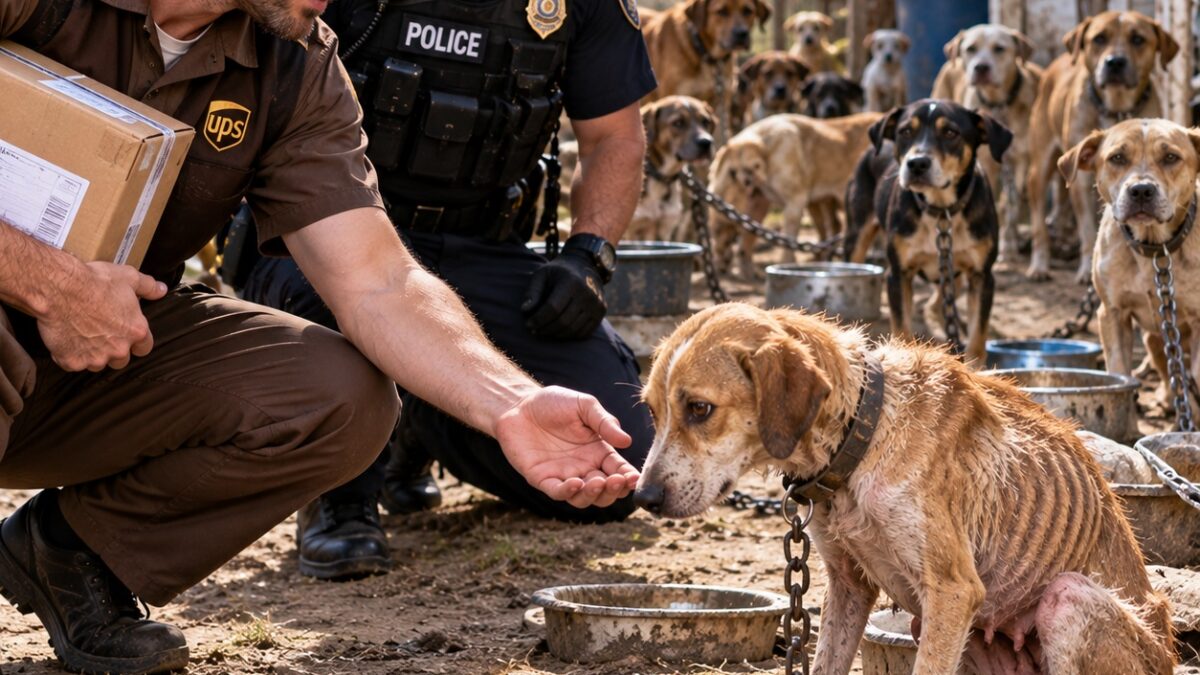
PART2
Removing eleven frightened dogs from one property is not a dramatic montage.
It is work.
Slow work.
Careful work.
Every animal reacts differently.
One dog was so eager to leave that the moment his restraint was safely transferred, he pulled toward the vehicle with every ounce of strength he had.
Another flattened himself to the ground.
A larger dog barked continuously until somebody sat beside him long enough for the barking to become whining.
We documented what we needed to document.
Conditions.
Chains.
The dogs.
The property.
Anything that might later matter in court.
Rescue personnel arrived.
We coordinated transport.
Nobody rushed because fear and rushing are a bad combination.
Clover watched all of it.
When someone approached her, she curled inward.
Not dramatically.
No growling.
No snapping.
She simply lowered herself, closed her eyes, and waited.
That behavior bothered me more than aggression would have.
Aggression says:
Stay away.
Clover seemed to say:
I know I cannot stop you.
The first time I reached toward her, I stopped halfway.
She had already closed her eyes.
I withdrew my hand.
“Okay.”
Her eyes opened slightly.
“I’m not touching you.”
Maybe she understood the tone.
Maybe not.
But she watched.
We gave her time.
Eventually, with careful handling, we moved her.
She was shockingly light.
I had expected a small dog.
I had not expected the feeling of lifting a body that seemed to consist of little more than bones beneath fur.
She did not struggle.
That should not be mistaken for trust.
Clover had learned stillness.
There is a difference.
When all eleven dogs were secured for transport, the delivery driver stood near his truck.
He looked shaken.
“You got all of them?”
“All eleven.”
“I thought there were maybe six.”
“So did we at first.”
He stared toward the property.
“I almost left.”
I looked at him.
“What stopped you?”
He shook his head.
“I don’t know.”
Then:
“It just looked wrong.”
Sometimes that is enough.
You do not need to understand the whole situation before you make a responsible call.
You only need to recognize that something is wrong enough that the right people should look.
I shook his hand.
“Thank you for staying.”
He shrugged almost uncomfortably.
“I didn’t do anything.”
“You called.”
At the time, he did not understand why I emphasized that word.
Later, he would.
We transported the dogs to temporary shelter care.
That was where Clover received her name.
I suggested it.
People sometimes ask whether there was a special reason.
There wasn’t some dramatic meaning.
I looked at her and thought:
Clover.
Maybe I wanted something soft.
Something green.
Something that belonged in sunlight instead of on the end of a chain.
The name stayed.
During the entire ride, Clover made no sound.
The other dogs moved through different stages.
One trembled.
Then stopped.
Another pressed his nose toward the window.
One barked whenever the vehicle slowed.
Clover sat in her corner.
Head resting on her front paws.
Eyes fixed somewhere beyond us.
Not sleeping.
Not really watching.
Just present.
When we arrived at the temporary shelter, the others were unloaded one by one.
Clover would not come out.
We opened the transport space.
Waited.
She looked at the opening.
Then at us.
Did not move.
Food did not convince her.
A soft voice did not convince her.
Eventually, I climbed closer.
“Clover.”
No reaction.
I reached beneath her carefully.
Her body stiffened.
Not resistance.
Expectation.
I lifted.
Again, that terrible lightness.
She weighed less than she should have.
Her head rested briefly against my arm.
I carried her into the shelter.
Dr. Parker was working with us that day.
She had treated neglected animals before.
More than any veterinarian should have to.
When she first saw Clover, she did not speak.
She crouched.
Looked at her body.
Her posture.
The way she responded when someone moved nearby.
Then Dr. Parker stood.
“This dog has lived through something we can’t fully imagine.”
She looked at me.
“But she’s alive.”
A pause.
“That matters.”
All eleven dogs needed evaluation.
Some had obvious physical needs.
Underweight.
Skin problems.
Old injuries.
Stress.
Clover’s greatest difficulty was not something you could treat with one medication.
She did not trust people.
At feeding time, she waited.
If someone stood nearby, she stared at the bowl but did not move toward it.
We would leave.
Then check later.
Food gone.
The first few times, we assumed she simply preferred privacy.
Then I watched more closely.
If a person remained in the room, Clover would not eat.
It didn’t matter how hungry she was.
Presence overruled appetite.
Touch was worse.
Reach toward her and she folded herself down.
Eyes closed.
Head turned slightly away.
Her whole body prepared for something unpleasant.
I remember the first time a volunteer tried petting her.
The volunteer was gentle.
Experienced.
Moved slowly.
Still, Clover collapsed inward.
The woman immediately withdrew.
“Oh, sweetheart.”
Clover did not look at her.
I stood in the hallway afterward.
Dr. Parker came beside me.
“She’s not aggressive.”
“No.”
“I almost wish she were.”
I understood.
A dog that growls is still expressing a boundary.
Clover had learned that boundaries might not matter.
That first week was the hardest.
Not because she became medically unstable.
Because nothing changed.
Day one:
Corner.
Day two:
Corner.
Day three:
Corner.
She ate only when people left.
Relieved herself when necessary.
Returned to the same position.
Head down.
If shelter activity became loud, she tucked herself tighter.
The other rescued dogs were beginning to show individual personalities.
A shepherd mix started wagging for volunteers.
One hound discovered blankets and immediately began dragging them into piles.
Another dog barked whenever anyone walked by because he had apparently decided all human movement should involve him.
Clover stayed still.
People began quietly wondering what kind of home would ever be possible for her.
You can medically stabilize a dog.
You cannot force trust.
I started visiting every day.
At first, I had no plan.
I was involved in the case.
I needed updates.
That was the practical excuse.
But I kept coming back for Clover.
The first afternoon, I sat several feet from her enclosure.
Did not look directly at her for long.
Opened my notebook.
Worked.
Reports.
Names.
Times.
Statements.
Descriptions.
Police work contains more writing than most people realize.
Clover remained in the corner.
After twenty minutes, I read part of a report aloud.
Not to her exactly.
Just into the room.
My own voice sounded ridiculous.
“Subject property contained eleven canines…”
I stopped.
Looked at Clover.
“You know this story already.”
Nothing.
I went back to writing.
The next day, same thing.
I sat.
Notebook.
No touching.
No calling her repeatedly.
No treats pushed into her face.
Sometimes I read.
Sometimes I said nothing.
On day four, I looked up and realized Clover’s eyes were open.
Watching me.
I looked back at the page.
You learn not to make a ceremony out of fragile progress.
The next day, she watched longer.
Then something changed.
Not distance exactly.
Orientation.
Her body no longer faced entirely away from me.
A few degrees toward the door.
Then, near the end of the first week, she moved from the deepest corner while I was there.
Only a foot.
Maybe less.
I kept writing.
Inside, I wanted to celebrate.
I did not.
“Good girl” can be pressure when a frightened dog has not asked to interact.
So I allowed the moment to remain hers.
The second week began with the same routine.
I came after my shift whenever possible.
Sometimes still in uniform.
Sometimes after changing.
I began leaving the notebook on the floor beside me.
Clover learned the sound of pages turning.
She learned that the man sitting outside her enclosure could exist without reaching for her.
That was important.
Trust is often described as something you build by doing kind things.
With Clover, trust began with all the things I did not do.
I did not corner her.
Did not force touch.
Did not stare continuously.
Did not insist she take food from my hand.
Did not demand progress because I had shown up.
I sat.
She watched.
That was our relationship.
Then she started sitting closer to the enclosure door when I arrived.
Not at the door.
Near it.
The first time I noticed, I thought maybe someone had moved her bedding.
Next day, same.
Then again.
Dr. Parker noticed too.
“She waits for you.”
“I wouldn’t go that far.”
“She does.”
“She waits near the door.”
“That’s what I said.”
I did not want to believe it too quickly.
Hope can make you interpret animals selfishly.
Maybe Clover liked that corner now.
Maybe the room temperature was different.
Maybe anything.
But one afternoon, I came later than usual.
As I entered the room, Clover was in the back.
She heard me.
Raised her head.
Then stood and moved toward the front.
Slowly.
Stopped several feet away.
Sat.
I had to look down at my notebook because my face gave me away.
“You’re making this difficult, Clover.”
Her ears shifted.
That week, I forgot my jacket.
I had taken it off while completing paperwork because the shelter room was warm.
Dark work jacket.
Nothing special.
I left without it.
Realized in the parking lot.
Went back.
When I entered, I stopped.
Clover was lying on my jacket.
Head resting on the fabric.
For several seconds, I did not move.
She raised her head.
We looked at each other.
The jacket smelled like me.
Vehicle interior.
Coffee.
Whatever else a police officer’s jacket smells like after a shift.
Clover had chosen it.
That choice meant more than if she had taken food from my hand.
She could have remained in the corner.
Instead, she had placed herself on something carrying the scent of the person who kept sitting beside her without hurting her.
I crouched.
Did not approach.
Clover stood.
For the first time, she walked toward me without being coaxed.
One step.
Then another.
No trembling.
No folding herself downward.
She stopped at my feet.
Sat.
Waited.
I hardly breathed.
Slowly, I lowered onto one knee.
Clover watched my hand.
I extended it.
Palm down.
Not over her head.
She leaned forward.
Sniffed my fingers.
Once.
Twice.
Then something happened I still remember with painful clarity.
Clover lowered her head into my palm.
And closed her eyes.
Not the same way she used to close them.
Before, her eyes shut while her body contracted, waiting for harm.
This time, her body remained soft.
She pressed her head into my hand.
I touched her.
Barely.
One slow movement between her ears.
Clover did not flinch.
I felt my throat tighten.
“You’re okay.”
Another stroke.
She stayed.
I do not know how long we remained there.
Maybe thirty seconds.
Maybe five minutes.
Memory stretches certain moments.
What mattered was that Clover had made the decision.
I had not overcome her fear.
She had crossed the space herself.
That night, driving home, I kept thinking about something.
People said Clover distrusted humans.
Maybe.
But I began to think that was incomplete.
She had not rejected every possibility of trust.
She had been waiting for evidence.
Day after day, I had given her the same evidence.
I come here.
I sit.
I do not hurt you.
I leave.
Then I come back.
Trust was not one brave moment.
It was accumulated predictability.
The jacket was simply the first time she showed me the account had a balance.
From the third week onward, Clover began changing faster.
Not instantly.
But enough that everyone noticed.
She ate while I sat in the room.
The first time, she stared at me.
Then at the bowl.
Then at me.
I looked down at my notes.
I heard one piece of food move.
Did not look.
Another.
By the time I finally glanced up, she was eating.
I smiled.
Said nothing.
Next, she began walking around her enclosure while I was nearby.
Then sniffing.
Then approaching the door.
One morning, I entered and saw the smallest lift of her tail.
Not a full wag.
One movement.
Up.
Then down.
I stopped.
Dr. Parker was behind me.
“Did you see that?”
“I saw nothing.”
She laughed.
“You saw it.”
“Could’ve been balance.”
“Sure, Officer.”
The next time Clover did it, there was no ambiguity.
Two small wags.
I sat on the floor.
“Now you’re showing off.”
Clover came to the door.
Dr. Parker was amazed by the rate of change.
Not because she believed trauma had vanished.
It had not.
Clover could still startle.
Unfamiliar people made her cautious.
Certain sounds sent her backward.
But her recovery accelerated once she had a predictable relationship.
“She trusts you,” Dr. Parker said.
“I think she trusts the routine.”
“She trusts you inside the routine.”
I thought about that.
Maybe she was right.
Trust did not mean Clover suddenly believed every person was safe.
It meant one person had become safe enough to use as a bridge.
From me, she started tolerating another volunteer.
Then Dr. Parker.
Then another staff member.
Each introduction slow.
Each interaction her choice when possible.
She began realizing that hands could have different meanings.
One hand clips a chain.
Another fills a bowl.
Another touches gently.
Another checks a wound and then stops.
Another sits nearby and expects nothing.
That distinction had to be learned.
The other ten dogs were changing too.
It is easy for Clover’s story to eclipse them because I became closest to her.
But eleven dogs left that property.
Eleven individual recoveries.
One became obsessed with squeaky toys.
Another turned out to be embarrassingly affectionate once his fear decreased.
One older dog preferred sleeping in the same blanket pile for most of the day and would sigh loudly whenever anyone disturbed him.
Each had survived the same property differently.
And each reminded us that trauma does not create one predictable kind of animal.
Some become loud.
Some shut down.
Some cling.
Some avoid.
Some recover quickly.
Some need months.
There is no morally superior response to suffering.
Clover was not “better” because she became trusting.
She was fortunate enough to find an environment where trust could become useful again.
Meanwhile, the legal case moved slowly.
That is another part people often misunderstand.
Rescue can happen in a day.
Accountability takes months.
Statements.
Evidence.
Documentation.
Veterinary records.
Photographs.
Witnesses.
Hearings.
Attorneys.
The owner of the property was charged in connection with animal cruelty and related organized activity described in the case.
I will not pretend the courtroom process felt as emotionally satisfying as carrying dogs out of the yard.
Law is structured.
Slow.
Sometimes painfully restrained.
You sit listening to conduct that made you angry when you first saw it, and everyone speaks in measured terms.
That restraint matters.
The court cannot sentence someone because we hate what we saw.
Evidence matters.
Procedure matters.
The delivery driver became one of the most important witnesses.
Months after the rescue, I saw him outside the courtroom.
He wore a collared shirt and looked more nervous than he had on the day of the rescue.
“You okay?”
“I’ve never testified.”
“Just tell them what you saw.”
“What if I say something wrong?”
“Don’t try to remember anything you don’t remember.”
He looked at me.
“That’s it?”
“That’s it.”
Truth does not need decoration.
When he took the stand, he did exactly that.
Calm.
No dramatic speeches.
He explained why he had been at the property.
A delivery.
He described walking toward the house.
Seeing the dogs.
Chains.
Their physical condition.
The atmosphere.
The one dog who barely moved.
He did not call the owner a monster.
Did not speculate about motives.
Did not exaggerate.
The prosecutor asked why he called authorities.
The driver paused.
Then said:
“Nobody made me.”
Another pause.
“I just couldn’t drive away.”
That sentence changed the room for me.
Because that was the entire story.
He could not drive away.
Eleven lives turned on that decision.
The judge heard the remaining testimony.
Reviewed photographs.
Medical records.
Other evidence.
The process continued.
Then the ruling came.
The owner was prohibited from owning animals.
The court condemned the treatment reflected in the evidence.
There were consequences.
Legal ones.
Formal ones.
I sat in the courtroom listening.
I thought I would feel triumphant.
Instead, I mostly felt tired.
Justice does not magically repair the past.
The dogs had still lived there.
Clover had still learned to shut down when hands approached.
The chains had still existed.
A ruling could prevent future ownership.
Could impose consequences.
Could create an official record saying:
This was wrong.
That matters.
But it does not erase.
After court, the delivery driver approached me.
He looked relieved.
“I’m glad I called.”
“So am I.”
“I didn’t know there were eleven.”
“I know.”
“I didn’t know how bad it was.”
“No.”
He looked toward the courthouse doors.
“But I knew I couldn’t pass it.”
I held out my hand.
He shook it.
I had worn a uniform for years.
People like to call police officers heroes.
Sometimes they call firefighters heroes.
Veterinarians.
Rescuers.
People in roles where helping is expected.
The delivery driver had no role.
No badge.
No assignment.
No obligation beyond completing his route.
That is why his decision stayed with me.
Heroism is sometimes nothing more glamorous than refusing to normalize what everyone else has stopped seeing.
Cruelty survives when it becomes background.
A chained dog people drive past every day.
A thin animal behind a fence.
A sound people decide belongs to somebody else’s property.
The driver looked once.
Then looked again.
And because he looked again, eleven dogs left.
After the legal case, adoption became the next major chapter.
Nine of the eleven dogs eventually went to adoptive homes.
One remained with us as an official shelter resident.
There was no tragedy in that.
Sometimes a shelter becomes the right place for a particular animal.
Routine.
Known people.
A life that works.
Then there was Clover.
By the time adoption conversations became serious, she was almost unrecognizable emotionally compared with the dog I had carried from the transport vehicle.
She ate with trusted people present.
She approached me.
Accepted touch.
Sometimes sought it.
Her tail moved when I arrived.
She still had caution inside her.
I could see it.
A stranger entered too quickly and Clover’s body remembered.
A sudden movement could still make her lower herself.
Recovery does not delete memory.
It gives the animal enough new experience that memory no longer controls every moment.
We wanted a quiet home.
Patient people.
No one who expected Clover to perform gratitude.
Then we met Margaret and Thomas.
Older couple.
Large garden.
Calm house.
They had time.
More important, they had the right kind of patience.
Margaret did not ask:
“How soon will she warm up to us?”
She asked:
“What does she do when she’s scared?”
Thomas wanted to know whether she preferred doors left open or closed when adjusting to a room.
They asked about feeding.
Routine.
Sounds.
How to introduce visitors.
What not to do.
I liked them almost immediately.
Still, the day I drove Clover to their home felt like betrayal.
That is the selfish side of rescue nobody likes admitting.
You want the animal to find a family.
Then a family appears and suddenly you think:
But she trusts me.
Exactly.
She trusted me enough to learn that trust could exist.
The point was never to make myself the only safe person in her world.
The point was to make the world larger.
Margaret and Thomas lived in a modest house with a big back garden.
Not fancy.
Beautiful in the way lived-in homes are beautiful.
Flower beds.
Old wooden bench.
A few trees casting wide patches of shade.
When I opened the vehicle door, Clover did not immediately get out.
Of course she didn’t.
New place.
New smells.
Two unfamiliar people.
She looked at me.
Then Margaret.
Then past us toward the garden.
I waited.
Thomas stood several feet away.
He did not call her.
Margaret sat on the porch step.
Excellent choice.
Clover lowered herself from the vehicle slowly.
Stopped.
Looked at me again.
“Take your time.”
She sniffed the ground.
One step.
Another.
At the threshold, she froze.
I thought:
Maybe we’re moving too fast.
Then Clover looked toward the yard.
Something changed.
Not magical.
Her body simply softened.
She walked through.
Into the garden.
A few feet.
Stopped.
Sat.
Then lifted her face toward the sun.
Eyes closed.
I stood near the doorway watching.
People sometimes say dogs smile and somebody inevitably corrects them.
Technically, perhaps.
That afternoon I did not care.
Clover looked like she was smiling.
Margaret approached slowly.
Sat on the grass beside her.
No reaching.
No command.
Clover opened her eyes.
Looked at Margaret.
Then leaned.
Her head settled onto Margaret’s lap.
Exactly the way she had once placed her head into my palm.
My eyes filled before I could stop them.
Margaret looked toward me.
Neither of us spoke.
We did not need to.
Clover was not replacing me.
She was expanding.
That was the moment I knew she could stay.
I left later that afternoon.
Hardest part was the car.
Starting the engine without Clover inside.
For weeks, I had become accustomed to her being part of my daily mental map.
Shelter.
Case.
Visits.
Now I was driving away.
I checked the mirror too many times.
Margaret stood at the gate.
Clover beside her.
Not pulling after the car.
Not panicking.
Watching.
That hurt.
And helped.
I told myself:
This is what success looks like.
Sometimes success does not follow you home.
Sometimes it stays behind with the people who need to become its new family.
Margaret called that evening.
“She ate.”
“With you there?”
“Yes.”
I smiled.
“Good.”
“She’s sleeping near Thomas’s chair.”
“Already?”
“She chose the rug.”
There was a long pause.
Then Margaret said:
“Thank you for trusting us.”
I looked at the road through my windshield.
“No.”
“What?”
“Thank her.”
Clover had taken the biggest risk.
One year passed.
I visited often.
Not so often that Clover’s new home became dependent on me.
Enough.
The first visit, she recognized my vehicle.
I know people say dogs do not interpret cars that way.
Clover did something.
The moment I stepped out, she ran toward the gate.
Not fast like a dog in a commercial.
Clover had her own run.
A little awkward.
Entirely enthusiastic.
Her tail moved so hard her back end followed.
She came to me.
Head against my leg.
I knelt.
“Hey, Clover.”
Then something beautiful happened.
After greeting me, she turned and went back to Margaret.
That was perfect.
She remembered me.
She chose home.
Over that year, more of the old fear loosened.
People could approach slowly without Clover collapsing.
Thunderstorms stopped sending her into corners.
At first, Margaret had created a quiet covered place for storms.
Clover used it.
Then eventually stopped needing it every time.
She began sleeping in open rooms.
Stretching on her side.
Belly exposed.
Anyone who has cared for a terrified dog understands what that posture can mean.
Vulnerability without panic.
She played with other dogs.
Not immediately.
Introductions had been careful.
But eventually Clover learned play bows.
Chasing.
The strange stop-start rituals dogs understand instinctively.
One afternoon I watched her run across Margaret and Thomas’s garden with another dog.
I remembered the transport ride.
Head on paws.
No sound.
The distance between those two images felt too large for one life.
But there she was.
Same Clover.
Different world.
Margaret let her dig in one section of the garden.
Thomas objected.
Clover ignored him.
Within weeks, one corner looked like amateur excavation.
Thomas pretended to be upset.
Then built a little wooden border around Clover’s “approved digging zone.”
That is love.
Not declaring the dog perfect.
Reorganizing the garden around the dog’s imperfections.
I visited during spring.
Clover had dirt on her paws.
Margaret said:
“She destroyed my lavender.”
Thomas called from the porch:
“Your lavender.”
Margaret turned.
“Our lavender.”
Clover looked pleased.
Just a dog.
Finally.
There is tremendous power in that phrase.
Just a dog.
Not evidence.
Not victim.
Not cruelty case.
Not the silent one.
A dog.
Hungry at dinner.
Lazy on hot afternoons.
Annoyed by baths.
Interested in squirrels.
Attached to particular blankets.
Capable of stealing a piece of toast when Thomas looked away.
Free to be ordinary.
One afternoon I took Clover for a walk in the park.
Margaret came with us initially, then stayed near a bench while I continued along a path.
Clover walked beside me.
Leash loose.
Sunlight moving through trees.
Children were playing across a field.
Running.
Shouting.
A ball moving between them.
Clover stopped.
She watched.
For a long moment.
In the original telling of her story, I said I understood that she remembered being a puppy who once wanted to play with children.
The truth is, I could never know what Clover remembered.
Dogs cannot tell us their memories in sentences.
Maybe she was curious.
Maybe the children’s movement triggered something old.
Maybe she simply liked watching.
But standing beside her, I found myself imagining a younger Clover.
Before the chains became normal.
Before stillness became protection.
Perhaps there had once been a version of her that wanted to run toward voices.
I will never know.
Clover watched the children.
Then looked up at me.
Her tail moved.
Once.
Twice.
Then she started walking again.
That was enough.
Whatever lived behind her eyes belonged to her.
The important thing was the leash between us hung loose.
No chain fixed her to the ground.
She could move forward.
So she did.
Sometimes I think about what would have happened if the driver had left.
That thought never becomes easier.
He had no reason to expect eleven dogs.
He could see only part of the yard at first.
He could have said:
Maybe the owner knows what he’s doing.
Maybe somebody else has called.
Maybe it isn’t as bad as it looks.
Maybe I should mind my business.
Those sentences are how terrible things survive in plain sight.
Everybody assumes someone closer has responsibility.
The driver did not know exactly what was happening.
He called anyway.
That distinction matters.
You do not have to become investigator, prosecutor, rescuer, and judge.
You can simply report what you genuinely observe and let the appropriate people evaluate it.
That is what he did.
One call.
Eleven dogs.
Nine adopted.
One shelter resident.
Clover with Margaret and Thomas.
Those numbers stayed with me.
I ran into the delivery driver unexpectedly about a year after the case.
Different street.
I was coming out of a coffee shop.
His truck was parked nearby.
He saw me.
Pointed.
“Officer.”
“James.”
“Right. James.”
We talked beside the truck.
He asked first:
“How are the dogs?”
“Good.”
“All of them?”
“Doing well.”
“What about the quiet one?”
I smiled.
“Clover?”
“That was her name?”
“We named her that.”
“How is she?”
“Living with an older couple. Big garden.”
He smiled.
Really smiled.
Relief, even a year later.
“I think about that day.”
“I figured.”
“Sometimes I wish I hadn’t seen it.”
I understood.
Then he added:
“But I’m glad I called.”
“I’m glad too.”
He looked into the truck.
Packages stacked behind him.
“I’ll never forget that yard.”
Pause.
“But the feeling after?”
“What feeling?”
“Knowing I did what I was supposed to do.”
He shook his head.
“Not supposed to.”
Then corrected himself.
“What was right.”
I nodded.
I understood exactly.
Some calls become part of your professional history.
Others become part of your personal life.
Clover was both.
People assume police officers grow used to cruelty.
I hope I never do.
You learn procedure.
You learn to control your face.
You learn how to walk into places without allowing anger to make decisions for you.
But “used to it”?
No.
If I ever look at eleven chained dogs and feel nothing, I need another job.
What changes is what you do with the feeling.
Anger that produces careless action can damage a case.
Document.
Photograph.
Get veterinary professionals involved.
Preserve evidence.
Find witnesses.
Let the process move.
That can feel unsatisfying when you are staring at a frightened animal.
You want immediate justice.
But rescuing the dogs is only one responsibility.
Building a case strong enough to protect future animals matters too.
The delivery driver’s testimony mattered because he had no personal history with anyone involved.
He was not a disgruntled neighbor.
Not an activist with an agenda.
Not a police officer arriving after a complaint.
He was delivering a package.
That neutrality gave his observations weight.
He described what he saw.
Nothing more.
That was powerful.
Clover taught me a different kind of patience.
Law-enforcement patience is about evidence.
Wait.
Watch.
Do not contaminate.
Let facts form.
Clover’s patience was relational.
Sit.
Do nothing.
Return tomorrow.
Do nothing again.
Trust forms.
I had believed helping meant action.
Clover taught me that sometimes the most helpful thing you can offer a frightened animal is a predictable absence of action.
No reaching.
No demand.
No expectation.
I sat outside her enclosure because I did not know what else to do.
That became exactly what she needed.
I think about the jacket sometimes.
That ordinary jacket.
If I had remembered it, maybe another moment would have come later.
But I forgot it.
Clover found it.
Lay down on it.
The first object associated with me became a place she chose for comfort.
That said more than any training exercise could have.
People often ask me:
“How did you get her to trust you?”
I did not.
Not exactly.
I gave her information.
Then Clover reached her own conclusion.
That is different.
The distinction matters when working with frightened animals.
Trust cannot be extracted.
It has to remain voluntary or it is not trust.
Clover taught me that more clearly than any course ever could.
The shelter kept the first photograph of her.
I saw it once after she had been adopted.
I almost did not recognize the expression.
Small body.
Head low.
Eyes far away.
There was nothing dramatic in the image.
That was the horror.
She looked absent while being physically present.
Beside it was a photograph Margaret had sent.
Clover in the garden.
Head in sunlight.
Mouth slightly open.
Relaxed.
The two images made people say:
“What a transformation.”
Yes.
But the transformation was not only Clover.
Her circumstances transformed.
The first photograph showed a dog surviving what people had done around her.
The second showed what happened when her environment finally became safe enough for her personality to emerge.
I do not believe every damaged animal has a secret cheerful dog trapped inside waiting to appear.
That is too simple.
Some remain cautious.
Some never enjoy strangers.
Some carry habits forever.
They still deserve homes.
Clover happened to open beautifully once she felt secure.
That was her path.
One of the other rescued dogs took much longer.
He was adopted later than the others.
His family worked for months before he accepted certain kinds of touch.
His story was not less successful.
I mention that because Clover’s relatively quick emotional change after trusting me could create an unfair expectation.
Two weeks is not a deadline.
Three weeks is not a deadline.
An animal does not owe recovery on a rescue organization’s preferred schedule.
Clover approached when she was ready.
Margaret and Thomas understood that.
It is why I trusted them.
On one visit, Margaret told me Clover still sometimes woke suddenly at night.
Not often.
She would lift her head.
Look around.
Then settle again once she understood where she was.
“Do you think she dreams about the old place?” Margaret asked.
“I don’t know.”
Neither of us tried to turn it into certainty.
Margaret rubbed Clover’s shoulder.
“Well, she wakes up here.”
That sentence has stayed with me.
Whatever Clover remembered, she woke up there.
Safe.
The past does not need to disappear for a life to become good.
Sometimes the difference is simply where you wake.
A chain or a soft bed.
An empty yard or Margaret’s garden.
Fear with nowhere to go or fear inside a house where someone notices.
That is enough to change everything.
The one-year anniversary of the rescue passed quietly.
No ceremony.
No press.
I visited.
Thomas had made coffee.
Margaret had baked something I absolutely did not need but ate anyway.
Clover greeted me.
Then carried a toy into the garden.
I sat on the porch watching her.
Nine of the dogs were living in homes.
One remained at the shelter.
Clover was there.
Eleven.
I tried to picture them back on that property.
Could not.
Or maybe I did not want to.
Thomas sat beside me.
“You think she remembers you from the first days?”
“She remembers something.”
“She definitely knows your car.”
“That’s probably because it means I bring treats.”
“Still counts.”
Margaret walked into the garden.
Clover followed.
No hesitation.
That ordinary following touched me.
Once, humans approaching meant Clover closed her eyes and prepared herself.
Now she followed one voluntarily.
The body tells the truth about trust.
That evening, before leaving, I knelt.
Clover came over.
Placed her head against my hand.
Same gesture.
One year later.
But now the meaning had changed again.
The first time, it felt like a test.
Will this hand hurt?
Now it was greeting.
Familiarity.
Maybe affection.
I scratched beneath her chin.
“You picked good people.”
Margaret called from behind me:
“We picked a good dog.”
Both were true.
I drove home thinking about the delivery driver.
He probably had no idea this exact scene existed because of him.
Not alone.
A rescue is never one person.
Police.
Animal-control personnel.
Veterinarian.
Shelter workers.
Volunteers.
Court witnesses.
Adopters.
But every chain has a first link.
For Clover, it was a man standing beside a delivery truck deciding the next package could wait.
That small delay changed eleven lives.
People like grand definitions of courage.
Running into fire.
Stopping violence.
Facing danger.
Those things are courage.
But there is another kind.
Civic courage.
The willingness to make yourself slightly uncomfortable because something does not look right.
To call.
To stay.
To give your name.
To testify months later.
To spend a morning in court when you could have told yourself the problem had become someone else’s.
The driver did all of that.
He did not ask for recognition.
I am not even sure he wanted people knowing his name.
He simply did not pass.
That is why I remember him.
And Clover.
Especially Clover.
My job exposes me to dark corners.
Sometimes literally.
More often human ones.
Places where people decide another living thing’s suffering does not matter because nobody important is watching.
Clover changed the way I think about those places.
Darkness is not defeated by pretending it does not exist.
It is defeated when somebody sees enough to turn on a light.
The delivery driver turned on the first one.
Then we arrived.
Then Dr. Parker.
Then shelter workers.
Then the court.
Then Margaret and Thomas.
Each light small.
Together enough.
I am still a police officer.
Still answer calls.
Still write reports.
Still arrive at homes where people insist nothing is wrong.
Still meet animals who have no way to explain what happened before we got there.
I do not carry Clover’s story into every call as some dramatic personal mission.
That would be dangerous.
Every case is different.
Evidence first.
Facts first.
But I do carry one lesson.
Do not ignore the quiet one.
The dog barking at you tells you something.
The dog pulling against the chain tells you something.
The dog making no sound may be telling you something too.
Clover’s silence had been her camouflage.
Her protection.
Maybe her surrender in certain moments.
I cannot know.
What I know is that once she was safe, silence slowly stopped being necessary.
She never became the loudest dog.
That was not her.
But she began communicating.
Tail.
Eyes.
Approach.
Head in palm.
Following Margaret.
Running in the yard.
Freedom has its own language.
Toward the end of that first year, I visited again on a warm afternoon.
Clover was in the garden.
Margaret had planted flowers along the back fence.
Thomas had repaired Clover’s digging zone after she expanded it without authorization.
“She ignores property boundaries,” he told me.
“Dangerous habit.”
“You’re law enforcement. Do something.”
I looked at Clover.
She was lying directly inside the flower bed.
“No probable cause.”
Thomas laughed.
Clover rolled slightly onto her side.
Sun on her stomach.
No tension.
No watching us for signs of danger.
I thought about the first yard.
Chains.
Thin bodies.
The delivery driver standing near the road.
Then this yard.
Flowers.
Loose collar.
Open space.
Clover could walk away from us.
That is perhaps the clearest definition of freedom I know.
She could leave and chose to stay.
Later, Margaret opened the back door.
“Dinner.”
Clover stood immediately.
Ran inside.
Thomas shook his head.
“She trusts dinner more than any of us.”
“Healthy priorities.”
I stayed on the porch alone for another minute.
The yard was empty.
No chain marks.
No dogs waiting for food after humans left.
No silence that felt like fear.
Just a small hole near the flowers where Clover had been digging.
I smiled.
There are scars you repair.
There are holes you fill.
And sometimes you leave one because it reminds you the dog who made it is free enough to make a mess.
When I finally left, Clover came to the gate.
I reached through.
She pressed her head against my palm.
Eyes closed.
I remembered the shelter.
My jacket on the floor.
That first voluntary step toward me.
Same gesture.
Different dog.
Or maybe not.
Maybe Clover had always contained the possibility of this version.
She simply needed the world around her to stop proving fear correct.
I rubbed her head.
“See you soon.”
Her tail moved.
I got into the cruiser.
Drove away.
In the mirror, Margaret appeared beside her.
Clover turned toward Margaret before I reached the corner.
Home.
That is the word.
The story began with a package.
Something ordinary.
A driver following a route.
A house.
A door.
A yard.
One moment when the easiest thing would have been to keep walking.
He stopped.
That is all.
The biggest changes in life sometimes begin with embarrassingly small actions.
A phone call.
A report.
A person sitting quietly outside a frightened dog’s enclosure.
A forgotten jacket.
An old couple leaving a doorway open instead of forcing a dog through it.
None of those actions look heroic by themselves.
Together, they gave Clover a life.
They gave ten other dogs a different future too.
Nine adoptive homes.
One permanent shelter home.
One garden where a frightened little dog learned she could close her eyes because she was comfortable, not because she was waiting to be hurt.
That difference means everything to me.
Years from now, I may forget certain details.
The date.
The exact time of the call.
Which cruiser I drove.
What I wrote in the first report.
I will not forget Clover placing her head in my hand.
I will not forget the weight of her when I carried her from the vehicle.
I will not forget Dr. Parker looking at her and saying:
“She’s still alive.”
I will not forget the delivery driver in court.
“I just couldn’t drive away.”
And I will not forget watching Clover enter Margaret and Thomas’s garden.
Stop.
Sit.
Lift her face toward sunlight.
Then eventually rest her head on Margaret’s lap.
People often want rescue stories to end with punishment.
The bad person loses.
The court rules.
Justice.
That matters.
The owner was prohibited from owning animals again.
The evidence was heard.
The system said what happened was unacceptable.
Good.
But that is not Clover’s ending.
Her ending belongs to Clover.
Not the defendant.
It is a yard.
A sunny afternoon.
Margaret sitting nearby.
Thomas pretending to complain about holes.
Other dogs to play with.
Children in a distant park who no longer represent a life she cannot reach.
A loose leash.
A soft bed.
Food she does not have to wait to eat until everyone leaves.
Hands she approaches voluntarily.
A home where she is no longer evidence of what somebody did wrong.
She is simply loved.
I still think about the question:
What if the delivery driver had not called?
I do not have an answer I like.
So I try not to live there.
He did call.
That is the fact.
He saw something.
He stopped.
Eleven dogs were rescued.
Clover got another chance.
Sometimes people tell me things happen the way they are supposed to.
I am not sure I believe that.
Those dogs were never supposed to suffer.
Nothing about what happened to them was necessary.
What I believe is simpler.
When something wrong happens, someone still has a choice about what happens next.
The driver chose.
We chose.
The shelter chose.
Margaret and Thomas chose.
And eventually Clover chose too.
She chose to move closer to the kennel door.
To lie on my jacket.
To sniff my hand.
To place her head into my palm.
To walk into a new garden.
To rest against Margaret.
To run.
To play.
To stay.
One choice did not erase the chains.
But it broke their claim on her future.
My name is James.
I’m still a police officer.
I still answer calls.
And whenever somebody tells me one person cannot make much difference, I think about a delivery truck stopped beside a road.
A man with a phone in his hand.
Eleven dogs behind a fence.
And one silent little dog named Clover who is no longer silent because somebody decided not to keep driving.
That is enough proof for me.








