PART 2:“You’re Fired!” They Told the Nurse After She Saved His Mother — Then the SEAL Walked In
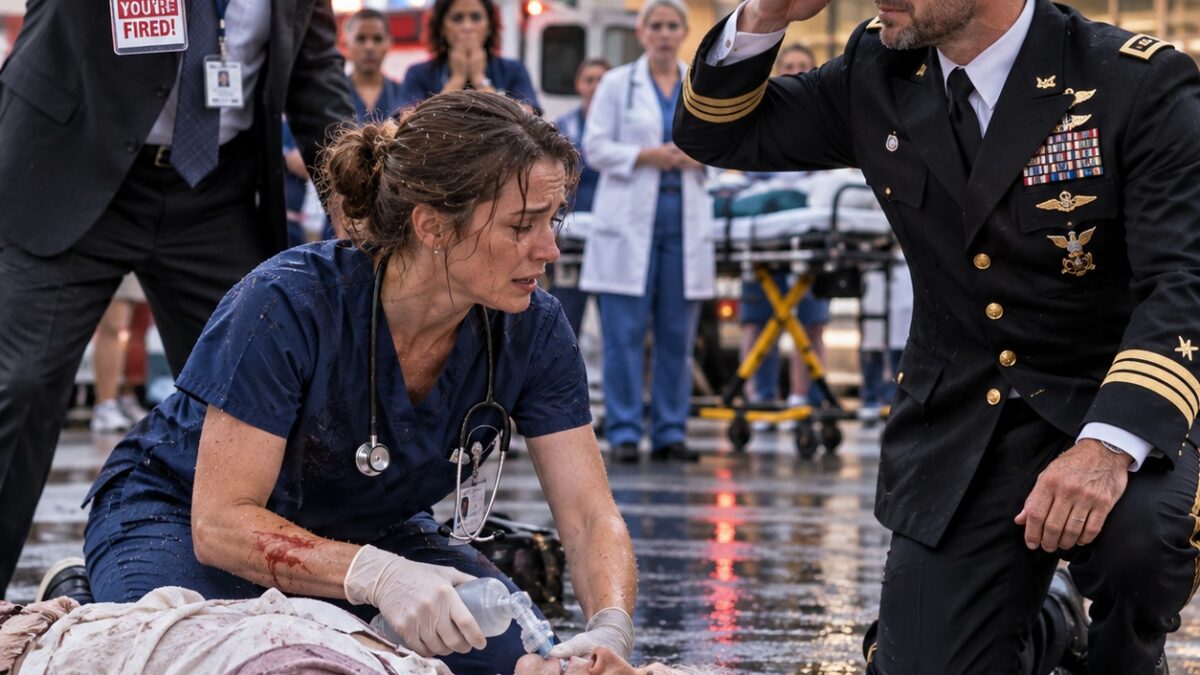
PART 2 AND THE COMPLETE CONCLUSION 👇👇 Thank you ❤️
For several seconds, nobody moved.
It was one of those strange silences that do not belong in hospitals.
Hospitals are never truly quiet.
Ventilation.
Wheels.
Monitors.
Phones.
Shoes crossing tile.
Someone asking for a physician.
Someone else arguing with registration.
But outside that morning, under a gray Virginia sky, twenty people stood perfectly still because a decorated Navy officer was saluting a nurse who had just been fired.
I wanted to disappear.
Not because I was ashamed of what I had been.
Because I had spent twelve years learning how to be someone else.
“Sir.”
I said softly.
“Please.”
Caleb did not lower his hand.
His face had gone pale.
Not the terrified pale of the man who had watched his mother stop breathing.
Something deeper.
Older.
“You’re the one.”
His voice cracked.
“The Lauren Marie.”
My stomach tightened.
“Caleb.”
Twelve years.
I had not said his name in twelve years.
He noticed.
That broke whatever doubt remained.
His salute dropped.
“You remember me.”
I looked at Margaret.
Her chest rose through the improvised airway.
She needed to be inside.
Not standing in the middle of someone else’s memory.
“Get your mother to trauma.”
I said.
Caleb stared.
“I never saw your face.”
“You had hypothermia.”
“You had the mask.”
“The helicopter.”
“I tried to find you.”
His voice kept breaking.
“The Coast Guard wouldn’t release your information.”
“I wrote letters.”
“I called.”
“I thought maybe you were still serving.”
“Please.”
I said.
“Not here.”
A weak cough came from Margaret.
Everything snapped back into the present.
I looked toward the orderly.
“Move.”
The gurney rolled.
Dr. Hail stepped between me and it.
“You no longer work here.”
His voice had that careful flatness men use when they are trying to regain control after losing the room.
“I need you off hospital property.”
I stared at him.
Margaret’s life still hung from an airway made with a piece of plastic because he had arrived ninety seconds too late to help.
He was worried about property.
Before I could answer, another man stepped through the crowd.
Gerald Voss.
Chief operating officer.
He was in his late fifties, silver hair, charcoal suit, tie already loosened even though the day had barely begun.
I had worked under his administration six years.
We had spoken maybe fifteen times.
Mostly about staffing.
Once about flu vaccination.
He looked at Hail.
Then Caleb.
Then me.
Then the woman on the gurney.
“Warren.”
He said carefully.
“Let’s get the patient inside.”
“We can resolve the employment question after she has an airway that wasn’t made from office supplies.”
Hail’s mouth tightened.
He moved aside.
The trauma team took Margaret.
I followed three steps behind.
Close enough to answer questions.
Too far away to touch.
Caleb stayed beside me.
He would not leave.
Inside, the hospital swallowed his mother.
Bright lights.
Curtains.
Controlled chaos.
Residents.
Respiratory therapy.
Real airway equipment.
Medication.
Someone removed the improvised tube and established something appropriate for an actual hospital.
I stood outside the working area.
Badge gone.
Suddenly a civilian in the building where I had spent six years.
That was when the absurdity hit.
Forty minutes earlier, I had worried I was too early for my shift.
Now I did not have a shift.
I looked down.
There was dried blood beneath my fingernails.
Margaret’s.
Caleb stood beside me.
He was still in dress blues.
Jacket splashed from kneeling on wet pavement.
His mother’s handbag in one hand.
My old life standing six inches away.
“You were nineteen.”
I said.
He stared.
“You remember.”
“You kept saying your mother’s name.”
Caleb’s face broke.
“My mom.”
“Maggie.”
“You said it over and over.”
He looked through the glass.
“That’s her.”
“I figured.”
A faint, broken laugh escaped him.
Then he covered his mouth.
For a moment, he looked nineteen again.
Not Lieutenant Caleb Ror.
Not Navy SEAL.
Not decorated officer.
Just a kid dying of cold in black water.
And I was somewhere I had sworn never to go again.
George Bank.
October.
Twelve years earlier.
I had been Petty Officer Second Class Norah Beckett.
Aviation Survival Technician.
Rescue swimmer.
Air Station Elizabeth City.
The only woman on my flight’s active swimmer roster that year.
People loved that detail.
Reporters especially.
The woman.
The first.
The smallest.
The one who made it.
They did not understand that once the helicopter door opened, the ocean did not care what gender you were.
Neither did hypothermia.
Neither did forty-foot seas.
Training had removed any part of me that believed panic deserved negotiation.
Eighteen weeks.
Water confidence drills.
Breath control.
Underwater tasks.
Cold exposure.
Open ocean.
Long swims in conditions that turned muscle into useless weight if you allowed fear to waste oxygen.
The washout rate was brutal.
More than eighty percent some classes.
I wanted it since I was fifteen.
Lifeguard stand.
North Carolina.
Bright summer day.
A rescue helicopter passed low over the beach.
I watched somebody descend from it toward water where strangers were in trouble.
That was all.
Something inside me decided:
That.
I want to be the person who goes in.
Nobody warned me that going in is only half the job.
The other half is learning to live with the people you could not bring back.
By twenty-seven, I had fourteen confirmed rescues.
Fishermen.
Sailors.
Tourists.
A father and daughter whose kayak flipped in a rip current two miles offshore.
College students after a sailboat capsized.
People whose names I sometimes forgot and faces I sometimes remembered at three in the morning.
Then came the Lauren Marie.
A fishing trawler caught by a nor’easter roughly two hundred miles offshore.
Five crew.
Three overboard by the time we arrived.
Wind over the rotor.
Swells climbing like moving buildings.
Dark water.
Water temperature low enough that time became a weapon.
I went down first.
The ocean hit like concrete.
Cold so severe it stopped feeling like temperature and became pressure around my chest.
I found Caleb maybe thirty yards from where the trawler had rolled.
Nineteen years old.
Deckhand.
He had taken the job for one summer.
Save money.
Community college.
Ordinary plans.
He was barely conscious.
Arms no longer working properly.
Lips gray-blue.
He kept saying one word.
“Mom.”
I got the rescue strap around him.
Fought to keep both our faces above water.
Signaled the helicopter.
As the hoist took him, I saw another man.
Older deckhand.
Going under.
Danny Ruiz was already in the water.
My swim partner.
Two years.
Best friend.
Broad shoulders.
Black hair.
Born in Ohio.
Had never seen the ocean until he enlisted at eighteen.
Loved it immediately.
Loved everything loudly.
Coffee.
Terrible jokes.
Cheap hot sauce.
Air-conditioned rooms after training.
He could make himself laugh harder than anybody else could.
He went toward the second deckhand.
That was the last clear image I had of him.
His silhouette cutting through black water.
Then the wave.
Nobody saw it correctly.
Later, everyone remembered differently.
Pilot thought he saw Danny dive.
Flight mechanic believed the swell broke over both men.
I remembered turning toward the hoist.
Then back.
Danny was gone.
Just gone.
The ocean does that.
People imagine drowning dramatically.
Arms.
Screams.
Sometimes the sea simply removes someone.
We found the second deckhand alive two hours later.
He had reached debris from the Lauren Marie.
Danny never surfaced.
We searched four days.
Cutters.
Aircraft.
Grid patterns.
Everything protocol required.
Everything grief demanded.
I flew every search I could.
Refused relief until somebody senior enough ordered me out of the aircraft.
On day five, a rear admiral stood in front of us.
Used one word.
“Presumed.”
Presumed lost.
Presumed dead.
Presumed.
As if language could make absence official enough to carry.
I worked eleven more months.
Because quitting immediately felt like giving the ocean a second casualty.
That was what I told myself.
Truth was worse.
Every mission became Danny’s mission.
Every black patch of water looked like the place he vanished.
Every hoist cable reminded me of the instant I went up while he stayed below.
I started shaking.
Not during swimming.
Before.
Clipping harnesses.
Standing near open helicopter doors.
Once, my hands shook so badly I could not secure my own attachment correctly.
That scared me more than the ocean ever had.
A rescue swimmer whose hands cannot obey is not brave.
She is dangerous.
So I left.
No scandal.
No discipline.
Medical separation available if I wanted it.
I did not.
I simply resigned when I could.
Went to nursing school.
Chose medicine because I still needed to help.
Chose hospital walls because walls felt different from horizons.
Beds did not move in forty-foot swells.
Floors stayed beneath you.
If somebody died, the room did not swallow the body and refuse to give it back.
For twelve years, I never told anyone at Tidewater.
Not Hail.
Not Voss.
Not the nurses who worked Christmas beside me.
Not the techs who knew how I took my coffee.
My badge said Registered Nurse.
That was enough.
I wanted it to be enough.
Then Caleb Ror recognized a scar.
“You saved me.”
He said beside the trauma bay.
“No.”
“Yes.”
“You did.”
“I pulled you to a helicopter.”
“That’s generally what saving someone means.”
I looked at him.
“Danny went back for the other man.”
Caleb’s expression changed.
“I know.”
“How?”
“I read everything I could.”
He swallowed.
“The Coast Guard sent a public incident report.”
“Most names redacted.”
“Ruiz wasn’t.”
I looked through the glass.
Maggie’s heart rhythm steadied.
Respiratory working.
Good.
Caleb continued.
“I joined the Navy because of that night.”
That made me look at him.
“I was supposed to go to community college.”
“I made it two semesters.”
“Couldn’t sit in class thinking about what happened.”
“Thinking about you.”
“Thinking about Ruiz.”
He looked down at his uniform.
“I wanted to become someone who went in.”
My throat tightened.
The words were too close to the reason I had become a rescue swimmer.
“Don’t build your life around a debt.”
“I didn’t.”
He met my eyes.
“Not eventually.”
“I built it around the kind of person I wanted to be.”
Before I could answer, Warren Hail came out of the trauma bay.
His expression was controlled.
“Mrs. Ror is stabilized.”
Caleb moved immediately.
“Can I see her?”
“In a few minutes.”
Then Hail looked at me.
“You need to leave.”
“Warren.”
Caleb’s voice changed.
Military steel.
Hail raised one hand.
“Lieutenant, I understand your gratitude.”
“This is an employment matter.”
“My mother is alive because of her.”
“I am aware.”
“You fired her before my mother was even inside.”
“Because she performed an invasive procedure outside scope.”
Caleb stepped closer.
“You mean she chose my mother’s airway over your paperwork.”
Hail’s jaw tightened.
“I mean hospitals cannot function if every employee decides rules are optional.”
I spoke before Caleb could.
“He’s right about one thing.”
Both men looked at me.
“Rules matter.”
Hail appeared almost vindicated.
Then I continued.
“Which is why rules also need pathways for situations the rule did not anticipate.”
“You can review my decision later.”
“Right now your patient is alive.”
“That’s the relevant fact.”
Hail stared.
Maybe he expected anger.
I did not have enough energy for it.
“Leave hospital property.”
He repeated.
This time I nodded.
“All right.”
Caleb turned.
“Norah—”
“Your mother needs you.”
I said.
“I need a shower.”
That almost made him smile.
I walked toward the ambulance exit.
Past coworkers who had suddenly discovered I had a history.
Nobody stopped me.
Outside, my blue sedan waited exactly where I left it.
The coffee stain still spread across the pavement.
I sat behind the wheel.
Keys in ignition.
Did not start the engine.
My hands rested at ten and two.
Funny.
Perfect driving-school position.
They began shaking.
I watched them.
Twelve years.
I had spent twelve years avoiding the ocean.
Avoiding rescue stories.
Avoiding people asking what I did before nursing.
One salute had opened every hatch I had welded shut.
Danny.
Wave.
Hoist.
Presumed.
I closed my eyes.
“You’re not there.”
I whispered.
The words were useless.
Trauma does not care what year your calendar says.
I stayed like that for almost forty minutes.
Then somebody struck the passenger window.
I jumped.
Caleb stood outside.
His face terrified again.
I lowered the window.
“She’s crashing.”
Every thought disappeared.
“What?”
“They don’t know what’s wrong.”
“They said infection, reaction, something with the airway.”
His voice broke.
“Please.”
“I know I have no right to ask.”
“But please.”
I was out of the car before he finished.
We ran.
Past security.
One guard stepped into my path.
Caleb shouted:
“She’s with me.”
The guard looked at his face.
Moved.
Inside, I heard alarms before I reached the bay.
Chaos has signatures.
Some rooms are busy.
Some rooms are losing control.
This one was losing control.
Maggie’s oxygen saturation was falling.
Swelling had appeared along her neck and upper chest.
A young resident stood beside her.
Priya Anand.
Smart.
Second year.
I knew her from nights.
She had two fingers near Maggie’s collarbone.
“Crepitus.”
She said.
Hail was ordering cultures.
X-ray.
More medication.
Priya tried again.
“Dr. Hail, there’s air under the tissue.”
“We know there’s swelling.”
“It’s crepitus.”
He waved her off.
“Get portable imaging.”
I stepped through the curtain.
The sound under Maggie’s skin was unmistakable.
Air where it should not be.
The emergency airway site had developed a leak.
Not because the initial action had been wrong.
Because an improvised airway is exactly that—
improvised.
Temporary.
It had bought time.
Now the definitive repair had a complication.
Potentially catastrophic if the air tracked deeper.
I looked at Hail.
“You have air leaking into soft tissue.”
His head snapped around.
“You are not permitted in this room.”
“It’s tracking from the airway repair.”
“Get her out.”
Priya looked at me.
Then at Hail.
I continued.
“Her oxygen is falling despite an open airway.”
“The neck and chest changes fit an expanding leak.”
“If it progresses, you’re going to have a much bigger problem.”
Hail stepped toward me.
“Security.”
A voice came from the doorway.
“Warren.”
Gerald Voss.
He held a manila folder against his chest.
Something about his face had changed since the parking lot.
The administrator was gone.
This was anger.
“Let her help.”
Hail stared.
“Gerald—”
“We can discuss policy when the patient is alive.”
“You don’t dictate medical treatment.”
“No.”
Voss said.
“But I can tell you what I found in medical records.”
He opened the folder.
“Three weeks ago, Margaret Ror was here.”
“Documented severe bee-sting allergy.”
“A nurse recommended an epinephrine auto-injector.”
“Allergy referral.”
“Active chart update.”
Hail went still.
Voss continued.
“You signed the note.”
“You marked the prescription as unnecessary.”
“You never added the allergy to her active problem list.”
Every person in the trauma bay heard it.
Priya looked down.
Caleb stopped breathing.
Hail’s face drained.
“That has nothing to do with the current complication.”
“No.”
Voss replied.
“It has everything to do with why she collapsed outside this building without epinephrine.”
Maggie’s monitor alarm climbed.
I stepped toward the bed.
“That conversation can happen later.”
I said.
“She doesn’t have time for it.”
I looked at the surgical cart.
“Get the airway team.”
“Chest setup.”
“Real instruments.”
“Now.”
For the first time that day, Warren Hail stepped back.
Not dramatically.
One step.
Enough.
A physician took the definitive procedural role.
I guided the team toward what I was seeing.
Air leaking from the prior emergency site.
Swelling.
Pressure.
Threat to ventilation.
The goal was not another improvised maneuver.
It was controlled correction.
Proper airway.
Release of trapped air.
Prevent progression into the chest.
Dr. Malik from anesthesia arrived.
Priya stood opposite him.
I stayed at Maggie’s shoulder.
The room became precise.
That is what good emergency medicine looks like.
Not frantic.
Fast.
Different.
Minutes later, the trapped air began releasing.
Maggie’s oxygen started rising.
Slowly.
Then faster.
The alarm stopped.
That silence hit harder than noise.
I stepped away.
Blood on my gloves again.
Maggie breathing.
Again.
Caleb stood at the foot of the bed.
Tears ran down his face.
Not hidden.
Not wiped.
A man who had survived black water.
Combat.
Training.
Years of learning how to remain composed.
Crying because his mother’s chest was finally rising properly.
Then Caleb turned.
Not toward me.
Toward the room.
“I need all of you to understand something.”
His voice shook.
Then steadied.
Twelve years came out.
Lauren Marie.
Nor’easter.
George Bank.
Nineteen-year-old deckhand.
Black water.
Rescue swimmer.
He told them about me.
I wanted to stop him.
I did not.
Maybe because Danny’s name deserved the room too.
Caleb said it.
“Danny Ruiz.”
He described the second swimmer who went back.
The man who disappeared.
The search.
How he had spent years trying to find the woman who saved him.
How Coast Guard privacy rules and sealed personnel information kept my identity from him.
How he had finally recognized my scar.
My eyes.
My voice.
The same woman he had searched for was the nurse Warren Hail fired in the parking lot for saving his mother.
The trauma bay became silent.
One nurse covered her mouth.
The orderly who brought the gurney looked at the floor.
Priya stared at me.
Not hero worship.
Something more complicated.
Recognition that the nurse she knew possessed an entire life none of them had asked about.
Gerald Voss looked toward Hail.
“You fired the only person in this hospital who recognized both emergencies before they became irreversible.”
He said.
“And you did it because you were more concerned about liability than the patient you had already failed three weeks earlier.”
Hail did not answer.
There was no useful answer.
I removed my gloves.
“Do not turn this into one person saving someone twice.”
I said.
Everyone looked at me.
“Dr. Malik corrected the airway.”
“Priya identified the crepitus.”
“She tried to tell you.”
I looked directly at Hail.
“You did not listen.”
Priya’s eyes widened.
Important.
If the room was going to remember what happened, it would remember correctly.
“This was a team.”
I continued.
“The first time, there was no team available fast enough.”
“That’s the problem.”
Not my badge.
Not Hail.
The gap.
Ninety seconds where life depended on whoever happened to be closest.
That thought stayed with me.
By evening, Maggie was stable upstairs.
Breathing without the emergency airway.
Epinephrine prescription finally in her record.
Allergy referral.
Everything that should have happened weeks earlier.
I had been fired roughly ten hours.
The hospital board was already meeting.
Videos from the parking lot had spread online.
Six phones had captured enough.
Caleb saluting.
Hail firing me.
Maggie saying I saved her.
The internet did what the internet does.
Heroes.
Villains.
Outrage.
People with no medical background explaining emergency medicine to one another in all caps.
I turned my phone off.
Gerald Voss found me sitting in an empty office beside administration.
Ironically, it was Hail’s office.
He had been sent home pending review.
My old badge lay on the desk.
Someone had retrieved it from the gurney.
Voss sat across from me.
“You have your job back.”
I stared at him.
“That was fast.”
“The board vote was unanimous.”
“Also, formal written apology.”
“Back pay for today.”
I almost laughed.
“Back pay for a day I was fired?”
“Hospital lawyers.”
“That explains it.”
His mouth tightened.
“There will be an external review.”
“State board notification.”
“Hail’s conduct.”
“The missed allergy documentation.”
“The termination.”
“All of it.”
I looked at my badge.
Six years.
Night shifts.
Christmas mornings.
Flu seasons.
Trauma rooms.
Patients whose names I still remembered.
My job.
Then Danny’s face.
Caleb.
Maggie.
The parking lot.
“I don’t want it back.”
Voss stared.
“What?”
“I don’t want my old position.”
“You’ve worked here six years.”
“I know.”
“You’re one of the strongest ER nurses we have.”
“You fired me ten hours ago.”
“I didn’t.”
“The hospital did.”
“Fair.”
He sat back.
“What do you want?”
That was the first useful question an administrator had asked me all day.
I did not answer immediately.
Because the idea had arrived less than an hour earlier.
When I said:
The problem is the gap.
The ninety seconds.
The school hallway.
Parking lot.
Highway shoulder.
Boat dock.
Anywhere someone starts dying before the person with the right equipment arrives.
“My old job put me inside the emergency department.”
I said.
“What happened today occurred outside it.”
Voss listened.
“I spent years in rescue medicine.”
“You know that now.”
“Yes.”
“I spent the rest of my career in trauma nursing.”
“I understand the difference between improvised care and hospital care.”
“Yes.”
“I want to build a program.”
“What kind?”
“Rapid-response medicine.”
“Emergency airway recognition.”
“Bleeding control.”
“Field stabilization.”
“What hospital staff, security, paramedics, and first responders can safely do in the gap before a full team arrives.”
Voss leaned forward.
“I want every hospital within an hour of coastline or major highway to have people who know the difference between waiting for help and becoming the help that is already there.”
“Norah…”
“I’m not asking nurses to become surgeons.”
“I’m asking the hospital to admit that emergencies do not respect doors.”
“They happen in parking lots.”
“Elevators.”
“Cafeterias.”
“Roads.”
“If your entire plan depends on the patient surviving until somebody crosses a particular threshold, that’s not a plan.”
Voss stared at me.
I continued.
“I want to teach judgment.”
“When action is necessary.”
“When action becomes reckless.”
“How to hand off from improvised care to definitive care without ego.”
“That is what went wrong today.”
“Not because Hail believes in protocol.”
“Protocol matters.”
“He forgot protocol exists to protect patients.”
“Not administrators.”
Voss sat quietly.
Then:
“Write it.”
“What?”
“The proposal.”
“Curriculum.”
“Staffing.”
“Budget.”
“You have my approval before you finish it.”
I looked at him.
“You don’t know what it costs.”
“I know what today cost.”
Fair.
Two days later, Warren Hail resigned.
The letter used “mutual agreement” three times.
Voss told me that later.
I felt no triumph.
I had worked with Hail for six years.
He was not an evil man.
That made everything worse.
Evil is easy.
You recognize it.
Hail was a frightened administrator who had spent a career learning that the safest decision was the one he could defend afterward.
That mindset worked most days.
Until it met a woman dying faster than paperwork could move.
He mistook defensibility for safety.
Control for competence.
And when my decision forced him to confront that difference publicly, he protected himself.
People do that.
Harm comes from fear as often as malice.
Understanding that did not excuse him.
It made the lesson more useful.
Maggie sent me a card from upstairs.
Shaky handwriting.
One sentence.
Thank you for not asking permission. Some of us are alive because a stranger didn’t wait for one.
I read it three times.
Then put it away.
Because I did not want “do not ask permission” to become the lesson either.
That is how dangerous myths start.
The real lesson was:
Know when permission is no longer the relevant question.
Know the limits.
Know the consequence of doing nothing.
Know what you are capable of.
Know what you are not.
Then act honestly.
The program took three weeks to build.
Tidewater Rapid Response Medicine.
The name was Voss’s.
I hated it.
Then got tired of arguing.
Curriculum filled evenings.
My kitchen table disappeared beneath notes.
Bleeding control.
Rapid triage.
Airway emergencies.
Field stabilization.
Hypothermia.
Vehicle extrication coordination.
Water-related injury.
When to improvise.
When improvisation creates more danger.
Most importantly:
handoff.
How to give definitive teams clean information after chaotic intervention.
I pulled from nursing.
Coast Guard training.
Everything I had spent twelve years separating.
I thought combining them would hurt.
Sometimes it did.
Other times—
it felt like opening a room I had abandoned and discovering the furniture was still useful.
Caleb called during those weeks.
Twice at first.
Then more.
His mother was recovering.
Complaining about hospital food.
Threatening to leave before physicians cleared her.
Good signs.
He did not call primarily about Maggie.
He called about Danny.
“What was he like?”
Caleb asked the first time.
I stared at my kitchen window.
Had not spoken Danny’s name conversationally in twelve years.
“He thought he was funny.”
“Was he?”
“No.”
Caleb laughed.
I did too.
The sound shocked me.
“He grew up in Ohio.”
I said.
“Had never seen the ocean until he joined.”
“He used to say that made him more qualified because the rest of us took it for granted.”
“Family?”
“Parents.”
“Younger sister.”
“You ever talk to them?”
“For a while.”
“After?”
“Yes.”
“Then less.”
Caleb was quiet.
“I’d like them to know.”
“Know what?”
“That people still say his name.”
My throat tightened.
“I’ll find the information.”
He did.
Through Coast Guard contacts.
Old associations.
People who remembered.
A week later, Caleb came to my office.
No dress blues.
Civilian clothes.
He held a small box.
“I found something.”
Inside was a brass challenge coin.
Old Coast Guard rescue swimmer insignia.
On the reverse:
DANNY RUIZ
AVIATION SURVIVAL TECHNICIAN
SO OTHERS MAY LIVE
My vision blurred.
“Where did you get this?”
“His sister.”
“She had extras made years ago for the family.”
“I spoke to her.”
My head snapped up.
“You what?”
“I told her who I was.”
“That I was one of the people on the Lauren Marie.”
“That you saved me.”
“That Danny went back for someone else.”
“She knew the official story.”
“She didn’t know anybody from that night was still talking about him.”
I sat down.
Could not stop staring at the coin.
Caleb pushed it toward me.
“She asked me to give you this.”
I touched the edge.
Cold metal.
Twelve years became something I could hold.
“I left him.”
The words came out before I could stop them.
Caleb’s face changed.
“No.”
“I went up.”
“He stayed.”
“That’s how rescue works.”
“I know.”
My voice broke.
“Knowing and believing are not always the same thing.”
Caleb sat across from me.
“Nobody blamed you.”
“I did.”
“For twelve years?”
I looked at him.
“Yes.”
He breathed out.
“Then maybe it’s my turn.”
“What?”
“To tell you something you already know.”
He leaned forward.
“You saved the person you reached.”
“Danny went for another.”
“The ocean made the rest of the decision.”
“That isn’t on you.”
It was almost annoying hearing my own logic from somebody else.
I laughed through tears.
“You’ve been waiting twelve years to give me therapy?”
“I was nineteen.”
“I had time to prepare.”
That was the first time I liked Caleb outside crisis.
Three weeks after Maggie collapsed, our first training session opened.
Conference room cleared.
Twelve nurses.
Two paramedics.
One security supervisor.
Mannequin.
Real emergency equipment.
No pens.
I made a point of that.
Caleb sat in the back.
On leave.
Quiet.
The challenge coin rested on the table beside my notes.
I looked at the room.
Nobody knew what I was going to say.
Neither did I, entirely.
I touched the coin.
Then began.
“Emergency medicine has two enemies.”
People wrote.
“Panic.”
“And ego.”
A few heads lifted.
“Panic makes you move without thinking.”
“Ego makes you stop listening after you think you’re right.”
“Both kill.”
I walked toward the mannequin.
“Today is not about turning nurses into rescue swimmers.”
“Or turning paramedics into surgeons.”
“It is about recognizing the moments when the perfect tool is still ten minutes away and the patient has ninety seconds.”
“And learning what you can do safely before that clock runs out.”
Caleb watched.
I did not look at him again for the first hour.
When I finished, the room stayed quiet.
One nurse raised her hand.
“What if we act and we’re wrong?”
“Then you need to understand the consequence before you act.”
I said.
“What if we wait and we’re wrong?”
“That consequence matters too.”
Another asked:
“How do you know?”
“You train.”
“You practice.”
“You learn your scope.”
“You learn emergency exceptions.”
“You learn when to call somebody more qualified.”
“And you do not let fear of being blamed replace clinical judgment.”
I looked at the coin.
“Courage is not ignoring rules.”
“It is knowing what the rule is trying to protect.”
“And protecting that first.”
Months passed.
The program expanded.
Hospital security.
Urgent care sites.
County EMS.
Highway patrol.
Lifeguards.
Eventually two neighboring hospitals.
Not because of the viral video.
The video faded.
Everything online fades.
The program lasted because it worked.
A security officer used bleeding-control training after a loading-dock accident.
A receptionist recognized anaphylaxis in a patient’s spouse before anyone realized she was the person in distress.
An off-duty radiology tech stabilized a cyclist on a highway shoulder until paramedics arrived.
No dramatic articles.
Good.
The goal was not fame.
The goal was boring survival.
Caleb stayed in contact.
Maggie recovered fully.
She carried two epinephrine auto-injectors afterward.
One in her purse.
One in Caleb’s vehicle.
She sent me a photograph as proof.
Caption:
Happy now?
I wrote:
Extremely.
She replied:
Bossy.
Fair.
Gerald Voss remained COO.
He became more irritating once he realized I would argue with him.
Budgets.
Liability.
Training time.
Overtime.
But he never asked me to make the program smaller to make it safer on paper.
He had learned too.
One evening, he stood in the back of a session while I taught airway assessment.
Afterward, he said:
“I spent thirty years trying to protect hospitals from lawsuits.”
“And?”
“I think I forgot a hospital is also supposed to protect people from dying.”
“Those goals overlap more than you think.”
“I’m learning.”
I respected that.
Warren Hail’s licensing review concluded months later.
Formal findings.
Failure to document allergy history.
Inappropriate administrative action during active emergency response.
Several remediation requirements.
He did not lose his license.
Some employees complained.
I didn’t.
Accountability does not always mean destruction.
Sometimes it means the record is correct and the person cannot quietly repeat the same behavior elsewhere.
I heard he took a role in a smaller system later.
No administration.
Clinical work.
I hoped he became better.
Truly.
Not for him.
For his patients.
A year after the parking lot, Caleb invited me to a Coast Guard memorial event.
I said no.
Immediately.
He did not pressure me.
Two weeks later, I called back.
“Yes.”
The helicopter display at the entrance almost sent me home.
Static aircraft.
Doors open.
Rescue basket hanging.
My hands began shaking.
I stood forty feet away.
Breathing.
Count.
Four in.
Six out.
Old techniques.
Caleb stood beside me.
Did not touch.
Did not say:
You’re safe.
People say that to trauma survivors as if the body can be embarrassed into agreement.
Instead he said:
“We can leave.”
That helped.
Choice.
I stayed.
Inside, Danny Ruiz’s name was read with others lost in service.
When I heard it, I cried.
Not quietly.
Not gracefully.
Caleb stood beside me.
So did Maggie.
She had insisted on coming.
Afterward, Danny’s sister found me.
Elena.
Same eyes.
Same awful sense of humor apparently.
She hugged me before asking.
I normally hate that.
I let her.
“My brother loved you.”
She said.
I started crying harder.
“He loved everybody.”
“No.”
She pulled back.
“He tolerated most people.”
“That sounds more accurate.”
We laughed.
She told stories.
Danny as a child.
Danny terrified of fish until age ten.
Danny setting a toaster on fire.
Stories Coast Guard files do not contain.
That was the first time Danny became a full person in my memory again instead of the man disappearing beneath a wave.
Grief had frozen him at the moment of loss.
Elena gave him years back.
Childhood.
Bad haircuts.
Family.
Life before the ocean.
That changed something.
The following month, I went near open water voluntarily.
A beach.
Daylight.
No helicopter.
No mission.
Caleb did not come.
Nobody did.
I stood ankle-deep.
That was enough.
The ocean touched my boots.
Retreated.
Came back.
It did not apologize.
I did not ask it to.
I stayed ten minutes.
Then left.
Two years later, Tidewater Rapid Response Medicine became a regional program.
State grant.
Standard curriculum.
Instructor certification.
The hospital wanted my photograph on promotional material.
I refused.
Voss argued.
I won.
The logo was enough.
I did agree to one thing.
Inside every instructor manual, on the first page:
SO OTHERS MAY LIVE.
No explanation.
Danny’s words.
Our words.
Everybody’s.
Caleb became part of the program when Navy assignments allowed.
Not teaching medical procedures.
Decision-making under pressure.
Communication.
Leadership.
He was good.
Annoyingly good.
Maggie attended exactly one public session and interrupted him twice.
“You exaggerate.”
She said from the back.
Caleb closed his eyes.
“Mom.”
I loved her.
She still called me the woman with the pen.
Never Nurse Beckett.
Never Norah.
“The pen woman.”
Acceptable.
Years passed.
The story people told about that day changed.
Stories always do.
Nurse fired for saving woman.
Navy SEAL recognizes secret Coast Guard hero.
Hospital exposed.
Truth was less tidy.
I had been skilled enough to act.
Lucky enough that it worked.
Hail had been wrong but not entirely unreasonable to fear an improvised invasive procedure.
Maggie’s complication was real.
Priya noticed what others missed.
Voss found the chart error.
Caleb recognized me.
A team corrected the second crisis.
Everybody carried part.
I taught that whenever somebody tried to turn the story into a legend.
“Hero” is a dangerous word in medicine.
It encourages people to believe good outcomes belong to exceptional personalities.
They don’t.
Good outcomes should come from preparation.
Systems.
Teams.
Training.
The whole reason I built the program was so the next patient did not need a former rescue swimmer to happen across the parking lot.
I wanted ordinary people prepared enough to do extraordinary things without believing they were extraordinary.
That was the point.
Five years after Maggie, Priya Anand became an attending physician.
She invited me to her first department lecture.
Title:
LISTEN BEFORE THE MONITOR DOES.
I sat in the back.
She told the story of Maggie’s crepitus.
Did not name Hail.
Did not name me.
She said:
“The junior person in the room may be the only one touching the patient.”
“If they say something feels different, listen.”
That made me prouder than any viral clip.
Afterward, Priya hugged me.
“You were the first person who said I had been right.”
“You were.”
“I almost stopped saying anything.”
“I know.”
She looked at me.
“Did you ever?”
“Stopped saying things?”
“Yes.”
I thought about Danny.
The Coast Guard.
Nursing.
Twelve years of silence.
“Yes.”
“Why?”
“Because sometimes the cost of speaking feels larger than the cost of carrying it yourself.”
“And was it?”
“No.”
I answered after a moment.
“It just took longer to find out.”
Maggie lived another nine years.
She died in her sleep at eighty-one.
Caleb called.
I went to the funeral.
Of course.
Her casket had a small yellow bee pin attached near the flowers.
I stared.
Caleb whispered:
“Her idea.”
“That woman was impossible.”
“You noticed.”
After the service, Caleb gave me an envelope.
Inside was the original card she sent from the hospital.
Thank you for not asking permission.
Below it, in newer handwriting:
Still bossy. Still grateful. Don’t let my idiot son turn me into a sad story.
I laughed at a funeral.
Maggie would have approved.
Caleb eventually retired from active Navy service.
He did not stop being useful.
People like him rarely do.
He took a training position.
Then helped veterans transition into emergency services.
We remained friends.
Nothing romantic.
People always want that ending too.
They assume a man and woman who share trauma need to fall in love to justify the relationship.
No.
Caleb had a wife.
Two children.
A life.
I had mine.
What connected us was stranger and maybe stronger.
I had once carried him out of an ocean.
Years later, he dragged me out of hiding without meaning to.
We were even enough.
When Tidewater Regional celebrated the tenth anniversary of Rapid Response Medicine, they tried again to give me an award.
I threatened not to attend.
Voss—retired by then—called me.
“You are exhausting.”
“I learned from administrators.”
“Take the award.”
“No.”
“It’s named after Danny.”
That stopped me.
The Danny Ruiz Rapid Response Award.
For emergency professionals who acted effectively before definitive support arrived.
I agreed on one condition.
His sister presented it.
Elena did.
She stood at the podium.
Held the plaque.
Then said:
“Danny would have hated this.”
Everybody laughed.
“He did heroic work because he loved the work, not because he wanted strangers saying heroic afterward.”
Then she looked at me.
“Norah understands that better than anyone.”
I walked up.
Took the plaque.
Said only:
“Say his name.”
The room did.
Danny Ruiz.
That was enough.
I never returned to rescue swimming.
Not professionally.
People asked.
I had built a life.
I did not need to prove healing by returning to the exact thing that hurt me.
That is another myth.
Healing is not always going back.
Sometimes it is carrying the skill forward into another place.
My hands that once tied rescue straps now started IVs.
The judgment I learned above black water became triage.
The ability to move before panic became program design.
Nothing was wasted.
Not even leaving.
Especially not leaving.
The small knife stayed in my bag for years.
Eventually I retired it.
Not because I regretted using it.
Because I no longer needed an object from the old life to prove I could respond.
I put it in the fireproof box with Danny’s challenge coin.
The pen?
No idea what happened to it.
Hospital waste probably.
People found that disappointing.
Objects become symbols only when we let them.
The important thing was never the pen.
It was ninety seconds.
A woman not breathing.
A choice.
Everything afterward grew from that.
The last years of my hospital career were quieter.
I moved fully into education and emergency preparedness.
Fewer overnight shifts.
More classrooms.
I still worked occasional clinical days because teaching emergency medicine without touching patients eventually makes people stupid.
I saw it happen.
So I kept my hands honest.
One afternoon, I entered the emergency department and saw a young nurse crouched beside a frightened family.
She was early for her shift.
Street clothes.
Backpack.
The patient had collapsed near registration.
Security had already called a code.
The nurse stayed.
Took vitals.
Positioned the patient.
Gave a concise report when the team arrived.
Nothing dramatic.
Everything correct.
Afterward, I asked:
“You clocked in?”
She blinked.
“No.”
“Good.”
Her face fell.
Then I smiled.
“Now go clock in before payroll blames me.”
She laughed.
I walked away.
That was success.
Not someone cutting an airway with a pen.
Someone prepared enough to recognize when to help.
Someone confident enough not to freeze.
A system fast enough that improvisation was unnecessary.
Boring.
Beautiful.
Sometimes I think about Warren Hail.
Not often.
I hope he learned.
I mean that.
Because the worst version of justice would be him spending the rest of his career thinking:
That woman ruined me.
The useful version is:
I failed because I chose self-protection over listening.
If he learned that, some patient benefited later.
If not—
the licensing record existed.
Systems need both hope and documentation.
Caleb once asked whether I forgave him.
“Hail?”
“Yes.”
“I don’t know.”
“That sounds like you.”
“What does that mean?”
“You hate emotional questions without operational definitions.”
I laughed.
“Accurate.”
Forgiveness was never relevant to my work.
I did not need anger to stay safe.
Did not need forgiveness to move forward.
I needed clarity.
He was wrong.
He faced consequences.
I built something afterward.
Done.
People sometimes spend years trying to find the perfect feeling that will officially release them from what happened.
I stopped waiting for one.
Danny taught me that too, eventually.
For years I thought healing would mean I could remember him without pain.
That never happened.
I can remember him with love now.
Also pain.
Both.
That is better.
The ocean remains the ocean.
Loss remains loss.
But memory expanded.
He is not only the wave.
He is hot sauce.
Bad jokes.
Ohio.
Setting off a smoke alarm while making toast.
Calling me “Beckett” like it was an accusation.
Being alive before he wasn’t.
That was the gift Caleb accidentally gave me.
He went looking for the stranger who saved him.
Found a woman who needed someone to remember the man she lost.
Debts do strange things.
The challenge coin sits on my desk now.
Not hidden.
Visitors ask.
I tell them.
Danny Ruiz.
Rescue swimmer.
My friend.
He died saving someone.
Simple.
Not secret.
Grief behaves differently once you stop protecting it from daylight.
The final time Caleb and I talked about the Lauren Marie, we were sitting outside Tidewater after one of his training sessions.
He was older.
Gray beginning at his temples.
I had more gray than I admitted.
He said:
“I spent twelve years thinking I owed you my life.”
I looked at him.
“You don’t.”
“I know.”
“When did that happen?”
“When Maggie almost died.”
I frowned.
He continued.
“I realized if you had shown up needing something, I would have done whatever I could.”
“Not because of debt.”
“Because that’s what people do.”
I nodded.
“Exactly.”
He smiled.
“So we’re square?”
“We were always square.”
“Danny?”
That question hurt.
Less than before.
“Danny made his choice.”
I said.
“We honor it by making the choice easier for the next person.”
Caleb looked toward the training building.
Tidewater Rapid Response Medicine across the glass doors.
“Think he’d like this?”
“No.”
Caleb stared.
I smiled.
“He hated classrooms.”
Caleb laughed so hard he had to stand.
That is how I choose to remember him now.
Through laughter.
Not water.
I retired from full-time hospital work at sixty-one.
The program continued without me.
That mattered most.
If something collapses when the founder leaves, the founder built dependency.
Not a system.
Priya took over clinical oversight.
Two paramedic educators ran field curriculum.
The hospital network funded it.
I taught four sessions a year.
Enough to complain.
Not enough to ruin retirement.
At my retirement reception, someone found the old parking-lot video.
I threatened violence.
They played only ten seconds.
Caleb saluting.
Me looking horrified.
Everyone laughed.
I did too.
Then the screen changed.
Photographs from years of training.
Nurses.
Paramedics.
Security officers.
Lifeguards.
Highway patrol.
Thousands of people.
Voss stood in the back.
Retired.
Older.
Maggie gone.
Caleb there with his wife.
Elena Ruiz.
Priya.
People whose lives connected because one woman collapsed between two parked cars.
A count appeared on the screen.
Documented emergency interventions by program-trained personnel before definitive response:
Four hundred seventeen.
Bleeding.
Airways.
Overdoses.
Cardiac events.
Water rescue.
Crashes.
That number undid me.
Not because every person survived.
They did not.
Medicine does not offer that promise.
Because 417 times, someone did not have to stand frozen waiting for a person like me to happen by.
That was the thing I wanted.
Voss handed me a small box.
Inside—
my original Tidewater hospital badge.
The one I placed on the gurney.
He had kept it.
I stared.
“You’re creepy.”
He smiled.
“Administrators call it records retention.”
On the back, someone had engraved:
EMPLOYMENT ENDED 10:47 A.M.
MISSION EXPANDED 9:16 P.M.
I laughed.
Then cried.
The dates were technically wrong.
I told him.
He said:
“Of course that’s what you noticed.”
The badge now sits beside Danny’s coin.
Two identities.
Neither complete.
Both mine.
Sometimes people still tell me:
“You got fired for saving someone.”
Technically true.
Incomplete.
I got fired because one man believed the risk of acting outside protocol was greater than the risk of doing nothing.
I got rehired because another group saw the outcome and corrected the decision.
Then I declined the job because returning to the exact same place would have wasted what happened.
That is the part I prefer.
Not revenge.
Expansion.
A bad decision created pressure.
The pressure revealed a gap.
We filled the gap.
That is how systems should respond to failure.
Not:
Who can we blame?
Ask:
What should exist tomorrow that did not exist yesterday?
Tidewater Rapid Response Medicine existed because of that question.
Danny’s name existed inside it.
Maggie lived nine more years.
Caleb got to thank the person he had searched for.
I got to stop hiding from a story I thought would drown me if I spoke it aloud.
None of that makes what happened “meant to be.”
I do not believe that.
Danny did not die so I could build a program twelve years later.
That would be cruel nonsense.
Maggie did not nearly suffocate so a hospital could improve training.
Bad things do not become good because we extract lessons from them.
They remain bad.
Meaning comes from what we do afterward.
That distinction has mattered my entire life.
The storm was bad.
Danny’s death was bad.
My trauma was real.
Maggie’s preventable allergy crisis was bad.
Hail’s decision was bad.
But afterward—
choices.
Caleb chose to remember Danny.
Voss chose to examine the record instead of hiding the hospital’s mistake.
Priya kept learning after being ignored.
I chose not to take my old job back.
We built something.
Not because suffering was secretly a gift.
Because wasting suffering would have been worse.
The day I saved Maggie, I thought the most important ninety seconds happened in the parking lot.
I was wrong.
There were several.
The ninety seconds before I acted.
The minutes when Hail could have listened to Priya.
The conversation where Voss could have protected the hospital instead of exposing its own failure.
The moment I could have accepted my badge and quietly returned to my old shift.
Every crisis contains small windows.
Not all medical.
Decisions.
I suppose that is what rescue work taught me before I understood it.
You cannot control the storm.
You cannot control the wave.
You control what you do when the cable drops.
You control whether you go in.
You control whether you listen.
You control when you admit someone else saw what you missed.
You control what happens after survival.
For twelve years, I thought leaving the Coast Guard meant I had failed that lesson.
I thought Danny disappeared because I had gone up while he stayed down.
So I became smaller.
Safer.
Hospital walls.
Scrubs.
Protocols.
No open water.
No rescue helicopters.
I thought I had stopped being the person who went in.
Then Maggie collapsed.
My body knew before my fear had time to object.
Coffee dropped.
Knees hit pavement.
Hands worked.
I did not become a rescue swimmer again that morning.
I realized I had never stopped being one.
Not in the dramatic sense.
I was not going back to helicopters.
The deeper part remained.
See the person in trouble.
Do not look away.
Bring what you know.
Accept that you cannot control everything after.
So others may live.
Danny’s coin says that.
People think it means sacrificing yourself.
Sometimes.
More often, it means building enough knowledge into the world that sacrifice becomes less necessary.
I prefer that version now.
The last time I visited Air Station Elizabeth City, I stood outside the rescue swimmer school and watched trainees running toward the pool.
Young.
Terrified.
Trying not to show it.
One woman at the back.
Shorter than everyone else.
Fighting.
I remembered myself.
Fifteen.
Lifeguard chair.
Helicopter over the beach.
I wanted to tell her:
You do not have to be fearless.
You need to know what fear does to your body and keep doing the next correct thing.
I said nothing.
She did not need a stranger giving her a speech.
She needed to run.
So I watched.
Then walked toward the memorial.
Danny’s name.
Finger against engraved metal.
“Hey.”
I said.
No big words.
“I finally told people you were funny.”
Wind moved across the grounds.
I smiled.
“That was a lie.”
Then I left.
The ocean was visible in the distance.
I did not avoid looking at it.
I did not need to walk into it either.
That is where I finally understood recovery.
Not conquering.
Not proving.
Choice.
The water could exist.
I could exist.
Neither needed to defeat the other.
If Maggie had never collapsed, maybe I would have gotten there eventually.
Maybe not.
I no longer spend time on alternate timelines.
They offer nothing.
This one happened.
An elderly woman got stung by a bee.
Her throat closed.
A nurse forty minutes early dropped her coffee.
A man panicked beside his mother.
A pen became an airway.
A hospital director chose liability over gratitude.
A Navy SEAL recognized a scar.
A dead rescue swimmer’s name returned to the world.
A program began.
That is enough.
People ask what I felt when Caleb saluted me.
Embarrassment.
Fear.
Grief.
A little anger.
Not pride.
Pride came later.
Much later.
The first time one of our trainees saved somebody without me there.
That was pride.
A highway paramedic called.
Vehicle collision.
Driver trapped.
Severe bleeding.
The medic used a technique from our course.
Controlled the bleeding until extrication.
Patient survived surgery.
He said:
“Your program saved him.”
I corrected him.
“You did.”
He replied:
“Then why did you teach me?”
I stopped correcting people after that.
We all want ownership to be clean.
It rarely is.
Danny taught me something.
I taught the medic.
The medic saved the driver.
The driver went home.
Who gets credit?
Everybody.
Nobody.
Doesn’t matter.
The person went home.
That is the only metric rescue ever really cared about.
Maggie went home.
Caleb went home twelve years earlier.
I went home eventually too.
That took longer.
But I did.
And when I think about Warren Hail saying:
“You’re finished here.”
I almost want to thank him.
Almost.
Because he was wrong.
I was finished with that job.
I simply was not finished with the work.
There is a difference.
The hospital badge he took defined one role.
The training inside my hands defined something larger.
Titles matter.
Licenses matter.
Scope matters.
But none of them replace judgment.
And judgment without humility becomes dangerous just as quickly as courage without training.
That is what I taught until retirement.
Not:
Break the rules.
Not:
Be a hero.
Something less cinematic.
Know what you know.
Know what you don’t.
Train for the moment before it arrives.
Listen when someone sees something you missed.
And when a human being is running out of time, do not let fear of being wrong become an excuse to do nothing.
Because emergencies do not ask whether your shift has started.
They do not care whether you are wearing a badge.
They do not wait for someone more important to arrive.
Sometimes the only question they leave you is this:
You are here.
What are you going to do?








