PART 2:The Surgeon Called Me “Just a Scrub Nurse” With a Father of Three Bleeding Out Beneath His Hands
FULL STORY CONTINUATION
I said nothing during the briefing.
That decision haunted me for the next several hours.
Maybe I should have spoken immediately.
Maybe I should have raised my hand in front of the residents and told Harrison that memorizing a classified protocol was not the same thing as understanding it.
Maybe I should have pulled Dr. Henson aside.
Maybe I should have called the chief of surgery.
Instead, I remained Harper Jane.
Scrub nurse.
Invisible.
Quiet.
Because the truth was complicated.
Ten years earlier, I had deliberately walked away from the kind of life that put my name on experimental medical protocols.
My mother had been diagnosed with a degenerative neurological disease.
She lived alone in Chicago.
I was spending sixteen-hour days in Bethesda working on battlefield trauma projects that carried security restrictions, political pressure, military funding, and the constant expectation that every breakthrough should be faster than biology allowed.
I was good at it.
Very good.
That was part of the problem.
Success brought larger projects.
Larger projects brought more meetings.
More oversight.
More politics.
More distance between me and actual patients.
We talked about mortality percentages.
Perfusion curves.
Failure modes.
Pressure differentials.
But the human beings those numbers represented were usually hundreds or thousands of miles away.
Then my mother got sick.
And suddenly medicine stopped being elegant.
It became feeding her soup when her hands shook.
Helping her into the shower.
Waiting beside her hospital bed at two in the morning while a tired nurse adjusted a blanket because she noticed my mother was cold.
That nurse did not write a protocol.
Nobody applauded her.
She probably forgot the moment by the next day.
I never did.
After my mother died, I never went back to Bethesda.
I renewed my clinical credentials.
Returned to operating-room nursing.
And disappeared.
I wanted patients.
Not committees.
I wanted to be near the person whose life depended on what happened in the room.
That was enough.
Until Ethan O’Connor.
Operating Room Four was freezing that morning.
Surgeons liked it cold.
Machines liked it cold.
Nurses learned to tolerate it.
Ethan lay beneath blue sterile drapes while monitors painted green waves across screens beside his head.
Above us, the observation gallery filled with residents and fellows.
Everyone wanted to watch Harrison Caldwell attempt the impossible.
I stood across from him behind my Mayo stand.
The specialized equipment had arrived less than an hour earlier.
I inspected every piece myself.
Harrison noticed.
“Fascinated, Jane?”
I looked up.
“Just checking the tray, Doctor.”
“I’m familiar with the equipment.”
I knew that tone.
Translation:
Remember your place.
“Yes, Doctor.”
The surgery began.
For the first two hours, Harrison was extraordinary.
That part matters.
It would be easy to make him incompetent because of what happened later.
He was not.
His hands were gifted.
Under the microscope, he moved through structures most surgeons would hesitate to approach.
His dissection was precise.
Controlled.
Beautiful, honestly.
I could understand why the hospital had recruited him.
I could also understand why people had stopped telling him no.
Success is dangerous when it convinces someone that skill in one domain means immunity from error in another.
As Harrison moved deeper, the room grew quieter.
Even Henson stopped making jokes from anesthesia.
Then the aneurysm came into view.
On the magnified monitor, it pulsed beside the brain stem.
Thin.
Dark.
Angry-looking.
Every beat of Ethan’s heart expanded it slightly.
I felt my stomach tighten.
It was worse than the scans suggested.
Harrison saw it too.
His voice changed.
“Suction.”
I handed it over.
He worked around the aneurysm.
A thin jet of arterial blood appeared.
Small.
Then larger.
Henson’s monitors accelerated.
“Pressure’s dropping.”
Harrison stiffened.
“I see it.”
Another leak opened.
Blood began obscuring the field.
“More suction.”
I moved closer.
Harrison’s breathing became audible beneath his mask.
That was my first warning.
He was scared.
Not cautious.
Scared.
There is nothing shameful about fear in an operating room.
Any surgeon who tells you they have never been frightened is either lying or has never understood what was at stake.
The danger comes when fear collides with ego.
Harrison had spent months presenting himself as the man who always knew the answer.
Now he was staring into a field where he did not.
“The wall is tearing,” he said.
Henson called out another pressure reading.
Lower.
Harrison’s voice sharpened.
“We’re initiating Elias-Merik.”
My entire body went still.
This was it.
The procedure had several stages, but the heart of it was simple in concept and brutally unforgiving in practice.
You temporarily redirected blood flow.
Allowed the system to stabilize.
Then secured the aneurysm.
Order mattered.
Timing mattered.
Pressure mattered.
The person performing it needed to understand what was happening physiologically, not merely remember a diagram.
I looked at the specialized shunt.
Then at Harrison.
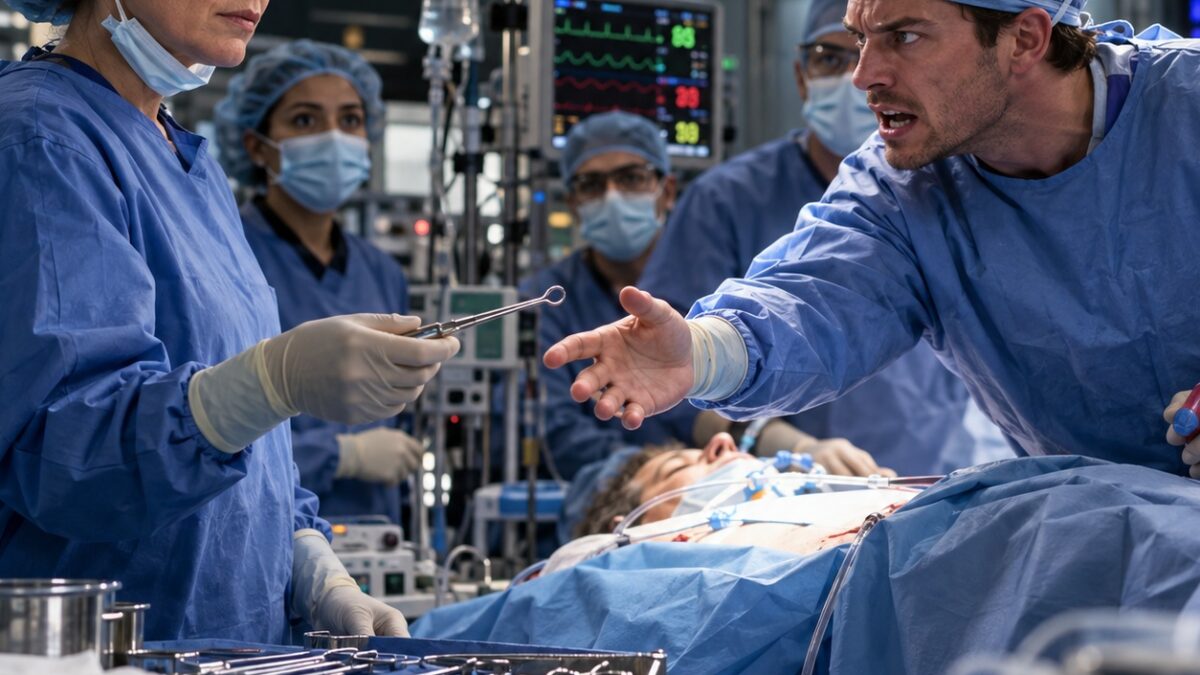
He held out his hand.
“Permanent titanium clip.”
I did not move.
For half a second, I wondered whether I had misheard him.
He extended his hand farther.
“Clip.”
My pulse hammered.
He was skipping the temporary bypass step.
If he committed to permanent occlusion before controlling the pressure, the weakened vessel could rupture catastrophically.
“Harrison.”
He kept his eye to the microscope.
“Clip.”
“You need the temporary shunt first.”
Silence.
Only a second.
But everyone felt it.
Harrison slowly lifted his head.
“What?”
“The shunt.”
My voice stayed low.
“Stabilize the flow first.”
His eyes sharpened.
“Jane, give me the clip.”
“The pressure isn’t controlled.”
“Do not question me.”
Henson called from behind us.
“He’s seventy over forty.”
Harrison snapped:
“I know.”
Then to me:
“Clip. Now.”
I looked at Ethan.
I could not see his face beneath the drapes.
But I had seen the photograph taped inside his chart.
Three children sitting beside him on a dock.
His wife had written their phone numbers on the consent paperwork with a shaking hand.
I imagined someone walking into the family room afterward.
We did everything we could.
I imagined knowing that was not true.
“No.”
The word came out quietly.
Harrison froze.
The gallery above us seemed to disappear.
“What did you say?”
“No.”
His eyes widened.
“Get me another scrub nurse.”
“There isn’t time.”
“You are refusing a direct order in the middle of a neurosurgical emergency.”
“I’m stopping you from making it worse.”
His face turned red above the mask.
“You have no idea what you’re looking at.”
“I do.”
“This is a restricted protocol.”
“I know.”
“You are a scrub nurse.”
“I know.”
“Then act like one.”
Blood continued filling the field.
Henson’s voice cut across the room.
“Harrison, whatever you’re doing, do it now.”
Harrison pointed toward my tray.
“Pass me the permanent clip before I have you removed from this hospital.”
I looked at his hand.
It was trembling.
Not much.
Enough.
Harrison Caldwell had finally reached the edge of his knowledge.
Instead of admitting it, he was trying to bully reality into obeying him.
That was when the woman I had been for ten years stopped being enough.
I picked up the temporary device.
Placed it into his palm.
Closed his fingers around it.
His eyes locked onto mine.
“What are you doing?”
“Saving your patient.”
He stared.
I spoke slowly.
“Establish temporary flow control first.”
His breathing stopped for half a beat.
“Harrison.”
Nobody called him Harrison in the OR.
Not nurses.
Not residents.
Not fellows.
Certainly not during surgery.
I did not care anymore.
“Look at me.”
He did.
“You are out of time.”
He swallowed.
“You don’t know this procedure.”
I lowered my voice.
“That’s where you’re wrong.”
His eyes narrowed.
I could feel every person in that room listening.
“I worked with Arthur Elias.”
Nothing moved.
“I worked with Jonathan Merik.”
His expression changed.
Not belief.
Shock searching for somewhere to land.
“I helped develop the sequence you’re trying to perform.”
The instrument in his hand suddenly looked heavier.
“What?”
“You heard me.”
His eyes searched mine.
I had spent three months making myself forgettable.
Now he was really seeing me for the first time.
“Harrison, do the bypass.”
For once, he obeyed.
Not because I outranked him.
I did not.
Not because he respected me.
Not yet.
Because somewhere beneath his pride, he was still a surgeon.
And surgeons recognize certainty when death is standing close enough.
He returned to the microscope.
His hands steadied slightly.
“Temporary shunt.”
“Yes.”
He positioned it.
Henson watched the monitors.
I watched both of them.
The room held its breath.
“Pressure improving,” Henson said.
Nobody answered.
Numbers climbed.
The instability began settling.
Harrison looked toward me.
I nodded.
“Now secure the aneurysm.”
I placed the clip into his hand.
This time he did not complain about the angle.
He moved carefully.
Applied it.
The bleeding stopped.
Just like that.
Not dramatically.
No music.
No applause.
One second, blood obscured the field.
The next, suction cleared it and revealed a stable repair.
Henson stared at the monitors.
“Pressure holding.”
A resident in the gallery put both hands over his mouth.
Harrison did not move.
For several seconds, he remained bent over the microscope.
Then he stepped back.
His entire scrub top was soaked with sweat.
He looked at his gloves.
Then at me.
I reorganized my tray.
“Would you like to begin closing, Doctor?”
My voice had returned to normal.
Soft.
Professional.
He stared at me as if I had become someone else.
In reality, I had simply stopped pretending to be smaller.
The rest of the surgery was quiet.
Harrison asked for instruments.
I handed them to him.
No snapping.
No lectures.
No insults.
Nobody in the gallery left.
When the last closure was complete, Ethan was transferred toward ICU.
His vital signs remained stable.
The double doors shut behind the gurney.
Only then did the room seem to exhale.
I walked toward the scrub sinks.
Harrison followed.
We washed in silence.
Pink water spiraled down the stainless-steel basin.
His hands were shaking again.
He looked at his reflection.
“You should have told me.”
I kept washing.
“Told you what?”
“Who you are.”
I shut off the water.
“You never asked.”
His jaw tightened.
“That’s not fair.”
I turned toward him.
“You told me not to think.”
He looked away.
“You said I was a bricklayer.”
Silence.
“You spent three months making it clear what you thought my role was.”
“I didn’t know.”
“That was the point.”
Before he could answer, the overhead speaker activated.
“Dr. Caldwell, Dr. Henson, and Nurse Jane, please report to the chief of surgery’s office immediately.”
Harrison closed his eyes.
There it was.
Consequence.
Dr. Thomas Albright ran St. Jude’s surgical department with the emotional warmth of a federal indictment.
He was silver-haired.
Precise.
Known for protecting excellent surgeons and destroying reckless ones.
When we entered his tenth-floor office, he did not offer anyone a seat.
Henson stood beside me.
Harrison faced the desk.
Albright held several printed pages.
“I have received four calls from residents who were observing OR Four.”
Harrison began:
“Tom—”
Albright lifted one finger.
Harrison stopped.
That alone told me how serious the situation was.
“You attempted an experimental military-derived vascular maneuver on a civilian patient.”
“It was the only viable option.”
“That is not my concern yet.”
Albright leaned forward.
“My concern is that you were not credentialed to perform it.”
Harrison swallowed.
“I was briefed extensively.”
“You attended a lecture.”
“I studied the complete technical sequence.”
“You studied theory.”
Harrison glanced toward me.
Albright noticed.
“Why are you looking at Nurse Jane?”
Henson answered.
“Because Harper saved the patient.”
Albright turned.
“What?”
Henson crossed his arms.
“The aneurysm started tearing.”
He described the pressure collapse.
Harrison’s decision.
His request for the permanent clip.
Then my refusal.
Albright stared at Harrison.
“You were going to clip before controlling flow?”
Harrison said nothing.
Henson answered for him.
“Yes.”
Albright’s face hardened.
“If she had handed you that clip—”
“Ethan would probably be dead,” Henson said.
The room became silent.
Albright turned toward me.
“Harper.”
“Yes, Doctor?”
“How did you know?”
I had expected that question.
For ten years, I had avoided this conversation.
Now there was no reason left.
I reached into my scrub-jacket pocket.
Pulled out a folded photocopy I had kept for reasons I never completely understood.
The page was heavily redacted.
I placed it on his desk.
Albright unfolded it.
His eyes moved across the heading.
Then down.
“What am I looking at?”
“A research excerpt from Bethesda.”
He read the authors.
Arthur Elias.
Jonathan Merik.
Then another name.
Harper Jane, BSN, RN.
His eyes stopped.
He looked up.
Then back down.
Harrison took one step closer.
“No.”
I looked at him.
He stared at the page.
“You?”
“Yes.”
Albright sat back.
“You co-authored this?”
“I coordinated the clinical research program.”
“What exactly does that mean?”
“I helped design the flow-control sequence.”
Nobody spoke.
“I worked with Elias directly.”
Harrison’s face had gone pale.
The procedure he had used to impress a room full of residents had been partly built by the scrub nurse he could barely be bothered to look at.
Albright removed his glasses.
“Why in God’s name are you working as a scrub nurse?”
I almost laughed.
That question came up every time someone discovered my old résumé.
“Because I like it.”
He stared.
“I’m serious.”
“So am I.”
“You could run surgical research.”
“I already did.”
“Then why leave?”
“My mother became ill.”
His expression softened slightly.
“I came home to take care of her.”
“And afterward?”
“I stayed.”
“Why?”
I thought about how to explain something I had spent years understanding.
“Research became too far away from patients.”
Albright said nothing.
“I spent years writing ways to save people I never met. Eventually I wanted to be in the room.”
I glanced toward the hallway.
“I wanted to hand the right instrument to the right person and know whether the patient lived.”
Harrison looked down.
Albright returned to the problem in front of him.
He placed the paper on his desk.
“Harrison.”
“Yes.”
“You are suspended from the surgical schedule effective immediately.”
Harrison closed his eyes.
“Pending a full credentialing and safety review.”
“I understand.”
“You will not operate independently until I determine whether your judgment can be trusted.”
Harrison nodded.
There was no argument left in him.
Albright continued.
“You had enough knowledge to recognize the procedure.”
A pause.
“But not enough humility to recognize when you didn’t understand it.”
Harrison swallowed.
“Yes.”
“Leave.”
He did.
No dramatic defense.
No blaming me.
No accusation that Henson had misunderstood.
He simply walked out.
The door closed.
Albright looked at me again.
“I want you in surgical innovation.”
“No.”
He blinked.
“I haven’t offered you anything yet.”
“You were about to.”
Henson laughed.
Albright ignored him.
“Director.”
“No.”
“Associate director.”
“No.”
“Research chair.”
“No.”
“Harper, most people negotiate upward.”
“I’m not negotiating.”
“Why?”
“Because I don’t want the job.”
He stared at me.
Then shook his head.
“You really do prefer being invisible.”
“Yes.”
“You understand that ended today.”
I sighed.
“I was afraid of that.”
By lunchtime, half the hospital knew.
By evening, everybody did.
Hospitals have no secrets.
They have delayed gossip.
Residents whispered in elevators.
Anesthesia technicians invented details.
Someone claimed I had designed the entire procedure alone.
Someone else said I used to operate with military surgeons in combat zones.
By Thursday, according to one version, I had personally trained half the Pentagon.
None of that was true.
I corrected nobody.
The nurses were the worst.
Not cruelly.
They were delighted.
For years, they had watched surgeons talk over them.
Interrupt them.
Forget their names.
Treat their knowledge as background noise.
Now one of the hospital’s most arrogant surgeons had nearly killed a patient because he refused to listen to a nurse who happened to know more than he did.
To them, the story felt like justice.
To me, it felt heavier.
Ethan was still unconscious.
Nothing mattered until he woke.
Three days later, I was restocking supplies when Henson found me.
He stood in the doorway.
“Harper.”
Something in his face made my stomach drop.
“What?”
“He’s awake.”
I stopped moving.
“Ethan?”
“Yes.”
“How is he?”
Henson smiled.
That was all I needed.
“Neurologically intact so far.”
My knees almost weakened.
“He’s talking?”
“Complaining.”
I laughed.
“Good.”
“He knows his wife.”
I closed my eyes.
“Kids?”
“Names all three.”
I leaned against the shelf.
For the first time since the surgery, emotion caught up with me.
Not dramatic sobbing.
Just tears.
Quiet.
Henson pretended not to notice for a few seconds.
Then handed me a tissue.
“Architect crying?”
“Careful.”
He smiled.
“Bricklayer?”
“Get out.”
Ethan’s wife cried harder than I did.
She held his face between both hands.
Their oldest daughter kept asking whether she could hug him.
He was exhausted.
Confused.
Alive.
That was enough.
That evening I returned to the sterile core behind the operating rooms.
It was one of my favorite places in St. Jude.
No families.
No alarms.
Just carts, supplies, bright lights, and the soft hum of ventilation.
I was stacking gauze when someone appeared in the doorway.
Harrison Caldwell.
No white coat.
No tailored suit.
Jeans.
Dark sweater.
He looked ten years older.
“Dr. Caldwell.”
“I’m suspended.”
“I heard.”
“I imagine everyone heard.”
“Pretty much.”
He stepped inside.
“I watched the tape.”
I continued stacking.
“The overhead surgical recording.”
I nodded.
“I watched it six times.”
I stopped.
He looked at the floor.
“If you had handed me what I asked for…”
His voice broke slightly.
I waited.
“He would have died.”
“Yes.”
He looked up.
“I calculated the pressure transition afterward.”
I said nothing.
“I was wrong.”
“Yes.”
The word hurt him.
It needed to.
He moved closer.
“I knew I was in over my head.”
That surprised me.
“In the OR?”
“Yes.”
“When?”
“Earlier than I admitted.”
He gave a humorless laugh.
“When the aneurysm looked worse than imaging.”
“Why didn’t you stop?”
“Because everyone was watching.”
There it was.
The ugliest truth.
Not technical.
Human.
“The gallery?”
“The department.”
He rubbed his forehead.
“I had spent months telling everyone I could do things other surgeons couldn’t.”
He swallowed.
“Then I opened Ethan’s skull and realized the procedure was beyond what I had actually trained for.”
I crossed my arms.
“You could have asked for help.”
“I know.”
“You could have called Albright.”
“I know.”
“You could have listened when Henson questioned you before surgery.”
“I know.”
His eyes reddened.
“I panicked.”
I stayed quiet.
“And instead of admitting I was scared, I became more arrogant.”
“Yes.”
“I tried to bully my way through it.”
“Yes.”
“And then I tried to bully you.”
“Yes.”
He almost laughed.
“You’re not making this easy.”
“It shouldn’t be easy.”
He nodded.
Then held out his hand.
“I am profoundly sorry.”
I looked at it.
Not because I wanted him to suffer.
Because apologies in hospitals can become shortcuts.
A sentence.
A handshake.
Everybody moves on.
That was not enough.
I looked at Harrison.
“Operating Room Four is not a stage.”
His hand lowered slightly.
“You are not performing for residents.”
He nodded.
“You are not performing for the board.”
Another nod.
“You are not the only intelligent person in that room.”
“I know.”
“No.”
I stepped closer.
“You know now.”
He held my gaze.
“The anesthesiologist matters.”
“Yes.”
“The perfusion team matters.”
“Yes.”
“The residents matter.”
“Yes.”
“The scrub nurse matters.”
His face tightened.
“Yes.”
“The circulating nurse matters.”
“Yes.”
“People who disagree with you are not automatically challenging your authority.”
He was silent.
“Sometimes they are trying to keep your patient alive.”
“I understand.”
I shook my head.
“You almost understand.”
He waited.
“I have worked with surgeons more talented than you.”
His eyes shifted.
“And surgeons less talented than you.”
I continued.
“The dangerous ones were never the least skilled.”
He listened.
“They were the ones who became too important in their own minds to hear the room.”
That landed.
I could see it.
“You have exceptional hands, Harrison.”
He looked surprised.
“That isn’t enough.”
“No.”
“If you ever turn that operating room into your private kingdom again, I will personally make sure every credentialing committee in Chicago understands why.”
He actually smiled faintly.
“I believe you.”
“Good.”
I took his hand.
His grip was different from the first day we met.
Not performative.
Just human.
“Thank you,” he said.
“For what?”
“Saving Ethan.”
“That’s our job.”
“For saving me.”
I let go.
“That part is still under review.”
He laughed once.
“Fair.”
I returned to the cart.
He started toward the door.
“Harrison.”
He turned.
“I heard the review board may clear you in another week.”
“So did I.”
“Good.”
He looked surprised.
“You want me back?”
“I want the surgeon who comes back after this.”
He stared.
“You’d better make sure he’s different from the one who left.”
He nodded.
“I will.”
“Good.”
I picked up another box.
“Now enjoy your suspension.”
Two weeks later, Harrison returned to surgery.
The transformation was almost uncomfortable to watch.
He arrived early.
Read the full chart.
Asked Henson whether anesthesia had concerns.
Asked the circulating nurse whether anything was missing.
Asked the resident to speak up if she saw something he did not.
The room did not know what to do with him.
Then he walked toward my station.
For a moment, neither of us spoke.
He raised his freshly scrubbed hands.
“Good morning, Harper.”
“Good morning, Doctor.”
He looked at the board.
“Anything you want to add before we start?”
I nearly smiled.
“Are you asking the bricklayer?”
His eyes closed.
“I deserve that.”
“Yes.”
Someone behind us snorted.
Harrison shook his head.
“Fine.”
He looked at me again.
“What’s our plan?”
Our.
One word.
Small.
Important.
I checked the tray.
“Straightforward case.”
“Those make me nervous now.”
“Good.”
He laughed.
I placed the scalpel into his hand.
Perfect angle.
Exactly how he liked it.
He noticed.
“Showing off?”
“Always.”
The operation went smoothly.
Then another.
Then another.
Weeks became months.
Harrison remained brilliant.
He also learned something brilliance had never taught him.
Listening is not surrender.
Asking for help does not reduce authority.
And respect in an operating room is not created by fear.
It is created when everyone trusts that if they speak, somebody will hear them.
I stayed a scrub nurse.
Albright tried three more times to promote me.
The final attempt involved a title so long I could not remember it.
“Director of Advanced Surgical Systems and Clinical Innovation.”
“No.”
“Associate?”
“No.”
“Consultant?”
“No.”
“Part-time?”
“No.”
He leaned back in his chair.
“You are the most infuriating employee I have.”
“I’ve heard worse.”
“You understand you could make twice your salary.”
“I understand.”
“You could shape hospital policy.”
“I already shaped enough policy for one lifetime.”
“You could teach.”
“I do.”
He frowned.
“When?”
“Every shift.”
That shut him up.
Because it was true.
Teaching does not always happen behind a podium.
Sometimes it is correcting a resident quietly before their mistake becomes public.
Sometimes it is telling a new scrub nurse why you count again even when everybody is rushing.
Sometimes it is showing a surgeon that the person standing across the table has a perspective they do not.
Sometimes it is refusing to hand somebody the wrong tool.
People eventually stopped staring at me.
Hospital gossip always finds a new target.
A chief resident had an affair.
A cardiologist crashed a Lamborghini.
Administration changed the cafeteria vendor and nearly caused a civil war.
My story faded.
I liked that.
Ethan recovered beyond what anyone expected.
Months later, he returned to St. Jude with his wife and children.
I was coming out of OR Four when I saw them in the hallway.
He looked thinner.
Moved carefully.
But he was walking.
His wife recognized me first.
“Harper.”
I stopped.
Ethan looked confused.
Then she whispered something.
His face changed.
He walked toward me.
“You’re the nurse.”
“One of them.”
“The one.”
I smiled.
“There were a lot of people in that room.”
He shook his head.
“My wife told me.”
I glanced toward her.
She shrugged.
“The doctors talk.”
“They really shouldn’t.”
Ethan laughed.
Then his eyes filled.
He looked at his children.
Three.
Exactly like the photograph.
Older than I had imagined.
Real.
His youngest daughter held his hand.
“I don’t know what to say,” he told me.
“You don’t have to say anything.”
“I’m alive.”
“Yes.”
“My kids still have their dad.”
My throat tightened.
“Yes.”
He hugged me.
That surprised me.
I stood stiff for a second.
Then hugged him back.
Over his shoulder, I saw Harrison at the end of the hallway.
He had stopped walking.
He watched.
No jealousy.
No discomfort.
Just understanding.
Ethan let go.
“Thank you.”
I shook my head.
“Go home.”
He smiled.
“That’s it?”
“That’s the goal.”
His family walked toward the elevator.
The youngest girl looked back and waved.
I waved too.
Harrison approached.
“Still prefer research less than this?”
I watched the elevator close.
“Much less.”
He nodded.
“I understand now.”
“Do you?”
“A little.”
That was enough.
A year after Ethan’s surgery, I worked another complex case with Harrison.
Different patient.
Different problem.
Nothing connected to Elias-Merik.
Halfway through, a resident noticed something unusual on imaging.
Old Harrison would have dismissed her.
New Harrison stopped.
“What do you see?”
She explained.
He listened.
Henson listened.
I listened.
She was right.
The plan changed.
The patient did well.
Afterward, Harrison found the resident.
“Good catch.”
She looked shocked.
“Thank you.”
“Next time, say it sooner.”
“I didn’t want to interrupt.”
He shook his head.
“If you think the patient is in danger, interrupt me.”
I stood across the room pretending not to hear.
Harrison saw me.
He pointed.
“Do not smile.”
“I’m not.”
“You are.”
“Must be the mask.”
He rolled his eyes.
But he smiled too.
That was the change I cared about.
Not that he became humble overnight.
People do not transform that neatly.
He still liked expensive cars.
Still knew he was talented.
Still became irritated when residents were unprepared.
Still had an ego.
Probably always would.
But now his ego had boundaries.
He had learned there were worse things than being wrong.
One of them was being wrong and refusing to listen.
As for me, I remained exactly where I wanted to be.
Blue scrubs.
Hair under a cap.
Mayo stand.
Cold operating rooms.
No office.
No political meetings.
No research budget.
No board presentations.
I occasionally received invitations to speak at conferences after the Ethan case became known in professional circles.
I declined most of them.
Arthur Elias called once.
We had not spoken in years.
“You caused trouble in Chicago.”
“I prevented trouble.”
“I heard Caldwell tried to perform our procedure after one briefing.”
“A little more than one.”
“Still stupid.”
I laughed.
“You sound exactly the same.”
“So do you.”
A pause.
“Come back to research.”
“No.”
“I knew you’d say that.”
“Then why ask?”
“Habit.”
We spoke for twenty minutes.
Before hanging up, Arthur said:
“Harper.”
“Yeah?”
“You know your name was never supposed to disappear from that work.”
I looked around the empty break room.
“I didn’t disappear.”
“Could’ve fooled me.”
“I’m exactly where I want to be.”
He sighed.
“Still stubborn.”
“Goodbye, Arthur.”
“Goodbye, Harper.”
After the call, I returned to OR Four.
Harrison was already there.
He looked at the clock.
“You’re thirty seconds late.”
I stared at him.
He immediately raised both hands.
“Joke.”
“Dangerous joke.”
“Understood.”
I took my place.
The patient was a sixty-three-year-old grandmother with a benign tumor compressing a cranial nerve.
Harrison reviewed the plan.
Then looked at the team.
“Questions?”
Nobody spoke.
He waited.
Old Harrison would have moved on.
He waited longer.
The junior resident raised a hand slightly.
“I have one.”
“Good.”
He listened.
I stood quietly behind my tray.
Invisible again.
But not ignored.
There is a difference.
I spent years believing invisibility was safety.
Maybe it was.
Then I learned something better.
You do not need to dominate a room to matter in it.
You do not need your name on the door.
You do not need the biggest salary.
You do not need thirty people waiting for you to speak.
Sometimes authority looks like a surgeon at the microscope.
Sometimes expertise wears a white coat.
And sometimes the person who knows exactly what must happen next is the woman everyone assumed was only there to hand over instruments.
That morning, Harrison finished his briefing.
He turned toward me.
“Harper?”
“Yes?”
“Anything I missed?”
I looked over the tray.
Then the monitors.
Then the patient.
“No.”
He nodded.
“Good.”
He held out his hand.
“Scalpel.”
I placed it perfectly into his palm.
He smiled behind his mask.
“Thank you.”
Three months earlier, he would never have said that.
I returned my hand to the tray.
“You’re welcome, Doctor.”
The lights brightened over the field.
The room settled.
Everyone took their position.
And I went quietly back to work.
Not beneath him.
Not behind him.
Beside the team.
Exactly where I had always belonged.








