PART 2:The Navy Was Ready to Put My Husband’s K9 Down, but My 9-Year-Old Daughter Knew the Secret Cole Never Told His Unit
PART 2 AND THE COMPLETE CONCLUSION 👇👇 Thank you ❤️
[08:54–15:15]
I sat down because suddenly my legs did not feel reliable.
“Why didn’t you tell anyone?”
Lily looked confused.
“I thought Dad told them.”
Of course she did.
She was nine.
She assumed trained adults knew the important things.
But Cole had apparently never put the signal in Shadow’s official command system.
Lily explained that after difficult training days, Cole sometimes removed Shadow’s harness in our backyard.
He would raise his open hand.
Then touch two fingers to his chest.
Sometimes he said one word.
Home.
It was not a command telling Shadow to perform something.
It was permission to stop performing.
That distinction would matter more than any of us understood.
That night, rain came in from the Atlantic.
I stood alone in the kitchen after Lily went upstairs.
Cole’s delayed survivor-benefit letter sat beneath unopened mail.
The mortgage needed attention.
His boots were still beside the hallway closet.
Six weeks.
I had tried twice to put them away.
Both times, I brought them back before the end of the day.
At 8:17, Mason called.
“We finished Shadow’s preliminary review.”
His voice was quieter than usual.
“We’re nearly out of safe options.”
I leaned against the counter.
“The final evaluation?”
“Tomorrow morning.”
“And if he fails?”
Silence.
“That bad?”
“Yes.”
After we hung up, I found Lily listening again.
This time she did not ask anything.
She simply held the bracelet.
The next morning, she came downstairs wearing the yellow dress Cole had bought her the previous spring.
I suggested jeans.
She refused.
“Dad liked this one.”
I handed her a sweater.
Some arguments are not worth winning.
We arrived less than an hour before the evaluation.
Mason met us near the secured entrance.
The instant he saw Lily, his face tightened.
“She cannot go near Shadow.”
“I know.”
Lily held up the bracelet.
“But I know something he remembers.”
Dr. Rachel Monroe joined us.
She listened while Lily explained.
Then asked careful questions.
Was the gesture official?
No.
Was it used repeatedly?
Yes.
Had anyone else used it?
Lily did not know.
Rachel remained cautious.
“A familiar cue may affect him.”
She said.
“But we cannot assume it overrides his current behavior.”
“I’m not asking Lily to touch him.”
I replied.
Rachel looked through the observation window.
Shadow had already reacted that morning when a technician passed carrying cleaning equipment.
He was restless.
Tense.
Rachel finally agreed.
Twenty feet minimum.
Safety line.
No running.
No approaching.
If she said move back, Lily moved back.
No argument.
Mason crouched in front of my daughter.
“Understood?”
“Yes, sir.”
We entered the outer training yard.
Shadow saw Lily almost immediately.
He stood.
His attention locked on the small figure in yellow.
A low warning sound came from his chest.
Jake instinctively stepped forward.
Mason raised one hand.
“Wait.”
Lily stopped behind the painted line.
For several seconds, nothing happened.
Then she slowly lowered herself onto one knee.
“Lily…”
I whispered.
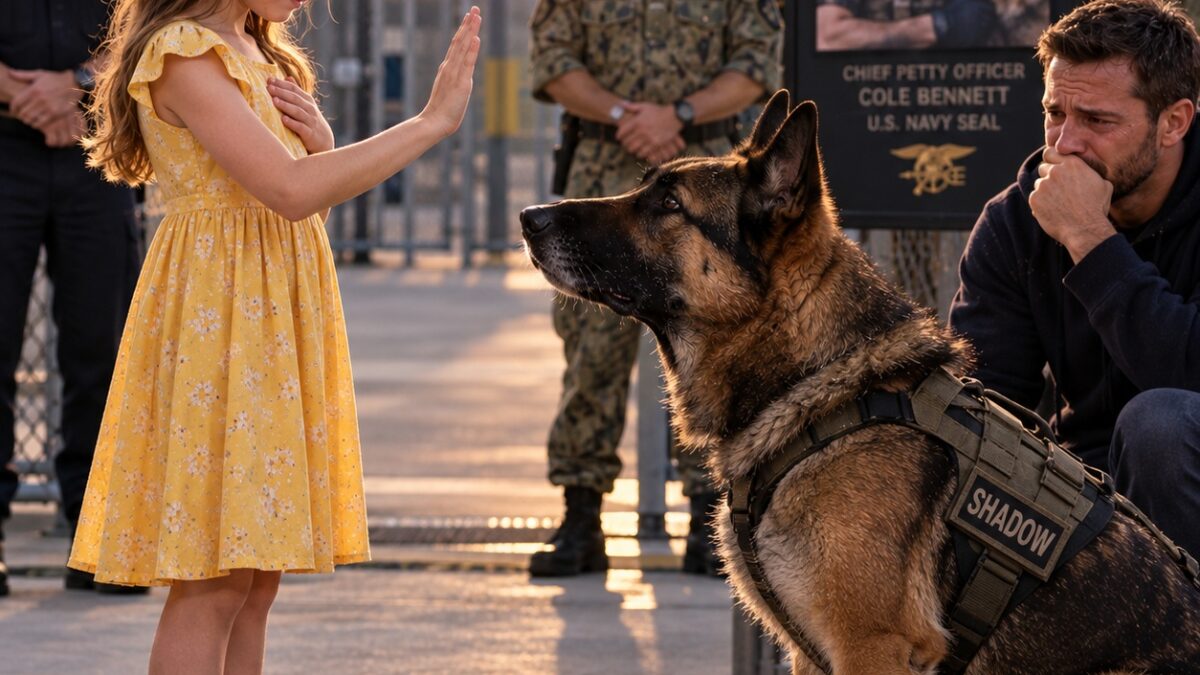
She raised her right hand.
Palm forward.
Shadow took two quick steps toward the barrier.
My body moved before thought.
Mason caught my forearm.
“Look at him.”
I did.
Shadow had stopped.
Lily kept her hand raised.
Then slowly touched two fingers to her chest.
Shadow’s ears moved forward.
His breathing changed.
The tension did not disappear.
But his attention shifted.
Rachel recorded everything.
Jake whispered:
“He ignored every sit command yesterday.”
Lily repeated the gesture.
Open hand.
Two fingers to her heart.
That was when Mason remembered.
Almost a year earlier, after a long training evening, he had seen Cole make the same movement.
He had asked:
“What’s that supposed to mean?”
Cole had smiled.
“Shadow needs to know when he’s allowed to stop being a soldier.”
Mason had laughed.
Forgotten.
Until now.
Shadow lowered his head.
The warning sound disappeared.
He stared at Lily.
Then slowly folded his hind legs beneath him.
Shadow sat.
I covered my mouth.
Jake forgot about his injured hand.
Rachel lowered the tablet slightly.
For six weeks, experienced handlers had tried commands.
Food.
Routines.
Equipment.
Distance.
Patience.
My daughter used none of them.
She had simply reminded Shadow of something Cole had taught him before anyone imagined it might someday matter.
Work was over.
Home still existed.
Nobody moved.
Shadow’s breathing slowed.
Rachel watched.
“This does not prove he is safe.”
She said.
My hope must have shown on my face.
“Do not get ahead of this.”
She reviewed the recording twice.
Then:
“Seven days.”
Mason stared.
“For what?”
“A controlled home rehabilitation trial.”
Before I could speak, Rachel continued.
“He remains Navy property.”
“This is not an adoption.”
“It does not erase the incident with Jake.”
“We need to know whether the response survives outside this facility.”
Conditions followed.
Basket muzzle outside our home.
Second secured barrier around the backyard.
Lily never alone with Shadow.
Mason performing daily checks.
Any serious uncontrolled aggression ended the trial.
I agreed.
Rachel looked at Lily.
“This is not seven days to prove Shadow loves you.”
Lily nodded.
“We already know he recognizes you.”
Rachel said.
“This is seven days to prove he can live safely around people again.”
By late afternoon, the paperwork was complete.
Shadow left the facility with two leads.
Mason held one.
Jake held the other, though I could see the stiffness in his grip.
Every time Shadow hesitated, Lily stopped several feet ahead.
Raised her open hand.
Two fingers to her heart.
Shadow followed.
When we reached our house, I opened the door.
Fresh water waited beside the kitchen.
A dog bed sat near the fireplace.
Shadow ignored both.
He moved through the hallway.
Stopped at the closet.
Cole’s boots.
Shadow lowered his nose.
Sniffed the leather.
Stayed there nearly a minute.
Then lay down.
Rested his head across one boot.
Lily sat several feet away.
She did not call him.
Did not touch him.
She simply stayed.
For six weeks, I had believed grief belonged mostly to people.
Watching Shadow that afternoon, I was no longer certain.
[15:16–21:48]
The first night almost ended the trial.
A storm moved inland after midnight.
A sudden gust pushed the back door open because the upper latch had not caught.
The door slammed against the wall.
Again.
Again.
I woke and ran downstairs.
Shadow stood in the hallway.
Between the open doorway and Lily’s bedroom.
Rigid.
Protective.
Lily had appeared behind him.
“Don’t move.”
I told her.
Shadow stared toward the darkness outside.
He was not threatening Lily.
He believed something was entering his territory.
Something he had to stop.
Lily slowly raised her hand.
Palm.
Two fingers to chest.
Shadow looked back.
The tension eased.
After several seconds, he stepped aside.
I closed the door.
Locked it.
Only then did I understand what Rachel had been trying to tell us.
Shadow’s reactions were not random.
He was responding to situations he believed required protection.
The problem was that Shadow no longer understood when protection was unnecessary.
So the next several days were not about teaching him tricks.
They were about teaching safety.
Our house developed a routine.
Every afternoon, Lily brought an old adventure book into the living room and read.
No commands.
No training.
No attempt to touch Shadow unless he approached first.
Day one, he stayed beside Cole’s boots.
Day two, halfway across the room.
By the third afternoon, he ate while Lily read.
I noticed.
Said nothing.
Some victories feel too fragile to celebrate loudly.
On day four, he lay beside her chair.
On day five, I walked into the room carrying laundry.
Tap.
Pause.
Tap.
Shadow’s tail against the floor.
Lily looked down.
Did not reach.
Turned another page.
I had to set the basket down because I was crying.
Outside our small circle of progress, real life was less gentle.
Cole’s survivor benefits remained delayed.
The mortgage payment was overdue.
I quietly listed his dark pickup for sale.
I did not tell Lily.
Margaret Hayes found out anyway.
Margaret was sixty-nine, short, solid, silver-haired, and incapable of seeing a problem without attempting to fix it.
She had lived beside us for eleven years.
She found me photographing the truck.
“You’re selling Cole’s pickup?”
“I may have to.”
She studied me.
Then noticed the temporary security fencing around the backyard.
The next morning, I heard drilling.
Two retired tradesmen from the neighborhood were repairing the weak fence sections.
Margaret stood nearby holding screws.
“You did this?”
“I made two phone calls.”
“I didn’t ask.”
“No.”
She replied.
“That appears to be your favorite problem.”
I almost argued.
Then stopped.
Maybe refusing help had become another kind of guarding.
Jake arrived later for Mason’s required check.
Shadow saw him through the fence.
His body tightened.
Jake’s hand moved unconsciously toward the place where his leash usually hung.
Lily noticed.
She carried an old chair outside.
Set it several yards away.
“You can sit there.”
Jake looked embarrassed.
“I’m not afraid of him.”
Lily looked at his hands.
Then:
“Okay.”
He sat.
He did not approach Shadow.
Instead, he told Lily about the time Cole forgot his lunch during a fourteen-hour training day and accused Shadow of stealing it.
“Did he?”
Lily asked.
“No.”
A voice came from the driveway.
“He absolutely did.”
Mason.
Jake looked offended.
“You weren’t there.”
“I was.”
“You ate my food.”
“I prevented waste.”
For the first time since Cole died, Lily laughed.
Not the small careful laugh she had been using for adults.
A real one.
Shadow lifted his head.
Jake returned the next morning.
And the next.
He sat outside the fence.
Told another harmless story about Cole.
Losing keys.
Getting sprayed with a hose.
Falling asleep halfway through movies and denying it afterward.
By the fourth visit, Shadow no longer stood when Jake arrived.
He watched.
That was enough.
Mason watched from the doorway one afternoon.
His hand remained inside his uniform pocket.
Later I would learn Cole’s dog tag was there.
He had carried it for almost two weeks.
Twice he had almost given it to me.
Twice guilt stopped him.
He believed that if he had been beside Cole on the last mission, something might have been different.
There was no evidence.
Grief did not require evidence.
Five days earlier, nobody knew whether Shadow could leave the kennel.
Now he lay beside Lily instead of Cole’s boots.
One quiet choice at a time, he seemed to be learning that home was not only where Cole had been.
It was also where someone was still waiting for him.
[21:49–28:13]
On the fifth morning, Mason decided Shadow was ready for a simple structured exercise.
Nothing difficult.
Walk.
Stop.
Sit.
Return.
No unfamiliar people.
No pressure.
Shadow wore his basket muzzle and remained on a secured lead.
Lily stood beside me.
Jake watched from the porch.
“Easy.”
Mason said.
Shadow stopped.
Several steps.
Followed.
I allowed myself a small smile.
Then we heard the helicopter.
Military.
Low.
Heading toward the coast.
The sound hit the yard suddenly.
Shadow froze.
His head lifted.
His entire body became still.
“Shadow.”
Mason called.
No response.
The helicopter passed beyond the trees.
Shadow remained focused on the sky.
Six weeks earlier, that kind of sound had been part of the last day he saw Cole.
Mason shortened the leash carefully.
“Easy, boy.”
Shadow pulled backward.
Then turned sharply toward the woods.
The movement caught Mason off balance.
The lead slipped.
At that exact moment, the side gate stood partially open.
One of the men who had repaired the fence earlier had been carrying equipment through.
Shadow saw the gap.
Then he was gone.
“SHADOW!”
Lily ran after him.
“LILY!”
But she had already passed through the gate.
Mason followed.
Jake behind him.
I ran.
The woods behind our property stretched toward low marshland and old conditioning trails.
Cole had taken Shadow there.
He had taken Lily too.
I did not know whether that made me feel better or worse.
Trees swallowed the houses.
“LILY!”
No answer.
Every terrible instinct created by Cole’s death came alive inside me.
My body remembered uniformed men at our door.
Words like regret.
Mission.
Killed.
I could not lose my daughter too.
Lily found Shadow first.
He stood in a small clearing beside an old oak.
Facing an empty trail.
Waiting.
Again.
She stopped several yards away.
Did not rush him.
Cole had taught her never to crowd a frightened working dog.
“Shadow.”
One ear moved.
She knelt.
Raised her hand.
Two fingers to her chest.
Nothing.
Shadow kept watching the trail.
Then Lily said the sentence no one else had been able to give him.
“Dad isn’t coming.”
Shadow remained still.
“But we can still go home.”
She repeated the signal.
This time, he turned.
His shoulders lowered.
One step.
Another.
When he finally reached her, Lily did not throw her arms around him.
She simply stood.
Shadow leaned lightly against her leg.
That was when Lily noticed the bracelet was missing.
Somewhere between the yard and the clearing, Cole’s old paracord bracelet had slipped off.
On another trail, Mason found it.
Green and black against wet leaves.
He picked it up.
For the first time since Cole died, the guilt inside him became heavier than his discipline.
Jake found him standing there.
“Did you find something?”
“Lily dropped it.”
Jake understood the real meaning.
Mason believed he had lost control again.
Cole.
Shadow.
Now Lily.
“This isn’t all on you.”
Jake told him.
Mason looked toward the trees.
“Tell me that after we find her.”
By then, Lily and Shadow had started walking back.
Shadow stayed close beside her.
Then Lily noticed something blue beneath wet leaves.
“Your ball.”
Shadow’s old training ball.
Cole had used it during recovery exercises.
Lily stepped toward it.
Shadow moved instantly.
Between Lily and the grass.
A copperhead lay partially hidden beneath the leaves.
Lily did not see it until Shadow pushed her backward.
He placed himself directly between her and the snake.
No command.
No home signal.
No handler.
Choice.
The danger passed quickly.
Then Lily noticed Shadow favoring one front leg.
Something was wrong.
Jake heard her calling.
Reached them first.
Five days earlier, Shadow rushing toward him had left his hands shaking.
Now Jake saw the injured dog and did not hesitate.
He removed his combat jacket.
Moved carefully closer.
“Easy.”
Shadow allowed him.
Jake supported his body.
Then lifted him.
Nearly forty kilograms of German Shepherd rested against the chest of the man who had once been afraid to stand inside the same fence with him.
Mason reached Lily.
I arrived seconds later.
I grabbed her.
“Are you hurt?”
She shook her head.
“Shadow moved me.”
I looked at the dog in Jake’s arms.
Nobody had told him to protect her.
He chose to.
We drove straight to Rachel.
Immediate treatment.
Observation.
Rachel stayed calm.
Her expression told me the next several hours mattered.
“The good news is you got him here quickly.”
She said.
“Now we give him time.”
Lily stood outside the treatment room.
“What about the evaluation?”
Rachel looked at Shadow.
Then at the schedule.
“That depends on how he recovers.”
For the first time, Shadow’s biggest threat was not behavioral.
It was whether he would physically be able to stand for the final assessment.
Word spread through Cole’s military community.
Messages.
Emails.
Letters.
A former teammate remembered Shadow locating an injured servicemember during a difficult search.
Another described Cole and Shadow staying beside a frightened family until help arrived.
Nobody asked the Navy to ignore safety.
They asked only that Shadow’s entire life be remembered.
Late that night, Mason sat outside the clinic with Cole’s bracelet in one hand and his dog tag still inside his pocket.
Jake stayed near Shadow.
Lily sat beside me.
And for the first time since this began, every one of us was waiting for the dog who had spent six weeks waiting for someone else.
[28:14–34:53]
Two days later, Shadow stood again.
Bandage around his front leg.
Slight stiffness.
But strong enough.
Rachel watched him cross the room.
“He can participate.”
Then:
“The evaluation has to change.”
No running.
No jumping.
No sudden leash pressure.
If he became tired, stop.
By midmorning, we were back in the fenced training yard.
Lily waited outside the test area beside me.
She held Cole’s bracelet in both hands.
Mason had found it in the woods and returned it.
Shadow wore a basket muzzle and plain black collar.
Rachel stood with a clipboard.
Beside her was Lieutenant Commander Thomas Reed, the Navy veterinary liaison.
Procedural.
Calm.
A man who believed sympathy should follow evidence instead of replacing it.
“This is not about whether we like Shadow.”
Thomas said.
Rachel nodded.
“It’s about whether he can remain under control.”
The first stage involved a stranger.
Marcus Hill entered through the opposite gate.
He had never worked directly with Shadow.
That was why he had been chosen.
Marcus walked in a wide circle.
Shadow watched.
Alert.
Stayed beside Rachel.
Marcus moved closer.
No forward movement from Shadow.
No attempt to close distance.
Rachel wrote.
Good.
Second stage.
Sudden noise.
A metal tray fell several yards behind Shadow.
Clang.
Shadow spun.
Shoulders tightened.
I held my breath.
He looked at the tray.
Then Rachel.
Nobody signaled.
Nobody corrected him.
Several seconds.
His body softened.
Rachel wrote again.
“He recovered without intervention.”
Third stage.
Two children entered the far end of the yard.
Navy families.
Carefully briefed.
Caleb.
Seven.
Red hair.
Barely able to stand without bouncing.
Ava.
Eleven.
Dark braids.
Quiet.
Used to being around service dogs.
They rolled a soft rubber ball.
Shadow noticed.
Leaned slightly.
Rachel watched his feet.
He did not move.
Ball again.
Shadow looked toward Lily.
She did nothing.
Hands down.
No home signal.
Shadow looked back at the children.
Stayed.
Thomas lowered his pen.
“That matters.”
Mason asked:
“Why?”
“Because he made the correction himself.”
Three stages complete.
One remained.
Before the final test, Jake asked Mason to step behind the equipment building.
He held a revised incident report.
“I changed my statement.”
“Why?”
“The first one makes it sound like Shadow reacted without warning.”
Jake looked toward the yard.
“That isn’t what happened.”
He admitted he saw the tension.
Saw Shadow focus on the leash.
Saw him step backward.
But believed their history would overcome the dog’s fear.
It did not.
“I triggered him.”
Mason shook his head.
“You didn’t cause everything.”
“No.”
Jake said.
“But I helped create that moment.”
He handed over the paper.
“If he gets judged, he should get judged on the truth.”
A few minutes later, Jake entered the yard.
Same style of camouflage uniform he had worn during the kennel incident.
A leash hung from his right hand.
Shadow saw him.
Immediate reaction.
Body tightened.
Low warning growl.
Mason stepped forward.
“That’s enough.”
Jake did not move closer.
“Give me one minute.”
Rachel watched carefully.
“Do not approach.”
“I won’t.”
Jake lowered the leash onto the grass.
Then knelt.
Shadow continued staring.
Jake raised his right hand.
Open palm.
Two fingers touched his chest.
The home signal.
Shadow’s ears moved forward.
Jake said nothing.
Outside the fence, Lily watched.
Mason glanced toward her.
She understood.
Lily kept her own hands down.
“This one has to be his choice.”
For several seconds, Shadow remained still.
Then the warning sound stopped.
His shoulders lowered.
One step.
Jake stayed kneeling.
Another.
Another.
Shadow reached him.
Jake did not touch him.
He waited.
Shadow lowered his head.
Then gently rested it against Jake’s knee.
Jake closed his eyes.
Nobody spoke.
Rachel waited until Shadow stepped away on his own.
He turned toward her.
Settled beside the marked evaluation line.
Only then did she close the file.
“Shadow is not demonstrating uncontrolled aggression.”
Thomas looked at her.
Rachel continued.
“His earlier behavior is consistent with trauma-related defensive fixation following the loss of his handler.”
“That does not mean the risk disappears.”
“It means the behavior has identifiable triggers.”
“He has demonstrated recovery.”
“He has demonstrated the ability to choose a controlled response.”
Mason looked toward Shadow.
“Recommendation?”
“Retirement.”
Rachel said.
“Continued structure.”
“Monitoring.”
For the first time in days, I breathed normally.
Later, inside the administrative building, Mason removed the euthanasia authorization from Shadow’s folder.
He tore it down the center.
Lily stared.
“He’s safe?”
“The order is canceled.”
She smiled.
Then Mason’s expression changed.
“But there’s another problem.”
Shadow still legally belonged to the Navy.
Passing the evaluation did not make him ours.
Lily’s smile disappeared.
“I don’t need him to be a K9 anymore.”
She said.
Mason looked at her.
“I just want him to be a dog.”
Across the room, Rachel reopened his medical file.
Near the back, she found an older note.
Cole had once asked about Shadow’s retirement procedure.
That afternoon, administrative specialist Dana Whitmore began searching archived files.
“If Cole filed anything.”
She told Mason.
“I’ll find it.”
Before leaving, Mason finally handed me Cole’s dog tag.
I closed my fingers around it.
“I should’ve gone with him.”
Mason whispered.
“Cole never blamed you.”
“You don’t know that.”
“Yes.”
I said.
“I do.”
I held the tag against my palm.
“Before that mission, Cole told me you had already carried enough for him.”
Mason looked away.
The guilt did not disappear.
But it became lighter.
Outside, Shadow rested beside Lily.
The decision about what kind of dog he was had finally been made.
The decision about where he belonged had not.
[34:54–40:42]
Dana was inside the archive before most of the facility opened the next morning.
At 7:42, she called Mason.
“I found something.”
Ten minutes later, he was standing over a thin folder.
Dated three weeks before Cole’s final mission.
MILITARY WORKING DOG RETIREMENT REQUEST.
Shadow’s identification number.
Service history.
Then:
PREFERRED RETIREMENT PLACEMENT:
AARON BENNETT
LILY BENNETT
VIRGINIA BEACH, VIRGINIA
Cole’s signature sat near the bottom.
But beneath the formal section was one handwritten sentence.
He has spent his life bringing people home.
When his watch is over, let him come home, too.
Mason turned away from the table.
Dana pretended not to notice.
For weeks, Mason believed he had failed one final responsibility to Cole.
Now Cole had left him another.
This time Mason knew exactly what to do.
The unit review board assembled later that morning.
Shadow’s service record.
Rachel’s report.
Behavioral evaluation.
Jake’s revised statement.
The woods incident.
Cole’s signed retirement request.
Rachel did not describe Shadow as cured.
That mattered.
She described him as manageable.
Responsive.
Capable of choosing calm behavior with clear boundaries.
Jake spoke next.
He did not defend himself.
He told them Shadow’s worst reaction happened when people misunderstood what the dog was communicating.
“He still needs rules.”
Jake said.
“But he also needs somewhere he understands.”
Mason placed Cole’s retirement request on the table.
The decision arrived that afternoon.
Shadow would officially retire.
Permanent placement:
Aaron and Lily Bennett.
Provided we continued Rachel’s care plan.
When Mason called, Lily answered first.
“Is he coming home?”
Mason looked through his office window.
Shadow was resting beside Jake beneath an equipment shelter.
“Yes.”
Mason said.
“This time for good.”
The retirement ceremony took place two days later.
Small.
Exactly how Cole would have wanted it.
A few unit members.
Rachel.
Jake.
Mason.
Lily.
Me.
Shadow stood on the same field he had watched from his kennel for six weeks.
He still wore the black military working dog collar that had identified him throughout his career.
Mason knelt.
“This collar means service.”
He said.
“Training.”
“Responsibility.”
“Trust.”
His hand rested on Shadow’s shoulder.
“It also means your job had an ending.”
He unclipped it.
For the first time in years, Shadow wore nothing identifying him as a military working dog.
Lily opened a small wooden box.
Inside:
Brown leather collar.
Brass tag.
She fastened it carefully.
SHADOW BENNETT
RETIRED
HOME
Lily touched two fingers to her chest.
Shadow looked at her.
Then leaned against her leg.
There was no command.
He did not need one.
In the weeks that followed, another part of our family began settling too.
Cole’s delayed survivor-benefit claim was finally resolved.
Missing documents processed.
Back payments released.
I removed the listing for his pickup.
The mortgage stopped feeling like a clock counting down over our house.
Margaret saw the truck still sitting beneath the maple tree.
“So you’re keeping it?”
“For now.”
She nodded.
“Good.”
Then:
“It was an ugly truck anyway.”
I laughed.
Full.
Unexpected.
The first full laugh she had heard from me since Cole died.
Mason began thinking about what might come next.
Behind one of the older training buildings sat a quiet fenced area no longer used for operational exercises.
He proposed turning part of it into a support space for military families who had lost loved ones.
Not formal therapy.
Just benches.
Shade.
Retired dogs.
People who understood that grief did not always need conversation.
Several months later, Shadow and Lily became regular visitors.
No tactical harness.
No searches.
No missions.
No waiting beside gates.
Shadow spent afternoons lying near children learning how to talk about somebody who was never coming home.
Some spoke to him.
Some only touched the fur behind his ears.
Shadow accepted both.
Lily understood better than most.
Silence could still mean something.
By late spring, our yard was green again.
Temporary fencing replaced with a permanent wooden gate.
Cole’s pickup under the maple.
His boots still beside the closet.
One warm afternoon, Lily walked outside carrying Shadow’s faded blue training ball.
He noticed instantly.
She threw it across the grass.
For a moment, Shadow simply watched.
Then looked back at Lily.
She did not use the signal.
She smiled.
“Go get it!”
Shadow ran.
Not toward a training course.
Not toward a vehicle.
Not toward danger.
Not toward anyone who needed to be found.
A ball.
Just a blue ball rolling through grass.
He reached it.
Picked it up.
Returned.
Dropped it near Lily’s feet.
She raised her open hand.
Two fingers moved toward her heart.
The same signal that once told him his work was finished.
But Shadow did not need to be released from anything anymore.
He simply stepped closer.
Rested his head beneath her palm.
That night, Shadow walked through the quiet hallway.
Cole’s boots remained beside the closet.
Months earlier, he had stopped there every time.
Now he paused only briefly.
Then continued.
He reached Lily’s bedroom.
Turned once on the rug.
Lay outside her door.
Closed his eyes.
Cole’s watch had ended.
Shadow’s old watch had ended with it.
Somewhere between an empty kennel, a little girl in a yellow dress, and one secret signal that meant home, Shadow had found something he had not been looking for.
Not another mission.
Not another handler.
A family.
And this time, he knew exactly where he belonged.
[40:43–42:59]
When people heard Shadow’s story later, they usually remembered the dramatic moment.
Lily kneeling twenty feet from him.
One open hand.
Two fingers against her heart.
The dangerous military dog sitting down.
I remember something else.
For six weeks, everyone saw a dog who had become too difficult to control.
Lily saw her father’s partner still standing watch.
Shadow had not been looking for a fight.
He had been waiting for permission to stop carrying the duty Cole had left behind.
He did not need another command.
He needed to know love had survived Cole’s absence.
Because Lily reached him, Shadow came home.
But she did not magically cure him.
That matters.
The signal opened the door.
Everything afterward required work.
Rachel’s caution.
Mason’s structure.
Jake admitting his mistake.
Neighbors fixing our fence.
Shadow learning to recover from fear without being forced through it.
Lily learning she could love her father without waiting for him to return.
And me learning that accepting help did not mean I had failed to carry my family.
Cole’s secret signal had always meant:
No mission.
No guarding.
Home.
At first, I thought those words belonged only to Shadow.
Eventually, I understood they belonged to all of us.
I had been guarding Cole’s boots.
Mason had been guarding his guilt.
Jake had been guarding his pride.
Lily had been guarding hope.
Shadow had been guarding an empty gate.
One by one, we learned to put those things down.
Not forget.
Not move on as though nothing happened.
Just stop standing watch over a life that could not return.
The last thing Cole wrote about Shadow was that he had spent his life bringing people home.
Cole wanted the same thing for his partner when his watch ended.
He never lived long enough to see it happen.
But Lily did.
And months later, when Shadow walked past Cole’s boots, lay outside my daughter’s bedroom, and closed his eyes without watching any door, I finally understood what coming home really meant.
It was not returning to the life we had before.
That life was gone.
Home was learning that the love inside it had survived anyway.








