PART 2:The HOA President Thought an Easement Made Her Untouchable Until I Started Saving Every Record
FULL STORY CONTINUATION
I didn’t argue with her after that.
That part surprises people when they hear the story.
They imagine I must have shouted.
Threatened a lawsuit.
Called the sheriff.
Blocked the trucks with my pickup.
I did none of those things.
There are moments when arguing stops being useful.
When somebody tells you, clearly and confidently, that reality is optional, the most valuable thing you can do is document exactly what happens next.
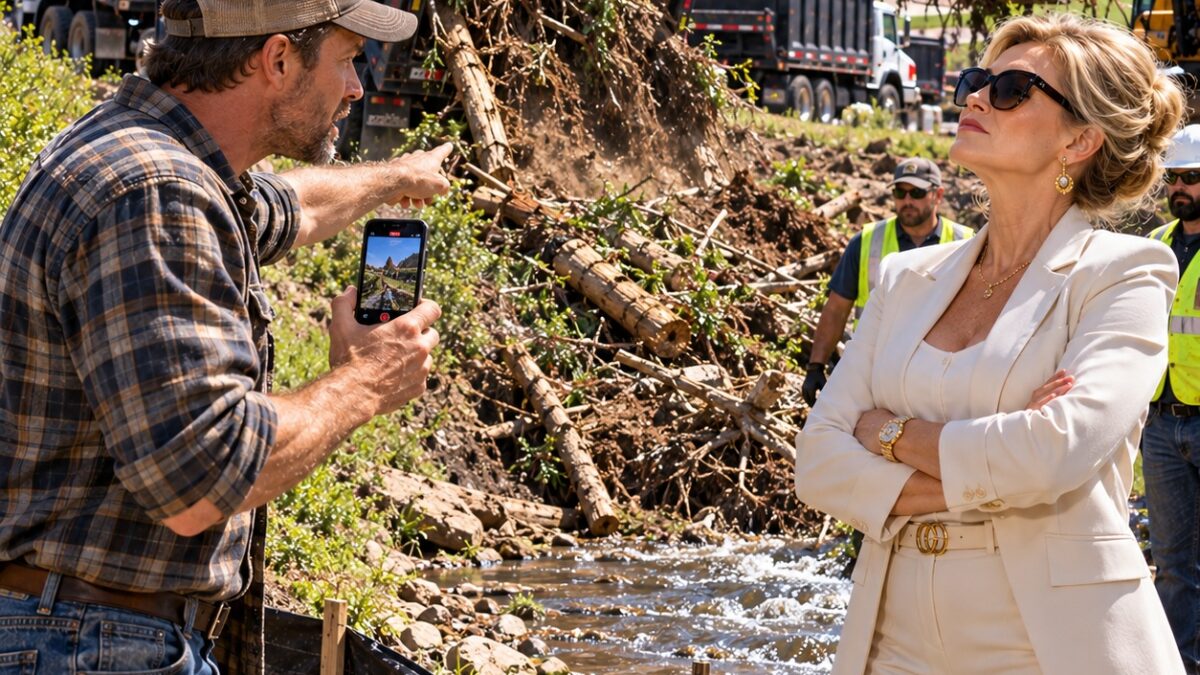
So I filmed.
Truck logos.
License plates.
The excavator.
The piles.
The condition of the channel.
Calvin.
Cynthia.
Everything.
I walked slowly enough that the camera captured reference points.
Fence posts.
Trees.
The width of the creek.
The edge of the maintenance lane.
I said the date out loud.
The time.
The location.
Calvin watched me.
“You making a documentary?”
“Something like that.”
Cynthia looked at the phone.
“Recording people without permission can create legal problems.”
“We’re standing outside.”
“You need to be careful.”
“I am.”
That answer irritated her.
I could see it.
People like Cynthia are often most uncomfortable around people they cannot provoke.
She expected anger.
Anger is easy to dismiss.
A calm man holding a camera is harder.
By sunset, fourteen truckloads of landscaping waste had been pushed down the bank.
Fourteen.
I knew because I counted.
I went home, washed mud off my boots, made coffee, and spread the old property maps across my kitchen table.
The ranch came with decades of paperwork.
Deeds.
Surveys.
Fence agreements.
Topographic maps.
Creek access records.
Most of it sat untouched inside a steel filing cabinet.
That night, I dug through everything.
Near midnight, I found the old topographic survey.
The paper had yellowed at the folds.
I traced the creek with my finger.
Past the section where Blue Finch had dumped its material.
Downhill.
Toward Brier Glenn.
Then my finger stopped.
A faint blue line split away from the main channel.
It spread across the land that later became Stonebrook Golf Course.
The label beside it was simple.
NATURAL OVERFLOW CORRIDOR.
I stared at it.
The line ran straight through what was now holes eight, nine, and ten.
Maybe part of eleven.
That explained why nobody had built houses there.
The land was supposed to take water.
The next morning, I pulled the original development records.
Stonebrook had been approved decades earlier on land considered unsuitable for residential construction.
The developer’s solution had been clever.
Golf.
Fairways could flood.
Grass could recover.
Houses could not.
The condition in the old planning documents was clear.
The low ground had to remain functional as an overflow route during major storms.
When the creek exceeded its banks, water was supposed to spread across that land.
Slow down.
Store temporarily.
Then ease back into the channel farther downstream.
It wasn’t glamorous engineering.
It was better.
It used the land the way the land already wanted to work.
I sat back in my chair.
Cynthia wasn’t just narrowing a creek.
She was messing with part of a larger system.
Still, I tried not to jump to conclusions.
Maybe Stonebrook had improved its drainage over the years.
Maybe the old corridor had been replaced with modern infrastructure.
Maybe the berms and pipes and culverts could handle the same volume.
So I drove the perimeter road.
The course looked beautiful.
No other word for it.
Perfect fairways.
Clean bunkers.
Mature trees.
Every edge trimmed.
The kind of place where even nature looked like it had signed a maintenance contract.
Then I reached Hole 9.
I slowed.
There it was.
A long raised berm.
Fresh earth.
Recent sod.
Built along the edge of the low ground.
I pulled onto the shoulder.
Took out the old map.
Compared.
The berm cut across part of the overflow corridor.
In moderate rain, I could understand why they liked it.
Water stayed off the fairway.
Turf remained playable.
Maintenance costs dropped.
Members stayed happy.
But during a major flood?
That berm wasn’t protection.
It was an obstruction.
It could force water sideways.
Concentrate flow.
Increase velocity.
I took photographs from the public road.
Then went home and called Cynthia.
She answered after three rings.
“Reed.”
Her tone made it obvious she knew why I was calling.
“You raised a berm along Hole 9.”
Silence.
Then:
“Why are you driving around our course?”
“I’m on the public perimeter road.”
“That isn’t what I asked.”
“The berm crosses the old overflow corridor.”
She gave a small laugh.
“You’re still looking at that old map?”
“Yes.”
“It’s decades out of date.”
“So is the creek.”
“I don’t have time for this.”
“You’re narrowing the upstream channel and blocking part of the overflow path.”
“We are stabilizing the creek.”
“With branches?”
“With approved material.”
“Approved by who?”
“Our contractor.”
“Your contractor approving his own work isn’t engineering.”
Her voice hardened.
“You are not our engineer.”
“No.”
“Then stop pretending you are.”
“I’m not pretending anything.”
I leaned against the counter.
“I’m telling you loose sod floats.”
“We disagree.”
“Branches float.”
“Compacted branches don’t.”
“Tree trunks move.”
“Not the way they’re placed.”
“You want to bet Stonebrook on that?”
That stopped her for half a second.
Then she said:
“You’re looking for a fight.”
“No.”
I looked through the window toward the hills.
“I’m trying to prevent one.”
“I have a meeting.”
“I’m putting this in writing.”
“Do whatever makes you feel important.”
She hung up.
I stood in the kitchen holding the phone.
Then I opened my laptop.
I wrote the email carefully.
I had managed earthmoving contracts for years.
One habit never left me.
Write every important email as though somebody you have never met will someday read it aloud in a room where you are not allowed to explain yourself.
So I kept it clean.
No insults.
No accusations.
No sarcasm.
I attached photographs.
The old map.
The easement.
I explained that the dumping had significantly reduced the channel’s effective cross-section.
I explained that loose material could migrate downstream during high-water conditions.
I identified the box culvert below Stonebrook as a likely blockage point.
I requested removal within seventy-two hours.
I read the message twice.
Then hit send.
Cynthia replied twenty-nine minutes later.
Three sentences.
The HOA was performing lawful maintenance.
There was no flood risk.
Mr. Talbot was instructed not to interfere with the easement.
I printed it.
Put it in a folder.
That folder started small.
It wouldn’t stay that way.
The following morning, I went out to check fence posts along the north pasture.
When I returned, an envelope was sitting inside my mailbox.
Brier Glenn Homeowners Association.
I opened it beside the road.
NOTICE OF VIOLATION.
For several seconds, I thought they had mailed it to the wrong address.
Then I saw my name.
According to Cynthia’s HOA, I had violated Brier Glenn rules by placing cameras and survey stakes too close to the maintenance easement.
I read the first page.
Then the second.
Then I laughed.
Actually laughed.
A cow in the nearest pasture raised her head.
“Apparently we joined an HOA,” I told her.
She kept chewing.
My ranch wasn’t in Brier Glenn.
It predated the subdivision by decades.
I paid no HOA dues.
Signed no covenants.
Accepted no restrictions.
Brier Glenn held one recorded drainage easement across a narrow strip.
That did not turn 126 acres into HOA property.
The violation letter had about as much power over me as a parking ticket issued by a neighborhood association three counties away.
My first instinct was to throw it away.
Then I stopped.
Never discard somebody else’s bad paperwork.
I slipped it into the same folder.
Video.
Photographs.
Email.
Map.
Violation notice.
One page at a time.
That afternoon, I walked the creek again.
Blue Finch had added more material.
Calvin saw me.
He shut down the excavator and climbed out.
“You filming again?”
“Yes.”
“You know we have legal access.”
“I know you have maintenance access.”
“Same thing.”
“No.”
He wiped his hands against his jeans.
Calvin was in his mid-fifties.
Big.
Weathered.
A contractor who looked like he had spent most of his life around machinery.
“I’ve been doing landscape work twenty-five years.”
“Then you know branches float.”
He laughed.
“They’re compacted.”
“Until water gets under them.”
“That creek isn’t moving those logs.”
“Not today.”
He looked at the shallow water.
“That’s the creek.”
“No.”
I pointed toward the hills.
“That’s the creek on a dry afternoon.”
“You ranch guys always think you know everything about water.”
“I know enough not to block it.”
He shook his head.
“You really think all this is going somewhere?”
“Yes.”
“Want to bet?”
“No.”
I started walking away.
“I don’t gamble with drainage.”
The excavator started again behind me.
Two nights later, my phone buzzed at 11:43 p.m.
Trail-camera alert.
Normally, that meant deer.
Or a raccoon.
Once it meant a teenager trying to dump a mattress near the back access road.
I opened the feed.
Headlights.
Blue Finch.
Two dump trucks.
An excavator.
Portable work lights.
I sat up in bed.
They were working after midnight.
That told me more than any conversation had.
If this was ordinary, lawful, transparent maintenance, why were they moving whole tree trunks under lights at midnight?
I dressed.
Went to the kitchen.
Did not drive down to confront them.
That would accomplish nothing.
Instead, I watched.
The first truck dumped branches.
Roots.
Fresh turf.
The second carried trunks.
Not massive logs.
But long enough and heavy enough to become serious debris.
Calvin stood beside the excavator pointing.
The operator pushed material down.
Compacted it.
At one point, a log rolled nearly crosswise to the current.
The bucket pressed it deeper.
I stared at the screen.
Any person who understood drainage should have seen the problem.
Maybe Calvin did.
Maybe he had decided the contract mattered more.
Maybe he genuinely believed the water would never rise high enough.
Intent would matter later.
That night, only actions mattered.
By dawn, the total was twenty-two truckloads.
I saved the original files.
Copied them onto an external drive.
Made a second backup.
Uploaded another copy offsite.
Then I sent representative clips to my ranch insurer.
Potential third-party drainage hazard adjacent to insured property.
After breakfast, I filed a formal complaint with the county stormwater department.
I did not ask for money.
I did not ask for penalties.
I did not demand Cynthia apologize.
I asked for an inspection.
That was all.
By lunchtime, Cynthia knew.
Her SUV appeared at my gate.
She stayed inside while I walked down.
Then she got out.
“You filed a county complaint.”
“Yes.”
“Withdraw it.”
“No.”
“I’m serious.”
“So am I.”
Her jaw tightened.
“Do you understand what county involvement could do to our tournament?”
“No.”
That threw her.
“And I don’t care.”
“This affects hundreds of homeowners.”
“Then maybe don’t put twenty-two loads of debris into a creek.”
“It is not debris.”
“Then an inspector should have no problem.”
She stared at me.
Then her expression changed.
The anger disappeared.
A bright smile replaced it.
That worried me more.
“Reed, I think we got off on the wrong foot.”
“I don’t.”
She ignored that.
“The HOA would be willing to clean up the entire creek frontage on your property at no cost.”
“My creek frontage doesn’t need cleaning.”
“We could clear brush.”
“No.”
“Flatten the banks.”
“No.”
“Improve access.”
“No.”
“Straighten the channel.”
I looked at her.
“Straighten it?”
“Yes.”
“For what?”
“Better flow.”
That answer told me everything.
A living creek is not a concrete drainage ditch.
Curves slow water.
Vegetation stabilizes soil.
Natural roughness can reduce velocity.
That does not mean every bend must remain forever.
It means you do not bulldoze one because a golf course looks cleaner when water behaves like a pipe.
“The creek doesn’t need to look nice,” I said.
“It needs to function.”
“We’re improving it.”
“No.”
I shook my head.
“You’re trying to force it somewhere else.”
She folded her arms.
“You are impossible.”
“And I’m not withdrawing the complaint.”
“You’re making this adversarial.”
“I sent you a written warning.”
“You’re trying to embarrass me.”
That word caught my attention.
Embarrass.
Not threaten Stonebrook.
Not interfere with maintenance.
Embarrass her.
I pulled out my phone.
“I’m recording our conversation.”
Her eyes dropped toward it.
“I don’t consent.”
“We’re outside on my property.”
“Be careful, Reed.”
“With what?”
“Accusations.”
“I haven’t accused you of anything.”
I lifted the phone slightly.
“I’m documenting.”
Her face hardened.
She got back into the SUV.
Drove away.
An hour later, a sign appeared beside the maintenance lane.
STORMWATER IMPROVEMENT PROJECT
AUTHORIZED PERSONNEL ONLY
No permit number.
No engineering company.
No county reference.
No project manager.
I photographed it.
Front.
Back.
Placement.
Another page in the file.
What I didn’t know yet was that somebody inside Stonebrook was building a file too.
His name was Bryce Kincaid.
He was forty-six and had managed Stonebrook’s golf course for years.
Quiet guy.
More comfortable discussing drainage than politics.
He knew every low spot.
Every drain.
Every place water collected after rain.
Months before the first Blue Finch truck arrived, Bryce had already told the board Stonebrook had a drainage problem.
The box culvert below Hole 11 was operating close to capacity.
The low corridor needed a new swale.
Electrical equipment needed to be moved.
The berm needed engineering review.
The estimate for a proper project came in at $318,000.
Cynthia killed it.
Stonebrook was preparing for a showcase tournament.
Buyers.
New members.
Sponsors.
Photographers.
A major drainage project meant excavation.
Heavy equipment.
Closed holes.
Mud.
Construction fencing.
Cynthia wanted the course immaculate.
Blue Finch offered something cheaper.
Bank stabilization.
Landscape recycling.
Organic-material management.
About $37,000 for the first phase.
On paper, it sounded efficient.
In the field, it was a mountain of garbage.
Bryce refused to sign the completion report.
Cynthia called him into the office.
He later told me almost word for word what happened.
She pushed the report toward him.
“Sign it.”
“I can’t.”
“Why not?”
“Because branches aren’t riprap.”
“They’re compacted.”
“They float.”
“Sod decomposes.”
“Not before a flood carries it into the culvert.”
She leaned back.
“You’re being dramatic.”
“I’m being the superintendent.”
“Your contract is up for review in five months.”
The room went quiet.
Bryce looked at her.
“Is that a threat?”
Cynthia smiled.
“Context.”
He still refused.
A few days later, he inspected the box culvert.
The water was low.
Yet small branches were already catching on the grate.
He photographed them.
Sent Cynthia an email.
Copied the full board.
He warned that if more than three inches of rain fell quickly, somebody needed to inspect the upstream section immediately.
Cynthia replied only to him.
She removed the board members.
Four words.
Don’t create unnecessary records.
Bryce stared at the message.
Then forwarded it to his personal email.
Saved another copy at home.
At the time, he didn’t fully understand why.
Later, he did.
Three days after his warning, the forecast changed.
A slow-moving system formed over the hills.
Five to seven inches of rain possible.
I read the weather bulletin twice.
Then walked the ranch.
Moved the tractor.
Moved the skid steer.
Checked internal drainage.
Cleared my own culverts.
Opened lower gates so they wouldn’t collect branches.
Drove elevation stakes into known points.
Photographed the creek from fixed locations.
Same framing.
Same scale.
Logged every pile.
I did not touch Blue Finch’s material.
That was deliberate.
I physically could have moved some of it.
But Cynthia had ordered me not to interfere.
The county complaint was open.
Any alteration by me would give her an argument.
So I left everything exactly where they put it.
Then I sent one final warning.
Forecast attached.
Twenty-two documented loads.
Potential blockage.
Immediate removal recommended.
County stormwater copied.
Cynthia replied within the hour.
Stonebrook has handled bigger storms than this.
I printed it.
Added it to the binder.
Then stood at the edge of the hill looking down at the creek.
Maybe she was right about one thing.
Maybe nothing happened.
Forecasts miss.
Storms shift.
Five inches could fall slowly enough for the creek to pass it.
The material might stay put.
The culvert might remain open.
I hoped so.
Being wrong would have been cheap.
A few neighbors laughing about Reed Talbot’s flood obsession was nothing compared with what could happen if I was right.
The county scheduled an inspection for the following afternoon.
The storm was coming that evening.
By late afternoon, dark clouds had swallowed the hills.
I made one last walk before nightfall.
Camera recording continuously.
“Thursday. Five forty-two p.m.”
I filmed the tractor on high ground.
Open gates.
Clear ditches.
Survey stakes.
Fence lines.
The creek.
The debris.
The maintenance lane.
Everything.
No cuts.
No edits.
At one point, I stopped near the largest pile.
Sod.
Roots.
Branches.
Logs.
Grass clippings.
The creek was still shallow enough to step across in places.
That was the dangerous illusion.
Before failure, bad systems often look completely ordinary.
At six, rain started.
By eight, the creek had turned dark brown.
By ten, water reached the base of the Blue Finch piles.
I sat at the kitchen table with my laptop.
Camera feeds.
Weather radar.
Rain gauge.
Notebook.
At 10:08, dry grass entered the current.
At 10:34, a strip of sod broke loose.
At 10:51, small branches.
At 11:17, larger movement.
Across the valley, Cynthia sat inside the Stonebrook clubhouse with several board members.
Bryce told me later there was wine on the table.
Tournament plans.
Budget papers.
Someone asked about the creek.
Cynthia told them Stonebrook had survived worse.
Bryce left.
He drove a utility cart toward Hole 11.
Rain hammered the roof.
When he reached the culvert, the water was almost two feet above normal.
A slab of sod drifted toward the opening.
Caught.
A branch followed.
Then roots.
Bryce called Cynthia.
“We need the excavator.”
“For what?”
“The culvert is catching material.”
“How bad?”
“Bad enough.”
“Clear it manually.”
“Not safe.”
“Then wait.”
“If this plugs, we’re going to lose the low holes.”
“Do not bring heavy equipment onto the course.”
“Cynthia.”
“We are not tearing up Stonebrook in the middle of the night.”
“This isn’t about turf anymore.”
“I said no.”
Bryce looked at the water.
“Why?”
There was a pause.
Then she said:
“I do not need another dramatic record of a problem that doesn’t exist.”
The call ended.
Midnight.
The rain gauge passed four inches.
I was still awake.
Then I heard it.
A deep hollow sound.
Wood against rock.
I opened the upstream camera.
For several seconds, rain blurred everything.
Then one pile shifted.
Water had gotten underneath.
A mat of sod lifted.
Roots rotated.
Branches moved.
One tree trunk rose.
Then the whole edge of the pile broke.
Material poured into the current.
Hundreds of pieces.
I leaned closer to the screen.
“No.”
The downstream camera caught the first wave.
Then shook.
Ten minutes later, it went black.
I called the county emergency line.
Reported man-made debris moving toward the Stonebrook culvert.
The dispatcher asked if I was near the water.
“No.”
“Stay away.”
“I will.”
“Public works can’t enter the channel right now.”
“I understand.”
There was nothing else to do.
At 1:17 a.m., the plug formed.
Stonebrook’s remaining cameras gave investigators the exact time.
A log lodged sideways.
Sod wrapped around it.
Branches accumulated.
Roots locked.
More material arrived.
The opening choked.
Water backed up.
Six inches.
A foot.
Two.
The creek searched for another path.
Normally, overflow would spread across the old corridor.
But Cynthia’s berm stood in the way.
So water ran along the berm.
The structure built to protect Hole 9 from ordinary runoff became a wall holding extraordinary water.
Pressure concentrated.
At 1:56 a.m., my phone rang.
Cynthia.
“Reed!”
She was yelling.
“Water is coming onto the course!”
“I know.”
“Bring your excavator down here.”
“No.”
“Open the creek.”
“I am not sending myself or anyone else into floodwater at two in the morning.”
“This is your creek!”
“Nothing of mine is blocking it.”
“You own equipment.”
“My equipment is on high ground.”
“Then move it!”
“No.”
There was a pause.
Then her voice dropped.
“If you don’t do something, I will hold you responsible for every dollar of damage.”
I looked at the camera feed.
The bank where Blue Finch’s material had been was nearly empty.
“Cynthia.”
“What?”
“Nothing of mine is blocking that culvert.”
Silence.
Then the call ended.
At Stonebrook, Bryce stood on a raised cart path.
Water was spreading in front of him.
Later he told me the path matched the old map almost perfectly.
Water remembered what people had forgotten.
At 2:41 a.m., the berm failed.
A low section gave.
Everything behind it broke through at once.
Hole 8 disappeared first.
Bunkers filled.
Then vanished.
White sand stretched into long pale streaks.
Hole 9 took the full force.
Bryce drove the last utility cart out minutes before the path behind him went underwater.
Then 10.
The irrigation pump station flooded.
Electrical controls shorted.
Cart paths broke.
Sections of asphalt lifted.
And everywhere the flood moved, it carried Blue Finch’s debris.
Mulch on greens.
Branches around flagsticks.
Rolled sod hanging from bridge rails.
Logs jammed against trees.
Some bundles still had orange supplier tags attached.
The creek had returned the material to its sender.
Cynthia reached the edge of Hole 10 in the rain.
The fairway she had walked the day before was now a brown river.
She started calling board members.
Her wording was careful.
“Talbot’s creek overflowed.”
Not the creek.
Talbot’s creek.
She wanted the story established before daylight.
A natural event.
Water from neighboring property.
Nobody’s fault.
Bryce stood nearby staring at a log pressed against a bridge.
Blue paint circled the bark.
Stonebrook maintenance crews used that paint to tag trees for removal.
He recognized it.
By five, rain eased.
The water did not.
The culvert remained blocked.
Hole 13 started taking water.
The practice range sank.
The maintenance parking lot disappeared beneath mud.
The clubhouse escaped major damage because it sat higher.
By sunrise, nearly half of Stonebrook was underwater.
I stood on my slope.
I did not smile.
There was nothing worth celebrating.
Floodwater ruins things people spent years building.
Pumps.
Paths.
Irrigation.
Greens.
Equipment.
Employees who had nothing to do with Cynthia’s decision would spend months repairing the damage.
What made me angry was how avoidable it had been.
As soon as there was enough light, I walked toward the creek.
The piles were nearly gone.
They had not broken down.
They had moved.
At eight, Cynthia arrived with the HOA’s attorney.
The lawyer introduced himself.
Then said:
“The association believes your failure to maintain the creek contributed materially to the damage at Stonebrook.”
I nodded.
He looked almost disappointed by my lack of reaction.
“We are preparing a formal demand.”
“All right.”
Cynthia turned toward me.
“You understand what he’s saying?”
“Yes.”
“You’re responsible.”
I looked at the attorney.
“Would you like to see the video before you send that letter?”
He stopped.
“What video?”
Cynthia snapped:
“What video?”
I held up my phone.
11:43 p.m.
Blue Finch.
Calvin.
Excavator.
Tree trunks.
Turf.
Roots.
Everything being pushed into the bank.
The attorney watched for several seconds.
“Do you have the original?”
“Yes.”
“Metadata?”
“Yes.”
“I’d like a copy.”
“You’ll get one from the county.”
Cynthia crossed her arms.
“That doesn’t prove any of it caused this.”
Behind them, a large branch floated slowly across flooded Hole 10.
Blue marking paint still circled the bark.
Stonebrook’s color.
The attorney saw it.
He did not respond to Cynthia.
As the water receded, more evidence appeared.
Torn product bags.
Plastic ties.
Landscape fabric.
Irrigation tubing.
Lot numbers tied to HOA purchases.
By noon, Cynthia had switched to damage control.
She sent a notice to Brier Glenn homeowners.
Stonebrook had suffered flooding caused by a drainage incident originating from adjacent property.
No Blue Finch.
No debris.
No Bryce warning.
No midnight trucks.
Then I received another HOA letter.
I was instructed not to alter the creek because an insurance investigation was underway.
I laughed.
For once, we agreed.
That afternoon, Monica Pritchard arrived from county stormwater.
Forty-one.
Work boots.
Clipboard.
No interest in who held what HOA title.
She began at the box culvert.
Her crew found the blockage quickly.
Logs.
Sod.
Roots.
Soil bags.
Plastic.
Shredded landscape fabric.
Old irrigation pipe.
Cynthia stood nearby.
“Floodwater can carry debris from anywhere.”
Monica nodded.
“Correct.”
Cynthia looked relieved.
Then Monica asked:
“Where is your pre-storm camera footage?”
“Some cameras lost power.”
“I’ll need whatever survived.”
I handed Monica a hard drive.
She looked at me.
“What is this?”
“Every truck I recorded.”
“All of them?”
“Everything I have.”
“Timestamped?”
“Yes.”
She took it.
Then I gave her fixed-point photographs.
Elevation stakes.
Pre-storm walkthrough.
Map.
Emails.
Violation letter.
Easement.
She glanced at the binder.
“You prepared all of this before the flood?”
“Yes.”
“Why?”
“I spent twenty years dealing with contractors.”
For the first time, she smiled.
“Understood.”
By late afternoon, Monica had a preliminary sequence.
The HOA reduced channel capacity.
Loose material migrated downstream.
The culvert blocked.
Water backed up.
The berm redirected the overflow.
The flood entered the historic corridor.
Nothing in that chain required me to alter anything.
Cynthia tried another argument.
“The creek crosses his property. He had a responsibility to remove dangerous material.”
I handed Monica the easement.
She read the maintenance clause.
The same document Cynthia used to justify access assigned the HOA responsibility for drainage maintenance in that exact section.
Monica looked at Cynthia.
“Did the association authorize the work?”
“Our contractor performed stabilization.”
“That isn’t what I asked.”
Silence.
Monica repeated:
“Did Brier Glenn authorize the placement?”
“Yes.”
Another word.
Another record.
Later that afternoon, Bryce approached Monica.
He waited until Cynthia was elsewhere.
Then handed her printed emails.
His warning copied to the board.
Cynthia’s private reply.
Don’t create unnecessary records.
Monica read it once.
Then again.
“Forward me the complete chain.”
He did it from his phone.
Stonebrook’s insurer sent an adjuster that evening.
Older man.
Weathered face.
The kind of person who had seen enough “acts of nature” to know when people were hiding behind weather.
He walked the course.
Greens.
Bunkers.
Bridge.
Irrigation.
Electrical.
Pump station.
Cart paths.
Lost operations.
His estimate climbed.
By the end of the day, the preliminary number was already north of $1.9 million.
Cynthia wanted the loss treated as unavoidable flooding.
The adjuster asked one question.
“Before the rain started, who changed how the water moved?”
Nobody answered.
That night, Bryce sent me an email.
Subject line:
PAGE 47.
I opened the attached engineering report.
Eight months old.
Commissioned by the HOA.
Its original purpose was ordinary enough.
Why did three holes stay wet after heavy rain?
How could Stonebrook improve drainage?
Then came Page 47.
The existing box culvert was operating near capacity.
The Hole 9 berm could increase velocity and pressure during major overflow.
And in bold:
NO LOOSE MATERIAL SHOULD BE PLACED IN THE UPSTREAM SECTION OF THE CREEK UNDER ANY CIRCUMSTANCES.
I read that sentence twice.
Then looked at the meeting notes.
Cynthia Marlo.
Present.
She knew.
Not should have known.
Knew.
That changed the case in my mind.
Before Page 47, I could still tell myself she had made a stupid decision.
Bad judgment.
Arrogance.
Ignorance.
The engineering report removed ignorance.
So why reject a $318,000 drainage project and approve Blue Finch?
The county started asking the same question.
Invoices provided part of the answer.
Not one large contract.
Several smaller ones.
$28,400.
$31,800.
$24,600.
$36,900.
Different labels.
Bank stabilization.
Organic debris management.
Landscape recycling.
Drainage appearance improvement.
Individually, they looked easier to swallow.
Together, they formed a pattern.
Blue Finch kept Stonebrook looking clean before the tournament.
The major engineering solution would have torn up the course.
Then Monica’s crew confirmed something else.
The debris was not purely organic.
Plastic sheeting.
Irrigation tubing.
Geotextile fabric.
Packaging.
Cynthia’s claim that everything would simply break down disappeared.
The county issued an emergency order.
Remove the blockage under supervision.
No more creek-bank work without approval.
Stonebrook closed damaged holes.
With pressure growing, Cynthia blamed Calvin.
She told investigators Blue Finch had independently decided where to place the material.
Calvin did not intend to drown alone.
He opened his phone.
First text from Cynthia:
USE THE CREEK SIDE. KEEP THE COURSE CLEAN BEFORE THE EVENT.
Second:
PACK THE BANK TIGHTER. I DON’T WANT RUNOFF CROSSING NINE AGAIN.
Bryce later told me Cynthia went completely still when those messages appeared.
The contractor she tried to sacrifice had receipts.
But the biggest discovery came from Gloria Hensley.
The HOA treasurer.
Retired accountant.
Gloria pulled Blue Finch’s corporate filings.
A holding company owned thirty-two percent.
Marlo Capital Holdings.
Cynthia’s signature was on the filing.
She had a financial stake in Blue Finch.
She had never properly disclosed that interest to the board.
Gloria called me.
“Reed.”
Her voice was tight.
“Did you know Cynthia owns part of Blue Finch?”
“No.”
“Thirty-two percent through a holding company.”
I sat down.
That was when the financial choices started making sense.
The engineered solution cost $318,000.
Visible.
Expensive.
Disruptive.
Blue Finch offered smaller contracts.
Cheaper on paper.
Cleaner for tournament marketing.
And money flowed into a company Cynthia partly owned.
I did not need to call her corrupt.
Documents were stronger than adjectives.
I added Gloria’s information to my binder.
The binder had started with one video from a gray Tuesday morning.
Now it was heavy enough that I carried it with both hands.
The county pulled the original development maps.
That was when we learned the full extent of the planning violation.
The destroyed holes had always been part of the flood corridor.
Brier Glenn’s developer had been permitted to use the land for golf only if it remained functional during overflow.
Fairways were fine.
Grass was fine.
Structures redirecting floodwater were not.
Over decades, managers had forgotten or ignored the restriction.
Cynthia had gone farther.
She raised the berm.
And in small storms, the berm worked.
That success convinced her she was right.
That was the dangerous part.
A bad design can appear excellent when it has not yet been tested by the event that matters.
During moderate rain, Hole 9 stayed dry.
Members were happy.
Maintenance looked efficient.
During a major storm, the same berm became a chute.
Monica summarized it at the emergency HOA meeting.
The debris made the plug.
The berm made the pressure.
The golf course sat in the historic path.
Nature had not betrayed Stonebrook.
Stonebrook had tried to force nature somewhere else.
The meeting room was packed.
Homeowners filled every chair.
People stood against the walls.
I sat near the back beside Diane Whitaker, my land-use attorney.
Diane was quiet.
Soft-spoken.
She had read the entire binder twice.
That made her more dangerous than anyone shouting.
Cynthia sat at the front.
At first, she looked composed.
Monica presented the flood model.
Cynthia immediately focused on the rainfall.
“This was an extraordinary storm.”
“Yes,” Monica said.
Cynthia looked almost relieved.
Then Monica continued.
“Extreme rainfall does not eliminate responsibility for man-made changes that materially increase damage.”
The room shifted.
Stonebrook’s insurer had already issued a reservation-of-rights letter.
Coverage was no longer guaranteed.
Homeowners started demanding contracts.
Emails.
Minutes.
Engineering studies.
Cynthia tried to move the meeting toward hiring more attorneys with reserve funds.
That was when Gloria stood.
She held a folder.
Marlo Capital Holdings.
Blue Finch.
Thirty-two percent ownership.
No proper disclosure.
The room erupted.
“Were you making money from this?”
“Did the board know?”
“Did you profit from the creek work?”
“Were those contracts even bid?”
Cynthia raised her hands.
“This is being intentionally misrepresented.”
A homeowner stood.
“Yes or no. Did you own part of Blue Finch?”
“My family has diversified investments.”
Wrong answer.
Another voice:
“Did you profit?”
“I did not personally direct—”
Bryce stood.
He carried Page 47.
Cynthia saw him.
Her face changed.
He read the engineering warning.
Then his pre-storm email.
Then her response.
Don’t create unnecessary records.
Silence.
Real silence.
The kind where you hear the air-conditioning.
Cynthia stared at Bryce.
“You are betraying this association to save your job.”
Bryce did not raise his voice.
“I was trying to save the golf course long before you decided to bury a creek.”
That sentence ended her presidency before any formal vote happened.
The board voted that night to suspend her authority pending a full audit.
No police.
No handcuffs.
No cinematic arrest.
She simply lost control of the same room she had controlled for years.
For the first time since the whole thing began, people stopped asking whether I was exaggerating.
They started asking how many warnings she had received.
A few days later, the HOA attorney called Diane.
Settlement.
The meeting took place downtown.
Cynthia sat across the table.
Not at the head.
Two attorneys beside her.
Insurance representative.
Diane beside me.
The offer was substantial.
Restore my creek bank.
Withdraw the violation letter.
Drop the easement dispute.
Pay legal fees.
Pay documented damage.
Compensate time.
Then add a lump sum large enough to get most people’s attention.
In exchange, I had to sign language saying no party admitted fault and that unusual rainfall had been the primary cause of the flood.
I read the agreement slowly.
Diane said nothing.
She knew I needed to reach the question myself.
Finally, I looked at the HOA attorney.
“If I sign this, what happens to the creek?”
“The association will develop an appropriate remediation plan.”
“When?”
“After the insurance matters are resolved.”
“Who designs it?”
“To be determined.”
“Independent engineer?”
“That can be discussed.”
“County approval?”
“Likely.”
I set the pen down.
Cynthia stared at me.
“You cannot be serious.”
The insurance representative leaned forward.
“Mr. Talbot, this is a very favorable offer.”
“I know.”
“Then what is the issue?”
“The water.”
Cynthia laughed.
“This stopped being about water weeks ago.”
I unfolded the old map.
Placed it on the table.
Tapped the blue corridor.
“No.”
I looked at her.
“It was always about water.”
I gave them my conditions.
Remove every bit of dumped material.
Reevaluate the unauthorized berm.
Upgrade the culvert.
Restore a native riparian buffer.
Limit easement use to actual drainage maintenance.
Independent engineering review.
County approval.
No rebuilding the same problem.
Cynthia leaned forward.
“You are exploiting a disaster.”
I slid the map toward her.
“I didn’t put a golf course in the path of the water.”
Diane spoke for the first time in almost twenty minutes.
“My client’s requests are remediation conditions.”
The HOA lawyer knew she was right.
So did the insurance representative.
I did not want Stonebrook destroyed.
That would have punished hundreds of homeowners who never made these decisions.
It would have hurt employees.
Maintenance workers.
Golfers.
I wanted the system fixed.
That was it.
The audit finished several weeks later.
Blue Finch had received more than $240,000 in landscaping and drainage-related work over two years.
Cynthia’s ownership interest had not been fully disclosed.
The board formally removed her.
Blue Finch lost its contract.
Insurers began negotiating shares of the cleanup.
By the time reconstruction, irrigation, drainage, creek restoration, legal costs, and lost revenue were included, the projected total exceeded $2.6 million.
Cynthia tried telling homeowners she had been scapegoated.
It did not work.
There was too much evidence.
Photographs.
Video.
Invoices.
Emails.
Engineering reports.
Text messages.
Maps.
Corporate filings.
No single piece brought her down.
That was the lesson.
It was the accumulation.
One shortcut.
One hidden conflict.
One ignored warning.
One midnight truck.
One false violation letter.
One message saying not to create records.
One decision after another.
Each one seemed manageable alone.
Together, they formed the truth.
The eventual civil settlement required all financially responsible parties to contribute.
The HOA.
Blue Finch.
Relevant insurers.
And because of the conflict of interest, Cynthia personally carried part of the legal and financial burden rather than shifting everything onto the homeowners.
But the consequence she hated most had nothing to do with money.
The county refused to allow Stonebrook to rebuild the low holes the way they had been.
The overflow corridor had to be restored.
Six months later, I walked down to the creek on a cool morning with mist hanging over the valley.
An excavator rolled onto old Hole 9.
For the last time.
It had not come to save Cynthia’s design.
It came to dismantle it.
The berm was lowered.
The old box culvert came out.
A wider structure went in.
Creek banks were reshaped under an engineered plan.
Native trees planted.
Flood-tolerant grasses.
Riparian buffer restored.
Stonebrook redesigned its lowest holes.
The whole golf course did not disappear.
That would have been ridiculous and unfair.
Part of old Hole 9 became seasonal wet meadow.
A detention pond went where engineers had recommended one years earlier.
Electrical and irrigation equipment moved higher.
Overflow routes reopened.
Bryce kept his job.
The new board gave him more authority over technical decisions.
Calvin lost the Stonebrook contract.
Blue Finch paid its share.
Cynthia sold her interest.
She stayed in Brier Glenn for a while.
Sometimes I saw her SUV.
We never spoke.
I never put up a sign.
Never wrote I TOLD YOU SO on the fence.
Never told neighbors the flood was what she deserved.
It wasn’t.
Too many innocent people paid for it.
I kept one thing from the entire mess.
The old map.
I had it framed.
Hung it above the kitchen table.
The same table where I first traced the pale blue corridor with my finger.
The following spring, another storm rolled over the hills.
Not as severe.
Heavy enough to test the new system.
I stood on the slope.
The creek rose.
Brown water moved fast.
The new culvert passed it.
No blockage.
No logs.
No sod.
At the high mark, water slipped gently over the bank.
Into the restored corridor.
It spread across the meadow.
Slowed.
Then returned to the creek downstream.
No violent surge.
No berm collapse.
No fairway disappearing in minutes.
Exactly what the engineers had designed decades earlier.
Bryce stood on the Stonebrook side.
When the rain eased, he walked toward the fence.
We watched the water for a while.
Finally, he said:
“Turns out the best way to control water is to stop trying to control every inch of it.”
I nodded.
“You just have to give it somewhere to go.”
Below us, the creek ran cleaner than it had in years.
No rotting sod.
No tree trunks.
No midnight excavator.
Across the valley, natural grass moved in the rain where Cynthia had once demanded a bone-dry fairway.
People sometimes called what happened karma.
I never did.
Karma sounds mystical.
Nothing about Stonebrook was mystical.
Branches float.
Culverts clog.
Water runs downhill.
Berms redirect flow.
Records preserve warnings.
Invoices preserve motives.
Cause and effect was enough.
I never broke a dam.
Never opened a gate.
Never redirected the creek.
Never sabotaged Stonebrook.
I recorded.
I photographed.
I saved emails.
I preserved evidence.
When the flood came, everybody had a story.
Cynthia had hers.
Blue Finch had theirs.
Lawyers had theirs.
Insurers wanted theirs.
The county had to determine one.
The creek had no story.
It left evidence.
Mud lines.
Flow paths.
Branches.
Broken pavement.
Tagged debris.
And because I had documented what existed before the storm, everyone could see where it began.
Years later, the bogus HOA violation letter is still in my binder.
Sometimes I come across it while looking for something else.
It still makes me laugh.
But it also reminds me of the mistake beneath every other mistake Cynthia made.
She thought authority could change reality.
She saw an easement and treated it like ownership.
She saw an engineering warning and treated it like criticism.
She saw a floodplain and treated it like an inconvenience.
She saw me and assumed eventually I would get tired and stop pushing.
She was right about one thing.
I did get tired.
There were nights when I wished I had never filed the complaint.
Days when I thought ignoring the trucks would have been easier.
Then I remembered Bryce on that cart path.
A few more minutes and he could have been trapped.
If the blockage had failed differently, water could have moved toward homes.
That was why the records mattered.
Not revenge.
Responsibility.
A few years later, Brier Glenn elected a new president.
Aaron Mills.
He came to my gate one afternoon.
Stayed outside.
Good start.
“Reed?”
“That’s me.”
“I’m Aaron. New Brier Glenn president.”
“I heard.”
“The board wanted me to introduce myself.”
“All right.”
He looked toward the creek.
“We rewrote the easement procedures.”
“How?”
“Independent engineering review for drainage changes. County notification. Full board approval before contractor work.”
“Sounds reasonable.”
“We’re trying.”
He hesitated.
“Can I ask you something?”
“Sure.”
“Why didn’t you take the first settlement?”
I looked across the valley.
The restored wet meadow was visible from the gate.
“That was a lot of money.”
“It was.”
“Most people would have signed.”
“Probably.”
“So why didn’t you?”
“Because the agreement let them call the flood natural and decide later what to do with the creek.”
“You thought they’d rebuild the same system?”
“At the time?”
I thought about Cynthia.
“Yes.”
Aaron looked at the meadow.
“I’m glad you didn’t.”
That mattered more than an apology.
It meant the lesson survived her.
Stonebrook eventually became better.
The wet meadow attracted birds.
Wildflowers.
The detention pond looked natural once vegetation took hold.
Bryce told me the redesigned Hole 9 became more interesting because golfers had to think around the water instead of pretending it wasn’t there.
I laughed.
Cynthia nearly destroyed the course trying to make it perfect.
The repaired version became more memorable because it accepted the valley instead of fighting it.
One rainy evening years later, I stood beneath the framed map.
The creek was high enough that I could hear it through the open back door.
I touched the faded blue line.
Some engineer decades earlier had looked at the valley and written down one simple truth.
Water needs somewhere to go.
Cynthia spent hundreds of thousands of dollars pretending that truth was negotiable.
It wasn’t.
That is the dangerous thing about bad systems.
They can look successful right up until the moment they fail.
The berm worked in smaller storms.
Hole 9 stayed dry.
Members were happy.
Tournament preparation looked beautiful.
Blue Finch cost less than the real drainage project.
Every short-term result rewarded the shortcut.
Then the one storm the system actually needed to survive arrived.
And every shortcut pointed toward the same failure.
No cosmic justice required.
No revenge.
Cause and effect handled the rest.
I bought the ranch because I wanted quiet.
Eventually, I got it back.
Pasture.
Fence.
Weather.
Creek.
Coffee.
No certified HOA letters.
No midnight machinery.
No phone calls from angry attorneys.
Just water following the same path it had used long before any of us showed up.
And whenever someone asks me what finally brought Cynthia Marlo down, they expect me to say the flood.
I don’t.
The flood exposed what she had built.
The record ended the argument.
Every time Cynthia made another bad decision, she left something behind.
A letter.
An email.
A contract.
A text.
An invoice.
A truck on camera.
A warning in an engineering report.
A corporate filing.
Each piece looked small by itself.
Together, they told one story.
All I did was keep that story intact long enough for everyone else to see it.
And in the end, the water took care of the rest.








