PART 2:The HOA President Kept Stealing From My Farm Because She Thought Her Title Made Her Untouchable
PART 2 and FULL ENDING  Thank you

I didn’t answer her.
There are moments when arguing is useful.
That was not one of them.
I kept the phone against my ear while the dispatcher asked whether the injured person was conscious.
“Yes.”
“Is she breathing normally?”
“She’s yelling pretty normally.”
The dispatcher paused.
“Sir, I need you to tell me what happened.”
“She trespassed onto my property,” I said. “She climbed my fence, took produce, tried to climb back over, caught her shirt on part of the fence, and fell.”
Martha heard me.
“That’s a lie!”
Her voice carried all the way across the orchard.
“He trapped me!”
I looked toward her from the porch.
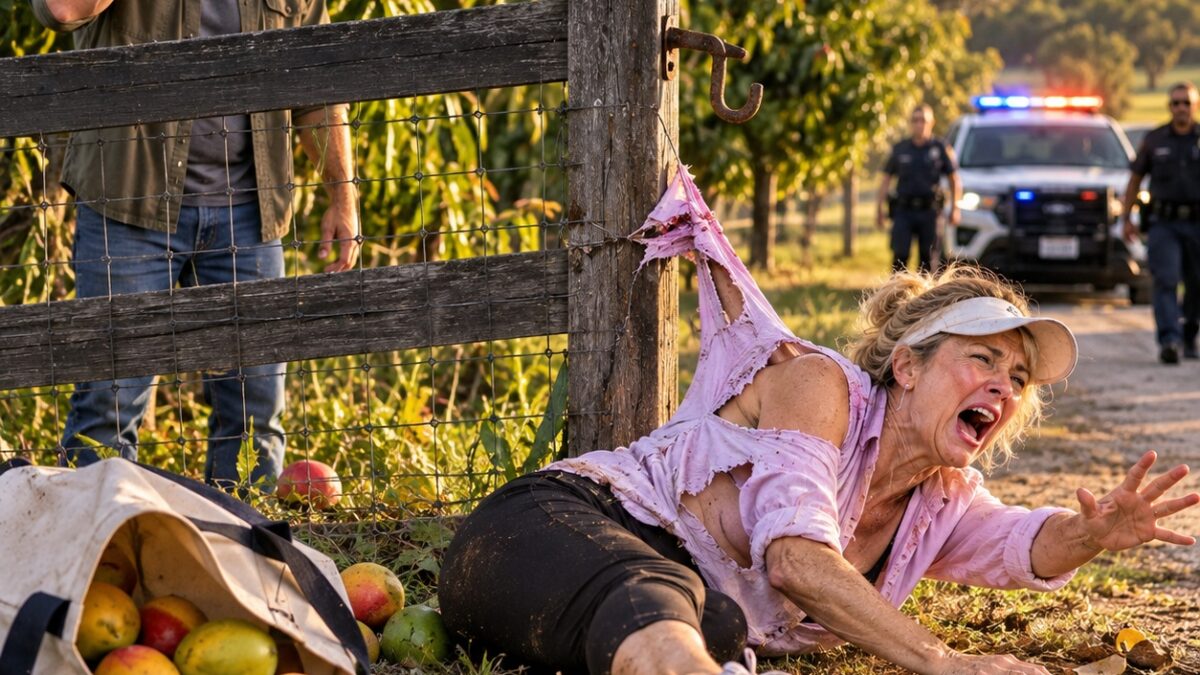
She was sitting now, one hand planted behind her, the other clutching her side. Mangoes were scattered around her like somebody had overturned a grocery display.
“I have the whole thing on camera,” I told the dispatcher.
That sentence made Martha quiet for maybe three seconds.
Then she started again.
“He knew I was coming! He set that up!”
I closed my eyes.
I had owned that property long enough to understand that broken irrigation lines, rotting fence posts, insect damage, storms, thieves, and drought all had something in common.
They didn’t care how angry you got.
You dealt with what was in front of you.
So I did.
I told the dispatcher exactly where Martha had fallen. I told her I wasn’t going to move her unless instructed. I told her Martha appeared conscious and had tried unsuccessfully to stand.
Then I waited.
From where I stood, I could see the fence post that had caused all the trouble.
The hook was old.
It had probably held wire or farm equipment years before.
I had noticed it several weeks earlier and marked that section for repair, but harvest season had pushed the job down my list.
It wasn’t hidden.
It wasn’t sharpened.
It wasn’t rigged.
It was just an old piece of metal sticking from an old farm fence.
Martha knew none of that.
She didn’t care.
She had already decided it was going to become my fault.
By the time I walked closer—but not too close—she had shifted from shouting to groaning dramatically.
“You did this,” she said.
“No, Martha.”
“You knew that was there.”
“It’s my fence.”
“You knew I might get hurt.”
I stared at her.
“You weren’t supposed to be climbing it.”
Her face tightened.
“I was checking the boundary.”
“With twenty pounds of my mangoes?”
Her eyes flicked toward the fruit on the ground.
That was when I saw the calculation start.
I had watched Martha do it before.
She would encounter a fact she couldn’t deny, ignore it, and immediately begin searching for a version of events in which the fact somehow proved she was right.
“I was collecting them,” she said.
“I saw that.”
“For the community.”
“My mangoes are not community property.”
“You don’t understand how common areas work.”
“Martha, you climbed over a private fence.”
“You have no right to interrogate me while I’m injured.”
“I’m not interrogating you.”
“Then stop talking to me.”
That was fine with me.
I stepped away.
The first patrol car arrived several minutes later, followed closely by emergency medical personnel.
Martha transformed the second she saw uniforms.
I don’t mean she became calmer.
I mean she became a different person.
The woman who had been screaming insults at me suddenly sounded fragile.
Her voice softened.
Her breathing became uneven.
She pressed one hand against her ribs and told the first officer, “Thank God you’re here.”
The officer looked from her to me.
“What happened?”
Martha pointed at me.
“I was inspecting a boundary issue when I was injured by a dangerous obstruction on his property.”
I actually looked behind me for a second.
Not because I was confused about what had happened.
Because her confidence was so absolute that some part of me expected another farmer to be standing there.
The officer asked, “You were inspecting whose boundary?”
“The HOA boundary.”
I said nothing.
Martha continued.
“This property adjoins our community, and we’ve had ongoing concerns about maintenance, vegetation, fencing, and encroachment.”
That was new.
In all the letters she had sent me, not one had accused me of encroachment.
The second officer approached the scattered mangoes.
He looked at the bag.
Then at Martha.
Then at the trees.
“Ma’am, were you picking fruit?”
Martha hesitated.
“I was removing produce that had become a nuisance.”
The officer looked around at the clean rows of trees.
“What nuisance?”
“Falling fruit. Pests. Sanitation. There are standards.”
He looked at me.
“You own this property?”
“Yes.”
“Are you a member of the HOA?”
“No.”
“Ever been a member?”
“No.”
“Is the farm included in the subdivision plat?”
“No.”
Martha interrupted.
“That isn’t the point.”
The officer turned back to her.
“It’s pretty relevant.”
She opened her mouth, but one of the medical responders asked her to stay still while they examined her shoulder and ribs.
The first officer walked over to me.
“Do you have identification?”
I gave it to him.
“You said on the 911 call you had cameras?”
“Yes.”
“They record this area?”
“They record most of the perimeter and several rows inside the orchard.”
“You have what happened today?”
“Beginning to end.”
Martha heard that.
“Those cameras are illegal.”
I looked over.
The officer did too.
“They’re on his property,” he said.
“He has them pointed toward the HOA.”
“No,” I said. “I have them pointed at my fence and my orchard.”
“You’re spying on residents.”
“I’m recording people who enter my land.”
“You can’t do that!”
The officer held up one hand.
“Ma’am, let us figure out what happened.”
Martha looked offended by the suggestion.
I went back to the house and pulled up the footage on a tablet.
Before returning, I opened the folder I had been building.
I hadn’t planned to use it that morning.
At least not yet.
I had imagined eventually taking the evidence to the police myself, perhaps after one more clear recording or after calculating exactly how much fruit had disappeared.
Part of me had still hoped Martha would stop.
That sounds foolish now.
But if you have never dealt with someone like her, you may not understand how exhausting conflict can become when the other person seems to enjoy it.
I farmed for a living.
My mornings started before sunrise.
Some days ended long after dark.
I worried about labor, weather, equipment, shipping, fertilizer prices, insects, disease, and whether a storm hundreds of miles away might change course.
I did not wake up each day hoping to fight with a woman over a subdivision I didn’t live in.
That was why I had gone to her office first.
I had given her the easiest possible exit.
Stop entering my land.
Stop taking my fruit.
We never have to speak about it again.
She had chosen something else.
When I returned with the tablet, Martha was on her feet with help from the medical team.
Her face changed when she saw what I was carrying.
The officer noticed.
“Let’s start with today.”
I opened the recording.
There she was.
Timestamp in the corner.
Martha appearing outside the fence.
Looking left.
Looking right.
Putting her bag down.
Climbing.
Dropping onto my property.
The officer watched silently.
Martha started talking immediately.
“That doesn’t show the whole situation.”
Nobody answered her.
On the screen, she walked to the trees.
She selected mangoes carefully.
Not fallen ones.
Not rotten ones.
She reached into branches and twisted ripe fruit from the stems.
One.
Two.
Three.
Ten.
More.
She moved from tree to tree.
The camera angle changed when I switched recordings.
Now she was closer.
Her bag was clearly visible.
So was the fruit.
“She’s picking them,” the second officer said.
“She was taking them for an HOA function,” I said.
Martha’s head snapped toward me.
“You don’t know that.”
“No. But the mangoes that disappeared from my property had an interesting habit of showing up sliced on trays at your community events.”
“That proves nothing.”
“I didn’t say it did.”
The video continued.
Martha finished filling the bag.
She returned toward the fence.
The officer leaned closer to the screen.
There was the jump.
The snag.
The violent twist.
The fall.
No one touched her.
No wire pulled tight.
No mechanism moved.
No trap activated.
She simply jumped, caught herself on the fence, and landed badly.
The video continued long enough to capture her sitting up and shouting toward my house.
The officer looked at Martha.
“Ma’am, you said he did this to you?”
“He knew the hook was there.”
“That isn’t what you said.”
“He created a dangerous condition.”
“You told us he caused your fall.”
“He did.”
“How?”
“By failing to maintain his fence.”
The officer exhaled through his nose.
Then he looked at me.
“You said this has happened before?”
“The trespassing? Yes.”
“How often?”
I opened the folder.
Martha took one step toward us.
“This is harassment.”
The officer held out his hand.
“Ma’am.”
“He’s been recording me for weeks.”
“On his property?”
“He’s obsessed with me.”
That almost made me laugh.
I didn’t.
There wasn’t anything funny about it anymore.
I opened the first clip.
A different date.
Different shirt.
Same fence.
Same movement.
Martha over the top.
Fruit into a bag.
Back out again.
Next clip.
Same.
Next.
Same.
The officers stopped asking questions for a while.
They just watched.
One recording showed another HOA board member outside the fence.
He never crossed onto my land.
He stood near the road, glancing around while Martha entered the orchard.
Another recording showed Martha dropping a mango as she climbed back over, noticing it, coming back, reaching through the fence, and taking it with her.
The smallest details bothered me more than the large ones.
That one especially.
She could not even leave one behind.
By the time I finished showing the clips, her earlier confidence had turned into something harder.
Not embarrassment.
Anger.
“You deliberately let this continue,” she said.
I looked at her.
“I told you to stop.”
“No, you were setting me up.”
“I came to your office.”
“You threatened me.”
“I told you I would call the police if you trespassed again.”
“That’s a threat.”
One officer asked me, “When did that conversation happen?”
I gave him the approximate date.
“Any witnesses?”
“The receptionist may have heard some of it. Martha also admitted taking the mangoes.”
“I did not.”
I looked directly at her.
“You said they were going to rot.”
“I said produce goes to waste.”
“You said I was preventing waste.”
“That is not an admission.”
The officer wrote something down.
Martha looked at his notebook.
Her voice rose again.
“Are you seriously taking his side?”
“We’re taking statements.”
“I’m president of the homeowners association.”
The officer’s expression didn’t change.
“Okay.”
“I represent hundreds of residents.”
“Okay.”
“I have an obligation to protect community interests.”
“Does that obligation include climbing private fences?”
Her mouth opened.
Nothing came out.
For once, there was no immediate answer.
The medical team recommended that she be evaluated further because of the fall. She resisted at first because she wanted to keep arguing with the officers, but they made it clear that her medical condition and the trespassing issue were separate matters.
Then came the question of the mangoes.
I was asked whether I wished to make a complaint.
“Yes.”
Martha looked at me as though I had slapped her.
“You’re kidding.”
“No.”
“Over fruit?”
“No. Over repeatedly entering my property and taking things that belong to me after I explicitly told you to stop.”
She gave a short, bitter laugh.
“You’re going to destroy your relationship with the entire neighborhood over a few mangoes.”
That sentence told me everything.
Not because she was right.
Because even then she still thought the problem was the price of the fruit.
It wasn’t.
If Martha had knocked on my door once and asked for six mangoes for an HOA picnic, I probably would have given her a box.
I had donated fruit before.
I gave damaged-but-good produce to food programs.
I sent neighbors home with more than they could eat.
The value of what she took mattered because it was part of my business.
But the deeper issue was simpler.
She had decided that my permission was unnecessary.
And every time she crossed that fence after I warned her, she was reinforcing that belief.
I looked at her and said, “You destroyed the relationship when you decided my property belonged to you.”
Her face hardened.
The officer separated us after that.
He took my statement.
He took hers.
He copied information from the recordings and asked me to preserve the original files.
Then Martha made one more mistake.
She changed her story again.
First she had been inspecting a boundary.
Then she had been removing nuisance fruit.
Then the fruit was for the community.
Now she told the officer she believed the orchard itself might partially lie within HOA-controlled property and that she had been gathering “samples.”
The officer asked whether she had a survey.
She didn’t.
A map?
No.
Written authorization?
No.
Notice sent to me before entering?
No.
Any official proceeding concerning the boundary?
No.
He looked at the bag lying in the grass.
“What were you going to do with the samples?”
“I don’t know.”
“How many samples do you need?”
She stopped answering.
Eventually, after the medical responders determined she was stable enough to move, the officers informed her that the evidence supported trespassing and theft allegations and that they were taking her into custody.
That was when the real Martha came back.
“You cannot be serious.”
The officer told her to turn around.
She looked at me.
“This man did this to me.”
I said nothing.
“Take his ass to jail! He created the hazard!”
The officer repeated his instruction.
Martha pointed at my house.
“He has illegal surveillance!”
“Martha,” I said quietly, “stop.”
She stared at me.
I had never seen hatred settle onto someone’s face so quickly.
“You’re going to regret this.”
One of the officers heard her.
“Ma’am, that’s enough.”
She was escorted toward the road.
I stood inside my own fence while they took her away.
The mangoes were still scattered in the grass.
Some had split open.
One had rolled into a shallow irrigation ditch.
The bag lay upside down.
For a long time after the vehicles disappeared, I stood there looking at everything.
I didn’t feel victorious.
That surprised me.
For weeks, I had imagined how satisfying it would be for somebody with authority to finally tell Martha no.
Instead, I felt tired.
Deeply tired.
I picked up the damaged fruit one piece at a time.
Anything salvageable went into a crate.
The rest went into compost.
Then I walked back to the house, reheated the coffee I had abandoned, and sat at the kitchen table.
My hands were shaking.
Not from fear exactly.
Adrenaline.
Anger.
Relief.
Maybe all three.
I opened the camera footage again.
This time, I watched only the moment when her shirt caught.
I wanted to make sure I had not missed something.
Maybe that sounds strange.
I knew I hadn’t touched the fence that morning.
I knew I hadn’t set a trap.
But when somebody accuses you confidently enough, especially in front of police, a tiny part of your brain starts reviewing your own actions as though certainty itself might be evidence.
The hook had been there.
The camera showed it.
The previous recordings showed it too.
Nothing about it had changed before Martha arrived.
I saved copies of everything.
Then I made backups.
One on an external drive.
One in cloud storage.
One for my attorney if it came to that.
At the time, I thought I was being overly cautious.
A few days later, a process server arrived at my gate.
He handed me a thick envelope.
Martha was suing me.
I stood there reading the first page twice because my mind refused to accept it.
Negligence.
Dangerous condition.
Intentional or reckless failure to maintain fencing.
Invasion of privacy.
Harassment.
Emotional distress.
Physical injury.
Damage to reputation.
The language was polished in a way Martha’s shouting had never been.
But underneath it was the same argument.
She had entered my land without permission.
Taken my property.
Hurt herself while leaving.
And somehow I was responsible.
I remember sitting at the kitchen table with those papers spread in front of me.
That table had held invoices, harvest schedules, tax forms, seed catalogs, repair manuals.
Now it held a lawsuit from a woman who had climbed my fence repeatedly after being told not to.
I read one paragraph aloud.
It claimed she had entered the area while carrying out duties associated with HOA boundary oversight.
I actually stopped and looked out the window toward the orchard.
Boundary oversight.
That was what she was calling it.
Not trespassing.
Not stealing.
Oversight.
Another paragraph claimed the camera system had been installed or used to intimidate her.
That one made me laugh once.
A short, humorless sound.
The cameras had been there because farms get theft, vandalism, wildlife, equipment problems, and trespassers.
Martha had turned herself into their most frequent subject.
Still, a lawsuit is a lawsuit.
You do not ignore legal papers because the claims seem ridiculous.
I called an attorney that afternoon.
I brought the documents.
I brought my deed.
The survey.
Photographs of the fence.
Maintenance records.
Copies of correspondence from the HOA.
The camera footage.
Every clip.
Every date.
Every timestamp.
When my attorney watched the first video, she said nothing.
When she watched the third, she leaned back.
“How many are there?”
“Enough.”
“And you told her to stop?”
“Yes.”
“In person?”
“Yes.”
“Before some of these recordings?”
“Before most of them.”
She looked through the folder again.
“Did you ever authorize her to enter?”
“No.”
“Did you ever tell her she could take fruit?”
“No.”
“Did the HOA ever claim ownership of your land before this?”
“They’ve complained about the farm. That’s different.”
“How?”
“They’ve sent letters about tractor noise, fence appearance, workers parking on my side of the road, the color of a storage shed. But they’ve never produced anything showing jurisdiction over the property.”
“You responded?”
“Every time.”
“Keep those.”
She watched the fall again.
Then again.
“Did you alter that hook?”
“No.”
“Install it?”
“No idea. It may be older than I am.”
“Did you sharpen it?”
“No.”
“Move it into a position designed to catch someone?”
“No.”
“Any warning signs on the property?”
“Yes. Private property. No trespassing.”
“Visible from where she climbed?”
“Very.”
She nodded.
“That helps.”
I asked the question that had been sitting in my stomach since the papers arrived.
“Can she actually win this?”
My attorney didn’t give me the comforting answer I wanted.
She gave me the professional one.
“Anyone can file a lawsuit. That doesn’t mean they can prove it.”
“That’s not what I asked.”
“I know.”
She folded her hands.
“Civil cases are not decided by who behaved worse in a general sense. They’re decided by claims, duties, evidence, statutes, facts, and what can actually be proven. We take it seriously.”
That was enough to ruin my sleep for several nights.
Not because I believed Martha’s story.
Because legal trouble has a way of occupying space in your life even when you did nothing wrong.
Every envelope looks threatening.
Every phone call feels important.
Every ordinary expense starts competing in your mind with attorney fees.
Martha had told me people like me backed down when things got expensive.
Now I understood why she had said it.
Maybe she had used that tactic before.
Maybe not.
It didn’t matter.
The cost itself was pressure.
The time was pressure.
The uncertainty was pressure.
For the first time since the problem began, I understood what she had expected from me.
She didn’t need to be right.
She only needed to make defending myself unpleasant enough that surrender became attractive.
I thought about that whenever I walked through the orchard.
Sometimes I would stop near the fence and stare at the subdivision beyond it.
The homes were neat.
Lawns trimmed.
Mailboxes matched.
Children rode bicycles in the evenings.
Most of the people who lived there had nothing to do with my dispute.
That mattered to me.
I refused to turn Martha into the entire neighborhood.
There were residents who waved when I drove by.
A few bought mangoes directly from me.
One older man had once helped me push a stalled utility vehicle out of mud during a storm.
The HOA was not one person.
But one person had been allowed to speak as though it were.
That distinction became clearer when word of Martha’s arrest spread.
At first, nobody said much to me directly.
Then the whispers started.
A resident stopped at my roadside produce stand and bought a box of mangoes.
While I was counting change, she asked quietly, “Is it true Martha was taking fruit from your farm?”
I looked at her.
“You’d have to ask Martha.”
She gave me a tired smile.
“That sounds like yes.”
I didn’t answer.
She hesitated.
“We always wondered where the fruit at those meetings came from.”
That got my attention.
“What fruit?”
“Mangoes. She started bringing trays this summer. Said she had a source.”
I looked toward the orchard.
“How often?”
“A few times.”
I thought about the timestamps.
The bags.
The days preceding HOA events.
Pieces began lining up.
I didn’t need them to.
The theft videos were already enough.
Still, the idea that she had been standing in a community clubhouse accepting praise for generosity while serving produce she had taken from my land made my jaw tighten.
The woman noticed.
“I’m sorry,” she said.
“You didn’t take them.”
“No. But people let her get away with a lot.”
I looked at her.
She lowered her voice.
“She likes people to think every decision comes from the board. Sometimes it’s just Martha.”
That was all she said.
Then she took her fruit and left.
I wrote down the conversation afterward, not because I intended to drag her into court but because by then I had learned to document anything related to Martha.
The lawsuit moved forward.
There were filings.
Responses.
Requests for records.
Statements.
More paperwork than I had imagined could grow from a bag of stolen fruit.
Martha’s position remained essentially the same.
She had entered because she was performing HOA-related responsibilities.
She argued the boundary was unclear.
She claimed she had reason to inspect conditions on my land.
She claimed the cameras had been placed to monitor her.
She claimed the fence was unsafe.
And she claimed I had either known or should have known that somebody might encounter the hook.
My attorney kept returning to the same point.
“She wasn’t walking past it.”
She had climbed over the fence.
That mattered.
So did the signs.
So did the deed.
So did the recordings of Martha choosing the same unauthorized route again and again.
So did the fact that she had been warned.
So did the fruit.
Especially the fruit.
There is something wonderfully stubborn about video.
People can argue over memory.
They can argue over tone.
They can argue about what someone intended.
But a camera does not care which person has the better title.
It showed Martha crossing.
It showed her picking.
It showed her carrying.
It showed her leaving.
And it showed her falling without any action from me.
She could explain the footage.
She could reinterpret it.
She could call it misleading.
But she could not make herself disappear from it.
The closer we got to court, the more aggressive her side became.
One letter suggested that settling privately would spare both parties “unnecessary reputational harm.”
I read that phrase several times.
Then I handed it to my attorney.
“What does that mean?”
“It means they would like this resolved without a judge seeing all the evidence.”
“Are they offering to drop the suit?”
“Not exactly.”
“What do they want?”
“Money and mutual releases.”
I laughed.
“So I pay her?”
“That appears to be the proposal.”
“For falling off the fence she climbed while carrying my mangoes?”
My attorney gave me a look.
“I’m explaining the offer, not recommending it.”
“Good.”
There was silence for a second.
Then she said, “You should still understand the decision. Trials involve cost and uncertainty.”
There it was again.
Cost.
The weapon Martha had predicted.
For the first time, I considered settling.
Not because I thought she deserved anything.
Because I was tired.
I wanted to wake up and think about rainfall instead of depositions.
I wanted to check fruit quality without wondering whether my camera placement would become a paragraph in another filing.
I wanted my farm back.
Conflict changes familiar places.
The fence that had once meant almost nothing to me had become the center of my attention.
Every time I drove past the HOA entrance, my shoulders tightened.
Every unknown vehicle near my gate made me look twice.
A small settlement could make that stop.
At least that was the temptation.
Then I remembered Martha sitting behind her desk.
People like you always back down when this gets expensive.
I heard her voice as clearly as though she were sitting across from me.
If I paid her, whatever legal language surrounded the agreement, she would understand only one thing.
Pressure had worked.
I looked at my attorney.
“No.”
“You’re sure?”
“Yes.”
She nodded.
“All right.”
That was the last time I seriously considered settling.
Court day came sooner than I expected.
I wore the best clothes I owned, which felt strange after months of boots and work shirts.
I arrived early.
Martha arrived later.
Her arm was supported by a brace.
Whether she still medically needed it, I couldn’t say.
I had no interest in pretending she hadn’t been hurt.
She had.
The fall was real.
Pain was real.
What I rejected was the idea that her injury rewrote everything that came before it.
She sat with her attorney looking composed.
When she noticed me, her expression changed only slightly.
A tightening around the mouth.
Then she looked away.
I did the same.
I had spent enough time looking at Martha.
The hearing began with paperwork and arguments that seemed dry compared with the emotional mess that had brought us there.
Then the central facts came into focus.
Martha’s attorney presented her version carefully.
She had served as HOA president.
My farm bordered the development.
There had been concerns about the condition of the boundary.
She had entered the area in connection with those concerns.
The fence contained a hazardous metal obstruction.
She fell and suffered injuries.
My surveillance practices contributed to a hostile environment.
The language almost made the story sound reasonable.
Almost.
Then Martha testified.
She spoke softly.
Much more softly than she had in her office.
She described herself as trying to protect residents.
She said the property line had been a matter of ongoing concern.
She said vegetation and fruit near the boundary raised maintenance questions.
She said she had never intended to steal anything.
My attorney asked, “Did you take mangoes from his trees?”
Martha paused.
“I removed fruit.”
“Did you pay for it?”
“No.”
“Did he give it to you?”
“No.”
“Did you ask?”
“I didn’t believe that was necessary under the circumstances.”
“What circumstances?”
“The community concerns.”
“What community concern required you to place ripe mangoes into a tote bag?”
Her attorney objected.
There was discussion.
The question was rephrased.
Martha said some fruit had been collected for examination.
My attorney looked down at her notes.
“Examination by whom?”
“I don’t recall.”
“Did you submit it to anyone?”
“I don’t recall.”
“Do you have any report resulting from that examination?”
“No.”
“Any photographs?”
“No.”
“Lab analysis?”
“No.”
“No record at all?”
“No.”
“What happened to the mangoes?”
Another pause.
“They may have been used.”
“Used how?”
“At community functions.”
My attorney let the silence sit.
It was one of the most effective things she did all day.
She did not rush to fill it.
She allowed Martha’s own answer to remain in the room.
Then came the footage.
The first recording played.
Martha climbed the fence.
Picked fruit.
Left.
The courtroom was quiet.
The second recording played.
Same thing.
The third.
Again.
Then another.
At one point, the judge looked toward Martha’s attorney.
“How many incidents are there?”
My attorney answered.
“Multiple documented entries over a period of weeks, Your Honor.”
The judge looked back at the screen.
We showed the clip involving the other board member.
Then footage from dates after my confrontation with Martha.
That mattered most to me.
Before the warning, she might claim confusion.
After it, she could not honestly claim she didn’t know I objected.
My attorney asked me about the office conversation.
I repeated it.
I told the court I had informed Martha that I had surveillance footage.
That I told her she was trespassing.
That she admitted taking fruit by arguing it would otherwise rot.
That I explicitly told her not to return.
Martha denied the wording.
She said the conversation had been hostile.
She said I had misunderstood her role.
She said she believed there were legitimate jurisdictional questions.
Then my attorney produced the deed and survey.
The boundary was shown.
My farm remained exactly where it had always been.
Outside the HOA.
The judge asked Martha whether she possessed documentation granting the HOA authority over my land.
“No,” she said.
“An easement?”
“No.”
“Inspection rights?”
“No.”
“Written consent from the owner?”
“No.”
“Any court order authorizing entry?”
“No.”
The judge leaned back.
“Then what legal authority did you believe allowed you to climb this fence?”
Martha began explaining HOA responsibilities.
The judge stopped her.
“I’m asking about this property.”
Martha hesitated.
“I believed the boundaries were disputed.”
“By whom?”
“The association.”
“Where is that dispute documented?”
Silence.
Her attorney tried to redirect the issue toward the fence.
That brought us to the fall.
The video played.
Everyone watched Martha approach with the full bag.
Watched her prepare to climb.
Watched her jump.
Watched the fabric catch.
Watched her twist.
Watched her hit the ground.
I hated seeing it again.
Even after everything, I hated the sound of the impact.
It looked painful because it was painful.
But the video also made one fact impossible to avoid.
I had done nothing to cause it.
My attorney paused the recording before the fall and pointed out the hook.
She showed older footage.
Same hook.
Same position.
Nothing newly installed.
Nothing activated.
No trap.
No concealed wire.
No device.
Just the fence Martha chose to climb.
Her attorney argued I knew the fence contained a hazard.
My attorney argued Martha knew she was entering without permission and that the condition had not been created to injure her.
The judge asked questions.
A lot of them.
Some made me uncomfortable.
That was his job.
He asked why I had not immediately contacted police after the first theft.
I answered honestly.
“I wanted clear documentation, and I hoped telling her directly would stop it.”
“You continued recording after warning her?”
“Yes.”
“Why not call police then?”
“I should have. I thought if she realized I knew, she would stop.”
“Did you want to catch her?”
“I wanted her to stay off my land.”
That answer mattered to me because it was true.
I had not spent weeks dreaming about Martha being arrested.
I wanted the opposite.
I wanted nothing to happen.
I wanted boring mornings.
Trees.
Coffee.
Work.
The judge asked whether I had deliberately left the hook in place because I expected Martha to return.
“No.”
“Had you identified it for repair?”
“Yes.”
“When?”
“Before the fall.”
“Why was it not repaired?”
“Farm work. It was on my maintenance list.”
“Did you anticipate someone climbing over that section of fence?”
“Not legally.”
A faint reaction moved through the room.
Not quite laughter.
The judge remained serious.
My attorney added that warning signs were posted and the gate provided a normal controlled entrance.
Martha had chosen neither.
Then the judge returned to something more damaging to her credibility.
Her statements to police.
The initial claim that she had been inspecting a boundary.
Her accusation that I had “done this” to her.
Her later explanations concerning nuisance fruit.
Community use.
Samples.
The stories did not match cleanly.
Martha tried to explain.
She had been injured.
Confused.
In pain.
Misunderstood.
Her words had been taken out of context.
The videos were taken out of context.
My warning was taken out of context.
The mangoes were taken out of context.
Eventually, everything except Martha seemed to have been taken out of context.
The judge finally interrupted.
“A title in a private association does not grant someone ownership rights over neighboring land.”
The room went still.
He looked toward Martha.
“Nor does it grant authority to ignore a fence.”
Martha stared straight ahead.
“Trespassing does not become an inspection because the person trespassing holds a board position.”
Her attorney began to speak.
The judge raised his hand.
“And property does not become community property merely because it is adjacent to a community.”
I looked down at my hands.
For months, I had wanted someone other than me to say that.
Not because the idea was complicated.
Because I had repeated the obvious so many times that I had begun to feel as if I were defending some bizarre personal interpretation of reality.
My farm was mine.
The fence was mine.
The trees were mine.
The fruit was mine.
Those should have been ordinary facts.
Martha had turned them into arguments.
The judge dismissed her claims against me.
The decision did not arrive with the kind of theatrical speech people imagine from television.
Reality is usually quieter.
Paperwork.
Findings.
Legal standards.
Orders.
But the effect was clear.
Her version had collapsed.
Her repeated unauthorized entries mattered.
The theft mattered.
The warnings mattered.
The recordings mattered.
And her injury did not transfer responsibility for her choices onto me.
Then came the consequences.
Restitution for the stolen produce.
Damage associated with the fence.
Legal costs to the extent ordered.
Fees connected to the emergency response and other expenses allowed by the court.
The number was not enormous in the world of lawsuits.
To Martha, judging by her face, it may as well have been.
She turned pale.
For the first time since I had known her, she looked less angry than stunned.
Not humiliated.
Not defeated.
Just unable to understand how the system had failed to bend around her.
Outside the courtroom, I stopped near the steps and breathed.
The air felt different.
Nothing about the farm had changed while I was inside.
The mango trees were still miles away.
Work was still waiting.
Bills were still bills.
But the pressure I had carried in my chest for months had loosened.
People came out behind us.
Some knew Martha.
Some knew me.
Some probably knew neither of us.
I heard whispers.
I ignored them.
Martha came through the doors several minutes later.
She saw me.
Our eyes met.
I expected another accusation.
Maybe another threat.
Instead, she looked away.
That frightened me more than shouting would have.
Because people who are accustomed to winning do not always become reasonable when they lose.
Sometimes they become quieter.
My attorney must have been thinking the same thing.
“She has already threatened you once,” she reminded me.
“More than once.”
“You should consider a protective order.”
I did.
That same week, I filed.
I brought the footage.
The police report.
The court findings.
Documentation of the threats and repeated entries.
The order was granted.
Martha was prohibited from entering my property.
From coming to my business.
From contacting me.
The paper itself was not magical.
I understood that.
A court order cannot physically stop another person from making a bad decision.
But it made the boundary legally unmistakable.
There would be no more debate about misunderstandings.
No more inspection excuses.
No more “community” justification.
Stay away.
Simple.
The HOA reacted more quietly than I expected.
There was no public apology.
No dramatic delegation arriving at my farm.
No board member standing at my gate begging forgiveness.
Martha was replaced.
That was enough.
I heard the news from one of the residents who regularly bought fruit from me.
“They had a meeting,” he said.
I looked up from the crate I was packing.
“And?”
“She’s out.”
“As president?”
“As everything, from what I understand.”
I nodded.
He waited, maybe expecting a bigger reaction.
“That’s it?” he asked.
“What do you want me to do?”
He smiled.
“I don’t know. Celebrate?”
“I have three pallets going out tomorrow.”
He laughed.
“You really are a farmer.”
“That’s what I kept trying to tell everybody.”
He bought six mangoes.
Paid for all six.
I remember that because when he handed me the money, he said, “See? Revolutionary concept.”
For the first time in months, I laughed about the situation.
After Martha was removed, the HOA correspondence stopped.
No complaints about tractor visibility.
No suggestion that my fence needed to match subdivision aesthetics.
No letters about farm equipment being inconsistent with neighborhood standards.
Nothing.
The silence was almost suspicious at first.
I would open the mailbox and expect another envelope.
There wouldn’t be one.
Days passed.
Then weeks.
Nobody climbed the fence.
Nobody arrived before sunrise with a tote bag.
Nobody claimed jurisdiction over my trees.
The cameras became boring again.
I cannot explain how much I appreciated that.
Boring camera footage is one of those things you do not value until somebody gives you hours of reasons to watch it.
Deer near the far row.
A raccoon.
Wind moving branches.
A delivery truck turning around.
Rain.
Nothing.
Beautiful nothing.
I repaired the section of fence where Martha had fallen.
The old hook came out.
I kept it for a while.
Not as a trophy.
More because I wasn’t sure whether litigation was completely finished and I had learned not to discard anything that might somehow become evidence.
Eventually, after my attorney said I no longer needed it, I threw it into the scrap bin.
It made an ordinary metallic sound when it landed.
That surprised me.
An object can occupy the center of months of conflict and still be nothing more than rusty metal when the conflict ends.
The orchard kept growing.
Trees do not care about lawsuits.
They do not care who is HOA president.
They do not understand property lines, court orders, threats, reputations, or entitlement.
Give them water.
Feed the soil.
Prune them correctly.
Watch for disease.
Protect the fruit.
Harvest at the right time.
They answer effort with whatever the season allows.
That year, the branches grew heavy.
Heavier than I expected.
Maybe I only noticed because I had spent so much time worrying about what was being taken that I had forgotten how much remained.
During the first major harvest after the court case, I walked the same rows Martha used to enter.
Sunlight was coming through the leaves.
Crates were stacked beside the workers.
The air smelled like sap, warm soil, and ripe fruit.
I stopped at the fence.
For months, that spot had represented conflict.
I could still picture her visor appearing above it.
Still picture the tote bag.
Still hear her office voice.
People like you always back down when this gets expensive.
She had been wrong about me.
But I understood the sentence differently now.
The most dangerous part of people like Martha is not that they believe rules do not apply to them.
It is that they become skilled at making resistance exhausting.
They count on the ordinary person wanting peace more than they want fairness.
They make the phone calls.
Send the letters.
Raise the stakes.
Use titles.
Use committees.
Use legal language.
Use confidence.
They create so much noise around something simple that eventually you begin asking yourself whether defending the obvious is worth the trouble.
That was the trap.
Not the hook.
Not the fence.
The real trap was exhaustion.
Martha believed that if she pushed long enough, I would decide a few mangoes were not worth fighting over.
And on the surface, she would have been right.
A few mangoes were not worth months of conflict.
But ownership was.
Permission was.
The right to stand on my own land and say no without having somebody turn that no into a negotiation was.
I never needed Martha to like me.
I never needed the HOA to approve of my farm.
I did not even need an apology.
I needed the boundary respected.
That was all.
Eventually, it was.
One afternoon several months later, I drove past the subdivision entrance on my way home from a delivery.
There was a new HOA notice board near the clubhouse.
Different names.
Different president.
I almost kept driving.
Then I noticed something that made me slow down.
A folding table had been set up outside.
People were preparing for some neighborhood event.
There were pitchers.
Paper plates.
Bowls.
Food trays.
And mangoes.
For one second, old anger rose automatically.
Then I saw the cardboard boxes under the table.
My farm label was printed on the side.
They had bought them.
I laughed to myself and kept driving.
That was all I had ever asked.
You want mangoes?
Buy them.
Ask for them.
Treat the person growing them like a human being.
The next morning, I checked the overnight camera footage with my coffee.
One raccoon.
Two deer.
A branch shifting in wind.
No Martha.
I closed the app.
Outside, dawn was spreading over the orchard.
The rows were quiet.
My gate was locked.
My signs were still visible.
Beyond the fence, the roofs of the subdivision caught the first light.
For a long time, I had looked in that direction and felt tension.
That morning, I felt nothing.
And nothing was exactly what I wanted.
I went outside and started working.
Harvest does not wait because you won a court case.
One of the trees near the western row was bending so heavily with fruit that I had to brace a branch before it split.
I stood beneath it with my hands sticky from sap and looked at all those mangoes hanging untouched.
For weeks, I had thought karma would need some dramatic intervention.
It didn’t.
I never had to chase Martha.
Never had to threaten her.
Never had to sabotage anything.
Never had to invent a story more outrageous than the truth.
I only had to document what happened, protect my property, and refuse to let her rewrite her choices as my responsibility.
Martha had done the rest herself.
She climbed the fence.
She took the fruit.
She ignored the warning.
She kept returning.
She fell.
She lied to the police.
She sued me.
And every new attempt to escape the consequences only created more evidence of the behavior that caused the problem in the first place.
That was the strange part.
I had spent months believing I was fighting Martha.
In the end, I mostly stood still while Martha fought reality.
Reality won.
The HOA got a new president.
I got my farm back.
The fence became just a fence again.
And the orchard grew so heavy with mangoes that season that by late summer, the branches looked like they were bowing under the weight.
I stood among them one evening after everyone else had gone home.
The sun was low.
The subdivision beyond my property was quiet.
No shouting.
No flashing police lights.
No legal papers waiting at my gate.
Just warm air moving through leaves.
I picked one ripe mango from a branch, turned it over in my hand, and smiled.
Not because Martha had lost.
Because finally, she no longer mattered.
That was better.








