PART 2:The HOA President Changed the Locks on My House—Then the Trooper Beside Me Opened Her Folder
PART 2 and FULL ENDING  Thank you

Vivian Cross had been president of the Laurel Ridge Homeowners Association for almost four years by then.
She wore tailored blazers to Saturday meetings.
She used phrases like “community integrity” and “enforcement continuity” as if she were managing a government agency instead of a neighborhood where people mostly wanted their trash picked up and their gutters left alone.
People whispered about her more than they challenged her.
I understood why.
Vivian did not argue like a neighbor.
She documented.
She filed.
She cited.
She sent letters with bold deadlines and red stamps. She made people feel as though losing an argument with her might turn into a lien, a fine, a public meeting, or a folder with their name on it.
I wanted no part of her little kingdom.
Then, one Tuesday evening, I came home in Trooper Marcus Hail’s cruiser.
Six hours earlier, I had stopped on the shoulder of a highway two counties away after a collision left a young woman stranded with a damaged car and a terrified eight-year-old in the back seat. I helped keep traffic away from the wreck until state police arrived. Marcus was the trooper assigned to the scene.
My old truck overheated before the tow truck left.
Marcus insisted on driving me home.
I thought the most embarrassing part of my night would be arriving in my subdivision like I had been arrested.
Then we turned onto my block.
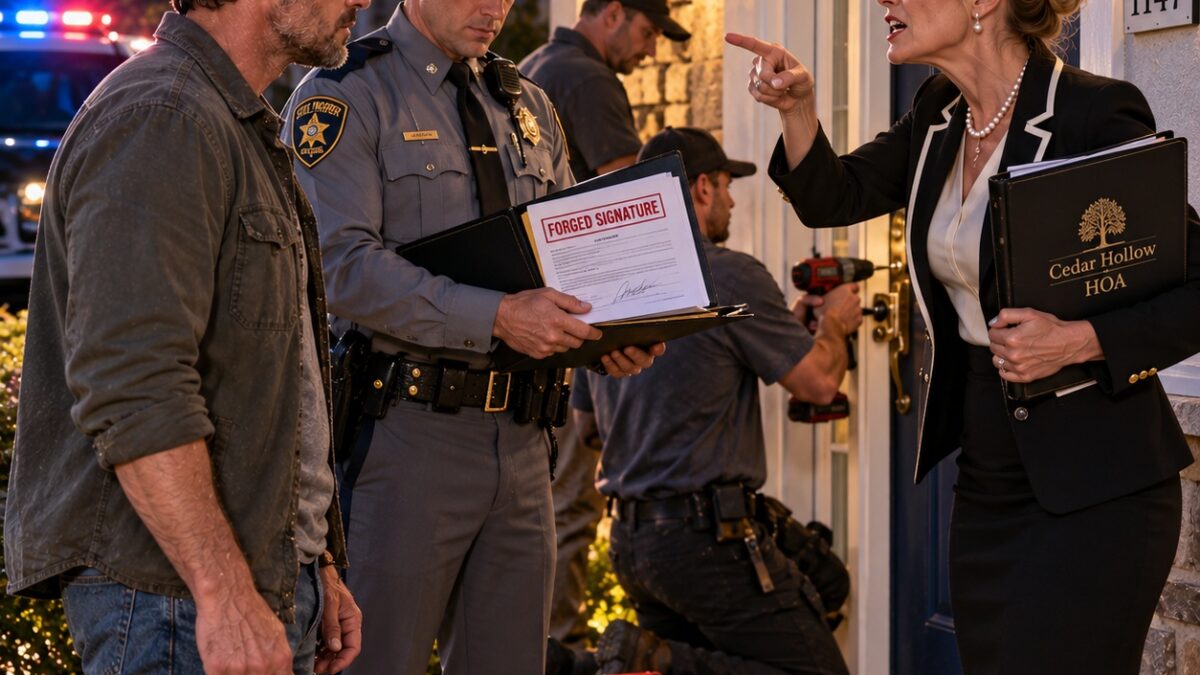
A white maintenance van sat crooked across my driveway.
Its hazard lights blinked against the dusk.
Two men in gray uniforms were kneeling at my front door with a drill.
And standing behind them with her arms folded, wearing a cream blazer too composed for the crime she was committing, was Vivian Cross.
She turned as the cruiser headlights swept across my yard.
She did not look surprised.
She looked satisfied.
I stepped out before Marcus had even put the car in park.
Vivian’s voice reached me across the lawn, calm and rehearsed.
“You’re a little late, Ethan,” she said. “This house isn’t yours anymore.”
[End Facebook Caption — full story continues below]
For a second, the words did not attach to anything real.
They did not attach to my mortgage payments.
They did not attach to the deed locked in my fireproof box.
They did not attach to the years of repairs, the bruised knuckles, the late nights in the garage, the quiet mornings drinking coffee on the front steps while the neighborhood still slept.
This house isn’t yours anymore.
It sounded like something from a nightmare where the rules had changed while I was away.
Marcus moved before I did.
He stepped between me and the porch with the unhurried authority of a man who had stood between angry people more times than he could count.
“Ma’am,” he said, “put the tools down.”
One of the men at the door looked up immediately.
The drill went silent.
Vivian glanced at Marcus’s uniform, then back at me.
“You don’t understand how this works,” she said. “The homeowners association has rights here.”
Marcus looked at the half-installed lock.
Then he looked at Vivian.
“No,” he said. “But I think you’re about to understand how big a mistake you just made.”
That was the first moment Vivian’s confidence flickered.
Not disappeared.
Flickered.
People like Vivian rarely lose confidence all at once. They patch it. Reinforce it. Shift the weight to another wall before anyone sees the crack spreading.
She lifted her chin and reached into the maintenance van.
When she turned back, she was holding a thick folder against her chest like a courtroom exhibit.
“We have full documentation proving this property is subject to association enforcement,” she said.
The maintenance men stood slowly.
They were not locksmiths, at least not the kind I would ever hire. Their gray shirts had a maintenance company logo stitched above the pocket. One of them, a younger man with reddish hair and a nervous mouth, looked like he suddenly wished he had called in sick.
I walked toward the porch.
Marcus did not stop me, but he moved with me.
Close enough to intervene.
Far enough not to look like he was fighting my battle for me.
I stopped at the bottom step and held out my hand.
“Give me the folder.”
Vivian’s eyes narrowed.
“These documents belong to the association.”
“You’re using them to change the lock on my house.”
Her fingers tightened.
Derek Vaughn appeared from the passenger side of the van before she could answer.
Derek was Vivian’s shadow.
Not her husband.
Not officially her employee.
Not on the board, at least not anymore. But he was at every important HOA meeting, every architectural review hearing, every tense doorstep conversation where Vivian wanted another body standing behind her.
He was maybe fifty, with expensive shoes, a loosened tie, and the kind of face that looked permanently ready to accuse someone else of bad faith.
“This confrontation is unnecessary,” he said.
I did not look at him.
“Then move your people away from my door.”
Vivian held the folder out.
I took it and opened to the first page.
Laurel Ridge Homeowners Association.
Case number.
My address.
My full legal name.
A paragraph about repeated noncompliance.
Another about accumulated fines.
Then a line at the bottom with a signature.
My name.
Almost.
The signature looked like mine the way a house looks real in a bad dream. The shape was close enough to unsettle me. The M had the wide first stroke I had used since high school. The final r dipped downward the way it sometimes did when I signed quickly.
But there was no pressure in it.
No hesitation where my pen usually caught.
The letters were too smooth, too evenly arranged, too careful.
It was a signature assembled by someone who had seen mine but had never felt my hand move.
I stared at it long enough that Vivian’s smile slipped.
Marcus leaned slightly over my shoulder.
The two maintenance men stopped breathing for a beat.
I closed the folder slowly.
“This isn’t my signature.”
Silence fell over the porch.
Not long.
Long enough.
For the first time since I had stepped out of the cruiser, Vivian Cross did not have an answer ready.
Then Derek moved closer, as if proximity could hold the whole story together.
“These are board-certified documents,” he said.
“Certified by whom?” I asked.
“The association.”
“That isn’t an answer.”
Vivian’s composure returned in a thinner layer.
“You have ignored repeated notices.”
“What notices?”
“Violation notices.”
“For what?”
“Community standards.”
She delivered the words as though everyone present already understood them.
Marcus crossed his arms.
“List them.”
Vivian looked at him.
“This is an association matter.”
“You’re attempting to take physical control of a residence,” Marcus said. “List them.”
The red-haired maintenance worker swallowed.
Derek’s jaw tightened.
Vivian opened her folder again and began reciting.
Failure to pay association dues for several consecutive months.
Unauthorized exterior modifications.
Failure to cure architectural violations.
Accumulated fines.
Default.
Abandonment protocol.
Loss of certain rights to the property.
Association reentry.
Reentry.
That was the word that made something cold settle in my stomach.
As if she were a landlord and I were a tenant who had overstayed.
As if nearly a decade of ownership had been demoted into occupancy.
Derek nodded along with each accusation, small murmurs of agreement slipping from his mouth.
Yes.
Correct.
That’s right.
Exactly.
That was the trick.
A lie sounds stronger when two people pretend to remember it together.
I let her finish.
Construction taught me patience.
When a subcontractor gave me a false explanation, I learned not to interrupt too early. Let the bad framing show. Let the contradiction reveal itself. A lie, like a crooked wall, eventually gives you a line to measure against.
“When was the first notice sent?” I asked.
Vivian blinked.
“The association follows standard procedures.”
“That wasn’t my question.”
“We mailed repeated notices.”
“What date?”
She opened the folder and flipped pages too quickly.
“The dates are in the file.”
“Show me.”
Her fingers stopped.
“These are confidential board materials.”
“You’re using them to remove me from my house.”
Derek cut in.
“You’re being aggressive.”
Marcus turned toward him.
That was enough.
Derek looked away.
I took out my phone, opened my banking app, and pulled up my automated payments.
Month after month.
Laurel Ridge HOA.
Processed.
Transaction numbers.
No missed payments.
I turned the screen toward Vivian.
“If I’ve never missed a payment, why are your people changing the locks on my house?”
She glanced at the screen for less than a second.
Then looked away.
That glance told me more than a full confession would have.
It told Marcus too.
I saw his posture shift. Not dramatically. Just enough. The way a professional recognizes when a story is no longer being told—it is being managed.
Vivian pivoted.
“You have been absent from the property for an extended period.”
“I slept here last night.”
“Our records indicate otherwise.”
“Then your records are wrong.”
“You were away today.”
“For one day.”
“Long enough to trigger concern.”
“Concern doesn’t let you drill my lock.”
She lifted the folder again.
“The board has protocols for abandoned residences.”
That contradiction hung in the air.
First I had supposedly failed to pay dues.
Then I had supposedly accumulated architectural violations.
Now I had supposedly abandoned my home.
Three different stories, none sturdy enough to hold weight.
Marcus held out his hand.
“Let me see the enforcement file.”
Vivian hesitated.
He did not repeat himself.
She gave it to him slowly.
Marcus flipped through the pages with the patience of a man who had read thousands of reports and knew that the important line was rarely where the writer wanted your eyes to go.
He reached the last page and stopped.
His eyes narrowed.
“What is it?” I asked.
He turned the page toward me.
Near the bottom, printed in plain black type, were the words:
TRANSFER OF OWNERSHIP.
The date was three weeks earlier.
A date when I had been standing in my own kitchen, very much alive, very much solvent, replacing a cabinet hinge and eating leftover chili from a cracked blue bowl.
Marcus tapped the date.
“According to this, ownership transferred three weeks ago.”
He looked at Vivian.
“But Mr. Mercer is standing right here, and as far as I can tell, nobody transferred anything.”
The maintenance workers stepped back from the porch.
Both of them.
It would have been funny if my hands had not been shaking.
Vivian lifted her chin.
“It is an internal association procedure used when a property enters default.”
Marcus looked at her.
“No.”
“You aren’t an HOA attorney.”
“No,” he said. “But no homeowners association can transfer private property through an internal procedure. That requires a lawful foreclosure process, a court order, or the owner’s consent. I don’t see any of those here.”
Derek’s face flushed.
“You’re interfering in private governance.”
Marcus turned his head again.
Derek went silent.
I reached for the folder.
Vivian pulled it back.
“I want the complete file,” I said. “Every notice. Every claimed violation. Every signature. Every date.”
“You are not entitled to confidential board files.”
“You put my name on them.”
“That doesn’t change procedure.”
“No,” I said. “But my attorney will.”
I photographed the case number before she could close the folder.
Then I stepped onto the lawn and called Nolan Pierce.
Nolan was seventy-one years old, though he moved like a man who refused to let age give him instructions. He had practiced real estate law for more than forty years and had the blunt, dry manner of someone who had watched too many people try to turn land into fiction.
He answered on the third ring.
“Nolan, it’s Ethan Mercer.”
“Ethan. What happened?”
I told him.
The van.
The lock.
Vivian.
The forged signature.
The fake ownership transfer.
Trooper Marcus Hail.
The maintenance workers.
The file number.
The missing dates.
When I finished, he didn’t ask if I was all right.
He knew better.
“Do not sign anything,” he said immediately.
“I wasn’t planning to.”
“Not a statement, not a receipt, not an acknowledgment that they were here, not even a piece of paper saying you refused to sign a piece of paper.”
“I understand.”
“Photograph everything.”
“Already started.”
“Record what you legally can.”
“Done.”
“Do not let them inside the house.”
“They won’t get past the porch.”
“I’m pulling county records now.”
“Nolan.”
“Yes?”
“How bad is this?”
A pause.
Then his voice changed.
“If that transfer document is what you say it is, this is not an HOA dispute. This is real estate fraud wearing an HOA badge.”
I looked toward Vivian.
She was speaking quietly with Derek near the van, her fingers tight around the folder.
The red-haired worker was packing the drill away as if he wanted distance from the tool.
Marcus had positioned himself near the steps, not touching anyone, not escalating, but leaving no doubt.
No one was entering that house.
Nolan continued.
“Send me everything. Now.”
I did.
Marcus told Vivian and Derek the work was over for the night.
No additional changes.
No entry.
No removal of property.
No further attempt to alter locks.
If the association wanted to proceed, it needed lawful process.
Vivian’s face hardened.
“You are creating liability for the state police.”
Marcus’s expression did not change.
“No. I’m preventing everyone here from creating more liability for themselves.”
The workers loaded their equipment into the van.
The door to my house still had the half-installed lock plate hanging crookedly beneath the original hardware.
The sight made me angrier than I expected.
Not because it was ugly.
Because it was intimate.
A door lock is not siding. Not mulch. Not a mailbox. It is the boundary between the world and the rooms where a man sleeps, eats, keeps his old photographs, folds laundry, fixes cabinet hinges, and lives unobserved.
They had touched that boundary like it belonged to them.
Vivian stepped close enough that Marcus moved subtly nearer.
“You should think carefully before turning this into a war,” she said.
“You turned it into a war the moment you changed the locks on my house.”
Her eyes sharpened.
Then my phone buzzed.
A message from an address I did not recognize.
One sentence.
We need to talk before certain people come looking for you.
Below it:
I used to serve as treasurer.
I stared at the screen.
Marcus noticed my expression.
“What is it?”
I handed him the phone.
He read the message once.
Then again.
Neither of us spoke.
Vivian and Derek climbed into the maintenance van.
The neighbors’ porch lights were coming on now.
Curtains moved.
Garage doors stood half-open.
People who had probably seen everything would later claim they had only heard about it.
That was the way neighborhoods protected themselves from involvement.
The van pulled away.
Marcus stayed until I was inside.
He walked through the entry with my permission, checked the door, made sure no one had entered while I was gone.
Then he stood in my foyer beneath a ceiling light I had installed myself.
“You have somewhere else to stay tonight?”
“This is my house.”
“That’s not what I asked.”
I looked toward the door.
“No.”
He nodded.
“Keep your phone charged. Don’t open the door for anyone from the association. If they come back tonight, call dispatch.”
“I thought this was civil.”
His mouth tightened.
“Civil doesn’t mean harmless.”
After he left, I sat at my kitchen table with the folder photos open on my phone.
I didn’t sleep.
At 1:17 a.m., Nolan emailed me.
Subject line:
DO NOT PANIC. CALL ME AT 7.
That is a cruel subject line to send a man whose house was nearly stolen.
I called him at 6:59.
He answered as if he had been expecting exactly that.
“The county still shows you as owner of record.”
I exhaled for the first time in hours.
“That’s good.”
“It is.”
“But?”
“There is a filing attempt in the system referencing the HOA document number from the folder.”
“What does that mean?”
“It means something was prepared for recording but appears incomplete or held.”
“Held by whom?”
“I don’t know yet.”
“Can they record it?”
“I am filing emergency notice this morning before anything moves.”
I closed my eyes.
“Nolan.”
“Yes?”
“Can a forged filing take my house?”
“Not lawfully.”
“That is not what I asked.”
He was quiet.
Then:
“It can create a mess expensive enough to frighten people into surrender. That may be the purpose.”
That sentence sat in my chest like a stone.
Two days later, I drove to a diner thirty minutes outside Laurel Ridge to meet the woman who had sent the message.
I chose the place after Nolan insisted I meet somewhere public and outside HOA influence.
The woman arrived at 8:05 wearing a gray coat and carrying a plain manila envelope.
She had silver hair pinned at the back of her neck, careful makeup, and the tense posture of someone who had spent months waiting for consequences.
“Ethan Mercer?”
“Yes.”
“I’m Marjorie Sloan.”
“Former treasurer?”
She looked toward the windows, then slid into the booth.
“Former because I resigned. Not because they wanted me gone.”
“That sounds like a distinction.”
“It is.”
She placed the envelope on the table.
Her hands trembled.
“I should have done this sooner.”
People kept saying that to me.
I was starting to understand how many disasters are built on sentences people should have said sooner.
Inside the envelope were printed emails, meeting minutes, photographs of bank statements, and a few handwritten notes in Marjorie’s neat cursive.
I read the first page.
Then the second.
By the fourth, the lock on my door no longer felt like the beginning of the story.
It felt like the final step.
Marjorie had discovered irregular deposits in an association-linked account almost a year earlier.
The deposits did not match dues, special assessments, maintenance reimbursements, fines, or any normal HOA revenue.
When she questioned Vivian, Vivian called them part of a confidential community improvement initiative.
“What kind of initiative?” I asked.
“That was my question.”
“And?”
“She said it wasn’t my concern.”
“You were treasurer.”
“Yes.”
Marjorie smiled bitterly.
“That’s why I resigned.”
One email used a phrase that made my skin tighten.
Facilitation fee for restructuring of ownership interests in select properties.
I read it again.
“Restructuring of ownership interests?”
Marjorie nodded.
“Your address appears in the attachment.”
I found it.
1147 Cedar Hollow Lane.
My home.
There were others.
Some familiar.
Some not.
“Why didn’t you take this to the board?”
“I tried.”
“What happened?”
“Vivian controlled the agenda. Derek controlled enough people socially to make dissent look personal. And everyone was tired.”
“Tired?”
“Tired of fighting over notices. Tired of meetings that went nowhere. Tired of being called hysterical because they asked why a fine doubled.”
She looked out the window.
“That’s how people like Vivian win. Not because everyone believes them. Because enough people decide questioning them costs too much.”
I could not answer.
I had been one of those people in smaller ways.
I had ignored absurd notices because fighting them seemed like a waste of energy.
Maybe Vivian had counted on that.
Marjorie reached into her bag and placed a flash drive on the table.
“I copied this from the shared association server before I resigned.”
“What’s on it?”
She swallowed.
“Proof I wasn’t imagining things.”
“Why give it to me now?”
“Because they changed your lock.”
Her eyes filled but did not spill.
“That means they’re done preparing.”
Before I could ask anything else, my phone rang.
Marcus.
“I checked the serial number from the lock in your photo.”
“Okay.”
“It showed up months ago in another report.”
“What report?”
“Another homeowner claimed a contractor arrived to replace locks during a default dispute. That owner sold before things got worse.”
My hand tightened around the phone.
“Same HOA?”
“No. Different neighborhood.”
“Same contractor?”
“Still checking.”
“Same hardware?”
“Same supply batch. Maybe same purchaser.”
I looked at the flash drive.
“So Tuesday was scheduled.”
“Yes.”
Marcus was quiet for a second.
“Ethan, this is bigger than Vivian yelling on a porch.”
“I’m beginning to understand that.”
“No,” he said. “You’re beginning to see it. Understanding it is going to be worse.”
He was right.
Two nights later, I sat in Nolan’s office while his tech examined the flash drive on an isolated machine.
Nolan refused to plug unknown evidence into anything connected to his firm’s network.
“Fraudsters who forge property transfers do not get the benefit of my trust,” he said.
Fair enough.
When the drive opened, there was one folder.
Project Mercer.
For a moment, the room was completely still.
Nolan looked at me.
I looked at the screen.
The folder name made my own last name feel less like identity and more like a label taped to an evidence box.
Nolan opened it.
Inside was a timeline stretching back almost a full year.
Property valuation.
HOA payment history.
Violation history.
Owner response pattern.
Pressure sequence.
Escalation.
Default preparation.
Transfer filing draft.
Physical access plan.
Lock replacement.
The final scheduled date matched the exact evening Marcus had driven me home.
Down to the hour.
Someone had known when I would return.
I felt cold in a way the office heater could not fix.
“Who knew I’d be late?” I asked.
Nolan did not answer immediately.
“Think carefully.”
“The collision happened randomly.”
“Yes.”
“Marcus driving me home was random.”
“Yes.”
“My truck overheating was random.”
“Maybe.”
I looked at him.
“You think they planned for me to be away but not for Marcus.”
“I think they planned to catch your house empty long enough to change physical control before you confronted them.”
I stared at the screen.
“If Marcus hadn’t brought me home when he did—”
“You might have arrived to a changed lock, a folder saying you were in default, and a demand that you deal with it at a board meeting.”
“Could they have kept me out?”
“Legally? Not if challenged properly.”
“But practically?”
Nolan’s mouth tightened.
“Long enough to scare a lot of people into signing something.”
He opened another file.
Acquisition Targets.
Eleven properties.
A column for projected value after the city’s planned infrastructure expansion.
A column for current owner resistance.
A column for status.
Pending.
Secured.
Resistant.
My address appeared near the bottom.
Resistant.
Bold red.
Three nearby addresses were marked secured.
Two belonged to neighbors who had sold within the last year.
One was a widow who had cried at the mailbox when she told me she was moving because “the neighborhood was becoming too expensive to fight.”
At the time, I thought she meant taxes.
Now I wondered.
Nolan leaned back.
“In all my years practicing property law, I have never seen an HOA enforcement structure used this patiently.”
“Patient fraud.”
“That’s usually the kind that works.”
He opened internal notes.
Manufactured violations.
Escalating fines.
Owner anxiety threshold.
Default notice timing.
Acquisition offer placement.
Lock control.
Resale or development transfer.
Each step written in clean, professional language.
That made it worse.
No villain twirling a mustache.
No frantic criminal manifesto.
Just project-management fraud.
The kind of document I had seen on construction jobs, only instead of scheduling concrete and steel, it scheduled pressure on human beings.
Nolan opened a folder labeled Mercer—Signature Assets.
Inside were scanned pages.
HOA forms I had signed years earlier.
A roofing approval request.
A payment authorization update.
A mailbox replacement acknowledgment.
My signature clipped from each.
Copied.
Compared.
Prepared.
I stood up so abruptly the chair rolled backward.
Nolan did not tell me to calm down.
He let me walk to the window.
Outside, his office parking lot was nearly empty. A delivery driver was eating from a paper bag under a streetlight. Someone’s taillights moved slowly past the building.
Ordinary life, still happening while my house sat inside a folder named like an acquisition.
“Nolan.”
“Yes.”
“I want them arrested.”
“I know.”
“Tonight.”
“I know.”
“I’m serious.”
“So am I.”
I turned.
He folded his hands.
“What we have is evidence. Evidence has to move through channels. If you act like this is already proven before investigators can prove it, you give them room to call you unstable.”
“I am unstable.”
“No,” he said. “You are furious. Those are different.”
I laughed once.
Nothing about it was funny.
Nolan continued.
“I’m filing emergency papers. Marcus files his report. Marjorie gives a sworn statement. The notary is contacted. We preserve everything. Then this becomes very hard to bury.”
At 9:42 that night, Nolan reached the notary whose seal appeared on the forged transfer document.
He put the call on speaker with her permission.
Her name was Patrice Ellery.
She sounded offended before he finished explaining.
“I have never notarized a document for Ethan Mercer.”
“Can you confirm whether you have any log entry matching the date on the transfer?”
“No.”
“Any appointment?”
“No.”
“Any ID record?”
“No.”
“Could your seal have been used without your knowledge?”
“My physical seal has never left my office.”
Nolan asked if she would provide a statement.
She said:
“I’ll provide one tonight.”
After he hung up, Nolan sat very still.
“A forged owner signature is bad,” he said. “A forged notary seal makes this much worse.”
“How?”
“It suggests coordination beyond someone tracing your name.”
“Vivian?”
“Maybe.”
“Derek?”
“Maybe.”
“The development company?”
He looked at the screen.
“We are going to find out.”
By morning, Nolan filed an emergency petition freezing any transaction connected to my house.
No transfer.
No lien enforcement.
No lock change.
No physical access.
No recording.
Nothing.
Marcus filed an incident report documenting what happened in my driveway, including the lock serial number, the forged transfer page, the attempted lock change, and the notary issue as reported.
He was careful not to overstep.
“This is not mine to solve,” he told me over the phone.
“You keep saying that.”
“Because you keep wanting me to.”
“I want someone to.”
“I can document. I can refer. I can testify. I can make sure what I saw enters the record. But property fraud gets built through paper, Ethan. It has to be taken apart the same way.”
I hated how right he was.
Vivian called an emergency HOA meeting that Thursday.
The subject line read:
DEFENSE OF COMMUNITY GOVERNANCE.
That was Vivian.
She could try to steal your house and still frame herself as a public servant.
By then, rumors were everywhere.
People had seen the maintenance van.
They had seen Marcus.
They had seen workers leave.
Vivian’s version was spreading faster than mine because Vivian had the email list.
According to her, I was attacking the HOA because I refused to respect enforcement.
I was using outside legal threats to intimidate volunteers.
I was destabilizing the neighborhood.
I was, in Derek’s phrase, “weaponizing confusion.”
I went to the meeting with Nolan.
Marcus did not come.
“I won’t be used as theater,” he said.
Smart.
The clubhouse was packed.
People stood along the walls.
Vivian sat at the front behind a folding table with Derek at her right hand.
When I entered, the room shifted.
Some faces hostile.
Some curious.
Some frightened.
A few apologetic.
Vivian stopped speaking.
“This is a members-only meeting.”
“I am a member,” I said.
“In default.”
“No.”
She smiled tightly.
“Your status is disputed.”
“My house is disputed because you forged paperwork.”
The room murmured.
Derek stood.
Nolan lifted one hand.
“Mr. Mercer is being discussed by name. The board will give him five minutes to respond, or tomorrow morning’s filing will note that the association publicly accused him while denying him an opportunity to answer.”
Vivian’s nostrils flared.
A woman near the back said:
“Let him talk.”
Then another voice.
“I want to know what’s going on.”
Then someone else.
“If this affects dues, we should hear it.”
That last one got everyone’s attention.
Vivian did not care about fairness, but she understood a room turning.
“Five minutes,” she said.
I connected my laptop to the projector.
No one stopped me.
The first slide was the bank transfer Marjorie had found.
The development company’s name was visible.
So were the dates.
So were the amounts.
I heard whispers.
“What is that?”
“Why is that going into our account?”
“Is that real?”
The second slide showed the internal email.
Facilitation fee.
Restructuring of ownership interests.
The third slide showed the acquisition list.
Eleven properties.
Pending.
Secured.
Resistant.
When the secured addresses appeared, a woman named Linda Carver made a small sound and covered her mouth.
Her old house was on the list.
She had sold after months of fines for landscaping, driveway stains, and supposed roof discoloration. I remembered because she had told me, embarrassed, that she couldn’t keep paying to fight.
Now her home was marked secured like a completed task.
I kept going.
Forged signature.
The signature asset folder.
Notary denial.
Project Mercer timeline.
Lock replacement date.
Serial number reference.
Manufactured violations.
At first, Vivian kept shaking her head.
Then she stopped.
By the final slide, her face had gone pale.
The projector fan hummed in the silence.
I turned toward her.
“Do you still want to call this a routine association procedure?”
Her mouth opened.
Closed.
Derek stood.
I had expected him to shout.
He didn’t.
He looked exhausted.
Like a man who had been holding up a wall for too long and finally understood it was falling anyway.
“Vivian,” he said, voice unsteady, “I think you should tell them who actually signed that contract.”
The room turned as one.
Vivian stared at him.
That was the first time I saw genuine fear on her face.
Not fear of me.
Fear of losing control of the story.
“Derek,” she said quietly.
He shook his head.
“No.”
Nolan stepped forward.
He had prepared for exactly this kind of fracture.
“What contract, Mr. Vaughn?”
Derek swallowed.
“The development arrangement.”
Vivian’s hand tightened around a pen until her knuckles whitened.
Nolan asked him to explain.
Derek did.
Not all at once.
Not heroically.
No one should mistake him for brave.
He had simply realized the room had seen too much for silence to save him.
A senior director at the development company approached him almost a year earlier.
The city’s upcoming infrastructure expansion would raise property values along our road.
The company wanted quiet control of key parcels before public announcement changed pricing.
Derek brought Vivian in because her position gave them a pressure mechanism.
Fines.
Notices.
Default threats.
Procedural confusion.
Acquisition offers timed when homeowners were tired or afraid.
Most people did not understand HOA law well enough to separate legitimate enforcement from coercion.
That was the business model.
Vivian finally snapped.
“You’re lying to protect yourself.”
Derek laughed once.
Bitter.
“I was protecting you.”
“No,” Nolan said. “You were protecting a scheme.”
He turned back to Derek.
“Who signed the development contract?”
Derek looked at Vivian.
Then the room.
“I did.”
Vivian closed her eyes.
“With whose knowledge?”
Derek hesitated.
Nolan waited.
“With Vivian’s.”
Gasps moved through the room.
One man shouted:
“Are you saying our fines paid for this?”
Derek said nothing.
Another resident stood.
“My mother sold after you threatened a lien.”
A woman near the aisle began crying.
Linda Carver stood, shaking.
“My house is on that list.”
Vivian banged the gavel.
“Order.”
No one listened.
For years, that gavel had been enough to quiet people.
Not now.
A retired schoolteacher named Mrs. Bellamy stood.
She lived three houses down from me.
Her hands shook, but her voice did not.
“Was my late fee last spring manufactured?”
Nolan looked at the file, then at her.
“Your address appears in a violation schedule.”
The room broke.
Not physically.
Emotionally.
People who had arrived ready to hear about one angry homeowner suddenly understood they were sitting inside their own evidence.
Vivian tried to leave.
Marcus had warned me not to block anyone.
I didn’t.
Nolan did something better.
He said calmly:
“Mrs. Cross, every attempt to delete or alter association records after tonight will be added to the court record.”
She stopped at the door.
Then walked out slowly.
The next few weeks unfolded through proper channels.
That sounds boring.
It was not.
Attorneys for the county reviewed the forged transfer.
Investigators specializing in real estate fraud got involved.
State investigators expanded the inquiry after Derek gave a formal statement naming the development company and the senior director who had recruited him.
Laurel Ridge suspended Vivian’s authority first, then removed her as president through an emergency vote.
Derek cooperated.
His cooperation mattered.
It did not erase his role.
Marjorie Sloan, who had been dismissed by Vivian as “unstable,” became the person residents thanked in the grocery store because she had copied records no one else thought to preserve.
The notary gave a sworn statement.
The development company issued a press release denying wrongdoing in language so careful it sounded like it had been built by lawyers wearing gloves.
Within a month, the senior director resigned.
Reporters from the regional paper started calling.
Then two families from another neighborhood forty miles east came forward.
Similar fines.
Similar pressure.
Similar quiet sales.
Nolan received calls from strangers who had read public filings and realized their own forced sales might not have been simple misfortune.
The county assessor’s office opened a review of HOA fines and violations issued over three years.
A pattern emerged.
Properties on or near the future infrastructure corridor received a disproportionate number of notices before sales.
Not always illegal.
Not always provable.
But enough.
Enough to make people look.
Enough to make the development company nervous.
Enough to make Vivian’s story collapse beyond Laurel Ridge.
I did not feel triumphant.
That surprised people.
Maybe it should not have.
Victory is what you feel when you win something you wanted.
I had wanted to come home that Tuesday, eat something bad for dinner, and sleep in my own bed.
Instead, I spent months proving I owned what was already mine.
That is not victory.
That is recovery.
I saw Vivian one final time outside my house.
The unauthorized lock was still half-bolted into the doorframe because Nolan insisted it remain in place until photographed, documented, and cleared for removal.
It looked like a metal scar.
Vivian approached slowly from the sidewalk.
No blazer this time.
No folder.
No Derek.
“You really want to destroy everything?” she asked.
For a second, I saw what Marjorie had described.
A woman who had once been competent.
A woman who had lost status and decided authority mattered more than honesty.
A woman who had mistaken fear for respect until she could no longer tell the difference.
“No,” I said. “I just wanted you to stop destroying other people’s lives.”
She looked toward the lock.
“You don’t understand what it feels like to lose everything.”
That almost made me laugh.
Almost.
“You tried to take my house.”
She looked away.
Maybe there was regret there.
Maybe just self-pity.
I did not care enough to sort it.
“This conversation is over,” I said.
A locksmith came later that day.
My locksmith.
Hired by me.
He removed the unauthorized hardware piece by piece while I stood in the foyer.
When he pulled the last plate free, there was a raw patch where the wood had been chewed by the wrong screws.
He apologized.
For damage he had not caused.
I told him it was fine.
It wasn’t.
Not really.
A house feels different after someone tries to put a stranger’s authority into your front door.
The new lock clicked into place at 4:37 p.m.
A small sound.
Clean.
Correct.
Mine.
Months later, Laurel Ridge changed.
Not perfectly.
No neighborhood reforms itself overnight.
But the old system could not survive Project Mercer.
Every fine and notice had to be logged in a shared record.
No single president controlled enforcement files.
A rotating committee reviewed violations.
Any lien, transfer action, or physical property access required documented majority approval and legal review.
Financial accounts became transparent.
Association contracts had to be disclosed.
Hidden “community improvement initiatives” died quickly under sunlight.
Residents asked me to run for the board.
I refused every time.
“I have no interest in holding the kind of authority that nearly cost me my home,” I told them.
That usually ended the conversation.
I attended one reform meeting.
Only one.
I sat in the back and spoke when asked.
People expected me to lead the anger.
I did not want that job.
Anger had done enough.
The community needed rules strong enough that no future Vivian could turn exhaustion into silence.
That was their work.
Not mine alone.
Marcus stopped by one quiet afternoon after the case had settled into slower legal proceedings.
The same cruiser pulled up along the curb.
He came to the porch carrying two coffees.
I had a small wooden box on the table.
Inside was the unauthorized brass lock.
He looked at it.
“You keeping that thing?”
“Yes.”
“Why?”
“To remind myself that a door can be locked, but ownership can’t be taken away with nothing more than a signature nobody actually wrote.”
Marcus sat down.
For a while, neither of us spoke.
Across the street, a kid rode a scooter in slow circles.
Mrs. Bellamy trimmed roses.
A dog barked twice and gave up.
Ordinary life.
The kind Vivian had tried to weaponize by convincing everyone official-looking paper mattered more than what they knew about their own homes.
Marcus sipped his coffee.
“Two more families came forward from East Marlow.”
“I heard.”
“Same development company?”
“Connected.”
He nodded.
“Your lawyer’s filings are making noise.”
“Good noise?”
“Depends who you are.”
That made me smile.
He looked toward my front door.
“You ever think about what would’ve happened if I hadn’t driven you home?”
“Yes.”
Often.
Too often.
“You would’ve fought it anyway,” he said.
“Maybe.”
“You would have.”
I wasn’t sure.
That is the truth I don’t always say aloud.
If I had come home alone after midnight and found my key no longer worked, a notice taped to the door, and an HOA folder claiming default, would I have acted as calmly?
Would I have called Nolan before touching the lock?
Would I have kicked my own door?
Would Vivian have used that against me?
Maybe.
Maybe not.
Good fortune often arrives wearing someone else’s uniform.
Marcus had not saved my house by being a trooper.
Not exactly.
He had saved the first hour.
He made everyone slow down long enough for the paper to be read.
Sometimes that is everything.
Before he left, he stood at the steps and looked back.
“Not many cases end with the right people held accountable.”
“No?”
“No.”
He tapped the railing once.
“Glad this one did.”
After he drove away, I stood on the porch until the sun dropped behind the roofs.
There was no maintenance van.
No drill.
No Vivian.
No Derek.
No folder.
Only the house.
Solid and ordinary in the evening light.
Before anyone decided it might be worth stealing.
I turned the key in the new lock myself.
The mechanism caught.
Held.
A simple act.
A small sound.
But after everything, it felt like a declaration.
Inside, the rooms looked the same.
Kitchen cabinets.
Blue bowl in the sink.
Toolbox near the garage door.
Half-finished shelf project in the den.
A framed photograph of my father on the hallway table.
Nothing dramatic.
Nothing anyone would put in a development spreadsheet.
That was the point.
A home is not valuable only because a future infrastructure project might raise its price.
It is valuable because it holds the quiet evidence of living.
Receipts.
Repairs.
Scratches.
Routines.
Coffee cups.
Rain against windows.
Keys dropped into the same bowl every night.
Vivian thought she could reduce all of that to ownership interests.
Restructuring.
Acquisition targets.
Resistant.
Secured.
She was wrong.
Project Mercer was built to make people feel isolated.
A fine here.
A notice there.
A lien threat.
A forged document.
A lock.
Every target was supposed to believe the problem belonged to them alone.
That was the genius and the cruelty of it.
Once we connected the files, none of us were alone anymore.
Linda Carver.
Mrs. Bellamy.
Marjorie.
The widow who sold.
The families in East Marlow.
Me.
Names replacing line items.
People replacing targets.
Truth replacing procedure.
If Vivian had understood anything about real construction, she might have known better.
You can dress a rotten structure with clean trim.
You can paint over cracks.
You can hang signs, polish hardware, and stage the entrance.
But if the foundation is false, the building eventually answers gravity.
Her foundation was paper nobody had checked.
Once we checked it, the whole thing came down.
I kept the brass lock.
Not because I needed a trophy.
I don’t believe in trophies from almost losing your home.
I kept it because every time I saw it, I remembered the lesson that cost too much to learn.
Authority is not the same as right.
A folder is not the same as truth.
A signature is not real because someone makes it look close enough.
And a house does not stop belonging to a man because an HOA president wants a development deal to close.
That night, standing in the doorway with my hand on the new lock, I finally understood something else too.
The loudest thefts are not always the ones done in the dark.
Sometimes they happen under porch lights, in front of neighbors, with a maintenance van in the driveway and a president smiling like everything has already been approved.
Sometimes the thief brings a folder.
Sometimes the weapon is procedure.
And sometimes the only thing that saves you at first is one calm voice saying, “Put the tools down,” while someone finally reads the fine print.
But what saves you in the end is slower.
Records.
Receipts.
Questions.
People brave enough to preserve what others wanted erased.
And the refusal to let official-looking lies stand unchallenged on your own front porch.
Vivian Cross almost took my home with a signature I never wrote.
She almost made my own door answer to someone else’s key.
Almost.
But almost is where a lie stops when somebody checks the foundation.
And I checked mine.








