PART 2:The HOA President Called My Pontoon a “Community Asset”—Her Son Was Already Out on the Water With It
PART 2 and FULL ENDING  Thank you

“Yes.”
“No.”
Her smile tightened.
“He’s building a brand.”
“I wish him luck.”
“This could showcase Seaglass Cove.”
“So can Google Maps.”
“He could tag the community.”
“No.”
Karen lowered the clipboard.
“You’re being very closed-minded.”
“I own the boat.”
“Obviously.”
“Then we’re done.”
She exhaled.
“Think about the potential. You barely use it during the week. Brody needs visually compelling assets.”
“My pontoon is not an asset for your son’s TikTok account.”
“That’s a very old-fashioned way of looking at community resources.”
I laughed.
That was my mistake.
Karen heard laughter as disrespect.
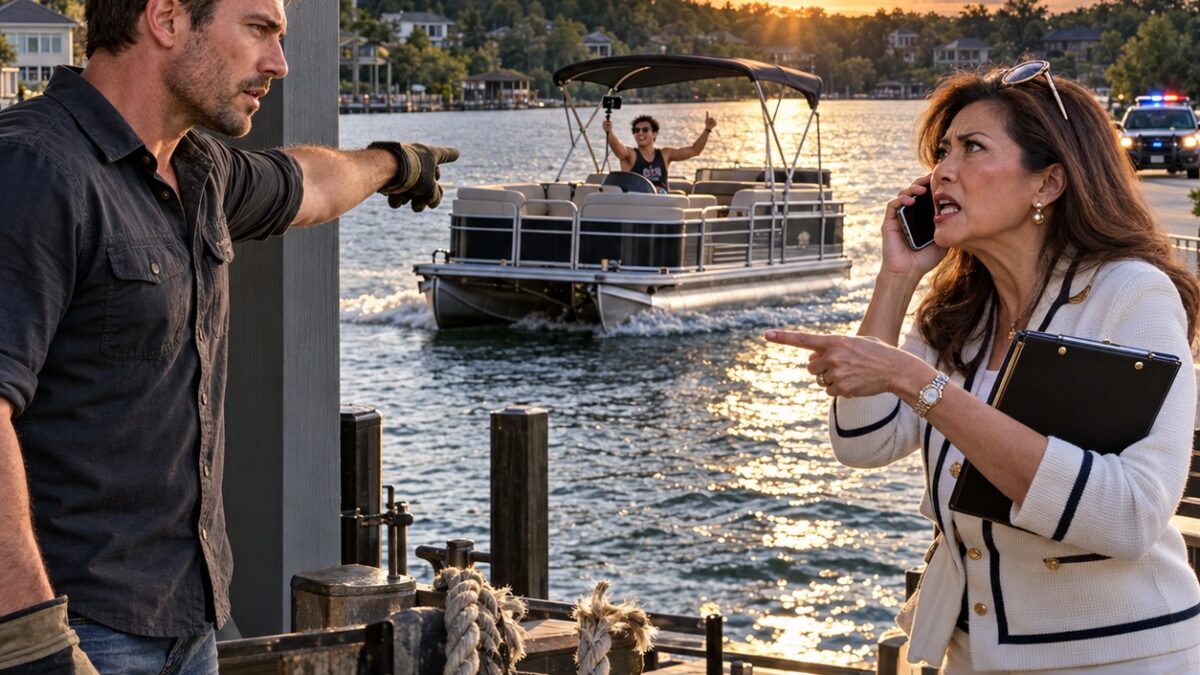
She looked toward the dock.
Then pulled a small tape measure from her purse.
“What are you doing?”
“Checking something.”
She walked toward the side path.
“Karen.”
“Marine committee issue.”
She measured part of my dock.
Wrote something down.
Then left.
I stood there wondering whether I had just witnessed a threat performed with a tape measure.
Three days later, the first violation notice arrived.
WATERCRAFT MAINTENANCE AND UTILIZATION STANDARDS.
I read it twice.
The notice referenced community wellness initiatives and the proper use of marine equipment.
My boat, apparently, was failing to contribute adequately to neighborhood engagement.
I checked the bylaws.
Nothing.
The actual marine rules covered:
Dock construction.
Fuel storage.
Lighting.
Waste discharge.
Insurance.
Safety.
Nothing about how frequently I had to take Mild Peril out.
I ignored the notice.
Karen emailed me.
The subject line read:
COMMUNITY SHARING OPPORTUNITY.
Three paragraphs.
Corporate language.
Collaborative utilization.
Neighborhood exposure.
Youth entrepreneurship.
Shared lifestyle value.
Translated into English:
Let my son use your boat.
I didn’t respond.
She emailed again.
Then again.
The third email said supporting young entrepreneurs reflected Seaglass Cove’s commitment to “inclusive community growth.”
That annoyed me enough that I started saving everything.
Not because I thought the situation was serious.
Because years in emergency services had taught me that when somebody starts producing strange documentation, you keep copies.
Then Karen began sitting at the end of my driveway.
White Mercedes.
Engine running.
Air conditioning on.
Sunglasses.
Clipboard.
Sometimes for forty minutes.
Sometimes an hour.
The first time, I walked over.
“Car trouble?”
“No.”
“What are you doing?”
“Monitoring.”
“What?”
“Watercraft usage patterns.”
I stared.
“For the HOA.”
“You’re monitoring my boat?”
“I’m gathering data.”
“From my driveway?”
“Public roadway.”
She smiled.
“Perfectly legitimate.”
I returned to my house.
Mrs. Patterson called that evening.
“Your stalker’s back.”
“Karen?”
“White Mercedes.”
“Yeah.”
“What did you do?”
“Owned a pontoon, apparently.”
Mrs. Patterson laughed.
Then lowered her voice.
“She asked me what days you take it out.”
That stopped being funny.
“What?”
“She wanted to know whether you’re maximizing community potential.”
“You told her?”
“I told her to get a hobby.”
God bless Mrs. Patterson.
Two days later, another neighbor said Karen had asked similar questions.
Then I learned she had created a spreadsheet.
My schedule.
When the boat left.
When it returned.
Weekdays unused.
Weekends used.
Notes about “missed community engagement opportunities.”
She presented it at an HOA board meeting.
I attended because by then I needed to hear this with my own ears.
Karen projected the spreadsheet onto a screen.
“Here,” she said, pointing to rows of dates, “we can clearly see significant underutilization.”
One board member named Frank stared at her.
“Karen.”
“Yes?”
“What exactly are we discussing?”
“A community resource.”
“Tyler’s boat?”
“Yes.”
Frank looked toward me.
Then back at Karen.
“That’s his boat.”
“Yes, Frank, everyone understands the title situation.”
I nearly choked.
Another board member asked:
“What action are you proposing?”
“Structured shared access.”
“No.”
That came from Martha, the board secretary.
Karen looked offended.
“We haven’t discussed it.”
Martha said:
“We are not allocating his boat.”
I liked Martha immediately.
Karen pressed on anyway.
She talked for another eight minutes about community visibility.
Nobody voted.
Nobody approved anything.
I thought the embarrassment might stop her.
Instead, it made her worse.
Two weeks later, I drove into town for marine supplies.
I was gone a little over an hour.
When I came back, Mild Peril was gone.
At first, my brain refused to process it.
The covered lift sat empty.
One dock line floated partly in the water.
The other had fallen onto the planks.
I walked down.
Both lines had been cut.
Cleanly.
Not untied.
Cut.
My security camera above the dock had been sprayed with black paint.
Muddy footprints crossed the decking.
I stood there for several seconds.
Just breathing.
I had responded to emergencies for most of my adult life.
Real emergencies.
I knew the difference between panic and assessment.
So I assessed.
Boat gone.
Lines cut.
Camera disabled.
Possible theft.
Then Karen appeared.
She walked into my driveway wearing white leisure clothes and sunglasses.
No urgency.
No concern.
“Don’t be dramatic.”
I turned slowly.
“Where is my boat?”
“Brody has it.”
For a second, I thought I had misheard.
“What?”
“He’s taking it out for exposure.”
I stared at her.
“You took my boat?”
“Brody did.”
“Without permission.”
She waved one hand.
“He’s tagging the HOA.”
I walked toward her.
Not aggressively.
Slowly.
I wanted to be absolutely certain every word was clear.
“Tell him to bring my boat back.”
Karen examined her nails.
“Tyler, you’re being selfish.”
“My dock lines are cut.”
“We can replace rope.”
“My security camera is painted black.”
“That wasn’t necessary, and I’ll speak to him.”
I almost laughed.
“Speak to him?”
She adjusted her sunglasses.
“The boat sits there ninety percent of the time.”
“It does not.”
“Brody has followers.”
“Seventeen.”
Her head snapped toward me.
“Who told you that?”
“Not important.”
“He’s growing.”
“Karen.”
“He’s building a brand.”
“That has nothing to do with my boat.”
“Think of it as a community partnership.”
“No.”
“Brody gets content. The HOA gets visibility. You support a local entrepreneur.”
“I said no before he took it.”
“You never gave the idea a fair chance.”
“I didn’t need to.”
Her face hardened.
“Technically, the HOA bylaws give us certain rights regarding community asset management.”
“Show me one sentence that says my registered boat is a community asset.”
She reached for her phone.
“I don’t appreciate your tone.”
“Call Brody.”
Instead, she dialed 911.
I watched her.
“You’re calling the police?”
“Yes.”
“Perfect.”
That word bothered her.
She turned away and started speaking.
“Yes, I need deputies at Seaglass Cove Estates. We have a hostile homeowner creating an unsafe situation.”
I stared at the sky.
Karen continued.
“He’s intimidating HOA leadership in the performance of official duties.”
I said loudly enough for the phone to pick up:
“My boat was stolen.”
Karen turned.
“Stop threatening me.”
“I didn’t threaten you.”
“He’s becoming aggressive,” she told the dispatcher.
I stepped away.
Fine.
Let police come.
At that point, official intervention sounded wonderful.
Twenty minutes later, two sheriff’s deputies pulled into my driveway.
By then, I had gathered everything.
Boat registration.
Insurance.
Purchase documents.
Dock permit.
Photographs from before I left.
Camera footage from the front yard showing Brody arriving.
The dock camera itself had been blinded, but another exterior camera had caught movement toward the backyard.
Karen met the deputies first.
Naturally.
“Officers.”
One of them raised a hand.
“Deputies.”
She corrected herself without apology.
“Deputies, this homeowner has been behaving aggressively toward members of the HOA.”
The first deputy looked at me.
I held up the folder.
“My boat was taken without permission.”
Karen sighed loudly.
“This is what I’m talking about.”
The deputy ignored her.
“You own the boat?”
“Yes.”
“Registration?”
I handed it over.
He checked.
“Tyler Bangan.”
“Yes.”
“Who has it?”
I pointed toward Karen.
“Her son.”
The second deputy looked at Karen.
“Ma’am?”
Karen folded her arms.
“Brody is temporarily using it as part of a community promotional initiative.”
The deputy blinked.
“Did the owner give permission?”
“He was informed.”
“No.”
I answered.
“I specifically refused.”
Karen said:
“You never signed a formal refusal.”
The deputy looked at her.
I will remember that expression forever.
Slow blink.
Then:
“Ma’am, permission is not assumed because someone failed to sign a refusal.”
Karen’s voice rose.
“The HOA has authority over community assets.”
“Is the boat titled to the HOA?”
“No.”
“Registered to the HOA?”
“No.”
“Owned by the HOA?”
“It is visible from common areas.”
The deputy stared at her.
“So?”
Karen hesitated.
“There are asset-reallocation principles.”
The deputy cleared his throat.
“That’s not a thing.”
I looked away because I was dangerously close to laughing.
Karen’s face turned red.
“You don’t understand our governing documents.”
“Do your governing documents transfer ownership of his boat to the association?”
“No, but—”
“Then we’re done with that argument.”
The second deputy asked where Brody was.
Karen crossed her arms.
“On the lake.”
“Can you call him?”
“He’s filming.”
“Call him.”
She did.
No answer.
Again.
No answer.
Then music drifted across the water.
Electronic bass.
We all turned.
A pontoon came around the bend.
My pontoon.
Gold lettering had been taped over the side.
BRODY YACHT LIFE.
My boat’s actual name was covered.
Brody stood behind the wheel wearing swim trunks and a white captain’s hat.
The price tag was still hanging from the back.
His phone was mounted on a small tripod.
Music loud enough to annoy fish.
Then he turned sharply.
The pontoon swung into a wide circle.
“Is he doing donuts?” the deputy asked.
“Yes.”
Karen smiled weakly.
“He’s getting dynamic footage.”
The deputy looked at her.
“Please stop helping.”
Brody made another circle.
Then tried to stand on the rear platform while filming himself.
The deputy radioed marine patrol.
I rubbed both hands over my face.
Karen muttered:
“This is being blown completely out of proportion.”
I turned.
“My boat was taken.”
“Temporarily borrowed.”
“Lines cut.”
“Rope.”
“Camera vandalized.”
“Paint comes off.”
The deputy said:
“Ma’am, you should stop talking.”
She didn’t.
Of course.
“Brody deserves an opportunity. Tyler barely uses the boat for anything meaningful.”
I laughed.
“What counts as meaningful?”
“Fishing is not brand development.”
There are moments when the universe gives you a sentence so absurd that anger temporarily disappears.
That was one.
Fishing is not brand development.
I almost thanked her.
PART2
Marine patrol intercepted Brody about fifteen minutes later.
By then, neighbors had gathered along the shoreline.
Because nothing attracts suburban attention like three police vehicles and somebody’s adult son being escorted off a pontoon in a captain’s hat.
Brody reached the dock furious.
Not afraid.
Furious.
“This is creative oppression.”
The deputy looked at him.
“What?”
“I’m trying to build something.”
“Did you have permission to take the boat?”
Brody looked toward Karen.
“She said it was fine.”
Karen immediately said:
“I said the HOA supported the initiative.”
I stared at her.
Brody’s mouth fell open.
“Mom.”
The first deputy asked:
“Did you cut the dock lines?”
Brody shifted.
“They were restrictive.”
“What does that mean?”
“I couldn’t get the boat out.”
“So yes.”
Silence.
“Did you paint the security camera?”
Brody looked offended.
“I protected my privacy.”
I almost admired the consistency.
Not intelligence.
Consistency.
The deputy asked:
“You covered somebody else’s camera while entering somebody else’s dock to take somebody else’s boat?”
Brody crossed his arms.
“When you say it like that, it sounds bad.”
“Yes.”
I said it quietly.
“It does.”
Marine patrol temporarily secured Mild Peril while the incident was documented.
I hated watching my own boat being handled as evidence.
But I understood.
Photographs.
Hull condition.
Tape.
Camera mount.
Cut ropes.
Brody’s phone.
His videos.
Everything.
I filed a formal report.
Karen hovered nearby, alternating between insisting the HOA had authority and accusing deputies of misunderstanding community governance.
Brody sat on the curb in wet swim trunks.
The captain’s hat was gone.
I never learned where.
Maybe the lake rejected him.
By sunset, I was exhausted.
Not from physical work.
From trying to remain calm around people committed to making calm difficult.
One deputy handed back my registration copies.
“You’ll likely want to speak with an attorney.”
“I already know one.”
“Good.”
Karen overheard.
“You’re suing?”
I looked at her.
“Yes.”
Her mouth opened.
“Over this?”
I pointed toward the empty dock.
“Over the stolen boat?”
“Borrowed.”
“Cut lines?”
“Replaceable.”
“Painted camera?”
“Cosmetic.”
“Unauthorized use?”
“Community promotional—”
The deputy said:
“Ma’am.”
She stopped.
Finally.
I called attorney Rachel Moore the next morning.
Rachel had handled a dock-contract dispute for me the year before.
She listened without interrupting for almost five minutes.
Then:
“I’m sorry. She did what?”
“Her son took the boat.”
“I got that part.”
“Because she believed I was underutilizing it.”
Silence.
“Tyler.”
“Yes?”
“Are you exaggerating for entertainment?”
“No.”
“You have this in writing?”
“Emails.”
More silence.
“Send me everything.”
I sent:
Violation notices.
Karen’s emails.
Board meeting notes.
Photographs.
Security footage.
Police report number.
Registration.
The cut lines.
Damage photos.
Brody’s public videos.
That last part became important.
Very important.
Brody had uploaded content during the theft.
Several clips.
One showed him standing beside Mild Peril before leaving.
Caption:
COMMUNITY ASSETS SHOULD BUILD COMMUNITY DREAMS.
Another:
MARITIME ENTREPRENEURSHIP > PRIVATE HOARDING.
Another showed him peeling a temporary label onto the boat.
BRODY YACHT LIFE.
Then the best one.
Brody standing on the rear deck shouting:
“Ownership is a construct, man!”
Behind him was my registration sticker.
Clearly visible.
Rachel called.
“I love social media.”
“You do?”
“For opposing evidence.”
Fair.
We filed against Karen and the HOA.
Property conversion.
Trespass.
Unauthorized use.
Damage.
Other claims Rachel believed applied.
Brody was separately responsible for his actions too.
The HOA immediately tried to distance itself.
Their attorney sent a letter stating Karen had acted outside board authority.
That did not surprise me.
What surprised me was how quickly board members agreed.
Frank called.
“I want you to know we never authorized this.”
“I know.”
“Martha is furious.”
“I know.”
“The association never voted to take your boat.”
“I know.”
“Karen told us she was still exploring voluntary sharing.”
I laughed.
“She explored it with bolt cutters.”
Frank groaned.
“Yeah.”
“Did you know she was tracking my schedule?”
“Yes.”
I paused.
“You did?”
“She presented the spreadsheet.”
“And nobody stopped her?”
“We thought it was ridiculous.”
“Ridiculous isn’t the same as harmless.”
Silence.
“You’re right.”
That mattered.
Because this wasn’t only about Karen’s absurdity.
Systems fail partly because normal people keep saying:
That’s crazy.
Instead of:
Stop.
Discovery began.
And that was when Karen’s behavior stopped being funny.
At least for a while.
My boat was not her first “reallocation.”
The word appeared repeatedly in her emails.
Community resource reallocation.
Temporary amenity redistribution.
Wellness-supportive asset sharing.
Language sophisticated enough to disguise something simple:
She gave away things that didn’t belong to her.
Mrs. Chen’s ladder had been loaned to a window-cleaning crew.
Without asking Mrs. Chen.
A resident’s hammock had been given to a yoga instructor running a neighborhood wellness session.
Garden gnomes had disappeared from one yard and reappeared around a “community beautification” display.
Mr. Thompson’s lawn mower had been loaned to a landscaping company during a volunteer cleanup.
He had assumed someone stole it.
Technically, someone had.
Karen.
Not personally in every instance.
Sometimes she instructed volunteers.
Sometimes Brody.
Sometimes vendors who believed she had authority.
Because she was HOA president.
That title carried enough credibility that people did things they would never have done if a random neighbor asked.
Rachel showed me one email thread.
Karen to a volunteer committee:
Please retrieve unused movable decorative elements from Lots 12, 18, and 27 for Saturday beautification staging.
One volunteer responded:
Do we have homeowner permission?
Karen wrote:
The association retains latitude over visible community presentation.
No.
It didn’t.
Another message discussed “temporarily reallocating excess yard equipment.”
Mr. Thompson’s mower.
Karen believed underuse created entitlement.
That was the pattern.
If you owned something she thought should serve another purpose, your ownership became an inconvenience.
The HOA’s insurance carrier reviewed the case.
Then denied coverage for some of Karen’s conduct on the basis that intentional property conversion fell outside the policy protections they expected.
That scared the board.
A lot.
Because members suddenly realized their dues could be affected.
Community anger shifted quickly.
The Facebook group exploded.
One neighbor wrote:
WAIT. IS THIS WHY MY LADDER DISAPPEARED IN APRIL?
Another:
KAREN TOOK MY OUTDOOR CHAIRS FOR A BOOK CLUB EVENT.
Another:
SHE MOVED MY FIRE PIT.
That last one had apparently been moved twelve feet.
Still.
Unauthorized.
The stories piled up.
Not all serious.
Some ridiculous.
But collectively, they showed a culture.
Karen genuinely believed HOA leadership gave her stewardship authority over privately owned items if she could describe the use as community-oriented.
That might sound too absurd to be real.
Brody helped explain it.
He had grown up inside Karen’s logic.
He talked about access as though ownership were selfish.
Private property as “static capital.”
Community exposure.
Creator economy.
Shared resources.
All of it conveniently benefited him.
Interesting philosophy.
The recall petition started with six homeowners.
Then fifteen.
Then thirty.
Karen responded by going door to door.
According to Mrs. Patterson, she carried pamphlets.
Of course.
The pamphlet accused me of attacking youth entrepreneurship and “traditional neighborly cooperation.”
Mrs. Patterson told her:
“Your son stole a boat.”
Karen apparently said:
“That’s an oversimplification.”
Mrs. Patterson closed the door.
I wish I had seen it.
Brody continued posting online.
That was Rachel’s favorite part.
“Do not contact him.”
“I wasn’t going to.”
“Do not comment.”
“Wasn’t planning to.”
“Do not even like the videos.”
“I don’t follow him.”
“Good.”
“Why?”
“Because every time he talks, he helps us.”
She was right.
One video showed scratches along the pontoon hull after the joyride.
Brody said:
“Real maritime assets get scars.”
I sent it to Rachel.
Another video complained about “capitalist ownership culture.”
Sent.
Another mocked me for using the boat “just for fishing.”
Sent.
The man was building a legal exhibit list one TikTok at a time.
The eventual hearing was almost surreal.
Brody’s own videos played.
The judge watched him shout:
“Ownership is a construct, man!”
He was standing on my boat.
While discussing private ownership.
Rachel didn’t smile.
Professional.
I looked down at the table because I was not as disciplined.
Evidence included:
Registration.
Insurance.
Dock permits.
Security footage.
Cut lines.
Painted camera.
Karen’s emails.
Her violation notices.
Board records showing no vote authorized the boat use.
Brody’s videos.
Brody tried explaining his plan.
“Maritime democratization.”
The judge asked:
“Did Mr. Bangan give you permission?”
Brody paused.
“Not in a traditional sense.”
I closed my eyes.
The judge repeated:
“Did he give you permission?”
“No.”
“Thank you.”
Karen did worse.
When asked to identify the legal authority permitting her to reassign my boat, she started talking about community wellness.
The judge interrupted.
“Mrs. Leu.”
Karen stopped.
“Do you have a document giving the HOA ownership or use rights over this boat?”
“No, but—”
“Do you have written permission from Mr. Bangan?”
“No.”
“Did the board authorize taking the boat?”
She looked toward the HOA attorney.
“No.”
“Then what exactly was your legal basis?”
Karen inhaled.
“Community benefit.”
The judge stared at her.
For a long time.
That silence did more than any lecture.
The outcome was straightforward.
I got Mild Peril back.
I was compensated for damage to the hull.
New ropes.
Camera replacement.
Related losses.
Brody received financial penalties tied to his conduct.
He was barred from the marina facilities for a period under the community consequences imposed after everything was resolved.
The HOA newsletter later printed an apology.
Brody’s section said he regretted that his “creative initiative had been misinterpreted.”
I called Rachel.
“Is that an apology?”
“No.”
“Can we sue for grammar?”
“No.”
“Shame.”
Karen’s recall vote came shortly afterward.
The clubhouse was packed.
More people than had attended any budget meeting in years.
That’s how HOAs work.
Nobody attends when the topic is reserve funds.
Steal one pontoon and suddenly democracy flourishes.
Karen stood at the front.
She spoke for nearly twenty minutes.
Community vision.
Leadership.
Sharing.
Opportunity.
Youth.
Progress.
Then residents spoke.
Mrs. Chen:
“My ladder is not a community resource.”
Applause.
Mr. Thompson:
“My lawn mower is not a community resource.”
More applause.
Mrs. Patterson:
“Neither is Tyler’s boat.”
Loud applause.
Karen tried to answer.
Someone shouted:
“Stop taking people’s stuff.”
That was effectively the meeting.
The recall passed overwhelmingly.
Karen lost the presidency.
For the first time in years, she was just another homeowner.
She stood outside afterward, furious.
“This is discrimination against ambitious young people!”
Nobody responded.
“Brody was going to make this community famous!”
Frank walked past me.
“Technically, he did.”
I laughed.
Karen heard.
“You think this is funny?”
“No.”
I looked at her.
“Not anymore.”
That shut down my own amusement.
Because by then I understood something.
At the beginning, Karen had seemed ridiculous.
The clipboard.
The spreadsheet.
The language.
Underutilized assets.
Community resources.
Easy to mock.
But ridiculous people can still cause real damage when others treat their authority as legitimate.
She had entered yards.
Moved property.
Directed volunteers.
Encouraged Brody.
Created fake rules.
Used HOA letterhead.
Harassed people.
Eventually, her son took a boat.
The absurdity did not make it harmless.
That became the biggest lesson.
Power does not need to be intelligent to be dangerous.
It only needs enough people to obey.
After Karen was removed, the HOA reviewed its governance policies.
The new board president was Martha.
The same woman who had said no during Karen’s boat-sharing presentation.
I voted for her.
First HOA vote I had cared about.
Martha’s first email was refreshingly boring.
NEW PROPERTY ACCESS AND BOARD AUTHORITY POLICY.
The board adopted clear language:
No board member.
No volunteer.
No committee.
No contractor.
Could enter private property or relocate privately owned items without explicit homeowner permission unless there was a genuine emergency or legally documented authority.
Amazing.
A rule stating:
Do not take people’s things.
Civilization advances.
Martha called me before the policy vote.
“We’re trying to make sure this never happens again.”
“Good.”
“Would you read the draft?”
“Why me?”
“You’re extremely motivated.”
Fair.
I read it.
Suggested they remove three unnecessary paragraphs.
They did.
Karen avoided me after that.
Mostly.
Sometimes we passed on the road.
No wave.
Fine.
Brody pivoted away from maritime content.
Land-based influencing.
Luxury chairs.
Outdoor lifestyle.
I learned that from Mrs. Patterson, who had apparently become my unpaid intelligence agency.
“He’s reviewing patio furniture now.”
“Why do you know this?”
“I retired.”
“That isn’t an explanation.”
“It is at my age.”
Fair.
Mild Peril required repairs.
Nothing catastrophic.
Scratches.
One damaged rail fitting.
A mark near the stern.
The mechanic who helped me laughed at the gold adhesive residue.
“What happened here?”
“Influencer incident.”
He nodded slowly.
“I don’t want to know.”
“You really don’t.”
I restored the name.
Mild Peril.
The first weekend after repairs, I took the boat out alone.
Early morning.
No camera.
No Brody.
No HOA.
Just water.
I went to my usual fishing spot.
Dropped anchor.
Sat.
Didn’t catch anything for two hours.
Perfect.
At one point, I thought about Karen’s argument.
The boat was underutilized.
She had technically been right in one meaningless sense.
Mild Peril spent most of its life docked.
That’s what boats do.
Cars sit parked.
Chairs sit empty.
Houses stand quiet while owners work.
Ladders spend most of their lives leaning in garages.
Ownership does not expire during inactivity.
That seems obvious.
Yet Karen had constructed an entire philosophy around the opposite.
If something isn’t being used enough, someone more deserving should use it.
Conveniently, the deserving person was usually her son, her committee, or her project.
That’s not community.
That’s entitlement with a newsletter.
Actual community is different.
Mrs. Patterson watering my plants when I traveled.
Frank lending me a pressure washer because I asked.
Me repairing Martha’s trolling motor for almost nothing because her husband was sick.
Neighbors sharing tools voluntarily.
Keys handed over knowingly.
Boats borrowed after permission.
Consent turns sharing into community.
Without consent, it’s just taking.
I wish Karen had understood that before cutting dock ropes became part of her legacy.
One evening, a teenager from down the street knocked.
His name was Jason.
Seventeen.
Polite kid.
“Mr. Bangan?”
“Tyler.”
“Can I ask something?”
“Sure.”
He pointed toward Mild Peril.
“Could I use it for prom pictures?”
I stared at him.
He panicked.
“Not drive it.”
I laughed.
“Okay.”
“My girlfriend wants photos by the water.”
“Sure.”
“Really?”
“Yes.”
His face lit up.
“Thank you.”
“Stay off the controls.”
“Absolutely.”
“Don’t cut anything.”
He looked confused.
Long story.
Jason and his girlfriend took pictures.
His parents came.
Everybody asked.
Everybody thanked me.
Nothing stolen.
No police.
No lawsuits.
The boat served someone else’s purpose.
Voluntarily.
That felt like the perfect answer to Karen’s whole theory.
I wasn’t selfish.
I just wanted the option to say yes or no.
That’s ownership.
Choice.
The incident changed my relationship with the HOA.
Not because I hated associations afterward.
I actually became more involved.
For a while.
Mostly because I realized sane people avoiding governance creates room for insane people to dominate it.
Karen had energy.
That’s one reason she lasted.
Normal residents had jobs.
Children.
Fishing plans.
Lives.
She had meetings.
Forms.
Committees.
When only the most intense people volunteer, intensity becomes policy.
So I attended.
Not every meeting.
I’m not a masochist.
But enough.
I read budgets.
Voted.
Asked whether new rules were actually authorized.
The phrase “show me where it says that” became something of a local joke.
Martha would look at me before proposing changes.
“Yes, Tyler. Counsel reviewed it.”
“Good.”
“Happy?”
“Suspiciously.”
Healthy governance requires annoying people asking boring questions.
I became one of them.
You’re welcome, Seaglass Cove.
The board eventually eliminated the Marine Infrastructure Enhancement Committee.
Turns out it had very little purpose.
Karen had created it largely herself.
The dock rules moved under ordinary property maintenance.
Simpler.
My twelve-thousand-dollar permit package remained ridiculous.
But at least nobody measured my dock for community utilization again.
The security camera got upgraded.
Naturally.
Higher resolution.
Better angle.
Karen saw the new one once while walking.
She looked away.
I didn’t smile.
Much.
Brody’s $1,500 fine apparently devastated his “brand development budget.”
Again, Mrs. Patterson knew this.
He posted a long video about being censored by suburban gatekeepers.
It received forty-three views.
Growth.
Good for him.
I did not watch.
Rachel did.
“For evidence?”
“The case is over.”
“Professional curiosity.”
Lawyers.
One year later, the entire thing had become neighborhood folklore.
New residents heard versions.
Karen stole a yacht.
Brody crashed a speedboat.
Police chased him across the lake.
None true.
The real story was ridiculous enough.
I corrected people occasionally.
“Pontoon.”
“What?”
“It was a pontoon.”
“Still a boat.”
“Yes, but if you’re going to gossip, respect vessel classification.”
Standards matter.
Mild Peril became famous locally.
Someone at the marina put a small sticker inside the fuel dock office:
NOT A COMMUNITY ASSET.
I pretended to object.
I did not remove it.
The humor returned eventually.
That’s healthy.
Once actual danger and legal stress passed, the absurdity became funny again.
The captain’s hat.
Brody Yacht Life.
The price tag.
Karen saying fishing wasn’t meaningful use.
The deputy telling her asset reallocation wasn’t a thing.
I can laugh now.
At the time, I couldn’t.
Because violation notices attached to your home are not funny.
Someone monitoring your schedule is not funny.
Coming home to a missing boat is definitely not funny.
Context decides whether ridiculous behavior is comedy or threat.
That’s another lesson.
Karen stayed in Seaglass Cove for a few more weeks after the recall, then moved a couple of blocks away outside the association.
I heard she still believed she was right “in principle.”
That sounds like her.
Some people interpret consequences as proof everybody else lacks vision.
No lesson can penetrate armor built from self-importance.
That’s okay.
I no longer needed her to understand.
That became freeing.
For months, I wanted acknowledgment.
Admit you stole it.
Admit you were wrong.
Admit the HOA didn’t own it.
Eventually, I realized outcomes mattered more.
Boat returned.
Damage compensated.
Rules changed.
Karen removed.
Enough.
An apology from someone who doesn’t understand why she’s apologizing is mostly theater.
I had received enough theater.
The 911 call became part of the evidence package.
I listened to it once.
Karen shouting.
“He stole the boat!”
Dispatcher:
“Ma’am, whose name is on the registration?”
Karen:
“That’s not the point!”
Then something about Brody’s aspirations.
I laughed until my stomach hurt.
That recording captured the whole conflict in under a minute.
Ownership document?
Not her son’s.
Karen’s conclusion?
Irrelevant because Brody had dreams.
Imagine running property law that way.
“Your Honor, yes, the deed belongs to him, but my nephew has ambitions.”
Civilization collapses by lunch.
My paramedic friends loved the story.
Naturally.
One former partner asked:
“Why didn’t you lose it?”
“What?”
“When she told you the son had the boat.”
“I almost did.”
“You looked calm on the body cam.”
“Training.”
Years in emergency medicine teaches something useful.
The loudest person on scene is not always the emergency.
Sometimes they are distracting you from it.
Karen was loud.
The problem was:
Where is the boat?
Is anyone injured?
Is Brody capable of operating it?
What evidence exists?
What needs documenting?
Focus reduces rage.
Not eliminates.
Reduces.
If I had screamed.
Threatened.
Touched Karen.
Broken something.
I would have created a competing story.
Instead, she called 911 and accidentally invited neutral witnesses into a situation where all evidence favored me.
Sometimes the best thing an unreasonable person can do is escalate to professionals.
I almost thanked her.
Almost.
Brody could have hurt himself.
That part I don’t joke about much.
He genuinely didn’t know much about boat handling.
He was turning aggressively.
Distracted by filming.
Trying stunts.
A pontoon feels forgiving until it isn’t.
Water doesn’t care about influencer confidence.
Had he injured a passenger, another boater, or himself, the story would have become much darker.
Karen never seemed to grasp that.
She talked about opportunity.
I saw risk.
Registration and consent exist partly because owners understand their equipment.
You don’t hand somebody a twenty-two-foot boat because he owns a waterproof phone case.
That seems obvious.
Apparently not universally.
Afterward, I offered a basic boating-safety session through the marina.
Not because of Brody specifically.
Mostly.
Several teenagers came.
We covered:
Life jackets.
Docking.
Speed.
Alcohol.
Right of way.
Weather.
Emergency procedures.
Phones while operating.
Brody did not attend.
Shocking.
Jason did.
The prom-photo kid.
Good kid.
He eventually bought a small used fishing boat.
Asked me to inspect it before purchase.
I did.
That made me happier than winning any argument with Karen.
Good experiences propagate too.
Not just bad ones.
Another year passed.
The gold lettering residue disappeared completely.
Scratches faded into normal wear.
The replacement dock lines weathered.
New camera became ordinary.
Mild Peril was just my boat again.
That’s what I wanted most.
Not symbol.
Not evidence.
Boat.
Some Saturday mornings I took it out.
Some I didn’t.
Sometimes it sat three weeks.
Nobody monitored.
Nobody created spreadsheets.
Nobody asked whether I was maximizing community potential.
Glorious.
The freedom to underutilize your own possessions is underrated.
I sometimes sit on the dock doing nothing and think:
Karen would’ve hated this.
Then I drink coffee.
Maximum inefficiency.
One afternoon, Martha walked by.
“Boat hasn’t moved in two weeks.”
I narrowed my eyes.
She smiled.
“Relax. Joke.”
“Dangerous joke.”
“I know.”
She kept walking.
We had come a long way.
The neighborhood improved after Karen.
Not aesthetically.
It already looked fine.
Culturally.
People questioned authority more.
Volunteers asked for written permission before entering yards.
Committee chairs stopped improvising.
Residents read agendas.
More candidates ran for board seats.
Martha served two years.
Then stepped aside voluntarily.
Imagine.
The HOA adopted term limits.
I supported that.
No president needs enough time to start viewing the neighborhood as personal territory.
Power should expire before imagination gets weird.
Someone proposed naming the rule after Karen.
Counsel advised against it.
Probably wise.
She would have framed it as recognition.
The board also changed how violation notices worked.
Any novel interpretation of governing documents required counsel review before fines.
This prevented another “boat utilization” theory from becoming official.
Again:
Boring controls.
Excellent.
My lawsuit ended without destroying the association.
I wanted that.
The HOA itself wasn’t my enemy.
Karen’s conduct was.
If the association had collapsed financially, every homeowner would have paid.
Including me.
The settlement separated unauthorized acts from legitimate board functions as much as possible.
Karen bore personal responsibility where appropriate.
Brody did too.
The HOA changed policies and contributed where its failures mattered.
Not dramatic enough for some people.
Practical.
I prefer practical.
The deeper discovery about Karen’s other property redistributions never became a massive criminal case in the story’s aftermath.
Most neighbors just wanted their items back or compensation.
Some matters were too small to pursue formally.
A ladder.
Gnomes.
Chairs.
But small theft is still a violation of trust.
Mrs. Chen got her ladder back.
Mr. Thompson’s mower had been damaged during landscaping use.
He received reimbursement.
The hammock?
The yoga instructor had apparently taken it home by mistake after the wellness session.
Returned.
Nobody could locate one ceramic gnome.
Presumed lost in action.
We held a moment of silence.
Not officially.
Mrs. Patterson named him Gary.
The memory remained.
That is how communities heal, I think.
Accountability first.
Then jokes.
Not the other way around.
Humor without accountability minimizes.
Humor after accountability releases.
I can laugh because nobody is still taking my boat.
Important difference.
Years later, I ran into Brody at a hardware store.
He was older.
Hair shorter.
No captain’s hat.
He was comparing patio cushions.
I considered turning away.
He saw me.
“Tyler.”
“Brody.”
Awkward.
He looked toward the cart.
“I’m doing outdoor product reviews.”
“I heard.”
“Of course you did.”
“Mrs. Patterson.”
He laughed.
“Yeah.”
We stood there.
Then he said:
“I was an idiot.”
I did not expect that.
“No argument.”
He smiled slightly.
“I really thought Mom had authority.”
“She told you that?”
“All the time.”
He looked embarrassed.
“I also thought followers were going to explode if I got boat content.”
“How’d that work?”
“Bad.”
I nodded.
“Fair.”
He hesitated.
“I’m sorry.”
This one sounded different from the newsletter apology.
No branding language.
No initiative.
No misunderstanding.
Just:
I’m sorry.
I believed him.
“Thanks.”
That was it.
No hug.
No friendship.
He went back to patio cushions.
I went to buy marine grease.
I drove home feeling strangely light.
Apparently people can learn.
Even Brody.
Karen?
No idea.
Didn’t matter.
If there is one thing I would tell anyone dealing with a controlling HOA officer, it isn’t:
Sue immediately.
It isn’t:
Ignore everything.
It isn’t even:
Install cameras.
Though cameras are good.
The first thing is:
Separate the association’s real authority from whatever one confident person claims.
Read the documents.
Own your records.
Save communications.
Ask:
Where does it say that?
If someone cannot answer, don’t let tone substitute for authority.
The second:
Stay calm long enough to protect your own position.
Karen wanted me emotional.
Maybe not consciously.
But her story depended on me becoming the hostile homeowner she had reported.
If I had given her that footage, things would have gotten messier.
Calm isn’t surrender.
It’s evidence preservation.
Third:
A community is not entitled to private property because sharing sounds nice.
Community requires consent.
Every meaningful shared thing in my neighborhood came from someone saying yes.
That is what makes it generous.
If yes is mandatory, it isn’t generosity.
Finally:
Ridiculous behavior can become serious if nobody stops it early.
Karen’s first offense wasn’t a stolen boat.
It was a dock.
Then a ladder.
A hammock.
A mower.
A spreadsheet.
A violation notice.
Each time, someone probably thought:
This isn’t worth the fight.
Eventually, she reached a pontoon.
Boundaries ignored do not usually improve themselves.
Someone has to say no.
My no just happened to come with a registration certificate and two sheriff’s deputies.
Today, Mild Peril still sits behind my house.
Same covered dock.
Different camera.
Better lines.
The paint has aged.
Seats replaced once.
Motor serviced more times than I can count.
I still fish.
Usually unsuccessfully.
Sometimes sunset cruises.
Sometimes nothing.
I no longer feel guilty when the boat sits unused.
Not even a little.
One summer evening, I was sitting on the pontoon while it remained tied to the dock.
Coffee.
No destination.
Mrs. Patterson called over the fence.
“Underutilizing assets again?”
I raised my mug.
“Extensively.”
She laughed.
That was the perfect ending.
Not court.
Not Karen losing the recall.
Not Brody’s fine.
Not the newsletter apology.
My boat.
My dock.
My choice to do absolutely nothing with either.
For someone who once had an HOA president explain that inactivity gave her son a claim to my property, doing nothing had never felt so much like ownership.








