PART 2:“She’s Just a Nurse!”—Then Her Secret Military Skills Saved the Blind K9 and Exposed a Major
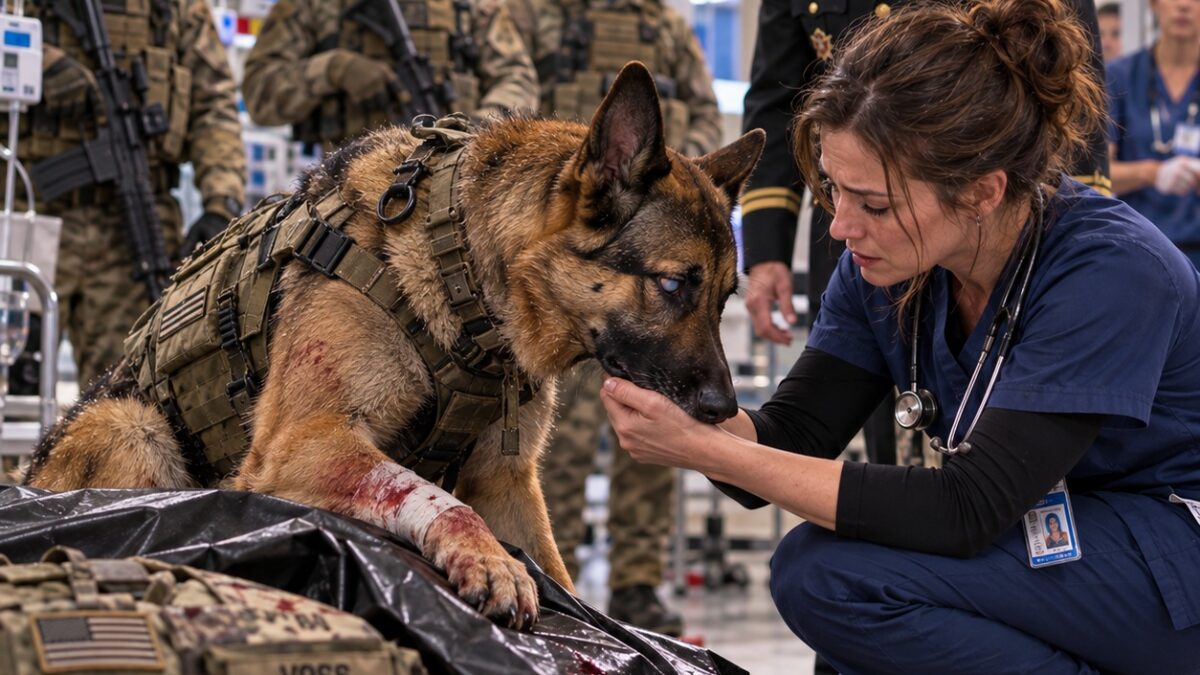
PART 2 and FULL ENDING  Thank you

Colonel Ethan Cross did not react the way ordinary people react when you tell them something impossible.
There was no sharp inhale.
No dramatic turn.
No immediate accusation.
His face simply became still.
Very still.
It was the expression of a man who had learned long ago that emotion sometimes contaminated information.
“What exactly did you see?”
I should have stopped there.
I had already exposed too much.
The dog-handling protocol.
My reading of Decker’s protective posture.
The fact that I had noticed his injured paw before trained military personnel did.
Now I was about to admit I had memorized details from paperwork I had only seen for a few seconds.
But some instincts survive because they are useful.
And one of mine had always been this:
When something does not fit, do not convince yourself it does merely because everyone else has moved on.
“The transport tag listed Sergeant Voss as thirty-one,” I said. “No documented cardiac history. Cause of death listed as cardiac event.”
Cross’s jaw tightened.
“That information is restricted.”
“I know.”
“Then how did you see it?”
“It was attached to the gurney.”
“That wasn’t what I asked.”
“I read quickly.”
He stared at me.
I continued.
“There was also an expedited transfer authorization.”
“That’s normal.”
“Sometimes.”
“What wasn’t?”
“The process was already moving before anyone here completed a surgical review.”
Cross said nothing.
“Maybe it’s nothing,” I added.
“You don’t sound like you think it’s nothing.”
“I sound like a trauma nurse who sees healthy thirty-one-year-old bodies.”
His expression shifted.
Barely.
“What are you suggesting?”
“Nothing.”
“I don’t believe that.”
“I’m not suggesting. I’m observing.”
I met his eyes.
“There’s a difference.”
For several seconds, the only sound between us was a rolling cart somewhere around the corner.
Then Cross said:
“I’m going to run your name.”
I nodded.
“That seems inefficient.”
His eyebrows lifted.
“You have a dead soldier, a traumatized military working dog, and a transfer you apparently don’t understand yet.”
“You’re avoiding the question.”
“Yes.”
“At least you admit it.”
“I try not to waste people’s time.”
“Interesting philosophy.”
He left.
Claudette appeared ten seconds later.
Of course she did.
Hospital supervisors possess a supernatural ability to materialize immediately after conversations they were definitely not listening to.
“What did he want?”
“To ask why I knew how to handle Decker.”
“And?”
“I told him the internet.”
Claudette stared at me.
“You told a United States Army colonel you learned restricted military dog behavior from the internet?”
“Yes.”
“You’re thirty-nine years old.”
“Forty-one.”
“That makes it worse.”
I started walking.
She followed.
“Mara.”
“I have patients.”
“You have something else too.”
“So does everyone.”
“Not whatever this is.”
I stopped.
Claudette had supervised me for almost five years.
She was difficult.
Opinionated.
Rigid about policy.
She had also defended every nurse on her floor when administration tried to blame understaffing on individual performance.
She deserved more truth than I usually gave people.
Just not all of it.
“I worked around military personnel before nursing.”
Her eyes narrowed.
“As what?”
“Medical support.”
“That vague on purpose?”
“Yes.”
“How long?”
“Several years.”
“Why isn’t it in your employee profile?”
“It is in the version HR is legally entitled to.”
“That sounded ominous.”
“It wasn’t intended to.”
“It succeeded.”
I looked toward the hallway.
“Claudette, I’m not lying about my nursing credentials.”
“I know.”
“I’m not practicing under a fake license.”
“I know.”
“I’m not secretly wanted by the government.”
She paused.
“That one sounded less convincing.”
Despite myself, I smiled.
“Go check your staffing board.”
“I hate you sometimes.”
“No, you don’t.”
“Moderately.”
She walked away.
I resumed my rounds.
Construction worker.
Hand injury.
Teenager with a shoulder dislocation.
Elderly man with chest pressure that probably was anxiety, which meant we treated it like cardiac disease until evidence gave us permission not to.
Normal cases.
I focused.
Mostly.
But part of my mind remained in the trauma bay.
Sergeant Voss.
Decker.
The paperwork.
Expedited transfer authorization.
Hospitals live on documentation.
People complain about it constantly, usually for good reason.
But documentation exists because medicine without a record becomes memory, and memory is unreliable.
Death is documented even more carefully than life.
Cause.
Time.
Clinical findings.
Notifications.
Transport.
Custody.
A military fatality added additional layers.
Yet Voss’s body seemed to have arrived inside a process that had already decided where it was going.
That bothered me.
At 3:15 p.m., I found ten minutes.
I opened the hospital’s daily operations log.
Nothing protected.
Nothing beyond my access.
Arrivals.
Transfers.
Bay assignments.
The entry for the military transport was there.
But there was no ordinary surgical consultation attached.
No coroner notification.
Then I saw the note.
Expedited transfer authorization — RB.
Rowan Beexley.
Hospital administrator.
I leaned back.
Beexley had been at Redwood Mercy longer than I had.
Fifties.
Perfect suits.
Never visibly hurried.
The kind of administrator who remembered physician names and forgot nurse names unless the nurse had become inconvenient.
There was nothing automatically sinister about his authorization.
Hospital executives signed strange things every day.
Still.
I looked at the timestamp.
Something in my stomach tightened.
I logged out.
No more.
Not my case.
Not my authority.
I repeated those phrases twice.
Neither worked.
At 5:15, my shift ended.
I changed.
Walked toward the parking garage.
Made it all the way to the east corridor before admitting I had no intention of leaving yet.
Decker had been moved into a supply room because nobody knew what else to do with him.
That description had come from Bev, one of our ward clerks, whose information network could have rivaled regional journalism.
I opened the door slowly.
Announced myself before entering.
Decker raised his head.
The cloudy left eye caught the overhead light.
For a second, he looked ancient.
Not old.
Ancient.
As though grief had placed years into him during the previous forty-eight hours.
He was curled near the wall, but facing the door.
Too tired to work.
Too trained to sleep with his back exposed.
I sat on the floor.
No food.
No leash.
Nothing to ask from him.
He watched me for nearly a minute.
Then lowered his head near my knee.
His good eye closed.
That simple act hurt unexpectedly.
Trust can feel heavier when you have done nothing to earn it except not make things worse.
I sat there.
Did not think about Voss.
Did not think about Rowan Beexley.
Did not think about the operation six years earlier that had ended my first career.
I just stayed.
Thirty minutes later, the door opened.
Cross stood there.
He looked at me.
Then Decker.
“I ran your name.”
“Efficient.”
“I have questions.”
“I assumed.”
“The public version says you’ve been a civilian trauma nurse for seven years.”
“That’s true.”
“No complaints.”
“Also true.”
“No missing employment.”
“Correct.”
He entered and closed the door.
“The restricted version contains a block of redacted material big enough to make me reconsider whether I wanted to know more.”
“That was thoughtful.”
“I called the number attached to the access restriction.”
I looked at him.
That I had not expected.
“What did they tell you?”
“That you completed your service.”
Nothing.
“That your records are sealed for operational reasons.”
I kept breathing.
“That further inquiry requires a formal request and approximately thirty days.”
“Sounds bureaucratically accurate.”
Cross’s mouth tightened.
“And then somebody told me off the record that I should trust you.”
That hit differently.
I looked down at Decker.
The dog slept.
“Who?”
“They did not introduce themselves in a way I’m going to repeat.”
“Smart.”
Cross leaned against the door frame.
“You know what bothers me?”
“Several things, apparently.”
“You didn’t use your background to impress anyone.”
“No.”
“You’ve actively hidden it.”
“Yes.”
“Why?”
“That question isn’t relevant to Sergeant Voss.”
“Maybe not.”
I looked up.
“But Beexley is.”
Cross’s face changed.
I continued.
“The transfer authorization was already active before normal postmortem steps.”
“How far before?”
“I didn’t access restricted records.”
“That is not what I asked.”
“I only saw the operational log.”
“How far?”
“I need the original authorization chain.”
He studied me.
“You think it was signed early.”
“Yes.”
“How early?”
“I don’t know.”
A pause.
“But enough that I’d check.”
Cross nodded once.
Then he did something I respected.
He did not demand my theory.
He said:
“I’ll check.”
That was it.
He left.
I stayed with Decker another ten minutes.
His harness still carried Voss’s identification tags.
I touched one lightly.
ALDRICH VOSS.
Decker opened his good eye.
“I know.”
I did not know what I meant.
Maybe:
I know he is gone.
Maybe:
I know you are still waiting.
Maybe:
I know something is wrong.
He closed his eye again.
Outside, the hospital moved into evening.
Shift change.
Visitors leaving.
Staff arriving.
Carts.
Phones.
Doors.
Then I heard footsteps stop somewhere footsteps did not usually stop.
Records alcove.
Two doors away.
Physical backup files.
Mostly obsolete since digital migration.
Mostly.
I stood.
Decker’s ear rotated.
A drawer opened.
I left the supply room by the opposite direction.
Long route.
Cross-corridor.
Back toward a line of sight.
Two men stood at the records alcove.
One was Marcus Pel, Beexley’s administrative coordinator.
The other wore an old hospital security uniform I did not recognize.
Pel had a folder in his hands.
He slid it into a bag.
The security guard saw me.
I did exactly what years of being deliberately unremarkable had taught me.
Nothing.
No reaction.
No sudden turn.
No confrontation.
I walked past as though I had not understood what I saw.
Through the stairwell.
Down half a flight.
Then stopped.
Cross had left a contact card on a trauma cart earlier.
I had memorized the number.
Some habits are useful.
He answered on the second ring.
“Cross.”
“They’re removing physical documents.”
Silence.
“Who?”
“Marcus Pel and someone wearing an older hospital-security uniform.”
“Where?”
“Second-floor east records alcove.”
“How long?”
“Ninety seconds.”
“Do not go back.”
“I know.”
“I mean it, Bennett.”
“I know.”
“Where are you?”
“Stairwell.”
“Stay—”
I ended the call.
Not because I wanted to be difficult.
Because I had remembered Decker.
A body can be evidence.
Documents can be evidence.
So can a dog.
Decker had been with Voss for twenty-two months.
Whatever happened to his handler, Decker had been there.
He could not testify.
Could not be bribed.
Could not be threatened into changing a statement.
But he carried time.
Injuries.
Behavior.
Scent.
He proved Voss had not died alone in some clean medical event.
And somebody who understood that might decide the dog was inconvenient.
I went back upstairs.
Decker was standing when I entered.
No longer resting.
Weight forward.
Good eye on the door.
He had heard something.
“Easy.”
His ears moved toward me.
“I’m here.”
The door opened.
A man entered.
Street clothes.
Athletic build.
Eyes that evaluated before his face did.
He carried a syringe.
Not concealed.
That confidence told me he expected authority to solve any questions.
“You need to step aside.”
“No.”
He looked at my badge.
“This animal has been authorized for veterinary sedation and transfer.”
“You’re not a veterinarian.”
“I’m contracted medical support.”
“That syringe isn’t a standard veterinary transport formulation.”
His eyes dropped toward his own hand.
Half a second.
Enough.
I had seen the label.
“You need to leave.”
His posture changed.
Not much.
“Ma’am.”
“No.”
Behind me, Decker made a low sound.
Not panic.
Warning.
The man finally looked at the dog properly.
Then back at me.
I continued.
“Colonel Cross is already asking questions about the documentation. Whoever sent you did not tell you that.”
He said nothing.
“Federal personnel are on their way.”
I was guessing that part.
His face told me it was a useful guess.
“You have about four minutes before this becomes a significantly worse decision.”
Risk calculation moved behind his eyes.
Money.
Task.
Dog.
Nurse who was somehow not intimidated.
Possible military involvement.
He backed away.
Then left.
I closed the door.
Locked it.
Leaned against it.
And shook for three seconds.
Exactly three.
An old rule.
Let the body do what it needs.
Then continue.
I called Cross again.
No answer.
Message.
“Someone just tried to sedate Decker. Unknown male. Wrong medication. He left. I’m moving the dog.”
Decker looked at me.
“All right.”
I exhaled.
“Apparently we’re doing this.”
Getting a ninety-pound military working dog with a bad paw through a hospital without attracting attention is not an ordinary nursing skill.
Fortunately, Redwood Mercy had been my workplace for seven years.
I knew which cameras had blind intervals.
Which service corridors stayed empty during dinner delivery.
Which exit kitchen staff propped open between five and six.
I did not command Decker.
I moved.
He followed.
That distinction mattered to me.
At the service entrance, we stopped.
Outside, evening light had turned Boise orange.
Decker lifted his nose.
For one second, he looked almost like a normal dog.
Then Sergeant Kowalski appeared at the end of the lane with two soldiers.
His relief was immediate.
Then confusion.
“You moved him.”
“Someone came into the supply room with a tranquilizer.”
His face hardened.
“Colonel Cross told us to find you and the dog.”
“In that order?”
“He said both.”
Interesting.
“Where is Cross?”
“With Beexley.”
“Any luck on the paperwork?”
Kowalski looked at the other soldiers.
Then apparently decided I had earned enough clearance by inconvenience.
“They caught Pel leaving with a bag.”
“What was inside?”
“Physical intake forms.”
“And?”
“Transfer authorization chain.”
My pulse slowed.
That often happened when bad suspicions became facts.
“What was wrong with it?”
Kowalski swallowed.
“Sergeant Voss’s transfer was approved three hours before the transport reached Redwood Mercy.”
I stared at him.
“Before notification?”
“Yes.”
Three hours.
Not sloppy paperwork.
Not a nurse signing in the wrong field.
Three hours meant someone had expected the body.
Possibly expected the death.
“Take me to Cross.”
The administrator’s office occupied a corner suite on the third floor.
Large windows.
Heavy desk.
Furniture that communicated power through square footage.
By the time Decker and I entered with Kowalski, the atmosphere had gone far beyond administrative disagreement.
Cross stood near the windows.
Rowan Beexley sat behind his desk.
His lawyer stood beside him.
Two security officers lined the wall.
The lawyer saw Decker.
“This is completely inappropriate.”
Cross did not turn.
“What is inappropriate is a military casualty transfer authorized by this facility three hours before the casualty was reported.”
“Colonel—”
“That is not a policy discrepancy.”
His voice remained flat.
“It is potentially federal criminal evidence.”
Beexley looked at me.
“Miss Bennett.”
“Nurse Bennett.”
“You were specifically advised to limit your involvement.”
“I remember.”
“And yet here you are.”
“Colonel Cross asked me here.”
Cross finally turned.
“She stays.”
That changed Beexley’s expression.
Tiny.
He had not known Cross and I were communicating.
People dislike connections they failed to account for.
The lawyer recovered first.
“Any documentation concerns can be addressed through appropriate internal channels.”
I looked at her.
“Internal compliance reports to Mr. Beexley.”
She stopped.
“That’s on the hospital organizational chart.”
Silence.
“So when you say appropriate internal channels, the channel leads through the person whose signature appears on the document being questioned.”
Cross’s mouth almost moved.
I think he wanted to smile.
He did not.
“I’ve requested federal review,” he said.
“They’ll be here within the hour.”
Beexley stood.
“This is harassment.”
“No.”
Cross looked at him.
“This is a shutdown.”
The word landed hard enough that even the lawyer stopped moving.
Then Decker made a sound.
Soft.
Almost nothing.
Everyone looked at him.
He was staring directly at Beexley.
Not snarling.
Not advancing.
Just looking.
Beexley’s face changed.
There.
Recognition.
Not of Decker as a dog.
Of Decker as a variable.
I watched it happen.
“When did you first learn about Sergeant Voss’s unit?”
Beexley looked at me.
His lawyer said:
“My client is not answering—”
“I’m not asking you.”
I kept my eyes on him.
“The form was signed three hours early.”
Nothing.
“That means someone told you the transfer was coming before ordinary field notification.”
Still nothing.
“Which means your information came from inside the operation or from someone inside the system processing it.”
Cross watched.
I continued.
“I’m not law enforcement.”
Beexley’s jaw tightened.
“I’m not recording you.”
His lawyer nearly objected again.
“I’m a nurse who has spent seven years in this building and six years before that doing something I’m not going to explain to you.”
I leaned forward slightly.
“And professionally, you look like a man who made a calculation and has just realized part of the calculation survived.”
His eyes flicked toward Decker.
Exactly.
The dog should not have been there.
That was the problem.
Dr. Phillips entered carrying a tablet.
“Colonel.”
Cross looked at him.
“IT pulled the server-side logs.”
Beexley’s lawyer went pale.
Phillips continued.
“Someone deleted portions of Voss’s intake documentation this afternoon.”
“Recoverable?”
“Not cleanly deleted.”
My pulse changed again.
“Metadata?”
“Yes.”
“Credentials?”
Phillips looked at the screen.
“Third-party contractor.”
“Which one?” Cross asked.
Phillips read the name.
“Velt Caro Security Services.”
The room disappeared for half a second.
Not physically.
Memory.
Six years earlier.
Another country.
Different supply chain.
Medical logistics invoices that made no sense.
A contractor name appearing where it should not.
Velt Caro.
Peripheral then.
Unimportant enough to dismiss.
Dangerous enough that when I pushed, the report above me became “inconclusive.”
My career changed soon afterward.
I had never proved the connection.
I had eventually stopped trying.
Cross was looking at me.
“You know them.”
Not a question.
“Adjacent.”
“To what?”
“My sealed record.”
Beexley stared now.
Not at the dog.
At me.
And then he said the sentence that broke the room open.
“You were supposed to be gone.”
Nobody breathed.
Cross turned slowly.
“Excuse me?”
Beexley did not look at him.
He looked at me.
“The transfer request.”
I remembered.
Four months earlier.
Routine reassignment to Millbrook satellite facility.
Thirty miles away.
I had pushed back because of continuity for several long-term trauma patients.
It was withdrawn.
I had forgotten about it.
Beexley continued.
“You should have transferred.”
My mouth went dry.
“You tried to move me.”
No answer.
“Because you knew I would recognize Velt Caro.”
His lawyer grabbed his arm.
He pulled free.
“You should have been gone.”
Quieter now.
Like a man repeating the exact point where his plan had failed.
Cross and I looked at each other.
The pre-signed Voss transfer.
The contractor credentials.
My attempted reassignment.
Not separate events.
One architecture.
One plan.
Decker lowered himself beside my leg.
Head up.
Watching the door.
Waiting.
Then Cross’s radio cracked alive.
“Federal team arrived early.”
He looked toward the window.
“How early?”
“Already in the city.”
That meant somebody else had anticipated trouble too.
The first people entered the lobby below.
Decker’s ears shifted.
Not toward friendly movement.
Toward something else.
“What is it?” Cross asked me.
“He hears something.”
Then the lights went out.
Complete darkness for three seconds.
Emergency backup failed to cycle.
Cross’s soldiers moved automatically.
I went behind Beexley’s heavy desk because it was solid and between me and the door.
“Generator override?”
Beexley said nothing.
“Where?”
“Basement mechanical.”
“Access?”
“Facilities key card.”
“Yours?”
Silence.
Answer.
Footsteps moved in the stairwell.
Careful.
Pairs.
Not frightened hospital staff.
Cross heard them too.
“How many?”
“Four, maybe.”
He looked at me.
“One group is carrying something.”
“Weapons?”
“Could be equipment.”
His radio produced static.
Then a voice:
“Pel is gone.”
“What?”
“Security released him to personnel they thought were your detail.”
Cross went still.
“They weren’t.”
Velt Caro had people physically inside the hospital.
Not just credentials.
Not just deleted files.
Personnel.
I looked at Phillips.
“What’s on this floor besides Beexley’s office?”
“Records annex.”
My mind moved.
“The backup server.”
Phillips’s face changed.
East end.
Physical rack.
The same partition holding metadata Velt Caro had failed to erase.
“They’re not coming here,” I said.
Cross understood.
“They’re coming for the server.”
His men were pinned by stairwell movement.
Elevator disabled.
We were effectively isolated.
I looked at Decker.
His paw was injured.
His left eye compromised.
His handler was dead.
And he was still the most reliable sensor in the building.
That thought should not have been comforting.
It was.
The next fifteen minutes became the part of the official report everyone later described with language far cleaner than the reality.
There was movement.
Dark corridors.
Federal teams pushing upward.
Velt Caro personnel trying to reach the server annex.
Cross coordinating units through broken radio traffic.
Me knowing hospital service passages better than anyone in uniform.
Decker hearing people before any of us could.
I will not pretend I became some cinematic action hero.
I did what I had always done.
Read the environment.
Move toward the problem when waiting would cost more.
Cross and I reached the service junction with Kowalski.
Decker moved beside me.
One man came through the dark.
Decker alerted first.
Kowalski stopped him.
Another tried to remove the portable drive from the server rack.
The extraction was already partially complete.
I jammed the drive before it cleared.
Not elegant.
Enough.
A second contractor reached for me.
Decker moved.
Not a blind charge.
Controlled.
One explosive step that forced the man backward long enough for Kowalski to close the distance.
Seconds.
Five, maybe.
Later Kowalski said five.
I believed him.
When it was over, two Velt Caro personnel were restrained.
The backup partition remained intact.
The portable drive contained only a partial copy.
I leaned against the wall.
Four breaths.
Decker came beside me.
I placed my palm between his shoulder blades.
His entire body was tight.
Holding himself together.
I understood that better than anyone in the room.
“Good boy.”
His tail moved once.
Federal review personnel finally reached the annex.
Their team lead introduced herself by surname only.
Serr.
No unnecessary explanation.
I respected her immediately.
“Walk me through it.”
I did.
Trauma bay.
Voss.
Decker.
Transfer form.
Pel.
Sedation attempt.
Beexley.
Server.
Every fact.
No theory unless she asked.
When I finished, Serr said:
“You’re going to give a full statement.”
“Yes.”
“And I need your complete background.”
“Redwood Mercy has what it needs.”
“I didn’t say personnel file.”
There it was.
The wall I had maintained for six years.
Not because I had committed a crime.
Because the last time I reported what I saw, the institution handling it had decided the easiest solution was to remove me from the situation.
Cross entered.
I looked at him.
“I want him present.”
Serr lifted an eyebrow.
“Why?”
“Because he called the number attached to my record.”
Cross stopped.
“And whoever answered trusted me enough to tell him not to push.”
I looked at him.
“He trusted that without knowing why.”
Cross said nothing.
“So he stays.”
Serr considered.
Then nodded.
“Fine.”
That was how the sealed part of my life reopened.
Not dramatically.
In a hospital breakroom.
Bad coffee.
Federal recorder.
Cross against the wall.
Serr across from me.
I talked about the operation six years earlier.
Not tactical details.
The logistics.
Supply discrepancies.
Medical shipments billed twice.
Controlled medications moving through contractor channels that did not match the units requesting them.
Velt Caro appearing at the edges.
I had reported it.
The review had gone upward.
Then returned as:
Non-actionable administrative irregularity.
The officer on the review board who signed the closure?
Major Dren Dentalis.
Cross heard the name.
His face changed.
“Dentalis?”
“Yes.”
“He was JAG review.”
“I know.”
“You’re sure?”
“I remember signatures.”
Of course I did.
The next hours turned the conspiracy outward.
Serr’s analysts processed recovered data.
Voss’s field packet arrived.
One sealed envelope inside had already been opened before his body reached Redwood Mercy.
That alone was wrong.
Page nine held an incident report dated eleven weeks earlier.
Voss had documented supply irregularities.
Velt Caro subcontractors.
Medical inventory.
Duplicate procurement.
Unauthorized access.
The same pattern I had seen six years earlier.
He had pulled the same thread.
He died.
The official cause said cardiac event.
And somebody pre-authorized his body transfer three hours before the hospital knew he was coming.
Cross read the report twice.
“Voss found it.”
“Yes.”
“Your old case.”
“Same architecture.”
Serr looked at me.
“You think this has been running six years?”
“At least some version of it.”
Cross swore quietly.
Then one of Serr’s analysts called me to a tablet.
“Bennett.”
Access logs.
Names.
Credentials.
Timestamps.
At the bottom of the contractor entries was a military account.
Not Velt Caro.
Military.
I read the name.
Major Dren Dentalis.
Accessed Redwood Mercy systems three weeks earlier.
I looked at Cross.
He saw my face.
“What?”
I turned the screen.
His anger did not explode.
It concentrated.
“Dentalis.”
“He closed my old review.”
Serr looked between us.
“What old review?”
“The supply discrepancy six years ago.”
Cross set the tablet down with extreme care.
“That means he wasn’t an officer who made a bad call.”
“No.”
“He was the mechanism.”
“Yes.”
Three weeks before Voss died, Dentalis had accessed a civilian hospital system he had no legitimate reason to touch.
He knew Redwood Mercy.
Knew Voss’s transfer.
Knew the review team was coming.
Possibly knew I was still employed there.
Then somewhere below us, a door slammed.
The entire room froze.
The hospital exits had been controlled since Serr’s people arrived.
Whoever made that sound had not just entered.
They were already inside.
“Major Dentalis,” I said.
Cross was on his radio instantly.
“Second floor east. Find him.”
We moved.
The preliminary evidence room had been compromised.
The posted federal guard sat against the wall, wrists bound, blood drying along his temple.
“He came through the ceiling.”
HVAC access.
Inside the consultation room, boxes had been opened.
A hard-drive case gone.
Original Velt Caro authorization chain missing.
Dentalis had not come to observe.
He had come to remove evidence.
That was the moment the word Major stopped meaning rank in my head.
It became suspect.
For more than an hour, we searched a hospital built with too many maintenance passages and decades of renovation.
Decker remained with me.
His cloudy eye limited his left side.
He compensated by shifting his body.
Nose.
Hearing.
Memory.
He did not treat blindness like tragedy.
Only geometry.
I admired him for that.
Eventually, Decker stopped outside a south service room.
Head angled.
Listening.
Cross looked at me.
“Something?”
“Yes.”
We approached.
Kowalski covered the opposite side.
Cross opened the door.
Major Dren Dentalis crouched near an elevator-shaft access panel.
A document box sat beside him.
Hard-drive case in his other hand.
For one second, nobody spoke.
Dentalis looked at Cross.
At Kowalski.
At me.
At Decker.
His gaze remained on the dog just a fraction too long.
Then he set everything down.
Straightened.
Raised his hands.
“I want an attorney.”
Cross’s voice was ice.
“You’ll get one.”
No chase.
No dramatic confession.
People imagine powerful conspirators end by screaming.
Sometimes they end with a lawyer request in a service room.
The box was recovered.
The drive recovered.
Original signatures.
Access records.
Documentation.
Process returned.
I understood process.
Process could take months.
Process could be frustrating.
But once good evidence enters a good process, powerful people lose some of the magic that protected them.
Decker sat beside me.
He watched Dentalis.
No growl.
No attack.
Just presence.
“Good boy.”
His tail moved twice.
The next four hours blurred into testimony.
Statements.
Evidence bags.
Federal custody.
Hospital lawyers.
Security reports.
Personnel interviews.
Somewhere after midnight, a veterinarian named Dr. Erin Ferris arrived for Decker.
She examined his paw.
The infection was treatable.
Then his left eye.
Old corneal damage.
Severe visual impairment.
Not total blindness.
Enough that his peripheral range on that side would never recover.
“He adapted,” Ferris said.
“I noticed.”
“He’ll need retirement review.”
I looked at her.
“Because of the eye?”
“Eye. Paw. Age. Trauma. Handler loss.”
Decker watched us.
“What happens to him?”
“That is not decided tonight.”
I disliked that answer.
She noticed.
“You attached already?”
“No.”
Ferris looked down.
Decker was leaning against my leg.
“Obviously.”
“He made that decision.”
“Dogs often do.”
Cross appeared behind us.
“Voss’s mother has been notified.”
I looked at him.
That hurt more than Dentalis.
More than Beexley.
A mother somewhere receiving confirmation her thirty-one-year-old son was not coming home.
“Does she know about Decker?”
“Not yet.”
“She should.”
Cross nodded.
“She will.”
I stayed with Decker until dawn.
Not because anyone asked me.
Because he slept when I was there.
And I had spent enough years around wounded bodies—human and otherwise—to respect sleep when it finally arrived.
The investigation expanded quickly.
Beexley was detained.
Pel cooperated after his attorney realized how much digital evidence existed.
Major Dentalis stopped cooperating almost immediately.
That did not matter.
The documents did.
The server metadata.
The contractor access.
The original transfer forms.
The military review history.
Voss’s incident report.
My old report.
Two threads six years apart converging on the same company.
Velt Caro.
The truth about Voss took longer.
Independent autopsy.
Toxicology.
Chain review.
Eleven days after the night at Redwood Mercy, I sat at my kitchen table with coffee and Decker asleep on the rug by the window.
That arrangement was supposed to be temporary.
Ferris had needed a safe place between evaluations.
Military kenneling was considered too stressful after the loss of Voss.
Cross asked whether I could take him for forty-eight hours.
Forty-eight hours became four days.
Decker apparently did not believe paperwork governed domestic relationships.
The federal press release appeared on my phone.
Rowan Beexley.
Seven federal counts.
Obstruction.
Conspiracy to conceal a wrongful death.
Accessory to fraud connected to federal contracting.
Marcus Pel.
Co-conspirator.
Major Dren Dentalis.
Stripped of rank pending military proceedings.
Conduct unbecoming.
Obstruction.
Conspiracy.
Three additional senior military personnel under investigation.
Two Velt Caro executives arrested.
Corporate accounts frozen.
Federal contracting suspended.
The company would probably not survive.
Then I reached the final paragraph.
Sergeant First Class Aldrich Voss’s death had been reclassified.
Not cardiac.
Acute respiratory suppression from a contraindicated pharmaceutical compound administered during transport by Velt Caro personnel.
Murder.
I put the phone down.
Decker lifted his head.
His good eye found me.
I did not know whether dogs understand tears.
Probably not the way we imagine.
They understand change.
Breathing.
Posture.
Scent.
He stood.
Walked toward me.
Rested his head against my knee.
“Voss was right.”
Decker remained still.
“He found it.”
My hand went to his neck.
“They killed him for finding it.”
I swallowed.
“But they didn’t erase him.”
His handler tags touched my wrist.
“He left you.”
That sentence broke something.
No.
Wrong.
Voss had not left Decker.
He had been taken.
There is a difference between absence and abandonment.
Humans know it intellectually.
Bodies do not always know.
Dogs probably struggle with the difference too.
I placed my hand over Voss’s tags.
“He didn’t leave you.”
Decker’s eyes closed.
I sat there with him.
The military announced Voss would receive full posthumous honors.
A commendation previously delayed by the false circumstances surrounding his death would be restored.
His family would receive the corrected record.
Cross came to Redwood Mercy six weeks later.
I found him in the east corridor.
The same corridor where I had sat with Decker when all of this started.
“You look less angry,” I said.
“I’m learning.”
“That seems dangerous.”
“The 206 officers are contesting.”
“So full proceedings.”
“Yes.”
“How long?”
“A year, maybe.”
“That sounds miserable.”
“It will be.”
“Evidence?”
“Solid.”
We walked.
“The IG office found procurement fraud bigger than we first estimated. Multiple theaters. Medical supplies. Security contracts. Duplicate invoicing.”
“Six years.”
“At least.”
My old case.
Six years of knowing I had seen something real.
Six years of wondering whether perhaps the people who closed the report had been right and I had connected patterns that were not connected.
That doubt is one of the quiet ways institutions can injure people.
Not by firing them.
By making them question whether they saw what they saw.
Cross stopped.
“There’s something else.”
I waited.
“Voss’s mother asked about Decker.”
My chest tightened.
“Before anything else.”
“What?”
“When the IG representative went to her, before the honors, before the legal explanation, she asked if the dog was being cared for.”
I looked away.
Cross continued.
“I told her he was.”
“He’s better than okay.”
Cross nodded.
“She’d like to meet him when she’s ready.”
“Whenever she wants.”
Silence.
Comfortable this time.
Then Cross said:
“The military is reviewing your sealed record.”
I stopped.
“Why?”
“The Velt Caro investigation reopened your old report.”
“That report was closed.”
“It was buried.”
“Same difference at the time.”
“Not anymore.”
He looked directly at me.
“Dentalis signed the closure.”
I knew.
“We now have evidence he did it intentionally.”
I breathed.
“That means the conclusion that your report was inconclusive is being re-evaluated.”
“Re-evaluated.”
Careful word.
“What does that mean for me?”
“Operational details remain classified.”
“Expected.”
“But the administrative determination that ended your position is being corrected.”
The corridor blurred slightly.
Not tears.
Not yet.
“You were right about what you saw.”
Six years.
I had lived six years without needing anyone to say that.
At least that was what I told myself.
Then someone said it.
The weight moved.
Not vanished.
Moved.
Cross continued.
“It doesn’t give you the years back.”
“No.”
“It doesn’t make how they treated you acceptable.”
“No.”
“But the record will reflect the truth.”
I nodded.
“Thank you.”
“For what?”
“Making the calls.”
He looked uncomfortable.
“You were right about Decker too.”
I glanced toward the automatic doors at the end of the hall.
“At seventeen minutes into the situation, you were the only person reading him correctly.”
“He was obvious.”
“He was obvious to you.”
That mattered.
Cross exhaled.
“I should’ve listened earlier.”
I looked at him.
“Are you apologizing?”
“I’m building a documented history of listening earlier.”
I almost smiled.
“Good strategy, Colonel.”
“Ethan.”
The first time he had offered his first name.
“Mara.”
“I knew that one.”
“Observant.”
He left.
One week later, Human Resources called me upstairs.
I assumed my sealed record had created some new credentialing nightmare.
Instead, the nursing director slid a paper across the desk.
“The military contacted us about Decker.”
My heart did something stupid.
“He’s being retired from active service.”
I looked at the page.
“Permanent?”
“Injuries. Visual impairment. Age. Handler loss.”
I knew the process.
Had known it in theory long before this.
“There’s a civilian adoption pathway.”
“I know.”
The director’s eyebrows lifted.
“Of course you do.”
She pushed the paper closer.
“Colonel Cross submitted a letter supporting you.”
I stared.
“So did the federal review lead.”
“Serr?”
“Apparently.”
“That seems excessive.”
“The military coordinator told me she has never seen two separate federal entities submit letters for one adoption.”
“That sounds embarrassing.”
The director smiled.
“It’s approved.”
I stopped breathing.
“What?”
“Decker is yours.”
Officially.
I looked down at the approval.
Case number.
My name.
Decker’s identification.
Disposition: retired military working dog. Approved civilian placement: Mara Bennett.
For several seconds I could not speak.
The director looked away politely.
That was kind.
“Thank you.”
It came out smaller than I intended.
“Thank the colonel.”
“I probably won’t.”
“I suspected.”
When I got home, Decker was where he always waited in the late afternoon.
Rug by the window.
Good eye toward the driveway.
Bad side protected by the wall.
He raised his head when I entered.
I held up the paper.
“This concerns you.”
He yawned.
“Appropriate enthusiasm.”
I sat beside him.
“You’re officially retired.”
His ears moved.
“No more deployments.”
Nothing.
“No more military kennels.”
He stood.
“No more government paperwork.”
That interested him enough to walk over.
I touched his harness.
He still wore Voss’s tags.
We had decided not to remove them until Voss’s family chose what they wanted.
Decker pressed his head against my shoulder.
“I guess you live here.”
His tail hit the floor.
Once.
Twice.
I laughed.
“You could pretend this required consideration.”
No.
Decision apparently final.
Voss’s mother came three months later.
Her name was Helen.
She was smaller than I expected.
Late fifties.
Gray beginning through dark hair.
She stood outside my house holding herself with the fragile precision of someone who has spent months avoiding any movement that might break the structure keeping her upright.
Decker saw her through the window.
He froze.
Not fear.
Recognition through scent, perhaps.
Something inherited from Voss’s clothes.
Or maybe memory of earlier meetings.
I opened the door.
Helen did not move toward him.
Good instinct.
Decker came slowly.
His nose worked.
Then he pressed his head into her hands.
Helen made one sound.
That was all.
She knelt.
Wrapped both arms around him.
I looked away.
Some grief should not have an audience.
After several minutes, she called my name.
I turned.
“Thank you.”
“You don’t have to thank me.”
“Yes.”
She stroked Decker’s neck.
“Aldrich talked about him constantly.”
I smiled.
“That sounds right.”
“He said Decker was smarter than most officers.”
“That also sounds right.”
She laughed and cried at the same time.
Then she saw the tags.
Her son’s identification still attached to Decker’s harness.
I reached toward them.
“These belong to you.”
Helen shook her head.
“No.”
“They’re Voss’s.”
“They’re Decker’s.”
I stopped.
She touched the metal.
“Aldrich would want him to keep them.”
So he did.
Not forever in the working harness.
Eventually I had the tags placed inside a small leather pouch on Decker’s retirement collar.
He carried Voss differently then.
Less like duty.
More like memory.
That distinction mattered to me too.
My own official correction arrived almost four months after Decker’s adoption.
Plain envelope.
No ceremony.
My old operational review had been amended.
The report I filed six years earlier was reclassified from inconclusive administrative discrepancy to validated precursor evidence in the Velt Caro contracting investigation.
The separation notation that had quietly suggested compromised judgment was removed.
The record now stated that my observations had been materially accurate.
I read that sentence five times.
Decker lay under the table.
Morning sunlight across his back.
For six years, I had believed I did not need vindication.
Maybe I did not.
What I needed was reality.
Not applause.
Not apology.
Just the record to stop lying.
I closed the file.
Put it in a drawer.
Then made breakfast.
Life did not transform dramatically afterward.
That was the beautiful part.
I remained a nurse.
Claudette remained irritating.
Dr. Phillips still bought the same shoes.
Bev still knew every rumor before the people involved knew it themselves.
Redwood Mercy strengthened record controls after Beexley’s arrest.
The board hired outside compliance.
Half the administrators used phrases like “institutional learning opportunity,” which irritated me enough to survive the entire process out of spite.
The staff stopped asking questions about my past after Claudette threatened disciplinary action against anyone who treated my sealed record like entertainment.
One day she came into the breakroom.
“You know, you could’ve told me something.”
“I told you I had military medical experience.”
“After the dog.”
“Yes.”
“You worked with classified units.”
“Sometimes.”
“You exposed a federal procurement conspiracy six years ago.”
“Technically I filed a report that nobody believed.”
“You physically protected a military K9 from a contractor trying to sedate him.”
“I stood in front of a door.”
“You chased corrupt men through a dark hospital.”
“That is not an accurate description.”
“You helped catch a major.”
“I located a service room.”
Claudette stared.
“You are exhausting.”
“So I’ve heard.”
She sat.
“How’s Decker?”
“Sleeping on my couch despite having two beds.”
She nodded.
“Good.”
That was friendship with Claudette.
No further discussion needed.
Decker adjusted to retirement the way he had adjusted to losing most of his sight on one side.
Practically.
The first week, he woke before dawn and waited beside the front door as though transport was coming.
The second week, he learned I did not leave for work at the same time every day.
The third, he discovered squirrels.
This became a serious professional interest.
His bad eye caused problems occasionally.
He bumped a chair once.
Misjudged a corner twice.
Then reorganized.
Always approached rooms from the right.
Used his nose.
Listened.
If something moved on his blind side, he turned his entire body instead of his head.
No self-pity.
No concept that his life was lesser.
Only adaptation.
Watching him changed the way I thought about myself.
I had spent years treating what happened six years earlier as the end of something.
Maybe it was.
But endings and damage are not the same.
The person I had been could not continue.
That did not mean the person afterward was reduced.
I had adapted too.
Different work.
Different city.
Different rules.
I had become a nurse because medicine was the part of my old life I could not imagine losing.
For years I had told myself I had chosen something smaller.
Civilian trauma nursing instead of classified operational medicine.
Redwood Mercy instead of forward environments.
Ordinary patients.
Ordinary rules.
Decker made me see how insulting that thought had been.
Nothing about being beside a frightened patient at 3:00 a.m. was small.
Nothing about noticing the color in a construction worker’s fingertips or the breathing pattern of an old woman was lesser because nobody was shooting.
The absence of war did not make care ordinary.
It made it possible to give care without also calculating how quickly you might need to move the casualty.
That was not smaller.
That was peace.
I had simply taken years to recognize it.
Cross visited occasionally.
Never socially at first.
Always documentation.
Follow-up.
Military process.
Questions about Voss.
Questions about Decker.
Then one Saturday, he appeared at my door without a folder.
I looked at his empty hands.
“You lost something?”
“No.”
“No paperwork?”
“No.”
“No federal review?”
“No.”
“Are you sick?”
Decker appeared behind me.
Tail moving.
Traitor.
Cross looked at him.
“How is he?”
“Manipulative.”
“He’s a dog.”
“He understands refrigerator geometry.”
Cross crouched.
Decker accepted a scratch behind his ears.
“You look good, buddy.”
Decker leaned into him.
Cross stood.
“Coffee?”
I stared.
“Is this a social call?”
“Apparently.”
“You should’ve warned me.”
“You would’ve found an excuse.”
“That is likely.”
He smiled.
So I let him in.
We drank coffee.
Talked about almost nothing.
Voss once.
His mother.
Decker.
Then ordinary things.
At one point Cross looked around my house.
“You’ve lived here seven years?”
“Six and change.”
“Doesn’t look temporary.”
That comment landed unexpectedly.
It wasn’t temporary.
Not anymore.
“No.”
“You staying?”
I looked toward Decker.
He was asleep in sunlight.
“Yes.”
The answer came without calculation.
“Yes, I am.”
Years later, people at Redwood Mercy still occasionally told the story wrong.
New nurses heard that a blind military attack dog once entered the trauma bay and only Mara Bennett could control him.
I corrected them whenever I caught it.
“Decker wasn’t attacking anyone.”
They would look disappointed.
“He was protecting his handler.”
“But he snapped at a soldier.”
“Because the soldier moved incorrectly toward the person he was guarding.”
“So you controlled him.”
“No.”
That one mattered.
“I understood him.”
There is a difference.
Control says:
I made you do what I wanted.
Understanding says:
I recognized what you were already trying to do and gave you another safe option.
That lesson turned out to apply to more than dogs.
Patients.
Veterans.
Coworkers.
Me.
I had spent years trying to control the parts of myself created by an old career.
Suppress them.
Hide them.
Pretend I did not notice what I noticed.
The result was not peace.
It was constant effort.
Understanding required less force.
I could be the nurse who knew military dogs.
The civilian who still read a room differently.
The woman who had once seen corruption and paid for saying so.
The person whose instincts had saved a dog and reopened a six-year-old case.
None of those truths canceled the others.
Two years after Voss’s death, Cross invited me to an annual military working-dog retirement event.
I refused.
Then Helen Voss called.
“You’re going.”
“That sounded like an order.”
“My son would’ve approved.”
“That doesn’t make it better.”
“Decker wants to go.”
“Decker cannot use a telephone.”
“I’m speaking for him.”
I went.
Decker wore his retirement collar.
Voss’s tags inside the leather pouch.
His left eye was fully cloudy now.
His right remained sharp.
The ceremony honored handlers and dogs.
Names.
Service years.
Deployments.
Retirements.
Some dogs stood beside former handlers.
Others beside adoptive families.
One empty place honored animals who had not made it home.
Near the end, Sergeant First Class Aldrich Voss’s name was read.
Decker stood.
Nobody commanded him.
He simply stood.
Helen covered her mouth.
Cross looked down.
I placed my hand on Decker’s back.
The announcer described Voss’s service.
Then the corrected circumstances surrounding his death.
Not details.
Enough.
His actions uncovering procurement irregularities were now part of his official record.
His report had contributed directly to a major federal and military investigation.
Voss had not died from a random medical event.
He had died because he noticed something people with power wanted hidden.
The same thing I had noticed six years earlier.
For a long time, I thought that symmetry was cruel.
Later I saw something else inside it.
Voss’s report gave my old report meaning.
Mine gave investigators context for his.
Neither of us had been wrong.
And because Decker refused to leave his handler’s body, the process slowed just enough for someone to look closely.
If Decker had allowed the transfer immediately, perhaps the body would have disappeared into the false process.
Perhaps the autopsy would never have happened.
Perhaps Pel would have removed the paperwork.
Perhaps Dentalis would have escaped through the elevator shaft.
Perhaps Velt Caro would have survived another year.
People called Decker a witness afterward.
Legally, of course, he was not.
But emotionally?
Yes.
He stood over Voss and refused to let the lie move forward.
Sometimes resistance does not look like testimony.
Sometimes it looks like a grieving dog refusing to step away.
After the ceremony, Helen knelt beside him.
“You stayed with him.”
Decker pressed his nose to her shoulder.
“You brought him home.”
I turned away.
My throat hurt.
Cross stood beside me.
“Good dog.”
“Best one in the room.”
He glanced at the decorated working dogs nearby.
“Don’t let them hear you.”
“They know.”
He smiled.
On the drive home, Decker slept across the back seat.
At a red light, I looked at him in the mirror.
Gray beginning around his muzzle.
Clouded eye.
Scarred flank.
Voss’s tags.
Retired.
Safe.
Home.
And I realized that was what I wanted for myself too.
Not glory.
Not vindication.
Not to be restored to the career I lost.
Home.
A place where I did not have to justify surviving differently than I had planned.
Redwood Mercy became that place.
Eventually, I helped develop a trauma protocol for veterans and service animals.
Not because I wanted a new title.
I resisted the title, actually.
Claudette forced the committee position on me by threatening to nominate someone incompetent if I refused.
It worked.
We trained staff to distinguish protective posture from aggression.
To ask before touching service dogs.
To understand that veterans could have medical responses tangled with old operational conditioning.
To recognize that the first goal was not always to make behavior look normal.
Sometimes the goal was to understand what the behavior was protecting.
A year into the program, an older veteran came in during a severe panic episode.
Three nurses had already tried calming language.
It made him worse.
I sat near the door.
Not blocking it.
“My name’s Mara.”
No response.
“I’m not going to tell you to calm down.”
His eyes found mine.
That sentence had nothing to do with Decker.
Everything did.
“You can see the exit.”
He nodded.
“Nobody is standing behind you.”
Another nod.
“I’ll stay here.”
Eventually he talked.
Afterward a young nurse asked:
“What did you do?”
“Nothing special.”
I smiled.
“I stopped treating what he was doing as the problem.”
That had become the theme of my life.
Decker aged.
Slowly at first.
Then all at once, the way dogs do.
His hearing remained excellent.
His sight worsened.
Eventually he navigated almost entirely by scent, memory, and sound.
He knew the house better than I did.
Furniture became sacred.
No rearranging.
I learned.
At ten, he stopped jumping into the car.
I bought a ramp.
At eleven, his hips stiffened.
Ferris prescribed medication.
At twelve, he slept more.
But every evening when I returned from Redwood Mercy, he still raised his head before my key entered the lock.
He heard me in the driveway.
Always.
Cross visited one evening when Decker was twelve and a half.
He sat on my kitchen floor beside him.
Colonel Ethan Cross, who had once ordered soldiers to secure Decker like an operational problem, now spent ten minutes feeding him tiny pieces of chicken from his fingers.
“You spoiled him,” I said.
Cross looked offended.
“He served his country.”
“So did I.”
“I have never fed you chicken on the floor.”
“Exactly.”
Decker ate another piece.
Traitor.
Cross became serious.
“His mother—Helen—asked whether you’d come to Voss’s memorial next month.”
“Yes.”
“You didn’t even think.”
“No need.”
He nodded.
Then looked at Decker.
“You know, the first day I thought you were reckless.”
“Me?”
“Yes.”
“That is rich.”
“You ignored a colonel.”
“You were wrong.”
“That was not yet established.”
“It was established to me.”
“That is the definition of difficult.”
I smiled.
“What do you think now?”
Cross took his time.
“I think you saw a dog clearly before anyone else in that room.”
“That’s less flattering.”
“It’s more important.”
We sat in silence.
Then he added:
“And I think I spent a lot of my career believing authority meant being the person expected to know what to do.”
He looked at me.
“You taught me there are times authority means listening fastest to the person who already does.”
I blinked.
“You’ve become disturbingly reflective.”
“Age.”
“Terrible condition.”
“Terminal.”
Decker sighed.
We both looked at him.
That was the thing about dogs.
They made people quieter.
Two months later, Voss’s mother gave me a photograph.
Aldrich and Decker.
Deployment.
Voss kneeling.
Decker leaning against him.
Both looking toward the camera with the exhausted expression of two professionals who wanted the photographer to hurry.
On the back, Voss had written:
He sees what I miss.
I stared at the words.
Helen said:
“I thought you should have it.”
“I can’t.”
“You can.”
“It belongs with you.”
She shook her head.
“I have copies.”
Of course.
She smiled.
“And I think Aldrich would find this funny.”
“What?”
“That Decker found someone else who sees what people miss.”
That photograph went on my desk at home.
Not hidden.
Visible.
Beside my corrected service record.
Two truths.
Two people who noticed.
One dog between them.
When Decker finally died, it was not dramatic.
I am grateful for that.
He was old.
Tired.
Ferris came to the house.
Cross came.
Helen came.
That surprised me until I realized it should not have.
Decker belonged to more than one chapter.
We sat around him.
He lay on his favorite rug by the window.
Morning light.
The place he had claimed his second night with me.
His head rested in my lap.
Voss’s tags touched my hand.
I whispered the same orientation cadence I had used in the trauma bay years earlier.
Not because he needed it.
Because I did.
His breathing slowed.
I told him:
“You did your job.”
His ear moved.
“You stayed with Voss.”
My throat closed.
“You stayed with me.”
Helen cried quietly.
Cross looked out the window.
“You can rest now.”
Decker exhaled.
And did.
For a long time afterward, nobody moved.
Then Helen placed her hand over mine.
“He brought Aldrich home.”
“Yes.”
“He brought you home too.”
That one broke me.
Because she was right.
Not literally.
Decker had never known my past.
Never understood classified reports or Velt Caro or career-ending administrative decisions.
He knew none of it.
He only knew who felt safe.
Who listened.
Who stayed.
Maybe that was enough.
Afterward, I placed Voss’s tags with his mother.
She kept one.
Gave one back.
“This belongs with you.”
I did not argue this time.
Cross had a small memorial plaque made for Decker at the working-dog training facility.
I protested.
No one listened.
It read:
DECKER
MILITARY WORKING DOG
FAITHFUL TO THE END OF THE MISSION—AND BEYOND.
I visited once.
Only once.
Not because it hurt too much.
Because I did not need a plaque to find him.
He was in the habits I kept.
The way I lowered my voice when someone was frightened.
The way I watched posture before labeling behavior.
The way I asked what something was protecting before deciding it needed to stop.
The way I no longer apologized for seeing what other people missed.
Years passed.
Major Dentalis was convicted through military proceedings.
Beexley through federal court.
Pel cooperated and received a reduced sentence.
Velt Caro disappeared as a federal contractor.
Senior officers resigned.
Audits reached other theaters.
Files reopened.
Names cleared.
Victims found.
Not all of them.
No investigation ever repairs everything.
That is another lie people like.
Justice is not rewind.
Voss remained dead.
Decker eventually died.
Six years of my career did not reappear.
But truth stopped being treated like inconvenience.
That mattered.
My corrected record stayed in the top drawer of my desk.
Sometimes I forgot it was there.
That was progress.
One Tuesday morning, a new trauma nurse joined Redwood Mercy.
Twenty-six.
Very smart.
Trying desperately not to show it.
I recognized the behavior instantly.
She noticed a subtle blood-pressure pattern in a patient.
Then hesitated because the resident had already called the vitals normal.
I watched her look at the monitor.
Patient.
Resident.
Back.
“Say it,” I told her.
She looked at me.
“What?”
“What you noticed.”
“I’m probably wrong.”
“Maybe.”
The resident turned.
She explained.
He ordered another scan.
The scan found the problem.
Afterward she came to me.
“How did you know I was right?”
“I didn’t.”
She frowned.
“Then why did you tell me to speak?”
“Because right and worth checking are not the same threshold.”
She absorbed that.
“What if everyone thinks I’m difficult?”
I almost laughed.
Instead I said:
“Sometimes being difficult is just what institutions call people who notice before the paperwork catches up.”
She stared.
“That sounds personal.”
“It is.”
She smiled.
Then went back to work.
I watched her leave.
For a moment I saw myself seven years earlier.
Before Decker.
Before Cross.
Before the administrator’s office went dark.
Before a half-blind dog refused to move away from the only person in the world who mattered to him.
I had spent years thinking my old life ended because I saw something I should not have seen.
That was not quite true.
It ended because I saw something and refused to pretend I had not.
There is a difference.
For a while, that difference cost me.
Later, it saved people.
It saved Voss’s truth.
It saved Decker.
Maybe it saved me.
If you asked what I remember most clearly about that first morning, it would not be Beexley’s face.
Not the paperwork.
Not Dentalis.
Not the darkness.
Not the federal raid.
I remember Decker stepping toward me.
One bad paw.
One clouded eye.
Handler dead behind him.
Every instinct telling him the world had become unsafe.
He came anyway.
One step.
Then another.
He put his nose against my wrist.
And decided.
Not that I was powerful.
Not that I had rank.
Not that I deserved obedience.
That I was safe enough to trust for the next moment.
Sometimes that is all any of us get.
The next moment.
A person.
A room.
A choice.
I used to think courage meant knowing what to do.
Now I think it is often simpler.
See clearly.
Tell the truth.
Stay when staying matters.
And when a frightened creature finally takes one step toward you—
do not punish it for needing time to get there.
My name is Mara Bennett.
I am a trauma nurse.
I once had another career.
That record is still sealed in places.
The part that matters is no longer buried.
I was right about what I saw.
Sergeant Aldrich Voss was right about what he saw.
Decker, in his own way, was right about all of us.
He knew who was grieving.
Who was lying.
Who was dangerous.
Who could be trusted.
And on the morning he walked into Redwood Mercy standing over his dead handler’s body, almost blind and hurting and refusing to give up the only duty he still understood, everybody else saw a problem that needed to be controlled.
I saw a soldier who had not been told the mission was over.
So I crouched.
Lowered my voice.
And gave him enough reason to take one step.
Years later, I finally understood that he had done the same thing for me.
I had been standing guard over an old life long after it was gone.
Decker did not tell me to forget it.
He taught me something better.
You can remember who you served beside.
You can carry what mattered.
You can grieve what was taken.
And when the danger is finally over—
you are still allowed to go home.








