PART 2: Two Men Thought the Blind Repairman Would Be Easy to Humiliate—They Never Asked Why He Counted Every Door in the Room
PART 2 and FULL ENDING  Thank you

I started with the screwdrivers.
Largest to smallest.
Back into the roll pouch in the same order they had come out.
Then the wire strippers.
Folded closed before I slid them into their slot.
Then the multimeter.
I ran my fingers around its casing.
No crack.
No loose internal rattle.
Still good.
The thermostat came last.
I found the split in the plastic immediately.
Clean break along one seam.
One corner sheared away.
Something small moved inside when I tilted it.
The control board was probably damaged.
Sixty-two dollars.
People hear a number like that and think:
Not much.
Maybe it was not much to Blake and Devon.
The two men whose sneakers probably cost more than my weekly groceries.
To me, sixty-two dollars had already been assigned three different jobs before I ever walked through the gym door.
The replacement part.
Tessa’s field trip.
The ophthalmology balance.
Every dollar in my life seemed to exist in two places at once.
What I earned.
And what it was already needed for.
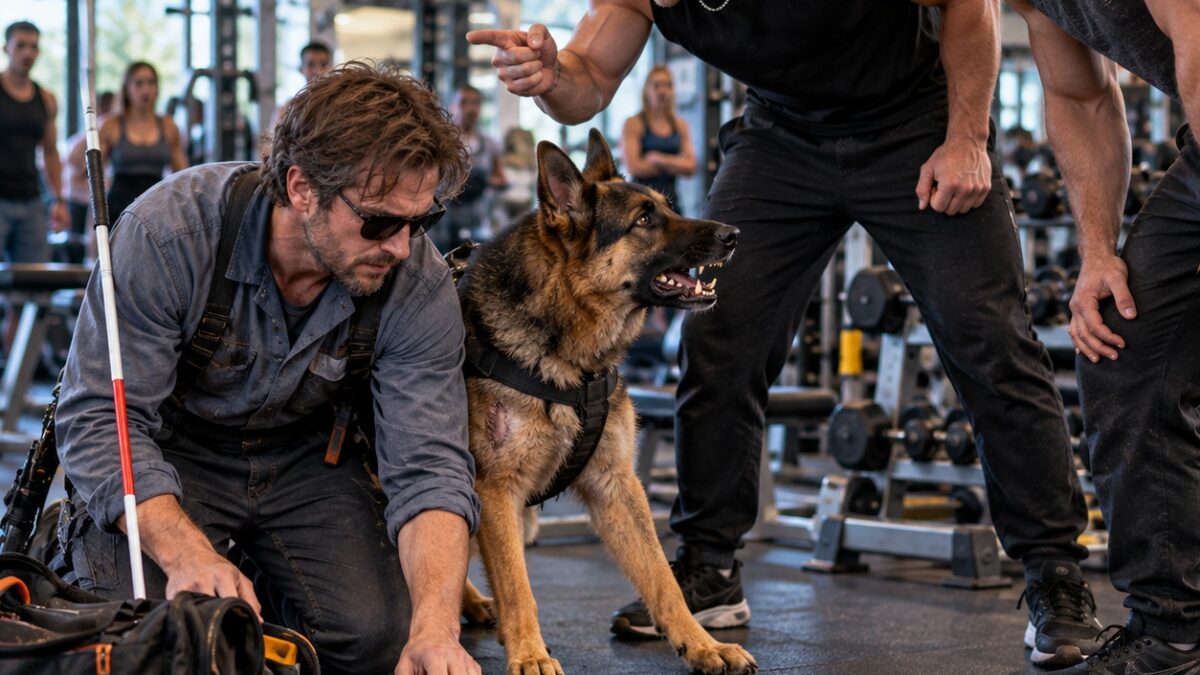
“My bad.”
One of the brothers said.
His voice contained no apology at all.
Then:
“Guess you should’ve seen that coming.”
They laughed.
Dagger’s growl dropped lower.
It did not become louder.
That was worse.
There is a difference between noise and warning.
Dagger understood that better than most people.
I placed the broken thermostat beside my knee.
Then breathed.
Four in.
Hold.
Four out.
Again.
People sometimes imagined calm was something you either possessed or did not.
It was not.
Mine was built.
Repetition.
Discipline.
Choice.
One breath at a time.
Some days it came easily.
Some days calm was a heavy door I held shut with both hands while something on the other side tried to kick through it.
That afternoon, I needed both hands.
The gym owner finally walked over.
His name was Gary.
I knew because he had introduced himself on the phone when he booked the service call.
He had sounded grateful then.
Now he sounded nervous.
“Hey.”
He said.
“Come on, guys.”
“Let’s dial it back.”
I heard the weakness immediately.
Not:
Stop.
Not:
Leave the contractor alone.
Not:
You just destroyed his property.
Dial it back.
The language people use when they want conflict to disappear without requiring the person causing it to actually stop.
One brother—Blake, I would soon learn—did not even turn toward him.
“We’re just talking, Gary.”
And somehow that was enough.
Gary shifted backward.
I heard his shoes slide half a step across rubber.
The shape of the room changed again.
Not physically.
Socially.
Blake and Devon now knew the owner would not intervene.
That mattered.
Men like them were good at reading permission.
It did not need to be spoken.
Sometimes permission was simply the absence of consequences.
“So what?”
Blake asked.
“You got like a whole system?”
I kept my hands folded loosely.
“What?”
He continued.
“You count stuff?”
“Doors?”
“Steps?”
“You got the whole place mapped out?”
Still nothing from me.
He moved closer.
Predatory curiosity.
The kind that comes when someone realizes they have not yet found the place where the knife goes in.
Then he did.
“Bet you got it mapped out for your kid too.”
Everything inside me changed.
Not visibly.
But instantly.
Tessa.
He had no idea who she was.
No idea that she was eight years old and talked in paragraphs that began before you realized she had entered the room.
No idea that she wanted the tenth sticker on her spelling chart because then Mrs. Fenwick would let her choose the class read-aloud book.
No idea that she hated crust unless it was toasted enough.
No idea that she checked the mirror before school even though her father could not tell her whether her braids were straight.
No idea that she had watched me adapt to blindness without ever once asking me why our life looked different from some other families.
He knew none of that.
And still he reached for her.
“She got the same trick?”
Blake said.
“Bet she’s real good at finding her way around.”
His brother laughed.
“Having a dad who can’t even—”
He did not finish.
He did not need to.
A precise blade entered just beneath my sternum.
Beside me, Dagger’s growl deepened.
His paws spread wider.
His body lowered until his stomach nearly touched the floor.
I kept breathing.
In.
Hold.
Out.
Again.
The old rhythm.
There had been rooms in my life where losing that rhythm had consequences more serious than embarrassment.
My body remembered even when I did not invite the memories.
Blake did not know that.
Devon did not know.
Gary certainly did not.
All they saw was a blind man kneeling on a gym floor.
Motionless.
Doing nothing.
“He’s not gonna do anything.”
Devon said.
There was amusement in his voice.
Confidence.
The confidence of a man who had confused restraint with inability.
“Look at him.”
“He’s just sitting there.”
That was when Blake grabbed my collar.
His fingers twisted into the fabric near my throat.
Then he pulled.
Hard.
Upward and sideways.
My bad shoulder took the angle wrong.
Pain flashed through me.
White.
Clean.
Immediate.
The room disappeared as a place and became geometry.
Twelve paces behind.
Bench left.
Fire exit right.
Blake in front.
Devon shifting.
Dagger low.
Gary farther back.
I did not need to think through any of it.
The map had been complete for nearly an hour.
My left hand found Blake’s wrist.
Not a punch.
Not a wild grab.
A controlled lock.
Pressure.
Angle.
His grip opened on reflex.
I rose.
One movement.
No wasted motion.
Blake stumbled back.
Devon came from my side.
I heard him.
The forward shift of his shoe.
Weight transferring.
A breath drawn differently.
There are sounds people make before throwing a punch.
Most never notice them because eyes do the work first.
My eyes had not done any work in four years.
My ears had become greedy.
They collected everything.
I turned around the sound.
Not toward it.
Devon’s fist passed through empty air.
Where my head had been.
My elbow came up.
Short.
Direct.
My body remembered a motion my life no longer required.
And then, before the strike completed, I stopped it.
One inch.
Maybe less.
My elbow hovered in front of Devon’s face.
Perfectly still.
The gym became silent.
Not truly silent.
The bass track continued.
Treadmills still ran.
Somewhere a cable machine rattled.
But no human being in the room was listening to any of it.
Devon stopped breathing for a second.
Blake stood near the wall.
His other hand wrapped around the wrist I had released.
I had not injured him.
I knew exactly how much pressure I had used.
Dagger stood between us and the exit.
No growl now.
No need.
He had not attacked.
Had not lunged.
Had not bitten.
He was simply there.
Absolute.
Waiting.
I counted.
One.
Two.
Three.
Four.
Then lowered my arm.
Slowly.
My breathing had not changed.
In.
Hold.
Out.
Devon stepped backward first.
One foot.
Then another.
His legs had made the decision before his pride caught up.
Blake did not speak.
Neither of them used the word blind again.
It was still in the room.
But it meant something different now.
That bothered me in a way I could not explain.
I did not want them to respect me because they discovered I could hurt them.
That was not the lesson I wanted anyone learning.
Blindness had not made me harmless before.
My past had not made me invincible now.
I was simply a man doing a job who should not have needed a hidden history to earn basic dignity.
But there was no speech I could give that would improve the moment.
So I went back to work.
I knelt.
Picked up my tools again.
My hands began shaking after the danger passed.
That always irritated people when they saw it.
They assumed shaking meant fear had just arrived.
Usually it meant fear had finally been allowed to leave.
Adrenaline does not disappear politely.
It finds exits.
Fingers.
Breathing.
Sweat.
Muscles.
I let the tremor move through me.
Dagger lowered slightly.
Not relaxed.
But no longer fully locked.
He tracked every shift Blake and Devon made.
Ready.
Not aggressive.
Ready.
There was a difference.
Gary walked closer.
This time his steps were slower.
“You good?”
He asked.
“Need me to call somebody?”
“I’m fine.”
I said.
And mostly meant it.
“My shoulder’s going to complain tomorrow.”
“But I’m fine.”
Gary stood there.
Uncertain.
I reached into my jacket for a clean pair of work gloves.
That was when the coin fell.
Small.
Heavy.
Metal.
It struck the rubber floor with a flat clink.
Spun once.
Stopped.
Gary picked it up automatically.
Then said nothing.
I knew what he was holding without touching it.
A brass challenge coin.
Worn edge.
Raised insignia.
The kind of object that meant very little if you had never belonged to the world that created it.
And sometimes far too much if you had.
Gary’s breathing changed.
He crouched.
“Here.”
He pressed it into my palm.
His voice had lost the hollow authority it carried earlier.
“This yours?”
“Yeah.”
My fingers closed around it.
“It’s mine.”
I slipped it into my pocket.
No explanation.
None needed.
Behind us, Blake and Devon began gathering their gym things.
Quietly.
The easy swagger was gone.
Shoes.
Water bottles.
Something zipped into a bag.
They moved toward the door.
Dagger did not block them.
He shifted enough to let them pass.
That mattered to me.
He understood the difference too.
Protect.
Not punish.
Gary stayed.
I returned to the thermostat.
Luckily, I kept a spare housing in the truck.
That was one habit civilian life had not cured.
Redundancy.
If something mattered, have a backup.
The internal board was damaged.
I swapped the failed component.
Replaced the capacitor.
Tested the relay.
Worked by touch.
By sound.
By the little click each connection made when seated correctly.
Gary hovered for another ten minutes before asking.
“Marines?”
My screwdriver paused.
“Recon.”
A long silence.
“Long time ago.”
“That where your eyes…”
“Yeah.”
That was all I gave him.
The source of my blindness was not a public exhibit.
Not a story owed to every person curious enough to ask.
Four years had passed.
My optic nerves were not coming back.
Doctors still scheduled follow-ups because that was what medicine did when certainty became uncomfortable.
Measure.
Monitor.
Document.
But both of us knew.
The world I had once seen existed now in memory.
Tessa’s face.
That was the part people always asked about.
Do you remember what your daughter looks like?
Yes.
Of course I did.
But memory is cruelly static.
The Tessa in my mind was four.
Round cheeks.
Messy hair.
Too-large front teeth just beginning to change.
The real Tessa was eight.
Her voice had matured.
Her height now came almost to my chest.
Her hair was longer.
She had lost baby teeth I never saw fall out.
Every year she changed in ways people described to me.
And somewhere inside my head remained the last image my eyes had managed to keep.
Four-year-old Tessa.
That was grief.
Not darkness.
I had learned darkness.
Grief was different.
Gary did not ask again.
I appreciated him for that.
When I finished, the system cycled normally.
Air shifted through the room.
The temperature would take time to balance.
But the problem was fixed.
I closed the panel.
Ran my thumb along the seam.
Proper fit.
Then stood.
Gary said:
“Those two won’t be back.”
“I’ll make sure.”
“They were never really a problem.”
I replied.
He made a sound halfway between a laugh and disbelief.
“They looked like a problem.”
“They were loud.”
That was true.
The real danger had never been Blake or Devon.
Not in the way Gary now imagined.
The danger had been what they stirred up.
Old reflexes.
Old rooms.
Old parts of me I worked very hard to keep stored where they belonged.
Gary asked:
“You always that calm?”
I considered.
“No.”
Then:
“Most days.”
I filled out the invoice.
My block lettering was slow but legible.
I had trained for that too.
Blindness was not one skill.
It was a thousand replacements.
Pouring coffee by pitch.
Reading text through software.
Labeling drawers.
Folding money by denomination.
Counting stairs.
Knowing which way a screw head faced through fingertips.
Writing letters large enough for someone else to read.
Driving?
That part of the original transcript makes my life look stranger than reality, but the truth was I managed transportation through adaptive arrangements and people I trusted when a job required equipment. What mattered to me was not pretending blindness had no limits.
It did.
So did sight.
The question was what you built around them.
Gary paid immediately.
That mattered.
The invoice clearing meant the numbers in my head changed.
Sixty-two recovered.
Labor paid.
Tessa’s twelve-dollar field trip no longer sitting so sharply behind everything.
The ophthalmology balance a little smaller.
Ordinary math.
Important math.
Dagger finally lay down.
His chin rested across his paws.
I reached toward him.
Found his head.
Then ran my palm down the side of his neck.
Muscles loosening.
Gary asked:
“He was ready to go, huh?”
“He was ready to protect.”
I said.
“There’s a difference.”
Dagger had a past I did not fully know.
The rescue coordinator had given me fragments.
Explosive detection.
Four years working.
One deployment that ended badly enough to end his program early.
Scar on his flank.
Strong reactions to uniforms.
Metallic bangs.
Reflections.
Confined spaces.
A cheap hallway mirror could stop him cold.
The first time a mail carrier came up our steps wearing a navy uniform shirt, Dagger planted himself in the doorway and became stone.
Not attacking.
Not retreating.
Refusing.
A police officer once knocked at the wrong apartment.
Same response.
The officer reached toward his belt.
I told him calmly:
“Please stop moving.”
Luckily, he listened.
I placed my hand on Dagger’s shoulder.
Waited.
Five minutes.
Maybe more.
Until the tension slowly left.
Loud metallic impacts were worse.
One day a construction crew fired a nail gun three times outside our building.
Dagger flattened himself so hard against the kitchen floor his claws scratched the linoleum.
I did not talk.
Words did not help him then.
I lay down beside him.
Matched my breathing.
Four in.
Four held.
Four out.
Eventually, his breaths found mine.
That was how our partnership worked.
People assumed Dagger guided me.
He did.
But not always in the way people imagined.
Sometimes I guided him around a mirror.
Sometimes he guided me around a curb.
Sometimes we simply reminded each other that a sound belonged to now instead of then.
Two damaged things.
Moving carefully around each other’s wounds.
Neither requiring the other to pretend they did not exist.
By the time we left Ironside Fitness, the gym had returned to normal.
Weights.
Music.
Machines.
Conversation.
The incident had already become a story for everyone except me.
People would probably retell it.
The blind repairman.
The scary dog.
The two arrogant brothers.
Then the military coin.
Every retelling would become cleaner.
More heroic.
Maybe someone would say I dropped both brothers.
I did not.
Maybe someone would claim Dagger attacked.
He did not.
The truth was less exciting.
I had avoided being hit.
Used enough control to break one grip.
Stopped another strike before it landed.
Then finished my job.
That was the outcome I preferred.
Outside, evening air was cooler.
Dagger climbed into the passenger side.
I listened to him settle.
His nails clicked against worn vinyl.
The truck smelled like tools, dust, old coffee, and dog.
Home.
Almost.
The drive took a little over twenty minutes.
I let the events at the gym remain behind me.
There was a time I would have replayed every movement.
Analyzed mistakes.
Angles.
Distances.
What I could have done faster.
What I should have noticed earlier.
That kind of thinking can be useful.
Until it becomes a room you never leave.
So I gave myself the road.
The engine.
Dagger breathing.
The numbers.
Invoice paid.
Eye bill smaller.
Tessa’s field trip covered.
Six o’clock promise.
That last one hurt.
I was late.
By the time I reached our apartment building, evening had settled.
Someone nearby was cooking onions.
Another apartment smelled like curry.
Dagger’s harness handle rested lightly in my palm as we climbed.
Stairs had their own language.
Concrete changed to hallway flooring.
The echo narrowed.
Apartment door.
Key.
Home.
I opened the door quietly.
No small feet rushed toward me.
No Tessa voice already mid-story.
That told me everything.
Television murmured low.
And beneath it came her breathing.
Slow.
Asleep.
I followed the sound.
She was curled sideways on the couch.
One arm hanging off the cushion.
The book rested open against her chest.
The lighthouse dog story.
Four chapters from the end.
Exactly where we had left it that morning.
My throat tightened.
I had promised.
Six o’clock.
Book.
She had waited.
I set the tool bag down.
Dagger followed silently.
I knelt beside the couch.
Slid one arm beneath her knees.
One behind her shoulders.
Lifted.
She had gotten heavier again.
Of course she had.
Children do that without permission.
Her head settled against my chest.
I carried her down the hallway.
She stirred.
“You said…”
Sleep made the words thick.
“What?”
“You said we’d finish the book.”
“I know.”
Guilt pressed hard.
“Tomorrow.”
I said.
Then immediately hated the weakness of the word.
Tomorrow had become a phrase people used when they meant maybe.
Not with her.
So I added:
“I promise.”
That was different.
Promises were not hope.
A promise was a structure.
Something you built behavior around.
I had learned that long before blindness.
Long before fatherhood.
You either kept one or accepted what breaking it made you.
Tessa relaxed.
Dagger refused the direct hallway route because of the mirror.
He took the longer way through the living room and kitchen.
I followed his sound without thinking.
That had become our route too.
People might have told me to train the behavior out of him.
Maybe a better handler would have.
I could not.
Not because I believed fear should control him forever.
Because not every healing process needs to become a confrontation.
The longer route cost us twelve seconds.
Dagger’s peace was worth twelve seconds.
We reached Tessa’s room.
I laid her down.
Pulled the blanket over her shoulder.
Set the paperback on her nightstand.
Dagger circled once on the small rug beside her bed.
Then settled.
He chose that spot every night.
No command.
No formal task.
Just his place.
His scarred flank rose and fell.
Tessa’s breathing matched it loosely.
I stood in the doorway.
Listened.
For most people, a dark room means absence.
For me, rooms were full.
Breathing.
Heat.
Air movement.
Building pipes.
Fabric shifting.
Dagger.
Tessa.
I did not need my eyes to know exactly what mattered in that room.
The day finally began leaving me.
My shoulder ached.
The tremor in my hands was gone.
My collar felt stretched where Blake had grabbed it.
Tomorrow I would probably wake stiff.
But Tessa was safe.
Dagger was safe.
The field trip could be paid.
The job was finished.
All things considered?
Good day.
That thought would have sounded insane to someone who had watched the gym incident.
But I had learned to grade days differently.
A bad ten minutes did not automatically own the remaining twenty-three hours and fifty minutes.
Later, after washing dishes, I went into my bedroom.
Third drawer.
It stuck unless lifted slightly.
I opened it.
Reached into my jacket.
Removed the challenge coin.
Turned it between my fingers.
The worn edge.
Raised emblem.
Weight.
Same as morning.
Different somehow.
Gary’s recognition had not made the coin more important.
Blake and Devon’s sudden silence had not restored anything.
I did not need strangers to discover my old history in order to validate my current life.
That was something I had learned slowly.
For a long time after losing my sight, people who knew my military background spoke about me differently from people who did not.
Those who knew said:
Marine.
Recon.
Tough.
Warrior.
Those who did not saw:
Blind guy.
Disabled father.
Repairman.
The strange thing was that neither group knew me particularly well.
One reduced me to what I had been.
The other reduced me to what I had lost.
I was tired of being reduced.
I was Rowan.
Father.
Technician.
Man with an overdue eye bill.
Man who buttered his daughter’s toast all the way to the edges.
Man who sometimes woke from dreams he did not tell anyone about.
Man who knew how to stop an elbow an inch before impact.
Man who still occasionally walked into an open cabinet door because no amount of Recon training makes somebody immune to badly placed kitchen furniture.
Dagger had the same problem in different form.
People saw the scar and wanted his story to be one thing.
Heroic service dog.
Traumatized animal.
Dangerous retired working dog.
Damaged.
Loyal.
Protective.
Maybe he was all of those.
Mostly he liked chicken.
He snored.
He hated mirrors.
He slept beside an eight-year-old girl as though somebody had formally assigned him that post.
No one had.
That was simply who he had become.
I set the coin beneath the folded flannel shirt.
Closed the drawer.
Down the hall, Dagger shifted once.
His collar tag made a tiny sound.
Then stillness.
I went to bed.
The next morning, Tessa woke before my alarm.
She entered my room already speaking.
“You were late.”
No greeting.
Straight to prosecution.
“I know.”
“You promised six.”
“I did.”
“And we didn’t finish the book.”
“We didn’t.”
Silence.
Dangerous silence.
Then:
“Was work bad?”
Children hear more than adults realize.
I sat up.
“Complicated.”
“Did the thermostat win?”
I laughed.
“The thermostat put up a fight.”
“Did you fix it?”
“Yes.”
“Then we can finish tonight.”
“We can.”
“Promise?”
“Promise.”
She moved closer.
Her hand touched my forearm.
Then stopped.
“What happened to your shoulder?”
I had not realized I was guarding it.
“Somebody grabbed me.”
The words came out before I decided how much to tell her.
Tessa became completely still.
“Why?”
“They were being stupid.”
“Did they hurt you?”
“No.”
Not exactly.
“Did Dagger bite them?”
“No.”
“Good.”
That surprised me.
“Good?”
“He’d get in trouble.”
Eight years old.
Perfect logic.
I reached toward where her voice came from.
Found her shoulder.
“They left.”
“I finished the job.”
“It’s over.”
She was quiet.
Then asked:
“Did they make fun of you because you’re blind?”
There it was.
Children go to the center.
Adults circle it.
“Yes.”
“What did you say?”
“Nothing.”
“Why?”
I thought.
“Because they weren’t asking a question.”
She considered that.
“That’s smart.”
“I’m occasionally smart.”
“No.”
She said.
“Like twice a week.”
I laughed.
Then she hugged me.
Hard.
Dagger came into the room.
Tessa immediately shifted.
“Did they make fun of you too?”
Dagger sneezed.
“I think that means yes.”
She wrapped both arms around his neck.
He tolerated it.
Then breakfast.
Spelling-test review.
School bus.
Life.
I almost told her about the challenge coin.
About Gary.
About the moment the room changed.
I did not.
Maybe someday.
Not because my past was shameful.
Because I wanted Tessa to understand something I had spent years learning.
Her father’s worth did not begin the moment strangers discovered he had once been a Recon Marine.
I had been worthy on my knees.
Before the wrist lock.
Before the almost-strike.
Before the coin fell.
The men were wrong when they thought I was weak.
They would still have been wrong if I had never served a day in uniform.
That distinction mattered.
A week later, Gary called.
My phone read his name aloud.
“Ironside Fitness.”
I almost let it go to voicemail.
Then answered.
“Rowan.”
“Gary.”
“Got a minute?”
“Depends.”
A pause.
“I wanted to apologize.”
I leaned against the kitchen counter.
“For what?”
“For not stepping in.”
That caught me off guard.
Gary continued.
“I watched the security footage.”
“The whole thing.”
“I kept telling myself I was de-escalating.”
“You weren’t.”
“No.”
“I was protecting two members because they pay a lot of money.”
Honest.
Painfully honest.
“I should’ve stopped it when they started.”
“Yes.”
Another pause.
“They’re banned.”
“Okay.”
“And I replaced the thermostat cost in the payment.”
“You already paid the invoice.”
“I added the damaged part.”
I had not noticed.
The deposit had come through slightly higher.
“Thank you.”
Then he said:
“There’s something else.”
I waited.
“I’ve got a lot of guys in there who think strength means being the loudest person in the room.”
“That sounds like a gym.”
He laughed.
“Yeah.”
“I’m changing a few things.”
“Staff training.”
“Harassment policy.”
“Actual enforcement.”
I almost said:
You’re doing this because you discovered I used to be dangerous.
Instead, I asked:
“Would you have done it if I hadn’t stopped Devon?”
Gary went quiet.
That answer mattered more than whatever policy he was about to describe.
Finally:
“I don’t know.”
“Then start there.”
He breathed out.
“Fair.”
“That blind customer you didn’t defend was entitled to the same respect even if he’d never been able to defend himself.”
“I know.”
“Now?”
“Yeah.”
“Now.”
We scheduled the next filter service.
Same time next month.
I considered declining the job.
Then did not.
Leaving every place where someone had been cruel would eventually make the world very small.
When I returned, the gym sounded the same.
Weights.
Music.
Treadmills.
But Gary met me at the entrance.
No over-enunciation.
No grabbing my elbow.
He simply said:
“Panel’s clear.”
“Bench still left of it.”
“Call if you need anything.”
Perfect.
People think accommodation requires grand gestures.
Mostly it requires paying attention and not behaving like an idiot.
Blake and Devon were gone.
Good.
I did not ask where.
That chapter did not need sequels.
During the filter service, a young trainer approached.
“You Rowan?”
“Yes.”
“I saw the video.”
My jaw tightened.
Of course there was video.
Security footage has a way of becoming folklore.
He continued:
“Man, that was badass.”
There it was.
The version I had feared.
I stopped working.
“No.”
He hesitated.
“No?”
“The best thing that happened in that video is nobody got hurt.”
The trainer looked confused.
“You almost dropped that guy.”
“I almost didn’t.”
He laughed uncertainly.
I returned to the filter.
“Control isn’t what you can do.”
I said.
“It’s what you don’t have to.”
He walked away quieter.
Maybe he understood.
Maybe not.
That was okay.
Not every sentence needs immediate results.
At home, Dagger slowly improved too.
A month passed before he would walk within two feet of the hallway mirror.
Tessa invented the breakthrough.
I would like to say it came from careful behavioral theory.
It did not.
It came from peanut butter.
She sat on the floor far enough from the mirror that Dagger remained comfortable.
Gave him a treat.
Next day, one foot closer.
Then another.
Never forcing.
Never luring him past his threshold.
Just teaching the hallway a different memory.
Weeks later, I heard his nails take the direct route.
I froze in the kitchen.
No detour through the living room.
No stop.
He passed the mirror.
Then entered Tessa’s room.
I smiled.
Did not clap.
Did not make a celebration.
Dagger hated attention around fear.
That evening, I scratched his ears and gave him chicken.
He understood chicken.
My own version of the mirror was harder.
People.
Crowded rooms.
Sudden hands.
Metallic impact.
Someone behind me moving too fast.
The blindness itself was not the hardest part of my injury.
People assumed it was.
Loss of sight was enormous.
But adaptation became practical.
Technology.
Training.
Repetition.
The body learns.
The mind is less obedient.
It keeps alarms long after the fire is gone.
My four-count breathing existed because there were parts of me that still believed some rooms could become other rooms without warning.
The gym proved those parts were not entirely irrational.
But they also did not get to run my life.
That distinction was my therapy, whether I used the word or not.
Months later, the ophthalmologist appointment came again.
Tessa came because school was closed.
She sat beside me while the specialist conducted the same tests.
Light I could not see.
Responses I could not give.
Pressure.
Imaging.
Clinical language.
Finally:
“No meaningful change.”
I smiled.
“Meaning?”
He hesitated.
Doctors hate closing doors.
“Meaning recovery remains extremely unlikely.”
There it was.
Tessa took my hand.
Not dramatically.
Just fingers sliding into mine.
The doctor continued explaining follow-up intervals.
I barely listened.
Outside, Tessa asked:
“Are you sad?”
“Yes.”
I told her.
It was important not to lie.
“Do you want to see again?”
“Very much.”
She squeezed my hand.
Then:
“You’d finally know my hair looks terrible.”
I laughed.
“I already know.”
“How?”
“You take after me.”
“That’s rude.”
We went for ice cream.
Loss could exist beside ice cream.
Another lesson.
Time moved.
Tessa got her tenth spelling sticker.
She chose the dog book for class.
At home, we finished our copy together.
She read the last chapter to me because she had become impatient with my pace.
The lighthouse keeper adopted the stray.
Of course he did.
Tessa cried.
Dagger slept through the entire emotional climax.
“He doesn’t appreciate literature.”
She whispered.
“He has lived experience.”
I said.
“He doesn’t need fiction.”
She threw a pillow at me.
Missed.
I did not.
That became one of our jokes.
Sometimes blindness was grief.
Sometimes inconvenience.
Sometimes absurd.
People are uncomfortable with that complexity.
They want disability to be tragedy or inspiration.
Usually it is life.
Bills.
Toast.
Field trips.
Bad jokes.
Daughters who throw pillows at blind fathers because they know the father can still catch them if he hears the movement early enough.
Years earlier, I would not have believed this ordinary life could feel like victory.
The challenge coin stayed in the third drawer.
I stopped touching it every morning.
At first, that bothered me.
Was I forgetting?
Losing connection?
Then I understood.
Memory does not need daily proof to remain real.
The coin was part of me.
Not all of me.
Dagger’s scar was part of him.
Not all of him.
Blindness was part of me.
Not all.
That was the thread connecting us.
People had looked at Dagger’s scar and decided:
Broken dog.
People looked at my cane, my eyes, my careful movement and decided:
Broken man.
The rescue paperwork had once called Dagger unsuitable for ordinary placement.
The VA paperwork used different words for me.
Functional limitations.
Permanent visual impairment.
Disability percentage.
Useful language for systems.
Dangerous language if you let it become biography.
Neither of us was what paperwork summarized.
One rainy night, Tessa fell asleep beside me on the couch.
Dagger had his head across my foot.
The television played something nobody was watching.
I listened to rain strike the windows.
Three separate rhythms.
Glass.
Air conditioner.
Dog breathing.
The world remained full.
Tessa murmured:
“Dad?”
I thought she was asleep.
“Yeah?”
“Were you a soldier?”
The question came out of nowhere.
“Marine.”
“What’s the difference?”
“Never ask a Marine that.”
She giggled.
Then:
“Were you like…”
Pause.
“A hero?”
I went still.
Children inherit stories even when adults try to keep drawers closed.
“Who told you?”
“Mrs. Fenwick said her husband saw something online.”
Of course.
The gym video had traveled.
Maybe Gary’s staff.
Maybe security footage leaked.
Modern life hates privacy.
I sighed.
“I served.”
“That’s not what I asked.”
She had inherited my dislike of evasive answers.
“I did my job.”
“Did you save people?”
“Sometimes.”
“Did people save you?”
That question went deeper.
“Yes.”
“More than once.”
She shifted against me.
“Is that why you know fighting?”
“Partly.”
“Is that why you’re blind?”
I could have answered in detail.
The source of this story does not tell every piece, and even inside my own life there were parts I did not give Tessa at eight years old.
So I said:
“It’s connected to that part of my life.”
She accepted it.
Then:
“Are you still a Marine?”
I smiled.
“That answer gets complicated.”
“Dad.”
“Yes.”
“In some ways.”
She yawned.
“I think you’re mostly my dad.”
Something inside my chest opened.
“Yeah.”
I said.
“Mostly that.”
She fell asleep.
I sat there a long time.
Heroes.
Veterans.
Disabled.
Blind.
Single father.
Repairman.
People love nouns.
Nouns make strangers easier to understand.
Tessa gave me the only one I needed.
Dad.
Dagger shifted.
His scar brushed my ankle.
Dog.
That was probably enough for him too.
A year after the gym incident, Gary called me for another HVAC problem.
Blake and Devon never returned.
The new staff policy apparently survived beyond the embarrassment.
That pleased me more than revenge would have.
There is a temptation after humiliation to want the other person humiliated back.
I had felt it.
For one second, when Blake stepped away clutching his wrist, there had been satisfaction.
I will not lie.
Then it passed.
Humiliation rarely teaches what people hope.
Boundaries teach.
Consequences teach.
Sometimes distance teaches.
They were banned.
The gym changed.
I continued getting paid.
Enough.
Gary eventually hired me for regular maintenance.
Not charity.
Not apology.
Work.
That mattered.
My business grew slowly.
Word spread that the blind HVAC technician was annoyingly good at diagnosis.
I hated the adjective but accepted the customers.
Some called because they had heard the gym story.
They stayed because the systems worked.
One homeowner once asked:
“How can you repair wiring if you can’t see colors?”
“Labels.”
“Tools.”
“Testing.”
“Organization.”
“Also, I’m not guessing.”
He laughed.
I did not.
Then charged him the normal rate.
Blindness had forced precision.
Not magic.
Precision.
There were jobs I refused because they were not safe for me alone.
Roof edges.
Certain high ladders.
Situations where visual inspection was essential.
Knowing limitations was not weakness.
It was professionalism.
The younger version of me had needed years to learn that.
Recon culture had taught me to adapt.
Injury taught me something harder.
There are things adaptation cannot erase.
Ask for help anyway.
My neighbor drove me to distant jobs when needed.
A friend handled transportation logistics.
Sometimes customers sent photos through an accessibility app.
Tessa learned not to leave shoes in the hallway after I tripped over one and said a word she was not supposed to hear.
Life became systems.
Systems become freedom when chosen well.
Four years after losing sight, I had believed independence meant proving I needed nobody.
By year five, I knew better.
Independence was choosing how help entered your life.
Dagger taught me that too.
He guided me.
I guided him.
Neither relationship was one-directional.
One afternoon, we passed a uniformed mail carrier in the hallway.
Dagger stiffened.
Then stopped.
I waited.
His body trembled once.
The carrier froze respectfully.
“Should I back up?”
I said:
“Just stay there.”
Dagger breathed.
I breathed.
Four in.
Hold.
Out.
After several seconds, his muscles softened.
We walked past.
No detour.
No wall.
Nothing dramatic.
I scratched his shoulder later.
Progress often looks unimpressive from across the room.
That is why people miss it.
The day at Ironside was dramatic.
Elbow stopped midair.
Dog in guard stance.
Challenge coin.
Everybody remembered.
But that was not the hardest work Dagger or I did.
The hardest work was boring.
Walking past a mirror.
Going back into a gym.
Paying bills.
Letting strangers stand behind me without assuming danger.
Explaining blindness to my daughter honestly without making her afraid.
Allowing an ophthalmologist to say “unlikely” and still planning dinner.
Healing hides in repetition.
So does parenthood.
Tessa grew.
Her field trips became more expensive.
Twelve dollars became thirty.
Then seventy-five.
I complained.
She informed me inflation was not her fault.
I accused her fifth-grade teacher of running an international travel cartel.
She rolled her eyes.
Dagger aged more visibly.
Gray around the muzzle.
Slight stiffness after sleep.
The scar remained.
Some things fade.
Some do not.
I kept working.
Kept counting rooms.
Less because I expected violence.
More because my mind simply preferred maps.
At restaurants, I knew the exits.
At school events, the aisle.
At home, every object.
Tessa eventually noticed.
“You always know where the door is.”
“Yes.”
“Even if we’ve never been somewhere.”
“Usually.”
“Is that because you’re blind?”
“Partly.”
She thought.
“And the Marine stuff?”
“Partly.”
“Does it make you tired?”
That question surprised me.
“Yes.”
Sometimes.
She took my hand.
“You don’t have to count our house.”
I smiled.
“I know.”
But I still did.
Not consciously.
The body keeps certain habits after the reason has left.
That does not mean you failed to heal.
It means history exists in muscle.
We do not erase it.
We teach it that now is different.
That was what I had been doing with Dagger.
And myself.
Years later, people still occasionally mentioned the gym incident.
A contractor once recognized my name.
“You’re the blind Marine who almost knocked some dude out.”
“No.”
I said.
“That story is already wrong.”
He laughed.
“You know what I mean.”
“I know exactly what you mean.”
I did not almost knock anybody out.
I almost chose not to.
That was a different story.
More important.
Violence had once been part of my job.
Control had been part of it too.
People remembered the violent part because it sounded impressive.
They rarely understood how much training goes into deciding not to use everything you know.
At Ironside, the real moment was not when my elbow came up.
It was when it stopped.
One inch.
That inch contained the life I had built after everything else.
Tessa.
Bills.
Work.
Dagger.
Home.
A future that did not need another man bleeding on a floor just because he deserved consequences.
I chose that inch.
That is the part I am proud of.
Not the coin.
Not the silence afterward.
The stop.
Gary understood eventually.
He told me years later:
“When I saw your coin, I suddenly realized those guys had messed with the wrong person.”
I corrected him.
“No.”
“They were messing with the wrong person before the coin fell.”
He went quiet.
Then:
“Yeah.”
“That’s what I mean.”
Maybe.
But I needed him to understand.
Respect that appears only after discovering someone can hurt you is fear wearing better clothes.
Real respect should have been there when I was kneeling beside the thermostat.
Blind.
Working.
Unthreatening.
Dagger lying quietly.
Before anyone knew anything else.
That lesson applied far beyond me.
Wheelchair.
Cane.
Age.
Speech difficulty.
Uniform.
No uniform.
Rich.
Poor.
Strong.
Fragile.
The world is full of people waiting to discover whether someone has a hidden credential before deciding how much dignity to offer.
That is backward.
Dignity comes first.
Everything else is biography.
One night, years after the gym, I opened the third drawer.
The coin was there.
Of course.
Same folded flannel shirt.
Different apartment by then.
Tessa had grown enough to need a room with an actual desk.
Dagger’s steps were slower.
My business was steadier.
I held the coin.
For the first time, I considered displaying it.
Frame.
Shelf.
Something.
Then I laughed.
No.
Back in the drawer.
Not shame.
Privacy.
The man that coin represented had survived enough.
The man standing there needed to pack Tessa’s lunch.
Down the hallway, she shouted:
“Dad!”
“What?”
“Dagger stole my sock!”
I listened.
Dog tags.
Fast paws.
Tessa laughing.
I closed the drawer.
Walked toward them.
No hurry.
No map needed.
Home was the one room I no longer had to measure.
Dagger stood in the hallway with a sock in his mouth.
Old.
Scarred.
Tail wagging.
Tessa pointed.
“Criminal.”
I reached down.
“Drop.”
He did not.
Retirement had corrupted him.
I traded chicken.
Tessa protested the injustice of rewarding theft.
I told her this was advanced negotiation.
She called it bribery.
Maybe both.
We finished her homework.
Read.
Argued about bedtime.
Normal life.
That was the ending nobody in the gym saw coming.
Not revenge.
Not respect.
Not a reveal.
Ordinary.
Because ordinary was what both Dagger and I had fought hardest to reach.
He had spent years being treated as too damaged for normal placement.
I had spent four years being looked at by strangers who saw blindness before they saw me.
Somewhere along the way, a scarred dog and a blind man ended up in a small apartment with an eight-year-old girl who did not think either one was broken.
She thought Dagger snored.
She thought I made bad pancakes.
She was correct on both counts.
That was enough.
The thermostat incident did not change my life.
It simply exposed something already true.
Blake and Devon thought they were standing over a helpless man.
Gary thought he was looking at a customer who needed someone else to protect him.
The gym thought Dagger was a dangerous dog waiting to attack.
All of them were wrong in different directions.
I did not need rescuing.
I also did not need to prove I was dangerous.
Dagger was not waiting to attack.
He was waiting to protect.
And when the moment ended, neither of us wanted applause.
We wanted to go home.
That night, after I carried Tessa to bed, I stood at her doorway listening to two rhythms.
Her breathing above.
Dagger’s below.
Slow.
Safe.
Ordinary.
My shoulder hurt.
My hands had stopped shaking.
The sixty-two dollars was no longer a disaster.
The field trip would be paid.
The book waited on the nightstand.
And the challenge coin sat again beneath a folded shirt where nobody needed to see it.
Dagger had spent part of his life being treated like a good dog ruined by something nobody wanted to understand.
I had spent part of mine learning that losing my sight did not erase the man I had been or prevent the man I still needed to become.
Neither of us entered that gym to prove anything.
Neither of us left needing to.
Because the most important people in our lives already knew exactly who we were.
Tessa knew Dagger would sleep beside her bed.
She knew I would finish the book.
And I knew that when morning came, she would start talking before she reached the kitchen, Dagger would meet me at the hallway corner, coffee would beep, bills would still exist, and we would begin another ordinary day.
For men like Blake and Devon, strength had meant being able to make someone smaller.
For me, by then, strength meant something else.
It meant knowing exactly how much damage you could do—and choosing to go home instead.








