PART 2: The Most Feared Man in Nashville Could Silence a Room—But He Couldn’t Make Me Shrink
FULL STORY CONTINUATION
I did not know his name then.
Not the real one.
The reservation said Roman Black.
That was all.
He was still sitting at table six when I came back, coffee in front of him, pear tart untouched.
The enormous man by the wall shifted when I approached.
The stranger lifted two fingers without looking at him.
The big man stopped.
I noticed that.
I noticed most things.
Pastry work teaches you to notice tiny changes.
Butter two degrees too warm.
Sugar beginning to caramel.
Cream one whisk away from breaking.
People were not all that different.
I stood beside Roman’s table.
“You can tell me.”
He looked up.
“Tell you what?”
“What’s wrong with it.”
“Nothing.”
“You’ve been staring at it for forty minutes.”
“I was thinking.”
“About my tart?”
“No.”
“Then you’re wasting perfectly good pastry.”
His expression did not change.
“I assure you, Miss—”
“Celia.”
“Celia.”
He said my name carefully.
Like he did not often call strangers by their first names.
“It’s good.”
“Then why haven’t you eaten it?”
That stopped him.
For the first time, I saw something human move behind those dark eyes.
“Because you are watching me.”
I smiled.
“Maybe I’m waiting for the plate back.”
The corner of his mouth shifted.
Barely.
Not quite a smile.
More like the memory of one.
He picked up the fork.
Cut the smallest possible bite.
Tasted it.
His eyes closed for half a second.
When they opened, something had changed.
“My wife used to make pear tart.”
The sentence seemed to surprise him as much as it surprised me.
“Used to?”
“A long time ago.”
I heard the wall come back into his voice.
So I left it alone.
That mattered.
I learned later that most people around Roman Blackwell responded to any weakness by reaching for it.
Questions.
Sympathy.
Leverage.
I just nodded.
Then turned toward the kitchen.
Halfway to the door, something bothered me.
I stopped.
Looked back.
“You didn’t eat the tuile.”
He glanced at the thin almond crisp beside the tart.
“I can’t.”
“Why?”
“Tree nuts.”
My stomach tightened.
“How bad?”
“They close my throat.”
I stared at him.
“You could’ve mentioned that.”
He looked almost offended.
“I don’t mention things.”
“Clearly.”
I walked back, removed the almond garnish from his plate with two fingers, and gave him a look.
“If you’re going to sit in my dining room and quietly gamble with death, at least have the courtesy to tell the pastry chef what can kill you.”
From the wall, the enormous man made a strange choking noise.
I looked at him.
“You okay?”
He nodded too quickly.
Roman stared at him.
“Not one word, Teddy.”
So.
Teddy.
“I didn’t say anything, boss.”
Boss.
Another thing I noticed.
Roman looked at me.
I looked at him.
Neither of us explained anything.
When I went downstairs, I was smiling.
That should have been the end.
It was not.
He came back Thursday.
Then Tuesday.
Then the Thursday after that.
Always around one-thirty.
Always table six.
Always Teddy against the wall.
Always under the reservation name Roman Black.
At first I assumed he liked the food.
Then I realized half the time he barely ate.
He sat.
Drank coffee.
Watched the room.
Talked to me when I passed.
And somehow, little by little, I started talking back.
I learned he drank coffee black and dangerously hot.
Then complained it was too hot.
“You ordered it hot.”
“Hot is not the same as volcanic.”
“Coffee has one job.”
“To remove skin from my tongue?”
“To keep dramatic old men awake.”
The first time I called him old, I almost swallowed my own tongue.
It slipped out during an argument about the size of the Briarwood sugar bowls.
Roman had been delivering a five-minute opinion about why they were impractical.
I had a cake waiting.
I looked at him.
“Are you always this dramatic, old man?”
Silence.
Teddy’s head came up.
Roman slowly looked at me.
“I am fifty-nine years old.”
“That’s what I said.”
He stared.
I waited for anger.
Instead, he picked up his coffee.
“Your generation has no respect.”
“You don’t know my generation.”
“Exactly.”
He came back Tuesday.
That was how I knew I had not actually offended him.
The reading glasses happened in March.
Roman had been holding the dessert menu three feet from his face for weeks, squinting at it with enormous dignity.
I got tired of watching.
I kept cheap reading glasses in my apron because Nana Joe had done the same.
I pulled out a purple pair.
Set them beside his coffee.
“Try those.”
Roman stared at them.
“No.”
“You can’t read the menu.”
“I can read perfectly well.”
“Then order.”
He looked down.
Paused.
I folded my arms.
Teddy stared at the ceiling.
Roman picked up the glasses like they were evidence in a criminal trial.
Put them on.
They were purple.
Bright purple.
He looked distinguished and ridiculous.
I bit the inside of my cheek.
Teddy failed completely.
A sound escaped him.
Roman did not turn.
“Not one word.”
“I did not say anything, boss.”
“You breathed sarcastically.”
I laughed so hard I had to walk away.
Later, Teddy told me that Roman kept those glasses.
He did not tell me Roman carried them in his breast pocket.
I discovered that myself.
By April, I was beginning to understand that Roman came to the Briarwood for more than dessert.
What I did not understand was why.
I still thought he was simply some wealthy businessman who preferred privacy.
Then came the luncheon.
Mrs. Margaret Ashby owned the Briarwood.
She had run that hotel for forty years with an iron spine, excellent manners, and cardigans in every shade of beige ever manufactured.
Her annual Nashville Builders Association luncheon was one of our biggest spring events.
Forty guests.
Three courses.
Dessert service timed to the minute.
The event order included one serious tree-nut allergy.
One seat.
One nut-free dessert.
Green pick.
I made a lemon posset in a clear glass.
No nuts.
Separate tools.
Clear green flag.
It sat at the end of my pass.
Twenty-two tart plates.
Eight cheese plates.
One posset.
I counted.
Then counted again.
Counting calmed me.
Nana Joe taught me that.
A baker who cannot count does not remain a baker long.
The first tray left.
I reached for the posset.
It was still sitting there.
My stomach dropped.
I looked at the tray.
Twenty-one normal desserts.
And one pistachio-crusted tart with the green allergy flag stuck into it.
My body moved before my mind did.
I ran.
Through the kitchen.
Through the swinging doors.
Into a room full of forty men in suits.
At the first table sat Roman.
Fork in hand.
Green flag on the tart in front of him.
The fork was one inch from his mouth.
“DON’T.”
Every head turned.
I crossed the room and knocked the fork out of his hand.
It struck the plate.
Spun across the table.
Dropped onto the carpet.
The room went silent.
Teddy moved away from the wall so fast that one second he was standing still and the next he was between me and half the room.
One hand disappeared inside his jacket.
His face changed.
That was the moment I understood I might have just interrupted something far more dangerous than a luncheon.
I looked at Roman.
“That’s pistachio.”
My voice shook.
“The green flag is on the wrong plate. Yours is the posset. It’s still in my kitchen. Please don’t eat that.”
Roman looked at the tart.
Then the fork.
Then me.
His expression became very still.
Not angry.
Not afraid.
Something else.
Like somebody had just handed him a thing he had forgotten existed.
Teddy found the waiter responsible for the switched plate.
His name was Kyle.
Twenty-two.
Scared half to death.
Some stranger had given him five hundred dollars and told him to move the green flag.
Only a prank, the man had said.
Kyle claimed he never saw the stranger clearly.
Mrs. Ashby contained the scene before panic could spread.
She thanked me publicly for catching a kitchen error.
Then turned to Dennis Whitlock when he started blaming pastry staff.
“Mr. Whitlock.”
He stopped.
“I would like you to explain later how a plate left my kitchen contrary to your own event order.”
Dennis closed his mouth.
Afterward, in the service corridor, Roman caught up with me.
My hands were shaking so hard I had hidden them in my apron.
“How did you know?”
“What?”
“My allergy.”
“You told me.”
His eyes narrowed.
“When?”
“February.”
He stared.
“You said tree nuts closed your throat.”
He looked at me like I had performed a magic trick.
“I remembered.”
“Why?”
I frowned.
“Why wouldn’t I?”
He looked away.
Then back.
“Nobody remembers things about me unless they want something.”
That sentence took all the cleverness out of me.
I had no smart answer.
So I did what I knew how to do.
I went back into my pastry office.
Returned with a paper bag.
Inside was his untouched nut-free lemon posset.
I had written on the bag:
FOR THE OLD MAN. EAT SLOWLY.
He stared at the note.
Did not say thank you.
At the time, I thought maybe he simply had terrible manners.
Later, I realized gratitude frightened him almost as much as affection.
An hour afterward, Teddy came downstairs carrying an envelope of cash.
“For your trouble.”
I pushed it back.
“Tell your boss I don’t accept tips for preventing him from killing himself.”
Teddy hesitated.
Then smiled.
I looked up at him.
“You like cinnamon rolls?”
His face changed completely.
“Ma’am.”
“Yes?”
“I would very much like a cinnamon roll.”
I made him twelve.
The truth arrived in May.
Darra Okafor, my best friend at the hotel, found me after a Friday shift with her phone held out like it contained a bomb.
Darra knew everything about everybody.
Not because she was nosy.
She was.
But also because Nashville seemed to personally deliver gossip into her hands.
“Celia.”
“What?”
“Celia.”
“What?”
“Table six.”
“What about him?”
She pushed the phone toward me.
A local news report showed a courthouse.
Men in suits.
Cameras.
Then Roman walked down the steps in dark glasses with Teddy behind him.
The caption underneath read:
ROMAN BLACKWELL.
I watched.
The reporter used phrases like racketeering allegations.
Organized crime.
Fourth failed prosecution in thirty years.
Blackwell family.
River contracts.
Political influence.
I watched twice.
Then gave the phone back.
Darra whispered:
“That is Roman Blackwell.”
“I can read.”
“That is not a businessman.”
“He does business.”
“Celia.”
“I heard you.”
“Everybody in Nashville knows that name.”
“I didn’t.”
“Nobody says it at lunch!”
That part, for reasons I cannot explain, irritated me most.
I took off my apron.
Hung it on the hook.
Walked out of the hotel.
Darra followed me outside.
“Where are you going?”
“To ask him.”
“Ask him what?”
“Why he lied.”
“You are going to confront a mafia boss?”
“I’m going to confront Roman.”
“That sentence is not better.”
I knew where he lived because Teddy had mentioned the street while eating his sixth cinnamon roll one afternoon.
I took a cab.
By the time I reached the gates, the sun was low.
Roman was standing on the porch.
I still do not know whether somebody warned him I was coming.
Probably.
He looked at me.
I looked at him.
“Why didn’t you tell me?”
No greeting.
No hesitation.
Roman rested one hand on the porch rail.
“Because I wanted one place where nobody looked at me like Roman Blackwell.”
I crossed my arms.
“You gave me a fake name.”
“Yes.”
“You let me sit there insulting you every week while half the city apparently thinks you bury people under highways.”
His eyebrow moved.
“That is an exaggeration.”
“That is not the part of that sentence you should be correcting.”
For the first time, he looked almost ashamed.
“I wanted one table.”
I said nothing.
“One hour.”
His voice was quiet.
“One person who complained about my coffee and made me wear purple glasses and did not care what my last name could do.”
His jaw tightened.
“I know it was dishonest.”
“Yes.”
“I am sorry for that.”
“Good.”
“I am not sorry I wanted it.”
That took some of the anger out of me.
Not all.
But some.
Because I recognized loneliness.
I had lived with my own version of it.
People had spent my life looking at my body before they looked at me.
Roman had spent his life watching people look at his power first.
Different cages.
Same problem.
Finally I said:
“Then stop acting like a mafia boss around me.”
He blinked.
“What?”
“You want me to treat you like a man? Fine.”
I raised three fingers.
“Rules.”
Roman Blackwell, who had allegedly intimidated judges and mayors, stared at my fingers.
“One. No more lying.”
He nodded.
“Two. Nobody gets hurt in my kitchen. I do not care who they are.”
Another nod.
“Three. When your doctor tells you to stop eating sugar, you stop hiding lemon tart in your briefcase.”
His eyes narrowed.
“How do you know about the briefcase?”
From behind a hedge came a tiny sound.
I looked toward it.
“Teddy.”
Silence.
Roman closed his eyes.
“Agreed.”
Our relationship changed after that.
I do not know what else to call it.
Friendship sounds too simple.
Romance came later.
At first, we became two people learning to be honest in places honesty did not come naturally.
Roman did not know how to text.
That discovery almost killed me.
His first message arrived at seven on a Saturday morning.
Good morning, Roman.
Then:
This is Roman.
Then:
Blackwell.
I sat on my bed in a towel after showering and laughed until coffee came out my nose.
I sent him a donut emoji.
A minute passed.
Then:
What does the round one mean?
Another message.
Is it an insult?
I wrote:
It means I’m thinking about you, old man.
Then immediately set the phone face down because apparently I was thirty years old and twelve at the same time.
By June, Roman got jealous of a chocolate salesman.
Gavin represented one of our suppliers.
Nice teeth.
Too much cologne.
He leaned on my pastry counter and flirted harmlessly while I tempered chocolate.
Across the dining room, Roman lowered his coffee cup.
Slowly.
Removed the purple glasses.
Folded them.
Put them into his pocket.
Then stared at Gavin.
Gavin stopped talking mid-sentence.
Looked around.
Said he had another appointment.
Left.
I marched into the Magnolia Room holding a spatula.
“You cannot glare at the chocolate man.”
Roman looked offended.
“He was standing too close.”
“He was standing at a counter.”
“He was leaning.”
“That is what counters are for.”
“I did not like him.”
“You were jealous.”
“I was observant.”
“You were jealous of a man who sells chocolate.”
Roman considered this.
Then said with great dignity:
“I was concerned about the integrity of your counter.”
I laughed until my sides hurt.
From the wall, Teddy looked like he might cry from happiness.
But there were parts of Roman that were not funny.
I found one in July.
Teddy accidentally mentioned that Roman went to the same cemetery on the nineteenth of every month.
I went.
He was sitting on a stone bench in front of a simple marker.
Eleanor Marie Blackwell.
His wife.
I sat beside him.
He did not ask me to leave.
For a long time, neither of us spoke.
Then he said:
“She used to bake.”
I smiled.
“Good?”
“Terrible.”
I looked at him.
“The pear tart?”
“The only thing she could make.”
He turned his hat between his hands.
“She loved almonds. Used to complain that marrying a man allergic to them was divine punishment.”
There was a little warmth in his voice.
Then it disappeared.
“The house has been quiet since she died.”
I looked at the enormous man beside me.
The man newspapers feared.
The man judges watched.
The man nobody spoke over.
His voice was almost gone.
“I didn’t know a house could get that quiet, Celia.”
I did not tell him I was sorry.
Grief had taught me that sometimes “I’m sorry” is what people say when they want to close the door and leave.
Instead, I moved my hand across the bench.
Covered his.
He turned his palm upward.
Held on.
“Nana died four years ago.”
Roman looked at me.
“I keep her recipe box over my bed.”
I swallowed.
“I talk to it.”
His thumb moved once against my hand.
“I’m not saying it’s the same.”
“It is.”
So we sat there until sunset.
Two lonely people holding hands in a cemetery.
Two days later, Roman nearly ruined everything by trying to pay my debt.
He came into the pastry kitchen carrying a legal letter.
I read it.
Sixty-one thousand dollars.
Paid in full.
Or rather, an offer to pay it in full.
“No.”
“Celia.”
“No.”
“It’s money.”
“It’s my money.”
“You do not have it.”
“That is not what I mean.”
I felt my voice start shaking.
“I have paid four hundred dollars every month for four years.”
Roman went still.
“Every payment is mine.”
He listened.
“It’s Nana’s hospital bill.”
“I know.”
“It’s what I have left of taking care of her.”
“That does not make sense.”
“I don’t care.”
My eyes burned.
“I don’t want to be rescued, Roman.”
He looked at the letter.
Then at me.
“I want to be seen.”
That silenced him.
“Do you understand the difference?”
For a long moment, he did not move.
Then he folded the letter.
Placed it back inside his coat.
“Yes.”
No argument.
No manipulation.
No secret payment.
That was the moment I started trusting him with my heart.
Not because he offered money.
Because he accepted no.
Dennis Whitlock was another problem.
Smaller than Roman’s world.
But cruelty does not need to be large to hurt.
In late July, Dennis called a staff meeting.
He held up the magazine featuring his face and my tart.
Announced that “his” lemon-lavender dessert had become one of Nashville’s most requested.
Then looked straight at my chef coat.
“Of course, some of us could stand to be more careful around staff meals.”
A few people laughed nervously.
Darra looked ready to stab him with a dessert fork.
I stood there.
For two years, I had imagined what I would say when Dennis finally crossed the line badly enough.
I had fifty speeches.
I used none.
I looked at him.
Nodded once.
Walked out.
Roman’s car was waiting outside.
Teddy had apparently heard.
I got into the back seat.
Roman looked at me.
“Don’t.”
“I haven’t said anything.”
“I know.”
My chin started shaking.
“Please don’t fix it.”
His jaw tightened.
“If you fix Dennis, then it belongs to you.”
I stared out the window.
“I need this one to belong to me.”
Every muscle in Roman’s body looked locked.
Finally he asked:
“What do you need me to do?”
“Drive.”
So he did.
Around the river.
For an hour.
I put my head on his shoulder.
He rested one careful hand on the back of my hair.
No threats.
No phone calls.
No men disappearing.
Just driving.
That mattered more than he knew.
It was around then that I started noticing the pattern.
I kept a spiral notebook in the pastry office.
Deliveries.
Invoices.
Event orders.
Special requests.
Nana Joe had taught me to write everything down.
She used to say:
“A baker who does not know where her butter comes from will wake up one morning wondering where her bakery went.”
One wet Thursday night, I was reviewing the previous six months.
Something bothered me.
Every time Roman held a private meeting at the Briarwood, an extra delivery arrived from a produce vendor called Delmare.
White van.
Dented bumper.
Always stayed about an hour.
Driver carried one crate at most.
His name was Luis Herrera.
On the same days, the Camellia Room beside the Magnolia was booked under:
Lanning and Pierce Development.
Party of four.
Lunch.
Six months of reservations.
Not one food order.
That made no sense.
Hotels make money selling rooms and food.
Companies do not repeatedly book lunch rooms and eat nothing.
I started watching.
A week later, I found Luis sitting on the back step of his van.
Crying.
I sat beside him.
Put a tray of lemon bars in his lap.
“Eat.”
He looked embarrassed.
“I’m fine.”
“You are crying behind a produce van.”
“Allergies.”
“Eat.”
He took one bite.
Then broke.
“My daughter is nine.”
Her name was Marisol.
She had a heart defect.
Surgery would cost more than eighty thousand dollars.
Insurance would not cover enough.
A man approached Luis.
Offered money.
All he had to do was watch.
Tell him which rooms Roman used.
When Roman arrived.
Who attended.
“Nobody was supposed to get hurt.”
I understood medical bills.
Too well.
I did not threaten him.
I did not turn him in.
I said:
“I’m going to introduce you to somebody.”
Luis went pale.
“Who?”
“The man you’ve been watching.”
“No.”
“He will listen to me.”
That was a bold thing to say.
But I believed it.
I called Roman.
“Come to the hotel.”
“Is something wrong?”
“Yes.”
A pause.
“Are you hurt?”
“No.”
“I’m coming.”
“Bring Teddy.”
“You just said—”
“Bring Teddy.”
They arrived.
Luis sat rigidly in my pastry office holding half a lemon bar.
Teddy blocked the door.
Roman stood against the filing cabinet.
I opened the notebook.
Walked him through everything.
Dates.
Deliveries.
Meeting times.
Empty reservations.
Then I reached:
Lanning and Pierce Development.
Roman stopped breathing.
“Who contacted you?” he asked Luis.
Luis swallowed.
“Tall man. Silver hair.”
Roman’s face changed.
“Anything else?”
“He wore a ring.”
“What kind?”
“Gold. Crest on the little finger.”
Teddy closed his eyes.
Roman walked toward the window.
His hand touched the glass.
It shook.
“That ring was a gift from my father.”
Nobody spoke.
“He gave it to Victor when I was born.”
Victor Lanning.
Roman’s closest adviser.
His father’s old friend.
The man who held Roman upright at Eleanor’s funeral.
The man who had called him Row since childhood.
The man Roman trusted enough to walk into his home without being searched.
“Lanning and Pierce is his company,” Roman said.
His voice sounded hollow.
“I signed the incorporation papers myself.”
I reached for his sleeve.
He did not look at me.
For perhaps the first time since meeting him, I saw Roman Blackwell with nothing to hide behind.
Not fear.
Not power.
Not anger.
Betrayal.
Luis whispered:
“Sir, I’m sorry.”
Roman turned.
Luis was crying.
“My daughter—”
“Her surgery will happen this week.”
Luis stared.
“What?”
“At the best hospital available.”
“Mr. Blackwell, I can’t—”
“It is not payment.”
Roman’s voice became firm.
“It is not a reward.”
He looked at the frightened father.
“It is simply what happens now.”
Luis covered his face.
Later, Roman explained the larger picture.
A man named Dominic Varger in Memphis had been trying to break into Nashville’s riverfront operations.
Victor had apparently helped him.
The neighboring meeting room had been used to listen.
Luis carried schedules out.
The switched allergy plate months earlier may have been a test.
A warning.
Maybe something worse.
Either way, the danger was no longer theoretical.
And I was inside it.
Because I had the notebook.
“I want you out of Nashville,” Roman said.
“No.”
“Teddy has a sister near Asheville.”
“No.”
“Nobody knows the property.”
“No.”
“Celia.”
“I heard you.”
“This is not a discussion.”
“I know.”
That stopped him.
I stood.
He was much taller than me.
I had flour on my cheek.
I probably looked ridiculous.
I did not care.
“You do not get to send me away every time you are afraid.”
“I am trying to keep you alive.”
“My mother sent me away.”
He went silent.
“Brent decided I was not enough unless I changed.”
I felt tears burn.
“Dennis has spent years trying to make me smaller in every room.”
I stepped closer.
“I am done being sent away.”
His expression cracked.
“Celia—”
“I am staying.”
“This is not about pride.”
“No.”
I held out my hand.
“It’s about trust.”
He stared at it.
“If I am going to stand with you, trust me enough to let me stand.”
His voice dropped.
“Beside me.”
“Yes.”
“Not in front.”
“Fine.”
“Not behind.”
I smiled through tears.
“Beside.”
He took my hand.
We made a plan over three nights in my tiny apartment above the laundromat.
Coffee.
Maps.
My notebook.
Teddy occupying most of the couch.
The hardest part for Roman was doing nothing.
He had to pretend he suspected nothing.
Keep taking Victor’s calls.
Keep having dinner with him.
Feed one false piece of information into the network:
Roman would meet a Varger representative at the Briarwood on Friday night.
Teddy’s people would be there.
Victor and Varger’s men would expose themselves.
My job was evidence.
The notebook.
Dates.
Connections.
Victor’s corporate paperwork tying Lanning and Pierce to the reserved room.
Roman made me promise to stay away from the confrontation.
I promised.
Then Mrs. Ashby moved the Briarwood centennial reception up by one day.
Three hundred guests.
My six-tier anniversary cake.
Three weeks of work.
I could not leave.
It was my kitchen.
My team.
My cake.
Nana Joe’s name was stitched inside my coat.
I texted Roman.
I have to stay. I’ll be in the kitchen. Teddy’s men are outside. I’ll be fine.
He took eleven minutes to answer.
I’ll come as soon as I can.
That night, Roman invited Victor to dinner.
He later told me he spent two hours watching a man he had loved like family talk about his father.
Laugh.
Drink wine.
Tell old stories.
The gold ring catching candlelight.
And Roman realized something worse than six months of betrayal.
Victor had probably been lying for years.
At ten, Victor received a call.
Excused himself.
Roman waited ninety seconds.
Went into the hall.
The front door was open.
Victor’s car was already gone.
At the Briarwood, the centennial reception ended around ten.
The cake had been cut.
Photographed.
Praised.
Mrs. Ashby kissed both my cheeks.
“Your grandmother would have been proud.”
That almost made me cry harder than anything else that night.
Darra left around ten-thirty.
By eleven-fifteen, I was alone in the pastry kitchen wiping counters.
The service door clicked.
I looked up.
Victor Lanning smiled at me.
Silver hair perfect.
Gold ring on his little finger.
“Celia, my dear.”
Cold moved through me.
“Victor.”
“Roman asked me to check on you.”
That was wrong.
Roman would have texted.
“He’s tied up,” Victor continued.
He came closer.
Teddy’s people had apparently let him through without question.
Of course they had.
Victor had spent decades going anywhere Roman went.
Nobody thought to stop him.
“Roman would call me.”
Victor sighed.
Then smiled sadly.
“You are observant.”
My hands went cold.
“There’s a notebook.”
I did not move.
“I would like it.”
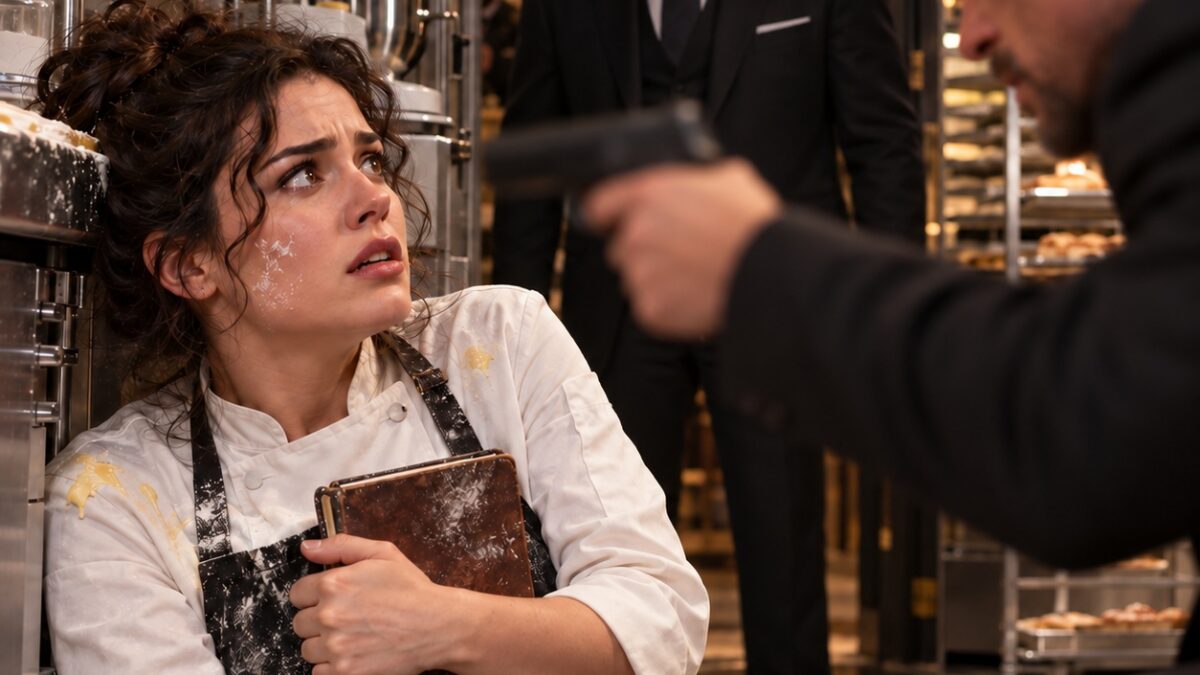
His hand disappeared inside his coat.
I looked at his face instead of his hand.
Kind.
Tired.
Resolved.
Then he gripped my arm.
The gun rose between us.
“Where is the notebook?”
I could hear the coolers humming.
“Who else saw it?”
I swallowed.
My knees were shaking.
My voice was not.
“Victor.”
“Yes?”
“You told me my pecan sticky bun reminded you of your mother.”
Something moved behind his eyes.
“You sat at my counter.”
His grip tightened.
“You looked happy.”
I looked straight at him.
“Why are you doing this?”
For one second, I saw something break through.
Not Victor the traitor.
Not Victor holding a gun.
A tired man.
Then it was gone.
“Because I’m tired, dear.”
His voice was soft.
“Thirty years beside Roman.”
His mouth twisted.
“Thirty years carrying every ugly thing.”
He stared past me.
“And he still never saw me the way he sees you.”
My breath caught.
“A pastry cook.”
He almost laughed.
“Purple glasses. Pear tarts. A smile.”
Pain filled his face.
“Varger offered me half the river.”
He looked at me.
“Do you know what it is to be second for thirty years?”
I thought of Dennis.
Of Brent.
Of being unseen.
I understood the feeling.
Not the choice.
“No.”
He sighed.
“I’m sorry.”
The gun moved closer.
“Where is the notebook?”
Nana Joe’s voice came back.
Never shrink to fit the room.
I raised my chin.
“No.”
The service door opened.
“Take your hand off her.”
Roman stood there.
Black overcoat.
Silver at his temples.
Hands empty.
Teddy behind him.
I had seen Roman angry.
Amused.
Grieving.
Jealous.
Quiet.
I had never seen him afraid.
That night I did.
Not because Victor had a gun.
Because Victor had me.
Victor turned.
The weapon moved away from my body toward Roman.
That was his mistake.
His attention left me.
I moved.
Not elegantly.
Not heroically.
I threw my weight into his arm.
The gun fired upward.
The sound exploded through the kitchen.
Plaster fell.
A light shattered.
Then Teddy hit Victor and drove him away from me.
The weapon slid across the floor.
Everything stopped.
Victor was pinned.
Roman crossed the kitchen.
He did not look at the gun.
Did not look at Victor.
He came straight to me.
“Look at me.”
His hands went to my face.
They were shaking.
“Celia.”
“I’m okay.”
“Are you hurt?”
“I’m okay.”
My whole body started trembling now that the danger was over.
I put my hands over his.
“I’m all right, old man.”
He closed his eyes.
Then I started laughing.
Not because anything was funny.
Shock.
“I have the notebook.”
His eyes opened.
“It’s in my pocket.”
I touched my coat.
“I wasn’t giving it to him.”
Roman pressed his forehead against mine.
For a long time, he just breathed.
When he finally turned toward Victor, something in him changed.
Victor stood with Teddy holding him.
His lip was bleeding.
His coat ruined.
He looked like somebody’s distinguished grandfather.
Roman stared at him.
“Eleven years.”
Victor looked confused.
“Eleven years since Eleanor died.”
Roman swallowed.
“You held me up at her funeral.”
Victor’s eyes filled.
“I would have given you anything.”
His voice broke.
“All you had to do was ask.”
Victor laughed bitterly.
“You would have given me a seat.”
A tear slid down his face.
“I wanted the head of the table.”
Then he looked at me.
“She wasn’t the problem, Row.”
His voice softened.
“I’m sorry.”
Roman did not answer.
“It was always you.”
I expected violence.
Every story I had ever heard about Roman told me what came next.
Instead, Roman walked closer.
Put one hand on Victor’s shoulder.
“You leave Tennessee tonight.”
Victor looked up.
“With whatever is in your pockets.”
Silence.
“You never speak my name again.”
Roman’s voice was almost gentle.
“And if you ever come within a hundred miles of her, you will meet a version of me you have not met tonight.”
Victor closed his eyes.
That was the end of their friendship.
Thirty years reduced to one doorway and a coat pocket.
Varger’s men arrived at the loading dock later.
Teddy’s people were waiting.
I never asked for the details.
That was one rule I kept for my own peace.
By two in the morning, I was sitting inside a quiet car wrapped in a blanket.
Someone had given me tea.
Roman sat beside me.
Not touching.
He did not know if he was allowed.
After a while, I leaned my head against his shoulder.
He went rigid.
“Don’t.”
His voice caught.
“I’m sorry.”
“That’s what I said not to do.”
He stayed still.
“I stayed.”
He looked at me.
“That was my choice.”
Slowly, his arm came around me.
“You are the bravest person I have ever known.”
“And the most stubborn.”
“Yes.”
“Good.”
I fell asleep against his coat.
The next few days were strange.
The Briarwood replaced the damaged ceiling.
Officially, there had been a minor electrical accident.
Dominic Varger suddenly found Nashville inhospitable and withdrew to Memphis.
Luis Herrera’s daughter had surgery.
She survived.
Teddy sat beside Luis in the hospital waiting room the entire time.
Marisol woke asking for ice cream.
That Friday, Mrs. Ashby called me into her office.
A thick envelope sat on her desk.
“Sit.”
I sat.
“The Dennis Whitlock problem is over.”
I blinked.
“What?”
She pushed documents toward me.
Phone records.
Bank statements.
Copies of schedules.
My notebook had helped expose another pattern.
Dennis had been selling hotel event information for more than a year to cover gambling debts.
Not necessarily everything Victor had done.
But enough.
Enough to betray the Briarwood.
Enough for police.
Enough for Mrs. Ashby.
“He was dismissed this morning.”
She adjusted her glasses.
“Police were waiting.”
I sat very still.
“And the magazine?”
She gave me a thin smile.
“I called the editor personally.”
My throat tightened.
“The lemon-lavender tart will be corrected.”
I looked down.
“Celia Monroe.”
I closed my eyes.
Nana Joe’s recipe.
My work.
My name.
Finally.
Then Mrs. Ashby slid another paper toward me.
“I would like you to become executive pastry chef.”
I looked up.
“Effective immediately.”
“Mrs. Ashby—”
“The salary is good enough that I will not insult either of us by saying it aloud in an emotional moment.”
I laughed.
Then she continued.
“And I understand there is a certain building on Gallatin Pike you once considered home.”
My heart stopped.
“How do you—”
“Mr. Blackwell.”
I stiffened.
She lifted one hand.
“He did not ask me to buy it for you.”
Good.
Because I would have killed him.
“He asked whether I knew who currently owned it.”
I stared.
“I do.”
She slid a third document toward me.
“I am offering you a legitimate business loan.”
My eyes filled.
“Market terms.”
She continued.
“In writing.”
I could not speak.
“You will repay it.”
She smiled.
“Entirely.”
I looked at the loan.
Then at her.
“I can’t—”
“Nonsense.”
She leaned back.
“A debt you choose for yourself is the only kind worth holding.”
The words sounded almost like Roman.
That made me laugh and cry at the same time.
I signed.
By October, Gallatin Pike smelled like cinnamon again.
The old bakery building had been scrubbed.
Painted.
Repaired.
The six stools were back.
The windows gleamed.
Darra cried through most of opening morning.
Teddy stood beside the door in a dark suit eating samples at a rate that threatened our first-day inventory.
Neighbors lined the sidewalk.
The barber shop owner came.
The tire store owner came.
People who remembered Nana Joe brought flowers.
I stood outside in a clean white chef coat.
My curls were loose.
My hands would not stop shaking.
The only thing missing was the sign.
And Roman.
“Where is he?”
Darra checked her watch.
“You have asked four times.”
“He said ten.”
“It is nine fifty-nine.”
“He is annoyingly punctual.”
At exactly ten, a black car stopped at the curb.
A truck pulled in behind it.
Roman stepped out.
Charcoal suit.
Purple glasses tucked into his breast pocket.
He looked at me.
Not the crowd.
Me.
“I’m sorry I’m late.”
“You’re not late.”
“It took longer to find than expected.”
Two workers lifted something from the truck.
Covered.
Heavy.
They turned it.
My breath disappeared.
The sign was old.
Red lettering.
Hand-painted.
Weathered but restored.
NANA JOE’S BAKERY
The original sign.
The one I had watched strangers carry away after the building was lost.
My hand covered my mouth.
“Roman.”
He stopped several feet away.
“I did not buy the building.”
“I know.”
“I did not pay the loan.”
“I know.”
“I did not pay your medical debt.”
“You’d better not have.”
A few people laughed.
Roman nodded toward the sign.
“This was mine to give.”
I stared at him.
“How did you find it?”
“That is not important.”
“It absolutely is.”
“It involved Kentucky.”
I laughed through tears.
He looked nervous.
Roman Blackwell.
Nervous.
In front of me.
Then he turned toward the crowd.
Everyone went quiet.
Of course they did.
This man could silence half of Nashville just by standing straighter.
He looked back at me.
“I have spent most of my life telling people what would happen.”
I crossed my arms.
“That tracks.”
More laughter.
He ignored them.
“I will not do that with you.”
My throat tightened.
“You told me once you did not want to be rescued.”
I nodded.
“You wanted to be seen.”
Tears came.
Roman continued.
“I see you.”
The street became very quiet.
“All of you.”
His eyes moved over me.
“Your stubbornness.”
I smiled.
“Your temper.”
“Careful.”
“Your kindness.”
His voice softened.
“Your strength.”
My chest hurt.
“The way you walk into rooms that have spent your whole life trying to make you smaller.”
He took one step closer.
“And somehow make the room adjust instead.”
I could hear Nana Joe laughing in my memory.
Roman looked toward the people around us.
“I want everyone here to hear one thing.”
Oh God.
“Anybody who mocks her answers to me.”
I groaned.
“Roman.”
“Anybody who harms her answers to me.”
“Roman.”
“And she—”
His voice cracked.
“Answers to nobody.”
That shut me up.
He looked at me.
“Which is why I am asking.”
Asking.
Not ordering.
Not arranging.
Not paying.
Asking.
“Celia Monroe.”
“Yes?”
He took my hand.
“Will you choose me?”
My vision blurred.
“Freely.”
He lifted my knuckles.
“Not because of my name.”
Kissed them.
“Not because of my money.”
Another kiss.
“Not because anybody is afraid of me.”
His eyes were wet.
“Just me.”
I could barely breathe.
Roman leaned closer.
“I have faced juries.”
His voice dropped so only I could hear.
“Men with guns.”
“Mayors.”
“Enemies.”
“None of them frightened me the way you do.”
I laughed through tears.
“That is the sweetest terrible compliment anyone has ever given me.”
He smiled.
“I have been starving since February.”
My heart stopped.
“For pear tart?”
“For you.”
There are moments when the correct response should be elegant.
I have never been especially elegant when it matters.
“Roman.”
“Yes?”
“Kiss me, you stubborn old man.”
He did.
Right there on Gallatin Pike.
Neighbors cheering.
Darra crying.
Teddy dropping an entire tray of samples.
Roman’s hand on my waist.
Mine around his neck.
Above us, Nana Joe’s sign.
Behind us, cinnamon coming through an open bakery door.
For the first time in my life, being seen did not feel like being judged.
It felt like being loved.
A week later, I went to Roman’s office with a white pastry box.
He was sitting behind a desk large enough to land a plane on, wearing his purple reading glasses.
I placed the box in front of him.
“I brought something.”
He looked at it.
Then at me.
“You baked?”
“Obviously.”
He untied the string.
Inside were twelve small pastries.
Golden.
Flaky.
Dusting of sugar substitute.
A card lay across the top.
SUGAR-FREE. MOSTLY.
Roman looked suspicious.
“Mostly?”
“You’re alive. Be grateful.”
He took one.
Bit into it.
His whole face softened.
I leaned against the desk.
“Careful, old man.”
He chewed.
“Too much sugar isn’t good for you.”
“I’m aware.”
“I’d like to keep you around.”
He looked at me.
I smiled.
“A long, long time.”
Then, because apparently courage comes in strange forms, I added quietly:
“Since you’re mine.”
Roman froze.
I instantly wanted to climb under his desk.
He set down the pastry.
Slowly.
“What did you say?”
“You heard me.”
“Celia.”
“No.”
“Say it again.”
I folded my arms.
“You are impossible.”
His eyes darkened.
“Please.”
That word.
From him.
I looked at the man everyone feared.
The man who could command rooms.
The man who once lied because he wanted one hour where nobody knew his name.
The man who tried to solve my problems with money until I taught him that respect sometimes meant doing nothing.
The man who stood outside my bakery and asked instead of told.
So I gave him what he wanted.
“You’re mine, old man.”
Roman went absolutely still.
Then a smile spread across his face.
Wide.
Real.
Almost boyish.
A smile from a man who still could not believe happiness had been offered to him without an invoice attached.
“That is what I thought you said.”
“You made me repeat it.”
“I wanted to hear it twice.”
He reached across the desk.
Took my hand.
His thumb moved over my knuckles.
“I have spent my entire life making people obey me.”
His voice had none of the Blackwell power in it now.
“I have never understood what it is to be chosen.”
I squeezed his fingers.
“You’d better get used to it.”
We stayed there as the sunlight over the Cumberland River turned gold.
Then purple.
Then dark.
Outside the office, Teddy sat on a chair much too small for him and ate a pastry while pretending he was not crying.
Across town, Nana Joe’s bakery glowed beneath the restored red sign.
Her recipe box sat on a shelf above the register.
Not hidden above my bed anymore.
Out in the light.
Where everybody could see it.
Nana always said nobody expected a woman who smelled like cinnamon to be dangerous.
She was right.
What she never told me was that strength did not mean doing everything alone.
It did not mean refusing love.
It did not mean turning yourself into stone so nobody could ever hurt you.
Real strength was knowing the difference between somebody trying to own you and somebody standing beside you.
Dennis wanted me smaller.
Brent wanted me different.
My mother left.
Roman had every resource in the world to control my life.
Instead, once I demanded it, he learned how to ask.
That was why I chose him.
Not because Nashville feared him.
Not because of the cars.
The house.
The money.
The whispered name.
I chose the man who wore cheap purple reading glasses because I told him to.
The man who complained about coffee being too hot after ordering it scalding.
The widower who still visited his wife’s grave.
The man who could buy almost anything but learned that my dignity was never for sale.
And he chose me.
Not the thinner version Brent imagined.
Not the silent employee Dennis wanted.
Not a woman who stayed safely behind him.
Me.
Soft.
Curvy.
Loud when necessary.
Flour on my cheek.
Cinnamon in my hair.
Standing beside him.
Never behind.
Never in front.
Beside.
I spent thirty years being told, directly or indirectly, that I occupied too much room.
Too much body.
Too much opinion.
Too much stubbornness.
Too much feeling.
I never did learn how to shrink.
Thank God.
Because the life waiting for me required every inch.
My bakery.
My name above the door.
Nana Joe’s recipes.
My debt that I would pay myself.
My own work credited to me.
And one dangerous, impossible, silver-haired man who looked at all the things other people had called “too much” and somehow decided they were exactly enough.
I had wanted to be seen.
In the end, I was.
And for the first time in my life, I did not have to become smaller to be chosen.








