PART 2: The Money I Sent My Mother for Seven Years Was Gone, and My Own Brother Knew Why
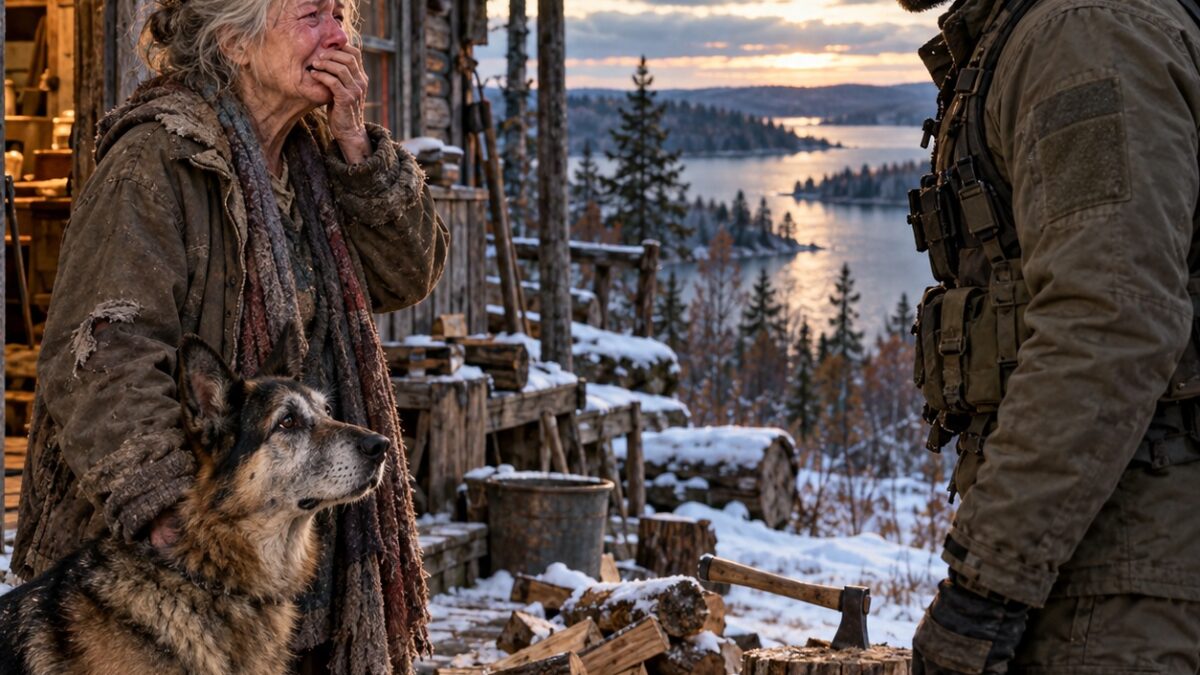
The first thing I heard was the ax.
A dull, heavy impact.
Then silence.
Another impact.
Then a longer pause.
I slowed my truck as the old cabin appeared between the birch trees.
The sight made my chest tighten.
The porch railing leaned outward.
A cracked window had been covered with clear tape.
The roof looked as though it hadn’t been properly maintained in years.
Near the steps sat a two-wheeled utility cart filled with crushed aluminum cans, copper fittings, and pieces of scrap metal.
And beside a chopping block stood my mother.
She was wearing an old brown-gray canvas coat with patches at the elbows.
A cream sweater showed beneath it.
Her black boots were worn.
Her white hair had been tied loosely behind her neck.
She raised the ax.
Stopped.
Then lowered it and rubbed her wrist.
A German Shepherd stood beside her.
Cinder.
I’d heard Mom mention him on the phone, but I hadn’t realized how much he’d become part of her daily life.
He was seven years old, golden brown with a black saddle across his back, a dark muzzle, upright ears, and a little scar along his right ear.
He watched Mom with the steady attention of a dog who had learned to recognize when someone needed help.
I pulled over.
For a moment, I couldn’t move.
My mother looked smaller than I remembered.
Not simply older.
Worn down.
I had seen thin, exhausted people in places where suffering was expected.
But this was my mother.
The woman who used to carry two grocery bags in one hand while dragging me away from trouble with the other.
The woman who had raised Warren and me after long days of work.
The woman I believed was spending her retirement comfortably beside the lake.
And she was chopping firewood to keep herself warm.
I opened the truck door.
Cinder heard me first.
His ears lifted.
He moved between Mom and the driveway.
He didn’t bark.
He simply stood, watching.
“Easy, buddy,” I said.
Mom turned.
For a second, she didn’t recognize me.
That hurt more than I expected.
Then her eyes widened.
“Damon?”
I swallowed.
“Hey, Mom.”
The ax slipped from her hand.
She stared.
Then she smiled.
And suddenly I was seventeen again, arriving home late after driving my father’s truck too fast along the lake road.
“Damon!”
She came toward me.
I crossed the yard and wrapped my arms around her.
She felt frighteningly light.
For a moment, I couldn’t speak.
I wanted to apologize.
Ask questions.
Demand explanations.
But all I managed was to hold her.
Cinder approached cautiously.
He sniffed my sleeve.
Mom laughed against my chest.
“That’s Cinder. He thinks he owns me.”
I looked down.
“Does he?”
“Mostly.”
The dog studied me.
I held out my hand.
He sniffed it, then returned to Mom’s side.
I glanced toward the chopping block.
“You’re cutting your own firewood?”
Mom shrugged.
“Wood doesn’t usually volunteer.”
I almost smiled.
That was Nell Bain.
If the roof collapsed, she’d probably complain that it had chosen an inconvenient afternoon.
But the humor didn’t change what I was seeing.
“Show me inside,” I said.
She hesitated.
Only briefly.
But I noticed.
The cabin smelled of pine smoke, cold wood, and canned soup.
A small stove stood near the wall.
An old radio rested on a shelf.
Several tins of food had been arranged neatly beside a medicine organizer.
Two coats hung near the door.
A narrow bed occupied the corner.
Beside it lay a thick cushion where Cinder slept.
Everything was clean.
Everything had been cared for.
That made it worse.
My mother wasn’t neglecting herself.
She was working incredibly hard to make a bad situation look respectable.
I touched the wall near the window.
Cold.
“Where’s the heater?”
She pointed toward the stove.
“That works.”
“That isn’t what I asked.”
“Damon, you just got here.”
I turned toward her.
“How long have you been living like this?”
She looked toward the window.
I waited.
“Mom.”
“A few years.”
“How many?”
She sighed.
“Five, if you’re going to be difficult.”
Five.
The word seemed to settle between us.
Five winters.
Five summers.
Five years of my mother living in a building that had never been intended as a permanent home.
And nobody had told me.
I looked at the patched gloves on the table.
The canned food.
The worn cushion.
The little cart outside.
Then I asked the question that had been growing inside me since Warren mentioned the cabin.
“Where’s the money I’ve been sending?”
Mom frowned.
“What money?”
I stared at her.
“The transfers.”
She shook her head.
“Damon, what transfers?”
“Eighteen hundred dollars. Every month.”
Her expression changed.
I watched the confusion become concern.
“Every month?”
“Yes.”
“For how long?”
“Seven years.”
The room went silent.
Cinder lifted his head.
Mom lowered herself into the chair beside the stove.
She looked at me for a long moment.
Then whispered, “I never received that money.”
I felt something cold move through my chest.
Not surprise.
Not even disbelief.
Something harder.
The sudden understanding that the life I’d spent years paying to protect might never have existed.
My first instinct was to drive straight back to the main house.
I wanted Warren in front of me.
Vanessa beside him.
Seven years of bank statements spread across the dining table.
I wanted answers before the sun went down.
I stood.
“I’m going back up there.”
“No.”
Mom’s voice stopped me.
I turned.
She was sitting beside the stove, her hands folded in her lap.
“Mom.”
“I said no.”
“They’ve been lying to me.”
“Maybe.”
“Maybe?”
She looked up.
“Being angry before you understand everything is how families turn one bad thing into ten.”
I stared at her.
There she was.
Seventy-two years old.
Living in a cold cabin.
Collecting scrap metal.
Chopping wood with a painful wrist.
And she was the one telling me to stay calm.
I wanted to scream.
Instead, I pulled out a chair.
Sat down.
And asked, “What happened?”
Mom stared into the stove.
For a long while, she said nothing.
Then she began.
Two years after I left for my long stretch away from home, Warren told Mom the main house needed repairs.
The roof leaked.
The wiring was outdated.
The heating system had become unreliable.
Moisture had damaged part of the basement wall.
Vanessa suggested Mom move temporarily into Dad’s old cabin while contractors worked.
At the time, it made sense.
Warren brought over a mattress.
Vanessa stocked the shelves with food.
Someone improved the stove pipe.
Mom packed a few clothes.
They told her it would be three or four months.
“Then what?” I asked.
She looked toward the window.
“The repairs took longer.”
“How much longer?”
“Warren’s business started having problems.”
I leaned forward.
“What kind of problems?”
“Money.”
Of course.
Their father, Henry Bain, had founded a small woodworking shop decades earlier.
He built furniture, repaired cabinets, and made custom woodwork for homes around Larksburg Bay.
After he died, Warren took over.
I’d assumed the business was doing well.
The photographs Vanessa sent showed finished projects, new equipment, and an expanded showroom.
But Mom explained that the business had struggled.
There were unpaid suppliers.
Expensive equipment leases.
Canceled contracts.
And growing pressure from lenders.
The temporary move lasted through the first winter.
Then spring.
Then another winter.
Vanessa said clients needed to use part of the main house for meetings while the business office was being renovated.
Warren said refinancing would help.
Then there were delays.
New contractors.
New expenses.
Another promise.
And another.
“Eventually,” Mom said, “I stopped asking when I could move back.”
I stared at her.
“Why?”
She gave me a tired smile.
“Because every time I asked, everyone looked exhausted.”
That sentence hit me harder than almost anything else she’d said.
My mother had spent her life making herself uncomfortable so the people she loved could be comfortable.
When Warren and I were boys, she’d eaten the burnt toast.
Worn the old winter coat.
Skipped things she needed because we wanted new shoes.
She had called that parenting.
And all of us had accepted it.
Now she had done the same thing on a much larger scale.
She’d given up her home because everyone else seemed to need it more.
I looked around the cabin.
“Where are your things?”
“Some are here.”
“And the rest?”
“Storage.”
“Whose storage?”
“Warren arranged it.”
I took a slow breath.
“Mom, how much money do you receive every month?”
“Enough.”
“That’s not a number.”
She sighed.
“My Social Security. A little savings.”
“And the money I sent?”
“I thought you occasionally sent something for Christmas.”
I stared.
“Christmas?”
“Gift cards. Flowers. Once money for a medical copay.”
I felt physically sick.
I had sent thousands of dollars.
Year after year.
The money was supposed to make sure Mom never had to choose between groceries, medication, and heating.
Instead, she had been surviving on her own income.
“What happens when you can’t cover everything?”
She looked away.
“Sometimes there’s enough.”
“And sometimes?”
She didn’t answer.
“Mom.”
“Sometimes there isn’t.”
I rubbed both hands over my face.
“What do you do?”
She glanced toward the cart outside.
“Whatever needs doing.”
She explained that she repaired small wooden items using techniques Dad had taught her.
Stools.
Picture frames.
Loose drawers.
Old chairs.
She sold what she could through a resale shop in town.
She collected aluminum cans from recycling areas where people left them.
Copper fittings sometimes brought a little more money.
When the weather was cold, she gathered fallen branches from permitted woodland areas.
Cinder went with her.
“Sometimes he helps pull the cart,” she added.
I looked at the German Shepherd.
“What?”
“He has a proper harness. Only light loads.”
My throat tightened.
She smiled faintly.
“He doesn’t like watching me struggle.”
Cinder lifted his head.
I couldn’t answer.
Because I had spent years believing my money was doing what that dog had actually been doing.
Staying beside my mother.
Noticing when she slowed.
Helping when she needed it.
And never leaving her alone with a burden simply because she said she was fine.
Later that afternoon, Mom opened a drawer to find an old receipt.
Something metallic rolled forward and struck the wood.
Cinder stood.
Mom froze.
I noticed the change in her expression immediately.
She reached inside and removed a small dark-leather box.
I recognized it.
Dad’s watch.
He’d worn the same simple steel watch for almost thirty years.
The clasp was scratched.
The band had been repaired twice.
He wore it while working in the shop, fishing with Warren and me, and fixing things around the house.
I remembered him tapping the glass whenever it ran slow.
I looked at the empty box.
“Where is it?”
Mom didn’t answer.
“Mom?”
She ran one finger along the worn velvet.
“I sold it.”
My chest tightened.
“When?”
“Two winters ago.”
“Why?”
She looked up.
“The electric bill.”
Three words.
Quiet.
Ordinary.
Devastating.
I stared at the empty box.
I remembered Dad wearing that watch when he taught me how to use a table saw.
I remembered him checking it before Warren’s Little League games.
I remembered the way he polished the scratched glass with his thumb.
And Mom had sold it to keep the lights on.
While I was sending eighteen hundred dollars every month.
I stood and walked to the window.
Outside, Lake Aurelia had turned gray.
For several seconds, I couldn’t speak.
Then I asked the question I’d been avoiding.
“Why didn’t you tell me?”
Mom remained silent.
I turned.
“Please don’t protect me from this.”
She folded the box closed.
“You called from places I didn’t know.”
“That doesn’t matter.”
“It mattered to me.”
She reminded me of a phone call three years earlier.
I had been exhausted.
Preparing to leave on another assignment.
I’d told her I might be unreachable for a while.
She remembered my voice.
Not frightened.
Just distant.
Already focused on the next thing I had to do.
“You said you were leaving the next morning,” she told me.
I swallowed.
“What did you want me to say?”
“That the cabin was cold?”
“That Warren was having money problems?”
“That I was struggling with the bills?”
“Yes.”
She shook her head.
“No, Damon. You wanted to hear that I was safe enough for you to go do your work.”
I looked down.
“So I told you I was.”
I couldn’t argue.
Because she was right about something I hated admitting.
I’d called home.
I’d sent money.
I’d asked whether everything was okay.
But I’d never asked questions that required real answers.
I had wanted reassurance.
And my mother had given it to me.
That night, Warren texted.
When are you coming back up to the house?
I stared at the message.
Then typed:
Staying with Mom tonight.
I put the phone away.
The cabin had no guest room.
Mom offered me her bed.
I refused.
She offered the chair.
I refused that, too.
Eventually, I stretched out on the narrow sofa with an old blanket.
Cinder watched the entire negotiation.
When Mom turned off the lamp, the dog settled on the floor between her bed and the door.
Not beside me.
Between me and Mom.
“Still doesn’t trust me,” I muttered.
Mom’s voice came through the darkness.
“He trusts what he knows.”
I stared at the ceiling.
“Fair.”
Outside, wind moved through the birch trees.
The stove clicked softly.
And for the first time in seven years, I fell asleep under the same roof as my mother.
Not in the beautiful family house I’d been paying to maintain.
In a cold wooden cabin beside the lake.
With a dog who seemed to understand exactly who needed protecting.
I woke before dawn to the sound of nails tapping against the floor.
Cinder stood beside a narrow metal cabinet.
He looked at me.
Then at Mom’s coat hanging near the door.
Then back at the cabinet.
“You need outside?”
He didn’t move toward the door.
Instead, he touched the cabinet with his nose.
Mom stirred.
“What is he doing?”
“I was going to ask you.”
She sat up.
“Oh.”
“What?”
“That’s where I keep my mail.”
I looked at the cabinet.
“Can I look?”
She nodded.
I opened it.
Inside were utility bills, prescription receipts, insurance notices, bank envelopes, and letters Vanessa had brought over.
I sorted through them slowly.
Then I found an envelope bearing the logo of a regional commercial lender.
The heading read:
Commercial Loan Confirmation.
Borrower:
Warren Bain.
I scanned the document.
Then stopped.
A section concerning collateral referenced property interests associated with my mother.
I read it again.
Then handed the page to her.
She adjusted her glasses.
“What is this?”
“You tell me.”
Her eyes moved across the page.
“I’ve never seen this.”
“You didn’t agree to a business loan?”
“No.”
I looked at the document.
Then at Mom.
For a moment, I felt the same cold anger I’d experienced the day before.
But this time, I stayed seated.
Because I was beginning to understand that the problem wasn’t simply money that hadn’t reached her.
Someone had connected her name or her property to financial obligations she didn’t understand.
And that required more than an angry confrontation.
It required evidence.
The following morning, I made coffee while Mom sliced an apple at the counter.
Her left knee was stiff.
She shifted her weight carefully whenever she turned.
Cinder sat beside her.
I watched him.
He had become less suspicious of me overnight, but he still followed Mom’s movements closely.
“I need to understand what your days look like,” I said.
She glanced at me.
“You’ve seen the glamorous part.”
“I’m serious.”
“So am I.”
I waited.
Finally, she looked at Cinder.
“If you want to understand, walk with him.”
I frowned.
“Where?”
“Where we go.”
She reached for her old canvas coat.
I immediately noticed her knee.
“You’re not walking far.”
“I’ve been walking on it for years.”
“That doesn’t mean it’s a good idea.”
She looked at me.
The same look she’d given me when I was fourteen and tried explaining why I had missed curfew.
“I didn’t say I was walking all the way.”
I almost smiled.
We went outside.
The path behind the cabin curved through birch and pine.
Frost glittered on the grass.
The air smelled of damp leaves and wood smoke.
Cinder walked at Mom’s pace.
Not mine.
Every time she slowed, he slowed.
When she stopped to adjust her glove, he stopped without being told.
After ten minutes, he moved toward a shallow ditch filled with fallen branches.
Mom pointed.
“This is where I get most of the dry wood.”
I looked around.
“You cut trees here?”
“No. Deadfall.”
She tapped a branch with her boot.
“Storms do half the work.”
I lifted one.
It was heavier than it looked.
“How often do you come here?”
“Depends.”
“On what?”
“The weather.”
“Mom.”
She sighed.
“Twice a week when it’s cold.”
I looked toward Cinder.
“He helps?”
“He supervises.”
The dog glanced at me.
Mom added, “Aggressively.”
I laughed.
The sound surprised me.
It had been a long time since anything about coming home felt funny.
We continued along the road until Mom stopped.
“That’s enough for my knee.”
I looked back toward the cabin.
“Want me to take you home?”
“No.”
She nodded toward Cinder.
“Follow him.”
I frowned.
“Where?”
“He knows.”
I glanced at the dog.
“Apparently everyone around here has more information than I do.”
Mom’s smile was faint.
“That can happen when you’re gone a long time.”
She hadn’t meant it cruelly.
That made it hurt worse.
Cinder led me to a recycling yard near the edge of town.
A corrugated-metal building stood behind piles of sorted aluminum, copper, and discarded appliances.
A man stepped out from behind a scale.
He was short, broad through the chest, with a gray beard and a dark knit cap.
He looked at Cinder.
“Well, there’s the foreman.”
The dog trotted toward him.
The man scratched behind his ears.
Then noticed me.
“You one of Nell’s boys?”
“Yes.”
“Which one?”
“Damon.”
His expression changed.
“The Navy one.”
I nodded.
He looked at me for a long moment.
Then said, “About time.”
The words landed like a slap.
I didn’t argue.
The man introduced himself as Earl Benton.
He explained that Mom brought scrap metal when she could.
Aluminum.
Copper.
Small pieces of discarded hardware.
“She never takes anything she shouldn’t,” he said.
I nodded.
“Cinder comes with her?”
“Every time.”
Earl smiled.
“Even in weather that would keep sensible people indoors.”
I looked toward the dog.
He was sniffing a stack of old crates.
“How much does she earn?”
“Depends on what she brings.”
Earl hesitated.
“She doesn’t like charity.”
“I know.”
“If I round the weight up, she catches me.”
I almost smiled.
“That sounds like Mom.”
He nodded.
“She works hard.”
I looked toward the road.
I wanted to ask why nobody had called me.
Why so many people had watched my mother struggle while I believed she was safe.
But I knew the answer wasn’t simple.
Some probably assumed I knew.
Others may have thought it wasn’t their place.
And Mom herself had spent years making sure nobody understood how difficult things had become.
I thanked Earl.
He only nodded.
Then Cinder headed toward the town square.
Our next stop was Bell & Pine Resale.
The shop occupied an old brick storefront filled with furniture, lamps, picture frames, dishes, and things people had decided they no longer needed.
A bell rang when I opened the door.
A woman behind the counter looked up.
She was in her late sixties, wearing a moss-green cardigan and oval glasses.
Her silver-brown hair curled around her face.
The moment she saw Cinder, she smiled.
“There you are.”
Then she saw me.
Her smile faded.
“So you came back.”
I knew her.
Mara Bell.
She’d known our family for decades.
“Mara.”
She studied me.
“Damon.”
Cinder moved behind the counter as though he owned the place.
Mara didn’t stop him.
I looked around.
“Mom sells things here?”
“Yes.”
“What kind of things?”
Mara removed her glasses.
Then led me toward a shelf near the back.
She showed me a wooden stool.
A repaired picture frame.
A small drawer box with new runners.
A brass lamp polished until it looked almost new.
“She fixes what people throw away.”
I ran a thumb along the stool’s edge.
The sanding was careful.
The joint was solid.
I remembered Dad teaching Warren and me how to smooth pine without rounding the corners.
Mom had remembered every lesson.
“She made these?”
“Some of them.”
“Do you pay her fairly?”
Mara looked offended.
“No.”
My jaw tightened.
Then she smiled.
“I pay her more than fairly.”
I blinked.
“What?”
“Your mother has pride the size of Wisconsin. If I offered charity, she’d never come back.”
“So you overpay?”
“I pretend I have terrible business instincts.”
I looked around the crowded shop.
“That part seems believable.”
Mara laughed.
Cinder thumped his tail against a cabinet.
Then her expression became serious.
“There’s something else.”
She reached beneath the counter and brought out a narrow wooden box.
I recognized it instantly.
Dad’s old watch box.
She opened it.
Inside lay the steel watch.
Scratched face.
Repaired band.
Still ticking.
I stared.
“I thought Mom sold it.”
“She did.”
“Then why is it here?”
“Because I bought it.”
I looked at her.
“And because,” Mara added quietly, “I never intended to sell it again.”
She explained that Mom had needed money for electricity two winters earlier.
Mara offered to help.
Mom refused.
So Mara bought the watch and kept it.
I reached toward the box.
Then stopped.
“Can I take it?”
Mara didn’t answer.
I understood why.
The watch wasn’t mine.
Mom had made a choice.
Maybe a heartbreaking one.
But still hers.
I lowered my hand.
“I should ask her.”
Mara nodded.
“Exactly.”
Mom came to the shop around noon.
She sat beside the counter while I placed the watch in front of her.
Cinder settled beside her chair.
Mom stared at it.
For a long moment, she didn’t speak.
I asked, “Do you want it back?”
She touched the band.
Then withdrew her hand.
“No.”
I stared.
“Mom.”
“Mara bought it.”
“She kept it for you.”
“I know.”
“Then why not take it?”
Mom looked at me.
“Because I sold it.”
I started to argue.
Then stopped.
She continued.
“I needed electricity. Mara paid me. She didn’t cheat me.”
Mara looked as though she wanted to protest.
Mom raised one finger.
“Don’t.”
Mara closed her mouth.
I sat back.
For years, I’d believed protecting family meant preventing them from losing things.
But I was beginning to understand that protection could become another form of control.
Mom had suffered.
She had made sacrifices.
But that didn’t mean I had the right to overturn every decision she made.
I nodded.
“All right.”
Mom smiled faintly.
Cinder rested his head against her knee.
Before we left, Mara told me something else.
There had been months when Mom delayed filling prescriptions.
Not emergencies.
Not dramatic collapses.
Just a few days.
A week.
Sometimes longer.
One winter, she used the cabin’s electric heat only at night and relied on the wood stove during daylight.
I walked outside.
Sat on the curb.
Cinder followed.
He lowered himself beside me.
For seven years, I had sent money on schedule.
Never missed a month.
I’d believed consistency meant responsibility.
Now I understood that money sent without attention could become another kind of absence.
On the way back, Cinder turned down a narrow dirt lane.
I stopped.
“Wrong way.”
He kept walking.
I followed.
The lane ended near an old storage trailer half-hidden behind brush.
Cinder stopped near the door.
He sniffed once.
Then sat.
I looked at the faded parcel marker beside the trailer.
Something about the location bothered me.
I photographed the number.
Then returned to town.
At the county records office, I searched the public parcel information.
The result made me sit straighter.
The land near the trailer, the cabin, and part of Dad’s old workshop property appeared in documents associated with Warren’s commercial financing.
Mom’s name was connected to some of the property interests.
I stared at the screen.
The language was technical.
I wasn’t a lawyer.
And I wasn’t going to pretend a Navy SEAL knew more about trusts and commercial lending than the people trained to handle them.
So I called Owen Pike.
We’d gone to school together.
He now worked at Larksburg Community Bank.
I explained the situation.
Owen listened.
Then said, “If your mother wants to review accounts she has authority over, she needs to come herself.”
“Can I be there?”
“If she authorizes it.”
“Tomorrow?”
“Ten-thirty.”
I thanked him.
Then returned to the cabin.
Mom was sitting beside the stove brushing Cinder’s coat.
I placed the property printouts on the table.
I didn’t say I’d fix everything.
I didn’t threaten Warren.
I sat across from her.
“Mom, do you want to find out what these mean?”
She studied the papers.
Then looked at Cinder.
He rested his chin against her knee.
She stroked his ears.
Finally, she looked at me.
“Yes.”
And for the first time since I came home, the search for the truth belonged to her, too.
Owen met us at the bank the next morning.
He looked almost exactly as I remembered him.
Thin glasses.
Neatly combed hair.
Careful expression.
He’d been the kind of kid who corrected teachers and apologized afterward.
That habit had apparently followed him into adulthood.
He led us into a small office.
Before opening anything, he explained the rules.
“Mrs. Bain, I can show you information you’re legally authorized to access.”
Mom nodded.
“Damon, you can remain if your mother wants you here.”
I looked at her.
She nodded.
“He stays.”
Owen began reviewing records.
At first, the pattern looked ordinary.
Social Security deposits.
Utility payments.
Insurance.
Then the structure changed.
Four years earlier, some bills began being paid through a linked household account.
Other transfers moved automatically.
I leaned forward.
Owen raised a finger.
“Let me explain before we decide what it means.”
I sat back.
The change had occurred after Mom’s fall.
I turned toward her.
“What fall?”
She sighed.
“January. Freezing rain. I slipped near the mailbox.”
“You never told me.”
“It healed.”
“That’s not the point.”
She gave me a look.
I stopped.
Owen continued.
Mom had fractured her wrist badly enough to require surgery.
For several weeks, she struggled to write checks, carry groceries, or manage paperwork.
Vanessa stepped in.
Mom remembered signing documents.
“I thought it was so she could pay bills until my hand worked again.”
Owen nodded.
“That would be consistent with a temporary financial arrangement.”
He printed several pages.
Some signatures were clearly Mom’s.
The problem wasn’t an obvious forgery.
The problem was what happened afterward.
I looked at the documents.
“So she signed something that let Vanessa use the accounts?”
Owen chose his words carefully.
“Some authority was granted. Whether later actions stayed within the intended scope needs independent review.”
Mom looked embarrassed.
“I should’ve read everything.”
I leaned toward her.
“You were injured.”
“I still signed.”
Owen spoke gently.
“Signing a document and understanding how that authority was later used are two separate questions.”
That sentence changed the room.
Mom looked at him.
Then nodded slowly.
She seemed to realize that trusting someone when she needed help didn’t mean she had agreed to surrender control forever.
As Owen gathered another page, Mom noticed handwriting beside one of her signatures.
Three words.
Written in blue ink.
She touched the paper.
“That’s mine.”
Owen looked up.
“The handwriting?”
“Yes.”
I leaned closer.
The words read:
For temporary recovery.
Mom stared.
“I remember writing that.”
Her voice trembled.
“I wanted Vanessa to understand it was temporary.”
I looked at the note.
Such a small thing.
Three words in a margin.
But they mattered.
Not because they automatically invalidated anything.
Not because they solved the case.
Because they confirmed something about what Mom believed she was agreeing to.
She hadn’t intended to surrender permanent control.
Owen copied the page separately.
Then advised us to consult an independent attorney.
Outside, I called Rebecca Shaw.
She’d helped Dad with estate planning years earlier.
She was sixty-one now, sharp, direct, and still possessed the kind of calm authority that could make grown men stop talking.
She agreed to review the documents by video that afternoon.
Rebecca’s first instruction was simple.
“Do not confront your brother until we’ve reviewed the facts.”
I nodded.
“Understood.”
“Do not take documents from his house unless you’re entitled to them.”
“I know.”
“Do not access private accounts using saved passwords.”
“I wasn’t planning to.”
“Do not threaten Warren.”
I paused.
Rebecca lowered her glasses.
“That pause is why I said it.”
Mom almost smiled.
Rebecca continued.
“Your job is not to make the facts more dramatic. Let the records tell us what happened.”
I leaned back.
I didn’t enjoy hearing that.
But I needed it.
Warren came to the cabin that evening.
No warning.
Cinder heard his truck first.
The dog stood beside Mom and watched the door.
Warren entered after she called him in.
He looked worse than the day before.
His eyes were bloodshot.
His work jacket hung open.
Dark stubble covered his jaw.
“You went to the bank,” he said.
I remained seated.
“Yes.”
He looked at Mom.
“You could’ve called me.”
Mom folded her hands.
“I’m beginning to understand I should’ve called more people besides you.”
Warren flinched.
That mattered.
He sat.
For several minutes, nobody spoke.
Then I asked, “Tell me about the business.”
He rubbed both hands over his face.
And finally, my older brother began telling the truth.
After Dad died, the woodworking shop struggled.
Two experienced employees left.
Orders slowed.
Warren refused to close it.
Dad had built that business from almost nothing.
To Warren, shutting it down felt like burying him twice.
So he expanded.
New equipment.
A larger workspace.
Commercial financing.
For a while, it worked.
Then material costs rose.
A major hotel contract fell through.
Suppliers demanded payment.
The loans remained.
Warren kept borrowing time.
Then money.
Then more time.
I listened without interrupting.
Finally, I asked, “When did my money start going into the business?”
He looked toward the stove.
“Not all of it.”
“That wasn’t my question.”
He swallowed.
“Third year.”
I stared at him.
“What?”
“One payroll cycle.”
He rubbed his face.
“I thought I could replace it before anyone noticed.”
“Then?”
“Another month. A supplier threatened to stop deliveries.”
He looked down.
“Then taxes. Insurance. Equipment.”
I felt my jaw tighten.
“Did Mom know?”
He looked at her.
Then at the floor.
He said nothing.
That silence answered everything.
The next morning, I went to the main house.
This time, I called first.
Vanessa was waiting.
I placed seven years of transfer statements on the dining table.
The total exceeded one hundred fifty thousand dollars.
She looked at the papers.
Then at me.
“Yes,” she said. “The money came here.”
I stared.
“You knew.”
“I handled the accounts.”
I pointed at the memo lines.
“Medication. Heat. Groceries.”
“Taxes. Repairs. Insurance.”
“And business expenses.”
Vanessa’s expression tightened.
“Expenses that helped keep the property together.”
“That isn’t what I sent it for.”
She folded her arms.
“And where were you when the roof failed?”
I said nothing.
“Where were you when the bank threatened Warren?”
Silence.
“Where were you when your mother fell on ice and couldn’t write her own name for six weeks?”
I felt my jaw tighten.
Vanessa leaned forward.
“You transferred money and thought the transfer itself made you present.”
The words landed because part of them was true.
That didn’t excuse what she had done.
But truth didn’t become false simply because it came from someone who had crossed a line.
I looked at the papers.
“I wanted Mom taken care of.”
“And Warren wanted to save the business.”
“That doesn’t give you the right to use her money.”
Vanessa’s composure faltered.
“She signed the authorizations.”
“She thought they were temporary.”
“She signed.”
“That’s not the same as understanding what you did afterward.”
For a moment, neither of us spoke.
Then Vanessa opened a folder.
More documents.
More signatures.
Some appeared genuine.
I photographed the pages with permission and sent copies to Rebecca.
I had wanted the deception to be simple.
A forged signature.
A stolen account.
A clear villain.
Instead, the documents told a more complicated story.
Warren had tried to save the business at almost any cost.
Vanessa had treated control as responsibility until she stopped recognizing the difference.
I had sent money and accepted reassurance because coming home to ask difficult questions felt inconvenient.
And Mom had trusted all of us.
The truth didn’t divide neatly into good people and bad people.
It was worse.
People who loved each other had made selfish choices.
And those choices had hurt the one person everyone claimed to be protecting.
Three days after I arrived, the weather turned colder.
The sky above Lake Aurelia softened beneath high clouds.
Cinder spent most of the morning watching me from beside the stove while I sorted bank statements.
At one point, he stood.
Walked across the cabin.
And dropped his leash beside my boot.
I looked down.
“Subtle.”
He nudged it again.
Mom laughed.
“He’s been waiting twenty minutes.”
“You could’ve told me.”
“I wanted to see how long it took the Navy to recognize a request.”
I shook my head.
Then stood.
We took the path north of the cabin.
Frost hardened the ground.
Birch leaves scraped across the road.
A hundred yards beyond the old workshop lane, Cinder turned toward the storage trailer.
I recognized it immediately.
Mom stopped.
Her expression changed.
Not surprise.
Recognition.
I looked at her.
“You know this place.”
She nodded.
“My things are still there.”
“What things?”
She looked toward the trailer.
“Most of the house.”
I stared.
She explained that when Warren and Vanessa moved her out for repairs, they packed nearly everything into storage.
Furniture.
Photographs.
Clothes.
Dishes.
Dad’s tools.
The belongings she didn’t need immediately.
It was supposed to be temporary.
That word again.
Temporary.
I was beginning to hate it.
We reached the trailer.
Its paint had faded.
Rust darkened the hinges.
Dead weeds grew around the wheels.
I looked at the lock.
“Do you have a key?”
Mom reached into her coat pocket.
A small brass key rested in her palm.
“Would this help?”
I almost smiled.
She opened the lock herself.
I helped with the doors only after she nodded.
When they swung outward, the smell of dust, cedar, old fabric, and trapped summers came into the cold air.
I stood at the entrance.
It felt less like looking into storage than looking into a life someone had paused.
Boxes lined the walls.
A wooden rocking chair stood upside down near the back.
Mom’s sewing machine rested beneath a yellowing sheet.
Crates of floral china were stacked beside wedding albums.
Christmas decorations.
Dad’s winter coats.
An old hallway lamp.
Even the wooden ruler with pencil marks showing Warren’s and my childhood heights.
Mom stepped inside.
She touched the rocking chair.
“Your father hated this thing.”
I remembered.
“It squeaked.”
“He said it sounded like a dying goose.”
“He tried fixing it six times.”
“Seven.”
We laughed.
Cinder moved between us.
He walked toward a low wooden chest.
Sat.
And waited.
Mom smiled.
“He remembers that.”
“What?”
She opened the chest.
Inside were folded blankets.
Near the top lay an old dark-plaid blanket worn almost smooth with age.
“That was your father’s.”
She touched it.
“I brought it back to the cabin one winter. Cinder slept on it for nearly a year.”
The dog lowered his nose toward the fabric.
I watched him.
Nothing mystical.
Just memory.
A familiar scent.
An old road.
A place connected to warmth and someone he loved.
And somehow, that felt more meaningful than anything supernatural could have.
Beneath the blankets was an old brown-leather satchel.
I recognized it immediately.
Dad had carried that bag to the bank, the lumberyard, tax meetings, and once to my high school principal after I broke a classroom window with a baseball.
I looked at Mom.
“Yours?”
“Mine now.”
“Can I?”
She nodded.
The leather buckle cracked softly.
Inside were old receipts, property maps, measurements, insurance correspondence, and tax papers.
Then I found a narrow black notebook.
Dad’s handwriting filled the pages.
Materials.
Costs.
Fence measurements.
Water lines.
Notes about trees that needed removal.
Then a section marked:
Estate.
Rebecca Shaw.
Below it was a file number.
And beneath that, a sentence.
Nell keeps cabin plus north acreage use for life. Boys deal with rest later. Do not move her.
I read it twice.
My throat tightened.
“Dad wrote this.”
Mom nodded.
She touched the page.
For a long moment, neither of us spoke.
Then Cinder moved toward one of Dad’s old coats.
He pushed his nose beneath the sleeve.
Something fell to the floor.
A brass key.
Mom stared.
Then burst out laughing.
“Oh, Henry.”
I looked at her.
“What?”
“Your father lost that key for six years.”
“To what?”
“The old document cabinet.”
I felt my pulse accelerate.
Then Mom shook her head.
“Don’t get excited. He kept fishing licenses in there.”
I laughed despite myself.
Cinder looked between us.
For a moment, the trailer wasn’t a place full of everything Mom had lost.
It was a room full of memories.
And not every memory hurt.
I photographed the notebook pages and called Rebecca.
When I read Dad’s note aloud, she interrupted immediately.
“Important distinction, Damon.”
“I know.”
“No. I need you to hear it.”
She paused.
“Your father’s notebook isn’t a deed.”
I looked at Mom.
“I understand.”
“It doesn’t establish ownership. It doesn’t override a trust. It doesn’t automatically invalidate anything Warren signed.”
“So it means nothing?”
“I didn’t say that.”
She asked for the file number.
I read it.
A pause followed.
“That looks familiar.”
Rebecca had worked with Dad during his estate planning years.
She searched her archived index.
Within an hour, she found the corresponding trust file.
By late afternoon, she had obtained the formal documents.
We joined her on a video call from the cabin.
She reviewed them carefully.
Then looked up.
“This is better.”
I leaned forward.
“How?”
She turned to one section.
The language was formal, but the meaning was clear.
Mom possessed lifetime occupancy and use rights over the cabin and a defined portion of the northern acreage.
The trust also established conditions for transactions materially affecting those interests.
I stared.
“And Warren’s loan?”
Rebecca raised one finger.
“Slow down.”
I sat back.
“We don’t yet know whether the lender received complete disclosures. We don’t know whether the collateral language actually reaches Eleanor’s protected interest. We also need to review whether the financial authorization was used beyond its intended scope.”
I looked at Mom.
“So what do we know?”
Rebecca’s voice remained steady.
“We know enough to ask formal questions before anyone takes further action involving the property.”
It wasn’t victory.
But it was the first time since coming home that I felt we had a real path forward.
Rebecca explained the next steps.
Preserve records.
Review the accounts independently.
Compare the commercial loan documents with the trust.
Examine Vanessa’s authority.
Notify the appropriate parties that Mom’s protected interests required review.
When Rebecca finished, Mom asked the question I hadn’t.
“What happens to Warren?”
Rebecca removed her glasses.
“Nothing automatically.”
Mom nodded slowly.
That mattered to her.
She didn’t want revenge disguised as procedure.
She wanted the truth.
The preservation notice went out before evening.
Warren called seventeen minutes later.
I stared at the phone.
Let it ring.
A voicemail arrived.
Then another call.
Then a text.
What exactly are you trying to do?
Ten minutes later:
You don’t understand how the trust works.
Then:
Call me before Vanessa sees this.
I read that sentence twice.
Before Vanessa sees this.
Interesting.
An hour later, Vanessa called Mom directly.
Mom put the phone on speaker.
Vanessa’s voice was controlled.
Almost too controlled.
“Rebecca sent Warren something.”
Mom answered calmly.
“She sent both of you something.”
A pause.
Vanessa continued.
“Warren told me he understood the trust when we signed the loan documents.”
From the background, Warren’s voice cut in.
“I said I understood the business authority.”
Vanessa’s tone sharpened.
“You told me the land side was covered.”
“I said the accountant thought it was.”
“You never said that.”
Mom looked at me.
I said nothing.
For the first time, the fault line between Warren and Vanessa was visible.
Warren believed Vanessa had handled the legal details.
Vanessa believed Warren had confirmed the property authority.
Neither could honestly claim ignorance.
Both had known enough to ask harder questions.
Neither had wanted the answers badly enough to stop.
After the call ended, Mom looked toward Cinder.
He was asleep near the stove, one paw resting across the old plaid blanket.
I turned toward her.
“Rebecca will handle the records.”
She nodded.
“And us?”
I understood what she meant.
“That part we handle ourselves.”
Outside, the first snow began falling over Lake Aurelia.
The preliminary audit summary arrived on a Thursday morning.
Rebecca sent it in three parts.
I read the first page standing at Mom’s kitchen counter.
By the second, I sat down.
By the third, I was angry enough that Cinder left his place near the stove and quietly positioned himself beside Mom.
The numbers weren’t simple.
That almost made them worse.
Not every dollar I’d sent had been misused.
Property taxes had been paid.
The main house’s roof had been repaired.
Insurance premiums were covered.
Several plumbing and electrical repairs were legitimate.
Some expenses benefited the entire family property.
I could live with that.
What I couldn’t accept was everything else.
Money intended for Mom’s medication, heat, groceries, and living expenses had gone toward Warren’s woodworking business.
Equipment leases.
Commercial credit cards.
Delinquent supplier accounts.
Business debt.
Payments associated with the expensive SUV parked outside the main house.
All while Mom had been buying groceries from her Social Security income, delaying prescriptions, and gathering firewood.
I stared at the page.
“Tell me I’m reading this wrong.”
Rebecca’s voice came through the phone.
“I can’t.”
I closed my eyes.
Mom sat beside me.
She didn’t look angry.
She looked tired.
That was somehow worse.
I had imagined my brother stealing money.
But the reality was more tangled.
Some money went toward legitimate household expenses.
Some was redirected into the business.
Some transactions were tied to authorizations Mom remembered signing but hadn’t understood as permanent.
And all of it had happened while Warren and Vanessa insisted they were managing everything responsibly.
I looked at Mom.
“What do you want to do?”
She studied the papers.
Then said, “I want them to stop deciding for me.”
I nodded.
That was the clearest instruction she’d given me since I returned.
And for once, I knew better than to replace it with my own plan.
Warren and Vanessa met with Rebecca separately.
Then together.
The legal review continued.
The lender was notified of the disputed property interests.
The trust documents were compared with the commercial financing arrangements.
Accounts were examined.
The business’s debts were separated from Mom’s personal finances.
It took meetings.
Letters.
More meetings.
Account statements.
Phone calls.
And long afternoons in which nobody felt satisfied.
I had spent my adult life training to make decisions quickly.
This was different.
Nobody could solve it by kicking open a door.
The people involved were my family.
The documents had consequences.
And the person most affected was entitled to decide what happened next.
Mom insisted on participating in every important conversation.
She read the explanations.
Asked questions.
Requested time when she needed it.
Occasionally she became frustrated.
So did I.
But slowly, the direction changed.
The process stopped being something Warren, Vanessa, or I did around Mom.
It became something she directed.
The hardest conversation happened at the cabin.
Mom asked Warren and Vanessa to come.
I was there because she wanted me there.
Cinder lay beside the stove.
Rebecca joined by video for part of the discussion.
Warren looked exhausted.
Vanessa sat stiffly in the chair opposite Mom.
Nobody spoke at first.
Then Warren said, “Mom, I never meant for things to get this bad.”
Mom looked at him.
“I know.”
He swallowed.
“I was trying to save Dad’s shop.”
“I know that too.”
“I thought if we could get through one more contract—”
Mom raised her hand.
He stopped.
She looked at Vanessa.
“And you?”
Vanessa folded her hands tightly.
“I thought somebody had to keep everything organized.”
Mom nodded.
“Organized.”
Her voice was quiet.
“You moved my money.”
Vanessa lowered her eyes.
“You signed the authorization.”
Mom looked at her steadily.
“I signed because my wrist was broken and I needed help paying bills.”
Vanessa said nothing.
“I didn’t sign because I wanted somebody to decide how I should spend the rest of my life.”
Warren shifted in his chair.
“Mom—”
She raised her hand again.
“No.”
Silence.
For a moment, I saw the woman who had raised us.
Not a frail elderly person sitting in a cold cabin.
Not somebody who needed rescuing.
Our mother.
The woman who had always known when we’d crossed a line.
She looked at Warren.
“You wanted to save your father’s business.”
He nodded.
“That’s not a bad thing.”
His eyes filled.
“But you were so frightened of losing it that you stopped asking what it was costing everybody else.”
Warren looked down.
Mom turned toward Vanessa.
“You wanted to keep things under control.”
Vanessa’s lips trembled.
“Yes.”
“But somewhere along the way, you began treating my choices as problems to manage.”
Vanessa wiped her eyes.
Mom looked at me last.
I felt my chest tighten.
“Damon.”
“Yes, Mom.”
“You sent money because you loved me.”
I nodded.
“But you spent years believing that was enough.”
I couldn’t look away.
“I know.”
She took a breath.
“And now you’ve come home and want to fix everything.”
I swallowed.
“Yes.”
“I love you for that.”
Her eyes filled.
“But I don’t want to be managed by another son.”
That hurt.
Because I knew she was right.
She looked at all three of us.
“I’ve spent years letting people decide what would be easiest for everyone.”
Her voice became firmer.
“I’m finished doing that.”
Nobody interrupted.
“I want to know where my money goes.”
She looked at Warren.
“I want the business kept separate from my personal finances.”
She looked at Vanessa.
“I want documents explained before I sign them.”
Then she looked at me.
“And I want to decide where I live.”
I nodded slowly.
“All right.”
It was one of the hardest promises I’d ever made.
Not because it required action.
Because it required restraint.
Cinder rose and placed his head across Mom’s knee.
She rested one hand between his ears.
The cabin became quiet.
And I realized something.
For years, we’d treated Mom’s life as a problem to solve.
Now, for the first time, we were listening to her describe the life she actually wanted.
Three months later, winter had settled completely over Larksburg Bay.
Snow covered the roofs.
The lake had frozen near the shoreline.
Birch trees stood white against the darker pines.
Smoke rose from chimneys across the valley.
The audit ended without a dramatic courtroom scene.
No police cars raced up the driveway.
Nobody lost everything overnight.
Instead, consequences arrived through paperwork, meetings, revised agreements, bank appointments, and repayment schedules.
The final accounting confirmed that a substantial amount of my transfers had been redirected into Warren’s business.
Enough that nobody could continue calling it a misunderstanding.
Warren and Vanessa agreed to separate business accounts from anything connected to Mom.
The expensive SUV disappeared from the driveway.
Several woodworking machines were sold.
Warren closed the newer showroom and returned to the original workshop Dad had used.
The business didn’t collapse.
It shrank.
That seemed to humble my brother more than any legal letter could.
For years, he’d told himself that preserving Dad’s legacy justified almost any sacrifice.
Now he was working in a smaller shop, taking fewer orders, and learning that protecting a business didn’t mean sacrificing the people it was supposed to support.
Warren and Vanessa entered a formal repayment plan.
Not because Mom demanded revenge.
Because the financial records required accountability.
Vanessa moved into a small apartment in town.
Whether their marriage would survive remained uncertain.
Neither asked Mom to forgive them anymore.
That was progress, too.
Some apologies become selfish when they demand immediate forgiveness.
Mom was finally allowed to leave hers unanswered.
Her finances changed.
Social Security went into an account in her name alone.
Insurance mail came directly to the cabin.
Prescription notices arrived on her own phone.
Nobody had access to her banking without her authorization.
Rebecca remained involved where necessary.
The rest belonged to Mom.
Exactly as she wanted.
And the cabin changed.
Not dramatically.
I had wanted to rebuild the entire place.
New walls.
Bigger kitchen.
Two bedrooms.
A proper living room.
Something impressive enough to erase the shame I felt whenever I remembered Mom chopping wood in the cold.
She refused.
“I need a house, Damon.”
I looked at her.
“Not a monument to your guilt.”
I almost laughed.
But she was right.
So we made practical repairs.
Double-glazed windows replaced the old single-pane ones.
The walls received proper insulation.
A safe heating system was installed.
The roof was repaired.
A handrail went beside the steps.
Grab bars were added in the bathroom.
Mom complained they made her feel ninety.
Then used them.
A small covered porch was built facing the lake.
That was the only unnecessary thing she allowed.
She loved it.
On clear mornings, she sat there with coffee while Cinder watched the trees.
The cabin remained small.
But now it was warm.
Safe.
Comfortable.
And most importantly, Mom had chosen to stay.
That changed its meaning more than any renovation could.
One afternoon, Mara Bell arrived carrying something beneath a quilt.
She’d driven over in an old station wagon that sounded as though the engine was arguing with itself.
Mom stood on the porch.
“What did you bring?”
Mara smiled.
“Something ugly.”
“That narrows nothing down in your store.”
Mara pulled back the quilt.
The old rocking chair.
The same one from the storage trailer.
Its varnish was dull.
One arm was loose.
The runners were scratched.
Mom stared.
“I thought you sold this.”
“Nobody wanted it.”
“That means you priced it too high.”
“I always do.”
I carried it onto the porch.
Then reached for my tools.
Mom stopped me.
“No.”
I looked at her.
“The arm is loose.”
“I know.”
“I can fix it.”
“I know.”
She smiled.
“But I want to.”
I hesitated.
Three months earlier, I would’ve repaired it while she was asleep.
Now I put the tools down.
“All right.”
Over the next week, Mom repaired the chair herself.
She tightened the joints.
Sanded the armrests.
Applied fresh oil to the wood.
I watched when she wanted company.
Helped only when she asked.
Cinder supervised.
Aggressively.
By the end of the week, the rocking chair was finished.
And Mom looked prouder of it than she’d looked after any of the expensive cabin improvements.
I understood why.
It was hers.
She had done it.
One evening, I came outside and found Mom sitting in the rocking chair.
Snow fell lightly beyond the railing.
Cinder lay beside her on the porch boards.
A coffee mug rested on the table.
White ceramic.
Faded blue line around the rim.
Dad’s old mug.
I stared.
“Where did you find that?”
“The trailer.”
“I thought most of that stuff was still packed.”
“It is.”
She wrapped her hands around the mug.
“Your father hated this cup.”
I laughed.
“He used it every morning.”
“He hated throwing things away more.”
I sat beside her.
For a while, we watched the snow.
Cinder stood and walked toward the porch steps.
He looked out at the trees.
Then turned toward Mom.
I followed his gaze.
Nothing.
No visitor.
No hidden document.
No mystery waiting beneath the snow.
Just the lake.
The road.
The trees.
Cinder returned and lay down beside Mom.
I smiled.
For weeks, I’d learned to pay attention whenever he stopped or changed direction.
I’d begun expecting every movement to reveal something important.
Now he was simply a dog enjoying a quiet evening with the person he loved.
And for the first time, I understood that peace sometimes looked exactly like nothing happening.
After everything Mom had endured, perhaps that was the greatest gift of all.
I had five days left before returning to duty.
I wanted more.
For once, I didn’t pretend otherwise.
Mom and I reviewed her new banking arrangements.
I would continue helping financially, but this time we discussed it.
Not as a son deciding what his mother needed.
As two adults agreeing on what help actually looked like.
“How much?” I asked.
She named an amount.
I frowned.
“That’s not enough.”
“For what?”
“Everything.”
“I already have income.”
“I know.”
“Then why did you ask?”
I sighed.
Mom smiled.
We compromised.
The transfers would go directly into an account she controlled.
No third person would manage them.
No shared passwords.
No silent redistribution.
If Mom wanted something changed, she would change it.
Then we made another agreement.
I would stop asking, “Everything okay?”
It had become too easy a question.
Too easy to answer.
Instead, I wrote down better ones.
How many days of medication do you have left?
What was the electric bill this month?
Has your knee been hurting more?
When is Cinder’s next veterinary appointment?
What needs fixing?
And finally:
What do you want help with?
Mom examined the list.
“That’s a lot of questions.”
“You complained I didn’t ask enough.”
“I reserve the right to complain when you ask too many.”
I laughed.
“Fair.”
The morning before I left, I found Mom outside stacking firewood.
My body reacted before my mind did.
I crossed the yard.
“I’ll do that.”
She straightened.
She was holding two short pieces of birch.
“They weigh less than my purse.”
“You shouldn’t be carrying things on ice.”
“I’m standing on dry boards.”
I reached toward the wood.
She pulled it back slightly.
I stopped.
Three months earlier, I would’ve taken it anyway.
Now I looked at her.
“Want help?”
“Yes.”
“With what?”
She nodded toward the larger pieces.
“Those.”
I picked them up.
Mom carried the smaller ones.
Cinder walked between us.
That was all.
No argument.
No rescue.
Just work divided according to need.
And somehow, it felt more like family than anything we’d done in years.
The next morning, the sky was clear.
I loaded my bag into the truck.
Mom stood on the porch.
Cinder beside her.
I walked up the steps one final time.
“I still have to go.”
She nodded.
“I know.”
“I’ll call Wednesday.”
“Not at five in the morning.”
“I’ll check the time.”
“Good start.”
I hugged her.
This time, she didn’t feel fragile.
She felt small.
There was a difference.
Small wasn’t helpless.
I stepped back.
Cinder followed me down the porch steps.
He trotted several yards toward the truck.
I crouched.
“Hey, buddy.”
He stopped.
Looked at me.
Then looked back at Mom.
His ears shifted.
For a second, I thought he might come closer.
Instead, he turned.
Walked back to the porch.
Climbed the steps.
And sat beside her.
Mom rested a hand on his head.
I smiled.
“Yeah.”
Cinder watched me.
“I know.”
I climbed into the truck.
Started the engine.
And drove slowly down the lane.
In the mirror, the cabin became smaller between the birch trees.
The new windows reflected the winter sunlight.
Smoke rose steadily from the chimney.
Mom stood on the porch until I reached the bend.
Then she went inside.
I knew the cabin was warm.
The heating system worked.
Her medication was covered.
Her money belonged to her.
And Cinder was there.
Not because I had assigned him a mission.
Because he’d chosen to stay.
I thought about the seven years I’d spent sending money home.
The thousands of dollars.
The missed visits.
The short phone calls.
The photographs I accepted without questions.
I had believed love could be measured in transfers.
Bills paid.
Promises kept from far away.
Warren had believed responsibility meant holding the family business together at any cost.
Vanessa had convinced herself that control was necessary because she feared losing everything.
And Mom had quietly carried the cost of all those decisions.
But what I learned during those months wasn’t simply that my family had mishandled money.
It was that love could become harmful when nobody listened.
Warren wanted to protect Dad’s legacy.
Vanessa wanted to keep things organized.
I wanted Mom comfortable.
All of us had good intentions somewhere beneath our mistakes.
But we’d stopped asking what Mom actually wanted.
We made plans around her.
Spent money meant for her.
Moved her belongings.
Changed her living arrangements.
Assumed her silence meant agreement.
And whenever she said she was fine, we accepted it because doing so made our lives easier.
Cinder had done something none of us managed to do.
He paid attention.
He noticed when Mom walked slowly.
Waited when her knee hurt.
Stayed beside her when she carried wood.
Followed the roads she’d traveled.
And never treated her age as a reason to stop respecting her choices.
He didn’t understand money.
Property.
Trust documents.
Or bank accounts.
He simply knew when to walk beside her.
I had spent decades learning how to protect people from danger.
But my mother’s dog taught me something I hadn’t learned in all those years.
Sometimes protecting someone doesn’t mean taking control.
Sometimes it means slowing down.
Asking questions.
Listening to answers you might not like.
And allowing the people you love to remain the owners of their own lives.
For years, the cabin had been the place Mom was sent because it was convenient for everyone else.
Now she’d chosen to stay.
That one decision transformed the little building more completely than new windows, insulation, or a heating system ever could.
It was no longer a reminder of what had been taken from her.
It was proof of what she had recovered.
Her independence.
Her dignity.
Her voice.
And the right to decide what the rest of her life would look like.
I drove along the frozen lake with tears in my eyes.
Not because everything was perfect.
It wasn’t.
My family was still healing.
Warren had debts to repay.
Vanessa had choices to face.
Trust would take longer to rebuild than a house.
But Mom was safe.
And she was safe on her own terms.
That mattered.
In the rearview mirror, the last glimpse of the cabin disappeared behind the pines.
I imagined Cinder stretching out on Dad’s old plaid blanket near the stove.
Mom sitting in her repaired rocking chair.
Coffee warming her hands.
Snow falling softly outside.
For the first time in seven years, I wasn’t driving away from a reassuring story somebody else had told me.
I was driving away from a life I’d finally taken the time to understand.
And when I called my mother the following Wednesday, I didn’t ask whether everything was okay.
I asked what she had done that morning.
She told me about the lake.
The snow.
A loose hinge she wanted to repair.
And how Cinder had stolen one of her gloves and hidden it beneath the rocking chair.
I laughed.
Then I listened.
And for once, I didn’t rush to end the call.








