PART 2 :The Hospital Thought I Was Just a Quiet Night Nurse—Then a Military K9 Obeyed Five Words No Civilian Was Supposed to Know
PART 2 and FULL ENDING  Thank you

I had heard that designation before.
Not recently.
Not anywhere I wanted to explain.
It had surfaced years earlier in a debrief inside a room where phones were prohibited, notes were collected afterward, and everybody understood that what happened inside stayed inside.
“Who is the patient?” I asked.
“Brigadier General Arthur Kaine. Retired. Seventy-three.”
“What happened?”
“Fall at his residence outside Cranbrook. Suspected internal injury. Transport team tried separating Cipher during assessment.”
I was already moving toward the door.
“And?”
“The dog put the bay into lockdown.”
“Anybody hurt?”
“No.”
That told me something immediately.
A dog capable of locking down a trauma bay without injuring anyone was not out of control.
He was controlling exactly what he intended to control.
“How long?”
“Thirty-one minutes.”
That stopped me.
Thirty-one minutes with a seventy-three-year-old trauma patient whose blood pressure was already unstable was not a behavioral inconvenience.
It was a medical emergency.
“I’ll be there in nine.”
I hung up.
The drive usually took longer.
That morning, it did not.
When I entered Peton General, security had pushed everyone outside the trauma bay.
A physician stood beside the doors.
Another farther back.
One paramedic sat against the wall staring at nothing.
The room had that strange held-breath quality hospitals develop when everyone knows the next mistake could become the story people repeat for years.
I badged through the outer door.
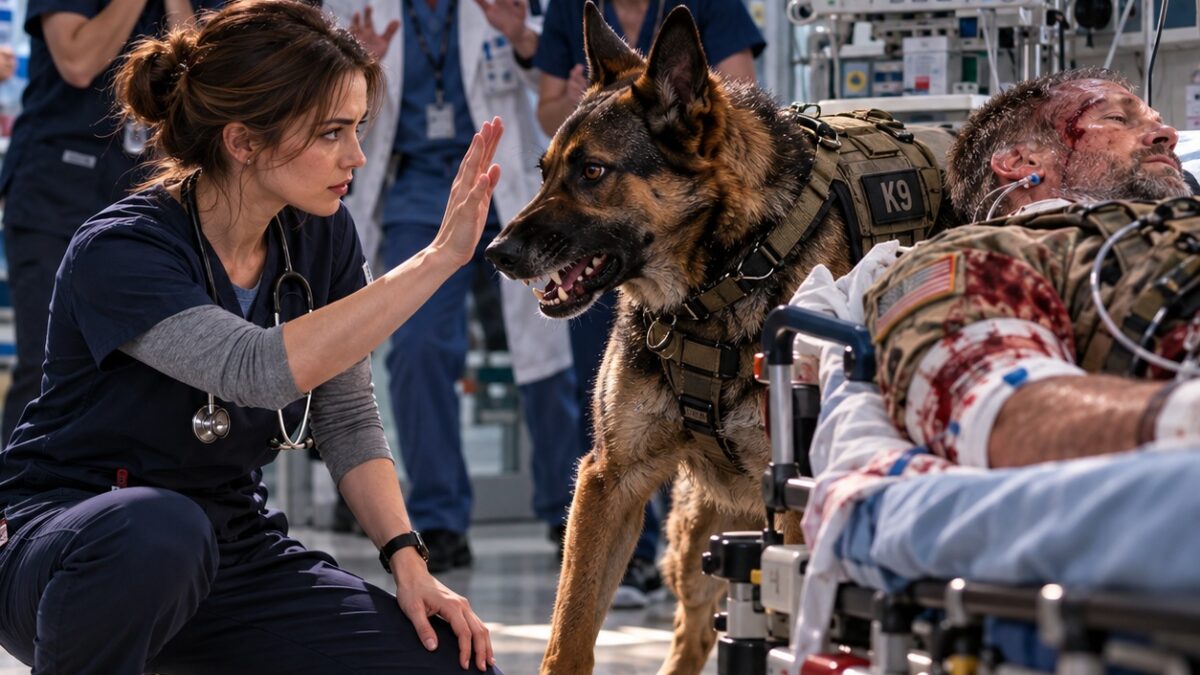
Cipher stood beside the gurney.
Belgian Malinois.
Older.
Lean.
Hard.
His body showed a decade of work.
He was not barking.
Not pacing.
Not lunging.
His eyes moved methodically across the room.
Gurney.
Door.
Staff.
Back to gurney.
Protective hold.
Exactly what I expected.
A physician turned toward me.
“You’re the one they called?”
“I know the protocol.”
His eyebrows tightened.
That answer probably created ten future questions.
I did not care.
General Kaine had thirty-one minutes of lost treatment time behind him already.
“How’s his pressure?”
“Dropping.”
“Access?”
“None we trust. Nobody can stay close enough.”
“Imaging?”
“Not yet.”
I set my bag beside the door.
The physician tried to move with me.
I raised one palm.
“Stay.”
He looked insulted.
I did not have time to protect that.
I walked toward Cipher.
Eight feet.
Stopped.
His eyes fixed on me immediately.
I let him evaluate.
Hands visible.
No forward lean.
No fear response.
No challenge.
Then I used the restricted handler language Ferris had given me.
Not loudly.
Dogs like Cipher do not need volume.
They need correctness.
The change was instant.
His ears came forward.
His jaw relaxed.
Then he sat.
No argument.
No residual growl.
No uncertainty.
He sat the way trained people stand down when the right authority finally enters the room.
Someone behind me whispered something I did not catch.
I was already at the gurney.
General Kaine was unconscious.
Skin pale.
Breathing shallow.
Pulse wrong.
I touched his abdomen.
Something felt off.
The transport report suggested splenic injury.
Possible.
But not enough.
“Get Dr. Oce.”
“We already—”
“Get her.”
I placed my hand against the right lateral abdomen again.
Resistance.
Subtle.
His pressure was sliding.
“This isn’t only splenic.”
The physician beside me—Torin—looked at the chart.
“Transport assessment—”
“Was done without full access to the patient because Cipher was preventing it.”
I looked at him.
“I’m not dismissing the report. I’m telling you it’s incomplete.”
He held my gaze.
Then turned.
“Full abdominal CT.”
The room moved.
Cipher stayed beside the gurney.
Calm now.
Watching.
I had seen that kind of loyalty before.
A working dog does not need to understand anatomy to know his person is failing.
Forty-five minutes later, the CT confirmed splenic involvement.
It also showed what I had felt.
Retroperitoneal hemorrhage on the right side.
Partially obscured by the original mechanics of the fall.
Dr. Oce stared at the imaging.
Then looked at me.
“You called it before imaging.”
“I felt it.”
“That is not a nursing-school skill.”
“No.”
Something passed across her face.
Not accusation.
Recognition.
“Scrub in.”
I hesitated.
One second.
I was a trauma nurse at Peton General.
Scrubbing into surgery was outside the role I had spent sixteen months fitting myself into.
I thought about Solway’s folder.
The supplemental history.
The Monday meeting I assumed would end with a polite version of:
You are too complicated for this hospital.
Then I looked at Kaine’s pressure.
“Yes.”
The operation lasted two hours and nine minutes.
I was not the surgeon.
I did not lead the room.
I did what I had always done best.
Watch.
Anticipate.
Notice.
I caught a pressure change before the primary circulator.
Later I stopped closure because the count was wrong.
One sponge.
Displaced.
Found under the lateral wall.
Retrieved.
Nobody mentioned scope in that room.
Not while every decision had consequences measured in blood pressure and minutes.
Afterward, Dr. Oce removed her gloves at the sink.
“You’ve worked military operating environments.”
“Yes.”
“I trained in a base trauma hospital.”
“I know the kind of people that produces.”
She looked directly at me.
“What you did tonight is not what I would expect from a nurse who came straight from school.”
“I came here from somewhere.”
“That is not an answer.”
“It’s the answer I can give.”
She almost smiled.
“Administration will have questions.”
“I know.”
“Do you want somebody in your corner?”
That caught me off guard.
The offer was real.
“Let’s make sure he survives first.”
I found Ed Beaumont in the parking lot at four in the morning.
Master Warrant Officer, retired.
Hospital transport security now.
A man who had first approached me after Rook’s case because he had recognized my dog-handling techniques for what they were.
He was leaning against a concrete pillar with a thermos.
“General?”
“Alive.”
“I heard.”
“You always hear quickly.”
He ignored that.
“Solway’s going to use this.”
“Probably.”
“She’ll say you exceeded scope.”
“Probably.”
“She’ll say the background you submitted proves you’re difficult to place.”
I looked toward the dark mountain line.
“Probably.”
He drank from the thermos.
“You know what her real problem is?”
“I’m sure you’re going to tell me.”
“You saved his life.”
“That is a strange problem.”
“No.”
He shook his head.
“You saved his life using skills their system doesn’t know how to categorize.”
He looked at me.
“You fit as long as the box fit around you. The second it didn’t, they decided the part outside the box must be dangerous.”
I said nothing.
“I submitted what they asked for.”
“I know.”
“And Monday they were going to use it against you.”
“Probably.”
“Past tense.”
I turned toward him.
“What changed?”
“Tonight.”
He lifted the thermos.
“The variables changed.”
I hated when military men retired and continued speaking like briefing officers.
“Go home, Beaumont.”
“My shift starts at six.”
“Then stop lurking in hospital parking lots.”
“Occupational habit.”
“It’s creepy.”
He laughed.
I went back inside.
Monday’s meeting never happened.
Instead, three days after Kaine’s surgery, I was summoned to a conference room I had walked past a hundred times.
Nine people.
Hospital board chair Patricia Dial.
Two additional board members.
Solway.
Dr. Oce.
A representative from the provincial health authority.
Hospital solicitor Marcus Gant.
Two people nobody formally introduced.
Those two interested me most.
People whose authority is decorative introduce themselves.
People whose authority is not often do not need to.
Gant opened a folder.
“We have several concerns.”
“Of course.”
He looked over his glasses.
“You entered a surgical environment outside your documented role.”
“At Dr. Oce’s request.”
“You administered a restricted military handler command.”
“Yes.”
“You overrode an initial transport assessment.”
“I challenged it.”
“You were under active administrative review at the time.”
“Yes.”
Oce leaned forward.
“I requested Nurse Don in the operating room.”
Gant turned.
“That does not resolve credential questions.”
“She caught a displaced surgical sponge before closure.”
Silence.
“She identified the hemorrhage before imaging.”
Another pause.
“And she flagged a pressure change before the circulator.”
Oce’s voice stayed even.
“If we want to discuss liability, we should begin with the fact that the patient survived.”
The health inspector focused on the handler protocol.
“That training is not in any civilian database.”
“It would not be.”
“Why?”
“Because it comes from a service record with classified portions.”
“Were you authorized to use it?”
I looked at her.
“A critically injured patient had been inaccessible for thirty-one minutes because a service animal would not release the perimeter.”
“That wasn’t my question.”
“It’s the relevant answer.”
The room quieted.
“My nursing credentials are current. My military medical designation is current where applicable. I disclosed everything I am legally allowed to disclose.”
I looked toward Gant.
“General Kaine was going to die if nobody entered that bay.”
Nobody interrupted.
“I entered.”
I let the next words sit.
“He didn’t die.”
Then:
“If this institution needs to find a procedural framework to be uncomfortable with that, I understand. But I will not apologize for what I did.”
Gant closed his mouth.
Patricia Dial finally spoke.
“The board’s concern is different.”
Everyone looked at her.
She turned toward me.
“Our concern is that someone with your training and background worked in this hospital for sixteen months and our onboarding process failed to identify the full value of what you brought.”
Gant shifted.
“With respect to liability—”
“Marcus.”
One word.
He stopped.
Dial continued.
“A patient is alive because Nurse Don performed better than our systems were prepared to recognize.”
She placed both hands on the table.
“That sounds like a structural failure on our side.”
For the first time since I entered, I did not know what response the room expected.
So I gave none.
The meeting continued thirty-five minutes.
Facts.
Timeline.
Credentials.
What I did.
What I did not do.
At the end, nobody suspended me.
Nobody dismissed me.
Nothing dramatic happened.
Sometimes not being destroyed is the first stage of winning.
General Kaine woke the next afternoon.
Cipher was at the foot of the bed.
The moment Kaine opened his eyes, he found the dog first.
Something in his face relaxed.
Not measurable.
Not chartable.
Still real.
Then he saw me.
“Peton General,” I said. “Fernie. You had surgery two days ago for internal bleeding. It went well.”
His voice was rough.
“Dog?”
“Right here.”
Cipher moved to the bedside.
Pressed his head beneath Kaine’s hand.
That was not a command.
Just the dog.
Kaine closed his eyes.
His fingers rested on Cipher’s skull.
I checked his monitor.
Updated the note.
Started toward the door.
“Don’t.”
I stopped.
He looked at me again.
“Ferris told me what happened.”
I waited.
“A nurse walked into the bay. Gave Cipher a restricted handler release. Cipher obeyed.”
“Yes.”
“Who cleared you?”
“That information is part of a service record I can’t discuss.”
His eyes sharpened.
“What was your field handle?”
I looked at him.
“My name is Clare Don.”
A small almost-smile touched his face.
“Of course it is.”
I could not tell whether he knew more than he was saying.
With men like Arthur Kaine, the answer was usually yes.
“Thank you,” he said.
“For?”
“You know.”
I left.
The next attack came that same evening.
Not with a gun.
With paperwork.
At 7:15, Robert Fen found me during medication rounds.
“Soway called another meeting.”
“When?”
“Now.”
“Who?”
“Board. Oce. Two people from the BC College of Nursing.”
He lowered his voice.
“And legal.”
I handed off my medication record.
The same conference room.
More chairs.
Gant positioned differently now.
Not advising.
Conducting.
That told me enough.
He opened a folder.
“The College has received a formal complaint regarding your practice.”
I felt nothing at first.
Maybe because I had already expected it.
“Allegations include unauthorized scope of practice, undisclosed clinical training, use of specialized animal-handling techniques, and possible misrepresentation during hiring.”
Oce immediately said:
“I invited her into surgery.”
“The complaint was submitted independently.”
“By whom?” I asked.
Gant looked at me.
“Confidential.”
“I know how complaints work. Who filed it?”
“That information is not available.”
One of the college assessors spoke.
“Filed at 6:42 p.m. on Thursday.”
I looked at her.
“What time?”
“6:42.”
I did the math instantly.
Fourteen minutes.
The previous board meeting had ended fourteen minutes before that complaint was submitted.
The room understood at nearly the same time I did.
Someone had lost the internal disciplinary route.
So they moved externally.
“I want that timing entered into the record.”
The assessor nodded and wrote.
Gant’s face did not move.
That told me more.
Oce gave a precise account of Kaine’s surgery.
Patricia Dial, who had apparently decided to attend on her own initiative, said almost nothing.
That silence was worse for Gant than anything she might have said.
The college assessors asked factual questions.
Not hostile.
Not theatrical.
By 8:50, the meeting ended without a finding.
The complaint had not disappeared.
But whatever momentum Gant expected was gone.
Outside, Oce walked beside me toward the elevator.
“It was him.”
“I know.”
“Gant.”
“Yes.”
“He used information from the confidential board review.”
“Yes.”
Oce pressed the elevator button.
“Dial knows.”
The doors opened.
“He won’t be our solicitor much longer.”
I looked at her.
“You sound certain.”
“I have worked with Patricia for eleven years.”
We stepped inside.
“She does not forgive people who move using her authority without her permission.”
At 10:15, I went into the stairwell because I needed thirty seconds where nobody expected an answer.
Beaumont found me.
I looked at him.
“You need a hobby.”
“Gant filed the complaint.”
“I know.”
“Using privileged material.”
“I know.”
“Ferris confirmed the filing time.”
I turned toward him.
“How?”
He raised one eyebrow.
“Some of the people General Kaine’s office talks to have access to records hospital lawyers tend to forget exist.”
That did not answer the question.
It answered enough.
“Why is Kaine’s office involved in my regulatory complaint?”
Beaumont became quiet.
There.
That silence.
Military people often reveal the most in the gap before choosing their next sentence.
“The Lofthouse shooting,” I said.
His eyes stayed on mine.
“Was it connected?”
He waited another second.
“Graeme Lofthouse worked for Kaine.”
The stairwell suddenly felt colder.
“Doing what?”
“Private advisory work.”
“And the shooting?”
“Not random.”
I stopped breathing for one beat.
“The documents.”
He nodded.
“Working theory says Lofthouse was transporting materials connected to an investigation. Somebody wanted those documents stopped before they reached Kaine.”
I thought of Rook entering the trauma bay.
Three visible bullet wounds.
The fourth nobody initially saw.
“That explains Lofthouse.”
“Part of it.”
“What does it have to do with me?”
Beaumont leaned against the wall.
“General Kaine had a scheduled medical evaluation in Fernie.”
I waited.
“Somebody knew.”
Still nothing.
“And they knew there was a nurse here with a very specific military medical background and restricted handler training.”
My stomach went cold.
“They knew about me.”
“Six weeks ago.”
That hit harder than I expected.
I had spent sixteen months deliberately becoming invisible.
Somebody had found me anyway.
“The original plan,” Beaumont said, “appears to have been getting you removed from Peton General before Kaine arrived.”
“Through Solway?”
“Solway wasn’t part of the conspiracy.”
That mattered.
“She thought she was conducting a compliance review.”
“Yes.”
“Gant?”
“Different question.”
The pieces aligned.
Lofthouse shot.
Documents intercepted.
Kaine expected in Fernie.
My background identified.
Hospital administration encouraged to treat me as a liability.
Then Kaine unexpectedly arrived early because of an injury at home.
Cipher locked down the trauma bay.
They had expected me gone before he ever entered the building.
Instead, I was still there.
I got to him.
He survived.
Then within hours, somebody filed a professional complaint designed to remove me from clinical practice another way.
“When did this become a hospital?”
Beaumont frowned.
“What?”
“I came here to get away from operations.”
“I know.”
“I picked Fernie because nothing important was supposed to happen here.”
“That may have been your first mistake.”
I gave him a look.
He wisely stopped smiling.
“What happens now?”
“Ferris has been coordinating with RCMP federal serious crimes.”
“Arrests?”
“Expected.”
“How soon?”
“Day or two.”
“And me?”
“Formal statement tomorrow, probably.”
He turned toward the stairwell door.
“Also, General Kaine has requested you as his primary clinical contact for the rest of his recovery.”
“I am a trauma nurse.”
Beaumont looked back.
“Apparently that description is starting to annoy everyone.”
I went home around midnight.
Sat at my kitchen table wearing my coat.
Did not make tea.
Did not turn on the television.
Just sat.
Sixteen months.
I had spent sixteen months trying to create distance.
From military records.
From deployments.
From rooms where people bled differently.
From the version of myself who could hear an explosion and know by the spacing what kind of problem was about to arrive.
I wanted to be good at something ordinary.
Nursing was not ordinary, obviously.
But civilian nursing had rules.
Scope.
Shift changes.
Credential files.
Places for everything.
I thought if I became skilled enough inside those boundaries, I could leave the rest unused.
Then one Dutch Shepherd entered my trauma bay.
Everything followed.
At 6:45 the next morning, I went back to work.
Because Kaine was still in ICU.
Because a patient requiring consistent care does not care whether someone is attempting to professionally destroy the nurse assigned to him.
The arrests came at 10:40.
One in Cranbrook.
One in Calgary.
Federal conspiracy charges.
Interference with protected persons.
Ferris told me inside a family consultation room.
“One suspect gave a statement.”
“What kind?”
“Enough.”
“About me?”
“Yes.”
He folded his hands.
“You were specifically identified as a target for removal from clinical practice.”
Not incidentally.
Not administrative collateral.
A target.
I absorbed that slowly.
“Immediate threat?”
“Neutralized.”
“Gant?”
“Law Society has been notified.”
“Why?”
“The complaint used privileged information combined with timing and the federal connection.”
He paused.
“His license may be at risk.”
I should have felt satisfied.
I did not.
Mostly I was tired.
Then Ferris said:
“There’s something else.”
I looked at him.
“The commendation.”
My chest tightened.
“What commendation?”
He knew I knew.
“The operational engagement in your third theater.”
I stared at the wall behind him.
Officially, parts of that engagement had never happened the way the people who were there remembered it.
Reports changed.
Language softened.
Actions redistributed across units and titles because clean documentation had political value.
I had stopped fighting it when I left.
“General Kaine’s office requested restoration.”
“He wasn’t there.”
“No.”
“Then why does he care?”
“Because he found the after-action report later.”
Ferris looked at me.
“And because somebody had buried what you did.”
I did not answer.
“He’s been trying to correct it for some time.”
“He didn’t have authority.”
“He does now.”
Silence.
“He knows your name,” Ferris said, “because he pulled the report.”
I felt something I had kept sealed for years begin shifting.
Not pride.
Not vindication exactly.
Something quieter.
The exhaustion of having a truth finally stop requiring defense.
“He’ll talk to you when he’s stronger.”
Twelve days after surgery, the hospital board called another meeting.
No legal counsel.
No college representatives.
No outsiders.
Dial.
Two board members.
Solway.
Dr. Oce.
Me.
Solway said nothing for almost ten minutes.
That alone told me something.
Dial began.
“Marcus Gant’s retainer has been terminated.”
No preamble.
“The hospital has filed a complaint with the Law Society.”
She continued.
“The complaint against you submitted to the College of Nursing has been withdrawn. The college has closed the matter.”
I nodded.
“Okay.”
Dial looked almost amused by my response.
“That is all you have?”
“What should I say?”
“Fair.”
She folded her hands.
“We need to discuss your future here.”
There it was.
I had been waiting for that sentence for weeks.
“What role?”
“Not the one you have.”
I stared at her.
She continued before I could interpret it negatively.
“We’ve been speaking with the provincial health authority about creating a veteran trauma and complex-care unit.”
I said nothing.
“A dedicated service for high-acuity patients with military histories whose prior exposures, injuries, medications, operational trauma, and service conditions affect civilian treatment.”
Oce added:
“People like Lofthouse.”
“And Kaine,” Dial said.
Then:
“And people whose complications never become dramatic enough to announce themselves with a military dog in the trauma bay.”
I felt something change in the room.
“We want you to lead it.”
I looked at them.
No one smiled.
This was not a ceremonial offer.
They were serious.
Oce spoke.
“You caught things we would have missed.”
She paused.
“More than once.”
Then:
“Some of those misses would not have been recoverable.”
Solway finally raised her eyes.
“I owe you something.”
I waited.
“I assessed your unexplained history as risk.”
Her voice was controlled.
“The gaps were real.”
“Yes.”
“Your behavior sometimes fell outside what I expected.”
“Yes.”
“But the conclusions I drew from those facts were wrong.”
She stopped.
“I was preparing to remove you from the hospital.”
“I know.”
“I want to say it plainly because disguising it as policy language now would be cowardly.”
That surprised me more than the job offer.
Solway was not suddenly my friend.
She did not need to be.
She was an administrator who had been wrong and had decided not to protect herself from the discomfort of saying so.
“Thank you,” I said.
Dial leaned forward.
“So?”
“So what?”
“The unit.”
I looked through the window.
Mountains.
The same mountains I had chosen because they were far from everything.
I remembered arriving in Fernie.
Telling myself distance could divide a person cleanly.
Military there.
Civilian here.
Field medicine there.
Nurse here.
Past there.
Present here.
But the exhaustion I carried and the skills I wanted to keep had come from the same years.
I could not amputate one without damaging the other.
“Yes.”
Nobody applauded.
Thank God.
The general was discharged twenty-one days after surgery.
He hated the wheelchair.
That was obvious.
Cipher went to the vehicle first as though supervising the entire discharge process.
Kaine had asked me to be there.
Before Ferris closed the door, the general looked at me.
“The unit.”
“I accepted.”
“Build it properly.”
“I intend to.”
He nodded.
“Veterans are not complicated patients.”
That sounded like exactly the kind of thing veterans said before describing seven diagnoses, twelve medications, five old injuries, and an allergy they forgot to mention.
I must have looked skeptical.
He clarified.
“They are patients whose histories created medical realities civilian systems were not built to recognize.”
That I understood.
“You have the framework,” he said.
“I have some of it.”
“You earned it.”
I glanced toward Cipher.
Kaine followed my eyes.
Then looked back at me.
“Stop running from what you are.”
I said nothing.
“You spent six years becoming the person who walked into that trauma bay.”
His voice remained hard.
Direct.
Not comforting.
“Running from it does not unmake it.”
He paused.
“It wastes it.”
Then he got into the vehicle.
Cipher appeared through the rear window.
The car disappeared down the gray Fernie road.
Six weeks later, the Veteran Trauma and Complex Care Unit at Peton General was formally approved.
Those six weeks were not inspirational.
They were exhausting.
Budgets.
Staffing.
Credential reviews.
Health authority meetings.
Case protocols.
Security protocols.
Training questions.
I had to retrieve records I had spent sixteen months refusing to look at.
Some nights I went home more tired than after twelve hours in trauma.
But it was different.
Trauma fatigue came from sustaining.
This came from building.
That mattered.
Beaumont transferred into our security-coordination role.
Technically, the position had a much longer administrative title.
I never used it.
He arrived the first morning carrying the same thermos.
He stood under the new unit sign.
“What do you think?” I asked.
“I think you built something that should have existed before you got here.”
“Maybe.”
“But it didn’t.”
“No.”
Our first patient was sixty-one.
Former Army combat engineer.
Transferred after a routine procedure because his original care team could not explain a pattern of neurological symptoms.
His chart contained everything except the question I asked twenty minutes after admission.
“Blast exposure?”
He looked at me.
“Second deployment.”
“How close?”
His answer changed the treatment plan.
That was the unit.
Not heroic speeches.
Not uniforms on walls.
Asking the question nobody had known to ask because somebody’s medical history began long before their civilian chart did.
Three months after General Kaine’s discharge, an official envelope arrived at my home.
My service record.
Restored.
Corrected.
Operational details returned to proper classification.
The suppressed commendation formally attached.
I sat at my kitchen table and read the report.
Accurate now.
What happened at the forward position.
Who did what.
What it cost.
Then I reached the notes field.
One sentence had been added.
Not formal language.
Not regulation.
Just:
She held the line. Every person came home. The record should always have said so.
I read it again.
I did not know who wrote it.
Kaine, maybe.
Someone in his office.
Someone farther back in the chain.
It did not matter.
It was true.
That was enough.
I placed the record in the desk drawer.
Not hidden.
Just put away.
There is a difference.
Then I made tea.
Finished it while it was still warm.
The next morning, I arrived at 6:50.
Fen gave me the overnight notes.
A third-year resident asked me about a medication interaction in a veteran patient.
I answered.
Then I walked to the corridor window.
Mountains outside.
Same as before.
I stood there for thirty seconds.
Not escaping.
Not remembering.
Just standing.
Then I entered the first room on my rounds.
“Good morning.”
The patient looked up.
“Tell me how you’re doing.”
And he did.
I listened.
That was where the whole thing had always begun.
Not with Rook.
Not Cipher.
Not General Kaine.
Not the board.
Not the arrests.
Not Gant losing his contract.
Not the complaint disappearing.
Not even my service record being restored.
A patient talks.
You listen carefully enough to hear what the chart does not say.
Maybe that was the part I had been running from without understanding it.
The military had taught me to listen for what was missing.
A pressure trend.
A change in breathing.
The posture of a dog protecting a wounded handler.
A silence where a response should have been.
A history nobody asked for.
Those skills had cost me more than I liked admitting.
But the cost did not make them worthless.
For sixteen months, I had believed healing meant becoming somebody who did not need the person I had been.
I was wrong.
Healing was learning I could carry her without letting her control every room I entered.
I could be a nurse without pretending I had never been a combat medic.
I could work inside a civilian hospital without apologizing for recognizing things a civilian system had never trained me to see.
And I could admit that the past was not only the place where I had been injured.
It was also the place where I learned how to keep people alive.
Rook had exposed that with five words.
Cipher confirmed it.
General Kaine forced me to stop hiding from it.
But the truth had been there from my first night in Fernie.
I had never really become somebody else.
I had only become quieter.
Sometimes quiet is healing.
Sometimes it is hiding.
For sixteen months, I had confused the two.
I do not anymore.
When people at Peton General ask about my background now, I tell them what I am allowed to tell them.
Six years.
Four months.
Three days.
Canadian Forces.
Combat medical training.
Three deployments.
Medical release after injury.
Then nursing.
I do not make it dramatic.
I do not give them stories they have no right to hear.
I do not turn the worst days of my life into proof that I belong in a room.
I simply no longer pretend those years did not build the nurse standing there.
The Veteran Trauma and Complex Care Unit grew slowly.
That was how I wanted it.
No slogans.
No wall of medals.
No romantic version of military medicine.
We built protocols.
Screening questions.
Blast-exposure history.
Old traumatic brain injuries.
Medication interactions.
Chronic pain shaped by service injuries.
Sleep disorders.
Operational stress.
The strange medical consequences of years spent carrying equipment, absorbing shock waves, functioning on broken sleep, delaying treatment, and telling yourself something could wait because the mission could not.
We trained civilian staff to ask without making veterans feel like museum exhibits.
We taught them that a patient saying, “I’m fine,” did not always mean the same thing in somebody who had spent twenty years being rewarded for functioning while hurt.
Oce helped build the clinical side.
Beaumont handled security and the odd problems that appeared whenever military patients arrived with service animals, former protective personnel, or habits civilian facilities did not anticipate.
Solway handled administration.
We never became close.
That was fine.
Respect did not require affection.
Months after the unit opened, she stopped me in a hallway.
“Nurse Don.”
“Yes?”
“I owe you another apology.”
“One was enough.”
“I know.”
She almost smiled.
“This is not that.”
She looked through the glass toward the unit.
“I spent years thinking systems protect institutions by making exceptions difficult.”
“They do.”
“Yes.”
She nodded.
“But sometimes the system is wrong about what it thinks is an exception.”
I waited.
“You were not an exception.”
“No.”
“You were a capability we failed to identify.”
“That sounds like something written for a board report.”
“It probably will be.”
That was Solway.
Still an administrator.
Just a better one.
One afternoon Ferris visited.
No emergency.
No classified phone calls.
He stood near the nurses’ station looking uncomfortable without a crisis to manage.
“How’s Kaine?”
“Insufferable.”
“So recovered.”
“Mostly.”
“Cipher?”
“Still thinks he’s in charge.”
“He probably is.”
Ferris nodded toward the unit.
“The general was right about you.”
“I wouldn’t tell him that.”
“I already have.”
“Traitor.”
He smiled.
Then his expression changed.
“Lofthouse came through.”
I looked at him.
“Recovered?”
“Enough.”
“And Rook?”
“With him.”
I thought about the first night.
Rook guarding the gurney.
Everyone stepping away.
My five words.
One patient.
One dog.
The crack that opened an entire buried life.
“Good.”
Ferris started leaving.
“Clare.”
I looked up.
“Lofthouse asked me to tell you something.”
“What?”
“He remembers waking briefly in transport.”
I waited.
“He remembers Rook refusing to leave.”
That sounded right.
“And?”
“He remembers hearing somebody at the hospital say the dog was dangerous.”
My jaw tightened slightly.
Ferris noticed.
“Then he remembers your voice.”
I said nothing.
“He said Rook stopped growling.”
Pause.
“And for the first time since being shot, he knew he might live.”
I looked down at the chart in front of me.
People like to believe saving a life is one dramatic act.
It rarely is.
It is layers.
A motorist stopping.
Paramedics accepting a dog in an ambulance when regulations say they should not.
A nurse recognizing protection instead of aggression.
A physician agreeing to image again.
A surgeon moving fast.
A monitor catching a trend.
One person believing another when the numbers do not fit.
Lives survive through chains.
Break one link and the ending changes.
Maybe that is why the restored line in my service record mattered so much.
She held the line. Every person came home.
Back then, I thought holding the line meant refusing to move.
Now I knew better.
Sometimes holding the line means moving when everyone else is telling you to stay inside the category they assigned you.
Walking toward Rook.
Entering Cipher’s bay.
Questioning a transport assessment.
Saying yes when Oce told me to scrub.
Refusing to apologize when a dying man lived because I used every skill available to me.
Taking leadership of a unit when my first instinct was still to disappear.
Every one of those decisions frightened me more than I let anyone see.
That is another thing military training can teach badly if you are not careful.
Composure is not the absence of fear.
It is choosing what the fear gets to control.
I had been controlled by mine for sixteen months.
Not in obvious ways.
I still worked.
Still functioned.
Still treated patients.
But every day I measured myself against an invisible line.
Not too certain.
Not too skilled.
Not too fast.
Not too familiar with things a civilian nurse should not know.
Make yourself smaller.
Just enough.
I told myself that was peace.
It was not.
Peace does not require pretending.
The day I finally understood that, I stopped thinking about leaving Fernie.
The town I had chosen as an escape became the first place where I stopped escaping.
I stayed.
Not because everything there became easy.
The winters remained brutal.
The hospital still lacked things larger facilities took for granted.
Fen still wrote assignments on a whiteboard as though personally offended by every staffing shortage.
Oce still expected impossible efficiency.
Beaumont still appeared in places nobody invited him.
And veteran medicine remained messy because people are messy.
But it was honest work.
My whole history could finally serve the person in front of me instead of sitting behind me like something waiting to be discovered.
Sometimes new staff heard stories.
The nurse who controlled a military dog.
The nurse who diagnosed Kaine.
The hidden combat medic.
Most versions became exaggerated.
People love turning competence into legend because legend is easier than understanding years of training.
I corrected the worst parts.
“I didn’t control Rook.”
“You made him sit.”
“I gave him a command he already knew.”
“You diagnosed a hidden bleed by touch.”
“I suspected one and asked for imaging.”
“You saved General Kaine.”
“A surgical team saved General Kaine.”
“But you—”
“Was part of the team.”
That distinction mattered.
I had spent enough of my life watching institutions erase some people and over-credit others.
I had no interest in becoming the center of a story that involved dozens of hands.
The only part I refused to minimize anymore was this:
I knew what I knew.
I had earned those instincts.
I no longer needed to apologize for using them.
About a year after Rook first came through those doors, a new nurse joined our unit.
Young.
Sharp.
Too careful.
I recognized it immediately.
She noticed a medication issue during rounds but waited.
Another nurse caught it three minutes later.
After shift, I found her alone.
“You saw it first.”
She looked startled.
“What?”
“The medication.”
She hesitated.
“I wasn’t sure.”
“Were you unsure?”
Silence.
“Or were you worried about sounding too sure?”
Her expression changed.
There are some mirrors you wish people would not hold up.
I knew.
“Second one.”
I nodded.
“Why?”
“I’m new.”
“That does not make you wrong.”
“I didn’t want to step on anyone.”
“Good instinct.”
She looked relieved.
“Until?”
“Until protecting somebody’s ego becomes more important than protecting the patient.”
She nodded slowly.
“What if I’m wrong?”
“Then we check.”
“That simple?”
“No.”
I smiled.
“But that clear.”
She left.
I stood at the nurses’ station thinking about the sixteen months I had intentionally arrived three steps late to things I already understood because I was afraid excellence would expose me.
Maybe the cost had not only been mine.
That realization stayed uncomfortable.
Good.
Some discomfort deserves to remain.
It keeps you from repeating yourself.
I never became reckless.
My military background did not make me infallible.
In fact, it made me more suspicious of certainty.
Field medicine teaches humility quickly.
Bodies surprise you.
Environments lie.
Information arrives incomplete.
Training is not permission to ignore process.
It is the ability to recognize when the process has failed to account for reality.
There is a difference.
That was the principle our unit eventually built around.
Not:
Veterans are special.
Not:
Military experience overrides civilian medicine.
Something more useful.
History matters.
Context matters.
Patterns matter.
Listen before you simplify.
That philosophy saved people.
Not every week.
Not dramatically.
Sometimes it simply prevented unnecessary testing.
Sometimes it changed a medication.
Sometimes it made a patient willing to describe an injury he had hidden for fifteen years because somebody finally asked without making him feel weak.
One former infantryman had spent years sleeping in a chair because lying flat made him panic.
His previous records called it insomnia.
It was not just insomnia.
Another had persistent headaches everyone treated as ordinary migraines.
Nobody had asked how many breaching charges he had stood near across his career.
Another older veteran became agitated every time staff approached him from behind.
The chart described him as difficult.
We changed room entry procedures.
He stopped being difficult.
People are often easier to understand after you stop insisting they should behave like somebody with a different history.
That applied to dogs too.
Rook had never been the problem in that first trauma bay.
Neither had Cipher.
They were behaving perfectly according to the worlds they had been trained inside.
The problem was that the room did not understand their language.
Maybe that was the thread connecting everything.
Rook.
Cipher.
Lofthouse.
Kaine.
Me.
The hospital.
All of us had been placed inside systems that did not fully understand the languages we carried.
The solution was not destroying the difference.
It was translation.
Years later, when I remember the night Rook arrived, I still see the same image first.
Blood on the tactical vest.
Paramedics behind the gurney.
Doctors against the walls.
Rook standing low between them.
Everyone interpreting the growl as danger.
Me hearing something else.
Wait.
That was all he was saying.
Give me the right reason.
Tell me these people are safe.
Tell me my job can change now.
I knew the words.
So I said them.
And he sat.
The room thought that was the moment I revealed who I really was.
It was not.
That took longer.
Rook revealed what I knew.
Cipher revealed where it came from.
The conspiracy revealed that hiding would never make me unreachable.
Kaine made me face the fact that skills do not disappear because you stop claiming them.
And the patients in the unit taught me the rest.
Who I really was had never been contained in a service record.
Or a nursing license.
Or an after-action report.
Or the things somebody had buried.
It was in the decisions.
The same decision every day.
Look closely.
Listen.
Do not reduce the person in front of you to the first explanation that fits.
And when the numbers do not make sense, look again.
That was the job.
It had always been the job.
One morning, long after the drama had passed, I entered a patient’s room.
No dogs.
No generals.
No hospital lawyers.
No federal investigators.
Just a man sitting in bed, hurting.
“Good morning,” I said.
He looked tired.
“Tell me how you’re doing.”
He started talking.
I listened.
And for the first time in years, there was no part of me standing somewhere else trying to disappear.
I was a nurse.
I had been a combat medic.
I had survived things that changed how I saw bodies, danger, loyalty, fear, and pain.
All of it was true at once.
The world had spent a long time trying to decide which version fit.
Eventually, I stopped letting it choose.
I did not need another identity.
I needed permission to use my whole one.
And in the strangest way possible, the first creature to remind me of that was an eighty-five-pound Dutch Shepherd standing between a dying man and a room full of people too frightened to move.
Rook did not know my history.
He did not care.
He heard the right voice.
The right command.
And he trusted what he recognized.
Maybe I should have done the same sooner.








