PART 2: The HOA President Put a $14 Million Price Tag on My Father’s Ranch and Expected Me to Surrender What My Family Spent a Lifetime Building
PART 2 and FULL ENDING  Thank you

I did not sleep that night.
The ranch house looked exactly as I had left it three weeks earlier.
Coffee mug beside the sink.
Boots near the back door.
My father’s old hat hanging from the peg beside the mudroom.
The place was quiet enough that I could hear crickets outside and cattle shifting in the east pasture.
Nothing inside the house had changed.
That almost made it worse.
Because while my home sat untouched, strangers had apparently been walking my land.
Photographing it.
Surveying it.
Marketing it.
Turning everything my father built into glossy investment language.
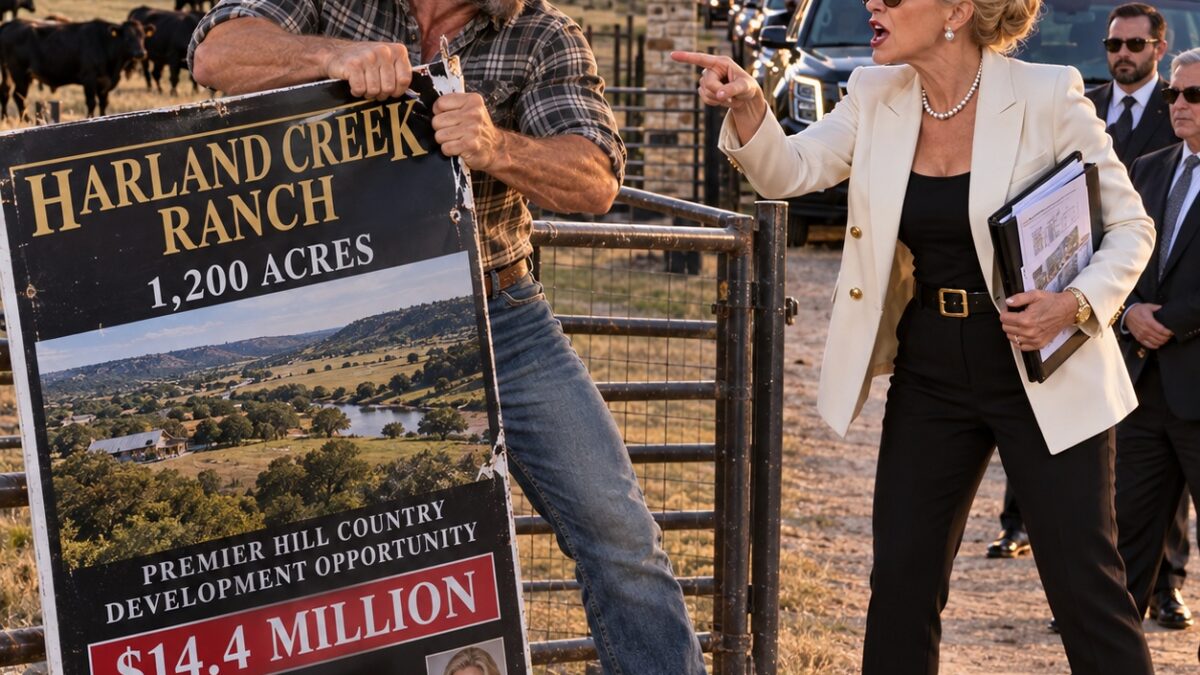
I set the real-estate sign against the kitchen wall and stared at it.
Fourteen point four million dollars.
People hear a number like that and assume temptation.
They imagine what they would buy.
Where they would go.
How quickly they would say yes.
I saw something different.
I saw the creek crossing Buck built by hand in 1971.
Flat limestone laid one piece at a time.
I saw the live oak in the east pasture where he ate lunch during roundup.
The tree was three hundred years old.
You could still see little knife marks in the bark from where he sharpened his pocketknife.
I saw the windmill over the south well.
Fence posts he planted.
The porch where he died.
Money does not erase those things.
It only gives people who do not understand them a number to argue with.
At 7:15 the next morning, I showered, pulled on a clean shirt, and drove to the Kendall County Clerk’s office in Boerne.
I was waiting outside when Martha Venegas unlocked the door.
Martha had worked county records almost as long as I had worked assessments.
She took one look at me.
“Wade.”
“Martha.”
“You look terrible.”
“Haven’t slept.”
“That obvious?”
“You’re wearing yesterday’s boots and you haven’t insulted my coffee yet.”
“Give me five minutes.”
“What happened?”
I handed her a piece of paper.
“Document 2024-08-17442.”
Her expression changed.
“Property?”
“Yes.”
She led me inside.
The lights were barely on when she logged into the county system.
A few keystrokes.
Then she stopped.
“Oh.”
“That bad?”
She turned the monitor toward me.
Durable Power of Attorney.
Dated August seventeenth.
Principal:
Wade Harland.
Attorney-in-fact:
Diane Prescott.
The language gave her authority to execute documents related to the sale, transfer, or conveyance of real property I owned in Kendall County.
Broad.
Clean.
Professional.
At the bottom was my name.
My supposed signature.
It was a decent forgery.
Good enough to fool somebody unfamiliar with my handwriting.
But I knew immediately.
My real signature has a hard downward stroke on the H.
The forged version looped.
The spacing between Wade and Harland was wrong.
And whoever copied the final d always hooks it too far left.
My father used to joke that I signed my name like I was trying to stab the paper.
This signature looked careful.
Mine never did.
Martha stared at me over her glasses.
“You didn’t sign this.”
“I was in Montana.”
She leaned closer to the screen.
“Notary is Crystal Daws.”
“Know her?”
“No.”
“Neither do I.”
Martha printed three certified copies.
Then she looked at me.
“Call the sheriff.”
“I intend to.”
“Wade.”
“Yes?”
“This isn’t just some title dispute.”
“I know.”
“If somebody forged a POA and filed it with us…”
“I know.”
She lowered her voice.
“Be careful.”
I folded the documents into a manila folder.
“Always am.”
That was a lie.
Men who work cattle are frequently not careful.
We simply tell ourselves risk is part of the job.
I called Earl Beckett before the sheriff.
Earl’s ranch bordered mine to the north.
Six hundred acres.
Retired Air Force.
Seventy-one years old.
The kind of neighbor who sees a broken fence from half a mile away and repairs it before telling you.
Before Montana, I gave him a spare key and asked him to watch the cattle.
He arrived at my kitchen table within an hour.
I slid the power of attorney across to him.
He read it twice.
“What the hell is this?”
“Apparently I gave Diane Prescott the right to sell the ranch.”
Earl looked at me.
“You did not.”
“Good to know somebody believes me.”
“I watched you leave for Montana.”
“Exactly.”
His face changed.
“Wade.”
“What?”
“There were survey crews here.”
Every muscle in my shoulders tightened.
“When?”
“Two days after you left.”
He told me three trucks with Prescott Realty magnets came down the county road.
Men set stakes.
Used surveying equipment.
Flew a drone.
Earl assumed I had hired them.
Why wouldn’t he?
I owned the place.
Then a helicopter showed up.
Circled for almost an hour taking aerial photographs.
Then came buyers.
Luxury SUVs.
Men in khakis and polo shirts.
Diane walking them through the property.
Pointing toward the creek.
Toward the bluff.
Toward my ranch house.
Earl counted seven separate tours.
“I tried calling you.”
He said.
“No service.”
“I should’ve come down.”
“You had no reason to think somebody forged my name.”
He rubbed both hands over his face.
“There’s more.”
I waited.
“Last Tuesday I drove past the Colton Ridge clubhouse.”
“And?”
“They had a banner.”
“What banner?”
He looked sick.
HARLAND CREEK RANCH — EXCLUSIVE DEVELOPMENT PREVIEW — INVITATION ONLY.
I sat back.
For some reason, that was the part that truly enraged me.
Not the legal document.
Not the listing.
The event.
Diane had turned theft into a launch party.
People drinking wine inside that ridiculous clubhouse while studying drawings of what they planned to build over my father’s land.
I stood.
“Where are you going?”
“Colton Ridge.”
“I’m coming.”
“No.”
“Wade.”
“Earl.”
He stared at me.
Then sighed.
“At least call before you hit somebody.”
“I’m not hitting anyone.”
“That answer took too long.”
I drove to the Colton Ridge gate.
The guard recognized my truck.
Tyler.
Young kid.
Probably twenty-two.
He waved.
“Morning, Mr. Harland.”
“Morning.”
“Going to see somebody?”
“Clubhouse.”
“Sure.”
He did not know.
None of them knew.
Inside the clubhouse lobby, a table stood near the entrance.
Forty-six glossy brochures.
I counted them later.
Thirty-two pages each.
Thick paper.
Gold foil.
Professional photography.
The cover:
HARLAND CREEK
A PRESCOTT REALTY VISION
The photograph was my ranch at sunset.
I opened one.
Page three showed a luxury resort hotel where my house stood.
Page six showed a golf course across the south pasture.
Page nine showed villas along the creek.
One rendering replaced the old limestone crossing Buck built with an ornamental pedestrian bridge.
Another turned the creek bend into a “spring-fed wellness lagoon.”
My two wells were described as “existing water assets.”
Water assets.
I stared at that phrase.
Buck nearly died drilling the first well.
Old cable rig.
August heat.
Three straight days with barely any water coming up.
He called it the meanest hole he ever fought.
Diane called it an amenity.
The back cover showed her smiling in a blazer.
YOUR VISION BEGINS HERE.
I gathered every brochure.
Two trips to my truck.
Locked them in the toolbox.
Then called the sheriff.
Deputy Carlos Medina came out that afternoon.
Carlos had been with the county ten years.
Grew up around ranching families.
He stood at my kitchen table while I laid everything out.
Forged power of attorney.
Certified copies.
Listing.
Brochures.
Photographs of the sign.
Carlos whistled quietly.
“She actually listed the whole ranch?”
“Yep.”
“Fourteen point four?”
“Apparently I’m valuable now.”
“Always knew you were fancy.”
“Don’t spread it around.”
He smiled briefly.
Then became serious.
“I’m filing this with investigations.”
“What happens?”
“They’ll verify the signature.”
“Look at the notary.”
“We will.”
“Diane’s trying to close quickly.”
“How do you know?”
“The buyer tours.”
“The marketing.”
“She wouldn’t be doing this unless she already had someone.”
Carlos nodded.
“Do not confront her.”
I stared.
He stared back.
“Wade.”
“I heard you.”
“That’s not agreement.”
“I’ll behave.”
He pointed at me.
“That sentence worries me.”
Two hours after he left, my phone rang.
Diane Prescott.
Of course.
I let it ring twice.
“Wade.”
Her voice was smooth.
Controlled.
“I heard you’re back.”
“Word travels.”
“I think there’s been a misunderstanding.”
“A misunderstanding is somebody taking the wrong parking spot.”
Silence.
“You forged my signature and listed my ranch.”
“I forged nothing.”
“I’m holding the document.”
“I have legal authorization from Harland Creek Ranch LLC.”
“That company does not exist.”
“It was created by your father.”
“No.”
“Wade—”
“My father never created an LLC.”
I stood on the porch while we spoke.
The same porch where she had asked to buy my land three times.
“I inherited through Buck’s will.”
I said.
“Probate completed in 2013.”
“The deed is in my personal name.”
“You know that because I showed it to you right here.”
Three seconds of silence.
Just enough to tell me I had hit something real.
Then:
“I think you should speak with my attorney.”
“No problem.”
“There are parties involved who have invested significant resources based on legitimate representations.”
I almost laughed.
“Legitimate?”
“Be careful what accusations you make.”
“I am being very careful.”
“Diane.”
“Yes?”
“You forged a power of attorney.”
She hung up.
The next morning, a letter was taped to my gate.
Cease and desist.
Attorney Brent Collier.
San Antonio address.
The letter said Harland Creek Ranch LLC controlled the property.
It accused me of tortious interference.
Demanded I stop blocking buyer access.
Stop disparaging the transaction.
Remove gates preventing authorized entry.
I stood beside my truck and read it twice.
Then folded it.
Added it to the evidence folder.
Diane was not backing away.
She was doubling down.
Later that same afternoon, Carlos called.
“Wade.”
“Carlos.”
“I have something you’re going to enjoy.”
“That sounds unlikely.”
“Diane filed a trespass complaint.”
“Against who?”
“You.”
I actually laughed.
“On my own ranch?”
“Yep.”
“She claims Harland Creek Ranch LLC controls the land and you’re an unauthorized occupant.”
“You took my forgery report yesterday.”
“I remember.”
“Are you sending deputies?”
“No.”
“Shame.”
“I would’ve liked to see you explain it.”
“Don’t tempt me.”
Carlos lowered his voice.
“She’s building a paper record.”
“I know.”
“Keep everything.”
“I am.”
“She’s either incredibly confident or incredibly desperate.”
At the time, I did not understand how important that observation would become.
The next escalation came with bolt cutters.
I was checking a water trough near the south gate when a locksmith van pulled up.
Man got out.
Blue work shirt.
Tools.
Walked straight to my gate.
Cut my padlock.
I stood fifty yards away watching.
He installed a new lock.
Then drove to the east gate.
Same thing.
By the time he reached the north gate, I was waiting.
“Morning.”
He looked up.
“Morning.”
“Who hired you?”
He pulled out his phone.
“Prescott Realty.”
“Work order says change all locks at Harland Creek Ranch.”
“Bill Diane Prescott.”
“This ranch belongs to me.”
He frowned.
“Sir, I just have the order.”
“The order is based on a forged document.”
He looked at the gate.
Then at me.
Then at the phone.
I could see exactly what he was thinking.
He was a working man trapped in someone else’s insanity.
“I don’t know anything about that.”
He said.
“I just do the job.”
“I don’t blame you.”
Relief entered his face.
“Thank you.”
“I am cutting every lock you installed off within the hour.”
Relief disappeared.
“That might be something you should—”
“My land.”
“Okay.”
He packed his tools.
Drove away.
I went to the hardware store in Boerne.
Bought new padlocks.
Then mounted trail cameras at every gate.
For the next week, the cameras became a parade of evidence.
Luxury SUVs.
Real-estate agents.
Surveyors.
A man carrying blueprints.
Potential buyers.
Most saw my signs and turned around.
Two climbed fences.
The cameras caught faces.
License plates.
Times.
Everything.
But the break in the case did not come from my land records.
It came from a seventy-three-year-old retired accountant named Doris Han.
Earl brought her over.
Doris lived in Colton Ridge.
She arrived carrying a calculator and a thick manila folder.
Before sitting down, she looked around my kitchen.
“So this is the ranch house she wants to turn into a resort lobby.”
“Apparently.”
“She has bad taste.”
I liked her immediately.
Doris had been asking the HOA for an independent financial audit for two years.
Diane blocked every request.
Administrative confidentiality.
Board discretion.
Reserve strategy.
Words designed to make ordinary homeowners feel as if finances were too complicated to question.
Doris did not scare easily.
She kept her own numbers.
Seventy-eight homeowners.
Four thousand eight hundred dollars in annual dues.
Approximately three hundred seventy-four thousand dollars a year.
Over six years:
More than two million dollars collected.
Then she calculated what could be documented.
Clubhouse.
Pool.
Roads.
Landscaping.
Routine maintenance.
Roughly eight hundred thirty thousand.
She tapped the calculator.
“Where’s the rest?”
I looked at the number.
Around one point four million dollars.
“Reserve accounts?”
“That’s what Diane says.”
“Statements?”
“She refuses.”
“Bonds?”
“She claims community-improvement bonds.”
“Proof?”
“None.”
Doris removed her glasses.
“That woman has been stealing from Colton Ridge for years.”
I sat very still.
“And I think your ranch is how she planned to cover it.”
Then she did the math.
Fourteen point four million dollar listing.
Six percent real-estate commission.
Eight hundred sixty-four thousand dollars.
A massive infusion of cash.
Enough to patch a large part of the hole.
Maybe enough to move money around before an audit exposed the truth.
Everything suddenly made sense.
The urgency.
The forged POA.
The buyer previews before I returned.
The relocked gates.
The trespass complaint.
Diane did not simply covet my ranch.
She needed a closing.
Fast.
I called a lawyer.
Not Brent Collier.
A real-estate fraud attorney.
Ray Gutierrez.
Board-certified.
Former prosecutor.
Twenty-six years in practice.
His office was inside a converted stone farmhouse in Fredericksburg.
Thick walls.
Books from floor to ceiling.
Ray himself looked exactly like the kind of lawyer I trusted.
Barrel chest.
Salt-and-pepper mustache.
Reading glasses hanging from a chain.
No polished television-lawyer nonsense.
I laid everything across his desk.
Power of attorney.
Certified clerk copies.
Listing.
Brochures.
Trail-camera footage.
Locksmith work order.
Cease-and-desist letter.
Trespass complaint.
Doris’s financial analysis.
Ray read in silence for nearly forty-five minutes.
Finally, he took off his glasses.
“Wade.”
“Yes?”
“This is insane.”
“That your legal opinion?”
“Unofficially?”
“Yes.”
“Yes.”
He tapped the forged POA.
“She didn’t just forge your name.”
He pointed to the brochures.
“She built marketing around the fraud.”
Another page.
“She created a fictional ownership entity.”
Another.
“She conducted buyer tours.”
Another.
“She changed locks.”
Another.
“She filed a trespass complaint against the actual owner.”
He leaned back.
“In twenty-six years, I’ve seen maybe two real-estate fraud cases this bold.”
“What do we do?”
“First?”
He smiled.
“We kill the sale.”
He filed a notice affecting title.
A lis pendens tied to pending litigation.
Once recorded, any title company searching Harland Creek Ranch would see the dispute.
No clear title.
No clean closing.
“No title company is going to insure a fourteen-million-dollar transaction over that.”
Ray said.
“What if the closing is already scheduled?”
He stopped.
“You think it is?”
“I think Diane is desperate.”
Ray nodded.
“Then we find the buyer.”
Earl had one clue.
A black Suburban.
Same vehicle.
Three times at Colton Ridge preview events.
Old Air Force habits die hard.
Earl had written the plate number down.
Ray used a title-search contact.
Vehicle registered to Lone Star Heritage Development Group out of Dallas.
CEO:
Philip Gentry.
Ray knew him.
“Legitimate developer.”
He said.
“Resort communities.”
“Big projects.”
“He would not knowingly buy stolen land.”
“So Diane lied to him too.”
“Almost certainly.”
Ray made three calls.
District attorney.
FBI field office in San Antonio because of the potential interstate wire.
Then Gentry’s attorney.
The return call came within two hours.
Philip Gentry had signed a letter of intent.
Purchase price:
Thirteen point eight million dollars.
Closing:
Tuesday.
Five days away.
I stared at Ray.
“She did it.”
“Almost.”
“The buyer is real.”
“Very.”
“The closing is real.”
“Yes.”
“She was going to sell my ranch.”
“Yes.”
Ray recorded the lis pendens that afternoon.
By four o’clock, the sale was legally poisoned.
Any competent title search would stop it.
That should have ended the matter.
Instead, Ray looked at me and said:
“Do you want to catch her doing it?”
I stared.
“What do you mean?”
“If Diane is notified now, she retreats.”
“She claims misunderstanding.”
“Blames lawyers.”
“Blames forged documents she supposedly believed were legitimate.”
“But if she walks into a closing after everything she has done and signs as your attorney-in-fact…”
He let the sentence hang.
The DA’s office agreed.
No immediate arrest.
The title company would know.
The buyer’s attorney would know.
The investigators would be ready.
Nothing would actually transfer.
The lis pendens ensured that.
The wire could be blocked.
But Diane would be allowed to proceed far enough to put her own hand on every fraudulent signature.
I thought about Buck.
My father was not subtle.
He would have handled theft with a fence post.
Ray preferred evidence.
“Tuesday.”
I said.
“Tuesday.”
The night before closing, I sat on Buck’s porch.
Moon over Hill Country.
Live oaks black against silver pasture.
My dog asleep near my boots.
The Angus I bought in Montana bedded down in the east field.
The creek caught moonlight below the bluff.
I held a cup of coffee even though it was late.
That ranch looked exactly the same as it had before Diane started printing brochures.
That helped.
Paper had power.
Deeds.
POAs.
Contracts.
But paper had not changed the land.
The creek still flowed.
The cattle still grazed.
My father’s fence still stood.
I wondered what Buck would say about me walking willingly into a title office the next morning to watch a woman pretend to sell his ranch.
Probably:
Don’t punch anybody.
Then:
Unless the lawyer says it’s okay.
I laughed alone.
At 5:30 the alarm went off.
I wore a clean pearl-snap shirt.
Good boots.
And Buck’s silver belt buckle.
Hereford head in the center.
He won it at the Kendall County Stock Show in 1984.
I had not worn it in years.
Ray noticed.
“Nice buckle.”
“Evidence.”
“Of what?”
“That I can dress up.”
“Debatable.”
Blue Bonnet Title Company sat on Broadway in San Antonio.
Third-floor office.
Limestone building.
Dark wood.
Tall windows.
The kind of place where multimillion-dollar transactions happen quietly over coffee and signature tabs.
Ray and I arrived at 9:15.
Sandra Vega, the managing attorney, met us privately.
She had already confirmed the lis pendens.
She understood everything.
“Nothing transfers.”
She said.
“Nothing.”
“The wire?”
“Flagged.”
“Escrow will not release.”
“Good.”
Sandra looked at me.
“You understand I am going to conduct the meeting as if it is proceeding?”
“Yes.”
“Until Ray enters.”
“Yes.”
“You may find that difficult.”
“I’ve spent my entire adult life watching cattle auctions.”
She frowned.
“What does that mean?”
“No idea.”
Ray laughed.
We waited down the hall behind a glass partition.
At 9:45, Diane walked in.
Navy blazer.
Gold buttons.
Heels clicking against tile.
Silver-blonde hair freshly styled.
Turquoise earrings.
Leather portfolio.
Montblanc pen.
She looked like she belonged there.
That was the dangerous thing about people like Diane.
Fraud rarely dresses like fraud.
It dresses like authority.
Russell Kemp followed.
Then Brent Collier.
The lawyer who sent me the cease-and-desist letter.
At 9:50, Philip Gentry arrived with two associates and his attorney.
Gentry looked exactly how I expected a man prepared to spend thirteen point eight million dollars to look.
Relaxed.
Expensive.
Unhurried.
They entered the conference room.
Diane took a seat near the head.
Spread out documents.
Uncapped the Montblanc.
She smiled.
I watched through glass.
I could not hear every word.
Did not need to.
At 10:05, Sandra began.
Parties identified.
Title commitment.
Survey.
Exceptions.
Tax prorations.
Disclosures.
Diane nodded along.
Confident.
Comfortable.
At 10:14, Sandra turned to signature pages.
My stomach tightened.
Diane picked up the pen.
Signed.
Diane Prescott, attorney-in-fact for Wade Harland.
Pursuant to document 2024-08-17442.
She signed the deed.
Closing disclosure.
Transfer affidavit.
Every stroke smooth.
Not a hesitation anywhere.
I looked at Ray.
He did not move.
Gentry signed.
His attorney initialed the wire authorization.
Sandra gathered everything.
Then said:
“Congratulations.”
I felt my jaw tighten.
Not because the ranch was sold.
It wasn’t.
But hearing those words while Diane smiled made something in me want to break through the glass.
She stood.
Reached across.
Shook Philip Gentry’s hand.
“Welcome to the Hill Country.”
Ray’s phone buzzed.
He checked the message.
Investigators ready.
Then he touched my arm.
“Now.”
We walked down the hall.
Ray opened the door.
Every head turned.
Diane was still holding Gentry’s hand.
She saw me.
The smile disappeared so completely it was almost mechanical.
One second present.
Next second gone.
Color drained from her face.
Her hand fell away from Gentry’s.
I stepped inside.
“Morning, Diane.”
She opened her mouth.
Nothing came out.
The papers lay across the table.
My forged authority.
Her real signatures.
Ray introduced himself.
“My name is Ray Gutierrez.”
“I represent Wade Harland, sole legal owner of Harland Creek Ranch.”
Brent Collier stood.
“What is this?”
Ray ignored him.
“The documents just signed are legally void.”
Gentry’s attorney immediately stopped moving.
“The power of attorney cited in this transaction is fraudulent.”
Diane found her voice.
“That is false.”
Ray continued.
“Harland Creek Ranch LLC does not exist.”
Russell stood.
“That is not true.”
Ray placed certified records on the table.
“No entity by that name was ever created by Buck Harland.”
“No entity holds title.”
He laid my deed over the closing documents.
“Wade Harland inherited the ranch individually through probate in 2013.”
“Title remains solely in his name.”
Then another document.
“Mr. Harland was in Montana when the alleged power of attorney was executed.”
Diane looked toward Sandra.
“Sandra?”
Sandra’s expression remained professional.
A title lawyer’s face.
Impossible to read.
Ray placed the lis pendens on the table.
“This was recorded five days ago.”
“No title company in Texas can insure this transfer.”
“The wire has been blocked.”
Diane stared at Sandra.
“You knew?”
Sandra said:
“I knew the title was disputed.”
Diane’s face twisted.
“You let us sign?”
Sandra’s tone did not change.
“I conducted the scheduled meeting.”
Gentry looked down at the purchase agreement.
His own signature.
Then at Diane.
Then at me.
Ray turned toward him.
“Mr. Gentry.”
Gentry’s attorney stiffened.
“You are not under investigation.”
“We notified your counsel before today’s meeting.”
“You were misled.”
Gentry’s face hardened.
He looked at Diane.
“You told me the family ownership structure had been verified.”
Diane swallowed.
“It was.”
“No.”
I said.
Everyone looked at me.
“There is no family ownership structure.”
“There is me.”
“That’s it.”
Gentry picked up the agreement.
Set it down.
“You shook my hand.”
One sentence.
Quiet.
Colder than shouting.
Then he walked out.
His associates followed.
Attorney too.
Diane stayed standing.
The Montblanc lay on the table beside four signatures.
Ray looked at me once.
We did not smile.
The conference-room door opened.
Two plainclothes investigators entered.
Carlos Medina behind them.
Diane looked toward the door.
Her skin turned gray.
Not pale.
Gray.
The body sometimes understands before the mind catches up.
The female investigator spoke.
“Diane Prescott?”
No answer.
“Diane Prescott?”
“Yes.”
“You are under arrest for forgery, fraud, and theft of real property.”
Russell moved forward.
“Wait.”
Carlos stepped between them.
“Sir, step back.”
“This is a misunderstanding.”
Carlos looked at him.
“This isn’t a negotiation.”
Brent Collier began gathering his papers.
Fast.
Did not ask Diane whether she needed counsel.
Did not look at Russell.
Just collected his briefcase and left.
Fastest retreat I had ever seen from a lawyer.
The investigator instructed Diane to turn.
Hands behind her back.
The handcuffs clicked.
Television does not capture that sound correctly.
In person, it is smaller.
Sharper.
Final.
Diane stared straight ahead.
Her hands trembled behind her.
The Montblanc remained on the table.
The pen she thought would earn her an $800,000-plus commission.
Now sitting beside the signatures that helped prove intent.
They read her rights.
Walked her out.
Russell followed, already on the phone.
“I need you down here.”
His voice cracked.
“Right now.”
Outside, Broadway traffic moved as if nothing happened.
Delivery trucks.
Bus.
People crossing the sidewalk.
Diane was placed in the back of a marked vehicle.
Nobody outside that title company knew a thirteen-million-dollar land fraud had just collapsed upstairs.
I stood beside Ray.
Watched the cruiser leave.
He waited.
Then said:
“Your father would have handled that the same way.”
I looked at him.
“My father would’ve handled it with a fence post.”
Ray almost smiled.
“That’s why we have courts.”
The investigation exploded after the arrest.
Search warrants hit Diane’s home office and Prescott Realty.
Computers.
Files.
Financial records.
Client communications.
Investigators examined the forged POA.
A document expert compared it against fifteen real signatures.
Forgery.
Clear.
The notary stamp led to Crystal Daws.
Part-time nail technician.
No active notary commission.
Diane had paid her five hundred dollars to stamp a document she never witnessed.
Crystal cooperated immediately.
Told investigators everything.
How Diane approached her.
How she said it was routine.
Easy money.
How Crystal barely read it.
She received immunity for truthful testimony.
Then came the FBI.
The proposed thirteen point eight million dollar wire created federal exposure.
But the ranch fraud was only half of Diane’s problem.
The HOA books opened.
And Doris had been right.
The court-appointed forensic accountant was Rachel Torres.
Six weeks.
Every check.
Every transfer.
Every vendor.
Every reserve claim.
One point three million dollars.
Gone.
Diverted from Colton Ridge.
Personal accounts.
Shell companies.
Cash.
Escalade.
Cabo vacations.
Kitchen renovation.
Russell’s boat.
And something I found almost poetic in its stupidity:
Diane used stolen HOA money to pay for the brochures advertising my stolen ranch.
The surveying crews too.
Homeowners were furious.
They had paid nearly five thousand dollars per year believing the money maintained their community.
Instead, roads cracked.
Pool equipment failed.
Clubhouse roof leaked.
Reserve accounts Diane claimed existed were empty.
Community-improvement bonds?
Never existed.
Seventy-eight families had been funding her lifestyle while she lectured everyone about standards.
Doris came to see me after the audit became public.
She brought a pie.
“What’s this?”
“Peach.”
“I meant why.”
“Because I was right.”
“That usually gets you pie?”
“It should.”
We sat on the porch.
She looked across the ranch.
“I feel stupid.”
“For what?”
“We trusted her.”
“You asked questions.”
“Not soon enough.”
“Welcome to humanity.”
She smiled.
“Wade.”
“Yes?”
“What if we never get the money back?”
“I don’t know.”
“She ruined people.”
“Yes.”
Doris looked toward Colton Ridge.
“We thought the biggest threat was HOA fees going up.”
“Turns out the president trying to steal neighboring ranches is slightly worse.”
She laughed.
Then covered her face.
Not crying exactly.
Overwhelmed.
“I hate that woman.”
“I know.”
“Do you?”
I thought.
“Not really.”
Doris stared.
“She tried to steal your father’s ranch.”
“I know.”
“How do you not hate her?”
“Too much work.”
I meant it.
Ranching uses enough energy.
Hate seemed inefficient.
The criminal case moved over the next five months.
State charges.
Forgery.
Fraud.
Theft of real property.
Misapplication of fiduciary property.
Government-record tampering.
Federal investigation.
Russell was eventually charged too.
Text messages from Diane’s phone destroyed any claim he knew nothing.
One message stood out.
Make sure the POA looks clean. Use the nail girl.
That was Russell.
So much for misunderstanding.
His real-estate license was suspended.
Investigators also began examining whether Colton Ridge buyers had been misled about views or access when Russell originally marketed the subdivision.
Homeowners filed complaints.
Brent Collier faced professional review over the cease-and-desist letter.
Whether he knowingly relied on a forged document or recklessly failed to verify it became a separate issue.
Everyone who had stood behind Diane’s fake authority suddenly discovered authority comes with paperwork.
And paperwork cuts both ways.
Diane eventually pleaded guilty to the state charges.
Eight-year sentence suspended to five years of probation under strict conditions.
Full restitution of the one point three million dollars missing from the HOA.
Five hundred hours of community service.
Passport surrendered.
Real-estate licensing consequences.
Permanent prohibition on serving as an officer or board member of an HOA, nonprofit, or fiduciary entity in Texas.
If she violated probation, the eight years could be imposed.
The federal case resulted in additional probation and a fifty-thousand-dollar fine.
Russell pleaded guilty to conspiracy.
Probation.
Loss of his real-estate license.
Restitution exposure from homeowners.
Their Colton Ridge house ended up under a judicial lien.
The same five-bedroom stone-and-stucco mansion Diane used as proof of success became an asset creditors could see.
Funny how property records work.
Philip Gentry called me a week after Diane’s arrest.
Not his attorney.
Him.
“Mr. Harland?”
“Wade is fine.”
“This is Philip Gentry.”
“I figured.”
“I wanted to apologize.”
“You didn’t forge anything.”
“I should have caught it.”
“You hired lawyers.”
“We ran diligence.”
“She fabricated an entire ownership structure.”
“That’s what Ray says.”
Gentry exhaled.
“I’ve been developing land thirty-two years.”
“I’ve never seen anything like it.”
“Welcome to my month.”
He laughed weakly.
“Your ranch is extraordinary.”
“I know.”
“I mean it.”
“I know.”
“What she planned…”
His voice trailed.
Resort.
Golf course.
Villas.
Luxury trails.
People paying enormous money to imitate the landscape they destroyed.
“I’m sorry.”
He repeated.
“No hard feelings.”
I meant that.
He had lost money.
Legal fees.
Design costs.
Due-diligence expenses.
Months of employee time.
He was a victim too.
Different scale.
Same fraud.
“I’m filing against Diane and Russell.”
He said.
“I assumed.”
“I wanted you to hear it from me.”
“Good luck.”
“Wade?”
“Yes?”
“If you ever decide to sell—”
I went silent.
Gentry laughed.
“Kidding.”
“Smart man.”
Colton Ridge held elections.
Doris Han ran for HOA president.
Seventy-one votes for Doris.
Two against.
I never found out who the two were.
Doris’s first move:
Hire an independent professional management company.
Second:
Quarterly financial reports accessible to every homeowner.
Third:
Full conflict-of-interest disclosure for board members.
Then she sent me a handwritten letter on behalf of the subdivision.
No lawyer.
No corporate language.
Just paper.
Wade,
We are sorry that someone claiming to represent this community committed crimes against you. Harland Creek Ranch is not ours to covet and never was.
I read it twice.
Then framed it.
It hangs in the hallway beside a photograph of Buck and his first Hereford bull.
The day after Diane’s sentencing, I drove to the north pasture.
Alone.
The survey stakes were gone.
I had pulled them months earlier.
But some holes remained where they had been hammered into the limestone soil.
I walked the fence line Buck strung in 1970.
Wire still tight.
Cedar posts gray with age.
Solid.
Red-tailed hawk circling over the creek.
The Angus from Montana grazed in the east pasture.
Black coats shining.
Creek running clear.
Windmill turning slowly above the south well.
Same as always.
I stood there a long time.
People love saying justice feels good.
Sometimes.
Mostly, that morning felt quiet.
Diane had been punished.
Russell too.
The ranch remained mine.
The sale never happened.
Still, I did not feel like celebrating.
I felt tired.
For months I had thought about deeds.
Felonies.
Investigators.
Title companies.
Closing papers.
Wire transfers.
Probation.
Restitution.
Then I looked at the land.
It did not know any of that happened.
Buck used to say land does not care whose name is on a deed.
When I was younger, I thought that was one of his old-man sayings that sounded deeper than it was.
I understand now.
He meant land cares about work.
Who fixes fence after a storm?
Who clears cedar?
Who checks water when the pump freezes?
Who sits awake beside a sick calf?
Who learns where the creek jumps its banks?
Who knows which pasture greens first after rain?
Who can find the north spring in the dark?
Diane never knew this ranch.
She knew the acreage.
The appraisal.
The commission.
She saw my creek and imagined a swimming amenity.
Saw pasture and imagined golf.
Saw limestone and imagined resort architecture.
Saw my father’s house and imagined a lobby.
She never asked what the ranch was.
Only what it could be turned into.
That is a particular kind of blindness.
Money can teach people to look directly at something and never see it.
I replaced the entrance sign.
The old one had read:
HARLAND CREEK RANCH
PRIVATE PROPERTY
The new one says the same.
But I added another line.
EST. 1968 — BUCK HARLAND
Powder-coated steel.
Mounted on cedar posts cut from this ranch.
Earl helped install it.
He stood back.
“Crooked.”
“It is not.”
“Left side is low.”
“Your head is crooked.”
“Possible.”
We adjusted it anyway.
When we finished, he leaned against my truck.
“So.”
“So?”
“You ever going back to Montana?”
“Eventually.”
“Giving me a satellite phone next time.”
“I’ll consider it.”
“No.”
“You’re buying one.”
I laughed.
“Fine.”
He looked at Buck’s name on the sign.
“Your dad would’ve enjoyed all this.”
“The crime?”
“The ending.”
“My father did not enjoy paperwork.”
“True.”
“He would’ve hated Ray.”
“Ray knows.”
“He still says courts were better than fence posts.”
Earl considered.
“Debatable.”
Life returned to normal faster than I expected.
That does not mean I forgot.
For the first few months, every unfamiliar truck on the county road made me look twice.
Every survey vehicle irritated me.
I installed better gate cameras.
Updated my title-monitoring alerts.
Ray persuaded me to create a proper estate structure so nobody could exploit ambiguity after I died.
I resisted at first.
“You sound like Diane.”
I told him.
Ray stared.
“That may be the cruelest thing anyone has ever said to me.”
I laughed.
“Fine.”
We created a legitimate ranch entity.
Carefully.
Transparently.
With one important difference.
I knew about this one.
My ownership remained protected.
Estate documents clear.
Succession rules defined.
Earl asked who was getting the ranch when I died.
“None of your business.”
“You don’t have children.”
“Still none of your business.”
“You giving it to me?”
“You’re older than I am.”
“That isn’t a no.”
I threw a glove at him.
Truth was, the succession question had started bothering me.
Buck had me.
I had nobody.
For years I avoided thinking about it because I was healthy and the ranch felt permanent.
Diane’s fraud changed that.
Not because I feared death.
Because I understood that unclear ownership invites people who see land only as value.
I eventually created a conservation-minded trust structure tied to ranching use.
No resort.
No subdivision.
No golf course.
The land could continue supporting cattle and habitat long after I was gone.
That decision gave me a peace I did not expect.
Buck bought land for permanence.
I wanted to honor that.
Doris and I became unlikely friends.
She showed up every few months with financial gossip from Colton Ridge.
Not personal gossip.
Numbers.
She loved numbers.
“Pool repair came in twelve thousand under budget.”
She would say.
“Congratulations.”
“Management company tried to charge a duplicate landscaping invoice.”
“And?”
“I caught it.”
“Of course you did.”
She grinned.
Under Doris, Colton Ridge improved.
Roads repaired.
Pool fixed.
Roof replaced.
Homeowners could see the books.
Meetings remained annoying.
All HOA meetings are probably annoying by nature.
But annoying is different from corrupt.
People sometimes waved when I drove past the subdivision.
A few came to apologize personally.
One man admitted he had attended Diane’s preview event.
I stared at him.
“You were there?”
He flushed.
“She told us you wanted to sell.”
“What did you think?”
“Honestly?”
“Please.”
“I thought it was strange.”
“Why?”
“Everybody knew you hated development.”
“Good.”
“But the documents looked real.”
That mattered.
Diane did not succeed because everyone around her was stupid.
She succeeded as far as she did because she built credibility around forged paper.
Letterhead.
Lawyers.
Notary seals.
Real-estate platforms.
Brochures.
Meetings.
People trust structure.
A fake document filed in a real government office looks more real than a lie spoken across a fence.
That was why my background saved me.
I knew where to look.
I knew document numbers.
Knew how title records should connect.
Knew my father never had an LLC.
Somebody without that knowledge might have spent weeks simply trying to understand what happened.
By then, a desperate fraudster could do enormous damage.
Ray asked whether I would testify before a county property-fraud seminar.
“No.”
“Why?”
“You talk better.”
“I’m billing by the hour.”
“Exactly.”
He convinced me anyway.
Room full of clerks.
Realtors.
County staff.
Ranchers.
Attorneys.
I stood behind a podium in San Antonio.
Hated every second.
I told the story plainly.
Not dramatic.
Forged POA.
Fake entity.
Listing.
Closing.
Then I said something I had learned the hard way:
“People think stealing land means somebody sneaks onto your property.”
“It doesn’t.”
“Sometimes they steal the paperwork first.”
The room went quiet.
“If the records say the wrong person has authority, the fence becomes the second fight.”
“That is why owners need to know what is recorded under their name.”
Afterward, an older woman approached.
Widow.
Her husband had recently died.
She owned eighty acres outside Comfort.
“My nephew keeps asking me to sign papers.”
She said.
“What papers?”
“I don’t know.”
I felt my jaw tighten.
“Then don’t sign them until your own lawyer explains every page.”
“He says lawyers are expensive.”
“Cheaper than losing eighty acres.”
She smiled nervously.
“I suppose so.”
“Your lawyer.”
I repeated.
“Not his.”
A month later, Ray told me she contacted his office.
Turns out the nephew had tried to convince her to transfer development rights.
Maybe she would have caught it anyway.
Maybe not.
That made the months of insanity feel slightly more useful.
I do not believe suffering happens for a reason.
That sounds nice until you stand inside someone else’s suffering.
But I believe you can make use of what it teaches.
Diane taught me vigilance.
Not intentionally.
She taught Colton Ridge transparency.
Again, not intentionally.
She taught a title company to question aggressive authority claims.
Taught county staff what a fabricated ownership chain can look like.
Taught me to plan beyond my own lifetime.
Those lessons did not redeem what she did.
They simply refused to let her have the last word.
A year after sentencing, I saw Russell Kemp.
Feed store.
He looked older.
No sport coat.
No developer confidence.
Jeans.
Baseball cap.
We recognized each other immediately.
He almost turned away.
Then stopped.
“Wade.”
“Russell.”
He swallowed.
“I owe you an apology.”
“You owe several people things.”
“Fair.”
We stood beside stacked bags of mineral supplement.
Strange place for moral reckoning.
“I knew.”
He said.
“I know.”
“I knew the POA was fake.”
“I saw the texts.”
His face tightened.
“I told myself Diane would fix it.”
“How?”
“I don’t know.”
“Good plan.”
“I deserve that.”
“Yes.”
He stared toward the floor.
“When Colton Ridge started selling, everything moved so fast.”
“Money.”
“Attention.”
“More projects.”
“Diane kept saying the ranch was the next step.”
“You told her no three times.”
“I should’ve stopped her.”
“Yes.”
“She said once the developer money was in, we could make the paperwork work.”
I almost laughed.
“Paper doesn’t work like that.”
“I know now.”
“You built subdivisions.”
“I know.”
“That’s worse.”
He nodded.
No defense.
That surprised me.
“How’s Doris?”
I asked.
He smiled weakly.
“She hates me.”
“Doris hates inaccurate accounting.”
“Same thing now.”
Probably.
He looked at me.
“I’m sorry about Buck’s place.”
That landed differently.
Most people called it the ranch.
Buck’s place.
Russell had lived next door long enough to understand at least that.
“Thank you.”
I said.
That was all.
Forgiveness is not the same as friendship.
Acknowledgment is not restoration.
He left.
I bought cattle mineral.
Life continued.
The second anniversary of the attempted closing fell on a Tuesday.
I remembered because Buck also died on a Tuesday.
Too many Tuesdays in this story.
I drove to the east pasture before sunrise.
Coffee.
Dog in passenger seat.
The old live oak came into view.
Buck’s knife marks still there.
I sat beneath it.
When I was twelve, Buck caught me carving my initials into that tree.
He was furious.
“You don’t own that tree.”
He said.
I thought he was being ridiculous.
“It’s on our land.”
“So?”
“Then we own it.”
He shook his head.
“No.”
“We’re borrowing it.”
I rolled my eyes.
Teenagers are excellent at missing wisdom.
Now, decades later, I finally understood.
Ownership is temporary even when stewardship is serious.
That realization did not make me more willing to sell.
The opposite.
If land outlives you, your obligation becomes greater.
You do not get to treat everything inherited as an ATM.
I traced one of Buck’s old knife marks.
Hypocrite.
He told me not to carve the tree while sharpening his knife on it for thirty years.
I smiled.
Wind moved through the leaves.
Cattle grazed in the distance.
No survey flags.
No buyers.
No drones.
That quiet was worth more than fourteen million dollars.
People accused me of being sentimental.
They were right.
Sentiment is not automatically foolish.
Some things acquire value precisely because they cannot be reproduced.
You can build another house.
You cannot rebuild the porch where your father died and have it be the same porch.
You can dig another creek feature.
It will not be the creek where he taught you to swim.
You can plant another live oak.
You will not sit under its three hundred years of shade.
Diane understood price.
She did not understand value.
That was our entire conflict in one sentence.
One afternoon, Philip Gentry drove out to the ranch.
He called first.
That mattered.
“Still not selling.”
I told him.
“Not buying.”
He replied.
“Just want to see it without being lied to.”
I agreed.
He arrived alone.
No associates.
No black Suburban.
Old Land Cruiser.
That amused me.
We drove pasture roads.
I showed him the creek.
The bluff.
The old oak.
He stood above the valley.
“I understand why she wanted it.”
“So do I.”
“You could build something incredible here.”
I stared.
He raised both hands.
“Developer reflex.”
“Dangerous condition.”
“Apparently.”
We laughed.
Then he said:
“I also understand why you won’t.”
That surprised me.
“Do you?”
“I build communities.”
He looked across the ranch.
“I spend my career manufacturing what you already have.”
“Views.”
“Privacy.”
“Open space.”
“Water.”
“Character.”
“People pay me millions to simulate authenticity.”
“That is one hell of a sales pitch.”
He smiled.
“I’m off duty.”
We sat on the tailgate.
He told me Diane’s fraud changed how his company verified seller authority.
Independent title-chain confirmation before major land acquisitions.
Direct contact with named owners.
No sole reliance on an agent’s POA representation.
“Cost us more.”
He said.
“Worth it.”
There it was again.
Change.
Not redemption.
Change.
When he left, he shook my hand.
No transaction.
No papers.
Just a handshake.
That one I trusted.
Doris’s framed apology remains in my hallway.
Sometimes visitors ask why.
I tell them.
Most react the same.
“They tried to do what?”
I point toward the ranch.
“All of it.”
People assume stories like mine require sophisticated hacking.
Organized crime.
Some brilliant criminal mastermind.
Not always.
Diane relied on something simpler.
Confidence.
She acted as if she had authority.
Most people assumed she did.
Survey crews followed work orders.
Photographers accepted payment.
Realtors saw recorded documents.
Lawyers wrote letters.
Buyers reviewed packets.
Gate guards let her through because she belonged next door.
A confident lie can travel surprisingly far when every person in the chain assumes somebody before them verified the truth.
That frightened me more than Diane herself.
Systems protect property only if people actually check.
Martha checked.
Carlos checked.
Ray checked.
Sandra checked.
Doris checked the HOA books.
Each person who stopped trusting appearances added one more wall.
Eventually Diane ran out of space.
That is what happened.
Not one heroic act.
A chain of ordinary people verifying facts.
I like that version better.
Because it means you do not need to be extraordinary to stop fraud.
You need to ask:
Who actually owns this?
Who signed this?
Does this entity exist?
Where did the money go?
Is the person giving orders authorized to give them?
Simple questions.
Dangerous to dishonest people.
Years passed.
My ranch remained.
Colton Ridge remained too.
That mattered.
I never wanted their neighborhood destroyed.
Seventy-eight families lived there.
Children.
Retirees.
People who had nothing to do with Diane’s crimes.
They repaired the roads.
Fixed the pool.
Rebuilt reserves.
Doris eventually stepped down after three terms.
“Why?”
I asked.
“Because homeowners are idiots.”
“That seems harsh.”
“You’ve never chaired an HOA budget meeting.”
“True.”
She handed the job to someone younger.
Left behind audited books and policies nobody could easily manipulate alone.
That was a legacy worth respecting.
When she stepped down, Colton Ridge held a picnic.
They invited me.
I almost declined.
Then Earl threatened to go without me.
“You won’t.”
“I absolutely will.”
“They’ll think you own my ranch.”
“I could.”
“Try.”
We both went.
The creek side of my property formed the view behind their common area.
Funny.
Years earlier, Diane wanted to own the view.
Now the residents simply enjoyed it from where they already lived.
Nobody needed to possess everything beautiful.
That concept should not be revolutionary.
A woman approached me.
Maybe forty.
Two kids.
“We bought here after everything happened.”
She said.
“Doris told us the story.”
“Hope she exaggerated.”
“She probably did.”
“Good.”
“My husband asked why you don’t sell.”
“Smart husband?”
“Sometimes.”
“What did you tell him?”
“That if you wanted money, you would’ve taken fourteen million.”
I laughed.
“Close enough.”
She looked across the fence.
“I’m glad it’s still a ranch.”
“Me too.”
Her son, maybe eight years old, stood nearby watching cattle.
“Do cows bite?”
He asked.
“Some.”
His eyes widened.
His mother glared at me.
I smiled.
“Usually not.”
That afternoon, I drove home thinking about Buck.
If he could see the area now, he would hate half of it.
Luxury subdivision.
Traffic.
Property taxes.
He would complain about people calling five-acre lots “ranches.”
Then he would sit on the porch and eventually admit the world changes.
He just did not believe change required surrender.
Neither do I.
The biggest difference between me and Diane was never pro-development versus anti-development.
People can build whatever they lawfully own.
Gentry builds resorts.
Russell built Colton Ridge.
Fine.
The line is ownership.
Consent.
Diane heard no and decided no was a temporary obstacle.
That was her fatal mistake.
Some people think persistence is always admirable.
It isn’t.
Persistence after a boundary can become entitlement.
Entitlement plus power becomes dangerous.
Diane had money.
Name recognition.
Real-estate connections.
HOA authority.
A lawyer.
Access to filings.
She took all of that and treated my refusal as something to engineer around.
I learned something from that too.
“No” only protects you if you’re prepared to defend it.
Sometimes verbally.
Sometimes legally.
Sometimes with a new padlock and trail cameras.
I am older now.
The Ford has even more miles.
Earl still calls it the cockroach.
He may be right.
My dog sleeps more.
The ranch house needs roof work.
The south fence always needs something.
Cattle prices go up and down.
Rain decides whether I feel rich or poor more effectively than the stock market ever could.
Life returned to ordinary problems.
Thank God.
Ordinary problems are underrated.
A broken trough does not forge your name.
A cow through a fence does not hire a lawyer.
Cedar does not file trespass complaints.
Most days, my enemy is weather.
I prefer weather.
One evening, Ray came out for dinner.
He had retired from full-time practice.
Still consulted.
I grilled steak.
He brought wine too expensive for me to understand.
We sat on Buck’s porch.
“You ever think about what would’ve happened if you came back two days later?”
Ray asked.
“No.”
“That fast?”
“No point.”
“The closing might already have happened.”
“You would’ve unwound it.”
“Eventually.”
“Then why ruin dinner?”
He smiled.
“Fair.”
We watched the sun drop behind the ridge.
After a while he said:
“You know, Diane’s forgery probably would not have survived serious litigation.”
“I know.”
“But it could have caused a nightmare.”
“I know.”
“Gentry might have wired.”
“Title insurer involved.”
“Possession fights.”
“Years.”
“I know.”
He looked at me.
“That’s why I asked.”
“And that’s why I don’t think about it.”
Some doors lead only to anxiety.
I had enough facts.
I came home when I came home.
Saw the sign.
Pulled the document.
Called the right people.
Everything else belongs to imagination.
Buck never had patience for imaginary problems.
He barely had patience for real ones.
We drank.
The first stars appeared.
Ray looked toward the new ranch sign.
“Buck Harland.”
“Yep.”
“Looks good.”
“Earl said it was crooked.”
“Earl’s crooked.”
“Exactly.”
A week later I found a young cedar pushing through the soil near the north fence.
Normally, I would cut it.
Cedar drinks water and takes pasture.
Buck fought it his whole life.
I stood there holding the saw.
Then left that one.
No good reason.
Maybe land does not need every decision optimized.
Maybe some things get to grow because they chose a place.
Buck would disagree.
Fine.
He is not here to stop me.
That is another truth about inheritance.
You honor the people before you.
You do not become their ghost.
Harland Creek Ranch remains Buck’s legacy.
It is also my life.
Someday it will become someone else’s responsibility.
That person will not owe me identical choices.
Only stewardship.
Respect.
No pretending twelve hundred acres are merely square footage waiting for a higher use.
That word—
higher.
Developers love it.
Highest and best use.
Assessment language.
Planning language.
I used it myself for fourteen years.
Financially, maybe a resort was a higher use.
More tax base.
More buildings.
More money.
But “best” depends on what you measure.
I measure calves born in spring.
Water in the creek.
Old oak still standing.
Pasture recovering after drought.
Fence lines straight.
Hawks over the valley.
Sunrise from the porch.
No spreadsheet captures all of that.
And I say that as a man who understands spreadsheets better than most cowboys.
The final legal document in Diane’s case arrived years later.
Restitution update.
Colton Ridge had recovered significant money through asset sales, insurance, and court orders.
Not everything.
Probably never everything.
Doris called.
“We got another payment.”
“Good.”
“You don’t sound excited.”
“Not my money.”
“It means accountability.”
“That I understand.”
She paused.
“Do you ever wonder whether Diane regrets it?”
“No.”
“Never?”
“What difference would it make?”
Doris considered.
“None.”
“Exactly.”
Regret is private.
Consequences are measurable.
I did not need Diane’s apology.
Did not need her to understand Buck.
Did not need her to admit she was wrong.
The ranch remained.
That was enough.
The last time I saw Diane was not dramatic.
Years after the case.
Boerne courthouse.
I was there filing unrelated water-rights paperwork.
She stood across the lobby with an attorney.
Older.
Hair shorter.
No turquoise earrings.
We recognized each other.
She froze.
I stopped.
Neither spoke.
For a second, I thought she might come over.
She did not.
I did not either.
Then she turned down another hall.
That was it.
Once, she occupied months of my life.
Now she was simply a woman in a courthouse corridor walking away.
I liked that ending better than any confrontation I could imagine.
Some people deserve to become irrelevant.
I drove home.
Turned onto Harland Creek Road.
Passed the steel sign.
HARLAND CREEK RANCH
PRIVATE PROPERTY
EST. 1968 — BUCK HARLAND
Cattle stood in the pasture.
Windmill turning.
Creek still clear over white gravel.
The house appeared beyond the live oaks.
I parked near the porch.
My father’s hat still hangs inside.
The brim has warped.
Felt faded.
I should probably store it properly.
I never do.
Some mornings, when sunrise catches the east pasture a certain way, I can still imagine Buck sitting in his chair.
Coffee.
Boots.
Watching.
He spent his whole life building something he believed would outlast him.
It did.
Not automatically.
Things do not survive simply because we love them.
They survive because somebody protects them when protection becomes inconvenient.
Fixes the fence.
Pays the tax.
Challenges the forged document.
Shows up at the closing table.
That is what inheritance means to me now.
Not receiving.
Keeping faith.
Diane Prescott looked at my ranch and saw fourteen million dollars.
She assumed that number was large enough to turn no into yes.
When that failed, she tried to replace my answer with a forged signature.
That was the part she never understood.
A signature can be copied.
Consent cannot.
Authority can be fabricated on paper.
Ownership can be challenged.
Money can make a lie look professional.
But eventually somebody has to answer a simple question:
Did Wade Harland agree to sell?
No.
Everything else collapsed from there.
The fake LLC.
POA.
Brochures.
Buyer tours.
Locks.
Cease-and-desist letter.
Trespass complaint.
Closing.
Wire.
All of it.
A giant expensive machine built around one false premise.
That I had said yes.
I hadn’t.
And I was still alive to say so.
People sometimes ask what I felt when I walked into that title room and saw Diane’s face.
Triumph?
Maybe for half a second.
Mostly relief.
Relief that the ranch was safe.
Relief that Gentry was not part of it.
Relief that paperwork had finally caught up with truth.
Relief that I could go home.
That night, I sat on Buck’s porch.
No lawyers.
No investigators.
No title binders.
Dog at my feet.
Coffee in my hand.
The ranch dark beyond the porch light.
Coyotes somewhere in the distance.
I remember thinking:
This is what she almost stole.
Not the appraisal.
Not the commission.
Not even the land itself.
The right to sit here and know nobody else gets to decide what happens next.
That right is worth defending.
Nobody has taken Harland Creek Ranch.
Not for fourteen million.
Not for forty million.
Not for whatever number somebody might write on the next offer.
Some things are not for sale.
And the people who refuse to understand that eventually discover there is a very big difference between putting a price on something—
and owning it.








