PART 2: The HOA Chair Sent Fake “Enforcement Officers” to My Door and Picked the One House She Should Have Left Alone
PART 2 and FULL ENDING 👇👇Thank you ❤️
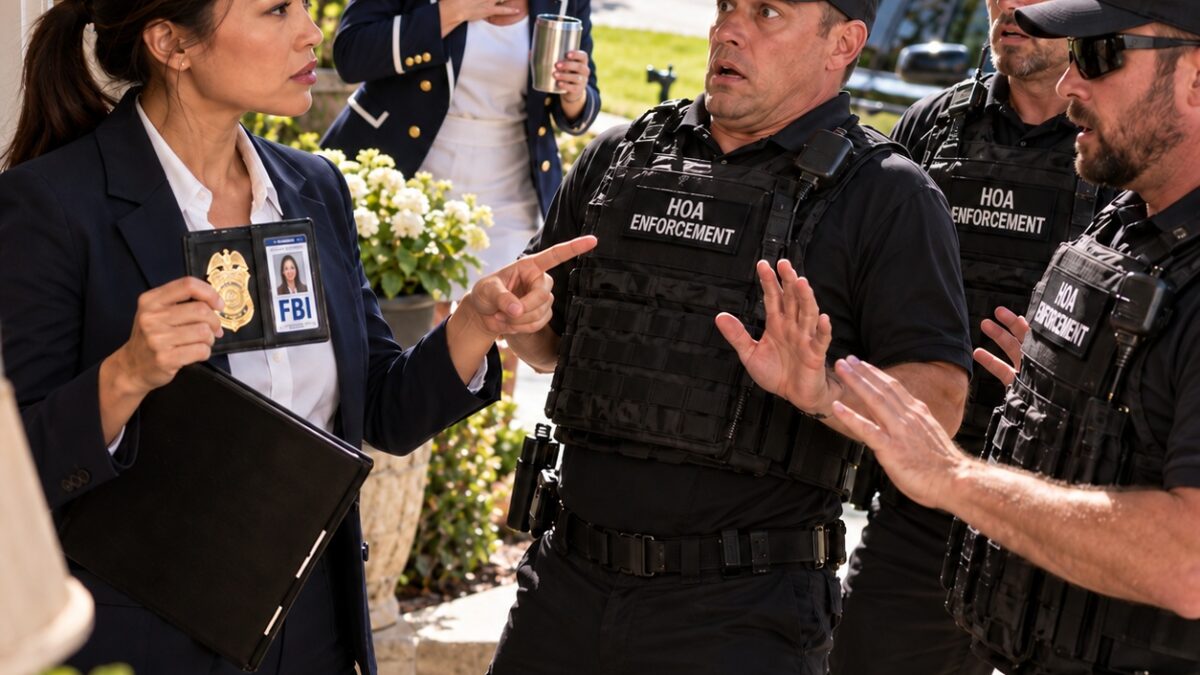
Nancy crossed the street with the controlled urgency of someone trying very hard to make anger look like leadership.
Her navy blazer moved stiffly around her shoulders.
She had one hand wrapped around a leather portfolio and the other swinging at her side.
The three men shifted almost automatically when she approached.
That told me more than their badges had.
They weren’t really there to enforce anything.
They were there because Nancy had sent them.
“What exactly is happening here?” she demanded.
Akai folded her arms.
“You tell me.”
Nancy glanced at the men.
Then at the black folder in my wife’s hand.
Her eyes narrowed.
“I’m Nancy Holloway. Chairwoman of the association.”
Akai nodded.
“Nancy.”
“This is my neighborhood.”
My wife smiled.
“No.”
Nancy blinked.
“Excuse me?”
“This is our property. Your neighborhood surrounds it. That does not make our front porch yours.”
Nancy’s jaw tightened.
“We have community standards.”
“And?”
“And every resident agreed to follow them.”
Akai’s expression stayed calm.
“We follow the rules we legally agreed to.”
“Then you shouldn’t have a problem with an inspection.”
“That is not how property rights work.”
Nancy looked at the three men.
“You told her?”
The tall one cleared his throat.
“She asked for a warrant.”
Nancy turned back toward Akai.
“They don’t need a warrant.”
“They do if they’re claiming a right to enter after I tell them no.”
“They are HOA enforcement.”
“Exactly.”
Akai’s voice never rose.
That was what made Nancy more irritated.
People like Nancy understand shouting.
They know what to do when the other person gets angry.
They can call you unstable.
Aggressive.
Unreasonable.
Akai gave her none of that.
She simply kept forcing Nancy back toward facts.
Nancy pointed toward our driveway.
“You have already been cited.”
“For parking?”
“For noncompliance.”
“Those are not the same thing.”
“The vehicle was improperly positioned.”
Akai looked at the car.
Then Nancy.
“I would love to hear the safety emergency caused by my rear tire being six inches farther from the curb than you prefer.”
“That’s not the point.”
“It usually isn’t with you, is it?”
Nancy’s face tightened.
I was standing just inside the doorway by then, arms folded, doing my best not to smile.
Akai did not need help.
If anything, my involvement would probably make things worse.
Nancy looked toward me.
“Your wife’s attitude is unnecessary.”
I said, “You came to our house with three men dressed like off-brand federal agents.”
“They’re community security.”
“No,” Akai said. “They’re private civilians wearing accessories.”
The man on the left quietly removed his sunglasses.
I almost felt sorry for him.
Almost.
Nancy raised her chin.
“We’re trying to maintain safety.”
Akai stepped slightly closer.
“Then here is a safety recommendation.”
Nancy’s eyes narrowed.
“Stop sending untrained people onto private property pretending they have powers they do not have.”
“They’re not pretending.”
“Good. Then ask them to explain, in legally meaningful language, exactly what authority allows them to cross my property line after I refuse consent.”
Silence.
Akai looked at the tall man.
He looked at Nancy.
Nancy looked back at him.
Nobody answered.
Akai nodded.
“That’s what I thought.”
Nancy’s cheeks flushed.
“You don’t get to intimidate my staff because of whatever government job you think makes you special.”
My wife’s smile disappeared.
“I’m not special.”
She tapped the folder lightly against her palm.
“But I know the difference between authority and costume jewelry.”
One of the men looked down at his badge.
Nancy heard the insult.
Her nostrils flared.
“You think this is funny?”
“No.”
Akai stepped toward the edge of our porch.
“If any of these men enter our property again without consent or valid legal authority, I will document it and take appropriate action.”
Nancy gave a sharp laugh.
“Appropriate action?”
“Yes.”
“What exactly are you threatening?”
“I’m not threatening you.”
Akai held her gaze.
“I’m explaining consequences.”
That distinction landed.
Nancy’s posture changed.
Not much.
Just enough.
Then Akai added, “You should learn the difference.”
For the first time that morning, I saw uncertainty cross Nancy’s face.
She covered it quickly.
“This conversation isn’t over.”
“From my perspective,” Akai said, “it should be.”
Nancy turned.
The three men followed.
Not proudly.
Not dramatically.
They shuffled behind her.
As they crossed the street, the tallest one looked over his shoulder once.
Akai was already drinking her espresso again.
I closed the door.
Then I turned toward her.
“You enjoyed that.”
“No.”
“You absolutely enjoyed that.”
She walked toward the kitchen.
“I enjoyed my coffee.”
“You held up your credentials like the final card in a poker game.”
“I showed them identification because three men with fake badges claimed authority over our home.”
“One of them nearly fell into the roses.”
“That part was unfortunate.”
“You smiled.”
“I smile all the time.”
“You smiled like a Bond villain.”
She sat at the counter.
“Ethan.”
“Yes?”
“Do not make me regret marrying you.”
“Too late. I’m making a T-shirt.”
She pointed toward the coffee machine.
“Make yourself useful.”
For perhaps six hours, the situation seemed over.
At sunset, an email arrived.
SUBJECT: NOTICE OF CONTINUING COMPLIANCE REVIEW.
Nancy had written nearly nine hundred words about our hostility toward association personnel.
She claimed we had “obstructed a lawful community safety function.”
She accused Akai of using her professional credentials to intimidate volunteers.
She demanded written acknowledgment that we would cooperate with future inspections.
Akai read the email silently.
Then handed me her phone.
“What?”
I scanned it.
“She used the phrase ‘lawful community safety function’ four times.”
“I noticed.”
“She really likes it.”
“She thinks repetition turns adjectives into statutes.”
I handed the phone back.
“What are you going to do?”
“Nothing tonight.”
That surprised me.
Usually, Akai responded quickly to anything involving paperwork.
She had spent years in environments where documentation mattered.
Deadlines mattered.
Exact wording mattered.
She could take a vague sentence apart the way a watchmaker dismantles a movement.
But this time she put her phone face down.
“We already told them no.”
“That’s it?”
“For now.”
I looked toward the window.
Nancy’s house sat diagonally across the street.
Her porch light was on.
“So we just wait?”
Akai took another sip of coffee.
“We let people show us who they are.”
That sounded ominous.
It was.
The next few days were strangely quiet.
No citations.
No emails.
No fake enforcement patrols.
Nancy drove past our house twice without looking toward it.
The men in tactical vests vanished entirely.
I started thinking embarrassment might have accomplished what common sense had not.
Then our backyard camera sent a motion alert at 11:47 on Friday night.
I was brushing my teeth.
Akai was reading in bed.
My phone vibrated.
I opened the feed.
A flashlight beam moved along our rear fence.
I enlarged the image.
A man was crouched near the corner post.
Tape measure in one hand.
Flashlight in the other.
“Nancy’s husband.”
Akai was already out of bed.
I blinked.
“How did you—”
“I saw your face.”
She was pulling on a sweatshirt.
“Wait.”
She didn’t.
By the time I got shoes on, Akai had opened the back door.
She walked across the grass barefoot.
Her own flashlight came alive.
The beam hit Nancy’s husband so suddenly he dropped the tape measure.
He spun around.
“Jesus!”
Akai stopped several yards away.
“What are you doing?”
“I’m checking the fence.”
“At midnight.”
“It’s HOA protocol.”
Akai stared at him.
That sentence might have been the worst possible answer.
“Name.”
He blinked.
“You know who I am.”
“Say it.”
“Robert.”
“Robert what?”
“Holloway.”
“Nancy’s husband.”
His face tightened.
“Yes.”
“And what position do you hold with the HOA?”
“I assist with compliance.”
“Are you on our property right now?”
“I’m checking the boundary.”
“That wasn’t the question.”
He looked down.
One shoe was clearly inside our lot line.
The camera mounted on the garage was pointed directly toward him.
Akai lifted her flashlight slightly.
“Step back.”
He did.
“Again.”
He moved farther.
“Thank you.”
I reached them then.
Robert looked at me.
“You people are making this bigger than it needs to be.”
I laughed.
“You’re measuring our fence at midnight.”
“Nancy wants documentation.”
“Then Nancy can use public records.”
Akai said, “You have been told not to enter this property.”
“I barely stepped over.”
“Good. Then barely never do it again.”
Robert’s hands trembled slightly.
Whether from anger or embarrassment, I couldn’t tell.
“This is ridiculous.”
“No,” Akai said. “This is very simple.”
She pointed toward our house.
“You are on video.”
His face changed.
“You’re recording?”
“Yes.”
“You can’t record me without permission.”
“In our own backyard?”
He stopped.
Akai continued.
“If you return onto our property after being expressly told to stay off, I will document that too.”
Robert started to say something.
She raised one hand.
“And before you repeat the phrase ‘HOA protocol,’ understand this: HOA procedure does not override private property law.”
He bent down for his tape measure.
Akai looked at it.
“Leave it.”
“What?”
“You dropped it on our side.”
“That’s mine.”
“Yes. I’m aware.”
She paused.
Then nudged it carefully toward the boundary with her foot.
“Now take it.”
Robert picked it up.
His face was red.
I knew Akai well enough to understand she was deliberately giving him no excuse to claim we had kept his property.
Documentation.
Clarity.
No unnecessary drama.
Robert apparently preferred unnecessary drama.
“You think you’re untouchable because you work for the government.”
Akai looked almost bored.
“No.”
“You threatened Nancy.”
“I warned her not to trespass.”
“She’s trying to protect this neighborhood.”
“From what?”
He stared at her.
She waited.
There was no answer.
Finally, she said, “Tell Nancy tonight counts as notice.”
“Notice of what?”
“That both of you need to stay off our property.”
Robert gave a humorless laugh.
“Or what?”
Akai’s expression cooled.
“Or we stop being informal.”
That got through.
He walked quickly toward the golf cart parked in the alley behind our house.
He climbed in.
Started it.
And drove off faster than any grown man should drive a golf cart at midnight.
I watched the red taillights disappear.
Then I looked at Akai.
“You threatened him with paperwork.”
“Yes.”
“He looked terrified.”
“People like Robert often fear paperwork more than jail.”
“You should put that on a motivational poster.”
She turned toward the house.
“Go back to bed.”
“You forgot something.”
“What?”
I pointed toward her feet.
She looked down.
Grass.
Mud.
Bare feet.
Akai sighed.
“This is your fault.”
“How?”
“I married you.”
We both started laughing.
It was the last carefree moment we had for a while.
The following morning, a printed flyer appeared on every mailbox in the neighborhood.
NEW COMMUNITY SAFETY PROCEDURES — EFFECTIVE IMMEDIATELY.
Rule one prohibited “unauthorized citizen surveillance.”
Rule two prohibited “self-appointed patrol activity.”
Rule three warned residents against “interfering with accredited HOA compliance personnel.”
Then came the line that made me choke on my coffee.
RESIDENTS ARE ADVISED NOT TO ENGAGE IN OFFICIAL CAPACITY WITH ANY FEDERAL PERSONNEL RESIDING WITHIN THE COMMUNITY WITHOUT BOARD APPROVAL.
I carried the flyer into the kitchen.
Akai read it.
Once.
Then twice.
“Wow,” I said.
She looked at me.
“They wrote a rule about you.”
“They wrote a rule because they’re scared of me.”
“Same difference.”
“No.”
Her eyes stayed on the paper.
“This is useful.”
“What does that mean?”
“It means Nancy has now created written evidence that she is using association policy to target a specific household.”
I stared at her.
“Most people would just say the flyer is stupid.”
“It can be two things.”
That afternoon, Akai made several calls.
I didn’t ask for details.
There are parts of her work I don’t know.
Not because she spends evenings dramatically whispering state secrets into secure phones.
Reality is much more boring.
She had worked for years in intelligence-related federal roles and specialized in compliance, threat assessment, and interagency coordination.
The dramatic version sounded exciting.
The real version involved endless reports, legal restrictions, approvals, and people arguing over what one paragraph meant.
The important part for our situation was simple.
Akai understood procedures.
Nancy understood intimidation.
Those were about to collide.
My wife called what followed “Athena.”
I asked whether that was a real classified protocol.
She stared at me.
“No.”
“Seriously?”
“Ethan, if it were classified, why would I tell you?”
“Fair point.”
“Athena is the name of the folder on my laptop.”
“That is deeply disappointing.”
“It’s a documentation package.”
“Even worse.”
She ignored me.
Athena contained the parking notices.
Emails.
Video from the front door.
Video of Robert crossing the rear boundary.
Copies of the new HOA rules.
Dates.
Times.
Names.
Transcripts.
Copies of the association covenants.
Local property statutes.
Everything.
She documented each contact as though preparing a professional case file.
Then she contacted a federal ethics attorney she trusted and a private civil lawyer who specialized in HOA disputes.
No satellite surveillance.
No secret vans.
No men in dark suits rappelling from helicopters.
Just lawyers.
Which, as it turned out, frightened Nancy more.
The first formal letter went to the board.
It identified targeted harassment.
Improper representation of private security personnel.
Possible trespass.
Potential retaliation.
Selective rulemaking.
The board was instructed to preserve all communications involving our address.
Nancy.
Robert.
The fake enforcement team.
Internal messages.
Meeting minutes.
Emails.
That was when the neighborhood changed.
People stopped looking amused.
Board members started looking nervous.
One came to our house alone.
His name was Martin Cole.
He stood on the walkway with both hands visible and waited for me to answer.
“I’m not here as enforcement.”
“Good opening.”
“I’d like to speak with your wife.”
Akai joined us.
Martin looked exhausted.
“I did not approve those men coming to your property.”
Akai nodded.
“Who did?”
“I’m trying to find that out.”
“Nancy?”
He hesitated.
“That’s what it looks like.”
“And Robert entering our yard?”
“I knew nothing about that.”
“The new rules?”
Martin rubbed one hand over his face.
“Those were distributed before the entire board voted.”
Akai was silent.
He looked at her.
“I’m not asking you to drop anything.”
“That’s wise.”
“I’m asking whether this can be contained.”
“To what?”
“Nancy.”
There it was.
The first crack.
Not in Nancy.
In the people around her.
Martin had spent years letting Nancy represent the board.
Now that her decisions carried possible legal exposure, everyone suddenly wanted to distinguish her actions from theirs.
Akai said, “I don’t want your HOA.”
Martin blinked.
“What?”
“I don’t want your money. I don’t want to run your neighborhood. I don’t want apologies from fifty residents who had nothing to do with this.”
“Then what do you want?”
“I want Nancy and anyone acting for her to stop entering our property, stop inventing authority, and stop targeting us with rules because I refused an unlawful inspection.”
Martin nodded slowly.
“That seems reasonable.”
“It was reasonable the first time.”
He looked embarrassed.
“I know.”
After he left, I asked Akai, “Do you trust him?”
“No.”
“You think he’s lying?”
“No.”
“Then why not?”
“Trust is not the same as believing someone is telling the truth in one conversation.”
I thought about that.
“You really should write greeting cards.”
Over the next week, residents started talking.
That was what changed everything.
Nancy had spent years running the HOA through a mixture of efficiency and intimidation.
She knew every covenant.
Every deadline.
Every homeowner who was late with dues.
Every mailbox that had been replaced without approval.
Every trash can that remained visible past the allowed time.
Some residents liked her.
Some feared her.
Most simply tried to avoid attracting her attention.
But the fake enforcement incident exposed something larger.
Nancy had crossed from aggressive HOA administration into something harder to defend.
She had sent men to a private home claiming powers they did not have.
Then her husband had entered the backyard at night.
Then she created rules targeting the household that objected.
Once residents saw that pattern, they began reexamining their own experiences.
A woman named Deborah stopped Akai near the mailbox.
“Nancy fined us three hundred dollars last year.”
“For what?”
“My daughter left chalk drawings on our driveway.”
Akai frowned.
“Was that actually prohibited?”
“That’s the thing. We asked for the rule. Nancy sent us something about exterior visual harmony.”
Another resident had been threatened with escalating fees because his garbage cans remained visible while he was at the emergency room with his father.
A retired teacher had received repeated warnings because her front garden contained “excessive decorative variation.”
I didn’t know that phrase could exist.
Nancy proved me wrong.
The stories accumulated.
Then someone discovered something more important.
Several of Nancy’s supposed “enforcement policies” had never been formally approved.
She had taken vague language in the covenants and turned personal preferences into operating rules.
Not all of them.
But enough.
The board scheduled an emergency meeting.
Nancy fought it.
Of course she did.
She sent an email claiming outside intimidation was threatening Sunset Ridge’s sovereignty.
I read that sentence three times.
“Sovereignty?”
Akai didn’t look up from her laptop.
“Maybe she plans to issue passports.”
“Should we apply?”
“No.”
“Currency?”
“Ethan.”
“I’m just asking.”
The meeting happened on a Thursday night.
We did not attend.
I wanted to.
Akai refused.
“This is their association.”
“But it’s about us.”
“It started with us.”
She closed her laptop.
“That does not make their internal governance our business.”
So we stayed home.
Naturally, half the neighborhood texted people during the meeting.
George, our next-door neighbor, sent me updates every ten minutes.
7:12 — NANCY IS BLAMING YOU.
7:28 — ROBERT LOOKS LIKE HE WANTS TO ESCAPE THROUGH FLOOR.
7:41 — MARTIN JUST READ YOUR LAWYER LETTER.
8:03 — LADY FROM CEDAR COURT IS DESTROYING HER.
8:17 — THEY’RE ASKING ABOUT THE FAKE SECURITY TEAM.
8:26 — NANCY IS YELLING.
8:31 — I THINK THIS IS IT.
Then nothing.
I stared at my phone.
Akai was reading a book.
“How are you calm?”
“I’m reading.”
“Nancy may be losing her presidency.”
“That would be an internal HOA matter.”
“You don’t mean that.”
“I absolutely do.”
My phone vibrated.
George.
ROOK TAKES QUEEN.
I laughed.
Akai looked up.
“What?”
“They suspended her.”
That got her attention.
“Pending review?”
“How did you know?”
“Because removal procedures usually require—”
I held up my hand.
“Please let one moment in our marriage remain dramatic.”
She smiled.
“Fine.”
George called ten minutes later.
The board had voted to suspend Nancy immediately while reviewing her conduct.
The vote wasn’t even close.
Several residents had demanded a complete investigation of the fake enforcement team, selective fines, and rules issued without proper board approval.
Nancy apparently accused everyone of betrayal.
Then she accused Akai of manipulating the neighborhood.
Then federal intimidation.
Then, for reasons nobody could clearly explain, foreign influence.
At that point even people who had defended her stopped.
“She lost it,” George said.
“How bad?”
“At one point she said this was psychological warfare.”
I looked toward Akai.
My wife was calmly turning a page.
“Honestly,” I said, “living with Akai can feel that way.”
She threw a pillow at me.
Nancy disappeared from neighborhood life for several days.
Her blinds stayed shut.
Robert’s golf cart remained in their garage.
No citations appeared.
No enforcement patrols.
The quiet felt unnatural.
Then the board president pro tem contacted our attorney.
The HOA formally rescinded the rules targeting federal personnel.
They terminated the private “enforcement” arrangement.
They issued written instructions that no representative could enter residential property without consent or legitimate legal authority.
They withdrew our parking citation.
Akai read the letter.
“Well.”
“What?”
“We won.”
She looked at me.
“That is not how I would phrase it.”
“Of course not.”
“The board corrected its conduct.”
“We won.”
“Ethan.”
“We absolutely won.”
She shook her head.
But she was smiling.
I thought that would be the end.
In one sense, it was.
There was no dramatic arrest.
No federal raid.
No secret tribunal.
No government agents descending on Sunset Ridge.
The truth was almost disappointingly normal.
Lawyers wrote letters.
Board members reviewed records.
Residents voted.
Insurance representatives got involved.
Policies changed.
Nancy lost the position that had given her the platform to intimidate everyone.
And once the platform disappeared, something unexpected happened.
She became ordinary.
That sounds cruel.
I don’t mean she became worthless.
I mean the title had magnified her.
For years, people had seen Nancy approaching with a clipboard and imagined the entire HOA standing behind her.
After the suspension, she was simply Nancy Holloway.
One homeowner.
One opinion.
One voice.
That was enough to change the entire atmosphere.
People started challenging fines.
Some were overturned.
The board established an appeal process.
Private “compliance patrols” were eliminated.
Exterior inspections had to be documented and approved.
Members could request the exact covenant supporting any violation.
It was astonishing how much power disappeared when people started asking one question.
“Show me the rule.”
George loved that phrase.
He started saying it about everything.
I saw him outside one morning drinking coffee.
“Your lawn looks long.”
“Show me the rule.”
“You’re wearing sandals with socks.”
“Show me the rule.”
“Your music is terrible.”
“SHOW ME THE RULE.”
The neighborhood became almost fun.
Akai hated that I encouraged him.
Nancy remained under review for another month.
Then she resigned.
Officially, it was for personal reasons.
Nobody believed that.
Robert stopped measuring fences.
The three fake enforcement guys vanished entirely.
I eventually learned they had been employees of a local private security contractor hired for limited community patrol services.
Nancy had apparently expanded their role far beyond the written agreement.
When their employer discovered what happened at our door, he terminated the HOA contract.
One of the men sent us a written apology through our attorney.
The tall one.
His name was Tyler.
The letter surprised me.
He admitted he had been told residents were legally required to cooperate.
He had assumed Nancy knew what she was talking about.
Akai read the letter twice.
“Are you going to accept it?”
“Yes.”
“Just like that?”
“He admitted he was wrong.”
“What about the fake badge?”
She looked at me.
“Ethan.”
“I’m asking.”
“People are allowed to learn.”
That was Akai.
Hard as steel while a boundary was being crossed.
Strangely generous once someone genuinely stepped back.
I had expected her to enjoy Nancy’s downfall.
She didn’t.
That taught me something.
What Akai had wanted from the beginning was not victory.
It was clarity.
You do not enter our home because a clipboard tells you to.
You do not invent authority because someone is intimidated by your title.
You do not send your husband into our backyard at midnight because somebody refused you.
You do not write rules targeting one family and call it community safety.
When all of that stopped, she stopped caring.
I took longer.
I was still angry.
Maybe because I had watched Nancy stand across the street that first morning smiling while three men pounded on our door.
There was something personal in that image.
She had wanted Akai embarrassed.
Afraid.
Forced to submit publicly.
I struggled to let that go.
One evening, several weeks after Nancy resigned, I saw her walking alone.
No blazer.
No clipboard.
Sweatpants.
Hair tied back.
She was carrying a small grocery bag.
She saw me standing near the driveway.
For a second, both of us froze.
Then she walked toward me.
My shoulders tightened.
“Ethan.”
“Nancy.”
There was no wine tumbler.
No audience.
No board members.
She looked older.
Maybe she had always looked that age and I simply hadn’t noticed beneath all the performance.
“I suppose you’re happy.”
I could have said yes.
Part of me wanted to.
Instead, I said, “About what?”
“You know.”
“I’m happy people stopped coming onto our property.”
Her mouth tightened.
“You ruined my reputation.”
“No.”
“You and your wife made me look unstable.”
I took a breath.
This was the moment where old Ethan might have argued.
Listed everything.
Parking ticket.
Fake cops.
Robert.
The flyer.
The emails.
I didn’t.
“Nancy, I don’t want to fight with you.”
She stared at me.
“That’s easy for you to say.”
“It was easy for me to say at the beginning too.”
That landed.
Her eyes dropped briefly.
Then came back.
“I was trying to protect the neighborhood.”
“I believe you believe that.”
Her face changed.
“That’s insulting.”
“It isn’t meant to be.”
I chose my next words carefully.
“But protecting people does not mean controlling them.”
She looked toward her house.
“You wouldn’t understand.”
“You’re probably right.”
I waited.
Nancy shifted the grocery bag in her hand.
“For seven years, every time something went wrong, people called me.”
I said nothing.
“If somebody’s dog was loose, they called me. If the entrance lights failed, they called me. If a roof color looked wrong, they called me. If someone parked badly, if teenagers made noise, if landscaping died—me.”
Her voice was quieter now.
“Everyone wanted rules enforced until the rule applied to them.”
That was probably true.
“And after a while,” she continued, “if I didn’t handle everything, nothing got handled.”
There it was.
For the first time, Nancy sounded like a person instead of a title.
I understood more than I wanted to.
Responsibility can distort people.
Especially when others hand it to them piece by piece.
Eventually, you can begin believing indispensability is the same thing as righteousness.
“You still went too far,” I said.
“I know what you think.”
“That wasn’t what I said.”
She looked at me.
“I said you went too far.”
Silence.
Then, barely audible:
“I know.”
I wasn’t prepared for that.
Nancy looked embarrassed the moment the words left her mouth.
She straightened.
“I should go.”
“Nancy.”
She paused.
“I don’t hate you.”
She gave me a strange expression.
“I’m not sure that makes me feel better.”
“It wasn’t supposed to.”
That almost made her smile.
Almost.
Then she walked home.
I told Akai about it.
She listened without interrupting.
When I finished, she asked, “Do you feel better?”
“I don’t know.”
“That means yes.”
“How?”
“Because if you still wanted revenge, you’d know exactly how you felt.”
I sat beside her.
“Do you feel sorry for Nancy?”
“No.”
That answer came quickly.
I laughed.
“Okay.”
“I can understand someone and still hold them responsible.”
“That sounds exhausting.”
“It’s called adulthood.”
“Again, horrible greeting card.”
Months passed.
Life became normal.
Akai went to work.
I worked from home most days.
George continued using “show me the rule” as if he had invented constitutional law.
The HOA elected new leadership.
Martin became president.
He hated the title.
That was probably why he was good at it.
His first email to residents was six paragraphs.
Nancy’s average had been twenty-seven.
Property values did not collapse.
Children continued drawing chalk flowers.
Garbage cans occasionally remained visible.
Civilization survived.
Then one Saturday, the HOA held a neighborhood block party.
We almost skipped it.
George appeared at our door.
“You’re coming.”
“No.”
“Yes.”
“No.”
Akai walked behind me carrying sunglasses.
“We’re coming.”
I turned.
“Traitor.”
George smiled.
“I like her.”
“Everyone does.”
We went.
There were tables.
Food.
Music.
Kids running between driveways.
Nobody wore tactical vests.
That alone improved the atmosphere.
Martin had posted a joke sign beside the food.
ALL PLATES MUST BE ALIGNED WITH TABLE EDGE WITHIN 0.25 INCHES.
George saw it and nearly collapsed laughing.
Akai shook her head.
“You’ve created monsters.”
“I did nothing.”
Nancy did not attend.
I noticed.
I wished I hadn’t.
Because noticing meant some part of me still expected her to be central to the story.
She wasn’t anymore.
That was the real ending.
Not her suspension.
Not the legal letter.
Not the apology.
Not even the moment she admitted she had gone too far.
The ending was when nobody needed Nancy to be the villain anymore.
The neighborhood functioned without her.
We functioned without thinking about her.
Weeks could pass before I saw her.
Then months.
Eventually, Robert waved at me from his golf cart.
I stared.
He looked embarrassed.
Then I waved back.
Life is strange.
One morning almost a year after the first parking ticket, I found another piece of paper tucked under Akai’s windshield wiper.
My stomach tightened instantly.
I pulled it free.
It was handwritten.
IMPROPER ALIGNMENT WITH CURB.
For one second, rage surged through me.
Then I saw the bottom.
— GEORGE
SHOW ME THE RULE.
I heard laughter from across the street.
George was standing in his driveway.
I raised the paper.
“You have five seconds.”
He ran inside.
Akai walked out carrying coffee.
“What?”
I handed her the note.
She read it.
Then laughed so hard she had to lean against the car.
That sound did something to me.
It returned the entire experience to its proper size.
A ridiculous parking citation.
A ridiculous conflict.
A woman who confused leadership with ownership.
Three men who confused a tactical vest with legal authority.
A husband measuring fences after midnight.
A neighborhood that had forgotten it could simply ask questions.
For months, Nancy had made everything feel dangerous and dramatic.
Eventually, the drama collapsed under something much more ordinary.
Boundaries.
Documentation.
People saying no.
That was all.
Akai folded George’s fake citation and slipped it into her pocket.
“You keeping that?”
“Yes.”
“Why?”
She opened the car door.
“Evidence.”
I stared at her.
She smiled.
“Relax, Ethan.”
“You cannot joke about evidence.”
“I just did.”
She got into the car.
Before closing the door, she looked toward Nancy’s house.
The blinds were open.
No one was watching us.
No clipboard.
No security patrol.
No confrontation waiting.
Just another quiet morning.
Akai started the engine.
I leaned through the open window.
“You know, technically your rear tire is a little far from the curb.”
She slowly turned toward me.
I stepped backward.
“Never mind.”
“Smart.”
She drove away.
I stood in the driveway laughing.
For all the stories people tell about power, I learned something simple from Nancy.
Real authority rarely needs costumes.
It does not need fake badges.
It does not need intimidation.
It does not need people pounding on doors.
And it certainly does not need a woman across the street smiling because she thinks three men with clipboards are about to frighten her neighbors into obedience.
Real authority has limits.
That is what makes it legitimate.
Nancy never understood that until those limits finally reached her.
My wife understood it from the beginning.
Maybe that was why she had never needed to yell.
The truth was enough.
The property line was enough.
The camera footage was enough.
The paperwork was enough.
And when the people around Nancy finally stopped treating her confidence like law, all that enormous power she seemed to have disappeared almost overnight.
One year later, the curb was still there.
Our house was still there.
The HOA was still there.
The neighborhood was doing just fine.
And nobody had tried to inspect our perimeter since.
Which, as far as I’m concerned, was the best possible ending.








