PART 2 :The Developer Threatened to Take My Job and My Home—He Didn’t Know I Had Already Documented Every Unsafe Shortcut
FULL STORY CONTINUATION
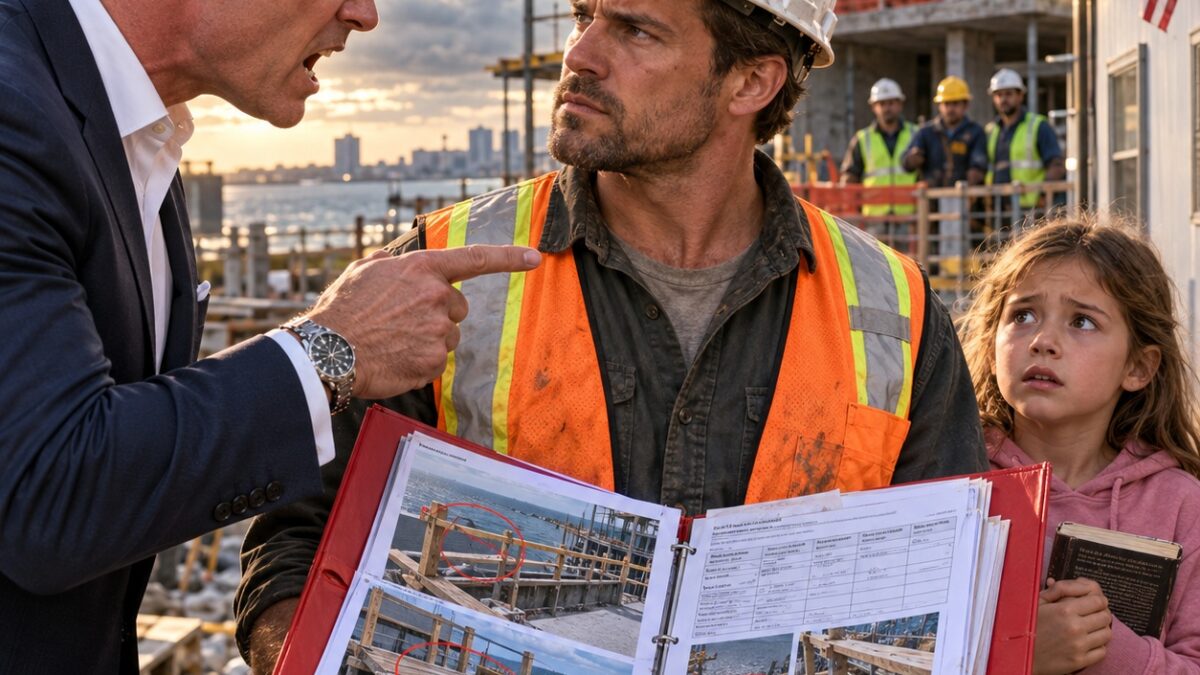
Grant pointed at the temporary flooring.
“Remove the report.”
“No.”
“Excuse me?”
“The report stays.”
He took another step.
“You work for a contractor on my development.”
“I work for the construction company.”
“Which works for me.”
“The safety requirements don’t.”
That was the sentence that changed his expression.
Not because it was dramatic.
Because it drew a boundary.
Grant lived comfortably inside systems where money created leverage.
Contractors wanted his next project.
Managers wanted his invoices paid.
Vendors wanted preferred status.
He was used to pressure working.
Safety rules irritated him because they were supposed to function differently.
If a floor was unsafe, money did not make it safe.
If a railing failed, influence did not strengthen the metal.
Gravity did not care who signed the checks.
Grant leaned close enough that I could smell expensive aftershave.
“You are going to withdraw that report.”
“No.”
“And sign a statement accepting responsibility for the delay.”
“No.”
His face hardened.
“You really don’t understand how this world works.”
I looked toward the weakened flooring.
“I understand how that works.”
He followed my eyes.
Then laughed.
“You’re being dramatic.”
An older foreman named Luis Martinez stood twenty feet away.
He had been in construction longer than Grant had probably been in development.
Luis spoke quietly.
“It’s not right, sir.”
Grant turned.
“What?”
“The flooring.”
Luis removed his hard hat.
“Mercer’s right.”
Grant looked around.
No one else spoke.
But nobody contradicted Luis.
That made Grant angrier.
He pointed toward the site office.
“Get your regional director here.”
My project manager started to say something.
Grant cut him off.
“Now.”
Then he looked at me.
“You want to make this formal?”
“It already is.”
“Good.”
He smiled.
“Let’s make it formal.”
Willa was still standing near the trailer.
Her eyes moved between us.
I hated that she was there.
Not because I thought Grant could physically harm me.
Because children absorb humiliation differently from adults.
She had already lost one parent.
She worried constantly about losing stability.
I knew she had heard the words career.
Home.
Job.
Money.
She knew more about those things than an eight-year-old should.
I walked toward her.
“Hey.”
She looked up.
“Am I in trouble?”
That hurt.
“No.”
“Are you?”
“Maybe a little.”
Her eyes widened.
I smiled.
“Work trouble. Not real trouble.”
“Can he make you lose your job?”
I could have lied.
Parents lie with good intentions all the time.
No, sweetheart.
Everything is fine.
But Willa had already spent too much of her childhood learning that adults can say fine while everything is falling apart.
So I told her the truth carefully.
“He can make things difficult.”
She looked toward Grant.
“He’s mean.”
“Sometimes scared people act mean.”
“He doesn’t look scared.”
“That doesn’t mean he isn’t.”
She considered that.
Then said:
“Mom said strong people don’t have to scare everybody.”
I looked at her.
Claire had said that more than once.
Usually about people on television.
Sometimes about me.
“Your mom was right.”
Willa nodded.
Then:
“Are you scared?”
I hesitated.
“Yes.”
Her eyes widened again.
That answer mattered too.
“Really?”
“Yes.”
“Then why aren’t you doing what he says?”
Because that is how children ask the questions adults spend entire lives avoiding.
I crouched.
“Because being scared doesn’t mean somebody else gets to decide what’s right.”
She held the book tighter.
I touched her shoulder.
“Stay near the office.”
“Okay.”
“And if anybody tells you to go anywhere?”
“I find you.”
“Or Miss Ramirez.”
The administrative assistant was already standing in the trailer doorway.
She nodded.
“I’ve got her.”
I returned to the work area.
Grant was on his phone.
He wanted my regional director, Thomas Avery, there immediately.
Thomas supervised six major projects.
He was fair.
Not soft.
I had no idea how much pressure Grant could put on him.
That uncertainty made my stomach hurt more than Grant’s threats did.
I had enough savings for perhaps three months if I cut everything.
Maybe four.
Rent due in two weeks.
School expenses.
Health insurance.
Willa’s upcoming field trip.
I remember thinking:
You can be right and still be unemployed.
That is one of adulthood’s ugliest truths.
Being correct does not guarantee protection.
So I checked my records again.
Safety report.
Photographs.
Time stamps.
Emails.
Requests for repairs.
I had already sent copies to the company server.
That habit came from another life.
Documentation.
Redundancy.
Do not depend on one copy of anything important.
Grant had no idea how much existed outside the site office.
That helped.
The regional director arrived forty minutes later.
Thomas Avery stepped from his truck carrying a black folder.
Grant walked toward him before he reached the trailer.
“Thank God.”
Thomas nodded.
“Mr. Huxley.”
“I want Mercer removed.”
Thomas looked past him at me.
Then toward the closed work area.
“What happened?”
“What always happens. He stopped production over another technicality.”
I said:
“Incorrectly installed temporary flooring.”
Grant threw up his hands.
“Exactly.”
Thomas looked at him.
“That wasn’t agreement.”
Grant’s mouth tightened.
Thomas walked toward the trailer.
“Let’s sit.”
Grant remained standing.
“I don’t need a meeting. I need a decision.”
Thomas looked at him.
“You called me to the site.”
“Yes.”
“Then you’re getting a meeting.”
That was the first moment Grant seemed uncertain.
We went inside.
Willa sat in the corner with her book.
I didn’t like her hearing any of it.
Miss Ramirez quietly guided her into the adjacent room.
Grant sat.
Thomas opened the folder.
“I received your complaint.”
“Good.”
Thomas continued.
“I also received Mr. Mercer’s documentation.”
Grant leaned back.
“You’ll see exactly what I’m talking about.”
Thomas took out several photographs.
“No.”
Grant frowned.
“What?”
“These photographs were submitted before your complaint.”
He placed one on the table.
Temporary railing.
Date stamp.
Another.
Missing anchor points.
Another.
The flooring.
Deflection around an improperly supported section.
Thomas added emails.
Callan Mercer requesting corrective work.
Callan Mercer requesting confirmation.
Callan Mercer documenting no response.
Grant’s face hardened.
“He creates paper to protect himself.”
“Yes.”
Thomas looked at me.
“He does.”
That could have been criticism.
It wasn’t.
“That’s part of the job.”
Then Thomas removed another report.
Different letterhead.
Independent structural engineer.
Grant leaned forward.
“What is that?”
Thomas slid it across.
“Third-party review.”
“You called an engineer?”
“The company did.”
“When?”
“This morning.”
Grant looked at me.
“You went around me?”
I answered:
“I notified my employer of a safety issue.”
Thomas continued.
“The engineer inspected photographs and现场 measurements, then visited the site before I arrived.”
Grant’s face changed.
I had not known the engineer had already come.
Thomas pointed toward the conclusion.
“Work in the affected zone should remain suspended until temporary support is corrected.”
Grant pushed the report back.
“He’s being overly cautious.”
Thomas closed the folder.
“No.”
Grant laughed.
“You’re going to delay a multimillion-dollar development because a safety guy and one nervous engineer don’t like temporary flooring?”
Thomas’s expression became flat.
“I’m going to stop work because a documented structural hazard has been identified.”
Grant stood.
“You know what my company pays you?”
Thomas stayed seated.
“I know what our contract says.”
“I can move every future project away from your company.”
“You can.”
“Then fire him.”
Thomas looked at me.
Then at Grant.
“No.”
That word changed the room.
Grant had heard no from me.
A safety supervisor.
Replaceable in his mind.
Hearing it from a regional director was different.
“You’re choosing him over this development?”
Thomas shook his head.
“This isn’t him versus you.”
“It absolutely is.”
“No.”
Thomas tapped the engineer’s report.
“This is safe versus unsafe.”
Grant stared.
For years afterward, I remembered that sentence.
Not because it saved my job.
Because it made the issue smaller than Grant wanted it to be.
He kept trying to turn everything into status.
Money.
Influence.
Loyalty.
Defiance.
Thomas returned it to fact.
Safe.
Unsafe.
Grant pointed toward me.
“He has been sabotaging this project for weeks.”
Thomas opened another section of the folder.
“Then explain these.”
More emails.
Several from Grant’s project office.
Instructions to accelerate work before full correction.
One message said:
TEMPORARY CONDITION ACCEPTABLE UNTIL FINAL INSPECTION.
Another:
DO NOT ALLOW SAFETY TEAM TO CREATE ADDITIONAL DELAY WITHOUT OWNER REVIEW.
Grant stared.
“Those are ordinary project-management communications.”
“Not when safety staff are being told to defer hazards for schedule.”
“That’s your interpretation.”
“It is now part of the investigation.”
For the first time, Grant stopped talking.
Thomas looked toward me.
“Callan, there’s something unrelated I want to confirm.”
I frowned.
“Okay.”
“Your personnel file notes prior Navy service.”
“Yes.”
Grant rolled his eyes.
I ignored him.
Thomas continued.
“Were you attached to a special operations element involved in an evacuation near Al Tanf in 2018?”
That question hit differently.
The construction trailer disappeared for half a second.
Dust.
Heat.
Radio static.
Vehicle smoke.
A corpsman shouting.
I looked at Thomas.
“Yes.”
He exhaled.
“I thought so.”
Grant looked between us.
“What does that have to do with my project?”
Thomas turned toward him.
“My younger brother was a Navy corpsman on that deployment.”
I went still.
Thomas looked back at me.
“Daniel Avery.”
I remembered the name immediately.
Young corpsman.
Sharp.
Too calm until he wasn’t.
Injured during withdrawal.
“You’re Daniel’s brother?”
“Yes.”
I looked away.
Thomas continued quietly.
“He told me about the extraction.”
Grant crossed his arms.
“This is completely irrelevant.”
Thomas ignored him.
“My brother’s team was cut off after the planned route failed.”
I said:
“We had several people coordinating.”
“He said one person stayed behind after the last vehicle started moving.”
I knew where this was going.
“Thomas.”
“He said that man refused to leave until every wounded person was accounted for.”
The crew had gathered outside the trailer.
Some could hear through the open windows.
I hated that.
Not because I was ashamed.
Because the story did not belong on a construction site.
Grant looked at me differently.
That irritated me even more.
Thomas said:
“Daniel told me his name was Mercer.”
I rubbed my forehead.
“We had a good team.”
“He said you went back for him.”
“I didn’t go alone.”
“He said he was the last one.”
“He had a leg injury.”
“He said you could’ve left.”
I looked at him.
“I wasn’t leaving him.”
Thomas nodded.
Emotion moved through his face.
“He remembers.”
I didn’t know what to say.
Grant did.
“So he’s a war hero now?”
The contempt in his voice made Luis, standing outside, look toward him.
I answered before Thomas could.
“No.”
Grant blinked.
“I was doing my job.”
Then I placed the current safety report on the table.
“And I’m doing my job now.”
That was the point.
Not Al Tanf.
Not SEAL teams.
Not old missions.
The floor.
The workers.
Today.
“This is the final inspection report,” I said. “The weak section is documented. So are the missing maintenance requests and the prior notices.”
Grant looked at it.
I continued.
“I am asking for the site to be made safe.”
“That’s it?”
“Yes.”
“You don’t want me removed?”
“That isn’t my decision.”
“You don’t want revenge?”
“No.”
He almost seemed offended.
Thomas closed the folder.
“Work remains suspended in the affected areas.”
Grant opened his mouth.
Thomas continued.
“And we are initiating a formal review of pressure placed on site safety personnel.”
Grant turned to him.
“You’ll regret this.”
Thomas stood.
“Maybe.”
“Millions are at stake.”
Thomas looked toward the workers outside.
“So are people.”
Grant walked out.
Not defeated.
Not destroyed.
Just denied.
That was the beginning of the real investigation.
Over the next several days, regional management reviewed more than my reports.
They interviewed workers.
Foremen.
Project coordinators.
Subcontractors.
The story widened.
A scaffold repair request had been delayed.
Electrical housekeeping concerns repeatedly marked “low priority.”
A crane inspection had been rescheduled under pressure.
None had caused a serious injury.
That became Grant’s defense.
Nothing happened.
I hate that phrase.
Nothing happened is not evidence that unsafe behavior was acceptable.
Sometimes nothing happened because people were lucky.
Sometimes because someone stopped the job before luck ran out.
The company brought in independent safety consultants.
Grant was removed from direct day-to-day oversight while his development company decided how to respond.
The project did not disappear.
Construction continued.
Eventually.
Under stricter controls.
That mattered.
Stories like this become dishonest when the villain loses everything overnight.
Grant did not become poor.
His company did not collapse.
The buildings were not abandoned.
He lost something more specific.
Unchecked control.
Every stop-work decision required documented review.
Independent sign-off increased.
Safety complaints went directly to our regional office.
Grant could challenge them.
He could not bury them.
The damaged flooring was rebuilt.
Proper temporary support installed.
Engineer approved.
Crews returned.
No drama.
No one fell.
That was the victory.
Thomas called me into the regional office a week later.
I assumed it was follow-up.
Instead, he offered me a promotion.
Regional safety oversight.
Multiple projects.
More money.
Better benefits.
I should have been happy immediately.
I wasn’t.
“What does it involve?”
“Site audits.”
“Paperwork?”
“A lot.”
“Terrible.”
He smiled.
“Training.”
“Better.”
“Investigations.”
“Fine.”
I looked at the offer.
Then said:
“One condition.”
Thomas leaned back.
“You’re negotiating already?”
“Yes.”
“What?”
“Hazard reporting needs a protected channel.”
“We have one.”
“No.”
I shook my head.
“We have an email address.”
“Difference?”
“Workers need to know they can report without a superintendent retaliating or cutting hours.”
Thomas listened.
“Anonymous option.”
“Yes.”
“Written non-retaliation policy.”
“Yes.”
“Escalation if site management interferes.”
“Yes.”
He smiled slightly.
“You prepared this.”
“For years.”
“Anything else?”
“Yes.”
“Of course.”
“Every stop-work order gets logged centrally.”
Thomas nodded.
“Done.”
I accepted.
When I told Willa, she asked:
“Does that mean you’re the boss now?”
“No.”
“More boss?”
“Unfortunately.”
“Do you get more money?”
“Yes.”
She thought carefully.
“Can I still go on the field trip?”
I laughed.
“Yes.”
“That is good.”
Priorities.
A week later, I brought her back to the site.
This time intentionally.
The affected floor had been rebuilt.
Guardrails corrected.
New inspection tags posted.
Crews working.
Luis saw her.
“Miss Willa.”
She smiled.
He removed his hard hat dramatically.
“Your father has become important.”
I said:
“Don’t tell her that.”
Willa looked up at me.
“Are you famous now?”
“Absolutely not.”
“But everybody listens to you.”
“That isn’t because of what I used to do.”
She frowned.
“Commander stuff?”
“SEAL stuff.”
“Whatever.”
Eight-year-olds.
I crouched.
“They listen because safety matters.”
She looked toward the workers.
“So because you were right?”
“Sometimes being right helps.”
I smiled.
“But that’s not the whole thing.”
“What is?”
“People deserve to go home.”
She looked at me.
Even at eight, she understood home differently after losing Claire.
“Were you scared when Mr. Huxley said he’d make you lose everything?”
There it was again.
Truth question.
I could have told her no.
Hero father.
Navy SEAL.
Fearless.
Terrible lesson.
“Yes.”
She looked surprised.
“A lot?”
“Yes.”
“Because of him?”
“Because I could have lost my job.”
“And the house?”
“Maybe.”
She moved closer.
“But you didn’t do what he said.”
“No.”
“What if you had?”
I looked toward the repaired floor.
“Maybe nothing would have happened.”
That was honest.
“Maybe everybody would’ve been fine.”
She waited.
“Or maybe someone would’ve gotten hurt.”
Willa looked at the workers above us.
“So being strong means not being scared?”
“No.”
I touched her hair.
“Being strong means fear doesn’t get to decide what kind of person you become.”
She wrapped her arms around my neck.
I held her.
For a few seconds, the construction site disappeared.
Just Dad.
Daughter.
Home.
The story about my military service spread through the company anyway.
Of course it did.
Luis told someone.
Someone told someone else.
The Al Tanf story grew with every retelling.
By the third month, apparently I had single-handedly rescued twenty men under heavy fire while carrying a helicopter.
Construction workers are worse than fishermen.
I corrected it whenever I could.
“We had a team.”
“Yeah, but you stayed.”
“So did others.”
“Regional director said—”
“Regional director wasn’t there.”
Thomas heard me say that once.
Later he asked:
“Does it bother you?”
“What?”
“People knowing.”
“Yes.”
“Why?”
I thought.
“Because it changes why they listen.”
He frowned.
“Meaning?”
“If I say a railing is unsafe, I want them thinking about the railing.”
“Not the Navy.”
“Exactly.”
Thomas nodded.
Then said:
“I understand.”
But I don’t think he fully did.
People love hidden-identity stories.
Quiet worker secretly elite soldier.
Janitor secretly millionaire.
Old man secretly champion.
The reveal becomes permission to respect someone.
That always bothered me.
I should not need to have been a SEAL for Grant’s behavior to be wrong.
If I had spent my entire adult life as a construction safety technician, the reports would still be valid.
The floor would still be dangerous.
The threats would still be retaliation.
Willa should not need a heroic father for someone to leave her out of a workplace argument.
Dignity cannot depend on a résumé.
I eventually said that during a company safety meeting.
New supervisors.
Foremen.
Project managers.
I stood in front of them with slides nobody wanted to see.
Incident reporting.
Retaliation.
Stop-work procedures.
At the end, someone asked about Grant.
“You weren’t intimidated?”
I laughed.
“Of course I was.”
“You were a SEAL.”
“That doesn’t pay rent.”
The room laughed.
I didn’t.
“I had a child.”
Quiet.
“I had savings that could run out. I knew the developer had influence.”
I looked around.
“Fear is exactly why retaliation works.”
Nobody moved.
“If reporting a hazard means losing your paycheck, people will stay quiet.”
That was the lesson.
Not bravery as personality.
Systems.
If doing the right thing requires extraordinary courage every single time, the system is badly designed.
We needed processes that let ordinary workers tell the truth without risking everything.
That became the focus of my new role.
We built reporting lines.
Anonymous options.
Photograph uploads.
Central review.
No local manager could simply erase a complaint.
If a safety report disappeared from one file, it still existed elsewhere.
Documentation is not glamorous.
It saves people.
Months later, one electrician used the anonymous system to report improper temporary power distribution on another project.
We investigated.
He was right.
Corrected before anyone was hurt.
Nobody knew his name.
Perfect.
That was what safety should look like.
No hero.
No funeral.
Problem found.
Problem fixed.
Grant’s company remained involved with our firm for a while.
But he no longer came to site meetings often.
When he did, he behaved differently around me.
Not respectful exactly.
Careful.
I could live with careful.
About six months after the confrontation, he approached after a project review.
“Mercer.”
“Mr. Huxley.”
“Got a minute?”
“Yes.”
He looked older.
Probably because I had stopped seeing him as larger than life.
Fear does that.
Makes people grow.
Once it fades, they become normal size again.
Grant said:
“You cost me four weeks.”
“No.”
His eyes narrowed.
“The review did.”
“The flooring cost you time.”
He exhaled sharply.
“Still doing that.”
“What?”
“Never taking the bait.”
I almost smiled.
“Usually safer.”
He looked toward the water.
“I was out of line with your daughter.”
“Yes.”
He looked annoyed by the immediate answer.
Then accepted it.
“I should not have said that.”
“No.”
Another pause.
“I was angry.”
“I know.”
“I thought you were trying to undermine me.”
“I wasn’t.”
“I know that now.”
That was more than I expected.
He continued:
“I’ve been on projects where safety people weaponized stoppages.”
“I have too.”
“You don’t?”
“No.”
He looked at me.
“How do I know?”
“Because I document why.”
That landed.
Evidence again.
Grant nodded.
“I don’t expect you to forgive what I said.”
I thought.
“I don’t need to carry it.”
He looked at me differently.
That was as close to forgiveness as I could offer then.
We shook hands.
Not friendship.
Not redemption.
A boundary becoming less hostile.
Grant did improve some.
Not dramatically.
He remained impatient.
Still asked why things took so long.
Still talked about money constantly.
But he stopped bypassing safety reporting.
On a later project, he called me before construction started.
“We’re planning an aggressive schedule.”
“Of course you are.”
“I want your team involved early.”
“That helps.”
“I know.”
Progress.
People want villains punished.
Sometimes improvement is more useful.
I never became close to Grant.
But I watched him learn that compliance obtained through fear is fragile.
Systems work better when people can tell you things you don’t want to hear.
Willa grew up around that lesson.
At ten, she came home upset because a teacher had blamed her for talking when another student started it.
“What did you do?”
“Told her I wasn’t talking.”
“Then?”
“She said don’t argue.”
“Then?”
“I stopped.”
I looked at her.
“Why?”
“Because she’s the teacher.”
That bothered me.
“Teachers deserve respect.”
“Okay.”
“But respectful doesn’t mean dishonest.”
Willa looked confused.
“You can say, ‘I understand, but that isn’t what happened.’”
“Isn’t that arguing?”
“Sometimes disagreement sounds like arguing to people who expect obedience.”
The sentence came out before I realized where it came from.
Grant.
She tried it the next day.
Teacher checked.
Other students confirmed.
Teacher apologized.
Willa came home thrilled.
“You were right.”
“Rare event.”
“Don’t ruin it.”
Claire lived in her sometimes so strongly it hurt.
Years after her death, I still talked to her.
Not out loud usually.
Sometimes.
When Willa achieved something.
When I was scared.
When I made decisions I wasn’t sure about.
One evening after accepting the promotion, I sat alone at the kitchen table.
Claire’s photograph on the refrigerator.
Willa asleep.
I said:
“I kept the promise today.”
Maybe I had.
Kind.
Strong.
Not cruel.
Those values were harder than any military creed because they applied everywhere.
The military had clear structures.
Mission.
Chain of command.
Rules.
Civilian life was murkier.
A wealthy man threatened your livelihood.
What then?
No enemy uniform.
No briefing.
No extraction.
Just a decision.
Sign the lie or don’t.
People imagine courage is easier for veterans.
Sometimes experience helps.
Sometimes it doesn’t.
Military service did not make losing my job less frightening.
My daughter did.
Responsibility clarifies.
The same thing that had kept me in dangerous places years earlier kept me steady on the construction site.
People.
Someone had to go home.
The difference was scale.
Years earlier, a team.
Now hundreds of workers across several projects.
Same principle.
Bring them home.
Thomas’s brother Daniel eventually contacted me.
I had not spoken to him since the deployment.
He sent an email.
Subject:
YOU STILL ARGUE TOO MUCH.
I laughed before opening it.
Callan,
Tom told me where you’re working. I told him not to embarrass you with the story. Clearly he ignored me.
Thank you again. I have two kids now. Every birthday makes me think about the people who made that possible.
Stay safe.
Daniel
I read it twice.
Then closed the computer.
That was enough recognition for a lifetime.
Not a ceremony.
Not applause.
A man with children.
Alive.
Home.
I showed Willa the email when she was older.
Twelve.
She read slowly.
Then asked:
“Is that the man Uncle Thomas talked about?”
“Thomas is not your uncle.”
“He brings birthday gifts.”
“Fine.”
“Yes.”
“Did you save him?”
“We got him out.”
She rolled her eyes.
“You always say we.”
“Because it was we.”
She reread the line about children.
Then looked at me.
“That’s kind of huge.”
“Yes.”
“Do you think about it?”
“Sometimes.”
“More than the jobsite thing?”
I smiled.
“Different.”
“Which was scarier?”
That question surprised me.
I thought about dust.
Gunfire.
Then Grant saying:
I can destroy everything.
Honestly?
“Depends what you mean.”
She waited.
“The deployment was more dangerous.”
Obviously.
“The jobsite made me more afraid of failing you.”
Willa’s expression softened.
“You didn’t.”
Parents hear that sentence differently.
I looked away.
“Still working on it.”
She reached across the table and squeezed my hand.
Years moved.
I became regional safety director eventually.
I fought the title for three weeks.
Willa said:
“Take the raise.”
Practical child.
I took it.
We moved from the rental into a small house.
Nothing luxurious.
Backyard.
Garage.
Enough.
The day we signed closing papers, Willa walked into her room.
Stood in the center.
“This is ours?”
“Mostly the bank’s.”
She stared.
“Dad.”
“Yes.”
“Can you let one thing be nice?”
I laughed.
“Yes.”
She put a photograph of Claire on the desk.
Then the stuffed animal she still denied sleeping with.
I stood at the door.
Grant’s threat came back.
Take away your home.
Let your daughter watch.
Fear has good memory.
I looked around the room.
Didn’t feel triumphant.
Relieved.
Those are different.
The house did not prove I won.
It proved his threat had not decided the future.
That was enough.
I kept working.
Construction continued to teach me humility.
You can write perfect policies.
People still make mistakes.
You can inspect everything.
Something unexpected fails.
Safety is not control.
That was another lesson I carried from military life.
You reduce risk.
You prepare.
You communicate.
Then reality gets a vote.
The goal is not zero uncertainty.
The goal is refusing to ignore what you know.
Grant’s failure had been exactly that.
He saw safety information as opposition because it threatened schedule.
The reports were not attacking him.
They were describing the world.
Bad news is not insubordination.
I used that phrase constantly with new project leaders.
One manager asked:
“What if the safety guy is wrong?”
“Great.”
“Great?”
“Review it.”
“If he’s wrong, restart.”
Simple.
“But don’t punish him for raising it.”
That culture changed our company.
Not because of me alone.
Leadership supported it.
Workers used it.
Managers adapted.
Incident rates improved.
More near-misses got reported.
At first, some executives hated that.
“Reports are up.”
“Yes.”
“That’s bad.”
“No.”
I explained.
More reported near-misses can mean people trust the system enough to speak.
Hidden danger is worse than documented danger.
People eventually understood.
Grant did too, surprisingly.
Several years after our first conflict, his company began a new development with us.
At kickoff, he stood beside the planning table.
“You’ll have Callan’s team involved from day one?”
Thomas said:
“Yes.”
Grant nodded.
“Good.”
I looked at him.
He caught it.
“What?”
“Nothing.”
“You’re enjoying this.”
“A little.”
He smiled reluctantly.
That might have been the first time we were almost friendly.
Then he said:
“I still think you overdocument.”
“Perfect.”
He laughed.
People change in increments.
The first time I saw Grant speak respectfully to a junior safety technician, I noticed.
He asked:
“What’s the concern?”
She explained.
He listened.
Asked:
“What do you need?”
No threat.
No performance.
Afterward, she told me:
“He’s intense.”
I said:
“You should’ve met him five years ago.”
She laughed.
I didn’t explain.
He deserved to be judged by current behavior too.
Willa became a teenager.
That was more frightening than military service.
At fourteen, she wanted to go to a concert with friends.
I said no.
She said:
“You’re letting fear decide what kind of person you’re going to be.”
I stared at her.
“That sentence is revoked.”
“You said it.”
“Context matters.”
She grinned.
Claire definitely won that round from beyond the grave.
We negotiated.
She went.
I stayed awake until she got home.
Strength.
Courage.
All those beautiful words become much less impressive at midnight when your child is out with friends.
I learned fear never disappears.
It just changes clothes.
Career.
Money.
Children.
Loss.
Age.
The goal remains the same.
Don’t let it decide your values for you.
Years after the original project finished, Thomas invited several people to a company safety conference.
Grant attended.
Luis retired by then but came for free lunch.
Willa, now sixteen, came because she was considering engineering.
During a panel, someone asked me:
“What was the moment you knew safety culture had to change?”
I could have told the dramatic story.
The threat.
Grant.
My daughter.
Al Tanf reveal.
Instead I said:
“When a worker told me quietly that he agreed with a stop-work order but was afraid to say so in front of the developer.”
Luis looked toward me.
He remembered.
That was the real moment.
One person being brave is not enough.
If a whole crew knows something is unsafe but only one person can speak, leadership has failed.
The moderator asked:
“What fixed it?”
“Documentation helped.”
I looked around.
“Management backing the process helped more.”
Then:
“And learning to treat bad news as useful instead of disloyal.”
Grant sat in the audience.
I saw him nod.
No embarrassment.
No defensiveness.
That meant something.
Afterward, Willa said:
“You didn’t tell the Navy story.”
“No.”
“Everybody likes that story.”
“I wasn’t there to entertain them.”
She smiled.
“Very you.”
We walked through the hotel lobby.
She asked:
“Do you think Mom would be proud?”
I stopped.
Some questions never get easier.
“Yes.”
“Of me?”
“Mostly.”
She punched my arm.
Then smiled.
“Of you too.”
I let myself believe her.
Grant Huxley never destroyed my career.
But he came closer than he probably understood.
If Thomas had chosen the money differently, I could have been removed.
Maybe later reinstated.
Maybe not.
Evidence does not always protect people fast enough.
That uncertainty is important.
Stories become dishonest when doing the right thing guarantees reward.
It doesn’t.
Sometimes people lose jobs for speaking up.
Sometimes lawsuits take years.
Sometimes the powerful win for a while.
I want Willa to understand that too.
Courage is not a vending machine where you insert integrity and receive success.
You do the right thing because of what it makes you, not because the universe owes you a promotion.
I happened to have records.
A company willing to review them.
An engineer willing to put his name on a finding.
A regional director willing to tell a valuable client no.
Those things mattered.
The Navy story?
Emotionally powerful.
Legally irrelevant.
The floor did not become more dangerous because I had once been a SEAL.
My report did not become more accurate because I had helped evacuate a team.
Grant’s pressure did not become wrong because Thomas respected my past.
That is the part I always correct when people retell the story.
My history made them look at me differently.
The evidence made them stop the work.
Never confuse the two.
I certainly don’t.
The final waterfront complex eventually opened.
Luxury units.
Glass balconies.
Landscaped walkways.
Everything polished.
I drove by once with Willa.
“That’s it?”
“Yes.”
“The dangerous floor?”
“Was there.”
“Which building?”
I pointed.
She stared.
“Looks normal.”
“That’s the goal.”
She looked at me.
“No plaque?”
“For what?”
“Dad Saves Rich People From Bad Flooring.”
I laughed.
“Absolutely not.”
“Missed opportunity.”
We kept driving.
That building probably contains people who will never know there was once a weak temporary section during construction.
Good.
They do not need to know.
Safety is invisible when it works.
Someone notices the hazard.
Work stops.
Repairs happen.
People continue.
No memorial.
No headline.
No widow receiving a phone call.
I like invisible success.
It feels honest.
The last time I saw Grant on that completed site, we were both older.
He stood near the marina portion of the property.
Suit still expensive.
Hair grayer.
He looked at the finished buildings.
“Worth the delay.”
I glanced at him.
“Careful.”
“What?”
“You’re admitting something.”
“Don’t push it.”
We stood quietly.
Then he said:
“I meant what I said that day.”
I knew immediately.
About ruining me.
“I know.”
“I would’ve tried.”
“I know.”
He looked ashamed.
“I don’t like that version of myself.”
I considered.
“Then don’t be him.”
He nodded.
“You really make everything irritatingly simple.”
“Occupational hazard.”
He extended his hand.
I shook it.
No applause.
No dramatic forgiveness.
Two men looking at a completed job.
One had threatened.
One had refused.
Both had changed.
Enough.
Today, if you asked Willa what I do, she would probably say:
“He annoys people about rules.”
Not Navy SEAL.
Not regional safety director.
Not single father.
Definitely not hero.
Good.
Those titles are too heavy for daily life.
I am her dad.
Still burn pancakes sometimes.
Still check doors at night.
Still keep Claire’s photograph beside the kitchen calendar.
Still wake up some mornings wondering whether I am doing any of this correctly.
Strength never removed doubt.
It gave me a way to live beside it.
That is what I learned from Grant too.
He thought strength meant the ability to make consequences happen to other people.
Fire them.
Embarrass them.
Cost them money.
Silence them.
I had known men with far more power than Grant.
Real power.
Military authority.
Weapons.
Responsibility over lives.
The best among them understood something he did not.
Power is not measured by how quickly you can punish resistance.
It is measured by what you refuse to sacrifice when pressure rises.
For me, that was the worker under the railing.
The carpenter above the temporary floor.
The electrician on a scaffold.
The laborer whose name the developer never knew.
They all had families too.
Someone waiting.
Dinner.
Children.
Spouses.
Parents.
Dogs scratching at doors.
Ordinary lives.
Every construction worker on the site deserved the same thing Daniel Avery had deserved years earlier.
To go home.
That was the link Thomas saw between my past and my present.
Not combat.
Responsibility.
I understood that later.
Years ago, people depended on me in places where danger was obvious.
Now danger wore hard hats and spreadsheets.
Deadline pressure.
Missing bolts.
Unsigned reports.
Both worlds asked the same question.
When it becomes inconvenient to protect people, do you still do it?
My answer had to remain yes.
Otherwise nothing I had learned meant much.
I still have the original photographs from Grant’s project.
Railings.
Floor.
Emails.
All archived.
Not because I am sentimental.
Because records matter.
Willa once found the file.
“You keep everything.”
“Important things.”
She pulled out one of the photographs.
“This is what almost got you fired?”
“Yes.”
She studied it.
“It doesn’t look that bad.”
I smiled.
“Exactly.”
Danger often doesn’t.
The floor wasn’t collapsing.
No flames.
No dramatic crack.
Just wrong support.
Small deflection.
Technical.
Boring.
Potentially deadly.
That is why expertise matters.
You cannot wait for danger to look dramatic.
By then, someone may already be falling.
She put the photograph back.
Then found the memo Grant wanted me to sign accepting responsibility.
“You didn’t sign?”
“No.”
“What would have happened if you did?”
“Maybe nothing.”
“That answer again.”
“Because it’s true.”
I looked at her.
“But it would’ve made a lie part of the official record.”
“And then?”
“If someone got hurt, truth would be harder to find.”
She nodded slowly.
That was the larger lesson.
Truth has infrastructure.
Reports.
Photos.
Witnesses.
People willing to preserve facts before they know whether anyone will care.
Grant almost won because he assumed the record could be controlled by whoever had more money.
He was wrong.
Not because I was tougher.
Because too many copies existed.
Too many people had seen.
The engineer signed.
Thomas read.
Luis spoke.
Systems can protect truth when enough parts resist pressure.
That is stronger than one fearless man.
I was never fearless anyway.
I told Willa the truth about that.
Fear came home with me that night.
After Grant threatened my career, I sat at the kitchen table while she slept.
Opened bank statements.
Calculated rent.
Utilities.
Food.
Insurance.
What if I’m fired?
What if Grant blacklists me?
What if Thomas chooses the contract?
I had faced physical danger before.
That night I was afraid of numbers.
Arithmetic.
That does not make the fear smaller.
Only different.
I remembered Claire.
Kind without afraid.
Strong without cruel.
I whispered:
“I hope I’m doing this right.”
No answer.
Of course.
Then morning came.
Breakfast.
School.
Work.
Life.
Fear did not disappear.
I moved with it.
That’s courage, if the word means anything.
Not the absence of fear.
Movement without surrendering the part of yourself you want to keep.
Grant threatened to take my job.
I kept the report.
He threatened my reputation.
I kept the photographs.
He brought my daughter into it.
I kept my voice down.
Thomas revealed my past.
I refused to use it as a weapon.
And when the company offered me more authority afterward, I used it to make reporting safer for people with less leverage than I had.
That is the part I am proud of.
Not the old mission.
Not standing up to Grant.
Building something after.
A process.
A culture.
A place where the next safety supervisor would not need a dramatic history for someone to believe him.
Because the strongest workplace is not one filled with heroes.
It is one that does not require heroism just to tell the truth.
Years later, when I pass a construction site, I still look up automatically.
Guardrails.
Harnesses.
Ladders.
Old habits.
Willa catches me.
“Dad.”
“What?”
“You’re not working.”
“I know.”
“Stop inspecting buildings.”
“Impossible.”
She laughs.
Sometimes Claire’s laugh comes out through her.
Those moments still hurt.
Beautifully.
I think about the promise.
Kind.
Strong.
Not cruel.
I used to believe I was making that promise for Willa.
Now I know I was making it for myself too.
Grant offered me cruelty as a form of strength.
Fight him.
Threaten back.
Use my past.
Humiliate him.
I chose documents.
Boundaries.
Procedure.
Not because those things are more exciting.
Because they work.
The day I walked away from that site with Willa’s hand inside mine, no medal appeared.
No speech.
No dramatic music.
Workers went back to repaired flooring.
Grant’s oversight changed.
I got a new title.
Then life continued.
That is what I wanted.
I did not need the construction crew to fear me.
I needed them to trust that when I said something was unsafe, I would not trade their bodies for somebody else’s schedule.
I did not need Grant to feel small.
I needed him to stop making safety reports disappear.
I did not need Willa to think her father was fearless.
I needed her to see a frightened man still choose what mattered.
That was enough.
More than enough.
And if I learned anything from that afternoon, it is this:
The loudest person on a jobsite is not always the strongest.
The richest person is not always the one with the most power.
The man with the most dangerous past is not necessarily the one looking for a fight.
Sometimes real strength is a widowed father standing beside a stack of photographs while a powerful man threatens everything he has.
His hands shake later.
His bank account worries him.
His daughter sees the fear.
And he still says:
No.
That floor is unsafe.
Fix it.
Because somewhere above him is a worker who expects to go home that night.
And making sure he does is worth more than any threat a developer can make.








