PART 2 :The Black-Belt CEO Thought My Silence Made Me Weak—The Salute Across the Room Changed Everything
FULL STORY CONTINUATION
There are moments when anger feels clean.
Simple.
Someone crosses a line.
Your body knows exactly what it wants to do.
The danger is believing that wanting something makes it right.
I had learned that lesson years before.
Harder than I wanted to remember.
I bent slightly so Willa and I were eye level.
“You okay?”
She nodded too quickly.
That meant no.
A volunteer named Harper stood nearby.
She had been kind to Willa during the children’s class.
I said:
“Stay with Miss Harper for a minute.”
Willa looked at me.
“Dad?”
“I’ll be right here.”
“You’re not going to fight him?”
“No.”
Gideon heard.
He laughed.
“That would require him to step onto the mat.”
I ignored him.
Willa did not.
Her face tightened.
I touched her shoulder.
“Look at me.”
She did.
“Strength isn’t doing whatever someone dares you to do.”
I could feel Gideon’s eyes on us.
“It means you decide what you do.”
Willa swallowed.
“Okay.”
“Stay with Miss Harper.”
Harper nodded.
“I’ve got her.”
I removed my work jacket and laid it over a chair.
Not because I planned to fight.
Because the room was hot and Gideon was apparently committed to making the afternoon longer than necessary.
I walked toward the mat.
Stopped at the edge.
“I’ll stand here.”
Gideon smiled.
“But I’m not fighting you.”
“You don’t get to set the rules.”
I met his eyes.
“I just did.”
A few people murmured.
His smile changed.
That was another lesson I had learned long ago.
People addicted to control rarely react well when you establish a boundary without emotion.
If you shout, they can shout louder.
If you insult them, they can become the victim.
If you remain calm, they are left alone with their own behavior.
Gideon stepped onto the padded area.
He bowed theatrically.
I stayed where I was.
Hands loose.
Feet comfortable.
No stance.
No fists.
Nothing that looked like a challenge.
That irritated him.
“Last chance.”
“For what?”
“To apologize.”
“For almost knocking over a trophy?”
“For disrespecting me in my own facility.”
I stared at him.
“What exactly did I say?”
His jaw tightened.
“You know what you did.”
That phrase had always interested me.
Usually it means:
I cannot explain why I’m angry without sounding ridiculous.
I shrugged.
“Then we’re done.”
I turned.
Gideon moved.
Fast.
A controlled kick passed inches from my side.
He stopped it before contact.
The crowd reacted.
I shifted half a step.
Nothing more.
Gideon lowered his leg.
“Still think you can ignore me?”
“Yes.”
He smiled.
“Lucky movement.”
“Maybe.”
That bothered him too.
He tried another combination.
Two hand strikes in the air.
A pivot.
Another kick.
I moved just enough to keep distance.
He was skilled.
Very skilled.
That needs to be said.
Gideon Shaw had earned his black belt.
The problem was not that he had no ability.
The problem was that ability had become part of his identity in a way that required other people to acknowledge it.
He moved faster the second time.
I shifted again.
No counter.
No strike.
No block that would embarrass him.
Just distance.
The audience changed.
You can feel a crowd change before you hear it.
People stopped watching Gideon.
They started watching me.
That was the last thing he wanted.
He stepped closer.
“Where did you train?”
“I didn’t say I trained.”
“You moved.”
“So do most people.”
His eyes narrowed.
Behind him, Willa stood beside Harper.
Watching.
That was all I cared about.
Gideon threw a quick demonstration jab toward my shoulder.
I leaned away.
He stopped.
“Come on.”
“No.”
“Hit me.”
“No.”
“Afraid?”
“No.”
The truth was I was becoming tired.
Not physically.
Emotionally.
There is a specific exhaustion that comes from watching a grown man need validation badly enough to humiliate himself.
I picked up my jacket.
“That’s enough.”
Gideon stepped off the mat.
“Don’t walk away from me.”
I turned.
He reached for my shoulder.
That changed the situation.
Not because it justified violence.
Because physical contact required a response.
His fingers closed around the sweatshirt near my upper arm.
I caught his wrist.
Turned my body slightly.
Shifted his elbow.
Used his forward momentum.
Nothing dramatic.
No strike.
No throw.
No joint damage.
One moment Gideon was pulling me toward him.
The next he was off balance with his wrist controlled, shoulder turned, and feet trying to find the floor.
I held him there for perhaps one second.
Long enough for him to understand.
Then I released.
Gideon stepped backward.
His face changed completely.
He rubbed his wrist.
“What was that?”
“Nothing.”
“Where did you learn that?”
“A long time ago.”
His eyes searched my face.
He was no longer performing for the room.
He genuinely wanted to know.
I picked up my jacket again.
“Have a good event.”
“Nolan.”
I stopped.
It was the first time he had used my name.
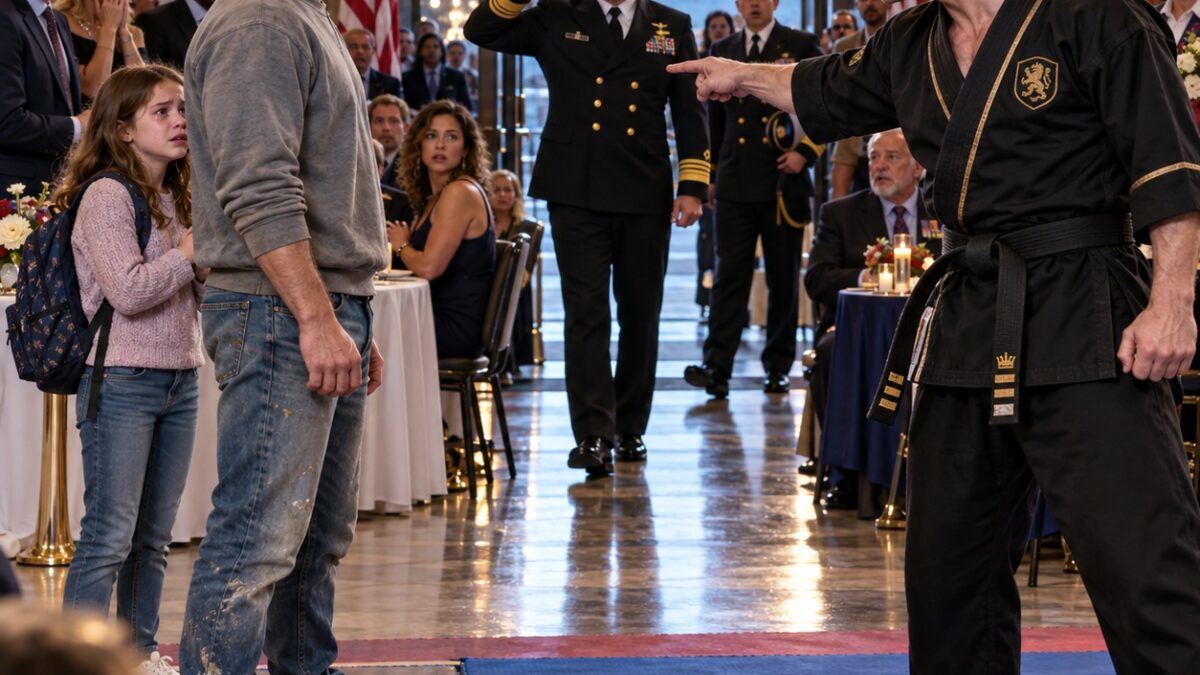
Before either of us could say anything else, the glass entrance doors opened.
Three Navy officers entered with one of the event coordinators.
I didn’t notice them immediately.
Gideon did.
His posture straightened.
A successful CEO knows when important people enter a room.
The officer in the center was broad-shouldered, mid-forties, dress uniform immaculate.
Commander Elias Vance.
I had not seen him in almost four years.
He walked two steps.
Then saw me.
Stopped dead.
The officer behind him nearly walked into his back.
For a moment, Elias simply stared.
I knew what he was seeing.
Not the sweatshirt.
Not the work boots.
Not the father standing in a charity hall.
Somewhere behind his eyes was dust.
Heat.
Smoke.
Bad radio traffic.
A collapsed evacuation route.
A night neither of us liked discussing.
I closed my eyes briefly.
Not here.
Please not here.
Elias straightened.
Raised his hand.
Saluted.
“Sir.”
The entire room went silent.
“I never thought I’d have the honor of seeing you here.”
I felt Willa’s eyes on me.
That was the part I feared most.
Not Gideon.
Not the crowd.
My daughter.
I returned the salute automatically.
Old muscle memory.
Then lowered my hand.
“At ease, Commander.”
Elias lowered his.
Emotion remained in his face.
“I’m sorry, sir. I didn’t know you’d be attending.”
“I’m not attending anything official.”
I looked toward Willa.
“I’m here with my daughter.”
Elias followed my gaze.
His expression softened.
“Of course.”
Gideon cleared his throat.
“Commander Vance.”
Elias turned.
Gideon smiled as if trying to recover control of his own room.
“Welcome to Ironwood. We were just finishing a demonstration.”
Elias looked from him to me.
“Demonstration?”
Gideon nodded.
“Mr. Pierce agreed to test some techniques.”
I sighed.
“I agreed to stop him from grabbing me.”
The crowd made a sound somewhere between laughter and discomfort.
Gideon’s face reddened.
Elias studied him.
Then me.
“Would you like me to explain?”
“No.”
I said it too quickly.
Elias knew exactly what I meant.
He also knew I was asking him not to turn my past into entertainment.
“That isn’t necessary.”
Gideon looked between us.
“Explain what?”
Nobody answered.
He tried again.
“Commander, do you know this man?”
Elias stared at me.
I shook my head once.
Please don’t.
Then Willa said:
“Dad?”
I turned.
She was no longer crying.
She looked confused.
That expression changed my mind slightly.
Not because she needed to know everything.
But perhaps she deserved context.
Elias seemed to read the same thing.
He spoke carefully.
“I served with your father.”
Willa looked at me.
“You were in the Navy?”
“I told you I was.”
“You said you fixed things.”
“I did.”
Elias almost smiled.
“That is one way to describe it.”
Gideon folded his arms.
“What exactly did he do?”
I looked at him.
“This isn’t about you.”
But Elias had spent years carrying his own version of that night.
Maybe he needed to speak too.
“Three years ago,” he said, “my team was involved in an evacuation overseas.”
The room quieted further.
Elias did not provide location.
Good.
Some details still did not belong to an audience.
“Our planned extraction route became unusable. Communications were intermittent. We had injured personnel and civilians moving through an area that was becoming increasingly unstable.”
I felt my jaw tighten.
Memory does not ask permission.
Heat.
Concrete dust.
A radio that kept cutting out.
Someone bleeding through a field dressing.
Elias continued.
“The person who took control of the evacuation wasn’t the highest-ranking officer present.”
He looked directly at me.
“It was Chief Petty Officer Nolan Pierce.”
Someone gasped.
Willa stared.
I looked at the floor.
Elias said:
“He reorganized the movement order, found another route, kept the wounded moving, and refused to leave personnel behind when the original plan failed.”
“I followed training.”
Elias shook his head.
“You did more than that.”
“Commander.”
“No.”
His voice softened.
“I was there.”
He looked toward the room.
“I was the officer he refused to leave.”
I could hear my own heartbeat.
Willa stepped away from Harper.
“Dad?”
I looked at her.
Elias continued.
“I was injured. We were losing time. I told him to move without me.”
I remembered.
Very clearly.
Elias sitting against a wall.
Blood on his uniform.
Angry.
Ordering me to go.
“You weren’t giving good orders that night.”
A small laugh moved through the crowd.
Elias smiled.
“No. Apparently not.”
Then he looked at Willa.
“Your father stayed.”
She looked at me as though she had never seen my face before.
“He helped carry me to safety. He coordinated the final movement and made sure everyone reached extraction.”
I swallowed.
“He makes it sound cleaner than it was.”
“It wasn’t clean.”
Elias’s eyes hardened at the memory.
“But we got home.”
The room stayed silent.
Gideon stared at my sweatshirt.
My boots.
My hands.
He seemed almost offended by reality.
“Why didn’t you say anything?”
I looked at him.
“Why would I?”
“You let everyone think—”
“Think what?”
He stopped.
That was the important question.
What exactly had Gideon assumed?
Because I repaired air conditioners?
Because my boots were dirty?
Because I didn’t advertise an old rank?
Because I would not fight him?
He looked away first.
Willa crossed the room.
“Dad.”
I crouched.
She threw her arms around my neck.
I held her.
For a few seconds, the entire room disappeared.
“Were you really a hero?”
I closed my eyes.
That word.
I never liked it.
Not because courage isn’t real.
Because hero can turn complicated moments into simple stories.
People become statues.
Reality disappears.
I whispered:
“I was somebody who had friends who needed help getting home.”
She pulled back.
“Commander Vance said you saved him.”
“Commander Vance talks too much.”
Behind me, Elias said:
“True.”
Willa smiled.
The tension cracked.
When I stood, Gideon was still there.
For the first time all afternoon, he looked unsure what role to play.
No audience command.
No instructor voice.
No CEO posture.
Just a man who had made a fool of himself and knew it.
He walked toward me.
“I owe you an apology.”
I waited.
He glanced at Willa.
Then back at me.
“I tried to humiliate you because you wouldn’t react the way I wanted.”
That was honest.
“And I involved your daughter.”
Willa moved slightly closer to me.
Gideon looked genuinely ashamed.
“That was wrong.”
I nodded.
“Yes.”
He seemed surprised.
Maybe he expected me to soften it.
I wasn’t going to.
An apology does not require the injured person to make the speaker comfortable.
Gideon swallowed.
“I also put my hands on you.”
“Yes.”
“I should not have.”
“No.”
The room remained quiet.
He asked:
“What do you want me to say?”
“Nothing else.”
He blinked.
“I mean—”
“I know.”
I looked toward the training mat.
“You teach people how to defend themselves.”
He nodded.
“Teach them when not to hurt somebody.”
His eyes dropped.
That was all.
No speech.
No demand that he kneel.
No challenge.
I had spent too much of my life around men who thought humiliation corrected humiliation.
It doesn’t.
It usually breeds more.
Gideon nodded.
“I will.”
I believed he meant it in that moment.
Whether he would mean it tomorrow was his responsibility.
The event coordinator approached Elias.
“Commander, we’re ready for you whenever—”
Elias shook his head.
“Give me a minute.”
He walked toward me.
“Coffee?”
I looked at the clock.
“Willa?”
She said:
“Yes.”
That settled it.
We found a quieter room near the back of the center.
Elias.
Me.
Willa.
Harper brought water and disappeared.
For several seconds, nobody spoke.
Then Elias looked at Willa.
“How old are you?”
“Twelve.”
“Your dad ever tell you anything interesting?”
“No.”
I objected.
“That is untrue.”
“He tells me how refrigerant pressure works.”
Elias stared at me.
“You’ve become unbearable.”
“Retirement.”
Willa looked between us.
“Were you his boss?”
“No.”
Elias smiled.
“Sometimes he acted like mine.”
“I was enlisted.”
“Didn’t stop you.”
Willa leaned forward.
“What happened?”
There it was.
The question I knew would come eventually.
I had planned to tell her more when she was older.
Not because I was ashamed.
Because children deserve childhoods not cluttered by every burden their parents carry.
I chose my words.
“I served in the Navy before you remember much.”
“You wore a uniform?”
“Yes.”
“Did Mom know?”
I smiled.
“Your mother knew everything.”
That was nearly true.
Rachel had known the parts I could tell her.
She had also known the parts I couldn’t.
Sometimes spouses learn silence as a second language.
“Why did you leave?”
That question was harder.
“My time was done.”
Elias looked at me.
Willa noticed.
“That’s not the whole answer.”
I laughed softly.
“You are your mother’s daughter.”
I took a breath.
“There were things I wanted to be home for.”
“You mean me?”
“Yes.”
The truth was more complicated.
Injuries.
Burnout.
A mission that stayed too close.
Rachel telling me one night that Willa had started drawing pictures of me as a stick figure with a suitcase because that was how she remembered her father.
I had served long enough.
Done enough.
Eventually duty can become an excuse not to admit life has changed.
I chose home.
Then two years later, Rachel died.
For a while I wondered whether I had made the wrong choice.
I don’t anymore.
Willa had needed me.
Still did.
Elias said:
“Your father was very good at his job.”
Willa looked proud.
Then immediately worried.
“Did he hurt people?”
Children ask the question adults avoid.
I looked at her.
“Sometimes I had to do difficult things.”
She waited.
“But the point was always to bring people home.”
Elias nodded.
That was enough for now.
We returned to the hall.
The event continued.
Different energy.
Gideon did not lead the final demonstration.
One of his senior instructors did.
That mattered.
Not because Gideon was defeated.
Because he recognized he should step back.
The instructor’s demonstration focused on distance.
Boundaries.
Leaving dangerous situations.
Calling for help.
I wondered whether he had improvised it.
Probably.
Willa watched closely.
Afterward, Gideon approached us again.
This time no crowd around him.
No posture.
He crouched slightly so he wasn’t towering over Willa.
“I owe you an apology too.”
She looked at me.
I said nothing.
Her choice.
Gideon continued.
“I used you to embarrass your father.”
Willa stared at him.
“That wasn’t fair.”
“No.”
“I was angry.”
“My dad says being angry doesn’t mean you have to do what anger tells you.”
I looked at her.
Where had she heard that?
Right.
Me.
Gideon looked at me too.
Then back at her.
“Your dad is right.”
Willa thought.
Then said:
“Okay.”
Not forgiveness.
Not absolution.
Just acknowledgment.
I was proud of her for that.
On the drive home, she was quiet.
I knew questions were building.
Finally:
“Dad?”
“Yeah?”
“Could you have beaten him?”
I almost drove into the shoulder laughing.
“That’s your question?”
“Yes.”
I thought about Gideon.
His skill.
My age.
My old training.
“My goal wasn’t to beat him.”
“That doesn’t answer it.”
“No.”
“So you could?”
“Willa.”
She smiled for the first time all day.
“Mom would say you’re avoiding.”
I sighed.
“Your mother would enjoy this way too much.”
We stopped for burgers.
She ordered a milkshake.
We sat in a booth.
She kept looking at me.
“Stop.”
“Stop what?”
“Looking at me like I’m somebody else.”
“You are somebody else.”
“No.”
“You were a Chief Petty Officer.”
“I was.”
“You saved Commander Vance.”
“I helped.”
“You know all those moves.”
“Some.”
“You fix air conditioners.”
“That too.”
She frowned.
“How can all of those be the same person?”
That question stayed with me.
Adults struggle with it too.
We like people in categories.
Hero.
Coward.
Soldier.
Repairman.
Father.
Widower.
Black belt.
CEO.
But nobody is one thing.
I reached across the table.
“Because jobs aren’t people.”
She listened.
“I wore a uniform. Then I didn’t.”
I pointed toward my hands.
“I work HVAC now.”
Then at her.
“I’ll always be your dad.”
She looked down at her fries.
“Which one matters most?”
“That one.”
She smiled.
A week later, Gideon called.
I almost didn’t answer.
“Nolan?”
“Yes.”
“This is Gideon Shaw.”
“I know.”
Pause.
“I wanted you to hear something directly from me before it gets turned into a publicity thing.”
That interested me.
“What?”
He had met with Ironwood’s instructors.
They were adding a required module to children’s and adult programs.
De-escalation.
Consent during training.
Boundaries.
Responsible use of skill.
“When someone says no to sparring,” Gideon said, “that should be the end of it.”
“Yes.”
“I should have known that.”
“Yes.”
Another pause.
“You’re not going to make this easy.”
“Do you need me to?”
“No.”
“Then don’t ask.”
He exhaled.
Fair.
He also funded additional free classes for children from military families and families of fallen service members.
“Good.”
“I don’t want you thinking I’m doing it because of what Commander Vance said about you.”
“Why are you doing it?”
“Because I embarrassed a child at an event that was supposed to help children.”
That answer sounded better.
“Then keep doing it for that reason.”
“I will.”
We hung up.
I did not become friends with Gideon.
That would make a nicer story.
Not every apology needs friendship afterward.
We saw each other occasionally.
He changed.
Some.
People rarely transform overnight.
But his instructors told me later he stopped participating in public challenge demonstrations.
He asked more questions.
Interrupted less.
One assistant instructor said Gideon had begun opening advanced classes with:
“Control is not making someone else submit. Control is being responsible for yourself.”
I recognized the lesson.
Didn’t need credit.
Willa stayed at Ironwood.
That decision surprised me.
I offered another school.
She said no.
“Why?”
“Miss Harper is there.”
True.
“And?”
“Mr. Shaw apologized.”
Also true.
“You don’t have to stay because of that.”
“I know.”
“Then why?”
She thought.
“Because if I leave because he was mean, doesn’t he still decide what I do?”
I sat back.
Twelve years old.
Rachel would have been unbearable with pride.
“All right.”
She stayed.
Her confidence grew.
Not because she became aggressive.
Quite the opposite.
She learned how to say:
No, thank you.
Back up.
Don’t touch me.
I need help.
People underestimate how powerful those sentences are.
At school, a boy once grabbed her backpack.
Old Willa might have frozen.
New Willa turned.
“Give it back.”
He laughed.
She repeated:
“Give it back.”
Teacher heard.
Problem ended.
No punch.
No takedown.
No dramatic revenge.
She came home proud.
I was too.
“Did you want to hit him?”
“Yes.”
“Good.”
She stared at me.
“Good?”
“Feelings are information.”
I opened the refrigerator.
“Not instructions.”
She rolled her eyes.
“You say that all the time.”
“Because it’s true all the time.”
Months passed.
Commander Vance visited occasionally.
He became Uncle Elias despite having no biological right to the title.
He brought terrible gifts.
Military challenge coins.
A model ship Willa had no interest in.
A giant stuffed seal because he thought Navy SEAL jokes were funnier than they were.
She loved him anyway.
One night after dinner, Willa asked Elias:
“Was Dad scary?”
I nearly choked.
Elias looked delighted.
“Terrifying.”
“Elias.”
“He once made a lieutenant rewrite a supply request three times.”
“That isn’t scary.”
“You didn’t see the lieutenant.”
Willa laughed.
Then:
“Did he ever lose his temper?”
Elias grew thoughtful.
“Rarely.”
I stopped washing dishes.
He looked at me.
“There was one time.”
“Don’t.”
Willa leaned forward.
“What?”
Elias considered me.
I shook my head.
Not that story.
He understood.
“Your father was good at staying calm when everybody else wasn’t.”
That version I could accept.
“Why?”
Willa asked.
Elias said:
“Because when people depend on you, your feelings stop being the most important thing in the room.”
I looked at him.
That was better than anything I would have said.
Willa absorbed it.
Later, after she went to bed, I handed Elias a beer.
“You remember too much.”
“You remember too little.”
“I try.”
He sat on the porch.
“Does she know about Rachel and the decision to leave?”
“Some.”
“She’ll ask more eventually.”
“I know.”
“You going to tell her?”
“When she’s ready.”
He nodded.
“You always were good at waiting.”
I laughed.
“No one ever said that.”
“I just did.”
The incident at Ironwood stayed local for a while.
Then someone uploaded part of the video.
Of course.
Gideon’s challenge.
My refusal.
The wrist redirect.
Elias entering.
Salute.
Internet did what internet does.
Former Navy Hero Humiliates Black-Belt CEO.
Wrong.
Retired SEAL Destroys Arrogant Martial Arts Master.
Very wrong.
I was never a SEAL.
And I destroyed nobody.
Then:
SECRET COMMANDO DAD REVEALS TRUE IDENTITY.
Ridiculous.
I had revealed nothing.
Elias had.
Willa found the clips at school.
She came home irritated.
“They’re lying.”
“Welcome to the internet.”
“They say you knocked him out.”
“I didn’t.”
“I know.”
“They say Commander Vance called you Captain.”
“He did not.”
“I know.”
She sat at the table.
“Why don’t you correct them?”
“Because then I become part of it.”
“But they’re wrong.”
“Yes.”
“That doesn’t bother you?”
“A little.”
“Then?”
I sat across from her.
“Do you know what happened?”
“Yes.”
“Do I?”
“Yes.”
“Does Gideon?”
“Yes.”
“Does Commander Vance?”
“Yes.”
“Then the people who matter know.”
She considered that.
Rachel had needed years to accept that answer from me.
Willa was twelve.
She got there in thirty seconds.
“Okay.”
Then:
“Can I report the video?”
I laughed.
“Knock yourself out.”
Ironwood issued a short statement clarifying that the public confrontation had not been planned and did not reflect the center’s standards.
No mention of me beyond asking people to respect the privacy of families involved.
That was Gideon’s idea.
I appreciated it.
People eventually moved on.
They always do.
Another video.
Another outrage.
Another hero.
Another villain.
Real life became quieter.
Willa earned her next belt.
Then another.
At her first promotion after the incident, Gideon attended.
He stood in the back.
Did not give a speech.
Did not make himself central.
When Willa received her certificate, he applauded with everyone else.
Afterward he approached me.
“She is good.”
“She works hard.”
“Like her father.”
I looked at him.
“Don’t ruin the moment.”
He laughed.
“Fair.”
Our relationship settled into something like mutual respect.
Not friendship.
Enough.
One year after the incident, Ironwood held the charity event again.
I nearly skipped it.
Willa insisted.
“You have to come.”
“Why?”
“Because I’m demonstrating.”
That settled it.
She was part of the beginner self-defense presentation.
I stood near the back.
Same hall.
Same glass doors.
Same trophy display.
One trophy stand had been moved away from the equipment table.
Good decision.
Gideon opened the event.
I braced myself for a speech.
Instead, he said:
“Today we teach three things.”
He held up one finger.
“Awareness.”
Second.
“Boundaries.”
Third.
“Control of yourself before control of anything else.”
Then he stepped aside.
That was it.
I looked at Elias, who had somehow acquired a doughnut despite there being no food table nearby.
He whispered:
“Personal growth.”
“Don’t get sentimental.”
“Too late.”
Willa’s demonstration began.
A young instructor played the aggressor.
He approached.
Willa raised one hand.
“Stop.”
He stopped.
The instructor explained to the audience:
“If someone respects a clear boundary, the safest confrontation is the one that ends there.”
I looked toward Gideon.
He was watching too.
For half a second, our eyes met.
He nodded.
I nodded back.
That was probably the closest thing to closure either of us needed.
Afterward, Willa ran to me.
“How was I?”
“Terrible.”
She punched my arm lightly.
“I hate you.”
“Footwork was good.”
She smiled.
“Really?”
“Really.”
Elias appeared.
“Your father is emotionally constipated.”
“Commander.”
“What?”
Willa laughed.
Life.
Ordinary life.
That was what I had wanted when I left the Navy.
Not medals.
Not recognition.
Not secret respect from decorated officers.
Breakfast.
Work.
Homework.
A daughter who annoyed me.
A home where Rachel’s absence hurt but did not control every room.
People misunderstood that after the video.
They assumed I had fallen from something prestigious into ordinary work.
As though repairing air-conditioning systems were beneath the man I used to be.
It wasn’t.
There is dignity in making things work.
A grocery store’s freezer system.
A hospital’s rooftop unit.
A school classroom in August.
People need those things too.
Different mission.
Same principle.
Solve the problem.
Don’t panic.
Bring people relief.
I liked my job.
I liked my boots.
I liked coming home.
One afternoon, an apprentice named Marcus rode with me on a service call.
Nineteen.
Talked constantly.
He had seen the video.
Of course.
Halfway through replacing a compressor contactor, he finally asked:
“Can I ask you something?”
“You’re going to anyway.”
“Could you really have taken that CEO?”
I tightened a terminal screw.
“What is it with this question?”
He grinned.
“Come on.”
I looked at him.
“Maybe.”
“Seriously?”
“Doesn’t matter.”
“Why not?”
“Because I didn’t need to.”
Marcus thought about that.
Then went back to work.
Twenty minutes later:
“But if you had—”
“Marcus.”
“Okay.”
Youth.
Willa asked fewer questions about my service as she got older, not more.
Not because she stopped caring.
Because she understood privacy differently.
At thirteen she asked:
“Do you ever miss it?”
“Sometimes.”
“What part?”
“The people.”
“Not the action?”
I laughed.
“People who miss action usually didn’t spend enough time in it.”
She nodded.
“Do you miss being important?”
That question cut deeper than she knew.
I put down the coffee cup.
“Do you think I’m important now?”
“To me.”
“There you go.”
She smiled.
“But you know what I mean.”
I did.
Uniforms create visible importance.
Rank.
Salutes.
Authority.
Civilian life strips much of that away.
Nobody salutes an HVAC technician.
Good.
I did not want them to.
Being needed by one child mattered more than being recognized by a room.
That was the lesson Gideon had accidentally given Willa.
Not that her father was secretly impressive.
I hated that interpretation.
The lesson was that appearances contain almost nothing.
The quiet man can have history.
The powerful man can be insecure.
The person with trophies can still lack self-control.
The person in work boots can understand restraint.
And nobody deserves basic dignity because of a hidden résumé.
They deserve it before you know who they are.
That was the part Gideon eventually understood too.
One evening, two years after our confrontation, he asked me to speak privately after Willa’s class.
“I need advice.”
“That’s dangerous.”
He smiled.
“I’m serious.”
We sat near the mat.
He told me one of his instructors was talented but increasingly aggressive.
Humiliating students.
Pushing sparring partners.
Using rank to force participation.
“What should I do?”
I looked at him.
“You know.”
He nodded.
“I do.”
“Then why ask me?”
“Because I want to make sure I’m not overcorrecting because of what happened with us.”
That was more self-awareness than the old Gideon would have shown.
I said:
“Are students safe?”
“Physically? Mostly.”
“Emotionally?”
Pause.
“No.”
“Does he respect no?”
Another pause.
“No.”
“Then this isn’t about us.”
Gideon nodded.
The instructor was removed from teaching pending retraining.
No spectacle.
No public humiliation.
Handled privately.
Months later, Gideon told me he had returned after completing additional instructor development.
“He’s better.”
“Good.”
“You were right.”
“Careful. You’ll damage my humility.”
Gideon laughed.
That was when I realized I had forgiven him.
Not forgotten.
Forgiveness is not deleting facts.
It is deciding the facts no longer require payment every day.
He had changed behavior.
That mattered more to me than repeated apology.
Willa eventually earned her black belt.
Five years after the afternoon everything started.
Seventeen.
Taller than her mother had been.
Same stubborn eyes.
The ceremony filled the Ironwood hall.
Rachel should have been there.
That thought sat beside me all evening.
I had learned to let grief sit without demanding it leave.
Elias attended in civilian clothes.
Retired now.
Still stood like a commander.
Gideon tied Willa’s belt.
Before doing so, he said quietly:
“Remember what this means.”
Willa answered:
“That I can beat Dad.”
The room laughed.
I shook my head.
Gideon smiled.
“No.”
Then his expression became serious.
“It means you are responsible for what you know.”
Willa looked at him.
He continued:
“Skill is not permission.”
She nodded.
He tied the belt.
I felt something twist in my chest.
Because that was the lesson he had once failed in front of her.
Now he was teaching it.
People can change.
Not everyone.
Not always.
But enough that refusing the possibility becomes its own kind of arrogance.
After the ceremony, Willa found me near the same doorway where she had once stood clutching her backpack.
“Dad.”
“Yeah?”
“You okay?”
“Fine.”
“You look like you’re going to cry.”
“Dust.”
“Inside?”
“Advanced dust.”
She hugged me.
I held her.
Then she whispered:
“Mom would’ve been proud.”
That almost ended me.
“Yes.”
She pulled back.
“Of me?”
“Mostly.”
She laughed.
Then:
“You too.”
I looked toward Gideon.
He was talking with students.
No audience around him.
No need to dominate.
Elias stood nearby pretending not to steal snacks.
Same room.
Completely different feeling.
I thought about the afternoon five years earlier.
Gideon pointing at me.
Ten seconds.
Coward.
Fight me.
Willa crying.
Me choosing not to strike.
Then Elias entering.
Salute.
People loved that part.
Of course they did.
Recognition is dramatic.
But if I could rewrite the memory, I would remove the salute.
Not because Elias was wrong.
Because I never wanted Willa to believe my restraint mattered only because I had once been somebody impressive.
My restraint mattered because she was watching.
It would have mattered if I had never served a day.
If I had spent my entire life fixing air conditioners, Gideon still would have been wrong to humiliate a child.
I still would have been right to refuse a fight.
Sometimes we hide ordinary morality behind extraordinary credentials.
We say:
You shouldn’t have disrespected him—he was a veteran.
You shouldn’t have mocked her—she was a doctor.
You shouldn’t have ignored him—he was wealthy.
No.
You shouldn’t treat people badly because they’re people.
Everything else is biography.
That was what I eventually told Willa.
Years after the video.
We were driving home after her black-belt ceremony.
She had placed the belt carefully across her lap.
“Do you remember that first event?”
“Yes.”
“What do you remember most?”
She thought.
“Commander Vance saluting you.”
I expected that.
Then she added:
“And you not hitting Mr. Shaw.”
That surprised me.
“Really?”
“Yeah.”
“Why?”
She looked out the window.
“Because I knew you could after Commander Vance told everybody who you were.”
I waited.
“But you didn’t.”
She touched the black belt.
“I think that’s why this means something.”
I had to pull into our driveway before answering.
She got out.
Then looked back.
“You coming?”
“In a minute.”
She went inside.
I sat behind the wheel.
Rachel’s old photograph hung from the visor.
I flipped it down.
She was laughing in the picture.
I imagined telling her:
We did okay.
Not perfectly.
But okay.
I eventually went inside.
Willa was at the kitchen table doing exactly what she had done as a child.
Homework.
Black belt draped over the back of the chair.
I started dinner.
Ordinary life.
The thing I had fought hardest to keep.
Years later, people still occasionally recognize me.
Not often.
Someone will stare.
“You’re that Navy guy.”
“I was in the Navy.”
“The one from the martial-arts video?”
“Unfortunately.”
They usually ask what happened to Gideon.
I tell them:
“He learned.”
That disappoints people.
They want downfall.
Bankruptcy.
Public humiliation.
Something cinematic.
The truth is better.
He became a better instructor.
Ironwood expanded its charity program.
Its children’s curriculum included de-escalation.
Willa remained connected to the center.
Gideon and I exchanged Christmas cards.
Nothing spectacular.
Growth rarely is.
They ask about Elias.
Retired.
Fishing badly.
Calling too often.
They ask whether I returned to military work.
No.
I still repair commercial HVAC systems.
Own a small service company now.
Marcus, the apprentice who wouldn’t stop asking whether I could beat Gideon, became my operations manager.
Still annoying.
Willa is in college.
Studying physical therapy.
Calls every Sunday.
Usually.
If she forgets, I text:
BLACK BELT DOES NOT EXCUSE FAILURE TO CALL FATHER.
She sends an eye-roll emoji.
Life moves.
Trophies gather dust.
Uniforms go into storage.
Work boots wear out.
Ranks disappear.
Children become adults.
The moments that remain are usually not the ones where someone looked strongest.
They are the moments where strength had a choice.
That afternoon at Ironwood, Gideon believed strength meant forcing me onto the mat.
I once believed strength meant being able to finish every mission no matter the cost.
Age corrected both of us.
Strength sometimes means leaving.
Sometimes staying.
Sometimes fighting.
Sometimes refusing.
Sometimes admitting you were wrong in front of the people who saw you fail.
And sometimes it is simply kneeling beside a frightened twelve-year-old girl and making sure she understands that another man’s anger does not get to decide who her father becomes.
I never cared that Gideon thought I was a coward.
I cared that Willa didn’t learn courage from his definition.
That’s why I stayed calm.
That’s why I refused to strike.
That’s why when he grabbed me, I used only enough force to make him let go.
The salute came later.
The revelation came later.
None of that made the decision right.
The decision had already been right.
Elias Vance did not walk through those doors and turn me into a man worthy of respect.
He only reminded the room that appearances had fooled them.
The work boots were real.
So was the Navy service.
The gray sweatshirt was real.
So was the evacuation.
The single father was real.
So was the chief petty officer.
None canceled the other.
But if you ask me now which identity mattered most in that room, I know exactly what I would say.
Dad.
Because Commander Vance was remembering the man who once helped bring a team home.
Gideon was discovering that the quiet stranger in front of him had a past he had badly underestimated.
But Willa was learning something more important.
She was learning what a man does when he has the ability to hurt somebody and chooses not to.
That was the demonstration she needed.
No mat.
No trophy.
No belt.
No applause.
Just restraint.
Years later, Gideon’s championship trophies still sit inside glass cases at Ironwood.
Willa’s black belt hangs in her room.
My old Navy uniforms remain boxed in the attic.
I rarely look at them.
But every once in a while, when Elias visits, he’ll tell the evacuation story again.
I interrupt.
He exaggerates.
Willa asks questions.
We argue over details.
Then somebody laughs.
That is enough.
We all made it home.
Some of us just took longer to understand what home was for.
And if I learned anything from that afternoon, it is this:
The strongest person in a room is rarely the one demanding everyone notice his strength.
Sometimes he’s the tired single father in work boots who has nothing left to prove.
Sometimes he’s the commander who remembers who carried him when he could no longer walk.
Sometimes she’s the twelve-year-old girl who learns that courage can be quiet.
And sometimes real power is simply having ten seconds to humiliate somebody back—
and deciding you don’t need them.








