No One Knows How Long Stefany Lay Trapped Inside Those Three Garbage Bags, Unable to Walk or Free Herself — But When Rescuers Finally Found Her, They Discovered a Little Soul Still Desperate to Live.
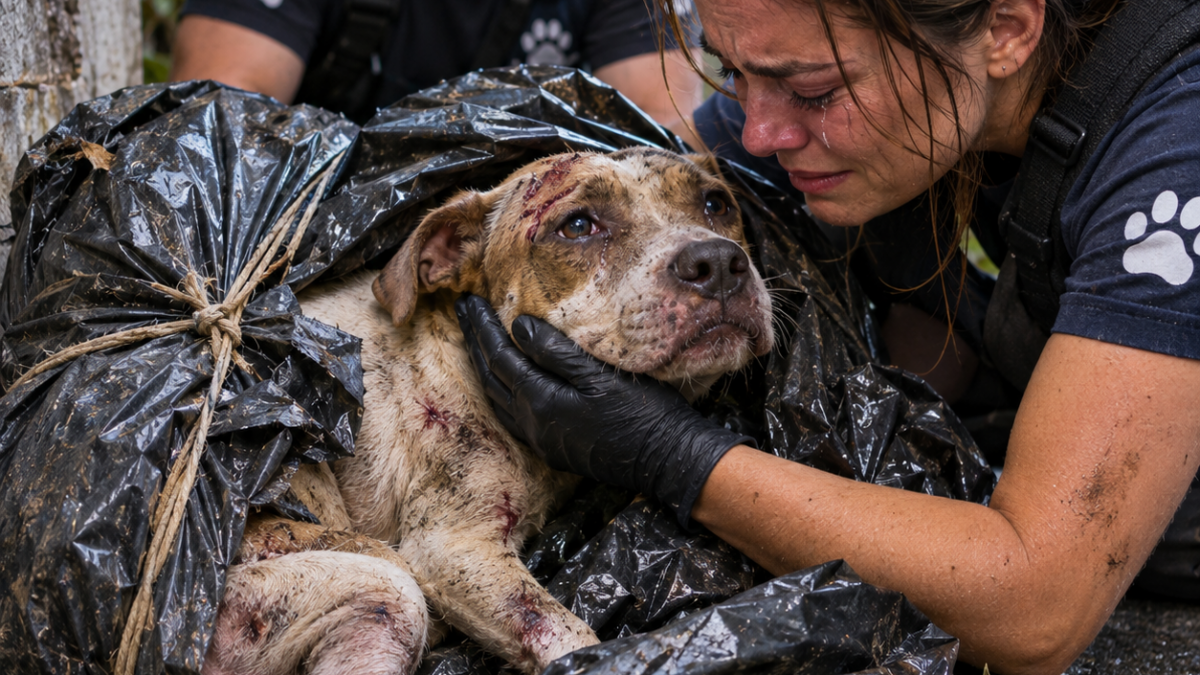
The Cruelty Was Over, but the Fear Was Still There
Being rescued does not erase what happened before rescue.
That may be one of the hardest things for people to understand.
We want the rescue itself to be the ending.
We want the vehicle door to close, the animal to arrive at safety, the cage to become a bed, and the story to immediately become happy.
But for animals who have experienced severe neglect or cruelty, safety can arrive long before the nervous system believes it.
Stefany had no reason to assume that people approaching her now were different from the people who had hurt her.
Dogs do not read rescue organization logos.
They do not understand explanations.
Nobody can tell an injured animal:
“You are safe now.”
“You will never go back.”
“These people are different.”
“The worst part is over.”
Those truths have to be demonstrated.
Again.
Again.
Again.
And then again.
A bowl appears.
No one takes it away.
A person enters.
No one hurts her.
A caregiver reaches near her.
Nothing terrible happens.
She rests.
She wakes.
She is still safe.
Another day passes.
Still safe.
For an animal whose world has taught her that humans can suddenly become dangerous, consistency becomes a language.
Every gentle routine says:
Not this time.
Every respectful interaction says:
You have a choice.
Every quiet night says:
No one is coming to throw you away.
Slowly, the body begins to believe what words could never explain.
Stefany’s caregivers gave her that time.
They let her grow comfortable at her own pace.
And that phrase—at her own pace—matters.
Because the old Stefany had lived in a world where people controlled what happened to her.
People tied her.
People put her inside garbage bags.
People abandoned her.
She did not choose those things.
Now, for perhaps the first time in a long time, her choices mattered.
If she wanted distance, she got distance.
If she was not ready for affection, affection could wait.
If she wanted to observe before approaching, nobody forced the next step.
It sounds small.
It was not.
It was dignity.
The Dog Who Was Afraid of People Began to Let Someone Close
Then something started changing.
Not all at once.
There was no single morning when Stefany woke up and decided fear was gone.
Fear does not disappear because we want a beautiful ending.
But beneath the frightened behavior, another part of her began to appear.
An affectionate part.
A dog who wanted connection.
A dog who had not lost the ability to enjoy gentle attention.
A dog who still carried a desire to be close to someone—if that someone could prove they were safe.
That may be the most heartbreaking part of Stefany’s story.
Because what happened to her had not destroyed her capacity for love.
It had only buried it beneath fear.
Think about what that means.
After being tied up.
After being treated as disposable.
After being unable to walk away.
After learning that human hands could take away control—
she still had affection left to give.
Not immediately.
Not to everyone.
Not without caution.
But it was there.
Waiting.
Her caregivers began seeing it.
Stefany could accept affection from a person she trusted.
She could allow someone close.
She could experience human contact without every part of her telling her to escape.
That is a rescue milestone no medical chart can fully capture.
Because healing is not only whether a wound closes.
It is not only whether a dog eats.
It is not only whether she learns a new way to move.
Sometimes healing is the moment an animal stops believing every hand is dangerous.
Sometimes it is the moment she leans instead of recoiling.
Sometimes it is the moment her eyes soften.
Sometimes it is the first time she chooses not to move away.
For a dog with Stefany’s history, trust was not something she owed her rescuers.
It was something they had to earn.
And they did.
Patiently.
Quietly.
Without demanding that she become the dog they wanted on their schedule.
Little by little, Stefany allowed people into the space fear had once guarded.
Imagine being one of those caregivers.
You know where she came from.
You know how she was found.
You know she cannot simply get up and leave if she feels trapped.
You have watched her worry when people come too close.
Then one day, she lets you touch her.
Maybe only briefly.
Maybe cautiously.
But she stays.
How do you measure a moment like that?
In seconds?
In inches?
In the slight relaxation of a body that once braced itself for harm?
To someone else, it may look like a person petting a dog.
To the person who has spent days or weeks respecting that animal’s fear, it can feel like being trusted with something sacred.
Stefany was saying, in the only language available to her:
I am still afraid.
But I think you might be safe.
No One Could Give Her Back the Body She Had Before
There was another truth her rescuers could not change.
Stefany’s spinal injury was serious.
She would not walk normally again.
Rescue could not erase that.
Love could not reverse every physical consequence of what had happened.
There are animal stories where recovery ends with running through a field.
This was not that story.
Stefany’s victory would have to look different.
And that does not make it smaller.
She learned to move in her own way.
Getting around took more effort.
Her body required adaptation.
The things another dog might do without thought could require work from her.
But Stefany explored.
She moved.
She experienced her surroundings.
She participated in her life.
There is something deeply moving about watching an animal adapt without knowing the word disability.
Stefany did not sit and compare her movement to another dog’s.
She did not wonder whether her body looked different.
She did not ask why running came easily to others.
She simply learned what her body could do now.
Animals can teach us something about survival that humans often forget.
Life does not have to return to what it was before in order to remain worth living.
Stefany would not become the dog she might have been without the injury.
But she could become Stefany.
The Stefany who moved differently.
The Stefany who needed more help.
The Stefany who still explored.
The Stefany who still enjoyed attention.
The Stefany who still rested comfortably.
The Stefany whose days could contain safety and affection.
The Stefany who still deserved a home.
Disability did not reduce her value.
It only changed what care looked like.
Somewhere Comfortable to Rest
There is a particular cruelty in imagining Stefany inside those garbage bags and then imagining her later resting somewhere comfortable.
The difference sounds almost too simple.
Plastic meant to contain waste.
Then a soft place intended for her body.
Abandonment.
Then daily care.
People leaving.
Then people checking on her.
Fear.
Then routine.
An injured dog does not need luxury.
She needs consistency.
Cleanliness.
Comfort.
Help moving when she needs it.
Observation.
Patience.
People paying attention.
Stefany had those things after rescue.
Someone noticed what she needed.
That matters because abandonment sends one message:
Nobody is watching.
Nobody cares what happens next.
Rescue reverses that message.
Someone notices whether you ate.
Someone notices whether you are comfortable.
Someone notices when you are frightened.
Someone notices how you are moving.
Someone notices whether today was harder than yesterday.
Someone notices whether you are ready for touch.
Someone notices you.
For an animal once discarded inside garbage bags, being noticed every day may have been its own kind of healing.
She was no longer invisible.
The Hardest Part Was Not Teaching Her to Move
People might look at Stefany and assume the biggest challenge was her physical disability.
That was obvious.
Visible.
A serious spinal cord injury changes a dog’s life.
But the emotional injury may have been even harder to see.
A dog who cannot walk normally can often learn adaptations.
A dog who cannot trust does not have a device that can simply replace trust.
That has to be rebuilt through experience.
A wheelchair, sling, mobility aid, supportive surface, or careful handling can address pieces of physical need depending on an individual animal and veterinary guidance.
Fear is different.
Fear lives in anticipation.
It begins before anything happens.
A person approaches.
The body remembers.
A hand moves.
The body remembers.
Something rustles.
The body remembers.
The dog may not understand why she is afraid in the way a person narrates memory, but the response is still real.
Her body learned:
People can hurt me.
Now caregivers had to teach:
Some people will not.
That second lesson always takes longer.
Because cruelty can happen once and create fear.
Trust has to be proven repeatedly.
The cruel person may need only seconds to change an animal.
The kind person may need weeks or months to help that animal believe kindness.
That imbalance is painfully unfair.
Yet Stefany tried.
That is what makes her story remarkable.
She did not owe humanity another chance.
But slowly, selectively, she gave one.
What Does Trust Look Like After Betrayal?
Trust in a rescue dog is often misunderstood.
People imagine a dramatic leap into someone’s arms.
But trust can be much quieter.
Trust can be sleeping deeply when another person is nearby.
Trust can be eating while someone watches.
Trust can be allowing a caregiver to help reposition an injured body.
Trust can be turning the face toward a hand rather than away.
Trust can be accepting affection for ten seconds.
Then twenty.
Then longer.
Trust can be choosing proximity.
For Stefany, trust had to include an especially difficult truth:
Because of her injury, she sometimes needed people.
The same species that had harmed her was now necessary for parts of her care.
That contradiction could not have been easy.
Her body might need help while her fear said:
Do not let them touch you.
Her caregivers’ job was not merely to provide physical assistance.
It was to do so in ways that did not take more control from her than necessary.
That means patience.
Predictability.
Gentleness.
Watching body language.
Knowing when to stop.
Knowing when comfort matters more than progress.
Real rescue is full of moments like that.
They rarely become viral photographs.
But they are where recovery actually happens.
She Began Discovering That Her Days Could Contain More Than Fear
Once an animal is safe long enough, something changes.
The day stops being only about surviving it.
There can be curiosity.
Rest.
Food.
Movement.
Attention.
Sunlight.
Smells.
Sounds.
Exploration.
Affection.
Stefany began living inside days that contained more than fear.
She learned ways to move through her surroundings.
It took more effort.
But effort did not mean impossibility.
Perhaps that is one of the most important distinctions in her story.
She needed more.
More patience.
More assistance.
More understanding.
But needing more did not mean she deserved less.
Less love.
Less opportunity.
Less comfort.
Less future.
There are people who see a disabled animal and see inconvenience first.
Stefany’s rescuers saw Stefany.
That difference gave her life back.
The Question Every Rescue Eventually Has to Face
Once immediate danger passes, another question appears.
What comes next?
For Stefany, the answer her rescuers hoped for was a family.
Not simply anyone willing to say yes.
The right family.
A home prepared to understand that Stefany would always be different physically.
A family who would not mistake disability for brokenness.
A family who understood that trust could not be rushed.
People willing to accept that Stefany might need time before fully relaxing.
A home where help would be given without making her feel trapped.
A place where her physical needs would be part of daily life, not treated as a burden.
A family willing to see her not as a tragic story but as a dog.
A living individual.
A companion.
A personality.
An animal capable of affection.
The hope was simple:
Somewhere she could settle without fear.
Somewhere needing extra care would never make her less wanted.
That sentence carries the entire weight of Stefany’s story.
Because somewhere before the rescue, someone decided her needs made her disposable.
Now the people around her were trying to prove the opposite.
The Most Painful Question Has No Answer
Who did this to her?
Why?
The information provided about Stefany’s rescue does not answer those questions.
And perhaps that makes the images even harder to bear.
There is no explanation capable of making the act acceptable anyway.
No frustration.
No inconvenience.
No financial problem.
No lack of experience.
Nothing turns tying an injured dog inside garbage bags and abandoning her into an understandable choice.
If someone could not care for her, there were other choices.
Ask for help.
Contact rescuers.
Reach out to a shelter.
Leave her somewhere she could be found safely.
Tell someone she needed care.
Anything.
Instead, she was tied.
Bagged.
Abandoned.
There is an intentionality in that sequence that makes the heart recoil.
Someone had to physically handle her.
Someone had to see her body.
Someone had to know she could not move normally.
Someone had to recognize she was alive.
And still leave.
People sometimes describe animals as not understanding betrayal.
I am not sure that matters.
Stefany did not need the human concept of betrayal to understand fear.
She did not need vocabulary to know restraint.
She did not need to understand intent to know that when people approached, terrible things could happen.
Her fear afterward was evidence enough.
Something had taught her to be afraid.
The Garbage Bags Were Not the End of Her Story
It would be easy to tell Stefany’s story entirely through the cruelty.
The bags.
The injury.
The abandonment.
Those are the details that shock people.
But if we stop there, the person who abandoned her gets to define the whole story.
They do not deserve that power.
The story also belongs to the people who came after.
The rescuers who said:
No.
This dog does not end here.
The caregivers who understood that safety without patience would not be enough.
The people who let her be frightened without labeling her difficult.
The people who helped her move without expecting her body to become normal.
The people who discovered the affectionate dog underneath the fear.
The people hoping to find her a family.
Cruelty may have opened Stefany’s story.
It did not get the final word.
Imagine the First Night
We cannot know exactly what Stefany thought during her first night somewhere safe.
We should not invent feelings she cannot tell us.
But we can understand the contrast.
No garbage bags.
No abandonment site.
A place to rest.
People checking on her.
Water.
Food.
Care.
Still, safety can be frightening when you do not yet recognize it.
A new room has unfamiliar smells.
New voices.
New footsteps.
For a frightened animal, unfamiliarity itself can be threatening.
Perhaps Stefany watched every movement.
Perhaps she struggled to rest.
Perhaps she relaxed more quickly than anyone expected.
We do not know.
What we do know is that her fear did not disappear simply because rescue arrived.
Her caregivers had to give her time.
That fact alone tells us healing was a process.
And somewhere inside that process came a night when she rested more deeply than before.
A morning when someone approached and she was a little less afraid.
A day when affection felt safe enough to accept.
Those are the invisible milestones of recovery.
There Are Injuries X-Rays Cannot Fully Show
Stefany had a serious spinal cord injury.
That physical injury was undeniable.
But there was another wound.
Fear.
Fear does not appear neatly on an X-ray.
It cannot be measured in the same way.
There is no scan that says:
This dog has lost seventy percent of her faith in people.
There is no lab value for trust.
No number for how much courage it takes to allow touch after being harmed.
That is why emotionally traumatized animals are sometimes misunderstood.
People ask:
Why won’t she let us pet her?
Why is she scared?
Doesn’t she know we’re helping?
No.
She doesn’t automatically know.
She has to learn.
And if she has learned the opposite lesson strongly enough, kindness may initially look suspicious.
Stefany’s caregivers seem to have understood the difference between being afraid and being aggressive, between needing space and rejecting love.
They let her choose.
Eventually, she began choosing connection.
Her Affection Was Not Evidence That the Trauma Was Small
Sometimes people see a formerly abused dog becoming affectionate and assume the animal has “forgotten.”
We cannot know what a dog remembers in the human sense.
But we should not minimize the recovery simply because love returned.
Stefany’s affectionate behavior did not mean what happened to her had not mattered.
It meant the harm had not destroyed everything.
There is a difference.
A flower blooming after a fire does not prove the fire was harmless.
It proves life survived it.
Stefany’s affection was not evidence that cruelty leaves no scars.
It was evidence that cruelty failed to take all of her.
That is much more powerful.
She Could Not Walk Away, So Her Caregivers Had to Become People She Would Never Need to Escape
Perhaps that is the most important sentence in Stefany’s recovery.
She could not simply run from frightening situations.
So the humans around her had an extra responsibility.
They had to become people she did not need to run from.
People whose hands meant support.
People whose footsteps did not predict pain.
People whose closeness did not mean restraint.
People who would listen to the smallest signals her body could give.
There is profound responsibility in caring for a disabled animal.
The animal is vulnerable not because she is less valuable, but because she has fewer ways to protect herself independently.
That vulnerability should make people gentler.
Not crueler.
Someone once exploited Stefany’s vulnerability.
Her rescuers protected it.
That is the difference between possession and care.
The Moment That Can Break Your Heart
Imagine Stefany allowing affection.
Really imagine it.
Do not think first about the rescuers.
Think about her.
A dog who had once been tied.
A dog whose movement was permanently changed.
A dog who had learned to fear closeness.
Now a human hand comes toward her.
She can pull away.
Maybe she does.
The hand stops.
No punishment.
Later the hand returns.
Slowly.
She watches.
Nothing happens.
Maybe fingertips touch the side of her face.
She waits.
No restraint.
No bag.
No abandonment.
Just contact.
Warm.
Gentle.
Brief.
Then the person stops.
Stefany remains.
The hand returns.
This time, perhaps she leans.
That tiny movement would be enough to make someone who knew her beginning cry.
Because trust is never more moving than when it comes from someone with every reason to withhold it.
The People Caring for Her Could Not Promise an Easy Life
A permanent spinal injury meant Stefany’s future would always require thought.
She would not suddenly become physically typical.
Her future family would need to understand her mobility.
Watch her comfort.
Help her as necessary.
Provide an environment she could navigate.
Understand that extra care is not temporary.
That reality can make adoption harder for disabled animals.
Some people want uncomplicated companionship.
There is nothing wrong with understanding your limits.
But somewhere there may be a person who sees Stefany and thinks:
I can do that.
Not:
I can save her.
She had already been saved.
But:
I can love her.
I can make room.
I can learn.
I can be patient.
I can give her a home where needing help is ordinary.
That is what her rescuers hoped for.
A Family Would Not Need to Feel Sorry for Her Every Day
Stefany deserves compassion.
But pity cannot be the foundation of a life.
A family adopting her would not need to wake every morning thinking about the garbage bags.
They would eventually wake thinking:
Stefany needs breakfast.
Stefany wants attention.
Stefany is resting in her favorite place.
Stefany wants to explore.
Stefany is being stubborn about something.
Stefany had a good day.
That is one of the most beautiful things that can happen to a rescue animal.
The tragedy becomes background.
Not forgotten.
But no longer the animal’s entire identity.
She becomes herself rather than “the dog who was abandoned.”
Stefany.
Just Stefany.
What Makes a Life Worth Saving?
Stories like hers raise uncomfortable questions.
Some people look at a dog with a permanent disability and ask whether the effort is worth it.
But “worth it” depends entirely on what we think gives life value.
Is it running?
Then what about animals who cannot?
Is it physical perfection?
Then what about injury?
Is it independence?
Then what about creatures who need help?
Or is value something more basic?
The ability to experience comfort.
Connection.
Curiosity.
Pleasure.
Safety.
Affection.
A good meal.
Rest.
The warmth of someone trusted.
Stefany could still experience life.
She learned to explore.
She learned to receive affection.
She enjoyed her days.
She had relationships.
That is life.
Not a lesser imitation.
Life.
The Most Important Thing Her Rescuers Gave Her Was Choice
Food mattered.
Medical care mattered.
Comfort mattered.
Safe shelter mattered.
But choice may have been the gift that healed the deepest wound.
Because abandonment had stripped Stefany of choice.
Her caregivers returned it.
Come closer when you want.
Move away when you need.
Rest.
Explore.
Accept affection.
Or not yet.
Tomorrow is fine.
That freedom can be profoundly healing.
There is a phrase used often in rescue work:
Let the animal come to you.
It sounds passive.
It is actually an act of restraint by the human.
We want to comfort.
We want to hug.
We want to show love.
Sometimes love means not touching.
Sometimes love means sitting close enough that the animal knows you are there and far enough that she does not feel trapped.
Sometimes love means letting trust arrive without grabbing it.
Stefany’s caregivers appear to have done exactly that.
And eventually she came closer.
A Small Act of Trust Can Carry the Weight of an Entire Past
When Stefany accepts affection now, a person seeing only that moment might not understand why it matters.
A dog being petted.
Ordinary.
Millions of dogs experience it every day.
But context transforms ordinary things.
For Stefany, touch could have been associated with fear.
Now touch could become comfort.
That transformation is enormous.
A hand did not always have to mean control.
An approaching person did not always have to mean danger.
Closeness could be chosen.
That is what the rescuers earned.
Not obedience.
Trust.
There is a difference.
There Is No Need to Call Her “Broken”
Stefany is disabled.
She experienced trauma.
She needs care.
None of those facts make her broken.
“Broken” suggests an object whose value depends on functioning a certain way.
Stefany is not an object.
Her body works differently now.
Her nervous system carries fear.
Her life requires adaptation.
But she is capable of relationship.
She can enjoy affection.
She can explore.
She can feel safe.
She can have good days.
She can be wanted.
That is enough.
More than enough.
The People Who Abandoned Her Saw a Problem
Her rescuers saw a life.
That contrast may be the entire story.
Someone looked at an injured dog and apparently decided:
Get rid of her.
Caraíva Proteção Animal looked at the same dog and decided:
Help her.
The physical animal was the same.
The difference was in the humans.
One response turned vulnerability into abandonment.
The other turned vulnerability into responsibility.
That is why animal rescue stories are never only about animals.
They reveal people.
The worst.
And the best.
There Was No Grand Moment When Everything Became Fine
Recovery is not a movie ending.
Stefany still had a spinal injury.
She still had limitations.
She still needed care.
Fear could still appear.
Progress does not mean erasing every difficult day.
But she had something she did not have when rescuers learned about her in Monte Pascoal.
A future.
Not a guaranteed easy future.
A future.
Days ahead in which something good could happen.
That is what abandonment nearly took from her.
Rescue returned it.
Her Future Family Will Inherit More Than Responsibility
Yes, Stefany will need patience.
Yes, mobility may require extra attention.
Yes, trust may need continued respect.
But the person who eventually becomes her family will receive something too.
They will receive a dog who knows what safety means because she has lived without it.
A dog whose affection was earned slowly.
A dog whose trust cannot be taken for granted.
There is something extraordinary about being chosen by an animal who once feared people.
Not because the adopter becomes a hero.
But because the relationship means both sides have participated.
The human says:
I will not hurt you.
The dog eventually says:
I believe you.
That is not charity.
That is relationship.
Stefany Does Not Need Someone to Fix Her
She needs someone willing to meet her where she is.
That distinction matters.
She cannot be restored to a hypothetical version of herself before injury.
She does not need to be.
A home should not be a rehabilitation project with love offered only if she becomes more “normal.”
She needs love that already includes the dog she is today.
The dog who moves differently.
The dog who may need assistance.
The dog who might sometimes be cautious.
The dog who can also be affectionate.
The dog who explores.
The dog who rests.
The dog who survived.
Maybe One Day the Garbage Bags Will Be the Least Important Thing About Her
That is the future worth hoping for.
Not that everyone forgets what happened.
What happened matters.
But perhaps one day Stefany’s family will know a hundred things about her that matter more.
Where she likes to sleep.
Which person she prefers sitting beside.
What sounds make her curious.
How she asks for affection.
What part of the day she enjoys most.
Which routines make her comfortable.
What makes her stubborn.
What makes her happy.
Her history will remain.
But it will no longer be the biggest fact in the room.
That is what home can do.
Home gives an animal enough ordinary days that catastrophe stops being the only story.
There Is Something Almost Unbearable About the Word “Again”
Stefany trusted people again.
That word contains everything.
Again.
It means there was once some ability to approach humans without terror.
Then something damaged it.
Then patient people helped rebuild it.
Again means harm did not get permanent ownership of her emotional life.
Again means fear was not the only possible future.
Again means the door was not completely closed.
The people who abandoned her may never understand the significance of that.
Perhaps they never cared.
But the rescuers know.
Every person who works with frightened animals knows.
When a dog who once recoiled from touch chooses contact again, you do not simply feel happy.
You feel humbled.
Because trust from the wounded is never cheap.
She Did Not Know She Was Inspiring Anyone
Stefany did not recover for an audience.
She did not choose courage because people might share her story.
She was simply living.
Responding.
Adjusting.
Surviving.
Humans are the ones who see meaning in it.
But there is meaning.
A creature can be treated with unimaginable disregard and still discover comfort.
A body can lose abilities and still have a full claim to love.
Fear can coexist with progress.
Trust can return slowly.
A life can become different without becoming worthless.
Those truths reach beyond one dog.
Somewhere Between Fear and Affection, Stefany Found Herself Again
At first, everything after rescue may have been about what she could not do.
She could not walk normally.
She could not immediately trust.
She could not simply behave as though nothing had happened.
But slowly, another list appeared.
She could move in her own way.
She could explore.
She could rest safely.
She could learn routines.
She could allow people close.
She could accept affection.
She could still connect.
She could still enjoy life.
The second list became more important than the first.
That is rehabilitation at its best.
Not forcing a body to meet an old definition.
Expanding the definition of what a good life can look like.
The Cruelest Part of Her Story Is Also the Reason Her Recovery Matters So Much
Someone did not merely abandon Stefany.
They abandoned her while she was unable to walk away normally.
That detail sits at the center of the heartbreak.
Vulnerability should call forth protection.
Instead, hers was met with abandonment.
That reversal feels morally shocking because it violates something fundamental.
When a living creature is weak, we are supposed to become gentler.
When an animal cannot run, we are supposed to make sure she has nothing to run from.
When she is afraid, we are supposed to lower our voices.
When she is injured, we are supposed to help.
When she needs more, we should not decide she deserves less.
Caraíva Proteção Animal gave Stefany what should have been given all along.
Care.
There Are People Who Will Read Her Story and Ask How Anyone Could Do This
There is no satisfying answer.
Cruelty rarely has one.
But perhaps another question matters more now.
What can people do after cruelty happens?
They can intervene.
They can report.
They can rescue.
They can foster.
They can adopt animals whose needs make other people hesitate.
They can support groups doing the difficult daily work after the dramatic rescue is over.
Because saving an animal from a dangerous place is only one moment.
The weeks after matter.
The bedding.
The medication if prescribed.
The cleaning.
The feeding.
The patience.
The rehabilitation.
The repeated gentle interactions.
The emotional labor of giving without being immediately trusted.
That is where Stefany’s life was rebuilt.
Her Caregivers Had to Love Her Without Needing Immediate Love Back
This may be one of the purest forms of care.
A frightened animal does not always respond to kindness with affection.
Sometimes she responds by hiding.
Turning away.
Tensing.
Trying to escape.
The caregiver has to remain kind anyway.
Not because the animal rewards them.
Because kindness is the right thing.
Stefany’s affectionate side eventually appeared.
But before that, her caregivers had to respect the frightened side.
They had to love the dog who did not yet know how to receive love.
That is extraordinary.
She Was Never Required to Forgive Humanity
People like to describe rescued animals as forgiving.
It is a beautiful idea.
But perhaps we should ask for less.
Stefany did not need to forgive the people who harmed her.
She did not need to absolve humanity.
She only needed the freedom to discover that these particular people were safe.
That is enough.
Trust is not forgiveness.
It is new evidence.
Her caregivers gave her new evidence every day.
Imagine the Future
Perhaps there will be a home.
A familiar bed.
A water bowl that stays in the same place.
A person whose footsteps Stefany recognizes.
Morning routines.
Quiet afternoons.
Maybe someone comes home and the sound means safety rather than danger.
Maybe a hand reaches down and she leans into it without thinking.
Maybe the family forgets sometimes how remarkable that is.
That would be beautiful.
Because ordinary love is the real goal.
Not endless tragedy.
Not endless rescue.
Ordinary belonging.
The Most Beautiful Part Will Be When Nobody Calls Her a Rescue Dog First
One day, perhaps, someone will ask about Stefany.
And her person will say:
“She’s stubborn.”
“She loves this.”
“She hates that.”
“She always wants to be near me.”
“She has her own way of getting around.”
And only later:
“Yes, she was rescued.”
That is when the story will have truly changed.
When the garbage bags become history instead of identity.
The World Once Became Very Small for Stefany
Imagine being confined.
Unable to move normally.
Unable to understand why.
The world shrinks.
There is no horizon.
No safe direction.
No option.
Rescue expanded her world again.
A room.
A resting place.
People.
Movement.
Exploration.
Possibility.
Eventually perhaps a home.
Every stage makes the world larger.
What She Needed Was Not a Miracle
Sometimes people describe survival like Stefany’s as a miracle.
But much of what changed her life was not miraculous.
It was human action.
Someone responded.
Someone transported her.
Someone cared.
Someone waited.
Someone respected her fear.
Someone kept showing up.
That is important because miracles can feel rare and unreachable.
Compassion is available.
People can choose it.
Stefany’s rescue happened because people chose to act.
A Dog Who Needed More Help Did Not Need Less Love
This truth deserves repeating.
Needing help does not reduce worth.
A paralyzed or mobility-impaired dog may require additional time.
Additional planning.
Maybe additional expense.
That is real.
Potential adopters should understand their capacity honestly.
But the animal does not become less deserving because care is more complicated.
Stefany’s needs are part of her.
They are not a moral defect.
Her Body Was Changed, but Her Desire to Live Was Still There
She explored.
She learned to move.
She accepted affection.
Those behaviors tell us something simple.
She still participated in life.
That matters.
Animals do not need to perform inspirational heroism to justify survival.
Stefany did not have to “overcome” disability in the dramatic sense.
She only had to have days worth living.
And she did.
There Is a Quiet Violence in Being Called a Burden
Disabled animals are sometimes treated as if the help they require is an inconvenience that outweighs their existence.
Stefany’s story rejects that idea.
Care is work.
Yes.
Love often includes work.
Parents know it.
Partners know it.
Caregivers know it.
Animal rescuers know it.
The presence of effort does not mean the recipient is a burden.
It means relationship requires something from us.
Stefany needed more from people.
Her rescuers gave it.
Perhaps the Most Powerful Revenge Against Cruelty Is a Good Day
Cruelty wanted Stefany gone.
A good day says she remained.
A comfortable nap.
She remained.
A gentle touch.
She remained.
Movement through her surroundings.
She remained.
Trust.
She remained.
Affection.
She remained.
Potential adoption.
She remained.
Every ordinary good experience is evidence that whoever discarded her failed to determine the value of her life.
We May Never Know What Happened Before Those Bags
The source of Stefany’s injury, the exact sequence leading to abandonment, and many details of her prior life are not known from the information available here.
We should not invent them.
The facts we do have are already enough.
Tied.
Three garbage bags.
Serious spinal cord injury.
Unable to walk normally.
Afraid of human closeness.
Rescued.
Given time.
Learning trust.
Learning movement.
Receiving daily care.
Waiting for a family.
Nothing needs embellishment to be devastating.
Sometimes the truth is powerful precisely because it is simple.
Imagine Being the Person Who Finds Her Trusting You
There is a moment in rescue that almost no photograph can capture properly.
The animal chooses you.
Not because you are holding food.
Not because you are blocking an exit.
Not because you pick her up.
She simply decides your presence is safe enough.
For Stefany, perhaps that moment happened more than once with different caregivers.
A small circle of humans she could allow near.
Each person entered that circle through patience.
Nobody had the right to it.
Stefany gave permission.
There is dignity in that.
The Future She Deserves Is Not Extraordinary
A safe room.
Food.
Comfort.
Care.
Someone patient.
Someone who understands her movement.
Someone who sees fear and responds gently.
Someone who does not leave when care becomes inconvenient.
That is not an extravagant dream.
It is a home.
Yet for a dog once tied inside garbage bags, ordinary safety can feel like the greatest possible ending.
Her Story Should Hurt
It should hurt to imagine Stefany abandoned.
If stories like this stop hurting us, something is wrong.
Pain reminds us that cruelty is unacceptable.
But the story should not leave us only with pain.
Because Stefany did not remain inside those bags.
Rescuers came.
That matters.
Human beings harmed her.
Human beings also carried her toward safety.
One group taught her fear.
Another taught her patience.
Someone discarded her.
Someone else looked at the same injured body and said:
You matter.
Both truths exist.
The Saddest Moment May Not Be the Abandonment
The obvious answer is the bags.
But perhaps there is something even sadder.
The moment after rescue when someone gentle approached Stefany and she was afraid.
That is what cruelty leaves behind.
The harmful person can disappear.
The fear stays.
The rescuer then has to meet the consequences of someone else’s actions.
A kind hand is treated like a dangerous hand because another person taught the dog that hands are dangerous.
There is terrible unfairness in that.
The person who did nothing wrong must wait.
The animal who did nothing wrong must struggle.
The person who caused everything may never see the aftermath.
But still the waiting happens.
Still the trust returns.
That is why rescue work can be emotionally exhausting.
You are repairing wounds you did not cause in someone who cannot understand why you deserve a chance.
Stefany’s caregivers did it anyway.
And Then Comes the Moment That Makes All the Waiting Worth It
A frightened dog lets someone close.
That is the climax of Stefany’s story.
Not a courtroom.
Not an arrest.
Not revenge.
Trust.
After everything, trust.
The animal whose physical body could not easily escape chose not to escape.
The animal who feared human closeness accepted affection.
The dog someone treated like trash responded to patient care by offering something no one could force from her.
Her trust.
Think about that.
Someone once tied her.
Someone later extended a hand.
Those two human actions belonged to the same species.
Stefany had no philosophical reason to distinguish them.
She distinguished them through experience.
This hand waits.
This voice is quiet.
This person stops when I am afraid.
This place gives me food.
This place lets me sleep.
This person comes back tomorrow and is still gentle.
Maybe this one is safe.
Maybe I can stay.
Maybe I can let them touch me.
Maybe I do not have to be afraid every second.
There is the miracle, if we insist on using the word.
Not that Stefany survived.
Not even that she adapted to her injury.
The miracle is that fear did not become the only language she knew.
The First Time She Truly Relaxed Must Have Meant Everything
We cannot identify the exact moment.
There may not have been one obvious instant.
But at some point, Stefany experienced safety deeply enough for her affectionate nature to show.
That means somewhere along the way, her body stopped preparing for danger long enough to enjoy closeness.
For an animal who once could not escape, relaxation is courage.
Rest is courage.
Affection is courage.
Trust is courage.
A Person May Look at Her and See What She Cannot Do
The right person will see what she can.
She cannot walk normally.
She can move.
She can explore.
She can connect.
She can enjoy attention.
She can learn routines.
She can trust.
She can be loved.
She can love in the way dogs do—through presence, familiarity, preference, and closeness.
That list is longer than the first.
Whoever Adopts Her Will Not Erase the Past
They cannot.
But they can change what comes after it.
That is enough.
We cannot undo every cruel act.
We cannot put Stefany back into the body she had before injury.
We cannot remove the memory carried by her nervous system.
But tomorrow can still differ from yesterday.
That is the entire premise of rescue.
Tomorrow can differ.
There May Be Difficult Days
A responsible story should say that.
Stefany’s life is not a fairy tale.
Disability is not cured by affection.
Fear may not vanish permanently.
Care requires commitment.
Adoption should not be impulsive.
The right family would need to understand her needs and work with appropriate veterinary and rescue guidance.
But difficult does not mean tragic.
A difficult day in a loving home is still different from abandonment.
A day needing extra help can still contain joy.
Stefany’s Life Did Not Become Smaller Because Her Body Needed Adaptation
In some ways, rescue made it larger.
Before:
Confinement.
Fear.
Abandonment.
After:
Safety.
People.
Movement.
Comfort.
Care.
Potential family.
The boundaries of her body changed.
The boundaries of her life expanded.
There Is Another Person in This Story We Haven’t Met Yet
Stefany’s future adopter.
Perhaps that person does not know Stefany exists yet.
Maybe they are scrolling past rescue posts.
Maybe they have cared for a disabled dog before.
Maybe they have never considered one.
Maybe there is a quiet home waiting somewhere.
We do not know.
But the rescuers hoped for exactly that person.
Someone who would not ask:
Why can’t she be easier?
Someone who would ask:
What does she need to feel safe?
That question can change a life.
If Stefany Could Speak, We Should Be Careful About Putting Words in Her Mouth
It is tempting to write:
She forgives us.
She is grateful.
She knows she was rescued.
We do not know those things.
What we can say is more honest.
Her behavior changed.
Her fear softened around trusted people.
She accepted affection.
She adapted to moving.
She engaged with her surroundings.
Those facts are beautiful enough.
We do not need to make her human to care about her.
She Did Not Survive to Become a Symbol
She survived because she is alive.
The symbolism comes from us.
We see resilience.
We see the consequences of cruelty.
We see the value of patience.
But Stefany’s life has value even if nobody learns a lesson from it.
That may be the most important ethical point of all.
She did not need to inspire us to deserve rescue.
She deserved rescue because she was suffering.
Still, Her Story Teaches Something
It teaches that fear should not be rushed.
That disability should not be confused with lack of quality of life.
That trust has to be earned.
That rescue organizations do far more than remove animals from bad places.
That recovery often happens in tiny, repetitive acts.
That an animal can need more care without being less worthy.
That people can cause terrible damage.
And other people can decide to repair what they can.
The Image That Is Hardest to Forget
Three garbage bags.
That detail stays.
It is ugly.
Ordinary.
Garbage bags are everywhere.
Under sinks.
In kitchens.
At curbs.
We barely notice them.
Now imagine one moving.
Imagine discovering life inside.
An injured dog.
Tied.
Unable to walk normally.
No context can make that image acceptable.
But there is another image worth holding beside it.
Stefany resting safely.
Someone nearby.
No restraint.
A hand offered, not forced.
Stefany allowing it.
Two images.
Two versions of humanity.
Her Rescuers Could Not Choose Her Past
They could choose their response.
That is all any of us can do when we encounter suffering we did not cause.
We cannot rewrite the beginning.
We can enter the story before the end.
Caraíva Proteção Animal did.
Somewhere Along the Way, Stefany Learned That Help Does Not Always Hurt
Perhaps that is the sentence that brings tears more than any other.
Help does not always hurt.
A person can lift without throwing away.
Touch without restraining.
Approach without frightening.
Care without controlling.
Stay without demanding.
For an animal whose previous experience taught the opposite, discovering that truth is enormous.
One Day, Maybe She Will Fall Asleep Beside Someone Without Watching the Door
That is the ending I hope for.
Not because sleep is dramatic.
Because deep sleep requires safety.
An animal who sleeps comfortably is not scanning for immediate danger.
One day, perhaps Stefany will have a person whose presence makes rest easier.
Perhaps needing assistance will become simply part of the household routine.
Perhaps nobody will talk every day about her injury.
They will simply live with her.
That would be beautiful.
She Was Thrown Away Once
Those words are unbearable.
But they are not the last sentence.
She was thrown away once.
Then someone came.
She was frightened.
Someone waited.
She could not walk normally.
She learned another way to move.
She did not trust.
People earned it.
She needed care.
People gave it.
She needed a future.
People began looking for one.
That is her story now.
We Often Think Strength Looks Like Standing
Stefany reminds us it does not.
Strength can look like dragging yourself toward something interesting.
Strength can look like accepting help.
Strength can look like surviving a body that works differently.
Strength can look like resting.
Strength can look like allowing affection.
Strength can look like staying present in a life that has already been cruel to you.
Stefany did not need to stand on four healthy legs to be strong.
Some Animals Never Receive the Second Chance She Did
That fact should make us grateful and uncomfortable.
Stefany was found.
Someone learned about her.
Someone intervened.
Not every abandoned animal gets that chain of events.
Some are never seen.
Some are noticed too late.
Some live in places where rescue resources are stretched beyond capacity.
That reality makes organizations and local rescuers essential.
They exist in the space between cruelty and death.
Between abandonment and home.
For Stefany, someone occupied that space.
And because they did, she lived long enough to experience gentle people.
The Work After Rescue Is What Made the Story Possible
If rescuers had simply removed the bags and stopped there, Stefany would not have had what she needed.
She required sustained care.
That is what people often miss when a rescue post disappears from their feed.
The animal still wakes the next morning.
Still needs cleaning.
Still needs assessment.
Still needs food.
Still needs rehabilitation.
Still needs someone to respect fear.
Still needs another day of care after the emotional moment has passed.
Stefany received that daily attention.
That is why her affectionate side had time to return.
No One Should Expect Her to Be “Grateful”
This idea deserves challenging.
Rescued animals are not required to perform gratitude.
A frightened dog may remain frightened.
An injured dog may be difficult to handle.
A traumatized animal may take time.
Care should not depend on emotional repayment.
Stefany’s eventual affection is beautiful precisely because it was freely given.
Not owed.
Perhaps She Will Never Understand Why the Bad People Left
But she does not need to understand the past to experience the present.
Dogs live closer to the immediate world than humans often do.
What matters now is:
Where am I?
Who is near me?
Am I safe?
Can I rest?
Can I move?
Is someone going to hurt me?
Day after day, the answers became kinder.
That is healing.
There Is Something Profound About Being Given Back Your Own Pace
Trauma creates urgency.
Escape.
Defend.
Hide.
Rescue gave Stefany time.
No deadline for trust.
No requirement to become affectionate quickly.
No expectation that because she survived, she had to behave “normally.”
Her own pace.
Those three words contain respect.
Every Rescue Dog Has a Line Humans Cannot See
Too close.
Too fast.
Too loud.
Too much.
A good caregiver learns to recognize the line before crossing it.
Stefany needed people who cared about that invisible boundary.
She got them.
And because they respected the line, she could eventually move it herself.
Closer.
A little closer.
Closer again.
Trust grew not by people breaking the boundary but by proving they would honor it.
That Is How You Earn the Trust of Someone Who Has Been Powerless
You do not take.
You wait.
You do not demand.
You offer.
You do not insist on closeness.
You make closeness safe enough to choose.
Stefany’s recovery is a quiet lesson in consent even across species.
The World Had Already Asked Too Much of Her
She had survived an injury.
Abandonment.
Fear.
Now nobody needed to ask her to become inspirational.
She could simply be a dog.
Eat.
Rest.
Move.
Explore.
Receive affection.
That simplicity is precious.
Maybe the Family She Needs Will Read Her Story and See Themselves in It
Not as rescuers.
As companions.
Someone who knows what patience means.
Someone whose home does not require a dog to move perfectly.
Someone who has time.
Someone who will not become frustrated if trust takes longer.
Someone who understands that a disabled animal still has preferences, personality, and dignity.
Someone who can say:
You do not have to earn your place here.
That would be the opposite of everything Stefany was once told through cruelty.
The Bags Said “Disposable”
Rescue said “Beloved.”
The bags said:
Get rid of her.
The caregivers said:
Make her comfortable.
Abandonment said:
No future.
Rescue said:
Let’s see what tomorrow brings.
Fear said:
Stay away.
Patience said:
I’ll wait.
And eventually Stefany answered patience.
That is why this story hurts.
And that is why it heals.
Her Story Is Not Finished
At the point described by her rescuers, the hope remained that Stefany would find the right permanent family.
A family willing to offer the same patience she had received in care.
A family who would understand that her mobility needs did not reduce her ability to belong.
That means her ending has not fully been written.
Perhaps that is fitting.
Because the people who abandoned her once tried to decide the ending for her.
They were wrong.
Somewhere in Brazil, a Dog Once Left Inside Garbage Bags Was Learning That the World Could Be Gentle
Hold that image.
Not the bags.
Not yet.
Hold the later image.
Stefany somewhere comfortable.
Her body resting.
Her movements different but purposeful.
A trusted person nearby.
Perhaps a hand touching her gently.
Perhaps Stefany accepting it.
She does not have to know how extraordinary that moment is.
We do.
The People Who Hurt Her Will Never Own the Best Part of Her Story
They own the cruelty.
That is theirs.
The rescuers own the intervention.
The caregivers own the patience.
Stefany owns the courage.
And whoever eventually becomes her family may get to share the rest.
There Is No Way to Return What Was Taken
She cannot be given back the time before abandonment.
No one can erase the injury.
No one can promise she will ever move normally.
There are limits to rescue.
Acknowledging them does not diminish the success.
It makes the success honest.
The goal is not always restoration.
Sometimes the goal is a good life from this point forward.
Stefany still had that possibility.
She Had Already Proven That Her Life Was Bigger Than What Happened to Her
Every time she explored.
Every time she accepted affection.
Every time she rested safely.
Every time she interacted with someone she trusted.
She expanded beyond the moment of abandonment.
This is what survivors do without intending to make a statement.
They continue.
Perhaps That Is the Most Devastating Thing About Stefany
She was still capable of so much.
The person who abandoned her did not see it.
Or did not care.
They saw an injured body.
A problem.
Something difficult.
Her rescuers later saw affection.
Adaptation.
Curiosity.
Potential.
Same dog.
Different eyes.
We Cannot Know Whether Stefany Understands the Idea of Home
But she can understand familiar safety.
A place where nothing bad happens overnight.
A person whose scent predicts comfort.
A routine.
A resting spot.
Hands that help.
Food appearing.
Fear decreasing.
That is home in the language that matters.
One Day, Her New Family May Forget to Feel Sorry for Her
I hope they do.
Not forget the history.
Forget pity.
I hope they become annoyed because she wants attention at the wrong time.
I hope they laugh at some habit she develops.
I hope helping her move becomes as ordinary as filling a water bowl.
I hope somebody says:
“That’s just Stefany.”
Not:
“Poor Stefany.”
That is dignity.
A Good Ending Does Not Mean the Beginning Stops Hurting
Both can exist.
We can look at her later life with hope and still feel furious about how she was found.
We can celebrate trust without pretending the fear never existed.
We can admire adaptation without romanticizing disability.
We can be grateful for rescue without letting the original cruelty become acceptable.
Mature compassion can hold all of it at once.
If Her Rescuers Had Arrived Later
That thought is difficult.
We do not need to imagine specifics.
Simply the fact that Stefany could not walk away normally tells us how vulnerable she was.
Time mattered.
Someone learned about her.
Someone acted.
There are moments when the difference between suffering continuing and suffering ending is simply whether another person decides the situation is their problem too.
Caraíva Proteção Animal decided Stefany mattered.
She Was Once Left With No Way to Save Herself
And that is why humans had an obligation to help.
There is a common phrase:
Animals are resilient.
It is true.
But we should never use resilience as an excuse for what they endure.
Stefany’s ability to adapt does not make her abandonment less cruel.
Her survival does not reduce the seriousness of what happened.
Resilience is what the victim brings.
It is not credit for the perpetrator.
The Courage to Trust Again May Have Been Greater Than the Courage to Survive
Survival is sometimes automatic.
The body keeps breathing.
Trust is different.
Trust opens a door.
It creates vulnerability.
For Stefany to allow affection meant accepting the possibility that closeness could happen without harm.
That required new experience.
And courage.
The Person Who Eventually Loves Stefany Will Be Receiving Something Precious
Not a damaged dog.
Not a charity project.
A relationship built slowly.
Her affection may carry the weight of everything it took to reach that point.
There will be something deeply meaningful in knowing:
She did not trust everyone.
She trusts me.
That should never become ownership.
It should become responsibility.
The Most Moving Thing Her Caregivers Did Was Probably Something Nobody Photographed
Maybe it was the hundredth quiet approach.
Maybe changing bedding.
Maybe helping her shift position.
Maybe sitting nearby.
Maybe stopping when she became frightened.
Maybe returning the next day with exactly the same gentleness.
Healing is built from repetition.
The dramatic rescue gets attention.
Consistency creates recovery.
The Greatest Gift Stefany Received Was Not Being Forced to Become Someone Else
She did not have to walk normally to deserve care.
She did not have to stop being afraid immediately.
She did not have to perform happiness.
She was allowed to be herself at every stage.
Afraid Stefany.
Injured Stefany.
Cautious Stefany.
Curious Stefany.
Affectionate Stefany.
All of them deserved care.
And Maybe That Is What Every Rescued Animal Needs Most
Not simply someone saying:
I saved you.
But someone saying:
You are safe even when you are scared.
You are wanted even when care is difficult.
You are loved even if recovery is slow.
You can take your time.
That is the opposite of abandonment.
Stefany’s Story Began With Someone Deciding She Was Not Worth the Trouble
Her second chapter began when other people decided trouble had nothing to do with worth.
She needed more.
So they gave more.
That is compassion.
If There Is a Moment That Should Make Us Cry, Let It Be This One
Not Stefany inside the bags.
Though that should break the heart.
Not even the discovery that she would never walk normally.
Let it be the moment after all of that.
The moment a human came close.
The moment Stefany was afraid.
The moment that person waited.
The moment nothing bad happened.
The next time.
And the next.
Until one day, the dog who had been tied up and thrown away allowed someone to touch her with kindness.
Because in that moment, Stefany was risking something.
She was risking belief.
Belief that this hand was different.
Belief that this person would stop when she needed them to stop.
Belief that being close did not mean losing control.
Belief that the world was not made entirely of people who hurt vulnerable animals.
There are animals who survive cruelty and never fully lose their fear.
There are animals who learn to trust only one person.
There are animals who surprise everyone.
Stefany slowly allowed people close again.
That is not a minor detail at the end of her story.
It is the emotional center of it.
Someone tried to teach her that humans were dangerous.
Patient people taught her that this was not always true.
The second lesson did not erase the first.
It became stronger.
Now Imagine the Last Scene
Not a dramatic rescue truck.
Not a veterinary table.
Not garbage bags.
Imagine Stefany somewhere quiet.
Her body arranged comfortably.
She moves differently because of the injury.
That will always be part of her.
Maybe sunlight reaches the place where she rests.
A caregiver comes near.
Stefany watches.
No panic.
The person sits.
Waits.
A hand extends.
Stefany does not have to accept it.
That is the point.
She chooses.
She leans closer.
Perhaps only slightly.
Enough.
The hand touches her gently.
The dog who once had no control over what people did to her now has a choice about affection.
And her choice is yes.
That is where the tears come.
Not because she is helpless.
Because she isn’t.
Not anymore.
She cannot walk normally.
But she can choose.
She cannot change her past.
But she can experience today.
She cannot tell us what happened.
But she can show us what safety looks like now.
Someone tied Stefany up.
Someone placed her inside three garbage bags.
Someone left her injured body behind.
But those actions did not become the final definition of her life.
Other people found her.
Other people cared.
Other people waited.
And Stefany did something no one could have forced her to do.
She trusted again.
There is no greater victory over cruelty than that.
A dog once treated like something disposable was now surrounded by people paying attention to what she needed.
A dog once left with no way to walk away was now being given the freedom to decide who could come close.
A dog once abandoned was waiting for a home.
Not because she needed someone to make her whole.
She was already Stefany.
She simply needed someone willing to look at her—her injured spine, her unusual movement, her cautious heart, her growing affection—and say:
You do not have to be easier.
You do not have to be different.
You do not have to prove anything.
You can stay.
And if that day comes, perhaps Stefany will never understand how close her story once came to ending inside three garbage bags in Monte Pascoal.
Perhaps she does not need to.
Perhaps all she needs to know is that when she wakes up tomorrow, there will be someone nearby.
Someone who will not leave.
Someone whose footsteps she recognizes.
Someone who understands that fear should be met with patience.
Someone who sees the way she moves and does not look away.
Someone who reaches toward her and waits.
And when Stefany is ready, she can move toward that hand in the only way she knows how.
Slowly.
Carefully.
Bravely.
Not because she has forgotten what people did to her.
But because at last, someone has given her enough reasons to believe that what happens next can be different.
She was once tied up.
She was once thrown away.
She was once left unable to save herself.
But she was found.
She was cared for.
She learned to move again in her own way.
She learned to let safe people near.
She discovered that affection could feel like affection instead of danger.
And somewhere ahead of her, there may still be the simplest thing she was denied when she needed it most:
A home.
A place where she will never again be treated like something disposable.
A place where no one will measure her worth by how easily she walks.
A place where needing more help will never mean being loved less.
A place where her frightened heart can finally stop preparing to be abandoned.
Because Stefany was never garbage.
She was never a burden to be thrown away.
She was a living, feeling dog whose body had been injured and whose trust had been shattered.
And when people finally treated her life as something precious, she showed them exactly how much of that life was still waiting inside her.
She still wanted to explore.
She still wanted comfort.
She still had affection.
She still had trust to give.
She still had days ahead.
And after everything that had been taken from her, perhaps that is the most heartbreaking and beautiful truth of all:
They left Stefany with almost no way to walk away.
But they never managed to take away her ability to move toward love again.