Martial Arts Champion Forced a Quiet Single Dad to His Knees in Front of His Daughter—He Had No Idea Who He’d Just Humiliated
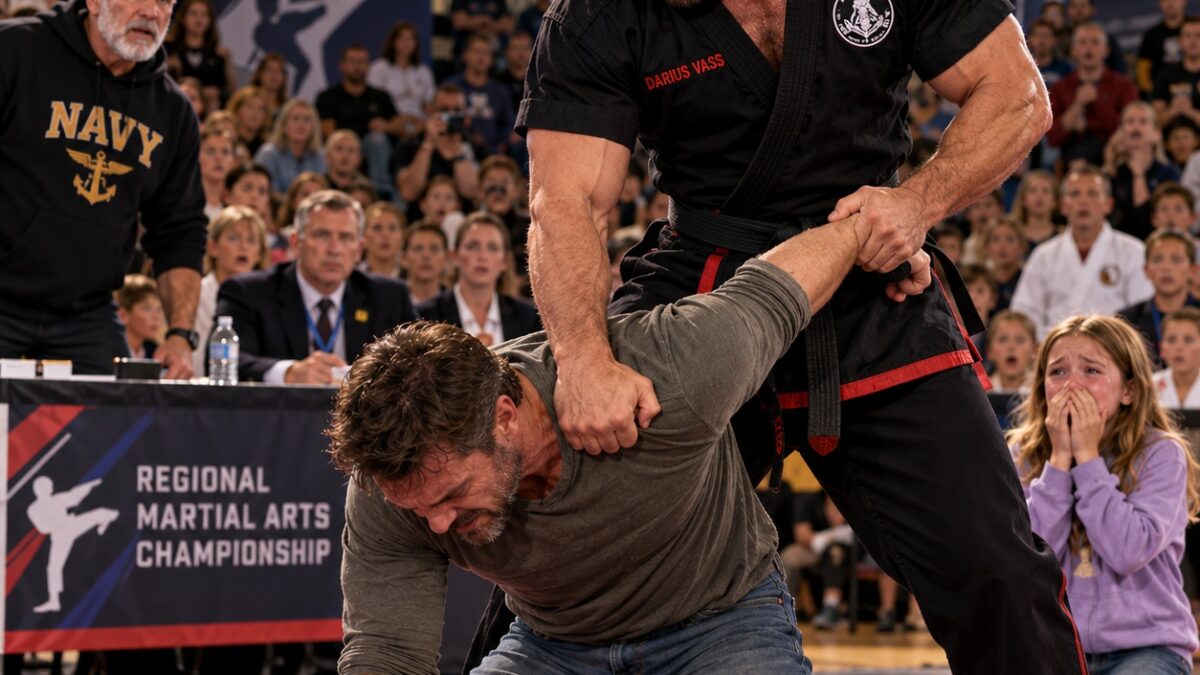
Martial Arts Champion Forced a Quiet Single Dad to His Knees in Front of His Daughter—He Had No Idea Who He’d Just Humiliated
The entire gym laughed when Darius Vass twisted my arm behind my back and forced me onto one knee, telling me I should have stayed home with my daughter instead of questioning a real champion.
I could have ended the situation in seconds, but my nine-year-old girl was standing ten feet away with tears running down her face, and the last thing I wanted was for her to watch her father become the most dangerous man in the room.
Then an older Navy chief near the judges’ table stood up, stared at the way I was holding myself, and asked a question I had spent years hoping nobody in my new life would ever ask in public: “Garrett Boone… were you Anchor?”
My name is Garrett Boone.
I was thirty-eight years old, a widower, a boat mechanic in Tacoma, Washington, and the full-time father of a nine-year-old girl named Piper.
That was the identity I cared about.
Everything before it belonged to another life.
Three years earlier, cancer had taken my wife.
There are losses that explode your life in one afternoon.
Cancer did something crueler.
It dismantled ours slowly.
Appointments.
Treatments.
Good weeks.
Bad scans.
Hope.
Then less hope.
Then the day Piper and I came home without her mother.
After that, I stopped caring very much about the things men usually use to measure themselves.
Rank.
Recognition.
Reputation.
Whether somebody thought I was tough.
I had already spent enough years around violence to know how little applause means when you are the person cleaning up afterward.
Before Piper and before the marina, I had served as a Navy SEAL.
My team called me Anchor.
Not because I was the loudest.
I wasn’t.
Not because I was the strongest.
There were men stronger than me.
They called me Anchor because when something went wrong, I stayed calm.
That skill had kept people alive overseas.
Later, it helped me survive packing school lunches while grieving a woman I still expected to hear walking down the hallway.
These days, my biggest missions were different.
Getting Piper to school on time.
Learning to braid hair from online videos.
Remembering which lunch snacks she liked this month.
Knowing when “I’m fine” meant she was fine and when it meant I needed to sit on the edge of her bed until she finally told me what was wrong.
That Saturday, she wanted to attend a martial arts exhibition at a local community center because one of her school friends was performing.
“Please, Dad?”
I looked at the marina schedule.
“Two hours?”
“Probably.”
“You said that about the school talent show.”
“That was different.”
“It lasted four hours.”
She smiled.
“You survived.”
Barely.
But I agreed.
The gym was packed.
Parents in folding chairs.
Kids in uniforms.
Bare feet slapping against mats.
At the center stood Darius Vass.
Thirty-five.
Nationally recognized.
Owner of three training academies.
And undeniably talented.
I want to be fair about that.
Darius was not a fraud.
His technique was real.
His conditioning was real.
His trophies had been earned.
The problem was that somewhere along the way, accomplishment had turned into entitlement.
Every demonstration became about him.
Every correction had to be public.
Every mistake became an opportunity to remind somebody who held authority.
A young student missed a sequence.
Darius grabbed the boy’s arm.
“Again.”
The kid tried.
Stumbled.
Darius’s voice sharpened.
“If you quit every time you make a mistake, you’ll never be worth anything.”
The boy’s eyes filled.
I shifted in my chair.
“He’s a kid.”
I had not said it loudly.
Unfortunately, Darius heard me.
He turned.
“What was that?”
Piper looked at me.
I shook my head.
“Nothing worth stopping the show over.”
A few parents chuckled.
Darius did not.
“Come down here.”
“I’m here to watch my daughter’s friend.”
“Then watch closely. Maybe you’ll learn something about discipline.”
I stood because I wanted to end the exchange before the boy on the mat felt even more humiliated.
“I respect what you do.”
Darius smiled.
No warmth.
“I just think there’s a better way to teach a child.”
“And what would you know about teaching fighters?”
“Enough to know humiliation isn’t the same as discipline.”
The entire room went quiet.
Darius pointed toward the mat.
“Fine. Come show us.”
“No.”
That surprised him more than an insult would have.
“You’re afraid.”
“No.”
“Afraid you’ll look weak in front of your little girl?”
Piper caught my hand.
“Dad, we can go.”
I squeezed her fingers.
“We’re okay, sweetheart.”
Then I looked at Darius.
“I said no. Respect that.”
Instead, he grabbed my wrist.
And the second his hand closed around me, I knew the day had just changed.
FULL STORY CONTINUATION
The old part of my brain woke up before the rest of me had time to object.
Grip angle.
Thumb position.
Weight distribution.
Distance from his hips.
Balance in his front foot.
The people around us saw a champion grabbing an ordinary father.
I saw geometry.
That was exactly why I did not react.
Darius expected resistance.
A pull.
Maybe a shove.
An amateur trying to yank free.
If I responded the way years of training had conditioned me to respond, the exchange would stop being embarrassing and become dangerous.
I had spent too much of my adult life learning what happens after a man says:
I can control this.
You often cannot.
Darius raised my wrist higher.
“See?” he told the audience. “People talk because they’ve never had anyone test them.”
A few uncomfortable laughs moved through the chairs.
I could hear Piper beside me.
Her breathing changed.
That mattered more than Darius.
I rotated my wrist a few degrees.
Shifted one foot.
Stepped inside the direction of pressure instead of fighting away from it.
Simple.
Darius lost his balance for half a second.
His shoulder dipped.
His foot moved.
The crowd gasped.
His eyes flashed.
That was the moment I knew his pride had become more dangerous than his technique.
He tightened the grip.
I said quietly:
“Let go.”
He twisted my arm behind me.
Harder this time.
A joint lock.
Technically clean.
Emotionally stupid.
I could have countered.
There were at least three options available before he finished the motion.
One would have dumped him over my hip.
Another would have separated his grip and sent him face-first onto the mat.
A third was uglier.
I chose none.
Because I saw Piper moving.
She had pushed through two adults and was coming toward the edge of the mat.
Her eyes were wide.
I went down onto one knee.
Not because Darius had forced me there.
Because lowering my body reduced the tension on my shoulder and gave me time to keep the scene from exploding in front of my daughter.
Darius leaned toward me.
His breath smelled like mint gum.
“That’s what happens when amateurs forget their place.”
Someone laughed nervously.
Someone else had a phone raised.
I remember thinking:
Of course somebody is recording this.
Then Piper said:
“Please stop hurting my dad.”
Her voice was not loud.
It did not need to be.
The entire room changed.
I looked at her.
Tears were running down her face.
And suddenly Darius did not matter.
The audience did not matter.
My pride did not matter.
I had promised Piper’s mother something near the end.
Not dramatically.
There were no violins.
She was tired.
Very tired.
I was sitting beside her bed.
She looked at me and said:
“Don’t let her grow up afraid.”
That was all.
Not:
Make her fearless.
Not:
Protect her from everything.
Just:
Don’t let her grow up afraid.
I had carried that sentence for three years.
Now Piper was looking at me as if the world had suddenly revealed that grown men could hurt her father for entertainment.
That was the real damage happening in the room.
I turned my head toward Darius.
“Let go of my arm.”
My voice was quiet.
Something in it made him hesitate.
Not because I threatened him.
I didn’t.
Maybe he finally realized the scene no longer looked the way he intended.
He released me with a theatrical shove.
I stood.
Did not look at him.
I went directly to Piper.
Knelt in front of her.
“Look at me.”
She did.
“I’m all right.”
Her lower lip shook.
“Why didn’t you fight him?”
The question hurt more than my shoulder.
I brushed a tear from her cheek.
“Because I don’t have to hurt someone just because he wants me to.”
She looked toward Darius.
“He hurt you.”
“He tried to embarrass me.”
“Isn’t that bad?”
“Yes.”
“Then why—”
“Because sometimes stopping something doesn’t mean hitting back.”
That answer was partly for her.
Partly for me.
I took her hand.
“We’re leaving.”
I had reached the edge of the mat when Darius called after me.
“Running away already?”
I stopped.
I wish I hadn’t.
Not because of what eventually happened.
Because for one second I felt the old anger.
Hot.
Clean.
Familiar.
The kind of anger that makes every option seem simpler.
I looked down at Piper.
Then at a volunteer I recognized from previous community-center events.
“Can you take her to the lobby?”
Piper grabbed my sleeve.
“No.”
“I’m not fighting.”
“Promise?”
“I promise.”
I looked directly into her eyes.
“I just need to finish the conversation.”
She hesitated.
Then nodded.
The volunteer led her toward the lobby, where another parent from her school was waiting.
Only when she was out of immediate reach did I turn around.
Darius was standing on the mat.
Arms loose.
Smiling again.
The crowd had not returned to normal.
Phones were still raised.
Parents whispered.
The young boy Darius had humiliated earlier was standing beside his mother.
I walked back.
Stopped several feet from him.
“I’m giving you one last chance to let this end.”
Darius laughed.
“Or what?”
“Or you’ll have to explain to every parent here why you put your hands on someone who asked you to stop.”
A murmur moved through the gym.
Darius looked around.
That bothered him.
He could feel the audience shifting.
A performance only works as long as the crowd agrees on who the hero is.
“Get back on the mat.”
“I’m already standing on it.”
“One round.”
“No.”
“No excuses.”
I sighed.
“You really don’t know when to stop.”
He raised his hands into a fighting stance.
I did not.
I stood with my feet balanced.
Shoulders loose.
Hands low.
Eyes on the center of his chest.
It was not a martial arts demonstration stance.
It was simply the position that came naturally after years of training where wasted motion could get people killed.
The difference was subtle.
Most of the audience did not notice.
One man did.
He sat near the judges’ table.
Older.
Late sixties, maybe.
Gray hair.
Straight posture.
I had noticed him earlier talking with event staff.
He stood suddenly.
“Hold on.”
Darius looked irritated.
The man stepped closer.
His eyes were on me.
Not on Darius.
On my feet.
Then my hands.
Then my face.
He stared.
My stomach tightened.
Please don’t.
He said:
“Garrett Boone?”
I did not answer immediately.
Darius frowned.
The man moved closer.
“You’re Garrett Boone.”
I knew him then.
Not personally.
But enough.
Malcolm Price.
Retired Navy chief.
I had seen him years ago at Coronado during joint training.
He volunteered with veteran events now.
He looked older.
So did I.
“Yes, sir.”
Malcolm’s expression changed.
“You were Anchor?”
The gym went silent.
I looked away.
That name had not been spoken around Piper much.
She knew I had served.
She knew pieces.
Not details.
Darius lowered his hands slightly.
Malcolm continued:
“The SEAL instructor who trained our rescue teams at Coronado?”
I said:
“We had a lot of instructors.”
“I watched you demonstrate close-quarters defense.”
Darius’s eyes moved between us.
Malcolm pointed toward me.
“You could disarm a man without throwing a punch.”
I felt heat rise in my face.
This was exactly the kind of public attention I hated.
Malcolm kept going.
“They said your team called you Anchor.”
I said:
“They called me worse things too.”
A few people laughed.
Malcolm did not.
“You led people through an operation where every member came home.”
“We had a good team.”
“You kept them together.”
“Chief.”
He understood the warning in my voice.
Enough.
But the damage had already been done.
Whispers spread.
“Navy SEAL?”
“Seriously?”
“That guy?”
Darius stared.
Some of the arrogance left his face.
Not all.
Enough.
“Is that true?”
I looked at him.
“I served.”
“You were a SEAL?”
“Yes.”
His stance dropped another inch.
“Why didn’t you defend yourself?”
That question irritated me.
Not because it was unfair.
Because it revealed the entire problem.
“I did defend myself.”
His brow furrowed.
“You were on your knee.”
“I made sure this didn’t become something worse.”
He looked almost offended.
“You’re saying you let me—”
“I’m saying I had no reason to hurt you.”
Silence.
Then:
“Don’t confuse restraint with inability.”
I regretted the sentence as soon as I said it because it sounded more threatening than I intended.
Darius heard it.
So did everyone else.
I added:
“I’m not here to prove anything.”
Malcolm stepped between us.
“This exhibition is supposed to teach respect.”
Darius looked toward him.
Malcolm’s voice became harder.
“What I watched today was a champion using his reputation to intimidate a father in front of his child.”
Darius glanced toward the boy he had berated earlier.
The kid was standing beside his mother.
Not smiling.
Not impressed.
Just watching.
Then I saw Piper in the lobby doorway.
The volunteer held her hand.
She was watching me.
That decided everything.
I walked away.
No match.
No throw.
No secret military technique.
No public humiliation returned in kind.
I took Piper’s hand.
And we left.
The parking lot was quiet.
She did not speak until we reached the truck.
Then:
“Dad?”
“Yeah?”
“Are you really a Navy SEAL?”
I opened her door.
“I was.”
“Like in movies?”
“Absolutely not like movies.”
She climbed inside.
I closed the door.
Walked around.
Sat behind the wheel.
Piper watched me.
“Why didn’t you tell me?”
“I did tell you I was in the Navy.”
“You said you worked with boats.”
“I did work with boats.”
She narrowed her eyes.
“That is sneaky.”
“Technically accurate.”
“Were you really called Anchor?”
I looked through the windshield.
“Yes.”
“Why?”
I thought about how much a nine-year-old needed.
Not much.
“Because I stayed calm when things got bad.”
She looked at my shoulder.
“Did today get bad?”
“A little.”
“Were you scared?”
That question surprised me.
“Yes.”
Her eyes widened.
“Of him?”
“No.”
“Then what?”
I turned toward her.
“Of making it worse.”
She thought about that.
“Could you have beat him?”
There it was.
The question every child asks when strength becomes visible.
I said:
“Maybe.”
“That means yes.”
“That means fighting isn’t math.”
She rolled her eyes.
“You always do that.”
“Do what?”
“Give dad answers.”
“What is a dad answer?”
“An answer that sounds like an answer but also sounds like homework.”
I laughed for the first time that afternoon.
She did too.
Then she became serious.
“Why did he do that?”
I knew she meant Darius.
“He got embarrassed.”
“So he hurt you?”
“Yes.”
“That’s stupid.”
“Yes.”
“Are grown-ups always stupid when they’re embarrassed?”
I started the truck.
“More often than they’d like to admit.”
The drive home was quiet.
I stopped for ice cream because sometimes emotional processing requires vanilla with chocolate chips.
Piper talked eventually.
Not about Darius first.
About her mother.
She asked:
“Would Mom have been mad?”
“Yes.”
“At him?”
“Yes.”
“At you?”
“Probably.”
“Why?”
“For getting involved.”
Piper smiled faintly.
“She would’ve said you can’t keep your mouth shut.”
“Those might have been her exact words.”
We laughed.
Then Piper looked out the window.
“She would’ve been proud you didn’t hit him.”
I swallowed.
“Maybe.”
“She would.”
I did not argue.
At home, my shoulder stiffened.
Nothing serious.
Darius knew how to apply a lock.
I iced it.
Piper sat beside me doing homework she absolutely could have completed in her room.
I understood why she stayed.
Around seven, my phone started buzzing.
Messages.
People from the community center.
Parents.
A marina coworker.
Then Malcolm.
I stared at his name.
Piper looked over.
“Who’s Malcolm?”
“The man who talked too much.”
She smiled.
“Answer.”
I did.
“Chief.”
“Garrett.”
“You made my afternoon difficult.”
“I figured.”
“Sorry.”
“No, you’re not.”
“No.”
I laughed.
He became serious.
“You did the right thing.”
“I took my daughter to watch her friend perform.”
“You know what I mean.”
“Yeah.”
“The video is spreading.”
I closed my eyes.
“Of course it is.”
“Several angles.”
“Wonderful.”
“People are asking who you are.”
“I’d prefer if you didn’t help.”
“I won’t.”
“Thank you.”
Pause.
Then Malcolm said:
“Piper okay?”
I looked at her.
She was pretending not to listen.
“She will be.”
“That man crossed a line.”
“Yes.”
“You planning anything?”
“No.”
“Good.”
“You sound disappointed.”
“I’m old, not stupid.”
We hung up.
By nine, the videos were everywhere locally.
One angle started with Darius grabbing my wrist.
Another captured Piper saying:
Please stop hurting my dad.
That one hurt to watch.
I stopped after ten seconds.
Comments multiplied.
Some people recognized Darius.
Parents.
Former students.
Competitors.
At first, I ignored it.
Then one message caught my attention.
It came from the mother of the boy Darius had berated.
Thank you for saying something. My son thought he deserved to be treated that way because Darius tells them embarrassment creates toughness.
I read it twice.
That bothered me more than what Darius had done to me.
A child believing humiliation was deserved.
I typed:
He didn’t deserve it.
Deleted.
Typed again.
Your son did nothing wrong by making a mistake during a demonstration. I hope he knows that.
She responded:
I’m working on it.
That was the first sign the incident had uncovered something larger.
Over the next several hours, former students began posting.
Not all accused Darius of anything extreme.
Most described pressure.
Fear.
Being called weak in front of classmates.
Being told tears were shameful.
Public drills designed to embarrass anyone who failed.
Parents described children quitting martial arts after suddenly developing stomachaches before class.
Some defended him.
“He produces champions.”
“He teaches discipline.”
“Kids are too soft.”
“He never treated my child badly.”
Those perspectives existed too.
Darius had helped some students.
That mattered.
Reality rarely gives you a villain with zero redeeming qualities.
His accomplishments were real.
His academy had produced excellent athletes.
Some students loved him.
But success had insulated his methods from criticism.
People tolerated behavior they might have questioned in a less famous instructor because Darius could point at trophies.
Winning had become his evidence that every method was justified.
That was dangerous.
Around midnight, Piper came downstairs.
“You should be asleep.”
“I was.”
“You are standing in the kitchen.”
“I woke up.”
Nightmare.
I knew before she said it.
I poured her water.
She sat at the table.
“What happened?”
“You were fighting.”
“In your dream?”
She nodded.
“Did I win?”
She looked annoyed.
“That isn’t funny.”
“Sorry.”
“You hurt him really bad.”
I sat across from her.
“And that scared you?”
“Yes.”
“Even though he hurt me first?”
She nodded.
Good.
That might sound strange.
I was relieved.
Because she had understood something important instinctively.
Violence does not become safe merely because the person using it is on your side.
I reached across the table.
“That’s why I didn’t fight.”
Her eyes filled again.
“I don’t want anyone hurting you.”
“I know.”
“What if he had kept going?”
“Then I would have stopped him.”
“How?”
“Only as much as I needed to.”
She thought.
“So you wouldn’t let him really hurt you.”
“No.”
“You promise?”
“Yes.”
She leaned against me.
I held her.
There are no military schools for that part.
No instructors.
No drills.
Just your child shaking against your chest while you try to convince her the world is safe even though you know better.
Eventually she fell asleep on the couch.
I carried her upstairs.
When I came back down, I saw a text from an unknown number.
This is Darius Vass. We need to talk.
I stared at it.
Then put the phone down.
We did not need to talk at midnight.
The next morning, I went to work.
Routine mattered.
Piper went to school.
I went to the marina.
Boat engines do not care whether a video of you is spreading online.
A fuel problem remains a fuel problem.
A corroded connection remains corroded.
That normality helped.
I had been working on a twenty-six-foot fishing boat for about an hour when my coworker Eli walked in.
He held his phone.
“Dude.”
“No.”
“You’re a Navy SEAL?”
“Was.”
“You told me you did maritime work.”
“I did.”
“You let me explain basic self-defense to you at the Christmas party.”
“That was a very informative conversation.”
“You’re unbelievable.”
“Hand me the twelve-millimeter.”
He did.
Then stood there.
“What?”
“You’re not going to tell me anything?”
“About what?”
“SEAL stuff.”
“No.”
“Not one story?”
“No.”
“Did you kill—”
“Eli.”
He stopped.
That boundary rarely needed explaining twice.
He nodded.
“Right.”
Then he grinned.
“You could’ve destroyed that guy.”
I went back to the engine.
“That isn’t the point.”
“It kind of is.”
“No.”
Eli leaned against the bench.
“Everyone online thinks you were being humble.”
“I was trying not to traumatize my kid.”
That took the smile out of him.
“Yeah.”
People love restraint after they discover what could have happened.
In the moment, restraint often looks like weakness.
That contradiction had followed me most of my adult life.
Overseas, the dangerous men were rarely the ones yelling.
They were the ones who did not waste energy proving themselves.
Back home, civilians often learned violence through entertainment.
You get insulted.
You respond.
You win.
Crowd cheers.
Credits.
Real violence leaves injuries, statements, lawsuits, guilt, nightmares, and people who replay one second for years.
I had seen enough.
Piper had seen too much already.
Around ten in the morning, Darius walked into the marina.
Eli saw him first.
“Oh.”
I looked up.
Darius stood near the workshop entrance.
Jeans.
Plain jacket.
No martial arts uniform.
No students.
No crowd.
He looked smaller.
Not physically.
Context does that to people.
Yesterday, he had been at the center of a room built around his authority.
Today, he was a man standing in somebody else’s workplace.
I wiped my hands.
“What do you need?”
“I came to apologize.”
Eli looked at me.
I nodded toward the office.
He understood and disappeared.
Darius stayed by the door.
I said nothing.
He shifted.
That surprised me.
The man from yesterday had filled every silence.
This version seemed afraid of one.
Finally:
“I watched the videos.”
“So did a lot of people.”
“I expected them to make me look bad.”
I raised an eyebrow.
“They did.”
“No.”
He shook his head.
“I mean I expected editing. Out-of-context clips.”
“And?”
“They weren’t.”
That mattered.
He continued.
“I saw Piper.”
I looked at him.
“She was terrified.”
“Yes.”
Darius swallowed.
“I didn’t see her in the moment.”
“You heard her.”
“I know.”
“You kept going.”
His face tightened.
“I know.”
I let the silence return.
Darius looked toward the boats outside.
“When I started teaching, I hated instructors who humiliated people.”
Interesting.
He continued.
“I had one when I was fourteen. He used to make us line up while he told everyone what the worst student had done wrong.”
“And you became him.”
He flinched.
“Yes.”
That answer was more honest than I expected.
“I told myself I was different because my students win.”
I leaned against the workbench.
“Winning makes a lot of bad methods look smart.”
He nodded.
“I thought fear made them tougher.”
“Fear makes people good at avoiding whatever caused the fear.”
“I know that now.”
“No. You know you’re embarrassed now.”
His jaw tightened.
For a second I saw yesterday’s Darius.
Then it passed.
“Fair.”
That was another good sign.
He said:
“I owe you an apology.”
“You owe my daughter one too.”
“I know.”
“And the kid you humiliated.”
“I know.”
“Probably more than one.”
He looked down.
“Yes.”
I crossed my arms.
“What are you going to do?”
He looked up.
“I don’t know.”
“That’s a problem.”
“I came here first.”
“Why?”
“Because I thought if you forgave me—”
I laughed.
He stopped.
Not mockery.
Disbelief.
“You think my forgiveness fixes your academy?”
“No.”
“It doesn’t fix the kids.”
“I know.”
“It doesn’t make the videos disappear.”
“I know.”
“Then why are you here?”
Darius took a breath.
“Because I needed to say I was wrong to your face.”
That answer was acceptable.
Not enough.
Acceptable.
I said:
“An apology matters.”
He waited.
“But what you do after matters more.”
His eyes stayed on mine.
“What would you do?”
“I’m not running your school.”
“I’m asking.”
I thought about it.
“Stop deciding accountability has to be humiliating.”
He nodded.
“Get outside review.”
“Of what?”
“Your youth teaching.”
His expression changed.
“From who?”
“Someone who doesn’t depend on you for a paycheck.”
He understood immediately.
“Independent organization.”
“Yes.”
“That could damage us.”
“You already damaged you.”
He looked away.
I continued.
“Ask why kids quit.”
“That’s going to hurt.”
“Probably.”
“Parents are already pulling students.”
“Then you can either learn why or complain that everyone became too sensitive.”
He almost smiled.
“I’ve probably said that.”
“I’m sure.”
He nodded.
“I’ll do it.”
I did not say:
I believe you.
Trust requires evidence too.
Darius looked toward the door.
Then stopped.
“Can I ask you something?”
“Depends.”
“When I had your arm…”
I knew where this was going.
“You could have gotten out.”
“Yes.”
“How fast?”
“That question does not help you.”
“I need to know.”
“No, you want to know.”
His pride had not vanished.
It had changed clothes.
I looked at him.
“Fast enough.”
He stared.
“That’s all?”
“That’s all.”
He nodded slowly.
Then:
“Thank you for not humiliating me.”
I thought about that.
“I wasn’t protecting your dignity.”
His eyes lifted.
“I was protecting my daughter.”
That landed.
Good.
Darius left.
I watched him cross the marina.
Eli reappeared before the door finished closing.
“Well?”
“He apologized.”
“Did you forgive him?”
“That isn’t a light switch.”
“What’d you tell him?”
“To fix his school.”
Eli looked disappointed.
“That’s it?”
“You wanted a duel?”
“A little.”
I threw a rag at him.
He laughed.
That afternoon, Darius posted a public statement.
Not perfect.
Public apologies rarely are.
He acknowledged that he had used intimidation during the exhibition.
Apologized to me.
Apologized to Piper.
Apologized to the young student.
Announced that his academies would immediately adopt a policy prohibiting public humiliation and intimidation as training methods.
Then he announced something I did not expect him to follow through on so quickly.
Independent review.
A youth sports organization would evaluate coaching practices.
Parents would be invited to provide confidential feedback.
Students too.
That was real risk for him.
Good.
Change without risk is often branding.
Darius also contacted the boy and his mother privately.
I only knew because she messaged me later.
He apologized directly.
No excuses.
She said her son had not decided whether he wanted to return.
That was fair.
An apology does not create obligation in the person harmed.
You can apologize.
They can still leave.
Several families did.
Darius lost students.
One assistant instructor resigned.
People online called that justice.
Maybe.
I saw it more as consequence.
Trust is slow.
Fear is fast.
He had built some of his authority through fear.
Once parents recognized that, he could not demand immediate trust simply because he had a revelation.
The academy had to earn it.
Over the following weeks, I avoided most of the discussion.
I was not interested in becoming Darius’s reform supervisor.
My life was already full.
Piper.
Marina.
Laundry.
Grocery shopping.
The horrifying discovery that a child’s school project can require construction materials at eight o’clock on a Sunday night.
That was enough.
Piper processed the event differently.
At first, she wanted constant reassurance.
“Will he come here?”
“No.”
“Does he know where we live?”
“I don’t think so.”
“Could he find out?”
“Probably.”
“That’s not reassuring.”
“He has no reason to come to our house.”
“Are you sure?”
“Yes.”
Then she became curious.
She asked about my military life more than before.
I had always planned to tell her gradually.
I just had not expected Malcolm Price to speed up the timeline in front of seventy strangers.
One evening she found an old photograph in a drawer.
Me younger.
Uniform.
Several men beside me.
She brought it to the kitchen.
“Is this your team?”
I looked.
My chest tightened.
“Yes.”
“Are they alive?”
Children ask direct questions adults avoid.
“Some are.”
She understood what I had not said.
“Did some die?”
“Yes.”
She sat.
I sat across from her.
“Did you see it?”
“Yes.”
“Is that why you don’t like fighting?”
Partly.
I chose my words.
“I learned that hurting somebody is easy compared with living with everything that comes after.”
She studied the picture.
“You were young.”
“I thought I was ancient.”
“You had terrible hair.”
“That is classified.”
She smiled.
Then:
“Were you scared there too?”
“All the time.”
“But Malcolm said you stayed calm.”
“You can be scared and calm at the same time.”
“How?”
“You decide what you do even when your body is telling you to panic.”
She looked at me.
“Like at the gym.”
“Yes.”
That was the conversation I wanted her to remember.
Not that her father could fight.
That fear and choice can coexist.
Two weeks later, Malcolm came by the marina.
I saw him before he saw me.
“Chief.”
He smiled.
“Anchor.”
“Please don’t.”
“Fair.”
I handed him coffee.
He looked around.
“Nice place.”
“Engines don’t talk back.”
“You always liked machines.”
“Machines are honest when broken.”
He laughed.
Then became serious.
“I owe you an apology.”
“You and everybody else.”
“I should’ve asked before saying anything about your service.”
“Yes.”
“I got carried away.”
“Yes.”
“You going to make me suffer?”
“I’m considering it.”
He smiled.
“I meant well.”
“I know.”
“I saw his stance. Saw yours. Then I recognized you and thought the room needed context.”
“It did not need my résumé.”
“No.”
He looked toward the water.
“But maybe Darius did.”
I thought.
“Maybe.”
Malcolm said:
“You know the internet version says you were some legendary instructor who could kill six men with a spoon.”
I closed my eyes.
“Of course it does.”
“I’ve been correcting people.”
“Thank you.”
“I tell them five men.”
I stared.
He laughed so hard he coughed.
Retired chiefs remain dangerous.
He settled.
“Seriously. You did something useful.”
“I took a wrist lock.”
“You showed a room full of people that capability and restraint are different.”
“I didn’t plan a lesson.”
“Best lessons rarely are.”
I hated when older people said annoyingly accurate things.
He left after an hour.
A few weeks after the original exhibition, Piper’s school friend had another community-center event.
Piper wanted to go.
I did not answer immediately.
She noticed.
“We don’t have to.”
“No. If you want to go, we go.”
“Darius will be there.”
“I know.”
“Are you okay with that?”
Interesting question from a nine-year-old.
“Yes.”
“Are you sure?”
“Yes.”
She thought.
“Okay.”
We went.
The community center looked exactly the same.
That surprised me.
Same folding chairs.
Same mat.
Same bright lights.
Traumatic moments change places in memory, but buildings do not participate.
They remain walls.
Darius stood near the entrance.
When he saw us, he walked over.
He stopped several feet away.
Good.
Space.
He looked at me.
Then Piper.
“Hi.”
Piper moved half a step closer to me.
Darius noticed.
“I wanted to tell both of you something.”
I looked down at Piper.
Her choice.
She waited.
Darius said:
“I owe you both better than what happened.”
Then directly to Piper:
“I’m sorry I scared you.”
Piper studied him.
Kids are terrifying judges because they do not care about reputation.
“Are you going to yell at the kids again?”
Darius looked down.
“I’m going to work very hard not to.”
Piper did not smile.
“Why not just not do it?”
I bit the inside of my cheek.
Darius almost laughed.
Fair to him, he stopped himself.
“Because sometimes adults have bad habits they have to practice changing.”
Piper thought.
“Okay.”
That was it.
No hug.
No instant forgiveness.
No sweet music.
She accepted the answer without pretending the past had disappeared.
Darius looked at me.
I nodded once.
Enough.
We went inside.
The exhibition began.
I noticed differences immediately.
A student made a mistake.
Darius stopped him.
For a second, I saw the old reflex.
His jaw tightened.
Then he breathed.
“Reset.”
The boy did.
“Again.”
He tried.
Failed.
Darius said:
“What changed that time?”
The kid answered.
Darius adjusted his stance.
No insult.
No public shaming.
Teaching.
It should not have felt revolutionary.
But after the previous event, it did.
Near the middle of the demonstration, Darius called several younger students forward.
He asked:
“What does strength mean?”
A boy raised his hand.
“Winning.”
Darius smiled faintly.
“Sometimes.”
He looked toward the back of the room.
At me.
I wished he had not.
Then he said:
“But real strength is knowing what you could do and choosing what you should do.”
The room was quiet.
I did not need the credit.
The lesson mattered more.
Piper leaned against me.
“That’s what you said.”
“Similar.”
“He copied you.”
“Teachers steal good material.”
She whispered:
“Can we sue him?”
I looked down.
She grinned.
Her mother would have been proud of that one.
After the event, several parents approached me.
I hated that part.
One father shook my hand.
“You showed incredible restraint.”
“Thank you.”
A mother said:
“My son almost quit before. He says practice feels different now.”
“I’m glad.”
Another man asked whether I offered self-defense training.
“No.”
“Private lessons?”
“No.”
“Veteran seminars?”
“No.”
“Security consulting?”
“No.”
Piper tugged my sleeve.
“He fixes boats.”
I pointed at her.
“Exactly.”
She rescued me.
In the parking lot, Darius approached one last time.
Not close.
“Garrett.”
I turned.
“The review started.”
“Good.”
“They’re not being gentle.”
“They shouldn’t.”
He nodded.
“Some parents are furious.”
“Expected.”
“Some staff too.”
“Also expected.”
He looked tired.
“But I think I needed it.”
I said nothing.
He continued.
“I spent years thinking respect was what happened when nobody challenged me.”
I looked at him.
“That’s fear.”
“Yes.”
He seemed to understand now.
Or at least he understood the sentence.
Time would decide the rest.
“I’m trying.”
“That’s all you can do.”
He nodded.
“Thank you.”
“For what?”
“For not giving me the lesson I was asking for.”
I understood.
The fight.
The public beating.
The humiliation in reverse.
“You would’ve learned the wrong thing.”
He looked surprised.
“What?”
“If I had beaten you in front of everyone, you might’ve learned there was a tougher man in the room.”
I gestured toward the building.
“That wasn’t your problem.”
He waited.
“Your problem was thinking being tougher gave you the right to humiliate somebody weaker.”
He looked back toward the gym.
The young students were leaving with parents.
“Yes.”
“If I had humiliated you, all I would’ve done was prove your philosophy.”
That stopped him.
I had not realized the idea fully until I said it.
Darius slowly nodded.
“Yeah.”
I left.
In the truck, Piper buckled herself.
We pulled out.
Streetlights moved across the windshield.
For several minutes, she watched through the passenger window.
Then:
“Dad?”
“Yeah, sweetheart?”
“Were you really one of the best fighters in the Navy?”
I smiled.
“I knew a few good people.”
“That’s not what I asked.”
“It’s the answer you’re getting.”
She groaned.
“Dad answer.”
“Correct.”
She became quiet.
Then:
“I think you’re strongest when you’re being my dad.”
My hands tightened on the steering wheel.
There are moments when grief returns so quickly it feels physical.
Her mother should have heard that sentence.
She should have been sitting beside me.
She should have teased me until I got embarrassed.
Instead, there was an empty history between Piper and me.
I reached across the console.
Held her hand.
“That’s the only thing I really want to be good at.”
“You’re okay.”
“High praise.”
“You’re not good at braids.”
“I have improved.”
“You make them crooked.”
“Hair is difficult.”
“Mom did them straight.”
“Yes.”
Silence.
“I miss her.”
“Me too.”
We drove.
The event became smaller with time.
Not unimportant.
Smaller.
That is what healing does.
At first, Piper mentioned Darius every few days.
Then once a week.
Then occasionally.
She stopped asking whether he would come to the house.
Her nightmares faded.
The videos online disappeared beneath whatever outrage came next.
Darius continued running his academies, though not exactly as before.
Some students never returned.
Some parents never trusted him again.
That was their right.
His new policy against public humiliation remained.
The independent youth organization completed its review.
I did not read the full report.
It was not my responsibility.
I heard there were substantial recommendations around coaching methods, complaint procedures, parent observation, and staff training.
Darius implemented them.
Good.
That was enough for me.
He apologized directly to more former students.
Some accepted.
Some did not.
Also fair.
Apologies are not invoices.
You cannot demand a receipt.
The young boy from the first demonstration eventually returned to training.
Not because Darius asked.
His mother told me he wanted to.
There were conditions.
She stayed at practices.
The academy allowed it.
The boy trained under another instructor for a while.
Darius respected that.
That mattered.
Real change often looks boring.
Policies.
Supervision.
Feedback.
Awkward apologies.
Less yelling.
No cinematic redemption montage.
Darius did not become my best friend.
I did not secretly train with him every Tuesday.
We did not open an academy together.
Life does not need that kind of symmetry.
We became two men who had once collided badly and later understood the collision.
That was enough.
Sometimes I saw him at community events.
He nodded.
I nodded.
Piper eventually stopped moving closer to me when he approached.
That was probably the best measure of change.
Not whether Darius felt forgiven.
Whether my daughter felt safe.
That remained my standard.
A year after the incident, Piper asked to try martial arts herself.
I nearly dropped a plate.
“What?”
She shrugged.
“Ella does it.”
“Which academy?”
She gave me a look.
“Not his.”
I relaxed.
Then felt guilty for relaxing.
She laughed.
“Dad.”
“What?”
“You looked like I said I wanted to join the Marines.”
“Worse.”
We visited a smaller school.
The instructor was a woman named Ms. Chen.
She watched students carefully.
Corrected them without shouting.
One little boy cried after falling.
She did not tell him to toughen up.
She asked whether he was hurt.
Then whether he wanted to try again.
He did.
I watched Piper watch him.
That was what mattered.
Afterward:
“What do you think?” I asked.
“I like it.”
“Why?”
“No one yelled.”
“Good reason.”
“You’re not going to be weird about it, right?”
“What does weird mean?”
“Standing in the corner checking everybody’s hands.”
“I would never.”
“You’re already doing it.”
I looked down.
My hands were folded.
She smiled.
“Dad.”
“I’m learning.”
So was she.
Piper started classes.
Not because of me.
Not because of Darius.
Because she wanted to.
That distinction made me proud.
The original incident had not turned martial arts itself into something frightening for her.
She had separated one man’s bad behavior from the discipline.
That was healthy.
One afternoon, after several months, she showed me a basic wrist escape.
“Grab me.”
“No.”
“Dad.”
“I do not see this ending well.”
“My instructor said practice with a parent.”
I gently took her wrist.
She rotated.
Stepped.
Broke the grip.
She grinned.
“See?”
“Good.”
“Did I do it right?”
“Mostly.”
“What was wrong?”
I almost corrected her foot immediately.
Stopped.
“Ask Ms. Chen.”
She narrowed her eyes.
“You know.”
“Probably.”
“Tell me.”
I adjusted her position.
Only slightly.
“Here.”
She tried again.
Better.
“You really do know stuff.”
“I’ve been trying to tell you I worked with boats.”
She laughed.
Then:
“Do you miss it?”
That question came out of nowhere.
“The Navy?”
“Yes.”
I thought.
“Parts.”
“Fighting?”
“No.”
“Your friends?”
“Yes.”
“Being Anchor?”
I sat down.
“I don’t think that was something I knew I was being at the time.”
“What does that mean?”
“It was a nickname other people gave me because of how they saw me.”
She sat too.
“Do you miss people seeing you like that?”
Interesting.
“No.”
“Why?”
“Because being needed in dangerous places sounds important until you realize the goal should be fewer dangerous places.”
She thought.
“Do you like people needing you here?”
“Here?”
She nodded.
“Me.”
My chest tightened.
“Yes.”
“That’s different?”
“Completely.”
She smiled.
“Good.”
It was.
The military had taught me to remain functional in chaos.
Fatherhood taught me something harder.
To create calm before chaos happens.
Lunch packed.
Door locked.
Show up for school events.
Listen before fixing.
Apologize when wrong.
Keep routines.
Make home predictable.
There were no medals for any of it.
Good.
Medals were never the point.
The day Darius put me on one knee, spectators initially saw a man failing to stand up for himself.
That interpretation did not bother me anymore.
Because I understood something after Piper’s nightmare.
If I had destroyed Darius in front of her, there was a chance people would have cheered.
The clip might have become more viral.
Former SEAL destroys arrogant martial arts champion.
Millions of views.
People would have written:
That’s what he gets.
But Piper might have remembered something else.
Her father becoming terrifying.
A man hurt badly.
Adults celebrating.
Strength tied permanently to dominance.
I did not want to give her that inheritance.
Her mother had asked me not to let her grow up afraid.
Part of that meant teaching Piper that strong people can be safe.
That ability does not require intimidation.
That boundaries can be firm without cruelty.
That saying no is not weakness.
That walking away is not losing.
And that sometimes protecting someone means refusing the fight everyone else wants to watch.
Years of military training had taught me a thousand ways to control another human body.
Piper taught me what control actually mattered.
My own.
That was the lesson Darius learned too.
Not perfectly.
Nobody learns anything perfectly.
But enough.
He had spent decades mastering his body.
Speed.
Balance.
Precision.
Timing.
Then one Saturday afternoon, a crying nine-year-old exposed the skill he had neglected.
Restraint.
Not physical restraint.
Emotional.
The ability to experience embarrassment without retaliating.
To hear criticism without treating it as rebellion.
To watch a student fail without turning failure into shame.
To possess power without needing constant proof.
Those skills were harder than a kick.
Harder than a throw.
Harder than a submission.
Because there is no crowd cheering while you practice them.
Sometimes the only evidence you are improving is that nobody gets hurt.
Darius eventually understood that.
Months after Piper started martial arts, I saw him at another community event.
He was helping organize.
Not starring.
That alone surprised me.
A young volunteer dropped a box of programs.
Papers scattered everywhere.
Darius looked over.
I saw the irritation flash across his face.
Old reflex.
Then he walked over.
Knelt.
Helped pick them up.
No lecture.
No public joke.
Nothing.
Maybe that sounds insignificant.
It wasn’t.
Character changes in seconds like that.
Not in speeches.
Not in public apologies.
In the tiny moment where the old version of you appears and you choose differently.
He saw me watching.
I nodded.
He smiled faintly.
That was enough.
Piper was beside me.
“Why are you smiling?”
“Nothing.”
“You always say nothing when it’s something.”
“Parent privilege.”
She rolled her eyes.
She was getting very good at that.
We sat through the event.
No drama.
No confrontation.
No revelation.
Exactly how I liked community centers now.
On the drive home, Piper talked about school.
A science project.
A friend problem.
Something involving a group chat that apparently carried the diplomatic complexity of the United Nations.
I listened.
That was my life.
Good.
The man called Anchor had become a father driving forty miles an hour through Tacoma while receiving a detailed explanation of why two fourth-graders were no longer speaking because one had used the wrong emoji.
I would take it over war.
Every time.
People still occasionally recognized me from the video.
Mostly at the marina.
“Were you that SEAL dad?”
Unfortunately.
“You really let that guy take you down?”
“Yes.”
“Man, I would’ve—”
Usually whatever followed proved they understood nothing.
I smiled.
Went back to work.
One customer said:
“You should have taught him a lesson.”
I answered:
“I did.”
He looked confused.
That was fine.
Not every lesson needs the student thrown onto the floor.
Darius’s lesson lasted because nobody gave him the excuse to make himself the victim.
If I had broken his nose, the story could have become:
Veteran attacks martial arts instructor.
Questions.
Provocation.
Liability.
People debating whether my response was excessive.
Instead, the facts stayed clean.
He grabbed me.
I asked him to stop.
He continued.
My daughter cried.
I left.
Then he had to look at himself without any distraction.
That may have been harder.
I know it would have been for me.
Physical pain is simple.
Shame is complicated.
Darius used shame as a teaching tool because perhaps he had never learned how to tolerate his own.
When the crowd laughed at his student, Darius felt powerful.
When the crowd shifted against him, he became reckless.
Same emotion.
Different direction.
It took public failure for him to notice the pattern.
I hope he never forgets it.
I hope I don’t either.
Because I am not immune.
People heard Navy SEAL and suddenly treated my restraint as wisdom.
But I know what anger feels like inside me.
I know I was close to turning around differently when he called:
Running away already?
I know there was a version of me—years younger, less tired, without Piper—who might have accepted that challenge simply because another man questioned my courage.
Training does not remove ego.
Age helps.
Loss helps.
Fatherhood helps more.
When you have someone small watching, pride becomes expensive.
Piper did not need a father who won every room.
She needed one who came home emotionally intact.
That had been my rule since leaving service.
Come home to my daughter.
Not just physically.
Mentally.
Present.
Available.
The world is full of men who survive dangerous jobs and then bring danger home inside them.
I had seen that.
Friends drinking too much.
Marriages collapsing.
Fathers unable to turn off the posture that kept them alive overseas.
I did not judge them.
I understood.
I was terrified of becoming one.
After my wife died, that fear doubled.
Piper had already lost one parent.
She could not afford to lose the other to anger while he was still standing in the kitchen.
So I built routine.
Marina.
School pickups.
Dinner.
Braids.
Homework.
Therapy when needed.
Quiet.
That quiet was not weakness.
It was something I had fought years to earn.
Darius almost pulled me away from it for an afternoon.
He failed.
Not because I was stronger.
Because Piper reminded me what I was protecting.
One evening, years later, she found the old viral clip.
She was older.
Twelve.
Maybe thirteen.
Old enough to understand more.
She came into the kitchen holding her tablet.
“You looked so mad.”
I saw the frozen frame.
Darius behind me.
My arm twisted.
Piper younger at the edge of the mat.
“I was.”
“You always say you weren’t.”
“I say I stayed calm.”
“That’s different?”
“Very.”
She replayed a few seconds.
“I barely remember being this little.”
“I do.”
“You look at me right here.”
She paused the video.
My face had turned toward her.
Everything changed in that frame.
Before it, I was managing Darius.
After it, I was protecting Piper.
She looked at me.
“You could’ve really hurt him?”
I sighed.
“Yes.”
“How bad?”
“I’m not answering that.”
“Dad.”
“No.”
“Fine.”
She watched another second.
“I’m glad you didn’t.”
“Me too.”
Then:
“Was Mom really why?”
“What?”
“You told me once you promised her I wouldn’t grow up afraid.”
I nodded.
“She asked me to protect that part of you.”
Piper’s expression softened.
“You did.”
I looked away because my eyes suddenly burned.
Teenagers are not supposed to notice their fathers trying not to cry.
Unfortunately, mine had inherited her mother’s observational skills.
She came over.
Hugged me.
“You can cry.”
“Terrible parenting.”
“I’m serious.”
“I know.”
I hugged her back.
That was the moment I finally understood the full meaning of that Saturday.
The public story was simple.
Champion humiliates quiet father.
Father turns out to be dangerous veteran.
Champion learns humility.
Good viral structure.
Reality had always been more private.
A widower trying not to let his daughter inherit fear.
A man with a violent past choosing not to let old skills define a new life.
A talented coach discovering that expertise without emotional control can make strength ugly.
A little girl crying.
Then years later saying:
You did it.
That was the victory.
Not Darius losing students.
Not the videos.
Not Malcolm revealing my past.
Not public opinion.
Piper felt safe beside me.
That was all.
Darius eventually stabilized his academies.
Smaller than before.
Different culture.
More oversight.
He still produced strong competitors.
Maybe fewer people feared him.
That seemed like an improvement.
I heard through Malcolm that Darius began telling new instructors:
“If a student has to be humiliated for you to feel in control, you’ve already lost control.”
That sounded almost annoyingly wise.
Maybe he had learned.
Good.
I never took credit.
The lesson belonged to him once he acted on it.
People can change after doing something ugly.
Not always.
Not automatically.
But sometimes.
The possibility matters.
Otherwise accountability becomes nothing more than permanent labeling.
You did bad.
Therefore you are bad forever.
I do not believe that.
I cannot.
Too many good men I knew had done things they regretted.
Too many broken people had rebuilt.
I wanted that possibility for Darius.
For Kyle? Wait—wrong story. For Darius.
For myself.
For anyone.
The condition is action.
Not language.
Darius apologized.
Then changed policies.
Invited review.
Accepted student loss.
Apologized directly.
Adjusted coaching.
Years later, the changes still held.
That gave his apology weight.
Without that, the marina conversation would have been nothing but reputation management.
He understood what I told him.
What you do afterward matters more.
Piper eventually stopped caring about the incident entirely.
Children move forward when adults let them.
That was healthy.
She cared about martial arts because she enjoyed it.
Not because of Darius.
She became competent.
Quick.
Disciplined.
Not a prodigy.
Did not need to be.
She liked the community.
Liked learning.
Liked knowing she could protect herself.
The first time she won a small local competition, she ran over holding a cheap medal.
“I won!”
I hugged her.
“Congratulations.”
“You’re supposed to be more excited.”
“I am.”
“You look normal.”
“I’m internally screaming.”
She laughed.
Then Darius appeared across the gym.
He was there coaching one of his own students.
He saw us.
Raised a hand.
Piper waved.
No tension.
No fear.
Just recognition.
I watched her return attention to her medal.
That was closure.
Not forgiving and forgetting.
Not pretending nothing happened.
The memory had lost power.
Darius was simply another person in the room.
My daughter did not need to hold my hand tighter.
I had promised her mother she would not grow up afraid.
No parent can fully deliver that promise.
Fear is part of being alive.
People hurt you.
Illness comes.
Cars crash.
Friends leave.
Parents die.
You cannot remove fear.
What I could do was teach Piper that fear did not own her decisions.
That was the real promise.
I think I kept it as best I could.
The day Darius forced me onto one knee, he thought he was teaching the room a hierarchy.
Champion over amateur.
Strong over weak.
Teacher over critic.
He thought the physical position proved the truth.
I knew better.
Sometimes a man kneels because he is protecting a child.
Sometimes he walks away because he has already seen enough violence.
Sometimes the person who refuses to fight understands fighting better than the person demanding it.
That is not always true.
There are moments when force is necessary.
I learned that too.
But necessity and pride are different.
Darius had confused them.
I refused to.
That was the entire difference between us that day.
Not Navy SEAL versus martial arts champion.
Not military versus sport.
Not secret expert versus arrogant bully.
One man needed to prove something.
The other did not.
And once Piper cried, proving anything became meaningless.
Years after the video stopped circulating, I still repaired boats.
Still wore old sweatshirts.
Still hated talking about my military service with strangers.
People at the marina eventually stopped asking.
Eli did not.
He occasionally introduced me to customers with:
“This is Garrett. He knows boats and absolutely nothing else interesting.”
Perfect.
Piper grew.
My braids improved.
Then became irrelevant when she decided she could do her own hair.
That hurt more than expected.
She became more independent.
Stayed out later.
Needed me differently.
Parenthood is one long process of becoming less necessary while hoping you remain wanted.
I missed the little girl who held my hand at community events.
I was proud of the older girl who no longer needed to.
One night, we drove past the community center.
She pointed.
“Remember?”
“Yes.”
“You embarrassed a martial arts champion there.”
“I did not.”
“You kind of did.”
“I literally left.”
“Exactly.”
I laughed.
She looked out the window.
“Do you think he would’ve changed if you beat him?”
I thought about the question.
“No.”
“Why?”
“He would have blamed me.”
“For winning?”
“For humiliating him.”
“But he humiliated you.”
“Yes.”
“That’s hypocritical.”
“Humans are talented at that.”
“So not fighting made him change?”
“No.”
“What did?”
“Him deciding he didn’t like who he had become.”
She nodded.
“That makes sense.”
I looked at her.
“When did you get so smart?”
“Mom.”
“Fair.”
She smiled.
The road stretched ahead.
Tacoma lights reflected in the windshield.
For a moment, I remembered another drive.
Piper nine years old.
Leaning against the passenger door.
Asking whether I had been one of the best fighters in the Navy.
Then telling me:
I think you’re strongest when you’re being my dad.
She probably did not remember saying it.
I did.
Some sentences become anchors.
That one became mine.
My old team had given me a nickname because they believed I kept everyone steady when things went wrong.
Piper redefined it.
Strength was not holding the room together under gunfire anymore.
It was holding myself together when somebody tried turning my pride into a weapon.
It was keeping her safe from the part of me that could solve the wrong problem too effectively.
It was letting an arrogant man keep his dignity long enough to have the chance to change.
It was going home.
Making dinner.
Showing up again tomorrow.
That was harder than winning one round.
Darius learned something similar.
His trophies remained.
His championships remained.
Nobody needed to pretend he had not achieved extraordinary things.
But eventually he understood those achievements did not give him permission to make children feel small.
His greatest correction was not a kick.
It was changing his idea of what strength looked like.
Mine too, maybe.
Because even after everything I had survived overseas, part of me still enjoyed the idea of being recognized as dangerous.
I would be lying if I said otherwise.
When Malcolm said Anchor and the gym went silent, a small primitive part of me felt satisfaction.
See?
You picked the wrong man.
That feeling existed.
I did not obey it.
That is the work.
Good people are not people who never experience ugly impulses.
They are people who decide which impulses get authority.
Darius let his pride have authority too long.
I had done that in younger years too.
Not that day.
That mattered.
If anyone asks me now what happened at that gym, I do not tell them I defeated a champion.
I did not.
There was no fight.
That is the entire point.
Darius tried to create one.
I refused.
The crowd discovered my background.
Darius discovered humiliation and discipline were not the same.
Piper discovered her father could be strong without becoming frightening.
And I discovered something I probably should have understood years earlier.
Restraint is not the absence of action.
It is action under control.
I chose where my hands stayed.
Where my feet moved.
When I lowered myself.
When I stood.
When I walked away.
Those were decisions.
Nothing passive about them.
At the end of that first Saturday, I had no trophy.
No standing ovation.
No public victory.
Good.
I had Piper’s hand in mine.
That was enough.
And years later, when I think about Darius Vass forcing me onto one knee in front of a crowded gym, I do not remember the pressure in my shoulder first.
I remember Piper’s voice.
Please stop hurting my dad.
Then I remember looking at her and realizing the real challenge had never been whether I could beat Darius.
It was whether I could remain the father she believed I was while every instinct in the room was telling me to become something else.
I passed that test.
Not perfectly.
Not gracefully.
But I came home with my daughter.
Darius came home with a question about the man he had become.
And in the end, that did more than any fight ever could.
Because the champion who thought strength meant making other people submit eventually changed the way he taught.
The little girl who once cried at the edge of the mat eventually learned martial arts without being afraid of it.
And the quiet single father everyone assumed was too weak to fight?
I went back to the marina.
Back to packing lunches.
Back to crooked braids.
Back to being Dad.
Exactly where I wanted to be.








