“I’m Not the Kind of Woman Men Notice,” She Said—He Replied, “You’re the First Person I Look For”.v
FULL STORY CONTINUATION
The Moretti estate sat behind a dense line of dark pines outside the city.
I had driven past the road before without thinking about it.
You could barely see the property from the highway.
Just iron gates.
Stone columns.
Security cameras positioned so discreetly they almost disappeared.
When the gates opened for my green delivery van, my stomach dropped.
The driveway seemed to go on forever.
By the time the house appeared, I understood why Priya had told me to wear shoes suitable for running.
Not because the place looked sinister.
Because it looked expensive in a way that made ordinary people instinctively check whether they had dirt on their clothes.
Stone.
Glass.
Two stories.
Long windows.
Landscaping that probably required a staff larger than Willow and Bloom.
The house was almost unnaturally quiet.
Not peaceful.
Controlled.
A man in a black suit met me before I had fully parked.
He did not introduce himself.
He did not offer to help.
He just watched me unload the first box.
“Good morning to you too,” I muttered.
No reaction.
I carried white roses inside.
Then lilies.
Then more roses.
Three trips.
By the fourth, I was sweating despite the cold outside.
The grand hall had ceilings high enough to make our shop look like a pantry.
Caterers moved around setting tables.
Men ran cables.
Somebody checked lighting.
It looked like preparations for a private dinner, although six hundred flowers seemed excessive even for rich people.
That was when I saw Lucian Moretti for the first time.
He stood beside a wall of windows wearing black trousers and a black shirt with the sleeves rolled to his forearms.
No tie.
Dark hair cut short.
Clean jaw.
Stillness.
That was what struck me most.
I had expected somebody loud.
Men with reputations usually seemed loud.
They entered rooms as if the room had failed to prepare properly for them.
Lucian barely moved.
His eyes did.
He watched everything.
Workers.
Doors.
Furniture.
People.
The way I checked an arrangement from several angles before deciding where another stem belonged.
A young caterer crossing the hall tripped over an extension cord.
A tray of crystal glasses hit the marble.
The crash froze everyone.
I froze too.
There was something revealing about the silence that followed.
Everybody waited for Lucian.
He did not shout.
He barely turned.
“Clean it up.”
The young man looked terrified.
“I’m sorry, Mr. Moretti.”
“I heard the glass.”
Lucian’s voice was quiet.
“Nobody needs to explain gravity.”
A few people loosened visibly.
“Get him another tray.”
That was it.
No firing.
No humiliation.
No performance.
It did not fit what little I had heard.
I filed that away.
Then went back to my roses.
The main entry arrangement needed height without becoming aggressive.
Too much height in a narrow foyer makes flowers look like they’re trying to attack people.
I removed three white roses that had bruised in transit.
Not the whole stem.
Just the damaged petals.
Marta had taught me that.
Never throw away what is still good just because one part got hurt.
I was halfway through repositioning the remaining blooms when an older woman approached.
Gray hair.
Dark dress.
Warm eyes.
“You have gentle hands.”
“Practice.”
“My husband grew roses.”
She touched one petal.
“He would have liked this.”
“Does he still grow them?”
Her smile changed.
“He has been gone eight years.”
“I’m sorry.”
“Don’t be.”
She looked toward the flowers.
“He still tells me when I’m doing the orchids wrong.”
That made me laugh.
“Then he sounds involved.”
“He was impossible.”
She introduced herself as Rosa.
She had worked for the Moretti family longer than anybody seemed willing to count.
I asked whether she preferred the lilies near the fireplace or the windows.
Her entire face brightened.
It was such a small question.
I didn’t understand why it mattered.
I learned later that very few people in that house asked Rosa what she preferred.
I was adjusting the lilies near the windows when I heard two men near a side door.
They were not talking loudly.
They didn’t need to.
“The florist.”
One chuckled.
“Kind of easy to overlook, isn’t she?”
I kept my back turned.
That old sting landed beneath my ribs.
Familiar.
Small.
Sharp.
I had heard versions of it my whole life.
I kept arranging flowers.
That was what I did with things that hurt.
I made something pretty beside them.
What I did not hear was Lucian’s answer.
I learned about it much later.
“She’s not easy to overlook.”
That was all.
Apparently the man who had made the comment went silent immediately.
I never knew.
Not that day.
As far as I was concerned, the entire Moretti house barely noticed I existed.
That suited me.
I finished the job.
Rosa thanked me.
The silent security man finally produced a signature.
I drove back to Willow and Bloom.
When Priya asked whether Lucian Moretti looked terrifying, I shrugged.
“Mostly he looked expensive.”
“Did he talk to you?”
“No.”
“Did he smile?”
“No.”
“Told you.”
“Rosa is nice.”
“Who is Rosa?”
“Housekeeper.”
Priya stared.
“You spent an afternoon at the home of one of the most dangerous men in Wisconsin and came back with gossip about the housekeeper.”
“She grows orchids.”
“You are hopeless.”
I thought that was the end.
The next order arrived three days later.
Twelve white roses.
No event.
Delivery requested specifically by me.
I stared at the form.
“Marta?”
She looked innocent.
“What?”
“Why does a man with six hundred flowers need twelve more?”
“Maybe six hundred wasn’t enough.”
“He has a greenhouse.”
“How do you know?”
“Rosa told me.”
Marta smiled.
I narrowed my eyes.
“Stop that.”
“What?”
“That face.”
“I have no face.”
The next week, another order came.
Tulips.
Then an arrangement for an office that already had flowers.
Then roses again.
Always requested that I deliver.
Priya noticed immediately.
“Third time.”
“Large houses need flowers.”
“They have a professional florist on retainer.”
I looked at her.
“How do you know that?”
“My cousin.”
“Your cousin knows far too much.”
“You’re smiling.”
“I am not.”
“You smiled at the order slip.”
“I have facial muscles.”
“You like him.”
“I barely know him.”
Priya leaned closer.
“That has never stopped anyone.”
I drove to the estate muttering at her the whole way.
Lucian was there.
That became the pattern.
He was always there.
No longer pretending to be occupied somewhere else.
He would stand near the room while I worked.
Sometimes he asked questions.
Usually he listened.
At first I found it strange.
Then I started talking.
Not about anything important.
Customers.
Priya.
Marta.
My mother.
One afternoon I told him about a customer who wanted a refund for funeral flowers after the funeral had already happened.
Lucian stared.
“She returned flowers after using them?”
“She attempted.”
“And?”
“I told her grief does not come with a thirty-day exchange policy.”
His mouth moved slightly.
“Was that effective?”
“She called me rude.”
“She was correct.”
“Thank you.”
Another afternoon I mentioned my mother’s Sunday calls.
“She asks whether you met someone every week?”
“For ten years.”
“Persistent.”
“At this point it’s less optimism and more a personal challenge she has issued to the universe.”
He looked at me for a moment longer than necessary.
“And you don’t think she’ll win?”
“I believe she believes she will.”
“That wasn’t my question.”
I trimmed a stem.
“No.”
Lucian said nothing.
Something in the silence changed.
Not uncomfortable.
Warmer.
He began asking me to stay for coffee after I finished.
The first time I assumed it was courtesy.
The third time, I knew better.
We sat in the greenhouse behind the main house.
Rosa kept orchids there.
Citrus trees.
Ferns.
The glass captured the afternoon light and made winter feel temporarily impossible.
Lucian listened.
Really listened.
No phone.
No checking the door while I spoke.
No waiting for his turn.
I was not used to that.
Most people were half somewhere else.
Lucian seemed fully wherever he decided to be.
One afternoon Rosa embarrassed him.
I was laughing with her about a story from his childhood.
Apparently eight-year-old Lucian had once tried to bathe a stray cat in the kitchen sink.
The cat disagreed.
“Eight stitches,” Rosa told me.
“There is no proof.”
“There is a scar.”
Lucian walked into the greenhouse at exactly the wrong moment.
Rosa pointed.
“Left hand.”
He looked betrayed.
“You promised.”
“I promised your mother I would not tell anyone while she lived.”
Lucian stared at her.
“Technically, promise fulfilled.”
I was laughing so hard I had to sit on the greenhouse steps.
“Show me.”
Lucian held up his left hand with surprising obedience.
A faint scar crossed one knuckle.
“The cat won.”
He sighed.
“The cat won.”
That was the first time I saw him embarrassed.
It made him seem less like the man people whispered about.
More like somebody I might actually know.
The sixth unnecessary delivery happened during heavy rain.
Tulips.
A completely absurd number considering Rosa already had flowers delivered every Friday.
The storm trapped Lucian and me beneath the covered entryway.
His driver waited in the car.
Water poured from the roof.
I watched it.
Then said:
“You know you could just ask me to come here.”
Lucian turned.
“What?”
“Instead of ordering flowers you don’t need.”
“I need flowers.”
“No.”
“The house is large.”
“It is already full of flowers.”
“Rosa likes them.”
“Rosa told me you have standing deliveries.”
Lucian’s expression tightened.
“Rosa talks too much.”
“Rosa is delightful.”
“She earns more than my accountant.”
“She deserves a raise.”
Something like amusement touched his voice.
“I don’t think that is your real complaint.”
I watched the rain because looking at him felt more dangerous.
“My complaint is that for a man who apparently runs half the state, you are not very good at asking directly for what you want.”
He went quiet.
“I have not asked anyone directly for anything in a long time.”
“Why?”
“When people believe they cannot say no to you, asking becomes complicated.”
I turned toward him.
“I can say no.”
“I’ve noticed.”
“I tell you no about these stupid tulip orders every week.”
“And still deliver them.”
I hesitated.
“Why?”
There it was.
I could joke.
I almost did.
Jokes had always been my exit.
Then I said the truth.
“Because I like coming here.”
Lucian watched me.
“More than I should.”
“Given that you still do not fully understand what I am.”
“That too.”
His voice was quiet.
“I do not know what this is either.”
“That is either honest or extremely smooth.”
“With me, it is rarely smooth.”
“Ask the cat.”
That finally made him laugh.
Small.
Brief.
Real.
The rain lasted another fifteen minutes.
Neither of us was in a hurry for it to stop.
What frightened me was not his reputation.
Not yet.
It was that he noticed me.
He remembered my coffee.
Too much cream.
Almost no sugar.
No stupid joke about what a woman my size was “supposed” to order.
He remembered when I was tired.
Once, after I had worked a double shift because the cooler failed, I arrived at his house looking half dead.
He took one look.
“You’re not working.”
“I drove here to work.”
“No.”
“That is my line.”
“Sit.”
“You cannot order your florist to sit.”
“I can ask.”
He corrected himself.
“Please.”
Then Rosa brought tea.
He noticed when I wore my hair differently.
Said nothing.
But I caught the look.
That was somehow worse.
I had spent years being passed over.
I did not have a mental category for a man like Lucian Moretti looking at me constantly and trying to pretend he wasn’t.
One evening in late October, we sat in the greenhouse with wine.
Rain pressed softly against the glass.
Orchids glowed pale under low lights.
I was exhausted.
The kind of exhaustion that loosens truths from places where you have stored them safely.
“Can I tell you something embarrassing?”
Lucian leaned back.
“You have already heard the cat story.”
“That was your embarrassment.”
“Rosa’s betrayal.”
“This is mine.”
I turned the wineglass between my hands.
Then said the thing I had never said aloud to anyone.
“I’m not the kind of woman men notice.”
Lucian went completely still.
I rushed ahead.
“I made peace with that.”
“Adeline.”
“No, it’s fine.”
I smiled.
Old reflex.
“I’m not saying it for sympathy.”
“I just don’t want you thinking I’m confused about this.”
“About what?”
“Whatever this is.”
His eyes stayed on mine.
I could feel myself wanting to take it back.
Turn it into a joke.
Say something about roses.
Instead he spoke first.
“You’re the first person I look for.”
My breath caught.
I laughed once.
Nervous.
“That’s very smooth.”
“I am not a smooth man.”
“You are terrifying at dinner parties.”
“So I’m told.”
“You just showed me your cat scar.”
“Further evidence.”
I looked down.
Lucian leaned slightly forward.
“Adeline.”
I looked back.
“I meant it.”
No flourish.
No charm.
Just certainty.
For the first time since I was fourteen, some small stubborn part of me standing against that gym wall wondered whether it had been wrong.
Lucian should have told me everything that night.
He later admitted that.
Instead, danger arrived first.
Three weeks before that greenhouse conversation, a rival organization out of Chicago had begun moving aggressively into shipping routes the Moretti family controlled.
The man behind it was Victor Sokol.
Lucian initially treated it as business.
Then one of his shipments was intercepted using information nobody outside his inner circle should have known.
That meant there was a traitor.
Someone close.
Lucian trusted men who had been around him fifteen years.
Capos.
Security.
His underboss, Anton Reyes.
Anton had grown up beside him.
As close as a brother.
Somewhere inside that circle, someone was feeding Victor routes.
Schedules.
Weak points.
Lucian told me none of this.
Then one evening I stayed late at the estate.
I needed floral wire from my van.
Near the side gate, I saw two men.
One was part of Lucian’s crew.
The other I did not recognize.
No plates on his car.
Briefcase exchanged between them.
I saw the stranger’s face only briefly under a security light.
Strong jaw.
Dark coat.
Slight limp on the left side.
I assumed it was business.
That house always had business.
I got my wire.
Finished the arrangement.
Drove home.
Two days later, Lucian learned I had been near the gate.
One of his younger guards admitted seeing me.
That was when I unknowingly became a liability.
Sokol’s people found out too.
A photograph of me was added to a file.
The florist.
Nobody important.
Not family.
No rank.
No protection anyone could see.
Which made me useful.
Lucian doubled security around Willow and Bloom.
He had my drive home watched.
Men appeared outside the shop.
Nobody told me why.
That was his mistake.
Priya noticed first.
She photographed a dark sedan through the front window.
Sent it to me.
STALKER OR BODYGUARD? GENUINELY CANNOT TELL WITH YOUR LIFE ANYMORE.
I laughed.
Then saw the same car that night.
Again the next evening.
A man walked past Willow and Bloom three times in one hour.
I asked Marta.
She went quiet.
Then admitted somebody from Moretti’s security had contacted her.
“They asked permission to watch the shop.”
“Why?”
“They didn’t say.”
“Did you ask?”
“Yes.”
“And?”
“They said it was precautionary.”
I was in my van before I had fully decided to go.
I drove straight to the estate.
Lucian was in his study.
Dark shelves.
Leather.
Old scotch.
He stood at a window with his back to me.
“You’re having me watched.”
He turned.
“Told you already?”
“Marta did.”
His face looked tired.
“You’re also watching my apartment.”
Silence.
“That is not a question.”
“Yes.”
Anger rose slowly.
“You didn’t think I deserved to know?”
“It is safer if you don’t know the details.”
“Safer for who?”
“For you.”
“It doesn’t feel safer.”
“Adeline.”
“It feels like men I don’t know have been watching me buy groceries while the man responsible decided I wasn’t intelligent enough to understand why.”
“That is not what I think.”
“Then what do you think?”
“I think the less you know, the less useful you are to people who may come asking questions.”
“And you decided that for me.”
“I am protecting you.”
“By moving me around like furniture?”
His jaw tightened.
“That is unfair.”
“No.”
My voice stayed steadier than I felt.
“Do you know what it is like to spend your whole life being overlooked?”
Lucian said nothing.
“To finally have somebody look at you like you matter?”
My eyes burned.
“And then discover that same person decided you are better off invisible when things become difficult?”
That landed.
I saw it.
“You don’t get to make me feel seen and then decide I’m safer unseen.”
Silence.
Lucian turned toward the window.
For a long time, he did not speak.
“My mother lived behind guards.”
His voice changed.
“My sister grew up behind them.”
He looked at me.
“They did not know most of what happened around them.”
“That doesn’t make it right.”
“No.”
He said it quietly.
“I am beginning to understand that.”
So he told me.
All of it.
The routes.
Sokol.
The intercepted shipment.
The traitor.
The man at the gate.
Why seeing that exchange put me in danger.
I sat with both hands around a glass of water.
I never drank it.
By the end, my fingers were trembling.
Lucian noticed.
“You are frightened.”
“Obviously.”
“I can move you somewhere safe.”
“No.”
He closed his mouth.
Good.
Learning.
I stared through the window.
Then said:
“The flowers.”
“What?”
“The first giant order was real.”
“Yes.”
“The ones after that?”
Lucian looked almost uncomfortable.
“I kept finding reasons.”
Despite everything, I laughed.
“You have an entire greenhouse.”
“Orchids are poor conversationalists.”
“Rosa says the same about you.”
“She is disloyal.”
“I still don’t want to disappear.”
Lucian nodded.
“I know.”
“I want to decide whether I can handle this.”
“You may not get to decide calmly.”
“What does that mean?”
“Sokol does not wait.”
He was right.
Three days later, an ultimatum arrived.
Twenty-four hours.
Hand over the shipping route Victor wanted or “the flower girl” would pay for what she had seen.
Lucian spent the first six hours hunting the traitor.
He spent the next six trying to convince me to leave Wisconsin.
I refused.
“I’m not running from something I did not cause.”
I was standing in the back room of Willow and Bloom.
Priya was six feet away pretending not to listen while sweeping the same floor section repeatedly.
“Adeline, listen to me.”
“I am.”
“This is not pride.”
“I know.”
“I can put you somewhere they cannot find.”
“And take my entire life away in the process.”
“Temporarily.”
“I sat with you because you looked like you needed somebody to sit with you.”
Silence.
“I am not leaving now because caring about you became inconvenient.”
His voice softened.
“This could get you killed.”
“I know.”
That was the part nobody says in romantic stories.
I was terrified.
My legs felt weak.
Every sound outside made me look at the door.
But fear did not automatically mean the answer was run.
“If you send somebody to drag me to an airport,” I added, “I will make their life deeply unpleasant.”
A pause.
Then something suspiciously like a laugh.
“I do not doubt that.”
“Good.”
Priya finally dropped the broom.
“I have absolutely no idea what is happening.”
I looked at her.
“I know.”
“I also have the strong impression I do not want to know.”
“Probably correct.”
She walked to the front door.
Locked it.
Turned the sign to CLOSED.
“If you need the lights off, say so.”
My throat tightened.
“Thank you.”
By the twelfth hour, Lucian finally found the leak.
Anton Reyes.
His underboss.
His friend.
His almost-brother.
A missed call.
A location discrepancy.
A payment buried through shell companies.
Money connected back to Sokol.
When Lucian called me, his voice sounded empty.
“Anton.”
I knew the name.
I had met him several times.
Warm smile.
Easy laugh.
The kind of man who made serious rooms less serious.
“I’m sorry.”
“So am I.”
He did not tell me what happened next.
There wasn’t time.
By hour nine, I had closed the shop and gone home.
One of Lucian’s senior men, Diego, called.
“Pack a bag.”
“Where am I going?”
“Somewhere safer.”
“That is not an answer.”
“No, ma’am.”
He sounded apologetic.
“For what it’s worth, he has not sat down in nine hours.”
“Lucian?”
“I’ve worked for him a long time.”
Diego hesitated.
“I’ve never seen him like this over anybody.”
That should not have comforted me.
It did.
I packed.
Then Lucian changed the plan.
The estate had better security.
Rosa was there.
More men.
A safe room.
I agreed to go because this time I was being asked.
Not ordered.
That difference mattered.
I reached the estate in the evening.
Rosa acted like nothing unusual was happening.
Which meant everything unusual was happening.
She handed me flowers.
“Help.”
“What?”
“Dinner arrangement.”
“There is no dinner.”
“I know.”
“So why are we arranging flowers?”
“Because my hands need work.”
I understood.
We went to the greenhouse.
For fifteen minutes, life almost felt ordinary.
Rosa argued that I was using too many greens.
I accused her of being emotionally attached to orchids.
She accused me of having terrible taste in men.
I asked whether she knew something I did not.
She laughed.
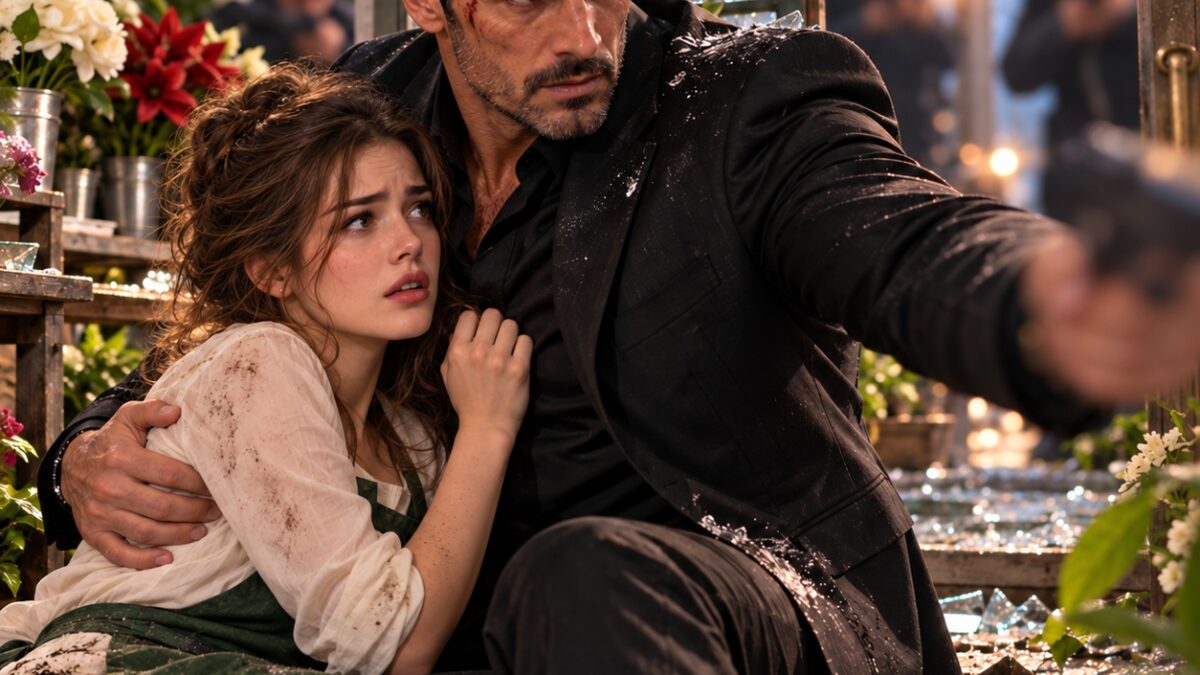
Then glass shattered above us.
I heard the first gunshot before I understood the sound.
My body dropped.
Terracotta pots.
Wet soil.
Glass falling around me.
Somebody shouted outside.
Rosa disappeared behind a stone planter.
Lucian came through the greenhouse door with two men.
Another shot cracked overhead.
He grabbed me around the waist.
Pulled me behind cover.
“Six hours.”
His mouth was close to my ear.
“What?”
“That was what they had left.”
“Six hours?”
“They moved early.”
Boots hit gravel outside.
Closer.
Lucian spoke into an earpiece.
Commands.
Short.
Calm.
The panic around him seemed to organize itself.
I was shaking so badly my teeth almost clicked.
He angled his body between me and the doorway.
“Stay down.”
“I am down.”
“Stay behind me.”
“I do not plan to volunteer as a target.”
Another burst broke glass.
Stone chipped beside my shoulder.
I pressed closer to the planter.
Then something clicked in my head.
The man at the gate.
The one I had seen during the briefcase exchange.
Half a face.
Jawline.
Movement.
There was a voice outside.
Orders.
And someone moving past the shattered panes.
I saw him.
Just enough.
Favoring his left leg.
“Lucian.”
“Not now.”
“The man outside.”
“What?”
“One of them limps.”
Lucian looked at me.
“Left leg.”
His expression sharpened.
“That night at the gate.”
“You’re sure?”
“I arrange flowers.”
He stared.
“What?”
“I notice things other people walk past.”
I pointed.
“That’s him.”
Lucian immediately relayed the description.
Something shifted outside.
His people redirected.
Within moments, the chaotic shooting became controlled.
Then stopped.
The man with the limp was caught before he reached the east side of the house.
Anton was there.
Waiting to escape in the confusion.
He never made it.
Lucian’s men found him near the tree line.
Burner phone.
Three months of messages.
Routes.
Shipments.
Weak points.
Everything sold.
For money Lucian later called insulting.
They brought Anton into the main hall.
My hair had glass in it.
Dirt covered my sleeves.
A small cut burned along my forearm.
Lucian stood facing the man he had trusted for fifteen years.
The same hall where I had once arranged four hundred white roses.
Anton’s records were spread across the table beneath them.
Rosa stood near the fireplace.
Arms folded.
Her expression was colder than Lucian’s.
“I made that man soup.”
Nobody knew what to do with that sentence.
I nearly laughed.
Not because anything was funny.
Because shock does strange things.
Anton finally spoke.
“You were always going to choose the empire.”
Lucian watched him.
“I got tired of pretending you cared about the men keeping it alive.”
No response.
“You chose business over people every time.”
Lucian’s voice, when it came, was quiet.
“I chose people many times.”
He looked at Anton.
“You were one of them once.”
Anton’s face tightened.
“That is what makes this worse.”
Nobody said anything after that.
There was nothing worth saying.
Anton was led away.
Through the same side doorway where, weeks before, somebody had called me easy to overlook.
Sokol’s operation began collapsing within days.
Without Anton feeding information, routes changed.
Evidence surfaced.
People who had been loyal only while they thought Sokol was winning started talking.
I never learned every detail.
I did not ask.
That world remained Lucian’s.
I did not want ownership of it.
What mattered to me happened after everybody left.
I stood near the ruined greenhouse wrapped in a blanket.
Cold air entered through the broken glass.
The orchids were destroyed in places.
Terracotta everywhere.
One of Rosa’s little orange trees had lost half its branches.
Lucian approached.
No security voice.
No controlled expression.
Just exhaustion.
“You could have run.”
I looked at him.
“Any sane person would have.”
“I already told you.”
“What?”
“I’m not much of a runner.”
A weak laugh escaped him.
“Apparently not.”
He reached for my hand.
Slowly.
Carefully.
Like he expected me to pull away after seeing his world at its worst.
I did not.
“For the record,” I said, “I identified the accomplice by his limp.”
Lucian’s mouth twitched.
“That should count professionally.”
“I will mention it at the next family meeting.”
“I would prefer a raise.”
“Done.”
“I don’t actually want a raise.”
His almost-smile faded.
I looked at the wreckage.
“I don’t want any of this.”
Lucian went still.
“The money.”
“The men who straighten when I walk by because they think I belong to you.”
“The protection that becomes permission to decide things for me.”
I turned toward him.
“I don’t want to become somebody else just to fit into your life.”
“You won’t.”
His answer came immediately.
“That is what I keep trying to tell you.”
“Lucian.”
“You never had to become anything.”
His fingers tightened around mine.
“You already are the first person I look for.”
That sentence hit differently after the bullets.
The fourteen-year-old girl inside me was still standing against the gym wall.
Still watching everybody else get asked.
For the first time, I felt her finally step away.
Not because Lucian had chosen me.
That mattered.
Of course it mattered.
But because I understood something I had never understood at fourteen.
Being overlooked by people incapable of seeing you does not make you invisible.
It only means they were looking for the wrong things.
“I need honesty.”
Lucian nodded.
“All of it.”
“Yes.”
“Even when it makes me angry.”
“Yes.”
“Especially then.”
He looked toward the shattered greenhouse.
“I spent fifteen years building a life where nobody got close enough to ask me for that.”
He faced me.
“You walked in here carrying roses and dismantled most of it in six weeks.”
“That sounds efficient.”
“It is deeply inconvenient.”
I smiled.
“So what now?”
“I cannot promise I will never make the wrong decision.”
“Good.”
“I can promise I will stop making decisions for you without asking.”
“That is a start.”
He lifted my hand.
Kissed my knuckles.
Not possession.
Not a contract.
A promise he was still learning how to keep.
Ordinary months followed.
Ordinary became a luxury.
Willow and Bloom had its busiest winter in years.
Marta finally increased prices after six years of threatening to.
Nobody vandalized the storefront.
Nobody followed me home.
Word had apparently spread that bothering the florist was a poor career move.
Priya began calling me the shop’s “organized-crime liaison.”
“Customer has a complaint.”
“Handle it.”
“Why me?”
“You have connections.”
“I arrange centerpieces.”
“You identified a criminal by his gait.”
“That is not on my résumé.”
“It should be.”
The greenhouse was rebuilt.
Rosa sent me a Christmas card.
A photograph showed new glass shining in winter sunlight.
Orchids healthy.
The orange tree recovering.
Her note:
THE ORCHIDS MISS YOU MORE THAN HE WILL ADMIT. COME VISIT.
Marta never asked what had happened.
Not directly.
She quietly stopped scheduling me alone at closing.
She also kept white roses in stock more often.
Neither of us discussed it.
My mother found out about Lucian accidentally.
Of course she did.
Mothers always discover the one thing you are deliberately not explaining.
We were on a video call.
I was in my kitchen.
Lucian had come over for dinner.
Halfway through my mother describing a neighbor’s gallbladder surgery in detail nobody had requested, Lucian walked behind me.
Opened the refrigerator.
Bent.
Kissed the top of my head.
Then kept walking.
My mother stopped speaking.
Completely.
I froze.
Her eyes widened.
“Who was that?”
“Nobody.”
“Adeline Marie Mercer.”
“Mom.”
“A man just kissed you.”
“He kissed my head.”
“That is still a man.”
“Could be very friendly behavior.”
“WHO IS HE?”
I spent ten minutes explaining Lucian using the most useless vocabulary available.
Businessman.
Private.
Older.
Widowed.
Complicated.
My mother listened.
Then smiled with the satisfaction of a woman who had personally ordered fate and finally received shipping confirmation.
“I told you.”
“Please don’t.”
“I told you a miracle would happen.”
“This is not a miracle.”
“I want him at Thanksgiving.”
“Mom.”
“Is he Italian?”
“Why does that matter?”
“I need to know what to cook.”
Lucian, who had absolutely been listening from the next room, said:
“Anything.”
My mother gasped.
“You’re still there!”
He came back into frame.
“Mrs. Mercer.”
I watched my mother transform instantly.
“Lucian.”
He looked alarmed.
That delighted me.
The man who could run a criminal organization with terrifying calm was apparently defenseless against my mother.
“Do you like sweet potatoes?”
Lucian looked at me for help.
I refused.
“Yes, ma’am.”
“Good.”
Thanksgiving was settled.
Priya was worse.
The moment she realized my mysterious flower customer had become something real, she took complete credit.
“I called it.”
“You told me to wear running shoes.”
“Exactly.”
“That is not calling romance.”
“I said something was going to happen.”
“You implied murder.”
“Still counts.”
For weeks she reminded customers.
One woman buying anniversary roses looked confused while Priya said:
“Day one. I knew.”
“You knew nothing.”
“I knew he had a big house.”
“So did everybody.”
“I sensed chemistry.”
“You had never met him.”
“I am intuitive.”
She made me laugh.
I found I was laughing more.
Not performing happiness.
Actually forgetting to guard it.
That was probably the biggest change.
Lucian came to Willow and Bloom sometimes.
The first few visits were disasters.
Customers recognized him.
Some went quiet.
One man left without his change.
Lucian hated that.
“I told you.”
I wrapped a bouquet in brown paper.
“Told me what?”
“People behave differently.”
“Then keep coming until they get bored.”
He looked at me.
“You want me here.”
“Yes.”
That answer still surprised him.
He tried helping.
That went poorly.
I gave him twelve roses and asked him to strip the lower leaves.
He somehow removed half the useful foliage.
I stared at the stems.
“What did these flowers do to you?”
“You said remove the leaves.”
“The lower leaves.”
“They were all lower than something.”
“Give me the knife.”
He handed it over.
“You are banned from preparation.”
“I oversee shipping worth millions.”
“And still cannot clean roses.”
He looked offended.
Rosa would have been proud.
He was better at carrying boxes.
Quietly.
Without behaving like the task was beneath him.
That mattered to me more than the estate.
The suits.
The drivers.
Any of it.
One afternoon, a wedding order came in.
Peonies.
Roses.
Delphinium.
Bride named Emily.
Her mother spent forty-five minutes explaining that Emily had “always been particular.”
When they left, Lucian walked from the back carrying buckets.
“What does particular mean?”
“In this context?”
“Yes.”
“Someone else is paying.”
He nodded.
“I understand.”
“You absolutely do.”
We developed a normal life in fragments.
Not completely normal.
Lucian’s phone still rang at odd hours.
Men still visited the estate.
I did not ask questions I did not need answered.
He did not lie when I did ask.
That was our boundary.
Sometimes the truth was unpleasant.
We learned to live with unpleasant truth better than comforting omission.
He would say:
“There is a problem.”
I would ask:
“Do I need to know?”
Sometimes:
“No.”
Other times:
“Yes.”
If yes, he told me.
No disappearing security.
No watching me secretly.
If extra protection became necessary, he asked.
The first time he did, I almost laughed.
He stood in my apartment looking deeply uncomfortable.
“There is a man I would prefer to station outside tonight.”
“Prefer?”
“Yes.”
“Not already there?”
“No.”
I walked to the window.
Nobody.
I looked back.
“You’re learning.”
“It is excruciating.”
“Fine.”
“One man.”
“Two.”
I blinked.
“You’re negotiating upward?”
“Wisconsin winter.”
He looked serious.
“One watches while the other gets warm.”
That was annoyingly reasonable.
“Fine.”
He nodded.
“Thank you.”
That was love for us sometimes.
Not poetry.
Negotiated security shifts.
Lucian told me about his family slowly.
His father had built much of what Lucian later controlled.
Power came with rules.
Loyalty.
Silence.
Distance.
His mother had lived inside the house but rarely understood the dangers surrounding her.
His younger sister had grown up protected into helplessness.
Every decision made for her.
Where to live.
Who drove her.
Who she dated.
Lucian believed that was care.
Until me.
“You hated when she rebelled?” I asked one evening.
“Yes.”
“Why?”
“I thought she didn’t understand danger.”
“Did she?”
“Not all of it.”
“Because nobody told her?”
Lucian went silent.
“That sounds familiar.”
“I dislike your tone.”
“You like my tone.”
“Unfortunately.”
His sister had eventually moved away.
Built a quieter life.
Lucian admitted their relationship had been strained for years.
Months later, he called her.
Not because I told him to.
I was still proud.
People think love transforms somebody dramatically.
Usually it doesn’t.
It creates opportunities.
The person still has to choose what to do with them.
Lucian chose differently more often.
So did I.
For most of my life, I handled discomfort by making jokes.
If someone made a comment about my weight, I laughed first.
If a man overlooked me, I pretended not to notice.
If my mother worried I would be alone, I made a joke about owning cats.
Hope felt embarrassing.
Lucian made avoiding it harder.
One night we had dinner at his estate.
Nothing formal.
Soup Rosa made.
Bread.
Wine.
I was wearing jeans and an old green sweater.
My hair was barely pinned.
Lucian stared across the table.
“What?”
“Nothing.”
“You are staring.”
“I am looking.”
“Difference?”
“Yes.”
“Explain.”
“No.”
I threw a piece of bread at him.
It hit his shoulder.
He stared at it.
Then at me.
“You threw food at me.”
“Yes.”
“In my house.”
“Correct.”
“I have had men apologize for breathing too loudly in this room.”
“That sounds unhealthy.”
His mouth twitched.
“You’re smiling.”
“No.”
“You are.”
He looked down at his soup.
I sat there grinning.
Then something became quiet inside me.
That old question.
Why me?
It had never fully disappeared.
Confidence is not a switch.
You do not spend fifteen years believing yourself ordinary and wake up cured because one handsome man looks at you differently.
Some nights I still waited for Lucian to realize he had made a mistake.
One night I finally asked.
“Why?”
He looked up from a file.
“Why what?”
“Me.”
He closed the folder.
That made me nervous.
I tried to retreat.
“Never mind.”
“No.”
He came around the desk.
“Ask.”
So I did.
“You could have anyone.”
He frowned.
“That is not true.”
“You know what I mean.”
“I know what people assume.”
I wrapped my arms around myself.
“You live in a world full of women who look like…”
I waved vaguely.
“Like what?”
“Like they know photographers.”
Lucian waited.
“I arrange flowers.”
“Yes.”
“I live above a laundromat.”
“Yes.”
“I buy bras on sale.”
His eyebrow lifted.
“This conversation improved suddenly.”
“Lucian.”
He smiled.
Then became serious.
“You want an answer.”
“Yes.”
He thought.
Not because he didn’t have one.
Because he wanted the correct words.
“The first day you came into my house, everybody knew who I was.”
He leaned against the desk.
“The caterers.”
“The staff.”
“The guards.”
“The men who had come for dinner.”
“They watched me.”
He said.
“Every person adjusted.”
“Spoke differently.”
“Moved differently.”
“You didn’t.”
“I didn’t know.”
“I know.”
His eyes softened.
“You asked Rosa where she wanted the flowers.”
I remembered.
“She smiled.”
“Yes.”
“You saved bruised roses instead of throwing them away.”
“That is literally my job.”
“You laughed with a woman everybody else treated as staff.”
“I liked Rosa.”
“You noticed the young caterer after the glasses fell.”
“What about him?”
“You checked whether he cut his hand.”
I had forgotten.
Lucian had not.
“You were not trying to impress me.”
He stepped closer.
“You weren’t trying to impress anyone.”
“I watched you for an hour.”
My throat tightened.
“You say men do not notice you.”
His hand touched my arm.
“I could not stop.”
I looked down because suddenly looking at him was too much.
He lifted my chin.
“You’re not a consolation.”
“You’re not an exception I am making.”
His voice was low.
“You are the person I want.”
No qualification.
No brave for your size.
No despite.
No reassurance dressed as pity.
Just want.
It took me a while to learn how to accept sentences like that without defending myself from them.
Spring came slowly.
Snow melted.
Willow and Bloom filled with daffodils and tulips.
The city turned green again.
One Tuesday morning, I opened the shop at seven.
Priya arrived ten minutes late with two coffees.
Marta was already arguing with the cooler.
Normal.
Beautifully normal.
At exactly 8:15, the bell above the front door rang.
I looked up.
Lucian stood among buckets of spring flowers.
Black suit.
No tie.
Completely out of place.
Holding one white rose.
Just one.
I leaned on the counter.
“One?”
“One.”
“You used to order four hundred.”
“I was inefficient.”
“Finally admitting it.”
He approached.
The rose had no ribbon.
No expensive wrapping.
Just a clean stem.
“One is enough.”
“For what?”
He held it out.
“For the woman I always look for.”
Priya made a noise behind me.
Then converted it badly into a cough.
I took the rose.
Looked at the petals.
Then Lucian.
For almost thirty years, I had believed being noticed required something I did not possess.
More beauty.
Less body.
More polish.
A different kind of woman.
I thought there was a roster somewhere, and I had been left off it at fourteen.
But standing in Willow and Bloom with Lucian Moretti looking at me like the entire room began where I stood, something settled.
Not because a powerful man had chosen me.
That was not the lesson.
The lesson was that I had spent years measuring my worth with the eyes of people who never learned how to see.
Danny Whitfield in a gymnasium.
Random men in coffee shops.
Customers who spoke to Priya first even when I owned the answer.
My own mother’s worried questions.
My reflection.
I had taken all those tiny moments and built a verdict.
Invisible.
Lucian did not make me visible.
He made me question the verdict.
There is a difference.
I was already visible.
To Marta.
To Priya.
To Rosa.
To customers whose weddings I rescued.
To families who trusted me with funeral flowers.
To my mother, who loved me so aggressively she sometimes turned hope into interrogation.
I had always mattered.
Romantic attention was never the proof.
Lucian was simply the first man who made me understand that being truly seen was not about attracting every eye in the room.
It was about one person paying attention to what everyone else rushed past.
He knew my coffee.
My tired face.
My nervous jokes.
The way I moved bruised petals to the back rather than throwing away the whole bloom.
He knew I hated being managed.
He knew I would choose truth even if it frightened me.
He knew I asked questions.
He knew I would not run simply because running sounded sensible.
And I knew him too.
Not the Moretti name.
Not the estate.
Not the men with earpieces.
The man beneath all of it.
The boy who lost a fight to a cat.
The man who stood in rain because he did not know how to ask a florist to stay.
The leader who believed control was protection until I told him otherwise.
The man betrayed by somebody he loved like a brother.
The man who could face gunfire calmly but looked uncertain every time he asked me for something personal.
The greenhouse attack did not disappear from us.
For weeks, glass breaking made my heart race.
The first time somebody dropped a vase at Willow and Bloom, I crouched before I realized what I was doing.
Priya came around the counter.
Sat beside me on the floor.
Did not say anything.
That night I told Lucian.
He was silent.
Then asked:
“Do you want me there?”
There.
My apartment.
Not:
I’m coming.
Do you want me?
“Yes.”
He arrived thirty minutes later.
No security inside.
No advice.
He sat on my couch while I drank tea.
When I eventually fell asleep against him, he stayed.
We both had things to unlearn.
I had to stop treating needing somebody as weakness.
Lucian had to stop treating fear as permission.
We made mistakes.
Once, six months later, he withheld information about a business dispute because he thought it was too minor to concern me.
I found out through Rosa.
We fought.
Loudly.
“I did not lie.”
“You omitted.”
“There was no threat to you.”
“That is not the standard.”
“What is the standard?”
“Would I have wanted to know?”
He stared.
“That could include everything.”
“No.”
I stepped closer.
“It includes everything that changes the choices I’m making.”
That stopped him.
He apologized.
Not perfectly.
Lucian’s apologies sounded like legal settlements.
But he apologized.
Another time I picked a fight because one of his security men held a door for me twice.
Lucian listened.
Then finally said:
“Adeline.”
“What?”
“Diego holds doors for everyone.”
I paused.
“He opened one for Thomas this morning.”
“Oh.”
“Yes.”
“So I may have overreacted.”
“Possibly.”
“You’re enjoying this.”
“Immensely.”
I learned too.
Honesty worked both ways.
Not every act of care was control.
Not every offer was a cage.
Not every person helping me believed I was helpless.
That distinction mattered.
Willow and Bloom eventually expanded.
Not because Lucian bought it.
He offered once.
I said no.
He never offered again.
Marta brought me into the business as a partner.
The day she handed me the paperwork, I cried into a bucket of hydrangeas.
Priya took a photograph.
I threatened her.
She framed it.
The cooler finally died.
Completely.
I replaced it with financing from the shop’s own accounts.
When Lucian asked whether I wanted help, I said:
“No.”
He said:
“All right.”
Then:
“Can I help move the old one?”
That I allowed.
Watching one of the most feared men in Wisconsin wrestle a dead floral cooler through a back door with Marta shouting directions was one of the most satisfying afternoons of my life.
“Lift your side.”
“I am lifting.”
“No, you are making a face.”
“The machine is heavy.”
“You own shipping companies.”
“They use equipment.”
“So do we.”
“This is poor planning.”
“Stop complaining.”
Priya filmed everything.
Lucian eventually discovered.
He threatened to buy her phone.
She told him the cloud existed.
He looked genuinely betrayed by technology.
My mother adored him.
Of course she did.
Thanksgiving was unbearable.
She made too much food.
Lucian brought wine.
She made him sit beside her.
Within an hour she had asked:
Whether he slept enough.
Whether he intended to marry me.
Whether his cholesterol was acceptable.
Whether “business” meant anything she would see on television.
I nearly died.
Lucian answered every question except the third one.
My mother noticed.
“So the cholesterol is bad.”
“Mom.”
He looked at me.
Then smiled.
“A little.”
She pointed her fork.
“I knew it.”
Later, washing dishes, I apologized.
Lucian dried a plate.
“Why?”
“She interrogated you.”
“I have been interrogated before.”
“By my mother?”
“No.”
“Then it doesn’t count.”
He thought.
“She reminds me of Rosa.”
“That is horrifyingly accurate.”
He smiled.
Life kept becoming ordinary.
That was what surprised me.
I had assumed loving someone like Lucian meant living permanently inside danger.
Some danger existed.
I never romanticized that.
There were places he did not take me.
People I did not meet.
Conversations he had without me.
I chose those boundaries.
But most days were not bullets and betrayals.
Most days were grocery lists.
Coffee.
Flowers.
His coat on the back of my chair.
My shoes under the table at his house.
Rosa complaining he did not eat.
Priya sending me memes I refused to explain to him.
Lucian calling because he passed a field of wildflowers and wanted to know what they were.
“Goldenrod.”
“It looks like a weed.”
“It is a wildflower.”
“Those are not mutually exclusive.”
“Why did you call?”
A pause.
“I thought you would know.”
He looked for me.
In rooms.
In questions.
In the ordinary.
That became the real meaning of his sentence.
Not obsession.
Attention.
When something amused him, he wanted to tell me.
When he was angry, he wanted my opinion even when he knew I would disagree.
When Rosa tried a new recipe, he asked whether I was coming for dinner.
When he saw ugly flowers, he sent photographs with no caption because he knew I would complain.
I became the person he looked for.
He became one of mine.
Years later, if you asked Priya how our relationship started, she would claim she caused it.
“I told her to wear good boots.”
“That is not causation.”
“It is narrative foreshadowing.”
“You did not know what foreshadowing meant until last week.”
“I know it now.”
Rosa said it started with the white roses.
Marta said it started when Lucian requested me by name the second time.
Lucian insisted it started when I asked Rosa where she wanted the lilies.
I thought it started earlier.
At fourteen.
Standing beside that gymnasium wall.
Not because Lucian was somehow destined to correct what Danny Whitfield did.
That would give a fourteen-year-old boy far too much importance.
It started because that was the day I began writing a story about myself.
I am not the woman men notice.
I repeated it until it sounded like identity instead of injury.
Every missed glance became proof.
Every bouquet Priya received became evidence.
Every Sunday question from my mother became another reminder.
By twenty-nine, I was not sad.
I was certain.
Certainty can be more difficult to change than sadness.
Then Lucian contradicted me.
Not with a compliment.
Compliments are easy.
He contradicted me with behavior.
He noticed.
Again.
And again.
And again.
He remembered.
He listened.
He looked for me.
That consistency reached a place flattery never could.
One evening, years after the greenhouse, we were walking through the rebuilt structure.
Rosa had retired by then but still visited twice a week because retirement, according to her, was “an American conspiracy to make old people useless.”
The orchids were blooming.
Glass clean.
Orange trees taller.
Lucian stopped near the stone planter where we had hidden.
“You remember?”
“Unfortunately.”
“I do too.”
I looked at him.
“You still hate this room?”
“I never hated it.”
“You replaced every piece of glass.”
“It was broken.”
“You almost had the entire building torn down.”
“It was unsafe.”
“Rosa threatened you.”
“Yes.”
“What did she say?”
“That if I destroyed her orchids because I was frightened, she would haunt me before she was dead.”
“That sounds like Rosa.”
We stood quietly.
Then Lucian said:
“I was wrong that night.”
“About?”
“When I told you to stay behind me.”
I looked at him.
“I wanted you nowhere near the danger.”
“Reasonable.”
“I wanted to control every variable.”
“Less reasonable.”
He nodded.
“You were the variable I could not control.”
“That must have been terrible.”
“It was.”
I smiled.
He took my hand.
“But you noticed the limp.”
“I did.”
“You changed the outcome.”
“I did.”
“You saved people.”
“We both did.”
He looked at me.
“That is the part I had to learn.”
“What?”
“That loving someone does not always mean standing in front of them.”
His thumb moved over my knuckles.
“Sometimes it means standing beside them and trusting that they know how to move.”
I leaned my head against his shoulder.
“That sounded almost emotionally healthy.”
“Do not tell anyone.”
“Your reputation would collapse.”
“Exactly.”
I still arranged flowers.
Even after becoming part-owner.
Even when we could have hired more staff.
I liked the work.
There was something honest about making beauty from individual things that looked incomplete alone.
One rose.
One branch.
One imperfect stem.
Sometimes the bruised bloom belonged at the back.
Sometimes it needed one damaged petal removed.
Sometimes it was the thing that gave an arrangement character.
I thought about that often.
The first day I entered Lucian’s house, I saved a few bruised roses instead of throwing away the stems.
I had no idea he was watching.
Years later, he remembered.
“Why did that matter to you?” I asked.
He answered immediately.
“Because everybody in my world throws away damaged things.”
I went quiet.
“People too.”
“Yes.”
He touched one rose.
“You didn’t.”
Maybe that was why we understood each other.
I had spent years believing I was the bloom people overlooked.
Lucian had spent years believing damaged things were dangerous to keep.
We were both wrong.
Not all damage destroys value.
Some damage simply becomes part of the shape.
Anton’s betrayal stayed with Lucian.
He never pretended otherwise.
Fifteen years does not vanish because a burner phone proves what happened.
There were photographs of them younger.
Weddings.
Funerals.
Business openings.
Lucian did not destroy them.
One day I found him looking at an old photo.
Anton beside him.
Both laughing.
He started to put it away.
“You don’t have to hide that.”
“He betrayed me.”
“I know.”
“I should hate this.”
“The photograph?”
“The man in it.”
I sat beside him.
“You can hate what he did and still miss who you thought he was.”
Lucian looked at me.
That was the difference between restoration and erasure.
I knew it from flowers too.
You cannot undo what happened.
You decide what still deserves to be carried.
He kept the photograph.
Not on display.
In a drawer.
That felt honest.
I never became comfortable with every piece of Lucian’s world.
I did not try.
Love is not agreement.
Sometimes I told him I hated something.
He listened.
Sometimes nothing changed.
That was hard.
There were lines we negotiated.
There were lines I refused to cross.
I never handled his business.
Never passed messages.
Never accepted money tied to it.
Willow and Bloom stayed separate.
My apartment stayed mine for years.
Eventually I spent more nights at his estate than at home.
But I kept my key.
Kept paying rent until I decided, myself, to move.
When that day came, Lucian did not send movers without asking.
He stood in my apartment holding a box labeled KITCHEN.
“Where does this go?”
“Your house.”
“Our house.”
I looked at him.
He corrected himself.
“The house.”
I smiled.
“Learning.”
“Slowly.”
I carried my own box downstairs.
Because sometimes symbolism matters.
My old apartment was small.
The estate was huge.
The first month I lived there, I kept losing things.
Shoes.
Phone chargers.
Hair ties.
Lucian had staff who could find anything.
I refused to ask for help out of principle.
That lasted two weeks.
Then I lost my good pruning shears.
I was furious.
Rosa listened to me rant.
Opened a drawer beside the greenhouse sink.
There they were.
“How did you know?”
“You leave things everywhere.”
“I do not.”
“You do.”
Lucian appeared in the doorway.
“She does.”
“You are both against me.”
“Yes.”
Home.
That word changed too.
I used to think home was simply the place where nobody could reject you because you were alone.
That is a sad definition.
I learned another.
Home can be the place where someone knows exactly how much cream goes in your coffee and never once asks whether you should use less.
Where your body is not a project.
Where your questions are not inconvenience.
Where being frightened does not cancel your courage.
Where the person with the most power still understands that your no means no.
Where you can disagree and still stay.
My mother stopped asking whether I had met someone.
Instead she asked:
“How is Lucian?”
Then immediately:
“Is he eating?”
Apparently every woman in his life eventually became Rosa.
At Willow and Bloom, Priya kept receiving flowers from men.
Some relationships lasted.
Some did not.
One afternoon, a bouquet arrived for me.
Huge.
Red roses.
Peonies.
Orchids.
Expensive.
No signature.
Priya squealed.
“Lucian.”
I looked at it.
“No.”
“What do you mean?”
“He wouldn’t send this.”
“How do you know?”
“He knows I hate red roses with white orchids.”
“That seems arbitrary.”
“It looks like a casino lobby.”
The customer who sent it had apparently meant it as thanks after I rescued a corporate event.
Priya stared.
“Your boyfriend has ruined random romantic gestures for you.”
“No.”
“He just knows my taste.”
That night, Lucian arrived with one bunch of grocery-store daffodils.
I laughed.
“Where did you get those?”
“Gas station.”
“You bought gas-station flowers for a florist.”
“They looked cheerful.”
“They are half dead.”
“I assumed you could save them.”
I stared at him.
Then kissed him.
He understood me.
Not professionally.
Personally.
That beat money every time.
I eventually told him about Danny Whitfield.
The dance.
The dress.
The row of girls.
I had never told anyone.
Not Priya.
Not my mother.
Lucian listened without interrupting.
When I finished, he looked almost offended.
“He skipped you.”
“He was fourteen.”
“I was also stupid at fourteen.”
“That is not an excuse.”
I laughed.
“Do not locate Danny Whitfield.”
“I did not suggest that.”
“You thought it.”
“I wondered what he does now.”
“No.”
“What if he needs flowers?”
“Lucian.”
“Fine.”
Then he became serious.
“You believed that because one boy did not see you?”
“Not because of one boy.”
I looked down.
“He was just the first moment I remember.”
Lucian’s voice softened.
“I wish I could tell that girl something.”
“What?”
He took my hand.
“That being unseen by one room does not mean she disappears.”
My eyes burned.
“She wouldn’t believe you.”
“No.”
I smiled.
“She’d think you were somebody’s father.”
Lucian looked personally wounded.
“That was unnecessary.”
“You’re older.”
“Not that old.”
I laughed until the sadness loosened.
He had a gift for that.
Not making pain disappear.
Giving it another place to sit.
Eventually, the story of the greenhouse became one of those things people around us stopped mentioning.
Security procedures changed.
Anton was gone.
Sokol’s organization never recovered its Wisconsin ambitions.
I did not ask what happened to Victor Sokol personally.
The answer did not belong to me.
That was intentional.
I refused to turn Lucian’s world into entertainment.
People who romanticize power usually do so from a safe distance.
I had seen the greenhouse glass fall.
Seen Rosa on the ground.
Seen what betrayal did to Lucian’s face.
There was nothing glamorous about it.
Danger is mostly noise, fear, cleanup, and people trying afterward to pretend they are fine.
The part worth remembering was not the gunfire.
It was what came after.
Lucian asking instead of deciding.
Me staying because I chose to.
Rosa rebuilding orchids.
Marta changing my shifts.
Priya sweeping a floor that was already clean because she did not know how else to help.
My mother demanding Thanksgiving.
Ordinary people putting the world back together.
That was the real story.
One Tuesday in early spring, years after the first one, I opened Willow and Bloom before eight.
Fresh tulips stood in buckets.
Cooler humming properly for once.
Priya was late.
Marta had retired and left most of the business to me.
I stood behind the counter trimming white roses.
The bell rang at exactly 8:15.
I looked up.
Lucian.
Gray appearing at his temples now.
Dark suit.
Stillness.
Same eyes.
One white rose.
I smiled.
“You know we sell those here.”
“I am aware.”
“You overpaid somewhere else?”
“Yes.”
“Terrible financial judgment.”
“I have survived.”
He crossed the shop.
I took the rose.
“Why one?”
“You asked this before.”
“I like consistency.”
“One is enough.”
“For?”
He looked at me.
That same careful attention.
Years later, still there.
“For the first person I look for.”
The fourteen-year-old girl against the gym wall was gone by then.
Not erased.
Integrated.
Part of me.
A memory instead of a prophecy.
I no longer needed that sentence to prove anything.
That was how I knew I had healed.
I simply loved hearing it.
So I reached across the counter.
Hooked one finger into his lapel.
Pulled him close.
“Good answer.”
He kissed me.
Behind us, Priya walked through the door.
“Oh, come on.”
I laughed against Lucian’s mouth.
“It’s eight fifteen.”
“I haven’t even had coffee.”
Lucian stepped back.
“Good morning, Priya.”
“You’ve been ruining my mornings for years.”
“You seem resilient.”
“I am.”
She threw her bag under the counter.
Then pointed at his rose.
“Did you buy flowers from somebody else again?”
Lucian looked at me.
I folded my arms.
“Answer carefully.”
“I prefer not to incriminate myself.”
Priya laughed.
I looked around Willow and Bloom.
My shop now.
My life.
Flowers everywhere.
Everything ordinary.
Everything earned.
There had been a time when I believed my life’s safest shape was small.
Work.
Apartment.
Sunday calls.
No expectations.
I was not miserable.
That mattered.
You do not need romance to make a life real.
I had built something before Lucian.
A job I loved.
Friendship.
Independence.
A home.
He did not rescue me from emptiness.
He found me in a life that was already mine.
What changed was that I stopped assuming wanting more was foolish.
Hope did not make me weak.
Being loved did not erase my independence.
And being noticed by one man did not finally grant me value.
Lucian’s greatest gift was not seeing something nobody else could see.
It was paying attention long enough for me to realize I had always been worth seeing.
There is a difference.
When I told him I was not the kind of woman men noticed, I expected him to reassure me.
Maybe flatter me.
Instead, he said:
“You’re the first person I look for.”
That sentence stayed because he proved it afterward.
Not once.
Repeatedly.
When I entered a room.
When something made him laugh.
When something frightened him.
When he needed truth.
When he needed somebody to tell him he was being controlling.
When the greenhouse shattered.
When betrayal stood in front of him.
When spring returned.
He looked for me.
And I looked for him too.
Not because he was Lucian Moretti.
Not because men feared him.
Not because he had an estate or security or an empire.
I looked for the man who lost a fight to a cat.
Who bought unnecessary tulips because he could not ask for company.
Who remembered my coffee.
Who learned, slowly and imperfectly, that protecting me did not mean deciding for me.
Who could command half a room with one glance but still sometimes stood awkwardly in Willow and Bloom holding a single rose.
That was the man I loved.
I spent most of my life thinking being overlooked meant there was something missing in me.
There wasn’t.
The right people had always seen me.
Priya.
Marta.
My mother.
Customers who trusted my hands with the important days of their lives.
I just had not counted those kinds of seeing because somewhere along the way I decided only romantic attention qualified.
I know better now.
Visibility is not popularity.
Beauty is not consensus.
Love is not being chosen from a lineup.
It is being known.
Fully.
Honestly.
Without being reduced.
Lucian learned that too.
He had spent years surrounded by people who noticed every movement he made.
Men watched his face for approval.
Enemies watched for weakness.
Employees watched for orders.
Everybody saw Lucian Moretti.
Almost nobody knew Lucian.
There are many ways to be invisible.
His was simply more expensive than mine.
Maybe that was why we found each other.
A florist everybody looked past.
A man everybody looked at for the wrong reasons.
We met somewhere in the middle.
Among roses.
Rain.
Coffee.
Orchids.
Fear.
Questions.
And eventually truth.
If you had told me at twenty-nine that the most frightening man in Wisconsin would teach me anything about being seen, I would have laughed.
If you told me I would teach him that love without choice was only another form of control, I would have laughed harder.
But life rarely arrives in the shape you expect.
Sometimes it drives through your shop disguised as an absurd order for four hundred roses.
Sometimes it stands twenty feet away pretending not to watch you work.
Sometimes it orders flowers it does not need.
Sometimes it waits beneath a greenhouse roof while rain falls and finally says what both people are afraid to admit.
Years after all of it, I still kept one white rose from that spring morning.
I dried it.
Not because I needed evidence that Lucian loved me.
I had enough of that.
I kept it because it reminded me of the difference between the girl I was and the woman I became.
At fourteen, I stood against a wall waiting for somebody else to prove I belonged in the room.
At twenty-nine, I told myself I no longer cared whether anyone looked.
By thirty, I understood both versions of me had been waiting for the wrong thing.
I did not need permission to exist.
I did not need to earn visibility.
I did not need to become thinner, louder, prettier, quieter, more polished, or less complicated.
I was already there.
All Lucian did was look directly at me long enough that I finally stopped looking away from myself.
And once I understood that, I never stood against the wall waiting to be chosen again.








