FULL ENDING: The Hospital Fired Me for Refusing to Ignore One Altered Chart, and Before I Reached the Exit Everything They Buried Started Moving
PART 2 and FULL ENDING  Thank you

I did not decide to go back.
That is the easiest way I can explain it.
There was no dramatic internal debate.
No moment where I weighed my career against some higher calling.
A six-year-old boy was bleeding in the pediatric bay, and the nurse beside him had pressure on the wrong location.
So I moved.
I pulled the curtain aside.
His mother was crying.
His father looked like he had forgotten how to breathe.
The boy’s skin was turning the wrong shade.
I repositioned the nurse’s hands.
“Here. Hold pressure here.”
She stared at me.
“Olivia, I thought—”
“Later.”
I looked at the mother.
“I need you to keep your hand exactly where mine is. Do not move it until someone tells you.”
She nodded frantically.
I called for a specific instrument kit.
Nobody moved.
I repeated the name and catalog number.
Someone ran.
Then another gurney entered.
Then another.
And another.
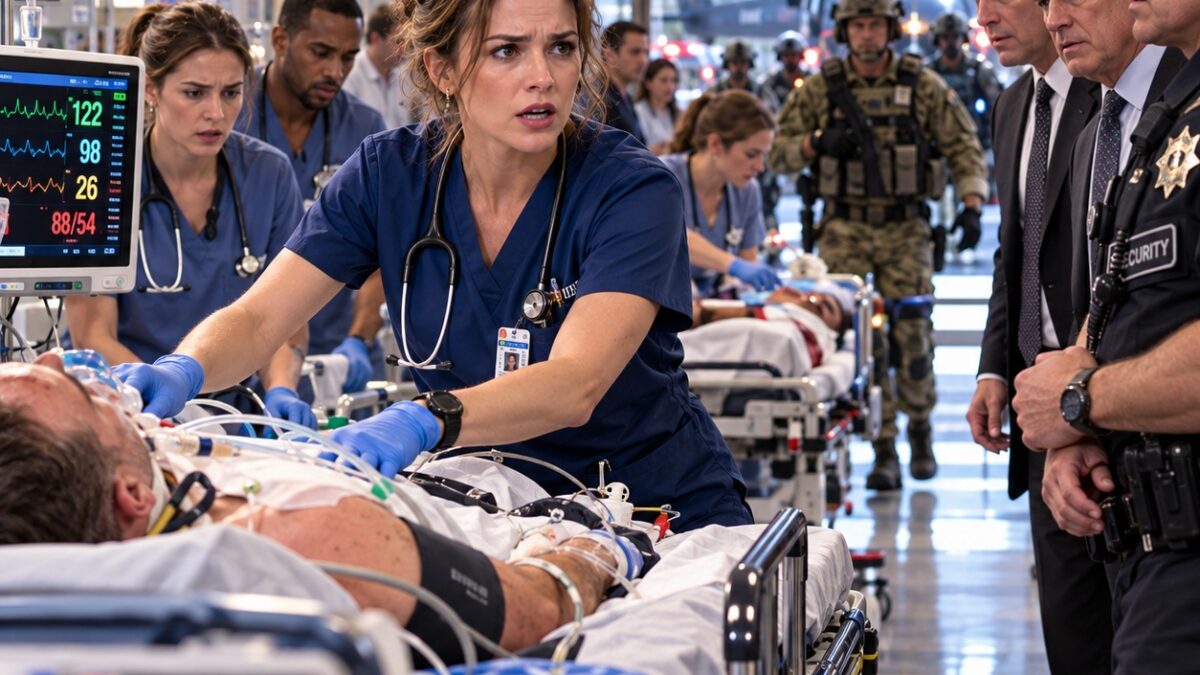
The emergency department was already ninety percent full before the alarm.
Within minutes, it became something different.
Not controlled chaos.
Just chaos.
There is a point during a large emergency when everybody is working and nobody is actually leading.
That is more dangerous than people realize.
Good nurses move.
Doctors make decisions.
Techs fetch equipment.
But if the priorities are wrong, competence only helps you make the wrong thing happen faster.
I moved toward the ambulance entrance.
Four patients needed immediate assessment.
Two were loud.
Two were quiet.
I went to the quiet ones first.
A young resident stared at me.
“You were just fired.”
“Then I’m fired and triaging.”
He looked stunned.
I pointed.
“Those four are critical. Those two are stable enough to wait. If you disagree, tell me which critical patient you want to put down.”
His face went pale.
He looked at the patients.
Then back at me.
“The four.”
“Good.”
We moved.
For the next forty minutes, I stopped thinking about Stonebridge.
About Holt.
Greer.
Poe.
My badge sitting on an executive desk upstairs.
I thought in categories.
Airway.
Breathing.
Circulation.
Neurological status.
Hemorrhage.
Time.
An older man arrived with a crushed chest and essentially no blood pressure.
I called what needed to happen before the attending finished looking at the monitor.
“You don’t have authority to order that,” he said.
“I just did.”
He stared at me.
“Get the tray.”
Something in my voice made him get the tray.
More ambulances arrived.
A woman in cardiac arrest.
A teenager with a penetrating wound that looked terrible but was temporarily stable.
A middle-aged man who was barely complaining and whose abdomen told me he was in much more danger than the teenager.
That was something people who had only worked in controlled clinical environments sometimes missed.
Noise does not equal severity.
In certain environments, the quiet casualty kills you.
I had learned that a long time before Stonebridge.
In places I did not put on résumés.
The woman in cardiac arrest came back.
Then coded again.
Marcus was on her.
“Keep her talking if she stays awake,” I told him. “If she codes again, come get me before you restart compressions.”
He frowned.
“Why?”
“Because somebody is going to want to call it, and I want to see the rhythm first.”
Marcus looked at me for half a second.
Then nodded.
That was what I liked about him.
He asked questions when questions mattered.
He stopped asking when time mattered more.
The room gradually began moving with me instead of around me.
Not because I was special.
Because somebody had finally established sequence.
Who went first.
Where blood went.
Which bay opened.
Which surgical resident took which patient.
Which ambulance needed rerouting to Callaway Regional because Stonebridge physically could not absorb everything coming through the doors.
Then the building shook.
Every window rattled.
The lights flickered.
For half a second, I thought another structural event had hit nearby.
Then I heard rotors.
Deep.
Multiple aircraft.
Organized.
The radio crackled.
Military approach cleared for the rooftop pad.
One aircraft.
Then another.
Then more.
I continued working.
The patient in front of me mattered more.
But something old inside me recognized that sound.
Recognized the rhythm.
Recognized what coordinated arrival sounded like when people were not asking permission so much as informing others what was about to happen.
The double doors opened.
A man entered in tactical field gear.
No visible rank from where I stood.
He did not need one.
Some men carry command in the way they look at a room.
He was in his mid-forties.
Two operators came in behind him.
Both scanning without appearing to scan.
He stopped.
Looked across the emergency department.
Past Holt.
Past Poe.
Past the nurses’ station.
Then his eyes found me.
Three years disappeared.
“Heart.”
That was all he said.
Not Nurse Hart.
Not Ms. Hart.
Heart.
The old callsign.
I straightened.
“Commander.”
Every person within hearing distance looked at us.
Decker Maize walked toward me.
I had worked beside him before Stonebridge.
That is as much as I will say about where.
Some records remained classified then.
Some still do.
He had known me when emergency medicine was not practiced under fluorescent lights with legal departments upstairs.
He stopped three feet away.
I finished stabilizing my patient before looking at him fully.
“How bad?”
“Still developing. Second collapse confirmed. Possible gas involvement. More casualties inbound.”
“You have medics?”
“Two.”
“I want them.”
“Done.”
No question.
No institutional negotiation.
He touched his earpiece and gave the order.
That was when Warren Holt finally found his voice.
“She was terminated this evening.”
Decker turned slowly.
I almost felt sorry for Holt.
Almost.
“She’s not authorized to be in this department,” he continued. “Her access has been revoked. The hospital cannot accept liability for—”
Decker held up one hand.
Holt stopped.
“Say that again.”
Holt did.
More words this time.
Credentialing.
Authority.
Liability.
Employment status.
When he finished, Decker looked at me.
“What do you need?”
That was it.
I pointed toward the second trauma area.
“Open that bay. Pull every available unit of O-negative. I need your two medics integrated with our floor, not standing around waiting for federal instructions.”
He nodded.
The room moved.
Holt’s face went pale.
I did not enjoy that.
I did not have time.
The second wave of casualties arrived seventeen minutes later.
Nine patients in four minutes.
Three immediately critical.
Two needing surgery almost as soon as they cleared the ambulance doors.
Decker’s medics were excellent.
Combat trained.
Focused.
No wasted movement.
They fit into the ER as if they had been working there for months.
That told me a lot about Decker’s current unit.
Then Dr. Poe reappeared.
He walked toward a man I had already triaged for immediate surgery.
“Imaging first.”
“He’s bleeding internally.”
“We need confirmation.”
“He has no pressure and a rigid abdomen.”
“You are not authorized to make that call.”
I looked at him.
“If you want to send him to imaging, document that decision under your name.”
Poe’s face tightened.
The surgical resident beside him looked at the patient.
Then at me.
Then at Poe.
“She’s right about the presentation.”
Poe gave him a look that promised consequences later.
Then he looked at the patient again.
For once, reality beat hierarchy.
“Get blood running.”
I was already moving.
Two hours into the response, Stonebridge had received thirty-one patients.
We lost two.
Both arrived with essentially no viable signs.
Clinically, both calls were defensible.
That did not mean I stopped thinking about them.
People like easy categories.
Saved.
Lost.
Successful night.
Bad night.
Emergency medicine does not work that way.
There is only what happened and what might have happened under different conditions.
Our floor began settling around 9:45.
Not quiet.
An ER after a mass-casualty event does not become quiet.
It just stops feeling like every wall is about to fail at the same time.
I was washing my hands when Marcus appeared.
“You’ve eaten?”
“No.”
“That wasn’t really a question.”
“Then why did you ask?”
“There’s food in the break room.”
“Later.”
He leaned against the door.
“The military guy hasn’t stopped watching you.”
“I know.”
“Who is he?”
“Someone from before.”
“Before Stonebridge?”
“Yes.”
Marcus waited.
I dried my hands.
He understood he was not getting more.
“Whatever ‘before’ means,” he said, “you looked different when he walked in.”
“So did Holt.”
That made Marcus laugh once.
Then he stopped.
“What happens now?”
“I don’t know.”
That was true.
Decker was waiting near the nurses’ station.
“We need to talk.”
There was a small glass-walled consultation room off the corridor.
I went inside.
He followed.
He left the door open.
I noticed.
Old habits.
“How much do you know about Clifton Brewer?”
I folded my arms.
“Sixty-one. Admitted six weeks ago for COPD exacerbation. Diagnosis is real but incomplete. Lab values were altered. One medication documented as administered was still sealed. Hospital administration pressured me to stop documenting discrepancies.”
Decker studied me.
“Brewer is federal.”
“I assumed he was something.”
“You knew?”
“No.”
“He was embedded in a financial network we’ve been following for almost three years.”
“What kind?”
“Infrastructure fraud.”
“Healthcare?”
“Among other sectors.”
The phrase landed badly.
Brewer had once told me he worked in logistics.
I had told him I had worked in federal contracting.
We had both lied in exactly the same way.
By telling the truth sideways.
Decker continued.
“Brewer spent years in financial forensics. He was building a physical case. Paper records. Chain of custody. He knew digital evidence could be scrubbed.”
“When was he supposed to deliver it?”
“Eight weeks ago.”
“He’s been here six.”
“He got sick before the handoff.”
“Actually sick?”
“Yes. We’re not disputing the lung disease.”
“But after he entered Stonebridge, his treatment began going wrong.”
Decker nodded.
“Things that could look like routine medical mismanagement.”
I thought about the changed number.
The sealed medication bag.
Greer asking me to withdraw the report.
Holt firing me within days of the external complaint.
“That wasn’t about protecting Poe.”
“No.”
“Or avoiding liability.”
“No.”
They had moved too quickly.
Too precisely.
Institutions tolerate ego.
They tolerate mediocre medicine longer than anyone likes admitting.
They do not mobilize at executive level over one nurse documenting a chart error unless somebody is afraid of what the chart connects to.
“Where are Brewer’s records?”
“We don’t know.”
“He was conscious here for weeks.”
“That’s why we think he had time to secure them.”
“I need to see him.”
“He’s in ICU.”
“I know.”
Decker stepped aside.
I went upstairs.
The ICU charge nurse, Gail, stopped me immediately.
“You are not credentialed for this unit.”
She was not hostile.
She was correct.
“I know.”
“I can’t let you into room seven.”
“Call downstairs. Ask for Commander Maize.”
“Who?”
“The federal officer coordinating with administration.”
Gail stared at me.
Then made the call.
Whatever she heard changed her expression.
“Five minutes.”
“Thank you.”
Clifton Brewer was awake.
His ventilator had been removed temporarily, but his lungs were still working too hard.
He looked at me.
“They fired you.”
“Yes.”
“And you’re still here.”
“Apparently.”
I pulled the chair close.
“Mr. Brewer, I’m going to ask you something directly.”
“That seems consistent.”
“Hospital staff altered your chart.”
His face stayed neutral.
“I documented it. I reported it. A medication charted as administered was still sealed. Then administration terminated me. Tonight, federal personnel arrived asking about you.”
I leaned closer.
“What are they protecting?”
Brewer looked toward the ceiling.
Then back at me.
“You know what I used to do?”
“I know it wasn’t logistics.”
Something almost like a smile appeared.
“Financial forensics. Fifteen years.”
“Federal?”
“Contract work.”
Now I understood why his vagueness had sounded familiar.
He continued.
“You follow money long enough, eventually you find where people stop being careful.”
“How large?”
“Larger than one hospital.”
He took a breath.
“The network runs through healthcare facilities, billing processors, insurance channels. The fraud lives in the difference between what is billed and what is actually delivered.”
“Phantom procedures.”
“Yes.”
“Medication billed but not given.”
“Yes.”
“Monitoring documented but not done.”
“Yes.”
I felt something cold move through me.
“Patients harmed?”
Brewer looked at me.
“Sometimes patients died from what they didn’t receive.”
I sat back.
“How long?”
“I spent three years building the case.”
“And the evidence?”
“Physical. Verified. Redundant.”
“Where?”
Before he answered, the door opened.
A man from hospital administration entered carrying a tablet.
I had seen him on the fourth floor.
He stopped when he saw me.
“Patient consult,” I said.
“This unit is restricted.”
“I have clearance.”
“From whom?”
“The federal officer currently coordinating with administration.”
I watched his eyes.
A small reaction.
Not surprise.
Recalculation.
“I’ll need you to leave.”
“I’m leaving in two minutes.”
I turned back toward Brewer.
His face had changed.
Sharper.
Watching.
I lowered my voice.
“Anything else I should know before I go?”
His eyes moved.
Not toward the man.
Toward his left wrist.
Then back to me.
I understood enough not to react.
“Thank you, Mr. Brewer.”
I left.
In the stairwell, I stopped.
Left wrist.
Brewer had arrived wearing an old mechanical watch.
Silver case.
Manual stem.
The sort of object that looked strange beside a plastic hospital band.
I had noticed it because I noticed things.
Tonight, it was gone.
I went back to Gail.
“Brewer’s personal effects.”
“I can’t release patient property.”
“I’m not asking you to.”
I kept my voice quiet.
“Was a mechanical watch included in his intake inventory?”
Gail hesitated.
Then checked.
“Silver mechanical watch. Bedside lock drawer by patient request.”
My phone buzzed.
Unknown number.
THEY KNOW YOU TALKED TO HIM.
GET OUT OF ICU NOW.
I looked up.
Two men came through the far stairwell door.
Hospital clothing.
Wrong bodies inside it.
One had his hand near his jacket in a way I recognized before conscious thought caught up.
The world sharpened.
I turned to Gail.
“Lock the unit.”
“What?”
“Now. Call 911. Not internal security. Police.”
“Olivia—”
“Do it.”
I walked away.
Not running.
Running makes people look.
I took the stairwell up instead of down.
People usually flee toward exits.
I needed time to think.
Fourth floor.
Administrative corridor.
Carpet.
Dark offices.
Light beneath Greer’s door.
Voices.
I pressed myself against the wall.
A man I did not recognize was speaking.
“They don’t have anything.”
Greer answered.
“She talked to him five minutes.”
“That’s enough.”
“We searched the room.”
“Then where are the records?”
“We’re handling it.”
The other man’s voice hardened.
“You fired the nurse asking the right questions. Federal operators are downstairs. A 911 call came from ICU. That is not handling anything.”
Silence.
Then Greer:
“What do you want me to do?”
“Find out what she knows. Find out what she gave the military officer.”
My pulse slowed.
That happens sometimes when danger becomes clear.
Fear is worst when it is shapeless.
Now it had edges.
Footsteps approached the door.
I moved.
By the time it opened, I was already walking away.
I borrowed Marcus’s phone because I no longer trusted mine.
Decker answered on the second ring.
“Olivia.”
“Two men came into ICU. Not staff. One likely armed.”
“We have them.”
That stopped me.
“Already?”
“My people intercepted them at the entrance. Police are coming.”
“There’s more.”
I told him what I heard outside Greer’s office.
When I finished, he asked one question.
“How certain?”
“Certain enough to tell you.”
“Stay away from four.”
“Decker.”
“Yes?”
“The watch.”
Silence.
“Brewer’s mechanical watch is in his bedside drawer. He pointed me toward his left wrist.”
Another beat.
“Get there before they do.”
He disconnected.
I returned to the ER.
Marcus asked if I was in trouble.
“The hospital is in trouble.”
“That isn’t comforting.”
“No.”
“What do you need?”
“If administration asks where I am, you don’t know.”
“I don’t.”
“If anyone asks about Brewer’s watch—”
“What watch?”
I looked at him.
“Exactly.”
I started writing.
Not electronically.
Paper.
A complete timeline.
Brewer’s admission.
The first abnormal trend.
The altered laboratory value.
My meeting with Greer.
The missing medication.
Poe’s warning.
The external nursing-board complaint.
My termination.
The two men in ICU.
The conversation outside Greer’s office.
Times.
Witnesses.
What I knew.
What I inferred.
What I could prove.
People make a mistake when they think documentation is bureaucracy.
Good documentation is memory that survives pressure.
Decker returned while I was halfway through page three.
“We have the watch.”
“What was inside?”
“A micro-storage device hidden in the casing.”
“Data?”
“Encrypted.”
“But real.”
“Yes.”
I kept writing.
He pulled up a stool.
“You understand this is going to get ugly.”
“It already is.”
“Depositions. Hearings. Your employment history will be examined.”
“Let them examine it.”
“The gaps.”
“There are records available to people with the right clearance.”
“The reason you left your previous work.”
I stopped writing.
“It’s been three years.”
“You disappeared.”
“I needed to.”
Decker nodded.
He did not ask why.
That was one of the reasons I had trusted him once.
He understood silence was not always deception.
Sometimes it was survival.
“You were good tonight,” he said.
“I was trained.”
“That isn’t what I meant.”
I looked at him.
“Don’t.”
He nodded.
No argument.
Then he became operational again.
“The ICU men are in custody. Not talking. Federal attorneys are moving. Greer, Holt, and whoever met with Greer are still in the building.”
“Greer will run.”
Decker looked at me.
“Why?”
“Arrogant people stay when they think control is recoverable. Desperate people leave when they realize it isn’t.”
Twenty minutes later, he came back.
“Greer is gone.”
I did not feel satisfaction.
Only confirmation.
“He knew the encryption was broken.”
“That’s our assumption.”
“How long?”
“About twenty minutes ahead.”
“And Holt?”
“Still here.”
“Thinking about cooperation.”
Decker studied me.
“You really think so?”
“Yes. Holt is an administrator. Administrators believe in structures. If his structure is collapsing, he’ll look for the next structure that keeps him standing.”
Decker almost smiled.
His earpiece sounded.
He listened.
Then looked at me.
“Warrants cleared.”
“When?”
“Federal teams arrive in six minutes.”
I glanced across the emergency department.
Patients sleeping.
Nurses charting.
Monitors sounding.
Staff who had already worked through one disaster.
“You want me to keep clinical continuity.”
“Yes.”
“You realize I’m still fired.”
“I’ve noticed.”
I returned to bay three.
Terry, the woman who had coded twice, was awake.
“How are you feeling?” I asked.
“Like I died twice.”
“You did.”
“And came back?”
“Yes.”
“Is that good?”
“Usually.”
She studied me.
“You were the one giving orders.”
“I was helping.”
“No. I heard you.”
I adjusted her oxygen.
“You sounded like someone who had done that before.”
I said nothing.
“I worked for the district attorney’s office before I retired,” Terry said.
That got my attention.
“I know what federal warrant execution sounds like.”
Then we heard it.
Vehicle doors.
Multiple.
Organized movement.
Agents entered Stonebridge.
Two teams.
Fast.
Controlled.
The overhead speaker activated.
The voice did not belong to our hospital system.
Federal personnel instructed staff to remain in assigned clinical areas.
Nobody was to access administrative offices without authorization.
The investigation had become visible.
Holt cooperated before midnight.
No attorney at first.
He went directly to federal investigators and began producing documents.
Decker found me afterward.
“Holt is talking.”
“How much?”
“He says Greer managed Stonebridge’s operational relationship with the network. Holt admits signing records and knowing about billing irregularities.”
“So he’s positioning himself as downstream.”
“Aggressively.”
“Is he?”
“We’ll know after analysts finish the watch.”
The third man from Greer’s office was identified through access records and security systems.
His name meant nothing to me initially.
Later it meant a great deal.
Darren Sult.
Network operator.
The kind of person who did not need public visibility because his value came from coordinating other people.
Federal teams were already searching for him.
Greer was captured before dawn.
Sult was located near a south service area during the operation.
When agents moved toward him, he froze for one second.
I saw him make the calculation.
Then he raised his hands.
No shooting.
No dramatic chase.
Just a man whose risk assessment told him the game had ended.
That was appropriate.
People like Sult rarely believe in loyalty when prison enters the conversation.
By three in the morning, he was cooperating.
Decker forced me to sit down and eat something in the break room.
Agent Castillo came in with the preliminary numbers.
“Fourteen healthcare facilities across three states.”
I stopped chewing.
“How long?”
“Nine years of documented fraud so far.”
“How much?”
“Current estimate exceeds forty million.”
The numbers kept coming.
More than six hundred altered patient files.
Thirty-one documented adverse outcomes connected to treatment deviations.
Medication not given.
Procedures billed but not performed.
Monitoring skipped.
Eleven deaths.
I put the food down.
“Eleven?”
Castillo nodded.
“Not all can be directly attributed. Some can.”
“How many at Stonebridge?”
“Four significant adverse outcomes identified so far.”
“Deaths?”
“Two.”
The room became too quiet.
I thought about Brewer.
About a sealed medication bag.
About everybody who had told me I was making noise over nothing.
People had died.
Not because somebody forgot a checkbox.
Because fraud required the medical record to say something happened when it did not.
And somewhere between billing and bedside, a patient became a financial abstraction.
I looked at Castillo.
“What happens to Stonebridge?”
“For now? Federal monitor. Administrative restrictions. Clinical operations continue under emergency oversight.”
“And Brewer?”
“Still alive.”
That was all I cared about for several seconds.
Marcus found me near six in the morning.
“You need sleep.”
“I know.”
“Is it over?”
I thought about Greer in custody.
Holt talking.
Sult detained.
Fourteen facilities.
Forty million dollars.
Eleven patients.
“No.”
Marcus waited.
“But it started.”
He nodded.
That was why I liked him.
He understood the distinction.
Reporters were already outside.
My name had leaked.
I refused interviews.
The story was not me.
That mattered.
Then Castillo came to the break room.
“Brewer wants you.”
I stood immediately.
“He says the watch is not the full evidence.”
My stomach tightened.
“What is?”
“He’ll only tell you.”
Brewer looked worse in morning light.
Smaller.
Tired.
But he was off the ventilator and on nasal oxygen.
“You look terrible,” he said.
“I’ve been awake eighteen hours.”
“I’ve been awake three years.”
“Castillo says you have more evidence.”
“I do.”
“Why tell me?”
Brewer studied me.
“Because you saw a sealed bag.”
I said nothing.
“You saw it. Logged it. Got warned. Logged it again. Got fired.”
“So?”
“Everyone else involved now has a mission.”
“Decker.”
“Mission.”
“Castillo.”
“Mission.”
“Federal investigators.”
“Mission.”
He leaned slightly toward me.
“You acted before you knew there was a mission.”
I understood what he meant.
I did not like it.
“That doesn’t make me special.”
“It makes you reliable.”
“Where is it?”
He smiled faintly.
“Direct.”
“Always.”
The real source material was stored offsite.
A commercial storage facility on the south side.
Rented under another name.
The access instructions were sealed with his attorney.
But the second key had been inside his hospital room the entire time.
“Where?”
He looked toward a framed landscape photograph.
I opened the back.
A small brass key was taped behind the cardboard.
Brewer watched me hold it.
“The drives contain raw communications. Full financial architecture. Shell companies. Routing. Internal correspondence.”
“How far back?”
“Eleven years.”
“Names?”
“Thirty-one people in regulatory and oversight positions across five states.”
That number hit harder than the money.
The people who were supposed to catch the fraud had been paid to protect it.
“That will take years.”
“Yes.”
He did not sound discouraged.
“The cases that matter usually do.”
I gave the key to Castillo.
Within minutes, another federal team was moving.
Then I borrowed Marcus’s car.
Drove six blocks home.
And slept for seven hours.
The following weeks unfolded in layers.
Every time I thought I understood the size of the case, another layer opened beneath it.
The storage unit contained four external drives and two binders of physical records.
The federal analysts described Brewer’s evidence as one of the most carefully constructed packages they had seen in a healthcare fraud investigation.
Brewer had built it as if he expected not to survive long enough to explain it.
Redundancy.
Sourcing.
Originals.
Copies.
Chain of custody.
The investigation spread beyond Stonebridge.
Meridian Claims Management, a central billing processor, was raided six days later.
Their internal records confirmed the patterns on Brewer’s drives.
Warren Holt was charged with healthcare fraud, obstruction, and conspiracy.
His cooperation did not save him.
It only gave him something to bargain with at sentencing.
He resigned.
Nolan Greer faced the same charges plus evidence tampering connected to patient records.
He did not cooperate.
His attorneys attacked jurisdiction.
Procedure.
Chain of custody.
Anything except the facts.
A state medical board official named Aldis Van was arrested outside his home after Brewer’s documents showed payments tied to regulatory protection.
The list kept expanding.
Of thirty-one oversight figures identified, twenty-four eventually faced either criminal prosecution, professional sanctions, or both.
Eleven medical licenses were revoked.
Seven regulatory appointments ended.
That sounds satisfying when you say it quickly.
It did not feel satisfying.
Because eleven patients were still dead.
The hardest justice is the kind that arrives after the person who needed it is gone.
Families were contacted.
Civil suits began.
No amount of money could turn those phone calls into good news.
Stonebridge’s four adverse cases received independent review.
Two deaths were found to have clear treatment deviations serious enough to matter directly.
I read the panel report alone in my apartment.
I wrote the names down.
People I had never met.
People who came through Stonebridge before I did.
I sat with those names because I refused to let myself use the phrase before my time as permission not to feel anything.
Six weeks after the mass-casualty night, I gave my deposition.
Brewer had warned me about the room.
He was right.
Expensive attorneys are very good at making simple facts look debatable.
They spent forty minutes on my employment history.
“Why are there gaps?”
“Classified service.”
“What agency?”
“I am not authorized to answer that.”
“How convenient.”
“My service record is available to appropriately cleared reviewers.”
They spent twenty minutes on Decker.
“When did you first contact Commander Maize about Stonebridge?”
“I didn’t.”
“You expect us to believe his arrival was unrelated to you?”
“Yes.”
“You had a prior relationship.”
“Professional.”
“Of what nature?”
“Restricted.”
“Again, convenient.”
“No. Accurate.”
Then they spent an hour going line by line through my reports.
Date.
Time.
Language.
Why I wrote one phrase instead of another.
Whether concern meant suspicion.
Whether inconsistency meant accusation.
They were looking for variation.
They found none.
Because I had documented every incident knowing somebody might eventually try to pretend I had not seen what I saw.
Afterward, Castillo found me in the hallway.
“You did well.”
“I answered questions.”
“That is doing well.”
Then her expression changed.
“For what it’s worth, your reports probably saved Brewer’s life.”
I looked at her.
“How?”
“The people interfering with his treatment knew you were documenting discrepancies. Once your complaints existed, they had to be careful.”
“That didn’t prevent the harm.”
“No.”
She did not insult me with false reassurance.
“But it may have prevented worse harm.”
That mattered.
Not enough.
But it mattered.
Eight weeks after the night Stonebridge fired me, I was asked to attend a small federal ceremony.
I nearly declined.
Decker called.
“I kept it small.”
“How small?”
“Twelve people.”
“That is not small.”
“For government, it’s intimate.”
I went.
There was no ballroom.
No press.
Just a conference room.
Decker presented a formal commendation recognizing parts of my previous classified service that could legally be acknowledged and what I had done at Stonebridge.
He stood in front of those twelve people and said:
“What Olivia Hart did at Stonebridge was not required of her. She had been terminated. She had every legal and personal justification to walk through those doors and not return.”
I looked at the floor.
“She returned anyway.”
My throat tightened.
“The fact that this did not appear to be a meaningful choice for her tells you more about her character than anything I can add.”
He handed me the commendation.
I hated that everyone was looking at me.
“Thank you.”
Nobody moved.
Apparently they expected more.
I sighed.
“I want to be clear about something.”
Decker’s mouth almost smiled.
“I didn’t do what I did because I’m noble.”
A few people shifted.
“I did it because I couldn’t not do it.”
That sounded awkward.
It was true.
“The people who operate systems like the one Brewer uncovered depend on reasonable people finding reasonable reasons not to act.”
The room became still.
“Protect your job.”
I looked at the commendation in my hands.
“Protect your reputation. Respect hierarchy. Assume somebody senior must know something you don’t.”
I thought about Poe.
Greer.
Holt.
Darra looking away while security escorted me through the ER.
“Those reasons are usually rational. Sometimes they are even responsible.”
I paused.
“But the altered lab still exists. The sealed medication bag still exists. The patient nobody checked for forty minutes still exists.”
Decker watched me.
“Those facts carry a cost whether you act on them or not.”
I looked around the room.
“The only question is who pays it.”
Nobody spoke.
“I did not want another patient to pay because I was afraid of what acting might cost me.”
I set the commendation against my side.
“That is not heroism.”
Decker said quietly, “It might be close enough.”
Stonebridge Medical Center reopened under interim leadership two weeks after the investigation began.
Federal monitoring.
Independent patient-safety board.
New administrative controls.
A woman named Hara Solano became interim director.
She had spent twenty years in healthcare regulation and sounded permanently unimpressed by excuses.
She called me.
“I have read your employment file.”
“Which one?”
There was a pause.
“The hospital version and the complete version.”
“The hospital version had gaps.”
“I noticed.”
I almost smiled.
“I am not offering your old job back.”
“Good.”
That surprised her.
“Good?”
“That job existed inside a system that fired me for doing it correctly.”
Another pause.
“What I am offering is director of patient safety.”
“No.”
“You haven’t heard the role.”
“I’m not a director.”
“You ran an ER during a mass-casualty event after being fired.”
“That doesn’t make me administrative.”
“You filed seven reports correctly enough to trigger external review while your own administration was trying to bury them.”
“I’m difficult.”
“That is a recommendation in this context.”
She explained the role.
Clinical oversight.
Investigative authority.
Patient advocacy.
Direct reporting line to the federal monitor.
Bypassing hospital administration when necessary.
“Why me?”
“Because most patient-safety systems are designed by people who understand policy.”
She paused.
“I need someone who understands the moment policy stops working.”
I looked out my apartment window.
Bare trees.
Traffic.
People going to work.
“The Stonebridge adverse cases.”
“What about them?”
“I want every one reviewed independently.”
“Already required.”
“Not because federal government requires it.”
I continued.
“I want it written into the position. Original records. Full access. Public findings.”
Solano was quiet.
“I can do that.”
“I’m still not saying yes.”
“Take the meeting.”
It took two meetings.
The second lasted four hours.
By the end, the job barely resembled the first version.
That was when I accepted.
I started in December.
My office was smaller than Greer’s had been.
That pleased me.
I had no interest in offices that made people nervous before they entered.
One of the first changes I made was simple.
Any clinician who filed a patient-safety discrepancy automatically received an external tracking number.
No administrator could quietly make it disappear.
I made sure everybody knew.
Especially senior physicians.
Poe stayed at Stonebridge for a while.
People expected me to punish him.
I did not.
Poe had been dismissive.
Wrong.
Defensive.
But the evidence did not show that he had been part of the fraud network.
That distinction mattered.
Being arrogant is not the same thing as being criminal.
He came into my office during my second week.
“This is awkward.”
“Yes.”
He almost smiled.
“You could enjoy this more.”
“I could.”
He sat.
“I was wrong about Brewer.”
“Yes.”
“I was wrong about you.”
I waited.
He exhaled.
“I thought you were looking for conflict.”
“I was looking at numbers.”
“I know that now.”
He looked older than he had two months earlier.
“I should have listened.”
“Yes.”
That was all.
He nodded.
No dramatic forgiveness was required.
Sometimes accountability sounds like one person saying I should have listened and another refusing to make it easier.
Darra Sims approached me too.
In the hallway.
She looked uncomfortable.
“I should have said something when security walked you out.”
“You didn’t know everything.”
“I knew enough to know it was wrong.”
I let that sit.
“I’m sorry.”
“Thank you.”
That was enough.
Marcus was easier.
He continued bringing me coffee.
The first time he entered my new office, he looked around.
“You have an office.”
“Apparently.”
“This is unsettling.”
“For both of us.”
He put coffee on my desk.
“What do I call you now?”
“Olivia.”
“Director Hart?”
“Do that and I’ll transfer you to night inventory.”
He laughed.
Some things survived institutional collapse.
I was grateful for that.
Clifton Brewer was discharged in early December.
He had undergone surgery on his left lung.
It did not make him healthy.
It made him healthier than he had been.
He walked slowly with a cane and carried an oxygen concentrator he clearly hated.
I met him near the main entrance.
He looked back at Stonebridge.
“Done.”
“Not remotely.”
He sighed.
“Greer’s trial is fourteen months away. Van hasn’t even been scheduled. Civil litigation will run for years.”
“I mean the building part.”
I considered that.
“Yes.”
He adjusted his oxygen line.
“The rest has momentum now.”
“Testimony.”
“When they call.”
“You too.”
He nodded.
His car was waiting.
He started toward it.
Then stopped.
“Hart.”
“Yes?”
He did not turn around.
“You know why I trusted you?”
“You told me.”
“No.”
He looked back.
“I told you why I trusted you with the location.”
“What’s the difference?”
“I’m talking about before.”
I waited.
“When I first came into Stonebridge.”
“You didn’t know me.”
“I knew your type.”
“That sounds insulting.”
“It probably is.”
He smiled.
“You kept checking numbers nobody assigned you to check.”
“That annoyed people.”
“Yes.”
“You were one of them.”
“I was curious.”
“Why?”
He looked toward the hospital doors.
“Most people see what their role tells them to see.”
I thought about that.
“You didn’t.”
He walked away.
I stood there after the car left.
For fourteen months, Stonebridge had treated that tendency like a personality defect.
Then it became the thing that uncovered a problem affecting fourteen hospitals.
Life has an irritating sense of irony.
People often ask what changed most afterward.
They assume the answer is my career.
It was not.
Titles are useful for email signatures.
Authority is useful if you know what to do with it.
The biggest change was smaller.
I stopped believing competence automatically protects you.
Before Stonebridge, I had survived environments where competence was measurable.
You knew whether somebody could do the job because consequences were immediate.
Hospitals were different.
Institutions were different.
A person could be wrong for years if enough hierarchy stood behind them.
A system could produce paperwork proving care had happened even when the patient never received it.
People could die inside the distance between documentation and reality.
That frightened me more than anything classified from my old life.
Because the people doing it did not look like villains.
They wore badges.
White coats.
Business suits.
They sat on boards.
They used words like compliance and efficiency.
Some of them probably convinced themselves nobody was really being harmed.
That is how systems become dangerous.
Not when everybody inside is evil.
When enough people learn to look away.
Months later, I testified again.
Then again.
Stonebridge’s reforms expanded.
Brewer’s evidence held.
The network continued collapsing.
Not dramatically.
Methodically.
One subpoena.
One revoked license.
One indictment.
One audit.
One patient file at a time.
Some people wanted a satisfying ending.
Greer convicted instantly.
Families compensated fully.
Every corrupt person exposed.
That is not how institutional harm resolves.
It is slow.
Legal.
Incomplete.
There are always people who escape the worst consequences.
Always victims who receive money instead of what they actually lost.
Always administrators who say they had no idea.
Always doctors who insist the system failed them rather than admitting they helped the system fail patients.
I learned not to confuse process with justice.
But process matters.
Brewer understood that better than anyone.
He spent three years building evidence because outrage without evidence is temporary.
Evidence stays.
One evening, long after the reporters had stopped waiting outside Stonebridge, Decker visited my office.
No tactical equipment.
Civilian clothes.
He looked wrong without an earpiece.
“You look unemployed,” I told him.
“Nice to see you too.”
I gestured toward the chair.
He sat.
“What are you doing here?”
“Passing through.”
“That sounds suspiciously normal.”
“It feels unnatural.”
I smiled.
For a minute neither of us said anything.
Three years earlier, I had walked away from the world where Decker and I worked.
Not because of one event.
Not entirely.
People assume if you are good at something difficult, you should keep doing it.
They rarely ask what being good costs.
I had reached a point where every emergency felt familiar.
Every loss became another name added to a private list.
I could function perfectly.
That was the problem.
I did not like the person who could function perfectly through anything.
So I left.
Nursing was supposed to bring me closer to individual people again.
Stonebridge almost convinced me that ordinary medicine could be more morally complicated than anything I had left behind.
Decker looked around.
“Patient Safety Director.”
“Don’t say it like that.”
“Like what?”
“Like you’re amused.”
“I am.”
“You flew military aircraft onto my hospital roof.”
“It was not your hospital then.”
“Technically, I didn’t work there.”
“Exactly.”
I leaned back.
“Why were there so many aircraft?”
“Operational requirement.”
“Decker.”
“Some things are still classified.”
“You enjoy saying that.”
“It’s one of the few pleasures government provides.”
I laughed.
Then he became serious.
“You okay?”
The question was simple.
I respected him enough not to answer automatically.
“Some days.”
He nodded.
“The eleven?”
“Yes.”
“You didn’t create what happened.”
“I know.”
“That does not mean you stop carrying it.”
“I know that too.”
He looked at me.
“You always did understand the bad version of responsibility.”
“What does that mean?”
“The version where you take ownership of things because you were close enough to see them.”
“That is how patient safety works.”
“No.”
His voice was quiet.
“That is how guilt works.”
I looked away.
He let the silence stand.
Three years earlier, I would have hated him for saying it.
Now I understood what he meant.
Responsibility says: act when you can.
Guilt says: if anything went wrong near you, you should have prevented it.
Those are not the same thing.
I was still learning the difference.
“I don’t regret filing the reports,” I said.
“I know.”
“I don’t regret going back into the ER.”
“I know.”
“I regret that it took seven reports before anyone outside Stonebridge noticed.”
Decker nodded.
“That is why your new job exists.”
It was an annoyingly reasonable answer.
I hated reasonable answers.
They rarely feel as good as anger.
A year after Stonebridge fired me, I walked through the same emergency department during an evening shift.
Marcus was at the desk.
A new resident was arguing with a nurse about a medication discrepancy.
I stopped.
Not because the resident was wrong.
Because the nurse was hesitating.
“Show me.”
Both looked startled.
The nurse handed me the chart.
The problem turned out to be ordinary.
A timing error.
Nothing criminal.
Nobody died.
Nobody got arrested.
We corrected it.
Documented it.
Moved on.
That may sound anticlimactic.
It was one of the proudest moments of my career.
Because nobody asked the nurse to withdraw the report.
Nobody told her she was creating noise.
Nobody told her to stay in her lane.
The system did what it was supposed to do.
That is what reform looks like most days.
Boring.
Correct.
Almost invisible.
Later, Marcus found me near the coffee machine.
“You know you ruined your reputation.”
“I had a reputation?”
“You used to be mysterious.”
“I’m still mysterious.”
“You have a compliance badge.”
“Terrifying.”
“People know you now.”
I looked through the glass toward the ER.
That was true.
For fourteen months, people at Stonebridge had known a version of me.
Quiet nurse.
Cold.
Probably hiding something.
Strange employment history.
Difficult with authority.
Then, after the helicopters, they created another version.
Secret military operator.
Hero.
Whistleblower.
Woman who saved the ER.
I disliked that version almost as much.
People want categories because categories save time.
I had spent enough of my life being turned into one.
“I’m still just me.”
Marcus handed me coffee.
“That sounds disappointing.”
“It usually is.”
He laughed.
I looked down at my cup.
Then at the department around us.
The same walls.
Different structure.
Some of the same people.
Different rules.
Brewer once said most people can find a good reason to walk past something wrong.
He was right.
I do not judge them as easily as people might expect.
Fear is real.
Mortgages are real.
Careers are real.
Professional retaliation is real.
When somebody above you says the thing you saw did not happen, believing them can feel safer than believing your own eyes.
I understand that.
But there is a cost.
There is always a cost.
Sometimes you pay it.
Sometimes the patient does.
That is the part I can never forget.
The night Stonebridge fired me, I could have walked out.
Legally.
Emotionally.
Morally, some people would argue.
I had been humiliated.
Escorted.
Dismissed after doing exactly what policy claimed I was supposed to do.
No reasonable person would have blamed me for continuing through those doors.
Then the alarm sounded.
A child was bleeding.
And whatever Stonebridge thought of me stopped mattering.
People later called that heroic.
I still do not.
Heroism sounds like choosing something extraordinary.
I did what was in front of me.
That is less glamorous.
It is also more important.
Most institutional disasters are not prevented by dramatic people arriving at the final second.
They are prevented by somebody noticing a number that does not match.
A bag that is still sealed.
A patient who has waited forty minutes.
A signature that appears where it should not.
Then refusing to pretend they did not see it.
The helicopter is the interesting part of the story.
The altered lab value is the important part.
Decker’s arrival shocked Stonebridge.
Brewer’s watch helped expose the network.
Federal agents made arrests.
But none of that began the case.
The beginning was much smaller.
A number.
A discrepancy.
And one decision.
Document it.
That is why the first policy I wrote as Director of Patient Safety had nothing dramatic in it.
Three paragraphs.
If a staff member observes a patient-safety inconsistency, the observation is preserved.
It cannot be deleted by the department being questioned.
The person filing it cannot be disciplined for filing accurately.
Simple.
It should never have needed to be written.
But sometimes the most important rules are the ones institutions assume decent people will follow without being forced.
Decent people are not the problem.
Systems that make decency expensive are.
I still have the commendation Decker gave me.
It is in a drawer.
I do not display it.
Marcus says that proves something psychologically unhealthy.
I told him he watches too much television.
What I do keep visible is something else.
A photocopy of my first discrepancy report on Brewer.
The original is evidence.
The copy is framed behind my desk.
People occasionally ask why.
The report is ugly.
Plain hospital form.
No inspirational quote.
No photograph.
Just dates.
Numbers.
A note indicating that one value did not match another.
I keep it there because everything that happened afterward could make a person believe the story began with helicopters.
It did not.
It began when something looked wrong and I wrote it down.
Clifton Brewer survived.
Stonebridge survived too.
Those are not the same kind of survival.
Brewer walked out with damaged lungs and a cane.
Stonebridge reopened with its old leadership gone, federal oversight embedded, and a structure designed to make silence harder.
Both carried scars.
That is usually what survival actually means.
Not returning to what you were.
Continuing as something changed.
And me?
I never got the ordinary life I came to Stonebridge looking for.
Maybe ordinary was never really the goal.
Maybe I wanted a place where doing the right thing would not require becoming the person I used to be.
It took me a while to understand that no workplace can promise that.
No institution can promise it.
There will always be moments when policy fails.
When hierarchy protects itself.
When somebody asks you to accept an explanation your own eyes contradict.
In those moments, titles matter less than people think.
Nurse.
Doctor.
Commander.
Director.
None of them answer the important question.
What will you do with what you know?
I know my answer now.
I knew it the day Stonebridge fired me.
I just did not have words for it yet.
If I see the number change, I write it down.
If the medication is still sealed, I say so.
If somebody tells me silence is safer, I ask who that safety is protecting.
And if a patient needs me while someone is escorting me out the door?
They had better walk faster.
Because I already know which direction I’m going.








