HOA President Had My Disabled Veteran Neighbor’s Accessible Van Towed Overnight—Then the Sheriff Asked to See Her Board Vote.v
PART2
I walked Arthur back to his front door.
He hated that I did.
Not because he did not appreciate the company.
Because Arthur hated needing anything.
That was one of the first things I had learned about him.
If you carried groceries without asking, he would thank you, then make sure he carried something next time.
If you shoveled the little section near his ramp, he would be outside later brushing snow from somebody else’s windshield.
Independence mattered to him in a way people who had never lost it probably could not understand.
That morning, though, he looked smaller.
Not physically.
Defeated.
His chair stopped beside the kitchen table.
He put his phone down.
“I’ve got medication in that van.”
“What kind?”
“Nothing controlled. Backup medical supplies. Catheter supplies. Emergency bag.”
“We’ll get it back.”
He looked at me.
“You don’t know that.”
“No.”
I pulled out a chair.
“But we’re going to make a lot of phone calls.”
The tow company answered first.
A man named Carl picked up after three rings.
I put the call on speaker.
“Morning. I’m calling about a blue wheelchair-accessible van removed from Brookhaven Commons overnight.”
Keyboard clicking.
“Plate?”
Arthur gave it.
More clicking.
“Yeah. We have it.”
“Why was it towed?”
“HOA authorization.”
“Who authorized it?”
“Property representative.”
“Name?”
Pause.
“I can only discuss release details with the registered owner.”
Arthur spoke.
“I’m the owner.”
Carl’s tone changed immediately.
“All right, sir. We’ll need proof of ownership and the release fee.”
“How much?”
“Three hundred eighty-five dollars currently.”
Arthur closed his eyes.
“And I need to get there?”
“Yes, sir.”
“I’m in a wheelchair.”
Another pause.
“My accessible equipment is in the van you towed.”
The man stopped typing.
“That’s the vehicle with the side lift?”
“Yes.”
“Hold on.”
We waited.
When Carl came back, he sounded less confident.
“Sir, we were told it was an unauthorized modified vehicle.”
“By who?”
“I can’t get into the HOA side of it.”
“Can you bring it back?”
“Not without authorization or payment.”
I took the phone.
“If the tow was improper?”
“Then the property manager needs to contact us.”
We already knew how that conversation with Susan would go.
Arthur hung up.
He stared at his hands.
Then said quietly:
“I can pay it.”
I looked at him.
“That’s not the point.”
“I need the van.”
“I know.”
“My appointment is tomorrow.”
“I’ll drive you.”
“My chair won’t fit in your car.”
That stopped me.
Of course it would not.
Not safely.
His wheelchair was heavy.
Motorized.
My sedan might as well have been a bicycle.
“I’ll rent something.”
Arthur shook his head.
“No.”
“We can.”
“No.”
His voice sharpened.
“I don’t want this turning into everybody rearranging their life because Susan doesn’t like the way my van looks.”
There it was.
Not pride.
Dignity.
He wanted his own vehicle.
His own schedule.
His own life.
I understood.
“All right.”
I pulled my laptop onto the table.
“Then we fix the actual problem.”
We started with the HOA.
Arthur emailed every board member.
Subject:
URGENT – ACCESSIBLE VEHICLE TOWED WITHOUT NOTICE
He kept it simple.
His van was wheelchair accessible.
It was his only independent transportation.
He had received no warning.
No hearing.
No appeal.
Medical equipment remained inside.
He requested immediate authorization for its return.
I sent a separate email.
Photographs of Arthur’s space.
Van registration.
Accessible equipment.
Screenshot of Susan’s earlier message.
Then I printed copies.
Not because email was not enough.
Because I had started to understand Susan.
She liked pretending she had not received things.
Paper under doors was harder to ignore.
That afternoon I walked to each board member’s house.
Five homes.
Five envelopes.
One board member, Linda, answered.
She saw Arthur’s name and looked uncomfortable.
“I didn’t know about this.”
“You’re on the board.”
“I know.”
“Did you vote to tow his van?”
Her face changed.
“Vote?”
“Susan said the board approved it.”
Linda looked toward Susan’s house.
“We haven’t voted on towing anything recently.”
That sentence stayed with me.
“What about updated vehicle rules?”
“We discussed parking last month.”
“Disabled vans?”
“No.”
“Page twelve?”
“I don’t know what you’re talking about.”
I felt my pulse change.
“Do you have the updated handbook?”
“Updated?”
Exactly.
I thanked her.
Did not push.
Went home.
Arthur received one response.
From Susan.
Per HOA rules, the vehicle violated community appearance standards and was properly removed. Continued hostile contact with board leadership may be treated as harassment.
I read it twice.
“Hostile?”
Arthur gave a tired little laugh.
“I asked for my van.”
Susan had taken his only accessible vehicle.
Now asking for it back was harassment.
That evening I went door to door.
I wish I could say the neighborhood immediately rallied.
It did not.
Fear is rarely dramatic.
It sounds like:
“I’m so sorry.”
Then:
“But…”
One woman opened her door only six inches.
“I agree with you.”
“Then email the board.”
Her eyes widened.
“Susan already threatened us over the kids’ bikes.”
Another neighbor whispered:
“She fined us for putting our trash cans out the night before pickup.”
“Did you appeal?”
“We paid.”
“Why?”
“Because it was seventy-five dollars.”
There was that logic.
Cheaper to surrender than fight.
A young father across the courtyard said:
“I saw the tow truck.”
“What time?”
“Maybe two-thirty.”
“Why didn’t you say anything?”
“I thought Arthur knew.”
“Did Susan supervise?”
He hesitated.
“I saw her outside.”
“Will you put that in writing?”
His face changed immediately.
“I don’t want trouble.”
Arthur’s van disappeared at two-thirty in the morning.
Susan had been outside.
Clipboard president overseeing a midnight tow of a disabled veteran’s accessible vehicle.
But nobody wanted to be next.
I could understand fear.
I hated what it did.
By nine that night, I was at my kitchen table.
Laptop open.
HOA handbook on one side.
Coffee on the other.
Anger somewhere beyond useful.
So I read.
Every page.
I looked for:
Accessible vehicles.
Wheelchairs.
Modified vans.
Oversized vehicles.
Reasonable accommodation.
Towing.
Notice.
Appeal.
Nothing.
There was a standard restriction on abandoned vehicles.
One on commercial trucks.
One on recreational vehicles.
One section allowing towing for vehicles parked in fire lanes, blocking access, or creating safety hazards.
Arthur’s van qualified as none of those.
Then I searched the association’s online portal for the “updated handbook.”
Nothing.
Meeting minutes?
Parking discussion.
No vote adopting a ban on modified vehicles.
No tow authorization.
No Arthur.
Then I started looking beyond HOA rules.
I am not a lawyer.
I knew that.
The internet has created an entire generation of people who read three paragraphs and become constitutional scholars.
I did not want to be one of them.
So I looked for official sources.
State disability protections.
Accessible parking.
Housing discrimination.
Reasonable accommodation.
Federal Fair Housing guidance.
The wording varied.
The principle did not.
Housing providers and associations could not simply treat disability-related accommodation needs like cosmetic preferences.
Rules often required reasonable accommodation when needed for a disabled resident’s equal use and enjoyment of housing.
Our state also had protections around accessible parking and towing procedure.
Notice mattered.
Accommodation mattered.
Due process under the association’s own procedures mattered.
Susan had skipped everything.
No warning.
No hearing.
No appeal.
No accommodation discussion.
No board vote, apparently.
Just a phone call to a tow company in the middle of the night.
I called Arthur.
“Are you awake?”
“It’s ten-thirty.”
“You’re seventy.”
“I’m disabled, not dead.”
Fair.
“I found some things.”
“What kind?”
“The kind we need a real person to confirm.”
The next morning, we called the sheriff’s non-emergency line.
Not 911.
No sirens needed.
At least, we thought.
The deputy on the phone listened while Arthur explained.
His age.
His disability.
Van.
Lift.
Medical equipment.
No warning.
Susan’s email.
When Arthur finished, the deputy asked:
“Do you still have the message stating the vehicle was removed under HOA authority?”
“Yes.”
“Anything mentioning notice?”
“No.”
“Board approval?”
“Susan says the board approved.”
I interrupted.
“I spoke with a board member who says there was no vote.”
The deputy went quiet.
Then:
“Do you have that in writing?”
“Not yet.”
“Get it if you can.”
He asked for photographs.
Tow receipt.
Registration.
Medical accommodation documentation if Arthur was comfortable providing it.
Arthur said:
“I’ll send whatever you need.”
The deputy said:
“We’ll send someone tomorrow.”
I thought that meant one officer.
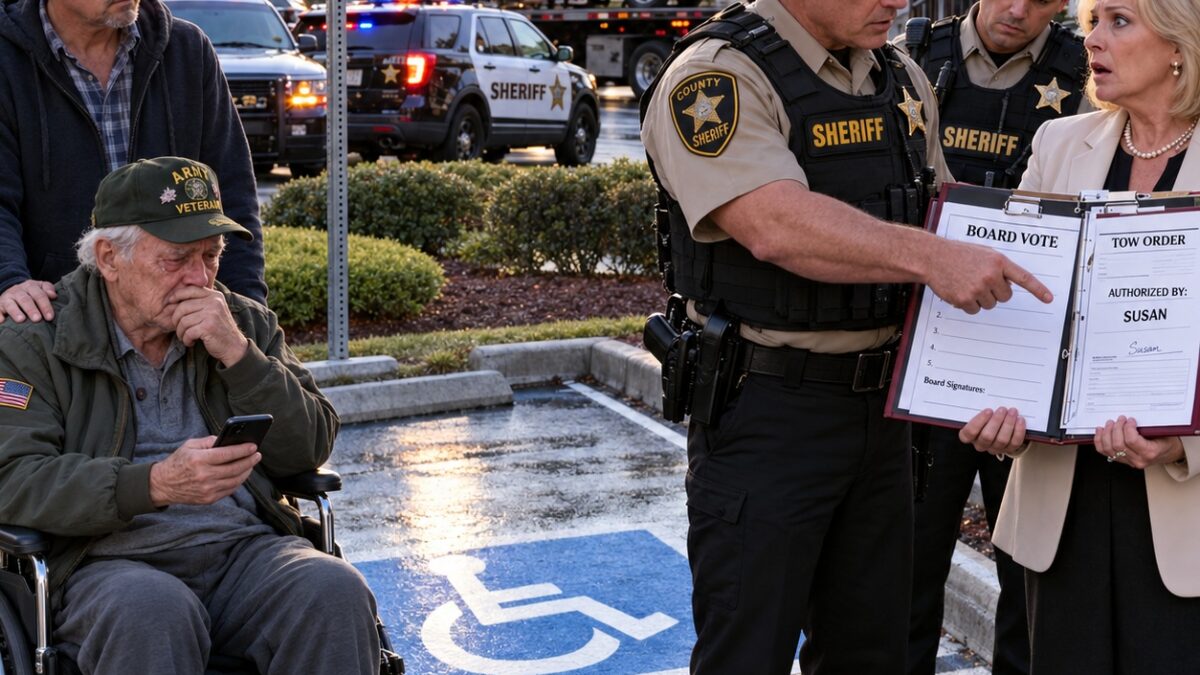
The next morning, two sheriff’s cruisers pulled into Brookhaven Commons.
Slowly.
No lights.
No sirens.
Still, every curtain on the street moved.
Arthur was beside me in his chair.
I had a folder.
Not a clipboard.
I was beginning to understand the difference.
Susan came out before the deputies reached us.
Bright red blazer.
Hair perfect.
Clipboard.
Of course.
She approached with a smile that did not reach her eyes.
“Officers. I’m Susan. HOA president.”
Neither deputy reacted to the title.
The older one introduced himself as Deputy Harris.
The second was Deputy Cole.
Harris looked at Arthur.
“Mr. Mitchell?”
Arthur nodded.
“Yes, sir.”
“We spoke yesterday.”
Then Harris turned toward Susan.
“Ma’am, we received a complaint regarding the removal of an accessible vehicle.”
Susan’s smile stayed in place.
“Yes. Unfortunately, Mr. Mitchell was violating updated community standards.”
Harris held out his hand.
“Can we see the documentation?”
Her smile moved slightly.
“What documentation?”
“Written warnings.”
Susan blinked.
“Board authorization.”
Her fingers tightened on the clipboard.
“Notice of tow.”
No answer.
“Accommodation policy.”
Susan’s voice cooled.
“This is private property.”
Harris nodded.
“It is.”
“Then the HOA has authority to enforce parking rules.”
“Within the law and your governing documents.”
“We did.”
“Good.”
He held out his hand again.
“Show me.”
Susan did not.
Instead she opened her clipboard.
Flipped several pages.
“This section restricts visually incompatible vehicles.”
I leaned toward Arthur.
The language on the page looked photocopied.
Harris read it.
“When was this adopted?”
“Recently.”
“Date?”
Susan paused.
“Last quarter.”
“Board vote?”
“Yes.”
“Minutes?”
“They’re maintained by the secretary.”
Harris nodded.
“We spoke with two board members this morning.”
That was the moment.
Susan’s eyes flicked toward him.
He continued.
“Neither recalls voting to tow Mr. Mitchell’s van.”
Susan’s smile vanished.
“They may not remember the specific enforcement action.”
Deputy Cole spoke for the first time.
“They say they didn’t vote on any new disabled-vehicle restriction either.”
Susan looked at him.
“It isn’t a disabled-vehicle restriction.”
Arthur said quietly:
“It sure seems to only be hurting one disabled person.”
Nobody answered.
Harris looked at the photocopied page.
“This language isn’t in the copy of the governing documents provided by the board secretary.”
Susan stiffened.
“She may have an older copy.”
“We asked.”
Silence.
Susan took a breath.
“This is being blown out of proportion. The vehicle is oversized. It has an exterior ramp system. Residents complained.”
“Who?”
“Complaints are confidential.”
Deputy Cole looked toward the empty space.
“Was it blocking anything?”
“No.”
“Fire lane?”
“No.”
“Expired registration?”
“No.”
“Abandoned?”
“No.”
“Commercial vehicle?”
“No.”
“Then what safety issue required removal?”
Susan raised her chin.
“Community appearance.”
Something changed in Harris’s expression.
Not anger.
Professional distance disappeared.
He looked at Arthur.
“Sir, your wheelchair and lift equipment are still in the vehicle?”
“Yes.”
“Medical supplies?”
“Yes.”
“Is it your only accessible vehicle?”
“Yes, sir.”
“Can you independently use a standard passenger car?”
“No.”
Harris turned back to Susan.
“Did you discuss accommodation before ordering the tow?”
“No accommodation was requested.”
Arthur stared.
“My van has been parked there for six years.”
“That doesn’t constitute a formal request.”
I said:
“You had it towed at two-thirty in the morning.”
Susan looked at me.
“No one asked you.”
Harris raised one hand.
“Let’s keep this calm.”
Then he asked Susan:
“What company has the vehicle?”
She did not answer.
“Ma’am?”
She gave him the name.
He nodded.
“Call them.”
Susan looked confused.
“Excuse me?”
“Call the tow company.”
“Why?”
“The vehicle needs to be returned while this is investigated.”
“You can’t order me to reverse lawful HOA enforcement.”
Harris held her gaze.
“Ma’am, at this point we have a disabled resident deprived of his only accessible vehicle, no documented warning, no documented hearing, disputed board authorization, disputed rule language, and medical equipment held at an impound lot.”
Susan opened her mouth.
He continued.
“You can cooperate now, or we document that you refused.”
The street had started filling.
Not crowded.
But people were outside.
Phones visible.
For the first time, Susan noticed.
She looked around.
The woman who had been afraid to email the board stood near her mailbox recording.
The father who saw the tow truck was outside too.
So was Linda.
The board member.
Susan looked back at Harris.
“The board approved this.”
Linda spoke from across the street.
“No, we didn’t.”
Susan turned so fast I thought she might drop the clipboard.
“Linda.”
Linda walked closer.
“I never voted on towing Arthur.”
“This was an administrative enforcement decision.”
“That’s not what you told him.”
Linda pointed at me.
“You told residents the board voted.”
Susan’s jaw tightened.
“This is not the place.”
Linda folded her arms.
“No. The place would have been a board meeting.”
There it was.
The neighborhood changed in real time.
Fear needs isolation.
Once one person speaks, somebody else often remembers how.
The father near the curb raised his phone.
“I saw Susan outside when the truck came.”
Susan snapped:
“Stop recording me.”
Deputy Cole said:
“He’s on a public/common area.”
Susan stared at him.
Then back at her phone.
She called the tow company.
Put it on speaker because Harris asked her to.
Carl answered.
Same man.
“Susan?”
“Yes.”
Her voice was tight.
“I need the blue van returned.”
Pause.
“The accessible one?”
“Yes.”
“There’s a release balance.”
Deputy Harris stepped closer.
“This is Deputy Harris with the county sheriff’s office.”
Long silence.
“Oh.”
“The vehicle is being returned pending investigation.”
“All right.”
“No storage fee to the owner.”
“We need somebody billed.”
Harris looked at Susan.
“Send whatever invoice exists to the party that authorized the tow.”
Carl said:
“Understood.”
Susan said:
“This is ridiculous.”
Harris ignored her.
“How soon?”
“About an hour.”
Arthur took a breath.
I did not realize how tightly he had been holding himself until that moment.
His shoulders dropped.
Only slightly.
He whispered:
“Thank you.”
Harris looked at him.
“We’re not done.”
Neither was the neighborhood.
For the next hour, people came outside.
Someone brought Arthur a soda.
Mrs. Chen from the corner brought coffee.
The young father pulled two folding chairs onto the sidewalk.
I said:
“This isn’t a parade.”
He replied:
“Feels like one.”
Arthur actually smiled.
Susan disappeared inside her house for twenty minutes.
When she returned, the blazer was still perfect.
The expression was not.
The tow truck arrived at 11:14.
Blue van on the flatbed.
I had never been so happy to see an ugly vehicle in my life.
Not that it was ugly.
It looked exactly like what it was.
A practical machine modified around a human need.
The driver backed toward Arthur’s space.
He climbed down.
Looked at Arthur.
“Sir, I’m sorry.”
Arthur shook his head.
“You were doing what you were told.”
The driver glanced toward Susan.
“Yeah.”
He lowered the bed.
Carefully.
The van rolled down.
When he unfolded the side ramp to make sure nothing had been damaged, he handled it more gently than Susan had handled Arthur’s entire life the previous forty-eight hours.
Arthur rolled forward.
Touched the side panel.
Not dramatic.
Just his palm against the blue paint.
Like confirming something had returned.
The crowd went quiet.
I watched his face.
Relief.
Anger.
Humiliation.
All mixed.
People sometimes underestimate what having something taken does.
It was not simply that Arthur could not drive.
His independence had been removed without his consent.
Returned property does not instantly erase that feeling.
Harris inspected the van with him.
Medical bag still there.
Chair-loading equipment intact.
Nothing obviously damaged.
Then he walked back to Susan.
“We need a written statement.”
“I’ve already explained.”
“We need it written.”
She crossed her arms.
“Am I under arrest?”
“No.”
That answer visibly relieved her.
Harris added:
“But we are documenting the incident for referral.”
“Referral to who?”
“Potentially the county housing office. Potentially other agencies depending on what counsel determines.”
Susan’s face tightened again.
“This is an HOA matter.”
“Not exclusively.”
She looked at Arthur.
Then at everyone recording.
“I was enforcing rules.”
Harris nodded.
“Then the paperwork should establish that.”
It did not.
That became clearer over the next week.
The county sent an accessibility compliance officer.
The HOA’s insurer asked questions.
A lot of questions.
The board’s attorney requested every communication related to Arthur’s van.
Susan produced emails.
No vote.
No hearing.
No notice.
No accommodation review.
Worse, the mysterious “updated handbook” page Susan had quoted turned out not to be part of any formally adopted handbook the residents had received.
There had been discussion about vehicle appearance.
Susan had converted discussion into enforcement language.
Then treated her own language as board policy.
Linda came to my house three days after the van returned.
“I feel awful.”
“For what?”
“I should’ve stopped her sooner.”
“You didn’t know.”
“I knew she was aggressive.”
“That’s different.”
Linda sat at my kitchen table.
She looked exhausted.
“She’s been making decisions on her own for months.”
“What kind?”
“Warning letters.”
“Fines?”
“Some.”
“Tow orders?”
“Not that I knew.”
“Why didn’t the board stop her?”
Linda looked down.
“Because Susan does everything.”
That answer again.
The person who volunteers for every unpleasant task eventually becomes difficult to challenge because everybody else is relieved not to do it.
“She reads every complaint.”
Linda continued.
“Talks to vendors. Drafts notices. Runs meetings. Calls attorneys.”
“So nobody checks her.”
“We should have.”
“Yes.”
Not cruel.
Just true.
The HOA announced an emergency meeting Friday evening.
Every resident received notice.
This time, nobody stayed behind blinds.
The clubhouse filled before the meeting started.
Arthur sat beside me.
His van was outside.
In its usual spot.
Visible from the windows.
That felt important.
Susan arrived last.
No clipboard.
I noticed immediately.
Just a folder.
She sat at the front beside the other board members.
The temporary chair, Linda, called the meeting to order.
Susan interrupted within two minutes.
“I think residents deserve context.”
Linda looked at her.
“You’ll have time.”
Susan folded her hands.
The HOA attorney summarized the issue.
Carefully.
No dramatic accusations.
An accessible vehicle belonging to a disabled resident had been towed without documented board approval.
No written pre-tow notice had been found.
No appeal opportunity had been provided.
No accommodation process had been initiated.
The vehicle rule cited by Susan had not been properly adopted in the form used.
The HOA faced potential legal exposure.
People whispered.
Then Arthur spoke.
He had not planned to.
I knew because he had told me:
“I don’t want to turn this into a show.”
But when Linda asked if he wanted to address the board, Arthur rolled forward.
The room quieted.
He did not give a speech about military service.
He did not demand revenge.
He looked directly at Susan.
“My chair was in that van.”
She looked down.
“My medical bag was in that van.”
Silence.
“I asked you how I was supposed to get to my doctor.”
Susan said quietly:
“I remember.”
“And you said it wasn’t your problem.”
No answer.
Arthur’s voice stayed steady.
“I’ve spent years making sure my disability is my responsibility.”
That line hit me harder than anything else.
“I pay for my equipment.”
He continued.
“I maintain my van. I schedule my transportation. I do what I can for myself because I don’t want my neighbors carrying me every time I need groceries.”
Several people looked down.
Arthur continued.
“You took the one thing that made that possible because you didn’t like how it looked.”
Susan finally raised her eyes.
“I was enforcing appearance standards.”
Arthur shook his head.
“No.”
Nothing angry.
Just no.
“You were enforcing yourself.”
The room stayed completely silent.
Arthur rolled back beside me.
I put a hand on his shoulder.
He whispered:
“I’m done.”
Good.
He had said enough.
Then residents started speaking.
The woman with kids’ bicycles.
Susan had threatened her with escalating fines because the bikes remained visible after sunset.
Mr. Evans.
Warning over a work truck.
Mrs. Chen.
Holiday decorations.
Another resident said Susan had sent a violation for a medical-delivery van temporarily parked outside his mother’s unit.
Small stories.
One after another.
Not all illegal.
Not all outrageous.
But together they showed a pattern.
Susan saw discretion as weakness.
Every issue needed enforcement.
Every disagreement became disrespect.
Every exception threatened control.
The board treasurer stood.
“We also need to address financial exposure.”
Susan turned.
“What financial exposure?”
“Tow fees.”
“The vehicle was returned.”
“Invoice remains.”
“Insurance will cover it.”
The treasurer shook her head.
“Our carrier is reviewing whether this was an authorized association action.”
That sentence landed.
If the insurer decided Susan acted outside her authority, the HOA might face costs it had not budgeted for.
Someone shouted from the back:
“Send her the bill.”
A few people laughed.
Linda raised a hand.
“Please.”
Then another resident called:
“What are you going to do, Susan? Tow our chairs?”
That broke the room.
Laughter.
Even Arthur smiled.
Susan did not.
She stood.
“This entire meeting has become a public humiliation.”
Linda answered:
“This meeting is about accountability.”
“I acted to protect property values.”
Arthur’s blue van was visible through the window behind her.
I wondered how many times property value had been used to justify treating people like problems.
Susan continued.
“If we allow exceptions whenever somebody has a personal circumstance—”
A man near the aisle interrupted:
“A wheelchair is not a personal aesthetic preference.”
Applause.
Susan raised her voice.
“I never said it was.”
“You called his van ugly.”
“I said it was visually incompatible.”
More laughter.
Wrong answer.
She realized it too late.
Linda called for the scheduled board motion.
Removal of Susan as HOA president.
The board voted.
She lost.
Immediately.
Not removed from her home.
Not arrested.
Not exiled.
She simply stopped being president.
The title that had shielded every sentence disappeared with one vote.
Susan stared at the table.
Then said:
“You’ll regret this.”
Linda answered:
“I hope we learn from it.”
That was better.
No victory speech.
No humiliation.
Just:
Learn.
The HOA appointed Linda interim president.
Then they voted on temporary policies.
No towing based solely on appearance until a full review.
No disability-related vehicle enforcement without consultation regarding reasonable accommodation.
Written notice required except immediate safety emergencies.
Appeal opportunity.
Board approval required for non-emergency towing.
Designated accessible spaces reviewed.
Existing residents invited to request accommodation without added HOA fees.
The attorney promised training.
Real training.
Not Susan reading a binder aloud.
The county review continued separately.
The sheriff’s report documented the facts.
The accessibility officer reviewed the property.
Arthur provided medical documentation only where necessary.
The tow company cooperated.
Susan’s messages mattered.
Especially the one stating the vehicle was “rightfully removed” because of appearance standards.
Written words are stubborn things.
They remain after confidence disappears.
The HOA insurer ultimately required corrective procedures before renewing certain coverage terms.
The association had to pay the tow-related costs.
According to what the board later disclosed, Susan also became personally responsible for part of the financial consequences connected to actions she had authorized without board approval.
I never asked for the exact breakdown.
Arthur did not either.
We did not care.
He had his van.
That was the point.
Several neighbors wanted Arthur to sue.
“You could get money.”
“You should make an example.”
“She deserves it.”
Arthur listened.
Then said:
“I want to go to my doctor without thinking about this woman.”
That was his answer.
I respected it.
He did file the complaints necessary to protect his rights and make sure the association changed its practices.
He worked with the county.
He documented his costs.
But he did not turn revenge into a second job.
One evening, about two weeks after the meeting, we sat outside his place.
Arthur had just returned from the grocery store.
Van ramp lowering behind him.
He rolled down.
Three bags hanging from the back of his chair.
I grabbed one.
He slapped my hand.
“I’ve got it.”
“You have three.”
“I’ve had three before.”
“Fine.”
He looked toward Susan’s house.
Curtains closed.
“You know what bothered me most?”
“The tow?”
“No.”
I waited.
“She looked at me like I was asking for special treatment.”
I nodded.
Arthur adjusted one grocery bag.
“I’ve spent most of my life trying not to ask for special treatment.”
“You were asking for access.”
“Exactly.”
He looked at the van.
“That thing doesn’t make my life easier than yours.”
He pointed at my legs.
“It makes my life possible in a way yours already is.”
I had no answer better than that.
So I said nothing.
Over the next month, Brookhaven Commons changed.
Slowly.
People who had been afraid started attending meetings.
Not all of them.
Enough.
The board published minutes.
Actual vote records.
Policies went online before enforcement.
Residents got notice of proposed rule changes.
Accessible-parking spaces were repainted.
Not symbolic.
Proper width.
Access aisles.
Signs.
The board consulted someone who actually understood disability accommodation instead of guessing.
Arthur was asked for input.
He agreed reluctantly.
“I don’t want to become the disability guy.”
“You already became the van guy.”
He glared at me.
“Not helping.”
But he participated.
He explained simple things people miss.
A parking space is not accessible because a blue sign exists.
The side aisle matters.
Ramp clearance matters.
Surface slope matters.
Snow removal matters.
Trash bins cannot block access routes.
Contractors cannot stack materials where a wheelchair needs to pass.
The new board listened.
One member asked:
“Why didn’t we know this before?”
Arthur shrugged.
“Because you never had to.”
That was not accusation.
Just truth.
People often do not see obstacles their own bodies move through without effort.
Susan still lived there.
That made the aftermath interesting.
No cinematic disappearance.
No moving truck the next morning.
She went to her mailbox.
Drove to the grocery store.
Walked past neighbors.
Lived inside the community she had once controlled.
Without a clipboard.
The first time I saw her pass Arthur’s van after the reforms, she looked at it.
Then away.
Arthur noticed too.
“She hates that thing.”
“No.”
He smiled slightly.
“She’s afraid of it now.”
Maybe.
But I thought it represented something else.
Evidence.
The van had become a visible reminder that the most vulnerable person in a dispute is not automatically the weakest.
Especially once documentation exists.
A few residents started helping Arthur voluntarily.
Not because he suddenly needed rescuing.
He hated that.
Small things.
Kids carried groceries when he had too many.
A teenager shoveled snow around the ramp before school.
Mrs. Chen brought over soup after one medical appointment.
Arthur returned favors in his own ways.
He fixed a kid’s laptop.
Helped Mr. Evans organize veterans-benefit paperwork.
Watched somebody’s dog for an afternoon.
Community did not mean treating Arthur like a charity case.
It meant remembering he was part of the exchange.
That was another thing Susan had misunderstood.
She treated accommodation as favoritism.
Real accommodation is often what makes equal participation possible.
The board learned.
So did some of us.
I did too.
Before all this, I had seen Arthur’s van every day.
Blue.
Large.
Ramp equipment visible.
I knew what it was.
But I had not really thought about what it meant.
Then the parking space was empty.
One empty space taught me more than years of seeing the vehicle there.
Absence has a way of explaining value.
Three months later, the board held its first accessibility training.
Attendance was mandatory for board members.
Residents could join.
I attended because I was curious.
Arthur refused initially.
Then showed up five minutes late.
I looked at him.
“What?”
“Nothing.”
“You’re smiling.”
“No.”
“You are.”
He parked his chair beside me.
“Shut up.”
The trainer talked about accommodation.
Housing obligations.
Interactive processes.
Documentation.
Parking.
Communication.
The difference between equal treatment and identical treatment.
That phrase stuck.
Identical treatment is not always equal treatment.
If everybody must use stairs, the rule is identical.
It is not equal for the person who cannot walk.
If everybody must park a standard sedan, the rule is identical.
It is not equal for somebody whose mobility requires a modified van.
Susan had used “rules are rules” as if sameness was automatically fairness.
It was not.
Afterward, Arthur said:
“They should have done this years ago.”
“Yes.”
“Would’ve saved me an impound fee.”
“You never paid it.”
“Would’ve saved somebody an impound fee.”
Fair.
The tow company changed its procedure too.
At least for our property.
Carl told Arthur they would no longer accept a disability-related removal request without additional written authorization from management and confirmation that notice requirements had been met.
Arthur laughed.
“I became policy.”
“Congratulations.”
“I don’t want to be policy.”
Nobody ever does.
Sometimes policy is written in the space where common sense failed.
The following winter, Susan tested the new system indirectly.
Not intentionally, maybe.
Snow fell overnight.
Heavy.
A maintenance contractor piled snow too close to Arthur’s access aisle.
His ramp could not lower fully.
Old Brookhaven?
Arthur would probably call Susan.
Susan would say maintenance had a schedule.
Maybe the problem would sit.
New Brookhaven?
Arthur emailed the board.
Linda replied in nine minutes.
Contractor returned within an hour.
Snow moved.
No argument.
No humiliation.
No emergency meeting.
That was reform.
Boring competence.
People rarely applaud it.
They should.
One afternoon in spring, I saw Susan standing near the mailboxes.
No clipboard.
She looked older somehow.
Not physically much different.
Smaller in the neighborhood.
Titles can change a person’s silhouette.
She saw me.
“Can we talk?”
I stopped.
“Sure.”
She glanced toward Arthur’s house.
“He hates me.”
I thought carefully.
“I don’t think he spends enough time thinking about you to hate you.”
That surprised her.
She looked down.
“I didn’t mean to trap him in his house.”
“But you knew what the van was.”
“Yes.”
“You knew he used a wheelchair.”
“Yes.”
“You knew it was his only accessible vehicle.”
“I didn’t know that.”
“He told you that morning.”
“After the tow.”
“Exactly.”
She crossed her arms.
Not defensive.
More like holding herself together.
“I thought if I made one exception, everybody would ask for one.”
“There it is.”
“What?”
“You keep calling it an exception.”
She looked at me.
I continued.
“Arthur doesn’t drive that van because he likes ramps.”
Silence.
“He needs it.”
“I understand that now.”
“Good.”
She looked toward the ground.
“The board made me pay part of the costs.”
“I heard.”
“My husband is furious.”
I did not know what she wanted from me.
Sympathy?
Permission?
Absolution?
I gave her facts.
“You made the decision.”
She nodded.
“Yes.”
For the first time since I had known Susan, she said that without adding but.
No defense.
No property values.
No handbook.
No board.
Just yes.
“I’m sorry,” she said.
“Tell Arthur.”
“I tried.”
“What happened?”
“He said thank you and closed the door.”
That sounded exactly like Arthur.
“What did you expect?”
“I don’t know.”
“Forgiveness on schedule?”
She almost smiled.
“No.”
“Then leave him alone.”
Susan nodded.
“I will.”
She did.
That mattered more than the apology.
Weeks later, I asked Arthur about it.
“Susan apologized?”
“Yes.”
“You accept?”
He shrugged.
“She said sorry.”
“That’s not what I asked.”
Arthur maneuvered his chair toward the van.
“I’m too old to carry grudges and groceries at the same time.”
I laughed.
“So yes?”
“So I don’t need revenge.”
Different answer.
Better one.
He opened the van ramp.
Then looked back.
“I also don’t want her running anything.”
“Reasonable.”
The next HOA election came.
Linda ran for president.
Won easily.
Her campaign was almost comically boring.
Transparent minutes.
Proper notice.
Reserve planning.
Accessibility.
Maintenance.
No surprise enforcement.
Nobody printed signs.
Nobody had slogans.
That was exactly what the neighborhood needed.
Susan did not run.
She sat near the back during the annual meeting.
When results were announced, she clapped.
Not enthusiastically.
Still.
Clapped.
Progress can be awkward.
Arthur remained Arthur.
Doctor appointments.
Grocery runs.
Veterans’ group twice a month.
Coffee every morning.
He started volunteering one afternoon a week helping younger disabled veterans navigate benefit paperwork.
I drove him once when the van needed routine maintenance.
He complained about my vehicle the entire trip.
“Your passenger seat is too low.”
“I know.”
“No handhold.”
“I know.”
“Suspension terrible.”
“Arthur.”
“This is why I have my van.”
Exactly.
When we picked it up, he looked relieved.
The mechanic had upgraded part of the ramp mechanism.
Arthur demonstrated it like a man showing off a sports car.
“Listen.”
Whirr.
Ramp lowered.
“Smooth.”
“Very.”
“Quieter.”
“Definitely.”
He looked proud.
That van was never an eyesore.
It was engineering.
Adaptation.
Independence.
It just took Susan’s mistake to force everyone else to see it.
The story spread beyond Brookhaven.
Not massively viral.
Enough.
Local disability advocates heard.
A county newsletter referenced the incident anonymously during an accessibility-awareness piece.
Other associations requested training.
Linda received calls from two nearby HOA boards asking for copies of our new towing policy.
I teased Arthur.
“Regional celebrity.”
He looked horrified.
“If anybody asks me to speak at a conference, I’m blaming you.”
“No conferences.”
“Good.”
One local reporter asked for an interview.
Arthur declined.
He said:
“I don’t want people remembering me as the old disabled guy whose van got towed.”
That sentence stayed with me.
Because stories flatten people.
Veteran.
Disabled.
Victim.
Hero.
Arthur was all and none of those labels.
He was also a man who swore at football games.
Burned toast regularly.
Loved terrible western movies.
Could fix electronics.
Hated mushrooms.
Called everybody under forty “kid.”
His disability shaped his life.
It did not replace his personality.
The van story mattered.
It did not deserve ownership over him.
So eventually we stopped telling it.
Mostly.
Brookhaven moved on.
That is healthy.
The policies remained.
That is also healthy.
Five years later, a new family moved into the row behind Arthur.
Their teenage daughter used a wheelchair.
Her mother came to an HOA meeting before move-in.
Nervous.
Asked about accessible parking.
Linda pulled out the policy.
Showed designated spaces.
Accommodation form.
Emergency contact.
No extra fees.
No drama.
The mother looked surprised.
“You already have all this?”
Linda glanced toward Arthur.
“We learned.”
Arthur rolled his eyes.
After the meeting, the girl introduced herself.
She was sixteen.
Fast chair.
Faster mouth.
She looked at his blue van.
“Old-school ramp.”
Arthur looked offended.
“This ramp works perfectly.”
“Slow.”
“It’s reliable.”
“My dad says that when his phone is ancient.”
I stood nearby trying not to laugh.
Arthur pointed at me.
“See what your generation is like?”
“She’s sixteen.”
“Exactly.”
Within months, he was helping her father compare hand-control systems.
That felt like the real legacy of the whole mess.
Not Susan’s embarrassment.
Not sheriffs.
Not phones recording.
A system improved enough that the next disabled resident did not have to fight the same battle.
That is what accountability should produce.
Less repetition.
Otherwise punishment is just theater.
Susan still lived in Brookhaven.
She aged.
So did everyone.
Eventually, she started volunteering with the landscaping committee.
Not chairing.
Volunteering.
She planted flowers near the clubhouse.
Nobody gave her towing authority.
Good arrangement.
One Saturday, I saw Arthur roll past while Susan was planting begonias.
She looked up.
“Morning, Arthur.”
He stopped.
“Morning.”
That was it.
No reconciliation movie.
No hug.
No dramatic forgiveness.
Just two neighbors capable of existing in the same place again.
Sometimes that is enough.
The blue van stayed in its spot.
Rain.
Snow.
Summer.
Always legal.
Always visible.
Nobody complained.
The paint faded.
Arthur eventually added a small veterans sticker near the rear window.
Then another sticker that said:
IF YOU CAN READ THIS, MY RAMP NEEDS SPACE.
The board liked it so much they ordered standardized ramp-clearance signs.
I told him:
“Now you’re writing policy again.”
He said:
“Shut up.”
Years passed.
Arthur’s mobility changed.
Not dramatically.
Age does what age does.
He needed more help loading groceries.
Accepted it reluctantly.
The van remained central.
Eventually he traded it for a newer accessible model.
Same blue.
I laughed when I saw it.
“You picked blue again.”
He looked offended.
“Blue isn’t the problem.”
“No.”
“Never was.”
That line felt like something bigger.
The old van was sold through an adaptive-vehicle dealer.
It went to another disabled driver.
Arthur watched it leave.
Quiet.
“You okay?”
“It got me through a lot.”
I knew he was not only talking about transportation.
The new van parked in the same space.
No special drama.
No HOA memo.
No Susan.
That ordinary arrival felt like a victory nobody needed to announce.
One morning, years after the original tow, I looked outside and saw Arthur lowering the ramp.
Two kids from the block stood nearby.
One held a grocery bag.
Arthur was telling them something.
Probably giving orders.
He saw me.
Raised one hand.
I waved.
Susan happened to be walking on the opposite sidewalk.
She passed the van.
Looked at it.
Then at Arthur.
She gave a small nod.
Arthur nodded back.
No clipboard.
No argument.
No fear.
That was the image I kept.
Because the day his first van disappeared, Arthur had looked frightened in a way I had never seen.
Not frightened of Susan personally.
Frightened of dependency.
Of having somebody else decide when he could leave his home.
When he could see his doctor.
When he could shop.
When he could move through the world.
Susan thought she had towed an unauthorized vehicle.
She had actually removed a piece of someone’s autonomy.
That is why the reaction was so strong.
That is why the law mattered.
That is why the board’s reforms mattered.
Rules are not supposed to erase people.
They are supposed to make shared living workable.
When rules stop doing that, somebody needs to ask what purpose they are serving.
Appearance?
Property values?
Uniformity?
Fine.
Those things can matter.
But they do not automatically outrank accessibility, safety, dignity, or law.
Susan learned that painfully.
The board learned it publicly.
The rest of us learned it by watching one empty parking space.
I still think about that space sometimes.
Empty.
Cold morning.
Arthur beside it.
Hands shaking.
That was the beginning.
Not the sheriff cars.
Not the board vote.
Not the van coming back.
An empty space where independence used to sit.
And the ending?
The opposite.
Arthur’s new blue van.
Ramp lowered.
Groceries inside.
Keys in his hand.
Nobody asking permission for him to live his own life.
Susan still lived down the street, but the clipboard was gone.
The towing policy was clear.
The accessible spots were protected.
The board knew it needed actual votes before taking serious action.
Residents knew they could appeal.
Everybody knew where the line was now.
And every time Arthur pulled out of that parking space and drove away on his own schedule, the neighborhood got a quiet reminder of why that line mattered.
Susan once said the van hurt property values.
She was wrong.
If anything, what nearly damaged our community was the idea that neat appearances mattered more than the person behind the windshield.
Arthur’s van never made Brookhaven look worse.
What happened to it forced Brookhaven to become better.








