HOA President Fined Me $7,200 Over My Mother’s Wheelchair Ramp—Then She Put Her Hands on My 71-Year-Old Mom.v
PART2
I opened it at the kitchen counter while Mom was making coffee.
NOTICE OF ARCHITECTURAL VIOLATION.
Section 4.7.
Unauthorized structural addition.
Correction required.
I read it twice.
Mom looked over.
“What?”
“Apparently your ramp is illegal.”
She took a sip of coffee.
“That was fast.”
I pulled up the Oakridge Estates architectural guidelines.
Section 4.7 covered detached storage structures and certain fencing installations.
Nothing about ramps.
Nothing about accessibility.
Nothing about medical accommodations.
Nothing that even remotely matched what Martha had cited.
I took a photograph of the notice.
Then a screenshot of Section 4.7.
Created a folder on my laptop.
HOA – RAMP.
Mom watched me.
“You’re making a file?”
“Yes.”
“Your father used to do that.”
“For what?”
“Everything.”
“I’m not sure that’s a compliment.”
“It isn’t.”
I did not remove the ramp.
Five days later, the second notice arrived.
This time Martha had abandoned Section 4.7.
The ramp was now an:
AESTHETIC VIOLATION INCONSISTENT WITH WILLOW CREEK DRIVE VISUAL STANDARDS.
Fine:
$400.
No specific bylaw.
No citation.
Just official HOA letterhead and Martha’s signature.
I added it to the folder.
Then I called an attorney.
Her name was Evelyn Reed.
She practiced disability-rights and housing law in Savannah and had handled accommodation disputes for more than a decade.
I emailed everything.
She called me back the same afternoon.
“Marcus?”
“Yes.”
“I’ve reviewed the documents.”
“Good.”
“First, do not remove the ramp.”
“I wasn’t planning to.”
“Good.”
“Second, Martha’s first citation is nonsense.”
“That was my impression.”
“Section 4.7 does not apply.”
“And the aesthetic one?”
Evelyn paused.
“An HOA does not get to override disability protections by saying an accommodation is unattractive.”
“So we’re okay?”
“You’re in a strong position.”
“That sounds less comforting than yes.”
“I’m a lawyer.”
Fair.
She asked whether Mom lived with me permanently.
“For the summer.”
“Is the ramp necessary for her access?”
“Yes.”
“Any alternative entrance?”
“The back has a smaller threshold but still requires crossing uneven lawn and a grade that isn’t safe.”
“Document that.”
“I can.”
“Photographs too.”
“Okay.”
Evelyn explained that disability-related reasonable accommodations and modifications in housing were protected under federal law, and that the HOA’s aesthetic preferences did not automatically override my mother’s need for access.
She drafted a letter.
It was calm.
Professional.
No insults.
No threats.
Just law.
The letter informed the Oakridge Estates board that the wheelchair ramp was a disability-related accommodation necessary for Eleanor Thorne’s safe access to 17 Willow Creek Drive.
It stated that I would not remove it.
It asked the board to withdraw the notices.
It warned against retaliation.
Evelyn cited the relevant federal protections and requested that future communication come through proper channels.
I thought that would end it.
That was my first major mistake.
Martha received the letter on a Monday.
The third violation notice arrived Tuesday.
Different wording.
Same ramp.
New fine.
Then another.
And another.
Each justification changed slightly.
Architectural inconsistency.
Improper exterior modification.
Failure to obtain preapproval.
Visual disruption.
Unauthorized access structure.
I had never seen anybody work so hard to rename the same piece of wood.
The fines increased.
$400.
$600.
$850.
Then daily amounts.
By the end of the month, Martha claimed I owed the HOA $7,200.
She began including language about liens.
Then foreclosure.
One letter said:
Failure to cure the continuing violation may result in a lien being placed against the property and further collection remedies up to and including foreclosure where permitted.
I called Evelyn immediately.
“She’s threatening my house.”
“I see that.”
“Can she do this?”
“She can write words on paper.”
“That isn’t what I asked.”
“No.”
Her voice sharpened.
“She does not get to convert an unlawful or unenforceable demand into a valid foreclosure just by repeating it.”
“Then why keep sending them?”
“Pressure.”
“Should I respond?”
“No.”
“Pay anything?”
“Absolutely not.”
“Board meeting?”
“I’ve sent another letter to the board.”
“What did they say?”
“Nothing yet.”
That concerned me.
Oakridge had five board members.
Martha was president.
Surely the others knew what she was doing.
Or maybe they did not.
That question would matter later.
For the moment, I followed Evelyn’s advice.
Paid nothing.
Removed nothing.
Saved everything.
Mom did something even more effective.
She lived her life.
Every morning, she rolled onto the porch.
Coffee.
Book.
Sometimes crossword puzzle.
She sat in the shade beneath the oak at the edge of my driveway.
Neighbors stopped to talk.
Children waved.
Mrs. Palmer from two doors down brought banana bread once.
Mom became part of the street almost immediately.
And every morning, across Willow Creek Drive, Martha could see the ramp.
I started noticing her noticing.
She would walk outside.
Pause near her mailbox.
Look toward Mom.
Look at the ramp.
Continue.
Mom noticed too.
Of course.
“Your HOA lady is watching me.”
“Martha.”
“I don’t care what her name is.”
“She’s not watching you.”
“She absolutely is.”
“What do you want me to do?”
“Nothing.”
Mom turned a page.
“I’ve dealt with worse people than a woman with a clipboard.”
That was true.
My mother had raised three sons by herself after my father left when I was twelve.
She worked two jobs for years.
Survived cancer.
Buried both parents.
Supported me through school.
A wheelchair had not made her fragile.
But it had made other people underestimate her.
She hated that.
About six weeks into the dispute, Martha finally crossed the street while Mom was outside alone.
I was at work.
Mom told me about it that evening.
“She came over.”
I stopped chopping onions.
“What?”
“Your friend.”
“Martha?”
“Clipboard Martha.”
“What did she want?”
“The ramp.”
I put the knife down.
“Tell me exactly what happened.”
Mom sighed.
“Marcus.”
“Exactly.”
“She came to the bottom of the ramp and said the HOA had determined it violated community standards.”
“Did she come onto the property?”
“Front walk.”
“Then?”
“I told her your lawyer had already written them.”
“What did she say?”
“That legal letters didn’t change community obligations.”
I could hear Martha’s voice without being there.
“And you?”
“I told her the ramp was protected and she could speak to the board or the attorney.”
Mom took an onion from the counter.
Then put it back.
“I also told her I would not be discussing it with her again.”
I stared.
“You said that?”
“Yes.”
“Exactly like that?”
“More politely.”
I doubted it.
“Did she threaten you?”
“Not really.”
“Mom.”
“She said it would come down.”
My hands went still.
“What?”
“She said eventually you’d have to remove it.”
“And?”
“I told her good luck.”
I called Evelyn.
She documented the confrontation.
Sent another written demand.
Martha received it.
Then did nothing for two days.
Thursday morning was quiet.
That detail still bothers me.
Nothing felt wrong.
I left for work around eight.
Mom was already on the porch.
Coffee on the little table.
Book open.
She liked morning shade.
I walked down the ramp beside her chair.
“You need anything?”
“Peace.”
“I’m leaving then.”
“Best gift you’ve given me.”
I kissed her forehead.
She swatted at me.
“Go fix people.”
I drove away.
At 9:24 a.m., my phone rang.
Mrs. Palmer.
I almost ignored it because I was with a patient.
Then she called again immediately.
Something about that second call made my stomach drop.
I stepped into the hallway.
“Hello?”
“Marcus.”
Her voice was shaking.
“You need to come home.”
“What happened?”
“Your mother fell.”
Everything inside me stopped.
“How?”
“She’s conscious.”
“How?”
“Marcus…”
“Tell me.”
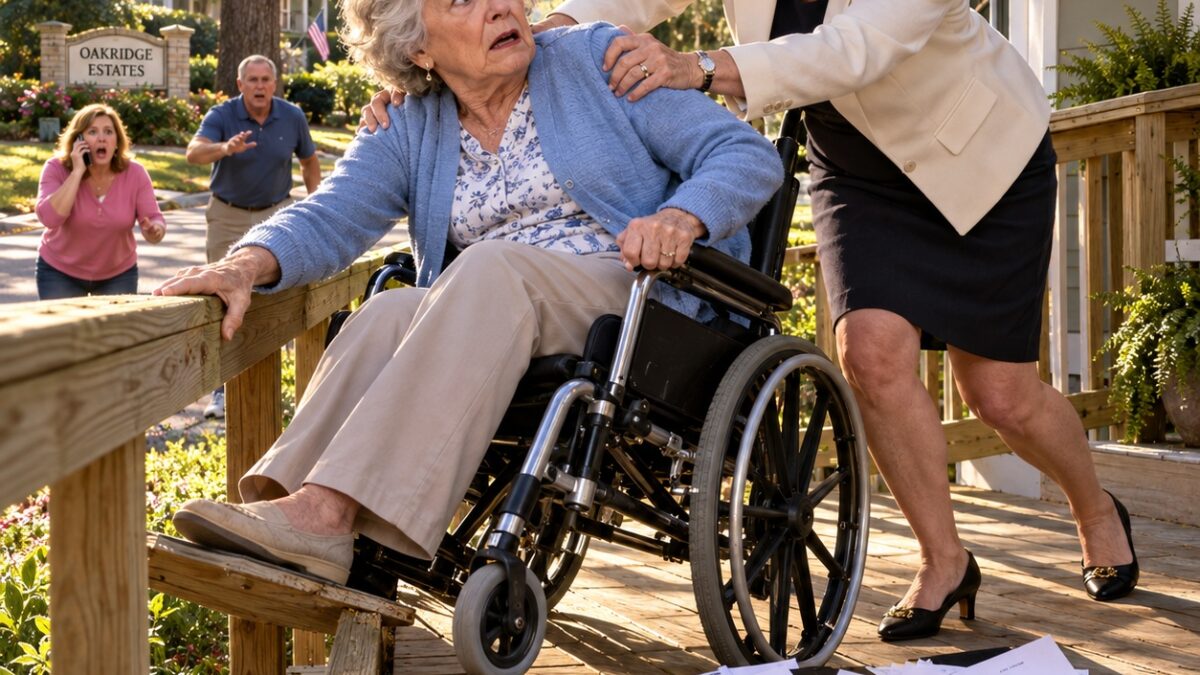
“Martha pushed her.”
For a second, the hallway narrowed.
“What did you say?”
“She pushed the wheelchair off the ramp.”
I do not remember hanging up.
I remember telling my supervisor I had to go.
I remember driving.
I remember every red light feeling personal.
I remember trying not to speed badly enough to make things worse.
By the time I turned onto Willow Creek Drive, an ambulance was outside my house.
Police cruiser behind it.
Three neighbors stood near the lawn.
Mom was on the ground beside the ramp.
Paramedics around her.
Her wheelchair lay sideways nearby.
I parked in the street.
Ran.
“Mom.”
She looked up.
Angry.
That was the first thing I noticed.
Not crying.
Not panicked.
Furious.
“I’m fine.”
“You are literally on the ground with paramedics.”
“I said fine.”
One paramedic looked at me.
“Are you Marcus?”
“Yes.”
“Your mother’s conscious and oriented. She has a forearm laceration and significant bruising around the hip. We want imaging because of her surgical history.”
I knelt.
“Did you hit your head?”
“No.”
“Are you sure?”
“Yes.”
“What happened?”
Her eyes moved toward the street.
Martha stood beside a police officer.
White face.
Arms folded tightly.
No clipboard.
Mom said:
“She put her hands on me.”
I looked at Martha.
Then back at Mom.
“What exactly happened?”
Mrs. Palmer answered from behind me.
“I saw it.”
Another neighbor, David Shaw, said:
“So did I.”
Then Mrs. Givens across the street:
“I did too.”
Three witnesses.
I looked at Mom again.
She spoke slowly.
“Martha came up here.”
Mom pointed toward the porch.
“Told me the ramp was coming down whether you paid the fines or not.”
I felt my jaw tighten.
“She said my being here was causing problems.”
“What did you say?”
“I told her she had no legal authority to be here making demands.”
Mom’s voice hardened.
“She did not like that.”
The paramedic continued dressing her arm.
Mom said:
“She stepped behind me.”
Mrs. Palmer interrupted.
“No.”
Everyone looked at her.
Mrs. Palmer pointed toward the top of the ramp.
“She was in front of Eleanor first.”
Her own voice was shaking now.
“I was watering my flowers.”
She demonstrated.
“Martha put both hands on Eleanor’s shoulders.”
I looked at Mom.
Mom nodded.
“And pushed.”
I could barely understand the words.
“Pushed?”
“Yes.”
Mrs. Palmer’s eyes filled.
“The chair tipped sideways.”
David added:
“She didn’t slip.”
Important.
“Martha pushed it.”
I stood.
Everything inside me wanted to cross the lawn.
Not to hit her.
I’m not going to pretend I knew exactly what I wanted.
I was angry enough that clarity was not my strongest quality.
So I took out my phone.
Called Evelyn.
She answered.
“Marcus?”
“Martha pushed my mother out of her wheelchair.”
Silence.
Then her voice changed completely.
“Is Eleanor conscious?”
“Yes.”
“Ambulance?”
“Here.”
“Police?”
“Here.”
“Witnesses?”
“Three.”
“Do not confront Martha.”
“I know.”
“Marcus.”
“I know.”
“Give police every prior notice.”
“They don’t have them.”
“Tell them the attorney correspondence exists. I’m coming.”
“You don’t need—”
“I’m coming.”
The paramedics loaded Mom.
She grabbed my hand.
“Don’t leave my chair.”
That was Mom.
Being lifted into an ambulance and still worried about equipment.
“I’ll bring it.”
“Bring my book too.”
“Seriously?”
“I was on chapter twelve.”
I laughed.
It came out wrong.
Half laugh.
Half something else.
She squeezed my hand.
“I’m okay.”
The ambulance doors closed.
Then I turned toward the police.
An officer introduced himself.
Sergeant Miles.
“Mr. Thorne?”
“Yes.”
“Your mother alleges physical contact caused the fall.”
“She has three witnesses.”
“We’ve spoken with them.”
I glanced toward Martha.
She was talking to another officer.
“What is she saying?”
“That there was an argument.”
“And?”
“That she tried to move around the wheelchair.”
I looked at him.
“That’s not what happened.”
“I know what the witnesses said.”
He kept his voice neutral.
“Were there previous disputes?”
I almost laughed.
“You have time?”
“Give me the short version.”
I brought him inside.
Set the folder on the kitchen counter.
First notice.
Second.
Third.
Fines.
Evelyn’s letters.
Martha’s responses.
$7,200.
Threats of lien.
Threats of foreclosure.
Sergeant Miles read quietly.
“She had been notified this was a disability accommodation?”
“Multiple times.”
“Your attorney sent this?”
“Yes.”
“Board received it?”
“Certified.”
He looked toward the front window.
“Did your mother ever threaten Ms. Higgins?”
“No.”
“Have you?”
“No.”
“Physical confrontation before today?”
“No.”
He closed the folder.
“Stay here.”
I did.
Fifteen minutes later, I saw the second officer approach Martha.
He spoke.
She shook her head.
He spoke again.
Then he took her arm.
Not violently.
Not dramatically.
Placed her under arrest.
Martha’s face changed.
“What are you doing?”
I heard it through the closed window.
The officer turned her.
Handcuffs.
She raised her voice.
“This is an HOA matter.”
Nobody answered.
That sentence followed her all the way to the cruiser.
I took Mom’s wheelchair and drove to Memorial Health.
The emergency department took forever.
Everything does when somebody you love is lying behind a curtain.
X-rays.
Exam.
Questions.
Her hip was badly bruised but not fractured.
That was the miracle.
Given her prior surgery and how she landed, it could have been much worse.
Her forearm required several stitches.
No head injury.
She would hurt.
She would recover.
When I finally sat beside her bed, she looked at me.
“Where’s Martha?”
“Jail.”
Mom nodded.
“Good.”
“That’s all?”
“What do you want me to say?”
“You were assaulted.”
“I noticed.”
“Mom.”
She looked at me more gently.
“I’m alive.”
I closed my eyes.
For the first time since Mrs. Palmer’s call, my body understood enough to shake.
Mom saw it.
Reached over.
Put her hand on mine.
“I’m alive.”
I nodded.
Then Evelyn walked in.
She was still carrying her work bag.
Looked at Mom.
“Mrs. Thorne?”
“Eleanor.”
“I’m Evelyn Reed.”
“The lawyer.”
“Yes.”
“Marcus says you’re expensive.”
I stared at Mom.
Evelyn smiled.
“I like her.”
“Everybody does until she starts talking.”
Mom squeezed my hand harder.
Evelyn sat.
Asked permission before discussing the case.
Mom said:
“Do whatever you need to.”
Then Evelyn asked her to tell the story.
Again.
Slowly.
Martha crossed the street at 9:22.
Walked up the path.
Stopped near the ramp.
Said the fines had accumulated.
Said the ramp would be removed whether I paid or not.
Said Mom’s presence was creating an ongoing “community problem.”
Mom closed her book.
Told her the accommodation was protected.
Told her attorney had already notified the HOA.
Told Martha she had no authority to be on the porch making demands.
Then Martha stepped onto the ramp.
Reached out.
Put both hands against Mom’s shoulders.
Pushed.
Mom remembered the right wheel leaving the edge.
Then impact.
Evelyn asked:
“Did she say anything as she touched you?”
Mom thought.
“She said something like, ‘You people think rules don’t apply to you.’”
My stomach turned.
Evelyn wrote it down.
Then she looked at me.
“This is no longer an accommodation dispute.”
I knew.
“It is also battery.”
“Yes.”
“And we have a pattern.”
She pointed toward my folder.
“Nine weeks of notices.”
“Yes.”
“Threats.”
“Yes.”
“Written notice of disability need.”
“Yes.”
“Continued fines after notice.”
“Yes.”
“Then physical contact with the person needing the accommodation.”
“Yes.”
Evelyn’s jaw tightened.
“We file tomorrow.”
She did.
The criminal matter moved first.
Martha was booked that morning.
The charge involved battery against an elderly person.
Georgia law treated age as significant.
Three independent witnesses gave statements.
Mom gave hers.
Police photographed the ramp.
The wheelchair.
Her injuries.
Martha was released on bond later that day.
No HOA lanyard in the booking photograph.
Someone sent me the image.
I deleted it.
I did not need it.
Evelyn filed the civil complaint the next morning.
The lawsuit was built around three things.
First:
The physical assault and resulting injuries.
Second:
The sustained campaign against a disability-related accommodation after the HOA had been repeatedly notified of the need and legal protections.
Third:
The emotional and financial harm caused by weeks of threats, fines, lien language, foreclosure threats, and eventually physical violence.
The lawsuit named Martha personally.
It also named the Oakridge Estates HOA.
That surprised me.
I called Evelyn.
“The whole board?”
“The association.”
“They didn’t push Mom.”
“No.”
“Then why?”
“Because Martha used association authority, stationery, processes, and enforcement mechanisms.”
“What if they didn’t know?”
“Then discovery will show that.”
“Can they cooperate?”
“Yes.”
“Does that matter?”
“Very much.”
They cooperated.
Fast.
Within forty-eight hours of the lawsuit being filed, Oakridge called an emergency board meeting.
I did not attend.
I was done with HOA rooms for a while.
Mom wanted to go.
I refused.
“You have stitches.”
“I can sit with stitches.”
“No.”
“I want to see her face.”
“That is exactly why you’re not going.”
Evelyn went.
She called afterward.
“Martha has been removed.”
“As president?”
“Unanimous vote.”
“And the notices?”
“Suspended.”
“Fines?”
“Withdrawn pending final board action.”
“Ramp?”
“Not going anywhere.”
I looked toward the porch.
Mom was reading outside.
Same place.
Same ramp.
That mattered.
“What else?”
“The board hired separate counsel.”
“From Martha?”
“Yes.”
“They’re cooperating with law enforcement and the disability review.”
“Good.”
“Marcus.”
“What?”
“They say Martha had been handling most architectural enforcement personally.”
Of course.
“Did they approve the fines?”
“Some general authority existed.”
“But?”
“They’re claiming they did not review each notice.”
I laughed once.
Not amused.
“They gave her power and stopped checking.”
“That appears to be part of the issue.”
That became the board’s central shame.
They had not pushed Mom.
They had not personally threatened foreclosure.
But they had spent years allowing Martha to operate with almost no oversight.
She drafted.
Issued.
Escalated.
Interpreted.
And because residents were tired of fighting, people paid.
The board assumed no news meant everything was fine.
It was not.
Mom’s fall made ignoring that impossible.
Neighbors started talking.
A lot.
Mrs. Palmer came over with flowers.
Mom looked at them.
“I’m injured, not dead.”
Mrs. Palmer laughed and cried at the same time.
Then apologized.
“For what?”
“I saw Martha watching your ramp for weeks.”
Mom waited.
“I should’ve said something.”
“What would you have said?”
“That she was obsessed.”
Mom shrugged.
“Everybody knew.”
Mrs. Palmer wiped her eyes.
“I didn’t think she’d…”
“Neither did I.”
That was important.
Martha’s notices were ugly.
Her threats were aggressive.
But nobody expected physical violence.
We should be careful when we tell stories backward.
Once something terrible happens, every earlier moment starts looking like an obvious warning.
It was not obvious then.
It was obnoxious.
Harassing.
Possibly unlawful.
But nobody expected a woman to put both hands on a seventy-one-year-old woman in a wheelchair and push.
Not until she did.
The ramp stayed.
That summer, Mom used it every morning.
At first, the bruise around her hip made transfers painful.
I offered to help.
She said no.
Then accepted help five minutes later.
Progress.
She never stopped sitting outside.
That was deliberate.
The day after she came home from the hospital, she rolled onto the porch.
Coffee.
Book.
Bandage on her arm.
I stared.
“What are you doing?”
“Reading.”
“You could read inside.”
“I like it here.”
“Mom.”
She looked at me.
“If I stop sitting here because Martha pushed me, then every morning belongs to her.”
I had no answer.
So I brought another chair and sat beside her.
That became our routine for a while.
Before work.
Ten minutes.
Coffee.
Sometimes no conversation.
Just us.
The criminal case moved through the system.
Slowly.
Real cases do.
No dramatic same-week sentencing.
Martha hired counsel.
There were hearings.
Filings.
Negotiations.
She argued the contact had been misinterpreted.
The witnesses disagreed.
Strongly.
Mrs. Palmer was especially clear.
“She pushed.”
David:
“Both hands.”
Mrs. Givens:
“I saw the chair tip because of the force.”
Physical evidence supported them.
Mom’s injuries.
Ramp position.
Wheelchair damage.
There was no magical ambiguity.
Meanwhile, Evelyn pursued the civil case.
She obtained HOA emails.
That was where things got worse for Martha.
Messages about the ramp.
Complaints about its appearance.
Statements about “setting a precedent.”
Language suggesting other residents might seek accommodations if Mom’s ramp remained.
One email from Martha said:
If we allow medical exceptions to override visual standards, we will lose control of the community appearance process.
Evelyn showed me that sentence.
I read it twice.
“She thought disability access was contagious.”
Evelyn nodded.
“In a way.”
“What does that mean?”
“She was worried about precedent.”
“For people who need ramps?”
“Yes.”
I sat back.
“That sounds insane.”
“Many discriminatory policies are defended as consistency.”
That line stayed with me.
Consistency.
Martha loved it.
Uniform fences.
Uniform colors.
Uniform lawns.
Uniform rules.
The problem is human bodies are not uniform.
Needs are not uniform.
Lives are not uniform.
A rule that treats everyone identically can still burden one person far more than another.
I knew that professionally.
Now I was watching a neighborhood learn it legally.
The HOA board issued a formal letter to residents.
It acknowledged the accommodation dispute.
Withdrew all fines against my property.
Confirmed the ramp would remain.
Announced an independent review of enforcement procedures.
Promised disability-accommodation training.
Martha was no longer president.
No longer on architectural enforcement.
No longer authorized to contact residents on behalf of the board.
Mom read the letter.
Then said:
“Good.”
“That’s it?”
“What else?”
“They admitted it.”
“Marcus.”
She folded the paper.
“I wanted to get into your house.”
“You can.”
“Then I won.”
Simple.
I envied her clarity.
The rest of us were still thinking about punishment.
Mom was thinking about the ramp.
That was the point.
The HOA attorney came to my house about a month later.
Not Martha’s attorney.
The board’s.
His name was Thomas Keller.
He sat at my kitchen table with Evelyn and me.
Mom refused to leave.
Of course.
Thomas said:
“Mrs. Thorne—”
“Eleanor.”
“Eleanor.”
He nodded.
“The board wants to express its sincere regret.”
Mom said nothing.
He continued.
“The board should have intervened earlier.”
“Yes,” Mom said.
Thomas paused.
“Absolutely.”
Good answer.
He explained that the board had delegated enforcement authority too broadly.
Martha had been allowed to issue and escalate notices without adequate review.
The board did not know the full content of Evelyn’s correspondence when later notices were issued.
Evelyn asked:
“How is that possible?”
Thomas looked uncomfortable.
“Correspondence was routed through the president.”
There it was.
Martha controlled the inbox.
Controlled the notices.
Controlled the narrative.
“How many other accommodation requests?” Evelyn asked.
Thomas said:
“We’re reviewing.”
“Other questionable fines?”
“Reviewing.”
“Lien threats?”
“Reviewing.”
The word became embarrassing by the fourth use.
Mom leaned back.
“Sounds like you should’ve reviewed before.”
Thomas nodded.
“Yes, ma’am.”
Mom respected that.
So did I.
People make mistakes.
Institutions make mistakes.
The difference is what they do after the mistake is undeniable.
Oakridge could have defended Martha.
They did not.
They separated counsel.
Cooperated.
Reviewed records.
Suspended enforcement.
That did not erase harm.
It mattered anyway.
Civil negotiations eventually resolved the HOA’s portion separately from Martha’s personal exposure.
I will not pretend every detail was emotionally satisfying.
Legal systems turn pain into categories.
Medical bills.
Fees.
Compensatory damages.
Insurance.
Release language.
Terms.
Numbers.
Mom hated depositions.
Especially questions implying her fall might have been worsened by her existing condition.
At one point she said:
“Of course my wheelchair mattered. That’s why pushing me was dangerous.”
Her attorney almost smiled.
The board’s cooperation reduced the individual exposure of board members.
They had been negligent in oversight.
They were not treated as though each had personally assaulted Mom.
That distinction felt right.
Martha’s personal case was different.
Her criminal defense bills grew.
So did civil fees.
Eventually, the civil judgment against her included Mom’s medical expenses, my legal costs attributable to her conduct, and damages reflecting the severity of the harassment and assault.
I did not celebrate when I heard the number.
Mom did not either.
She said:
“Can we stop talking about money now?”
So we did.
About fourteen months after the judgment, Martha’s house went into foreclosure.
That part became neighborhood gossip.
I learned about it from Mrs. Palmer.
“Did you hear?”
“No.”
“Martha’s moving.”
I looked across the street.
A real-estate sign stood in front of her house.
“Foreclosure?”
Mrs. Palmer nodded.
I felt something I did not expect.
Sadness.
Not for what she had done.
Not forgiveness.
Just the realization that one stupid campaign of control had consumed far more than a ramp dispute ever should have.
Her presidency.
Money.
Legal bills.
Reputation.
Home.
All because she could not accept that a disabled woman needed a ramp.
There is no satisfaction in watching somebody destroy herself that thoroughly.
At least there wasn’t for me.
Mom had less patience.
“She had fourteen months to think about it.”
“Mom.”
“What?”
“You don’t feel bad?”
“I feel bad that she made the choices.”
That was probably the healthier way to say it.
Martha sold what she could.
Moved.
I never spoke with her again.
No apology.
No reconciliation.
No final confrontation.
One afternoon, a moving truck arrived.
By evening, her driveway was empty.
The next morning, Mom sat on the porch with coffee and did not mention it.
Neither did I.
Oakridge Estates changed.
The new board president was a man named James Holloway.
Retired accountant.
Extremely boring.
Perfect.
He implemented a rule requiring multiple board members to review serious fines.
Accommodation requests went directly to a designated committee and counsel when necessary.
Residents received clear appeal instructions.
No single president could escalate fines alone.
The association also held disability-access training.
I attended the first session.
So did Mom.
The presenter talked about reasonable accommodations and modifications.
Equal access.
Interactive processes.
Avoiding retaliation.
Federal fair-housing obligations.
State protections.
Mom leaned toward me.
“You teach this stuff?”
“Some of it.”
“Then why am I here?”
“Free cookies.”
She took another cookie.
Fair.
After the training, James approached her.
“Mrs. Thorne?”
“Eleanor.”
“Yes. Sorry.”
“You all keep doing that.”
He smiled.
“I wanted to ask if you’d be willing to give feedback on our accessibility policy.”
Mom stared at him.
“I’m not becoming an HOA volunteer.”
“No, ma’am.”
“Good.”
“Just feedback.”
She thought.
“One time.”
That turned into two meetings.
Because Mom liked fixing things more than she liked admitting she cared.
They reviewed accessible parking.
Sidewalk obstructions.
Common-area pathways.
Pool gate width.
Nothing revolutionary.
Just details nobody had considered because nobody making the rules used a wheelchair.
The ramp at my house became almost invisible again.
That was the goal.
For months, it had been:
The Ramp.
Violation.
Evidence.
Federal issue.
Crime scene.
Lawsuit exhibit.
Eventually, it became wood leading to a porch.
Exactly what it should have been.
Neighbors stopped talking about it.
Kids sat on the edge sometimes.
Delivery drivers used it with carts.
Mom rolled up and down.
No symbolism.
Access.
That was victory.
She returned home at the end of summer.
I hated watching the van pull away.
Not because I was worried.
Because I had gotten used to coffee on the porch.
She called me the next day.
“You eating?”
“Yes.”
“Vegetables?”
“Yes.”
“Liar.”
“Why did you call?”
“To make sure the ramp is still there.”
I laughed.
“It’s still there.”
“Good.”
The following spring, she called.
“I’m coming back.”
“For how long?”
“Summer.”
“Do I get a vote?”
“No.”
“When?”
“June.”
“Okay.”
She paused.
“And Marcus?”
“Yes?”
“Don’t touch my room.”
“I turned it into a gym.”
“You did not.”
“I did.”
“I raised you badly.”
She returned in June.
Same chair.
Same personality.
First thing she did?
Rolled onto the porch.
Looked at the ramp.
Then at me.
“Still ugly.”
I stared.
She laughed.
“Relax.”
We sat.
Oak leaves moving overhead.
No Martha across the street.
No violation letters.
No clipboard.
Just Mom.
The neighborhood had a new family in Martha’s old house.
Young couple.
Two children.
They introduced themselves politely.
The mother noticed the ramp.
“My father uses a walker.”
“If he visits, tell me if you need anything.”
She smiled.
“That’s nice.”
No controversy.
That simple exchange showed me how absurd the previous year had been.
Accessibility did not destroy property values.
It did not collapse visual standards.
One ramp did not trigger architectural anarchy.
Oakridge still looked like Oakridge.
Lawns trimmed.
Houses neat.
Oaks shading the sidewalks.
Children riding bikes.
The world survived.
If anything, people became more aware of one another.
Mrs. Palmer started checking that nobody blocked curb access near her driveway.
James pushed the city to repair a cracked sidewalk section near the neighborhood entrance.
Someone requested a handrail at the clubhouse steps.
The board approved it.
No war.
No $7,200 fine.
No foreclosure threat.
Just a handrail.
Imagine that.
I sometimes think about what Martha said.
“Aesthetically unpleasant.”
Those words appeared in one of her early notices.
As if unpleasant were a legal category.
As if the view from the street mattered more than whether my mother could enter my house independently.
Martha was not the first person to think that way.
She was simply the person who pushed the logic until everybody could see how ugly it was.
That is the irony.
The ramp was never the eyesore.
Her behavior was.
Mom would hate that sentence because it sounds like something printed on a motivational poster.
Still true.
The professional side of me changed too.
At work, I became more aggressive about asking patients what their homes actually looked like.
Not just:
Can you walk ten feet?
Can you climb three stairs?
But:
What happens at your front door?
Who controls modifications?
Are you renting?
Do you have an HOA?
Has anyone resisted equipment?
Do you need documentation?
Mobility does not stop at the clinic door.
A patient can gain twenty percent strength and still be trapped by one step.
A ramp can matter more than a perfect therapy session.
I knew that before.
After Mom, I understood it differently.
Evelyn and I stayed in touch.
Not socially exactly.
She became the attorney I recommended when patients ran into accommodation problems.
I asked permission first.
Always.
One afternoon, I called her.
“Do you remember the first notice?”
“Of course.”
“Section 4.7?”
“Fences and sheds.”
“Right.”
“What about it?”
“I was cleaning files.”
“And?”
“I almost threw it away.”
“Don’t.”
“Evidence?”
“History.”
“You lawyers keep everything.”
“Correct.”
I still have the folder.
Every notice.
Every photograph.
Every letter.
The $400 fine.
The escalation.
The $7,200 total.
The lien threat.
The foreclosure language.
The photograph police took of the ramp after Mom fell.
I do not look often.
I do not need to.
The ramp itself is better evidence.
It remained.
That is what Martha wanted gone.
It is still there.
Not because I defeated her.
Because Mom needed it.
People often ask the wrong question after conflicts.
Who won?
I understand why.
Stories are cleaner with winners.
But if I answer honestly:
Mom won the ability to enter my house.
That was the whole case.
Everything else was consequence.
Martha lost authority because she abused it.
Lost money because harm creates costs.
Lost her home eventually because those costs and legal consequences became more than she could carry.
The board changed because it had failed.
But the central right was always simple.
Eleanor could use the front door.
That was worth defending before any lawsuit existed.
Before the police.
Before witnesses.
Before Martha made everything catastrophic.
The ramp never needed to be beautiful.
It needed to work.
It did.
One evening during Mom’s second summer, we sat outside.
Sun low.
Humidity finally easing.
She had a book open but was not reading.
I asked:
“Do you ever think about it?”
“Martha?”
“Yes.”
“No.”
“That’s impossible.”
“Why?”
“She pushed you out of your chair.”
“And?”
“And you don’t think about it?”
Mom closed the book.
“Marcus, I am seventy-two years old.”
“You were seventy-one.”
“Thank you for the correction.”
“Sorry.”
“I have lived through a lot of people being stupid.”
I laughed.
She continued.
“If I keep every stupid person with me forever, there won’t be room for anything else.”
I sat quietly.
Then she pointed toward the oak tree.
“Look.”
A squirrel was trying to steal something from a bird feeder.
“That’s what you want me to look at?”
“Yes.”
“Why?”
“Because it’s happening now.”
That was Mom.
Brutally practical philosophy disguised as wildlife observation.
I watched the squirrel.
Eventually it fell.
We both laughed.
Martha became part of the past.
Not erased.
Placed.
There is a difference.
The new board mailed annual notices about rule changes.
Normal things.
Pool hours.
Tree trimming.
Parking.
I read them more carefully now.
Not out of fear.
Because governance works better when people pay attention before something becomes a crisis.
Residents attended more meetings after Martha.
For a while.
Then attendance dropped again.
That actually made James happy.
“If nobody comes, maybe we’re finally boring.”
He was joking.
Partly.
Good governance should not require constant vigilance because somebody is always trying to hurt you.
But it should have enough transparency that one person cannot quietly turn preference into punishment.
Oakridge added checks.
That was Martha’s real legacy.
Not intentionally.
Still.
No unilateral fines over a certain amount.
No lien process without board vote and attorney review.
Accommodation complaints routed outside ordinary aesthetic enforcement.
Meeting minutes posted promptly.
Residents informed of appeal rights.
Simple structural fixes.
Nothing guaranteed another Martha could never appear.
It made it harder.
That is what systems can do.
Reduce dependence on personality.
One board member once asked Evelyn during training:
“What if somebody abuses disability accommodation to avoid normal rules?”
Evelyn answered:
“Then evaluate the actual request and evidence.”
Simple.
Not:
Assume every accommodation is automatically valid.
Not:
Assume every aesthetic rule disappears.
Evaluate.
Document.
Interact.
Reason.
Everything Martha had skipped because certainty was faster.
That is another lesson I carried.
Good law is often less dramatic than angry people want it to be.
It asks questions.
What is needed?
What burden exists?
What alternatives?
What rights?
What process?
Martha did not ask.
She decided.
Then kept escalating because admitting error became more expensive to her pride than issuing another notice.
By the time Evelyn’s letter arrived, Martha had a choice.
She could have said:
I was wrong.
Ramp stays.
Done.
Instead she issued another fine.
Then another.
Then threatened liens.
Then foreclosure.
Then crossed the street.
Then put her hands on Mom.
Escalation becomes its own trap.
Every step makes the next step feel necessary to defend the previous one.
That is why people sometimes destroy themselves over something tiny.
Not because the original issue was huge.
Because backing down starts feeling like losing.
Martha chose not to lose.
She lost far more.
I tell patients that in a different context.
Small corrections early prevent large compensations later.
Bodies do it.
Organizations do it.
People do it.
Ignore a bad pattern long enough and eventually something tears.
Oakridge learned that.
So did I.
I also learned my mother is impossible.
Her second summer, I wanted to improve the ramp.
Replace handrails.
Maybe composite decking.
She objected.
“Why?”
“This works.”
“The wood is weathering.”
“It’s wood.”
“I want to improve it.”
“Is something unsafe?”
“No.”
“Then stop improving me.”
“That’s not what I’m doing.”
She pointed.
“You therapists can’t leave anything alone.”
I replaced one loose board.
That was all she allowed.
The ramp stayed plain.
Pressure-treated wood weathering into gray.
No decorative lattice.
No fancy paint.
No attempt to disguise its purpose.
I liked that.
It looked honest.
Years from now, I may remove it.
If Mom no longer visits.
If the house changes.
I do not know.
But I will never remove it because somebody says it makes the neighborhood less attractive.
That question has been answered.
Sometimes, when I stand at the top, I can still see where the chair went over.
Not a mark exactly.
Memory.
The section where one wheel slipped beyond the edge.
I used to hate looking at it.
Then I realized Mom crossed the same place every morning without hesitation.
If she could, so could I.
So I stopped treating the ramp like a crime scene.
It became a ramp again.
That might sound small.
It was not.
The first morning of Mom’s second summer, I woke early.
Went to the kitchen.
Coffee machine already running.
Of course.
I opened the front door.
She was halfway down the ramp.
“Where are you going?”
“Mailbox.”
“You just got here yesterday.”
“I know how mail works.”
“You want help?”
“No.”
I leaned against the door.
She rolled to the mailbox.
Retrieved two envelopes.
Came back.
Up the ramp.
Smooth.
Independent.
Exactly as designed.
At the porch, she looked at me.
“What?”
“Nothing.”
“You’re doing the sentimental thing.”
“No.”
“Yes.”
“Go drink your coffee.”
She rolled inside.
I stayed outside another minute.
Looking down Willow Creek Drive.
Quiet.
Oak trees.
Morning sun.
No Martha.
No police.
No ambulance.
No attorneys.
The street had returned to being ordinary.
And maybe that was the best consequence of all.
Martha once tried to make my mother’s presence feel like a disruption.
A community problem.
Something inconsistent.
Something unpleasant to look at.
But Eleanor came back the next summer.
Sat on the same porch.
Used the same ramp.
Talked to the same neighbors.
Drank the same coffee.
Nothing about her needed fixing.
Nothing about her access needed apologizing for.
The thing that had been wrong was never the ramp.
It was the person who looked at a seventy-one-year-old woman trying to enter her son’s home and saw an aesthetic violation instead of a human being.
The board eventually understood that.
The neighbors understood it.
Martha learned it in the hardest possible way.
And the ramp?
It never came down.








