FULL STORY:They Shoved Me in Front of My Daughter and Laughed—Then the Parking Lot Went Quiet
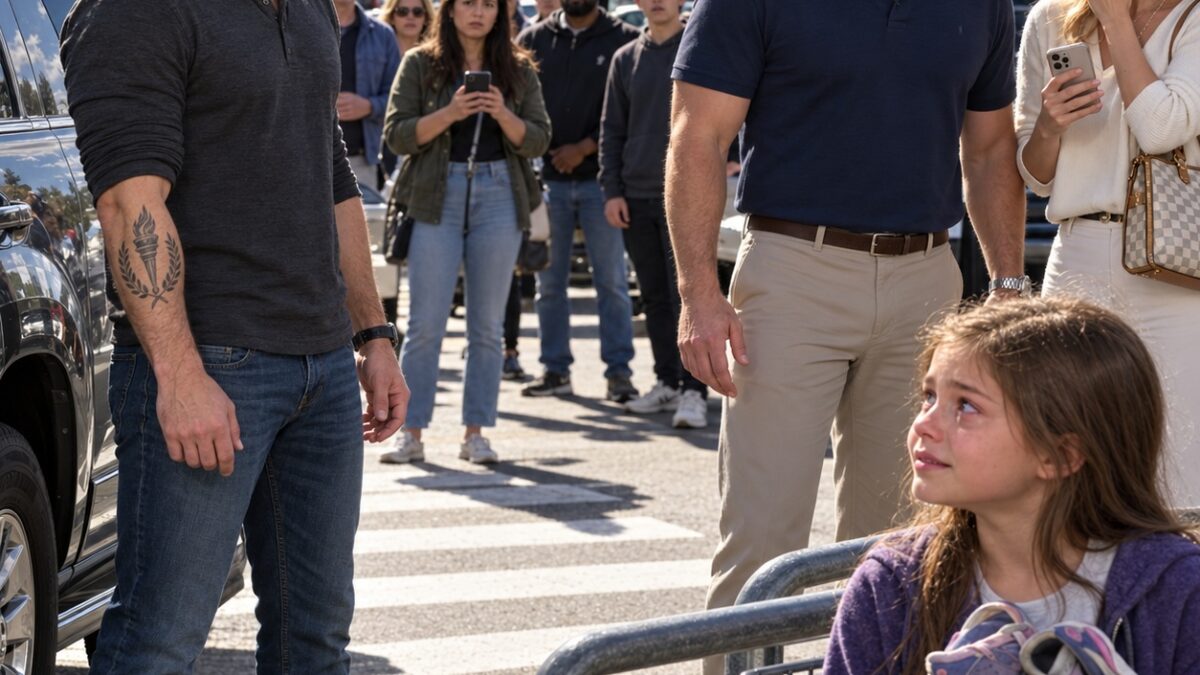
FULL STORY CONTINUATION
He came fast.
Not trained fast.
Angry fast.
There is a difference.
Someone with training usually tries to control distance before committing weight.
Angry people often send their body before their balance has caught up.
His right foot crossed farther than it should have.
His shoulders moved ahead of his hips.
I stepped outside his line.
Caught the forearm.
Turned with his momentum.
Guided rather than threw.
Three seconds later, he was sitting on the pavement.
No impact beyond what his own weight created.
No punch.
No kick.
No damaged joint.
Nothing dramatic.
Just a confused adult man sitting beside a parking space wondering how the person he had tried to tackle was suddenly standing several feet away.
I backed up immediately.
Hands open.
His wife stared.
“What did you do?”
“Nothing that hurt him.”
Her husband planted one palm on the asphalt.
“You got lucky.”
I didn’t answer.
People love that phrase after losing control of an interaction.
Lucky.
Cheap shot.
Wasn’t ready.
Doesn’t count.
I didn’t care what counted.
I wanted Tessa calm.
I turned toward her.
“Come here, sweetheart.”
She ran into me.
I wrapped both arms around her.
“I’m okay.”
She pressed her face into my shirt.
“You’re sure?”
“Yes.”
Behind us, the man stood.
I could hear it.
Shoes scraping pavement.
Heavy breathing.
I turned without letting go of Tessa completely.
He looked furious.
His wife grabbed his arm.
“Stop.”
“Let go.”
“No.”
“He—”
“You tried to hit him.”
“That isn’t the point.”
Actually, it was very much the point.
I took Tessa’s hand.
“We’re leaving.”
As I reached down, my sweatshirt sleeve pulled slightly above my forearm.
That was when the woman’s expression changed.
Not gradually.
Immediately.
She stopped looking at my face.
Her eyes locked on the tattoo.
Small.
Black.
Faded with age.
An eagle above five linked circles, surrounded by Korean characters that marked a place and year important to a group of people I had once spent more time with than my own family.
The woman took a step backward.
“No.”
Her husband looked at her.
“What?”
She pointed.
“That tattoo.”
I pulled the sleeve down.
Too late.
She looked at me.
“I’ve seen that.”
“Probably not.”
“Yes.”
Her voice had lost nearly all the arrogance.
“My brother trained taekwondo.”
“That covers a lot of people.”
“He had posters.”
I almost laughed.
Posters.
Fantastic.
Her husband looked between us.
“What are you talking about?”
Before she answered, another voice came from behind the crowd.
“Nolan?”
That one I recognized.
Older.
Rougher.
Impossible to mistake.
I closed my eyes for half a second.
Of all the people who could have been buying sporting goods on a Saturday afternoon.
I turned.
Coach Daniel Whitaker stood near the entrance wearing a gray tracksuit with a small American flag stitched across one side of his chest.
He was in his late sixties now.
Still broad through the shoulders.
Still standing like every room might unexpectedly require a whistle.
He stared at me.
“Nolan Mercer?”
I sighed.
“Coach Whitaker.”
His face broke into disbelief.
“Good Lord.”
The crowd looked from him to me.
I already hated where this was going.
Whitaker walked closer.
“How long has it been?”
“Several years.”
“Several?”
He laughed.
“You disappeared.”
“I changed jobs.”
“You changed continents.”
“Temporarily.”
The husband interrupted.
“Who is he?”
Coach Whitaker turned.
He looked at the man.
Then at the pavement.
Then at the growing crowd.
“What happened?”
His wife answered before anyone else.
“My husband got into an argument with him.”
The man snapped:
“He attacked me.”
I looked at him.
Whitaker looked at me.
Then at him.
“You attacked Nolan Mercer?”
“I said he attacked me.”
Whitaker stared for perhaps two seconds.
Then laughed.
Not cruelly.
Which somehow made it worse.
“No.”
The husband’s face hardened.
“You weren’t here.”
“I don’t need to have been.”
A woman holding a phone said:
“I recorded it.”
That settled that portion.
Whitaker looked back at me.
“You okay?”
“Fine.”
Then he saw Tessa.
His expression softened instantly.
“And this must be your daughter.”
Tessa moved closer to my side.
“Yes.”
“Hi.”
She gave him a cautious wave.
Whitaker said:
“I’m Daniel.”
She looked at me.
“Dad knows you?”
“Unfortunately.”
Whitaker laughed.
“There he is.”
The woman who had recognized my tattoo was still staring.
Then she said:
“Were you with the national team?”
I looked at Whitaker.
He betrayed me immediately.
“He coached it.”
The husband blinked.
“What?”
I said:
“Not anymore.”
Whitaker looked offended.
“Nolan.”
“Coach.”
“Don’t do that.”
“Do what?”
“Make it sound like you handed out water bottles.”
I rubbed my forehead.
Tessa looked fascinated now.
This was not how I’d planned to have this conversation.
Whitaker turned toward the small crowd.
I cut him off.
“Daniel.”
He stopped.
I rarely used his first name.
He understood.
No speech.
No résumé recital.
No dramatic list of medals or athletes.
Good.
He looked back at the couple.
“He coached elite competitors for years.”
That was enough.
“He worked with Team USA athletes who competed internationally.”
Tessa looked up at me.
“You were a coach?”
I smiled awkwardly.
“Something like that.”
Whitaker shook his head.
“Do not teach her your bad habits.”
“I was going to tell her.”
“When?”
“Eventually.”
Tessa crossed her arms.
“When is eventually?”
“Not now.”
She gave me the look children reserve for parents obviously attempting escape.
The husband seemed to shrink where he stood.
A few minutes earlier, he had seen a quiet father in ordinary clothes.
Nothing about me had changed.
Same shoes.
Same sweatshirt.
Same face.
But now he knew a fact he considered important.
I disliked how quickly that changed his attitude.
“You trained fighters?”
“I coached athletes.”
“Same thing.”
“No.”
It wasn’t.
Not to me.
He glanced toward the spot where he had fallen.
“You could’ve hurt me.”
“Yes.”
The word came out before I softened it.
Tessa heard.
So did everybody else.
I continued:
“That is why I didn’t.”
The man looked confused.
I said:
“If you don’t know what you’re doing, force can become panic.”
I looked at his hands.
“If you do know what you’re doing, force becomes a choice.”
He stared.
“You chose not to.”
“Yes.”
His wife covered her mouth briefly.
Whether from embarrassment or realization, I didn’t know.
Then the man looked at Tessa.
She was still pressed against my side.
His shoulders dropped.
He said:
“I shouldn’t have touched you.”
“No.”
He swallowed.
The crowd waited.
I hated crowds.
He continued:
“I shouldn’t have thrown a punch.”
“No.”
Then he looked at my daughter.
“And I scared her.”
I said nothing.
His voice lowered.
“I’m sorry.”
I looked at Tessa.
The apology needed to go to her, not through me.
“You should tell her.”
He hesitated.
Then took one step forward.
I raised a hand.
“From there.”
He stopped.
Good.
He looked at Tessa.
“I’m sorry I scared you.”
Tessa studied him.
She had her mother’s eyes.
The kind that made dishonesty uncomfortable.
Finally:
“Okay.”
Not forgiveness.
Not comfort.
Acknowledgment.
Enough.
His wife spoke next.
“I owe you both an apology too.”
Tessa looked at her.
The woman continued:
“I made it worse when I should have stopped it.”
That answer I appreciated.
I nodded.
“We’re done.”
The husband looked surprised.
“That’s it?”
“What else do you want?”
“I don’t know.”
Neither did I.
Punishment?
A public lecture?
Applause?
I wanted shoes.
Children’s shoes.
That was why we had come.
I took Tessa’s hand.
“Come on.”
Coach Whitaker called:
“Nolan.”
I turned.
“Coffee sometime.”
“Maybe.”
“That means no.”
“Correct.”
He smiled.
“You haven’t changed.”
I looked at Tessa.
“I have.”
Whitaker followed my eyes.
His expression softened.
“Yes.”
Then I walked with my daughter into the sporting-goods store.
For thirty seconds, neither of us said anything.
Then Tessa said:
“Dad.”
Here we go.
“Yes?”
“Were you really Team USA?”
“I worked with the program.”
“Coach Whitaker said you coached them.”
“Yes.”
“So yes.”
“Yes.”
“Taekwondo?”
“Yes.”
“How long?”
“Quite a while.”
“Why didn’t you tell me?”
“I told you I used to coach.”
“You said fitness.”
“That was also true.”
She stopped in the middle of the shoe aisle.
“Dad.”
I stopped.
Her face had changed.
Not excited now.
Hurt.
That mattered.
“You think I hid it from you.”
“You did.”
Maybe.
There are times as a parent when technical truth becomes cowardice.
I could have said:
You never asked.
You were too young.
It wasn’t relevant.
All partly true.
None adequate.
“I didn’t know how to talk about that part of my life.”
“Why?”
I looked toward a display of children’s running shoes.
Terrible location for emotional honesty.
But parenthood rarely schedules itself properly.
“Because your mom died.”
Tessa became still.
I crouched.
“You remember that I traveled a lot when you were little?”
“Some.”
“I spent years helping athletes train.”
“Tournaments?”
“Yes.”
“Other countries?”
“Yes.”
Her eyes widened.
“And when Mom got sick?”
I nodded.
“I was home more.”
The next part hurt.
“She never blamed me.”
That was important.
Your dead spouse becomes easy to rewrite if you’re not careful.
My wife, Emily, had never demanded that I stop coaching.
Never accused me of choosing work over family.
The accusation came from inside me.
“When she died, I looked at how much time I’d spent helping other people’s sons and daughters become stronger.”
Tessa listened.
“And I realized I’d missed things with you.”
Her expression softened.
“Like what?”
“School mornings.”
“Those are terrible.”
I smiled.
“Birthday preparation. Soccer. Bedtime.”
“You were there sometimes.”
“Not enough for me.”
She stared.
“That is why you quit?”
“Yes.”
“You quit because of me?”
Dangerous sentence.
I shook my head immediately.
“No.”
“Dad—”
“No, sweetheart.”
I took both her hands.
“I chose because of me.”
She listened.
“You were never a burden that made me give something up.”
That distinction mattered more than anything.
“I changed what I wanted.”
Tessa looked down.
“What did you want?”
“This.”
I gestured vaguely around us.
She looked around the shoe department.
“You wanted sneakers?”
I laughed.
God bless children.
“I wanted Saturdays with you.”
She smiled.
Then:
“Could you have really hurt that man?”
The emotional pivot of nine-year-olds is remarkable.
“Yes.”
“How bad?”
“Tessa.”
“I’m asking.”
“I know.”
I thought about lying.
Didn’t.
“If I lost control, badly.”
Her face became serious.
“But you didn’t.”
“No.”
“Why?”
We started walking again.
“Because knowing how to fight is not about proving you can hurt somebody.”
She followed.
“Then what is it about?”
I looked down at her.
“Knowing when you don’t have to.”
She thought about that.
Then lifted the old sneakers.
“Can we still get these replaced?”
I laughed.
“Absolutely.”
That should have been the end of the day.
It wasn’t.
The parking-lot video appeared online that evening.
I discovered this because Coach Whitaker called.
I almost didn’t answer.
Then I remembered he’d asked for coffee.
Maybe he was persistent enough to appear at my house.
“Hello?”
“You’re famous again.”
I hung up.
He called back immediately.
“Nolan.”
“No.”
“You haven’t even heard me.”
“I know what that sentence means.”
“The video has thirty thousand views.”
“Wonderful.”
“You look good.”
I hung up again.
My phone started buzzing with messages.
Old athletes.
Former colleagues.
People I hadn’t spoken to in years.
One wrote:
Still can’t believe you helped him stay upright after he swung at you.
Another:
Classic Mercer. Opponent tries to fight, Nolan corrects his footwork.
I hated them all.
Then one message came from a former athlete named Kayla Brooks.
She had competed internationally under my coaching.
Coach, I saw the video. You did exactly what you used to tell us. Skill isn’t for punishment. Hope your daughter is okay.
I read that one twice.
Tessa came into the kitchen.
“What?”
“Nothing.”
“You’re doing your weird face.”
“I have several.”
“The sad-proud one.”
That girl knew too much.
I handed her the phone.
She read Kayla’s message.
“Was she your student?”
“Yes.”
“Was she good?”
“Very.”
“Did she win?”
“Sometimes.”
“Did you teach her what you told me?”
“I tried.”
Tessa handed back the phone.
“Then you didn’t waste all that time.”
That sentence stopped me.
Children can accidentally reach places adults spend years avoiding.
I sat down.
“What?”
“You said you missed stuff with me because you were teaching other people’s kids.”
“Yes.”
“But you helped them.”
“Yes.”
“So it wasn’t wasted.”
No.
It hadn’t been.
Regret had simplified my past too much.
I had treated one life as if it had to be wrong for the next one to be right.
Maybe it didn’t.
I looked at her.
“When did you get wise?”
“Fourth grade.”
“Apparently.”
The video’s popularity brought attention I did not want.
Local media called.
I declined.
A national martial-arts site asked for an interview.
Declined.
Someone labeled me SECRET OLYMPIC MASTER DAD.
Not accurate.
Another said FORMER FIGHTER DESTROYS PARKING LOT BULLY.
I had destroyed nobody.
By the next day, the man from the parking lot had a name online.
Ethan Cole.
His wife, Vanessa.
People found their social media.
That bothered me.
I called the woman who had recorded the video.
Her name was Michelle.
She had given a copy to store security and police after the incident.
“Can you take down the public post?”
She sounded surprised.
“Why?”
“Because this doesn’t need to become a mob.”
“He attacked you.”
“Yes.”
“People should know.”
“Police can know.”
I paused.
“The store can know.”
“But—”
“His employer doesn’t need thousands of strangers calling because he lost his temper in a parking lot.”
Michelle became quiet.
“You’re defending him?”
“No.”
Important distinction.
“I am refusing to turn accountability into entertainment.”
She removed her original upload.
Too late completely.
Copies existed.
But the gesture mattered.
Ethan was cited after store security reported the assault and video was provided to authorities.
I did not ask for special treatment.
I did not ask charges to disappear.
Consequences belonged to the system now.
Not me.
A week later, Ethan sent a letter through the store manager because I had refused direct contact information.
Short.
No excuses.
Mr. Mercer,
I behaved badly in front of your daughter and mine would be ashamed if she ever saw the video. I have no justification for touching you after you repeatedly tried to leave. Thank you for not hurting me when you clearly could have. I am dealing with the consequences.
Ethan Cole
I folded it.
Put it away.
Tessa asked:
“Are you going to forgive him?”
“Maybe.”
“What does that mean?”
“It means forgiveness and consequences are different things.”
She frowned.
I explained.
“I can decide not to hate someone and still believe what they did matters.”
“Oh.”
She thought.
“Like when I lost tablet privileges but you still loved me?”
Exactly.
“Yes.”
“Except he punched at you.”
“Bigger mistake.”
“Bigger timeout.”
I laughed.
“Something like that.”
Coach Whitaker finally got his coffee.
He arrived at my house two Saturdays later.
Tessa opened the door.
“Coach Whitaker.”
He grinned.
“You remembered.”
“You told everyone Dad’s secret.”
He looked at me.
“Tough crowd.”
“You created her.”
“I did not.”
He entered.
Whitaker had been one of the people who first brought me into high-level coaching.
Decades of experience.
Sharp eye.
Zero ability to mind his business.
He sat at the kitchen table.
Tessa joined us despite my subtle suggestions that she might have homework.
She did not accept the hint.
Whitaker looked around.
Family photographs.
School calendar.
Tessa’s artwork.
“You really changed everything.”
“Yes.”
“Happy?”
I looked at my daughter.
“Yes.”
Tessa interrupted.
“What was Dad like as a coach?”
Whitaker’s smile became dangerous.
“No.”
I pointed at him.
“No stories.”
Tessa said:
“Dad.”
“Absolutely not.”
Whitaker ignored me.
“Very patient.”
I stared.
“That sounded sincere.”
“It was.”
He looked at Tessa.
“Your father could watch an athlete make the same mistake fifty times and find fifty different ways to explain it.”
“That sounds like him helping with math.”
“Exactly.”
I relaxed slightly.
Then Whitaker continued:
“He was also the most stubborn—”
“Coffee over.”
Tessa laughed.
The conversation became easier.
He told her about travel.
Team dinners.
Competitions.
Nothing inappropriate.
No mythology.
Just a younger version of her father.
At one point Tessa asked:
“Why that tattoo?”
I looked at my forearm.
Whitaker answered carefully.
“A group of athletes and coaches got similar markers after an overseas competition.”
He pointed.
“The Korean writing marks the place and a phrase about discipline.”
Tessa looked at me.
“What phrase?”
“Control before victory.”
Her eyes widened.
“Seriously?”
“Yes.”
She looked toward the kitchen window.
“That’s kind of exactly what happened.”
Whitaker laughed.
“Your daughter is smarter than you.”
“I know.”
After Tessa went outside, Whitaker’s expression changed.
“You still blame yourself?”
I knew what he meant.
“For traveling.”
“Sometimes.”
“Emily didn’t.”
“I know.”
“You’re allowed to miss things and still have done good work.”
I looked toward the yard.
Tessa drawing chalk lines on the patio.
“She needed me.”
“And you showed up.”
“Eventually.”
Whitaker shook his head.
“Nolan, parenthood isn’t a competition where you get points deducted for every bedtime you missed.”
“Easy for you.”
“No.”
His voice softened.
“I missed plenty.”
I had forgotten he had two adult sons.
“Did they forgive you?”
He smiled.
“They charge me in grandparent labor.”
Fair.
I realized then that I’d been teaching Tessa restraint while still punishing myself for an old life I could no longer change.
Interesting hypocrisy.
That took longer to correct.
Months passed.
The parking-lot story faded.
Thank God.
Tessa got her new shoes muddy within four days.
Naturally.
My consulting work continued.
I started incorporating more conflict-de-escalation elements into youth physical-education programs.
Not martial arts.
Basic movement.
Personal space.
Verbal boundaries.
How to leave.
When to ask adults for help.
Teachers responded well.
One principal asked:
“Why are you so focused on de-escalation?”
I said:
“Because kids are taught plenty about standing up for themselves.”
I paused.
“They get less instruction on what to do after they stand.”
That had become important.
Standing your ground is useful language.
But children can turn every disagreement into ground that must be defended.
Adults do it too.
Ethan Cole had.
I had been walking away.
He could not tolerate that because in his mind, my leaving meant he had lost.
Lost what?
Nothing.
There had been no contest until he created one.
Pride invents scoreboards.
That became a phrase in my notes.
Tessa heard me say it once.
“Pride invents scoreboards?”
“Yes.”
“What does that mean?”
“Sometimes people think every conversation has a winner.”
“Like Madison.”
“Who is Madison?”
“I told you.”
“You tell me about thirty people daily.”
She rolled her eyes.
Apparently Madison had started another lunch-table conflict.
Nine-year-old life is brutal.
Tessa began asking me to teach her taekwondo.
I refused initially.
“Why?”
“I am Dad.”
“You can be Coach Dad.”
“Terrible combination.”
“Please?”
I knew what would happen.
Correcting foot position at breakfast.
Arguments over technique.
No.
Then she brought out the most unfair weapon.
“Mom would say yes.”
I stared.
“You cannot use your dead mother in negotiations.”
She smiled.
“Did it work?”
Unfortunately.
We started lightly.
Nothing formal.
Basic stance.
Balance.
Movement.
How to fall safely.
I was careful not to turn her into a project.
She was my daughter first.
Some evenings she wanted to practice.
Some evenings she wanted television.
Both fine.
One afternoon, she became frustrated because she couldn’t coordinate a turning movement.
“I can’t.”
“You can.”
“No.”
“Okay.”
She stared.
“Okay?”
“We stop.”
“But I want to learn.”
“Then stop saying you can’t.”
She narrowed her eyes.
“That’s annoying.”
“High-level coaching.”
She tried again.
Better.
Then again.
Got it.
She celebrated like she’d won an international medal.
I celebrated more.
That was when I understood what I’d missed in my old career.
Not because those athletes mattered less.
Because this particular kid mattered differently.
There is room for both truths.
Tessa eventually met Kayla Brooks, one of my former athletes.
Kayla came through Denver for a coaching clinic.
We had lunch.
Tessa interrogated her mercilessly.
“Was Dad strict?”
“Yes.”
I objected.
Kayla continued:
“But never mean.”
Better.
“Did he yell?”
“Rarely.”
“Did you win?”
“Sometimes.”
“What happened when you lost?”
Kayla smiled.
“He made us review everything.”
Tessa groaned.
“He does that with homework.”
I was outnumbered.
Then Kayla became serious.
“Your dad once told me something before a major match.”
Tessa leaned forward.
“What?”
“That my opponent could control what happened in the match, but not who I became because of it.”
I had forgotten saying that.
Tessa looked at me.
“You say stuff like that?”
“Apparently.”
Kayla said:
“He also made terrible jokes.”
“Now I believe you.”
After lunch, Kayla pulled me aside.
“You look better.”
“Than what?”
“Back then.”
That surprised me.
“I was fine.”
“No.”
She smiled.
“You were always leaving for something.”
I looked toward Tessa.
“Not now.”
“Good.”
Life continued.
Then, almost a year after the parking-lot incident, I saw Ethan again.
Same shopping center.
Different store.
I recognized him before he recognized me.
For a second, old tension returned automatically.
Not fear.
Preparedness.
Then he saw me.
Stopped.
He was alone.
No Vanessa.
No crowd.
He raised one hand slightly.
“Nolan.”
“Ethan.”
He approached carefully.
Stopped several feet away.
“How’s your daughter?”
“Good.”
He nodded.
“I wanted to thank you.”
“For?”
“Not making that day worse.”
I said nothing.
He continued:
“I deserved consequences.”
Good start.
“But if you’d hit me…”
He rubbed the back of his neck.
“I would’ve spent months telling myself you were the violent one.”
That was more insight than I’d expected.
“And because you didn’t?”
“I had to watch the video.”
He laughed bitterly.
“Turns out it’s difficult to blame someone who spends the whole thing trying to leave.”
I nodded.
“How are things?”
“Better.”
Then:
“Vanessa and I started counseling.”
Unexpected.
“She apologized too.”
“Yes.”
“We were…”
He searched for the word.
“Entitled?”
He smiled without humor.
“That’s one.”
I wasn’t interested in becoming his therapist.
So I nodded.
“Take care of yourself.”
“You too.”
He stepped away.
Then stopped.
“One question.”
“What?”
“When you told me to move my right foot…”
I almost smiled.
“What about it?”
“Did you already know I was going down?”
“Yes.”
His face fell.
I added:
“I was trying to stop you from doing it.”
That surprised him.
“You were warning me?”
“Yes.”
He laughed.
Actually laughed.
“God.”
Then walked away.
That interaction mattered more than the apology letter.
No crowd.
No humiliation.
No hidden identity reveal.
Two adults acknowledging what happened.
Finished.
I told Tessa later.
She asked:
“Is he nice now?”
“I don’t know.”
“Did he change?”
“Maybe.”
“How can you not know?”
“Because people aren’t one scene.”
She thought.
“You always say that.”
“Because you keep asking.”
She smiled.
“Do you like him?”
“No.”
Honesty.
“You don’t have to like someone to hope they do better.”
That lesson stayed with her.
Mine too.
By the time Tessa was twelve, she was taller, louder, and completely convinced my clothing choices were damaging her reputation.
She still trained casually with me.
One evening, she asked:
“Would you ever coach a team again?”
“No.”
“Why?”
I paused.
Then corrected myself.
“Not like before.”
“Because of me?”
“No.”
She gave me the same look from the sporting-goods aisle years earlier.
I smiled.
“Because my priorities changed.”
“That’s basically because of me.”
“Partly because being your father taught me what I wanted.”
She accepted that.
“Do you miss competition?”
“Sometimes.”
“Winning?”
Sometimes.
I thought about it.
“I miss seeing someone realize they can do something they thought they couldn’t.”
Tessa smiled.
“You can do that without Team USA.”
Exactly.
Maybe she had become my coach.
I started volunteering occasionally with a local youth program.
No travel.
No elite competition.
Saturday mornings.
Kids who wanted confidence more than medals.
Tessa helped.
That felt right.
Coach Whitaker visited once.
He watched from the side.
After class he said:
“You’re coaching again.”
“No.”
“You literally just coached.”
“Different.”
He nodded.
“Yes.”
Then smiled.
“Better?”
I looked at Tessa helping a younger girl tie her shoe.
“Yes.”
Different did not have to mean lesser.
I wish I’d understood that earlier.
I had left elite coaching believing I needed to choose completely between the man I had been and the father I wanted to become.
Eventually I understood integration.
The past could stay.
Skills could stay.
Lessons could stay.
The schedule could change.
The priorities could change.
I didn’t need to erase Coach Nolan to become Dad.
I needed to know which role served which moment.
That parking lot had forced those worlds together.
Old training.
New life.
Daughter watching.
Angry stranger.
And the correct answer had been neither denial nor domination.
Just enough.
Move.
Redirect.
Protect.
Stop.
That word—stop—became more important to me as I grew older.
Athletes are trained to continue.
Push.
Again.
One more round.
One more repetition.
Parents learn another skill.
Stop.
This isn’t worth winning.
This argument doesn’t need completion.
This person doesn’t need punishment.
This career doesn’t need every remaining year.
Stop.
Walk home.
I taught that to Tessa as seriously as any stance.
At thirteen, she called me from school because a girl had been taunting her.
My first instinct was anger.
Dad anger.
The most irrational martial art.
“What happened?”
“She keeps saying stuff.”
“Threats?”
“No.”
“Touching you?”
“No.”
“What do you want to do?”
Tessa sighed.
“Nothing.”
“Okay.”
“That easy?”
“If you’re safe.”
“She wants me to react.”
There it was.
“What happens if you don’t?”
“She looks stupid.”
I laughed.
“Advanced strategy.”
Tessa had learned.
Not passivity.
Choice.
That is all restraint really is.
Choice under pressure.
Years later, the parking-lot tattoo faded further.
I considered removing it.
Didn’t.
Not because I needed the old identity.
Because the phrase beneath the design still mattered.
Control before victory.
When I was younger, I interpreted that competitively.
Control the distance.
Control breathing.
Control timing.
Then victory becomes possible.
Age changed the meaning.
Control yourself before deciding whether victory is even necessary.
Much harder.
Much more useful.
Tessa eventually asked what I meant by “winning” the parking-lot incident.
I said:
“I didn’t win.”
“You put him on the ground.”
“That’s not winning.”
“What would winning be?”
I looked at her.
“You going home believing strength doesn’t require cruelty.”
She rolled her eyes.
“That sounds like something for a poster.”
“Probably.”
“But I get it.”
Good.
She was sixteen by then.
Old enough to hear more about Emily.
I told her about the final conversation that changed my career.
Her mother had been sick.
I had come home from another long training block.
Emily said:
“You keep telling athletes to build lives bigger than medals.”
I remembered every word.
“Maybe you should take your own advice.”
Tessa listened.
“Was she mad?”
“No.”
“That makes it worse.”
“Yes.”
Emily had not demanded.
She had observed.
The people who know you best rarely need dramatic speeches.
One true sentence can be enough.
After she died, I heard it everywhere.
Build a life bigger than medals.
I did.
Messily.
Slowly.
Tessa was the center of it.
But not the entire structure.
Work mattered.
Former athletes mattered.
Coaching kids occasionally mattered.
Friends.
Memory.
All of it.
By then, Coach Whitaker had retired completely.
He moved closer to his grandchildren.
Before leaving Denver, he came for dinner.
Tessa asked him:
“Do you remember the parking lot?”
“I am old, not dead.”
She smiled.
“Did you know Dad was going to handle that guy?”
Whitaker looked at me.
“Nolan always hated unnecessary exchanges.”
“Was he always calm?”
Whitaker laughed so loudly I nearly dropped a plate.
“No.”
Tessa stared at me.
I pointed at him.
“Leave.”
Whitaker wiped his eyes.
“Your father became calm.”
Tessa looked fascinated.
“What was he like?”
“Intense.”
“That is a polite lie.”
“Yes.”
Whitaker continued:
“He wanted every problem solved immediately.”
I knew where he was going.
“He hated mistakes.”
Also true.
“He thought responsibility meant carrying everything himself.”
Tessa looked at me.
“You still do that.”
Betrayal everywhere.
Whitaker nodded.
“Some things take longer.”
I asked:
“Can we eat?”
Later, after Tessa went upstairs, Whitaker said:
“You know why she needed to hear that?”
“Why?”
“Because kids think parents were born finished.”
I looked toward the stairs.
“We weren’t.”
“No.”
He smiled.
“Some of us are still disasters.”
“Speak for yourself.”
He raised his glass.
I realized then that Tessa had seen me handle Ethan correctly and could easily assume restraint had always come naturally.
It hadn’t.
I had trained it.
Failed at it.
Learned.
That made the lesson better.
Character is practice too.
Not a hidden gift.
Not something only champions possess.
Practice.
A person insults you.
You practice not needing the last word.
Someone embarrasses you.
You practice deciding whether pride is useful.
Someone gets physical.
You practice doing only what is necessary.
Someone apologizes.
You practice letting the apology exist without making them crawl.
Again.
Again.
Again.
Until one day your daughter watches you and thinks calm is simply who you are.
Maybe that is success.
Ethan and Vanessa eventually moved.
I heard through a neighbor.
No dramatic reason.
Job change.
Tessa barely remembered their names.
I liked that.
The incident did not need to become a family legend centered on enemies.
It became a lesson.
Then life moved on.
Tessa grew.
I aged.
The shoes we bought that Saturday disappeared into a donation bin after she outgrew them.
That always amused me.
All that chaos over an errand for shoes that lasted less than a year.
Life is like that.
The objects disappear.
The moment stays.
Years later, when Tessa left for college, I found one of those old shoes in a storage box.
Apparently I’d missed it.
Blue.
Tiny compared with her current size.
I held it for a while.
Remembered her crying in that parking lot.
Remembered thinking the only thing that mattered was making sure she did not see her father become someone frightening.
That had shaped every decision.
Not the cameras.
Not Coach Whitaker.
Not the tattoo.
Her.
I put the shoe back.
Then drove her to campus.
On move-in day she said:
“Dad.”
“Yes?”
“You know I’m not nine anymore.”
“I’ve noticed.”
“You don’t have to protect me from everything.”
“I know.”
She stared.
“You don’t believe that.”
“No.”
She laughed.
Then hugged me.
As I started to leave, she called:
“Hey.”
I turned.
“Control before victory.”
I stared.
“Where did that come from?”
She pointed toward my forearm.
“You’ve been wearing it my entire life.”
Fair.
“What are you trying to tell me?”
“Go home.”
I laughed.
Then did.
That phrase had traveled farther than I expected.
From an old training culture.
To a tattoo.
To a parking lot.
To a daughter telling her father to let go.
Maybe that is what good lessons do.
They outgrow the person who first learned them.
Today, people who know the parking-lot story often tell it wrong.
They call it the day a national-team coach exposed an arrogant bully.
No.
My past did not expose Ethan.
His behavior did.
They say I humiliated him.
No.
I tried repeatedly not to.
They say Vanessa went pale because she suddenly realized her husband had attacked someone dangerous.
Maybe.
But that is not the lesson I want preserved.
The lesson isn’t:
Be careful who you bully because he might secretly be powerful.
That still allows bullying people who aren’t.
The lesson is simpler.
Don’t bully anyone.
Don’t put your hands on people because they refuse to argue with you.
Don’t mistake someone walking away for weakness.
And if you possess skill—physical, financial, professional, anything—your responsibility grows with it.
Coach Whitaker recognized my résumé.
Tessa recognized something more important.
I could have hurt Ethan.
I didn’t.
The man told me I got lucky.
Maybe I did.
I was lucky enough to have spent years learning control.
Lucky enough to have a daughter standing nearby who reminded me exactly what kind of man I wanted to be.
Lucky enough that Ethan wasn’t seriously injured by his own recklessness.
Lucky enough that everyone went home.
That is my definition of a good ending now.
Everyone goes home.
No ambulance.
No broken bones.
No revenge.
A scared child receives an apology.
An angry man faces consequences without being destroyed.
A father buys shoes.
The world continues.
People underestimate how difficult that ending can be.
It is much easier to hit back.
Much easier to let an audience decide what pride requires.
Much easier to believe capability creates obligation.
He shoved me.
Therefore I must shove harder.
He swung.
Therefore I must punish.
People were watching.
Therefore I must win.
No.
There was nothing in that parking lot worth winning.
There was only something worth protecting.
Tessa.
My own self-control.
Even Ethan, to some extent.
Because once I knew I could stop him without injuring him, hurting him would have become about me.
That is where defense ends and punishment begins.
I’ve crossed enough lines in my life to know the difference.
I don’t pretend every situation permits restraint that clean.
Sometimes danger is real.
Sometimes people have weapons.
Sometimes escape fails.
Sometimes force is necessary.
But necessity should remain the standard.
Not anger.
Not embarrassment.
Not an audience.
That was what I wanted Tessa to understand.
It took me years to learn.
She learned it at nine in a parking lot.
Children are efficient that way.
The last time she asked about the incident, she was home from college.
We were making dinner.
She said:
“You know what I remember?”
“What?”
“Not the guy falling.”
That surprised me.
“Coach Whitaker?”
“No.”
“The tattoo?”
“No.”
I waited.
“You helping him when he almost fell the first time.”
I had forgotten that part.
The missed punch.
Ethan stumbling.
My hand catching his elbow.
“You could’ve let him hit the car.”
“Yes.”
“But you didn’t.”
I looked at her.
“That is what you remember?”
“Yes.”
“Why?”
She shrugged.
“Because he was being horrible to you.”
I waited.
“And you still didn’t want him hurt.”
My throat tightened.
She continued chopping vegetables.
Completely unaware she’d just summarized the entire person I’d spent years trying to become.
I smiled.
“Your mother would’ve liked that answer.”
Tessa looked at me.
“She taught you?”
“Partly.”
“Who taught you the rest?”
I thought about Whitaker.
Athletes.
Loss.
Regret.
Fatherhood.
Ethan.
Tessa herself.
“Everybody.”
That was true.
Nobody becomes disciplined alone.
We borrow lessons.
Fail.
Try again.
Eventually, if we’re lucky, the people watching us get something useful from the process.
That Saturday outside the sporting-goods store, people thought they were watching a fight.
They weren’t.
They were watching two different definitions of strength collide.
Ethan thought strength meant forcing another man to react.
I had once believed versions of that myself.
Years of coaching, losing my wife, and raising my daughter had changed the definition.
Strength was not how hard I could hit.
Not how quickly I could put someone on pavement.
Not whether Coach Whitaker remembered my name.
Not the tattoo.
Not Team USA.
Strength was knowing exactly what I could do—
and choosing only what the moment actually required.
Sometimes that meant stepping aside.
Sometimes catching a wrist.
Sometimes warning a man about his own balance.
Sometimes putting him safely on the ground.
Sometimes asking for an apology.
And sometimes taking your daughter’s hand afterward and continuing inside because she still needed a pair of shoes.
That last part remains my favorite.
Tessa chose bright blue sneakers.
They were more expensive than I planned.
Naturally.
At checkout she held my hand.
The cashier had apparently seen the parking-lot crowd.
She asked:
“Everything okay?”
I looked at Tessa.
Tessa looked at me.
Then she smiled.
“Yeah.”
I smiled too.
“Everything’s fine.”
For once, that was true.
And as we walked out through another entrance to avoid the remaining crowd, Tessa looked up at me and asked the question that mattered more than anyone else’s.
“Dad?”
“Yeah?”
“If you knew you could beat him, why did you keep giving him chances to walk away?”
I stopped.
Looked at her.
Because children sometimes hand you the test after the lesson.
“Because knowing you can win doesn’t mean the fight is worth having.”
She thought.
Then squeezed my hand.
“Okay.”
And that was it.
No medal.
No crowd cheering.
No victory pose.
Just a father, a daughter, and a pair of new shoes crossing a parking lot together.
Exactly the life I had chosen.
Exactly the one worth protecting.








