FULL STORY:They Left Baby Elijah With Thousands of Maggots Eating His Wounds—Even the Vets Didn’t Know How Much of Him They Could Save
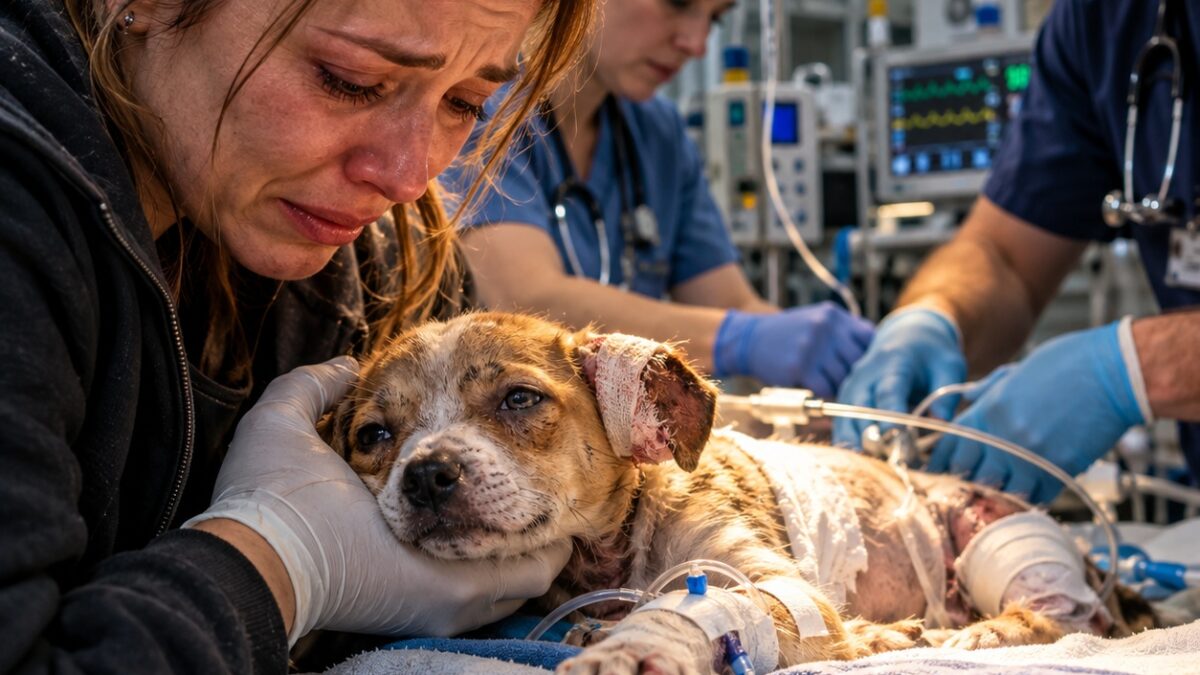
FULL STORY CONTINUATION
The first surgery lasted more than four hours.
Four hours is a long time when a healthy animal is under anesthesia.
When the patient is a badly injured, severely infected puppy whose body has already spent days—or perhaps longer—trying to survive untreated wounds, four hours feels impossible.
I watched the clock.
Then stopped watching because every minute started feeling personal.
Someone brought coffee.
I forgot to drink it.
Another rescuer sat beside me.
Neither of us talked much.
What was there to say?
We had seen Elijah.
Words did not improve the image.
Behind the surgery doors, the medical team was removing maggots one by one and in clusters from wounds that went deeper than we had realized.
They flushed damaged areas repeatedly.
Cleaned dirt.
Discharge.
Dead tissue.
Anything that could continue feeding infection.
The more they cleaned, the more the true extent of the injuries became visible.
That is one of the cruel things about severe wounds.
Filth can hide damage.
Once the contamination is removed, you finally see what remains.
Elijah had multiple punctures.
Areas where skin had separated from tissue below.
Places where infection had spread beyond the original wounds.
And areas of necrosis—flesh that no longer had enough healthy blood supply to survive.
The team removed what could not be saved.
Carefully.
Conservatively.
A puppy has so little body to begin with.
Every piece matters.
His ear was one of the worst areas.
The damage had progressed too far.
Part of it could not be preserved.
The surgeons had to amputate the dead portion.
I learned that after the procedure.
The veterinarian came out looking exhausted.
“How is he?”
“He made it through surgery.”
I breathed for what felt like the first time in hours.
Then she did not smile.
That told me the rest.
“He’s critical.”
“What happens now?”
“We monitor him very closely.”
She explained.
The surgery had removed a huge amount of contamination.
That did not mean the infection was gone.
His body had already been affected.
Some skin that looked questionable might still die.
He would need intensive wound management.
Antibiotics.
Pain medication.
Nutritional support.
Fluids.
Possibly more procedures.
Possibly more surgery.
“And his ear?”
She hesitated.
“We had to remove part of it.”
I closed my eyes.
Not because the ear mattered more than his life.
Because it was another thing taken from a puppy who had already lost too much.
“Is he awake?”
“Not fully.”
“Can we see him?”
“Briefly.”
Elijah looked smaller after surgery.
That seems impossible.
Most of his body was hidden beneath dressings.
Bandages covered areas I had seen raw only hours earlier.
Lines ran from him.
Equipment surrounded him.
His ear was wrapped.
A feeding tube had been placed because his body desperately needed calories, protein, and energy to heal whether or not he felt strong enough to eat voluntarily.
A catheter meant he did not have to stand every time his body needed relief.
A wound vacuum had been applied to help manage one of the most serious areas.
The machine created controlled negative pressure over the wound.
It looked clinical.
Impersonal.
Necessary.
I hated all of it.
Not because the equipment was bad.
Because a puppy should have been chewing on toys.
Not surrounded by tubes.
He should have been asleep because he wore himself out playing.
Not because pain medication and surgery had drained everything from him.
I touched him in one of the few places where the staff said it was safe.
“Elijah.”
His eyes opened slightly.
Then closed.
“That’s okay.”
I kept my voice low.
“You don’t have to do anything.”
That became something I said often.
You don’t have to do anything.
Because everybody around Elijah wanted him to survive so badly that it would have been easy to turn survival into another demand.
Eat.
Stand.
Respond.
Fight.
Please.
But Elijah was already doing everything his body could.
There is a tendency to call severely injured animals “fighters.”
I understand why.
We need language for hope.
But I never wanted Elijah’s survival to become some moral test.
If his body failed, it would not mean he had not fought hard enough.
No puppy should ever have been asked to fight this hard in the first place.
Our job was to give him the best possible chance.
His job was simply to exist inside that chance.
The first night after surgery was terrifying.
His vital signs needed constant monitoring.
Pain control had to be balanced carefully.
His body temperature.
Hydration.
Wound drainage.
Everything mattered.
Infection can destabilize an animal quickly.
Elijah had almost no reserve.
I went home because the hospital staff told us to.
I did not sleep.
Every time my phone moved, I grabbed it.
Sometimes it was nothing.
An email.
A notification.
Then a real update came.
Stable.
That word became beautiful.
Not good.
Not safe.
Stable.
I learned to celebrate smaller vocabulary.
By morning, Elijah was still alive.
The next day, he looked almost exactly as fragile.
That was hard.
You want surgery to create visible improvement.
Before.
After.
Clean wound.
Bright eyes.
Tail.
Reality does not care about our preferred storytelling pace.
Elijah remained critical.
The team continued flushing and treating wounds.
Pain medication kept him as comfortable as possible.
The feeding tube did the work his appetite could not yet do.
The wound vacuum ran.
Antibiotics attacked the infection from inside while wound care attacked it from outside.
His body had to meet them in the middle.
Some areas responded.
Some did not.
Then came the news we feared.
More tissue was dying.
Even after the first debridement, damaged skin that had seemed potentially viable was declaring itself unsalvageable.
Necrosis can continue.
Blood supply compromised by infection and trauma may not recover.
The veterinarian explained that dead tissue could not simply remain.
It would become another source of infection.
Another burden.
More surgery.
I looked through the hospital glass at Elijah.
His body was already so covered.
“How much more can he take?”
The veterinarian did not answer with certainty.
That mattered.
Good medicine respects uncertainty.
“We’ll do only what he needs.”
Not what looks dramatic.
Not everything possible because technology exists.
Only what gives him a chance.
The second procedure removed additional dead tissue.
Less time than the first.
Still too much for a puppy.
When he came back, he was exhausted.
I sat near him.
Elijah barely lifted his head.
“Don’t.”
I put my hand beside him.
“Save it.”
He let his head drop.
For a long time, nothing happened.
Then his nose moved toward my fingers.
Barely.
Contact.
I felt his breath.
That tiny choice destroyed me emotionally more than any dramatic movement could have.
He wanted contact.
After everything.
That was the part of Elijah nobody understood.
If any dog had a reason to fear people, it was him.
We believed humans had been involved in the cruelty that put him there.
Human hands had failed him.
Human decisions had allowed wounds to become catastrophic.
Yet when gentle hands reached toward him now, Elijah did not spend every moment trying to get away.
He leaned.
Sometimes only an inch.
Sometimes his head.
Sometimes the side of his face.
He wanted comfort.
That did not mean trauma had magically disappeared.
He was exhausted.
Medicated.
Vulnerable.
But there was unmistakably something inside him still open to us.
The staff noticed too.
A technician would enter.
Speak softly.
Elijah’s body relaxed.
Someone changed a dressing.
He endured it.
Painful procedure finished.
Hand rested near him.
He leaned closer.
Soon half the hospital seemed emotionally invested.
“Your boy is awake.”
“Our boy?”
“He’s everyone’s boy now.”
That happened quickly.
His care was intense.
The people changing dressings at two in the morning knew him.
The person checking his feeding tube knew him.
The veterinarian reviewing his wound margins every day knew him.
They did not fall in love because Elijah was easy.
Nothing about his case was easy.
They loved him because the puppy beneath the injuries kept appearing in flashes.
A look.
A gentle response.
A small movement toward affection.
Sometimes a tail shift.
Not yet a real wag.
Enough.
Then a setback.
His wounds needed another procedure.
Every surgery reopened the same fear.
Anesthesia.
Blood pressure.
Infection.
Recovery.
I began hating the phrase:
“We need to take him back.”
Take him back to surgery.
I knew why.
Still hated it.
Before one procedure, I stood near him.
“You’ve done enough.”
His eyes looked toward me.
“We’re going to let them help you again.”
That sounded more accurate.
We were not sending him somewhere frightening because he had failed to heal.
We were allowing professionals to continue what his body needed.
When he returned, he was wrapped even more extensively.
Staples closed areas that could now be brought together.
Other regions remained open because closing contaminated tissue too soon can trap infection.
Healing has rules.
You cannot rush skin because everyone is tired of seeing a wound.
The wound vacuum remained.
Feeding tube remained.
Catheter remained.
Machines.
Lines.
Bandages.
Elijah inside.
Days blurred.
I learned his hospital routine without trying.
Morning rounds.
Wound checks.
Medication.
Nutrition.
Dressing changes.
Rest.
Another assessment.
His weight.
Temperature.
Blood values.
Hydration.
Urine output.
Everything.
When you are waiting for an animal to survive, ordinary numbers become emotional events.
Temperature lower?
Good.
White cell changes?
What does that mean?
Wound drainage improved?
How much?
We asked too many questions.
The veterinary team answered anyway.
One morning the veterinarian said:
“The infection is beginning to respond.”
Beginning.
I held onto it.
“What about the skin?”
“Some areas look healthier.”
Some.
Also good.
“Is he safe?”
“No.”
I appreciated that answer too.
Hope without dishonesty.
Elijah was improving in places.
Still critical overall.
That became our reality.
Two truths simultaneously.
His body began slowly stabilizing.
Not beautifully.
Not linearly.
One day brighter.
Next day exhausted.
A little more alert.
Then slept most of the afternoon.
One wound looked better.
Another needed closer attention.
Progress came fragmented.
We celebrated fragments.
The first time Elijah held his head up for more than a few seconds, somebody took a picture.
His face looked tired.
Bandage near his ear.
Eyes half-open.
To anyone else, it might not look victorious.
To us, he was holding his own head.
Huge.
The first time he shifted position without assistance?
Huge.
When he reacted to a familiar voice?
Huge.
Then came food.
Up to that point, the feeding tube had done the job.
His body needed nutrition whether he was hungry or not.
Protein to rebuild tissue.
Calories to survive healing.
But voluntary eating would mean something different.
Appetite is not merely about nutrition.
It tells you the body is turning outward again.
Interested.
Participating.
One afternoon, a small amount of food was offered.
Elijah sniffed.
Nothing.
No pressure.
Try later.
Again.
Sniff.
Turn away.
Fine.
The feeding tube remained.
The next day.
Food.
His nose moved.
Closer.
One lick.
I froze.
The technician smiled.
“Come on, buddy.”
I wanted to say:
Do not pressure him.
Then Elijah took a small bite.
Chewed.
Swallowed.
I put my hand over my mouth.
The technician looked at me.
“You okay?”
“No.”
She laughed quietly.
Elijah ate another bite.
For another puppy, this would have been nothing.
A meal.
Ordinary.
For us it felt impossible.
He was choosing to eat.
Not a tube feeding him because his body could not do enough on its own.
He wanted food.
The life inside him wanted something.
That first voluntary meal was not large.
Did not need to be.
He had crossed another line.
Afterward, he slept.
I sat beside him like he had accomplished something historic.
Maybe he had.
We started seeing changes more frequently after that.
Not miracles.
Momentum.
He ate a little more.
Then more.
The staff adjusted nutrition carefully.
The feeding tube still supported him until everyone was confident he could meet his needs.
No rushing to remove medical help for the sake of a dramatic milestone.
The tube was not failure.
It had kept him alive long enough to eat.
Eventually, though, it was no longer necessary.
The day they removed it, I almost asked to keep it as some kind of horrible souvenir.
I did not.
Some things should leave.
The wound vacuum eventually came off too.
That machine had become so associated with Elijah that seeing him without it made him look strangely unfinished.
Then I realized:
No.
Less medical equipment.
More dog.
That was the direction.
The first walk outside happened before he looked remotely healed.
I want to be clear about that.
He still had wounds.
Still had healing tissue.
Still had areas protected.
His ear had permanently changed.
His body remained thin and recovering.
But he had reached a point where controlled movement and fresh air were possible.
A staff member supported him.
We stepped outside.
Sunlight hit him.
Elijah blinked.
For a moment, he just stood.
Or tried to.
His legs looked uncertain beneath him.
Muscle disappears quickly during critical illness.
A puppy who should be building strength through play had spent days fighting infection and recovering from surgery.
His first step was small.
Then another.
Someone behind me started crying.
I turned.
A technician.
She laughed through tears.
“Sorry.”
“No.”
I was crying too.
Elijah moved forward.
Slow.
No heroic run.
No dramatic sprint.
One step.
Balance.
Another.
Pause.
That was enough.
The puppy we had once carried because he could do almost nothing was choosing where to put his feet.
He reached a patch of grass.
Sniffed.
That destroyed us all.
Sniffing grass.
Ordinary.
One of the most beautiful things I had ever seen.
He did not walk far.
Nobody needed him to.
He returned inside.
Rest.
But we had seen it.
His body contained enough life to move toward something.
After that, the hospital staff started talking about him differently.
Not consciously.
At first:
The critical puppy.
The severe wound case.
Now:
Elijah likes this food.
Elijah wanted to look out the door.
Elijah tried to follow a tech.
Elijah likes that toy.
Personality began replacing prognosis in conversation.
That shift was everything.
A patient becoming a puppy.
The wounds continued healing.
Staples stayed until they had done their job.
Then some came out.
Later more.
Bandages grew smaller.
A patch of exposed skin became healthy pink tissue.
Another area closed.
Infection markers improved.
Pain medication changed as his needs changed.
He became more alert during treatments.
Sometimes mildly opinionated.
That delighted everyone.
One dressing change, Elijah shifted away and gave the technician a look.
She laughed.
“Oh, now you have complaints?”
He stared.
“Good.”
That was exactly how we felt.
Complain.
Have preferences.
Be difficult.
A puppy secure enough to dislike medical care is doing something normal.
No one expected him to enjoy it.
He had tolerated more than enough.
As he improved, his damaged ear became easier to see.
Part had been amputated.
The shape would never be what it had been before.
I found myself staring once.
Not because he looked bad.
Because I remembered what forced that decision.
Someone noticed.
“He’s still handsome.”
I smiled.
“He is.”
He did not care.
Dogs rarely suffer from our obsession with symmetry.
Elijah’s ear functioned as much as it could.
He healed.
That was enough.
The scar was not a tragedy by itself.
The tragedy was what caused it.
The healed result was survival.
I tried to remember that.
People would later see the ear and ask questions.
Fine.
But I never wanted Elijah introduced permanently as:
The dog with the missing ear from abuse.
He was becoming too much more.
Sweet.
That was the first word everybody used.
Sweet.
Even after everything.
He leaned into people.
Accepted affection.
Looked for familiar faces.
When someone sat with him, he settled.
When gentle hands rubbed the safe areas of his body, his eyes softened.
He wanted companionship.
The staff adored him.
Then playful.
That took longer.
Understandably.
Play requires extra energy.
You do not play while your body is allocating every resource to survival.
The first hint was a toy.
Someone placed it near him.
Elijah sniffed.
Nothing.
Later he nudged it.
Another day, mouth.
Small bite.
Release.
Then one afternoon, he grabbed a toy and held it.
The entire room reacted like a stadium.
“Elijah!”
He dropped it.
Everyone froze.
Too much.
We laughed.
Someone moved the toy again.
Elijah followed.
Tail.
There.
A real wag.
Not just movement from repositioning.
A wag.
I looked at the staff.
“Did you see?”
Every person in the room:
“Yes.”
We were ridiculous.
Proud.
Relieved.
Emotionally destroyed by a tail.
Elijah took the toy again.
The puppy was coming back.
That phrase bothered me later.
Coming back from where?
We did not know who he had been before.
Maybe he had never been allowed to play.
Maybe this was not returning.
Maybe he was discovering puppyhood for the first time.
That possibility hurt.
But it also made every toy more important.
Play was not merely evidence of recovery.
It was access to something he should always have had.
A puppy’s life.
No survival purpose.
No medical goal.
Just:
This squeaks.
I want it.
That is freedom.
Elijah began moving more.
Walking with more confidence.
His body filled out gradually as eating improved.
Wounds closed.
Bandages disappeared one after another.
The day the last major dressing came off, his body still carried scars.
Of course.
Healing does not restore untouched skin.
But the active emergency had changed.
No maggots.
No rotting tissue.
No wound vacuum.
No feeding tube.
No constant battle against overwhelming infection.
Scars.
Healthy tissue.
Fur beginning to return around some areas.
I ran a gentle hand where the staff allowed.
Warm.
Alive.
The first image returned.
Maggots.
I pushed it away.
Present.
Elijah now.
That became important.
If every good moment is constantly compared with the worst, the worst keeps owning the story.
Elijah deserved present tense.
He is eating.
He is walking.
He is playing.
He is trusting.
Not only:
He was hurt.
Rescue work can unintentionally trap animals inside trauma because trauma is what brought attention.
People donate because they see the emergency.
Then months later, the animal is healed, and everyone still introduces him through the wound.
Elijah had suffered enough.
His future identity did not need to be:
Bait dog.
Maggot puppy.
Abuse case.
Those facts belonged in his history.
Not his whole name.
The staff began referring to him affectionately as “the little boy.”
“How’s our little boy?”
“Eating.”
“Our little boy played.”
“He went outside.”
Simple.
He became less medically extraordinary every week.
I loved that.
Eventually, the question shifted.
Not:
Will Elijah survive?
Now:
Where will Elijah live?
That question scared me in a different way.
A forever home sounds like the easy part after intensive medicine.
Sometimes it is not.
Elijah had visible scars.
A damaged ear.
A history that would make people emotional.
I did not want someone adopting him because his suffering made them feel heroic.
Pity can begin relationships.
It does not always sustain them.
He needed people who wanted Elijah.
Not only his story.
People willing to see a young dog who might be playful.
Affectionate.
Curious.
Needing normal boundaries.
Normal training.
Normal veterinary care.
Not a fragile museum piece.
Survivors still need ordinary lives.
We began looking.
Applications came.
People had seen his story.
Some wrote paragraphs about how sorry they felt.
I understood.
But sorrow was not the qualification.
Who was home?
Other animals?
Lifestyle?
Experience?
What did they expect from him?
Could they see past the first photographs?
One person said:
“I just want him to know nobody will ever hurt him again.”
Beautiful intention.
But dogs need more than protection.
They need lives.
Walks.
Play.
Exploration.
Rules.
Social interaction appropriate to them.
Patience.
Someone else talked about car rides.
Outdoor adventures.
Swimming eventually if Elijah enjoyed water.
Other dogs introduced carefully.
That sounded like a future.
Not a memorial.
When the right family appeared, there was no movie-music moment.
There was an introduction.
Elijah approached.
Sniffed.
Accepted attention.
People talked.
Asked good questions.
Not:
How horrible was it?
More:
What food does he like?
What does he play with?
How much exercise is appropriate right now?
How does he respond to other dogs?
What ongoing care does he need?
That told me something.
They wanted the dog standing in front of them.
Not just the tragedy behind him.
Elijah leaned toward them.
I felt the same fear every rescuer feels.
What if we are wrong?
No screening process can predict everything.
Eventually you have to trust evidence.
Their behavior.
Their preparation.
Their willingness.
Elijah’s response.
The home was approved.
The day he left the hospital/rescue system for his permanent home felt strange.
We had spent so long fighting to keep him alive that handing him over felt almost irresponsible.
Like:
Are you sure?
Do you understand how much we watched him?
Do you understand every scar?
Every medication?
Every small sign?
Of course they could not understand it exactly.
They had not been there.
That was okay.
They did not need to carry our fear.
They needed to carry Elijah forward.
He had a collar.
Leash.
No tubes.
That contrast hit me.
I knelt.
“You’re leaving us.”
Elijah wagged.
Unconcerned.
Good.
“You are incredibly ungrateful.”
More tail.
Someone laughed.
I touched the healed side of his face.
His damaged ear gave him an unmistakable look now.
Beautiful.
His own.
“You don’t know what’s happening, do you?”
Maybe he did.
New people.
Car.
Movement.
Another transition.
This time, unlike his first arrival at the hospital, he was strong enough to climb into a life.
No one carried him because he was dying.
He went because he was ready.
That difference brought tears.
The car pulled away.
I stood there longer than necessary.
Rescue is strange.
Success often looks like losing someone.
You work desperately to keep an animal with you.
Then if everything goes right, they leave.
That is the goal.
The first updates mattered.
Eating.
Sleeping.
Exploring.
Settling.
Then car rides.
Elijah liked them.
Photograph:
His face near a window.
Wind moving the fur that had grown back.
That ear.
Those bright eyes.
I stared at it.
No hospital.
Another update:
Other dogs.
Careful introductions.
Elijah interacting.
That mattered because of what we had been told about his past.
Reportedly used as a bait dog.
People sometimes assume a dog with that history must fear or hate every other dog forever.
Not necessarily.
Trauma affects individuals differently.
We did not force a narrative onto Elijah.
His new family introduced him appropriately and watched him.
He could meet other dogs without being attacked.
Think about that.
Another dog could approach and the encounter could mean:
Sniff.
Walk.
Play.
Normal canine communication.
Not pain.
That ordinary social possibility was something cruelty had tried to steal.
Now he had it.
Then swimming.
The first photo made me laugh.
Elijah in water.
His body strong enough to move through it.
No bandages.
No wound vacuum.
Just a dog.
Water around him.
Someone nearby.
He looked alive in a way the word alive could not describe.
Not technically surviving.
Participating.
That distinction became the heart of his story.
There is a huge difference between being kept alive and living.
At the hospital, our goal was first:
Heartbeat.
Blood pressure.
Nutrition.
Infection.
Tissue.
Life in the biological sense.
Later:
Toy.
Walk.
Car.
Water.
Friends.
Family.
Life in the full sense.
Elijah reached both.
I would sometimes show his latest picture to staff who had treated him.
“Look.”
A technician would stop.
“Oh my God.”
We all became emotional again.
The people who had seen him at his worst were uniquely qualified to understand the ordinary photographs.
A normal person sees a dog in a car.
We saw:
He survived.
A normal person sees a dog swimming.
We saw:
That body works.
A normal person sees him with another dog.
We saw:
He gets to have friends.
A normal person sees him asleep on a bed.
We saw:
No equipment.
No pain crisis.
No one watching every breath.
That is why rescue updates matter.
They close something in the people who carried the beginning.
Not perfectly.
Some cases stay with you.
Elijah will always stay with me.
But seeing him live prevented the first image from being the only image.
Thousands of maggots.
No.
Also:
Toy.
Water.
Car.
Dog friend.
Family.
Those images stand beside the first now.
That is healing for humans too.
People asked how Elijah could still trust humans.
I never liked pretending I knew.
Animals do not narrate their psychology to us.
I cannot say:
He forgave.
That is a human word.
Maybe Elijah distinguished one person from another.
Maybe the desire for social connection remained despite trauma.
Maybe his age mattered.
Maybe temperament.
Maybe safety experiences accumulated quickly.
What I can say is what we observed.
Gentle hand.
Lean.
Soft voice.
Relax.
Familiar person.
Interest.
He accepted affection.
Sought it.
Loved being close.
That was enough.
I never needed to call it forgiveness.
Forgiveness can accidentally make suffering responsible for a moral lesson.
Elijah did not owe humanity grace because humans hurt him.
He deserved kindness whether he trusted us or not.
The miracle was not that he remained sweet enough for us.
The miracle was that he survived long enough to get a choice.
That is different.
Had Elijah growled at everyone, we would still have treated him.
Had he hidden?
Still.
Had he taken months to trust?
Still.
His affection was a gift.
Not proof he deserved rescue.
He deserved rescue the moment someone saw him suffering.
Full stop.
I think about the four-hour surgery.
Sometimes more than the adoption day.
Those surgeons had no guarantee.
They could have worked for hours and still lost him.
They removed maggots because leaving them meant death.
Removed necrotic tissue because his body could not heal around rot.
Removed part of his ear because preserving dead tissue would have endangered the rest of him.
That is what medicine sometimes is.
Not restoring everything.
Choosing what can be saved.
People later looked at Elijah’s ear and saw what was missing.
I looked and saw what stayed.
Elijah.
That body.
Those eyes.
Life.
A perfect ear would have been nice.
Living dog better.
Scars are often described poetically as evidence of strength.
Sometimes I think we put too much burden on scars.
A scar is healed tissue.
That is enough.
It does not need to inspire anyone.
Elijah’s ear did not need to become a symbol.
But since people naturally ask what happened, I preferred one interpretation over pity.
It meant the wound closed.
The infection stopped.
The surgery worked.
Healing happened.
Closed is powerful.
At first his body contained open wounds full of life that did not belong there.
Maggots.
Bacteria.
Death spreading through tissue.
Later:
Closed skin.
Fur.
Scars.
Him.
That biological reversal still amazes me.
Bodies can come back from terrible places if they receive help in time.
Not always.
That is why Elijah’s story should never become:
Love saves everything.
Sometimes it doesn’t.
Veterinary medicine has limits.
Infection wins sometimes.
Trauma wins.
Bodies fail.
Elijah was fortunate enough to reach care while his body still had a path forward.
The veterinary team created as much opportunity as they could.
His physiology responded.
That combination gave us Elijah today.
I respect that more than language about miracles alone.
Miracle can erase the work.
Four hours of surgery.
Debridement.
Wound management.
Medication.
Nutrition.
Monitoring.
Repeated procedures.
Tube feeding.
Vacuum therapy.
Nursing.
Clean bedding.
Constant assessment.
Human beings doing difficult, technical, exhausting work.
That mattered.
So did money.
Resources.
Access to an animal hospital equipped for this level of care.
Rescue does not happen through emotion alone.
Someone has to fund treatment.
Someone has to clean.
Drive.
Administer medication.
Change dressings.
Document.
Follow up.
Love shows up as logistics a lot.
Elijah received logistics.
That saved him.
One of the nurses once told me:
“The first day, I was afraid to touch him.”
I understood.
Not emotionally.
Physically.
Where do you touch a body covered in wounds?
Later that same person sent me a photo of Elijah leaning his whole body into her.
“That’s progress,” she wrote.
Yes.
A body that once had almost nowhere safe to touch becoming a body asking for contact.
That stays with me.
His eating milestone also stays.
People hear:
He ate.
Fine.
But appetite after critical illness is communication.
The feeding tube had done essential work.
Removing it too early for emotional satisfaction would have been irresponsible.
When Elijah voluntarily began eating enough, then we knew.
His body was taking over functions machines had supported.
Same with walking.
We did not prop him up for a triumphant video before he was ready.
When he walked, it was because his body had regained enough strength.
That is why every step mattered.
We did not make the milestone.
He did.
A puppy walking on grass should not bring a room full of adults to tears.
Except when you have seen that puppy unable to lift his head.
Context changes ordinary things.
Even now, when I see a healthy puppy tearing across a yard, part of me thinks of Elijah.
That animal does not know how lucky it is to waste energy.
Waste.
That is the beauty.
Run for no reason.
Chew something useless.
Chase another dog.
Jump.
Roll.
Bodies with surplus energy can waste it on joy.
Elijah eventually had surplus.
That felt extravagant.
He started playing with toys.
Then going on adventures with his family.
Those were calories not spent on infection.
Strength not spent surviving surgery.
Attention not spent enduring pain.
Life redistributed toward pleasure.
That is recovery.
His forever family understood that his scars did not need constant protection from experience.
They allowed him to live appropriately.
Car rides.
Water.
Other dogs.
Exploration.
Not locked in a soft room because he had suffered before.
Safety does not mean shrinking life until nothing can happen.
It means giving an animal secure conditions from which he can experience things.
Elijah had that.
That is why seeing him swim mattered.
Risk managed.
Life expanded.
The first hospital room was narrow.
Eventually his world was big.
That is the trajectory I love.
From lying almost motionless in pain—
to outside.
To home.
To car.
To water.
To friends.
More world.
Cruelty had reduced his life to a body under attack.
Love and medicine gave the world back.
I do not know whether Elijah remembers the beginning.
I hope memory in dogs is kinder than ours sometimes.
Maybe he carries sensory pieces.
Maybe not.
It does not matter for the truth of the ending.
Whether or not he remembers pain consciously, his current life is not organized around it.
That is enough.
He does not wake in an animal hospital.
No wound vacuum starts humming beside him.
No feeding tube.
No bandage changes.
No surgical schedule.
He wakes at home.
That sentence contains everything.
Home.
People.
Routine.
Food.
Adventure.
Sleep.
Repeat.
I think rescue succeeds most completely when the dramatic story becomes irrelevant to the animal.
Humans remember.
Elijah gets to move on.
We may look at his ear and remember maggots.
He may look at the person holding a car key and think:
Ride.
Better.
Let him win that way.
The people who hurt him do not deserve permanent residency in his identity.
They were part of the beginning.
Not the owner of the ending.
I am careful with that phrase too.
“Elijah wrote the ending.”
Dogs do not write narratives.
But emotionally, it captures something.
Whoever allowed his injuries to become that severe made a decision about his worth.
Maybe consciously.
Maybe through neglect.
They left him in a condition that said:
This life is disposable.
Everything afterward contradicted that decision.
Rescuers said:
No.
Veterinarians said:
No.
Nurses changing wounds said:
No.
A feeding tube said:
This body is worth nourishing.
Four-hour surgery said:
This body is worth working on.
Another procedure said:
Again.
His family said:
Come home.
Every act opposed abandonment.
That is powerful.
Not revenge.
No courtroom.
No identified perpetrator.
No dramatic justice outside the dog.
We do not have those facts.
I will not invent them.
The justice in this source is Elijah living.
Some people dislike endings where the abuser is not punished on-page.
I understand.
Anger wants symmetry.
Pain caused.
Pain returned.
But animal rescue often does not provide that.
Sometimes we never know who.
Sometimes evidence is limited.
Sometimes legal outcomes are outside the story.
The animal cannot wait for justice to start healing.
So care begins first.
Elijah’s recovery did not require us to know every person who failed him.
It required surgery.
Immediately.
That is where our energy went.
I still felt anger.
Of course.
How could someone watch that happen?
How could wounds reach infestation?
How could a baby be used as bait?
Questions.
No answers.
Eventually anger becomes expensive if you feed it every day.
Elijah needed something else from us.
Presence.
So I learned to move from:
Who did this?
to:
What does he need now?
That question was useful.
Pain control.
Done.
Food.
Done.
Dressings.
Done.
Touch.
If wanted.
Rest.
Safety.
Later toy.
Later walk.
Later family.
Now matters.
The future gets built from now.
The first time his forever family sent a picture of him sleeping deeply, I stared at it longer than the adventure photos.
He was stretched out.
Body loose.
That old damaged ear visible.
Nothing medical nearby.
Do you know what it means for a dog once in constant pain to sleep with his whole body unguarded?
Everything.
Sleep is vulnerability.
No monitoring.
No survival attention.
He expected safety to continue while unconscious.
That may be the deepest trust an animal can show.
I saved the photo.
The swimming photo too.
Car photo.
A picture near other dogs.
I built a folder.
Not:
Elijah Rescue Case.
Just:
Elijah.
Because eventually the qualifier should go away.
He is not Rescue Elijah forever.
He is Elijah.
One day somebody will meet him without knowing.
They may notice his ear.
Maybe ask.
His family can tell them.
Or not.
His value does not depend on the listener crying.
I like imagining someone seeing only:
Sweet dog.
Friendly.
Playful.
Loves the car.
Likes water.
That is freedom from narrative.
The scar remains physical.
The story becomes optional.
There is dignity in that.
I remember the first time someone described him as “beautiful” after recovery.
Not brave.
Not survivor.
Beautiful.
I liked that.
Survivor is powerful.
It can also become a job.
Elijah does not need to survive every day now.
He already survived the emergency.
Today he can simply be beautiful.
Or muddy.
Or annoying.
Or sleepy.
Or playful.
Whatever.
That is normal life.
His family did not adopt a symbol.
They adopted a dog.
That is exactly what we wanted.
A dog who might steal space.
Get wet.
Track dirt.
Want food.
Meet friends.
Need affection.
Have preferences.
Carry an imperfect ear.
Perfect.
One of the most important changes happened in us too.
During critical care, every person who entered Elijah’s room looked for danger.
Is the wound worse?
Temperature?
Drainage?
Pain?
Later, when somebody entered:
Where’s the toy?
Want to go outside?
Hi, buddy.
The environment stopped being clinical.
Language changed.
That told us the emergency had receded.
He was allowed to be inconvenient.
One day he apparently wanted to play during a moment when someone wanted him to rest.
Good.
That made me laugh.
Disobedience can be a health milestone.
Not medically official.
Emotionally true.
An animal no longer conserving every ounce of energy starts spending it stupidly.
Welcome back.
Elijah’s recovery also forced me to think about the word “baby.”
He was a puppy.
That made the initial cruelty especially shocking.
But adult animals deserve the same outrage.
Age does not determine whether pain matters.
Still, puppyhood represents dependency.
A puppy depends almost completely on humans for environment, safety, feeding, medical care.
Whoever had responsibility for Elijah failed catastrophically.
That is why the hospital’s care felt like restoration of something basic.
Adults finally behaving like adults around a dependent animal.
Feed.
Protect.
Treat injury.
Not complicated morally.
Technically difficult because damage was so severe.
Morally simple.
Help the baby.
That was all.
I wish he had arrived with small wounds.
One puncture.
An infected ear caught early.
Easy antibiotics.
Quick recovery.
But rescue rarely lets us rewrite timing.
We get the animal at the point someone finally intervenes.
Elijah arrived late.
Very late.
Still not too late.
That phrase matters.
Late is not always too late.
You do not look at a terrible condition and assume suffering has already decided the outcome.
Get to a veterinarian.
Act.
Sometimes there is still a path.
Elijah had one.
Narrow.
Expensive.
Painful.
He traveled it.
I think of the medical team whenever somebody praises only the rescue organization.
We carried him.
They performed the work that kept him alive.
More than four hours the first surgery.
Imagine concentrating that long on microscopic decisions.
What tissue stays?
What goes?
Where to flush?
What wound can close?
What needs open management?
How much anesthesia?
What fluid support?
Every decision inside a tiny body.
Then nursing afterward.
Surgery is visible.
Nursing is endless.
Midnight.
Three a.m.
Six.
Pain medication due.
Tube.
Wound vac.
Temperature.
Clean.
Turn.
Comfort.
Elijah’s forever home was built partly in those invisible hours.
He could not reach the family without surviving the night.
Somebody was there.
That is the hidden architecture of rescue.
People.
Shifts.
Schedules.
Not one heroic moment.
Many ordinary ones.
I returned to visit him during recovery as often as appropriate.
I never wanted to interfere with treatment.
Sometimes I sat fifteen minutes.
Sometimes longer.
Often he slept.
I considered those good visits.
If an injured puppy can sleep while you are there, maybe your presence has become safe.
One day he woke and immediately shifted toward me.
No hesitation.
I cried.
Again.
I cried far too much around Elijah.
He would have been embarrassed if dogs experienced secondhand embarrassment.
He placed his head near my hand.
I rubbed his cheek.
“You’re getting heavy.”
Not really.
But heavier.
Wonderful.
“Keep it up.”
He closed his eyes.
That weight became another milestone.
At first, lifting him felt like lifting something too fragile.
Later, there was body.
Muscle.
Substance.
His ribs less sharp.
A puppy filling the space under his skin instead of disappearing from it.
Nutrition is visible eventually.
Meal by meal.
Another boring miracle.
When he went outside again, the steps looked stronger.
No one cried as much.
That was progress for us.
His walking no longer required ceremony.
Eventually it became:
Elijah needs his walk.
Excellent.
Normal tasks replacing miracle language.
I wanted that everywhere.
The adoption day had the same quality.
Everyone emotional.
Then updates became routine.
Elijah went in the car.
Of course.
Elijah went swimming.
Great.
Elijah has dog friends.
Wonderful.
Elijah slept.
Perfect.
The less extraordinary safety became, the more successful the rescue.
That is something I did not understand when I started.
I thought success meant dramatic transformation photographs.
Now I think it means nobody needs to photograph breakfast.
Breakfast simply happens.
Elijah eats.
Nobody cries.
That is peace.
His damaged ear will always remain visible.
Fine.
Bodies tell history.
But I hope people notice the eyes first.
The brightness that returned.
At the beginning, his eyes looked overwhelmed.
Later, engaged.
Following movement.
Looking toward people.
Wanting.
That change cannot be surgically created.
It emerges as pain decreases and life becomes interesting again.
That may be my favorite transformation.
Interest.
Pain is selfish in the biological sense.
It demands attention.
When pain eases, the world reappears.
Toy.
Grass.
Person.
Water.
Dog.
Car.
Elijah regained the world because his body no longer had to spend every second reporting emergency.
That is what the veterinary team gave him.
Quiet inside himself.
Enough quiet to notice fun.
One of the last times I saw him before adoption, he tried to follow someone out of the room.
“Where are you going?”
Tail.
No answer.
He wanted to go.
That is such a simple desire.
At the beginning, wherever we placed him was where he stayed.
He lacked strength and choice.
Now:
I want to go there.
Agency.
We opened the door when safe.
He walked.
Beautiful.
His forever home expanded that agency.
Adventure means choices within safety.
Different places.
New smells.
Water.
Friends.
A dog once immobilized by injury experiencing movement as pleasure.
I do not think any revenge scene could be more satisfying.
That is why the ending belongs with life, not punishment.
Elijah swimming is the answer.
Elijah sleeping safely is the answer.
Elijah playing with dogs is the answer.
The people who hurt him are absent from those scenes.
Exactly.
Their importance diminished.
That is victory.
I know some wounds never disappear emotionally for rescuers.
The first sight of Elijah remains.
Sometimes an unrelated smell brings it back.
Infection has a smell.
I hate it.
A certain sound from a wound vacuum can do the same.
Then I remind myself of current photos.
Memory needs updating deliberately.
Otherwise trauma freezes time.
Elijah did not stay on that first table.
Neither should my mind.
He moved.
So I follow.
Hospital.
Outside.
Home.
Car.
Water.
Life.
That sequence helps.
If people hear only the first part of Elijah’s story, cruelty wins attention forever.
Tell the whole thing.
Not sanitized.
The maggots matter.
The dead tissue matters.
The lost part of his ear matters.
They show what he survived and why intervention was urgent.
But continue.
He ate.
He walked.
He healed.
He played.
He was adopted.
He swims.
Complete sentence.
Do not stop at suffering because suffering is visually powerful.
Recovery deserves equal storytelling space.
Maybe more.
That is why I talk so much about ordinary details.
They are the things abuse tried to erase.
Toy.
Bed.
Car.
Friend.
Meal.
Sleep.
Nobody should have to earn them through suffering.
Elijah deserved them before.
He got them after.
I sometimes struggle with language like:
He finally got what he deserved.
Because animals do not earn safety.
It should be default.
Same with children.
Basic care is not reward.
But given the world as it is, we celebrate when restoration happens.
Not because suffering made Elijah more worthy.
Because people finally treated his worth as obvious.
His family did.
They did not need him perfect.
His ear?
Fine.
Scars?
Fine.
History?
Part of him.
What mattered was the dog.
That is the family every rescue animal deserves.
Not someone chasing a heroic identity.
Someone who wakes up Tuesday and fills the bowl.
Saturday and takes the dog somewhere fun.
Monday and schedules veterinary care.
Rainy night and lets the dog sleep.
Years—however many—of ordinary responsibility.
Forever home is not a phrase.
It is calendar behavior.
Day after day.
Elijah has that now.
I think about the night he was found.
No one knew whether there would be another morning.
Now mornings are ordinary.
How extraordinary.
Wake.
Stretch.
Food.
Maybe adventure.
That is the distance he traveled.
Not measured in miles.
Measured in expectations.
The first expectation:
Can he survive?
Now:
What are we doing today?
Huge.
If I could speak to the version of myself standing outside surgery that first night, I would not spoil the ending.
I would simply say:
Keep waiting.
There will be a day when you complain that Elijah has too much energy.
There will be a toy.
There will be grass under his feet.
There will be a family asking about car rides instead of wound margins.
There will be water around him that is there because he chose to swim, not because someone is cleaning injury.
There will be dogs near him that mean companionship.
Not attack.
There will be sleep without machines.
Keep waiting.
At the time, I could not imagine it.
Hope was too dangerous.
I kept it small.
Make it through surgery.
Make it through tonight.
Let the infection respond.
Let tissue survive.
Eat one bite.
Stand.
Step.
Small hope is manageable.
Eventually the hopes become normal life.
That is how Elijah got there.
One small impossible thing becoming possible.
Then another.
I know the phrase “refused to give up” appears in stories about animals like him.
I use it carefully.
Elijah did keep moving forward.
But he also had moments of complete exhaustion.
That is not giving up.
He barely lifted his head.
That is not lack of will.
Bodies need rest.
Healing can look passive.
A puppy sleeping for hours may be doing enormous biological work.
We should not require suffering beings to perform determination for us.
Elijah could lie there.
We would help anyway.
He could fail to wag.
Help.
Refuse food initially.
Tube feeds him.
Too weak to walk.
Carry him.
Rescue should not be conditional on inspiring us.
That lesson stayed.
When he finally did wag, eat, walk, play—
Those acts were his.
Not payment.
Gifts.
I received them that way.
The first meal.
Gift.
Grass sniff.
Gift.
Toy.
Gift.
Later, a photo of him wet from swimming.
Gift.
I never stopped feeling grateful that we got to see them.
People sometimes ask which moment was best.
Adoption?
Walking?
Eating?
I cannot choose.
The first surgery ending with:
He’s alive
was one kind of joy.
The first meal was another.
The first voluntary affection after pain.
Another.
The first play.
Then his family.
Each belongs to a different stage.
If forced, I might choose the moment he stopped looking like a patient and started looking like a dog.
There was no exact second.
That is probably why it mattered.
One day I walked in and realized the equipment had decreased.
His eyes were brighter.
He had opinions.
Someone called him playful.
And suddenly:
There you are.
Not underneath the injuries.
He had always been there.
But now pain no longer spoke louder.
That is recovery.
Not uncovering a hidden “real” dog.
Giving the whole dog room to exist beyond pain.
Elijah eventually reached a point where strangers could see him and not immediately understand the severity of his history.
Except the ear.
Maybe scars.
That is okay.
He does not owe anyone visual perfection.
I hope people learn to see damaged bodies without treating them as damaged lives.
A missing portion of ear does not reduce joy.
A scar does not limit affection.
Different shape.
Same dog.
His family understood.
That was why they were right.
No hesitation about appearance.
They saw him.
I think his rescuers needed that final reassurance.
We had spent so long focused on physical damage that we wanted his family to focus on everything else.
They did.
Adventure.
Personality.
Compatibility.
Life.
Perfect.
The story does not need another ending after that.
No anniversary.
No later tragedy.
No aging epilogue.
The source leaves Elijah living with his family.
So I will too.
Alive.
Safe.
Active.
Loved.
Anything beyond would change the emotional truth.
The final truth is not what happened to him.
It is what is happening now.
He wakes up safe.
That phrase matters.
Safety not as event.
State.
He meets other dogs without expecting harm.
He rides in a car without the destination being emergency surgery.
He enters water because he chooses.
He sleeps because nobody needs to monitor him minute by minute.
He receives affection from people who have no intention of turning their hands into pain.
That is his life.
His damaged ear still carries the shape of history.
Let it.
The rest of him carries the shape of recovery.
Muscle.
Movement.
Bright eyes.
Tail.
Play.
I sometimes think the greatest cruelty done to Elijah was not only pain.
It was the attempted theft of ordinary future.
The people who hurt him nearly took:
First toy.
First safe bed.
First loving family.
First swim.
First peaceful dog friendship.
First car ride toward something fun.
All those small futures were hanging by a thread when we carried him into surgery.
The veterinary team preserved more than tissue.
They preserved possibility.
That is what more than four hours bought.
Possibility.
Another day.
Then another.
Eventually a whole life.
When people call his survival miraculous, I understand.
It feels miraculous.
But I also remember the hands in that operating room.
The people cleaning maggots from wounds no one should ever have seen.
The people removing dead tissue millimeter by millimeter.
The person monitoring anesthesia.
The person managing pain.
The nurse cleaning his bedding.
The technician coaxing the first bite.
The rescuer sitting beside him.
His future family opening their home.
Miracles sometimes have schedules.
Invoices.
Gloves.
Medication charts.
That makes them no less beautiful.
Maybe more.
Elijah was saved by compassion translated into work.
That is the version I believe in.
Love as verb.
Remove.
Clean.
Feed.
Treat.
Wait.
Walk.
Adopt.
Repeat.
One day, long after the machines had disappeared, I saw an updated picture.
Elijah was standing near water.
His family close.
Another dog nearby.
His body looked strong.
Ear permanently changed.
Eyes bright.
I zoomed in.
Not because I needed to inspect wounds.
Habit.
Then I stopped myself.
No wound inspection.
Look at him.
Dog.
Water.
Sun.
Life.
I put the phone down.
For the first time, the image of him covered in maggots did not immediately appear afterward.
That felt like healing.
Mine.
Maybe I had finally allowed his present to become stronger than his beginning.
He deserved that from me too.
We tell stories partly to remember.
We should also tell them in ways that permit change.
Elijah’s story begins horribly.
It does not stay there.
That is the entire point.
Thousands of maggots were eating him alive.
True.
He survived surgery.
Also true.
Part of his ear was lost.
True.
His life was not.
More important.
He needed tube feeding.
True.
Then he chose his own food.
He could barely lift his head.
True.
Then he walked.
He was covered in wounds.
True.
Then he played.
He was reportedly used as a bait dog.
True.
Now he meets other dogs safely.
He was left suffering.
True.
Now people choose him every day.
Complete story.
That is how I want it remembered.
Not as a horror story with a happy photo attached.
As a life moving through stages.
The beginning matters.
The ending matters more because Elijah is the one living it.
I cannot undo the first days.
I can refuse to let them dominate every sentence.
Today—within the endpoint of the story we know—Elijah has a family.
He has friends.
He goes on adventures.
He rides in the car.
He swims.
He plays.
He rests.
He receives love.
That is what remains.
Sometimes I imagine the little body on that first table and want to tell him:
You do not know what is waiting.
But animals live in the present.
Maybe that saved him psychologically.
He did not need to imagine the whole road.
Only the next moment.
Hand gentle.
Pain eased.
Sleep.
Food.
Step.
Toy.
Person.
Home.
Life built from moments.
That is all any of us really get.
Elijah’s early moments were stolen.
His later ones became his.
And maybe that is why the simple photographs affect me more than dramatic rescue images now.
Elijah in a car.
He has somewhere to go.
Elijah swimming.
He has enough strength to waste.
Elijah beside another dog.
He has enough safety to socialize.
Elijah asleep at home.
He belongs somewhere.
Each ordinary act contradicts what was once done to him.
Not loudly.
The best contradictions rarely need speeches.
The person who left Elijah suffering treated his life as disposable.
His family treats breakfast as scheduled.
That is the answer.
Routine defeats abandonment in a quiet way.
Dinner appears again.
Door opens again.
Same people again.
Bed remains.
Home remains.
No need for dramatic promises.
Consistency.
The same kind of consistency that helped Bruno in another story.
Animals learn through what repeats.
For Elijah, pain had repeated first.
Now safety repeats.
That is the replacement I care about.
Not forgetting.
New pattern.
I hope eventually gentle touch became so ordinary that he stopped noticing its moral significance.
A hand is just a hand.
Petting.
Collar.
Toy.
Food.
No flinch.
That is freedom.
Humans may continue seeing symbolism.
Elijah should not have to.
His family gets to know him beyond rescue.
What makes him excited.
What makes him tired.
Which adventures he likes.
How he behaves in the car.
Whether he splashes or swims seriously.
What dog friends he prefers.
All the ordinary biography that cruelty almost prevented.
Those details are not filler in a life.
They are the life.
I wish every rescue story could get there.
Not all do.
That makes Elijah’s especially precious.
Not because he is more deserving.
Because we were lucky enough to witness survival.
The proper response is gratitude and responsibility, not mythology.
He survived.
Protect what comes after.
His forever family is doing that.
I think back to the first question that entered my mind when I saw him.
How could anyone let this happen?
I still do not have an answer.
Maybe I never will.
But another question eventually became more useful.
What can happen now that someone finally cares?
That answer became enormous.
Surgery.
Healing.
Food.
Steps.
Play.
Home.
Swimming.
Life.
The first question belongs to the people who failed him.
The second belongs to Elijah.
I prefer the second.
Years of rescue work—again, I will not invent a biography for the narrator beyond being one of his rescuers—but experiences like his change how you think about endings.
A good ending is not the villain getting punished.
Sometimes it happens.
Sometimes not.
A good ending is the vulnerable life no longer controlled by the worst person in its history.
Elijah reached that.
Whoever hurt him no longer chooses what happens in the morning.
His family does.
More importantly, Elijah’s own needs and personality do.
The people who abandoned him do not decide whether he swims.
Whether he gets in the car.
Whether he sleeps on a comfortable bed.
Whether he plays.
Their control ended the moment rescuers picked him up.
Medical consequences lingered.
Their authority did not.
That is worth emphasizing.
The rescue itself was the first transfer of power.
From cruelty to care.
The hospital deepened it.
His body started belonging to healing instead of injury.
Then adoption.
His daily life moved fully into hands committed to protecting it.
That is the arc.
Not revenge.
Freedom.
Elijah’s ear will remain.
Scars may remain.
Fine.
They cannot dictate the future.
A scar is not a command.
A missing piece is not a destiny.
He moves anyway.
Loves anyway.
Lives anyway.
I dislike saying “despite everything” too often because it turns every joyful act into defiance against trauma.
Maybe Elijah swims because swimming feels good.
Let that be enough.
Maybe he rides in the car because he likes going places.
Maybe he plays with dogs because he likes dogs.
No need to make every tail wag a speech against abuse.
Normal pleasure is more radical.
He is not performing resilience.
He is living.
That is the title beneath every title.
Living.
The first time I heard someone say:
“Elijah is going on an adventure today,”
I smiled for the rest of the afternoon.
Adventure.
Not treatment.
Not procedure.
Not surgery.
Adventure.
What a change one word can hold.
Another time:
“Elijah went swimming.”
Swimming.
Water used for fun.
Not wound flushing.
Language tracks recovery.
Eventually hospital words disappear.
Debridement.
Necrosis.
Catheter.
Wound vacuum.
Feeding tube.
Replace them.
Leash.
Toy.
Car.
Friend.
Home.
That vocabulary shift is the ending.
If someone ever asks me what saved Elijah, I will not say one thing.
Rescuers reaching him.
Emergency surgery.
The team spending hours removing maggots and dead tissue.
Antibiotics.
Pain management.
Nutrition.
Wound-vac therapy.
Repeated procedures.
Nurses.
Time.
His body responding.
Then a family willing to see beyond scars.
All.
Rescue is a chain.
Break one critical link and the ending changes.
He needed everyone.
That does not diminish his role.
It makes survival relational.
None of us survives alone all the time.
Elijah certainly did not have to.
That may be the greatest correction to his beginning.
He had been left alone with pain.
Then suddenly everything became:
We.
We’ve got you.
We’re treating you.
We’re watching.
We’ll feed you.
We’ll help you stand.
We’ll find you a home.
Then:
You’re ours.
Family.
No more alone.
I remember whispering during that first transport:
“No one is leaving you here.”
At the time, it meant that physical place.
Pick him up.
Get him out.
Later, the sentence grew.
The hospital did not leave him in pain.
His rescuers did not leave when treatment became complicated.
Staff did not leave emotionally because progress was slow.
His family did not leave because his body carried visible damage.
No one is leaving you here.
Maybe that is the sentence underneath the entire story.
Move forward.
Together.
At some point, Elijah no longer needed rescuers saying it.
His family’s routine said it.
That is better.
Words become unnecessary when reality repeats them.
The last image I want is simple.
Not surgery.
Not the first horrifying photograph.
Elijah outside with the body everyone once feared would not survive.
One ear permanently changed.
Scars part of him.
Eyes alive.
People nearby.
Maybe a car waiting.
Maybe water.
Maybe another dog.
No bandages.
No machines.
No maggots.
No hands hurting him.
Nothing feeding on his wounds.
Nothing demanding that he fight for another breath.
Just Elijah.
A dog.
A beautiful boy who once had almost everything stolen before life had properly begun and somehow reached people determined to give ordinary things back.
He can play now.
He can swim.
He can ride in the car.
He can meet another dog and discover friendship instead of pain.
He can close his eyes without somebody needing to check whether he will wake.
He can wake up hungry and know food is coming.
He can lean into a hand and know the hand is there because someone loves him.
That is the ending.
The maggots did not get to be his last chapter.
The infection did not.
The dying skin did not.
The damaged ear did not.
The people who failed him did not.
They are part of what happened.
They are not what Elijah became.
What he became was exactly what he should have been allowed to be from the beginning.
A dog with a family.
A dog with friends.
A dog with places to go.
A dog with things to play with.
A dog who is safe.
The first time I saw Elijah, I was terrified he would die before he ever learned what any of those things felt like.
Now, when I see a photograph of him somewhere new, I sometimes think of that fear.
Then I put it away.
He made it.
That sentence is enough.
He made it to food he could eat himself.
To grass under his own feet.
To toys.
To affection.
To home.
And the puppy we once begged simply to survive now wakes every day with the privilege he was nearly denied forever.
He gets to live.








