FULL STORY:They Left 11-Year-Old Bruno Behind and Wanted Him Put Down—Then My Daughter Refused to Walk Past Him Like Everyone Else
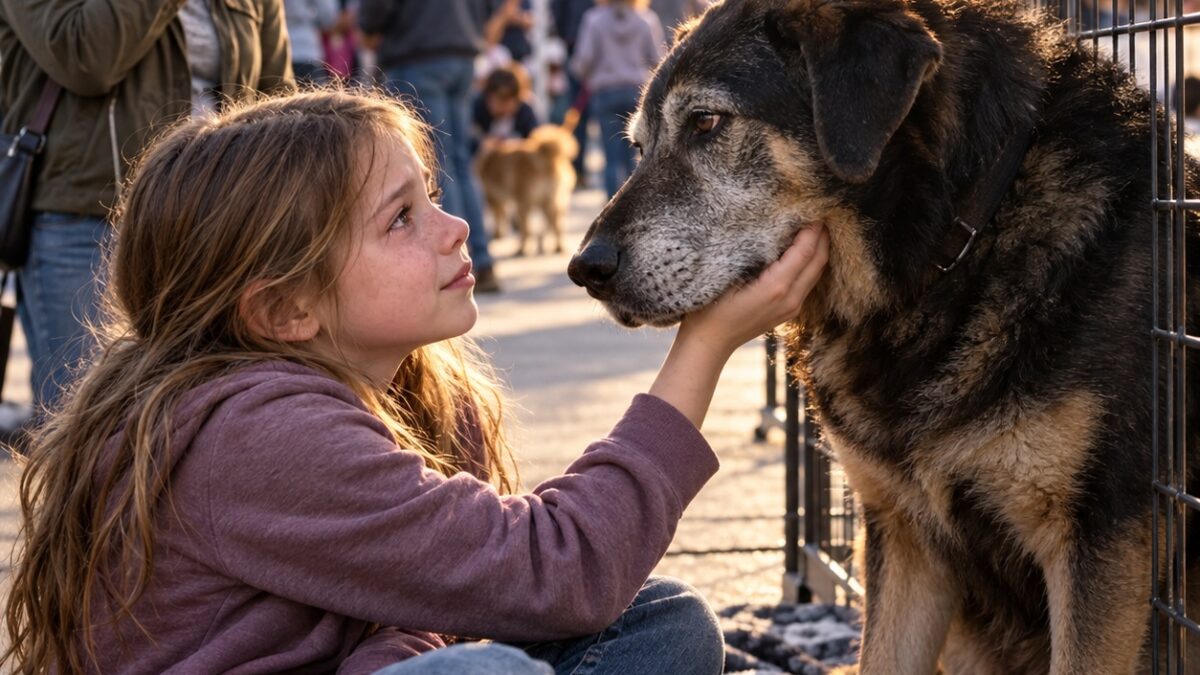
FULL STORY CONTINUATION
I wish I could tell you I made the decision immediately.
That would sound better.
More compassionate.
More certain.
The truth is, I hesitated.
Eleven years old.
That number mattered.
Not because I believed Bruno had less value.
Because bringing home a senior dog is not the same decision as bringing home a puppy.
You know time may be shorter.
You know there may be habits formed over years you did not witness.
You know there could be fear, confusion, medical needs, or emotional baggage you do not understand yet.
And Bruno had just lost the only home he apparently knew.
I was looking at my daughter, who had fallen in love before I had finished thinking.
She crouched again.
Bruno immediately moved toward her.
“Mom, look.”
“I’m looking.”
“He likes me.”
“I can see that.”
“He needs someone.”
That sentence hit harder than I wanted it to.
Because he did.
Obviously.
So did every dog there.
That is the unbearable part of adoption events.
You cannot take all of them.
There is always another face.
Another story.
Another animal waiting.
You have to choose, and choosing one means walking past others.
I watched Bruno.
Maybe he had already watched enough people do that.
An event volunteer came closer.
“You two seem to have made a friend.”
My daughter smiled.
“What’s he like?”
The volunteer looked at Bruno before answering.
“Quiet right now.”
“Was he always quiet?”
“We don’t really know what he was like before.”
That answer stayed with me.
We knew what had happened.
Not who Bruno had been before it happened.
“He lived with one family for eleven years?”
“That’s what we were told.”
“And they gave him up?”
The volunteer nodded carefully.
I did not ask for details that were not available.
The source of Bruno’s story does not tell us why his family left him or what happened inside that home.
I was not going to invent cruelty beyond what we knew.
The known truth was already painful enough.
Eleven years of familiarity.
Gone.
He was here.
And we had been told the family had reportedly wanted euthanasia.
My daughter did not understand the full meaning.
She knew enough.
“They didn’t want him?”
I knelt beside her.
“Whatever happened, he needs a new home now.”
She looked at me.
“He can come to ours.”
Simple.
Children are very good at skipping logistical steps.
I almost smiled.
“We weren’t planning to get a dog.”
“We have a house.”
“That is not the only requirement.”
“We have food.”
“Human food.”
“We can buy dog food.”
“Sweetheart.”
“We have a couch.”
I laughed.
“We’re not adopting a dog because we own furniture.”
Bruno had lowered himself beside her.
She rested one hand lightly against his shoulder.
He did not move away.
“He can have my blanket.”
That stopped me.
Her favorite blanket lived permanently on her bed.
She did not share it willingly with me.
Certainly not with hypothetical dogs.
I looked at Bruno again.
His face carried that soft gray seniors get around the muzzle and eyes.
There was dignity in him.
No frantic pleading.
No performance.
He simply wanted to remain close to the child who had sat beside him.
I stood.
“Let me ask questions.”
My daughter brightened immediately.
“That means maybe.”
“It means questions.”
“Which means maybe.”
I gave her the look.
She smiled.
The volunteer explained the adoption process.
Senior-dog needs.
Transition.
Patience.
The possibility that Bruno would not immediately understand a new home.
I listened.
My daughter stayed beside him.
That image affected every answer I gave.
At some point I stopped asking:
Should we adopt a dog?
And started asking:
Can we care for Bruno?
Different question.
The second felt more specific.
More honest.
Yes, we had room.
Yes, we could afford food and routine care.
Yes, I could adjust.
Yes, my daughter was old enough to understand basic boundaries.
No, we had not planned this.
Life does not always ask permission before becoming personal.
I signed the adoption paperwork.
My daughter stared.
“Are we really taking him?”
“Yes.”
She threw both arms around my waist.
Bruno lifted his head.
“What about Bruno?”
She immediately released me and went back to him.
I laughed.
Replaced in under thirty seconds.
Fair.
When they brought him out, he stood beside my daughter.
Not me.
Her.
That was clear from the beginning.
She held the leash with both hands while I kept one hand close enough to take control.
Bruno walked slowly.
No pulling.
No bouncing.
Nothing puppy-like.
People watched us.
Maybe because seeing a child leave with an old dog creates a particular kind of image.
Or maybe I imagined it.
We reached the car.
Bruno hesitated.
Of course.
Another transition.
Another unknown.
I opened the back door.
My daughter climbed in first.
“Come on, Bruno.”
He looked at her.
Then at the car.
She patted the seat.
“We’re going home.”
Home.
I wondered what that word meant to him now.
His old home?
No place?
A sound humans used?
He eventually climbed in with help.
My daughter sat beside him.
I adjusted everything.
Checked him twice.
Then closed the door.
As I walked around to the driver’s side, I saw him through the window.
He was staring out.
Not excited.
Not frightened exactly.
Just watchful.
The drive home was quiet.
My daughter talked enough for everybody.
“This road goes by my school.”
“Bruno, I have stuffed animals but you can’t eat them.”
“Do dogs like cartoons?”
“Mom, do you think he likes chicken?”
“Bruno, we have a backyard.”
The dog offered no opinion.
I glanced in the mirror.
Sometimes his eyes closed.
Then opened again quickly.
My daughter kept one hand resting near him.
Not always touching.
Just there.
I appreciated that.
She had understood instinctively that affection did not mean constant handling.
When we arrived, Bruno would not get out immediately.
I opened the door.
My daughter stepped onto the driveway.
“Come on.”
Bruno remained.
I crouched.
“No rush.”
We waited.
He eventually climbed down.
Then stood very still.
New driveway.
New smells.
New street.
New people.
New everything.
I wanted to be excited for him.
Instead I suddenly understood how terrifying rescue can be from the animal’s perspective.
Humans tell the story:
He was saved.
He found a family.
He went home.
The dog experiences:
Everything disappeared.
Strangers took me somewhere.
Now I am standing in another unfamiliar place.
Even good change is change.
Bruno did not know yet that he had landed somewhere safe.
We knew.
That knowledge belonged only to us.
He needed evidence.
The front door opened.
My daughter went in first.
Bruno stopped at the threshold.
I expected that too.
She turned.
“Bruno?”
He looked at her.
One step.
Then another.
Inside.
That was how his new life began.
Not running.
Not tail wagging.
A cautious step through a doorway.
I had bought basic supplies on the way home.
Food.
Bowls.
A soft bed.
A simple collar.
A few toys my daughter insisted on even after I explained he might not play with them.
She arranged everything as though preparing a hotel room.
Bed in one corner.
Water.
Toy beside bed.
Her blanket folded near it.
I stared.
“You really gave him that.”
“He needs it.”
“What are you going to sleep with?”
“My other blanket.”
Apparently generosity had backup inventory.
Bruno sniffed the bed.
Walked around it.
Then lay on the floor several feet away.
My daughter looked disappointed.
“He doesn’t like it.”
“He doesn’t know it yet.”
She sat on the floor.
Bruno watched.
“Don’t make him come over,” I said.
“I’m not.”
She stayed.
Five minutes.
Ten.
Eventually Bruno lowered his head.
Not on the bed.
Floor.
Fine.
Dinner went better.
The moment food appeared, something in him changed.
Interest.
He approached.
Ate.
Not wildly.
But with focus.
I felt relieved.
Food meant one ordinary thing had survived transition.
He understood the bowl.
He understood hunger.
He understood eating.
We could build around familiar things.
Afterward, my daughter sat near him again.
This time Bruno moved slightly closer.
Then stopped.
She smiled at me.
I put a finger to my lips.
Do not turn every inch into a celebration.
Let him decide.
That first night was difficult.
Bruno did not settle.
He moved from room to room.
Not constantly.
Enough.
He would lie down.
A sound happened.
Head up.
Another sound.
Stand.
Hallway.
Back.
I had expected exhaustion.
Instead his body seemed unable to stop monitoring.
He did not understand the house.
He did not know our sounds.
Heating system.
Refrigerator.
Cars outside.
Water pipes.
My daughter’s footsteps.
Every ordinary noise had to be classified.
Safe?
Danger?
Person leaving?
Food?
Unknown?
Around midnight, I found him standing near the front door.
My chest hurt.
I wondered if he was waiting for the family who had left him.
That is human interpretation.
I cannot know.
Maybe he simply associated doors with outside.
Maybe he wanted to relieve himself.
Maybe he was confused.
I took him out.
He walked quietly.
Then returned.
At the doorway, another hesitation.
My daughter appeared behind me in pajamas.
“Bruno?”
“He’s okay.”
She crouched.
He entered.
She stayed on the floor beside his bed.
“You need to sleep.”
“I’m helping him.”
“You have school.”
“He’s sad.”
“You don’t know that.”
She looked at me with eight-year-old certainty.
“Yes, I do.”
Maybe she did.
I let her stay five more minutes.
Then ten.
Eventually Bruno lay down.
My daughter whispered:
“Good night.”
We went upstairs.
I slept lightly.
Any sound from downstairs woke me.
At two in the morning, I checked.
Bruno was still on the floor.
Not the bed.
Eyes open.
I sat a few feet away.
“Hey, old man.”
His ears moved.
“You don’t know us.”
Nothing.
“That’s okay.”
I leaned back against the wall.
“We’re still going to be here tomorrow.”
That became the promise.
Not love.
Not forever.
Not yet.
Tomorrow.
Dogs learn patterns through repetition.
So I gave Bruno repetition.
Morning came.
We were still there.
Food came.
Water.
Walk.
My daughter left for school.
That worried him.
He watched the door.
I watched him.
“She’ll come back.”
Again, words he could not understand.
Or maybe tone mattered.
He eventually lay down.
When the school bus returned that afternoon, my daughter came through the door calling his name.
“Bruno!”
He lifted his head.
No tail.
But he stood.
That was something.
She dropped her backpack and went to him.
He let her pet his face.
Later, he followed her into the living room.
Not close.
Same room.
The first week taught me that recovery is not a straight line.
Day two, Bruno seemed slightly better.
He followed my daughter.
Accepted food.
Lay on the soft bed once.
Day three, withdrawn again.
Stayed in one corner.
Avoided touch.
Day four, came into the kitchen while I cooked.
Day five, barely moved from his bed.
I started worrying.
“Is something wrong?”
Everything felt like a medical question because I wanted an explanation for behavior that might simply have been grief, stress, age, or adjustment.
I watched appetite.
Water.
Movement.
Bathroom habits.
Nothing obvious indicated an acute problem.
He was just distant.
That can be harder.
A visible wound gives you something to treat.
A dog who has lost his familiar world may need something less measurable.
Time.
I hate time as treatment.
There is nothing to do with your hands.
My daughter handled it better.
She talked to him.
Read beside him.
Put homework on the floor so she could sit near his bed.
Sometimes Bruno ignored her.
She did not take it personally.
That impressed me.
Adults often demand emotional repayment from rescued animals.
We saved you.
Love us.
Be happy.
Be grateful.
That is not how it works.
Bruno did not owe us a personality performance.
He had lost eleven years of routine.
We had known him days.
My daughter seemed to understand that without needing the philosophy.
“He’s tired.”
Sometimes.
“He wants to be alone.”
Okay.
“He doesn’t want me to touch him right now.”
Fine.
Then she waited.
One evening, she sat watching television.
Bruno was across the room.
Halfway through the show, he stood.
Walked toward the couch.
Stopped beside her.
She froze.
Looked at me.
I whispered:
“Don’t make a big deal.”
She nodded.
Bruno lowered himself next to the couch.
Not touching.
Close.
My daughter rested her hand near the edge of the cushion.
After several minutes, Bruno shifted.
His shoulder touched her foot.
Her eyes filled.
She looked at me.
I smiled.
That was all.
Trust by inches.
The next morning he went back to his bed and barely interacted.
My daughter frowned.
“I thought he liked us now.”
“He can like us and still have a hard day.”
That sentence was for both of us.
We began learning Bruno’s rhythm.
Mornings quiet.
Afternoons slightly more curious.
He liked certain places.
A spot near the back window.
The hallway where sunlight landed.
My daughter’s room, eventually.
He did not climb onto her bed.
He would lie near the doorway.
At first, I worried that allowing him everywhere would overwhelm him.
Then I realized he was choosing.
Choice mattered.
For eleven years, he had known one environment.
Then suddenly everything changed.
Our house needed to become his through repetition.
Same hallway.
Same bowl.
Same voices.
Same morning sounds.
Same child coming home.
Same woman opening the back door.
Again.
Again.
Again.
One day I realized Bruno had stopped looking startled when the refrigerator motor started.
Tiny victory.
Another day he slept through the doorbell.
Progress.
A week later, he remained lying down when I left the room.
He trusted that absence did not automatically mean disappearance.
That one mattered.
I do not know whether dogs think in those exact terms.
I know what his behavior did.
At first he monitored.
Later he rested.
That is enough.
Food became another language.
My daughter wanted to spoil him.
“Can he have chicken?”
“Some.”
“Cheese?”
“A little.”
“Everything?”
“No.”
Bruno discovered the kitchen.
That helped.
The first time he came in while I prepared dinner, I laughed.
“Look who finally cares what I’m doing.”
His nose lifted.
I gave him nothing from the counter.
My daughter accused me of cruelty.
Bruno agreed with her expression.
He stood there another minute.
Then left.
Normal.
I wanted normal so badly.
Not dramatic joy.
Ordinary dog behavior.
Stand near kitchen.
Hope food falls.
Follow child.
Sleep somewhere inconvenient.
That was what healing looked like.
Weeks passed.
His coat did not change dramatically.
He was still an eleven-year-old dog.
Gray face.
Older body.
Slower than a puppy.
That mattered to me.
Rescue did not rewind age.
We were not transforming Bruno into something young.
We were giving the old dog in front of us a new place to belong.
There is dignity in letting senior animals remain seniors.
My daughter never seemed bothered.
To her, his gray face was simply Bruno.
She loved touching the lighter fur around his muzzle.
“You look like a grandpa.”
I said:
“Be polite.”
Bruno blinked.
She laughed.
He started wagging more.
Small at first.
My daughter came home.
Tail.
Meal time.
Tail.
Leash.
Tail.
Then one afternoon I walked into the room without food, leash, or daughter.
Bruno looked at me.
Tail moved.
I stopped.
“Was that for me?”
Again.
I smiled.
“About time.”
I sat.
Bruno approached.
He sniffed my hand.
Then pushed his head beneath it.
I pet him.
For the first time, he asked.
That difference nearly made me cry.
Touch you tolerate because people are caring for you is one thing.
Touch you request is another.
Bruno wanted affection.
From me.
Not only my daughter.
I called her later.
“You missed something.”
“What?”
“Bruno came over for pets.”
“Without me?”
“Yes.”
She looked offended.
“He’s my dog.”
“Our dog.”
“My dog who lives with our family.”
I laughed.
“Fine.”
Then she ran to find him.
Bruno’s emotional world widened.
That is the only way I can describe it.
At first:
My daughter.
Safe person.
Then:
Me.
Then:
The rest of the house.
Then visitors.
Slowly.
He remained cautious with new people.
Fine.
Nobody needed instant access.
I became protective of his right to say no.
Someone reached too quickly?
“Give him a second.”
Child wanted to hug?
“Don’t.”
Bruno had already spent too much of his life experiencing decisions made around him.
Our home could at least offer consent in the small things.
Come closer.
Move away.
Sleep here.
Go there.
Eat.
Rest.
Play if you want.
That last one seemed impossible in the beginning.
Play.
The event volunteers had mentioned nothing about toys.
At home, the toys my daughter bought remained untouched.
A rope.
Soft squeaky animal.
Ball.
She tried once.
Rolled the ball.
Bruno watched.
No movement.
She brought it back herself.
Again.
Nothing.
“He doesn’t know how.”
“Maybe he doesn’t want to.”
That saddened her more.
“Dogs like toys.”
“Some do. Some don’t.”
She left them near his bed.
Weeks later, I heard a squeak.
I was washing dishes.
One squeak.
Pause.
Another.
I turned.
Bruno stood in the living room with the soft toy partly in his mouth.
I froze.
My daughter was upstairs.
I almost called her.
Stopped.
Let Bruno have the moment without an audience.
He dropped the toy.
Sniffed.
Picked it up again.
A small shake.
Then it fell.
He walked away.
Thirty seconds.
Maybe less.
That evening my daughter came home.
I told her.
“You saw him play?”
“A little.”
“You didn’t record it?”
“No.”
“Mom!”
“I didn’t want to scare him.”
She considered.
Then accepted.
For the next two days, the toy remained untouched again.
Then Bruno picked it up while she was there.
Her whole face changed.
“Bruno!”
He dropped it.
She slapped both hands over her mouth.
“Sorry.”
I laughed quietly.
She crouched.
Waited.
Bruno picked it up again.
She moved the toy gently across the floor.
He followed.
Not running.
Walking.
Then a little faster.
Tail.
That was the beginning.
Play entered the house quietly.
At first, minutes.
Then more.
Bruno chased soft toys.
Not far.
Sometimes only across the living room.
My daughter celebrated every time as though he had won a championship.
I told her to calm down.
She did not.
Good.
Some joy deserves noise.
One afternoon, she ran through the backyard holding a toy.
Bruno followed.
I stood at the back door.
He was not fast.
Eleven-year-old fast.
My daughter adjusted her pace without being told.
She slowed enough that he could stay near.
That small act almost broke me.
She was not forcing him to become young.
She was meeting him where he was.
Bruno jogged after her.
Gray face.
Mouth slightly open.
Tail moving.
They made a circle around the yard.
Then another smaller one.
He stopped.
She stopped too.
No pushing.
She crouched.
He walked over.
She touched his face.
“You did it.”
I do not know what she thought he had done.
Run?
Play?
Trust?
Maybe all three.
He leaned against her.
For a second I remembered the adoption event.
Same child.
Same dog.
Except there, Bruno had been standing in a temporary enclosure watching people pass.
Here, he was in our yard choosing to stay beside her.
That difference was everything.
The hardest part of adopting Bruno was realizing rescue did not automatically make him happy.
I needed that lesson.
I had unconsciously imagined the traditional story.
Abandoned senior dog.
Kind family adopts him.
Tail wag.
Happy ending.
But a new home is not an eraser.
Bruno’s first eleven years existed.
We did not know all of them.
We did not know exactly what he missed.
People?
Rooms?
Routine?
Smells?
Favorite sleeping place?
Daily sounds?
Maybe another animal?
The source gives us none of those details.
We could not recreate what we did not know.
We could only build something new without demanding that new immediately replace old.
That required humility.
I could give Bruno comfort.
I could not decide when it felt like home.
He decided slowly.
The first night he slept deeply changed something.
I came downstairs before sunrise.
Usually he lifted his head immediately.
That morning he did not.
He was stretched on his side.
Not curled defensively.
Breathing slow.
The soft bed beneath him.
My daughter’s old blanket under his front legs.
I stood in the doorway.
No reaction.
I made coffee.
Still sleeping.
Opened the refrigerator.
Nothing.
I smiled.
That was safety.
Not because a bed was soft.
Because his body trusted the room enough to stop monitoring it.
When he finally woke, he stretched.
Long.
Old-dog stretch.
Front legs.
Back.
Shook.
Then walked toward the kitchen.
I put down breakfast.
He ate.
No drama.
I made coffee.
Perfect morning.
People sometimes ask when Bruno “became himself.”
I do not know.
That assumes I knew the original.
I didn’t.
Maybe the playful Bruno we eventually saw had always been there.
Maybe age had changed him.
Maybe our household brought out something new.
The more honest answer is:
We met him gradually.
The first Bruno was quiet.
The next Bruno was curious.
Then affectionate.
Then playful.
All were him.
Recovery does not reveal one true personality like opening a box.
Animals change in response to safety.
People do too.
My daughter changed.
She became more patient.
Before Bruno, she believed affection solved sadness.
Hug.
Pet.
Sit close.
Bruno taught her sometimes love means leaving someone alone without leaving them abandoned.
That distinction is hard for children.
Hard for adults.
She learned to sit nearby without touching.
To wait for Bruno to approach.
To stop petting when he moved away.
To understand distance was not rejection.
I watched her become gentler because of him.
Not softer exactly.
More observant.
One day a friend came over.
She ran toward Bruno.
My daughter put out a hand.
“Wait.”
Her friend stopped.
“He likes people.”
“I know, but let him smell you.”
I listened from the kitchen.
The same child who once wanted to hug every dog now explaining boundaries.
Bruno had taught something I could not have delivered as a lecture.
That is one reason animals belong in family stories.
They teach through relationship.
No worksheets.
My daughter also became his strongest advocate.
When people heard he was eleven, some reacted automatically.
“Oh, he’s old.”
She hated that.
“He’s not that old.”
I would say:
“He is eleven.”
She glared.
“Stop helping.”
Other people asked:
“How long do you think you’ll have him?”
I learned not to answer.
Not because the question was malicious.
Because I realized it framed our relationship around departure before Bruno had fully arrived.
Yes, he was senior.
Yes, time mattered.
It always matters.
But I did not want my daughter counting days in advance.
We had him today.
That was enough.
Senior adoption forces you to understand something younger pets let you postpone.
Love does not become less worthwhile because you cannot control duration.
Maybe especially then.
Bruno did not need eleven more years to justify bringing him home.
He needed the days available.
Good days.
Safe days.
Days with meals and beds and a child who wanted him nearby.
That was the contract.
No minimum length.
My daughter understood this better than I did because she did not think statistically.
Bruno is here.
Play.
That simple.
I tried to follow her.
Our routine solidified.
Morning walk.
Breakfast.
School.
Bruno usually slept.
Afternoon reunion.
Dinner.
Sometimes backyard play.
Evening near the couch.
Eventually he began waiting for my daughter before bedtime.
Not always.
Often enough that we noticed.
She would disappear upstairs.
Bruno watched the staircase.
A minute later, he followed slowly.
One step at a time.
Then lay outside her room.
She wanted him in the bed.
I said no until we knew whether climbing was comfortable.
She negotiated.
Of course.
Eventually we arranged a bed in her room.
Problem solved.
Bruno slept there some nights.
Other nights downstairs.
Choice.
I liked hearing his movement.
The soft sound of an older dog getting comfortable.
Turn.
Turn.
Sigh.
My daughter told me:
“He snores.”
“So do you.”
“No, I don’t.”
“You absolutely do.”
“Bruno snores louder.”
I did not verify.
Some family truths are safer unmeasured.
The adoption-event story spread among relatives.
Everyone wanted to know how my daughter chose him.
I always corrected that phrasing.
“She stopped.”
That was the beginning.
Not:
She saw something special nobody else could see.
Maybe she did.
I prefer not to romanticize.
She stopped.
That simple act mattered because other people kept moving.
Senior dogs can become invisible in environments designed around quick impressions.
Gray face.
Quiet.
Age on the card.
People make fast calculations.
My daughter did not.
She had nowhere urgent to be.
She sat.
Bruno approached.
Relationship required enough time for something to happen.
That stayed with me.
How many lives change because someone slows down for five minutes?
I do not know.
At the event, I had told her:
Five minutes.
Then complained when she stretched it.
If she had obeyed exactly, maybe we leave before Bruno stands.
Maybe another family adopts him.
I hope so.
Maybe no one does.
I do not follow that thought far.
We live in the timeline where she stayed.
That is enough.
I also think about the people who passed him.
I do not judge them.
Important.
Maybe they already had pets.
Maybe they needed a young dog for practical reasons.
Maybe senior care frightened them.
Maybe they simply connected with someone else.
Rescue stories become unfair when they turn every non-adopter into a villain.
The villain is not the stranger who cannot take every dog.
Bruno only needed one family.
We happened to become it.
That is different.
The people I struggled with emotionally were his former family.
Again, we knew very little.
The report that they wanted him put down made me angry.
Still does.
But anger cannot fill missing facts.
I do not know what circumstances surrounded surrender.
I will not invent abuse, financial motives, illness, or family conflict.
The source does not support it.
What we know is enough.
Eleven years.
Then he was left.
That kind of rupture would affect anybody.
Bruno showed it.
Withdrawal.
Nervousness.
Energy appearing and disappearing.
Some days better.
Some days quiet.
I stopped labeling every quiet day a setback.
That helped us.
Healing is not performance.
Animals do not owe consistency.
Neither do people.
Sometimes Bruno woke playful.
Sometimes he wanted a corner.
We learned both were allowed.
My daughter eventually stopped asking:
“Is he sad?”
She started asking:
“Does he want company?”
Better question.
One evening Bruno lay alone in the hallway.
My daughter went over.
Stopped several feet away.
He looked at her.
She sat.
No touch.
After a minute, Bruno stood.
Came to her.
Placed his head in her lap.
I watched from the kitchen.
She did not call me.
No celebration.
Just stroked his ears.
That showed me she had learned.
Trust becomes ordinary after it becomes real.
That is the goal.
Not forever celebrating every approach because you still believe the animal might disappear emotionally.
Bruno’s affection became normal.
Thank God.
I did not want him trapped forever in a before-and-after narrative.
He deserved days where nobody thought about abandonment.
Walk.
Food.
Nap.
Toy.
Child.
That is life.
One Saturday morning my daughter woke early.
I heard laughter downstairs.
I walked into the living room.
Bruno was following her around the coffee table.
She held the soft toy.
He tried to catch it.
Slowly.
She let him.
Then pretended he stole something valuable.
“Bruno!”
He wagged harder.
She ran toward the hallway.
Bruno followed.
I stood there in pajamas.
“Inside voices.”
Neither listened.
He made it halfway.
Stopped.
She came back immediately.
“Too much?”
Bruno panted lightly.
Happy-looking.
Loose.
She sat on the floor.
He lowered himself beside her.
“Mom, he’s smiling.”
Dogs do not smile exactly the way humans do.
I almost corrected her.
Didn’t.
“He looks happy.”
“I told you.”
Maybe she had.
The withdrawn old dog from the first week felt very far away in moments like that.
Then other days he returned.
Quiet.
Long nap.
Less engagement.
I no longer panicked.
Age has rhythms.
Emotion has rhythms.
Bruno was allowed to be both playful and old.
That duality became part of loving him.
My daughter sometimes wanted to keep playing after he stopped.
I reminded her:
“Bruno gets tired.”
“He wants more.”
Bruno was clearly asleep.
“He is unconscious.”
“He’ll wake up.”
“Leave the senior citizen alone.”
She laughed.
Then covered him with the edge of her old blanket.
He did not move.
That blanket stayed his.
Permanently.
I bought my daughter another one.
She said the new one was better anyway.
Convenient.
One afternoon I found her lying on the floor beside Bruno.
Both asleep.
Her hand resting near his paw.
Not holding.
Near.
I took a picture.
Not for social media.
For me.
That image contained the whole adoption.
A child who stopped.
An old dog who stayed.
Nothing else needed explanation.
I became aware of how much Bruno watched her.
She entered?
Eyes.
She laughed?
Ears.
She left for school?
Door.
Returned?
Tail.
He had chosen her first.
I did not compete.
A dog can have a primary person.
Fine.
I handled meals, appointments, schedules, practical care.
My daughter provided something I could not manufacture.
The exact presence he had connected with at the event.
Their relationship belonged to them.
Sometimes Bruno came to me after she went to bed.
Second choice.
I accepted my ranking.
He would settle near my chair.
I scratched his gray muzzle.
“Your girl is asleep.”
He sighed.
“Our girl.”
Another sigh.
I talked to him more than I admitted.
Adults do that with animals because animals are excellent listeners and terrible conversationalists.
I told him about work.
Bills.
My daughter’s school projects.
Nothing.
One night I said:
“You know she picked you.”
His eyes remained closed.
“Or maybe you picked her.”
No reaction.
“Either way, I signed the paperwork.”
That got a tail movement.
Probably coincidence.
I claimed acknowledgment.
Bruno eventually began greeting us at the door.
That became one of my favorite changes.
At first, arriving home meant discovering him somewhere.
Bed.
Hallway.
Window.
Later, keys in lock.
Movement.
Door opens.
There he was.
Not jumping.
Senior dignity.
Tail wag.
Body close.
My daughter usually dropped everything.
“Bruno!”
I had to remind her not to block the doorway.
Normal family chaos.
That was when I realized he no longer seemed like a guest.
Guests wait.
Family occupies.
Bruno occupied.
He chose routes through rooms.
Sleeping places.
Positions near the couch.
Where to stand during meal preparation.
He developed opinions.
That was huge.
Early Bruno accepted whatever happened.
Later Bruno had preferences.
He wanted the sunny patch.
Wanted the soft toy.
Wanted my daughter.
Wanted chicken.
Did not want a certain noisy delivery truck.
Preferred the backyard after dinner.
Preference requires expectation.
You believe the world may respond.
That is psychological luxury.
He had it.
One day I moved his bed to vacuum.
Bruno walked into the room.
Stopped.
Looked at the empty spot.
Then at me.
I laughed.
“Oh, now you care.”
I put it back.
He immediately lay down.
Apparently placement mattered.
Good.
Complain.
Demand.
Take up space.
He had spent enough time uncertain.
I wanted him entitled to his corner.
People sometimes describe rescue animals as grateful.
That idea can become unhealthy.
I did not need Bruno to thank us.
I needed him to become secure enough to assume things belonged to him.
Bed.
Food.
Us.
Security looks a little like entitlement.
Excellent.
One evening my daughter said:
“I think he knows we’re his family.”
“How?”
“He doesn’t look sad all the time.”
I thought.
Maybe.
I chose another answer.
“I think he knows what happens here.”
“What do you mean?”
“Breakfast happens. You come home. We walk him. He sleeps. Nobody sends him away.”
She nodded.
“That means family.”
Fair.
I could not improve on that.
Family is repeated evidence.
Not a speech.
Not adoption paperwork alone.
You leave and return.
Feed.
Notice.
Care.
Include.
Day after day until uncertainty becomes routine.
That is what changed Bruno.
Not one magical act of love.
Repetition.
My daughter stayed especially close through the difficult weeks.
That mattered.
Had she expected instant play, she might have been disappointed.
Instead she stayed.
That is what I admire most about her role.
The event choice gets attention.
Child stops for old dog.
Beautiful.
But choosing once is easy compared with choosing again when the dog comes home withdrawn.
She kept choosing.
Sit near him.
Bring water.
Help with food.
Walk slowly.
Wait.
Pet when invited.
Leave him alone when needed.
Then when Bruno became playful, she was there for that too.
Love through both versions.
That is real adoption.
Not selecting an animal.
Living through the adjustment together.
One rainy day Bruno refused to go far on his walk.
We made it to the end of the driveway.
He stopped.
Looked back.
My daughter held the leash.
“Come on.”
Nothing.
I said:
“He’s done.”
“We just started.”
“He voted.”
She laughed.
We turned around.
Bruno walked faster toward the house.
“Traitor.”
Tail.
Inside, he headed for his bed.
My daughter looked at me.
“He likes home.”
Three words.
I felt them.
He likes home.
At the event, he had no home.
At first with us, the house was merely unfamiliar shelter.
Now he hurried toward it in rain.
That was evidence.
I sat beside him after drying his paws.
“You like home?”
Bruno leaned into my hand.
Good enough.
There were no dramatic anniversaries in the source.
I will not invent a first Christmas, birthday party, or years later epilogue.
The story’s power stays close to the transition.
Bruno abandoned at eleven.
Adoption event.
Child stops.
New home.
Withdrawal.
Patience.
Trust.
Play.
That is complete.
Adding illness, death, or future loss would only hijack the emotional endpoint.
Bruno is alive in this story.
Playful.
With family.
That is where he should remain.
I want the final image to preserve him there.
Not as the dog somebody left.
As the dog somebody stayed for.
That difference matters.
I still remember the adoption event more vividly than I expected.
The noise.
The enclosures.
People moving.
Bruno’s gray face.
My daughter sitting.
I can see the exact moment he took those few steps toward her.
If he had not?
Would we have adopted him?
I do not know.
Maybe.
Maybe not.
Connection is mysterious.
We build stories around it afterward.
At the time, it was simply an old dog moving toward a child’s hand.
That movement changed our house.
There was no guarantee.
He did not know us.
We did not know him.
Adoption always contains uncertainty.
You choose before evidence is complete.
That can be frightening.
But relationships work that way.
Friendship.
Marriage.
Parenthood.
Animals.
You do not get the full future before committing.
You decide whether you are willing to stay through what you do not yet know.
That was Bruno’s real question.
Not:
Will you love the version of me sitting quietly at this event?
Will you stay if I remain withdrawn?
Will you stay if I do not play?
Will you keep feeding me if I do not act grateful?
Will the bed remain when I do not use it?
Will the child keep sitting beside me if I do not wag?
We answered those questions accidentally.
Yes.
Yes.
Yes.
Every day.
Then Bruno answered ours.
Will you trust us?
Eventually.
Will you come closer?
Eventually.
Will you play?
Eventually.
Will you make this your home?
Yes.
Slowly.
That pace made the ending more meaningful.
Instant happiness would have been easier.
Less true.
The difficult beginning proved the later joy belonged to him.
He did not perform it because people expected rescue gratitude.
He arrived there after enough safety.
I remember the first real backyard run.
My daughter was ahead.
Bruno behind.
Gray face bright.
Not puppy fast.
Bruno fast.
I stood by the door and thought:
That dog sat at an adoption event while people passed.
Same dog.
Not transformed into something else.
Same age.
Same gray muzzle.
Same history.
Different future.
That is rescue at its best.
Not erasing.
Adding.
Loss remains part of Bruno’s history.
We add home.
Abandonment.
Add return.
Fear.
Add routine.
Gray face.
Add play.
Eleven years old.
Add child running beside him.
You do not remove the first column.
You make sure it is no longer the only one.
That became my understanding of healing.
My daughter never articulated any of that.
She simply said:
“He’s faster today.”
Good.
Children are healthier storytellers.
They care about what is happening.
Not constantly what happened.
Bruno benefited from that.
She did not look at him every morning and say:
Poor abandoned dog.
She said:
Move, Bruno, you’re on my sock.
Family.
One afternoon he was lying in the middle of the hallway.
She stepped over him.
“Why do dogs pick the worst place?”
I laughed.
Weeks earlier, she would have cried from gratitude that he felt safe enough to lie there.
Now he was inconvenient.
Perfect.
Animals become truly integrated when their existence stops being ceremonial.
Bruno was no longer “our rescue.”
He was Bruno.
The dog blocking traffic.
The dog waiting for chicken.
The dog who stole the warm spot.
The dog who followed my daughter.
Normal.
I treasured that normalization.
His past did not need daily reverence.
I wanted him to outgrow being a tragedy in our minds.
He did.
One night my daughter asked:
“Do you think his old family misses him?”
I froze.
Children find emotional landmines before bed.
“I don’t know.”
“Do you think he misses them?”
“I don’t know.”
She looked at Bruno sleeping nearby.
“Can dogs love two families?”
“I think hearts are complicated.”
“That’s not an answer.”
“It’s the answer I have.”
She thought.
“If he misses them, that’s okay.”
That surprised me.
“Yeah.”
“Because he can miss them and still like us.”
Exactly.
She had learned the sentence I once gave her.
You can like us and still have a hard day.
Now applied across his life.
I stroked Bruno’s back.
We did not need him to forget anyone to prove he belonged with us.
Loyalty is not amnesia.
If there had been good things in his first eleven years, I hoped he retained them.
If loss hurt, we made space.
We did not need to become better by making the unknown past entirely evil.
That is another temptation in rescue storytelling.
New family good.
Old family monster.
Sometimes facts support that.
Here, we only know abandonment and reported euthanasia request.
Enough to condemn certain decisions.
Not enough to invent an entire household.
Bruno’s present did not require fictional villains.
He had us.
That was sufficient.
As months moved forward, the nervousness softened.
Again, no exact medical or behavioral milestones beyond what the source supports.
He became more comfortable.
Curious.
Affectionate.
Playful.
Those are the anchors.
I remember curiosity first.
Bruno started checking bags when we came home.
Sniffing grocery sacks.
Watching outside.
Investigating new objects.
Curiosity means the environment feels safe enough to explore.
Fear narrows.
Safety expands.
He expanded.
My daughter brought home a school project one day.
Large cardboard model.
Bruno inspected every corner.
She protested.
“Don’t eat it.”
He did not.
“He’s helping.”
“No.”
I took a picture.
Bruno’s nose near cardboard.
My daughter protecting glue and construction paper.
Normal.
Then affection.
He began choosing contact.
Resting his head on her leg.
Leaning into me.
Standing near us when we talked.
Sleeping in shared rooms rather than isolated corners.
No dramatic switch.
Presence.
He joined.
That word matters.
At first, he existed in our house.
Later, he joined our family.
You can see the difference.
An animal nearby because there is nowhere else.
An animal nearby because he wants to be there.
Bruno wanted.
That was the payoff.
Then play.
The visible joy.
Toys.
Chasing.
Short runs.
Tail.
My daughter laughing.
People love that stage because cameras can capture it.
I love it too.
But the quiet stages made it possible.
The nights on the floor.
The untouched bed.
The child sitting without demanding.
Meals.
Returning from school.
Routine.
You cannot photograph trust while it is building invisibly.
Then one day the dog plays.
Everyone calls it transformation.
It was accumulation.
Hundreds of small proofs.
No one is leaving.
That line became my private understanding of why Bruno changed.
No one is leaving.
At least not today.
I leave for work.
Return.
My daughter leaves for school.
Returns.
We go outside.
Return.
The home remains.
Repetition corrects fear slowly.
A family is partly predictable return.
I started appreciating that because of Bruno.
Before him, I thought consistency was boring parenting.
Same breakfast times.
Same bedtime reminders.
Same pickup.
Now I saw safety inside predictability.
My daughter knew I returned.
Bruno had to learn.
We taught the same lesson.
I am here.
I leave.
I come back.
You still belong.
That is powerful.
Bruno eventually stopped getting up every time I moved toward the door.
Good.
I wanted him to ignore me.
Trust enough to keep sleeping.
One morning I picked up keys.
Nothing.
“Rude.”
Bruno slept.
“I could be leaving forever.”
No response.
“Fine.”
I left.
When I returned, he greeted me.
Confidence.
People think attachment means watching constantly.
Secure attachment means not needing to.
He got there.
My daughter did too in different ways.
She used to ask every morning:
“Will Bruno be okay while I’m at school?”
I said yes.
Weeks later she stopped asking.
Not because she loved him less.
Because she trusted the system.
Mom.
Home.
Bruno.
All remain.
That mattered to me.
Adopting him strengthened something in both of them.
Maybe me too.
I had been cautious before saying yes.
Practical.
Age.
Responsibility.
Costs.
Valid.
Still, I nearly let caution make the decision alone.
My daughter interrupted that.
Children sometimes see immediate moral facts adults bury beneath logistics.
A lonely dog is here.
We can care for him.
Why not?
Adults then add necessary questions.
Can we truly support him?
In our case, yes.
Good decisions need both.
Heart opens.
Practicality confirms.
Then commitment.
Not impulse alone.
Not caution alone.
Balance.
Bruno benefited from both of us.
My daughter supplied the stopping.
I supplied the paperwork.
Fair division.
The volunteer at the event once checked in.
“How’s Bruno?”
I sent a photo.
Him in the yard.
My daughter nearby.
Reply:
“He looks happy.”
I stared at the image.
Gray.
Still eleven.
No cosmetic transformation.
But posture different.
Eyes engaged.
Tail visible.
He looked part of something.
I wrote:
“He’s doing really well.”
Simple.
No need for a speech.
That is another sign the crisis chapter has ended.
Updates become ordinary.
Eating.
Sleeping.
Playing.
Great.
The adoption event no longer controlled the story.
One afternoon we passed the location where the event had been held.
My daughter recognized it.
“Bruno was there.”
“Yes.”
“What if we didn’t stop?”
I looked at her.
“We did.”
“But what if?”
“You can torture yourself with what-ifs forever.”
She frowned.
“Is that a mom saying?”
“Yes.”
She accepted.
Then:
“I’m glad we stopped.”
“Me too.”
That is the only useful version.
We stopped.
He came home.
The rest followed.
No fate necessary.
One decision.
Then another.
And another.
Stay.
Feed.
Wait.
Walk.
Return.
Love.
Repeat.
Bruno’s story is not really about the moment my daughter chose him.
It is about all the times afterward when choosing became less dramatic.
Morning.
Afternoon.
Bad day.
Quiet day.
Playful day.
He stays.
We stay.
That is family.
The first choice gets a photograph.
The repeated choices create belonging.
I understood that because his adjustment was hard.
If Bruno had bounced into the house thrilled, I might never have appreciated the second part.
His withdrawal demanded patience.
He forced us to prove our love without immediate emotional reward.
That made the relationship deeper.
Not because suffering is good.
Because commitment became visible.
We did not only love the playful Bruno who emerged later.
We cared for the shut-down Bruno too.
Same dog.
Different day.
That matters.
My daughter learned not to love animals only when they entertain her.
I learned not to interpret silence as failure.
Bruno learned—I hope—that quiet would not make him disposable.
That last part means the most.
If his family had left after eleven years, what reason did he have to trust permanence?
None.
Words would not solve it.
Only time.
We gave time.
Eventually his body believed.
That is the part I still find beautiful.
Bodies learn safety before language can explain it.
Sleep deeper.
Tail moves.
Appetite normal.
Explore.
Play.
Approach.
Bruno’s body told us when home became home.
The day he started running around with my daughter was the most obvious expression.
But by then the decision had happened inside him long before.
He had already chosen our rooms.
Our routines.
Our hands.
The running simply made it visible.
I watched them once from the kitchen window.
My daughter moved across the yard.
Bruno behind her.
She slowed.
He caught up.
She turned.
He changed direction.
For maybe thirty seconds, he forgot to look old.
Not physically.
Emotionally.
There was lightness.
Then he stopped and stood beside her.
She touched his neck.
He looked up.
I took no picture.
Some moments are better experienced without proving them.
That was one.
The old dog and the child.
One had been left.
One had stopped.
Both changed each other simply by remaining.
Bruno’s gray face became something I loved deeply.
At the event, it represented age.
Risk.
Limited time.
Later, it was just his face.
The one I saw near the kitchen.
At the door.
On my daughter’s lap.
Gray stopped meaning ending.
It meant Bruno.
That shift happened inside me too.
Senior adoption initially scared me because age made loss visible.
Then I realized younger animals offer no guarantees either.
Life does not sign contracts.
You care anyway.
Bruno’s age did not reduce the value of a good afternoon.
If anything, it made us pay attention.
Not anxiously.
Eventually.
Gratefully.
My daughter never counted.
She simply said:
“Bruno wants to play.”
So they played.
That is probably the healthiest philosophy.
Use the day.
I never told her that in those words.
Too much pressure.
Children should not feel responsible for maximizing every moment because time is finite.
Let them waste time together.
Sit on floor.
Watch TV.
Nap.
Normality is love too.
Some of my favorite Bruno moments were absolutely nothing.
He slept.
She read.
I cooked.
Three lives sharing space.
No drama.
At the event, he had been surrounded by people but alone.
At home, he could be physically separate without being lonely.
That is the transformation.
Not constant touch.
Belonging to the same place.
One Sunday he spent almost the entire afternoon sleeping.
My daughter checked him once.
Then left him.
Later he wandered into the family room.
She did not cheer.
Just lifted one side of the blanket.
Bruno lay beside the couch.
Perfect.
That was when I realized we were past rescue.
We were living.
The word rescue can freeze animals in their worst moment.
Bruno deserved movement beyond it.
He was no longer the eleven-year-old abandoned dog.
He was Bruno.
Our Bruno, according to my daughter.
Senior.
Gray.
Sometimes nervous.
Increasingly playful.
Always interested in food.
Loved.
That is a fuller identity.
I hope people remember that when they see older animals at adoption events.
Not:
Take them all.
Impossible.
Maybe:
Do not assume age has already told you the whole story.
An eleven-year-old dog can still surprise you.
Not with a miraculous transformation into youth.
With relationship.
Bruno still had affection to give.
Curiosity.
Habits.
Joy.
Days.
A senior animal is not an ending waiting to happen.
It is a life still happening.
That distinction matters.
My daughter saw the life.
I saw the number.
She was right first.
I caught up.
I am grateful.
Would I recommend every family impulsively adopt a senior dog because a child asks?
No.
That would be irresponsible.
You have to assess capacity.
Time.
Money.
Home.
Other animals.
Children.
Care.
But once the answer to those practical questions is yes, age alone should not make the animal invisible.
Bruno was eleven.
That was information.
Not disqualification.
For us, it became part of the rhythm.
Slower walks.
More rest.
Gentle play.
Fine.
My daughter adapted.
Children are remarkably good at matching someone they love.
She ran slower.
Sat longer.
Learned patience.
No lecture could teach that so well.
Bruno gave her something beyond companionship.
He taught her how to love without controlling the pace.
That is a skill she will need for people too.
I hope she remembers.
One night, long after Bruno had settled, she asked:
“Do you think he picked me because I was little?”
I smiled.
“Maybe.”
“Or because I sat down?”
“Maybe.”
“Or because he knew?”
“Knew what?”
“That we’d take him.”
I looked at Bruno.
Sleeping.
“No.”
She seemed disappointed.
“I don’t think dogs can predict paperwork.”
She laughed.
Then I added:
“I think he knew you were kind to him.”
That satisfied her.
Kindness in the moment.
Enough.
You do not need fate when kindness works.
Maybe that is the best version.
Bruno did not magically know our future.
He knew a little girl sat beside him when other people kept walking.
Then she touched him gently.
Then she stayed.
The future grew from that.
One moment of safety followed by another.
That is how trust works.
That is how family works too.
If I could return to that adoption event and speak to myself, I would not say:
Take the dog.
Too easy.
I would say:
Do not expect him to thank you immediately.
Do not panic when he withdraws.
Do not assume one good day means every hard day is over.
Do not measure success by tail wags.
Keep feeding him.
Keep opening the door.
Let your daughter sit quietly.
Give him the bed even when he chooses the floor.
Time will do work you cannot.
And one day, without announcing it, Bruno will begin following her because he wants to.
Then he will play.
Then he will run.
And you will realize the happy ending was never the adoption form.
It was him believing the form.
Believing the home remained.
Believing the child remained.
Believing he could settle into something without immediately losing it.
That is the ending.
Not paperwork.
Trust.
The source gives us no final dramatic event.
Good.
Bruno does not need one.
He had enough drama when his first home disappeared.
Let the ending be ordinary.
A comfortable bed.
Good food.
Affection.
A child.
Play.
A family that keeps making room.
That is enough.
I still picture him at the event sometimes.
Sitting alone.
Gray muzzle.
People moving.
Then my daughter dropping beside him.
No music.
No announcement.
Just a child refusing to treat age like invisibility.
She had no idea she was changing anything.
She wanted to pet a dog.
That innocence made the moment powerful.
Adults plan rescue.
Children sometimes just notice loneliness.
She noticed.
Bruno responded.
The rest was responsibility.
I am glad I said yes.
Even more glad we kept saying yes after the excitement faded.
Yes when he stayed distant.
Yes when he ignored the bed.
Yes when he had quiet days.
Yes when trust moved backward.
Yes when my daughter had to learn patience.
Yes when Bruno finally came closer.
Yes when play appeared.
Yes every morning after.
That is what made us his family.
Not one compassionate decision.
Repetition.
The last image I want to keep is not the adoption event.
It is Bruno in our yard.
My daughter moving just ahead of him.
Not too fast.
Bruno following.
Gray face lifted.
Tail moving.
He catches up.
She laughs.
Then he slows.
She slows.
He stops.
She turns around instead of making him come farther.
That is their relationship in one scene.
She met him where he was.
At the event.
At home.
During the withdrawn days.
During the playful ones.
Even while running.
No dragging him into the future.
Just staying close enough that he never had to enter it alone.
I stood by the door watching.
The old dog who had lost an eleven-year home did not look like he was waiting for someone else to return anymore.
He looked like he knew where he was.
My daughter put one hand against his gray face.
Bruno leaned into her.
Then they came back toward the house together.
Not quickly.
They didn’t need to.
The door was open.
Dinner would be there.
His bed would be there.
We would be there tomorrow.
And after spending so long watching people walk past him, Bruno finally had a family that was no longer going anywhere.








