FULL STORY:The Stray Dog Kept Leaving My Butcher Shop With the Best Meat I Gave Him—When I Followed Him, I Finally Understood Why He Was Starving
FULL STORY CONTINUATION
I stayed hidden longer than I should have.
Part of me knew I needed to move.
Call someone.
Do something.
But shock has a strange way of turning a grown man into stone.
The industrial yard was almost silent.
Somewhere beyond the buildings, water moved beneath the bridge.
Wind pushed a loose piece of sheet metal against a wall with a hollow tapping sound.
Milo ignored everything.
His entire attention remained on the two dogs behind the fence.
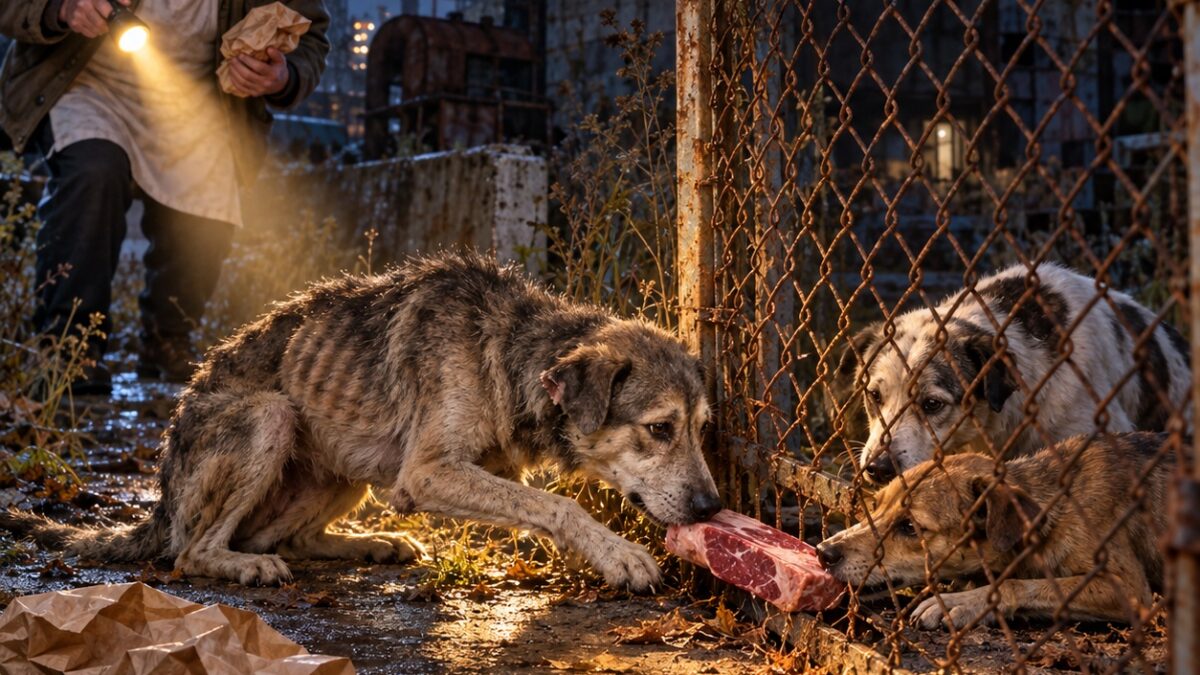
The brown dog ate first.
Slowly.
Painfully.
Its jaws looked weak.
The spotted dog tried to stand, stumbled, then crawled toward the meat.
Milo nudged a second piece through the opening.
He pushed it closer using his nose.
When the spotted dog finally reached it, Milo lowered himself outside the fence.
He watched them eat.
Only after both had swallowed several pieces did he reach through the wire and lick the brown dog’s muzzle.
The gesture destroyed me.
I had known dogs all my life.
My father always kept one behind the butcher shop when I was a child.
I understood pack behavior in the general way people do.
But this didn’t look instinctive in some cold, biological sense.
It looked deliberate.
Milo was making sure they ate.
I thought about every evening he had appeared behind my shop.
Every package he had carried away.
Every time I had silently congratulated myself for feeding a stray.
I’d imagined him disappearing somewhere quiet to eat.
Maybe beneath a porch.
Maybe in an alley.
I had never once asked why a starving dog would refuse to eat the food immediately.
Standing in that abandoned yard, the answer became painfully obvious.
He had decided two other lives mattered more than his own hunger.
I crouched behind the broken concrete wall.
The two imprisoned dogs finished.
Milo searched the ground around them as though checking for crumbs.
There were none.
Then he settled against the fence.
The brown dog moved closer from the other side.
Their bodies met through the wire.
The spotted one lay beside the brown dog.
Three animals separated by rusted metal.
I noticed something else.
There were chains on the ground inside.
Old bowls.
An overturned plastic container.
A rotting wooden shelter barely large enough for one dog.
Someone had kept those animals there.
Recently.
That changed my sadness into anger.
It was one thing to find strays in an abandoned property.
This wasn’t that.
Someone had confined them.
The gate was tied with heavy wire and secured with a padlock.
The dogs couldn’t simply leave.
Milo could.
They couldn’t.
I moved slightly.
My boot scraped gravel.
Milo’s head snapped toward me.
His body went rigid.
For several seconds, we stared at each other.
I expected him to run.
Instead, he stood between me and the fence.
Not aggressive.
No raised lip.
No bark.
Just protective.
“Easy.”
His ears moved.
“It’s me.”
Ridiculous.
Of course he knew who I was.
He had been taking meat from me for weeks.
I slowly showed him my empty hands.
“I’m not going to hurt them.”
Milo remained still.
I came no closer.
The brown dog retreated weakly into the shelter.
The spotted one couldn’t.
It just lay there trembling.
I felt sick.
“I should’ve followed you sooner.”
Milo tilted his head.
“I know. That’s not your fault.”
That sentence was for me.
I backed away.
“I’ll come back.”
His eyes stayed on me.
“I promise.”
I ran most of the way home.
At fifty-eight years old, running wasn’t something my knees appreciated.
I didn’t care.
I barely slept.
Every time I closed my eyes, I saw Milo sliding food through the fence.
At four forty in the morning, I gave up.
I made coffee.
Didn’t drink it.
Found the number for a local animal protection group I had donated to during Christmas drives.
At exactly five, I called.
A sleepy man answered.
I apologized.
Then described what I’d found.
His voice changed immediately.
“You’re certain the dogs are confined?”
“Yes.”
“Condition?”
“Bad.”
“How bad?”
“One could barely stand.”
“Do they have water?”
“I didn’t see any usable water.”
“Exact location?”
I gave him everything.
He told me someone would call back.
Twenty minutes later, a woman named Sophie did.
Her voice was awake, focused, direct.
She asked more questions.
How many dogs?
Three total, though one was free.
Any visible injuries?
Could I tell whether the property was occupied?
Was there vehicle access?
Did I see cameras?
Locks?
Chains?
“Can you take us there?”
“Yes.”
“We’ll meet at your shop at seven.”
I had never been so grateful for sunrise.
At six thirty I opened the butcher shop but didn’t turn on the display lights.
My employee, Carl, arrived at six forty-five.
He looked at me.
“You look terrible.”
“Thank you.”
“Didn’t sleep?”
“No.”
I handed him the keys.
“You’re opening.”
His eyebrows rose.
“In thirty years, you’ve never let me open alone.”
“There’s a first time for everything.”
“What happened?”
“A dog.”
Carl stared.
“A dog.”
“Three dogs.”
“That clears it up completely.”
“I’ll explain later.”
At seven sharp, a white van pulled up.
Sophie climbed out first.
She was maybe forty-two.
Compact.
Dark hair tied back.
Practical boots.
The kind of person whose calm made everyone around her move faster.
Two men followed.
Antoine and Julien.
They unloaded crates, blankets, water, bolt cutters, slip leads, gloves, and veterinary emergency supplies.
Sophie shook my hand.
“Thomas?”
“Yes.”
“Show us.”
We took the van as far as the old bridge allowed.
Then walked.
The morning light made everything worse.
Darkness had softened the industrial yard.
Daylight exposed it.
The weeds.
Broken bottles.
Oil-stained concrete.
Rust.
Trash.
The smell.
And the cage.
The brown dog was lying near the shelter.
The spotted one had not moved far from where I had seen him hours earlier.
“Jesus,” Antoine whispered.
Sophie’s jaw tightened.
“Go slow.”
She approached the fence.
The brown dog tried to stand.
His legs shook so badly he immediately sat again.
Sophie crouched.
“Hi, sweetheart.”
Her voice changed completely.
Soft.
Warm.
“No one’s going to rush you.”
She pushed a shallow bowl of water through a gap.
The brown dog stared.
The spotted dog lifted his head.
“Small amounts,” she told Julien. “We don’t know how dehydrated they are.”
I knew almost nothing about veterinary medicine, but even I understood why she was careful.
When an animal is that starved, even food and water can be dangerous if given too fast.
The spotted dog crawled toward the bowl.
He drank.
Sophie moved it away after several seconds.
“Easy.”
His tongue followed.
“I know.”
She waited.
Then offered more.
While she worked, Antoine examined the fence.
“Padlock’s old.”
“Can you cut it?”
“Probably.”
“Quietly.”
He and Julien positioned a heavy bolt cutter.
That was when movement behind us caught my eye.
Milo.
He stood partly hidden beside a dead shrub.
Gray-brown coat dirty.
Head low.
Eyes fixed on the rescuers.
“Milo.”
Sophie glanced at me.
“Milo?”
“That’s what I’ve been calling him.”
“He yours?”
“No.”
I looked at him.
“Not yet.”
Sophie noticed the way he watched the trapped dogs.
“That the one feeding them?”
“Yes.”
Something passed across her face.
She stood slowly.
“Keep working,” she told the men.
Then she walked toward Milo.
He didn’t run.
Ten feet.
Eight.
Six.
She stopped.
Crouched.
Turned slightly sideways so she wouldn’t confront him directly.
Her hand remained low.
“Hey, Milo.”
His ears shifted.
“You’ve been busy, haven’t you?”
He looked toward the cage.
Sophie followed his gaze.
“We’ve got them.”
Milo took one step.
Then another.
I held my breath.
He approached Sophie’s hand.
Sniffed.
Backed away half an inch.
Sniffed again.
Then something happened I will carry with me for the rest of my life.
Milo stepped forward and lowered his entire head into Sophie’s palm.
His eyes closed.
Not submission.
Not fear.
Relief.
That was what it looked like.
Relief.
As if this exhausted animal had spent weeks believing he was solely responsible for keeping two friends alive.
And suddenly someone had finally told him:
You don’t have to do this alone anymore.
Sophie froze.
Her eyes filled.
Antoine stopped cutting for a second.
Julien looked away.
I had not cried since my father died.
Not at his funeral.
Not when I sold his truck.
Not when I found his old butcher apron hanging behind the office door six months later.
But standing in that ruined industrial yard, watching Milo place his head into a stranger’s hand, I cried.
Quietly.
Embarrassingly.
Completely.
Sophie stroked one finger along his cheek.
“Good boy.”
His eyes remained closed.
“Such a good boy.”
Behind her, metal snapped.
Antoine cut the lock.
They opened the fence only enough to create controlled access.
Sophie moved toward the trapped dogs.
Milo followed.
She paused.
“Let him come.”
The brown dog noticed Milo immediately.
He attempted to stand.
Milo went to him.
They touched noses through the opening.
The spotted dog lifted his head.
Milo moved to him next.
His whole body seemed to change.
More alert.
More urgent.
He looked toward Sophie.
Then back at the dogs.
“I know,” she whispered. “We’re taking everybody.”
The rescue itself took almost forty minutes.
The brown dog was too weak to walk safely.
Antoine wrapped him in a blanket and lifted him.
The poor animal didn’t resist.
That frightened me more than aggression would have.
Healthy frightened dogs fight.
Severely exhausted animals surrender because they have nothing left.
Julien carried the spotted dog.
When he lifted him, I saw how narrow the dog’s waist truly was.
Skin.
Bone.
Almost nothing between.
Milo followed both crates to the van.
When Sophie tried to lead him into a third crate, he hesitated.
She didn’t force him.
I went beside her.
“Milo.”
He looked at me.
“You trust me enough to steal my best beef.”
Sophie’s mouth twitched.
“Not exactly the time, Thomas.”
“He knows what I mean.”
I crouched.
“Go.”
Milo smelled the crate.
Then looked at his companions.
The brown dog was already inside the van.
That decided it.
Milo stepped into his crate.
Sophie closed the door.
“We have a clinic waiting.”
“I’m coming.”
“You can follow.”
I looked toward the shop.
Carl would manage.
For once in my life, meat orders could wait.
Dr. Martin’s veterinary clinic sat on the edge of town.
The staff was ready when we arrived.
They moved fast but never looked rushed.
Three examination rooms.
Three sets of blood work.
Fluids.
Temperature checks.
Weighing.
Parasite tests.
Dr. Martin was a woman in her fifties with silver hair and the calm expression of someone who had delivered both very good and very bad news many times.
She examined Milo last.
When she came to the waiting area, I stood immediately.
“Well?”
She sat opposite me.
“Let’s start with the two who were confined.”
I nodded.
“Severe malnutrition.”
I knew that.
“Significant dehydration. Muscle wasting. Anemia. Likely intestinal parasites. Their immune systems are extremely compromised.”
“Are they dying?”
Dr. Martin didn’t soften the truth.
“They could have.”
My stomach dropped.
“Could have?”
“If they’d stayed there much longer.”
I looked toward the treatment rooms.
“But right now?”
“Right now, they are alive, their organ values are concerning but not catastrophic, and I don’t see evidence yet of irreversible failure.”
I exhaled.
“So they can recover.”
“They can.”
The word can mattered.
Not will.
“It’s going to be slow.”
“How slow?”
“Weeks before they’re stable. Months before they’re truly healthy if everything goes well.”
“And Milo?”
She smiled slightly.
“Also malnourished, although not as severely.”
“I fed him every night.”
“I believe you.”
“He never ate it.”
“So I’ve heard.”
She shook her head.
“I’ve worked with animals twenty-seven years.”
“What?”
“That is one remarkable dog.”
I stared through the small window into the treatment area.
Milo lay on a blanket.
His head faced the room where his companions were being treated.
“What happens now?”
“We feed very carefully.”
“Can’t you just give them as much as they want?”
“No.”
She explained refeeding syndrome.
Electrolytes.
Small meals.
Slow increases.
Fluids.
Monitoring.
Words I understood only partially.
The important part was simple.
Too much kindness too quickly could kill them.
That lesson hit harder than it should have.
Sometimes helping means controlling the urge to fix everything at once.
The brown dog and spotted dog had no identification.
No chips.
No collars.
The authorities began trying to determine who had confined them.
I asked Sophie what would happen if they found the owner.
Her expression hardened.
“That will become a legal matter.”
“Would they get the dogs back?”
“Not if I can help it.”
That was enough for me.
We needed names.
Sophie started calling the brown dog Bruno.
Julien named the spotted dog Patch because originality was apparently not his strength.
I laughed when he told me.
“You spent three hours thinking about that?”
“Look at him.”
Patch had black patches.
“It’s accurate.”
Milo remained Milo.
Nobody objected.
I had been calling him that long enough that he already looked when I said it.
The first week was difficult.
Bruno developed diarrhea.
Patch refused food one morning.
Milo became frantic whenever he couldn’t see them.
Dr. Martin eventually arranged their kennels so Milo could remain near both.
That helped.
Every afternoon, after I closed the butcher shop, I went to the clinic.
At first, I told myself I was checking on them.
By the second week, nobody believed that excuse.
“You know visiting hours aren’t mandatory,” Dr. Martin said one evening.
“I know.”
“You were here yesterday.”
“I remember.”
“And the day before.”
“You keeping records?”
“Thomas.”
“What?”
She smiled.
“They’ll still be here tomorrow.”
I looked toward Milo.
“He spent weeks making sure they were.”
Dr. Martin’s smile disappeared.
“I know.”
“So I’ll keep showing up.”
I began bringing food once she approved it.
Not random butcher-shop scraps anymore.
Everything controlled.
Lean meat.
Broths.
Tiny portions.
Soft food prepared according to her instructions.
The first time Bruno voluntarily ate from my hand, I felt more satisfaction than I had from any profitable Christmas season in thirty years.
“Good.”
He swallowed.
“Another?”
Dr. Martin stood behind me.
“One.”
I glared at her.
“He wants more.”
“Which is why I’m supervising you.”
“He weighs nothing.”
“And we want him alive.”
I gave Bruno one more piece.
Then stopped.
He looked betrayed.
“Blame the doctor.”
Dr. Martin sighed.
“Excellent. Make the dog hate me.”
Patch recovered more slowly.
He was timid in a way Bruno wasn’t.
If someone moved too quickly, Patch flattened himself against the kennel wall.
Raised voices made him tremble.
Milo seemed to understand.
Whenever Patch panicked, Milo approached slowly.
Never crowding him.
Just sitting nearby.
Sometimes the two touched noses.
Watching that made me wonder what had happened before I found them.
Were they siblings?
Had they lived together?
Had Milo escaped from the same person?
Had he found them afterward?
No one could tell me.
I imagined possibilities and hated all of them.
Sophie warned me not to create details we couldn’t know.
“You’ll drive yourself crazy.”
“Somebody locked them there.”
“Yes.”
“And Milo somehow knew them.”
“Yes.”
“That matters.”
“It matters.”
“Then why wasn’t he trapped?”
“We may never know.”
That frustrated me.
Humans like complete stories.
Beginning.
Cause.
Villain.
Explanation.
Animals don’t give you that.
They arrive carrying consequences.
Often that’s all you get.
So I focused on what I could see.
Milo loved them.
That was true.
They trusted him.
Also true.
He had been feeding them.
Undeniably true.
Everything else could remain unanswered.
By the fourth week, Bruno could walk around the treatment room.
His legs were still thin.
But he stood.
That first afternoon, I sat on the floor with my back against the wall.
Bruno walked five steps toward me.
Stopped.
Looked back at Milo.
Milo was lying near the door.
His tail thumped once.
Bruno continued.
He reached me and pushed his nose beneath my hand.
I swallowed.
“Well, look at you.”
His tail moved.
Small.
Tentative.
“You’re supposed to make me earn this.”
He leaned closer.
I scratched beneath his chin.
Patch watched from his bed.
“You’re next.”
Patch turned his face away.
Two weeks later, he proved me right.
Recovery did not happen dramatically.
There was no morning when all three dogs suddenly woke healthy.
It came in tiny signs.
Bruno’s ribs becoming less visible.
Patch finishing a meal.
Milo sleeping deeply rather than watching every doorway.
A tail wag.
A bark.
A stolen towel.
The first time Milo stole something from the clinic, Dr. Martin called me at work.
“Your dog is a criminal.”
“My dog?”
I caught the phrase immediately.
She did too.
“Yes. Your dog.”
“What did he do?”
“Stole a towel from the laundry cart.”
“That’s not serious.”
“He then encouraged Bruno to chase him.”
I smiled.
“Bruno ran?”
There was silence.
Then Dr. Martin understood why I had asked.
“Yes.”
My eyes burned.
“How far?”
“Across the treatment room.”
“Was he okay?”
“Thomas.”
“What?”
“You missed the point.”
“No, I didn’t.”
Bruno had run.
I told Carl to watch the shop and drove to the clinic during lunch.
“You understand this is unhealthy behavior,” Carl said.
“What is?”
“You’re acting like somebody’s grandfather.”
“I’ll be back in forty minutes.”
“It’s twenty minutes each way.”
“Then maybe fifty.”
When I arrived, Bruno was asleep.
Of course.
Milo was lying beside him.
The stolen towel was under Milo’s paw.
I stood there and laughed.
The months changed me too.
I had lived alone for nearly eleven years.
My wife, Evelyn, had died after a long illness.
We had no children.
After her death, I narrowed my life deliberately.
The butcher shop.
Home.
The occasional drink with Carl.
Sunday phone calls with my sister.
I told myself I preferred it.
Less complication.
Less expectation.
Less to lose.
Milo apparently disagreed.
Even before he moved into my home, he had begun dragging me back into other people’s lives.
I knew everyone at the rescue organization.
The clinic staff greeted me by name.
Sophie started dropping by the butcher shop for coffee.
Antoine became obsessed with my smoked sausages.
Julien kept insisting Patch was a good name.
“It still lacks imagination,” I told him.
“He knows it.”
“That only proves dogs are forgiving.”
The investigation into the abandoned property eventually produced a likely former owner, but the details became tangled in legal procedures.
The dogs were formally surrendered into rescue custody.
I didn’t care about punishment nearly as much as I thought I would.
Not because whoever did it deserved forgiveness.
Because anger was exhausting.
The dogs were alive.
That became enough to focus on.
Three months after the rescue, I walked into the clinic carrying a container of approved cooked beef.
Something yellow flew past me.
I stopped.
A rubber ball rolled beneath a chair.
Patch came racing after it.
Patch.
The dog who once couldn’t stand.
He skidded.
Missed the ball.
Turned too quickly.
Nearly crashed into my legs.
I stared.
Dr. Martin leaned against the front desk.
“He discovered toys.”
Patch grabbed the ball.
His tail wagged violently.
“That’s Patch?”
“No, we secretly replaced him.”
I ignored her.
“Come here.”
Patch backed up.
Play bow.
Then ran.
Dr. Martin laughed.
“He’s become obnoxious.”
“Good.”
I meant it.
I had never been happier to see bad behavior.
Bruno had recovered even faster.
He was athletic beneath all that lost weight.
As muscle returned, he developed an obsession with tug toys.
Milo had filled out too.
His coat was brushed.
His ribs were disappearing.
But what changed most was his face.
The constant vigilance faded.
He still checked on Bruno and Patch.
But not every second.
He ate entire meals now.
The first time he finished his own bowl before checking theirs, Sophie called it a major milestone.
“He’s learning he’s allowed to eat.”
That sentence hurt.
Imagine needing to learn that.
One afternoon I sat beside Milo while Bruno and Patch played in the clinic yard.
Milo watched them.
I rubbed his neck.
“They don’t need you to starve anymore.”
He looked at me.
“Understand?”
Nothing.
“You did your job.”
He leaned against my leg.
“Better than most humans would’ve.”
By month four, the inevitable question arrived.
Adoption.
I had known it was coming.
Bruno and Patch were healthy enough for homes.
The rescue had decided they should stay together if at all possible.
I was grateful.
They had survived confinement together.
Separating them now felt wrong.
Several applicants expressed interest in one dog.
Sophie declined.
Then a couple named Emma and David applied.
They owned a small farm about forty minutes outside town.
Not a commercial operation.
Several acres.
Chickens.
Two elderly horses.
A fenced yard.
They had recently lost their Labrador at fourteen.
Their application requested both dogs.
Sophie called me.
“I think we found them a home.”
My stomach tightened.
“Both?”
“Both.”
“Together?”
“Yes, Thomas.”
“Large yard?”
“Very.”
“Fence?”
“Six feet.”
“Experience with dogs?”
“Plenty.”
“Vet references?”
“Excellent.”
She paused.
“You realize you’re not actually their adoption coordinator.”
“I am emotionally overqualified.”
“You want to meet them?”
“Yes.”
Emma and David came to the clinic the following Saturday.
I distrusted them immediately.
Not because of anything they did.
Because they might take Bruno and Patch away.
That wasn’t fair.
I knew it.
Still, I watched everything.
How they approached.
Whether they bent over the dogs.
Whether they grabbed.
Whether they listened.
David sat on the floor.
Bruno eventually brought him the rope.
Good.
Emma waited for Patch to approach first.
Better.
When Patch backed away after a noise in the hallway, she didn’t chase him.
Excellent.
Milo watched too.
I noticed that.
He positioned himself several feet away, observing.
David glanced toward me.
“That’s Milo?”
“Yes.”
“The one who brought them food?”
“That’s him.”
David’s face changed.
“That’s incredible.”
Milo approached him.
Sniffed.
Then walked to Emma.
Sniffed her.
Returned to me.
“Well?” I asked him.
Sophie rolled her eyes.
“You’re asking the dog to approve?”
“He has better judgment than people.”
Emma smiled.
“Fair.”
Their adoption was approved.
I expected to be happy.
Instead, the night before Bruno and Patch left, I barely slept.
Which was ridiculous.
This was success.
They were not dying behind a fence.
They were healthy.
Loved.
Going somewhere safe.
But I’d spent four months watching them rebuild themselves.
I’d memorized their behaviors.
Bruno scratched the floor twice before lying down.
Patch hid treats beneath blankets and then forgot where he put them.
Bruno loved people immediately.
Patch loved slowly.
I knew their favorite toys.
Their feeding routine.
I knew which side Patch preferred being approached from.
And now they were leaving.
At the clinic the next morning, I brought meat.
Dr. Martin stopped me.
“They don’t need goodbye steak.”
“Yes, they do.”
“They’ve eaten.”
“This is ceremonial.”
“You are impossible.”
She allowed small pieces.
Bruno practically swallowed his whole.
Patch chewed his.
Milo sat beside them.
When Emma and David arrived, the dogs became excited.
That helped.
Bruno ran to David.
Patch approached Emma with his ball.
Good.
I stood back.
David attached Bruno’s leash.
Emma attached Patch’s.
Then Milo stepped between them.
Everyone paused.
He sniffed Bruno.
Licked the side of his face.
Then Patch.
Patch pressed against him.
My throat closed.
“No.”
Sophie glanced at me.
“Thomas?”
“I’m fine.”
I wasn’t.
Milo stepped away.
That was all.
No crying.
No dramatic attempt to follow.
He sat beside me.
Bruno and Patch climbed into Emma and David’s vehicle.
The door closed.
I watched through the glass.
Bruno’s face appeared at the window.
Patch beside him.
Milo remained sitting.
As the vehicle pulled away, his ears rose.
I put my hand on his back.
“They’re okay.”
He watched until the car disappeared.
Then looked at me.
For four months, Milo’s entire identity had revolved around protecting them.
Suddenly his job was done.
That terrified me.
“What now?”
Sophie stood behind us.
I turned.
She was smiling.
“What?”
“You really don’t know?”
“Know what?”
She nodded toward Milo.
“He’s going home.”
“With who?”
Her smile widened.
“Thomas.”
I stared at her.
“No.”
Milo leaned against my leg.
“You’ve been at this clinic every day for four months.”
“That doesn’t mean—”
“You bring his food.”
“I bring everyone’s food.”
“You bought him a collar.”
“It was practical.”
“His name is engraved with your phone number.”
I looked down.
Milo wore a brown leather collar.
Fine.
That was difficult to explain.
Sophie crossed her arms.
“You want us to find him another adopter?”
The thought hit me like a punch.
“No.”
She said nothing.
I sighed.
“This was planned.”
“Of course.”
“All of you.”
“Mostly Dr. Martin.”
From behind the desk came a voice.
“Coward.”
I looked toward Dr. Martin.
“You’re all terrible people.”
Milo wagged.
I crouched.
“You hear this?”
He licked my chin.
“No.”
Another lick.
“I have standards.”
Tail wag.
“I don’t allow dogs in my house.”
Sophie raised an eyebrow.
“You bought a dog bed yesterday.”
I turned sharply.
“How do you know that?”
“Small town.”
Traitors everywhere.
Milo came home with me that afternoon.
I wish I could claim there was a dramatic moment where he entered the house and immediately knew it was his.
Reality was less elegant.
He walked inside.
Sniffed the living room.
Sniffed the kitchen.
Drank half a bowl of water.
Then stole one of my slippers.
Apparently gratitude has limits.
“Put that down.”
Milo ran.
“Milo.”
He ran faster.
I chased him around the table.
At one point, I stopped.
Breathing hard.
He stood across the room with my slipper hanging from his mouth.
And I laughed.
Not polite laughter.
Not amusement.
The kind of laughter that fills an empty house and surprises you because you have forgotten what your own happiness sounds like.
Milo dropped the slipper.
Then came toward me.
I sat on the floor.
He placed his head against my chest.
I wrapped my arms around him.
“All right.”
His tail hit the floor.
“You win.”
That first night, I put his bed near the kitchen.
He slept beside my bedroom door.
The next night, I moved the bed into the hallway.
He slept beside my bed.
By the end of the week, I stopped arguing.
Milo began coming to the butcher shop every morning.
At first, I worried about health regulations, so he had a designated clean area near the front entry away from food preparation.
He loved it.
Customers loved him more.
Within two weeks, people were entering the shop asking for Milo before asking for meat.
Mrs. Gardner brought him biscuits.
I banned them because she gave too many.
Mr. Patel scratched behind his ears every Tuesday.
Children stopped outside the window.
Milo learned the delivery schedule.
He recognized Sophie’s van.
Whenever she visited, he ran to greet her.
Antoine and Julien became regular customers mainly because they enjoyed pretending Milo liked them more than me.
“He remembers who actually broke his friends out,” Antoine said.
“He remembers who fed everyone.”
“You’re jealous.”
“Buy your sausages and leave.”
Emma and David sent photographs.
Bruno and Patch adapted beautifully.
The first picture showed them running across a huge field.
I enlarged it and taped it behind my counter.
Another showed them sleeping together near a fireplace.
Patch gained enough confidence to follow Emma around the farm.
Bruno became obsessed with David’s tractor.
Every time those pictures arrived, I showed Milo.
Did he understand?
I don’t know.
But he sniffed them.
Sometimes his tail moved.
Six months after the adoption, Emma invited Milo and me to visit.
I worried about whether seeing Bruno and Patch might upset him.
Sophie told me I was overthinking.
She was right.
The moment we pulled into the farm, Bruno heard my truck.
He came running.
Patch behind him.
Milo jumped out before I had fully opened the door.
The reunion was chaos.
Running.
Sniffing.
Barking.
Milo disappeared across the field with them.
I stood near the truck, watching three healthy dogs race through tall grass.
Emma came beside me.
“Hard to believe?”
I nodded.
She knew the rescue story.
Everyone did by then.
“Milo still watches them,” she said.
“What?”
“When you visit?”
“No. In those old videos Sophie sent us. He watched them constantly.”
I looked toward the field.
Bruno tackled Patch.
Milo joined.
“Yeah.”
Emma smiled.
“He doesn’t look worried now.”
She was right.
He didn’t.
He looked free.
That mattered.
People began calling Milo a hero.
The local newspaper even wrote a small story.
STRAY DOG SAVES TWO COMPANIONS.
They photographed him outside the butcher shop.
Milo looked bored.
The reporter asked me how it felt owning a heroic dog.
“I don’t own him.”
She smiled.
“You mean emotionally?”
“No. Literally. He runs my schedule.”
She laughed.
But I disliked the hero label slightly.
Not because Milo hadn’t done something extraordinary.
He had.
But calling him heroic made it easy to make his behavior feel magical.
Something belonging only to exceptional animals.
The lesson I saw was simpler.
He had something.
Others needed it.
So he shared.
He was hungry.
He fed them anyway.
Humans spend a lot of time talking about generosity after we have enough.
After bills.
After savings.
After comfort.
Milo gave while he was starving.
I began thinking differently about my shop.
For years, I had thrown away usable food because of appearance.
Trim too small to sell.
Cuts that were safe but unsightly.
Bones.
I started working with the rescue organization and a local food assistance program to reduce waste safely.
Some products went to people.
Appropriate items went to animal organizations under veterinary guidance.
Carl looked at the new paperwork.
“You realize this creates more work.”
“Yes.”
“You hate more work.”
“Yes.”
“So?”
I looked at Milo lying near the entrance.
“He’s management.”
Carl nodded.
“Figures.”
The shop changed.
People changed.
Or maybe I just started noticing them.
A homeless man named Peter began coming by near closing.
Before Milo, I might have given him something occasionally and left it at that.
Now I started talking to him.
Not dramatically.
Not rescuing him.
Just talking.
Found out he’d worked construction twenty years.
Had a daughter in Oregon.
Preferred turkey to beef.
Hated mustard.
Small things.
Milo greeted him every evening.
Sometimes I wondered if the dog had spent his entire life seeing needs I trained myself not to notice.
One evening, almost a year after the rescue, I sat outside the butcher shop after closing.
Autumn again.
Same kind of cold air as the first night.
Milo lay beside me.
Healthy now.
Strong.
His coat had become thick and glossy.
No visible ribs.
No hollow sides.
His old torn ear remained.
I liked that.
Not every scar needs hiding.
The street quieted.
I watched him breathe.
“You almost died.”
Milo opened one eye.
“You know that?”
Nothing.
“You would’ve kept feeding them until there was nothing left of you.”
He closed his eye again.
“That was stupid.”
Tail thump.
“Brave.”
Another thump.
“But stupid.”
His head shifted onto my boot.
I thought about my father.
He had grown up poor.
Real poverty.
Not skip-a-vacation poverty.
Hunger.
He once told me that when he was nine, his mother cut one pork chop into four pieces so each child could believe they had their own.
I hadn’t thought about that story in years.
My father built the butcher shop because food meant security to him.
He hated waste.
After he died, I became more business-minded.
Margins.
Inventory.
Efficiency.
Milo somehow returned me to the original lesson.
Food was never only product.
Food was care.
Survival.
A way of saying:
Stay alive.
You’re not alone.
When I gave Milo meat those first nights, I thought I was helping him.
I was wrong in two ways.
First, the food belonged to Bruno and Patch almost as soon as it entered Milo’s mouth.
Second, Milo eventually helped me more than I helped him.
That sounds sentimental.
Maybe it is.
But loneliness can become invisible when you wear it long enough.
After Evelyn died, I did not collapse.
I functioned.
That fooled everyone.
Including me.
I opened the shop.
Paid taxes.
Remembered birthdays.
Kept the house clean.
Nothing outwardly wrong.
But my life had slowly become smaller.
Milo expanded it.
He forced me across a bridge at night.
Into a rescue operation.
Into a veterinary clinic.
Into friendships.
Into a farm.
Into conversations.
Into caring whether somebody returned my text because Patch had finally learned to fetch.
Sometimes saving a life does not look like pulling someone from a fire.
Sometimes it looks like making them feel necessary again.
Milo did that.
Not intentionally.
That is the strange part.
Animals do not set out to teach us lessons.
They simply live.
We assign lessons because we need them.
Bruno and Patch continued thriving.
Emma and David never separated them.
Years later, whenever Milo visited, the three dogs still recognized each other immediately.
Their greetings became less frantic with age.
But the bond remained.
The first thing Milo always did was check both dogs.
Nose to Bruno.
Nose to Patch.
Then he’d relax.
Old habits.
At one visit, David asked me something.
“Do you think he knew we’d save them?”
I looked at Milo.
“No.”
“Then why trust you?”
“He didn’t.”
David frowned.
“Not at first.”
I remembered the nights behind the shop.
Milo never came close enough for me to touch him.
He took the meat and left.
Trust happened in pieces.
The rescue yard.
Sophie’s hand.
The clinic.
My house.
The butcher shop.
“That might be the whole point,” I said.
“What?”
“He didn’t need to trust me completely to accept one useful thing from me.”
David smiled.
“Meat.”
“Exactly.”
Sometimes help begins before trust.
That mattered to me too.
You don’t always need someone to believe in you.
Sometimes you simply need to put the bowl down and step back.
Milo was getting older now.
Gray appeared around his muzzle.
His favorite position remained on the stone step outside Bell Family Meats.
Afternoon sun warmed that spot.
He could see the street.
Customers.
The alley.
Everything.
People called him Mayor Milo.
I hated the name.
It stuck.
Children knew his story.
I heard parents telling it badly.
“That dog saved two puppies.”
They weren’t puppies.
“He carried food five miles.”
Probably less than two.
“He fought off wolves.”
Absolutely not.
Stories grow.
I stopped correcting them unless the details mattered.
What mattered was this:
He shared.
He returned every night.
He refused to abandon them.
One winter, Bruno became sick.
Emma called me.
Cancer.
Advanced.
I drove to the farm with Milo.
Bruno lay beside the fireplace.
Patch was beside him.
Milo approached slowly.
No wild greeting.
Dogs know when wild greetings aren’t appropriate.
He sniffed Bruno.
Then lay down beside him.
The three stayed there.
Emma cried.
David walked outside several times.
I sat nearby.
Bruno died weeks later.
Peacefully.
At home.
Patch struggled afterward.
Milo visited often.
It brought everything full circle.
Years earlier, Milo had kept Bruno alive with stolen pieces of butcher meat.
Now he couldn’t save him.
None of us could.
That was a difficult truth.
Love does not always rescue.
Sometimes it accompanies.
Patch lived another two years.
Milo remained part of his life.
When Patch eventually died too, Emma sent me his collar.
I kept it in my office drawer.
Not because I like sad objects.
Because those dogs had mattered.
Their lives after rescue mattered as much as the rescue itself.
People sometimes treat saving an animal as the climax.
It isn’t.
The climax is what the saved life becomes.
Bruno got years of open fields.
Patch learned to trust people.
Milo got a butcher shop.
And I got Milo.
That was enough.
More than enough.
Today, when I close the shop, I still save one small piece of meat.
Not because Milo needs extra food.
His veterinarian has opinions about his weight now that would have seemed hilarious years ago.
“Too heavy,” Dr. Martin said at his last exam.
I stared at her.
“You once begged him to gain weight.”
“That was years ago.”
“He worked hard on this.”
“He’s fat.”
Milo looked offended.
I defended him unsuccessfully.
So the evening meat piece is tiny now.
Ceremonial.
I wrap it in butcher paper.
Carry it outside.
Sit on the stone step.
Milo waits.
But before I give it to him, I still think about the first weeks.
A starving gray-and-brown dog standing behind my shop.
Me putting food on the ground.
Him taking it into the darkness.
I had thought hunger would make any animal selfish.
That assumption embarrassed me afterward.
Human beings like to believe morality belongs to us.
We create complicated words.
Sacrifice.
Compassion.
Loyalty.
Altruism.
Milo never needed any of them.
He saw two dogs trapped behind wire.
He found food.
He brought it.
Again.
And again.
Until somebody finally noticed.
That is what stays with me most.
He never knew rescue workers were coming.
He never knew there would be a clinic.
He didn’t know Bruno and Patch would end up running through fields.
He didn’t know he would someday sleep in my house.
He wasn’t helping because he expected a happy ending.
He was helping because his friends were hungry that night.
Maybe goodness is most real when there is no guarantee it will succeed.
I think about that often.
Especially when people tell me the world has become cruel.
Maybe it has.
There is plenty of cruelty.
I saw the cage.
I saw what neglect could do.
But cruelty wasn’t the entire story.
The story also had Sophie answering a phone before sunrise.
Antoine and Julien cutting rusted wire.
Dr. Martin staying late.
Emma and David taking two dogs because they refused to separate them.
Carl covering my shifts.
Customers donating.
People showing up.
And one starving dog carrying meat across a bridge.
The world is rarely only one thing.
Milo taught me that too.
A terrible place can contain an extraordinary act of love.
An abandoned industrial yard can become the place where your faith in living things changes.
A butcher shop can become a sanctuary.
A stray can become family.
Sometimes late in the evening, Milo dreams beside the counter.
His paws move.
Tiny running motions.
I wonder what he dreams about.
The yard?
Bruno?
Patch?
The old bridge?
Or perhaps dogs don’t revisit the past the way we do.
Maybe that is another mercy they possess.
I hope his dreams are fields.
Sun.
Open gates.
Full bowls.
Friends running beside him.
One night recently, after the last customer left, I sat on the step.
Milo lowered himself beside me more carefully than he used to.
Age.
I gave him his tiny piece of meat.
He ate it immediately.
I laughed.
“There was a time you wouldn’t do that.”
He licked his lips.
“You’d carry it off.”
He looked toward the street.
“They’re not waiting anymore.”
I rested my hand against his back.
“It’s yours.”
Milo leaned into me.
That simple act still means more than I can explain.
Years ago, he had trusted Sophie enough to put his head in her hand.
Later, he trusted me enough to stay.
Now he falls asleep with my hand against his side.
A dog who once believed he had to remain awake to protect everybody else finally learned that somebody would watch over him too.
That may be the best thing I ever gave him.
Not meat.
Not a bed.
Not a name.
Rest.
The right to stop surviving.
The right to sleep deeply.
The right to eat his own food.
The right to need somebody.
And what did he give me?
More than he will ever know.
He gave an aging butcher a reason to look beyond the walls of his shop.
He gave me people.
Purpose.
Noise inside a house I had allowed to become too silent.
He reminded me of my father.
He reminded me of Evelyn.
Not in a painful way.
In the way that says loving what you’ve lost does not require withdrawing from what remains.
Milo didn’t save me from some dramatic catastrophe.
There was no cliff.
No accident.
No disease.
He saved me from becoming indifferent.
That is a quieter danger.
And maybe a more common one.
You see enough suffering, you start walking past.
You tell yourself someone else will handle it.
You stop asking why the starving dog is still starving after you feed him.
Milo made me follow.
That changed everything.
If I had not followed him that night, perhaps someone else would eventually have found Bruno and Patch.
Perhaps not.
I don’t let myself spend too much time on that question.
What happened is enough.
I followed.
I saw.
We acted.
They lived.
That is the chain.
Simple.
Fragile.
One decision could have broken it.
There is a photograph on the wall behind my counter now.
Not the newspaper picture.
I hated that one.
Milo looked bored and I looked twenty pounds heavier.
The photograph I chose was taken at Emma and David’s farm.
Bruno is running on the left.
Patch on the right.
Milo in the center.
All three dogs airborne for a fraction of a second, caught by the camera while racing across the field.
No fence.
No cage.
No visible ribs.
Nothing between them and the horizon.
Customers ask about it.
I tell them the story.
Usually shorter than I’m telling it now.
I say:
“That gray one used to come here for food.”
Then I point.
“He wasn’t eating it.”
Someone always asks why.
And even after all these years, answering still catches something in my throat.
“He was taking it to those two.”
People look at the photograph again after that.
Differently.
So do I.
Every time.
Because I remember the first version of those three dogs.
Concrete.
Rust.
Darkness.
Hunger.
And then I look at the field.
That is what rescue means to me now.
Not pretending suffering never happened.
Creating enough life afterward that suffering no longer gets the final word.
Bruno had that.
Patch had that.
Milo has it.
So do I.
I used to measure a good day at the butcher shop by numbers.
Sales.
Waste.
Margins.
Orders completed.
Now, some of my best days are the ones when business is slow enough for me to sit outside with Milo in the afternoon sun.
People pass.
Some stop.
He accepts scratches with the dignity of a king.
Children ask if they can pet him.
I say yes if he is willing.
He usually is.
Once in a while someone brings him meat.
I always inspect it first.
“Occupational habit,” I tell them.
Milo eats.
He doesn’t carry it anywhere.
Not anymore.
There is nobody trapped behind a fence waiting for him to return.
He has finally learned that.
His companions were saved.
Their lives were lived.
His responsibility is over.
Now he gets to be a dog.
He gets to sleep.
Beg.
Steal my chair.
Ignore expensive toys.
Bark at delivery drivers.
Roll in disgusting things immediately after I bathe him.
He gets to grow old in sunlight.
There are no awards for that.
No newspaper headline.
But I think it is the ending he earned.
People often say I rescued Milo.
I don’t correct them anymore.
It’s easier.
But privately, I know the truth is more complicated.
I fed a hungry dog.
He showed me where compassion was needed.
Sophie and her team cut the fence.
Dr. Martin repaired bodies that had almost given up.
Emma and David gave Bruno and Patch a home.
Milo gave me one.
Not the building.
I’d owned my house for decades.
A home is different.
A home is where something alive expects you.
Where absence is noticed.
Where another heartbeat changes the sound of a room.
I learned that late.
But not too late.
Tonight, when I lock the butcher shop, Milo will stand slowly.
He’ll stretch.
I’ll turn off the lights.
He’ll wait while I check the back door twice because my father taught me paranoia is free security.
Then we’ll walk home together.
The old bridge is still there.
The abandoned industrial site is mostly gone now.
The city eventually fenced it properly and began redevelopment.
Sometimes we drive past.
Milo never reacts.
Maybe he doesn’t remember.
Maybe he does and simply knows the past cannot reach him.
Either possibility comforts me.
When we get home, I’ll make dinner.
Milo will sit three feet away and pretend he has never been fed in his entire life.
I will tell him he’s a liar.
He will stare.
I will lose.
This is our life.
Ordinary.
I spent years believing ordinary meant unimportant.
Now I know better.
For a dog who once crossed dark streets carrying food to friends locked behind wire, ordinary is a miracle.
A full bowl.
A warm floor.
A safe door.
Someone coming home.
And for an old butcher who had forgotten what it felt like to be needed outside the walls of his business, ordinary turned out to be a miracle too.
Sometimes Milo still rests his head in my palm.
Every time he does, I remember Sophie kneeling in that abandoned yard.
I remember his exhausted body moving toward her.
I remember his eyes closing.
The first moment he allowed someone else to carry the burden.
Maybe that was the real rescue.
Not the bolt cutters.
Not the van.
Not the clinic.
The moment Milo understood he wasn’t alone anymore.
I wish every living thing got that moment.
Not all do.
That’s why the rest of us have to pay attention.
To the dog that keeps returning.
To the person who says they’re fine too quickly.
To the bowl that stays full.
To the food that disappears for reasons we never bothered asking about.
Sometimes the thing that looks like a mystery is someone trying desperately to keep another life alive.
And sometimes all it takes to change the ending is to follow.
I followed Milo one night because I could not understand why a dog I fed every evening was still starving.
I thought I was looking for an explanation.
What I found was a lesson.
Real loyalty isn’t loud.
It doesn’t ask for witnesses.
It doesn’t calculate what it can afford to give.
It simply notices who is hungry and carries what it has through the darkness.
That was Milo.
That will always be Milo to me.
Not the starving stray behind my butcher shop.
Not the neighborhood mascot sleeping in the sun.
Not even the dog who became my best friend.
I will always remember him first as the exhausted gray-and-brown dog sitting outside a rusted fence, watching his companions eat the food he desperately needed himself.
He gave everything he had because they had less.
And somehow, by following him into that darkness, I found my own way back into the light.








