FULL STORY:The Starving Dog Chased My Car for Miles—But He Was Never Asking Me to Save Him
FULL STORY CONTINUATION
The drive back to the gas station was nothing like the drive home the night before.
Burek did not hide in the back seat.
He wedged himself between the front seats.
Head near my elbow.
Watching the road.
Every few minutes, he looked at me.
There was urgency in him now.
Not panic.
Purpose.
As the gas station appeared in the distance, he began trembling.
I slowed.
His nails clicked against the floor mat.
“You know this place.”
He looked toward the window.
I pulled into the same area where I had first seen him.
The moment I opened the door, Burek jumped out.
He stood still for maybe two seconds.
Nose lifted.
Wind.
Scent.
Memory.
Then he ran.
Not toward the pumps.
Not toward the road.
Behind the station.
Across a patch of rough dirt.
Toward a narrow trail almost hidden by weeds.
I grabbed the water and food.
Locked the car.
“Burek!”
He stopped at the top of a small rise.
Turned.
Waited.
The instant he saw me following, he ran again.
That pattern continued.
Run.
Stop.
Check.
Run.
The land behind the station was rougher than I expected.
Loose stones.
Dry creek bed.
Thorny brush.
Small hills.
A person could pass the gas station a thousand times and never know what lay beyond it.
Burek knew every turn.
He moved quickly despite his condition.
Too quickly.
I struggled to keep up.
“Slow down.”
He ignored me.
Then stopped twenty yards ahead.
Waited.
As soon as I got close:
Run again.
He had one mission.
Make sure I came.
The morning sun had barely risen.
Cold air in my lungs.
Branches scratching my arms.
Sweat beneath my jacket.
At some point I started wondering whether I had made a mistake.
Maybe Burek was simply leading me to where he lived.
Maybe another stray.
Maybe nothing.
Then I remembered the untouched food.
The sleepless night.
His paw on my leg.
Keep going.
So I did.
After what felt like forever, Burek disappeared around a group of low bushes.
Then stopped.
Completely.
No barking.
No movement.
When I reached him, I understood.
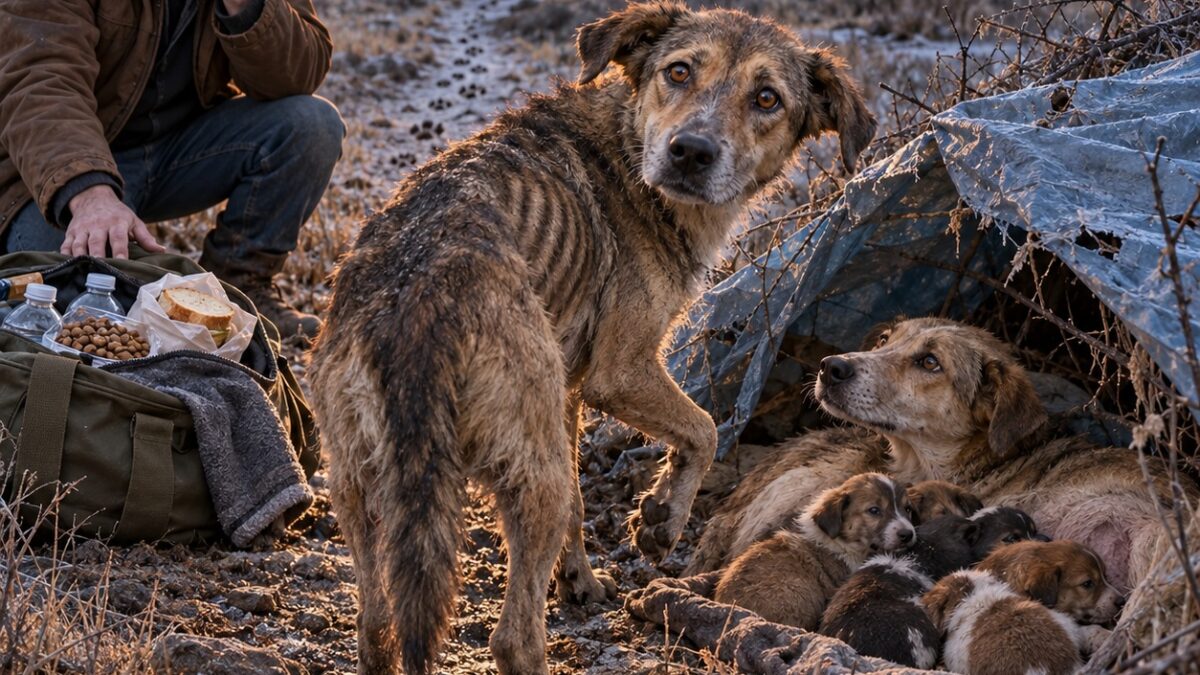
A torn sheet of plastic lay partly over a patch of dirt.
Underneath it was a female dog.
She barely looked alive.
Gray-brown like Burek.
Smaller.
Her ribs were even more visible.
Eyes half closed.
Body curled around several tiny puppies.
I stopped breathing.
The puppies made small noises.
Weak.
Cold.
Hungry.
The mother did not lift her head until I came closer.
Then one eye opened.
I saw fear.
Exhaustion.
Something beyond both.
She had reached the point where the body stops arguing.
Burek went to her.
Pressed his face against hers.
Licked her muzzle.
Then the puppies.
One.
Two.
Three.
Four.
Maybe more hidden beneath her body at first.
I crouched.
“Oh, God.”
Everything from the previous night rearranged itself instantly.
Burek refusing food.
The door.
The road.
The running.
He had not been starving and stupid.
He had been desperate.
He had found a human.
Then tried every method he had to explain:
Not me.
Them.
Help them.
I put one hand over my mouth.
Tears came before I could stop them.
“I’m sorry.”
Burek looked at me.
“I’m sorry I didn’t understand.”
I knelt near the mother.
Slowly.
No sudden movement.
She watched me but did not growl.
Did not have the strength.
I held my hand near her nose.
She smelled it weakly.
Then closed her eyes.
Not because she trusted me completely.
Because Burek was beside me.
That seemed to be enough.
I touched her head.
She gave one long breath.
A sigh.
The kind made by someone who had carried responsibility past the point of exhaustion and finally felt another pair of hands take hold.
“You can rest.”
My voice broke.
“I’ve got them.”
I called animal rescue.
Gave the best location I could.
Gas station.
Trail.
Coordinates from my phone.
The dispatcher told me help was coming.
“Please hurry.”
“We’re on our way.”
I put the phone down.
Then sat in the dirt.
There was nothing else to do yet.
I gave the mother small amounts of water carefully.
Not too much.
The puppies were dehydrated.
Cold.
Their little bodies pressed close to hers because warmth was survival.
Burek sat beside me.
Then, as if someone had turned off whatever force had kept him moving for days, he lowered his head onto my thigh.
His eyes closed.
I looked at him.
“You did it.”
His breathing deepened.
“You found somebody.”
That was the first time he truly rested.
Not in my house.
Not in the car.
There.
Beside the family he had refused to abandon.
I do not know Burek’s exact relationship to the female dog.
No one ever proved it.
Father of the puppies?
Possibly.
Sibling to the mother?
Maybe.
Companion from the same household?
Could be.
Later, the veterinarian told me it did not matter much.
“Family is behavior too.”
He said.
Burek had behaved like family.
That was enough.
The rescue team arrived about an hour later.
Longest hour of my life.
The mother had become less responsive.
One puppy stopped making noise at one point and I thought we were losing him.
I rubbed him gently through the cloth I had wrapped around him.
“Come on.”
Tiny movement.
Then another.
“Stay.”
I heard myself say the same word I had probably said to no one with real desperation in years.
Stay.
The rescuers came with thermal blankets and carriers.
Two vehicles.
Three people.
They moved with practiced urgency.
The mother went first.
IV access planned immediately.
Puppies grouped and warmed.
Burek resisted when they separated him.
He tried following every carrier.
One worker said:
“He’s coming too.”
“Good.”
I followed in my car.
At the veterinary clinic, all of them disappeared behind doors.
Burek too.
I stood in the waiting room with dirt on my clothes, scratches on my arms, and no idea what to do.
So I sat.
Minutes became hours.
The receptionist offered coffee.
I forgot to drink it.
Every time a door opened, I looked up.
Finally, a veterinarian came out.
Middle-aged man.
Tired face.
Kind eyes.
“You’re the one who found them?”
“Burek found them.”
He smiled slightly.
“Fair.”
“How are they?”
“The mother is severely dehydrated and malnourished.”
I nodded.
“The puppies are dehydrated too.”
“How bad?”
“Bad.”
My stomach dropped.
“But?”
He understood what I needed.
“But they’re alive.”
I exhaled.
“We’re treating them.”
“And Burek?”
“Also dehydrated.”
“Underweight.”
“Exhausted.”
Then the veterinarian paused.
“But medically, he’s surprisingly stable considering what he did.”
“What did he do?”
“Run how far?”
I told him roughly.
He shook his head.
“On the calories he had?”
“I don’t think he ate much.”
“No.”
The veterinarian looked toward the treatment area.
“That dog ran on something besides food.”
I knew what he meant.
“Will they survive?”
He sat beside me.
“I can’t promise.”
That sentence hurt.
“But you arrived at the critical point.”
“How critical?”
He looked directly at me.
“If another twenty-four hours had passed before someone found them…”
He didn’t finish.
He didn’t need to.
I stared at the floor.
Twenty-four hours.
One day.
I thought about the night before.
Burek running after my car.
What if I had accelerated?
What if I had said:
Not my problem.
What if I had dropped him at a shelter and gone home?
What if I had ignored the door?
Twenty-four hours.
I covered my face.
The veterinarian put one hand on my shoulder.
“He got you there.”
“Yes.”
“Focus on that.”
Easier said than done.
I went home late that night.
House silent.
Burek remained at the clinic.
For the first time since I brought him home, I missed the sound of an animal that had barely made any sound at all.
His absence filled every room.
The bowl I had put out was still there.
Food untouched.
I looked at it.
Then understood fully.
He had been starving.
Actually starving.
Yet he would not eat because they were still out there.
Maybe guilt.
Maybe instinct.
Maybe stress.
Maybe he simply could not settle while his family remained missing.
I sat on the kitchen floor.
And cried.
For him.
For the mother.
For puppies who had opened their eyes into hunger and dirt.
For the fact that a dog had understood loyalty more clearly than I had understood most relationships in my entire life.
I had built my identity around independence.
Burek nearly killed himself because independence meant nothing to him compared with connection.
The difference unsettled me.
The next afternoon, I went back.
Then the next.
Every day.
The mother had been placed on fluids.
She was receiving carefully controlled nutrition.
Her strength returned slowly.
The puppies received specialized feeding and warmth.
The smallest remained fragile.
Burek recovered faster.
Once he had seen everyone receiving care, he finally ate.
That first bowl disappeared so quickly the technician laughed.
“Slow down.”
Burek ignored her.
She divided future meals.
Smart.
I sat beside his enclosure.
“So now you eat.”
He looked at me.
“You nearly made me think you hated my cooking.”
Tail moved.
That was the first wag I had seen.
Tiny.
But there.
I smiled.
“Good.”
Each afternoon, Burek checked on the others.
If the clinic staff allowed it, he sat close to the mother.
Watched the puppies.
Never crowded.
Never took their food.
He seemed to need visual confirmation.
Everyone present.
Everyone breathing.
Only then would he relax.
The mother improved.
Her coat looked less dull.
Her eyes began following people with actual curiosity rather than exhaustion.
We called her Luna.
The name came from one of the veterinary technicians.
“Because she survived the dark.”
A little poetic for me.
But it fit.
The puppies received temporary names.
Milo.
Benji.
Scout.
Pepper.
Nora.
I do not know who started calling one Milo.
But he was the one Burek checked most often.
Small.
Gray-brown patches.
Restless even while weak.
He would crawl toward Burek whenever possible.
Burek tolerated him with the patience of someone who had already survived worse things than puppy teeth.
The weeks changed all of them.
Bodies filled out.
Eyes brightened.
Puppies began doing what puppies should do.
Making messes.
Fighting over toys.
Falling asleep mid-game.
One afternoon, I entered the clinic and heard barking.
Not weak noises.
Actual barking.
Milo stood against the enclosure gate making himself furious because another puppy had stolen a rope toy.
I laughed until tears came.
A staff member looked at me.
“You okay?”
“Yes.”
I pointed.
“He sounds terrible.”
“That’s good.”
“I know.”
Noise meant strength.
Chaos meant life.
Burek gained weight too.
His coat improved.
The terrified urgency left his posture.
But he still watched me whenever I entered.
The first time I moved toward the door to leave and he stood quickly, my chest tightened.
“You think I’m leaving you?”
Of course I was.
Technically.
But I was coming back.
He did not know the difference yet.
I started saying it every time.
“I’ll be back tomorrow.”
Same words.
Same tone.
The first week, he watched.
Second week, watched.
Third week, he stayed lying down.
That hurt in the best way.
He was beginning to believe repetition.
I leave.
I return.
Maybe trust is just memory learning a new pattern.
Adoption discussions started when the animals were medically cleared.
Luna received interest first.
A couple who lived outside town.
Large fenced property.
Quiet home.
No other dogs.
They visited several times.
Patient people.
Luna liked the woman.
I could see it.
She leaned into her hand.
When adoption day came, I expected Burek to panic.
Instead, he approached Luna.
Sniffed her.
They touched noses.
Long.
Then she left.
Burek stood at the clinic entrance watching the door.
I sat beside him.
“She’s okay.”
He looked at me.
“They’re good people.”
I wished language worked.
Maybe tone did.
He eventually returned to me.
Pressed his side against my leg.
The puppies followed one by one.
Families.
Children.
Homes.
Fenced yards.
People who had filled out applications and prepared beds.
Each goodbye hurt.
I had spent weeks wanting nothing more than for them to survive.
Then survival became departure.
That is rescue.
If it goes well, you lose them to better lives.
Scout went to a family with two teenage boys.
Pepper to a retired couple.
Nora to a young woman who already had another gentle dog.
Benji to a family with a large backyard.
Milo remained.
Mostly because I kept asking about him.
At first casually.
“How’s Milo?”
Then:
“Any applications?”
Then, when someone said there were two interested families, my stomach dropped.
That reaction told me something before my brain admitted it.
“What?”
The technician asked.
“Nothing.”
“You look upset.”
“I’m not.”
“You want him.”
“No.”
She laughed.
“You also want Burek.”
“That is different.”
“How?”
I had no answer.
I had never planned on a dog.
Certainly not two.
My house was not designed for chaos.
My schedule had not included walks.
Vet bills.
Hair.
Chewed furniture.
Responsibility.
I liked quiet.
Or thought I did.
Then one afternoon, I sat outside Burek’s enclosure while Milo climbed all over him.
Burek gently pushed the puppy away.
Milo returned.
Burek sighed.
I recognized the expression.
Tired man realizing resistance is useless.
I laughed.
“Same.”
He looked at me.
The technician passed.
“So?”
“So what?”
“Which one?”
I looked at Burek.
Then Milo.
“That’s the problem.”
She smiled.
“No.”
“That’s the answer.”
I adopted both.
The paperwork took longer than the decision.
Driving home with them felt completely different from the first night.
Burek sat upright.
Milo bounced everywhere.
I said:
“Sit.”
Milo did not know language apparently.
Burek looked exhausted already.
“Your fault.”
I told him.
“He likes you.”
Burek sighed.
At home, Milo attacked a shoe within twelve minutes.
Excellent beginning.
Burek walked through each room.
Slow.
Unlike the first night, he ate.
Full bowl.
Then drank.
Then lay in the middle of the living room.
Not by the door.
That detail destroyed me.
The first night he came into my life, he had spent hours guarding the exit because everyone he loved was somewhere else.
Now, everyone he had chosen was inside.
He slept.
Actually slept.
Milo curled against him.
I sat on the couch.
House no longer quiet.
Puppy breathing.
Burek snoring slightly.
Water bowl being kicked accidentally.
I thought:
So this is what I was protecting myself from?
Noise?
Need?
Attachment?
The possibility of loss?
Maybe.
The first weeks were difficult.
I had romanticized the idea of family too quickly.
Milo woke at ridiculous hours.
Burek needed more food and rest than I expected.
Training.
Vet appointments.
Cleaning.
I stepped in something unpleasant barefoot at 4:30 one morning and briefly reconsidered every life decision.
But the inconvenience came with something unfamiliar.
Expectation.
Someone waited for me.
Actually two someones.
If I worked late, Burek sat near the window.
Milo attacked the door when I entered.
Every evening, no matter how ordinary, had reunion built into it.
I started coming home earlier.
Not because anyone demanded it.
Because I wanted to.
That surprised me.
My house slowly changed.
Dog bed.
Then another.
Toys.
Leashes.
Photos.
Burek gained enough weight that strangers no longer immediately asked whether he had been sick.
Milo grew fast.
Too fast.
Long legs.
Huge paws.
Energy without brakes.
Burek became something like a father.
Again, biological relationship unknown.
Emotionally obvious.
He corrected Milo gently.
Let him climb on him.
Shared sleeping space.
Watched him outside.
If Milo wandered too far in the yard, Burek followed.
Always followed.
That was who he was.
Protector.
I saw it one evening when a thunderstorm rolled in.
Milo panicked.
Puppy fear.
Burek stood beside him.
No barking.
Just presence.
Milo pressed under his chest.
Storm passed.
Burek stayed.
I remembered the hidden clearing.
Same behavior.
Different day.
I started understanding that Burek’s greatest strength was not running behind my car.
Not finding me.
Not even refusing food.
It was vigilance rooted in love.
He noticed who was missing.
He noticed who was frightened.
He noticed when something was wrong.
I had spent most of my life training myself not to notice too much.
Notice creates obligation.
If you see loneliness, maybe you should call.
If you see fear, maybe you should stay.
If you see someone struggling, maybe independence stops being a virtue.
Burek noticed everything.
Then acted.
I began changing.
Slowly.
Calling my sister more.
Accepting invitations instead of saying I was busy.
Helping a neighbor with repairs.
Small things.
I did not become social overnight.
Still preferred quiet.
But quiet was no longer emptiness.
There is a difference.
Luna’s adoptive family sent pictures.
Healthy.
Beautiful.
Sleeping near a fireplace.
I showed Burek.
“I know you don’t understand photographs.”
He sniffed the phone.
Maybe he understood smell less than image.
Still.
“She’s okay.”
The other puppy families sent updates too.
Benji at a lake.
Pepper on a couch.
Scout riding in a car with his head near the window.
Nora beside a Christmas tree wearing antlers and looking deeply offended.
I printed them.
Put them on the fridge.
Milo eventually became too large to pretend he was a baby.
Still acted like one.
Burek aged gracefully.
Scars remained.
Not visible only.
Certain behaviors.
If I drove near the old gas station, Burek became alert.
Head up.
Watching.
The first time after adoption, I considered stopping.
Then decided not to.
Why drag him backward?
Months later, I changed my mind.
Not for Burek.
For myself.
We pulled into the parking lot.
Same lights.
Different season.
Burek stood beside me.
Milo bouncing on leash.
I looked toward the path.
“You remember?”
Burek sniffed.
Then walked several steps toward the trail.
Stopped.
Looked back at me.
Same gesture.
My throat tightened.
This time, I followed without fear.
We did not go all the way to the clearing.
Halfway, Burek slowed.
Sniffed the ground.
Then turned back voluntarily.
That mattered.
The mission was over.
No one waiting.
No one dying.
Nothing to save.
We returned to the car.
Burek climbed inside.
Milo attempted to steal a bag of snacks.
Normal life.
I laughed.
That old place had lost its power.
Years passed.
Not many.
Enough.
Burek grew gray around the muzzle.
Milo became strong.
Energetic.
The two remained inseparable.
One winter morning, Burek struggled getting up.
My stomach tightened.
Vet visit.
Arthritis.
Manageable.
Medication.
Weight control.
Less jumping.
Milo adjusted instinctively.
He stopped crashing into Burek during play.
Waited for him on walks.
If Burek fell behind, Milo circled back.
Family teaching family.
I watched the pattern repeat in reverse.
Burek had once kept everyone safe.
Now Milo watched him.
That was life.
Roles change.
Love stays.
I thought often about the veterinarian’s words from the first day.
Twenty-four more hours.
That number haunted me less with time.
Eventually, I changed how I held it.
Not:
What if I had failed?
Instead:
We didn’t.
Burek didn’t.
He found help in time.
That mattered.
Guilt tries to make us responsible for imaginary tragedies.
Gratitude makes room for what actually happened.
I chose gratitude.
One year after the rescue, I contacted the clinic.
Asked if I could bring food and supplies.
The veterinarian laughed.
“Bring Burek.”
We did.
Staff gathered.
Burek received too many treats.
Milo behaved disgracefully.
One technician hugged Burek and cried.
“You look good.”
He did.
He looked like a dog who had survived enough to become ordinary.
Best thing in the world.
I asked the vet once:
“Why do you think he refused to eat?”
He thought.
“Stress.”
“Attachment.”
“Maybe he was too focused on returning.”
“Animals can become profoundly distressed when separated from bonded companions.”
“So he wasn’t choosing starvation?”
“Not in a human moral sense.”
He smiled.
“But emotionally, he had unfinished business.”
That phrase fit.
Unfinished business.
Burek could not rest while his family was missing.
Once they were safe, he ate.
Slept.
Allowed a new bond.
Some people do the same.
We walk around unable to settle because part of us remains somewhere unresolved.
A death.
A relationship.
A person we failed.
A promise.
We think we are tired.
Sometimes we are simply divided.
Burek became whole again only after finding them.
Then, somehow, I did too.
I had not known I was divided.
Part of me living.
Part protecting.
Part refusing closeness so I would never need anyone enough to be frightened.
Dogs expose hypocrisy efficiently.
I claimed independence.
Then rearranged an entire day because Milo had diarrhea.
No philosophy survives puppy ownership.
I was happier.
That was the embarrassing truth.
Happier with responsibility.
Happier with interruption.
Happier with hair on my clothes.
Happier because something outside myself mattered every day.
Not abstractly.
Practically.
Food.
Walk.
Vet.
Home.
Love becomes real through logistics.
That is a lesson nobody puts on greeting cards.
Years later, Burek slowed more.
Milo stayed young enough to want long runs.
I started taking them separately sometimes.
One short walk with Burek.
One long with Milo.
At first Burek objected when Milo left.
Old worry.
Missing family.
So I changed the routine.
Burek came in the car.
Watched Milo run at a fenced park.
Then we all returned together.
He relaxed.
Old wounds do not always disappear.
You work around them with kindness.
That is fine.
Healing does not mean becoming unaffected.
It means effects become manageable inside safety.
Burek had taught me that too.
One evening, we received a letter from Luna’s family.
Photograph inside.
Luna older.
Beautiful.
Lying on grass near an older couple.
They wrote:
“She is gentle with everyone, but every time she hears a car door outside she still lifts her head.”
I read that twice.
Maybe waiting is part of some dogs forever.
Not necessarily for a specific person.
A habit born from loss.
I looked at Burek.
Sleeping.
Milo against him.
He no longer lifted his head at every car.
Progress.
I wrote back:
“Tell her Burek is safe.”
Ridiculous.
Meaningful.
Both.
Eventually, life brought the part I had been pretending not to consider.
Burek became ill.
Not sudden.
Age.
Kidney values.
Arthritis.
A heart murmur.
Nothing dramatic enough to call tragedy.
Everything inevitable enough to hurt.
The veterinarian said:
“We manage.”
So we did.
Special food.
Medication.
Shorter walks.
More blankets.
Milo became gentle around him.
The first time Burek refused breakfast again, my body remembered the beginning.
Panic.
I crouched.
“Not this again.”
But this time was different.
He wasn’t trying to lead me anywhere.
He was old.
The vet adjusted medication.
Appetite returned for a while.
I started counting good days.
Then stopped.
Counting makes time cruel.
Instead:
Today he ate.
Good.
Today he walked to the mailbox.
Good.
Today he slept in sun.
Good.
Today Milo licked his face until he became annoyed.
Very good.
One spring morning, I found Burek beside the front door.
My heart stopped.
Same position.
Head lowered.
For one second, I was back at the beginning.
Then I realized the door was open to sunlight.
He wasn’t waiting to leave.
He wanted outside.
I helped him stand.
We walked slowly to the yard.
Milo followed.
Burek lay in the grass.
Sun on his coat.
I sat beside him.
No emergency.
No mission.
Just morning.
Maybe peace is when old symbols stop meaning fear.
Door.
Road.
Car.
They had all changed.
Because home changes the meaning of leaving.
You leave and return.
You go to the vet and return.
You take a drive and return.
The world stops feeling like a sequence of disappearances.
Burek knew that by then.
So did I.
His last week arrived quietly.
Less eating.
More sleeping.
Eyes still bright when I spoke.
Body tired.
The veterinarian came to the house because I asked.
I did not want Burek’s final memory to involve a clinic if I could avoid it.
We put his favorite blanket in the living room.
Milo lay nearby.
Restless.
Confused.
Burek’s breathing was slow.
I sat on the floor.
The same way I had sat beside Luna in the clearing years before.
The same way I had sat with Burek after he completed his mission.
Life folding back on itself.
I put my hand beneath his head.
“You know something?”
His eyes moved.
“You were a nightmare.”
Tail barely moved.
“Ran behind my car.”
“Wouldn’t eat.”
“Made me hike through half the wilderness.”
“Then brought home a puppy.”
I laughed.
Cried.
“Completely ruined my life.”
Milo put his head on my leg.
I looked at both.
“Thank God.”
Burek breathed.
I touched the gray fur around his muzzle.
“You did enough.”
That sentence.
Again.
“You saved them.”
“All of them.”
“You saved Milo.”
“You saved Luna.”
I swallowed.
“And me.”
That was harder.
“I know that sounds dramatic.”
“I don’t care.”
The veterinarian waited.
No rush.
I leaned down.
“When you ran after my car, I thought you needed me.”
My voice broke.
“You were right.”
“You did.”
“But I needed you too.”
The medication began.
Burek relaxed.
Milo moved closer.
Pressed his body along Burek’s side.
I put one hand on each of them.
Family.
Burek exhaled.
Softly.
And did not breathe again.
Milo stayed beside him.
For a long time.
Sniffed.
Waited.
Then finally placed his head across Burek’s front legs.
That sight almost undid me completely.
I understood then why Burek had been so desperate years earlier.
Family missing feels physical.
Space changes.
Silence changes.
Food changes.
Everything.
Milo refused dinner that night.
Fear shot through me.
Not again.
I sat beside him.
“Hey.”
He looked toward the room where Burek’s bed remained.
“I know.”
I did not force food.
I stayed.
The next morning, Milo ate a little.
Then more.
He looked for Burek for weeks.
At the door.
Yard.
Car.
I repeated what Burek had taught me.
Presence.
Routine.
Return.
Milo adjusted.
Not forgot.
Adjusted.
There is a difference.
I kept Burek’s collar.
Not displayed dramatically.
It hangs near the door.
Sometimes Milo sniffs it.
Sometimes I touch it before leaving.
Years later, Milo still lives with me.
Older now.
Still energetic.
Still prone to stealing things he absolutely does not need.
The house remains noisy.
Thank God.
Luna’s family still sends occasional updates.
The other puppies too, when possible.
Five separate lives.
One dog’s impossible determination connecting all of them.
People sometimes tell me:
“You saved Burek.”
I correct them.
“No.”
“I gave him a ride.”
They laugh.
But I mean it.
Burek was the one with the plan.
He saw a car.
Ran.
Followed.
Refused comfort.
Refused food.
Stayed awake.
Waited until the human finally became intelligent enough to understand.
Then led me.
He was never helpless.
Exhausted.
Starving.
Yes.
But purposeful.
He carried responsibility larger than his body could support.
I helped only after he made helping possible.
That matters because we often tell rescue stories in ways that make humans the entire center.
We are not always.
Sometimes the animal is already fighting.
Already protecting.
Already doing everything possible.
Our job is simply to join the fight before it is too late.
Burek taught me to pay attention.
Not to the loudest signal.
The persistent one.
A dog refusing food.
A paw on your leg.
A body beside a door.
A look toward the road.
Communication does not fail only because language is missing.
Sometimes listening fails.
The first night, Burek communicated perfectly.
I was slow.
That humbles me.
He had one night to convince a stranger.
He did.
Now, when I think about the gas station, I do not remember the fluorescent lights first.
I remember his eyes.
Watching.
Assessing.
Deciding.
Maybe he had tried other people.
I will never know.
Maybe cars had passed him.
Maybe someone fed him and drove away.
Maybe I was simply the first idiot stubborn enough to stop twice.
Doesn’t matter.
He found what he needed eventually.
So did I.
Before Burek, I believed strength meant carrying your own burdens quietly.
He proved the opposite.
Strength can be running yourself nearly to collapse because someone else needs help.
Strength can be asking.
Again.
Again.
Again.
Strength can be accepting help once it finally arrives.
That part matters too.
Burek let me carry something.
Not his body.
His responsibility.
Once Luna and the puppies were safe, he slept.
He trusted me enough to stop.
There is enormous vulnerability in that.
I had spent years refusing such vulnerability.
No dependence.
No expectations.
No one can fail you if you never need them.
That philosophy sounds strong until you realize it leaves no room for anyone to save you either.
Burek broke that.
He needed me.
Then I needed him.
Then Milo needed both of us.
That became family.
Not biology.
Not paperwork.
Mutual vulnerability repeated long enough to become belonging.
Today, the house contains photographs.
One from the clinic.
Luna lying near her puppies.
Burek watching.
One of Milo as a young dog destroying a pillow.
One of Burek sleeping in the middle of my living room.
That photograph is my favorite.
Nothing dramatic.
No highway.
No rescue.
No visible suffering.
Just sleep.
Complete.
Deep.
Safe.
Because the first night I knew him, he could not sleep.
That is why the picture matters.
Safety is often most visible in unconsciousness.
An animal who sleeps deeply believes the world will still exist when he wakes.
Burek eventually believed that.
I am proud of that more than anything else.
There is another picture I never took but carry clearly.
Dawn.
Front door.
Burek sitting there.
Eyes open.
Waiting for me to understand.
If I could walk back into that room, I would not waste the night.
I would kneel.
Touch his head.
Say:
“Show me now.”
But life does not offer revised drafts.
We get the version we live.
The important thing is that morning came.
I understood in time.
That is enough.
The veterinarian’s twenty-four-hour warning used to haunt me.
Now it reminds me that sometimes being late is not the same as being too late.
We often punish ourselves for not understanding immediately.
Maybe grace is arriving before the final deadline.
I was slow.
Burek persisted.
We made it.
Luna survived.
The puppies grew.
Milo is asleep near me as I think about all of this.
He has one paw stretched toward the empty side of the rug where Burek used to lie.
Maybe coincidence.
Maybe memory.
I do not need to know.
I scratch his ear.
He opens one eye.
Then sleeps again.
Home.
That word still surprises me.
Before them, home meant the place my keys were.
Now it means someone sleeps without fear because I am there.
It means food bowls.
Hair.
Noise.
Obligation.
It means knowing absence matters because presence matters first.
Burek gave me that definition.
The starving dog who chased my car was never asking to be rescued alone.
He was asking me to join a family I had not even seen yet.
I thought I was following him into the wilderness to save a dying mother and her puppies.
What I did not understand was that the trail worked both ways.
He led me to them.
Then all of them led me out of the life I had built around never needing anyone.
That may be why, even now, whenever I drive past that old gas station, I slow down.
I look toward the edge of the parking lot.
For one impossible second, I can almost see him there again.
Thin.
Exhausted.
Watching my car.
Waiting to see whether I will stop.
In memory, I always do.
Every time.
I pull over.
Open the door.
And Burek runs toward me carrying the weight of an entire family in his tired body.
I tell him:
“I understand now.”
Of course he does not need to hear it anymore.
But I do.
Because the greatest thing Burek ever taught me was not how to rescue an animal.
It was how to recognize love when it refuses to leave someone behind.








