FULL STORY:The Rich Man’s Black-Belt Son Humiliated My Daughter—Three Days Later, He Was on His Knees in Front of Her
FULL STORY CONTINUATION
Kalen stepped closer.
Not enough to threaten.
Enough to test.
People who have spent a lot of time training often do that unconsciously.
Distance becomes language.
He wanted to know whether I would move.
I didn’t.
“You a martial arts guy?”
“No.”
That was technically true in the way certain truths can still hide a lot.
He looked at my hands.
“You don’t look like one.”
“Good.”
He smirked again.
“Then maybe don’t lecture me about strength.”
“I’m not lecturing you.”
“You just said—”
“I said leave my daughter alone.”
“That’s a lecture?”
“No.”
“Then we’re done.”
He walked past me.
I let him.
That should have ended it.
Instead, Bell Haven did what small towns do.
It talked.
By Friday afternoon, somebody had told somebody who told somebody else that Everett Harper had confronted Grant Voss’s son in the community-center parking lot.
The story grew.
By lunch, I had apparently threatened Kalen.
By dinner, I had challenged him to a fight.
By Saturday morning, according to a customer at the repair shop, I had offered to “teach that rich kid some humility.”
I hadn’t.
But rumors do not require participation.
At 10:17 Saturday morning, my phone rang.
Unknown number.
I answered.
“Everett Harper?”
“Yes.”
“Grant Voss.”
Of course.
His voice was controlled.
Measured.
“You spoke to my son yesterday.”
“Yes.”
“I understand there was a confrontation.”
“No.”
A pause.
“No?”
“I talked to him.”
“He says you threatened him.”
“Then he lied.”
Silence.
That was the first dangerous word.
Not because Grant shouted.
He didn’t.
Men like Grant are most threatening when they become quieter.
“You’re comfortable calling my son a liar?”
“When he says something untrue.”
Another silence.
Then:
“Let’s not turn this into something bigger than it is.”
“I agree.”
“Good.”
“Tell Kalen to leave Maisie alone.”
Grant exhaled.
“My son made a comment in a karate class.”
“He is twenty-six.”
“Children get embarrassed.”
“My daughter is eleven.”
“You’re making this emotional.”
“I’m her father.”
“That is usually emotional.”
Grant’s voice tightened.
“You need to understand something about Bell Haven.”
I looked through the kitchen window.
Maisie was in the backyard.
Barefoot.
Karate uniform pants with an old sweatshirt.
Practicing the same turning movement that had embarrassed her.
Again.
Again.
Again.
“What do I need to understand?”
Grant answered:
“My family has supported that community center for twenty years.”
There it was.
Money entering a moral argument.
“I know.”
“Kalen has volunteered there.”
“I know.”
“He’s helped train students.”
“Good.”
“Then maybe you should consider that one misunderstanding doesn’t justify damaging somebody’s reputation.”
I watched Maisie stumble.
Reset.
Try again.
“He humiliated my daughter.”
“She’ll recover.”
My jaw tightened.
“You don’t get to decide how much humiliation somebody else should tolerate.”
That produced another pause.
Then Grant said:
“You don’t understand who you’re dealing with.”
I almost laughed.
Not because it was funny.
Because men like Grant sometimes tell you exactly who they are when they believe the warning itself will do the work.
“I understand perfectly.”
I ended the call.
My hands shook afterward.
That bothered me.
Not fear exactly.
Anger.
Old anger.
I had spent years learning not to trust that feeling.
Caroline used to know when it arrived before I did.
She would put one hand on my forearm and say:
“Come back.”
Two words.
Come back.
I missed them.
Maisie came inside five minutes later.
Sweating.
Hair stuck to her forehead.
“Was that work?”
“No.”
“Who?”
“Grant Voss.”
Her eyes widened.
“Kalen’s dad?”
“Yes.”
“Are you in trouble?”
That question hurt.
“Why would I be?”
“They own everything.”
Children see power more clearly than adults sometimes.
“They don’t own us.”
Maisie looked unconvinced.
I crouched.
“You did nothing wrong.”
“I messed up the move.”
“That is not wrong.”
“He said—”
“I know what he said.”
She looked at me.
“Are we still going today?”
“Do you want to?”
“I don’t know.”
“Then we can skip.”
She looked toward the backyard.
Then shook her head.
“No.”
“No what?”
“I want to go.”
“You sure?”
She nodded.
“If I stop, he wins.”
I did not love that reason.
But courage sometimes begins from imperfect motives.
So we went.
The Saturday class started at two.
Parents sat along one wall.
Students lined up on the mats.
Coach Lenora saw Maisie enter and smiled.
“Glad you came.”
Maisie nodded.
Kalen was already there.
Not part of the class.
Watching his younger cousin.
He looked at me.
I looked at him.
Nothing more.
Class began.
For twenty minutes, everything was normal.
Then Kalen stood.
Walked toward the edge of the mat.
“Coach.”
Lenora turned.
“What?”
“I heard Everett wanted to talk.”
My stomach tightened.
“I already talked to you.”
Kalen looked across the room.
Parents stopped whispering.
Students noticed.
He smiled.
“You’ve been telling people I humiliated your daughter.”
“No.”
“You told my dad.”
“He called me.”
“Same thing.”
Lenora stepped toward him.
“Kalen, this isn’t the place.”
“Actually, it is.”
He removed his shoes.
Walked onto the mat.
My entire body recognized the gesture.
Not challenge yet.
Performance.
“You’ve been acting like you know something about martial arts.”
“I haven’t.”
“You told me being strong isn’t the same as being right.”
“Yes.”
“So show me.”
“No.”
He laughed.
“Scared?”
“No.”
“Then step on the mat.”
“I’m here for Maisie.”
“Exactly.”
He looked toward her.
“She deserves to know whether her dad actually knows what he’s talking about.”
Maisie grabbed my hand.
That was the moment everything became different.
Not because Kalen challenged me.
Because he used her.
He wanted to turn her father into proof.
If I refused, coward.
If I accepted, spectacle.
That is how ego traps people.
It creates only two choices.
Fight or humiliation.
I had learned long ago there were usually more.
“Kalen.”
Coach Lenora’s voice sharpened.
“Enough.”
He ignored her.
“You want me to apologize?”
“Yes.”
“Make me.”
Several parents shifted.
One man whispered:
“This is getting ridiculous.”
Correct.
I looked at Maisie.
Her eyes were wide.
Fear.
Not of Kalen hurting me.
Of what I might become.
That thought stopped me.
“Sweetheart.”
She looked up.
“I’m not going to hurt him.”
Kalen laughed.
“Confident.”
I looked at him.
“No.”
Then removed my shoes.
Coach Lenora stared at me.
“Everett.”
“It’s okay.”
“It might not be.”
“I know.”
I stepped onto the mat.
The texture under my feet returned memories too quickly.
Competition gyms.
Sweat.
Tape.
Crowds.
Referees.
Caroline sitting in folding chairs pretending she wasn’t nervous.
Another life.
Kalen bowed casually.
I bowed properly.
Not for him.
For the mat.
For the art.
For every teacher I had.
Lenora noticed.
Her expression changed.
“You’ve trained.”
I said nothing.
Kalen smiled.
“Thought so.”
He raised his hands.
I did not.
“Kalen,” Lenora warned, “this is not a sanctioned bout.”
“Relax.”
He moved first.
Fast.
Good technique.
Better than I expected.
A probing step.
Hand toward my shoulder.
Testing reaction.
I shifted.
He missed.
His eyebrows moved.
Again.
This time faster.
I moved outside the line.
Nothing dramatic.
No strike.
He turned.
Confusion.
A third attempt.
I redirected his arm just enough that he stepped past me.
Murmurs.
Kalen straightened.
“Stop running.”
“I’m standing right here.”
He came harder.
Now pride.
Speed without patience.
I angled away.
Caught the motion.
Released.
He stumbled.
Not fell.
His face changed.
The room became very quiet.
Kalen stared at me.
“Who taught you?”
I said:
“This doesn’t matter.”
“It does.”
“No.”
He attacked again.
This time committed.
Right hand reaching.
Hip turning.
He wanted contact.
I caught his wrist.
Rotated.
Stepped through.
Used his forward weight.
One controlled sweep.
Kalen went to the mat.
Safely.
No slam.
No joint pressure beyond control.
No pain needed.
I released immediately.
Kalen remained on his back.
Staring upward.
Lenora whispered:
“No way.”
I looked at her.
She stepped closer.
“That was the harbor sweep.”
Nobody else understood.
I did.
My stomach tightened.
“You remember?”
“Of course I remember.”
She stared at the small scar near my eyebrow.
Then at my stance.
“Everett Harper.”
I exhaled.
Kalen sat up.
“What?”
Lenora almost laughed from disbelief.
“You were at the state tournament in 2009.”
I looked away.
A father in the second row started searching on his phone.
Bad.
Lenora continued.
“Three years.”
“Kalen,” she said, “he won the state championship three times.”
Phones appeared.
Whispers.
I hated every second.
Kalen stood slowly.
“You were a champion?”
“Was.”
“And you said you weren’t a martial arts guy.”
“I said I’m not.”
“That makes no sense.”
“It does to me.”
Then a voice came from the gym entrance.
“Evan?”
Everything inside me stopped.
Nobody had called me that in fourteen years.
I turned.
Grant Voss stood near the doors.
Coat still on.
Face pale.
For several seconds, neither of us moved.
He knew.
That was obvious.
Maisie looked between us.
Grant took one step forward.
“Evan Harper?”
“My name is Everett.”
He stopped.
“Right.”
Kalen looked at his father.
“You know him?”
Grant ignored him.
“I thought you left.”
“I did.”
“After the 2010 invitational?”
“After that.”
Grant stared at me.
I had known him differently then.
Not friend.
Not exactly.
Grant had been one of the major sponsors of the state martial arts circuit.
Voss Construction banners at tournaments.
Grant sitting ringside.
Caroline beside me sometimes.
He had known my competitive name.
Evan Harper.
Shorter.
Sharper.
More marketable, according to a promoter who thought Everett sounded like an accountant.
When Caroline died, I buried more than my wife.
I buried that name.
Grant said:
“You disappeared.”
“Yes.”
“Why?”
I looked toward Maisie.
That answer was easy.
“Because after my wife died, my daughter needed a father more than the sport needed another champion.”
The room went still.
Maisie looked at me.
“Mom knew?”
I smiled faintly.
“Mom knew everything.”
Grant closed his eyes for a second.
Then turned toward his son.
“Kalen.”
The tone changed.
Not wealthy businessman.
Father.
“What exactly did you say to that girl?”
Kalen looked toward Maisie.
His arrogance had disappeared.
“I…”
Grant waited.
“What did you say?”
Kalen swallowed.
“I laughed when she messed up.”
“What else?”
“I said maybe karate wasn’t for her.”
Grant’s face tightened.
“Anything else?”
Kalen looked at me.
“He asked me to leave her alone.”
“And?”
“I told him…”
He stopped.
Grant’s voice lowered.
“What?”
Kalen looked down.
“I asked what he’d do if I didn’t.”
Grant stared at his son.
Then at me.
I expected apology from Grant first.
Instead, he said:
“Kneel.”
Kalen looked up.
“What?”
“Dad.”
“You heard me.”
I stepped forward.
“No.”
Grant looked at me.
“He needs—”
“He needs to apologize because he understands why.”
Silence.
“If you force him to kneel, he learns obedience.”
I looked toward Kalen.
“He needs to learn humility.”
Grant absorbed that.
Then stepped back.
The room waited.
Kalen looked at Maisie.
At me.
At Coach Lenora.
At the students.
At his father.
Then something happened no one ordered.
He walked toward Maisie.
Stopped three feet away.
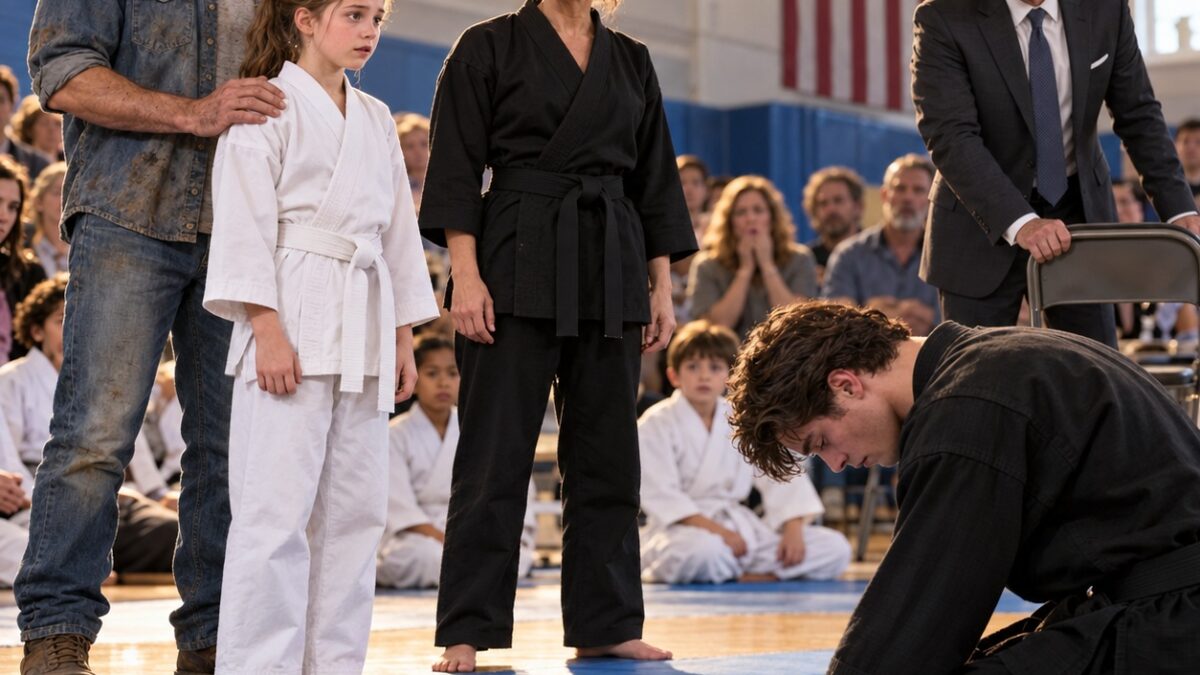
And lowered himself onto one knee.
Not because Grant told him.
Because standing over an eleven-year-old while apologizing suddenly felt wrong.
Maisie gripped my hand.
Kalen lowered his head.
“I’m sorry.”
His voice cracked slightly.
Nobody spoke.
He looked up.
“I thought because I was better at something, I was better than the people learning it.”
Maisie stared at him.
“I made you feel stupid.”
Her mouth trembled.
“You made me think I wasn’t good enough.”
Kalen swallowed.
“You are.”
She looked toward me.
I gave the smallest nod.
Not permission to forgive.
Permission to answer however she wanted.
Maisie looked at Kalen again.
“Then don’t make somebody else feel that way.”
Kalen nodded.
“I won’t.”
She did not hug him.
Did not smile.
Did not say everything was okay.
Good.
Apology is not a vending machine.
You do not insert words and receive forgiveness.
Kalen stood.
Grant approached me.
“I owe you one too.”
“Yes.”
He accepted that immediately.
“I protected him.”
“Yes.”
“I thought you were trying to embarrass him.”
“I was trying to protect my daughter.”
“I know that now.”
“You should’ve known before.”
Grant nodded.
“I should have.”
He looked toward Maisie.
“Your father was right.”
She raised an eyebrow.
“About what?”
Grant almost smiled.
“That strength and being right aren’t the same thing.”
Maisie considered this.
Then said:
“Your son still needs practice.”
Several parents laughed.
Kalen actually smiled.
Small.
Embarrassed.
Grant held out his hand.
I looked at it.
Then shook.
That should have ended the story.
It didn’t.
Because one apology in a gym does not change twenty-six years of entitlement.
The next part mattered more.
Monday afternoon, Kalen returned to the community center.
No audience.
No father.
No expensive car parked dramatically out front.
He walked into Maisie’s class wearing ordinary training clothes.
Coach Lenora saw him.
“What do you need?”
“I want to help.”
She folded her arms.
“Why?”
Kalen looked toward Maisie.
She was struggling with the same pivot.
Again.
Again.
He said:
“Because I made somebody afraid to learn.”
Lenora studied him.
Then:
“You don’t teach unless I ask.”
“Understood.”
“You don’t correct children by humiliating them.”
“Understood.”
“You don’t touch anyone without permission.”
“Understood.”
She pointed toward the equipment rack.
“Then stack those pads.”
Kalen stacked pads for forty minutes.
Nobody applauded.
Good.
The next class, he came again.
Pads.
Floors.
Equipment.
He said almost nothing.
Third class.
Same.
Eventually, Lenora let him assist with a beginner group.
Maisie noticed.
When she missed the pivot, Kalen did not laugh.
He crouched several feet away.
“Can I show you?”
She looked at Lenora.
Lenora nodded.
Kalen stood.
Demonstrated slowly.
“Your foot is landing here.”
He pointed.
“You’re trying to turn from your shoulders.”
“Turn from the floor first.”
Maisie tried.
Wrong.
Kalen said:
“Again.”
No judgment.
She tried.
Closer.
“Again.”
Third time.
Clean.
Maisie looked surprised.
Kalen smiled.
“There.”
She tried it again.
Still good.
Across the gym, I watched.
I did not feel victorious.
That surprised me.
For three days after the confrontation, part of me had imagined the satisfaction of Kalen being humbled.
Then it happened.
The actual satisfaction came later.
Watching him become useful.
Humiliation changes who is on top.
Growth changes the structure.
That distinction took me a long time to understand.
My old competitive life had been built around hierarchy.
Winner.
Loser.
Champion.
Challenger.
Rank.
Belt.
Record.
Everything measured.
I had loved parts of it.
Training.
Discipline.
Technical precision.
The calm before competition.
The strange honesty of standing across from someone equally prepared and knowing both of you agreed to the risk.
What I eventually hated was everything people attached to winning.
Worth.
Masculinity.
Superiority.
Power.
Caroline saw it before I did.
We met when I was twenty-four.
I had just won my second state title.
She worked at a physical-therapy clinic.
I came in for shoulder rehab.
She recognized me and didn’t care.
That irritated me.
“I won last weekend.”
She looked at my chart.
“You also partially tore your rotator cuff.”
“I’m serious.”
“So am I.”
I fell in love immediately.
Not literally.
Within months.
Caroline never let the sport become my personality.
After a win, she would say:
“Good.”
Then ask whether I remembered milk.
After a loss, she treated me exactly the same.
That was revolutionary.
Grant knew us from tournaments.
He sponsored events.
Hosted dinners.
He once offered to connect me with promoters outside the state.
I almost accepted.
Then Caroline became pregnant.
Maisie was born.
My priorities began shifting.
Then Caroline got sick.
Fast.
There is something obscene about training for competition while your wife is undergoing chemotherapy.
The contrast became unbearable.
One night, I was wrapping my hands for a tournament when Caroline said:
“Why are you going?”
I looked at her.
“Because I committed.”
“To who?”
“The organizers.”
She nodded.
“And me?”
That question ended my career.
Not immediately.
But inside.
I competed once more.
Won.
Retired.
A year later, Caroline was gone.
Grant remembered the champion.
He never knew the man after.
Until Maisie.
The local story spread after the community-center incident.
Small towns cannot resist.
By Tuesday, the diner had renamed a breakfast special “The Harper Sweep.”
I threatened to stop eating there.
The owner offered me free coffee.
I surrendered.
Phones showed old footage.
People who had known me for years suddenly acted as if my previous life changed something.
At work, my supervisor asked:
“You could’ve told us.”
“Why?”
“We’ve been sending you into industrial plants alone.”
I stared at him.
“What does karate have to do with generators?”
“Nothing.”
“Then there you go.”
People like hidden histories.
They make ordinary acquaintances feel secretly important.
I hated that.
Maisie loved it briefly.
“Dad.”
“What?”
“You were on TV.”
“Local TV.”
“Still TV.”
“Barely.”
“You had hair.”
I looked at her.
“Cruel.”
“You looked weird.”
“Thank you.”
She watched an old championship match.
About three minutes in, she frowned.
“You hit that guy.”
“Yes.”
“A lot.”
“Yes.”
“Did he hit you?”
“Yes.”
“Why?”
“We agreed to.”
She looked horrified by adulthood.
“That is a terrible hobby.”
“Your mother said the same thing.”
Maisie stopped the video.
“Did you like hurting people?”
That question mattered.
“No.”
“Then why fight?”
I sat beside her.
“Because competition isn’t always about hurting.”
“It looks like hurting.”
“Fair.”
I thought.
“I liked learning control.”
“Timing.”
“Discipline.”
“Fear.”
She frowned.
“You liked fear?”
“I liked learning what to do when I felt it.”
That she understood.
Karate had started giving her the same thing.
Not power.
Familiarity with discomfort.
She asked:
“Were you scared of Kalen?”
“Yes.”
Her eyes widened.
“But you put him down.”
“That doesn’t mean I wasn’t scared.”
“What were you scared of?”
“Hurting him.”
She looked confused.
“Really?”
“And getting hurt.”
“Making things worse.”
“Having you watch me become someone I didn’t want you to see.”
That last answer quieted her.
“Did you?”
“Did I what?”
“Become him?”
“No.”
I smiled.
“I hope not.”
Kalen’s growth continued in small increments.
He apologized to Coach Lenora.
Then to the class.
Not dramatic.
He stood in front of the students and said:
“I used rank as permission to embarrass someone.”
He looked at the belts lined up before him.
“It isn’t.”
One student asked:
“Are you still a black belt?”
“Yes.”
“Then aren’t you better?”
Kalen thought.
“At some things.”
The child looked confused.
Kalen continued.
“Being better at a technique doesn’t make you a better person.”
That was the right answer.
Grant heard about the volunteer work.
At first, I suspected he had ordered it.
I called him.
“Did you make Kalen go back?”
“No.”
“You sure?”
“Yes.”
“He came home after the apology and barely spoke.”
Grant paused.
“Then Monday he left early.”
“I asked where.”
“He said community center.”
“That’s all?”
“That’s all.”
Good.
Grant himself began changing too.
Slower.
His problem was not exactly arrogance.
It was protection.
He had spent Kalen’s entire life removing consequences.
A fight at school?
Lawyer.
A parking ticket?
Assistant.
A business mistake?
Transfer him to another division.
A complaint?
Somebody misunderstood.
Grant loved his son by making discomfort disappear.
That love had weakened him.
He admitted this months later.
We were sitting at the diner.
He looked deeply uncomfortable there.
Grant Voss had probably not sat on cracked vinyl since childhood.
“Coffee?”
I asked.
He looked at the mug.
“This is coffee?”
“Technically.”
He drank.
Regretted everything.
Then said:
“I thought good parenting meant making sure your kid didn’t suffer unnecessarily.”
“It does.”
“So where did I go wrong?”
“Unnecessarily.”
He looked at me.
I continued.
“Some consequences are necessary.”
“If Maisie lies, she gets consequences.”
“If she hurts someone, she apologizes.”
“If she fails, I let her fail sometimes.”
Grant stared at the coffee.
“I didn’t.”
“I know.”
“How?”
“Kalen.”
He sighed.
Fair.
“I kept thinking the world would be hard enough on him later.”
“So I made home easy.”
“Too easy?”
“Maybe.”
He rubbed his hands.
“You ever feel guilty every time your kid struggles?”
“Yes.”
“Then how do you stop fixing it?”
“You don’t always.”
“When?”
I thought about Caroline.
“If the struggle is dangerous, help.”
“If the struggle is painful but useful, stay close.”
Grant looked at me.
“That sounds simple.”
“It isn’t.”
No.
Nothing about parenting is.
The Voss name remained powerful.
That did not vanish because Grant learned humility.
His companies still owned buildings.
He still had influence.
Still received calls returned faster than mine.
But gradually, people noticed something.
Kalen started working at the community center regularly.
Not as instructor initially.
Maintenance.
Youth program.
Beginner assistant.
He stopped using his father’s last name as a shortcut.
That last part was difficult.
Bell Haven expected him to.
One afternoon, a parent arrived angry about a scheduling mistake.
She saw Kalen.
“You’re Grant Voss’s son. Fix this.”
Old Kalen might have.
Instead he said:
“Coach Lenora handles scheduling.”
“Your family funds this place.”
“Yes.”
“So?”
“So that doesn’t make me the director.”
Lenora heard.
Smiled.
Progress.
Maisie advanced.
White belt became yellow.
Yellow became orange.
She was never fastest.
Never strongest.
Still froze occasionally when everybody watched.
But she stopped assuming fear meant incapability.
Kalen helped with that.
Not by telling her she was gifted.
She wasn’t.
By normalizing repetition.
Again.
Again.
Again.
One Saturday, she struggled with a combination for twenty minutes.
Finally:
“I can’t do it.”
Kalen said:
“Correct.”
She glared.
I almost stood.
Then he continued:
“Yet.”
She stared.
Kalen demonstrated.
“You couldn’t do your pivot either.”
“I can now.”
“So?”
Maisie tried again.
Failed.
Again.
Closer.
Again.
Clean.
She smiled.
Kalen said:
“See?”
She looked smug.
“I basically taught myself.”
He laughed.
Good.
Their relationship became something like older brother and younger sister.
Careful.
Earned.
Kalen never demanded forgiveness.
That mattered.
Maisie gave trust in pieces.
That mattered more.
Grant’s apology developed too.
A year after the original incident, he announced changes to the Voss Foundation’s youth grants.
Previously, the family donated money and placed the Voss name everywhere.
New policy funded programs anonymously when possible.
No naming requirement.
No control over curriculum.
No requirement that family members sit on boards.
I asked Grant why.
He said:
“I discovered money can become another way of standing over people.”
That was a good sentence.
I told him not to get philosophical.
He blamed the diner coffee.
The community center eventually needed a roof.
Huge expense.
Grant offered to pay.
Lenora said:
“Yes.”
Then added:
“No VOSS COMMUNITY TRAINING COMPLEX sign.”
Grant laughed.
“Understood.”
Kalen added:
“Put Coach Pike’s name on it.”
Lenora threatened to remove his black belt personally.
The roof stayed unnamed.
Perfect.
Years passed.
Maisie turned thirteen.
Then fourteen.
Karate became hers.
Not mine.
Not Kalen’s.
Hers.
She competed once.
Lost first round.
Cried in the bathroom.
I found her.
“Want to go home?”
“No.”
“What do you want?”
“To watch.”
So we watched.
She studied the girl who beat her.
Later, she said:
“I know what I did wrong.”
“What?”
“Everything.”
I laughed.
“Specific.”
She trained.
Next tournament, won one match.
Lost second.
Celebrated the win.
Learned from the loss.
That was healthier than my younger self.
I had treated losses like moral failure.
Maisie treated them as information.
Kalen noticed too.
One night after class, he said:
“She’s tougher than I was.”
I looked at him.
“Why?”
“She loses better.”
That made sense.
Then:
“You know I hated you.”
“When?”
“That first Saturday.”
“Reasonable.”
“You didn’t even hit me.”
“Would hitting you have improved things?”
“At the time, I thought so.”
He laughed.
“I wanted proof.”
“Of what?”
“That you weren’t better.”
I looked at him.
“I wasn’t.”
He frowned.
“You were.”
“No.”
“At martial arts.”
“At some things.”
I smiled.
“You eventually learned your own lesson.”
He rolled his eyes.
“Coach Lenora repeats it constantly.”
Good.
Kalen eventually became a certified instructor.
Not because his black belt automatically qualified him.
Lenora made him complete everything.
Teaching hours.
Child-safety training.
First aid.
Background checks.
No shortcuts.
Grant offered to pay for advanced certification.
Kalen said:
“I’ve got it.”
That surprised Grant.
He told me later.
“I wanted to help.”
“I know.”
“He said no.”
“How did that feel?”
“Terrible.”
I laughed.
“Good.”
“Parenting with you is sadistic.”
“Character building.”
Years earlier, Grant had told me:
You don’t understand who you’re dealing with.
Eventually, he learned neither of us had understood completely.
He thought I was an industrial mechanic overreacting to a hurt child.
I thought he was simply a rich father protecting an arrogant son.
Both descriptions contained truth.
Neither contained enough.
People are always more dangerous and more redeemable than first impressions suggest.
Kalen had skill.
That was never the problem.
The problem was thinking skill created hierarchy.
Grant had wealth.
That was never automatically the problem either.
The problem was believing wealth created authority over experiences that were not his.
I had a championship past.
That could have become the same trap.
If I had stepped on the mat Saturday simply to show Kalen who was better, I would have proved exactly the belief I wanted him to abandon.
Strongest wins.
Better fighter means better man.
That is why I still feel uncomfortable when Bell Haven tells the story wrong.
And Bell Haven loves telling it wrong.
At the diner, people say:
“Remember when Everett flattened the Voss kid?”
I correct them.
“I did not flatten him.”
“You put him on the floor.”
“Safely.”
“Same thing.”
“No.”
Someone always adds:
“And then the kid got on his knees.”
Also wrong.
Kalen did not kneel because I beat him.
He knelt because for the first time, he understood the person he had hurt was not beneath him.
That difference is the whole story.
One version is dominance.
The other is humility.
I only care about the second.
Maisie turned sixteen.
Earned her brown belt.
Kalen awarded it under Lenora’s supervision.
Before tying it, he said:
“You remember your first month?”
Maisie groaned.
“Unfortunately.”
“You almost quit.”
“You were terrible.”
“I know.”
“You laughed at me.”
“I know.”
She looked at him.
“Good.”
The room laughed.
Kalen smiled.
Then tied the belt.
“I’m glad you stayed.”
Maisie said:
“Me too.”
I cried.
Quietly.
Grant saw.
Said nothing.
Good man.
Caroline should have been there.
That thought still came at every milestone.
Birthdays.
School plays.
Belts.
Graduation.
The missing person does not stop being missing because everyone else learns to carry it better.
That evening, after Maisie went to sleep, I sat outside.
Grant called.
“Congratulations.”
“For what?”
“Brown belt.”
“Her accomplishment.”
“You kept bringing her.”
“That’s parenting.”
He paused.
“Everett.”
“Yes?”
“Do you ever think Caroline would hate what happened?”
“With Kalen?”
“Yes.”
I smiled in the dark.
“She would have terrified all of us.”
He laughed.
“What would she have said?”
“To me?”
“Yes.”
“Probably that I should’ve gone to Lenora first instead of confronting Kalen alone.”
Grant stopped laughing.
“She’d be right.”
“She usually was.”
That part mattered too.
I was not flawless.
I could have handled the beginning differently.
Protecting Maisie did not require me to confront Kalen privately in a parking lot.
I could have spoken with Lenora.
Filed a complaint.
Avoided giving Kalen another chance to turn it into ego.
My calm did not make every decision wise.
That is another myth people attach to former champions.
Skill in one area spills magically into judgment everywhere.
No.
I still made mistakes.
The difference was learning from them.
Grant learned.
Kalen learned.
Maisie learned.
So did I.
By eighteen, Maisie earned her black belt.
The ceremony happened in the same gym.
Same mat.
Different people.
Kalen stood on one side.
Coach Lenora on the other.
Grant sat in the second row.
I sat beside him.
Maisie bowed.
Received the belt.
When she turned toward us, Grant whispered:
“She’s better than Kalen.”
I whispered back:
“Don’t start.”
He laughed.
Afterward, photos.
Cake.
Too many people.
Maisie found me near the hallway.
“Dad.”
“Yeah?”
“Remember when I wanted to quit?”
“Yes.”
“I think about that sometimes.”
“What about it?”
“If Kalen hadn’t apologized, I might have.”
“Maybe.”
“If you hadn’t stepped on the mat…”
I stopped her.
“No.”
She frowned.
“What?”
“Do not make my old championship the reason you stayed.”
“But—”
“You stayed because you chose to.”
“Kalen changed because he chose to.”
“Grant apologized because he chose to.”
“What I did mattered.”
“Not everything.”
Maisie looked at me.
Then smiled.
“You hate being the hero.”
“I hate simplified stories.”
“You’re exhausting.”
“Parenting.”
She hugged me.
Then whispered:
“You’re still my hero.”
I did not argue that time.
Some battles are unwinnable.
Grant aged.
His companies changed.
Kalen eventually took leadership of the security division.
That worried me initially.
Power again.
Different form.
He handled it better than younger Kalen would have.
Policies.
Training.
De-escalation standards.
Accountability.
One year, he fired a supervisor for humiliating a junior employee during training.
Grant called me afterward.
“Guess what your student did.”
“He isn’t my student.”
“He absolutely is.”
“No.”
“You swept him into adulthood.”
I groaned.
Grant loved that joke.
Kalen told me later:
“I heard that supervisor talking to the trainee and suddenly heard myself talking to Maisie.”
That was why memory matters.
Not to preserve shame forever.
To recognize yourself before repeating it.
He disciplined the supervisor.
Required retraining.
When the behavior continued, fired him.
No family protection.
No second system.
Good.
Bell Haven changed too.
The Voss family remained rich.
I remained not rich.
I eventually became shop supervisor.
Bought a small house instead of renting.
Kept peanut butter on the counter long after Maisie left for college.
Habit.
She studied physical therapy.
Caroline would have liked that.
Maybe the years around martial arts influenced her.
Maybe her mother did.
Probably both.
Coach Lenora retired.
Kalen took over the adult program but refused the head-director role.
A former student named Tara became program director.
When people asked why a Voss wasn’t in charge after donating so much money, Kalen said:
“Because donating money and being qualified are different.”
That sentence made me proud.
Grant said:
“You broke my son.”
I said:
“No.”
“He fixed himself.”
Grant considered that.
“Fine.”
“You dented him.”
I accepted.
The story of the kneeling apology became local mythology anyway.
People exaggerated.
Some said I knocked Kalen unconscious.
Never happened.
Others claimed Grant recognized me as a national champion.
State.
Three times.
Enough.
One version said I owned a secret dojo.
I repaired packaging equipment.
Much less glamorous.
But the core survived.
Rich man’s black-belt son humiliates little girl.
Quiet father reveals old skill.
Son kneels.
Town learns lesson.
Close enough.
Except the lesson was not:
Be careful who you bully because their father might secretly be stronger.
I hate that lesson.
It still centers fear.
Do not humiliate weak people because they might not actually be weak.
No.
Do not humiliate people.
Period.
Maisie deserved respect when I was just a mechanic.
She would have deserved it if I had never trained.
She deserved it if I could not defend her physically at all.
My history did not create her value.
Kalen’s discovery only exposed how shallow his measurement had been.
Years after everything, I sat in the community-center bleachers watching a beginner class.
Kalen was teaching.
A little boy missed a move.
Some children laughed.
Kalen stopped the class.
My chest tightened.
He crouched beside the boy.
“Want to know a secret?”
The kid nodded.
“I messed that exact movement up for almost a year.”
I knew that was probably not true.
Kalen had always been talented.
But the boy smiled.
Kalen continued.
“Being bad at something is the first part of learning it.”
He stood.
“Again.”
The boy tried.
Failed.
Nobody laughed this time.
Again.
Closer.
Again.
Clean.
Kalen smiled.
“There.”
Across the gym, he saw me.
We exchanged a nod.
No applause.
No revelation.
No rich father.
No old championship footage.
Just a grown man choosing a different way to use what he knew.
That was the ending I cared about.
Not the afternoon I put Kalen on the mat.
Not the night Bell Haven talked about him kneeling.
That was dramatic.
Change is rarely dramatic after the first moment.
It is repetitive.
You decide again tomorrow.
And again next week.
Again when nobody is watching.
Kalen eventually became a better teacher because he remembered what a terrible teacher he had once been.
Grant became a better father because he finally stopped confusing rescue with protection.
Maisie became confident because she learned embarrassment was survivable.
And I finally understood why I had never really left martial arts behind.
I stopped competing.
Stopped being Evan Harper.
Stopped chasing belts.
But the best parts stayed.
Control.
Respect.
Awareness.
Restraint.
The understanding that the more capable you become of hurting someone, the less often you should need to prove it.
That was what I wanted Maisie to inherit.
Not my trophies.
Not old footage.
Not the scar above my eyebrow.
Just that.
Strength should make the people around you safer.
If it only makes them afraid, it isn’t strength worth admiring.
When Kalen Voss knelt in front of my daughter all those years ago, Bell Haven thought it was witnessing a powerful man’s son being humbled.
Maybe.
I saw something else.
A twenty-six-year-old man finally becoming strong enough to lower himself.
And an eleven-year-old girl learning that somebody else’s cruelty did not get to decide whether she belonged.
Of the two, Maisie’s lesson mattered more.
It always did.








