FULL STORY:The Rich Kid Kept Provoking the Quiet Man Down the Street—He Had No Idea Who He Was Trying to Humiliate
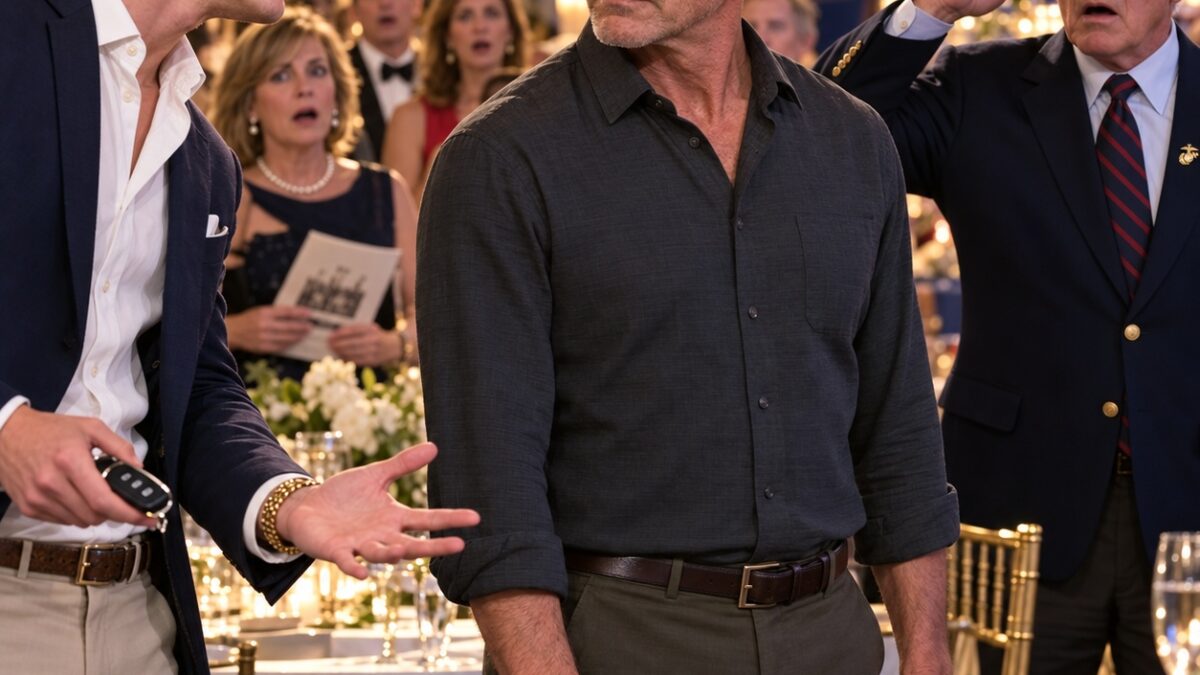
FULL STORY CONTINUATION
“Mason.”
He heard the warning in my voice.
Too late.
The room had already gone silent.
Bryce looked from him to me.
“What is Team Seven?”
Mason’s eyes remained fixed on me.
I hadn’t seen him in years.
Not directly.
I knew his name.
Knew his service history.
We had crossed paths briefly on joint operations.
He had the kind of memory older military officers develop when the people they knew are connected to stories that almost ended badly.
“You led that SEAL team,” he said.
I looked toward the exit.
For a second, leaving seemed appealing.
Then I saw Milo standing near the back wall with his mother.
He was watching.
So was Bryce.
So was half the neighborhood.
Running would turn this into something worse.
“Long time ago,” I said.
Mason shook his head.
“Not that long.”
“Long enough.”
Bryce folded his arms.
“Wait.”
His tone had changed.
Not mocking now.
Uncertain.
“You were actually a SEAL?”
“I was in the Navy.”
Mason almost laughed.
“That’s one way to say it.”
I looked at him.
“Mason.”
He finally registered that I did not want the story told.
His expression softened.
But then Bryce said:
“So what? Lots of people serve.”
True.
And I liked that answer better than I expected.
I nodded.
“Exactly.”
Mason looked at Bryce.
Something about the kid’s tone irritated him.
“Not like this.”
I knew then I was not stopping him.
Some stories belong partly to the people who survived them with you.
Mason wasn’t there that particular night.
But Marines talk.
Sailors talk.
Certain operations become institutional memory even when the details never make public stories.
He said:
“His unit had an extraction go bad overseas.”
I stared at the floor.
Ranger wasn’t there.
I suddenly wished he were.
Dogs make awkward rooms easier.
Mason continued.
“The team had wounded personnel and a collapsing route.”
Bryce’s face changed.
I said:
“That’s enough.”
Mason ignored me.
Probably revenge for every time a Navy man had ignored a Marine.
“He stayed behind until six men were out.”
“That is not what happened.”
Mason looked at me.
“That’s the version I heard.”
“Then you heard it wrong.”
The room waited.
I hated that.
People love a hero story because it turns chaos into one clean person doing one clean thing.
Reality is never clean.
“There were more than six people involved,” I said. “And nobody did anything alone.”
Mason nodded slowly.
“Fine.”
Then, because apparently he could not help himself:
“But you were the officer who refused the final extraction until everyone was accounted for.”
I looked at him.
“That part?”
He smiled faintly.
“Multiple sources.”
Bryce swallowed.
Grant Calloway had entered the community center at some point during the conversation.
I noticed him near the doors.
He looked at me.
Then at his son.
His expression said:
I warned you.
Bryce seemed to realize it too.
He spoke more quietly.
“You led a SEAL team?”
“Yes.”
The word came out flat.
No drama.
No pride.
Just fact.
His eyes dropped toward my hands.
Maybe remembering the shove outside the hardware store.
Then the recreation court.
All those moments when I could have responded differently.
“You could’ve—”
He stopped.
I knew what he meant.
“Could’ve what?”
He looked embarrassed.
“When I shoved you.”
“Yes.”
“You could’ve hurt me.”
“Yes.”
Grant closed his eyes.
Bryce looked around the room.
The worst thing for him was not learning I had once been dangerous.
It was knowing everyone else had learned he had been trying to provoke someone who kept choosing not to react.
Humiliation built from your own behavior is difficult to escape.
“So why didn’t you say anything?”
I picked up the folding chair.
“About what?”
“Who you were.”
“Why would I?”
His face tightened.
“You let me—”
“Let you what?”
He stopped again.
I set the chair down properly.
“You decided how to treat me before you knew anything about me.”
That sentence landed.
“So did you treat Milo.”
Milo looked down.
Bryce glanced at him.
I continued:
“If knowing my résumé changes whether you think your behavior was wrong, then you have learned nothing.”
The room stayed very quiet.
Grant walked toward us.
He didn’t look angry.
He looked tired.
That expression suited fathers of twenty-year-old sons better than fury.
“Bryce.”
His son looked at him.
“Apologize.”
Bryce’s jaw tightened.
There it was.
Old reflex.
Pride.
Audience.
He looked at me.
Then at Milo.
Then back at me.
“I’m sorry.”
Grant said nothing.
I said nothing.
Bryce took a breath.
Then something changed.
Maybe he realized a forced apology would be another performance.
He said:
“Not because you were a SEAL.”
That got my attention.
He continued.
“I was wrong before I knew that.”
I studied him.
For the first time since I had known Bryce Calloway, he wasn’t trying to win.
That mattered.
“Then maybe you finally learned something.”
He nodded.
No applause.
Thank God.
I hate applause in real life.
It turns private corrections into theater.
The charity event continued.
Mason cornered me twenty minutes later.
“You’re angry.”
“Yes.”
“Sorry.”
“No, you’re not.”
He smiled.
“Not entirely.”
We stepped outside.
Evening light over Hawthorne Ridge.
Children running somewhere near the court.
“You really kept all that quiet?”
“Yes.”
“Why?”
“Because I retired.”
“That doesn’t erase what you did.”
“I didn’t want it erased.”
“What then?”
I looked down the street toward my house.
Small flag beside the porch.
Ranger probably asleep near the screen door.
“I wanted it finished.”
Mason understood.
Military people know the difference.
Some men leave service and need to keep telling the story because the story is still where their identity lives.
Others put the uniform away because carrying it into every new room becomes another form of never coming home.
I wanted home.
Mason said:
“He deserved to know.”
“No.”
“Bryce?”
“No.”
I looked at him.
“He deserved to know not to shove people. He didn’t need my service record for that.”
Mason nodded.
“Fair.”
“Next time, keep your mouth shut.”
“Marines don’t do that.”
“I know.”
He laughed.
Inside, Grant was speaking privately to Bryce.
I did not listen.
Did not need to.
I went home.
Ranger met me at the porch like I had returned from war instead of a community center.
Tail.
Slow bark.
Then immediately toward the kitchen because loyalty apparently had a food component.
I sat on the porch.
Ranger lowered himself beside my chair.
My hands still remembered the hardware-store shove.
That surprised me.
Not the aggression.
The restraint.
People think old training fades.
Some of it does.
Speed.
Strength.
Endurance.
Other parts become deeper.
Reading movement.
Distance.
Tone.
The moment before violence.
Bryce had been safe with me mostly because I had spent years learning exactly what violence costs.
A younger Everett might have embarrassed him.
Not badly.
Enough.
A wrist lock.
A sweep.
Something controlled.
Something to teach him a lesson.
Age teaches you that humiliating someone is rarely teaching.
Usually it only creates a person who wants repayment.
The next morning, Grant came to my house.
Alone.
No luxury car.
Pickup from one of his dealerships.
Maybe intentional.
Maybe not.
Ranger watched him from the porch.
Grant stopped at the bottom step.
“Everett.”
“Grant.”
“Got a minute?”
I gestured toward the other chair.
He sat.
For several seconds he said nothing.
Then:
“I owe you an apology too.”
“For?”
“My son.”
“That’s his job.”
“I raised him.”
There was weight in that.
I waited.
Grant stared toward the street.
“When his mother died, I worked.”
I looked at him.
I had not known.
“Bryce was nine.”
Grant rubbed his hands together.
“I thought providing everything was enough.”
Money.
Cars.
Schools.
Vacations.
Whatever Bryce asked for.
Grant continued:
“If he got into trouble, I fixed it.”
“That’s usually a problem.”
“I know.”
He smiled without humor.
“Now.”
He told me about traffic tickets paid quietly.
School complaints smoothed over.
A fight in high school settled through lawyers.
Damage to a club property reimbursed before consequences reached Bryce.
“I thought I was protecting him.”
“You were.”
Grant looked at me.
“From everything that might have taught him something.”
Exactly.
“I told him to leave you alone.”
“I heard.”
“He thought I was afraid of you.”
“Were you?”
Grant laughed.
“A little.”
I almost smiled.
He continued:
“I knew your name.”
That surprised me.
“How?”
“Dealership customer years ago. Retired naval officer mentioned you.”
“Specific?”
“No.”
Grant shook his head.
“Just said you were someone not to annoy.”
“That is an unfortunate description.”
“Apparently accurate.”
We sat quietly.
He finally said:
“I’m going to stop fixing things for him.”
“That’s between you.”
“I know.”
“Harder than it sounds.”
Grant nodded.
“You have children?”
“No.”
Then I remembered how that sounded.
“Never did.”
Grant looked toward Ranger.
“Sometimes I envy you.”
“No.”
He looked at me.
“Don’t.”
Parenthood was not a burden to dismiss.
I knew that even without being a father.
But I understood what he meant.
Love creates complicated cowardice.
Sometimes you protect someone because watching them suffer consequences feels unbearable.
Then the protection becomes damage.
“Bryce needs to apologize to Milo.”
“He will.”
“Not because you tell him.”
Grant thought about that.
“Understood.”
He left.
For the next week, Bryce disappeared.
No revving.
No trash.
No court drama.
Hawthorne Ridge became strangely quiet.
Then, Saturday morning, I was trimming rosemary when I heard voices from the recreation court.
I walked toward the fence.
Bryce.
Milo.
Two other kids.
Bryce held a bag of basketballs.
The old hoop’s net was half torn.
One of the backboard supports needed repainting.
He had tools.
Milo looked suspicious.
Smart kid.
Bryce said something I couldn’t hear.
Milo responded.
Then Bryce handed him a new ball.
Milo accepted.
That was all.
Later, Milo came by my house.
“Mr. Hale?”
“Yes?”
“Bryce apologized.”
“Good.”
“He said he was stupid.”
“Also good.”
Milo smiled.
“He’s helping fix the court.”
“I saw.”
“Did you make him?”
“No.”
“His dad?”
“Don’t know.”
Milo bounced the ball once.
Then:
“Were you really a Navy SEAL?”
There it was.
Children are more direct than adults.
“Yes.”
“Did you shoot people?”
Straight to it.
“Sometimes military service involves things I don’t talk about.”
He nodded.
“Bryce says you could’ve beat him up.”
“Bryce says many things.”
“Could you?”
I looked at him.
“Probably when I was younger.”
Milo looked disappointed.
“Not now?”
“I am sixty-one.”
He laughed.
Then grew serious.
“Why didn’t you?”
“Because I didn’t need to.”
He nodded.
That answer seemed enough.
For children, sometimes simple answers remain simple.
Adults ruin them later.
Bryce began volunteering at the community center.
At first, everyone assumed Grant forced him.
Maybe he did initially.
But Bryce kept showing up after the attention faded.
That mattered more.
He repaired equipment.
Helped clean after events.
Worked with a youth basketball program.
The first month, he posted pictures online.
Of course.
Second month, fewer.
By the third, none.
One afternoon I saw him sweeping the gym floor after everyone left.
No audience.
That impressed me more than any apology.
We rarely spoke.
I wanted that too.
Change does not require mentorship.
People love stories where the older wise man adopts the young fool as a project.
I had no interest in being Bryce’s project manager.
Then one afternoon he knocked on my door.
Ranger barked once.
Then decided Bryce was not worth the effort.
I opened the door.
“What?”
Bryce shifted.
“Can I ask you something?”
“You already did.”
He almost smiled.
“Okay.”
I waited.
“How do you stay calm?”
That wasn’t the question I expected.
“When?”
“When somebody is trying to make you angry.”
I leaned against the doorframe.
“You don’t.”
He frowned.
“You don’t?”
“You feel angry.”
“Then how—”
“You decide what to do with it.”
He looked down.
“That sounds simple.”
“Most difficult things do when explained badly.”
That got a small laugh.
He looked toward the street.
“Milo still doesn’t trust me.”
“Why should he?”
Bryce looked back.
“I apologized.”
“Yes.”
“So what else am I supposed to do?”
“Stop expecting the apology to purchase immediate forgiveness.”
His face tightened.
Not angrily.
He was thinking.
“Then how do I fix it?”
“Maybe you don’t.”
He looked frustrated.
“You change anyway.”
“Even if he never likes me?”
“Yes.”
“What’s the point?”
There it was.
The old Bryce.
Transactions.
Do something, receive something.
I opened the screen door and stepped onto the porch.
“Who are you trying to become?”
He stared.
“I don’t know.”
“Figure that out.”
“What does that have to do with Milo?”
“Everything.”
I looked toward the recreation court.
“Winning isn’t making everyone forgive you.”
Bryce waited.
“You win by deciding what kind of man you want to be after you’ve done something you’re ashamed of.”
He stayed quiet.
Then nodded.
Ranger lifted his head.
Bryce looked at him.
“Does he like anybody?”
“Food.”
“That makes sense.”
He left.
Weeks passed.
Then months.
Bryce sold the sports car.
That became neighborhood gossip.
I asked Grant later whether he made him.
“No.”
“Why’d he sell?”
“Insurance.”
Practical consequences.
Beautiful.
Grant had stopped paying several of Bryce’s discretionary expenses.
Not because he wanted to punish him forever.
Because at twenty, responsibility needed friction.
Bryce got a job at one of the dealerships.
Not management.
Service intake.
Customers.
Phones.
Complaints.
People who did not care whose son he was.
Grant said:
“He hates it.”
“Good.”
Grant laughed.
At first, Bryce was terrible.
Apparently.
Then better.
One evening I saw him driving home in a used truck.
Slowly.
Speed limit.
Progress sometimes looks boring.
That year, Mason Rourke and I became friends.
Against my better judgment.
He lived six houses away.
Widower.
Marine colonel.
Terrible cook.
Good bourbon.
He had more war stories than sense.
One night on my porch, he asked:
“Do you miss command?”
“No.”
“Liar.”
“Parts.”
“Which?”
I thought.
“Clarity.”
“Meaning?”
“Problems were often immediate.”
“Not simple.”
“No.”
I looked at the quiet street.
“But immediate.”
Civilian problems stretch.
Family.
Grief.
Ego.
Forgiveness.
No extraction time.
No after-action report that makes them finished.
Mason nodded.
“Why Team Seven?”
“What?”
“Why’d you stop talking about it?”
I stared at him.
“I didn’t.”
“You know what I mean.”
I did.
I had left active duty after an accumulation rather than one event.
Injury.
Age.
Years of operations.
One extraction in particular.
The one Mason had mentioned.
Bad intelligence.
Route compromised.
Six men wounded to varying degrees.
Two partner-force personnel.
Chaos.
We got everyone out.
People later condensed that into:
Hale stayed behind.
Technically true.
Emotionally misleading.
There were people covering me.
Pilots waiting.
Medics working.
Men who refused to leave each other.
No one-man heroism.
That night gave me nightmares for years.
Hero stories erase nightmares.
I disliked that.
“People want service to mean something clean,” I told Mason.
“And it doesn’t?”
“It means plenty.”
I looked toward my flag.
“Just not cleanly.”
He understood.
Marine.
Of course.
Bryce’s curiosity about my past faded.
That impressed me too.
He stopped asking.
One day, almost a year after the charity event, we ended up near each other at the recreation court.
Milo and friends were playing.
Bryce sat on a bench.
I sat farther down because Ranger needed rest.
Bryce said:
“I thought knowing you were a SEAL would make everything make sense.”
I looked at him.
“Did it?”
“No.”
“Good.”
He laughed.
“I mean your calmness.”
“Training helped.”
“But you said you used to be different.”
I had apparently told him too much.
“Everyone used to be different.”
He nodded.
Then:
“My dad said he messed me up.”
“Parents enjoy taking too much credit.”
Bryce looked at me.
“He did, though.”
“Maybe.”
“He fixed everything.”
“That probably didn’t help.”
“I thought consequences were things that happened to people without money.”
Honest.
Ugly.
Useful.
“What changed?”
Bryce looked toward Milo.
“I hurt people who couldn’t do anything back.”
“You didn’t seriously hurt Milo.”
“He was scared.”
Yes.
“That’s enough.”
He nodded.
Then:
“When I shoved you, I thought you were scared too.”
I almost smiled.
“I was irritated.”
“I know that now.”
“No.”
I looked at him.
“You know the résumé now.”
He frowned.
“What’s the difference?”
“You still don’t know what I felt.”
He thought.
I continued:
“Maybe I was scared.”
“Were you?”
“Not of you.”
He smiled slightly.
“But fear isn’t shameful.”
That confused him.
“You were a SEAL.”
“So?”
He looked almost offended by the question.
“Weren’t you trained not to be scared?”
“No.”
“Seriously?”
“We were trained to function.”
Important distinction.
“Fear is useful.”
“How?”
“It tells you something matters.”
I looked at Milo again.
“The problem is when fear, anger, pride—anything—gets to choose for you.”
Bryce nodded slowly.
That became the kind of conversation we had.
Rare.
Never scheduled.
No mentorship montage.
Just fragments.
He learned.
I learned too.
Quietly.
I realized how easy it had become for me to dismiss Bryce as spoiled.
That label was accurate but incomplete.
At twenty, people are often unfinished in loud ways.
I had been unfinished at twenty too.
Different mistakes.
More consequences.
Less money.
But arrogance?
Plenty.
I remembered one instructor early in my Navy career.
Chief Dan Mercer.
Hard man.
Quiet.
I once ignored advice because I wanted to prove I could handle something alone.
Nothing catastrophic happened.
Chief Mercer pulled me aside.
“You want to be impressive or useful?”
I said:
“Useful.”
He replied:
“Then stop performing.”
Forty years later, I was apparently still passing along versions of that sentence.
Life recycles good lessons.
Grant changed too.
Subtly.
He attended more neighborhood events.
Less business talk.
One afternoon he helped paint the recreation court fence.
Badly.
Bryce corrected him.
I watched.
Mason whispered:
“We should film this.”
“No.”
“Historic.”
“No.”
Grant looked toward us.
“What?”
“Nothing.”
He knew we were lying.
Ranger aged.
His hips worsened.
Walks became shorter.
Bryce started stopping by sometimes with treats.
I told him not to.
He ignored me.
Ranger loved him for it.
Traitor.
One winter morning, Ranger couldn’t stand.
I knew before the veterinarian confirmed it.
There are decisions love makes cruel.
Ranger was thirteen.
Pain had become larger than pleasure.
I stayed with him.
Hand on his head.
Talked until the breathing stopped.
The house afterward was unbearable.
For the first time in years, silence felt hostile.
Mason came over.
No speech.
Whiskey.
Sat.
Bryce showed up the next day.
I had no idea how he knew.
Probably neighborhood information network.
He stood on the porch holding a small wooden box.
“I made something.”
“What?”
He opened it.
Ranger’s name burned into the lid.
Inside, a framed photograph.
Ranger lying near the recreation court.
I had never seen the picture.
Bryce said:
“Milo took it last summer.”
I couldn’t speak for a moment.
“Thank you.”
He nodded.
Started to leave.
“Bryce.”
He turned.
“That was kind.”
He looked uncomfortable.
“Yeah.”
Then left quickly.
That was when I realized he had changed more than I thought.
Not because of me.
Because he had practiced.
Change is repetition.
Like training.
One correct decision does not become character.
Repeated decisions do.
By twenty-three, Bryce managed the service department at one dealership.
Earned it, Grant insisted.
I believed him because Grant had become strangely committed to making sure everybody knew Bryce wasn’t handed things anymore.
Sometimes parents overcorrect too.
Milo got taller.
Eventually older than the version of Bryce who had first bullied him.
Life does that.
At sixteen, Milo worked summers at the community center.
He and Bryce became friendly.
Not close.
But the fear disappeared.
That mattered.
One afternoon, I watched them arguing over a basketball score.
Normal.
I remembered Milo clutching the ball while Bryce towered over him.
Healing can look disappointingly ordinary too.
Good.
The older I got, the more I appreciated ordinary.
Mason kept telling people my past despite explicit threats.
Mostly harmlessly.
One Memorial Day, the neighborhood asked me to speak.
I refused.
Mason volunteered me anyway.
I threatened to poison his bourbon.
He laughed.
I eventually stood in front of maybe sixty neighbors near the flagpole.
Bryce there.
Grant.
Milo.
Families.
I could have told them about combat.
Didn’t.
I spoke about people who didn’t come home.
Not tactics.
Not heroism.
Names.
Enough.
Afterward Bryce approached.
“You hate this stuff.”
“Yes.”
“Why do it?”
“Because some stories aren’t mine to hide.”
He thought.
“That’s different from the charity event?”
“Yes.”
“How?”
That was a good question.
“The event would’ve made my past about me.”
“And Memorial Day?”
“Isn’t.”
He nodded.
For all his former arrogance, Bryce became good at listening.
That may have been the biggest change.
Years earlier, silence made him nervous.
He filled rooms.
Now he could stand in one without needing ownership.
Grant once said:
“You did something I couldn’t.”
“No.”
“You got through to him.”
“He got through to himself.”
Grant looked skeptical.
I meant it.
People credit the person who delivers a lesson.
But no lesson works unless someone eventually chooses to hear it.
Bryce could have turned resentment into identity.
Instead, he let embarrassment become information.
That is harder than people think.
Especially when money gives you alternatives.
Grant’s wealth could still have insulated him.
Bryce stopped asking it to.
By twenty-five, he was running community fundraising through the dealership group.
Not glamorous.
Food drives.
Youth sports.
Scholarships for trade programs.
Mason said:
“You turned him into a Boy Scout.”
“I did nothing.”
“You always say that.”
“Because it’s true.”
“Annoying.”
Also true.
One spring afternoon, Bryce came to my house in a suit.
I almost closed the door.
“What happened?”
“Interview.”
“For?”
“General manager position.”
I raised an eyebrow.
“Dad’s dealership?”
“Another company.”
That interested me.
“Why?”
He shrugged.
“I want to know if I can do it without the last name.”
That was significant.
“You nervous?”
“Yes.”
“Good.”
He laughed.
“You say that about everything.”
“Fear means it matters.”
“Right.”
He paused.
“Any advice?”
I thought about saying something profound.
Instead:
“Don’t lie.”
He stared.
“That’s it?”
“Works remarkably often.”
He got the job.
Grant pretended not to be proud.
Failed.
Months later, Bryce moved across town.
Hawthorne Ridge became quieter.
I missed him more than expected.
That annoyed me.
Mason noticed.
“You miss your student.”
“He was not my student.”
“Sure.”
“You’re unbearable.”
“Marine.”
“Not an excuse.”
“Always an excuse.”
Bryce returned for neighborhood events.
Still drove nice cars.
Just slower.
One afternoon he arrived in something absurdly expensive.
Milo, now in college, yelled:
“Compensating for something?”
Bryce shouted back:
“Yes. Bad childhood.”
Grant nearly choked.
I laughed until my side hurt.
That was family, in its strange way.
Not mine exactly.
But near enough.
I never married.
People asked.
After service, I dated some.
Nothing lasted.
Eventually I stopped treating partnership as a requirement.
Ranger had been enough companionship for years.
Then the neighborhood itself changed.
Mason.
Grant.
Milo.
Even Bryce.
Sometimes home arrives accidentally.
You think you are choosing solitude.
Then people keep knocking.
The house with the gray siding became a place where neighbors borrowed tools.
Children retrieved basketballs.
Grant occasionally hid from dealership calls.
Mason stole bourbon.
Bryce asked impossible moral questions.
I liked it.
Would never admit it.
Age softens defenses more than people realize.
Not all of them.
Some should remain.
I still did not talk much about the Team.
Not publicly.
Bryce eventually stopped viewing that silence as mystery.
One night, years after the charity event, we sat on my porch.
He was twenty-eight.
I was nearly seventy.
He asked:
“Do you regret leaving?”
“No.”
“Do you miss leading people?”
I looked toward the street.
“Sometimes.”
“What part?”
“When everyone understood the mission.”
He smiled.
“Civilian life doesn’t have that?”
“Rarely.”
He thought.
“What was yours after?”
I looked around.
Porch.
Empty Ranger bed still in the corner because I never moved it.
Lights in neighboring homes.
Mason’s truck.
Basketball hoop.
“Learn to live here.”
Bryce nodded.
“Hard?”
“Harder than expected.”
He did not ask more.
That was maturity.
Years earlier, he would have demanded the whole story.
Now he knew a boundary could simply exist.
Grant passed away when Bryce was thirty.
Heart attack.
Sudden.
Bryce called me from the hospital.
Voice breaking.
For a moment, he sounded twenty again.
“I don’t know what to do.”
“Yes, you do.”
“No.”
“You call people.”
“I did.”
“You breathe.”
Silence.
“And you don’t decide everything tonight.”
He cried.
No shame in it.
I drove there.
Sat.
When Bryce saw me, he hugged me.
First time.
I let him.
At the funeral, Bryce gave the eulogy.
He didn’t pretend Grant had been perfect.
Said his father spent years confusing provision with presence.
Then learned.
That line stayed with me.
Afterward Bryce said:
“I was talking about both of us.”
I knew.
People can change late.
Late still counts.
A year after Grant’s death, Bryce asked if he could buy my house.
I laughed.
“No.”
“Worth trying.”
“Why?”
“Sentimental.”
“That’s unhealthy.”
He smiled.
“I know.”
He bought another house nearby instead.
Not Hawthorne Ridge.
Close.
His wife eventually had a son.
That was how I became “Uncle Everett,” a title I objected to without success.
The child, Grant Junior, grew up believing I was simply an old man who kept a garden and told boring stories.
Perfect.
One day when he was six, he found an old photograph Bryce had.
Military.
He pointed.
“Is that you?”
“Yes.”
“Why are you wearing funny clothes?”
“Fashion mistake.”
Bryce laughed from the kitchen.
The boy accepted it.
Children are merciful.
Later, Bryce said:
“You really don’t want anybody impressed.”
“No.”
“Why?”
“Impressing people becomes expensive.”
“How?”
“They start expecting you to keep being impressive.”
He laughed.
Then looked serious.
“Was that what happened to you?”
Sometimes Bryce asked better questions than I wanted.
“Partly.”
We left it there.
The story of our confrontation became neighborhood legend.
Badly distorted.
Versions included:
Bryce tried to fight an entire SEAL team.
False.
I disarmed him.
False.
Colonel Rourke saluted me.
False.
I threatened him using classified language.
Absolutely false.
The truth was almost disappointing.
A spoiled young man acted like a bully.
An older neighbor told him to stop.
Another old veteran talked too much.
The young man eventually listened.
That’s it.
But perhaps that’s why the story mattered.
No spectacular punishment.
No revenge.
No secret billionaire.
No violence.
Just consequences.
Recognition.
Choice.
Years after it happened, Bryce and I stood at the recreation court watching his son play with other kids.
Same court where Milo had been shoved.
The pavement had been resurfaced.
New hoop.
Fresh lines.
Bryce said:
“I hate coming here sometimes.”
“Why?”
“I remember.”
“Good.”
He looked at me.
“Good?”
“Memory prevents repetition.”
He watched the children.
“I was awful.”
“Yes.”
He laughed.
“You could soften that.”
“Why?”
“No reason.”
Then:
“Do you think people really change?”
I looked at him.
“Are you asking for reassurance?”
“Maybe.”
“No.”
He frowned.
I continued:
“People make different decisions.”
He waited.
“Enough different decisions become change.”
Bryce nodded.
“That sounds like training.”
“Most useful things do.”
His son missed a shot.
Bryce cheered anyway.
I remembered twenty-year-old Bryce driving onto the court because children annoyed him.
Different decisions.
Enough of them.
Change.
Mason Rourke died at eighty-two.
Cancer.
He remained irritating until the end.
At his memorial, I spoke.
Again against my will.
I told people he was brave.
Loyal.
Nosy.
Incapable of respecting operational security even in retirement.
Everyone laughed.
Bryce stood beside me afterward.
“He’s the reason I learned who you were.”
“Yes.”
“Do you wish he hadn’t said anything?”
I thought.
“For a long time.”
“And now?”
I looked toward Mason’s family.
“Now I think maybe the timing wasn’t entirely useless.”
Bryce smiled.
“That is practically gratitude.”
“Do not tell anyone.”
We left.
By then, most of Hawthorne Ridge’s original families had changed.
Some moved.
Children grew.
New people came in.
Nobody knew the old stories unless someone told them.
I liked that.
A neighborhood should not stay frozen around one dramatic afternoon.
Neither should people.
That became my final lesson from Bryce.
I had seen him as a bully because he was one.
Then I had to allow him to become something else without constantly dragging his worst moment behind him.
That is harder than forgiveness.
Forgiveness can happen privately.
Change asks you to update your judgment.
Humans are bad at that.
We like permanent categories.
Good man.
Bad man.
Hero.
Coward.
Spoiled kid.
SEAL commander.
Both of us had been trapped by categories.
Bryce thought I was weak because I was old and quiet.
Neighbors thought I became important once they learned I had led a team.
Both were wrong.
My worth did not increase when Mason said “Commander.”
Bryce’s humanity did not disappear when he behaved badly.
People are larger than moments.
But moments reveal choices.
The charity event revealed one of Bryce’s worst.
His apology revealed the beginning of something better.
I remember that apology more clearly now than the shove.
Not because it erased anything.
Because of one sentence.
Not because you’re a SEAL.
I was wrong before I knew that.
That told me he understood the only lesson that mattered.
Respect should not depend on discovering that the person in front of you has a powerful past.
Milo deserved respect.
The delivery drivers deserved it.
The kids on the court.
The elderly woman carrying the chair.
The quiet neighbor.
Everybody.
Titles are irrelevant to basic decency.
I spent part of my younger life in an organization where titles mattered operationally.
Rank.
Chain of command.
Responsibility.
Then retirement taught me something else.
Outside the mission, character matters more.
Bryce had money.
I had training.
Mason had rank.
Grant had influence.
None of that answered the basic question:
What do you do with power when nobody can easily stop you?
Young Bryce used it to make people smaller.
Older Bryce learned to use it differently.
Grant used money to erase consequences.
Later, he used it to build opportunities.
I once used skill as identity.
Later, I learned not using it could be the stronger choice.
Power does not reveal itself when challenged by equal power.
It reveals itself when facing someone weaker.
That’s what I saw at the basketball court.
A twenty-year-old with money towering over a twelve-year-old.
No risk to Bryce.
That was precisely why the moment mattered.
I intervened because Milo couldn’t.
Years later, when Bryce became a manager, I asked him once:
“Want to know if you’ve changed?”
He looked suspicious.
“Sure.”
“Watch how you treat someone who cannot help you.”
He thought about that a long time.
Months later, he texted:
I hate your advice.
Good sign.
Today, I am older.
My hands ache.
The garden is smaller.
I have another dog.
A rescue Labrador mix named June.
Bryce picked her out.
Against my instructions.
She has no respect for personal space.
Ranger would be ashamed.
The flag still hangs beside the porch.
The house is still gray.
Kids still play basketball.
Cars still drive too fast occasionally.
Life remains annoyingly alive.
Sometimes Bryce brings his family over.
His son runs through my garden.
His wife apologizes.
I tell her Bryce was worse.
He agrees.
Growth includes self-awareness.
One afternoon, Bryce stood in my driveway while his son chased June.
He looked toward the old recreation court.
“Remember what you told me?”
“You’ll need to narrow that down.”
“About fights.”
“I have said many brilliant things.”
He rolled his eyes.
“You said you don’t win every fight by fighting.”
“That sounds like me.”
“I asked how you win.”
“Yes.”
He looked at his son.
“And you said you decide what kind of man you want to be when it’s over.”
I remembered.
Barely.
“What about it?”
“I think I finally get it.”
I smiled.
“Took you long enough.”
He laughed.
Then grew serious.
“Thank you.”
I hated sincere moments.
They demand a response.
So I looked at June.
“She needs walking.”
Bryce smiled.
“That’s what I thought.”
He understood.
Some relationships reach the point where words become optional.
That was where we ended up.
Not father and son.
Not mentor and student.
Neighbors who survived one another long enough to become family-adjacent.
Strange.
Life does that.
People sometimes ask whether I would change anything about the day Mason revealed my past.
Yes.
I would stop him earlier.
No.
Maybe not.
Because Bryce needed the humiliation less than he needed the contrast.
He had spent weeks believing quietness meant weakness.
Then he learned quietness can come from control.
But if that were the only lesson, it would still be incomplete.
The deeper lesson came afterward.
He apologized before using my past as an excuse.
That made all the difference.
If he had said:
I’m sorry because I didn’t know you were dangerous,
I would have learned nothing about him.
Instead:
I was wrong before I knew.
That was the first adult sentence I ever heard him speak.
Everything after grew from there.
When I think about my old SEAL team now, I remember less of the violence than people expect.
I remember faces.
Jokes.
Bad coffee.
Men asleep wherever they could.
Waiting.
Arguments.
Relief when everyone was accounted for.
The public remembers extraordinary moments.
The people involved remember ordinary details.
That is why I never needed Hawthorne Ridge to know.
I had already lived it.
Recognition adds nothing.
The quiet house had become enough.
The garden.
Dog.
Neighbors.
Eventually Bryce.
That was home.
There is an irony in Bryce once telling me to get out of his driveway.
He wasn’t even in his own driveway.
He was blocking mine.
Twenty-year-olds are gifted that way.
But the line stayed with me.
Get out of my driveway, old man.
Years later, when he came to visit with his son, I reminded him.
He covered his face.
“Please stop.”
“You said it.”
“I know.”
“Very confidently.”
“I was twenty.”
“Tragic age.”
His son asked:
“What did Dad do?”
Bryce immediately said:
“Nothing.”
I smiled.
His son looked at me.
“Uncle Everett?”
I considered.
Then Bryce pointed at me.
“If you tell him, I am putting you in a nursing home.”
I looked at the boy.
“Your father was a delightful young man.”
Bryce groaned.
That was revenge.
The only kind worth having.
Laughter.
Time.
A person becoming better than the story you could have used against him.
I never hurt Bryce.
Didn’t need to.
Life did something more useful.
It made him live long enough to understand himself.
That’s harder.
Physical pain fades quickly.
Shame can become poison.
Or instruction.
He chose instruction.
I respect him for that.
If there is anything my years taught me, military and otherwise, it is that strength has almost nothing to do with who can hurt whom.
Plenty of weak men can hurt people.
Give them money.
Rank.
Weapons.
Influence.
An audience.
Cruelty requires surprisingly little strength.
Restraint requires more.
Admitting you’re wrong requires more.
Returning to apologize to a twelve-year-old requires more.
Changing when nobody is applauding requires more.
Bryce learned that.
So did I.
At sixty-one, I thought I had finished learning what strength meant.
Apparently not.
I had spent years teaching men to control fear, movement, violence, chaos.
A spoiled twenty-year-old reminded me that another form of discipline exists.
Allowing people room to become better without demanding they remain the worst thing they did to you.
That took practice.
Still does.
Sometimes the strongest person on the block is the man with the dangerous past who chooses not to prove it.
Sometimes it is the kid who finally realizes money cannot purchase character.
Sometimes it is a twelve-year-old who accepts an apology without pretending the fear never happened.
Sometimes it is a father who stops solving every problem for his son.
Strength moves around.
No one owns it.
If you had told me on that first Saturday, while Bryce stood beside the basketball court mocking Milo, that years later I would care about the man he became, I would have doubted you.
If you’d told Bryce that he would someday come to my porch asking how not to become the person anger wanted him to be, he would have laughed.
Life has a sense of humor.
The neighborhood used to think I was mysterious.
There was nothing mysterious.
I was simply a tired old sailor who wanted peace.
The part people mistook for weakness was the very thing the Navy had spent years teaching me.
Wait.
Observe.
Do not react just because someone wants a reaction.
Use only what is necessary.
Know the objective.
Get people home.
That Saturday, the objective was not defeating Bryce.
It was Milo going home with his basketball.
At the hardware store, the objective was leaving without turning a stupid shove into a police report.
At the charity event, the objective was not preserving my secret.
It was giving a young man one chance to recognize what he had become.
He did.
Eventually.
That was enough.
I still keep Mason’s old challenge coin in a drawer.
Ranger’s wooden box sits on a shelf.
The gray house creaks in winter.
June steals my socks.
Bryce complains that I don’t answer texts.
Milo sends Christmas cards.
Hawthorne Ridge is still too expensive for what the houses are worth.
Some things never change.
Others do.
And every now and then, when Bryce pulls into my driveway now, he parks carefully along the side so he never blocks the path.
I noticed the first time.
Never mentioned it.
Didn’t need to.
He knew.
So did I.
That small habit tells the whole story better than the dramatic reveal ever could.
Not Commander Hale.
Not Team Seven.
Not six men brought home.
Not the shove.
Not the apology.
A grown man remembering to leave another person’s driveway clear because once, long ago, he had believed everyone else’s space belonged to him.
That is change.
Quiet.
Ordinary.
Real.
And if there is one thing Bryce finally learned from the old man he once tried so hard to humiliate, it is the same thing I spent a lifetime learning in much harder places:
You do not prove strength by making someone else afraid.
You prove it by having every opportunity to become cruel—
and deciding you would rather go home as a better man.








